Tag: crm

  • CRM Dead? Sherlock Holmes- AI the Perp?

    CRM Dead? Sherlock Holmes- AI the Perp?

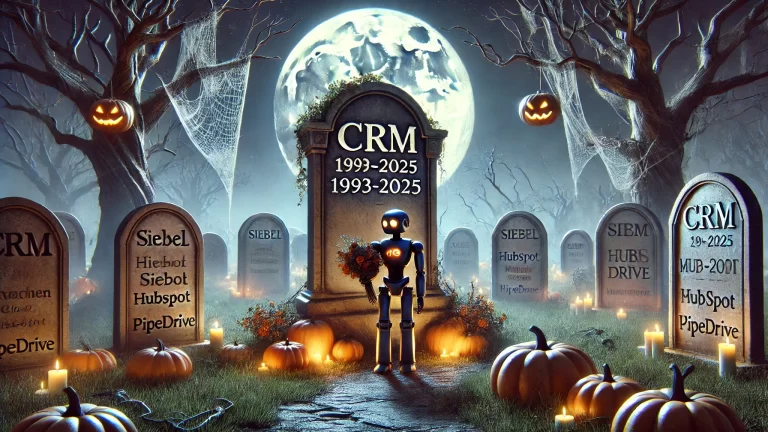
    Will AI be the Perpetrator of CRMs demise?

    On a weekly basis I get C-Suite execs calling me after AI events like Dreamforce and any of the myriad AI “you name it conferences” asking me if they can replace their salespeople with AI agents right now, or…use AI to replace their pesky CRMs…Or both! Yikes – the Kool-Aid is flowing in AI land!

    I ask them to tell me about the last AI conference they attended, review the event marketing puffery and often outlandish claims of what AI can do “just by buying our XYZ AI Tool and sales will Soar,” and let out an inaudible sigh.

    These conferences are designed to get attendees to drink the Alice in Wonderland vision of an utopian AI and just like every other tech hype cycle before it (yep AI isn’t the first “revolutionary technology”) there is a kernel of truth in what AI “maybe able to do.”  That being said. I see a lot of could do vs. can do/doing right now in the AI adoption cycle.    

    So, let’s get it out of the way. AI is unlikely to fully replace CRM systems in the next few years. But top enterprise grade AI enabled CRMs are already doing far more than traditional CRMs ever could. Most significantly. The most advanced AI enabled CRMS are already enhancing and transforming enterprise CRM capabilities. This will accelerate as cutting-edge AI technologists and tech savvy AI enabled salespeople work together to enhance what AI does well and keep what was working. (See Blended AI).

    With that in mind, let’s look at what the research and our own inhouse AI fortune tellers have forecasted for AI CRM Advancements:

    AI Evolution Timeline for CRM Systems

    2024-2025: Enhanced AI Features

    In the next 12 months, we’ll see more widespread adoption of AI-powered features within existing CRM platforms:

    – Advanced predictive analytics for sales forecasting and lead scoring

    – Natural language processing for improved chatbots and virtual assistants

    – AI Agents deployed

    – Automated data entry and cleansing

    -Conversational sentiment analysis post call – heading to real-time

    -Training recommendations based on AI evaluation of seller daily actions

    -Email comprehension, writing, reply and auto CRM addition (no data entry)

    2026-2028: AI-First CRM Platforms

    Within 5 years, we’ll likely see the emergence of AI-centric CRM systems:

    – Full voice activated conversational interfaces for querying and updating CRM data

    – AI-driven workflow automation and task prioritization

    – Hyper-personalized customer interactions at scale

    – AI driven B2B sales without human intervention or approval

    – AI driven procurement – AI Agents talking to Agents lowest price, shipping

    -AI driven manufacturing risk mitigation in procurement, sales and maintenance  

    -Human involvement / need for “human” salespeople evolving with blended AI at its core

    2029 and beyond: Potential AI Dominance

    In 5+ years, AI could become the primary driver of CRM functionality / replace many CRM based features:

    – Autonomous decision-making for many customer-facing processes

    – Predictive modeling of complex market trends and customer behaviors

    – Seamless integration with other business systems for holistic insights

    -Significantly faster response times with AI driven reporting and customer centric personalization enhancing customer service while reducing costs

    AI Features Poised to Transform CRM

    Intelligent Automation

    AI will take over routine tasks, freeing up human workers for higher-value activities. This includes automated data entry, scheduling, and follow-ups [1].

    Hyper-Personalization

    AI-powered CRMs will analyze vast amounts of data to deliver truly personalized experiences for each customer, far beyond current segmentation capabilities [1].

    Predictive Analytics

    Advanced AI models will provide increasingly accurate forecasts of customer behavior, sales trends, and market shifts [2].

    Natural Language Interfaces

    Conversational AI will allow users to interact with CRM systems using natural language, dramatically improving ease of use and adoption rates [3].

    Autonomous Decision-Making

    As AI systems become more sophisticated, they’ll be able to make certain decisions without human intervention, such as adjusting pricing or inventory levels based on real-time data [4].

    Benefits of AI-Enhanced CRM Available Now

    1. Improved efficiency, data capture & access, with blended AI productivity gains
    2. More accurate sales forecasting and lead scoring – enhancing C-Suite confidence
    3. Gold standard customer service experiences through personalization
    4. Better data quality and insights
    5. Reduced human error in data entry and analysis
    6. Significantly reduced data entry and time devoted to CRM maintenance activities
    7. Email writing, reply and auto CRM entry based on sales rep skill & role personalization
    8. Personalized training based on AI assessment of activities and results for all reps
    9. Hyper focused AI enhanced sales processes based directly on CRO sales goals, tracking requirements and 24/7 view of all sales activities with AI driven recommendations
    10. AI enhanced reporting on rep performance with training recommendations, improvement opportunities, or other rolls the AI “sees” they could be much better at than sales
    11. Cull ranking based on unbiased review of performance, potential, opportunities, training performance and client recorded sentiment analysis
    12. Enhanced AI driven cross sell and upsell opportunities    

    Why AI Won’t Completely Replace CRMs

    As noted in the features and benefits previously, AI has enhanced CRM capabilities and will undoubtedly transform enterprise CRM systems in amazing ways we haven’t envisioned yet. With that as a base AI is unlikely to fully replace them in the next five years. This is a mix of legacy CRM systems already deployed, reluctance to change (IT and C-Suite) and legacy enterprise integrations which can slow transitions.

    Companies facing difficult situations that know they must change or go bankrupt, profitable with innovative leadership teams or emerging companies building their AI infrastructure now or in the coming years will be far more likely to be fully AI integrated / replace CRMs.  

    Here are the things that AI can’t do by itself and will require Blended AI to accomplish

    1. Human Touch: Many aspects of customer relationships require human empathy, understanding and perceptual judgment that AI cannot replicate
    2. Complex Decision-Making: High-stakes decisions often require human oversight and contextual understanding. Think internal politics – who know who and how to get things done
    3. Data Privacy Concerns: Regulations and customer trust issues may limit the extent of AI’s autonomy in handling sensitive data
    4. Integration Challenges: Fully replacing existing CRM systems with AI would be a massive undertaking for most organizations (see current legacy system replacement timelines)
    5. Ethical Considerations: The use of AI in customer relationships raises ethical questions that will need to be carefully addressed (see EU AI ACT and recent California AI Act)

    10 Things AI Can Do That Traditional CRMs Cannot

    AI Capability

    Traditional CRM

    Real-Time Sentiment Analysis

    Static Customer Data

    Automated Data Enrichment

    Manual Data Entry

    Predictive Lead Scoring

    Rule-based scoring

    Natural language querying

    Complex Query Languages

    Autonomous Task Prioritization

    Manual Task Management

    Adaptive Sales Forecasting

    Personalize Content Generation

    Anomaly detection in customer behavior

    Cross-Channel Interaction Analysis

    Continuous self-optimization

    Fixed Forecasting Models

    Template Based content Generation

    Threshold based alerts

    Siloed Channel data

    Periodic Manual Updates

    If we stick with the facts vs. the AI CRM enhanced industry marketing puffery CRM is here for the long run (at least for the next 5 years (see legacy systems like Siebel CRM on premise still running). While AI already is and will dramatically enhance CRM capabilities in the coming years, it’s more likely to augment rather than replace CRM systems entirely.

    The future of CRM lies in blended ai. The seamless integration of AI technologies with human expertise to deliver superior customer experiences and business outcomes.

    Thanks for reading and please add your thoughts and comments to the future of AI & CRM!

    Research and Citations:

    [1] https://ddi-dev.com/blog/programming/ai-in-crm-benefits-and-use-cases-of-ai-powered-crm-system/

    [2] https://www.itransition.com/ai/crm

    [3] https://blog.hubspot.com/sales/crm-with-ai

    [4] https://callhippo.com/blog/telephony/how-ai-technologies-are-changing-the-face-of-crm

    [5] https://www.cio.com/article/465624/5-ways-ai-will-transform-crm.html

    [6] https://technologyadvice.com/blog/information-technology/ai-crm/

    [7] https://foundationinc.co/lab/the-rise-of-ai-in-crm/

    [8] https://www.blobr.io/post/ai-crm-industry

    Social Media Hashtags:

    #CRM #AIadoption #AIenabledCRM #AICRM #AI2025 #IndustryInnovation #AIRobotics #TechTransformation #Manufacturing #SAP #AIadoption #AITools #Siebel 

     

  • Sync Siebel to Anything, Anywhere, Here’s How

    Sync Siebel to Anything, Anywhere, Here’s How

    Moving from on-premises CRM solutions to cloud-based systems can be a challenging but necessary transition in today’s continuously evolving, AI saturated, IT landscape.

    As cloud adoption accelerates, many businesses with long-standing on-premises CRM systems are recognizing the need to modernize their approach. Sentia Smart Mesh offers a powerful solution for organizations looking to bridge the gap between legacy systems and cloud-based CRM that have the flexibility to connect and communicate.

    On-premises and Cloud CRM

    While Oracle Siebel CRM has been a robust on-premise solution for many companies since its inception way back in 1993, it lacks some of the key features that modern cloud-based CRMs provide. Siebel can be complex to use and maintain, requiring specialized IT staff. It also runs in batches, limiting real-time data access and updates.

    The Sentia Smart Mesh Advantage

    Sentia Smart Mesh is designed to address these limitations and empower organizations with a flexible, cloud-native approach to CRM. Key benefits include:

    • Real-time data access across multiple platforms (including Siebel on premise and cloud)
    • Seamless integration with other cloud applications and services
    • Reduced IT maintenance and infrastructure costs
    • Scalability to grow with your business needs
    • Enterprise grade security

    Creating Connectivity

    One of the biggest challenges in moving to the cloud is migrating existing data and integrating with legacy systems. Sentia Smart Mesh excels at creating connectivity between on-premises and cloud applications. Unlike custom-built integrations that can become tangled and difficult to maintain, Sentia Smart Mesh offers a streamlined approach:

    • Simplified data integration from Siebel and other on-premises CRMs
    • Pre-built connectors for popular enterprise applications
    • A flexible integration platform that adapts as your IT ecosystem evolves
    • Reduced complexity and easier modifications to integrations

    Sentia Smart Mesh Migration Solutions

    Sentia offers a number of integration solutions to aid businesses with their move from Siebel on-premises to Salesforce cloud solutions and or Sentia.

    In addition, Sentia supports organizations during the initial phase of migration where Siebel and Salesforce CRM co-exist to provide real-time integration to the end of the migration.

    • Sentia Smart Mesh is a cloud integration platform as a service (iPaaS) that offers safe and secure connectivity between on-premise / legacy software and SaaS applications. Businesses can use Sentia Smart Mesh between Siebel CRM and Salesforce (or any other platform such as HubSpot, Microsoft, SAP, Sentia AI, Zoho ) to transfer information seamlessly. In addition, Sentia Smart Mesh offers numerous  additional connectors, allowing businesses to share data across applications, services, and systems with only a few clicks. Bottom line. Corporations can maintain legacy data within their older Siebel CRM / on-premises solution, with the ability to integrate it with other applications and services providing access to all parts of the organization.

    Sentia Smart Mesh provides a comprehensive suite of tools and services to facilitate a smooth transition from Siebel CRM.

    By leveraging Sentia Smart Mesh, organizations can modernize their CRM infrastructure while preserving their valuable historical data and processes. This approach enables businesses to take advantage of cloud benefits without sacrificing the investments made in their existing systems. It also allows businesses to keep Siebel for the teams that want to use and it upgrade the rest to Sentia’s AI enabled CRM.

    “A perfect integration for organizations concerned about migrating from their legacy systems to a tangible and safe future state.” – M. Small, AI Strategy and Salesforce SME

  • Reclaiming Lost Time: The Power of Effective Meeting Strategies

    Reclaiming Lost Time: The Power of Effective Meeting Strategies

    Reclaiming Lost Time: The Power of Effective Meeting Strategies

    In today’s fast-paced business world, time is our most precious resource. Yet, countless hours are squandered in unproductive meetings. Did you know that employees spend approximately 31 hours in unproductive meetings each month? That’s nearly four full workdays lost to ineffective gatherings.

    The cost of this inefficiency is staggering. Unproductive meetings cost businesses $34 billion annually, a figure that continues to rise.  Yet, there is hope. By implementing smarter meeting strategies, companies can reclaim this lost time and significantly boost productivity.

    The Current State of Meetings

    Before we dive into solutions, let’s examine the scope of the problem:

    • Managers spend over 50% of their week in meetings, a 66% increase from previous years.
    • More than 22% of meetings have at least 8 attendees, leading to an average of 15 hours of meetings per week.
    • 65% of employees agree that frequent meetings impact their productivity.

    Strategies for Meeting Excellence

    To combat these issues, here are 10 best practices for meeting excellence:

    1. Have a Clear Purpose: Every meeting should have a well-defined objective communicated in advance.
    2. Create and Share a Detailed Agenda: Distribute a focused agenda before the meeting, including time allocations for each topic.
    3. Invite Only Essential Participants: Limit attendees to those crucial for achieving the meeting’s objectives.
    4. Prepare Pre-work: Ensure attendees come prepared by providing necessary information or tasks beforehand.
    5. Start and End on Time: Respect everyone’s time by beginning and concluding meetings as scheduled.
    6. Assign Clear Roles: Designate a facilitator, note-taker, and timekeeper for each meeting.
    7. Stay Focused: Use a “parking lot” for off-topic items and adhere to the agenda.
    8. Encourage Participation: Facilitate inclusive discussions and draw input from all attendees.
    9. Summarize Actions and Decisions: Conclude by recapping key decisions and assigning clear next steps with deadlines.
    10. Follow Up Promptly: Distribute meeting notes and action items within 24 hours of the meeting’s conclusion.

    Meeting Request Format

    To ensure meetings are purposeful from the start, use this format when requesting a meeting:

    Subject: [Meeting Type] – [Brief Topic]

    1. Purpose: [Clear statement of meeting objective]
    2. Desired Outcome: [Specific goals or decisions to be made]
    3. Agenda: [List topics with time allocations]
    4. Attendees: [List of essential participants]
    5. Date, Time, and Duration: [Proposed meeting details]
    6. Pre-work: [Any preparation required from attendees]
    7. Additional Context: [Brief background information if needed]

    By implementing these strategies, organizations can transform their meeting culture, reclaim lost time, and drive productivity. Remember, every minute saved in an unnecessary meeting is a minute gained for meaningful work.

    For further research on optimizing your meeting strategy, check out these resources:

    What strategies have you found effective in improving meeting productivity?

    Share your thoughts in the comments below!

    #MeetingEfficiency #ProductivityHacks #BusinessStrategy #TimeManagement #LeadershipSkills #WorkplaceCulture #OrganizationalEffectiveness #CorporateCommunication #TeamCollaboration #BusinessOptimization

  • The AI Revolution in Customer Experience: How Chief Customer Officers Are Leveraging Technology in 2024 and Beyond

    The AI Revolution in Customer Experience: How Chief Customer Officers Are Leveraging Technology in 2024 and Beyond

    As the business landscape evolves, the role of Chief Customer Officer (CCO) has become increasingly crucial. These executives are responsible for overseeing and optimizing the entire customer experience, from initial contact to post-purchase support. In today’s digital age, CCOs are turning to artificial intelligence (AI) to revolutionize how they understand, engage with, and satisfy customers.

    The Role of a Chief Customer Officer

    A Chief Customer Officer is the executive responsible for creating a customer-centric culture within an organization. Their primary duties include:

    1. Developing and implementing customer experience strategies
    2. Analyzing customer data to drive insights
    3. Overseeing customer service operations
    4. Collaborating with other departments to ensure customer-centricity
    5. Measuring and reporting on customer satisfaction metrics

    10 Ways CCOs Are Using AI in 2024

    1. Predictive Analytics for Customer Behavior
      AI-powered predictive analytics to anticipate customer needs and behaviors, allowing for proactive engagement and personalized experiences.
    2. AI-Driven Personalization
      Machine learning algorithms, are creating hyper-personalized customer journeys across all touchpoints. Job title, function, purchasing power, experience can all be used to personalize each interaction.
    3. Chatbots and Virtual Assistants
      AI-powered chatbots are being deployed to provide 24/7 customer support, handling routine inquiries and freeing up human agents for more complex issues. This is one of the areas most AI enthusiasts see as low hanging fruit. The trick is making the customer experience better than with a well-trained human. That is still a goal.
    4. Sentiment Analysis
      Sales, Marketing and CCOs are all using AI to analyze customer feedback across various channels, gaining real-time insights into customer sentiment and satisfaction levels. Outliers – really good / bad customer interactions will be immediately flagged by AI and sent to management for review.
    5. Voice of Customer (VoC) Programs
      AI is enhancing VoC programs by processing and analyzing vast amounts of unstructured customer feedback data. The key is creating the right prompts to gain the best actionable insights. AI is perfect for this.
    6. Customer Churn Prediction
      Machine learning models are being employed to identify customers at risk of churning, allowing for targeted retention efforts. This has been done for a long time already. See Sentia.
    7. Automated Quality Assurance
      AI is being used to monitor and analyze customer interactions, ensuring consistent service quality across all channels. (See #4)
    8. Intelligent Routing
      CCOs are implementing AI-powered systems to route customer inquiries to the most appropriate agent or department based on the nature of the request. The most important calls (highest paying customers) usually have the top tier of service. Regardless getting customers to the right answers (AI or People) is critical to customer happiness and retention.
    9. Predictive Maintenance
      For product-based companies, AI is being used to predict when customers might need maintenance or support, enabling proactive outreach. They are also using IoT on machines to max output / maintenance downtime. Manufacturing is generally a bit behind in the AI race but will rapidly evolve.
    10. Customer Lifetime Value Optimization
      AI algorithms are helping CCOs identify high-value customers and optimize strategies to increase their lifetime value. The best customer is your current one. The cost of getting new clients is almost always higher than upselling, cross selling and keeping current customers happy!

    How AI Enhances Customer Satisfaction

    That sounds swell. Tell me how can AI play a crucial role in elevating customer satisfaction levels across various touchpoints? *(See research links at end of article and additional reading)

    Personalized Experiences at Scale

    AI enables businesses to deliver personalized experiences to each customer, regardless of the size of their customer base. By analyzing vast amounts of data, AI can tailor interactions, recommendations, and offers to individual preferences and behaviors. This level of personalization makes customers feel valued and understood, leading to higher satisfaction rates.

    Faster Resolution Times

    AI-powered chatbots and virtual assistants can provide instant responses to customer queries, significantly reducing wait times. For more complex issues, AI can quickly route customers to the most appropriate human agent, ensuring faster resolution. This efficiency in handling customer inquiries leads to improved satisfaction and reduced frustration.

    Proactive Customer Service

    By leveraging predictive analytics, AI can anticipate customer needs and potential issues before they arise. This allows businesses to reach out proactively with solutions or support, demonstrating attentiveness and care. Proactive service not only solves problems more efficiently but also shows customers that the company values their experience.

    24/7 Availability – When does AI Sleep?

    AI-driven customer service solutions offer round-the-clock support, catering to customers across different time zones and schedules. This constant availability ensures that customers can get help whenever they need it, enhancing their overall experience with the brand. It also doesn’t need to eat, sleep, have a bad day or take a break.  

    Consistent Quality of Service

    AI systems can maintain a consistent level of service quality across all interactions. Unlike human agents who may have varying levels of knowledge or experience, AI can provide standardized, accurate information every time. This consistency builds trust and reliability in the customer’s mind. However, the best approaches are almost always hybrid. Using Blended AI or the integration of humans and AI for optimal outcomes.

    Emotional Intelligence in Interactions

    Advanced AI systems are now capable of detecting customer sentiment and adjusting their responses accordingly. This emotional intelligence allows for more empathetic and appropriate interactions, which can significantly improve customer satisfaction, especially in challenging situations. (See #4 how sentiment analysis can be used)

    Seamless Omnichannel Experience

    AI facilitates a seamless experience across multiple channels by integrating data from various touchpoints. Customers can switch between channels (e.g., from chat to phone) without losing context, creating a more cohesive and satisfying journey.

    By implementing these AI-driven strategies, businesses can significantly enhance customer satisfaction, leading to increased loyalty, positive word-of-mouth, and ultimately, business growth. As AI technology continues to evolve, its potential to improve customer satisfaction will only grow, making it an essential tool for businesses focused on delivering exceptional customer experiences.

    Bonus: AI Innovations on the Horizon for 2025

    1. Emotion AI: Advanced systems that can detect and respond to customer emotions in real-time during interactions.
    2. Augmented Reality (AR) Customer Support: AI-powered AR solutions for visual, interactive customer assistance.
    3. Predictive Personalization: AI systems that can anticipate and fulfill customer needs before they’re expressed.
    4. Voice-First Customer Experiences: AI-driven voice interfaces becoming the primary mode of customer interaction for many services.
    5. Quantum Computing in CX: Leveraging quantum computing for unprecedented data processing and predictive capabilities in customer experience management.

    As we move towards 2025, CCOs who embrace these AI innovations will be well-positioned to deliver exceptional customer experiences and drive business growth.

    Tags: #CustomerExperience #AI #ChiefCustomerOfficer #CX #ArtificialIntelligence #CustomerService #BusinessInnovation #CCO #bestpractices #GenAI #ChatGPT

    Research Links:

    1. 13 Ways AI Will Improve the Customer Experience in 2024 – Zendesk
    2. 10 Excellent Ways AI Will Improve Customer Experience in 2024 – Survey Sparrow
    3. How AI Will Transform Customer Satisfaction in the Future – Delegate
    4. How AI is Transforming Customer Experience for Businesses – Full Story
    5. AI in Customer Service: All You Need to Know – Zendesk
  • Composite AI: The Synergy of Multiple Artificial Intelligence Techniques

    Composite AI: The Synergy of Multiple Artificial Intelligence Techniques

    There are so many AI buzzwords being thrown about it is hard to keep up at times.

    The majority of terms aren’t so much “new things,” its more like a novel way of using AI on a old process then being first to name the new version with AI. With that in mind lets dive into Composite AI. What is it? How is it being used and is it something you should be using at your company now or in the near future?

    Composite AI stands out as a blended approach that integrates various AI techniques to tackle complex challenges. Unlike traditional AI, which often relies on a single methodology, Composite AI creates a cohesive system by combining strategies such as machine learning, natural language processing, and computer vision. This integrated approach enhances problem-solving capabilities, allowing for the addressal of more intricate issues with greater precision. Blended AI is the mesh of human and AI.

    What is Composite AI?

    The term refers to the systematic integration of different AI technologies into a unified solution pipeline. It brings together diverse analytical techniques, including machine learning (ML), natural language processing (NLP), computer vision (CV), knowledge graphs, and more, based on their strengths to build an end-to-end AI solution tailored to the problem at hand. It isn’t just one thing rather a combination of AI tech.

    How is it being used?

    The use of Composite AI is growing swiftly, with its market value projected to reach USD 4.4 billion by 2028. This growth underscores the increasing recognition of Composite AI’s potential across various business sectors, including healthcare, finance, and manufacturing. Organizations are leveraging Composite AI to enhance diagnostics, improve customer service, and optimize manufacturing processes, among other applications.

    5 Use Cases for your Review

    1. Healthcare Diagnostics: Companies like Leeway Hertz are using Composite AI to improve medical diagnostics by combining imaging analysis with patient data, leading to more accurate and timely treatment decisions.

    2. Finance Fraud Detection: In the financial sector, Composite AI is utilized for fraud detection by integrating various techniques such as anomaly detection algorithms and predictive analytics to identify fraudulent activities.

    3. Retail Customer Experience: Retailers are enhancing customer service by using Composite AI to analyze customer behavior, predict purchasing patterns, and personalize shopping experiences.

    4. Urban Planning: Smart city management is another area where Composite AI is applied, using a combination of spatial analysis, predictive modeling, and sensor data interpretation to optimize urban development and services.

    5. Manufacturing Optimization: In manufacturing, Composite AI is employed to monitor equipment, predict failures, and adjust production processes, thereby improving efficiency and reducing downtime.

    Lessons Learned?

    Composite AI represents a significant leap forward in the AI domain, offering a more sophisticated, flexible, and intelligent system. By strategically combining various AI methods, Composite AI addresses complex problems more effectively and is set to transform industries with its robust decision-making capabilities. As we continue to witness its adoption and growth, Composite AI is poised to become an indispensable tool in the enterprise AI toolkit.

    At the end of the day, it isn’t about AI or tech – it is about what business problems can you tech solve for me?

    For further information on Composite AI and its applications, please take a look at the following articles and resources for your perusal.

    Gartner Information Technology – This is Composite AI

    Blended AI – How can Blended AI make an impact on Sellers

  • The Future of AI in Sales Tech. What’s Coming you Need to Know

    The Future of AI in Sales Tech. What’s Coming you Need to Know

    The Future of AI in Sales Tech: What to Expect by 2025

    As the year winds down, every C-Suite executive I work with is eager to leverage AI in sales tech to stay ahead. Board meetings today prioritize shareholder expectations and the pressing question: “How will AI drive our growth faster than competitors?”

    The challenge for corporate strategists is navigating the “Irrational Exuberance of AI.”

    Just because AI “can” do something doesn’t mean it “should.” ROI remains crucial – that will never be a passing fad. It’s vital to create realistic AI adoption timelines, implement risk mitigation strategies, and plan for inevitable failures as tech teams learn to optimize AI.

    Looking ahead to 2025, AI is set to transform sales technology with hyper-personalized outreach, advanced predictive analytics, live sentiment analysis, and PCLV models. AI will continue to revolutionize sales operations—and it will be an adapt or get left behind activity. The future belongs to those who embrace blended AI.

    Based on my research, the most impactful AI features aren’t always the flashiest. Focus on those with significant ROI potential. Make safe bets, stretch goals, and a few long shots in your AI strategy. Remember, AI isn’t a set-it-and-forget-it tool; it requires ongoing tuning and parallel operation with current systems for risk mitigation and maximization.

    Here are the top ten AI features to consider, evaluated on their potential ROI impact.

    Top Ten AI Sales Tech Features for 2025

    1. AI-Driven Sales Strategy Optimization
    2. Advanced Sentiment Analysis
    3. AI-Powered Virtual Reality (VR) Sales Demos
    4. Predictive Customer Lifetime Value (CLV) Models
    5. AI-Enhanced Sales Training Programs
    6. Dynamic Pricing Algorithms
    7. AI-Generated Sales Scripts
    8. Automated Contract Generation and Management
    9. AI-Driven Market Segmentation
    10. Real-Time Competitive Analysis

    AI Sales Tech in Manufacturing

    The manufacturing sector is rapidly adopting AI technologies, often outpacing other industries in terms of investment and implementation. According to a study by MIT Technology Review Insights, 64% of manufacturers are currently researching or experimenting with AI, and 35% have begun to put AI use cases into production2. This sector’s focus on AI is driven by the need for enhanced product and process innovation, reduced cycle times, and improved operational efficiency. Compared to other verticals, manufacturing shows a higher rate of AI adoption, with significant investments expected to continue growing over the next few years1.

    Top 3 AI Features in AI-Enabled Sales Tech for Manufacturing

    1. Predictive Maintenance Sales Solutions
    2. AI-Enhanced Supply Chain Optimization
    3. Intelligent Product Recommendations

    Conclusion

    The integration of AI in sales technology is set to bring unprecedented efficiency and effectiveness to sales processes. From hyper-personalized outreach to advanced predictive analytics, these innovations will empower sales teams to better understand and serve their customers.

    In the manufacturing sector, AI will play a crucial role in predictive maintenance, supply chain optimization, and intelligent product recommendations, driving significant improvements in sales strategies and outcomes.

    Stay tuned as we continue to explore the exciting developments in AI and their impact on the future of sales!

    David is an investor and executive director at Sentia, a next generation AI sales enablement technology company and Salesforce partner. Dave’s passion for helping people with their AI, sales, marketing, business strategy, startup growth and strategic planning has taken him across the globe and spans numerous industries. You can follow him on Twitter LinkedIn or on Sentia Says.

    Tags: #manufacturing #CEO #BOD #AI #AIadoption #AIRisk #AIStrategy #Boardofdirectors #AItesting #AIusecase #AIplan #AIConsulting

  • Trust, Is it the Only Job Skill AI can’t Replace?

    Trust, Is it the Only Job Skill AI can’t Replace?

    Trust, the Only Job Skill AI can’t Replace?

    In an era where artificial intelligence is revolutionizing industries and transforming the way we live and work, there remains a fundamental human element that AI can never replicate trust.

    Trust is a deeply personal and intricate skill, built through genuine interactions, empathy, and understanding. While AI can analyze data and predict outcomes with remarkable accuracy, it lacks the emotional intelligence and authenticity required to foster true trust. This article explores why trust remains an irreplaceable human skill, highlighting the nuances and complexities that make it uniquely ours in a sales use case.

    Story

    After filling out a software online information request page, I received an instant email from a salesperson introducing himself. Let’s call him Jack. Jack is a software salesperson and an expert in his company’s product. I was working on a new social media strategy at the time and researching options. I was curious about his product and wanted to see if it would assist with the process, I was looking at implementing.

    Jack diligently followed up with an email, attachments of features and benefits, links to case studies, demo options, and questions about when I wanted to start. I responded to his email by informing him I was only at the beginning of researching social media tools. So not yet.

    Two weeks later, my inbox chimed. Jack acknowledged how busy I might be and asked if I was ready to get started. Not yet. Still establishing the plan. The process with the team is taking longer than expected.

    A month later, Jack again asked if I was ready to get started. When I saw his email, I deleted it. No reply. Ever again.

    It’s a shame because I might have considered his product.

    Not all prospects are ready to buy from you. But knowing how to occupy the mindshare of those people is critical to maintaining a pipeline of prospects and building the long-term value of your company.

    Whatever you do, don’t make the mistake Jack made, which was to ask if I was ready to consider his product while repeatedly pushing emails to me. This strategy is ‘me’-focused. To be frank, I didn’t really care about his product at this early stage of my planning. My concern was getting my strategy and process right first. That’s how your buyers feel. They don’t care about you or your product; they care about themselves.

    Hence, your objective with prospects should be to build relationships, build trust, and be of value because people only do business with people they know, like, and trust.

    Here are ten proven ways to help you do just that.

    Build Your Dream List

    Make a dream list of your top twenty prospects that you’d like to have as your customers. Think of ways to add genuine value to their lives. Once you have your dream list, review it daily, plan, and ask yourself, “How can I help, inform, and serve these people today?”

    Sales expert Barb Giamanco says, “Appropriate rapport will happen when your sales approach and messaging are focused on what the buyer cares about and NOT what you want to pitch or demo. This is the definition of rapport – ‘a close and harmonious relationship in which the people or groups concerned understand each other’s feelings or ideas and communicate well.’ What the buyer wants is for salespeople to demonstrate that they can help them solve their business problems. You don’t build rapport with someone you don’t know with a pitch or an offer to do a product demo. It is that simple.”

    AI Use Case: Use AI-powered CRM tools to analyze your prospects’ behavior and preferences. These tools can help you tailor your communication and offers to match their specific needs and interests, making your interactions more relevant and valuable.

    Socialize, Genuinely

    Follow the people on your dream list and their organizations on Twitter, LinkedIn, or any other platforms they’re using. Engage with them in a meaningful and genuine way.

    Interacting on social media also allows salespeople to build up little bits of rapport to nudge a prospect towards engaging with you. Start following and engaging them online. The whole point of social media is to get people to talk to you. So, talk to them! Take time to comment and offer your thoughts on the content posted by your targeted prospects. Recognize their interesting insights. You’re showing them what you care about and you’re adding social proof to the value of their posts.

    AI Use Case: Leverage AI-driven social listening tools to monitor your prospects’ social media activity. These tools can alert you to opportunities for engagement, such as when a prospect posts about a topic related to your product or industry.

    Show Respect for Their Inbox

    Instead of bombarding your dream list’s inbox with stuff about you, share insight that might help them or their business. Set up Google Alerts for your prospect’s company, or any major interests they might have. Invest some time each day sifting through this resource. When you find an article or insight someone from your list might find relevant or useful, share it, explaining why it might be of interest. Be careful with this tip; if you overdo it, you might come across as spammy.

    AI Use Case: Utilize AI-based email marketing platforms to personalize your email content. These platforms can analyze your prospects’ past interactions with your emails and suggest the best times to send emails, the most engaging subject lines, and the type of content that resonates most with each prospect.

    Make Them Stand Out

    Following on from the last tip, you could also use your new content aggregation to sift through and think of ideas that might help prospects. Instead of asking me to just look at his product, Jack could have pointed me to content to help me with my social strategy. I would have been thrilled. Sharing ideas shows prospective customers you’re genuine and trying to help them, which builds trust while waving the magic wand of reciprocity. It’s all about the client, not you.

    Working from content posted by your top-twenty picks, you can also review and share their best material with your friends and colleagues online. You are helping your prospect when you do this because you’re amplifying their message—which is another big reason why they’re online in the first place.

    AI Use Case: Use AI-powered content curation tools to find and share relevant content with your prospects. These tools can help you discover high-quality articles, blog posts, and other resources that align with your prospects’ interests and needs.

    Connect People

    When you regularly think of your dream list, you will find yourself meeting people you could connect them to. To avoid any awkward connections, first ask yourself if the connection is useful to both parties. If it’s not, then don’t do it. When you think of a good reason both parties could benefit from the connection, explain to both parties why you think an introduction might bring value to them and whether they would like you to make the intro. Only when both parties are interested should you make the introduction.

    AI Use Case: AI-driven networking platforms can help you identify potential connections between your prospects and other professionals in your network. These platforms can suggest introductions based on shared interests, goals, and mutual benefits.

    Celebrate Their Success

    If you have gathered information as a result of striking up great rapport and a relationship, don’t miss an opportunity to celebrate or acknowledge any good news, promotions, or wins. Celebrate their success and be genuine about it.

    AI Use Case: Use AI tools to track your prospects’ achievements and milestones. These tools can notify you of any significant updates, such as promotions or company news, so you can congratulate them in a timely and personalized manner.

    Think Outside the Box

    Jack the salesperson knew I was in the thick of establishing my social media strategy with some team challenges along the way. Had he communicated something like, “Hey Billie Jean, many of our clients are in the same position as you and I know how complicated and stressful it is. Thought you might find this document useful, giving you step-by-step how to get your team working towards a common goal. Hope it helps, Jack.” I would have appreciated the relevance and the fact that he could relate to my circumstances.

    So, think back to your previous conversations with dream listers. Do any problems spring to mind? Can you anticipate challenges they might have? Maybe they’re having a hiring or supplier problem, or a personal issue you might be able to solve? Sales is about problem solving, not just the specific problems your product solves, but also exploring ways to make people’s lives easier.

    AI Use Case: AI-powered customer relationship management (CRM) systems can help you keep track of past conversations and identify potential challenges your prospects might face. These systems can provide insights and suggestions for how you can offer relevant solutions.

    Know When to Walk Away

    You can’t win them all, and that’s okay. It is important that salespeople know when to walk away. The old adage “don’t take no for an answer” is a formula for disaster. If it’s not a fit for the customer, you’ll end up doing your company and brand more harm than good. If they simply aren’t interested and you continue to press the topic, you’ve entered the threshold of stalker just like Jack.

    AI Use Case: AI analytics can help you determine when a prospect is unlikely to convert. By analyzing engagement patterns and other data, AI can provide recommendations on when it might be best to move on to other opportunities.

    Don’t Take It Personally

    One of the benefits of not taking things personally is that you’re showing the prospect that it’s not about the sale, it’s about the relationship. If your solution is not the best for them, make sure it’s clear that you’re okay with that, and what you truly want for them is that they get what they need. Even if you truly, genuinely, believe with all your heart that your product is the right one for them, and they go elsewhere and they’re going to be disappointed, it’s still their choice. Allow them to make it at their own pace, on their own time. Just patiently stay in touch until they do make the decision.

    AI Use Case: AI sentiment analysis tools can help you gauge the tone and mood of your interactions with prospects. These tools can provide insights into how your messages are being received and suggest adjustments to improve your communication.

    Stay in Touch Even If They Do Say No

    Even prospects who have given you a clear ‘no’ may still appreciate hearing from you. Continue looking for ways to assist them, provide helpful and relevant information, and listen for any hints they might drop. Someone who says no today might change their mind in six months or even six years. This is the power of long-term follow-up: if they should have listened to you but didn’t, and you remain kind, helpful, and supportive of their decision, you may be the first person they think of when they reconsider.

    According to Stanford University, 85% of sales are made after the fifth meeting with a prospect, yet 95% of salespeople give up before then. Why do they give up so soon? Because the bottom 95% of salespeople don’t understand how to build genuine trust and rapport with prospects. It’s a fine line between persistence and stalking. You’ll never get it absolutely perfect, but the key is to be yourself, be friendly and personable, and balance your follow-up with a real-world understanding that nothing in our lives and businesses goes perfectly to plan.

    AI Use Case: Enhancing Follow-Up Strategies

    Artificial Intelligence can significantly enhance your follow-up strategies. AI-powered tools can analyze past interactions and predict the best times to reach out to prospects, ensuring your follow-ups are timely and relevant. Additionally, AI can personalize communication by analyzing a prospect’s preferences and behaviors, helping you craft messages that resonate more effectively. By leveraging AI, you can maintain a consistent and thoughtful follow-up process, increasing your chances of converting prospects who initially said no.

    Tags: #Trust #Sales #Training #Salestraining #buyerjourney #CRO #CSO #AI #AItraining #Aiadoption #AIRisk 

  • How do Salesforce CRM, Microsoft Dynamics, and Hubspot CRM Compare according to Copilot?

    How do Salesforce CRM, Microsoft Dynamics, and Hubspot CRM Compare according to Copilot?

    As a leader in the AI CRM Sales tech space I was curious how AI’s would evaluate competitive CRM/AI enhanced offerings and how likely it would be that it would be factual vs. the usual CRM marketing puffery we see on a daily basis. I was also curious how much AI “hallucination” would take place and whether or not it would be to the advantage of the AI parent company (in this case Microsoft) or just generalized AI hallucinations or perhaps non at all.

    Copilot comparison of AI capabilities and features across Microsoft Dynamics, Salesforce CRM, Hubspot CRM:

    FeatureMicrosoft DynamicsSalesforce CRMHubspot CRM
    AI-Assisted SalesAdvanced AI for sales insights and personalization1AI with Einstein for predictive analytics and recommendations1Basic AI functionalities for sales insights2
    Automated Data CaptureComprehensive automation in data entry1Automation with a focus on sales productivity1Automation for basic tasks2
    Intelligent ForecastingDetailed forecasting using AI1Predictive forecasting with Einstein AI1Forecasting based on standard sales data2
    Performance RecommendationsPersonalized suggestions for sales actions1Recommendations for next best actions1General guidance based on performance metrics2
    Conversation IntelligenceConversation analysis for actionable insights3Detailed conversation insights with Einstein Call Coaching1Basic conversation tracking2
    Lead & Opportunity ScoringAI-driven scoring to prioritize leads4Predictive lead scoring with AI1Lead scoring based on user-defined criteria2
    CustomizationHighly customizable with AI applications1Extensive customization options with AI1Customizable to a lesser extent compared to others2
    Ease of UseRequires some technical expertise4Complex, with a steep learning curve1User-friendly and intuitive interface2
    CostStarts at $65 per user per month2Starts at $25 per user per month1Free for basic features; pay for more as you go2
    Copilot generated table comparing Dynamics, Salesforce & Hubspot

    This table provides a high-level overview of how each CRM utilizes AI to enhance the sales process. Microsoft Dynamics and Salesforce CRM offer more advanced AI capabilities, which are suitable for larger organizations or those with complex sales processes.

    The challenge with this table is not knowing what is the “latest” and most correct information vs. what Copilot was able to access (and the time period). If I look at the cost, I think the research is a bit *old however, I look to my readers to help out and tell me what they think. How accurate is this table and what is AI marketing puffery vs. what these three CRM platforms can actually deliver.

    *Microsoft Dynamics Official Seat Pricing Page

    Salesforce CRM Official Seat Pricing Page

    HubSpot – I went to their website looking for a HubSpot pricing page (like Microsoft and Salesforce) and was intercepted by the worst AI chatbot I have seen this year. It refused to answer my questions, no matter my change in prompt, instead it was just sell, give me your email address, sell, sign up for demo, sell and my last contact with it was “Thanks Hubspot Chatbot – your performance has been so horrid that I have just taken your CRM off my consideration list.”

    As my dear readers know AI must be constantly monitored by humanoids. In this case my guess is they turned up the aggressive sell chatbot feature and forgot the sentiment / human part of the CX equation. Will check back in a week to see if it was an AI hallucination or programmed in.

    This is your average Blended AI SME Homosapien signing off and respectfully requesting your comments and perspective. Who is going to win or will it be a dark house like Sentia AI – that will take over the CRM landscape. Stay tuned!  

  • The AI Circle of Sorrow? A Funny but Cautionary Tale of What can go Wrong With AI Implementation!

    The AI Circle of Sorrow? A Funny but Cautionary Tale of What can go Wrong With AI Implementation!

    Remember those heady days when CRM systems promised sales gold and marketing nirvana? Yeah, about that…well, buckle up, folks, because the next technology tsunami is here, and it’s got even more hype and potential pitfalls than a Kardashian family reunion. I’m talking about the rise of Artificial Intelligence (AI), the shiny new toy everyone wants but nobody knows how to play with (safely… yet).

    So, you think your business needs AI? Let me tell you a story, a cautionary tale I call “The AI Circle of Sorrow,” because sometimes, even the most promising tech can leave you dancing naked in the boardroom like a rejected contestant on “Naked and Afraid.”

    Stage 1: The AI Unicorn Whisperer

    It all starts with a slick-talking “AI guru,” radiating the charisma of Steve Jobs and the trustworthiness of a used car salesman. They paint a picture of AI-powered robots writing your emails, closing deals while you sleep, and predicting customer demands faster than psychic octopus Paul. You’re hooked. Visions of soaring profits and early retirement dance in your head like sugarplum fairies. Faster than you can say “machine learning,” you’ve signed a contract that could buy a small island nation (and it comes with about as much clarity).

    Stage 2: The Unboxing of Horrors

    Once the money changes hands, the magic show disappears faster than Houdini escaping a milk can. Your shiny new AI system arrives, not as a fleet of self-driving sales bots, but as a clunky server the size of your cat and a user interface designed by a committee of rabid squirrels. You start digging through mountains of documentation, feeling like Indiana Jones lost in the Temple of Doom – except the only treasure is a working “hello world” program.

    Stage 3: The Great “We’re Doomed” Realization

    As days turn into weeks, the realization dawns – your company just bought a fancy paperweight with a hefty price tag. Your AI “unicorn” has morphed into a grumpy donkey, blaming your data, your processes, and probably the alignment of Saturn for the system’s shortcomings. Meanwhile, your employees dodge flying algorithms like Neo in the Matrix, terrified of being replaced by robot overlords.

    Stage 4: The Consultants’ Conundrum

    Desperate to salvage the situation, you call in the cavalry – a posse of AI consultants so expensive they make Scrooge McDuck look like a nickel-pincher. They analyze your system, speak in tongues about “LLM silos” “neural networks” and “quantum computing,” and leave you with a bill the size of the national debt and a vague promise of “potential success.”

    Stage 5: The Launch of Despair

    Months later, after more delays than a flight to Dubai on a camel, your AI system finally launches. But instead of applause, you get crickets. Your employees still prefer their trusty spreadsheets and the robots? Well, let’s just say they’re more interested in coffee breaks than cold calling. The C-suite throws you a look that could curdle milk, and you start practicing your resume in the mirror.

    Moral of the Story?

    Before you jump on the AI bandwagon, remember:

    1. AI is not magic. It’s a powerful tool, but it’s not a silver bullet. Fix your broken processes first, then think about AI.
    2. Don’t trust the snake oil salesmen. Choose your AI partners wisely, and get everything in writing (in crayon, if necessary).
    3. Focus on value, not hype. Ask yourself what problem AI will solve for your business, not how cool it sounds.
    4. It’s a marathon, not a sprint. Implementing AI takes time, effort, and patience. Don’t expect overnight miracles.

    So, if you’re considering joining the AI revolution, do your research, proceed with caution, and remember – laughter is the best medicine, even when you’re knee-deep in the AI Circle of Sorrow. Just trust me, a good chuckle beats crying into your latte any day.

    Now, if you’ll excuse me, I have a meeting with my AI-powered therapist. Apparently, dealing with robot-related meltdowns is not covered by my health insurance.

    This article is intended for satirical purposes and does not reflect the true complexity and potential of AI technology.

  • How can Manufacturing CIO’s Unleash the AI Kraken in 2024

    How can Manufacturing CIO’s Unleash the AI Kraken in 2024

    Forget flying cars and robot overlords for a sec, Manufacturing CIOs. Let’s talk about the real AI revolution happening right under our hard hats – right now, in 2024!

    This ain’t no sci-fi pipe dream, this is industrial-grade, grease-stained, game-changing stuff. So strap on your data goggles, fire up the algorithms, and prepare to conquer the factory floor with these top 10 AI tactics:

    1. Predict the Unpredictable: Think your machines are invincible? Think again. AI can sniff out equipment gremlins before they turn your production line into a spaghetti junction. No more surprise breakdowns, just smooth sailing into profit town.

    2. Quality Control on Steroids: Human inspectors? So 20th century. AI hawk-eyes can spot defects smaller than a gnat’s toenail, 24/7, ensuring your products are so flawless, Michelangelo would weep with envy.

    3. Inventory? More Like I-Know-Ventory: Ditch the dusty spreadsheets and embrace the AI oracle. It’ll predict demand with spooky accuracy, keeping your shelves stocked without overflowing, saving you storage space and sanity.

    4. Supply Chains that Sing: Gone are the days of frantic phone calls and crossed fingers. AI can navigate the global logistics labyrinth, optimizing routes, prices, and deliveries, making your supply chain sing like a well-oiled machine (or maybe a well-oiled, well-organized opera singer).

    5. Maintenance Magic: Forget clunky maintenance schedules. AI can listen to your machines whisper their woes, pinpointing issues before they become disasters. Think of it as preventative medicine for your factory floor.

    6. The Efficiency Whisperer: Your production line may think it’s running at peak, but the AI efficiency whisperer knows better. It’ll tweak processes, suggest micro-adjustments, and squeeze every ounce of productivity out of your operation, like a fuel-efficient Formula One pit crew for your robots.

    7. The Customer Whisperer (Yes, Another One): AI can analyze customer data like a seasoned therapist, uncovering hidden desires and predicting future needs. Use this intel to personalize marketing, predict demand, and basically become the Willy Wonka of your industry.

    8. Safety First, Always: AI can be your guardian angel on the factory floor. It can monitor safety protocols, spot hazards before they happen, and even help train your workforce, making your workplace safer than a bubble-wrapped bouncy castle factory.

    9. Upskilling, Not Replacing: Don’t fear the robot uprising, embrace the AI collaboration. Use AI to upskill your workforce, freeing them from tedious tasks and letting them focus on the stuff that truly requires human ingenuity. Think of it as giving your team rocket boots for their brains.

    10. Remember, You’re the Captain: AI is a powerful tool, but it’s not a magic wand. Keep control, define clear goals, and ensure your AI initiatives align with your overall strategy. You’re still the captain of this ship, CIO, just make sure your AI first mate is pulling its weight (and not plotting a mutiny).

    So there you have it, Manufacturing CIOs, the top 10 ways to unleash the AI kraken and transform your factory floor into a profit-churning, efficiency-blasting oasis. Just remember, with great AI power comes great responsibility. Use it wisely, and you’ll be laughing all the way to the bank (or at least the break room for some celebratory donuts). Now go forth and conquer!

    #manufacturing #ai #chatgpt #openai #cio #technology