Tag: crm

  • What are AI Agents? What are Best Practice Use Cases?

    What are AI Agents? What are Best Practice Use Cases?

    AI agents are intelligent automation solutions that use machine learning, predictive analytics, and natural language processing to revolutionize sales enablement and customer engagement in modern business settings. This article provides a comprehensive guide for understanding AI agents, highlighting how sales teams and business leaders can leverage AI for CRM automation, lead management, and data-driven decision making.

    What Are AI Agents?

    AI agents are advanced digital tools that automate complex workflows and sales processes previously managed by humans, including lead generation, pipeline management, and personalized customer outreach. Unlike simple chatbots or rule-based automations, AI agents analyze real-time data and context to help sales teams optimize performance and convert prospects into loyal customers, boosting sales productivity.

    Top AI Agent Types & Business Applications

    AI Agent TypeDescriptionUse Cases in Sales & Business
    Autonomous AgentsUse artificial intelligence to independently execute tasks like outreach and meeting setup.Automated lead nurturing, scheduling, inbound inquiry response
    Assistive AgentsOffer sales coaching and real-time performance insights through machine learning.CRM data analysis, call coaching, proposal recommendations
    Predictive AgentsLeverage analytics to anticipate sales trends and risk factors.Deal forecasting, opportunity scoring, renewal reminders
    Reactive AgentsTrigger workflows based on CRM events or customer activity.Demo follow-ups, personalized post-sale engagement
    Multi-Agent SystemsCoordinate multiple AI agents for seamless customer journey management.Automated sequences for multi-channel sales outreach
    Internal Process AgentsEnhance business intelligence and operational efficiency.CRM data enrichment, sales analytics dashboards, reporting
    AI Agent Use Cases

    How AI Agents Differ from Chatbots

    Unlike chatbots, which are primarily used for responding to basic FAQs, AI agents leverage natural language processing and predictive analytics to automate pipeline management, perform lead scoring, and generate actionable insights for sales teams.

    • AI agents integrate with CRM systems and ERP platforms to streamline end-to-end business automation.
    • They utilize big data, machine learning, and sales technology to adapt strategies and personalize customer engagement at scale.

    Where to Apply AI Agents in Business

    AI agents provide significant ROI in several business scenarios:

    • Automating repetitive back-office and sales admin tasks, delivering instant CRM updates.
    • Analyzing customer data for targeted sales outreach and opportunity identification.
    • Enhancing sales enablement by offering real-time coaching and workflow optimization.
    • Supporting enterprise AI transformation with predictive risk alerts and sales forecasting.
    • Driving customer engagement with advanced marketing automation and personalized recommendations.

    Features for Maximum Impact

    When selecting AI agent solutions, look for:

    • Seamless integration with core CRM and ERP software.
    • Advanced analytics, KPI tracking, and actionable reporting dashboards.
    • Tailored sales enablement tools including lead scoring and opportunity prioritization.
    • Continuous learning for improved outcomes in sales productivity and customer satisfaction.
    • Industry-specific automation capabilities for banking, SaaS, manufacturing, and more.

    Challenges in AI Agent Implementation

    AI agent deployment requires:

    • Clean CRM data and connected business intelligence systems.
    • Careful process redesign for old workflows, avoiding fragmented automation.
    • Oversight for accuracy in predictive analytics, minimizing risk of AI hallucination or error.
    • Strategic alignment with enterprise AI goals—from sales technology to process automation.

    AI Agents Can Amplify Sales When Properly Created, Deployed and Trained

    AI agents are essential for sales enablement and business automation, bringing machine learning, predictive analytics, and CRM integration to the core of modern enterprise operations. By streamlining workflows and boosting real-time customer engagement, AI agents empower sales teams to drive revenue and create sustainable business growth.

    Frequently Asked Questions: Understanding AI Agents & Use Cases

    What exactly is an AI agent? An AI agent is an advanced digital tool that uses machine learning, predictive analytics, and natural language processing (NLP) to independently execute complex workflows. Unlike standard automation, an AI agent can analyze real-time context and data to make decisions, such as nurturing a lead or optimizing a sales process, without constant human intervention.

    How do AI agents differ from traditional chatbots? While chatbots are typically limited to answering basic FAQs based on pre-set rules, AI agents are integrated into core business systems like CRMs and ERPs. They can perform “reasoning,” handle end-to-end tasks (like scheduling meetings or updating records), and adapt their strategies based on big data and sales performance trends.

    What are the different types of AI agents used in business? There are six primary types of AI agents:

    1. Autonomous Agents: Independently handle outreach and scheduling.
    2. Assistive Agents: Provide real-time coaching and performance insights.
    3. Predictive Agents: Forecast sales trends and identify renewal risks.
    4. Reactive Agents: Trigger specific workflows based on CRM events.
    5. Multi-Agent Systems: Coordinate several agents for complex customer journeys.
    6. Internal Process Agents: Focus on data enrichment and operational reporting.

    What are some best-practice use cases for AI agents in sales? Key use cases include automated lead qualification, real-time call coaching for reps, predictive deal forecasting, and automated CRM data enrichment. By handling repetitive administrative tasks, AI agents allow sales teams to focus on high-value relationship building and closing deals.

    What is required to successfully deploy an AI agent? Success depends on four foundational elements:

    • Clean Data: AI requires accurate, centralized CRM data to function correctly.
    • Process Redesign: You cannot simply automate “broken” workflows; processes must be optimized for AI.
    • Strategic Alignment: AI goals must map directly to business KPIs (e.g., pipeline growth).
    • Human Oversight: Constant monitoring is needed to prevent “AI hallucinations” and ensure brand consistency.

    Can AI agents help with CRM management? Yes. One of the most common internal use cases is using AI agents for CRM hygiene. They can automatically identify duplicate records, fill in missing contact information from external sources, and update deal stages based on customer activity, ensuring the “source of truth” remains accurate.

    #AIAgents #SalesEnablement #BusinessAutomation #CRM #AIinBusiness #EnterpriseAI #SalesTechnology #MachineLearning #PredictiveAnalytics #AIWorkflows #CustomerEngagement #SalesProductivity #AITransformation

  • Evaluating AI ROI? If Your Data Isn’t properly Structured for AI & Clean, your project will fail

    Evaluating AI ROI? If Your Data Isn’t properly Structured for AI & Clean, your project will fail

    Why your shiny new AI initiative is doomed without pristine data – a C-Suite & Board Member must-read.

    We’re all buzzing about AI’s transformative power. From predictive analytics to hyper-personalized customer experiences, the promise is huge. But here’s the cold, hard truth: AI is only as smart as the data you feed it. Ignoring your data’s quality is like fueling a Ferrari with dirty fuel (yikes – who would do that?) – it won’t just underperform, it will spectacularly break down. And if you think Ferrari maintenance is expensive – let me tell you a story about AI and dirty fuel (data) at company XYZ …..

    This isn’t a technical deep dive; it’s a strategic imperative. Your company’s AI success hinges on five critical data commandments. Miss even one, and your multi-million dollar AI investment could become a multi-million dollar mistake.


    The AI Data Preparation Checklist: Your 5 Commandments for Success

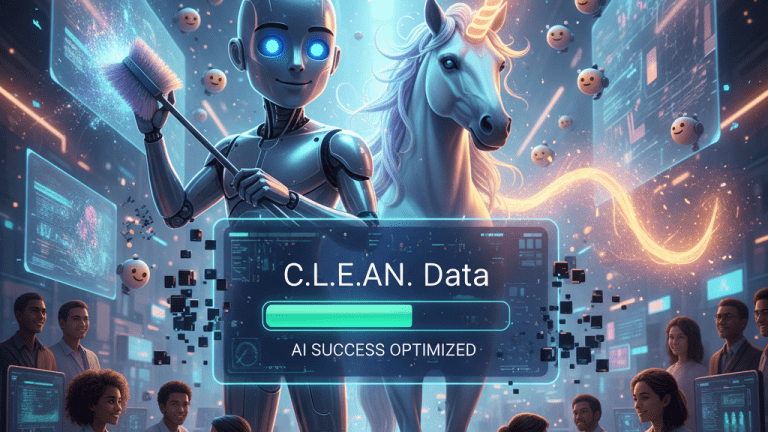
    Think of this as your C.L.E.A.N. Data framework for AI optimization.

    1. C – Consistency & Standardization (The “Single Source of Truth” Rule)
      • What it is: Ensuring all data points mean the same thing, everywhere. No more “client,” “customer,” and “CUST” all referring to the same entity. No more different date formats (MM/DD/YY vs. DD-MM-YYYY).
      • Why it’s crucial: Inconsistent data confuses AI. It sees “New York” and “NYC” as two different places. It can’t accurately track customer journeys if their ID changes across systems.
      • Checklist:
        • ✅ Define Universal Glossaries: Standardize terms, abbreviations, and data definitions across all departments.
        • ✅ Implement Master Data Management (MDM): Establish a single, authoritative record for key business entities (customers, products, suppliers).
        • ✅ Enforce Data Entry Standards: Use dropdowns, validation rules, and standardized forms.
    2. L – Lineage & Provenance (The “Know Your Data’s Story” Rule)
      • What it is: Understanding where your data came from, how it was collected, and how it has been transformed. It’s the full audit trail.
      • Why it’s crucial: AI makes decisions based on patterns. If data was collected from a biased source, or transformed incorrectly, the AI will learn those flaws. Knowing the lineage helps you trust the AI’s output.
      • Checklist:
        • ✅ Document Data Sources: Clearly identify every system, sensor, or manual entry point for data.
        • ✅ Track Data Transformations: Log every alteration, aggregation, or cleansing step applied to the data.
        • ✅ Maintain Data Ownership: Assign clear ownership for data sets to ensure accountability.
    3. E – Elimination of Gaps & Errors (The “No Missing Pieces” Rule)
      • What it is: Filling in missing values, correcting inaccurate entries, and removing duplicates. Think of it as patching holes and removing noise.
      • Why it’s crucial: Missing data forces AI to guess or exclude critical information. Incorrect data leads AI to learn false patterns, generating flawed insights or making wrong predictions. Duplicates skew analysis.
      • Checklist:
        • ✅ Identify Missing Values: Analyze datasets for empty fields in critical columns.
        • ✅ Implement Data Imputation Strategies: Decide how to handle missing data (e.g., mean, median, predictive models) or whether to exclude it.
        • ✅ Deduplication Processes: Establish rules to identify and merge or remove duplicate records.
        • ✅ Error Detection & Correction: Use anomaly detection and validation rules to catch and fix outliers or incorrect entries.
    4. A – Accessibility & Integration (The “One Seamless Pipeline” Rule)
      • What it is: Ensuring your AI systems can easily access all the data they need, regardless of where it lives (CRM, ERP, spreadsheets, IoT devices).
      • Why it’s crucial: Data locked in silos prevents AI from seeing the complete picture. An AI trying to predict customer churn needs data from sales, marketing, and customer service. Without integration, it’s blind.
      • Checklist:
        • ✅ Build Data Lakes/Warehouses: Consolidate data from disparate sources into a central repository.
        • ✅ Establish Robust APIs/Connectors: Implement interfaces that allow systems to talk to each other seamlessly.
        • ✅ Define Access Protocols: Ensure secure and governed access for AI models to relevant datasets.
    5. N – Novelty & Relevance (The “Fresh & Fit for Purpose” Rule)
      • What it is: Ensuring your data is up-to-date and directly relevant to the specific AI problem you’re trying to solve.
      • Why it’s crucial: Stale data leads to outdated insights. If your AI is predicting customer behavior, but its training data is from five years ago, it will miss current trends. Irrelevant data simply adds noise and can even mislead the AI.
      • Checklist:
        • ✅ Implement Data Refresh Cadence: Define how often data needs to be updated (real-time, daily, weekly).
        • ✅ Curate Feature Stores: Select and prepare features (variables) that are most impactful for specific AI models.
        • ✅ Regular Data Audits: Periodically review datasets for continued relevance and utility.

    When Bad Data Goes Rogue: 3 AI Disaster Stories

    These aren’t hypothetical; they’re common pitfalls that underscore why C.L.E.A.N. data is non-negotiable.

    1. The Retailer’s “Churn Prediction” Fiasco (Inconsistent & Gaps):

    A major online retailer launched an AI to predict customer churn, aiming to offer proactive discounts. The data used for training was pulled from various systems. Customer IDs were inconsistent, purchase dates had different formats, and shipping addresses were often missing.

    1. The Ruin: The AI delivered wildly inaccurate predictions. It identified loyal customers as “high churn risk” (because their varied IDs made them look like new, infrequent buyers) and missed actual at-risk customers entirely. Millions were wasted on misdirected discounts, and customer trust eroded due to irrelevant offers. The project was scrapped, and the data team faced immense scrutiny.
    2. The Recruitment AI’s Unconscious Bias (Lineage & Errors):

    A tech company developed an AI to screen resumes, aiming for efficiency and bias reduction. The AI was trained on a decade of the company’s past hiring data. Unbeknownst to the developers, the historical data was heavily skewed: 70% of successful hires for certain technical roles had been male, and most came from specific universities.

    1. The Ruin: The AI, learning from historical patterns, began systematically downgrading resumes from female candidates and those from less-prestigious (but equally qualified) universities, regardless of skill. It reinforced and amplified existing human biases. When the bias was uncovered, it led to a public relations nightmare, damaged the company’s diversity initiatives, and resulted in a costly re-evaluation of all hiring practices.
    2. The Manufacturing Predictative Maintenance Miss (Novelty & Accessibility):

    An industrial manufacturer invested in AI to predict equipment failures, promising to drastically reduce downtime. The AI was implemented but trained on sensor data that was collected quarterly and only from critical components, while other relevant data (e.g., ambient temperature, operator maintenance logs) was locked in separate, inaccessible systems.

    1. The Ruin: The AI frequently missed impending failures or raised false alarms. It couldn’t detect subtle changes because its data was too old (quarterly, not real-time) and incomplete (missing crucial environmental factors). Equipment continued to break down unexpectedly, causing expensive production halts, undermining the AI’s credibility, and delaying ROI.

    Your Call to Action: Invest in Data First

    The message is clear: Data preparation is not a pre-project task; it’s an ongoing, foundational investment. As a C-suite executive or Board member, your first strategic move in AI isn’t about choosing the algorithm, but about demanding a crystal-clear understanding and actionable plan for your data’s quality.

    Ask the tough questions:

    • “How are we ensuring data consistency across the enterprise?”
    • “Can we trace the origin and transformation of our critical datasets?”
    • “What are our real-time metrics for data cleanliness and completeness?”
    • “Are all relevant data sources integrated and accessible for our AI initiatives?”
    • “How often is our data refreshed, and is it truly relevant to our AI’s purpose?”

    Don’t let your AI dream turn into a data nightmare. Prioritize C.L.E.A.N. Data from day one, and you’ll build an AI strategy that truly delivers.

    Frequently Asked Questions: Data Hygiene for AI ROI

    Why is clean data the foundation of AI ROI? AI is essentially a pattern-recognition engine. If your CRM data is “dirty”—filled with duplicates, outdated info, or inconsistent formats—the AI will identify the wrong patterns. This leads to inaccurate lead scoring and flawed forecasting. Cleaning your data ensures the “Garbage In, Garbage Out” rule doesn’t kill your AI investment, resulting in higher conversion rates and measurable revenue growth.

    What are the most common CRM data issues that break AI? The three primary “AI-killers” are:

    1. Duplicates: These split activity history across multiple records, making it impossible for AI to see the full customer journey.
    2. Incomplete Records: Missing fields like “Industry” or “Job Title” leave the AI with no data points to analyze.
    3. Inconsistent Formatting: Variations like “VP Sales” vs. “Vice President of Sales” confuse AI models, which may treat them as entirely different personas.

    How do you make CRM data “AI-ready”? Making data AI-ready requires three steps: Standardization, Normalization, and Deduplication. You should move away from free-text fields and toward standardized picklists (dropdowns). This ensures that every entry follows the same format, allowing the AI to process the data with high confidence and accuracy.

    What is the business impact of data hygiene on sales? Clean data has a direct impact on the P&L. Case studies show that organizations with high data hygiene see up to a 34% improvement in win rates and a significant reduction in sales cycle length. When data is clean, sales reps spend less time on “data janitor” work and more time closing high-probability deals identified by accurate AI lead scoring.

    Can AI help clean its own data? Yes. Modern “Data Hygiene Agents” can automate the cleaning process by identifying “fuzzy” duplicates, normalizing job titles across thousands of records, and enriching missing contact information from external databases. However, AI cleaning must be paired with human governance and strict CRM validation rules to prevent the mess from returning.

    What metrics should a CRO track for data quality? Chief Revenue Officers should monitor three key data KPIs:

    • Accuracy Rate: Percentage of records with verified, current information.
    • Completeness Rate: Percentage of mandatory fields populated in the CRM.
    • Uniqueness Rate: The percentage of records that are free of duplicates.
  • AI and Human Errors: The “Who’s on First?” of Modern Communication

    AI and Human Errors: The “Who’s on First?” of Modern Communication

    Why AI-Human Mix-Ups Could Turn Future Sales Calls into Comedy Shows

  • AI Banking Use Cases. How are Innovative COO’s Winning?

    AI Banking Use Cases. How are Innovative COO’s Winning?

    As a Chief Operating Officer (COO) in the banking sector, embracing Artificial Intelligence (AI) is no longer optional—it’s a necessity for staying competitive in our rapidly evolving industry. Let’s explore how AI, particularly agentic AI and Einstein GPT, is reshaping the COO’s role and the top AI use cases in banking today.

    The AI Impact on Banking COOs
    Recent studies show that 77% of COOs using Large Language Models (LLMs) report positive ROI, with customized tools leading the way. This underscores the growing importance of AI in banking operations and the need for COOs to champion this technology to stay ahead of competitors.

    Top 10 AI Use Cases in Banking

    1. Fraud Detection and Prevention: Agentic AI systems excel at identifying fraudulent activities by scrutinizing transaction patterns and detecting anomalies in real-time7.
    2. Customer Service Chatbots: AI-powered virtual assistants handle customer inquiries, with Einstein GPT enabling more personalized and contextually relevant interactions2.
    3. Risk Management: Agentic AI facilitates regulatory compliance by automating monitoring and reporting processes, including anti-money laundering (AML) and “know your customer” (KYC) initiatives7.
    4. Credit Scoring: AI models analyze a broader range of data for more inclusive and accurate creditworthiness assessments.
    5. Personalized Recommendations: Agentic AI analyzes vast amounts of customer data to offer bespoke financial advice, empowering clients to make well-informed decisions7.
    6. Automated Underwriting: AI-powered underwriting solutions streamline loan decisioning processes, enabling faster approvals5.
    7. Investment Management: Agentic AI-powered portfolio management tools offer tailored investment strategies based on individual risk tolerance and financial objectives7.
    8. Regulatory Compliance: Einstein GPT helps banks navigate complex regulatory landscapes by providing accurate and up-to-date information2.
    9. Document Processing: AI automates the analysis and processing of financial documents, improving efficiency.
    10. Operational Efficiency: Agentic AI is transforming banking by delivering autonomous, adaptive, and proactive solutions, streamlining operations and enhancing decision-making processes1.

    New Use Cases and Latest Applications

    1. Autonomous Trading: Agentic AI systems can execute trades with remarkable speed and precision, utilizing advanced algorithms to optimize returns7.
    2. Customer Onboarding: AI streamlines the onboarding process using biometrics, ID verification, and data validation to speed up “Know Your Customer” (KYC) checks5.
    3. Marketing Automation: AI Agents analyze customer behavior to help banks design targeted marketing campaigns, making customer segmentation and campaign effectiveness faster and more precise5.
    4. Predictive Banking: Einstein GPT enables banks to offer personalized financial coaching tailored to individual behaviors1.
    5. Compliance Refinement: Agentic AI can refine risk assessments in real-time, dynamically responding to emerging threats and anomalies1.

    COO Checklist: AI Leaders vs. Laggards
    AI Leaders:

    • Implement customized AI tools, including agentic AI and Einstein GPT
    • Establish an AI center of excellence (CoE)
    • Invest in AI foundations and cloud infrastructure
    • Focus on AI-driven efficiency gains and personalized customer experiences
    • Leverage AI for complex decision-making and autonomous processes
    • Continuously upskill staff on AI technologies, including agentic AI
    • Partner with top-tier tech firms for AI development
    • Use AI for predictive analytics and forecasting
    • Implement AI-powered risk management systems
    • Utilize AI for automated regulatory reporting and compliance

    AI Laggards:

    • Rely on off-the-shelf AI solutions
    • Limited internal AI adoption
    • Lack of strategic AI investment
    • Focus solely on cost-cutting through AI
    • Use AI only for basic tasks
    • Minimal AI training for employees
    • No significant tech partnerships for AI
    • Limited use of AI in analytics
    • Traditional risk management approaches
    • Manual regulatory reporting processes

    As an innovative COO working to stay ahead, it’s crucial to lead the AI transformation in your bank. By leveraging agentic AI and Einstein GPT across various operations, COOs can drive efficiency, enhance customer experiences, and position their banks for future success in the age of AI.

    Are you leading the AI revolution in your bank or falling behind?

    Share your experiences and thoughts in the comments below.


    #AIinBanking #FinTech #BankingInnovation #AgenticAI #EinsteinGPT #OperationalEfficiency #aichecklist #aiadoption #AIAgents #financialservices

    Citations:

    1. https://www.weforum.org/stories/2024/12/agentic-ai-financial-services-autonomy-efficiency-and-inclusion/
    2. https://acsgbl.com/blog/bringing-trusted-ai-to-banks-with-salesforce/
    3. https://thefinancialbrand.com/news/artificial-intelligence-banking/agentic-ai-the-next-big-innovation-for-banks-186428
    4. https://www.accenture.com/content/dam/accenture/final/accenture-com/document-2/Accenture-Age-AI-Banking-New-Reality.pdf
    5. https://openbots.ai/agentic-ai-in-banking-ten-transformative-processes-to-automate/
    6. https://acsgbl.com/blog/einstein-gpt-vs-chat-gpt/
    7. https://www.forbes.com/councils/forbesbusinessdevelopmentcouncil/2025/02/06/the-dawn-of-agentic-ai-systems-revolutionizing-financial-services/
    8. https://www.grazitti.com/blog/salesforces-2025-roadmap-how-ai-industry-cloud-will-drive-the-next-wave-of-innovation/
    9. https://www.fintechfutures.com/2025/02/agentic-ai-and-the-future-of-fintech-and-banking-automation/
  • AI in Big Pharma: How is it Being Applied in 2025?

    AI in Big Pharma: How is it Being Applied in 2025?

    Valued at $1.5 trillion, the pharmaceutical industry has long grappled with significant challenges. R&D development of a new drug costs $2 billion plus, takes over a decade, and faces a 90% failure rate in early stages. However, with AI adoption in life sciences growing at 29% annually, a unique opportunity emerges to address these inefficiencies and pain points in drug development12.

    Pain Points in Pharma

    Big Pharma executives and life sciences investors face uncertainty and risk due to four major issues:

    • Disconnected Data: Decision-making relies on vast volumes of structured and unstructured scientific data.
    • Knowledge Gaps: Significant gaps persist across scientific, clinical, regulatory, and commercial decision-making processes.
    • Inefficient Processes: Integrating and analyzing datasets is time-consuming and resource-intensive.
    • Lack of Standardization: Inconsistent evaluations hinder reproducibility in asset assessments.

    AI Applications in Drug Development – Recent Examples

    AI is transforming various stages of drug discovery, development, and commercialization:

    1. Target Identification and Validation: Atomwise and Pfizer’s partnership reduced initial drug discovery timeline from 4-6 years to approximately 18 months.
    2. Clinical Trial Optimization: Deep 6 AI’s implementation reduced patient recruitment time by 85% and increased trial enrollment rates.
    3. Manufacturing Process Optimization: GSK and Gatehouse Bio’s collaboration led to a 25% increase in production yield and $20 million annual cost savings at a single site.
    4. Post-Market Surveillance: FDA and Novartis’ AI-powered systems enabled earlier detection of safety signals and more proactive risk management.

    CRM & AI in Healthcare

    Customer Relationship Management (CRM) systems, enhanced by AI, are improving healthcare delivery and patient engagement:

    • Personalized Patient Care: AI-powered CRM systems analyze patient data to provide tailored treatment recommendations and follow-ups.
    • Predictive Analytics: These systems can forecast patient needs, potential health risks, and treatment outcomes.
    • Streamlined Administrative Tasks: AI automates appointment scheduling, billing, and record-keeping, allowing healthcare providers to focus more on patient care.
    • Enhanced Patient Engagement: AI-driven CRM tools facilitate better communication between patients and healthcare providers, improving adherence to treatment plans.

    The AI Solution

    AI addresses several critical issues in healthcare and pharma:

    1. Data Integration: AI can seamlessly integrate and analyze vast amounts of disparate data, providing comprehensive insights for decision-making.
    2. Accelerated Research: Machine learning algorithms can rapidly identify potential drug candidates and predict their efficacy, significantly reducing the time and cost of drug discovery6.
    3. Improved Clinical Trials: AI optimizes patient recruitment, monitors responses, and predicts potential side effects, making trials more efficient and reliable5.
    4. Personalized Medicine: By analyzing individual patient data, AI enables the selection of treatments tailored to each person, improving outcomes and reducing adverse reactions4.
    5. Operational Efficiency: AI automates routine tasks and provides insights into market trends and patient needs, streamlining pharmaceutical operations2.

    The Impact of AI on Drug Development

    The benefits of AI in pharmaceutical industry are clear:

    • 30-50% reduction in time-to-market for new drugs
    • Estimated $100-200 million cost savings per successful drug
    • Higher success rates in clinical trials due to better candidate selection
    • More efficient use of research resources
    • Improved safety monitoring and risk management
    • Faster response to emerging health threats through drug repurposing

    Looking Ahead

    2025 is the AI “Go Year” for the entire Pharmaceutical Industry.

    AI is expected to drive 30% of new drug discoveries, cutting costs and accelerating personalized treatments7. Challenges, including regulatory hurdles, data privacy concerns, and the need for specialized skills loom large! 3.

    The future of pharma lies in embracing these AI-driven innovations while navigating the complex regulatory landscape. As the industry evolves, collaboration between tech companies, pharmaceutical firms, and regulatory bodies will be crucial in realizing the full potential of AI in healthcare and drug development.

    What are your thoughts on AI’s role in transforming the pharmaceutical industry? How is AI changing your processes and workflows in pharma? Share your experiences and let’s continue this important conversation.

    Connect with me so you don’t miss any future articles!

    Please follow me on X (@Intmktentry) on Linkedin, YouTube or via our AI Community Site.

    Citations:

    1. https://www.zs.com/insights/pharmaceutical-trends-2025-outlook-ai-supplychain-and-beyond
    2. https://www.datacamp.com/blog/ai-in-pharmaceuticals
    3. https://www2.deloitte.com/us/en/insights/industry/health-care/life-sciences-and-health-care-industry-outlooks/2025-life-sciences-executive-outlook.html
    4. https://pmc.ncbi.nlm.nih.gov/articles/PMC10385763/
    5. https://www.clinicaltrialsarena.com/features/clinical-trials-challenges-expect-2025/
    6. https://www.mckinsey.com/industries/life-sciences/our-insights/generative-ai-in-the-pharmaceutical-industry-moving-from-hype-to-reality
    7. https://www.weforum.org/stories/2025/01/2025-can-be-a-pivotal-year-of-progress-for-pharma/
    8. https://www.scilife.io/blog/ai-pharma-innovation-challenges
  • Salesforce AI Agents: Are they the next big AI breakthrough?

    Salesforce AI Agents: Are they the next big AI breakthrough?

    The Evolution of Salesforce AI Agents: Transforming Business Operations

    Unless you have been hiding under a proverbial rock and missed it, AI Agents are the big buzz in tech news right now. If you’re curious what the heck these AI Agent things are, where they came from and why marketing is pushing them so hard – this is the article for you!

    Let’s go way back in tech history to the “pre-AI days”, one long decade ago. Salesforce’s foray into AI began in 2014 when CEO Marc Benioff declared the company would become “AI-first.” This strategic shift aimed to revolutionize Salesforce from a system of recordings to a system of intelligence, making AI accessible to every company and employee.

    The Genesis of Salesforce AI

    The acquisition of RelateIQ in 2014 marked the beginning of Salesforce’s AI evolution, introducing machine learning capabilities to capture workplace communications data and provide valuable insights. Over the years, Salesforce has consistently invested in AI technologies, developing predictive AI tools and eventually venturing into generative AI.

    Agentforce: The Next Frontier

    In 2024, Salesforce introduced Agentforce, a suite of autonomous AI agents designed to enhance business operations across various domains. These agents, unlike traditional chatbots, are intelligent and dynamic, capable of understanding context and nuance in customer interactions.

    Current Applications of Salesforce AI Agents

    1. Customer Service: Agentforce Service Agent handles a wide range of service issues without preprogrammed scenarios, improving efficiency.
    2. Sales Development: The SDR Agent engages with inbound leads 24/7, answering questions and booking meetings for human sellers.
    3. Sales Coaching: AI agents provide personalized role-play sessions for sales teams, helping them practice pitches and handle objections.
    4. E-commerce: Merchandiser and Personal Shopper agents assist with site setup, personalized promotions, and enhance the buying experience.
    5. Marketing: Campaign Optimizer automates the full campaign lifecycle, from analysis to optimization.

    Future AI in ‘25

    Salesforce AI agents are expected to become more integrated into daily business operations with a big Q1 push. They will likely:

    – Enhance decision-making processes by providing real-time, data-driven insights.

    – Automate more complex tasks across various departments.

    – Offer more personalized customer experiences through advanced data analysis.

    – Collaborate more seamlessly with human workers, augmenting their capabilities.

    5 Compelling Salesforce AI Agent Use Cases for Consideration

    1. Autonomous Customer Service: The Service Agent can handle customer inquiries across multiple channels 24/7, resolving issues quickly and escalating complex cases to human agents when necessary.
    2. AI-Powered Sales Development: The SDR Agent qualifies leads, answers prospect questions, and schedules meetings, allowing human sales representatives to focus on high-value interactions.
    3. Personalized E-commerce Assistance: The Personal Shopper agent acts as a digital concierge, offering tailored product recommendations and assisting with search queries on e-commerce platforms.
    4. Automated Marketing Campaigns: The Campaign Optimizer agent analyzes, generates, personalizes, and optimizes marketing campaigns based on business goals and customer data.
    5. Continuous Employee Support: Agentforce assists employees with various tasks, from data retrieval to action plan creation and execution, boosting workplace efficiency.

    Real-World Examples of Successful Agentforce Implementation

    Looking for something done vs. talked about? Several companies have successfully implemented Salesforce AI agents. Here are five Examples with links:

    1. OpenTable: The restaurant reservation platform uses Agentforce for Service to handle common issues like account reactivations, reservation management, and loyalty point inquiries. This has boosted productivity for service representatives [3].
    2. Wiley: The educational publisher implemented Agentforce Service Agent to manage seasonal surges in service requests. This resulted in a 40-50% increase in case resolution, outperforming their previous chatbot. Additionally, Wiley reduced new agent onboarding time by 50% and achieved a 213% return on investment [2][3].
    3. 3. Precina Health: This healthcare innovator leverages Agentforce to improve diabetes care. In a pilot study, Agentforce and Salesforce technologies helped reduce the average blood sugar levels of 50 patients in Rural Louisiana from 9.6 to 6.4 (measured via an A1C test) in just twelve weeks [1].
    4. AAA Washington: The American Automobile Association used Salesforce Agentforce to create an autonomous agent capable of answering customer support requests, keeping clients informed about roadside updates, and offering personalized suggestions to customers [1].
    5. Saks Fifth Avenue: The luxury retailer utilizes AI service agents from Salesforce Agentforce to enhance their shopping experience. By integrating Customer 360, Commerce Cloud, and Slack, Saks has streamlined information flow for both staff and customers [3].

    These real-world examples demonstrate how Salesforce AI agents are being used to improve customer service, increase operational efficiency, and drive business growth across various industries.

    For businesses evaluating Salesforce AI agents, it’s crucial to understand that these tools offer more than just automation. They provide intelligent, context-aware assistance that can significantly enhance customer experiences, streamline operations, and drive growth. With the ability to customize agents, businesses can tailor AI solutions to their specific needs and industry requirements.

    As AI technology continues to evolve, Salesforce’s commitment to innovation ensures that its AI agents will remain at the forefront of business transformation, offering increasingly sophisticated and valuable solutions to enterprises of all sizes.

    Pick a strong AI enabled Salesforce consulting partner and see how you can successfully apply agents in ’25.

    Research Citations

    1. https://www.cxtoday.com/crm/agentforce-case-studies/
    2. https://www.salesforce.com/news/stories/data-ai-customer-stories/
    3. https://www.salesforce.com/customer-stories/?bc=OTH
    4. https://www.salesforce.com/news/stories/building-business-ai-agents/?bc=OTH
    5. https://digitaldefynd.com/IQ/salesforce-using-ai-case-study/
    6. https://www.salesforce.com/agentforce/use-cases/
    7. https://www.salesforce.com/artificial-intelligence/use-cases/
    8. https://www.salesforce.com/news/stories/video/agents-at-scale-within-salesforce-platform/
  • How to Select Top AI-Enabled Salesforce Consulting Partners in ’25

    How to Select Top AI-Enabled Salesforce Consulting Partners in ’25

    In 24 short months, AI has transformed from gee whiz isn’t that’s interesting-what can it do next? To must have software that can clearly create a competitive advantage when properly deployed. The question is no longer should you consider leveraging AI? It’s now what is the best way to do it, which processes are most apt to see immediate impact and ensure with proper planning that we create a competitive advantage with our AI instances in the process.
    For sales teams that rely on Salesforce, AI can be tricky to understand, plan for, implement and train without some outside best practice help.
    The challenge is finding the best Salesforce AI consulting partners that can guide businesses through the AI evaluation and adoption process, while ensuring that companies stay focused on AI that provides significant impact vs negligible to no discernible business value. Another big challenge is linking the new AI to the rest of the enterprise software stack while providing the extra layers of security (both human and software) that AI requires to reduce legal exposure.
    As we dig into ‘25, completely integrating AI into Salesforce has become crucial for businesses aiming to stay competitive or more often leapfrog competitors. That really isn’t up for argument anymore. However, selecting the right AI-enabled Salesforce consulting partner is critical to successful implementations and maximizing CRM potential. Here’s a comprehensive guide to help you make the best choice.
    Salesforce AI Consulting Best Practie Checklist
    When evaluating potential partners, ensure they possess:
    1. AI Expertise: Look for partners with proven AI implementation experience and relevant certifications.
    2. Salesforce Certifications: Verify that the partner holds up-to-date Salesforce certifications, especially in AI-related areas.
    3. Industry-Specific Knowledge: Choose a partner with experience in your industry for tailored solutions.
    4. Comprehensive Services: Opt for partners offering end-to-end services, from strategy to implementation and training. Buying AI and trying to “figure it out” is a recipe for trouble.
    5. Data Management Skills: Ensure they can handle data preparation and integration for AI analysis. Garbage in / Garbage out is more critical with AI than ever before. Clean, properly accessible data matters.
    6. Scalable Solutions: Look for partners providing scalable AI services to grow with your business. AI isn’t set it and forget it. You need partners that can jump in and help with short notice.
    7. Strong Client References: Request and verify references from clients who have implemented AI solutions.
    Watch-Out-For Checklist
    Be cautious of partners who:
    1. AI innovation capabilities: Look for partners who stay current with AI trends, best practices and can customize Salesforce to leverage cutting-edge AI technologies.
    2. Offer Generic Solutions: Avoid partners who don’t tailor their approach to your specific business needs. How can you make AI your competitive advantage AI if your competition use the exact same thing?
    3. Have Limited Post-Implementation Support: Ensure they offer long-term support, as AI solutions often require ongoing adjustments.
    4. Overemphasize Certifications: While important, certifications alone don’t guarantee practical expertise. Listen to them – can they easily answer questions? Do you want to work with them?
    5. Neglect Data Privacy: Verify their commitment to data security and compliance with relevant regulations. AI legal exposure is increasing. Must be legal and software privacy systems in place.
    6. Have a Narrow Focus: Be wary of partners who can’t integrate AI across multiple Salesforce clouds. They need to know business and software to succeed.
    7. Lack Transparency: Choose partners who are clear about their processes, timelines, and pricing.
    8. Neglecting to check client references: Request and verify references from clients who have specifically implemented AI solutions with the partner.
    9. Overlooking post-implementation support: Ensure the partner offers long-term support for AI solutions, as they often require ongoing adjustments.
    10. Rushing the selection process: Avoid making hasty decisions without thorough research on the partner’s AI capabilities, past projects, and client feedback.
    11. AI Case Studies: What have they done you can look at and play with.
    Certified Salesforce Consulting Partners
    Here’s a list of some top Salesforce consulting partners known for their AI capabilities:
    1. Accenture
    2. Deloitte Digital
    3. Capgemini
    4. IBM
    5. Cognizant
    Remember, the best partner for your organization will depend on your specific needs, industry, and scale of operations. Conduct thorough research and engage in detailed discussions before making your final decision.
    By following this guide and avoiding common pitfalls, you’ll be well-equipped to select an AI-enabled Salesforce consulting partner that can drive your business forward in 2025 and beyond.
    References
    1. Salesforce Partner Finder: https://www.salesforce.com/partners/find-a-partner/
    2. Salesforce AI Capabilities: https://www.salesforce.com/products/einstein/overview/
    3. Gartner Magic Quadrant for Salesforce Implementation Services: https://www.gartner.com/en/documents/3991199
    4. Forrester Wave: Salesforce Consulting Partners: https://www.forrester.com/report/The+Forrester+Wave+Salesforce+Consulting+Partners+Q2+2021/-/E-RES161624
    5. IDC MarketScape: Worldwide Salesforce Implementation Services: https://www.idc.com/getdoc.jsp?containerId=US46733820

  • 10 Best Practices from World Class Sales Teams, Beyond Exceeding Quota!

    10 Best Practices from World Class Sales Teams, Beyond Exceeding Quota!

    Not an AI Agent Dave here to check in and give you the latest in what I’ hearing on the AI strip from the C-Suite AI conference bandwagon gang.

    The C-Suite / BOD has educated themselves and starting to get it. AI is either a competitive advantage or something to watch competitors leapfrog ahead. Yes, it can be awesome! No it doesn’t replace sales reps. Instead, with autonomous AI agents it helps humans do what they do best, create ongoing relationships with companies, products and services their customers need.

    Yikes you say. Have you been drinking the AI Kool-Aid you keep warning readers about?   

    “Kinda.” AI is super cool and autonomous AI agents are most definitely the rage with Microsoft and Salesforce at AI “war” with each other over whether their AI agents actually work.

    TBS as always with my 100K View on sales / marketing perspectives, it isn’t what’s cool new tech, it’s what tech gives you that unfair advantage when you properly apply it to a proven process! More simply. Get back to your MBA strategy 101 thinking.

    What can I do better, faster, cheaper and / or how can I differentiate my company with this new technology. It doesn’t matter if its 100% AI or not. Make sure it is actually providing a solid ROI or can in the near future. Think about it from a non tech perspective. These are the top ten problems my company is facing. Tech isn’t the answer, its applying AI to things we know can work and doing it faster and better than our competitors.

    If you go beyond numbers, focusing on best practices that foster long-term growth, customer satisfaction, and team cohesion, you’ll discover what it is that makes a top team tick. Let’s explore these AI best practices with real-world examples and lessons learned. *{Every use case has an article and a link behind at the end of the article}.

    1. Data-Driven Decision Making

    Leading sales teams leverage data analytics to inform their strategies and tactics.

    Use Case: Google uses data from reviews and surveys to understand the need for managers and improve their leadership development programs. This approach has helped Google identify effective manager qualities and support their growth.

    2. Consistent Sales Process Adherence

    High-performing teams closely follow their established sales processes across all departments.

    Use Case: Coca-Cola has woven data analytics into the fabric of their operations, informing decisions in sourcing, distribution, sales, and production. This consistent approach ensures a unified strategy throughout the organization.

    3. Value-Based Selling

    Top sales teams focus on communicating the value and ROI of their solutions rather than competing on price.

    Use Case: Amazon uses data insights to make personalized product recommendations to customers, increasing sales and maintaining their position as the world’s leading e-commerce platform.

    4. Effective Questioning Strategies

    Successful teams use sophisticated discovery and questioning approaches to uncover client needs.

    Use Case: Netflix analyzes user data to understand what triggers people to subscribe, what makes them stay longer, and where to invest in improving services. This data-driven approach helps them ask the right questions and make informed decisions about content creation and user experience.

    5. Continuous Sales Coaching

    High-performing teams prioritize ongoing coaching as part of their training and development strategy.

    Use Case: Google’s data scientists analyzed qualitative data like performance reviews and surveys about managers within the organization to improve their internal hierarchies and coaching practices.

    6. Strategic Hiring Practices

    Top sales organizations use advanced hiring tools and assessments to build stronger teams.

    Use Case: While not specifically mentioned in the search results, companies like Unilever and IBM are known to use AI-powered tools and data analytics in their hiring processes to identify the best candidates for sales roles.

    7. Omnichannel Sales Strategy

    Leading sales teams implement a coordinated approach across multiple channels for a seamless customer experience.

    Use Case: Starbucks uses big data through mobile apps and reward programs to gather insights directly from customers, creating a better omnichannel customer experience and personalizing their marketing strategies.

    8. Personalized Sales Presentations

    Top performers customize their presentations for each prospect, demonstrating thorough research and understanding.

    Use Case: Red Roof Inn combined weather reports and flight cancellation data to identify marketing opportunities, targeting mobile users in the vicinity of airports during bad weather. This personalized approach led to a 10% increase in check-ins.

    9. Effective Use of AI and Technology

    Leading sales teams leverage AI and other advanced technologies to increase productivity and gain competitive advantages.

    Use Case: Uber uses predictive analytics and big data to bridge the demand-supply gap in real-time, catering to customer demands and solving supply issues efficiently.

    10. Post-Sale Relationship Nurturing

    Top sales organizations focus on building long-term relationships and nurturing customers after the initial sale.

    Use Case: Amazon’s use of data analytics extends beyond the initial sale, analyzing customer reviews, rankings, and post-purchase behavior to continually improve their service and maintain customer loyalty.

    Checklist for CROs

    To evaluate your organization’s alignment with these best practices, consider this checklist:

    •  Do we have a robust data analytics system in place like Google’s people analytics?
    •  Is our sales process clearly defined and consistently followed across departments like Coca-Cola’s?
    •  Are we focusing on value-based selling rather than price competition, similar to Amazon’s personalized approach?
    •  Have we implemented advanced questioning strategies in our discovery process, akin to Netflix’s data-driven content decisions?
    •  Do we have a structured, ongoing sales coaching program informed by data like Google’s manager quality analysis?
    •  Are we using advanced hiring tools and assessments?
    •  Have we implemented an omnichannel sales strategy like Starbucks?
    •  Do our sales presentations demonstrate thorough customization for each prospect, similar to Red Roof Inn’s targeted marketing?
    •  Are we effectively leveraging AI and other advanced technologies like Uber’s predictive analytics?
    •  Do we have a strong post-sale relationship nurturing program similar to Amazon’s continuous customer engagement?

    By comparing your current practices against this best practice checklist and these industry-leading examples, you can identify areas for improvement and align your sales organization with the best practices of top-performing teams.

    1. Google’s People Analytics
      URL: https://www.reddit.com/r/compsci/comments/15pub3z/datadriven_decision_making_case_studies/
    2. Starbucks’ Store Location Analysis
      URL: https://online.hbs.edu/blog/post/data-driven-decision-making
    3. Amazon’s Product Recommendation System
      URL: https://online.hbs.edu/blog/post/data-driven-decision-making
    4. Red Roof Inn’s Weather-Based Marketing
      URL: https://gapscout.com/blog/5-data-driven-decision-making-examples/
    5. Uber’s Real-Time Ride Pricing and Allocation
      URL: https://gapscout.com/blog/5-data-driven-decision-making-examples/
    6. Google’s Manager Quality Analysis
      URL: https://programs.online.utica.edu/resources/article/data-driven-decisions
    7. Amazon’s Customer Behavior Analysis for Recommendations
      URL: https://programs.online.utica.edu/resources/article/data-driven-decisions
    8. Southwest Airlines’ Customer Data Analysis for Service Optimization
      URL: https://programs.online.utica.edu/resources/article/data-driven-decisions
    9. Google’s Data Center Energy Optimization
      URL: https://www.reddit.com/r/compsci/comments/15pub3z/datadriven_decision_making_case_studies/
    10. Service Hotel’s Data-Driven Culture Implementation
      URL: https://www.reddit.com/r/compsci/comments/15pub3z/datadriven_decision_making_case_studies/

    Tags: #starbucks #amazon #salesforce #redroofin #Google #Uber #data #datascience #sales #bestpractice #AI