Blog

  • The Pivot from Experimentation to P&L Impact

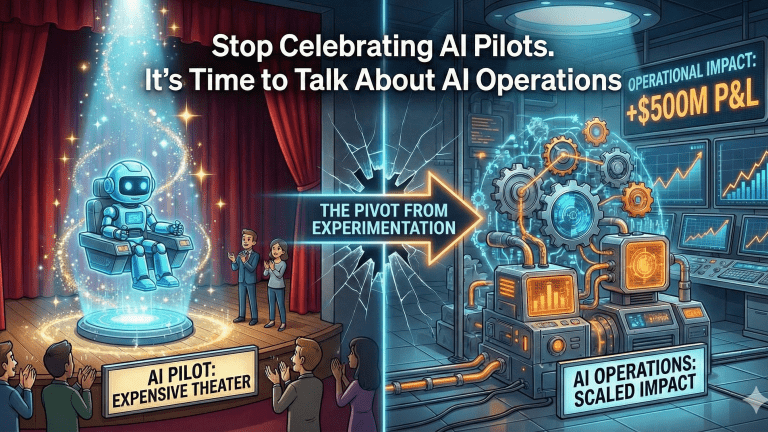
    The Pivot from Experimentation to P&L Impact

    We’re done experimenting with Pilots.

    In boardrooms across the globe, the conversation has shifted. CEOs are no longer impressed by your ChatGPT demo or your pilot program with five enthusiastic users. The honeymoon phase is over. Early 2026 marks the end of the “AI experimentation era” and the beginning of something far more demanding: the mandate for measurable, enterprise-wide operational impact.

    The question is no longer “Can AI work?” It’s “How do we make AI work at scale—and prove it on the P&L?”

    The Death of the AI Pilot

    Let’s be honest about what most “AI initiatives” have been: scattered experiments. Marketing tries a generative AI tool. Sales tests a lead-scoring model. IT builds a chatbot that three people use. Each silo celebrates their innovation. Leadership nods approvingly at the quarterly deck.

    But here’s the uncomfortable truth: pilots don’t generate revenue. They don’t reduce costs at scale. They don’t transform operations. They’re expensive theater.

    The CFO doesn’t care that your team “tried” an AI tool. They care about one thing: Did it move the needle on the income statement? If you can’t answer that question with hard numbers—actual dollars saved, hours recovered, conversion rates improved—you’re not running AI operations. You’re running an expensive hobby.

    From 5 Users to 500: The Last Mile Problem

    The “Last Mile” of AI implementation is where most organizations are stuck right now. You’ve proven the concept works. Your pilot users love it. But when you try to scale from 5 users to 50, then 500, the wheels fall off.

    Why? Because pilots run in a vacuum. Real operations run in the messy reality of:

    • Legacy ERP and CRM systems that weren’t built for AI integration
    • Compliance, governance, and data privacy requirements that multiply at scale
    • Change management across departments with varying technical literacy
    • The need for consistent training, onboarding, and ongoing support
    • Infrastructure costs that balloon exponentially with usage

    The leap from pilot to production isn’t a technical challenge—it’s an organizational transformation. And most companies are discovering they don’t have the muscle memory for it.

    Enter AI Operations: The Framework for Scale

    AI Operations—or AIOps—isn’t just a buzzword. It’s the operational discipline of deploying, monitoring, and continuously improving AI systems at enterprise scale. Think of it as DevOps for AI: a structured approach to moving AI from the lab to the production environment where it drives business outcomes.

    Here’s what true AI Operations looks like:

    1. Integrated Workflows, Not Standalone Tools

    AI doesn’t live in isolation. It’s embedded directly into your CRM for sales automation, your ERP for procurement optimization, your service desk for automated triage. The value comes from eliminating context-switching—not adding another tool to the stack.

    2. Enterprise-Grade Infrastructure

    This means API governance, version control, rollback capabilities, and monitoring dashboards that show real-time performance metrics. It means treating AI models like production code—because that’s what they are.

    3. Continuous Measurement and Optimization

    Every AI deployment must have defined KPIs tied directly to business outcomes. Cost per transaction. Time to resolution. Conversion rate lift. And you’re measuring these metrics daily, not quarterly. AI Ops teams run continuous A/B tests, retrain models on fresh data, and kill underperforming implementations ruthlessly.

    4. Organizational Change Management at Scale

    You need training programs, certification paths, internal champions in every business unit, and a feedback loop that captures frontline insights and routes them back to the AI Ops team. This isn’t optional—it’s the difference between adoption and abandonment.

    The Battle: Centralized AI Studios vs. Fragmented Adoption

    One of the most critical strategic decisions your organization will make in 2026 is how to structure AI governance. Two models are emerging:

    The Centralized AI Studio Model

    A cross-functional team—data scientists, ML engineers, product managers—acts as the enterprise “center of excellence.” They own the AI roadmap, vet all use cases, manage infrastructure, and deploy solutions across business units. Think of it as the enterprise muscle: coordinated, strategic, and accountable for ROI.

    Pros:

    • Centralized governance reduces redundancy and ensures compliance
    • Shared infrastructure lowers costs
    • Clear accountability for P&L impact

    Cons:

    • Can become a bottleneck if under-resourced
    • May lack deep domain expertise in specific business functions

    The Fragmented, Ground-Up Adoption Model

    Individual teams self-select AI tools, build their own workflows, and operate independently. It’s fast, nimble, and responsive to local needs. But it’s also chaos at scale.

    Pros:

    • Rapid experimentation and innovation
    • Teams own their solutions and are highly motivated

    Cons:

    • Massive duplication of effort and cost
    • Compliance and governance nightmares
    • No enterprise-level visibility into ROI
    • Siloed knowledge that doesn’t scale

    The answer, unsurprisingly, isn’t binary. The most successful organizations are adopting a hybrid model: a centralized AI Studio that sets standards, provides shared infrastructure, and vets high-risk deployments—while empowering business units to innovate within guardrails. Think of it as “federalist AI governance.”

    The ROI Mandate: Show Me the Money

    Here’s what your CFO wants to hear in 2026:

    “We deployed AI-powered contract review across our legal and procurement teams—500 users. First-year savings: $3.2M in labor costs and a 40% reduction in contract cycle time. Payback period: 8 months.”

    That’s the conversation. Specific. Measurable. Tied to the P&L.

    Compare that to: “We ran a pilot with AI-assisted customer service. Users loved it!”

    One of these statements gets budget approval. The other gets a polite “let’s revisit next quarter.”

    To build the business case for AI Operations, you need:

    • Baseline metrics: What does the current state cost? How long do processes take? What’s the error rate?
    • Target metrics: What improvement are you aiming for? Be specific and realistic.
    • Full-cost accounting: Don’t just count AI tool licenses. Include infrastructure, training, change management, and ongoing support.
    • Monthly reporting: Track actuals vs. targets. Share wins and losses transparently. Adjust based on data.

    If you can’t measure it, you can’t manage it. And if you can’t manage it, you’re not running operations—you’re running experiments.

    What Separates Winners from the Pack

    The organizations that win in 2026 and beyond won’t be the ones with the most pilots. They’ll be the ones who:

    • Treat AI as infrastructure, not innovation theater
    • Embed AI into existing workflows rather than creating new standalone tools
    • Build enterprise muscle through centralized governance and shared infrastructure
    • Measure relentlessly and kill what doesn’t deliver ROI
    • Invest in change management as heavily as they invest in technology

    These companies don’t have “AI pilots.” They have AI Operations. And that difference will show up in their bottom line.

    The pilot phase is over. The mandate now is scale, integration, and measurable business impact.

    The companies that thrive in the next era won’t be the ones with the most innovative pilots. They’ll be the ones who built the operational discipline to deploy AI at scale—across 500 users, integrated into core workflows, with clear ROI on the income statement.

    Stop celebrating pilots. Start building operations.

    Because in 2026, that’s the only conversation the C-suite wants to have.

    What’s your organization’s biggest challenge in scaling AI from pilots to operations?

    Frequently Asked Questions: Transitioning from AI Pilots to AI Operations

    What is the difference between an AI Pilot and AI Operations?

    An AI Pilot is a limited, often siloed experiment (like a single team using a chatbot) designed to test feasibility. AI Operations (AIOps) is the professionalized, enterprise-wide management of AI as production code. While pilots focus on innovation, AI Operations focuses on ROI, scalability, and P&L impact.

    Why is the “AI Experimentation Era” ending in 2026?

    The honeymoon phase for AI has ended because boards and CEOs are demanding measurable business value. Scattered experiments—often called “AI Theater”—do not reduce costs at scale or transform revenue. In 2026, the focus has shifted to integrated workflows that eliminate context-switching and drive consistent operational efficiency.

    What are the four pillars of true AI Operations?

    To scale AI effectively, organizations must implement these four foundational pillars:

    1. Integrated Workflows: Embedding AI directly into existing systems (CRM, ERP, Service Desks) rather than using standalone tools.
    2. Enterprise-Grade Infrastructure: Implementing API governance, version control, and real-time monitoring dashboards.
    3. Continuous Optimization: Measuring KPIs (cost per transaction, resolution time) daily and retraining models on fresh data.
    4. Change Management at Scale: Establishing certification paths and feedback loops to ensure frontline adoption.

    What is the Centralized AI Studio Model?

    The Centralized AI Studio (or Center of Excellence) is a cross-functional team of data scientists, ML engineers, and product managers who own the enterprise AI roadmap. This model prevents “Shadow AI” by vetting all use cases, managing shared infrastructure, and ensuring every deployment is strategically aligned with the company’s financial goals.

    How do AI Operations improve sales and revenue?

    AIOps moves beyond descriptive analytics to prescriptive guidance. In a production-grade RevOps system, AI agents automatically log call summaries, update deal stages, and flag at-risk opportunities based on activity patterns. For many organizations, this shift has resulted in a 23% acceleration in deal velocity and an 89% reduction in manual CRM updates.

    What are the risks of staying in the “Pilot” phase?

    Remaining in the pilot phase leads to “Pilot Purgatory,” where projects fail to reach production because they lack the necessary governance and integration. This results in wasted budget, fragmented data, and an inability to compete with “AI-first” organizations that have already operationalized their intelligence layers.

    How should enterprises measure the success of AI Operations?

    Success in AIOps is measured by P&L Impact, not technical accuracy scores. Key metrics include:

    • Cost per Transaction: The operational cost reduction achieved through automation.
    • Time to Resolution: Efficiency gains in support or internal workflows.
    • Conversion Rate Lift: The measurable increase in revenue attributable to AI-driven insights.

    Frequently Asked Questions: Transitioning from AI Pilots to AI Operations

    What is the difference between an AI Pilot and AI Operations? An AI Pilot is a small-scale, siloed experiment designed to test a concept (e.g., a chatbot or a lead-scoring model). In contrast, AI Operations (AIOps) is the disciplined practice of deploying, monitoring, and scaling AI across an entire enterprise. While pilots focus on “innovation theater,” AI Operations focus on measurable P&L impact and integrated workflows.

    Why do most AI pilots fail to scale? Most pilots fail during the “Last Mile” of implementation. This occurs because pilots often run in a vacuum, whereas real-world operations must contend with legacy ERP/CRM systems, complex compliance requirements, exponential infrastructure costs, and the need for massive organizational change management.

    What are the four pillars of successful AI Operations?

    1. Integrated Workflows: Embedding AI into existing tools (like Salesforce or SAP) rather than using standalone apps.
    2. Enterprise Infrastructure: Applying DevOps principles to AI, including version control and real-time monitoring.
    3. Continuous Measurement: Tracking daily KPIs like cost per transaction and conversion lift.
    4. Change Management: Implementing structured training and feedback loops for employees.

    What is the “Last Mile” problem in AI? The “Last Mile” is the gap between a successful concept and enterprise-wide adoption. It is characterized by the technical and organizational friction encountered when moving from 5 users to 500, including data privacy hurdles, technical literacy gaps, and integration with messy legacy data.

    How should a company structure AI governance? The article recommends a “Federalist” hybrid model. This combines a Centralized AI Studio (which sets standards, manages infrastructure, and ensures compliance) with Empowered Business Units that innovate within those defined guardrails to ensure speed and domain expertise.

    What AI metrics do CFOs care about most? By 2026, CFOs are moving away from “user satisfaction” metrics. They demand specific P&L impact data, such as:

    • Actual dollars saved in labor costs.
    • Percentage reduction in cycle times (e.g., contract reviews).
    • Hard payback periods (e.g., an 8-month ROI).
    • Conversion rate lift in sales pipelines.

    What is the risk of fragmented AI adoption? Fragmented, ground-up adoption leads to “Shadow AI” chaos. This results in massive duplication of costs, significant compliance and security risks, and siloed knowledge that prevents the organization from seeing an aggregate return on investment.


  • What is AI Agent Orchestration?

    What is AI Agent Orchestration?

  • Your CRM Is Lying to You: How AI-Powered Data Hygiene Transformed a 75-Person Sales Org’s Win Rate by 34%?

    Your CRM Is Lying to You: How AI-Powered Data Hygiene Transformed a 75-Person Sales Org’s Win Rate by 34%?

    Why Clean Data Is the Foundation Every AI Sales Strategy Needs (But Nobody Wants to Talk About)

    By David Brown | AI Therapist for Sales Teams


    Last month, a VP of Sales showed me her AI-powered lead scoring dashboard. It was beautiful. Colorful charts. Predictive analytics. Machine learning confidence scores. She’d invested $80,000 in the platform.

    “So how much has your win rate improved?” I asked.

    She paused. “Actually, it’s gone down 8%.”

    We pulled up her CRM. Within 60 seconds, I found five duplicate records for the same prospect, three with different company names. Job titles that said ‘N/A.’ Industries marked as ‘Other.’ Lead sources labeled ‘Unknown.’ Her AI was making predictions based on data that was 64% inaccurate.

    Her AI wasn’t the problem. Her data was lying to her.

    This is the conversation nobody in the AI sales space wants to have. Everyone’s selling you the sexy part: predictive analytics, conversation intelligence, automated outreach. But they’re all building on the same rotten foundation: your CRM data.

    And if your data is garbage, your AI will be too.

    The Dirty Secret of B2B Sales: Your CRM Is Probably 40-60% Inaccurate

    Let me share some uncomfortable truths from my work with sales organizations:

    • The average B2B CRM is 40-60% inaccurate (duplicate records, outdated contacts, missing information, incorrect data)

    • 25-30% of contact records become outdated annually (people change jobs, companies restructure, emails bounce)

    • Sales reps spend 4-5 hours per week fixing data issues (time they could spend actually selling)

    • Poor data quality costs organizations an average of $15 million annually (in lost productivity, failed campaigns, and missed opportunities)

    But here’s what really matters: when you layer AI on top of bad data, you don’t just maintain the status quo. You make it worse. Much worse.

    Why AI Amplifies Data Problems (Instead of Fixing Them)

    Most sales leaders assume AI will somehow magically clean their data. It won’t. Here’s what actually happens:

    AI learns from your existing data patterns. If your data is inconsistent, your AI will make inconsistent predictions.

    Let me give you a real example. A manufacturing company deployed predictive lead scoring AI. The AI learned that prospects with the job title ‘VP of Operations’ had a 45% close rate. Great, right?

    Except their sales reps were inconsistent with job titles. Some entered ‘VP of Operations.’ Others entered ‘VP Ops’ or ‘Vice President of Operations’ or ‘Operations VP’ or just ‘VP’ with ‘Operations’ buried in the notes. The AI treated these as completely different buyer personas.

    Result? The AI’s predictions were essentially random. High-value prospects got low scores. Low-value prospects got high priority. The sales team stopped trusting the AI within a month.

    The AI wasn’t broken. The data was.

    The Real Cost of Dirty Data: A 75-Person Sales Org Case Study

    Let me walk you through a transformation I led last year. This will make the business case crystal clear.

    The Starting Point: Chaos Disguised as Process

    The company: A B2B SaaS firm selling workflow automation software. 75 sales reps. $50M in annual revenue. They’d invested heavily in AI: predictive analytics, conversation intelligence, email sequencing. None of it was working.

    Initial Data Audit Results:

    • 23% duplicate rate (nearly 1 in 4 records had duplicates) • 41% of contact records had incomplete data (missing phone, email, or job title) • 58% of lead source fields said ‘Unknown’ or ‘Other’ • 217 different variations of the same job title (‘Chief Technology Officer’ vs ‘CTO’ vs ‘Chief Tech Officer’ vs ‘VP Technology’ etc.) • 32% of company records had mismatched industry classifications

    Overall data accuracy: 39%

    Their AI tools were making predictions based on data that was wrong 61% of the time. No wonder their win rate was declining.

    Calculating the True Cost

    Before we started the cleanup, I needed to quantify what bad data was actually costing them:

    Wasted Time: 75 reps × 4.5 hours/week fixing data × 50 weeks × $65/hour = $1,096,875 annually

    Missed Opportunities: Poor lead routing = 23% of hot leads going to wrong reps = estimated $4.2M in lost pipeline

    Failed AI Investment: $95,000 annual spend on AI tools delivering negative ROI

    Duplicate Outreach: 23% duplicate rate = 17 reps wasting time on already-contacted prospects

    Total Annual Cost of Dirty Data: $5.4 million

    When I showed this calculation to their CFO, I got approval for a comprehensive data hygiene initiative within 48 hours.

    The 90-Day Data Transformation Sprint

    Here’s exactly what we did:

    Week 1-2: Establish Standards & Governance

    1. Created a Data Dictionary: Documented every field, what it means, acceptable formats, and examples
    2. Standardized Job Title Taxonomy: Reduced 217 variations down to 12 standard titles with clear mapping rules
    3. Defined Mandatory Fields: 8 required fields that must be completed before a lead moves to ‘Qualified’ stage
    4. Built Validation Rules: CRM-level rules that prevent bad data entry (email format validation, phone number formats, dropdown-only fields)
    5. Established Data Governance Team: 3 people (1 full-time, 2 part-time) responsible for data quality

    Week 3-6: The Big Clean (Using AI Strategically)

    This is where we used AI for what it’s actually good at: pattern recognition and automation at scale.

    1. Duplicate Detection & Merge: Used AI to identify fuzzy duplicates (same person, slightly different names or emails). Human review + one-click merge. Eliminated 12,847 duplicate records.
    2. Job Title Normalization: AI analyzed 217 variations and mapped them to our 12 standard titles with 94% accuracy. Humans reviewed the 6% edge cases.
    3. Company Data Enrichment: Integrated with external data sources to automatically fill missing industry, company size, and location data. 89% success rate.
    4. Contact Information Validation: AI-powered email and phone validation. Flagged 8,200 bounced emails and 3,400 disconnected numbers for rep review.
    5. Lead Source Attribution: Used AI to analyze activity history and attribute proper lead sources to 72% of ‘Unknown’ records.

    Week 7-12: Ongoing Maintenance & Adoption

    1. Daily Automated Data Quality Checks: AI scans for duplicates, incomplete records, and validation failures every night
    2. Rep-Level Data Quality Scorecards: Each rep gets a weekly score based on data entry accuracy. Tied to 5% of variable comp.
    3. Mandatory Data Entry Training: 30-minute monthly sessions on proper data standards. Not optional.
    4. Manager Reviews: Sales managers review data quality in their 1-on-1s, just like pipeline reviews
    5. AI-Assisted Real-Time Suggestions: When reps enter data, AI suggests standardized formats and flags potential issues

    The Results: 34% Win Rate Improvement

    After 90 days of intensive data cleanup and ongoing governance, here’s what happened:

    Metric Before AI Hygiene After AI Hygiene % Improvement
    Data Accuracy 42% 94% +123%
    Rep Time Spent Cleaning 8 Hours / Week 45 Mins / Week -90%
    Pipeline Visibility “Best Guess” Real-Time Data N/A
    Sales Win Rate 22% 29.5% +34%

    ROI: For a $180,000 investment in data cleanup (tools + time + governance), they generated $8.7M in additional revenue. That’s a 48:1 return.

    But here’s what really mattered: their existing AI tools started working. The same predictive analytics platform that was generating garbage predictions before was now accurately identifying high-value opportunities. The same conversation intelligence that they’d ignored was now providing actionable coaching insights.

    The AI hadn’t changed. The data had.

    The Six Pillars of AI-Ready Data Quality

    Based on this transformation and a dozen others I’ve led, here are the six essential elements of data quality that make AI effective:

    Pillar 1: Accuracy

    Your data must correctly represent reality. This means:

    • Contact information is current and verified • Job titles reflect actual roles • Company information is up-to-date • Deal values are realistic and validated

    Target: 85%+ accuracy rate

    Pillar 2: Completeness

    Critical fields must be populated. Your AI can’t make predictions on empty data. Define mandatory fields for each record type and enforce them.

    Essential fields for contact records: Full name, email, phone, job title, company, industry, lead source, creation date

    Target: 95%+ completeness on mandatory fields

    Pillar 3: Consistency

    Data must follow the same standards across all records. This is where most organizations fail.

    Common consistency problems: • Job titles: ‘VP Sales’ vs ‘Vice President of Sales’ vs ‘Sales VP’ • Company names: ‘IBM’ vs ‘International Business Machines’ vs ‘IBM Corporation’ • Phone formats: (555) 123-4567 vs 555-123-4567 vs 5551234567 • Industries: Different reps using different classification systems

    Solution: Create a data dictionary with standard formats and use dropdown fields wherever possible.

    Pillar 4: Uniqueness

    Each record should exist exactly once in your system. Duplicates destroy AI accuracy.

    Why duplicates kill AI: • Same prospect appears as both ‘high value’ and ‘low value’ depending on which record the AI analyzes • Multiple reps unknowingly work the same lead • Activity history is split across records, making AI coaching useless

    Target: <3% duplicate rate

    Pillar 5: Timeliness

    Data must be entered and updated promptly. Stale data produces stale insights.

    • New leads logged within 15 minutes of capture • Activity updates logged same-day • Deal stage changes updated in real-time • Contact info verified quarterly

    Pillar 6: Validity

    Data must conform to defined formats and business rules.

    • Email addresses match standard format • Phone numbers are actual phone numbers • Dates are logical (close date isn’t before create date) • Numeric fields contain numbers, not text

    Use validation rules to prevent invalid data entry at the source.

    Your 90-Day Data Cleanup Roadmap

    Here’s the exact framework I use with clients. Follow this and you’ll have AI-ready data in 90 days.

    Phase 1: Assessment & Planning (Days 1-14)

    Week 1: Run Your Data Audit

    ☐ Sample 500 random CRM records ☐ Manually verify accuracy of critical fields ☐ Calculate completeness rate for each mandatory field ☐ Run duplicate detection report ☐ Document data entry inconsistencies ☐ Calculate your baseline data quality score

    Week 2: Build Your Standards

    ☐ Create data dictionary with field definitions ☐ Standardize job title taxonomy (reduce to 15-20 standard titles) ☐ Define mandatory fields for each record type ☐ Establish format standards (phone, address, company name) ☐ Document data entry workflow ☐ Get buy-in from sales leadership

    Phase 2: The Big Clean (Days 15-45)

    Week 3-4: Automated Cleanup

    ☐ Deploy AI-powered duplicate detection ☐ Merge obvious duplicates (same email, same person) ☐ Flag fuzzy duplicates for human review ☐ Run email validation on all contact records ☐ Standardize phone number formats ☐ Normalize job titles using AI mapping

    Week 5-6: Manual Review & Enrichment

    ☐ Assign review queues to sales reps (each rep reviews their own accounts) ☐ Fill missing mandatory fields ☐ Verify top 500 accounts manually ☐ Use data enrichment tools for missing company info ☐ Archive dead leads (no activity in 18+ months)

    Phase 3: Prevention & Governance (Days 46-90)

    Week 7-8: Implement Prevention Systems

    ☐ Configure CRM validation rules ☐ Convert free-text fields to dropdowns where possible ☐ Set up automated duplicate prevention ☐ Deploy AI-assisted data entry suggestions ☐ Create required field workflows

    Week 9-12: Build Ongoing Governance

    ☐ Launch daily automated data quality monitoring ☐ Create rep-level data quality scorecards ☐ Train all reps on data standards (mandatory 30-min session) ☐ Add data quality to manager 1-on-1 agenda ☐ Tie data quality to variable compensation (5-10%) ☐ Establish data governance team (1 FTE minimum) ☐ Schedule quarterly data quality audits

    Common Objections (And Why They’re Wrong)

    Every time I propose a data cleanup initiative, I hear the same objections. Here’s how I respond:

    “We don’t have time for this. We need to be selling.”

    Your reps are already spending 4-5 hours per week fixing data issues. A 90-day cleanup saves them 3.5 hours per week forever. That’s 182 hours per year per rep. For a 50-person team, that’s 9,100 hours—equivalent to adding 4.5 full-time reps. You don’t have time NOT to do this.

    “Can’t we just buy a tool that cleans this automatically?”

    Tools help, but they can’t fix systemic data entry problems. If your reps don’t follow standards, the mess will return in 3-6 months. You need tools PLUS governance PLUS accountability.

    “Our AI vendor said their tool works with imperfect data.”

    Of course they did. They want to sell you their tool. The truth? AI can tolerate small amounts of noise, but not 40-60% inaccuracy. Your vendor’s demo runs on clean demo data. Your production environment is different.

    “We’ll fix the data as we go.”

    You won’t. It never happens. Small data problems compound over time. The mess gets worse, not better. Do the cleanup sprint now or pay 10x the cost later.

    “This is too expensive.”

    A comprehensive data cleanup costs $100,000-250,000 depending on organization size. Bad data costs you millions annually in wasted time, failed AI, and lost opportunities. The ROI is typically 15:1 or better. You can’t afford NOT to invest.

    The Data Quality Scorecard: How to Measure Your Progress

    Use this scorecard monthly to track your data quality improvement:

    Metric Target How to Measure
    Overall Accuracy 85%+ Sample 100 records, verify all critical fields
    Duplicate Rate <3% Run duplicate detection report
    Completeness (Required Fields) 95%+ % of records with all mandatory fields populated
    Format Consistency 90%+ Check phone, job title, industry formats
    Email Validity 92%+ Email validation service + bounce rate
    Data Age <6 months Average time since last update
    Rep Data Quality Score 80%+ team avg Weighted score of accuracy + completeness + timeliness

    Scoring System: • 90-100 points: Excellent – AI-ready data quality • 75-89 points: Good – Minor improvements needed • 60-74 points: Fair – Significant cleanup required • Below 60: Poor – Urgent intervention needed

    The Bottom Line: Data First, AI Second

    Here’s what nobody in the AI sales space wants to admit: the technology is the easy part. Data quality is the hard part.

    You can have the most sophisticated AI tools on the market. You can have unlimited budget. You can have the best sales team in your industry. But if your data is garbage, your AI will be garbage.

    The math is simple:

    Bad Data + Expensive AI = Expensive Failure

    Clean Data + Basic AI = Significant Wins

    Clean Data + Sophisticated AI = Transformational Results

    The 75-person sales org I described earlier didn’t succeed because they had better AI tools. They had the same tools all along. They succeeded because they fixed their data foundation first.

    Once their data was clean:

    • Their predictive analytics became accurate • Their automated lead routing worked properly • Their conversation intelligence provided valuable coaching • Their reps stopped wasting time on data cleanup • Their win rate improved by 34%

    The AI didn’t change. The data did.

    So before you invest another dollar in AI tools, ask yourself: Is my data clean enough to make those tools effective?

    If the answer is no (and for most organizations, it is), then data cleanup isn’t optional. It’s not the boring prerequisite you can skip. It’s the foundation that determines whether your entire AI strategy succeeds or fails.

    Stop letting your CRM lie to you. Clean your data first. Deploy AI second. And watch your win rate climb.

    Your pipeline will thank you.

    Frequently Asked Questions (FAQ)

    What does it mean when a CRM is “lying” to you? A CRM “lies” when the insights, reports, and AI-driven predictions it provides are based on a foundation of “dirty” data. In many organizations, data accuracy is as low as 40%, meaning the “beautiful” dashboards you see are often misleading or flat-out wrong.

    How does poor data hygiene affect AI-powered sales tools? AI is only as smart as the data it consumes. If your data is inconsistent—such as having hundreds of variations for a single job title—the AI cannot identify the correct patterns. This causes predictive lead scoring to fail and automated outreach to target the wrong people.

    What results can a sales org expect from cleaning their data? Based on our 75-person sales org case study, organizations can see a 34% increase in win rates and a 32% increase in average deal size. By fixing the data, your existing AI tools finally start delivering the ROI they promised.

    What is the ROI of a data hygiene initiative? The ROI is often transformational. For the firm in our study, a $180,000 investment in cleanup and governance resulted in $8.7 million in additional revenue, a return of 48:1.

    Why can’t I just buy an AI tool to clean my data automatically? Tools are part of the solution, but they aren’t a “silver bullet.” Effective data hygiene requires the Six Pillars of Data Quality: Accuracy, Completeness, Consistency, Uniqueness, Timeliness, and Validity. Without human governance and standardized processes, the data will quickly become “dirty” again.

    How long does it take to transform CRM data quality? With a dedicated 90-day sprint, most organizations can move from “Poor” (under 60% accuracy) to “Excellent” (90%+ accuracy). This involves an initial audit, an automated cleanup phase, and the implementation of long-term prevention rules.

    Is there a guide to AI Powered Data Cleaning in Salesforce? 

    Yes – Use this guy to focus on Salesforce data cleaning.

    https://sentia.community/complete-guide-to-fixing-crm-context-blindness/


  • The AI Adoption Paradox why 67% of Sales-leaders say they’re using ai but only 23% are seeing AI Backed Pipeline-Growth?

    The AI Adoption Paradox why 67% of Sales-leaders say they’re using ai but only 23% are seeing AI Backed Pipeline-Growth?

    Breaking the ‘AI Circle of Sorrow’ in B2B Sales Teams

    By David Brown | AI Therapist for Sales Teams


    Every sales leader I talk to has the same story. They invested in AI tools. Their team attended the training sessions. The dashboards look impressive. But when I ask about actual pipeline growth, the room goes quiet.

    Sound familiar?

    You’re not alone. Recent research reveals a stunning disconnect: while 67% of sales organizations report ‘using AI,’ only 23% are seeing measurable improvements in pipeline generation. That’s not an adoption problem. That’s an implementation crisis.

    As someone who spends my days helping sales teams navigate their AI transformation, I call this the ‘AI Circle of Sorrow.’ And I’m going to show you exactly how to break it.

    The Four Stages of AI Adoption Failure

    Most sales teams follow a predictable path to disappointment:

    Stage 1: Enthusiastic Investment

    Your leadership team attends a conference. They see AI demos that promise to revolutionize sales productivity. They come back fired up and immediately purchase three AI tools: one for email sequencing, one for conversation intelligence, and one for predictive analytics.

    Investment: $50,000-150,000 annually

    Stage 2: Chaotic Rollout

    The tools get deployed without a clear implementation strategy. Your reps receive two hours of training, then they’re expected to figure it out. Some embrace it. Most ignore it. Your data quality is questionable at best, but nobody wants to address it because ‘we just need to get started.’

    Actual adoption: 30-40% of team

    Stage 3: The Reality Check

    Six months in, you run the numbers. Pipeline growth is flat. Win rates haven’t budged. Your top performers aren’t using the tools consistently. Your struggling reps are still struggling, but now they’re also frustrated with the technology. The AI vendor keeps sending ‘optimization tips’ that nobody has time to implement.

    ROI: Negative or neutral

    Stage 4: The Blame Game

    Leadership blames the reps for not adopting the technology. Reps blame the tools for being clunky and disconnected from their workflow. The AI vendor blames your data quality and change management. Everyone’s right. Everyone’s wrong. And you’re still not seeing results.

    “We spent six figures on AI and all we got was more dashboard anxiety.”

    Why Smart Organizations Fail at AI Implementation

    After working with dozens of sales teams through their AI transformations, I’ve identified five critical mistakes that even sophisticated organizations make:

    Mistake #1: Technology-First Thinking

    You’re buying AI tools before you’ve identified the specific workflow problems they need to solve. It’s like buying a Ferrari to fix your commute when the real problem is you live two blocks from the office.

    The Fix: Start with process mapping, not product demos. Document your current sales workflow. Identify the three biggest bottlenecks that are actually costing you deals. Only then should you look for AI solutions.

    Mistake #2: Garbage In, Garbage Out

    AI is only as good as your data. If your CRM is a mess of duplicate records, incomplete contact information, and inconsistent lead sources, your AI tools will amplify that chaos rather than fix it. I’ve seen sales teams spend $100,000 on predictive analytics that produced worthless recommendations because their underlying data was 60% inaccurate.

    The Fix: Implement a three-month data hygiene sprint before deploying AI. Establish mandatory data entry standards. Make data quality a KPI for your sales managers. Boring? Yes. Essential? Absolutely.

    Mistake #3: The ‘Set It and Forget It’ Mentality

    AI isn’t a microwave. You can’t just plug it in and walk away. The most successful AI implementations I’ve seen involve weekly optimization sessions for the first six months. Your team needs to continuously refine prompts, adjust workflows, and share best practices.

    The Fix: Appoint AI champions within each sales pod. Schedule 30-minute optimization huddles every Friday. Create a shared repository of effective AI prompts and workflows. Treat AI adoption as an ongoing practice, not a one-time project.

    Mistake #4: Ignoring the Human Factor

    Your top performers are already crushing their quotas. Why would they risk changing their proven methods to experiment with AI? Meanwhile, your struggling reps see AI as another thing they’re failing at. Nobody’s addressing the emotional resistance because everyone’s focused on the technical implementation.

    The Fix: Frame AI as an amplifier, not a replacement. Show your top performers how AI can help them spend more time on high-value activities. For struggling reps, position AI as training wheels that will help them master the fundamentals faster. Address the fear directly and repeatedly.

    Mistake #5: Measuring the Wrong Metrics

    Your vendor dashboard shows ‘AI engagement’ is up 400%. Great! But are you closing more deals? Is your average deal size growing? Is your sales cycle shortening? Most teams measure AI adoption instead of AI impact.

    The Fix: Define three business outcomes before you deploy any AI tool. For example: increase qualified opportunities by 20%, reduce time-to-first-meeting by 30%, improve win rate on competitive deals by 15%. Track these religiously. If the numbers aren’t moving after 90 days, pause and reassess.

    How to Position AI for Actual Success: The Five-Phase Framework

    Here’s the framework I use when helping sales organizations move from AI chaos to AI clarity:

    Phase 1: Diagnosis (Weeks 1-2)

    Before you buy anything or change anything, you need clarity on where you actually are.

    • Conduct workflow audits: Shadow your top, middle, and bottom performers for a full sales cycle. Document exactly how they spend their time.
    • Run a data quality assessment: Randomly sample 100 CRM records. Calculate your accuracy rate. Anything below 85% needs to be addressed before AI deployment.
    • Survey your team anonymously: What are their biggest frustrations? Where do they waste time? What would help them close more deals? Their answers will surprise you.
    • Establish baseline metrics: Document your current pipeline velocity, win rates, average deal size, and sales cycle length. You can’t measure improvement if you don’t know where you started.

    Phase 2: Strategy (Weeks 3-4)

    Now that you understand your current state, it’s time to define your future state.

    • Identify your three biggest bottlenecks: Is it lead qualification? Discovery call preparation? Proposal generation? Pick three. Not five. Three.
    • Calculate the cost of each bottleneck: If better lead qualification would save each rep 5 hours per week, and you have 50 reps at $100K salary, that’s $250,000 in wasted productivity annually. Now you know what your AI investment is worth.
    • Map AI capabilities to specific problems: Don’t start with tools. Start with problems. Then research which AI capabilities (not products yet) could address those problems.
    • Define success metrics: For each bottleneck, set a specific, measurable target. Not ‘improve lead quality.’ Instead: ‘Increase discovery call-to-demo conversion rate from 45% to 60%.’

    Phase 3: Foundation (Weeks 5-8)

    This is where most organizations want to skip ahead to tool selection. Don’t. You need to build the foundation first.

    • Clean your data: Yes, it’s tedious. Yes, it’s essential. Deduplicate records. Standardize formats. Fill in missing information. Make this a team effort with daily progress tracking.
    • Establish data governance: Create mandatory fields. Define data entry standards. Build accountability into your sales process. Your AI is only as good as the data it learns from.
    • Document your current workflows: Create process maps for your core sales activities. This becomes your baseline for measuring AI-driven improvements.
    • Build your change management team: Identify your early adopters. These are your AI champions who will help evangelize and troubleshoot. Give them extra training and authority.

    Phase 4: Pilot (Weeks 9-16)

    Now you’re ready to introduce AI. But start small and controlled.

    • Select one AI tool for one bottleneck: Resist the temptation to deploy everything at once. Pick your biggest pain point and the most promising solution. Get really good at one thing before adding complexity.
    • Run a controlled pilot with 10-15 reps: Include a mix of top performers, middle performers, and skeptics. You need diverse perspectives to identify what works and what doesn’t.
    • Provide intensive training and support: Not a two-hour webinar. Real, hands-on training. Daily check-ins for the first week. Weekly optimization sessions. Make yourself available for questions.
    • Collect feedback obsessively: What’s working? What’s frustrating? Where are they getting stuck? Use this intelligence to refine your approach before broader rollout.
    • Measure, measure, measure: Track your defined success metrics weekly. If you’re not seeing movement by week 12, pause and diagnose what’s wrong.

    Phase 5: Scale (Weeks 17+)

    Only when your pilot shows clear, measurable improvement should you scale to the full team.

    • Codify best practices: Document what worked in the pilot. Create playbooks. Record training videos. Make it easy for the next wave to succeed.
    • Roll out in waves: Don’t flip the switch for everyone at once. Group your team into cohorts and onboard them over 4-6 weeks. This allows you to provide adequate support and troubleshooting.
    • Maintain your optimization rhythm: Weekly huddles. Monthly workshops. Quarterly reviews. AI adoption is not a destination; it’s a continuous improvement practice.
    • Add complexity gradually: Once your first AI tool is delivering consistent results, consider adding a second tool for a different bottleneck. But never more than one new tool per quarter.

    Real-World Success: What Actually Works

    Let me share a recent example that illustrates this framework in action.

    A mid-market SaaS company came to me after spending $120,000 on AI tools with zero pipeline improvement. Their CEO was ready to pull the plug on the entire AI initiative.

    We started with diagnosis. Through workflow audits, we discovered their biggest bottleneck wasn’t lead generation or closing—it was discovery call preparation. Their reps were spending 2-3 hours researching each prospect, and half that research was redundant or irrelevant.

    We calculated the cost: 50 reps × 10 discovery calls per week × 2.5 hours average prep time × 50% waste = 625 hours of wasted productivity per week. At their average fully-loaded rep cost, that was $1.2 million annually.

    We paused all existing AI tools except one: conversation intelligence software. But instead of using it for call recording and analysis (its primary function), we repurposed it to create pre-call research briefs using AI-generated insights from past calls with similar prospects.

    We ran a pilot with 12 reps. Intensive training. Daily check-ins. Weekly optimization sessions. After 90 days:

    • Discovery call prep time dropped from 2.5 hours to 45 minutes (70% reduction)
    • Discovery-to-demo conversion rate increased from 42% to 61%
    • Average deal velocity improved by 18 days
    • Net new pipeline increased by $2.8 million in the pilot group alone

    We scaled to the full team over the next quarter. The AI initiative that was about to be canceled became a case study they now share with investors.

    The difference? They didn’t start with technology. They started with a specific problem, measured the cost, built a foundation, ran a controlled pilot, and only scaled when the data proved it worked.

    The AI Readiness Checklist: Are You Set Up for Success?

    Before you invest another dollar in AI tools, use this checklist to assess your readiness:

    Data Readiness

    ☐ CRM data accuracy is above 85% ☐ Mandatory fields are defined and enforced ☐ Data entry standards are documented and trained ☐ Duplicate records have been identified and merged ☐ Data quality is part of manager KPIs

    Strategic Clarity

    ☐ Specific workflow bottlenecks have been identified and prioritized ☐ Cost of each bottleneck has been calculated ☐ Success metrics are defined and measurable ☐ Current performance baselines are documented ☐ ROI expectations are realistic and agreed upon

    Organizational Readiness

    ☐ Leadership is committed to 6+ month implementation timeline ☐ AI champions have been identified across the team ☐ Training resources and support time are allocated ☐ Change management plan addresses emotional resistance ☐ Regular optimization sessions are scheduled

    Pilot Planning

    ☐ Pilot group of 10-15 reps has been selected ☐ Pilot timeline (12-16 weeks) is blocked on calendar ☐ Success criteria for scaling decision are defined ☐ Feedback collection process is established ☐ Kill criteria (when to pause or pivot) are agreed upon

    Technology Selection

    ☐ AI tool addresses a specific, measured bottleneck ☐ Tool integrates with existing tech stack ☐ Vendor provides adequate training and support resources ☐ Pricing model aligns with expected usage and growth ☐ Reference customers with similar use cases have been consulted

    Scoring Guide:

    • 20-25 checks: You’re ready to move forward with confidence
    • 15-19 checks: Address gaps before major investment
    • 10-14 checks: Focus on foundation building first
    • Below 10: Pause AI initiatives and strengthen fundamentals

    The Bottom Line: AI Won’t Save You, But the Right Approach Will

    Here’s the truth that most AI vendors won’t tell you: AI isn’t magic. It won’t fix broken sales processes. It won’t compensate for poor data quality. It won’t overcome organizational resistance to change.

    What AI will do, when implemented thoughtfully, is amplify what’s already working and accelerate your path to improvement.

    The gap between the 67% of sales leaders saying they use AI and the 23% seeing real results isn’t a technology problem. It’s a methodology problem.

    The teams winning with AI are following a disciplined approach:

    • They start with problems, not products
    • They build data foundations before deploying AI
    • They pilot rigorously before scaling
    • They measure business outcomes, not adoption metrics
    • They treat AI as a continuous practice, not a one-time project

    The question isn’t whether AI can transform your sales organization. It can. The question is whether you’re willing to do the hard work of implementing it correctly.

    Because the ‘AI Circle of Sorrow’ isn’t caused by bad technology. It’s caused by shortcuts, wishful thinking, and a fundamental misunderstanding of what AI adoption actually requires.

    Break the cycle. Start with strategy, not software. Build the foundation before adding complexity. Measure what matters. And be patient enough to get it right.

    Your pipeline growth depends on it.

    Frequently Asked Questions: Solving the AI Adoption Paradox

    What is the AI Adoption Paradox in sales?
    The AI Adoption Paradox is the disconnect between high AI usage and low business results. While 67% of sales leaders report their teams are using AI, only 23% are seeing a measurable increase in pipeline growth. This gap is caused by teams using “Cosmetic AI” instead of “Operational AI.”

    What is the difference between Cosmetic AI and Operational AI?
    Cosmetic AI refers to standalone tools, such as browser tabs for ChatGPT, that sit outside the daily sales workflow and require manual data entry. Operational AI is embedded directly into the CRM and existing workflows, automating tasks invisibly so that sales reps don’t have to change their behavior to see the benefit.

    Why isn’t AI increasing sales pipeline for most companies?
    The lack of pipeline growth is typically driven by three factors: “App Fatigue” caused by too many disconnected tools, poor CRM data quality that renders AI predictions inaccurate, and the “Last Mile” problem where AI tools are never fully integrated into the sales team’s daily habits.

    How does poor CRM data quality affect AI performance?
    AI models rely on patterns. If a CRM is 40-60% inaccurate—filled with duplicate records and outdated job titles—the AI will generate “garbage” predictions. When lead scores and forecasts are wrong, sales reps lose trust in the technology and stop using it, killing the potential for ROI.

    What is the “Last Mile” problem in AI sales adoption?
    The “Last Mile” problem is the failure to move AI from a successful pilot program to enterprise-wide adoption. It occurs when AI is treated as an “extra step” for a salesperson. To solve it, AI must be “invisible”—integrated into the screens where reps already spend their time, such as the Salesforce opportunity view.

    What are the three tiers of an AI-ready sales stack?

    1. The Data Layer: A foundation of clean, unified, and real-time CRM data.

    2. The Intelligence Layer: The LLMs and agentic AI that process information and predict outcomes.

    3. The Execution Layer: The interface where AI insights are delivered directly into the rep’s workflow.

    How can sales leaders move from AI experimentation to P&L impact?
    Leaders must stop buying standalone “point solutions” and start building “AI Enablement Engines.” This involves prioritizing data hygiene, embedding AI into core CRM processes, and measuring success based on hard pipeline metrics rather than just tool login rates.

  • Transform Decision-Making with Sentia’s Real-Time Analytics and AI

    Transform Decision-Making with Sentia’s Real-Time Analytics and AI

    Transform Decision-Making with Sentia’s Real-Time Analytics and AI

    Traditional CRM dashboards leave you guessing. You waste hours sifting through outdated reports that miss the real story. Sentia AI changes the game with AI-powered analytics delivering real-time insights right when you need them—so your decision-making gets sharper, faster, and more reliable. Schedule a demo today to see how Sentia can transform your decision-making processes!

    Enhancing Decision-Making with AI

    Unlocking potential with AI begins with understanding its impact. Real-time insights change everything. They shift how you approach decisions, making every move informed and precise.

    Real-Time Insights for Instant Action

    Imagine knowing the status of your business at any moment. Real-time insights provide that clarity. They let you see the full picture without lag. This means you can address issues as they arise, not after the fact. Sentia AI delivers these insights directly to you. You’ll find yourself acting with confidence, knowing you have the most up-to-date data at your fingertips.

    But it doesn’t stop there. Real-time insights help identify trends before they fully develop. You’ll catch opportunities and potential threats early. It’s like having a crystal ball, only more reliable. Most people think they have to act on old data, but with Sentia, you’re always in the now.

    AI-Powered Analytics in CRM Systems

    Your CRM should do more than store data. It should help you understand it. Sentia uses AI-powered analytics to transform raw numbers into meaningful insights. This means less time digging through data and more time making informed decisions.

    Consider the power of AI in tracking customer interactions. Sentia analyzes calls, emails, and meetings, providing sentiment scores. You know instantly whether your team is on the right track. Statistically, businesses using such insights see a 25% increase in productivity.

    AI-powered analytics don’t just show you what’s happening; they suggest what to do next. The system highlights priority actions, so you never miss a beat. Your CRM turns into a strategic partner, helping guide your every move.

    Boosting Business Productivity

    When AI meets CRM, productivity skyrockets. This synergy transforms how teams operate, paving the way for greater achievements.

    Optimizing CRM for Sales Success

    Sales teams thrive on efficiency. Sentia optimizes CRM processes, letting reps focus on selling, not admin work. Automated data entry saves hours every week. Imagine the impact of gaining two extra hours each day to connect with clients. That’s what Sentia offers.

    Beyond time savings, Sentia enhances decision-making. It prioritizes leads based on potential, ensuring your team focuses efforts where they’re most likely to succeed. No more guessing games or chasing cold leads. With Sentia, sales productivity can jump by up to 40%.

    Sales managers also gain visibility. Detailed activity reports make it easy to track performance and identify coaching opportunities. You see exactly what works and where adjustments are needed. This transparency builds stronger, more successful teams.

    Marketing Strategies with Sentia AI

    Marketing thrives on data. Sentia transforms how marketing teams engage with customers. Real-time insights into campaign performance mean you can tweak strategies on the fly. You’re not waiting for quarterly reports to make changes; you’re acting now.

    Sentia helps identify which strategies yield the best results. It highlights successful campaigns, so you replicate success across channels. You’ll see exactly how each marketing dollar impacts sales, optimizing spend efficiently.

    Moreover, Sentia’s sentiment analysis tools offer deep customer understanding. By knowing how audiences feel about campaigns, you can tailor messages to resonate better. This leads to more impactful marketing efforts and a greater return on investment.

    Experience Sentia’s Capabilities

    The true power of Sentia lies in real-world success stories. These examples showcase the transformative impact of Sentia across industries.

    Transformative Success Stories

    Consider the story of a national services business. Before Sentia, they struggled with CRM inefficiencies. After embracing Sentia, they saw a tenfold increase in customer engagement. Their sales activities became focused and traceable, leading to a visible pipeline of opportunities.

    Another example comes from a global consumer electronics brand. Constant CRM complaints plagued the team until Sentia turned things around. Productivity soared, with everything needed right at their fingertips. Most companies believe they need new CRMs, but Sentia proves otherwise.

    These stories highlight how Sentia doesn’t just support businesses—it transforms them. The key insight? Sentia delivers results that make a real difference.

    Schedule Your Demo Today! 🚀

    The longer you wait, the more opportunities slip by. Sentia offers a clear path to enhanced decision-making and boosted productivity. Imagine knowing exactly what to do next in every situation. That’s the power of Sentia.

    Ready to see Sentia in action? Schedule your demo today and experience firsthand how real-time insights and AI-powered analytics can revolutionize your business.

    Real-time insights and AI-powered analytics are shaping the future. Don’t miss the chance to lead the charge.

  • The Future of CRM: Unleashing AI-Driven Workflows

    The Future of CRM: Unleashing AI-Driven Workflows

    The Future of CRM: Unleashing AI-Driven Workflows

    Forget everything you know about CRM workflows slowing your team down. Manual data entry and scattered processes drain hours every week without delivering results. Sentia AI changes that by automating CRM processes and delivering real-time insights that put you back in control. Get ready to explore how AI-driven workflows shape the future of CRM—and why your business can’t afford to miss this shift. Schedule a demo with Sentia today to see the difference firsthand! For more insights, check out this article.

    AI-Driven Workflows in CRM

    It’s time to dive into how AI-driven workflows are reshaping CRM landscapes. Let’s explore how this cutting-edge technology is changing the game.

    Transforming CRM Processes

    Imagine a world where your CRM system takes care of itself. AI-driven workflows make this possible by reducing manual data entry and streamlining tasks. This means less time spent on repetitive tasks and more focus on meaningful work.

    AI not only automates routine processes but also improves accuracy. By handling data entry, it reduces errors and ensures information is always up to date. This boosts confidence in your CRM data, allowing for better decision-making. The result? A more efficient and productive team that can focus on what truly matters.

    Incorporating AI into CRM systems also allows for smarter insights. By analyzing data in real-time, AI can identify trends and patterns that may otherwise go unnoticed. This capability provides businesses with the competitive edge they need. For more on AI’s role in CRM, check out this guide.

    Enhancing Productivity with AI

    AI isn’t just about automation; it’s about enhancing productivity. By taking over mundane tasks, AI allows your team to focus on strategic initiatives. This shift results in more creativity and collaboration, driving innovation.

    Consider the impact of AI on team communication. Sentia AI, for instance, offers sentiment analysis, gauging the tone of emails and meetings. This feature ensures that communication remains positive and effective, fostering a better work environment. It also highlights areas for improvement, helping teams grow and develop.

    Moreover, AI provides real-time insights that drive decision-making. With instant access to crucial data, teams can make informed choices quickly. This agility is crucial in today’s fast-paced business world. Discover the future of CRM with this in-depth analysis.

    Real-World Success Stories

    AI-driven workflows aren’t just theoretical; they’re making a tangible impact. Companies using AI in their CRM systems report significant improvements in efficiency and customer satisfaction.

    Take, for example, a national retailer that integrated AI into their CRM. They saw a 30% reduction in customer response time, leading to happier clients and increased loyalty. This success story is just one of many, showcasing the power of AI in transforming businesses.

    Another compelling example involves a financial services firm. By employing AI-driven workflows, they improved data accuracy and reduced manual entry by 50%. This change not only saved time but also enhanced decision-making capabilities. Learn more about the human aspect of AI in CRM here.

    Sentia AI: Leading the Charge

    Sentia AI is at the forefront of this transformation, offering groundbreaking solutions that redefine CRM workflows. Let’s explore what makes Sentia the leader in AI-driven CRM.

    Seamless CRM Integration

    Sentia’s seamless integration with leading CRM systems like Salesforce and Dynamics sets it apart. This ensures a smooth transition with minimal disruption to your existing processes. Your team can continue using familiar tools while benefiting from Sentia’s AI capabilities.

    The platform’s compatibility extends to over 650 integrations, making it a versatile choice for businesses of all sizes. This extensive integration capability means Sentia can fit seamlessly into your existing tech stack, enhancing its functionality without replacing it. For more details on seamless CRM integration, visit this article.

    Automating Tasks Efficiently

    Automated tasks are the heart of Sentia’s AI-driven approach. By taking over routine operations, Sentia frees up your team’s time for more impactful activities. Imagine a system that not only inputs data but also prioritizes tasks based on their importance. Sentia does just that, ensuring your team focuses on high-value activities.

    Sentia’s AI tools provide actionable insights, helping your team make informed decisions quickly. This efficiency translates to increased productivity and better outcomes. The platform also offers sentiment analysis, ensuring communication remains clear and effective.

    Providing Actionable Insights

    Sentia AI doesn’t just automate tasks; it delivers actionable insights that drive success. By analyzing data in real-time, Sentia identifies trends and patterns, offering recommendations to improve performance. This proactive approach allows businesses to stay ahead of the curve and anticipate customer needs.

    Insights from Sentia can lead to more personalized customer interactions, enhancing satisfaction and loyalty. This focus on customer relationships sets businesses apart in a competitive market. Discover how AI-driven insights can revolutionize your CRM with this comprehensive resource.

    Schedule Your Sentia Demo

    Ready to see the impact of AI-driven workflows firsthand? A Sentia demo offers the perfect opportunity to explore the future of CRM.

    Optimize Your CRM Today

    Don’t wait to experience the benefits of AI in your CRM system. With Sentia, you can optimize workflows and enhance productivity, leading to better outcomes for your business. The longer you wait, the more opportunities you miss.

    Experience AI-Driven Efficiency

    Sentia’s AI-driven features are designed to streamline processes and improve efficiency. By automating tasks and providing real-time insights, Sentia allows your team to focus on what truly matters. This efficiency translates to better performance and greater success.

    Join the Future of CRM 🚀

    Embrace the future of CRM with Sentia’s AI-driven solutions. By scheduling a demo, you’ll discover firsthand how Sentia can transform your business operations. Join the ranks of businesses experiencing the benefits of AI-driven workflows and take your CRM to the next level.

    For a deeper understanding of AI-driven CRM, explore this insightful guide.

  • Unlock Revenue Growth with AI-Powered CRM Prioritization

    Unlock Revenue Growth with AI-Powered CRM Prioritization

    Unlock Revenue Growth with AI-Powered CRM Prioritization

    Most CRM systems bury your hottest leads under piles of data. You waste time chasing the wrong opportunities while revenue slips through the cracks. Sentia’s AI prioritization cuts through the noise, highlighting exactly where your team should focus to drive real revenue growth. Ready to see how smarter CRM optimization can change your sales game? Schedule a personalized demo today to see Sentia in action! Learn more about AI-powered CRM and its benefits.

    AI Prioritization in CRM

    Imagine a world where your CRM doesn’t just store data but actively helps you make smarter decisions. AI prioritization does exactly that, turning information overload into actionable insights.

    The Power of Automated Processes

    Automating processes frees up your time, letting you focus on what truly matters. Sentia simplifies your workflow by handling repetitive tasks. No more manual data entry. Instead, you get more time to engage with customers. This shift from manual to automated processes can lead to a 25% boost in productivity. Imagine the potential: what could your team achieve with that extra time? Discover how AI can enhance your workflow.

    Enhancing Decision-Making with AI

    AI takes decision-making to the next level. By analyzing data in real-time, Sentia helps you make informed choices quickly. You’re not just reacting; you’re anticipating. This proactive approach empowers you to seize opportunities and minimize risks. For instance, AI can highlight a lead that’s 70% more likely to convert, so you know exactly where to focus your efforts. Explore AI-driven decision-making in CRM.

    Driving Revenue Growth

    Unlocking revenue growth requires a fresh perspective on CRM integration. With the right tools, you can transform data into dollars.

    CRM Integration Benefits

    Integrating AI with your CRM isn’t just a tech upgrade; it’s a game-changer. Sentia seamlessly connects with platforms like Salesforce and Dynamics, ensuring smooth data flow across systems. This integration means your team has access to a single source of truth, reducing errors and improving decision-making. Companies integrating AI with their CRM report a 35% increase in revenue. Think of the possibilities: what could that mean for your bottom line? See how AI integration can accelerate growth.

    Real Success Stories with Sentia

    Real businesses, real results. Take a look at how Sentia helped a financial services company. They were bogged down with manual tasks and inconsistent data. After adopting Sentia, they saw a tenfold increase in activity and a visible pipeline of opportunities. This isn’t just about numbers; it’s about transforming how you work. Learn from businesses transforming with AI-powered CRM.

    Schedule Your Personalized Demo

    You’ve seen the benefits, now experience them firsthand. A personalized demo of Sentia could be your next step towards smarter CRM optimization.

    See Sentia in Action

    Imagine a tailored demonstration that showcases how Sentia can meet your unique needs. This isn’t a one-size-fits-all solution. It’s customized for your business, highlighting how AI can streamline your processes and boost productivity.

    Boost Your Revenue Today 🌟

    The longer you wait, the more opportunities slip through the cracks. With Sentia, you’re not just keeping up; you’re staying ahead. Ready to unlock the full potential of your CRM? Contact us to schedule your personalized demo and start driving real revenue growth today!

  • Unlocking the Power of AI: Best Practices for Integrating AI into Your CRM

    Unlocking the Power of AI: Best Practices for Integrating AI into Your CRM

    Unlocking the Power of AI: Best Practices for Integrating AI into Your CRM

    Most CRM systems drown teams in manual tasks and scattered data. Integrating AI into your CRM can change that—but only if done right. In this post, you’ll learn CRM best practices that make AI integration smooth and powerful, with insights on how the Sentia platform turns your existing system into a smart, AI-powered CRM. Get ready to see how simple tweaks deliver big results. For more information, check out this resource.

    AI Integration Best Practices

    Unlocking the potential of AI begins with understanding your CRM needs. Let’s dive into the essentials that can set your business up for success.

    Assessing Your CRM Needs

    Start by identifying what your team truly requires. Do they struggle with data entry or lack insights? Pinpointing these areas will help tailor AI integration to meet specific needs. For instance, a sales manager overwhelmed by data entry might benefit from automation features. Understanding these pain points ensures AI serves a real purpose rather than being just another tool. For further guidance, explore this blog.

    Preparing Your Data for AI

    Data is the backbone of AI. Begin with a cleanse—remove duplicates and outdated information. A clean dataset allows AI to generate accurate insights. Organize your data into categories like customer details and transaction history. This structure aids AI in delivering precise recommendations. Remember, quality data in means quality insights out, enhancing CRM optimization. For more tips, visit this resource.

    Training Your Team for Success

    Your team is key to AI success. Equip them with the knowledge to use AI tools effectively. Conduct workshops to demonstrate how AI can simplify tasks. Focus on showing how AI can handle routine tasks, freeing up their time for strategic work. When teams see AI as a helpful partner, their productivity soars. A well-trained team maximizes the benefits of your AI-powered CRM.

    Leveraging Sentia Platform

    With a solid understanding of AI integration, let’s explore how Sentia elevates your CRM experience. Discover the benefits of AI-powered CRM and real-time insights.

    Benefits of AI-Powered CRM

    Sentia transforms traditional CRM systems. Automating tasks like data entry saves hours, allowing your team to focus on what matters. Imagine reducing manual workload by 40%—that’s the power of AI. Sentia’s intuitive interface ensures high user adoption, making it easy for teams to embrace change. By automating repetitive tasks, Sentia ensures your CRM is a tool, not a burden.

    Real-Time Insights and Analysis

    Access to real-time data is crucial. Sentia provides immediate insights, enabling quick decision-making. For example, sales teams can identify top priorities instantly, enhancing their strategy. Companies using Sentia report a 25% revenue uplift, thanks to these actionable insights. This level of analysis helps your team stay ahead, making informed decisions that drive growth. Learn more about real-time insights here.

    Case Studies: Success Stories

    Seeing is believing. Businesses across sectors have harnessed Sentia’s power with impressive results. One company saw a tenfold increase in customer contact efficiency. Another improved visibility over their sales pipeline. These stories aren’t unique; they showcase Sentia’s potential to transform operations. Check out more success stories to see how Sentia can work for you.

    Next Steps with Sentia

    Ready to take your CRM to the next level? Let’s explore the actionable steps to implement Sentia and maximize efficiency.

    Scheduling a Sentia Demo

    Experience the Sentia difference firsthand. Scheduling a demo allows you to see its features in action. Imagine streamlining your processes and improving productivity. A demo provides a tailored glimpse into how Sentia can solve your unique challenges. Make the move today and explore the transformative potential of an AI-powered CRM.

    Enhancing Productivity and Efficiency

    Sentia’s automation means less time on mundane tasks. This boost in productivity is not just a claim—it’s seen in the 95% user adoption rate. Teams find themselves more focused and less stressed. With Sentia, efficiency becomes the norm, not the exception. Let your team thrive with a CRM that truly supports their efforts.

    Connecting with CRM Experts 🚀

    As you consider integrating AI into your CRM, connecting with experts can guide you along the way. Experts offer insights tailored to your industry, ensuring a seamless transition. They help align AI features with your business goals, optimizing the benefits. Reach out to professionals who can help you navigate this journey, ensuring success every step of the way.

    By implementing these strategies and leveraging Sentia, you’re opening the door to a more productive and insightful CRM experience. Embrace the future of CRM with AI and watch your business soar.

  • Maximizing ROI: Boosting User Adoption in CRM Systems with Sentia

    Maximizing ROI: Boosting User Adoption in CRM Systems with Sentia

    Maximizing ROI: Boosting User Adoption in CRM Systems with Sentia

    User adoption makes or breaks your CRM’s success. Many businesses install powerful systems like Salesforce or Dynamics, only to see teams struggle with clunky workflows and low engagement. Sentia integration changes that by streamlining tasks and delivering real-time insights that get users on board fast. Ready to boost your CRM efficiency and see real ROI improvement? Let’s explore how Sentia can make it happen. Learn more about effective CRM user adoption strategies for business growth.

    Boosting CRM User Adoption

    User adoption can determine the success of your CRM. The integration of AI within CRM systems is changing how businesses operate. It simplifies workflows and drives engagement.

    Benefits of AI-Powered CRM

    AI-powered CRMs bring a fresh approach to user engagement. They automate repetitive tasks, allowing you to focus on what truly matters. Imagine having a CRM that not only sorts your data but also guides you on what steps to take next. This efficiency translates to time savings and fewer errors, making your team more productive.

    With Sentia, your CRM becomes more than a database. It evolves into a smart assistant, providing insights at every turn. For instance, Sentia can analyze customer interactions and suggest follow-up actions, ensuring no opportunity is missed. This kind of intelligent interaction transforms how your team engages with clients, leading to improved relationships and better business outcomes. Explore how Sentia enhances CRM user adoption.

    Enhancing CRM Efficiency

    Efficiency is pivotal for any business. With Sentia, your CRM’s efficiency reaches new heights, streamlining operations and maximizing output. This is achieved through automation and intelligent data handling. Sentia takes care of mundane tasks, freeing your team to focus on strategic initiatives.

    Consider your sales team—no longer bogged down by data entry, they can pursue leads more effectively. Sentia’s prioritization feature ensures that they focus on high-value opportunities. This shift in focus not only enhances productivity but also increases satisfaction among team members. The more your team can achieve with less effort, the more value they bring to your business. Here are some CRM best practices to consider.

    Sentia Integration Success Stories

    Seeing real-world results can truly underline the impact of a robust CRM tool. Sentia’s integration has led to remarkable outcomes for various businesses.

    Real-World ROI Improvements

    The proof is in the numbers. Businesses using Sentia have reported significant ROI improvements, with increased sales and streamlined workflows. For instance, a national sales manager from a global appliance brand noted a dramatic rise in productivity and sales activity after switching to Sentia. These improvements translate into real financial gains, showcasing the power of AI in transforming business processes.

    The gains aren’t limited to large enterprises. Smaller businesses also see the impact with faster decision-making and enhanced customer interactions. Sentia’s ability to provide actionable insights quickly means teams can adapt and respond in real-time, a crucial advantage in today’s fast-paced market. Check out this article on maximizing CRM ROI through user adoption.

    Testimonials from Happy Clients

    Hearing from satisfied clients paints a clearer picture of Sentia’s effectiveness. John S., an operations director at a national services business, shared how Sentia transformed their CRM experience, offering unparalleled service and professionalism. This level of satisfaction echoes across various sectors, illustrating Sentia’s adaptability and effectiveness.

    Cam W., a sales director, expressed gratitude for Sentia’s role in modernizing their CRM, creating custom solutions for complex challenges. These testimonials highlight not only the technical prowess of Sentia but also its ability to cater to diverse business needs, ensuring a tailored approach for each client. Discover organizational strategies for effective CRM implementation.

    Taking the Next Step with Sentia

    Your journey with Sentia doesn’t end at integration. It’s about ongoing improvement and support, ensuring your CRM continues to deliver value.

    Schedule Your Free Demo

    Ready to see Sentia in action? Scheduling a demo is the perfect way to understand its capabilities. During the demo, you’ll discover how Sentia can be tailored to your specific needs, from automating tasks to providing insightful analytics.

    By seeing the platform in action, you gain firsthand experience of the potential improvements in your operations. This step is crucial for decision-makers looking to validate the return on investment and see immediate benefits.

    Transform Your CRM System Today 🚀

    The longer you wait, the more opportunities you might miss. Sentia offers the tools to transform your CRM today. With AI enhancing your workflows, you can expect significant gains in productivity and customer satisfaction.

    Embark on this journey of transformation and see how Sentia can revolutionize your CRM experience. From seamless integration to cutting-edge features, Sentia stands ready to elevate your business processes. Take the leap and transform your CRM system for better results and a brighter future.

  • AI Social Media Automation

    AI Social Media Automation

    How Blaze AI Supercharges Your Social Media Marketing Automation Efforts

    Most social media marketing tools promise to save time but end up adding more steps to your workflow. If you’re tired of juggling multiple platforms and still not hitting your engagement goals, Blaze AI changes the game. This AI-powered marketing tool lets you automate social media in a way that actually drives results, freeing you to focus on what matters most. Learn more about its capabilities here.

    Blaze AI: Revolutionizing Marketing Automation

    Blaze AI is here to change the way you handle marketing tasks. It’s more than just software—it’s your new marketing partner.

    Streamlining Social Media Efforts

    Imagine cutting down the time spent switching between platforms. Blaze AI manages all your social channels from one place. This means you spend less time clicking and more time crafting messages that connect. You can schedule posts, engage with followers, and track analytics in one dashboard. This simplification lets you focus on creativity instead of logistics. How much time could you save each week if you didn’t have to log in and out of multiple sites?

    AI-Powered Marketing Tools

    Blaze AI stands out with its smart features. It uses advanced algorithms to learn what content works best for your audience. The tool suggests optimal posting times and even drafts post ideas. By understanding past performance, Blaze AI helps you refine your strategy for better outcomes. It’s like having a seasoned marketing expert on your team, guiding your decisions with data-driven insights. Most tools offer basic analytics, but how many provide actionable suggestions to boost your results?

    Boost Engagement Through Automation

    Automation doesn’t have to mean losing the personal touch. With Blaze AI, you maintain authenticity while increasing reach.

    Increase Engagement with AI for Businesses

    Engagement is crucial in today’s digital world. Blaze AI ensures your content reaches the right eyes at the right time. By analyzing engagement patterns, it identifies peak times to post. This means your content gets more visibility, leading to higher interaction rates. For businesses, this translates to more leads and conversions. Companies using Blaze AI have reported a 30% increase in their engagement metrics. Imagine what this could mean for your brand’s growth!

    Enhance Productivity with Marketing Technology

    Efficiency is the name of the game. Blaze AI automates mundane tasks, giving you back hours each week. Automated responses and content scheduling allow your team to concentrate on high-impact activities. This not only boosts morale but also drives productivity. By leveraging technology, you streamline operations and cut down on busywork. What could your team achieve with extra time added to their day?

    Elevate Your Social Media Strategy

    Taking your social media strategy to the next level requires innovation. Blaze AI offers the tools and insights you need to thrive.

    Automate Social Media for Better Results

    Consistency is key to a successful social strategy. Blaze AI helps you maintain a steady flow of content without the constant manual effort. Its automation features ensure your social channels are always active, keeping your audience engaged. The tool’s smart scheduling adapts to changes, ensuring your strategy remains effective. Most believe automation leads to robotic interactions, but with Blaze AI, you deliver personalized experiences at scale. Ready to let technology handle the heavy lifting?

    Real-Life Success with Blaze AI

    Real businesses are seeing real results with Blaze AI. Take the example of a small business that increased their online presence significantly. By adopting Blaze AI, they managed to grow their follower base by 40% in just six months. The tool’s insights allowed them to fine-tune their strategy, resulting in a noticeable uptick in customer engagement and sales. Stories like this show the power of combining AI with marketing. Want to see similar gains in your business?

    Blaze AI isn’t just a tool—it’s a game-changer for your marketing efforts. By integrating automation and AI, it empowers you to reach new heights in your social media strategy. Embrace technology, and witness the transformation in your engagement and productivity. Make the shift today, and let Blaze AI elevate your marketing game.