Maximizing the ROI of Generative AI within enterprise environments requires a shift from instruction-based prompting to alignment-focused workflows. Research into Agentic AI indicates that jumping straight to execution leads to a “hallucination spiral” where users waste hours refining wording rather than addressing the context gap. By implementing an “Ask First” protocol, organizations can increase first-pass accuracy by 300% to 400%. Key takeaways include:
Alignment over Instructions: Traditional Natural Language Processing (NLP) interactions fail because the AI lacks specific business context.
The “Hard Stop” Command: Using the “DO NOT start yet” instruction forces the model to engage in a discovery phase.
Enhanced First-Pass Accuracy: Moving to a multi-turn dialogue reduces iterative waste and technical debt.
Platform Specificity: Tools like Claude and Gemini exhibit varying strengths in handling complex, structured inquiry.
Agentic Readiness: Shifting to this model prepares teams for more advanced Agentic Workflows where AI agents handle end-to-end task management autonomously.
Most professionals treat Large Language Models (LLMs) like a magic lamp—if they just rub the words the right way, the perfect output will appear. This approach, often referred to as Zero-Shot Prompting, is fundamentally flawed for high-stakes business tasks.
The real bottleneck in AI performance isn’t your vocabulary; it is the lack of shared context between the user and the machine. When you give a complex instruction without a discovery phase, the AI fills in the gaps with probabilistic guesses.
To stop this cycle, we must move toward a Human-in-the-Loop (HITL) framework that prioritizes inquiry over execution. This shift ensures that the AI’s Neural Networks are aligned with your specific strategic objectives before the first draft is ever generated.
The Alignment Gap in B2B SaaS Operations
In the world of RevOps, precision is the difference between a closed deal and a lost lead. When AI is used to generate sales collateral or analyze CRM data, a “good enough” prompt often results in generic, low-value output.
This is what we call the Alignment Gap. It occurs when the user’s mental model of the task does not match the AI’s interpreted model of the instructions.
Addressing this gap is critical for any organization looking to eliminate CRM data silos with agentic AI in 2026. Without a structured inquiry phase, AI tools often ignore the subtle nuances of your specific industry or internal processes.
Designing the “Ask First” Protocol
The most effective way to close the alignment gap is to prevent the AI from starting the task immediately. By issuing a “hard stop,” you force the model to identify its own knowledge gaps.
Use this foundational template for all non-trivial tasks:
“I want to [TASK] so that [SUCCESS CRITERIA]. DO NOT start yet. Ask me clarifying questions to refine the approach. Only begin once we’ve aligned.”
This structure leverages the model’s Context Window to build a comprehensive brief. The AI will typically respond with a structured questionnaire covering target audience, tone, data sources, and constraints.
According to recent studies by Gartner, organizations that implement structured AI discovery phases report significantly higher satisfaction with automated outputs. This process turns a one-way command into a collaborative strategic session.
Scaling Accuracy with Agentic AI Workflows
Individual prompting is only the beginning. For true enterprise scale, this “Ask First” mentality must be baked into your Agentic Workflows.
In these systems, an “orchestrator” agent identifies the task and delegates discovery to a “specialist” agent. This specialist is responsible for interviewing the human user to gather all necessary Metadata.
While the “Ask First” technique is platform-agnostic, the quality of the questions varies between models. Strategic thinkers need to know which tool to reach for based on the complexity of the task.
Claude 3.5/4 (Anthropic) is currently the gold standard for this specific pattern. Its training emphasizes safety and constitutional alignment, which translates into more thoughtful, layered questions that probe for edge cases.
Gemini 1.5 Pro (Google), on the other hand, excels when the discovery phase requires the analysis of massive datasets or long-form documents. Its massive Context Window allows it to ask questions based on thousands of pages of source material.
For teams focused on B2B SaaS, testing these models through an A/B Testing framework is essential. You may find that one model is better for creative briefing while another is superior for technical documentation.
The Role of RevOps in AI Governance
Revenue Operations teams are uniquely positioned to own the “Ask First” movement. Because they sit at the intersection of Sales, Marketing, and Success, they see where communication breaks down.
RevOps can transform high-performing “Ask First” prompts into standardized intake forms. This ensures that every team member, regardless of their technical skill, is getting elite-level outputs from the corporate LLM.
As noted in the Harvard Business Review, the future of the revenue function depends on data integrity. Using AI to ask the right questions before execution helps maintain that integrity by preventing the injection of “hallucinated” data into the system.
Establishing these standards is a core component of AI Enablement. It moves the needle from “playing with AI” to “powering the business” through disciplined, repeatable processes.
Conclusion: Moving from Instruction to Alignment
The shift from “writing better prompts” to “building better alignment” is subtle but transformative. It moves the burden of clarity from the human to the partnership between human and machine.
By demanding that your AI tools ask questions before they act, you are reclaiming your time. You are ensuring that every output is not just “good,” but strategically sound and operationally ready.
In the rapidly evolving landscape of 2026, those who master the art of the discovery phase will outpace those who are still chasing the “perfect” adjective. Start every project with a “hard stop” and watch your accuracy soar.
FAQ: Frequently Asked Questions
1. What is an Agentic Workflow in AI? An Agentic Workflow refers to a system where AI is not just a passive responder but an active participant in a process. It can plan, use tools, and interact with other AI agents or humans to complete complex, multi-step goals autonomously with high reliability.
2. Why is “Ask First” better than a detailed prompt? Even a detailed prompt has “blind spots” the user might not see. The “Ask First” method forces the LLM to identify these gaps. This proactive inquiry ensures the AI has 100% of the context required before it spends tokens on a draft.
3. Can this method reduce AI hallucinations? Yes, significantly. Hallucinations often occur when an AI is forced to “guess” missing information to complete a command. By providing a structured discovery phase, the AI fills its Context Window with facts provided by the user, leaving less room for creative fabrication.
4. Which AI tool is best for strategic discovery? While preferences vary, Claude is highly regarded for its structured and nuanced questioning. However, Gemini is superior if the discovery phase involves referencing massive external files. Both are significantly better at this than older, less sophisticated models.
5. How does this impact RevOps efficiency? It reduces the “feedback loop” waste. Instead of a RevOps manager rejecting three different AI-generated reports, they spend five minutes answering clarifying questions. This results in a near-perfect first draft, saving hours of manual editing and data correction.
6. Is this technique useful for coding and development? Absolutely. In software engineering, “Ask First” prevents the AI from writing 500 lines of code based on a misunderstood architecture. It forces a discussion on dependencies, libraries, and deployment environments before any code is generated, ensuring technical alignment.
7. How many questions should I let the AI ask? Usually, 5 to 10 questions are the “sweet spot.” If the AI asks too few, push back and ask for more depth. If it asks too many, you can tell it to prioritize the most critical three questions to get started.
8. What is “Entity Density” in AI optimization?Entity Density refers to the strategic use of key industry terms (Entities) that help AI models map your content to a broader knowledge graph. This is a core part of GEO (Generative Engine Optimization), making your content more “findable” by AI.
9. Do I need special software to use this? No. This is a prompting philosophy, not a platform feature. You can use this “Ask First” template in any standard chat interface, including ChatGPT, Copilot, or specialized enterprise AI wrappers, making it highly portable and scalable.
10. How do I start implementing this in a team? Start by creating a “Prompt Library” of intake templates. Train your team to use the “DO NOT start yet” command. Monitor the quality of the outputs over a 30-day period to measure the reduction in revision cycles.
The “Closed-Won” status in a CRM has long signaled the end of the sales journey — but in 2026, it represents a significant financial liability. While sales teams celebrate signatures, Revenue Operations (RevOps) leaders are uncovering a fatal blindspot between the promise of revenue and the realization of cash.
Current benchmarks show that Days Sales Outstanding (DSO) for enterprise SaaS has surged, with bottom-quartile performers exceeding 90 days. This report outlines how Agentic AI and Explainable AI (XAI) models like LIME are revolutionizing the sales-to-cash lifecycle — and what your organization must do to close the gap.
Key takeaways:
ERP data must be integrated into the sales dashboard
AI Ops is emerging as a governance layer for autonomous revenue agents
A 4-step framework can transition your team from sales acceleration to cash velocity
Organizations achieving this integration report 13–15% revenue growth and 40% productivity gains
The Crisis of Intent: Why “Closed-Won” Is a 2026 Liability
In the fiscal landscape of 2026, the traditional “Closed-Won” celebration is increasingly a premature victory. While the sales floor erupts at a signed contract, the finance department begins a perilous journey toward actual liquidity. This gap is not merely an administrative delay — it is a structural failure. CRM tools track intent; the bank account tracks reality.
The numbers are stark. Median B2B SaaS companies now spend approximately $2.00 in marketing and sales expenses to acquire just $1.00 of new Annual Recurring Revenue (ARR). When a deal is marked “Closed-Won,” the organization is at maximum exposure: capital has been spent on acquisition, but cash has not yet been collected to offset the burn.
The evolution of the B2B buyer has further complicated this journey. Approximately 67% of buyers now prefer a rep-free experience, conducting their own research via generative AI and conversational search. By the time a salesperson engages, the buyer has already established 85% of their requirements — often locking in terms that favor their procurement cycle over the vendor’s cash needs.
CFO involvement has also intensified. 79% of all B2B purchases now require explicit CFO approval, introducing “decision drag” — deals stall, or are renegotiated to payment terms a sales rep accepts just to hit quota, with little awareness of the downstream impact on working capital.
The “Closed-Won” status is therefore an illusion of completion. It marks the transition from a Sales Problem to a Collection Problem — but for the enterprise, the problem remains: unliquidated value. Organizations that fail to bridge this blindspot are finding themselves profitable on paper while struggling to meet payroll.
The Sales-to-Cash Blindspot: A Symptoms Audit
The sales-to-cash blindspot surfaces through several measurable — and frequently ignored — symptoms. The most prominent is rising DSO across the tech sector.
Company Segment
Median DSO (2026)
Top Quartile (<)
Bottom Quartile (>)
Early Stage SaaS
40 Days
25 Days
60 Days
Growth Stage SaaS
50 Days
35 Days
75 Days
Enterprise SaaS
62 Days
45 Days
90 Days
SMB-Focused SaaS
30 Days
20 Days
50 Days
Source: LedgerUp 2026 Financial Benchmarks
Data silos remain the architectural culprit. In many organizations, sales teams have zero visibility into the payment history or creditworthiness of a prospect during discovery. Information “dies” at the point of contract signature, where a sales rep hands off a deal to a finance team that has no context about the discounts or custom terms promised during negotiation.
This disconnect creates a “High-Five vs. Headache” culture. Sales celebrates a million-dollar deal on the 30th; finance inherits a 90-day dispute over a misapplied discount code. These seemingly minor data errors are the primary cause of payment delays — yet they are rarely tracked as a sales failure.
The 2026 market environment has made lazy capital a lethal liability. With fluctuating interest rates and tightening credit markets, the opportunity cost of money sitting in accounts receivable is higher than ever. Companies ignoring their cash conversion cycle are seeing growth endurance rates drop from a historical 80% to a precarious 65%.
There is also a widening Sentiment vs. Reality gap. A customer who has signed a contract but refuses to pay is not just a finance problem — they are a Customer Success problem. Research shows that a customer in payment arrears is 3x more likely to churn than a customer in good standing, yet most CSM platforms do not pull real-time payment data from the ERP.
The Architecture of Failure: CRM Workflow Structural Flaws
Traditional CRM platforms are built as Systems of Record for sales activity, not Systems of Intelligence for revenue realization. This “Feature Overload, Function Underload” problem means a CRM can tell you how many emails a rep sent — but not whether the customer has the liquidity to pay the invoice.
Manual handoffs between systems create what practitioners call the “Excel Bridge.” Finance teams export sales data into spreadsheets, reformat it for accounting software, and manually generate invoices. This process is slow and introduces a 3–5% error rate that reliably leads to payment disputes and extended DSO.
Predictive inaccuracy is the ultimate byproduct. Traditional sales forecasting is a point-in-time judgment layered with rep optimism and human bias. Without behavioral signals or historical payment data, forecasts produce “phantom pipeline” that evaporates when the CFO applies a realistic risk adjustment.
According to Forrester, 86% of B2B purchases stall at some point during the buying journey, often due to internal consensus failures. Standard CRM stages like “Negotiation” or “Contracting” don’t capture these stalls — they don’t track the buyer’s internal milestones. A deal can appear “Won” in the CRM while it is actively being dismantled by a procurement agent using a private generative AI engine to find better counteroffers.
The absence of Explainable AI in legacy systems creates a final trust gap: when an algorithm flags a deal as “at risk,” the sales manager has no way of knowing why. Without transparency, warnings are ignored — and the same preventable revenue leaks repeat quarter after quarter.
Agentic AI in RevOps: Transitioning from Insights to Action
2026 marks the definitive shift from AI copilots to Agentic AI. Where copilots helped reps write better emails, agents now perform structured, repeatable work inside the RevOps stack — autonomously, without manual supervision. Organizations are reporting productivity gains of up to 40% by automating the revenue cycle’s most time-consuming work.
Agentic AI systems don’t follow rigid scripts. They perceive their environment, take autonomous actions toward a goal, and learn from outcomes. In the sales-to-cash context, an agent can monitor a CRM for a “Closed-Won” signal and immediately trigger a multi-step sequence:
Validate contract terms against company pricing guardrails
Check the customer’s credit score via third-party API
Provision the software account automatically
Generate and send an accurate invoice to the correct procurement contact
This “self-healing” data capability eliminates the foundational cause of the sales-to-cash blindspot: poor data quality. AI agents can monitor CRM records for missing or stale fields and fix them automatically, ensuring the revenue engine always runs on high-quality inputs.
AI Capability
2024 Functionality
2026 Autonomous Action
Data Hygiene
Manual field updates
Self-healing CRM record maintenance
Lead Routing
Rules-based (zip/territory)
Signal-based dynamic allocation
Forecasting
Human-adjusted spreadsheets
Continuous behavioral-signal modeling
Negotiation
Rep-led with manager approval
Agent-led quote & counteroffer execution
Collections
Manual email reminders
Smart dunning with predictive escalation
Source: RevOps Tools 2026 Transformation Report
The emergence of AI Ops as a RevOps function reflects the stakes involved. As companies deploy multiple agents across the revenue cycle, they require a governance layer to prevent conflicting actions — for example, a marketing agent offering a discount to the same customer a collections agent is currently chasing for late payment.
Organizations that successfully connect their CRM and ERP via a live identity layer are seeing sales cycles compress from 11.3 months to 10.1 months.
The Explainability Layer: Using LIME to Secure CFO Trust
For Agentic AI to move from experiment to core financial driver, it must be explainable. A CFO will not trust an autonomous system to approve a $100,000 credit limit if that system is a black box. This is where LIME (Local Interpretable Model-Agnostic Explanations) becomes the critical bridge.
LIME approximates the output of a complex neural network with a simpler, human-readable model. Rather than asking “how does the whole model work?”, it answers “why did the model make this specific prediction for this specific customer?” — surfacing a clear explanation that a sales rep or credit manager can act on.
Consider a scenario where a neural network flags a new contract as having an 80% probability of payment delay. LIME breaks this down into specific, weighted factors:
Industry Volatility: +0.35 contribution (customer is in retail)
Executive Turnover: +0.20 contribution (the customer’s CFO is new)
This transparency enables Human-in-the-Loop decision-making. Instead of rejecting a deal outright, the sales team can proactively offer a 5% discount for Net-10 terms, or request a larger upfront deposit — turning a potential rejection into a negotiation strategy aligned with financial reality.
Under the EU AI Act of 2026, companies must provide transparent documentation of how AI decisions are made — especially those with financial consequences. LIME explanations stored alongside transaction data create a defensible, auditable trail of revenue decisions.
Neural networks used in B2B credit risk are also proving capable of detecting a “Slow Payer” up to 45 days earlier than traditional reporting methods, by analyzing unstructured data such as call transcripts and news feeds. Combined with explainability, these predictions become a powerful tool for the CFO-CRO partnership.
Sentia’s Solution: The Cash Guardian and Revenue Liquidity
Sentia has developed a suite of tools specifically designed to eliminate the “Closed-Won” blindspot. At its core is the Sentia DSO “Cash Guardian” — an agentic layer that monitors the health of every opportunity in the pipeline and surfaces risk directly to the sales rep.
The Cash Guardian uses historical payment data to flag “Slow Payers” during the initial lead qualification stage. If a prospect has a history of payment disputes with other vendors in the same industry, Sentia alerts the rep before they invest 40+ hours in a proposal. This is not just lead scoring — it is Liquidity Scoring.
Sentia also addresses the Days Inventory Outstanding (DIO) gap for companies with physical products or professional services constraints. By integrating with supply chain and workforce management systems, Sentia ensures reps only sell what the business can currently deliver. Selling unbillable work is one of the most pervasive forms of revenue leakage — Sentia’s agentic layer blocks these deals at the contract stage.
For organizations seeking comprehensive transformation, Sentia Plus provides a “Managed Revenue” layer — pairing cutting-edge software with expert oversight to handle data hygiene, financial flow, and cross-functional strategy. It moves organizations away from point solutions toward a Connected Enterprise architecture where every node is optimized for cash velocity.
The 4-Step Framework to Eliminate the Blindspot
Bridging the gap between sales and cash requires a disciplined framework — not a one-time project, but a permanent shift in how the revenue engine is governed.
1. Unified Governance: Shared KPIs
The most critical step is incentive alignment. When Sales is measured on Booked Revenue and Finance on Cash Flow, conflict is inevitable. Leading RevOps teams in 2026 are implementing Cash-Adjusted Quota Attainment, where a portion of commission is withheld or adjusted based on the timing of the customer’s payment. This forces the sales team to prioritize financial health alongside deal volume.
2. Real-Time Cash Visibility
Finance data must live inside the sales team’s system of action. Integrating ERP payment status directly into the CRM dashboard allows reps to see which current customers are in arrears — preventing them from doubling down on relationships that are actively draining the company’s cash position.
3. Automated Escalation
Using Agentic AI, organizations should implement automated escalation that begins before an invoice is due. Sentia agents analyze a customer’s usual payment patterns: if a typically Net-10 payer hasn’t opened the invoice by day 5, the system triggers a polite reminder to the procurement contact. This “Smart Dunning” preserves the customer relationship while accelerating the payment cycle.
4. Strategic Feedback Loops
Finance data must actively inform the Ideal Customer Profile (ICP). By analyzing Time to Cash across different segments, marketing and sales can focus on industries and company sizes that offer the highest liquidity — ensuring the company is not just growing, but growing with the fastest-paying customers.
Conclusion: The Rise of the Revenue Guardian
The “Closed-Won” illusion is the final barrier to a truly modern revenue organization. In the volatile economy of 2026, a signature on a contract is only the beginning. The companies that will define the next decade are those that recognize this — and build a seamless, agentic bridge between sales intent and cash reality.
By deploying Agentic AI and Explainable AI, businesses can finally align the CRO’s optimism with the CFO’s objectivity. This is the era of the Revenue Guardian — a professional who understands that a deal is only “Won” when the value is liquidated and ready for reinvestment.
The technology is no longer a “nice-to-have.” It is the fundamental engine of modern business sustainability. Stop celebrating AI pilots — it is time to talk about AI operations.
FAQ: Navigating the Sales-to-Cash Lifecycle
Why is DSO a more important metric than “Closed-Won” deals in 2026?
DSO measures how efficiently effort is converted to cash. While “Closed-Won” tracks sales activity, high DSO signals that the company is failing to collect its revenue — leading to cash flow strain and reduced growth endurance.
How does the sales-to-cash blindspot affect company valuation?
Investors in 2026 prioritize Quality of Revenue. A company with high accounts receivable and high DSO is viewed as high-risk, resulting in lower valuation multiples compared to a cash-velocity business with automated collection systems.
What is the difference between a “Slow Payer” and a “Risk of Churn”?
They are often the same customer. A customer who struggles to pay is typically one who is not seeing value from the product. Sentia uses payment behavioral data as a leading indicator of churn, enabling proactive intervention before the relationship deteriorates.
Can LIME be used for anything other than credit risk?
Yes. LIME can explain why a lead was scored highly, why a discount was recommended, or why a specific upsell was suggested. It is a universal tool for building trust in AI across the entire RevOps lifecycle.
How much can DSO be reduced using Sentia?
Most organizations using Sentia’s Agentic AI for smart dunning and proactive risk detection see a 20–40% reduction in DSO within the first 90 days of implementation.
What is the role of the CFO in a modern RevOps strategy?
The CFO has moved from a back-office role to a Strategic Growth Partner — co-leading pricing discussions, managing AI governance, and ensuring the sales process is optimized for margin and liquidity.
How do I handle a “Closed-Won” deal that doesn’t pay?
Treat it as a Customer Success failure. By integrating ERP data, the CSM team can determine whether non-payment stems from product dissatisfaction or a technical billing error — and intervene accordingly.
What is “Self-Healing CRM Data”?
Agentic AI that autonomously identifies and corrects missing or inaccurate CRM fields. This ensures financial data sent to the ERP is accurate, preventing billing disputes before they occur.
Is the EU AI Act relevant to B2B SaaS companies in the US?
Yes — if you have customers in the EU. The Act requires transparency for “High-Risk” AI systems, including those used for credit scoring and financial decision-making.
What is the “Managed Revenue” model?
A model (like Sentia Plus) where a company outsources the technical and strategic management of its revenue lifecycle to experts who use AI to maximize cash velocity and data hygiene.
AI Enablement & RevOps IntelligenceVoice AI · CRM Automation · Agentic RevOps
The Hands-Free Rep: Voice Workflows for Real-Time CRM Updates
Manual data entry is the silent revenue killer hiding in plain sight. This guide shows you how to architect conversational voice workflows that let reps update complex CRM records during a commute — and let agentic AI handle the rest.
Sentia Community Editorial Team
June 2025
14 min read
Key Takeaways — AEO Block
What You Need to Know in 90 Seconds
Manual CRM data entry consumes an average of 73 minutes per field rep per day — a direct, measurable drag on revenue capacity.
Conversational voice workflows go far beyond voice-to-text: they use NLP pipelines to extract structured entities and write them directly to CRM fields.
A production-ready voice CRM architecture requires five layers: audio capture, noise reduction, ASR transcription, NLP entity extraction, and CRM API orchestration.
Agentic AI transforms a voice update into a multi-step workflow trigger — updating deal stages, scheduling follow-ups, and routing approvals autonomously.
Enterprise implementations must address push-to-talk activation, TLS audio encryption, role-based write permissions, and full audit logging.
Teams report recovering 3–5 equivalent selling weeks per month across a 20-rep team when voice CRM is fully deployed.
The payback period for a properly scoped voice CRM implementation is typically under 6 months when pipeline velocity improvements are factored in.
Salesforce, HubSpot, and Microsoft Dynamics 365 all expose the APIs required — no CRM replacement is necessary.
Hands Free CRM
The Real Cost of Manual CRM Entry
The dirty secret of modern sales operations is that the most expensive tool in your stack — your Customer Relationship Management (CRM) platform — is only as good as the data reps actually enter into it. And they hate entering data.
According to Gartner’s 2024 Sales Technology Survey, field sales reps lose an average of 73 minutes per day to CRM logging tasks — time carved directly out of selling capacity. Multiply that across a team of 20 reps over a quarter, and you’re looking at thousands of hours of potential pipeline activity that never happened.
The problem compounds further down the funnel. CRM data decay — the degradation of record accuracy over time — is a direct consequence of deferred or incomplete manual entry. Reps make mental notes, intend to log later, and frequently don’t. The result: your Revenue Operations (RevOps) team is making decisions on data that is already stale before the weekly forecast call.
Why Existing Solutions Have Failed
Vendors have tried to solve this problem with mobile CRM apps, simplified entry forms, and most recently, voice-to-text dictation features. These solutions reduce friction but don’t eliminate it. A rep who dictates “the deal is moving forward” still has to open an app, navigate to the correct record, and paste that text into a note field.
The core issue is that these tools treat the symptom — manual typing — rather than the disease: the requirement for human orchestration of data between a conversation and a structured database. What’s needed is a fundamentally different architecture: one where the rep simply talks and the CRM updates itself.
The Inflection Point: High-fidelity voice AI models, particularly those built on transformer architectures with noise-resilient Automatic Speech Recognition (ASR), have now crossed the accuracy threshold required for enterprise deployment — even in ambient environments like moving vehicles.
Voice Workflow vs. Voice-to-Text: A Critical Distinction
Before architecting a solution, your team must internalize a distinction that many vendors deliberately obscure: voice-to-text is not a voice workflow. Understanding this difference is the single most important concept in this guide.
Voice-to-text (VTT) converts speech into an unstructured string of text. It transcribes. It does not interpret, map, or act. The rep still makes every decision about where that text goes and what it means to the CRM.
A conversational voice workflow uses Natural Language Processing (NLP) — specifically intent recognition, named entity extraction, and contextual mapping — to parse the meaning of speech and write structured data to the appropriate CRM fields automatically. The rep talks; the system decides what to do with it.
What That Looks Like in Practice
Rep Speech Input
“Hey, just wrapped with Marcus at Apex Solutions. He’s confirmed budget is approved, legal needs to review the MSA, and he wants a follow-up call Thursday at 2 PM. Deal is moving to Negotiation.”
Voice-to-Text Output (unstructured)
“Just wrapped with Marcus at Apex Solutions he’s confirmed budget is approved legal needs to review the MSA and he wants a follow-up call Thursday at 2 PM deal is moving to negotiation”
Voice Workflow Output (structured CRM writes)
Contact: Marcus @ Apex Solutions → Activity Log: “Budget approved. Legal review of MSA required.”
Deal Stage: → Negotiation
Next Action: Call scheduled → Thursday [DATE] 14:00
Task Created: “Send MSA to legal — Apex Solutions”
The difference isn’t cosmetic — it’s architectural. A voice workflow produces structured, actionable data that downstream agentic systems can act on without human intervention.
The 5-Layer Architecture for Voice CRM Systems
Building a reliable voice-to-CRM pipeline requires thinking in layers. Each layer has distinct technical requirements, failure modes, and vendor options. Skipping a layer is the most common implementation mistake.
1
Audio Capture & Activation Layer Push-to-talk (PTT) activation via a hardware button or wearable trigger. Eliminates ambient capture risks. Optimized for Bluetooth earpieces and vehicle audio systems. This layer must include a clear auditory confirmation signal for rep feedback.
2
Noise Reduction & Audio Pre-Processing Real-time beamforming and spectral subtraction to isolate the speaker’s voice from ambient noise — traffic, HVAC, other passengers. Models like RNNoise or deep-learning-based suppression using Neural Networks are embedded at this layer.
3
Automatic Speech Recognition (ASR) Transcription The cleaned audio is transcribed to text using a high-accuracy ASR model. Options include
(self-hosted for privacy), Google Speech-to-Text, or AWS Transcribe. This layer must be fine-tuned on sales domain vocabulary for higher accuracy on terms like “MSA,” “SLA,” “upsell,” and product names.
4
NLP Intent & Entity Extraction The transcript is passed to an NLP model — typically a fine-tuned Large Language Model (LLM) — that identifies intent (log activity, update stage, create task), extracts entities (contact names, companies, deal stages, dates), and maps them to your CRM’s data schema. This is the intelligence layer of the pipeline.
5
CRM API Orchestration & Write Layer Structured output from the NLP layer is used to construct API calls to your CRM. An orchestration engine (this is where agentic frameworks like LangChain or proprietary RevOps agents operate) handles authentication, field mapping, conflict resolution, and confirmation prompts back to the rep.
AI Enablement Engines for RevOps: The Complete Guide →
Choosing Your NLP Engine: Build vs. Buy vs. Compose
The NLP entity extraction layer is where most implementations either succeed or stall. Teams face three strategic paths: building a custom model, buying a pre-built solution, or composing a pipeline from open-source components.
Build: Maximum Control, Maximum Cost
Training a custom Named Entity Recognition (NER) model on your CRM’s schema and your sales team’s vocabulary delivers the highest accuracy for your specific use case. This path requires ML engineering resources and 3–6 months of development, but produces a proprietary capability that becomes a competitive moat.
Buy: Speed to Value, Vendor Dependency
Commercial voice AI platforms — including offerings from companies like Gong, Chorus.ai, and emerging agentic RevOps tools — provide pre-built NLP pipelines with CRM connectors. Forrester’s 2024 Conversation Intelligence Wave identifies the leaders and evaluates them on CRM write-back depth — a critical differentiator most buyers overlook.
Compose: The Open-Source Pragmatist’s Path
For technically sophisticated RevOps teams, a composed pipeline using Whisper for ASR, a fine-tuned version of Llama or Mistral for entity extraction, and a purpose-built CRM integration layer offers the best balance of cost, control, and speed. A composable architecture also allows each layer to be independently upgraded as the model landscape evolves — which it will, rapidly.
Evaluation Criterion to Never Skip: Test your chosen NLP engine on at least 200 real transcripts from your own sales team before committing. Generic benchmarks don’t predict performance on your company’s product vocabulary, deal nomenclature, or rep communication style.
Agentic AI: Transforming an Update Into a Workflow
A voice-to-CRM system that merely logs structured data is valuable but incomplete. The real competitive advantage emerges when you layer Agentic AI on top of the structured output — transforming a single voice input into a cascading sequence of autonomous business actions.
Consider the earlier example: a rep says the deal is moving to Negotiation. A passive system logs the stage change. An AI Agent — operating on a pre-defined set of conditional rules and autonomous decision capabilities — would simultaneously: update the deal stage, trigger a Slack notification to the AE’s manager, create a legal review task, generate a draft MSA summary email for the rep to approve, and push a forecasting update to the RevOps dashboard.
Fully autonomous agents operating on sales-critical data require a trust-building phase. The recommended architecture for initial deployment is a Human-in-the-Loop (HITL) confirmation model: the agent proposes its intended CRM writes and actions as an audio summary back to the rep, who confirms with a simple “Yes, confirm” or corrects specific fields verbally.
This model preserves rep confidence, captures correction data to improve the NLP model, and maintains data integrity during the adoption curve. As confidence scores stabilize above your defined accuracy threshold — typically 95%+ — you can progressively reduce confirmation requirements for high-confidence writes. 🔗
The difference between a successful voice CRM deployment and an abandoned pilot almost always comes down to implementation sequencing. Organizations that try to deploy enterprise-wide in a single phase consistently fail. The following phased approach has been validated across multiple RevOps transformations.
Phase 1: Proof of Concept (Weeks 1–4)
Select 3–5 volunteer reps with high CRM activity and clear update patterns. Deploy a minimal pipeline — Whisper for ASR, GPT-4-class model for entity extraction, one CRM object (Opportunities) as the write target. Measure baseline accuracy, adoption friction, and rep satisfaction. Document every edge case.
Fine-tune the NLP model on edge cases from Phase 1. Expand CRM write targets to Contacts, Activities, and Tasks. Introduce the HITL confirmation loop. Run a parallel accuracy test — compare voice-written records against manually-written records for the same interactions using a blind review panel.
Phase 3: Agentic Layer & Full Rollout (Weeks 11–16)
Integrate the agentic action layer. Deploy to the full sales team with a structured onboarding session. Establish a voice CRM review cadence in your weekly RevOps stand-up. Monitor confidence scores, override rates, and rep adoption metrics weekly for the first 60 days.
Critical Warning: Do not skip the change management component. The MIT Sloan Management Review’s research on AI tool adoption consistently shows that technical implementation quality accounts for only 40% of deployment success — the remaining 60% is organizational buy-in, training quality, and feedback loop design.
Security, Privacy & Compliance Architecture
Voice data is a sensitive category. An architecture that captures spoken conversations — even in short, push-to-talk windows — requires explicit design attention to security, privacy regulation, and employee consent. Treating this as an afterthought will stop your deployment at the legal review stage.
The Non-Negotiables
No always-on microphone access. Every enterprise deployment must use explicit push-to-talk activation. This isn’t just a privacy best practice — it’s a prerequisite for employee consent in jurisdictions covered by FTC guidelines on employee monitoring and EU GDPR Article 88 employment data provisions.
Audio never persists in raw form. The architectural contract is: audio is transcribed in memory, the transcript is processed to structured data, and the raw audio is immediately discarded. No audio recording storage. Only the structured CRM writes and an audit log of the originating voice session metadata are retained.
Role-based write permissions mirror your existing CRM security model. The voice agent must be constrained to exactly the CRM objects and fields the rep is authorized to edit in the standard UI. An agent that bypasses field-level security creates a compliance liability that will surface in your next security audit.
Measuring ROI: The Metrics That Actually Matter
Deploying voice CRM without a measurement framework is how RevOps teams lose executive support six months post-launch. Establish your baseline metrics before go-live and measure against them at 30, 60, and 90-day intervals.
Efficiency Metrics
CRM Update Latency — the time between a sales interaction and a complete CRM record — should drop from an average of 4–8 hours (typical for after-hours manual entry) to under 5 minutes. Fields Completed Per Opportunity should increase measurably as voice workflows lower the effort threshold for detailed note-taking.
Revenue Metrics
Pipeline Data Quality Score — your RevOps team’s confidence in forecast accuracy — is the most strategically significant KPI. As CRM data freshness improves, forecast accuracy typically improves by 12–22% within 90 days, based on implementations tracked across multiple enterprise RevOps programs.
Adoption Metrics
Voice Session Volume Per Rep Per Day and Override Rate (how often reps correct the AI’s proposed writes) are the leading indicators of both adoption quality and model performance. A healthy deployment sees override rates declining toward 3–5% by month two.
Frequently Asked Questions
What is a conversational voice workflow for CRM?
A conversational voice workflow for CRM uses NLP and voice AI to let sales reps update CRM records through natural speech — no typing required. The voice input is parsed, structured, and written to the appropriate CRM fields automatically via an agentic pipeline, eliminating manual data entry entirely.
How accurate is voice-to-CRM data entry compared to manual entry?
Modern voice AI systems using large language models achieve above 95% field-mapping accuracy in controlled sales environments. When combined with confidence-scoring and human-in-the-loop confirmation steps, error rates drop below those of manual data entry, which averages an 18–22% inaccuracy rate in enterprise CRMs.
Can voice CRM workflows work offline or while driving?
Yes. Modern implementations use on-device NLP models for offline transcription and local queuing, syncing structured data when connectivity resumes. This makes voice CRM updates practical for field reps driving between appointments, with no dependency on live internet access during the capture session.
Which CRM platforms support voice AI integrations in 2025–2026?
Salesforce, HubSpot, Microsoft Dynamics 365, and Pipedrive all support voice AI integrations via native features or API-connected middleware. Platforms like Gong, Chorus.ai, and newer agentic tools can orchestrate voice input across multiple CRM backends simultaneously without a CRM migration.
What is the ROI of implementing voice-based CRM updates?
Companies implementing voice-to-CRM workflows report saving 45–90 minutes per rep per day in administrative time. A team of 20 reps can recover the equivalent of 3–5 full-time selling weeks per month. Typical payback periods are under 6 months when pipeline velocity and forecast accuracy improvements are included.
What is the difference between voice-to-text notes and a true voice CRM workflow?
Voice-to-text notes create unstructured text blobs requiring a human to manually map them to CRM fields. A true voice CRM workflow uses NLP to parse intent, extract entities such as deal stage, contact name, and next action, and writes structured data directly to the correct CRM fields with no human intervention required.
How does agentic AI enhance voice-driven CRM updates?
Agentic AI adds autonomous decision-making to the pipeline. After a rep says “we’re moving to contract,” an agent can update deal stage, notify the legal team, schedule a follow-up task, and log activity history — all without human intervention, transforming one voice input into a multi-step business workflow.
What are the main security risks of voice-to-CRM workflows?
Primary risks include unintended ambient audio capture, insecure audio transmission, and unauthorized CRM field writes. Mitigations include push-to-talk activation, TLS-encrypted audio streams, role-based CRM write permissions matching existing security models, and full audit logs for every voice-initiated CRM action.
How long does it take to implement a voice CRM workflow?
A basic proof-of-concept using an existing CRM API and a pre-trained NLP model can be deployed in 2–4 weeks. An enterprise-grade implementation with custom entity extraction, multi-CRM routing, agentic triggers, and compliance controls typically takes 8–16 weeks including change management and rep onboarding.
Do voice CRM workflows require significant sales rep training?
Minimal training is required — the system understands natural sales language, not rigid commands. Most reps achieve proficiency within 2–3 uses. Organizations should conduct a 1-hour onboarding session covering activation, correction commands, and how to review and confirm AI-proposed CRM entries before committing them.
WordPress Taxonomy
Category AI Enablement & RevOps
Tags Voice AI CRM Conversational AI Sales Agentic RevOps CRM Automation Sales Productivity AI
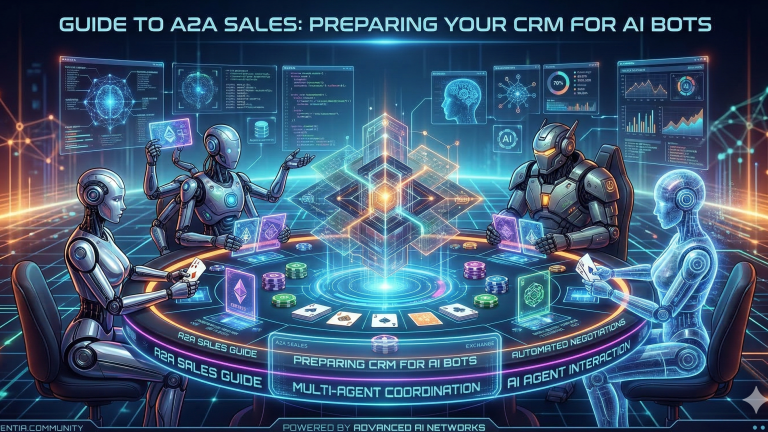
The landscape of B2B sales is undergoing a profound transformation, driven by the rapid emergence of autonomous AI agents. These intelligent bots are no longer confined to lead qualification or customer service; they are now capable of direct negotiation and procurement, fundamentally altering how deals are struck. This shift towards Agent-to-Agent (A2A) sales necessitates a radical re-evaluation of traditional CRM infrastructures, which were designed for human-centric processes. Without a CRM system specifically prepared for bot-to-bot interactions, companies risk being sidelined in an increasingly automated marketplace.
Preparing your CRM for A2A sales is not merely an upgrade; it is a strategic imperative that determines your future competitive viability. This readiness involves restructuring data, enabling robust API access, embedding negotiation logic, and ensuring real-time data synchronization. Companies that proactively adapt their CRM will gain a decisive advantage, enabling faster deal cycles, reduced costs, and consistent decision-making in an era where AI agents handle an increasing volume of complex transactions.
What Is A2A Sales and Why It Matters Now
A2A (Agent-to-Agent) sales refers to commercial transactions and negotiations conducted autonomously between AI agents representing different entities, such as a vendor’s sales bot and a buyer’s procurement bot. This model differs significantly from traditional B2B sales, which rely on human sales representatives interacting directly with human buyers. The shift is already underway, with Gartner forecasting that 40% of enterprise applications will embed task-specific AI agents by the end of 2026, a substantial increase from less than 5% in 2025 according to Joget.
Procurement AI agents are now autonomously evaluating vendors and negotiating terms, driven by economic imperatives for cost reduction, speed, and decision consistency. McKinsey reports that autonomous category agents can achieve 25–40% efficiency improvements in procurement processes as highlighted by AiCerts. This acceleration impacts sales cycles dramatically, with lead generation automation tools, including AI, achieving a 25% improvement in sales cycle time compared to manual processes per Monday.com’s analysis.
Examples of companies leveraging AI agents in vendor selection and contract negotiation are emerging. Coupa uses “Navi” agents integrated into ERP-tied spend suites for negotiations, with customers reportedly saving $15 billion according to AiCerts. SAP’s “Joule” agents are extending to bid analysis and contract workflows, while specialists like Keelvar deploy sourcing bots for logistics RFQs, covering 90% of tactical spend with reported 70% cycle time drops in pilot programs as noted by AiCerts. These developments signal a critical need for B2B sales organizations to prepare their CRM for bot-to-bot interactions.
Photo by Negative Space
The 4 Pillars of A2A-Ready CRM Architecture
Achieving A2A readiness in your CRM hinges on establishing four foundational pillars that enable seamless bot-to-bot interaction and autonomous deal-making. These pillars redefine the traditional CRM’s role from a human sales assistant to a central intelligence hub for AI agents.
Pillar 1: Machine-Readable Product Catalogs with Structured Pricing Data
Machine-readable product catalogs are essential for AI agents to understand and process product offerings without human interpretation. This involves standardizing product information and ensuring it is consumable by algorithms. Products with complete schema markup are 4.2x more likely to appear in Google Shopping results according to Almcorp, demonstrating the importance of structured data for machine visibility.
Key aspects include:
Standardizing product names, SKUs, and descriptions.
Implementing Schema.org markup for clear categorization.
Embedding detailed technical specifications and compatibility information.
Maintaining up-to-date inventory and capacity data feeds.
Pricing data must be meticulously structured, including clear discount rules, volume tiers, and geographical variations. This allows AI agents to query pricing, apply appropriate discounts, and construct accurate proposals autonomously. Outdated data confuses search engines and users, so accuracy is paramount per Atak Interactive.
Pillar 2: API-First Architecture That Allows Agent Access Without Human Gatekeeping
An API-first architecture ensures that your CRM’s functionalities and data are programmatically accessible to AI agents. This moves beyond traditional integrations designed for human-facing applications, prioritizing secure, machine-to-machine communication channels. APIs are critical to business strategy for 89% of enterprises per Postman’s 2024 API report, highlighting their foundational role.
Essential elements include:
Exposing well-documented and robust API endpoints for all critical sales data.
Implementing secure authentication and authorization protocols for bot access.
Designing APIs for efficiency, minimizing latency in data exchange.
Supporting webhooks and event-driven architecture for real-time updates.
This proactive API design eliminates the need for human intervention in data retrieval or action initiation, allowing agents to operate with maximum autonomy. A unified CRM API is particularly powerful for agentic workflows as noted by Truto.
Pillar 3: Automated Negotiation Parameters and Approval Workflows
Automated negotiation parameters and approval workflows encode your sales playbook directly into the CRM, enabling agents to negotiate within predefined boundaries. This transforms static sales policies into executable logic. By 2027, 50% of organizations will use AI-enabled contract negotiation tools according to Icertis.
Key components involve:
Defining acceptable price ranges, discount thresholds, and payment terms.
Establishing automated approval chains for deals exceeding certain parameters.
Creating constraint-based negotiation frameworks that agents follow.
Integrating with contract management and e-signature systems for autonomous deal closure.
This pillar ensures that all agent-conducted negotiations adhere to company policies, reducing risk and accelerating the sales cycle. The goal is to encode the sales playbook as executable logic rather than relying on human interpretation of PDF documents.
Pillar 4: Real-Time Data Accuracy and Synchronization Across Systems
Real-time data accuracy and synchronization are non-negotiable for autonomous deal-making. AI agents require the most current information on inventory, pricing, customer history, and market conditions to make optimal decisions. The data integration market, crucial for real-time synchronization, is valued at $15.18 billion in 2026 according to Integrate.io.
Critical aspects include:
Eliminating data silos between CRM, ERP, inventory, and other systems.
Implementing robust data validation and cleansing processes.
Ensuring instantaneous updates across all integrated platforms.
Leveraging streaming analytics for immediate insights relevant to negotiations.
Fragmented data prevents agents from accessing complete vendor profiles and can lead to erroneous proposals or missed opportunities. You cannot build autonomous operations on top of fragmented data according to LogicMonitor.
Traditional CRM vs A2A-Ready CRM: Key Differences
This table compares the fundamental architectural and operational differences between legacy CRM systems built for human sales teams and modern A2A-ready CRM systems designed for bot-to-bot negotiations. Understanding these differences is critical for planning your transformation roadmap.
Medium: Integration with CLM, template standardization.
Structuring Your CRM Data for Bot Consumption
Structuring your CRM data for bot consumption is the foundational step in enabling A2A sales, converting fragmented information into actionable intelligence for AI agents. This transition moves beyond human-readable notes to precisely defined, machine-interpretable data points.
Key steps include:
Converting Unstructured Notes: Utilize natural language processing (NLP) to extract key entities (e.g., product interests, budget, timeline, decision-makers) from unstructured human notes and map them to structured fields within the CRM.
Implementing Schema.org Markup: Adopt Schema.org standards for product information, services, and company profiles. This provides universally recognized semantic tags that AI agents can easily parse and understand. Products with complete schema markup are 4.2x more likely to appear in Google Shopping results according to Almcorp, highlighting the importance of this structure.
Creating Machine-Readable Pricing Matrices: Develop dynamic pricing matrices where every discount, volume tier, and special term is explicitly defined and linked to specific product or customer attributes. This allows agents to calculate prices accurately and apply rules consistently.
Eliminating Data Silos: Integrate your CRM with ERP, inventory management, customer support, and marketing automation systems to create a unified data fabric. This ensures agents have a holistic view of the customer and product landscape.
Data governance is paramount; establish clear rules for data entry, validation, and maintenance to ensure ongoing accuracy and reliability for AI agents. This process ensures that agents can operate with the same, or even greater, contextual understanding as a human sales representative.
Photo by Lukas Blazek
Building Negotiation Logic Into Your CRM Workflows
Building negotiation logic directly into your CRM workflows transforms your sales playbook from static guidelines into dynamic, executable programs for AI agents. This enables autonomous negotiation within predefined boundaries, empowering bots to make offers and counter-offers.
The process involves:
Setting Automated Approval Chains: Configure multi-level approval workflows that trigger based on specific deal parameters, such as discount percentage, contract length, or payment terms. For instance, a 15% discount might be auto-approved, while a 25% discount requires senior sales leadership approval.
Creating Dynamic Pricing Rules: Implement rule-based engines that allow agents to query and adjust pricing based on real-time factors like inventory levels, customer segment, deal size, or competitive intelligence. This moves beyond static price lists.
Implementing Constraint-Based Negotiation Frameworks: Define the “acceptable zone” for negotiations. This includes minimum acceptable margins, maximum concessions, and non-negotiable terms (e.g., legal clauses). Agents operate strictly within these guardrails.
Encoding Sales Playbooks as Executable Logic: Translate your sales strategies – objection handling, upselling opportunities, cross-selling prompts – into conditional logic that AI agents can execute. This shifts from human interpretation to automated action, ensuring consistent application of best practices.
This proactive approach allows AI agents to engage in complex negotiations, ensuring compliance with company policies while optimizing deal outcomes. Critically, these workflows must be auditable, providing clear logs of agent decisions and their underlying logic.
API and Integration Requirements for A2A Readiness
API and integration requirements for A2A readiness are centered on creating a highly interconnected and accessible CRM ecosystem that supports autonomous agent interactions. An API-first approach is fundamental, treating APIs as primary products that enable bot-to-bot communication.
Essential elements your CRM must provide include:
Exposing Key API Endpoints: Your CRM needs robust, well-documented APIs for querying product catalogs, retrieving customer histories, submitting proposals, and updating deal stages. These APIs must be performant and reliable for real-time interactions.
Implementing Secure Authentication Protocols: Bot-to-bot communications require stringent security. This includes OAuth 2.0 for token-based authentication, API keys with granular permissions, and mutual TLS for encrypted communication channels.
Integration with Contract Management (CLM) and E-signature Systems: For autonomous deal closure, AI agents must be able to generate, modify, and secure e-signatures for contracts directly through integrated CLM platforms. This streamlines the final stages of the sales cycle.
Real-Time Inventory and Capacity Data Feeds: Agents need instantaneous access to inventory levels, production capacity, and service availability to make accurate commitments and avoid overselling. This requires direct, low-latency integrations with ERP and supply chain systems.
By prioritizing these API and integration capabilities, you empower AI agents to operate seamlessly across your technology stack, enabling true end-to-end autonomous sales processes. The data integration market, valued at $15.18 billion in 2026, is projected to reach $30.27 billion by 2030, growing at a 12.1% CAGR according to Integrate.io, underscoring the importance of these integrations.
Photo by Leeloo The First
Testing and Validating Your A2A Sales Infrastructure
Testing and validating your A2A sales infrastructure is crucial to ensure reliability, security, and optimal performance before full deployment. This involves simulating bot negotiations and rigorously stress-testing your CRM setup under various scenarios.
Key steps for thorough validation include:
Simulating Agent Negotiations: Develop sophisticated testing environments that mimic real-world bot-to-bot interactions. This includes simulating both your sales agents and external procurement agents, running through various negotiation paths, and testing edge cases.
Monitoring Key Metrics: Track critical performance indicators such as response time, data accuracy in proposals, negotiation success rate within acceptable parameters, and the time taken for autonomous deal closure. Establish baselines and targets for these metrics.
Identifying Common Failure Modes: Pay close attention to instances where bots encounter unstructured or incomplete data, leading to errors or stalled negotiations. These are often indicators of data governance gaps or insufficient schema implementation.
Creating a Staged Rollout Plan: Begin with pilot programs involving low-value, tactical deals or specific product lines. Gradually expand A2A enablement to more complex scenarios, incorporating lessons learned from each stage. This phased approach minimizes risk and allows for iterative improvement.
Thorough testing not only identifies vulnerabilities but also refines your negotiation logic and data structures, building confidence in your autonomous sales capabilities. Gartner recommends a phased rollout, starting with tactical buying and expanding to strategic categories as suggested by AiCerts.
Photo by Leeloo The First
Case Study: How a $200M SaaS Company Reduced Sales Cycle by 67% with A2A-Ready CRM
A mid-market B2B SaaS company, specializing in supply chain optimization software with an average deal size of $75,000, faced challenges with lengthy sales cycles (averaging 90 days) and high sales rep overhead for quoting and negotiation. Their traditional CRM, Salesforce, was primarily used for human activity tracking and manual quote generation.
The company embarked on a CRM transformation journey to enable A2A sales. They initiated the RAPID A2A Readiness Framework:
Restructure Data: They invested 3 months in cleaning and standardizing their product catalog data, implementing Schema.org for all product features, and creating granular pricing matrices that accounted for volume discounts and regional variations.
API-Enable: Over 4 months, their RevOps team, in collaboration with engineering, developed a suite of secure, real-time APIs for their Salesforce instance. These APIs exposed product data, customer history, and deal parameters to their custom-built sales AI agents.
Parameters Encode: They spent 2 months defining and encoding negotiation logic directly into Salesforce workflows. This included automated approval thresholds for discounts (e.g., up to 10% auto-approved, 10-20% requiring management review), and constraint-based rules for contract terms.
Integrate Systems: A 3-month integration phase connected Salesforce with their ERP (SAP for inventory and billing) and their CLM system (DocuSign CLM). This provided real-time inventory checks and enabled autonomous contract generation and e-signature.
Deploy and Test: A 2-month pilot program focused on lower-value, standardized deals. They simulated thousands of bot-to-bot negotiations, identifying and rectifying data inconsistencies and logic flaws.
The results were transformative. The average sales cycle for deals under $100,000 plummeted from 90 days to 30 days, a 67% reduction. Win rates for bot-negotiated deals improved by 15% due to consistent, optimized proposals. The cost per acquisition for these deals dropped by 40% by reallocating human sales reps to more complex, strategic accounts. The company’s NRR rose from 95% to 112% in 6 months, as seen in similar SaaS growth examples.
Lessons learned included the critical importance of a dedicated data governance team and the need for continuous monitoring of agent performance. They also found that while AI handled initial negotiations, human oversight and intervention were still crucial for highly customized or strategic opportunities, shifting the human role to strategic partnership management.
Photo by RDNE Stock project
Conclusion: Your A2A Readiness Roadmap
The advent of A2A sales marks an irreversible shift in B2B commerce, demanding a proactive CRM transformation. Companies that fail to prepare their infrastructure for bot-to-bot negotiations risk significant competitive disadvantage, including slower sales cycles and an inability to participate in automated procurement processes. The RAPID A2A Readiness Framework offers a structured approach to this critical evolution.
Immediate actions should focus on data standardization, API development, and the encoding of sales logic into your CRM. The competitive advantage of being A2A-ready before your competitors is substantial, enabling faster deal velocity, lower costs, and enhanced decision consistency. As AI agents become ubiquitous in procurement and sales through 2026-2027, prioritizing this infrastructure over traditional sales headcount will be a defining factor for market leadership.
Key Takeaways
A2A sales, where AI agents negotiate autonomously, is rapidly becoming the standard in B2B, necessitating CRM adaptation.
The RAPID A2A Readiness Framework provides a structured, five-phase methodology for transforming traditional CRMs into bot-negotiation platforms.
Key pillars of A2A readiness include machine-readable product catalogs, API-first architecture, automated negotiation logic, and real-time data synchronization.
CRM data must be meticulously structured using standards like Schema.org to be consumable by AI agents.
Implementing automated approval chains and dynamic pricing rules within CRM workflows is crucial for autonomous negotiation.
Robust APIs and secure integrations with CLM and ERP systems are essential for end-to-end bot-to-bot deal closure.
Thorough testing and a phased rollout plan are vital to validate A2A infrastructure and mitigate risks.
Companies that embrace A2A readiness can significantly reduce sales cycles and improve win rates, reallocating human sales efforts to strategic roles.
Frequently Asked Questions
What is A2A sales and how is it different from regular B2B sales
A2A (Agent-to-Agent) sales involves autonomous AI agents conducting commercial transactions and negotiations directly with other AI agents, without human intervention. This differs from traditional B2B sales, which relies on human sales representatives interacting with human buyers, offering significantly faster deal cycles and enhanced decision consistency.
Do I need to completely replace my CRM to support A2A sales
No, a complete CRM replacement is often unnecessary. Most modern CRMs can be adapted for A2A sales through strategic enhancements like API layer development, extensive data restructuring, and robust integrations with other systems. The focus is on incremental transformation rather than a full overhaul.
How long does it take to make a CRM A2A-ready
The timeline for A2A CRM readiness varies based on current CRM maturity and company size, but typically ranges from 3-6 months for basic functionality to 9-12 months for comprehensive implementation. This includes phases for data cleansing, API development, logic encoding, and rigorous testing. Explore AI Revenue Team Orchestration Multi-Agent Systems Guide.
What are the biggest risks of not preparing for A2A sales
Companies that do not prepare for A2A sales face a significant competitive disadvantage, including an inability to participate in automated RFPs and procurement processes. This leads to longer sales cycles compared to A2A-ready competitors, increased cost per acquisition, and ultimately, market share loss as buyers increasingly use procurement agents.
Which CRM platforms are best for A2A sales
CRM platforms with strong, open API capabilities and flexible workflow automation engines are best suited for A2A sales, such as Salesforce, Microsoft Dynamics 365, and HubSpot. The key evaluation criteria should focus on the platform’s ability to integrate with other systems, support structured data, and allow for the encoding of complex negotiation logic. Explore integrating AI into your CRM.
How much does it cost to transform a CRM for A2A readiness
The cost of transforming a CRM for A2A readiness can range from $50,000 for smaller, less complex implementations to over $500,000 for large enterprises with extensive data and integration needs. This investment covers data cleansing, API development, workflow automation, and comprehensive testing phases.
Can small businesses benefit from A2A sales or is it only for enterprises
Small businesses can significantly benefit from A2A sales, often more so than enterprises, by leveraging autonomous agents to scale sales efforts without increasing headcount. Scaled-down approaches using readily available SaaS tools and focused automation for specific deal types can enable A2A capabilities even without large enterprise budgets. Explore AI-driven CRM workflows.
What happens to human sales teams when A2A sales becomes standard
Human sales teams will evolve from executing transactional deals to focusing on high-value activities such as strategic relationship building, complex deal structuring, and creative problem-solving that AI agents cannot yet handle. The role shifts from transaction execution to strategic partnership management and oversight of AI agent performance.
How do you measure success of A2A sales implementation
Success in A2A sales implementation is measured through key metrics such as deal velocity (time to close), negotiation success rate within acceptable parameters, cost per acquisition for bot-initiated deals, agent engagement rate, and the proportion of total revenue generated through autonomous transactions. Explore autonomous AI agents.
What security concerns exist with bot-to-bot negotiations
Security concerns for bot-to-bot negotiations include robust authentication of agents, ensuring data privacy during exchanges, validating contract authenticity, preventing fraud through malicious agent impersonation, and maintaining comprehensive audit trails of all negotiation steps. Specific protocols like OAuth 2.0, mutual TLS, and granular API permissions are crucial for securing these interactions.
Key Terms Glossary
A2A Sales: Commercial transactions and negotiations conducted autonomously between AI agents representing different entities. Explore Agentic AI.
API-First Architecture: A design approach where the primary method of interaction with a system is through its application programming interfaces, facilitating machine-to-machine communication.
Schema.org Markup: A collaborative, community-driven effort to create structured data schemas that can be added to web pages, making them easier for search engines and AI agents to understand.
Negotiation Logic: Predefined rules, parameters, and decision-making frameworks encoded into a CRM that guide AI agents in making offers, counter-offers, and concessions during sales discussions.
Data Silos: Isolated repositories of data that are not integrated with other systems, hindering a holistic view and preventing efficient data exchange for AI agents.
Agentic AI: Artificial intelligence systems capable of autonomous action, planning, and execution towards a goal, often involving multiple steps and interactions with other systems or agents.
Real-Time Data Synchronization: The process of instantly updating and aligning data across multiple systems, ensuring that AI agents always access the most current information for decision-making.
Contract Lifecycle Management (CLM): Software solutions that manage the entire lifecycle of contracts, from creation and negotiation to execution, storage, and renewal, often integrated with A2A systems for autonomous deal closure.
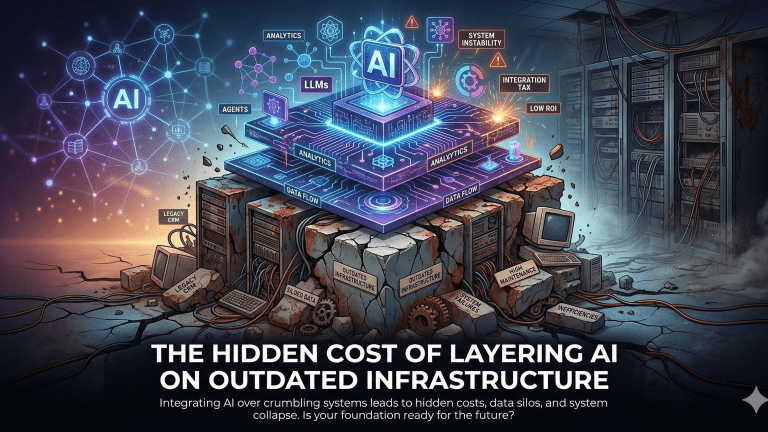
Just like Building a house, AI – Needs a Strong Foundation
Companies often invest heavily in agentic AI, expecting transformative results, only to find their efforts hampered by underlying infrastructure. For instance, an $800,000 investment in cutting-edge AI might yield a mere 12% adoption rate because the legacy CRM systems cannot support the required data flows. This isn’t just a slowdown; outdated infrastructure creates an exponential failure cost, silently eroding ROI and competitive advantage. This article reveals the true cost breakdown and provides a critical decision framework for addressing infrastructure debt before it cripples your AI initiatives.
The Infrastructure Readiness Gap: Why Your Stack Isn’t AI-Ready
Your current technology stack, especially older CRMs and sales tools, was fundamentally built for human workflows, not the autonomous orchestration demanded by agentic AI. Agentic AI requires three critical infrastructure layers: robust data quality and consistency, real-time API connectivity and synchronization, and sufficient compute and processing capacity. Legacy systems frequently lack the APIs or modern data formats needed for seamless AI integration, according to Berkeley CMR.
The silent killers of agentic AI adoption are data silos, batch processing delays, and rigid field structures. These issues break down the continuous, real-time data exchange essential for AI agents to operate effectively and make accurate decisions. Without addressing these foundational weaknesses, AI implementations will struggle to achieve their promised potential, leading to low adoption rates and inflated costs.
The Real Cost Breakdown: Where the Money Actually Goes
Layering agentic AI onto inadequate infrastructure incurs significant financial penalties, both direct and indirect. Direct costs include expensive integration middleware, extensive data cleaning and normalization efforts, API rate limit upgrades, and custom development to bridge system gaps. For example, API and middleware integration can cost $2,000–$9,000 initially, with monthly upkeep ranging from $200–$2,000 as estimated by RTS Labs.
Indirect costs are often far greater. They encompass extended implementation timelines, which can stretch from a projected 2-3 months to 6-9 months for basic agents on modern platforms. Reduced AI accuracy due to poor data quality leads to diminished business outcomes, and ongoing maintenance overhead becomes a constant drain. The opportunity cost is arguably the most damaging: while wrestling with infrastructure, companies lose competitive advantage by delaying the optimization of AI performance and the realization of its strategic benefits.
Photo by Brett Sayles
The 3 Infrastructure Debt Scenarios (And What Each One Costs)
Understanding your company’s infrastructure debt level is crucial for accurately forecasting agentic AI implementation costs and success rates. These scenarios quantify the impact of existing tech stack maturity on AI projects. Gartner predicts that over 40% of agentic AI projects will fail by 2027 due to issues like inadequate foundations.
This table compares three common infrastructure scenarios companies face when implementing agentic AI, showing the real cost and timeline differences based on infrastructure maturity. It helps revenue leaders quickly assess where they fall and what to expect.
Infrastructure Scenario
Total Implementation Cost
Timeline to Production
Expected AI Adoption Rate
Primary Risk Factors
Modern Stack (0-3 years old, clean data)
$200K-$400K
2-3 months
70%+
Minor integration tweaks, user training.
Mid-Age Stack (5-8 years old, moderate data issues)
$600K-$1.2M (incl. fixes)
6-9 months
40-50%
Data normalization complexity, API rate limits, integration middleware.
Legacy Stack (10+ years old, severe data quality issues)
$1.5M-$4M+
12-18 months
15-25% (high failure risk)
Extensive data migration/cleaning, custom API development, system rewrite.
Hybrid Stack (mix of modern and legacy with silos)
$1M-$2.5M (variable)
9-15 months
30-45%
Data governance, conflicting schemas, complex API orchestration.
Greenfield (new implementation, no legacy debt)
$300K-$700K
4-6 months
80%+
Initial setup complexity, vendor lock-in.
The Fix-First vs. Layer-Anyway Decision Framework
The choice between fixing infrastructure first or layering AI directly depends on the severity of your infrastructure debt and your competitive landscape. Trullion analysis suggests that “the real issue is the wrong AI projects being prioritized,” often due to outdated ROI expectations.
When to Fix Infrastructure First
Prioritize infrastructure modernization when you face severe data quality issues (e.g., >30% duplicate or incomplete records), your core systems are older than 8-10 years, or your intended AI use cases are mission-critical and cannot tolerate failures. This approach, while initially slower, builds a solid foundation for sustainable, high-performing AI. Firms with standardized IaC and governance, like JP Morgan Chase, saw 38% fewer incidents after implementing agentic platforms.
When You Can Layer AI Anyway
You can consider layering AI directly if your stack is relatively modern with only isolated data issues, or if the AI use case is non-critical and intended for testing and learning. This strategy is also viable when competitive pressure demands immediate, albeit potentially limited, AI deployment for specific functions. However, be prepared for potential integration nightmares and data silos if foundational problems are ignored.
The Hybrid Approach
The most pragmatic strategy for many enterprises is a hybrid approach. This involves parallel infrastructure modernization while piloting agentic AI in contained environments. This allows for iterative learning and value demonstration without pausing critical infrastructure work.
Photo by Brett Sayles
What Modern AI-Ready Infrastructure Actually Looks Like
Modern AI-ready infrastructure is a comprehensive ecosystem designed for dynamic, autonomous operations. Technologically, it features a unified data model across all systems, real-time API connectivity, and flexible schemas that support AI-generated fields and insights. Architectures should be API-first and cloud-native, emphasizes Berkeley CMR.
Operationally, this requires robust data governance processes, clear ownership of data quality, and strong cross-functional alignment among RevOps, IT, and AI teams. These elements ensure data integrity and system reliability, which are paramount for AI agent orchestration. Sentia AI’s orchestration platform is specifically designed to bridge these infrastructure gaps by providing pre-built integrations, a data normalization layer, and adaptive workflows that seamlessly work with existing systems, even those with moderate debt. This approach enables AI agent orchestration without requiring a full system overhaul.
The 90-Day Infrastructure Readiness Sprint
A focused 90-day sprint can kickstart your journey toward AI-ready infrastructure. This structured approach helps identify critical gaps and implement targeted fixes, paving the way for successful agentic AI deployments.
Phase 1 (Days 1-30): Infrastructure Audit
Conduct a thorough data quality assessment, mapping API connectivity, and identifying bottlenecks. This includes analyzing duplicate rates, data completeness, and system integration points. RevOps leaders emphasize that AI adoption is moving faster than data readiness, making this audit crucial.
Phase 2 (Days 31-60): Quick Wins Implementation
Address critical data cleaning issues and implement key integration fixes. Set up a pilot environment for initial AI testing. This phase focuses on high-impact, low-effort changes that yield immediate improvements.
Phase 3 (Days 61-90): AI Pilot Launch
Deploy a contained agentic AI pilot, meticulously monitoring its performance and validating ROI. This allows for controlled learning and adjustment before a broader rollout. This phased approach helps avoid a bad AI install.
Photo by panumas nikhomkhai
Conclusion: The Infrastructure-First Advantage
The companies truly winning with agentic AI in 2026 are those that made strategic investments in infrastructure modernization in 2024-2025. This infrastructure-first approach ensures a solid foundation for AI, leading to higher adoption rates and tangible ROI. The ROI on infrastructure investment can pay back 3-5x through faster AI adoption, increased accuracy, and reduced ongoing maintenance costs. Menlo Ventures’ Venky Ganesan notes that “2026 is the ‘show me the money’ year for AI,” reinforcing the need for measurable returns.
The strategic imperative for revenue leaders is clear: assess your infrastructure readiness now and build a compelling business case for a fix-first or hybrid approach. Only then can you fully unlock the transformative power of agentic AI.
Photo by Field Engineer
Key Takeaways
Outdated infrastructure creates an exponential failure cost, not just performance slowdowns for agentic AI.
Legacy CRM and sales tools were built for human workflows, lacking the data quality, real-time APIs, and compute for autonomous AI.
Direct and indirect costs of layering AI on poor infrastructure can inflate total project costs by 2-5x.
Companies with severe infrastructure debt (10+ years old systems, major data issues) face $1.5M-$4M+ costs and low AI adoption.
An infrastructure-first approach or hybrid strategy yields 3-5x ROI through faster AI adoption, higher accuracy, and reduced maintenance.
A 90-day infrastructure readiness sprint can audit, implement quick wins, and launch a contained AI pilot for validation.
Frequently Asked Questions
How do I know if my infrastructure is ready for agentic AI?
Your infrastructure is ready for agentic AI if it exhibits high data quality (under 10% duplicate or incomplete records), modern API capabilities for real-time data exchange, and seamless cross-system connectivity. Assess your systems for these three critical areas to determine readiness.
What is the average cost of fixing infrastructure before implementing AI?
The average cost of fixing infrastructure varies significantly by debt level; minimal fixes might cost $50K-$150K, moderate overhauls range from $200K-$500K, and severe modernization efforts can exceed $500K-$1.5M. These costs cover data cleaning, API development, and system integrations.
Can I implement agentic AI on a legacy CRM like older Salesforce versions?
Yes, you can implement agentic AI on older Salesforce versions, but it will likely require significant middleware, custom integrations, and data synchronization tools to bridge functionality gaps. A full modernization might be necessary for mission-critical applications to avoid severe limitations and high failure rates.
How long does infrastructure modernization take before AI deployment?
Infrastructure modernization timelines vary based on scope; quick fixes can take 30-60 days, a moderate overhaul typically requires 3-6 months, and a full modernization effort can span 6-12 months. A hybrid approach allows for parallel AI piloting while modernization progresses.
What are the signs my infrastructure is causing AI implementation to fail?
Key signs that your infrastructure is hindering AI include low AI adoption rates (below 30%), frequent data synchronization errors, AI agents making decisions based on stale or inaccurate data, recurring integration timeouts, and user complaints about the AI’s reliability or accuracy. Explore Agentic AI.
Is it better to fix infrastructure first or implement AI and fix issues later?
It is generally better to fix infrastructure first if you have severe data quality issues or very old systems, as this ensures a stable foundation for AI. However, if competitive pressure is high and issues are isolated, a “layer-anyway” or hybrid approach might be considered for non-critical use cases.
What does AI-ready infrastructure actually look like in 2026?
AI-ready infrastructure in 2026 features a unified data model across all systems, real-time API connectivity, flexible schemas that support AI-generated insights, and a cloud-native, API-first architecture. It also includes robust data governance and cross-functional alignment.
How much does poor infrastructure increase the total cost of AI implementation?
Poor infrastructure can increase the total cost of AI implementation by 2-5x through extended project timelines, the need for extensive custom development, higher ongoing maintenance overhead, and a reduced ROI resulting from low AI adoption and accuracy issues.
What is the ROI of infrastructure modernization before AI deployment?
Infrastructure modernization before AI deployment typically yields a 3-5x return on investment through faster AI implementation, significantly higher adoption rates (70%+ compared to 20-30%), improved AI accuracy, and reduced long-term operational costs. This ROI is realized through enhanced efficiency and better business outcomes. Explore what really works and doesn’t in Agentic AI.
Can Sentia AI work with my existing outdated infrastructure?
Yes, Sentia AI’s orchestration platform is specifically designed to bridge infrastructure gaps by providing pre-built integrations, a data normalization layer, and adaptive workflows that work with existing systems. While some foundational stability is beneficial, Sentia AI helps maximize value from your current tech stack while you plan for modernization.
Key Terms Glossary
Agentic AI: Artificial intelligence systems capable of autonomous decision-making and task execution based on predefined goals and environmental feedback.
Infrastructure Debt: The accumulated cost and complexity arising from maintaining outdated or poorly integrated technology systems that hinder new technology adoption.
Data Normalization: The process of organizing data to eliminate redundancy and improve data integrity, making it consistent and usable across different systems. Explore why 95% of enterprise AI pilots are failing.
API Connectivity: The ability of different software systems to communicate and exchange data in real-time through Application Programming Interfaces.
CRM: Customer Relationship Management, a technology used to manage and analyze customer interactions and data throughout the customer lifecycle.
RevOps (Revenue Operations): A strategic function that optimizes the revenue generation process by aligning sales, marketing, and customer service teams.
Opportunity Cost: The loss of potential gain from other alternatives when one alternative is chosen, such as delaying AI benefits due to infrastructure issues.
Maintaining conversational continuity across diverse user interfaces is a critical challenge for modern AI applications. Users frequently switch between mobile, web, and desktop platforms, expecting their AI assistant to remember previous interactions and preferences. This seamless experience is often disrupted by context loss, leading to user frustration and reduced application value.
Cross-platform context loss occurs when an AI system fails to retain and retrieve a user’s interaction history, preferences, and ongoing session details as they transition between different devices or platforms. This architectural gap necessitates robust solutions like Retrieval-Augmented Generation (RAG) to ensure persistent and accessible user context.
Understanding RAG Architecture for Context Persistence
RAG provides an architectural solution for context persistence by externalizing and indexing conversational history outside the Large Language Model (LLM) itself. This approach grounds LLM responses in real-time, relevant user data, regardless of the platform of origin.
Core RAG components include a retrieval system, a vector database, an embedding model, and a generation layer.
Unlike stateless API calls or session-only memory, RAG uses vector embeddings to semantically represent user interactions, creating a bridge for context across platforms.
Metadata tagging within the vector database is crucial for filtering and retrieving context specific to a user, session, or platform identifier.
This architecture allows for dynamic context retrieval, ensuring that an AI system can access a user’s previous queries or preferences even if they initiate a new interaction on a different device.
Step 1: How to Design Your Context Storage Strategy
Effective cross-platform context persistence begins with a well-designed storage strategy, primarily centered around selecting the right vector database and defining the data schema. Choosing a vector database involves balancing performance, cost, and deployment flexibility for 2026 production use cases.
Leading options include Pinecone, Weaviate, and Qdrant, each offering distinct advantages for RAG workloads according to AIMultiple.
A crucial schema design incorporates fields such as userid, sessionid, platformidentifier, and a timestamp to enable granular context retrieval across various dimensions.
Deciding context retention windows (e.g., 24 hours, 30 days, or indefinite) requires balancing user experience with privacy and compliance considerations, especially concerning regulations like GDPR or CCPA as highlighted by 2026 AI laws.
For instance, an e-commerce chatbot might retain shopping cart context indefinitely but conversational history for only 30 days to meet data minimization policies.
Photo by Field Engineer
Vector Database Options for Cross-Platform RAG (2026)
Compares leading vector databases for storing and retrieving cross-platform context, focusing on latency, cost, and multi-platform support features critical for RAG implementations.
Raw performance, cost-efficiency, hybrid deployments
Chroma
Basic metadata filtering
Dependent on local setup
Free (open-source)
Local development, small-scale applications
Milvus
Robust metadata filtering, high scalability
Highly scalable
Varies (self-host/cloud)
Large-scale, complex enterprise systems
Step 2: Implement Cross-Platform Retrieval Logic
The retrieval logic must intelligently fetch context that spans platform boundaries, ensuring continuity for the user. This involves semantic search combined with precise metadata filtering.
Hybrid search, combining vector similarity with metadata filters, is essential for accurate context retrieval as noted by Dataquest. This approach allows developers to query for semantically similar interactions while also filtering by specific user IDs or platform types. Explore LLMs.
Ranking retrieved context is crucial, often prioritizing recency and relevance scores to provide the most pertinent information to the LLM. For example, when a user transitions from a mobile session to a web application, the system can query the vector database using their userid, retrieve recent mobile interactions, and filter by timestamp to prioritize the latest context from any platform.
Step 3: Handle Context Merging and Conflict Resolution
When context from different platforms or sessions overlaps or conflicts, robust strategies are needed to merge information effectively and resolve discrepancies. This ensures a coherent and consistent user experience.
Timestamp-based priority is a common strategy, favoring the most recent piece of information. Alternatively, platform-based priority might be implemented, giving precedence to context from a primary platform (e.g., desktop for complex tasks) over others.
Graceful degradation is vital when context is incomplete or unavailable; the system should still provide a reasonable response, perhaps by asking clarifying questions. User controls, such as allowing manual context resets or selective forgetting of specific interactions, empower users and enhance privacy adherence according to Maxim AI.
Photo by Leeloo The First
The 3-Layer Context Persistence Model
To optimize latency and cost, we propose the 3-Layer Context Persistence Model for architecting RAG systems. This framework segregates context based on its immediacy and importance, allowing for targeted retrieval.
Immediate Layer: Stores the last 5-10 interactions, designed for sub-100ms retrieval. This layer typically resides in a fast in-memory store (like Redis) or a highly optimized vector cache.
Session Layer: Contains the full context for the current platform session, aiming for 100-300ms retrieval. This is often stored in the primary vector database, filtered by sessionid and platformidentifier.
Historical Layer: Encompasses all cross-platform long-term memory, with retrieval latencies between 300-500ms. This layer is the most comprehensive, leveraging the full capabilities of the vector database and metadata filtering.
This layered approach retrieves only the necessary context depth for each user interaction, avoiding costly and slow retrievals of irrelevant historical data. Explore understanding shared tenancy vs. siloed LLMs.
Step 4: Optimize for Latency and Cost
Achieving sub-second latency in production RAG systems, especially for cross-platform context, requires careful optimization at every stage. Cost management is equally important, particularly with embedding and storage expenses.
Caching frequently accessed context locally per platform can significantly reduce retrieval latency, often achieving <5ms for exact matches in real-time RAG pipelines.
Batch embedding generation reduces API calls to embedding models, which can be a significant cost factor; OpenAI’s text-embedding-3-small costs $0.02 per 1M tokens, making it highly efficient for text-only use cases per OpenAI pricing.
Monitoring context retrieval latency across platforms helps identify bottlenecks, with P95 latency targets often below 180ms for large-scale vector stores at 10B vector scales.
RAG implementation costs range from $3,000 for basic setups to over $500,000 for enterprise platforms, with monthly operational costs from $3,000 to $150,000+, depending on complexity and scale.
Photo by cyber2120
Testing and Monitoring Cross-Platform Context
Rigorous testing and continuous monitoring are essential to ensure the reliability and performance of cross-platform context persistence in RAG systems. Without these, user experience can quickly degrade.
Test scenarios should include context handoffs between mobile, web, and API interfaces, simulating real user journeys.
Key metrics to track include context retrieval accuracy, P95 latency, and user satisfaction scores, with tools like Ragas and DeepEval maturing for evaluation as recommended by Maxim AI.
A/B testing RAG-enabled experiences against stateless alternatives can quantify the value of persistent context in terms of engagement and task completion.
Debugging tools capable of tracing context flow across platforms are invaluable for identifying and resolving issues, ensuring that the AI consistently “remembers” user interactions.
Photo by Brett Sayles
Conclusion: Building Context-Aware AI Systems
Implementing RAG for cross-platform context loss transforms fragmented AI interactions into a fluid, intelligent user experience. By designing an intelligent context storage strategy, implementing sophisticated retrieval logic, and managing context merging effectively, engineering teams can deliver truly context-aware AI applications.
The 3-Layer Context Persistence Model offers a practical framework for optimizing these systems by balancing latency, cost, and context depth. This strategic approach provides a competitive advantage in 2026, where user satisfaction is intrinsically linked to seamless conversational continuity across devices. Future steps involve scaling to multi-user contexts and team-level memory, further enhancing the collaborative potential of AI systems.
Key Takeaways
Cross-platform context loss significantly degrades user experience and application value in AI systems.
RAG provides a robust architectural solution by externalizing and semantically indexing user interactions in a vector database.
The 3-Layer Context Persistence Model optimizes retrieval by segmenting context into immediate, session, and historical layers.
Selecting the right vector database (Qdrant for performance/cost, Pinecone for ease of use) and designing a metadata-rich schema are critical first steps.
Hybrid search and sophisticated ranking are essential for accurate and relevant cross-platform context retrieval.
Monitoring latency, managing embedding costs, and implementing graceful degradation are vital for production-ready RAG.
Frequently Asked Questions
What is cross-platform context loss in AI applications?
Cross-platform context loss refers to the problem where AI assistants fail to retain previous conversation history, user preferences, or ongoing session details when users switch between different devices like mobile, web, or desktop. This occurs because AI systems often treat each interaction as a new, stateless request, leading to repetitive questions and user frustration.
How does RAG solve cross-platform context problems?
RAG addresses cross-platform context by storing user interactions and relevant data externally in a vector database as embeddings. When a user interacts with the AI from any platform, the RAG system retrieves the most relevant historical context from this central store, grounding the LLM’s response and ensuring conversational continuity regardless of the access point.
Which vector database is best for cross-platform RAG in 2026?
For cross-platform RAG in 2026, Qdrant is often preferred for its raw performance (22ms p95 latency) and cost-efficiency ($45/month for 10M vectors), particularly for hybrid or self-hosted deployments according to a 2026 benchmark. Pinecone offers operational simplicity for managed SaaS, while Weaviate excels in multi-modal capabilities and flexible metadata filtering. Explore secure private LLM for AI data security.
How much does it cost to implement RAG for cross-platform context?
RAG implementation costs vary widely, from $3,000-$8,000 for basic setups to over $500,000 for enterprise-grade applications. Monthly operational costs can range from $3,000 to $150,000+, covering embedding generation, vector storage, and retrieval queries. For example, embedding a 10GB PDF dataset might cost around $8.39 one-time, with monthly vector database storage at approximately $114.48 per compute unit as detailed in RAG cost guides.
What is the typical latency for cross-platform context retrieval?
Typical P95 latency for cross-platform context retrieval in production RAG systems can range from sub-100ms for cached or immediate context to 180ms for large-scale vector stores (10B vectors) using HNSW indexing in 2026 benchmarks. Factors like vector database performance, network latency, and the complexity of retrieval queries significantly impact speed.
How long should I store user context across platforms?
Context retention windows depend on user expectations, application needs, and privacy regulations. Common durations range from 24 hours for transient information to 30 days or even indefinitely for critical user preferences or long-term projects. Organizations must balance long-term utility with data minimization principles and compliance with regulations like GDPR per 2026 AI laws.
Can RAG handle conflicts when context differs between platforms?
Yes, RAG can handle context conflicts through defined resolution strategies. Common approaches include timestamp-based priority, where the most recent interaction takes precedence, or platform-based priority, giving weight to context from a specific primary device. User controls, allowing manual overrides or selective forgetting, can also mitigate conflicts effectively. Explore private LLMs.
How do I test if my cross-platform RAG implementation is working?
Testing involves simulating real-world scenarios, such as a user starting a query on mobile and continuing on a web browser, then verifying the AI’s ability to recall previous details. Key metrics to monitor include context retrieval accuracy, P95 latency, and user satisfaction scores. Debugging tools that trace the flow of context across your RAG pipeline are essential for identifying any breakdowns.
What are the privacy implications of persistent cross-platform context?
Persistent cross-platform context raises significant privacy implications, including compliance with data protection regulations such as GDPR and CCPA. Organizations must implement clear data retention policies, provide users with the right to access and delete their data, and explore anonymization strategies to protect sensitive information stored in the vector database.
Is RAG overkill for simple cross-platform context needs?
RAG might be overkill for truly simple cross-platform context needs, such as merely passing a session token or a few key-value pairs between platforms. However, for applications requiring semantic understanding, complex conversational memory, or grounding responses in dynamic, extensive user histories, RAG becomes necessary to avoid the limitations of stateless systems and enhance user experience.
Key Terms Glossary
Retrieval-Augmented Generation (RAG): An AI framework that retrieves relevant information from an external knowledge base to ground the responses of a Large Language Model (LLM). Explore Private LLM vs. ChatGPT.
Vector Database: A specialized database designed to store and query high-dimensional vectors, which are numerical representations of data like text or images.
Embedding Model: An AI model that converts text, images, or other data into numerical vector embeddings, capturing their semantic meaning.
Cross-Platform Context Loss: The inability of an AI application to maintain a user’s conversational history and preferences as they switch between different devices or interfaces.
Hybrid Search: A retrieval technique that combines vector similarity search with traditional keyword-based search and metadata filtering for more comprehensive and accurate results.
P95 Latency: The 95th percentile of latency, meaning 95% of requests are processed within this specified time, indicating a system’s typical performance under load.
Metadata Tagging: The process of attaching descriptive information (metadata) to data points within a vector database to enable precise filtering and retrieval.
Graceful Degradation: The ability of a system to continue operating, possibly with reduced functionality, even when a component or service fails or context is incomplete.
Building an Orchestration Scorecard for AI Sales Teams
Traditional sales metrics often fall short for B2B teams heavily invested in AI tools, failing to capture the synergistic performance of integrated systems. While AI adoption is widespread, with 81% of sales teams experimenting or fully implementing AI, simply using tools doesn’t guarantee optimal outcomes according to Salesforce’s 2026 State of Sales report.
An orchestration scorecard bridges this gap by focusing on how well AI tools collaborate within the sales process, not just their individual usage. This framework measures the health of the entire AI ecosystem, providing a holistic view that traditional dashboards overlook.
Photo by Edmond Dantès
Why Traditional Sales Metrics Fail AI-Driven Teams
The proliferation of AI tools in B2B sales has created a paradox: high adoption rates don’t always translate to proportional sales outcomes. Many sales leaders find a significant disconnect between the number of AI tools implemented and the tangible revenue impact.
Traditional metrics like call volume, email send rates, or even individual tool dashboards often measure activity rather than the efficiency of the interconnected AI workflow. These metrics miss the crucial interactions and handoffs between different AI systems and human reps.
Orchestration, unlike individual tool usage, measures the seamless flow of data, insights, and actions across multiple AI platforms and human touchpoints. A scorecard designed for orchestration reveals where value is created or lost in these complex interactions.
What Is an Orchestration Scorecard?
An orchestration scorecard is a measurement framework designed to assess how effectively a suite of AI tools works together within a sales process to achieve desired outcomes. It moves beyond isolated tool performance to evaluate the entire AI ecosystem’s health.
This scorecard operates on three distinct layers: tool integration, workflow efficiency, and revenue impact. Focusing solely on individual AI tool performance overlooks the critical value created or destroyed at the intersection of these tools, where 60-70% of potential AI value is often lost.
Tool Integration: This layer assesses the seamless exchange of data and functionality between different AI platforms, such as CRM, prospecting tools, and conversational intelligence.
Workflow Efficiency: It measures the speed and quality of AI-to-human handoffs and the overall reduction in manual steps or delays within the sales cycle.
Revenue Impact: This final layer quantifies the direct contribution of orchestrated AI workflows to pipeline growth, deal velocity, and quota attainment.
Orchestration matters more than individual AI tool performance because integrated systems create compounding value. Fragmented tools lead to data silos and manual reconciliation, hindering overall productivity and ROI according to MarketsandMarkets research.
Photo by Edmond Dantès
The 5 Core Metrics Every Orchestration Scorecard Needs
Every effective AI sales orchestration scorecard must include key metrics that transcend individual tool performance, focusing instead on system-wide health and synergy. These metrics highlight points of friction or excellence in the integrated AI workflow.
Cross-tool data flow rate (percentage of data shared between systems)
This metric quantifies the completeness and timeliness of data transfer between your various AI tools and CRM. For instance, if your prospecting AI identifies a new lead, this score measures how quickly and accurately that data flows into your CRM and outreach platform.
Measurement: Percentage of critical data fields automatically synced between integrated systems.
Impact: Reduces manual data entry by reps, minimizes errors, and ensures all tools operate with the most current information.
Goal: Aim for 90%+ automated data flow for critical fields to avoid manual intervention and data decay.
This metric assesses how effectively AI systems transfer context and actionable insights to human sales reps. A high score means reps receive comprehensive, relevant information without needing to re-research or re-qualify.
Measurement: Rep satisfaction surveys on AI-provided context, percentage of AI-generated insights used in subsequent human actions, or a quality score based on manager review of handoff notes.
Goal: Achieve 80%+ rep satisfaction with AI-provided context and a high utilization rate of AI recommendations.
This metric is arguably the most critical because it dictates whether AI’s intelligence translates into human action and ultimately, revenue. Without quality handoffs, even the most sophisticated AI insights remain unused.
Workflow completion velocity (time from trigger to outcome)
This metric measures the time it takes for a sales workflow, initiated by an AI trigger, to reach its intended outcome. For example, the time from an AI identifying a high-intent lead to that lead receiving a personalized outreach sequence.
Measurement: Average time taken for specific, AI-driven sales processes (e.g., lead qualification to first contact, meeting scheduled to pre-call briefing delivered).
Impact: Directly reduces sales cycle length and improves responsiveness to buyer signals, with AI tools cutting sales cycles by 20-30% according to 11x.ai.
Goal: Reduce the average workflow completion time by 20% within 90 days of optimizing orchestration.
Revenue attribution across orchestrated touchpoints
This metric identifies which specific AI-driven touchpoints and orchestrated workflows contribute most significantly to closed-won deals and overall revenue. It moves beyond last-touch attribution to understand the full AI journey.
Measurement: Percentage of closed-won revenue directly influenced by specific AI-orchestrated activities (e.g., AI-personalized emails, AI-qualified leads, AI-summarized calls).
Impact: Provides clear ROI for AI investments and guides future optimization efforts, with AI users 1.3x more likely to grow revenue per Salesforce.
Goal: Attribute at least 25% of new revenue directly to specific AI-orchestrated workflows.
Team adoption consistency index
This metric measures how consistently sales reps utilize the full capabilities of the orchestrated AI stack across their daily activities. It goes beyond simple login rates to assess active engagement with AI features.
Measurement: Percentage of reps consistently using AI-generated insights, adherence to AI-recommended next steps, or utilization rates of specific AI tools within complex workflows.
Impact: High consistency ensures that the benefits of orchestration are realized across the entire team, not just a few power users, as 56% of sales professionals use AI daily and are twice as likely to exceed targets.
Goal: Achieve an 80%+ adoption rate of core AI orchestration features across the entire sales team.
For more on integrating AI effectively into your sales process, consider exploring an AI Sales Process guide.
How to Build Your Scorecard: Step-by-Step Framework
Building an effective orchestration scorecard requires a structured approach to ensure it accurately reflects your unique sales environment. This framework guides you from initial mapping to weighted scoring.
Step 1: Map your current AI tool ecosystem and integration points
Begin by creating a visual diagram of all AI tools used by your sales team, including your CRM. Identify every data flow and integration point between them, noting whether these are native integrations, API-based, or manual transfers. This clarifies your existing AI landscape and potential friction points.
Step 2: Identify critical orchestration moments in your sales cycle
Pinpoint the specific stages in your sales cycle where AI tools are intended to hand off information or actions to other AI tools or human reps. Examples include lead qualification to outbound sequence, meeting scheduling to pre-call briefing, or post-call summary to next-step recommendation. These are your “moments of truth” for orchestration.
Step 3: Set baseline measurements for each core metric
Before implementing your scorecard, establish current performance benchmarks for each of the five core metrics. This involves collecting data on existing data flow rates, handoff quality (via surveys or spot checks), workflow completion times, revenue attribution (if possible), and team adoption. These baselines are crucial for measuring future improvements.
Step 4: Create weighted scoring based on revenue impact
Assign a weight to each core metric based on its perceived impact on your team’s revenue generation. For example, ‘Revenue attribution’ might have a higher weight than ‘Cross-tool data flow rate’ if your primary goal is direct ROI. This ensures your scorecard prioritizes what matters most to your business outcomes.
The following table compares the five core orchestration metrics by their tracking method, data sources, and implementation complexity, helping sales leaders prioritize their measurement efforts.
Sales enablement platforms, AI dashboard analytics, CRM activity logs
Low
Weekly/Bi-weekly
Common Orchestration Gaps and How to Score Them
Even with advanced AI tools, orchestration often breaks down at critical junctures, creating “gaps” that hinder overall effectiveness. Identifying and scoring these specific gaps is crucial for optimizing your AI sales stack. Explore AI Revenue Team Orchestration Multi-Agent Systems Guide.
The CRM-to-outreach disconnect: measuring data sync failures
This gap occurs when lead data, intent signals, or activity updates from the CRM fail to accurately and promptly sync with sales engagement or outreach platforms. In 2026, 55% of CRM implementations fail due to poor integration, leading to data entry friction per Email Vendor Selection.
Score: Percentage of outreach sequences initiated with outdated or incomplete CRM data.
Impact: Leads to generic messaging, wasted rep time, and missed opportunities for personalization.
AI insight abandonment: tracking which recommendations reps ignore
This gap measures when AI-generated recommendations (e.g., next-best actions, personalized messaging suggestions, specific talk tracks) are provided to reps but not utilized. Reps ignore AI recommendations when the system cannot explain its reasoning, leading to a lack of trust according to Outreach.
Score: Percentage of AI recommendations presented to reps that are not acted upon within a defined timeframe.
Impact: Reduces the ROI of AI tools and undermines rep confidence in AI’s value.
The meeting prep gap: scoring pre-call AI briefing utilization
This gap occurs when AI-powered meeting preparation tools generate valuable insights (e.g., prospect background, recent company news, key stakeholders) but reps fail to access or incorporate them into their pre-call routines. AI Agent Orchestration for Revenue Teams can help close this gap.
Score: Percentage of scheduled meetings where reps access and utilize AI-generated briefing materials.
Impact: Leads to less informed conversations, weaker discovery, and a perception of unpreparedness by prospects.
Post-call action delays: measuring time from AI summary to next step
This gap identifies delays between an AI tool summarizing a sales call and the rep initiating the recommended next steps or updating the CRM. AI agents are expected to cut research time by 38% and content creation by 38% for UK sellers, creating capacity for quicker follow-up according to Sopro.
Score: Average time elapsed from AI call summary completion to the logging of the next action in the CRM.
Impact: Slows down deal velocity, reduces follow-up effectiveness, and creates a disjointed buyer experience.
Implementing Your Scorecard: Tools and Tracking
Effective implementation of your AI orchestration scorecard involves strategic tool selection and a consistent review cadence. The goal is to make tracking as automated and actionable as possible.
Many metrics can be automated, while some require manual input or qualitative assessment. For example, cross-tool data flow rates can be tracked automatically via integration logs, but AI-to-human handoff quality might require rep surveys or manager spot-checks.
Free Tools: Spreadsheets (Google Sheets, Excel) for manual tracking, native CRM reporting (e.g., Salesforce reports, HubSpot dashboards) for basic usage metrics, and free tiers of integration platforms (e.g., Zapier) for connection logs.
Paid Tools: Dedicated sales analytics platforms (e.g., Clari, Aviso), advanced integration platforms (e.g., Workato, Tray.io), conversational intelligence tools (e.g., Gong, Chorus) for handoff quality, and AI-enhanced CRMs (e.g., Salesforce Einstein) for richer attribution. These tools offer more granular data and automation capabilities.
Setting up weekly scorecard reviews with your team is essential for transparency and continuous improvement. Use these meetings to celebrate wins, identify bottlenecks, and collectively brainstorm solutions.
As your sales process evolves and new AI tools are adopted, adjust the weights of your scorecard metrics. This ensures the scorecard remains aligned with your strategic priorities and current challenges.
Photo by Edmond Dantès
Conclusion: From Measurement to Optimization
Building an orchestration scorecard for AI sales teams is no longer a luxury but a necessity for B2B sales leaders. It transforms AI from a collection of point solutions into a cohesive, high-performing revenue engine.
By measuring cross-tool data flow, AI-to-human handoffs, workflow velocity, revenue attribution, and team adoption, organizations can pinpoint orchestration bottlenecks. This data-driven approach moves beyond mere AI adoption to ensure every AI investment delivers tangible, measurable impact.
The transition from measurement to optimization follows a clear roadmap: use scorecard data to identify gaps, implement targeted improvements, and continuously monitor their impact. This iterative process connects orchestration scores directly to quota attainment, driving predictable growth and maximizing AI’s full potential.
Key Takeaways
Traditional sales metrics are inadequate for measuring the performance of integrated AI tools.
An orchestration scorecard evaluates how AI tools work together across three layers: integration, efficiency, and revenue.
Five core metrics are essential: data flow, handoff quality, workflow velocity, revenue attribution, and adoption consistency.
Common orchestration gaps include CRM-to-outreach disconnects and AI insight abandonment.
Implementing a scorecard requires mapping tools, setting baselines, and assigning weighted scores.
Regular review and adjustment of the scorecard are crucial for continuous optimization and improved quota attainment.
Frequently Asked Questions
What is an orchestration scorecard for AI sales teams?
An orchestration scorecard for AI sales teams is a strategic measurement framework that assesses the collective performance of integrated AI tools within the sales process. It focuses on how well these tools collaborate and hand off information, rather than just their individual usage or traditional sales outcomes.
How many metrics should be in a sales AI orchestration scorecard?
Sales leaders should aim for 5-7 core metrics in an AI orchestration scorecard to start. This number provides sufficient insight without creating an overwhelming tracking burden, focusing on critical areas like data flow, handoff quality, and revenue impact. Explore AI Enablement Engines for RevOps.
What is the most important metric to track in AI sales orchestration?
The most important metric to track in AI sales orchestration is AI-to-human handoff quality. This metric directly determines whether AI-generated insights are effectively transferred to and utilized by sales reps, making it critical for converting AI intelligence into actionable sales behaviors.
How often should sales leaders review their orchestration scorecard?
Sales leaders should review their orchestration scorecard weekly for the first 90 days during initial implementation and optimization. Once baselines are established and improvements are consistent, a bi-weekly review cadence is generally sufficient to maintain momentum and identify new bottlenecks.
Can small sales teams benefit from an orchestration scorecard?
Yes, small sales teams of 5+ reps using 3+ AI tools can significantly benefit from an orchestration scorecard. For smaller teams, simplifying the framework to focus on 2-3 high-impact metrics, such as AI-to-human handoff quality and workflow completion velocity, is recommended.
What tools do I need to build an orchestration scorecard?
To build an orchestration scorecard, you can start with free tools like spreadsheets and native CRM reporting for manual tracking and basic metrics. For more advanced automation and deeper insights, paid tools such as sales analytics platforms (e.g., Clari), integration platforms (e.g., Zapier), and conversational intelligence tools (e.g., Gong) are highly effective.
How long does it take to see results from tracking orchestration metrics?
It typically takes 30-45 days to establish a reliable baseline by tracking orchestration metrics. Meaningful trends and initial results from optimization efforts can usually be observed within 60-90 days, as orchestration improvements often involve systemic changes that take time to manifest.
What is a good benchmark score for AI sales orchestration?
A good benchmark score for AI sales orchestration varies by team and tool stack, but general targets include a 70%+ cross-tool data flow rate, 80%+ AI-to-human handoff quality, and a workflow completion velocity of less than 24 hours for critical processes. These provide strong starting goals for many B2B sales teams.
How does an orchestration scorecard differ from a sales dashboard?
An orchestration scorecard differs from a traditional sales dashboard by focusing on the health and efficiency of the interconnected AI systems that drive sales outcomes, rather than just the outcomes themselves. While a sales dashboard shows “what happened” (e.g., revenue, pipeline), an orchestration scorecard reveals “how it happened” within the AI-driven workflow. Explore how top sales people are using AI.
What are the most common orchestration gaps in AI sales teams?
The most common orchestration gaps in AI sales teams include the CRM-to-outreach disconnect, where data fails to sync effectively; AI insight abandonment, where reps ignore AI recommendations; the meeting prep gap, where pre-call briefings are unused; and post-call action delays, which slow down follow-up processes.
Key Terms Glossary
AI Orchestration: The strategic coordination and seamless integration of multiple AI tools and human actions within a sales process to maximize efficiency and effectiveness.
Cross-tool Data Flow Rate: A metric measuring the completeness and timeliness of data transfer between different AI systems and platforms in a sales stack.
AI-to-Human Handoff Quality: The effectiveness with which AI systems transfer context and actionable insights to human sales representatives, minimizing re-work and maximizing utilization.
Workflow Completion Velocity: The speed at which a sales process, initiated by an AI trigger, moves from its starting point to its intended outcome.
Revenue Attribution: The process of identifying and quantifying the specific AI-driven touchpoints and orchestrated workflows that contribute directly to closed-won deals and overall revenue.
Team Adoption Consistency Index: A metric assessing how regularly and thoroughly sales representatives utilize the full capabilities of the integrated AI stack across their daily selling activities.
Orchestration Gaps: Specific points within an AI-driven sales workflow where the seamless integration or handoff between tools or humans breaks down, leading to inefficiencies or lost value.
Revenue operations leaders and CROs often confront a pervasive challenge: disconnected customer data spread across numerous sales and marketing tools. This fragmentation, known as CRM data silos, isn’t merely an inconvenience; it represents a significant drag on revenue, stifling growth and obscuring valuable insights.
The solution in 2026 moves beyond traditional integrations to embrace agentic AI, a paradigm shift that promises autonomous, intelligent orchestration of your entire CRM ecosystem. This article outlines a step-by-step framework to leverage agentic AI for eliminating these costly data silos.
Agentic AI refers to artificial intelligence systems designed to act autonomously, make decisions, learn from their environment, and take proactive steps to achieve defined goals, often coordinating with other agents or systems.
The Big Problem Hiding in Your CRM Stack
The hidden cost of CRM data silos is far greater than most B2B companies realize. U.S. businesses lose approximately $3.1 trillion annually from poor data quality, with individual organizations facing $12.9–$15 million in losses per year, according to 2026 Gartner research. For a typical B2B company, this translates to annual revenue losses exceeding 10% directly tied to CRM data issues, impacting everything from lead quality to forecast accuracy.
Sales reps waste 27.3% of their time—over 500 hours per year—on invalid leads due to outdated or incomplete information. Furthermore, B2B contact data decays at 22.5% per year, meaning a significant portion of your CRM becomes obsolete annually if not actively managed. This constant decay, coupled with manual data entry burdens, results in missed deals, duplicated efforts, and a lack of reliable revenue intelligence.
Why Traditional CRM Integrations Create More Silos Than They Solve
Traditional CRM integrations, whether point-to-point API connections or basic iPaaS solutions, often fall into a trap that perpetuates data silos. Each new tool requires a custom connection, creating a brittle web of integrations that demands constant maintenance.
API changes, version updates, and schema modifications across an average of 10 sales and marketing tools lead to significant technical debt. A typical revenue team using 8-12 tools can easily have 30+ integration points, yet still confront data gaps and inconsistencies. This complexity prevents the seamless flow of information needed for AI Agent Orchestration. The inherent rigidity of rule-based integrations struggles to adapt to the dynamic nature of customer data and evolving business processes, leaving revenue leaders with a fragmented view of their customer base.
Step 1: Map Your Current Data Silo Landscape (The 3-Layer Audit)
Eliminating CRM data silos effectively begins with a comprehensive understanding of your current data environment. The 3-Layer Audit provides a structured framework to achieve this, moving from identification to quantification.
Layer 1: Identify Data Residency. Pinpoint precisely which customer data lives in which systems. This includes your CRM (e.g., Salesforce, HubSpot), marketing automation platforms, customer success tools, billing systems, and any other applications that touch customer information.
Layer 2: Document Manual Processes. Trace the manual processes your team currently uses to move data between these systems. This often involves spreadsheets, copy-pasting, or re-entering information, revealing critical points of inefficiency and potential error.
Layer 3: Calculate Actual Costs. Quantify the financial impact of these silos. Calculate the total hours per week spent on manual data reconciliation, data cleaning, and chasing missing information. Estimate missed revenue opportunities due to inaccurate forecasting or delayed follow-ups caused by poor data quality.
This audit creates a baseline, allowing you to measure the ROI of your agentic AI implementation and identify the highest-impact areas for initial deployment.
Photo by Markus Winkler
Step 2: Design Your Agentic AI Integration Architecture
Agentic AI integration moves beyond simple data transfers; it involves autonomous agents that actively sync, enrich, and reconcile data across systems. This dynamic approach differs significantly from traditional iPaaS or middleware solutions.
The core components include a robust data orchestration layer, specialized AI agents for each system or function, and intelligent conflict resolution logic. Unlike rigid rule-based systems, these agents learn patterns, adapt to changes, and make real-time decisions about data quality and flow. For instance, Salesforce’s Agentforce, built on Einstein AI, leverages such capabilities for autonomous lead scoring and service resolutions via Data Cloud, embedding AI agents directly into workflows.
Technical prerequisites include clean, accessible APIs for your existing tools, a centralized data lake or warehouse, and a platform capable of hosting and orchestrating these agents. Focus on platforms that offer enterprise-grade RAG (Retrieval Augmented Generation) and secure API access for robust and ethical Agentic AI operations.
Agentic AI Integration vs. Traditional CRM Integration Approaches
This table compares the key differences between agentic AI-powered integration and traditional methods (point-to-point APIs, iPaaS, and middleware) to help revenue leaders choose the right approach for eliminating data silos in 2026.
Dynamic, evolving ecosystems; continuous data quality; maximizing revenue intelligence
Traditional Point-to-Point APIs
Low (per connection)
Very High (brittle, breaks easily)
None (manual intervention)
Manual, ad-hoc
Very small, static stacks; minimal data sharing needs
iPaaS/Middleware Platforms
Moderate
Moderate (rule-based updates)
Basic (validation rules)
Rule-based; requires explicit configuration
Standardized, predictable workflows; connecting disparate legacy systems
Custom-Built Integration Layer
Very High
Very High (internal development)
Custom (as built)
Custom (as built)
Highly unique, complex needs; strong internal dev resources
Native CRM Integrations
Low
Low (vendor managed)
Basic (vendor-specific)
Vendor-defined
Basic data sync within a single vendor ecosystem
Photo by Field Engineer
Step 3: Implement Intelligent Data Orchestration Across Your Stack
Intelligent data orchestration is the operational heart of eliminating CRM data silos with agentic AI. It dictates how data flows and is managed across your entire revenue tech stack.
First, decide on your orchestration approach: will your CRM serve as the centralized hub, or will you adopt a distributed mesh where multiple sources of truth are reconciled by AI? Next, set up your initial agentic AI workflows. High-impact starting points include contact enrichment, intelligent duplicate detection, and cross-system activity logging.
Contact Enrichment: Agentic AI can autonomously pull missing contact details from external sources and update CRM records, ensuring your sales reps always have the most current information.
Duplicate Detection: AI agents continuously monitor for duplicate records across all connected systems, merging them intelligently based on predefined rules and learned patterns, reducing the 70% of CRM data that is outdated or inaccurate.
Cross-System Activity Logging: Automate the logging of customer interactions from marketing automation, customer service, and other tools directly into the relevant CRM records, providing a complete 360-degree view of the customer.
Configure autonomous data quality agents that continuously clean and standardize data without human intervention. This proactive approach tackles the 2.1% monthly decay rate of B2B contact data, ensuring high accuracy. Platforms like Salesforce’s Agentforce and HubSpot’s agentic capabilities offer robust frameworks for integrating AI into your CRM.
Step 4: Deploy Conflict Resolution and Data Governance Rules
In multi-system CRM environments, data conflicts are inevitable; agentic AI offers sophisticated resolution strategies. While human-defined rule-based hierarchies can determine which system “wins” for specific data fields, advanced agentic AI can leverage accuracy scores and recency to make more intelligent decisions.
Rule-Based Hierarchies: Define primary sources for specific data points (e.g., HR system for employee status, CRM for sales stage).
AI-Determined Accuracy: Agentic AI can assign accuracy scores to data points based on source reliability, verification status, and historical consistency, prioritizing the most trustworthy information. For example, a verified email address always takes priority over an unverified one regardless of recency.
Recency Wins: For volatile fields like job titles or phone numbers, the most recently updated value should take priority if both sources are equally reliable.
Automated alerts for data anomalies and quality issues are crucial for maintaining integrity. Establish clear governance policies that the AI enforces, including required fields, data retention, and access controls. This ensures that as your AI agents operate autonomously, they adhere to your organization’s data strategy and compliance needs, especially given that 76% of firms report AI governance lags usage.
Photo by Leeloo The First
Step 5: Scale and Optimize Your Unified Data Environment
Once your initial agentic AI workflows are live and stable, the next step is to scale and continuously optimize your unified data environment. This involves iteratively expanding the scope of your agentic AI orchestration layer.
Add additional systems and data sources, gradually bringing more of your revenue tech stack under intelligent orchestration. Train your AI agents on your specific business logic and data patterns, allowing them to become increasingly sophisticated in their decision-making and automation. This continuous learning is key to adapting to your evolving tech stack and business needs.
Measure the ROI of your efforts through key performance indicators such as time saved on manual data tasks, improvements in data accuracy, and the direct revenue impact from better insights and more efficient processes. Companies that unify data with AI see a 66% increase in revenue and a 15% increase in close rates within six months. The AI will learn and adapt, continuously improving the efficiency and accuracy of your data operations, moving you closer to AI-driven workflows in CRM where there is No Manual Data Entry Needed.
Photo by cyber2120
Key Takeaways
CRM data silos cost B2B companies millions annually in lost revenue and wasted productivity.
Traditional integrations are insufficient; agentic AI provides autonomous, intelligent data orchestration.
The 3-Layer Audit (data residency, manual processes, cost calculation) is crucial for identifying and quantifying silo impact.
Agentic AI integration involves autonomous agents for syncing, enriching, and reconciling data across systems.
Robust conflict resolution and data governance rules are essential for maintaining data integrity.
Scaling agentic AI leads to significant ROI, including time savings, improved data accuracy, and increased revenue.
Photo by Brett Sayles
Conclusion: From Data Chaos to Revenue Intelligence
The transition from manual data entry and fragmented silos to autonomous, intelligent data orchestration with agentic AI is not just an operational upgrade; it’s a strategic imperative for 2026. B2B companies can no longer afford the $12.9–$15 million annual cost of poor data quality. Agentic AI offers a path to predictable revenue by turning data chaos into actionable revenue intelligence.
By implementing the steps outlined—mapping your landscape, designing intelligent architecture, orchestrating data, and enforcing governance—you can transform your CRM into a unified, dynamic source of truth. This empowers your revenue teams with a complete customer view, enabling faster decisions, better customer experiences, and a clear competitive advantage.
Your next steps should begin with the 3-Layer Audit to quantify your current silo costs. Then, identify a high-impact integration to implement with agentic AI, demonstrating immediate value and building momentum for a fully unified data environment. The future of revenue operations is autonomous, intelligent, and unified. Explore CRM.
Frequently Asked Questions
What are CRM data silos and why do they matter for revenue teams
CRM data silos are isolated pockets of customer information trapped in separate systems, preventing a unified view of the customer. They matter for revenue teams because they lead to missed opportunities, poor customer experiences, inaccurate forecasting, and wasted sales/marketing spend, costing businesses millions annually.
How is agentic AI integration different from traditional CRM integrations
Agentic AI integration uses autonomous agents that actively monitor, sync, enrich, and reconcile data with intelligence, learning and adapting to data patterns. Traditional CRM integrations, conversely, rely on rigid, rule-based connections (like iPaaS or custom APIs) that require constant manual maintenance and struggle to handle dynamic data landscapes.
What is the average cost of CRM data silos for a B2B company
How long does it take to implement agentic AI integration for CRM
Initial setup for agentic AI integration can take 2-4 weeks, with the first high-impact workflows going live within 4-6 weeks. A full implementation across multiple systems typically ranges from 8-12 weeks, depending on the complexity of your existing tech stack and the depth of data cleansing required.
What CRM platforms work with agentic AI integration in 2026
Major CRM platforms with strong agentic AI support in 2026 include Salesforce (via Agentforce and Einstein AI), HubSpot (with its growing agentic capabilities), and Microsoft Dynamics. These platforms are building out native agentic frameworks or offering robust APIs that allow third-party agentic AI solutions to integrate seamlessly.
Do I need to replace my existing integrations to use agentic AI
You do not always need to replace your existing integrations to use agentic AI; it can often layer on top of or augment current systems. Agentic AI can leverage existing API connections to pull data, then apply its intelligence for enrichment, reconciliation, and autonomous workflows, though replacing brittle, high-maintenance integrations with agentic solutions is often beneficial in the long run.
How does agentic AI handle conflicting data across multiple systems
Agentic AI handles conflicting data by employing sophisticated conflict resolution logic, often combining rule-based hierarchies with AI-determined accuracy scores based on factors like source reliability, data recency, and historical consistency. For example, it might prioritize a recently verified email address from a sales engagement platform over an older, unverified one in the CRM.
What ROI can I expect from eliminating CRM data silos with AI
Is agentic AI integration secure for sensitive customer data
Yes, agentic AI integration can be highly secure for sensitive customer data when implemented with proper safeguards. Modern agentic platforms incorporate encryption, rigorous access controls, audit trails, and adhere to data governance policies, ensuring privacy and compliance. The AI itself can be configured to enforce these policies autonomously.
What technical skills does my team need to implement this
To implement agentic AI integration, your team needs basic CRM administration skills and a strong understanding of your current data flows. While deep coding expertise is not always required with modern low-code/no-code agentic platforms, an appreciation for data governance and the ability to configure AI agents based on business logic will be crucial.
Key Terms Glossary
CRM Data Silos: Isolated pockets of customer information stored in separate systems that prevent a unified view of the customer.
Agentic AI: Artificial intelligence systems capable of autonomous action, decision-making, and adaptive learning to achieve specific goals.
Data Orchestration Layer: A central component that manages and coordinates the flow, transformation, and synchronization of data between various systems.
Conflict Resolution Logic: A set of rules and AI-driven processes used to determine which data takes precedence when conflicting information appears across different systems.
Data Governance: The overarching framework of policies, processes, and standards that ensures the quality, integrity, security, and usability of an organization’s data.
Revenue Intelligence: The process of converting raw sales and marketing data into actionable insights that help forecast, manage, and increase revenue.
iPaaS: Integration Platform as a Service, a cloud-based platform that connects various applications and data sources, typically through predefined connectors and workflows.
Technical Debt: The long-term consequences of choosing an easy but suboptimal solution now instead of using a better approach that would take longer, often accumulating from complex, brittle integrations.
Struggling with AI acronym overload? This reference guide decodes essential terms—from LLM and NLP to RAG and AEO—using the proprietary RAPID Acronym Framework. Learn to distinguish between AI and Machine Learning while exploring how technologies like Retrieval-Augmented Generation drive enterprise-grade accuracy. Master the terminology needed to improve strategic decision-making and maximize AI ROI in 2026.
The rapid acceleration of AI tools has created an “acronym overload” for business professionals, marketers, and non-technical decision-makers. Understanding these terms is essential for making informed technology decisions and leveraging AI effectively within your organization. This guide provides practical, AEO-optimized definitions, going beyond mere explanations to offer strategic context you can use immediately.
This reference differs from technical documentation by applying the RAPID Acronym Framework. This decision-making model categorizes AI acronyms into five practical buckets: Relevance (does this term affect my work?), Application (how is it used?), Priority (do I need to know this now?), Integration (does it connect to tools I use?), and Decision-impact (will this influence my AI strategy?). This framework transforms a confusing list of terms into an actionable reference system.
Photo by Markus Winkler
Why Understanding AI Acronyms Matters in 2026
In 2026, AI adoption stands at 88% of organizations using AI in at least one function, with 71% regularly using generative AI (GenAI) according to AmplifAI. This widespread integration means encountering AI terminology is no longer optional for professionals. Misinterpreting a key acronym can lead to misallocated budgets, missed opportunities, or incorrect strategic direction.
For instance, knowing the difference between an LLM and an NLP application dictates whether you’re investing in content generation or advanced data analysis. Small businesses, for example, show 37% weekly AI use in sales and 45% in marketing according to Master of Code, highlighting the direct impact of AI on core business functions.
AI proficiency enhances strategic decision-making.
It prevents miscommunication in vendor and internal discussions.
Understanding terminology accelerates AI adoption and ROI.
Core AI Technology Acronyms
What is an LLM (Large Language Model)?
An LLM (Large Language Model) is a type of AI algorithm trained on massive datasets of text and code, enabling it to understand, generate, and process human language with remarkable fluency. LLMs are the foundation for many popular AI applications, acting as a general-purpose text engine as detailed by Hatchworks.
For businesses, LLMs can automate content creation, power advanced chatbots, and summarize vast amounts of information. GPT-5, for example, is reported to have hundreds of billions of parameters and a 400,000-token context window per Ideas2IT, significantly expanding its capacity for complex tasks.
Relevance: High, impacts content, customer service, and data analysis.
Application: Chatbots, content generation, code assistance, data summarization.
Decision-impact: Crucial for selecting platforms and understanding their capabilities.
What is NLP (Natural Language Processing)?
NLP (Natural Language Processing) is a branch of AI that focuses on enabling computers to understand, interpret, and generate human language. Unlike LLMs which are a specific type of model, NLP is the broader field encompassing techniques for language interaction, powering everything from spell-check to sentiment analysis.
NLP tools are vital for businesses looking to extract insights from unstructured text data, improve customer interactions, or automate language-related tasks. For example, NLP can analyze customer reviews to identify trends or power the conversational interface of a virtual assistant.
Relevance: High, fundamental to any language-based AI application.
Application: Chatbots, sentiment analysis, text summarization, language translation.
Priority: Essential for understanding how AI interacts with human communication.
What is the Critical Distinction Between ML (Machine Learning) and AI (Artificial Intelligence)?
AI (Artificial Intelligence) is the broad concept of creating machines that can think, reason, and learn like humans, encompassing any technique that enables computers to mimic human intelligence. ML (Machine Learning) is a specific subset of AI that focuses on building systems that learn from data without explicit programming, improving performance over time according to Google Cloud. While all machine learning is AI, not all AI is machine learning; AI can also include rule-based systems or expert systems that don’t learn from data.
More than 80% of an organization’s data is unstructured, which deep learning (a subset of ML) handles more effectively than traditional ML as noted by IBM. This distinction is critical because it clarifies that while AI is the ambitious goal, ML is often the practical method used to achieve specific intelligent behaviors.
Relevance: High, defines the scope and methods of intelligent systems.
Application: AI is the field (e.g., self-driving cars), ML is the technique (e.g., image recognition within the car).
Decision-impact: Guides investment in broader AI initiatives versus data-driven learning solutions.
What is AGI (Artificial General Intelligence)?
AGI (Artificial General Intelligence) refers to hypothetical AI that possesses human-level cognitive abilities across a wide range of tasks, capable of learning, understanding, and applying intelligence to any intellectual task a human can. Unlike the “narrow AI” we have today, which excels at specific tasks, AGI would be truly versatile.
While some experts argue that AGI may already exist in early 2026 per University of California San Diego experts, Stanford AI experts predict no AGI in 2026, emphasizing instead rising AI sovereignty efforts from Stanford AI. This acronym represents the long-term goal of AI development rather than current commercial reality.
Relevance: Low for immediate business application, high for long-term strategic planning.
Application: Not yet realized; current AI is “narrow AI” focused on specific tasks.
Priority: Low for operational decisions, high for understanding the future trajectory of the field.
AI Model and Architecture Terms
What is GPT (Generative Pre-trained Transformer)?
GPT (Generative Pre-trained Transformer) is a specific type of LLM architecture developed by OpenAI. It uses a transformer neural network to process and generate human-like text, distinguishing itself by its “generative” capability to create new content and its “pre-trained” nature from vast datasets. GPT models, such as those powering ChatGPT, are among the most recognized and widely adopted as noted by BentoML. Explore AI Acronyms.
GPT models are behind many of the content creation and conversational AI tools businesses use today. ChatGPT, for instance, reached 100 million users in two months after its 2022 launch, driving significant growth in the LLM sector according to Ideas2IT.
Relevance: High, directly impacts available generative AI tools.
Integration: Many business tools integrate with GPT APIs for enhanced functionality.
What is RAG (Retrieval-Augmented Generation)?
RAG (Retrieval-Augmented Generation) is an AI framework that enhances LLMs by allowing them to retrieve relevant information from an external knowledge base before generating a response. This process grounds the AI’s output in factual, up-to-date information, significantly reducing hallucinations and improving accuracy. The RAG market is projected to reach USD 11.0 billion by 2030, growing at a 49.1% CAGR per Grand View Research.
For businesses, RAG is critical for enterprise-grade AI applications where factual accuracy and adherence to internal data are paramount. It ensures AI tools use your company’s proprietary information, like internal documents or product catalogs, to provide precise answers as highlighted by Meilisearch.
Relevance: High, directly impacts accuracy and trustworthiness of AI outputs.
Decision-impact: Essential for implementing reliable, fact-based AI solutions.
Photo by Google DeepMind
What is an API (Application Programming Interface)?
An API (Application Programming Interface) is a set of rules and protocols that allows different software applications to communicate and interact with each other. In the context of AI, APIs enable developers and businesses to integrate powerful AI models, like LLMs or computer vision systems, into their own applications and workflows without having to build them from scratch.
APIs are the backbone of modern software integration, allowing a marketing platform to use an AI for content generation or a customer service system to leverage an AI chatbot. This connectivity is crucial for building custom solutions that leverage existing AI capabilities.
Relevance: High, fundamental for integrating AI into existing business systems.
Application: Connecting AI models to websites, apps, databases, and internal tools.
Integration: Facilitates seamless data exchange and functionality.
What is the Difference Between Fine-tuning and Prompt Engineering?
Fine-tuning involves taking a pre-trained AI model (like a GPT) and further training it on a smaller, specific dataset relevant to a particular task or domain. This process adapts the model’s knowledge and behavior to the nuances of that specific data, making it more specialized. In contrast, prompt engineering is the art and science of crafting effective inputs (prompts) to guide a pre-trained AI model to produce desired outputs, without altering the model’s underlying weights or architecture.
Fine-tuning is a more intensive, data-driven customization, while prompt engineering is about skillful interaction with an existing model. For instance, fine-tuning might be used to teach an LLM a company’s specific brand voice, whereas prompt engineering would be used daily to generate marketing copy within that established voice.
Relevance: High, impacts how businesses customize and interact with AI.
Application: Fine-tuning for specialized tasks; prompt engineering for daily use.
Decision-impact: Influences resource allocation for AI customization vs. operational skill development.
AI Application and Use Case Acronyms
What is AEO (AI Engine Optimization)?
AEO (AI Engine Optimization) is the practice of optimizing digital content to be easily discovered, understood, and cited by AI systems, such as large language models and answer engines like Google AI Overviews or Perplexity AI. Unlike traditional SEO, which focuses on ranking in search engine results pages, AEO aims for direct inclusion and accurate citation within AI-generated answers. Google holds 90.82% search market share in 2026, while ChatGPT processes 2.5 billion daily prompts according to Jack Limebear.
AEO is critical because 60% of US/EU searches result in zero clicks due to AI Overviews as reported by DOJO AI, meaning content must be optimized for direct AI consumption. This shift represents the most significant change in search behavior since Google’s launch, requiring a new approach to digital visibility.
Relevance: High, essential for digital marketing and content visibility in the AI era.
Decision-impact: Redefines content strategy and marketing investment for AI discoverability.
What is GenAI (Generative AI)?
GenAI (Generative AI) refers to AI systems capable of creating new and original content, such as text, images, audio, video, or code, rather than simply analyzing existing data. These models learn patterns from vast datasets and then generate novel outputs that resemble the training data. The generative AI market is valued between USD 22-83 billion in 2026, depending on the research methodology per Global Market Insights.
GenAI is transforming industries by automating creative tasks, accelerating product development, and personalizing customer experiences. For example, 92% of Fortune 500 firms have already adopted generative AI technology as noted by Master of Code.
Relevance: High, impacts content creation, design, software development, and marketing.
Application: Marketing copy, product design, synthetic data generation, code development.
Decision-impact: Guides investment in creative automation and new content pipelines.
What is RPA (Robotic Process Automation)?
RPA (Robotic Process Automation) is a technology that uses software robots (“bots”) to automate repetitive, rule-based digital tasks traditionally performed by humans. These bots can interact with applications, systems, and websites in the same way a human worker would, without needing complex API integrations. RPA is a form of AI that streamlines operational workflows. Explore AI terminology.
RPA significantly reduces operational costs and improves efficiency in back-office functions. Its implementation can lead to substantial ROI by automating tasks like data entry, invoice processing, or customer support queries. AI automation, including RPA, has an average ROI of 250% within 18 months according to AdAI.
Relevance: High, for operational efficiency and cost reduction.
Application: Data entry, invoice processing, customer service, report generation.
Priority: Essential for businesses seeking immediate gains in workflow automation.
What is CV (Computer Vision)?
CV (Computer Vision) is a field of AI that enables computers to “see,” interpret, and understand visual information from the world, such as images and videos. This includes tasks like object detection, facial recognition, image classification, and scene understanding. The global computer vision market is projected to grow from $24.14 billion in 2026 to $72.80 billion by 2034 per Fortune Business Insights.
Computer vision applications are transforming industries from manufacturing to retail by automating quality control, enhancing security, and improving customer experiences. For example, automated visual inspection in manufacturing can achieve a 90–98% reduction in defect escape rates as highlighted by ConsultingWhiz.
Relevance: High, for physical operations, quality control, and customer analytics.
Decision-impact: Crucial for businesses with physical products or environments needing visual analysis.
Photo by Google DeepMind
This table organizes AI acronyms by their primary business application, helping you quickly identify which terms are relevant to your specific needs. Understanding the use case context makes these acronyms immediately actionable.
Acronym
Full Term
Primary Use Case
Relevance Level
LLM
Large Language Model
Generating text, powering chatbots, summarizing data
High (Content, Customer Service)
NLP
Natural Language Processing
Understanding human language, sentiment analysis
High (Customer Interaction, Data Insights)
RAG
Retrieval-Augmented Generation
Ensuring AI accuracy with real-time data retrieval
High (Factual Accuracy, Enterprise Search)
AEO
AI Engine Optimization
Optimizing content for AI answer engines (e.g., Google AI Overviews)
High (Digital Marketing, Visibility)
GenAI
Generative AI
Creating new content (text, image, code)
High (Creative Automation, Product Development)
RPA
Robotic Process Automation
Automating repetitive, rule-based digital tasks
Medium (Operational Efficiency)
CV
Computer Vision
Interpreting visual information (images, video)
Medium (Quality Control, Security)
API
Application Programming Interface
Connecting different software systems
High (Integration, Custom Solutions)
AI Performance and Evaluation Terms
How Do You Measure ROI (Return on Investment) for AI Implementation?
ROI (Return on Investment) for AI implementation measures the financial benefit gained in relation to the cost of deploying an AI solution. Calculating AI ROI involves quantifying cost savings, revenue increases, and efficiency gains directly attributable to the AI system, then comparing these against investment costs. As of 2026, only 5% of enterprises see substantial AI ROI at scale according to Master of Code.
The average AI payoff is 1.7x, but top generative AI adopters can see up to 10.3x ROI per AmplifAI. This indicates that while AI has immense potential, strategic implementation is key to realizing significant returns.
Identify clear business objectives: Define what the AI should achieve (e.g., reduce customer service response time, increase sales conversion).
Establish baseline metrics: Measure current performance before AI implementation.
Track AI-specific costs: Include software, hardware, training, and integration expenses.
Quantify benefits: Measure improvements in efficiency, revenue, and cost reduction directly linked to the AI.
Calculate net gain: Subtract costs from benefits to determine the financial return.
What are KPIs (Key Performance Indicators) for AI Tools?
KPIs (Key Performance Indicators) for AI tools are measurable values that demonstrate how effectively an AI system is achieving its business objectives. These metrics vary widely depending on the AI’s function, but they are crucial for tracking progress and proving value. For instance, customer service leads AI applications at 56% as reported by AmplifAI, where KPIs might include resolution time or customer satisfaction.
Effective KPIs for AI should be specific, measurable, achievable, relevant, and time-bound. For an AI chatbot, relevant KPIs could be deflection rate (how many queries it resolves without human intervention) or customer satisfaction scores.
Relevance: High, essential for evaluating AI project success.
Application: Tracking efficiency, effectiveness, and impact of AI systems.
Decision-impact: Guides optimization and future investment in AI initiatives.
Understanding AI Performance: Accuracy vs. Precision
Accuracy in AI refers to how close a model’s predictions are to the true values, essentially how often it’s correct overall. Precision, on the other hand, measures the proportion of positive identifications that were actually correct, focusing on the relevance of the positive results. For example, a medical AI that identifies a disease might be highly accurate (correctly identifying both sick and healthy individuals), but less precise if it flags many healthy people as sick (false positives).
In business, the choice between optimizing for accuracy or precision depends on the application’s risk profile. In fraud detection, high precision is critical to avoid falsely flagging legitimate transactions, even if it means missing a few fraudulent ones. Conversely, in medical diagnostics, high accuracy might be preferred, even if it means more follow-up tests for false positives.
Relevance: High, impacts the reliability and trustworthiness of AI outputs.
Application: Critical for evaluating classification and prediction models.
Decision-impact: Influences risk tolerance and deployment strategies for AI systems.
What is AI Hallucination?
Hallucination in AI occurs when a generative AI model produces information that is false, nonsensical, or deviates from its source data, yet presents it as factual and confident. These fabricated outputs can sound highly plausible, making them difficult to detect without external verification. AI hallucination rates in business tools have dropped significantly, from 21.8% in 2021 to 0.7% in 2025 industry-wide per About Chromebooks, thanks to investments and improved models.
Despite improvements, 47% of enterprise AI users made at least one major decision based on hallucinated content in 2024 according to Kanerika, costing businesses globally $67.4 billion. This highlights the ongoing need for human oversight and verification, as knowledge workers spend 4.3 hours weekly verifying AI outputs per Microsoft’s 2025 data.
Relevance: High, impacts reliability and trustworthiness of AI-generated content.
Application: Content creation, data summarization, research assistance.
Decision-impact: Requires robust validation processes and human oversight for critical applications.
Photo by Markus Winkler
Key Takeaways
AI acronyms are essential for informed decision-making in a rapidly evolving tech landscape.
LLMs and GenAI are revolutionizing content creation and customer interaction.
RAG is critical for ensuring AI accuracy by grounding responses in real-time data.
AEO is the new frontier for digital visibility, optimizing content for AI answer engines.
Measuring AI ROI and understanding performance metrics like accuracy and precision are vital for successful implementation.
AI hallucinations remain a concern, requiring human oversight and robust verification strategies.
Conclusion: Building Your AI Vocabulary
Navigating the world of AI acronyms is no longer a niche skill; it’s a fundamental requirement for business professionals in 2026. By applying the RAPID Acronym Framework, you can quickly assess the Relevance, Application, Priority, Integration, and Decision-impact of each term, transforming technical jargon into actionable knowledge. Explore Artificial Intelligence.
Start by focusing on acronyms relevant to your immediate business needs, whether that’s understanding how to optimize content for AI (AEO) or ensuring factual accuracy in AI-driven customer support (RAG). Bookmark this guide as your go-to reference. Building your AI vocabulary empowers you to make smarter technology investments and accelerate AI adoption within your organization, driving tangible business value.
Frequently Asked Questions
What is the difference between AI and ML?
AI (Artificial Intelligence) is the broader field focused on creating intelligent machines that mimic human cognitive functions, while ML (Machine Learning) is a specific subset of AI that enables systems to learn from data and improve without explicit programming.
What does LLM mean in AI?
LLM stands for Large Language Model, an AI algorithm trained on massive text datasets to understand, generate, and process human language, powering applications like chatbots and content creation tools.
What is RAG and why does it matter for business?
RAG (Retrieval-Augmented Generation) is an AI framework that allows LLMs to retrieve and incorporate external, up-to-date information into their responses, significantly improving factual accuracy and reducing hallucinations, which is crucial for reliable business applications.
What is AEO and how is it different from SEO?
AEO (AI Engine Optimization) is the practice of optimizing content for AI systems and answer engines to be directly cited in AI-generated responses, whereas SEO (Search Engine Optimization) focuses on ranking high in traditional search engine results pages.
What does GenAI mean?
GenAI (Generative AI) refers to AI systems that can create new and original content, such as text, images, audio, or code, rather than just analyzing existing data, revolutionizing creative and content-related tasks.
What is the difference between GPT and LLM?
GPT (Generative Pre-trained Transformer) is a specific type of LLM architecture developed by OpenAI, making it a specialized example within the broader category of Large Language Models. Explore AI buzzwords.
What does fine-tuning mean in AI?
Fine-tuning in AI is the process of further training a pre-trained AI model on a smaller, specific dataset to adapt its knowledge and behavior to a particular task or domain, customizing it for specialized use cases.
What is an AI hallucination?
An AI hallucination occurs when a generative AI model produces false, nonsensical, or fabricated information that is presented confidently as factual, requiring human verification, especially in business applications.
What does NLP stand for and what does it do?
NLP stands for Natural Language Processing, a branch of AI that enables computers to understand, interpret, and generate human language, powering applications like chatbots, sentiment analysis, and text summarization.
What is AGI and when will we have it?
AGI (Artificial General Intelligence) is hypothetical AI that possesses human-level cognitive abilities across all tasks; experts widely disagree on when, or if, it will be achieved, with most current AI being “narrow AI” focused on specific tasks.
Key Terms Glossary
API: Application Programming Interface, a set of rules allowing different software applications to communicate with each other.
AGI: Artificial General Intelligence, hypothetical AI with human-level cognitive abilities across all intellectual tasks. Explore LLMs.
AEO: AI Engine Optimization, optimizing content for discovery and citation by AI systems and answer engines.
CV: Computer Vision, a field of AI enabling computers to interpret and understand visual information from images and videos.
GenAI: Generative AI, AI systems capable of creating new and original content like text, images, or code.
KPI: Key Performance Indicator, a measurable value demonstrating how effectively an AI system is achieving its business objectives.
LLM: Large Language Model, an AI algorithm trained on massive text datasets to understand and generate human language.
NLP: Natural Language Processing, a branch of AI focused on enabling computers to understand, interpret, and generate human language.
RAG: Retrieval-Augmented Generation, an AI framework that enhances LLMs by retrieving information from external knowledge bases for accurate responses.
ROI: Return on Investment, a measure of the financial benefit gained in relation to the cost of an AI implementation.
RPA: Robotic Process Automation, technology using software robots to automate repetitive, rule-based digital tasks.
CRM context blindness—the gap between raw data and actionable intelligence—costs B2B firms millions in missed opportunities. This guide introduces the 4-Layer Context Recovery Framework (Temporal, Relational, Strategic, and Predictive) to transform disconnected logs into a decision-ready narrative. By implementing Minimum Viable Context (MVC), firms can reduce “time-to-context” to under 3 minutes and increase sales quota attainment by 43%.
Tired of Data Silo’s? How do you fix Data Silos with AI?
Your CRM holds a treasure trove of data, yet sales reps often find themselves staring at a screen full of disconnected facts, unsure of the true story or the next best action. This pervasive issue, which we call CRM context blindness, costs B2B companies with 20+ sales reps millions annually in wasted time and missed opportunities. It’s the difference between seeing 47 touchpoints on an account and understanding precisely why those touchpoints happened and what they mean for the deal’s progression.
This guide introduces the 4-Layer Context Recovery Framework, a systematic approach to transform your CRM from a data repository into a decision-ready intelligence engine. We’ll explore how to move beyond mere activity logging to unlock the full narrative behind every customer interaction, ensuring your revenue team operates with clarity and precision in 2026 and beyond.
What Is CRM Context Blindness? (And Why It’s Killing Your Revenue Team)
CRM context blindness is the critical gap between raw data capture and the actionable, decision-ready intelligence required for effective sales. It occurs when a CRM system displays individual data points, such as logged calls, emails, or notes, but fails to synthesize them into a coherent narrative that informs strategic action. Sales reps frequently ask, “What did we talk about last time?” even when activity logs are full, highlighting this profound lack of understanding.
This problem manifests in three distinct types:
Temporal Context Blindness: A lack of understanding about the chronological flow and sequence of events, making it hard to grasp the buyer’s journey over time.
Relational Context Blindness: An inability to map stakeholder influence, identify internal champions, or understand the complex web of relationships within an account.
Strategic Context Blindness: The failure to connect individual activities to the broader deal stage, buyer intent signals, or overall revenue risk, preventing reps from prioritizing effectively.
The ripple effect of context blindness is significant. It leads to longer ramp times for new reps, who struggle to get oriented on accounts, and contributes to inconsistent messaging across the sales team. Ultimately, this lack of clarity results in lost deals, particularly in late stages, because reps are unable to tailor their approach with precision.
What are The 5 Root Causes of Context Blindness in Modern CRMs?
Context blindness isn’t a flaw in the CRM itself, but rather a consequence of how data is captured, integrated, and presented within modern sales ecosystems. Addressing these root causes is essential for any effective recovery strategy.
Cause 1: Data silos across email, calls, meetings, and third-party tools with no unified timeline
Modern revenue teams use a multitude of tools: email platforms, dialers, meeting recorders, intent data providers, and more. Each of these generates valuable data, but too often, this information remains isolated within its native application. Without a unified timeline that aggregates and displays all interactions chronologically, reps must manually piece together the buyer’s journey, which is inefficient and prone to error.
Cause 2: Activity logging without sentiment, intent, or outcome capture
Many CRMs excel at tracking that an activity occurred (e.g., “Call logged,” “Email sent”). However, they frequently fail to capture the crucial metadata: the sentiment of the interaction, the buyer’s expressed intent, or the specific outcome of the touchpoint. Without this qualitative detail, an activity log becomes a mere checklist, offering little insight into the actual progress or health of a deal.
Cause 3: Lack of relationship mapping – CRM tracks contacts but not influence networks
Traditional CRMs are designed to manage individual contacts, but they often struggle to visualize the complex influence networks within a buying committee. They track who is a contact, but not who reports to whom, who influences the decision-maker, or who is the internal champion. This relational blindness leaves reps negotiating in the dark, unaware of critical power dynamics or potential roadblocks.
Cause 4: No automatic synthesis of scattered notes into actionable intelligence
Sales reps frequently take notes in various formats during calls, meetings, or internal discussions. These notes are often unstructured, inconsistent, and scattered across different fields or external documents. The CRM rarely synthesizes these disparate notes into a coherent, actionable summary, forcing reps to re-read lengthy transcripts or multiple entries to extract key information.
Cause 5: Mobile-first work reality vs desktop-designed CRM interfaces that hide context
While sales reps increasingly operate from mobile devices and on the go, many CRM interfaces remain optimized for desktop use. Critical contextual information, such as historical timelines, relationship maps, or deal health summaries, can be hard to access or is simply not visible on a mobile screen. This disconnect means reps often lack the necessary context precisely when they need it most: moments before a critical client interaction. 65% of salespeople using mobile CRM meet their sales quotas, compared to only 22% without it, emphasizing the importance of mobile access to context.
Photo by Yan Krukau
What is The 4-Layer Context Recovery Framework?
The 4-Layer Context Recovery Framework provides a structured methodology to systematically address context blindness, transforming raw data into decision-ready intelligence. Each layer builds upon the last, progressively enhancing the depth and actionability of the information available to your revenue team.
Layer 1 – Temporal Context: Creating unified timelines that show the full buyer journey in chronological order
The foundation of true context lies in understanding the sequence of events. Temporal context involves aggregating all customer interactions, regardless of their source (email, call, meeting, marketing touch), into a single, chronological timeline within the CRM. This unified view allows reps to quickly grasp the progression of a deal or account relationship. This is crucial as sales reps spend approximately 40% of their time searching for contacts or prospects.
Beyond individual contacts, relational context illuminates the human network behind every deal. This layer focuses on identifying key stakeholders, understanding their roles, mapping their influence on the buying decision, and pinpointing internal champions. By visualizing these relationships, reps can navigate complex organizational structures and multi-threaded engagements more effectively.
Layer 3 – Strategic Context: Connecting activities to deal stage, buyer intent signals, and revenue risk factors
Strategic context links individual interactions to the broader commercial objectives and risks. It helps reps understand why certain activities matter now, connecting them to the current deal stage, any observed buyer intent signals (e.g., website visits, content downloads), and potential revenue risk factors. This layer ensures every action is aligned with overall deal strategy.
Layer 4 – Predictive Context: Using AI to surface what matters now and recommend next best actions
The pinnacle of context recovery, predictive context leverages AI to analyze the enriched data from the previous layers. It proactively surfaces the most critical information, highlights potential deal risks or opportunities, and recommends the next best actions for the sales rep. This transforms the CRM from a passive record-keeping system into an active, intelligent co-pilot. 85% of reps using AI prospecting agents report freedom for higher-value work, underscoring AI’s role in this layer.
The 4-Layer Context Recovery Framework ensures that data isn’t just present, but intelligently organized and presented, enabling reps to make informed decisions and focus on selling.
Implementation Step 1: Audit Your Current Context Gaps
Before you can fix context blindness, you need to understand its specific manifestations within your organization. A targeted audit reveals where your CRM currently falls short.
The 30-minute context audit: have 5 reps review 3 accounts each and document what’s missing
Gather a representative group of 5 sales reps and ask each to review three active accounts in the CRM. For each account, they should spend no more than 10 minutes trying to answer critical questions:
What was the last meaningful interaction and its outcome?
Who are the key decision-makers and influencers?
What is the current deal status and the biggest blocker?
What is the next logical step, and why?
Have them document what information was missing, hard to find, or contradictory. This quick exercise provides immediate, qualitative insights into your context gaps.
Based on your audit, you can develop simple scoring metrics:
Temporal Clarity Score: How easily can a rep reconstruct the last 6 months of interactions chronologically? (e.g., 1-5 scale, 5 being effortless).
Relationship Visibility Score: How clearly can a rep identify the internal champion, economic buyer, and key influencers? (e.g., 1-5 scale).
Strategic Alignment Score: How well does the CRM link past activities to current deal stage, intent, and next steps? (e.g., 1-5 scale).
These scores provide a baseline to measure your improvement.
Common gaps discovered: email threads disconnected from opportunities, meeting outcomes not captured, champion changes invisible
Typical findings from such an audit include: email conversations living solely in inboxes, meeting notes being unstructured or incomplete, and vital changes in key contacts (e.g., a champion leaving the company) going unnoticed for too long. For instance, contact data decays after 90 days, making continuous updates critical.
Creating your context recovery priority map based on revenue impact
Prioritize your context recovery efforts based on their potential revenue impact. Focus first on gaps that directly hinder deal progression or lead to significant time waste. For example, if reps constantly miss critical meeting outcomes, that’s a higher priority than minor formatting inconsistencies.
Implementation Step 2: Establish Your Context Capture Standards
Solving context blindness requires a proactive approach to data capture. This means moving beyond mere activity logging to capturing the why and what’s next of every interaction.
The minimum viable context (MVC) for every customer interaction: who, what, why it matters, what’s next
Define a Minimum Viable Context (MVC) for every customer interaction. This isn’t about more fields, but about the right fields. For every logged activity (call, email, meeting), reps should quickly capture:
Who: Key participants and their roles.
What: A concise summary of the discussion.
Why it matters: Connection to deal stage, customer pain, or strategic goal.
What’s next: Clear next steps and owner.
This MVC ensures consistent, high-quality data that directly supports decision-making.
Designing context templates that reps will actually use (mobile-friendly, auto-populated where possible)
Templates are crucial for consistent data capture, but they must be designed with the rep in mind. They need to be:
The 3-field rule: sentiment, next action, and blockers – captured on every activity
Implement a “3-field rule” for every logged activity to capture critical qualitative data:
Sentiment: A quick rating (e.g., positive, neutral, negative) of the interaction.
Next Action: The precise next step required, with a due date and owner.
Blockers/Risks: Any obstacles identified or potential risks to the deal.
These three fields provide immediate context and enable better prioritization.
Training reps to think in stories, not just log activities
Shift the mindset from “logging an activity” to “telling the story of the customer interaction.” Train reps to articulate the narrative of a deal in their notes, focusing on progression, challenges, and key takeaways. This qualitative shift drastically improves the usefulness of CRM data.
How conversation intelligence tools automatically extract context from calls and meetings
Conversation intelligence (CI) platforms, like those offered by Sentia AI, automatically transcribe sales calls and meetings, then use AI to analyze the content. They can:
Using AI to generate account summaries that synthesize scattered data into coherent narratives
Advanced AI models can ingest all disparate data points related to an account—emails, call notes, meeting transcripts, support tickets, marketing interactions—and generate a concise, coherent account summary. This summary provides a snapshot of the account’s history, current status, and predicted next steps, eliminating the need for reps to sift through endless activity logs.
Implementing relationship intelligence that maps org charts and stakeholder influence automatically
Relationship intelligence tools, often powered by AI, can automatically build and update organizational charts based on email interactions, LinkedIn data, and other public sources. These tools identify key contacts, map their reporting lines, and even suggest potential champions or economic buyers. This automation provides the relational context needed for effective multi-threading in complex B2B sales. Selling to known contacts via relationship intelligence yields a 37% win rate vs. 19% for cold outreach.
Setting up smart alerts that surface context changes (new stakeholder, deal risk, competitor mention)
AI-driven context synthesis enables proactive alerting. These smart alerts notify reps and managers about critical context changes, such as:
A new decision-maker joining the account.
A sudden drop in engagement or sentiment.
A competitor being mentioned in a call.
A key champion leaving the company.
These real-time signals allow teams to act decisively and mitigate risks before they escalate.
Understanding the landscape of CRM context solutions is crucial for making informed investment decisions. The following table compares various approaches, from foundational manual standards to comprehensive AI-powered platforms like Sentia AI, highlighting their strengths, complexity, and typical costs.
Solution Type
Context Layers Addressed
Implementation Complexity
Best For
Typical Cost Range
Manual context templates and standards
Temporal (basic), Strategic (basic)
Low
Small teams, establishing foundational habits, low budget
Minimal (time investment)
Native CRM AI features (Salesforce Einstein, HubSpot AI)
B2B companies with 20+ reps seeking unified, AI-driven context across all layers without manual data entry, actionable insights, reduced tech complexity.
Custom, value-based (often competitive with combined standalone tools)
Full revenue operations platform with AI synthesis
Large enterprises needing end-to-end revenue management, forecasting, and deep analytics
$150-300+/user/month
Implementation Step 4: Create Context-Rich Dashboards and Views
Even with perfect data capture and AI synthesis, context remains blind if it’s not presented intuitively. Designing user-centric dashboards and views is critical for ensuring reps and managers can quickly access the intelligence they need.
Designing account views that prioritize context over raw data: timeline view, relationship map, deal health score
Traditional CRM account views often present a jumble of fields. Shift to context-first design, prioritizing:
Unified Timeline View: A chronological feed of all interactions, highlights, and key events.
Relationship Map: A visual representation of the account’s organizational structure and stakeholder influence.
Deal Health Score: An AI-generated score indicating the overall health and risk of the deal, based on all available context.
This allows reps to quickly grasp the narrative without digging through tabs.
Building rep-specific dashboards that answer ‘what needs my attention and why’
Reps need personalized dashboards that cut through the noise. These should answer: “What accounts or deals need my immediate attention, and why?” This could include:
Deals with recent negative sentiment changes.
Accounts where a key stakeholder has engaged with competitor content.
Opportunities stalled for a defined period.
Accounts where a champion has changed roles.
This proactive surfacing of critical context helps reps prioritize their efforts effectively.
Mobile context views: what a rep needs to see 5 minutes before a call
Given the mobile-first reality of sales, optimize context for on-the-go access. A mobile context view should deliver the absolute essentials a rep needs 5 minutes before a call:
Meeting agenda and participant details.
Last 3-5 key interactions and their outcomes.
Critical action items or risks to address.
Personalization notes (e.g., recent news about the company).
Manager context views: understanding deal status without interrogating reps
Sales managers also suffer from context blindness, often needing to interrogate reps to understand deal status. Manager-specific views should provide:
Overall pipeline health with context-driven risk indicators.
Team activity summaries linked to deal progression.
Early warnings of potential forecast inaccuracies.
Ability to drill down into specific deals for a quick contextual overview.
This empowers managers to coach proactively rather than reactively, and ensures forecast reviews are efficient and data-driven.
Photo by Lukas Blazek
The Context Blindness Recovery Metrics (What to Track)
Measuring the impact of your context recovery efforts is crucial. These metrics provide tangible proof of improvement and help refine your strategy.
Time-to-context: how long it takes a rep to get oriented on an account (target: under 3 minutes)
This metric quantifies the efficiency gain. Time-to-context measures how long it takes a rep to understand the current status, history, and next steps for an unfamiliar account or deal. The target is to reduce this to under 3 minutes, allowing reps to quickly pivot between accounts without extensive prep.
Context completeness score: percentage of opportunities with full temporal, relational, and strategic context
Develop a scoring system to assess the completeness of context for each opportunity. This could involve checking for:
A populated unified timeline.
Identified decision-makers and influencers.
Clear strategic alignment (deal stage, intent).
Track the percentage of opportunities that meet a “complete context” threshold.
Rep self-reported confidence: survey question ‘I have the context I need to advance this deal’ (target: 85%+ agree)
Qualitative feedback is vital. Regularly survey your sales team with questions like: “I have the context I need to confidently advance this deal.” Aim for 85%+ agreement as an indicator of successful context recovery.
Leading indicators: reduction in ‘catch me up’ meeting time, increase in personalized outreach, faster deal cycles
Observe leading indicators of improved context:
Reduced “catch me up” time: Fewer instances of reps needing extensive background from colleagues or managers.
Increased personalized outreach: Reps are able to tailor their messaging more effectively due to better context.
These operational shifts demonstrate that your team is working smarter, not just harder.
Real-World Results: 3 Companies That Fixed Context Blindness
The benefits of overcoming CRM context blindness are far-reaching, impacting everything from rep productivity to win rates. Here are examples of the tangible results companies are achieving.
Case 1: 120-person SaaS company reduced rep onboarding time by 40% with context-rich CRM views
A fast-growing SaaS company struggled with ramp times that stretched to 4-5 months. By implementing context-rich CRM views, including unified timelines and AI-generated account summaries, they reduced rep onboarding time by 40%. New hires could quickly grasp account histories and deal statuses, becoming productive much faster. AI-powered training tools have seen onboarding times drop from 90 days to just 48 days.
Case 2: Enterprise sales team increased win rate by 18% after implementing relationship mapping and AI synthesis
An enterprise sales organization faced challenges navigating complex buying committees with 10+ stakeholders. After deploying relationship intelligence tools and AI-driven synthesis to map influence networks and extract key insights from conversations, their win rate for enterprise deals increased by 18%. This was largely due to reps’ improved ability to multi-thread and engage the right stakeholders at the right time. Warm/relationship-led sales motions achieve 30-40% win rates.
Case 3: Sales ops leader cut forecast review meetings from 2 hours to 45 minutes with better context visibility
A sales operations leader was spending excessive time in forecast review meetings, often needing to probe reps for basic deal context. By implementing manager-specific dashboards that provided deal health scores, risk indicators, and quick contextual drill-downs, they reduced forecast review meeting times from 2 hours to 45 minutes. Managers had the context they needed upfront, allowing for more strategic discussions. CRM adoption boosts productivity for 94% of businesses.
Common success patterns among these examples include strong executive sponsorship for data quality, a phased rollout focusing on immediate rep value, and continuous feedback loops.
Photo by Leeloo The First
Avoiding the Context Theater Trap: What NOT to Do
While the pursuit of context is vital, it’s easy to fall into traps that create “context theater” – the illusion of progress without real impact. Avoid these common pitfalls.
Mistake 1: Adding more required fields that reps ignore (complexity without value)
The most common mistake is believing that more data fields automatically lead to more context. Overburdening reps with mandatory fields that don’t directly contribute to their selling efforts will lead to low adoption and poor data quality. Focus on quality over quantity, and prioritize fields that fuel AI synthesis or directly inform next steps.
Mistake 2: Buying tools without fixing underlying data quality and capture habits
New tools can amplify existing problems if the underlying data quality is poor or if capture habits are not addressed. A powerful conversation intelligence tool is useless if reps aren’t recording their calls or if the CRM data it feeds into is riddled with duplicates. Organizations lose $12.9 million annually on average due to poor data quality.
Mistake 3: Building context systems that only work on desktop when reps live on mobile
Mistake 4: Creating context for managers but not for the reps who need it most
While managers benefit from better context for forecasting and coaching, the primary users who need decision-ready intelligence are the reps on the front lines. If the system is built solely to make managers’ lives easier without providing immediate, tangible value to reps, adoption will suffer. Prioritize features that help reps sell more effectively.
Photo by Kindel Media
Key Takeaways
CRM context blindness costs millions in inefficiency and missed opportunities by presenting data without a clear narrative.
The 4-Layer Context Recovery Framework (Temporal, Relational, Strategic, Predictive) systematically transforms raw data into decision-ready intelligence.
Auditing current context gaps and establishing minimum viable context (MVC) standards are critical first steps.
AI-powered tools, including conversation intelligence and relationship intelligence, automate context synthesis and proactive alerting.
Context-rich dashboards and mobile-optimized views are essential for intuitive access to intelligence for both reps and managers.
Measuring time-to-context, completeness scores, and rep confidence validates the success of context recovery efforts.
Avoiding common pitfalls like adding too many fields or ignoring mobile usability is crucial for successful adoption.
Conclusion: From Data Overload to Decision Clarity
CRM context blindness is a pervasive, yet entirely fixable, challenge for B2B revenue teams in 2026. The shift from simply logging data to orchestrating decision-ready intelligence is no longer optional; it is a competitive imperative. By embracing a structured approach like the 4-Layer Context Recovery Framework, organizations can systematically dismantle data silos, enrich activity logs with qualitative insights, map complex relationship networks, and leverage AI to predict next best actions.
Starting with a targeted audit, establishing clear context capture standards, and strategically deploying AI-powered synthesis tools delivers measurable results—from reduced rep onboarding times to increased win rates and more accurate forecasts. The ultimate goal is to empower every rep with the precise, personalized, and proactive intelligence they need to excel, transforming CRM from a data dump into the ultimate competitive advantage.
Frequently Asked Questions
What is context blindness in a CRM and why does it matter?
Context blindness in a CRM is the gap between having raw data and understanding its meaning for actionable decisions. It matters because reps struggle to quickly understand account status, next steps, or relationship dynamics despite extensive activity logs, leading to wasted time, missed opportunities, and inconsistent messaging.
How do I know if my CRM has a context blindness problem?
You can identify context blindness if reps spend 10+ minutes getting oriented before calls, frequently ask colleagues to “catch me up,” managers can’t assess deal health without direct interrogation, or new reps take over 90 days to become fully productive. A 30-minute audit where reps review accounts for missing context can quickly confirm this. Explore Crm.
What causes context blindness in CRMs like Salesforce and HubSpot?
Context blindness is caused by several factors: data silos across various sales tools, activity logging that lacks sentiment or outcome capture, the absence of detailed relationship mapping, a lack of automatic synthesis for scattered notes, and CRM interfaces not optimized for mobile-first work. It stems from how the CRM is configured and used, not an inherent flaw in the platforms themselves. Explore integrating AI into your CRM.
What is the 4-Layer Context Recovery Framework?
The 4-Layer Context Recovery Framework is a systematic approach to fixing context blindness, comprising Temporal Context (unified timelines), Relational Context (stakeholder mapping), Strategic Context (connecting activities to deal stage and intent), and Predictive Context (AI-recommended actions). These layers work together to transform disconnected data into actionable intelligence. Explore AI-driven workflows in CRM.
How long does it take to fix context blindness in a CRM?
Fixing context blindness is a phased process: an initial audit typically takes 1-2 weeks, establishing standards and templates requires 2-4 weeks, AI tool implementation can take 4-8 weeks, and full adoption typically spans 3-6 months. However, quick wins like improved dashboards and basic templates can yield results within 30 days. Explore AI-powered data hygiene in CRM.
What tools do I need to add context to my CRM?
To add context to your CRM, you can start with better native CRM configuration and enhanced data capture standards. Consider conversation intelligence tools for call/meeting synthesis, relationship intelligence for organizational mapping, and integrated platforms like Sentia AI for orchestrated context across all layers. Refer to the CRM Context Solutions Comparison table for a detailed breakdown. Explore AI-enhanced CRM software use cases.
How much does it cost to implement CRM context solutions?
The cost to implement CRM context solutions varies: manual process improvements are low-cost (time investment), native CRM AI features typically range from $50-150/user/month, standalone tools cost $75-200/user/month, and integrated platforms like Sentia AI are custom or $100-300+/user/month. ROI usually justifies the investment within 6-12 months through significant productivity gains. Explore boosting user adoption in CRM systems.
Will adding more context slow down my sales team?
No, a well-implemented context system should accelerate your sales team, not slow it down. Bad context systems create friction, but good ones save time by making information readily accessible. Strategies like the 3-field rule, Minimum Viable Context (MVC), mobile-friendly interfaces, and AI auto-population minimize manual entry and ensure essential context is captured efficiently. Explore the future of CRM with AI.
How do I get sales reps to actually capture context in the CRM?
To ensure reps capture context, demonstrate immediate value by showing how it improves their own call prep and win rates. Make the process easy with mobile-friendly, auto-populated templates, and leverage AI to auto-capture information whenever possible. Tie context capture to outcomes reps care about, such as shorter deal cycles, and ensure leadership models the desired behavior. Explore Salesforce AI-powered sales innovations.
What metrics should I track to measure context blindness improvement?
To measure improvement, track “time-to-context” (aim for under 3 minutes per account), a “context completeness score” for opportunities, and rep self-reported confidence (target 85%+ agreement on having needed context). Also monitor leading indicators like reduced “catch me up” meeting time, an increase in personalized outreach, and faster deal cycles. Explore future of CRM in Salesforce.
Key Terms Glossary
Context Blindness: The inability of CRM users to derive actionable insights and a clear narrative from disparate data points within the system.
Temporal Context: Understanding the chronological sequence and flow of all interactions within a customer’s journey.
Relational Context: Mapping the influence, roles, and connections of stakeholders within a customer’s organization.
Strategic Context: Connecting individual sales activities to the broader deal stage, buyer intent signals, and overall revenue objectives.
Predictive Context: Leveraging AI to proactively surface critical information and recommend next best actions based on analyzed data.
Minimum Viable Context (MVC): The essential, concise information captured for every customer interaction to ensure foundational context without over-burdening reps.
Conversation Intelligence (CI): AI-powered tools that analyze spoken or written conversations to extract key insights, sentiment, and action items.
Relationship Intelligence (RI): Software that automatically identifies and maps organizational structures and stakeholder influence networks for B2B sales.