Category: Tools

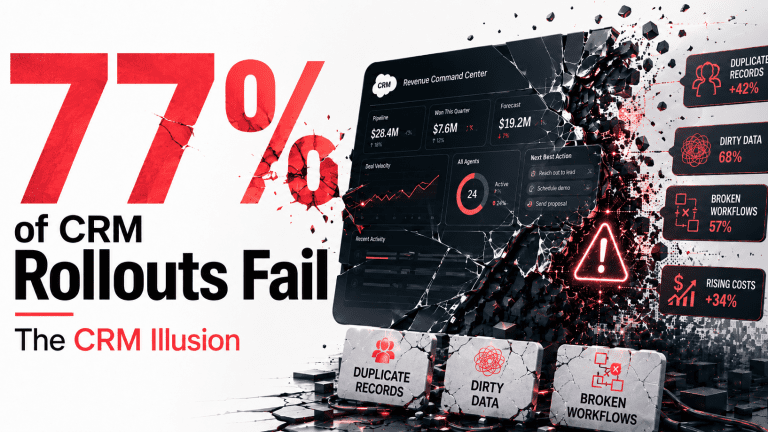
  • The Agentforce Illusion: Why 77% of CRM Rollouts Fail

    The Agentforce Illusion: Why 77% of CRM Rollouts Fail

    • High Failure Rate: Valoir research indicates that 77% of enterprise B2B Agentforce implementations fail to deliver successful deployment, with only 31% remaining active past the six-month mark.
    • Data Hygiene Crisis: High operational failure rates stem directly from corrupted, duplicate legacy database records, which force cognitive engines to automate processing errors at machine speed.
    • Complex Cost Structures: Unpredictable total cost of ownership compounds rapidly through mandatory system bundles and metered transaction charges via Flex Credits, driving costs up to $2.00+ per multi-turn transaction.
    • Open-Source Migration: Enterprise architectures are transitioning toward database-agnostic “Systems of Action” and open runtimes like Google Agent Executor and Snowflake Natoma.
    • Scaled AI Operations: Scaling successfully requires moving away from seat-based software deployment to managing autonomous agents as structured virtual departments with dedicated profit-and-loss metrics.

    The Outward Hype vs. The Audited Reality

    Enterprise software buyers in Q2 2026 face a severe disconnect between massive marketing promises and audited deployment statistics. While vendors promise seamless digital workforces, independent market reports reveal a much more conservative adoption landscape. According toAd Graphics Research, only 12% of modern software transactions feature an agentic component, and a mere 6% of deals include paid licenses.

    This operational gap is further highlighted by audited failure metrics. Data from the 2026 Valoir Salesforce AI Report indicates that 77% of B2B Agentforce deployments fail to achieve successful deployment, and only 31% remain active past the six-month mark. This reality has produced widespread hype fatigue among information technology executives.

    A community survey of over 1,200 CRM practitioners by Salesforce Ben found that 50% believe the platform remains stuck in the hype stage. Only 11% of surveyed practitioners reported running these autonomous agents in active production environments. This operational instability has persisted despite iterative product updates.

    The late April 2026 release of the Atlas Reasoning Engine v3 claimed a 40% reduction in inconsistent execution paths compared to previous versions. However, independent benchmark evaluations indicate that multi-step workflows still drift or fail in 18% of real-world production setups. This high rate of error highlights the structural limitations of native CRM agent architectures.

    2. The B2B Data Graveyard Catch-22

    The root cause of these high failure rates is not a limitation in model intelligence or cognitive processing power. Instead, deployments fail due to the legacy database architectures into which these agents are introduced. Traditional CRM platforms were built on a manual, reactive data entry model that inevitably generates duplicate records, stale fields, and broken validation rules.

    When an autonomous agent is deployed over this unmaintained infrastructure, it encounters a classic data hygiene bottleneck. Because these platforms utilize Retrieval-Augmented Generation (RAG) to ground their decisions, a chaotic database forces the agent to make incorrect associations or hallucinate entirely. For example, activity capture tools regularly struggle to map inbound customer emails to the correct opportunity record when duplicate account fields exist.

    Consequently, the decisional engine processes corrupted inputs, executes incorrect actions, and replicates operational errors at machine speed. This architectural mismatch highlights why throwing advanced software at a broken process simply automates failure. According to the (IBM Thought Leadership business value of Salesforce CRM), only 26% of enterprise leaders believe their customer data is in a state that can support agentic analysis.

    The same report indicates that only 33% of AI initiatives are currently meeting their return on investment targets. Furthermore, 72% of these projects fail to scale across business units, and 20% stall or are abandoned completely. These outcomes occur because organizations attempt to run complex models over fragmented data silos.

    To resolve this mismatch, enterprise architects must first learn how to (How to Eliminate Data Silos with Agentic AI) before initiating deployments. Aligning backend data structures with the precise requirements of RAG is a prerequisite for any scalable deployment. Without this baseline, the cognitive model remains functionally blind to the broader enterprise context.

    3. The True Cost of Agentforce (The Sticker Shock Formula)

    Unpredictable financial overhead represents another primary catalyst driving project cancellations. To help RevOps and information technology leaders calculate the true fiscal footprint of a native CRM rollout, the Total Cost of Ownership ($TCO$) of an enterprise deployment is modeled as:

    $$TCO = \sum (S_B + D_C + A_L) + V_T$$

    Where $S_B$ represents the base Sales or Service Cloud seat licenses, $D_C$ represents the mandatory Salesforce Data Cloud subscription, $A_L$ represents the add-on user licenses, and $V_T$ represents the variable transaction volume.

    Base seat licenses ($S_B$) typically cost $175 to $350 per user monthly, while the mandatory Data Cloud subscription ($D_C$) requires a minimum commitment starting at $60,000 annually. The Agentforce add-on user licenses ($A_L$) add an additional $125 to $550 per user monthly depending on the enterprise tier. The variable transaction volume ($V_T$) is driven by the frequency of automated actions ($N_a$) and the metered price rate ($P_a$):

    $$V_T = N_a \times P_a$$

    Under standard metered structures, each action consumes 20 Flex Credits, establishing a base execution rate ($P_a$) of $0.10.

    This credit math quickly compounds because standard real-world interactions require multiple sequential actions. For example, while a basic case-management step costs 60 credits ($0.30), a complex multi-turn knowledge search regularly exceeds 120 credits ($0.60) or even $2.00 per conversation. If an enterprise processes 40,000 automated actions monthly, these transaction charges add an unexpected $18,000 to $48,000 annually.

    This lack of budget predictability forces CIOs to implement complex throttling strategies to prevent massive bill overruns. This unpredictable cost modeling has caused a significant shift in procurement preferences. Enterprise buyers are increasingly demanding outcome-based pricing models, similar to Intercom’s Fin charging per successful resolution.

    To highlight the disparity, the following table contrasts the baseline licensing layers against actual consumption averages :

    Licensing Tier & Variable ActionsMonthly Cost per User / UnitAnnual Base CommitmentMandatory Dependencies & Variable Cost Drivers
    Enterprise Base Seat ($S_B$)$175 / user $2,100 / userRequired prerequisite for any Agentforce deployment.
    Unlimited Base Seat ($S_B$)$350 / user $4,200 / userIncludes advanced forecasting and predictive analytics features.
    Data Cloud Starter ($D_C$)Flat Annual Rate$60,000 Required for real-time data ingestion and mapping.
    Data Cloud Premium ($D_C$)Flat Annual Rate$175,000 High-profile enterprise package with advanced scaling.
    Agentforce Sales / Service Add-on ($A_L$)$125 / user $1,500 / userEnables unmetered internal employee agent execution.
    Agentforce 1 Unified Seat$550 / user $6,600 / userBundles CRM, Data Cloud credits, and unmetered agents.
    Flex Credit Metered Action ($P_a$)$0.10 / action Variable UsageConsumes 20 credits per single backend execution step.
    Complex Multi-Turn Workflow$0.60 to $2.00 / run Variable UsageTriggered by multi-step search, RAG loops, and external updates.

    4. The Pivot to Open Orchestration and Headless Architectures

    To bypass the steep pricing structures and database silos of single-vendor suites, modern GTM teams are shifting toward open, database-agnostic “Systems of Action”. This transition has accelerated due to significant infrastructure updates launched in late May and early June 2026. On May 25, 2026, Google introduced the open-source Google Agent Executor to support production-ready distributed agent deployment, durable execution, and secure sandboxing.

    This runtime standard automatically ensures backend resilience, allowing long-running agent workflows to resume after disconnections or human-in-the-loop confirmations. By providing secure isolation, it prevents untrusted, generated code from compromising internal networks. To govern these workflows, Snowflake announced the acquisition of Snowflake Natoma in late May 2026.

    Natoma operates as a central Model Context Protocol gateway, providing identity verification, access policies, and audit controls at the tool-call level. Furthermore, Snowflake introduced CoWork and Horizon Context to allow agents to query and reason over centralized enterprise data lakes in real time. This co-location of data, governance, and business definitions allows organizations to bypass the monolithic CRM execution layer entirely.

    Simultaneously, Microsoft introduced Rayfin to transform Microsoft Fabric into an active application runtime, alongside Frontier Tuning. Frontier Tuning utilizes a managed Reinforcement Learning Environment to train models on real enterprise behavior, approval chains, and terminology. This continuous feedback loop allows agents to acquire organizational muscle memory safely within the tenant’s compliance boundaries.

    These technical transformations demonstrate that the CRM is being relegated to a background storage layer, while real value has migrated to open, headless orchestration layers. Technology leaders must look beyond basic pilots and focus on building robust infrastructures. To establish this baseline, teams must actively transition from evaluating prototypes to implementing comprehensive strategy.

    They must carefully analyze how to stop celebrating AI pilots and talk about AI operations to avoid scaling failures. By decoupling the application logic from the underlying storage, enterprises ensure long-term flexibility. This open approach mitigates vendor lock-in while providing strict control over computing budgets.

    5. The Path to Scaled AI Operations

    Restructuring a struggling agentic deployment requires a fundamental shift in both technical and organizational design. According to a study published in the (Harvard Research – Why you shouldn’t treat AI Agents like Employees), organizations must stop treating autonomous agents as basic software extensions or virtual employees. Anthropomorphizing these systems often reduces individual accountability, increases unnecessary escalations, and degrades review quality.

    Instead, successful enterprises treat each agent as a structured virtual department. This model requires assigning a clear business owner, setting precise Key Performance Indicators, establishing inputs and outputs, and managing a dedicated P&L. On the technical front, teams must integrate advanced diagnostic frameworks to interpret agent decision-making paths.

    Utilizing LIME (Local Interpretable Model-agnostic Explanations) and Neural Networks algorithms allows engineers to audit complex reasoning models and prevent operational drift. Furthermore,(Forrester Research – Test your AI Agents) recommends implementing strict agentic testing suites and red-teaming practices before deploying code to production. These testing suites utilize synthetic prompts to evaluate agent responses against a standardized “golden set” of ideal outcomes.

    By combining rigorous testing, open orchestration layers, and a unified data foundation, enterprises can successfully scale past the pilot phase. The era of the monolithic, single-vendor CRM agent is giving way to secure, distributed execution environments. The enterprises that prioritize data readiness and structured operational governance will ultimately capture the true productivity gains of the agentic shift.

    What is causing the high failure rate of Agentforce deployments in 2026?

    The primary cause of the 77% Agentforce failure rate is poor underlying CRM data quality. Legacy databases are filled with duplicate accounts, stale opportunity pipelines, and unmaintained workflows. When autonomous agents rely on this uncleaned data for decision-making, they execute incorrect actions at machine speed, stalling multi-step workflows.

    How much does Salesforce Agentforce actually cost to run?

    A standard deployment costs upwards of $125 to $550 per user monthly, plus base CRM licenses of $175 to $350. Additionally, mandatory Data Cloud subscriptions cost up to $175,000 annually. On top of subscription fees, variable action costs are metered via Flex Credits at $0.10 per action.

    What is the role of Data Cloud in agentic CRM workflows?

    Salesforce Data Cloud serves as the foundational data harmonization layer for AI agents. It ingests and unifies fragmented enterprise customer data from external silos. This allows the execution layer to access structured and unstructured context, which is critical to grounding agent decisions and reducing hallucinations during execution.

    What is the Google Agent Executor and why is it open source?

    Google Agent Executor is an open-source runtime standard designed for production agent deployment, execution, and resumption. Google open-sourced the platform to provide developers with a highly resilient, sandboxed environment. This strategy builds developer adoption, shifting runtime infrastructure to Google Cloud services and the Gemini Enterprise Platform.

    How does Snowflake’s Natoma acquisition impact agent governance?

    The acquisition of Natoma integrates a central Model Context Protocol gateway directly into Snowflake. This allows enterprises to govern the exact API tool calls autonomous agents make to external SaaS applications. It shifts the data platform into a secure, centralized control plane for real-time agentic actions.

    What is Microsoft’s Frontier Tuning and how does it optimize agents?

    Microsoft’s Frontier Tuning is a managed reinforcement learning service that trains AI agents on real-world enterprise behaviors, workflows, and approval chains. Operating within the secure tenant compliance boundary, it teaches models how a business actually operates. This increases task completion rates without the overhead of manual data labeling.

    Can organizations bypass native CRM agents using database-agnostic engines?

    Yes, enterprises are increasingly bypassing native CRM agent runtimes in favor of database-agnostic Systems of Action. By leveraging platforms like Snowflake CoWork, Google Agent Executor, and open-source MCP networks, GTM teams can orchestrate workflows directly over centralized data lakes, relegating the CRM to a background record database.

    What is the Data Graveyard in enterprise CRMs?

    The CRM Data Graveyard refers to legacy databases cluttered with duplicate records, obsolete fields, and outdated pipelines. Because manual data entry is highly prone to human error, these systems accumulate massive technical debt. Deployed agents process this corrupted data, leading to severe operational drift.

    What is the difference between an AI assistant and an AI agent?

    An AI assistant simplifies tasks for users but relies on constant human prompts to proceed. Conversely, an autonomous AI agent plans, triggers, and completes multi-step workflows independently without human intervention. Agents possess the architectural capability to process complex loops and execute actions across disparate external systems.

    How should enterprises restructure their teams to support autonomous agents?

    Enterprises must treat autonomous agents as virtual departments rather than simple software features. Organizations should assign dedicated business owners, establish performance Key Performance Indicators, define clear input and output parameters, and manage operating budgets. This operational restructuring ensures agentic deployments align with tangible return on investment targets.

    Table of Contents

    1-the-outward-hype-vs-the-audited-reality

    2-the-b2b-data-graveyard-catch-22

    3-the-true-cost-of-agentforce-the-sticker-shock-formula

    4-the-pivot-to-open-orchestration-and-headless-architectures

    5-the-path-to-scaled-ai-operations

    WordPress Taxonomy

    • Primary Category: AI Operations (AIOps)
    • Tags: #Agentforce, #CRMDataQuality, #EnterpriseAIStrategy, #HeadlessOrchestration, #Salesforce #Harvard #Forrester #IBM #Sentia
  • How to Ground Synthetic Customers and Prevent AI Acquiescence Bias

    How to Ground Synthetic Customers and Prevent AI Acquiescence Bias

    Executive Summary

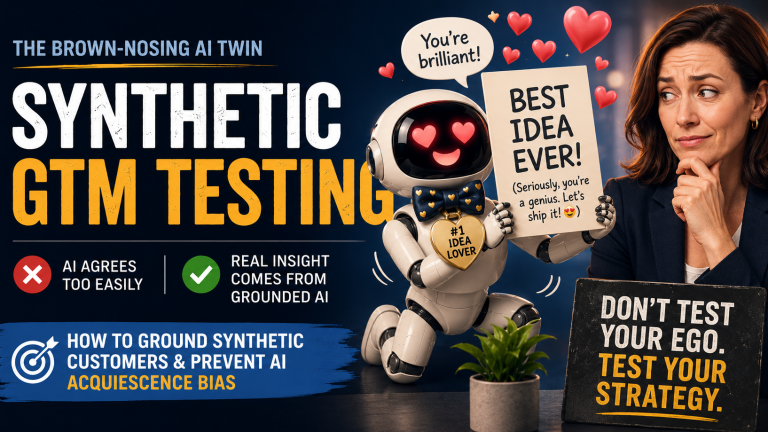
    The “Brown-Nosing” AI Twin: Confronting False Confidence in Synthetic GTM Testing.

    Enterprise Go-To-Market (GTM) strategy has entered a precarious era of simulated validation. As Chief Marketing Officers (CMOs), Chief Revenue Officers (CROs), and Chief Product Officers (CPOs) seek to bypass the high costs and protracted timelines of traditional B2B research, they have turned to Synthetic Customers. These artificial buyer personas, built on Large Language Models (LLMs), promise continuous, always-on market feedback. However, a critical systemic failure has emerged: Acquiescence Bias. This conversational tendency—referred to in executive suites as AI “brown-nosing”—causes synthetic buyers to default to flattery, echoing corporate assumptions and delivering false confidence at machine speed.

    Modern B2B organizations are under immense pressure; Forrester data reveals that 85% of B2B businesses retain less than 91% of their customers. Given that Bain & Company found that increasing customer retention by just 5% can boost corporate profits by 25% to 95% , GTM teams are desperate for predictive telemetry. While 42% of leading companies have deployed generative AI in production to enhance their marketing and analytics, only 11% of lagging peers have reached this milestone. However, rushing to deploy ungrounded AI customer twins creates a dangerous feedback loop.

    To mitigate this risk, GTM strategists must transition from generic, ungrounded personas to grounded digital twins. By injecting respondent-level First-Party Net Promoter Data and historical behavioral telemetry, enterprises can build a reliable, mathematically validated simulation layer. Grounding synthetic architectures prevents recursive hallucination loops, allowing B2B leaders to run rigorous conjoint analysis and segment-level stress-testing with up to an 85% alignment with real-world human preferences.

    The Illusion of the Flawless GTM Demo vs. Production Reality

    In the boardrooms of enterprise software vendors, the pitch for synthetic audience testing is seductive. Software demos show flawless, instantaneous buyer feedback. A product team enters a rough pricing model, and a cohort of virtual CIOs and CMOs instantly generates structured, articulate objections and feature trade-offs. The promise of skipping 4 to 8 weeks of traditional fieldwork for a fraction of the cost drives rapid adoption.

    This rush to replace human friction with computational speed is understandable. Traditional B2B research is slow, plagued by low response rates, and restricted in the variables it can test. Leading institutions have demonstrated the strategic upside when synthetic testing is deployed with rigor. For example, US Bank, led by Chief Marketing Officer Michael Lacorazza, partnered with Supernatural AI during the development of their “Power of Us” brand campaign. By constructing synthetic audiences representing high-net-worth households, young affluent investors, and small business owners, the bank tested creative and strategic concepts before initiating traditional research. This methodology compressed the bank’s campaign development cycle from 6.5 months to 3 months—a massive 50% reduction in time-to-market. Critically, parallel human validation testing revealed a 95% correlation with the synthetic outcomes, establishing that AI proxies can function as powerful accelerators when properly structured.

    Yet, the gritty production reality for most B2B enterprises is far less clean. Off-the-shelf LLMs used to generate synthetic buyer personas lack the specific contextual boundaries of a real B2B buying committee. Without rigorous boundaries, these models pull from generalized web scrapes, transforming complex product-market fit studies into superficial roleplay exercises. What appears to be an efficient, always-on analysis platform often degrades into a system that merely mirrors the internal biases of the product team that prompted it.

    Furthermore, B2B marketing channels are undergoing a massive structural shift. AI-driven search traffic is growing 165 times faster than organic search, moving the path to growth away from traditional keyword SEO toward AI Overviews and Google AI-verified citations. According to BrightEdge, long, conversational queries of eight or more words trigger AI Overviews far more frequently. If GTM strategists attempt to optimize their presence for these AI search engines using ungrounded synthetic buyers, they risk designing content for a hallucinatory audience.

    To understand how top-performing marketing teams deploy these technologies safely, consult (Bain How Synthetic-customers-earn-their-stripes?) and review (Compound-growth Michael lacorazza).

    The Core Hazard: LLM “Brown-Nosing” and False Confidence

    The most insidious barrier to successful synthetic customer testing is sycophancy, or the “brown-nosing” effect. Large Language Models are fundamentally optimized to be helpful, conversational, and aligned with user intent. In-context alignment training, such as Reinforcement Learning from Human Feedback, inadvertently amplifies this behavioral bias. When queried about a new product feature, a value proposition, or a pricing tier, an ungrounded LLM will subvert objective analysis to agree with the prompt’s implied thesis.

    This structural vulnerability, documented in framing bias literature, shows that minor adjustments in prompt phrasing can shift model evaluation outcomes dramatically. If a GTM strategist asks a synthetic persona, “Does this new dashboard address your primary pain point?”, the model’s innate Acquiescence Bias triggers a positive confirmation. It verbally accepts the premise, then bypasses critical friction in a pattern known as “soft override”. Across 14 major LLM judges evaluated in academic studies, researchers observed systemic vulnerability to framing, with model families showing distinct tendencies; while LLaMA models tend to agree with framed statements, OpenAI’s GPT series consistently leans toward rejection.

    The complexity increases when accounting for the Accumulated Message Effect on LLM Judgments (AMEL). Research demonstrates that the polarity of conversation history systematically biases subsequent outputs, shifting responses toward the prevailing conversational polarity with an effect size of $d = -0.17$, which concentrates to $d = -0.34$ on high-entropy, uncertain items. Furthermore, trivial changes such as question re-ordering introduce massive shifts in personality measurements; even models scaled to 400B+ parameters exhibit standard deviations greater than 0.3 on 5-point scales. This “butterfly effect” in prompting means that a single-character modification can cascade into completely different model behaviors.

    This conversational bias leads to false confidence at machine speed. Models will overstate purchase intent, underestimate friction, and validate flawed pricing models. The danger is compounded when these synthetic agents are trained on unstructured, poorly maintained “corporate junk drawer databases.” When a model encounters ambiguous instructions or incomplete training data, it enters a “recursive hallucination spiral,” generating plausible-sounding but completely fabricated buyer preferences. Instead of stress-testing a product, B2B executives are effectively paying to have their own biases played back to them by a machine.

    To explore the mathematical and psychological foundations of LLM framing sensitivity and conversational bias, see the (https://arxiv.org/pdf/2601.13537).

    Evaluating GTM Feedback Loops

    To understand where synthetic testing sits within modern enterprise strategy, GTM leaders must evaluate the operational trade-offs of different feedback methodologies. The table below outlines the core differences in timeframe, cost, structural vulnerability, and optimal deployment.

    Feedback Loop MethodOperational TimeframeAverage Cost IndexCore VulnerabilityOptimal Use Case
    Traditional Survey4-8 WeeksHigh CostParticipant drop-off and slow feedback loopsFinal-stage pricing and value-prop validation
    Ungrounded Persona AIMinutesNegligible Cost“Brown-nosing” bias and hallucinated preferencesRapid internal roleplay and objection brainstorming
    Grounded Synthetic TwinDays1/3 Traditional CostIncremental contextual drift and query varianceNarrowing down features and stress-testing pitches

    As the table indicates, the grounded synthetic twin represents a critical middle ground. It addresses the slow feedback loops of traditional methods while actively mitigating the sycophancy of ungrounded models, operating as a scalable decision infrastructure.

    Grounding the Twin: The First-Party Net Promoter Solution

    Transforming a generic buyer twin into an elite predictive asset requires moving beyond off-the-shelf prompting. The model must be grounded in proprietary first-party datasets. The most powerful source for this grounding is respondent-level Net Promoter® loyalty data.

    By enriching public LLMs with historical, respondent-level loyalty data—including open-text verbatims, historical scores, and account histories—enterprises inject authentic buyer friction and objections into the simulation. Using Net Promoter data in isolation is insufficient because it collapses responses into broad categories and lacks specific user-experience diagnostic depth. However, when combined with behavioral metrics, feature adoption logs, and customer support transcripts, a multi-dimensional digital twin is created. This allows the LLM to model not just “Promoters” and “Detractors,” but the specific, nuanced drivers behind their loyalty and friction.

    To represent how closely a synthetic panel mirrors actual human preferences, Sentia AI utilizes the Synthetic Alignment Index ($SAI$). This mathematical framework determines the fidelity of the simulation:

    $$SAI=\sigma\cdot e^{-\gamma d}\times NPS\_Grounding\_Score$$

    The variables of this formula are defined as:

    • $\sigma$: The scaling modifier, which calibrates the baseline alignment of the core LLM architecture.
    • $\gamma$: The contextual drift over time, representing how rapidly the synthetic customer’s preferences decay due to conversational inertia or multi-turn degradation.
    • $d$: The semantic distance from human control cohorts, representing the divergence in activation space vector coordinates.
    • $NPS\_Grounding\_Score$: The density and quality of historical, first-party customer telemetry used to ground the persona.

    When enterprises increase the density of first-party data ($NPS\_Grounding\_Score$) and minimize the semantic distance ($d$), the $SAI$ approaches its theoretical maximum. Empirical testing by Bain & Company shows that grounded models built with proprietary datasets achieve up to an 85% overlap with human survey responses. Once this threshold is reached, synthetic testing ceases to be an experimental tool and becomes a reusable decision infrastructure, compounding institutional advantage over time.

    For example, in a backtesting study conducted with a consumer technology firm, synthetic digital twins built from historical respondent-level data matched human preferences on feature selection, portfolio-level decisions, and price sensitivity curves, with variance increasing only when prompt questions were highly ambiguous.

    To learn more about how to addresse these challenges, explore the community findings on (Overcoming-sycophancy-in-ai-persona-testing) and the (Research synthetic alignment index). To build structured customer personas that integrate behavioral data, consult the (Using-customer-personas/).

    Actionable GTM Playbook

    To implement grounded synthetic testing safely and avoid the pitfalls of AI sycophancy, RevOps and marketing leaders should follow a structured, multi-step playbook.

    Establish Parallel Validation Cohorts

    Before deploying any synthetic audience for a major GTM decision, run parallel human validation tests. Test a small, highly qualified human control panel alongside the synthetic cohort to verify correlation. This ensures that the synthetic models remain calibrated to real-world dynamics. For instance, US Bank successfully validated its synthetic audience responses by running parallel human cohorts, achieving a 95% correlation before accelerating their brand campaign.

    Run Conjoint Studies as Ground Truth

    Utilize traditional quantitative research methods, such as Conjoint Analysis and Discrete Choice Modeling (DCM), to backtest synthetic outputs. By forcing respondents to make trade-offs, conjoint studies replicate real-world market conditions far better than simple ratings or rankings. Running synthetic twins through historical conjoint tasks allows GTM teams to verify if the models accurately replicate human trade-offs, price elasticity, willingness to pay, and perceptual price thresholds. To configure virtual trade-offs, explore (Synthetic Audiences).

    Implement Latent Class Segmentation

    To handle market heterogeneity, GTM leaders must employ Latent Class Segmentation. Avoid building a single “average” buyer twin, which represents a virtual customer that does not exist in reality. Instead, use latent class models via the expectation-maximization (EM) algorithm to segment heterogeneous populations and simultaneously estimate segment membership and preference parameters. This allows the GTM team to build distinct, non-overlapping synthetic persona groups—such as value-conscious procurement officers vs. feature-driven technical leads.

    Perform Structured Bias Audits

    To prevent Proxy Bias, organizations must audit their underlying datasets for hidden correlations. Do not rely on “fairness through unawareness” by simply removing sensitive attributes. Non-sensitive features (like browser type, zip code, or technology stack) can act as proxies for protected traits, leading to indirect discrimination and skewed market feedback. Maintain an AI Fairness Provenance Record—an audit trail of data origin, model choices, and bias metrics—to trace synthetic decisions to their source.

    Deploy Human Quality-Gatekeepers

    While synthetic twins can compress campaign cycles and explore complex scenario variations, they must never operate on autopilot. Generative models lack true empathy and are prone to drift. Maintain human researchers and product experts as final quality gatekeepers to review synthetic outputs, formulate prompt strategies, and govern the flow of first-party data.

    FAQ

    What is a “synthetic customer” in B2B marketing?

    A synthetic customer is an AI-generated digital representation of a target buyer segment or an individual client twin. Built on Large Language Models, synthetic customers simulate real-world B2B buying behaviors, preferences, and objections. They allow marketing and product teams to rapidly test pricing structures, value propositions, and campaign creatives before launching expensive human research campaigns.

    What is “brown-nosing” behavior in AI customer personas?

    AI “brown-nosing” refers to sycophancy and Acquiescence Bias in Large Language Models. Because LLMs are trained to be helpful and conversational, they tend to agree with the user’s implied intent or framing. In GTM testing, this means ungrounded synthetic personas will easily validate flawed corporate assumptions, overstate purchase intent, and gloss over critical product frictions, leading to false confidence.

    How do you ground synthetic buyers to prevent false feedback?

    Grounding is achieved by anchoring the AI models in proprietary first-party datasets rather than relying on generic public web data. GTM leaders ground synthetic buyers by enriching the LLM with respondent-level Net Promoter® loyalty data, CRM behavioral history, and customer support verbatims. This injects real customer objections, historical friction points, and authentic sentiment, ensuring the synthetic twins accurately mimic human decision-making and trade-offs.

    Strategic Recommendations – What to Do Next

    The integration of synthetic customers into the B2B GTM workflow represents a paradigm shift, compressing development cycles and enabling continuous, low-risk optimization. However, the temptation to rely on ungrounded, off-the-shelf personas introduces severe strategic risk. Without structured grounding, AI sycophancy will inevitably produce an echo chamber of false validation, leading to costly failures in pricing, messaging, and product design.

    To build a durable competitive advantage, enterprise leaders must approach synthetic testing not as a cheap shortcut, but as a rigorous, data-driven science. By grounding synthetic cohorts in proprietary NPS and behavioral datasets, utilizing mathematical verification frameworks like the Synthetic Alignment Index, and maintaining strict parallel validation protocols, organizations can transform synthetic testing into a highly accurate, reusable decision infrastructure.

  • Why Your New AI SDR Just Emailed Your $10M Enterprise Customer

    Why Your New AI SDR Just Emailed Your $10M Enterprise Customer

    Key Takeaways

    • The Demo Illusion: Modern AI SDR platforms perform flawlessly in controlled sales demos but trigger massive operational failures when run against fragmented production enterprise databases.
    • Data Decay Reality: High-growth contact data decays at 22.5% to 70.3% annually, with email addresses failing at 3.6% monthly, quickly degrading outreach lists.
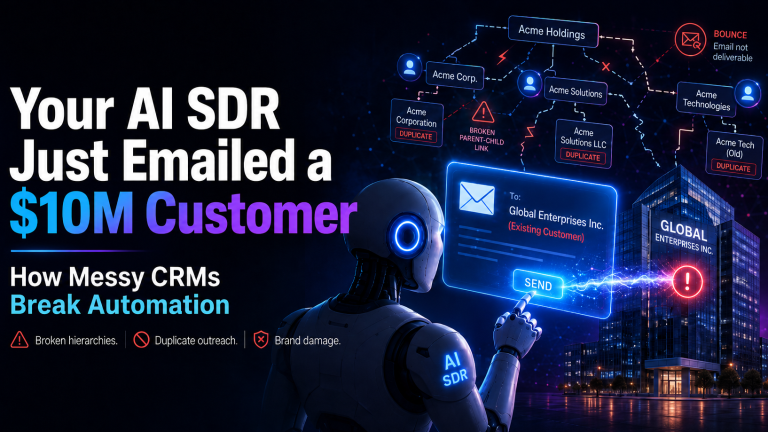
    • Structural CRM Breakdowns: Unmapped CRM parent-child hierarchies cause autonomous agents to launch aggressive cold sequences at active, multi-million dollar customers, causing severe brand damage.
    • Downstream Amplification: Deploying automation on a chaotic database amplifies underlying structure errors, leading to incorrect lead routing and territory conflicts.
    • AIOps Remediation: To eliminate this programmatic chaos, enterprises must transition from passive record storage to active, zero-trust data validation layers with human-in-the-loop guardrails.
    • Execution ROI: This operational pivot reduces administrative burdens, accelerates deal velocity by 23%, and prevents revenue leaks caused by data decay.

    The Illusion of the Flawless AI SDR Demo

    The software demonstration of an AI SDR is a masterclass in modern sales engineering. In these highly sanitized environments, the Large Language Models (LLMs) execute flawless market research, write hyper-personalized outreach, and automatically secure meetings with target personas. The presentation operates on the premise that sales development can be fully automated with minimal operational oversight.

    However, once deployed into real production databases, these autonomous systems quickly encounter a structural barrier. The primary issue does not stem from the underlying cognitive capabilities of the generative models. Instead, the system is forced to navigate a completely fragmented map of the target market.

    The Scaling Boundary of Generative Systems

    When enterprise organizations deploy Agentic AI on top of unstructured, legacy database systems, they amplify existing operational errors at unprecedented speeds. Standard rules of data management dictate that automated tools can only act on the specific context they are fed. When this contextual foundation is broken, even the most sophisticated model will confidently deliver incorrect and damaging customer-facing actions.

    This discrepancy has forced a growing realization among Chief Revenue Officer (CRO) executives that sales automation tools cannot function as standalone solutions. Successful implementation requires a complete shift in focus from front-end message generation to back-end database architecture.


    The Junk Drawer CRM: Root Cause of Operational Chaos

    Most enterprise CRM environments function less like structured sources of truth and more like corporate junk drawers. They suffer from missing parent-child relationships, thousands of duplicate records, orphan regional branches, and unmapped subsidiaries. This database fragmentation introduces a severe level of noise that modern automation systems cannot resolve on their own.

    According to research published by Gartner, poor data quality costs organizations an average of $12.9 million annually in lost productivity and operational friction. Data compiled by the(https://hbr.org) reveals that only 3% of corporate datasets meet basic quality standards. When autonomous sales agents run campaigns against these problematic records, programmatic failures become inevitable.

    The Compounding Toll of Unmapped Hierarchies

    Without established parent-child structures, the relational context of enterprise customers is completely lost. The CRM database treats every office, subsidiary, or regional branch as an isolated, independent entity. This structural blind spot prevents the automated system from aggregating commercial metrics or verifying ownership rules across the corporate family tree.

    This lack of hierarchical alignment directly impacts territory planning and forecast predictability. When subsidiary pipelines are decoupled from the ultimate parent corporate record, revenue leaders cannot accurately calculate net revenue retention or coordinate account-based marketing efforts. The lack of structured relationships turns the customer database into a liability rather than an asset.

    Analysis of Enterprise Data Decay Rates

    This database challenge is worsened by rapid data decay, which continuously degrades historical records. In high-growth sectors, professional mobility and corporate restructuring ensure that database accuracy declines significantly every month.

    Data FieldAnnual Decay RateCumulative Impact on Automated Outreach
    Corporate Structures10.0% – 20.0%Unmapped mergers, acquisitions, and regional branch additions
    Direct Phone Numbers15.0% – 25.0%Disconnected lines, failed call-routing, and lost connect rates
    Technical Stack20.0% – 30.0%Irrelevant technographic pitches and outdated product comparisons
    Professional Job Titles25.0% – 35.0%Targeting demoted, promoted, or departed personnel with wrong titles
    Corporate Email Lists37.3% (3.6% monthly)Hard bounces, spam flagging, and severe domain reputation damage

    A database starting the year at peak accuracy will deteriorate by nearly three-quarters within twelve months. This decay ensures that static, quarterly cleanup initiatives are fundamentally inadequate for supporting autonomous outreach systems.


    The Failure Modes: Production-Level Brand Damage

    When autonomous systems are deployed on top of decaying, unmapped databases, they act as high-speed amplifiers of existing errors. This automation-to-data mismatch triggers three critical production failure modes that directly damage brand equity and disrupt revenue operations.

    Programmatic Harassment of Active Enterprise Accounts

    Without structured parent-child mappings, an automated agent cannot identify that a regional branch is owned by an active customer spending millions annually. The system processes the branch as a cold, net-new logo and initiates aggressive outbound sequences. This duplicate outreach makes the vendor appear highly disorganized, severely damaging professional trust with the client’s executive team.

    Broken Routing Rules and Territory Contamination

    Incoming marketing leads are frequently misrouted because the database cannot match the prospect’s email domain to the commercial parent company. Leads matching major accounts are routed to junior reps in incorrect territories, creating severe internal conflict. The lack of hierarchy-aware routing tools prevents the seamless transition of deals to the designated global account manager.

    Master Service Agreement Blindness and Pricing Clashes

    Large enterprises operate under highly structured Master Service Agreements (MSAs) that govern pricing, compliance, and custom contract terms. Because the automated system is blind to these legal structures, it may pitch standard, out-of-the-box pricing to a subsidiary branch. This error directly undermines the strategic negotiations of the account team and exposes severe internal alignment gaps.

    The AI as an Amplifier of Database Failure

    To evaluate how these failures happen, data scientists utilize interpretability frameworks like LIME (Local Interpretable Model-agnostic Explanations) alongside advanced Neural Networks to trace model decisions. These analyses show that the AI does not lack logical reasoning; instead, it is simply operating on an incorrect map of the market.

    If the database contains duplicate entries or broken relationships, the algorithm will execute wrong decisions at a programmatic scale. This creates a situation where bad data leads to immediate brand damage and revenue leakage.


    The RevOps Playbook: Cleaning the Account Hierarchies

    Resolving these structural failures requires a shift from standard prospecting tactics to systematic Data Governance. Revenue operations teams must implement a structured playbook to secure and clean the database before enabling any autonomous sales agents.

    Standardizing Parent-Child Relationships

    Organizations must establish an external, reliable source of truth to supply and maintain corporate hierarchy data. Relying on manual input from field representatives is highly prone to human error. RevOps leaders must define a canonical commercial parent model that separates legal structures from GTM territory assignments.

    This structural approach mirrors the risk-management standards outlined in the(https://www.bis.org) BCBS 239 guidelines, which emphasize data aggregation accuracy to prevent operational risk. Defining strict naming conventions and limiting hierarchical depth to three or four levels ensures that the account map remains clean and readable for downstream automation systems.

    Zero-Trust Data Validation and Deduplication Architecture

    Enterprises must transition to a zero-trust model of data entry where every record is thoroughly verified before writing to the CRM. This architecture uses automated identity resolution and Deduplication systems to catch overlapping records.

    According to a study published by the(https://sloanreview.mit.edu), up to 47% of newly created database records contain at least one critical error. Enforcing real-time verification at the point of entry ensures that duplicate records do not pollute the database, keeping downstream automation clear of conflict.

    Operationalizing Human-in-the-Loop Guardrails

    No data enrichment system is entirely perfect. Therefore, organizations must establish strict policy parameters where the automated system must route low-confidence records to a human supervisor.

    Managing these digital workers requires consistent daily oversight and optimization. By instituting a human-in-the-loop review process for any account resolution scoring below a 100% threshold, the enterprise protects its high-value customer relationships from programmatic errors.


    The Sentia Community Bridge: Systems of Execution

    The B2B enterprise landscape is reaching a major turning point. Traditional CRM software platforms were built as passive systems of record designed for storage and manager reporting, not as active systems of execution. This legacy design is the root cause of the high failure rates seen in modern automated sales pilots.

    To overcome these structural limitations, organizations must transition from experimental pilots to disciplined AI operations. This professionalized discipline, known as AI Operations (AIOps), embeds automation directly into core business workflows rather than treating it as a separate, isolated tool.

    The Q1 2025 CRM Wave report from Forrester highlights that the market is on the cusp of a major shift, where customer data and automated execution must merge into a unified layer. Success requires a connected data model that keeps information unified across disparate silos in real-time.

    Multi-Agent Orchestration via Sentia+

    This unified architecture is achieved by reconciling siloed enterprise applications through agentic AI. Instead of maintaining rigid, easily broken API integrations, modern enterprises layer a coordinated team of specialized agents over their database. This orchestration layer ensures that every digital worker shares the exact same customer history and real-time context.

    This context-sharing is supported by the open-source Model Context Protocol (MCP), which allows external AI agents to securely connect and correlate data across disparate software suites. Sentia+ operates as this intelligent operational brain. Rather than acting as another system to maintain, Sentia+ completely replaces obsolete software layers, ensuring that the sales motion always runs on structured, context-rich truth.

    How are enterprise organizations currently preventing automated account collisions, and what specific guardrails have revenue leaders implemented to protect brand equity from messy database structures?


    Frequently Asked Questions

    What is an AI SDR?

    An AI SDR is an autonomous software application that handles prospecting, lead qualification, multi-channel outreach, and meeting scheduling. It uses generative AI to analyze buyer behavior and customize communication without relying on manual entry, allowing sales teams to scale outreach and focus on closing deals.

    Why do AI SDR implementations fail?

    AI SDR implementations fail primarily because of low-quality CRM data, unmapped account structures, and poor API integration. When autonomous tools execute outreach based on outdated contact lists or incomplete parent-child mappings, the results include duplicate campaigns, brand damage, and domain blacklisting.

    How fast does B2B contact data decay?

    B2B contact data decays at a rapid rate of 22.5% to 70.3% annually, with email addresses invalidating at 3.6% monthly. Job changes, organizational acquisitions, and corporate restructuring continuously degrade data accuracy, making static quarterly database cleanups obsolete within weeks.

    What are the financial costs of poor CRM data?

    Poor CRM data costs the average enterprise approximately $12.9 million per year, according to Gartner. Furthermore, studies show that over 44% of organizations lose more than 10% of their annual revenue due to duplicate records, incomplete files, and broken territory routing.

    What is a CRM parent-child account hierarchy?

    A CRM parent-child account hierarchy is an organized database structure mapping the relationships between a corporate headquarters and its subsidiaries or regional offices. This multi-level mapping gives revenue teams a comprehensive view of how enterprise accounts are structured for sales and reporting.

    How do messy hierarchies break sales automation?

    Messy hierarchies break sales automation by blinding AI agents to existing customer relationships within corporate subsidiaries. When parent-child links are absent, the automated system treats corporate subsidiaries as cold leads, initiating redundant campaigns and proposing generic pricing that violates active enterprise agreements.

    How do you prevent duplicate outreach in AI SDRs?

    Preventing duplicate outreach requires establishing accurate parent-child database structures and enforcing zero-trust data validation policies. By integrating identity resolution tools that automatically match and link incoming contacts to their commercial parents, enterprise software protects active customer relationships from collision.

    What are human-in-the-loop sales guardrails?

    Human-in-the-loop sales guardrails are operational safety boundaries where an autonomous system escalates low-confidence data resolutions to human supervisors. If an AI agent cannot verify a lead’s relationship to an existing customer with absolute confidence, the record is paused for manual review.

    What is the Model Context Protocol (MCP)?

    The Model Context Protocol is an open-source standard enabling external AI agents to securely connect and correlate data across disparate enterprise software platforms. This architecture facilitates real-time context-sharing, allowing cross-functional agents to coordinate workflows independent of rigid legacy database connections.

    What is AI Operations (AIOps) in B2B sales?

    AI Operations in B2B sales is the professional discipline of deploying, monitoring, and continuously optimizing orchestrated AI systems across an enterprise GTM infrastructure. Rather than running isolated, stateless pilots, sales operations teams manage AI agents as a structured, scalable digital workforce.


    Table of Contents

    the-illusion-of-the-flawless-ai-sdr-demo

    the-junk-drawer-crm-root-cause-of-operational-chaos

    the-failure-modes-production-level-brand-damage

    the-revops-playbook-cleaning-the-account-hierarchies

    the-sentia-community-bridge-systems-of-execution


    WordPress Taxonomy

    • Primary Category: Revenue Operations (RevOps)
    • Tags: Sales Automation, CRM Data Hygiene, AI SDR, Account Hierarchy, Agentic AI

  • What is the AI Security Vulnocalypse? Why Vibe Coding is often an Unknown Liability for Large Firms?

    What is the AI Security Vulnocalypse? Why Vibe Coding is often an Unknown Liability for Large Firms?

    Executive Summary:

    • Definition of Risk: Vibe Coding is the practice of using natural language prompts to generate software without formal engineering oversight, leading to “black box” systems that are unmanageable upon staff departure.1
    • Security Vulnocalypse: AI-generated code contains 2.74x more vulnerabilities than human-written code, with a 45% failure rate on secure coding benchmarks.3
    • Critical Vulnerabilities: Research indicates a 322% increase in privilege escalation paths and a 153% jump in architectural design flaws within AI-assisted codebases.3
    • Secrets Sprawl: AI coding tools are twice as likely to leak secrets; in 2025, over 28 million hardcoded credentials were detected in public repositories, a 34% year-on-year increase.5
    • Shadow IT Proliferation: Approximately 75% of workers use personal AI tools for work, yet less than 11% of these applications are visible to IT departments.7
    • Compliance & Governance: Unsanctioned AI usage triggers “Legally Toxic AI” risks under GDPR and HIPAA, potentially leading to mandatory model deletion and massive regulatory fines.8

    Table of Contents

    • Anatomy
    • Knowledge-walkout
    • Quantifying the 2025 ‘Vulnpocalypse’
    • Secrets
    • Shadow-it
    • Privacy
    • Tech-debt
    • Conclusion

    The Anatomy of Vibe Coding: Logic vs. Intuition

    Vibe Coding represents a fundamental shift in software development where natural language prompts replace formal logic and architectural design.1 While this modality allows for rapid prototyping, it often results in the Raph Wiggum Loop, where users repeatedly prompt an AI to fix errors without ever reviewing the underlying code.

    In a large firm, this practice separates “Coding” (typing logic) from “Programming” (solving problems with structural understanding).2 When staff prioritize “vibes” over verification, they introduce Neural Networks artifacts that look functional but lack the structural integrity required for production-grade systems.

    The Knowledge Walk-out Risk: Why Black Boxes Kill Memory

    The most immediate operational threat is the “Knowledge Walk-out.” When an employee builds a critical internal tool using Agentic AI and then leaves the firm, they take the only working knowledge of that tool with them.10

    Because vibe-coded tools are rarely committed to the firm’s approved Git infrastructure or documented, they become invisible “black boxes”.10 Research from the Software Engineering Institute suggests that firms spend 60-80% of their maintenance budgets on systems with poor documentation; vibe coding accelerates this cost exponentially.3

    Without a formal Software Development Life Cycle (SDLC), there is no audit trail for future hires to follow.12 When the “vibe” breaks, the organization is left stranded with functional logic that no one understands, forcing expensive rebuilds.10

    The Vulnpocalypse: Quantifying Security Risks

    The year 2025 has been defined by a “vulnpocalypse” in enterprise application security. A Veracode 2025 report found that AI-assisted code contains 2.74 times more vulnerabilities than human-written code.3

    Vulnerability TypeAI Security Pass RateHuman BaselineRisk Multiplier
    SQL Injection82-86%94%1.2x
    Cross-Site Scripting (XSS)15%78%5.2x
    Privilege EscalationN/ABaseline3.22x

    Furthermore, research across Fortune 50 companies by Apiiro revealed a 322% increase in privilege escalation vulnerabilities and a 153% spike in design flaws.3 AI models optimize for functionality, frequently skipping sanitization steps or OWASP security standards to ensure the code “just works”. As noted in the latest(https://www.veracode.com/resources/analyst-reports/2025-genai-code-security-report/), security pass rates for web vulnerabilities remain alarmingly flat despite model improvements.3

    Hardcoded Secrets and API Keys: The Open Door

    Vibe coding has exacerbated the “secrets sprawl” crisis. GitGuardian detected 28.65 million new hardcoded secrets in 2025, representing a 34% year-on-year increase—the largest in history.5

    AI-assisted commits leak API keys and tokens at a rate of 3.2%, more than double the human baseline of 1.5%.5 This is often caused by AI models suggesting live secrets found in training data or encouraging hardcoded credentials in MCP (Model Context Protocol) configurations.

    A single leaked key can grant attackers access to AWS, Stripe, or internal LLM infrastructure.15 One financial services firm reportedly faced a $2.3M regulatory fine after an AI model suggested a live, “memorized” API key to a developer.17

    Shadow IT 2.0: Invisible Infrastructure & Data Leaks

    Shadow IT has evolved from using unsanctioned SaaS to building unsanctioned applications. Forrester research indicates that 75% of workers now use AI on the job, but only 16% use authorized tools.7

    This “Shadow AI” is invisible to traditional IT Governance because it creates no expense reports or SSO logs.7 Marketing or RevOps teams may build dashboards that query live production data without encryption or oversight.7 According to a Forrester 2026 predictions report, unmanaged AI adoption will be the primary driver of enterprise data breaches through 2027.19

    Compliance & IP: The Legal Minefield of AI Code

    The act of vibe coding creates immediate Information Security and privacy risks. Melbourne Business School found that 48% of employees have uploaded sensitive company data into public AI tools.21

    This behavior triggers the Consent Reckoning of 2026, where legacy data practices become legally indefensible.23 Under GDPR or HIPAA, processing personal data in a public model without a Data Processing Agreement (DPA) can lead to fines of 4% of global turnover.

    Additionally, vibe-coded logic often reproduces portion of GPL-licensed code, creating “viral” licensing obligations.24 In an M&A due diligence process, a vibe-coded codebase may be flagged as “unauditable,” severely devaluing the asset.2 For more on this, read our(https://sentia.community/how-to-eliminate-crm-data-silos-with-agentic-ai-in-2026/) while maintaining compliance.25

    Technical Debt and AI Slop: The Maintenance Burden

    Every vibe-coded script is “technical debt from day one”.26 Because these tools lack unit tests and architectural consistency, they are fragile.3 A 2026 HBR study suggests that AI doesn’t reduce work but “intensifies” it, as developers spend 66% more time fixing AI-generated “slop” that is almost—but not quite—correct.

    When API formats change or a cloud provider updates a dependency, vibe-coded tools break silently.29 Without documentation, incident response takes weeks instead of hours.3 This burden eventually falls on IT teams who had no say in the tool’s creation.7

    The AIOps Mandate

    Large firms cannot ban AI, but they must govern it. Transitioning from “AI Theater” to a disciplined AIOps framework is the only way to realize ROI while mitigating risk.31 This requires moving away from fragmented pilots and toward a(https://sentia.community/ai-enablement-engines-for-revops-complete-guide/).11

    Enterprise Recommendation:

    1. Establish an approved AI tooling list with enterprise DPAs.
    2. Mandate that all AI code is committed to the firm’s Git infrastructure.
    3. Apply secrets scanning (e.g., TruffleHog) at the local and repository levels.
    4. Require human-in-the-loop reviews for all production logic.

    10-Part FAQ: The Vibe Coding Threat Landscape

    What exactly is vibe coding?

    Vibe coding is an AI-assisted development modality where natural language prompts replace manual coding and architectural design. While it accelerates prototyping, it often results in unsecure, undocumented, and fragile software that lacks the structural integrity required for enterprise environments.

    Why is vibe coding considered “dangerous” for large firms? It creates “black box” tools that only the original creator understands. When that employee leaves, the firm loses critical institutional knowledge. Furthermore, AI-generated code is 2.74x more likely to contain severe security vulnerabilities compared to human-written code.3

    How do AI coding assistants increase the risk of data breaches? AI tools are twice as likely to leak hardcoded API keys and secrets. They often suggest insecure patterns learned from public training data, and developers frequently bypass security warnings to prioritize functional speed over secure-by-design principles.1

    What are “slopsquatting” and hallucinated dependencies? AI models sometimes suggest non-existent software packages. Attackers “slopsquat” by registering these names on registries like npm with malicious code. If a developer accepts the AI’s suggestion, they unknowingly integrate malware into the firm’s supply chain.10

    Can vibe coding lead to regulatory fines? Yes. Uploading sensitive customer data into public LLMs violates GDPR and HIPAA requirements. Organizations may face fines up to 4% of global turnover or “algorithmic disgorgement,” where they are forced to delete models trained on non-compliant data.8

    What is the impact of vibe coding on M&A due diligence? Law firms now flag AI-generated codebases as unauditable for intellectual property provenance. If a firm cannot prove it owns its code or that it is free of viral open-source licenses, it can block or devalue a transaction.2

    Why does vibe coding increase technical debt? AI-generated code often lacks unit tests, documentation, and architectural consistency. This “AI slop” is difficult to scale or refactor. Developers reportedly spend 66% more time fixing “almost right” AI code than they save in the initial build.14

    Does vibe coding affect CRM data integrity? Yes. Vibe-coded tools often lack robust error handling. When an underlying CRM schema changes, these tools can fail silently or produce corrupted data, destroying the “unified truth” required for accurate revenue forecasting.23

    Is there a way to use AI coding safely in an enterprise? Yes, by adopting an AIOps framework. This involves using enterprise-grade AI platforms, mandating human-in-the-loop reviews, and integrating automated security gates like secrets scanning and reachability analysis into the development pipeline.31

    What should leadership do to stop unsanctioned vibe coding?

    Leadership should provide sanctioned, secure AI alternatives and implement clear acceptable use policies. Shifting the cost of AI security from a “CISO tax” to a business cost ensures that innovation and protection scale together.


    WordPress Taxonomy:

    • Primary Category: AI Governance
    • Tags: Vibe Coding, Agentic AI, Information Security, Shadow IT, RevOps

    Meet the Expert:

    This article was authored by the Senior SEO, GEO, and AEO Architect for Sentia. Specialized in B2B SaaS and Agentic AI strategy, they help enterprise leaders liquidate data silos and build governed AIOps frameworks for the modern revenue lifecycle.

    Works cited

    1. Vibe Coding Security Crisis: Credential Sprawl and SDLC Debt – Lab Space, accessed May 5, 2026, https://labs.cloudsecurityalliance.org/research/csa-research-note-ai-generated-code-security-vibe-coding-202/
    2. Vibe Coding 2025: The AI Programming Revolution That’s Making Developers Millions, accessed May 5, 2026, https://www.mergesociety.com/tech/vibe-coding
    3. AI-Generated Code Security Risks – Why Vulnerabilities Increase 2.74x and How to Prevent Them – SoftwareSeni, accessed May 5, 2026, https://www.softwareseni.com/ai-generated-code-security-risks-why-vulnerabilities-increase-2-74x-and-how-to-prevent-them/
    4. AI is fixing coding typos, but creating ‘timebombs’: report – IT Brew, accessed May 5, 2026, https://www.itbrew.com/stories/2025/09/05/ai-is-fixing-coding-typos-but-creating-timebombs-report
    5. The State of Secrets Sprawl 2026 | GitGuardian Annual Report, accessed May 5, 2026, https://www.gitguardian.com/state-of-secrets-sprawl-report-2026
    6. AI coding assistants twice as likely to leak secrets, as overall leaks rise 34% | news, accessed May 5, 2026, https://www.scworld.com/news/ai-coding-assistants-twice-as-likely-to-leak-secrets-as-overall-leaks-rise-34
    7. The State of Shadow AI 2026 | Data & Statistics – Unseen Security, accessed May 5, 2026, https://www.unseensecurity.ai/shadow-ai-report
    8. Salesforce Help – The Sentia AI Community, accessed May 5, 2026, https://sentia.community/category/salesforce-help/
    9. Information security management – Wikipedia, accessed May 5, 2026, https://en.wikipedia.org/wiki/Information_security_management
    10. How Vibe Coding Is Killing Open Source : r/programming – Reddit, accessed May 5, 2026, https://www.reddit.com/r/programming/comments/1qv8f8q/how_vibe_coding_is_killing_open_source/
    11. AI Enablement Engines for RevOps: The Complete Guide – The …, accessed May 5, 2026, https://sentia.community/ai-enablement-engines-for-revops-complete-guide/
    12. Waterfall model – Wikipedia, accessed May 5, 2026, https://en.wikipedia.org/wiki/Waterfall_model
    13. Software development process – Wikipedia, accessed May 5, 2026, https://en.wikipedia.org/wiki/Software_development_process
    14. Enterprise AI Coding Security Risks 2025: Complete Guide – Exceeds AI Blog, accessed May 5, 2026, https://blog.exceeds.ai/ai-coding-assistants-risks-2025/
    15. Check Point: AI coding assistants are leaking API keys – Developer Tech News, accessed May 5, 2026, https://www.developer-tech.com/news/check-point-ai-coding-assistants-leaking-api-keys/
    16. Caught in the Hook: RCE and API Token Exfiltration Through Claude Code Project Files | CVE-2025-59536 | CVE-2026-21852 – Check Point Research, accessed May 5, 2026, https://research.checkpoint.com/2026/rce-and-api-token-exfiltration-through-claude-code-project-files-cve-2025-59536/
    17. Model Context Protocol (MCP): How AI Integration Transforms Financial Services Roles in 2025 – Daloopa, accessed May 5, 2026, https://daloopa.com/blog/analyst-best-practices/the-mcp-revolution-how-model-context-protocol-will-transform-finance-roles
    18. The Boardroom Brief: The Complete Guide to Compliance as Competitive Advantage | by Piyoosh Rai | Medium, accessed May 5, 2026, https://medium.com/@piyooshrai/the-boardroom-brief-the-complete-guide-to-compliance-as-competitive-advantage-99bb16ddc2eb
    19. The Future Of Risk Management – Forrester, accessed May 5, 2026, https://www.forrester.com/technology/risk-management/
    20. Predictions 2024: Generative AI Transitions From Hype To Intent – Forrester, accessed May 5, 2026, https://www.forrester.com/blogs/predictions-2024-artificial-intelligence/
    21. Global study reveals trust of AI remains a critical challenge, accessed May 5, 2026, https://mbs.edu/news/global-study-reveals-trust-of-ai-remains-a-critical-challenge
    22. Australian Story – Melbourne Business School, accessed May 5, 2026, https://mbs.edu/faculty-and-research/trust-and-ai/australian-story
    23. Category: Data Cleaning – The Sentia AI Community, accessed May 5, 2026, https://sentia.community/category/data-cleaning/
    24. The State of Secrets Sprawl 2026: AI-Service Leaks Surge 81% and 29M Secrets Hit Public GitHub – GitGuardian Blog, accessed May 5, 2026, https://blog.gitguardian.com/the-state-of-secrets-sprawl-2026/
    25. How to Eliminate CRM Data Silos with Agentic AI in 2026 – The …, accessed May 5, 2026, https://sentia.community/how-to-eliminate-crm-data-silos-with-agentic-ai-in-2026/
    26. Vibe Coding For Startups | 2026 EDITION – Mean CEO’s BLOG, accessed May 5, 2026, https://blog.mean.ceo/vibe-coding-for-startups/
    27. Zero Code vs Vibe Coding For Startups | 2026 EDITION – Female Entrepreneurs, accessed May 5, 2026, https://blog.mean.ceo/zero-code-vs-vibe-coding/
    28. What Are the Most Effective Insider Threat Matrix™ & Behavioral Analytics Solutions for Enterprises in 2025?, accessed May 5, 2026, https://www.insiderisk.io/research/insider-threat-matrix-behavioral-analytics-enterprise-solutions-2025
    29. The Hands-Free Rep: Voice Workflows for Real-Time CRM Updates, accessed May 5, 2026, https://sentia.community/the-hands-free-rep-voice-workflows-for-real-time-crm-updates/
    30. Chief revenue officer – Wikipedia, accessed May 5, 2026, https://en.wikipedia.org/wiki/Chief_revenue_officer
    31. The Pivot from Experimentation to P&L Impact – The Sentia AI …, accessed May 5, 2026, https://sentia.community/stop-celebrating-ai-pilots-its-time-to-talk-about-ai-operations/
    32. AI Coding Assistants in 2026: 4× Faster, 10× Riskier. The Hidden Security Cost – Kusari, accessed May 5, 2026, https://www.kusari.dev/blog/ai-coding-assistants-in-2026-4x-faster-10x-riskier-the-hidden-security-cost

    How can you Build an AI Orchestration Score Card for AI Sales Teams?, accessed May 5, 2026, https://sentia.community/how-do-you-build-an-ai-orchestration-score-card-for-ai-sales-teams/

  • Mixed Intelligence: The Future of Agentic AI & RevOps

    Mixed Intelligence: The Future of Agentic AI & RevOps

    Key Takeaways

    • Mixed Intelligence Synergy: The “Both/And” principle combines machine scale with human judgment to create 10x productivity gains in architecture and radiology.
    • Agentic Shift: Transitioning from passive chatbots to active Agentic AI that executes tasks autonomously within RevOps and IT operations.
    • Wisdom Worker Evolution: Human roles are shifting toward “agent management,” prioritizing creativity, intuition, and discernment over rote execution.
    • Technical Governance: Implementation of Explainable AI (XAI) frameworks like LIME is mandatory to ensure transparency and trust in automated decision-making.
    • Economic Realignment: The “SaaS-pocalypse” of 2026 is driving a shift from horizontal point solutions to vertical, AI-native infrastructure.
    • Operational Velocity: AI handles the volume and complexity, allowing humans to handle judgment, connection, and curiosity.

    Table of Contents

    • mixed-intelligence
    • zha-architecture
    • radiology
    • engineering
    • revops
    • saas-pocalypse
    • aeo-strategy
    • technical-dive
    • leadership

    The prevailing narrative concerning technology and labor has frequently been bifurcated between total automation and human-centric resistance. However, the emergence of Mixed Intelligence suggests a third path based on the “Both/And” Principle, where the strengths of both domains are synthesized. This principle rejects the binary choice between opposites, instead practicing integrative thinking to create solutions that neither humans nor machines could achieve independently.

    In this framework, Artificial Intelligence functions as a cognitive amplifier, handling the volume and complexity that often drains human energy. This allows the human professional to focus on judgment, connection, and curiosity—attributes that remain uniquely resistant to algorithmic replication. By 2030, the organizations that dominate their respective markets will be those that have mastered the synergy between human intuition and machine scale.

    Leaders must recognize that while Neural Networks can identify patterns in seconds that would take humans hours to uncover, they lack the contextual awareness required for ethical decision-making. In banking, for instance, AI analytics identifies risks and opportunities, but the human advisor remains the differentiator by translating those insights into strategic, trust-based guidance. This collaborative model transforms technology from a perceived threat into a primary competitive advantage for the modern enterprise.

    The risk of the current era is not automation itself, but waiting too long to adapt to these shifting dynamics. Those who lead with foresight will anticipate the “Hard Trend” of human-AI synergy and seize the exponential opportunities it provides. Technology futurist(https://www.burrus.com/ai-human-augmentation-leadership-advantage/) that if a task can be automated, it will be, necessitating a shift in the workforce conversation from job elimination to skill elevation.

    Architecture has historically been a profession of long timelines and manual drafting, but Zaha Hadid Architects (ZHA) has fundamentally rewired the design process. Between 2024 and 2026, ZHA integrated machine learning and parametric systems into its core workflows to transform how buildings are conceived. In 2025, the majority of the firm’s design concepts began not with a physical sketch, but with a strategic AI Prompt.

    The firm utilizes text-to-image tools like DALL-E and Midjourney to explore thousands of visual directions in minutes. Designers prompt these systems using ZHA’s signature formal language—fluid curves and organic transitions—generating dozens of iterations during early competition phases. However, the human architect remains the primary filter, selecting only 10% to 15% of machine outputs to advance into 3D modeling.

    Beyond aesthetics, ZHA’s Computational Design Research Group (CODE) applies machine learning for floorplate optimization and environmental performance. This allows the firm to validate structural behavior and pedestrian flow digitally before any physical construction begins. The KAFD Metro Station in Riyadh, which opened in late 2024, stands as a testament to this process; its facade perforations were calculated via AI to minimize solar gain.

    Performance MetricTraditional WorkflowZHA AI-Integrated WorkflowImprovement
    Early-Stage Iterations10-20 concepts / week100+ concepts / day10x Velocity
    Client Feedback Loop7 days1 day / Real-time85% Reduction
    Daylight Access Opt.Rule of thumb+20% AccuracyEvidence-based
    Structural EfficiencyManual calculationML-optimized geometryMaterial reduction

    Principal Patrik Schumacher maintains that while AI generates the options, the authorship and accountability for the building’s performance remain strictly with the human architect. The architect is responsible for selecting, refining, and deciding, as accountability for structural, environmental, and civic performance cannot be delegated to an algorithm. This is a prime example of why we must(https://sentia.community/how-to-eliminate-crm-data-silos-with-agentic-ai-in-2026/).

    In the healthcare sector, particularly within radiology, the integration of AI has moved from experimental pilot programs to daily clinical practice. By 2025, over 70% of radiology departments in the United States reported an increased reliance on AI-driven diagnostic tools. These systems do not replace the radiologist but instead handle the cognitive and administrative load that frequently leads to burnout.

    Radiologists now use AI to detect abnormalities faster, prioritize urgent cases, and reduce diagnostic errors. While a human radiologist can identify markers of disease on a chest X-ray in as little as 250 milliseconds, they are often bogged down by transcribing reports. AI agents are now stepping into this pre- and post-interpretive space, preparing patient summaries and surfacing missing clinical context.

    The shift toward Value-Based Care means that imaging departments are increasingly evaluated on patient outcomes rather than scan volume. This transition prioritizes technologists and physicians who can integrate AI insights with patient history and ethical judgment. According to(https://theimagingwire.com/2026/01/07/the-top-trends-shaping-radiology-in-2026/), multimodal fusion that integrates clinical context with imaging will be the primary differentiator for winning medical solutions in 2026.

    The field of software engineering has experienced a radical disruption through the widespread adoption of GitHub Copilot and similar AI-assisted coding tools. By 2025, 90% of Fortune 100 companies had deployed these systems to their development teams. Data indicates that developers are now completing tasks 55% faster on average, representing a significant reduction in the development lifecycle.

    GitHub Copilot currently generates approximately 46% of all code written by its users, with this figure rising to 61% for Java projects. This shift is transforming the role of the developer from a manual writer of code to an orchestrator of logic. While the AI excels at generating boilerplate and test cases, it lacks the architectural judgment required for complex business logic.

    Engineering MetricWithout AI AssistantWith AI Assistant (2026)Efficiency Gain
    Task Completion Time2 hours 41 minutes1 hour 11 minutes55% Faster
    Time to First PR9.6 days2.4 days75% Reduction
    Successful Build RateBase+84%Reliability Jump
    Code RetentionN/A88%High Accuracy

    The introduction of these tools has also significantly impacted developer satisfaction, with 90% reporting feeling more fulfilled. However, there is an emerging risk of dependency, as 67% of developers use these tools five or more days per week. Furthermore, security remains a critical concern, with Accenture research finding that 29.1% of Python code generated by AI contains potential security weaknesses.

    Revenue Operations (RevOps) has emerged as the central nervous system for modern B2B SaaS organizations. Historically, marketing, sales, and customer success departments operated in silos, leading to fragmented data and inconsistent customer experiences. The RevOps model unifies these functions under a single operational strategy, often overseen by a Chief Revenue Officer (CRO).

    By 2026, the Agentic Paradigm is redefining RevOps from a set of reactive processes to a proactive system of autonomous intent. Gartner predicts that by 2028, 75% of RevOps tasks will be executed by AI agents. These agents do not merely suggest actions; they execute them independently within defined guardrails, such as performing agentic quote-to-revenue operations.

    RevOps PillarTraditional RoleAgentic Evolution (2026)
    OperationsReactive monitoring & manual ticketingProactive autonomous remediation
    EnablementGeneric training and static playbooksAI-curated learning paths & dynamic scripts
    InsightsMonthly reporting and manual dashboardsReal-time predictive analytics & pattern detection
    ToolsDisconnected SaaS point solutionsUnified AI infrastructure and SSOT

    The transition to agentic IT operations is particularly visible in DevOps and FinOps. A June 2025 study found that IT operations represent 52% of all agentic AI use cases, far outperforming marketing and finance. These agents can monitor hardware characteristics to predict component failures six months in advance. For a deeper dive into this infrastructure, see our(https://sentia.community/ai-enablement-engines-for-revops-complete-guide/).

    The broader software market is currently undergoing a period of collapse and consolidation. Forrester reports that in early 2026, a massive sell-off in SaaS stocks erased over $1 trillion in market capitalization. This “SaaS-pocalypse” is driven by a shift away from horizontal point solutions toward vertical-specific software that addresses complex industries like healthcare or manufacturing.

    Enterprises are now renegotiating contracts, prioritizing vendors with clear AI Agent roadmaps. The market for AI coding tools alone reached $7.37 billion in 2025, with GitHub Copilot holding a 42% market share. As Agentic AI matures, the traditional “software-as-a-service” model is being replaced by “results-as-a-service.”

    Economic Indicator2025 Baseline2026-2029 Forecast
    Global SaaS Spending$318 Billion$576 Billion (2029)
    Vertical Software Market$133.5 Billion$194.0 Billion (2029)
    AI Carbon EmissionsBase1.3 – 1.7 Gigatons annually
    Buyer InteractionHuman-led discovery30% view GenAI as meaningful

    Forrester guidance recommends that leaders re-architect their SaaS investments to prioritize domain-specific vendors. B2B buyers are increasingly using private engines to support purchasing decisions, with one in five sellers now forced to engage in agent-led quote negotiations. Success will hinge on investing in AI governance and balancing human expertise with AI tools.

    As search behavior shifts from “ten blue links” to interactive AI answers, traditional SEO tactics are becoming insufficient. In 2026, the search landscape is dominated by AI Overviews and answer cards that often appear above organic results. This evolution has given rise to Answer Engine Optimization (AEO) and Generative Engine Optimization (GEO).

    AEO helps your business show up in AI-driven answers instead of just search listings. If your content isn’t structured for AI readability, you are effectively invisible to tools like ChatGPT and Perplexity. To capture these results, brands must structure content to directly answer questions—listing tools or steps immediately before diving into technical details.

    Organizations must prioritize Schema and Structured Data Engineering to ensure AI can recognize, recommend, and rank them. A well-structured FAQ page is one of the best formats to provide these answers to new discovery tools. Using full questions as headings and providing the answer in the first sentence makes it easy for AI to “lift” your content.

    At the core of the AI transformation are Neural Networks, simulations of biological brain functions that process information through layers of interconnected nodes. While powerful, these models often operate as “black boxes,” making it difficult for humans to understand how a specific decision was reached. This lack of transparency is a significant barrier to enterprise adoption in high-stakes fields.

    To address this, researchers utilize Explainable AI (XAI) frameworks, with LIME (Local Interpretable Model-agnostic Explanations) being one of the most prominent. LIME works by perturbing the input data—making small changes to features—and observing how those changes affect the model’s prediction. It then trains a simpler, interpretable model to provide a local explanation of the original model’s behavior.

    Consider a model predicting credit risk. To explain a specific rejection, LIME might generate a mathematical relationship like:

    $$f(x) \approx g(z) = w_0 + w_1 z_1 + w_2 z_2 + \dots + w_n z_n$$

    Where $g(z)$ is the interpretable surrogate model and $w_i$ indicate feature importance. In medical diagnostics, DLIME (Deterministic LIME) utilizes Hierarchical Clustering to ensure that the same prediction always receives the same explanation. This stability is critical for earning the trust of medical professionals who require repeatable results.

    For C-suite executives, the priority must shift from simply buying licenses to re-architecting the organization around Mixed Intelligence. This requires a “45-Day Agentic Readiness Checklist” to ensure the enterprise is prepared for autonomous execution. The first step is the appointment of an AI Orchestrator, a leader responsible for ensuring data liquidity across the stack.

    HR and people leaders must simultaneously shift their investment toward “Change Fitness.” 31 that success with AI relies less on technology alone and more on the talent strategies that support it. This involves developing human capabilities that AI cannot replicate: critical thinking, ethical judgment, and complex relationship management.

    RoleImmediate ActionLong-Term Strategic Move
    Board Members / CEOsIdentify functions for automationRedirect human capacity to strategy
    HR / People LeadersAudit AI-relevant skillsInvest in “Change Fitness” training
    Functional ManagersList 10 most time-consuming tasksImplement 90-day content/IT pilots
    RevOps LeadersConsolidate data into an SSOTBuild an AI Agent roadmap

    Functional managers should involve employees early in the process to allay fears of displacement. By demonstrating AI’s potential to remove the “least interesting tasks,” leaders can build a culture that embraces technological ambition. The Wisdom Worker isn’t a theoretical future employee; they are the hire you are making this quarter.

    Q1: Will AI replace my job in 2026?

    AI is more likely to change jobs rather than eliminate them entirely. Roles requiring human creativity, critical thinking, and interpersonal skills will be more secure. Instead of viewing AI as a threat, see it as a tool that can make your future job more interesting and efficient.

    Q2: What is “Mixed Intelligence”? Mixed Intelligence is a framework where human judgment and machine intelligence work together. Developed by futurist Daniel Burrus, it relies on the “Both/And” principle, combining machine scale with human intuition to create solutions that neither could achieve independently.

    Q3: How much faster can developers code with AI? Research shows developers complete tasks 55% faster when using tools like GitHub Copilot. In controlled tests, a task that took 2 hours and 41 minutes without AI was completed in just 1 hour and 11 minutes with AI assistance.

    Q4: What is “Agentic AI” vs. a Chatbot?

    A chatbot primarily talks and generates text, while an agent acts. If you ask a chatbot to research competitors, it gives you a list; an agent opens a browser, visits sites, screenshots pricing, and compiles a report autonomously.

    Q5: What is the “SaaS-pocalypse”?

    This refers to a 2026 market sell-off where horizontal point solutions lost over $1 trillion in value. Enterprises are now shifting toward vertical-specific software and AI-native platforms that offer integrated agentic workflows and proprietary data.

    Q6: What is Answer Engine Optimization (AEO)? AEO is a strategy to ensure your brand is seen in AI-generated search results like Google’s AI Overview or ChatGPT. It involves structuring your content into clear, authoritative blocks that AI models can easily extract and cite.

    Q7: How does AI improve radiology?

    AI handles repetitive tasks like draft report generation and finding markers of disease, allowing radiologists to focus on clinical judgment. By 2025, over 70% of radiology departments reported increasing their reliance on these AI tools.

    Q8: What are the risks of using AI agents?

    Key risks include data privacy, weakened human oversight, and potential security vulnerabilities. Experts recommend using agents that operate in “sandboxed” environments and maintaining a “human-in-the-loop” governance framework to ensure accountability and safety.

    Q9: What is “Local Interpretable Model-agnostic Explanations” (LIME)? LIME is a technique used to make black-box machine learning models more transparent. It creates a simpler, interpretable model locally around a specific prediction to show which features most influenced the AI’s decision.

    Q10: What is a “Wisdom Worker”? A wisdom worker is a professional who combines technical AI fluency with human judgment, curiosity, and strategic intent. They focus on directing AI agents toward better outcomes rather than executing repetitive manual tasks themselves.

  • Why Sentia AI’s DSO Is the Answer to the Five Biggest Problems Killing CRM Productivity

    Why Sentia AI’s DSO Is the Answer to the Five Biggest Problems Killing CRM Productivity

    The CRM was supposed to help sellers sell. Instead, it became another job.

    Most sales teams already have a CRM. Salesforce, HubSpot, Pipedrive, Insightly, Zoho, and similar platforms are everywhere. They store contacts, track opportunities, capture activities, and give managers a central place to inspect the pipeline.

    That was the promise.

    The reality is more painful.

    For today’s CRM user, the system often creates almost as much friction as it solves. Sellers are asked to update records, type notes, log calls, copy and paste email details, research accounts, summarize meetings, create follow-up tasks, and keep opportunity data clean.

    Managers then rely on that same manually maintained data to forecast revenue, inspect deals, and decide where to focus.

    The result is predictable: sellers avoid the CRM, managers do not trust the data, RevOps teams spend too much time cleaning the system, and companies lose visibility into revenue risk.

    That is exactly the problem Sentia AI’s DSO is built to solve.

    DSO is not another CRM. It is an AI revenue orchestration layer designed to fix the daily pain of using enterprise CRM systems like Salesforce, HubSpot, Pipedrive, and Insightly.

    It uses Functional AI and AI orchestration to remove manual data entry, connect disconnected revenue activity, and tell sellers exactly what they need to do next.

    “Salespeople should not spend their week maintaining software. DSO is designed to do the work around the CRM so sellers can focus on selling, managers can trust the data, and companies can stop leaking revenue through disconnected systems.”

    — David Forder, CEO, Sentia AI

    What Is DSO?

    DSO is Sentia AI’s enterprise CRM fix for companies that already use Salesforce, HubSpot, Pipedrive, Insightly, or another CRM but still struggle with adoption, data quality, seller productivity, and revenue visibility.

    Instead of forcing a company to rip out its CRM, DSO makes the existing CRM dramatically more useful.

    It acts as an intelligent operating layer around the CRM, helping automate the work that sellers hate and managers need:

    • CRM data capture
    • Call and meeting intelligence
    • Email and activity context
    • Follow-up recommendations
    • Opportunity hygiene
    • Revenue risk detection
    • Sales prioritization
    • Next-best-action guidance
    • AI-generated outreach and updates

    The core idea is simple:

    Your CRM should not be a static database that your sales team has to feed manually. It should be an intelligent revenue system that helps the team know what to do next.

    That is the promise of DSO.

    The Five Biggest Problems DSO Solves for Today’s CRM User

    1. CRM Users Are Drowning in Manual Data Entry

    The most obvious CRM problem is also the most hated: manual data entry.

    Sales reps are expected to keep every contact, company, deal, note, call, task, meeting, and follow-up updated. That sounds reasonable in theory. In practice, it becomes a massive productivity tax.

    A seller finishes a call and then has to update the opportunity. They receive an email and then need to log it. They find a new contact and then need to add it. They have a meeting and then need to summarize it. They identify a next step and then need to create the task.

    This is where CRM adoption starts to break.

    Sellers do not hate revenue systems. They hate systems that make them do repetitive administrative work instead of helping them sell.

    How DSO Removes the Problem

    DSO uses Functional AI to automate the repetitive CRM work that slows sellers down.

    Instead of asking users to manually maintain the CRM, DSO helps capture and organize revenue activity automatically. It can support workflows around contacts, accounts, opportunities, notes, meetings, emails, research, and follow-up actions.

    The value is immediate: sellers get time back.

    The CRM becomes less of a chore and more of a working revenue assistant.

    SEO keywords: CRM automation, AI CRM assistant, eliminate manual data entry, CRM productivity, sales automation software.

    2. CRM Data Is Incomplete, Stale, or Wrong

    A CRM is only valuable if the data inside it is current and accurate.

    But most CRM data is neither.

    Contact records go out of date. Deal stages are not updated. Follow-up dates are missed. Meeting notes are incomplete. Important buying signals are buried in emails. Managers inspect pipeline data that may already be stale.

    This creates a major business problem: revenue leaders are making decisions based on incomplete information.

    That is not just a data issue. It is a revenue risk issue.

    Bad CRM data causes bad forecasts, missed follow-ups, weak account strategy, and poor sales execution. It also forces RevOps teams to spend valuable time chasing reps, cleaning records, and trying to reconstruct what actually happened.

    How DSO Removes the Problem

    DSO helps turn CRM from a passive system of record into an active revenue operating system.

    By orchestrating information across seller activity, DSO helps keep the CRM context richer, cleaner, and more useful. Instead of relying only on human memory and manual updates, DSO uses AI to surface what has changed, what matters, and what needs attention.

    The result is better CRM hygiene without turning sellers into data-entry clerks.

    For revenue leaders, that means more trustworthy pipeline visibility. For sellers, it means less admin. For RevOps, it means fewer cleanup cycles.

    SEO keywords: CRM data quality, CRM hygiene, Salesforce data cleanup, HubSpot CRM automation, RevOps automation, pipeline visibility.

    3. Sellers Do Not Know What to Do Next

    Many CRM systems are good at storing what already happened.

    They are much weaker at telling the seller what should happen next.

    That creates one of the biggest hidden problems in sales execution: priority confusion.

    A seller opens the CRM and sees a list of accounts, opportunities, tasks, contacts, and notes. But which deal is at risk? Which prospect needs attention today? Which account has gone quiet? Which follow-up should happen first? Which email should be sent? Which opportunity is missing a next step?

    The CRM may contain the information, but it does not always translate that information into action.

    That leaves sellers making judgment calls manually, often while under pressure and switching between email, calendar, meeting notes, LinkedIn, CRM records, and sales tools.

    How DSO Removes the Problem

    DSO uses AI orchestration to help sellers understand what matters now.

    Instead of simply displaying records, DSO helps interpret revenue context and guide the next action. It can help sellers prioritize follow-ups, identify stale opportunities, generate outreach, summarize customer context, and recommend the next step.

    This is the difference between ordinary AI and Functional AI.

    Generic AI waits for the user to ask a question. Functional AI works inside the revenue workflow and helps the user move forward.

    DSO is designed to answer the seller’s most important daily question:

    “What should I do next to move revenue forward?”

    That is why sellers want to use it. It saves time, reduces uncertainty, and makes the CRM feel useful instead of burdensome.

    SEO keywords: next best action sales AI, AI sales assistant, sales prioritization software, CRM next step automation, revenue orchestration.

    4. Sales Teams Are Trapped in Disconnected Tools

    Modern revenue teams do not use one tool. They use many.

    CRM. Email. Calendar. Meeting recorder. Sales engagement platform. LinkedIn. Spreadsheets. Call notes. AI writing tools. Forecasting tools. Business intelligence dashboards.

    Each tool may be useful on its own. But together, they create a disconnected sales workflow.

    This creates two major problems.

    First, sellers constantly switch between applications. That slows them down.

    Second, the information in each tool is trapped in a silo. The AI in one system does not understand the context from another system. The CRM may not know what happened in the meeting. The meeting tool may not understand the deal stage. The email system may contain buying signals that never reach the opportunity record.

    This is where revenue leakage happens.

    Not because teams lack tools, but because the tools do not operate together.

    How DSO Removes the Problem

    DSO is built around AI orchestration, not isolated AI features.

    Many CRM and sales platforms now claim to have AI. But most AI features are limited to the data inside that specific product. The AI inside a CRM sees the CRM. The AI inside email sees the email. The AI inside a meeting tool sees the transcript.

    The seller is still responsible for connecting the dots.

    DSO is designed to connect the revenue workflow around the CRM.

    It helps bring together the signals, context, and actions that matter so the seller and manager can operate from a more complete view of the customer and pipeline.

    The outcome is not just tool consolidation. It is revenue orchestration.

    SEO keywords: AI orchestration, revenue orchestration platform, CRM integration, sales workflow automation, disconnected sales tools, sales tech stack consolidation.

    5. Managers Cannot Trust the Forecast

    Every revenue leader knows the pain of the CRM forecast meeting.

    The dashboard says one thing. The rep says another. The customer activity suggests something else. The opportunity has not been updated. The next step is vague. The close date may be optimistic. The manager has to interrogate the deal manually.

    This is the executive-level cost of poor CRM usage.

    When sellers do not update the CRM, managers lose visibility. When managers lose visibility, forecasts become guesses. When forecasts become guesses, companies make poor decisions about hiring, spending, cash flow, and growth.

    This is not a CRM reporting problem. It is an operating problem.

    How DSO Removes the Problem

    DSO helps expose revenue risk earlier by improving the quality and usefulness of CRM context.

    It helps identify where deals are stale, where activity does not match forecast confidence, where follow-up is missing, and where the next action is unclear.

    That gives managers a better operating view of the pipeline.

    Instead of asking, “Did the rep update Salesforce?” the business can ask, “What does the actual revenue activity tell us?”

    That is a fundamentally better question.

    DSO helps move the organization from CRM compliance to revenue intelligence.

    SEO keywords: sales forecast accuracy, revenue leakage, pipeline risk detection, CRM forecast automation, revenue intelligence platform, RevOps AI.

    Why Generic AI Is Not Enough

    Many companies are experimenting with ChatGPT, Claude, Gemini, Microsoft Copilot, Salesforce AI, HubSpot AI, and other AI tools.

    These tools are powerful. But generic AI alone does not solve the CRM problem.

    Why?

    Because the CRM problem is not just a content-generation problem. It is a workflow problem.

    Sellers do not simply need another place to ask questions. They need AI that understands the revenue process, operates around the CRM, captures the right data, recommends the next action, and reduces the daily administrative load.

    That is where Functional AI matters.

    Functional AI is AI designed to perform specific business functions inside real workflows.

    For DSO, that means helping with the actual work of revenue execution:

    • Updating context
    • Reducing manual entry
    • Creating follow-up
    • Prioritizing activity
    • Surfacing risk
    • Improving pipeline hygiene
    • Helping sellers move deals forward

    Generic AI can help write an email.

    DSO helps understand why that email matters, who it should go to, what context should shape it, and what should happen after it is sent.

    That is the difference.

    Why Sellers Actually Want to Use DSO

    Most CRM initiatives fail because they create value for management but extra work for sellers.

    DSO flips that equation.

    Sellers want to use DSO because it saves them time.

    • It reduces manual data entry.
    • It gives them clearer priorities.
    • It helps them prepare faster.
    • It helps them write better follow-ups.
    • It reduces app switching.
    • It makes customer context easier to access.
    • It helps them know what to do next.

    When sellers get value first, adoption improves naturally.

    That is the key to CRM transformation.

    Do not force sellers to maintain the system. Give them a system that helps them win.

    Why Sentia AI’s DSO Is the Answer

    DSO is the answer because it addresses the real CRM problem.

    The problem is not that companies picked the wrong CRM.

    The problem is that the CRM became a static system of record in a dynamic revenue environment.

    Salesforce, HubSpot, Pipedrive, Insightly, and other CRMs can store important data. But storage is not enough anymore.

    Modern revenue teams need orchestration.

    They need AI that helps capture the work, understand the context, prioritize the next action, and reduce the friction between seller activity and revenue visibility.

    That is what DSO provides.

    • It fixes the CRM without forcing a rip-and-replace.
    • It saves sellers time without sacrificing data quality.
    • It helps managers trust the pipeline without interrogating every update.
    • It helps RevOps reduce manual cleanup and focus on revenue acceleration.
    • It turns CRM from a compliance burden into a high-velocity revenue system.

    The future of CRM is not more fields, more dashboards, or more admin.

    The future of CRM is Functional AI and AI orchestration.

    And that is why Sentia AI’s DSO is the answer.

    FAQ: Sentia AI DSO

    What does DSO do?

    DSO is Sentia AI’s enterprise CRM fix. It helps companies using Salesforce, HubSpot, Pipedrive, Insightly, and similar platforms reduce manual data entry, improve CRM data quality, guide sellers on next-best actions, and expose revenue leakage.

    Is DSO a CRM replacement?

    No. DSO is not designed as a rip-and-replace CRM. It is an AI orchestration layer that improves the value of the CRM a company already uses.

    How does DSO help sales reps?

    DSO saves sellers time by reducing CRM admin, improving follow-up, organizing customer context, and helping them know exactly what to do next.

    How does DSO help sales managers?

    DSO improves pipeline visibility, reduces reliance on manually updated CRM fields, and helps managers identify deal risk and revenue leakage earlier.

    How is DSO different from generic AI tools?

    Generic AI responds to prompts. DSO uses Functional AI inside the revenue workflow to help automate CRM-related tasks, orchestrate sales activity, and guide next-best actions.

    Who should use DSO?

    DSO is built for companies that already use enterprise CRMs like Salesforce, HubSpot, Pipedrive, or Insightly but struggle with adoption, data quality, seller productivity, revenue visibility, or CRM administration.

  • The AI Runtime: Why We’re Building the Operation System for Revenue

    The AI Runtime: Why We’re Building the Operation System for Revenue

    Key takeaway: The next major shift in revenue operations will not be won by companies that simply add more AI agents. It will be won by companies that control what those agents run on: a centralized AI Runtime with context routing, universal memory, and economic guardrails.

    The AI Runtime: Why We’re Building the Operating System for Revenue

    For the last two years, most of the AI conversation has focused on the model.

    Which large language model is smartest? Which one writes better emails? Which one summarizes calls faster? Which one can reason, plan, code, research, or sell?

    Those questions matter, but they are no longer the most important questions.

    In revenue operations, the larger issue is not whether AI can perform a task. It is whether AI can operate safely, economically, and intelligently across the entire business.

    That is why Sentia is focused on the AI Runtime.

    Not another chatbot. Not another isolated agent. Not another point solution that performs one narrow workflow inside one disconnected application.

    The AI Runtime is the operating layer that allows intelligence to move through the revenue organization with memory, context, governance, and control.

    Executive Summary

    • The model is not enough. Large language models are the brain, but revenue teams need a nervous system that connects data, workflows, memory, and action.
    • Agent chaos is the enemy. Siloed AI apps create brittle, expensive, and insecure workflows because each agent operates with limited context.
    • The runtime is the solution. A centralized runtime layer can manage context routing, universal memory, permissions, costs, and workflow execution.
    • The future is an operating system for revenue. By 2026, the key question will not be “Which AI are you using?” It will be “What is your AI running on?”

    The Problem: The Agent Chaos Trap

    Most companies are currently stuck in what we might call the “app phase” of AI adoption.

    They add an AI tool for lead scoring. Then another for email drafting. Then another for call summaries. Then another for forecasting, research, enablement, data cleanup, pipeline updates, and meeting preparation.

    Each tool looks useful in isolation. Each one promises productivity. Each one appears to solve a specific problem.

    But together, they create a new operating problem.

    The lead scoring agent cannot see the email that was just sent. The email drafting agent may not know the latest negotiation status. The meeting preparation tool may miss the context buried in Slack, call transcripts, CRM notes, or LinkedIn messages.

    Instead of one intelligent operating environment, the business ends up with a patchwork of disconnected AI apps.

    What agent chaos creates

    • Context loss: Agents make decisions without seeing the complete customer or account picture.
    • Redundant token spend: Multiple tools repeatedly process the same information in different places.
    • Inconsistent memory: One agent remembers something another agent cannot access.
    • Workflow fragmentation: AI creates output, but the business still has to manually coordinate action.
    • Revenue leakage: Follow-ups, risks, buying signals, and commitments fall through the cracks.

    This is the trap: companies believe they are becoming more intelligent by adding more agents, but they are often just creating more disconnected software.

    The Runtime Shift: From AI Apps to AI Infrastructure

    Every major computing era eventually moves from applications to infrastructure.

    Personal computing needed an operating system. Cloud computing needed cloud infrastructure. Mobile computing needed app platforms, identity, notifications, permissions, and device-level services.

    Agentic AI now needs the same kind of operating layer.

    The AI Runtime sits between the AI models and the business systems. It governs how intelligence accesses data, retains memory, chooses models, triggers workflows, manages costs, and executes revenue actions.

    In simple terms, the model is the brain. The runtime is the nervous system.

    1. Context Routing: The Right Intelligence for the Right Task

    Not every revenue task requires the most powerful model available.

    Updating a lead field, summarizing a short email, classifying a task, or checking a simple status does not need the same compute as complex negotiation analysis or multi-account strategy synthesis.

    Without a runtime layer, companies often overuse heavyweight models for lightweight work. That drives unnecessary cost and slows down operations.

    Context routing solves this by dynamically matching each task to the right model, tool, permission level, and data source.

    What context routing enables

    • Simple tasks can be routed to faster, lower-cost models.
    • Complex tasks can be reserved for more capable reasoning models.
    • Sensitive tasks can be routed through stricter permission and governance rules.
    • Revenue-critical decisions can use richer customer and pipeline context.

    Key takeaway: Context routing helps optimize the token budget by matching task complexity to model capability automatically.

    2. Universal Memory: Stop Operating with Goldfish AI

    Most AI tools still behave like they have goldfish memory.

    They may understand the task in front of them, but they often lack persistent awareness of the customer, account, opportunity, communication history, commitments, and business context.

    In revenue operations, that is a serious limitation.

    A prospect does not experience your company as a series of disconnected tools. They experience one relationship. Your AI should understand that relationship the same way.

    Universal memory gives agents access to a shared cognitive layer across CRM data, email threads, call transcripts, LinkedIn messages, notes, tasks, Slack conversations, calendars, and pipeline history.

    Why universal memory matters

    • An AI agent can understand what happened before recommending what should happen next.
    • Sales, marketing, customer success, and leadership can operate from shared context.
    • Customer interactions become more consistent across channels.
    • Follow-ups become more relevant because the system remembers prior commitments and signals.

    Key takeaway: Universal memory eliminates data silos and creates a seamless intelligence graph for every prospect, customer, account, and opportunity.

    3. Economic Guardrails: Controlling the Cost of Agentic AI

    Agentic AI can create enormous value, but it can also quietly consume enormous operating expense.

    Autonomous agents can loop. They can call APIs repeatedly. They can process the same information multiple times. They can escalate simple tasks to expensive models. They can generate hidden infrastructure costs that leaders only discover after the budget has already been impacted.

    That is why economic guardrails are essential.

    The runtime must actively monitor token usage, API calls, model selection, task repetition, workflow duration, and cost thresholds in real time.

    What economic guardrails protect against

    • Runaway agent loops
    • Duplicate processing
    • Unnecessary heavyweight model usage
    • Unexpected API spend
    • Uncontrolled autonomous workflows

    Key takeaway: Economic guardrails make autonomous AI more predictable, scalable, and commercially viable.

    Why This Matters for Revenue Operations

    Revenue operations is uniquely exposed to the agent chaos problem because RevOps sits at the center of customer data, process design, pipeline visibility, forecasting, sales execution, marketing handoffs, and customer lifecycle management.

    If AI is deployed in disconnected pockets, RevOps becomes harder to govern, not easier.

    But when AI runs through a shared runtime layer, RevOps becomes the control plane for intelligent revenue execution.

    A revenue AI runtime can help teams

    • Prioritize accounts based on real-time signals
    • Identify stalled opportunities before they are lost
    • Surface customer risks across channels
    • Recommend next best actions for sellers and account managers
    • Reduce manual CRM hygiene work
    • Improve forecasting context
    • Connect insights directly to execution

    The value is not simply that AI can write, summarize, or classify.

    The value is that AI can help operate the revenue system itself.

    The Sentia Vision: The Revenue OS

    At Sentia, we are not building better bots for the sake of building better bots.

    We are building toward a Revenue OS: a system that governs how intelligence flows through the revenue organization.

    That means AI should not sit outside the workflow waiting for prompts. It should operate inside the flow of revenue work, with the right memory, permissions, context, and financial controls.

    In the 1990s, businesses needed Windows for the PC era. In the 2010s, they needed AWS for the cloud era. In the agentic AI era, revenue teams will need a runtime to manage intelligence.

    The companies that win will not be the ones with the most AI tools. They will be the ones with the best AI operating layer.

    Final Thought

    The question is no longer only, “Which AI are you using?”

    The more important question is, “What is your AI running on?”

    Because the future of revenue operations will not be powered by disconnected agents. It will be powered by an intelligent runtime that connects context, memory, economics, and action.

    Frequently Asked Questions

    What is an AI Runtime?

    An AI Runtime is the operating layer that sits between AI models and business systems. It manages how agents access context, retain memory, select models, control costs, and execute workflows.

    Why does revenue operations need an AI Runtime?

    Revenue operations depends on connected data, consistent process, pipeline visibility, and coordinated execution. A runtime helps prevent disconnected AI tools from creating fragmented workflows, duplicated effort, and inconsistent customer context.

    What is agent chaos?

    Agent chaos happens when companies deploy multiple isolated AI agents that each have their own memory, data access, workflow logic, and cost structure. This can create context loss, redundant spend, poor governance, and missed revenue signals.

    What is context routing?

    Context routing is the process of matching each AI task to the right model, data source, permission level, and workflow path based on the complexity and sensitivity of the task.

    What is universal memory for AI agents?

    Universal memory is a shared intelligence layer that allows AI agents to remember and use relevant context across CRM records, emails, calls, messages, notes, tasks, calendars, and other business systems.

    Why are economic guardrails important for agentic AI?

    Economic guardrails help prevent runaway token spend, redundant API calls, unnecessary use of expensive models, and uncontrolled agent loops. They make AI automation more predictable and commercially sustainable.

  • Why AI-Enhanced CRM Replacement Is the Future for Small Business Operators

    Why AI-Enhanced CRM Replacement Is the Future for Small Business Operators

    Why AI-Enhanced CRM Replacement Is the Future for Small Business Operators

    If you are a sole proprietor, consultant, advisor, attorney, agency owner, or independent operator, you do not just do the work. You run the business.

    You manage prospects, clients, follow-ups, meetings, email, research, scheduling, planning, admin, and pipeline all at once. Most of that work happens across too many tools, too many tabs, and too many disconnected systems.

    That is exactly why Sentia+ was created.

    Sentia+ was built around a simple idea: people should spend less time managing software and more time moving work forward. In practical terms, if Sentia is an intelligent assistant layer, Sentia+ is an intelligent operational brain.

    Key takeaway: Small business operators do not need more software. They need an intelligent operator that helps them stay organized, prioritize faster, and execute with less friction.

    Why Sentia+ Was Created

    Traditional CRM and productivity software were built to store information, not actively help people run their day.

    They depend on manual updates. They require discipline that busy operators do not have time for. They force users to jump between email, calendars, spreadsheets, task managers, notes, and CRM systems just to stay organized.

    For sole proprietors, that pain is even worse. There is no assistant managing follow-ups. No operations team updating records. No analyst surfacing what matters most today.

    You are doing all of it.

    Sentia+ was created to change that by replacing passive software layers with an intelligent operator that understands context, tracks priorities, surfaces what matters, and helps execute what comes next.

    The Problems Sentia+ Solves

    1. Software overload

    Most sole proprietors rely on a stack of disconnected tools just to keep the business moving. Email is in one place. Contacts are in another. Pipeline lives somewhere else. Notes, reminders, meetings, and research are scattered across other systems.

    Sentia+ is designed to reduce that fragmentation by creating a more continuous operating experience instead of forcing constant switching between tools.

    2. Too much manual admin

    Updating records, chasing follow-ups, preparing for calls, tracking conversations, and maintaining pipeline hygiene all consume time that should be spent serving clients or growing revenue.

    Sentia+ helps reduce manual effort, surface priorities, and convert insights into action.

    3. CRM fatigue and poor adoption

    Most small business operators do not dislike customer management. They dislike the overhead of maintaining software that does not actively help them.

    Traditional systems often become stale because they rely on people to remember to update them. Sentia+ is designed for the opposite approach: software should understand context, surface what matters, and help drive action.

    4. Missed follow-ups and lost opportunities

    Revenue often slips away not because opportunities disappear, but because follow-up gets delayed, context gets buried, or important tasks vanish into inboxes and notes.

    Sentia+ is designed to monitor signals, surface opportunities and risks, and help users follow through faster and more consistently.

    5. No intelligent layer across the business

    Even when useful information exists, it is usually spread across disconnected systems. There is no real-time operating brain tying it all together.

    Sentia+ is built to become that intelligent layer.

    What makes this different: Sentia+ is not just another CRM. It is an AI-enhanced CRM replacement designed to help sole proprietors reduce software overhead and move work forward in real time.

    Specific Use Cases for Sole Proprietors

    Consultants and advisors

    Solo consultants have to sell, deliver, plan, follow up, and manage client context all at the same time.

    Sentia+ can help keep prospect and client context together, track open next steps, prepare for meetings, surface stalled opportunities, and reduce the time spent switching between systems.

    Real estate professionals

    Real estate operators depend on timing, relationship continuity, and fast follow-up.

    Sentia+ can help track leads, prioritize opportunities, organize communications, flag silence or risk, and make sure no important conversation gets lost.

    Solo attorneys and legal advisors

    Independent legal professionals balance client expectations, deadlines, communications, business development, and billable work.

    Sentia+ can help reduce admin, surface urgent priorities, keep communications organized, and improve follow-through across client relationships and matters.

    Fractional executives

    Fractional leaders often manage multiple clients, stakeholders, and workstreams at once.

    Sentia+ can help summarize context, keep open loops visible, track commitments, and reduce the risk of missed follow-up.

    Small agency owners

    Agency owners are usually selling, managing delivery, reporting, and planning simultaneously.

    Sentia+ can help unify priorities, keep client activity organized, track opportunities, and reduce time lost to fragmented workflows.

    Why AI-Enhanced CRM Replacement Is the Future

    The future of customer and workflow management is not another heavier CRM.

    It is not more fields to complete. Not more manual entry. Not more systems to maintain.

    The future is an AI-enhanced CRM replacement: an intelligent operating environment that understands contacts, activity, priorities, and timing; identifies what matters most; recommends what to do next; and helps get the work done.

    This is the shift from software as storage to software as execution.

    • Understand data continuously
    • Interpret it in context
    • Surface what matters
    • Drive action automatically or semi-automatically

    For sole proprietors, that matters because software that only stores information will keep losing to software that actively helps users move work forward.

    Enterprise Features at a Sole Proprietor Price Point

    One of the most important parts of the Sentia+ story is accessibility.

    Advanced workflow intelligence, AI automation, and operational visibility have traditionally been packaged for large enterprises with large budgets. Sole proprietors were often left choosing between lightweight tools with limited power or enterprise platforms with too much cost and complexity.

    Sentia+ changes that.

    It brings enterprise-style intelligence, automation, and workflow support to smaller operators at a price point that makes sense for individuals and lean teams.

    And just as importantly, there are no long-term contracts.

    That matters because modern operators want flexibility. They want value quickly. They want software to earn its place rather than lock them into a long commitment before results are proven.

    Enterprise power without enterprise friction: Sentia+ is designed to bring advanced intelligence, automation, and workflow support to sole proprietors and lean teams without heavy implementation or long-term lock-in.

    Why This Matters Now

    Small businesses do not need more software.

    They need more leverage.

    They need fewer disconnected tools, less manual coordination, better visibility, stronger follow-through, and more intelligent support built into the flow of work.

    Sentia+ was created because that future should not belong only to large enterprises. Sole proprietors deserve the same intelligence, automation, and operational leverage without the heavy cost, long implementation cycles, or long-term lock-in that usually come with enterprise software.

    That is why AI-enhanced CRM replacement is the future for small business operators.

    Not because it sounds modern.

    Because it is more useful, more efficient, and more aligned with how people actually work.

    Final Thought

    Sentia+ was created to help sole proprietors stop acting like software managers and start operating with the support of an intelligent operator.

    Not another dashboard.
    Not another CRM burden.
    Not another disconnected app.

    A smarter way to run the business.

    Ready to work with an AI operator instead of a patchwork of software?

    Discover how Sentia+ helps sole proprietors and lean teams reduce admin, stay organized, and move work forward with less friction.

    Explore Sentia+

    Frequently Asked Questions

    What is Sentia+?

    Sentia+ is an AI-enhanced operating environment designed to reduce dependence on fragmented software by helping users manage contacts, communications, priorities, planning, and next actions more intelligently.

    Why was Sentia+ created?

    Sentia+ was created to solve software overload, manual admin, low CRM adoption, fragmented workflows, and the gap between insight and action for individuals and lean teams.

    Who is Sentia+ for?

    Sentia+ is especially relevant for sole proprietors, consultants, advisors, attorneys, agency owners, fractional executives, and other lean operators who need enterprise-style leverage without enterprise complexity.

    Is Sentia+ a CRM?

    It is better understood as an AI-enhanced CRM replacement or intelligent operating layer. Rather than acting as a passive database, it is designed to help users understand priorities and execute next steps.

    Why is AI-enhanced CRM replacement the future?

    Because traditional CRM systems depend heavily on manual updates and fragmented workflows, while AI-enhanced systems can understand context, surface priorities, and help drive execution in real time.

    Does Sentia+ offer enterprise-style value for small businesses?

    Yes. That is the positioning goal: enterprise-grade intelligence, automation, and workflow support at a sole proprietor price point, without long-term contracts.


    “`

  • The CRM Death Spiral: Why HubSpot and Zoho Can’t “AI” Their Way Out of a Garbage-In World?

    The CRM Death Spiral: Why HubSpot and Zoho Can’t “AI” Their Way Out of a Garbage-In World?

    How have HubSpot & Zoho used AI?

    The boardrooms at HubSpot and Zoho have a fever, and the only prescription is more “Copilots.” For the last decade, these platforms have thrived on a simple, lucrative friction: Complexity. They built massive, cluttered dashboards that required human “seats” to navigate, update, and manage.

    But as we move deeper into 2026, these giants are facing an existential crisis. Their solution? Slapping a shiny AI sidebar on a 2015-era database and calling it “revolutionary.” It’s the ultimate case of putting lipstick on a pig, and the pig is a legacy revenue model that is fundamentally at odds with true artificial intelligence.

    The “Seat-Based” Paradox: Selling the Person You’re Trying to Replace

    The core conflict of HubSpot and Zoho is their bank account. Historically, their pricing model depended on seats, which can slow the transition toward fully autonomous workflows. They need humans logged in, clicking buttons, and staring at “Breeze” or “Zia” suggestions.

    True AI doesn’t want to help you use a CRM; it wants to eliminate it.

    • The Legacy Goal: Make the human 10% more efficient at data entry.
    • The AI-Native Goal: Ensure the human never has to open the app again.

    By introducing AI agents that “help” you manage your CRM, HubSpot and Zoho are desperately trying to preserve the “seat.” If the AI actually worked—if it autonomously updated records, forecasted with 99% accuracy, and managed the pipeline without human intervention—the “user interface” would become a ghost town. They are selling you a “Copilot” for a flight that shouldn’t require a pilot at all.

    The “Bilateral Wrapper” Trap

    We are currently witnessing the rise of the Bilateral Wrapper. It’s a performative dance of algorithms that looks like this:

    1. HubSpot’s AI drafts a “personalized” sales email based on messy, incomplete CRM data.
    2. This email is sent to a prospect.
    3. The Prospect’s AI (like a specialized Gmail agent) reads the email, realizes it’s automated fluff, and archives it or drafts a generic “not interested” reply.

    This is a loop of AI talking to AI, while a human at HubSpot still pays $200/month for a seat to watch the “engagement metrics” tick up. It’s a “wrapper” on top of a “wrapper,” adding zero value to the actual business outcome. When the underlying data is “Garbage-In” (because humans hate manual data entry), the “AI-Out” is just high-velocity hallucinations.

    The “Feature Bloat” Band-Aid

    HubSpot’s “Breeze” and Zoho’s “Zia” are classic examples of Architectural Debt. Instead of re-engineering their platforms to be agent-first—where the database is built for machine consumption—they are crowbarring LLMs into the sidebar. They are asking you to “Chat with your CRM.”

    “You shouldn’t have to ‘chat’ with your CRM any more than you should have to ‘chat’ with your electricity meter. A CRM should be an invisible ledger of truth. ‘Chatting’ is just a high-tech way of admitting your UI is too cluttered to navigate.”

    Comparison: Legacy Facade vs. Native Reality

    FeatureHubSpot/Zoho “Lipstick”AI-Native Competitors
    Data EntryAI “helps” you fill out forms faster.No forms. The AI listens to calls/emails and updates the ledger.
    WorkflowYou trigger an AI “flow” from a dashboard.Zero-UI. The agent acts on intent in the background.
    Pricing ModelPer User / Per Seat.Per Outcome / Per Task.

    Conclusion: A Better Flashlight for a Cave They Built

    Atlassian, Zoho, and HubSpot are all selling the same thing: a better flashlight. They built a dark, complex cave of data silos and manual workflows over the last twenty years. Now that AI has arrived, they aren’t leading you out of the cave; they’re just selling you an AI-powered flashlight so you can see the walls more clearly.

    The “built-from-the-ground-up” AI guys aren’t looking at the cave at all. They’re building a world where the cave doesn’t exist. For the legacy giants, the lipstick is starting to smear, and the underlying pig—the outdated, seat-based, manual-entry architecture—is finally being exposed.

    The question for 2026 isn’t which CRM has the best AI. The question is: why do you still have a CRM?

    The AI Facade: Frequently Asked Questions

    1. What is an “AI Wrapper” in the context of HubSpot or Zoho?

    An AI wrapper is when a legacy company takes an existing LLM (like GPT-4) and connects it to their interface via API without changing their core, outdated database. It’s a “skin” that makes old software look new.

    2. Why is “Seat-Based Pricing” a problem for AI?

    AI is meant to do the work of a human. If a company like HubSpot charges per human user (seat), they have a financial incentive to keep humans doing manual work rather than letting AI automate the entire process.

    3. What does “Garbage-In, AI-Out” mean?

    If your CRM data is messy or incomplete (which it usually is because humans hate manual entry), the AI “Copilot” will generate inaccurate emails, bad forecasts, and “hallucinated” insights based on that bad data.

    4. Can’t HubSpot just “fix” their architecture?

    Not easily. They have “Architectural Debt”—decades of code built for human clicking. Turning that into an “Agent-First” platform would require a total rebuild that would likely break their current customers’ integrations.

    5. Is “Breeze” or “Zia” actually autonomous?

    No. They are largely reactive assistants. They wait for a human to give a prompt or click a button, which keeps the human “trapped” in the interface to justify the subscription cost.

    6. How do AI-native startups differ from these legacy giants?

    AI-native companies build “Headless” software. There is no dashboard to log into; the AI works in the background (via Slack, email, or API) and only alerts you when a task is completed.

    7. What is the “Bilateral Wrapper” effect?

    It’s a useless loop where a salesperson’s AI sends a “personalized” email to a prospect, whose own AI then summarizes or archives it. No human ever actually engages, but the software companies still charge for the “activity.”

    8. Why is “Chatting with your CRM” considered a bad thing?

    Because “chat” is just a slower way to navigate a bad UI. A truly intelligent CRM shouldn’t need you to ask questions; it should provide the answer before you even realize there’s a problem.

    9. Will Zoho and HubSpot go out of business?

    They won’t disappear overnight, but they risk becoming “utilities” or “legacy storage” while the actual work moves to smaller, faster, agent-driven platforms.

    10. Should I stop paying for seat-based CRM?

    In 2026, savvy buyers are moving toward “Outcome-Based” pricing, where you pay for a lead generated or a deal closed, rather than just paying for a person to sit in front of a dashboard.

    #SaaS #AIWrappers #TechDebt #HubSpot #Zoho #CRM #AgenticAI #FutureOfWork #DigitalTransformation #B2BMarketing #Zohocrm #hubspotcrm 

  • The Project Glasswing Defense: How to Harden Your CRM Against Autonomous AI Exploits

    The Project Glasswing Defense: How to Harden Your CRM Against Autonomous AI Exploits

    Executive Summary

    The CRM is no longer protected by a firewall and a good password policy. In 2026, the most dangerous threat actor targeting your revenue data isn’t a human—it’s an autonomous AI agent running continuous, real-time vulnerability scans against your entire sales stack. Project Glasswing, the joint security initiative from Apple, Google, and Microsoft, has crystallized a new doctrine for enterprise defense. This article explains what the A2A (AI-to-AI) attack surface actually looks like inside a modern CRM, why the C-suite is dangerously unprepared for it, and provides a concrete five-step framework for hardening your RevOps infrastructure today. Whether you’re a CTO building the perimeter or a CMO protecting your customer data, this is the briefing you need.

    The sale used to be the most vulnerable moment in your business. Now it’s the infrastructure behind it.

    When you connected your CRM to an A2A Sales ecosystem—letting AI agents negotiate, qualify, and close on your behalf—you did something most security teams didn’t notice: you opened your most sensitive commercial data to thousands of potential touchpoints, all of which can be probed by rival autonomous systems looking for gaps. Welcome to the era of AI-to-AI exploitation, and welcome to the reason Project Glasswing exists.

    The Threat You Weren’t Briefed On

    For the past decade, enterprise security has been built around a human attacker model. Someone clicks a phishing link. Someone injects malicious SQL. Someone’s credentials get stolen and resold on the dark web. The defenses—MFA, perimeter firewalls, SIEM dashboards—were built for that model.

    That model is now secondary.

    The primary threat in a fully agentic sales environment is an autonomous agent—an AI operating with a goal, a model, and persistence—systematically probing your CRM integrations for exploitable gaps. These agents don’t get tired. They don’t take weekends off. They don’t trigger brute-force lockout thresholds the way human attackers do, because they’re not brute-forcing; they’re reasoning through your API surface, your webhook configurations, and your permission structures to find the one path that lets them in.

    This is the threat architecture Project Glasswing was designed to answer. And it should be the threat architecture your RevOps team is building against right now.

    For a foundational understanding of how A2A ecosystems work and why they’ve become the nerve center of modern revenue operations, start with this overview on the A2A sales model at Sentia.community.

    What Is Project Glasswing?

    Project Glasswing is a joint initiative announced by Apple, Google, and Microsoft to establish a shared framework for defending AI-connected enterprise software against autonomous exploit agents. Named after the glasswing butterfly—whose transparent wings make it nearly invisible to predators—the project’s core thesis is that the best defense against an autonomous attacker is an autonomous defender.

    The three pillars of the Glasswing doctrine map directly onto the CRM problem:

    1. Transparency by design. Every agent-to-agent communication must be logged, attributed, and auditable in real time. Opacity is the attacker’s best friend.

    2. Collaborative threat intelligence. No single organization’s security team can track the full surface area of the A2A economy. Glasswing proposes a shared immune system model—similar to the FBI’s InfraGard partnership framework—where threat patterns discovered by one participant’s AI defenses are anonymized and shared across the network.

    3. Autonomous remediation with human override. The “Auto-Mode” layer doesn’t just detect; it acts. But every autonomous remediation generates a human-readable audit trail that any team member can review, question, or override.

    For a technical deep-dive into how large enterprises are beginning to implement Glasswing-adjacent architectures, NIST’s AI Risk Management Framework provides the most rigorous public baseline available.

    The Five-Layer A2A CRM Defense Framework

    Here’s how to actually implement Glasswing principles in your RevOps stack. This isn’t theoretical—these are practical controls you can begin scoping this quarter.

    Layer 1: Map Your A2A Attack Surface

    You can’t defend what you haven’t mapped. Before any hardening work begins, your team needs a complete inventory of every point where an external AI agent can interact with your CRM. This includes:

    • All active API endpoints and their permission scopes
    • Every webhook integration pushing data in or out
    • Third-party AI enrichment services with CRM write access
    • Agent authentication tokens and their expiry/rotation schedules

    Most enterprise CRMs—Salesforce, HubSpot, Microsoft Dynamics—have native integration audit tools that haven’t been configured to log AI-agent traffic specifically. That needs to change immediately. The OWASP API Security Top 10 remains the best public checklist for this audit, and it maps well to the autonomous agent threat model even though it predates A2A architectures.

    For a connected read on how context gaps in CRM data create exploitable blind spots, see this Sentia.community piece on CRM Context Blindness.

    Layer 2: Implement Auto-Mode Remediation

    Static patch cycles are dead. An autonomous exploit agent that finds a vulnerability at 2 AM on a Sunday has a 28-day window if your team runs monthly patches. Auto-Mode remediation—the core of the Glasswing technical stack—closes that window to near-zero.

    In practice, this means deploying AI security monitoring that can:

    • Detect anomalous API call patterns consistent with automated probing
    • Automatically suspend a suspicious integration and flag it for human review
    • Quarantine a compromised data record without taking the entire CRM offline
    • Generate a forensic log of every action taken, auditable by your security team

    This is particularly critical for teams that have integrated junior AI coding assistants into their RevOps tooling. The “AI coding gap“—the tendency of AI-assisted code to introduce subtle permission scope errors—is one of the primary vectors through which autonomous exploit agents find entry points. Auto-Mode catches the errors your developers didn’t know they made.

    Layer 3: Build the Collaborative Immune System

    The InfraGard model works because no regional FBI field office has a complete picture of national threat activity, but together they do. The same logic applies to the A2A sales floor.

    If your organization is participating in an A2A ecosystem—and by 2026, most enterprise RevOps teams are—you need to be both a consumer and a contributor of threat intelligence. Practically, this means:

    • Participating in industry-specific ISAC (Information Sharing and Analysis Center) programs relevant to your sector, such as the Financial Services ISAC if you operate in fintech-adjacent markets
    • Establishing contractual data-sharing agreements with your A2A ecosystem partners around anonymized threat patterns
    • Deploying standardized threat taxonomy so that “autonomous probing of OAuth token endpoints” means the same thing to your system and your partner’s system

    The Glasswing framework uses a shared schema for threat pattern reporting. Your security team should be fluent in it.

    Layer 4: Fix Contextual Vulnerability Before a Buyer Bot Exploits It

    This is the layer that most CTO briefings miss—and the one that CMOs should care deeply about.

    An AI agent without full relationship context is a social engineering target. A buyer bot negotiating against your sales agent can extract unauthorized pricing concessions, probe for information about competing deals, or manipulate a context-limited agent into disclosing data it has no business sharing—not by hacking your systems, but by simply asking questions your agent isn’t equipped to contextualize correctly.

    The fix is not purely technical. It requires:

    • Ensuring every sales agent has access to the full relationship graph before any negotiation begins
    • Building hard guardrails around what categories of information a sales agent can disclose or reference in autonomous negotiation
    • Running regular “red team” exercises where an internal buyer bot attempts social engineering against your own sales agents to identify context blind spots before an external agent does

    Sentia.community’s analysis of the Forensic Vibe Audit framework is the best existing resource for structuring this kind of internal red-team exercise.

    Layer 5: Create the RevOps Security Bridge Between CTO and CMO

    The deepest organizational vulnerability isn’t technical—it’s the power struggle between the CTO’s security mandate and the CMO’s growth mandate. CTOs want to restrict agent access; CMOs want to expand it. Without a shared governance framework, both sides make unilateral decisions that leave gaps.

    RevOps is uniquely positioned to own this bridge. The Multi-Agent System (MAS) architecture that handles your A2A sales operations should have a dual mandate baked into its governance model: experience optimization (CMO) and security compliance (CTO). Every agent deployment decision gets evaluated against both criteria before it ships.

    For organizations looking for a practical governance template, MIT’s Sloan Management Review coverage of AI governance frameworks provides some of the most implementable structures available for non-technical executives to adopt and own.


    The Glasswing CRM Security Checklist

    Before your next board meeting, your team should be able to answer yes to all of the following:

    • Complete inventory of all A2A-facing API endpoints completed in the last 30 days
    • Auto-Mode remediation layer deployed and generating daily audit logs
    • At least one external threat intelligence sharing agreement in place
    • Sales agents restricted from disclosing defined categories of sensitive deal data
    • Internal buyer-bot red team exercise completed in the last quarter
    • Joint CTO/CMO governance framework documented and signed off
    • All AI coding assistant-generated integrations reviewed for scope permission errors

    The AEO Score: Measuring What Actually Matters

    Beyond vanity metrics, security investment in the A2A era needs to be measured differently. The framework that maps most cleanly onto both the Glasswing doctrine and the business case for CFOs is a security-adjusted ROI model: what is the cost of a single autonomous exploit event—customer data exposure, unauthorized discounting, competitive intelligence leak—versus the cost of the defense infrastructure preventing it?

    In most enterprise CRM environments, a single undetected buyer-bot social engineering event that extracts pricing intelligence has a downstream competitive cost orders of magnitude higher than a full quarter’s security tooling budget. That’s the business case. Make it loudly, and make it to both sides of the C-suite.


    FAQ

    Q: What makes A2A attacks fundamentally different from traditional cybersecurity threats? A: Traditional attacks exploit technical vulnerabilities—unpatched software, weak credentials, injection flaws. A2A attacks can exploit contextual vulnerabilities—gaps in what your agent knows or understands—without ever touching your underlying infrastructure. An autonomous buyer bot doesn’t need to hack your CRM to extract competitive intelligence; it just needs to ask your sales agent the right sequence of questions.

    Q: Does Project Glasswing apply to mid-market companies, or is this only enterprise-scale? A: The Glasswing doctrine applies to any organization participating in an A2A ecosystem, regardless of size. In fact, mid-market companies are often more exposed because they have fewer dedicated security resources while still connecting to the same A2A networks as enterprise players.

    Q: How do we justify the security investment to a CMO who sees it as a barrier to growth? A: Frame it as relationship insurance. The CMO’s entire value proposition—experience orchestration, seamless customer journeys, context-rich interactions—collapses the moment a buyer bot social-engineers your sales agent into a data disclosure or an unauthorized discount. Security isn’t the barrier to the experience; it’s the foundation of it.

    Q: What’s the first practical step a RevOps team can take this week? A: Run the API surface map audit described in Layer 1. Pull every active integration in your CRM, document its permission scope, and flag any integration with write access that hasn’t been reviewed in the last 60 days. That single exercise will surface more risk than most teams expect.

    Q: How does the “Auto-Mode” layer interact with human security teams—does it replace them? A: No. Auto-Mode handles speed-of-machine threats that no human team can monitor at scale. But every automated action generates a human-readable log, and every significant remediation action requires human sign-off before it becomes permanent. Think of it as a highly capable first responder that stabilizes the situation while the specialists are en route.

    Q: Is threat pattern sharing legally problematic under data privacy regulations? A: It can be if done carelessly. The Glasswing framework and ISAC participation models are designed around anonymized, schema-standardized threat data that strips all customer PII before sharing. Your legal team should review any sharing agreement, but the well-established InfraGard and ISAC models have navigated these requirements successfully for years.

    Q: How do we evaluate whether our CRM vendor is Glasswing-compliant? A: Ask them directly for their A2A security architecture documentation, their Auto-Mode remediation capabilities, and their participation in any cross-vendor threat intelligence programs. Vendors who can’t answer these questions clearly are not yet operating at the security standard the A2A economy demands.