Category: Salesforce.com

  • How do Salesforce CRM, Microsoft Dynamics, and Hubspot CRM Compare according to Copilot?

    How do Salesforce CRM, Microsoft Dynamics, and Hubspot CRM Compare according to Copilot?

    As a leader in the AI CRM Sales tech space I was curious how AI’s would evaluate competitive CRM/AI enhanced offerings and how likely it would be that it would be factual vs. the usual CRM marketing puffery we see on a daily basis. I was also curious how much AI “hallucination” would take place and whether or not it would be to the advantage of the AI parent company (in this case Microsoft) or just generalized AI hallucinations or perhaps non at all.

    Copilot comparison of AI capabilities and features across Microsoft Dynamics, Salesforce CRM, Hubspot CRM:

    FeatureMicrosoft DynamicsSalesforce CRMHubspot CRM
    AI-Assisted SalesAdvanced AI for sales insights and personalization1AI with Einstein for predictive analytics and recommendations1Basic AI functionalities for sales insights2
    Automated Data CaptureComprehensive automation in data entry1Automation with a focus on sales productivity1Automation for basic tasks2
    Intelligent ForecastingDetailed forecasting using AI1Predictive forecasting with Einstein AI1Forecasting based on standard sales data2
    Performance RecommendationsPersonalized suggestions for sales actions1Recommendations for next best actions1General guidance based on performance metrics2
    Conversation IntelligenceConversation analysis for actionable insights3Detailed conversation insights with Einstein Call Coaching1Basic conversation tracking2
    Lead & Opportunity ScoringAI-driven scoring to prioritize leads4Predictive lead scoring with AI1Lead scoring based on user-defined criteria2
    CustomizationHighly customizable with AI applications1Extensive customization options with AI1Customizable to a lesser extent compared to others2
    Ease of UseRequires some technical expertise4Complex, with a steep learning curve1User-friendly and intuitive interface2
    CostStarts at $65 per user per month2Starts at $25 per user per month1Free for basic features; pay for more as you go2
    Copilot generated table comparing Dynamics, Salesforce & Hubspot

    This table provides a high-level overview of how each CRM utilizes AI to enhance the sales process. Microsoft Dynamics and Salesforce CRM offer more advanced AI capabilities, which are suitable for larger organizations or those with complex sales processes.

    The challenge with this table is not knowing what is the “latest” and most correct information vs. what Copilot was able to access (and the time period). If I look at the cost, I think the research is a bit *old however, I look to my readers to help out and tell me what they think. How accurate is this table and what is AI marketing puffery vs. what these three CRM platforms can actually deliver.

    *Microsoft Dynamics Official Seat Pricing Page

    Salesforce CRM Official Seat Pricing Page

    HubSpot – I went to their website looking for a HubSpot pricing page (like Microsoft and Salesforce) and was intercepted by the worst AI chatbot I have seen this year. It refused to answer my questions, no matter my change in prompt, instead it was just sell, give me your email address, sell, sign up for demo, sell and my last contact with it was “Thanks Hubspot Chatbot – your performance has been so horrid that I have just taken your CRM off my consideration list.”

    As my dear readers know AI must be constantly monitored by humanoids. In this case my guess is they turned up the aggressive sell chatbot feature and forgot the sentiment / human part of the CX equation. Will check back in a week to see if it was an AI hallucination or programmed in.

    This is your average Blended AI SME Homosapien signing off and respectfully requesting your comments and perspective. Who is going to win or will it be a dark house like Sentia AI – that will take over the CRM landscape. Stay tuned!  

  • Unlocking the Mysterious World of Private LLMs

    Unlocking the Mysterious World of Private LLMs

    By Sentia AI’s Word Sorcerer & AI Jargon Decipherer

    What’s the Buzz About Private LLMs?

    Ah, my fellow digital wanderers! Gather ’round the virtual campfire, for today we delve into the clandestine realm of Private Large Language Models (LLMs). Picture this: a secret society of linguistic marketing and sales wizards, huddled in dimly lit chatrooms, whispering magic AI incantations to protect our words from prying algorithms. Yes, my friends, it’s time to demystify the enigma that is the Private LLM, lets see if the mystical golden dragon can protect your Castles AI Database.

    Chapter 1: The Quest for Privacy

    In the age of oversharing and data breaches, privacy is our golden fleece. Publicly available LLMs like GPT-3 are like chatty parrots—repeating everything they hear. But fear not! The Private LLM is a trusty invisibility cloak (TM Doctor Strange). It’s like whispering secrets to a mime—only you know what’s being said.

    Chapter 2: Crafting Your Own LLM

    1. Set Your Objectives: Before embarking on this epic journey, ask yourself: What’s your LLM’s purpose? Internal memos? Content creation? Or perhaps decoding ancient hieroglyphs? Define your quest, young linguist!
    2. Choose Your Architecture: Imagine LLMs as magical Unicorn like creatures. You can fine-tune existing beasts, birth a new one from scratch, or adopt a friendly neighborhood open-source model (like GPT-2). Choose wisely, for your LLM shall inherit its lineage.
    3. Data Collection and Preprocessing: Ah, the potion-making phase! Gather texts, poems, and cat memes (for err… balance). Cleanse them of typos, heresies, and misplaced semicolons. Tokenize like a caffeinated squirrel.
    4. Training Your Model: Picture a wizard’s tower, filled with humming GPUs and mystical incantations. Training your LLM takes time—days, weeks, or until your beard grows longer than Gandalf’s. Did you say prompts create the best answers?
    5. Securing the Model: Guard your LLM like Smaug guards his gold. Encrypt it, set traps, and hire a digital Cerberus. Remember, loose LLMs sink ships. AI risk is everywhere – every company wants to steal your data and learn your secrets! Your brave Private LLM – stands tall like a giant risk wall!

    Chapter 3: The Legal Scroll

    Why is this arcane knowledge legally crucial?

    Well, my friends, imagine a world where LLMs spill secrets like gossiping witches. Legal contracts, confidential emails, and classified cat videos—all exposed! Private LLMs keep our secrets safe, like a dragon guarding its hoard. Lawyers nod approvingly. Yes, “this is the way” echo the Mandalorians.

    Chapter 4: Marketing and Sales Sorcery

    Behold, the five ways marketers and sales wizards wield Private LLMs:

    1. Hyper-Personalized Emails: Picture an email that knows your soul better than your therapist. Private LLMs craft personalized pitches, making you feel like the protagonist of your own epic saga. With your magic AI marketing quill, you leap castle moats like King Arthur & Merlin– no mortal can ignore you anymore!
    2. Content Generation Spells: Blogs, social media posts, and product descriptions—Private LLMs churn them out faster than a caffeinated scribe. Quality? As high as a dragon’s eyrie.
    3. Sentiment Analysis Potions: LLMs sip from the cauldron of sentiment. They gauge customer feelings, predicting whether they’ll dance a jig or summon a storm. Like Sun Tzu said if you know your target, you know how to win.  
    4. Chatbot Enchantments: Ever chatted with a bot that understands your existential crisis? Thank the Private LLM. It’s like having a digital therapist who doesn’t judge your sock choices. Nor take a nap during your session.
    5. Market Research Wizardry: LLMs analyze trends, decipher cryptic hashtags, and predict the next unicorn startup. They’re the Merlin to your Arthur.

    And there you have it, dear reader! The Private LLM—a magical quill in our digital spell book. So go forth, build your LLM fortress, and remember: “With great language comes great responsibility.”

    SEO Tags: #LLMs #LLM #PrivateLLM #AI #ChatGPT #OpenAI #marketing #digitalmarketing

  • Top 20 Buzzwords in Business AI:                     Your Survival Guide to Not Sounding Like a Robot

    Top 20 Buzzwords in Business AI: Your Survival Guide to Not Sounding Like a Robot

    Let’s face it, folks, the world of Business AI is about as clear as a toddler’s explanation of the stock market. Between the jargon and the hype, it’s enough to make your head spin faster than a Tesla on autopilot with a slightly tipsy driver (but that’s a story for another day).

    Fear not, fellow business warriors! This here blog post is your one-stop shop for deciphering the top 20 words that plague the AI landscape. Consider it your Rosetta Stone to the land of algorithms and artificial everything. Buckle up, grab a robot-themed latte, and let’s dive in!

    #1 Algorithmic Bias: Your company’s AI recruitment tool keeps rejecting candidates with unconventional resumes, potentially overlooking valuable talent.

    #2 Artificial General Intelligence (AGI): Imagine your company’s new AI marketing assistant starts crafting haikus about your latest product launch, leaving you unsure if anyone will understand them.

    #3 Natural Language Processing (NLP): Ever have a conversation with Siri that felt like talking to a brick wall? Mastering NLP is harder than you think!

    #4 Machine Learning (ML): Online shopping platforms use ML to recommend products based on your past purchases, ever wonder why you keep seeing ads for that polka-dotted cat costume?

    #5 Deep Learning: Self-driving cars use deep learning to navigate roads and avoid obstacles, but can they handle a rogue shopping cart on a busy street?

    #6 Big Data: Social media companies collect vast amounts of data about their users. This “big data” is used to personalize your experience, but it also raises questions about privacy.

    #7 Computer Vision: Facial recognition technology used for security purposes is an example of computer vision in action, but concerns about its accuracy and potential for bias remain.

    #8 Predictive Analytics: Companies use predictive analytics to anticipate customer churn, allowing them to target marketing campaigns more effectively. But can they predict your sudden craving for pizza?

    #9 Chatbots: Virtual assistants like Siri and Alexa are chatbots that can answer questions and complete tasks on your behalf. Just don’t expect them to win a Pulitzer Prize for conversation anytime soon.

    #10 Robotics Process Automation (RPA): Automating repetitive tasks like data entry can free up employees for more strategic work. But will robots take all our jobs? (Don’t panic, probably not.)

    #11 Internet of Things (IoT): Your smart home devices like thermostats and lights can be controlled remotely using your smartphone, thanks to the Internet of Things. Just don’t forget to turn off the lights when you leave!

    #12 Explainable AI (XAI): Making AI models more transparent and understandable is crucial for building trust and ensuring responsible use of this technology.

    #13 Generative AI: AI systems can now create new content, like generating realistic images or writing different kinds of creative text formats. The future of creative expression is here, and it’s powered by AI.

    #14 Reinforcement Learning: Training AI models through trial and error is like teaching an AI agent to play a complex video game. But can they learn to make the perfect cup of coffee?

    #15 Unsupervised Learning: Identifying patterns in unlabeled data, like finding groups of similar customers, allows businesses to gain valuable insights. But can they also discover the next big business trend?

    #16 Augmented Reality (AR): AR applications used in the gaming industry overlay virtual objects onto the real world, blurring the lines between reality and the virtual. But will it make us forget about the real world altogether?

    #17 Virtual Reality (VR): VR headsets used for gaming experiences immerse the user in a virtual world. But can they be used for more than just entertainment?

    #18 Ethical AI: Considering the potential societal impacts of AI development and deployment, such as fairness, accountability, and transparency, is crucial for responsible use.

    #19 Responsible AI: Designing and using AI in a way that aligns with ethical principles and addresses potential risks and biases is essential for building trust and ensuring positive outcomes.

    #20 Bias: Unconscious prejudice can be reflected in datasets and algorithms used to train AI models, leading to unfair or discriminatory outcomes. We need to be aware of these biases and work towards mitigating them.

    By familiarizing yourself with these key terms and their real-life applications, you’ll be well on your way to navigating the dynamic and ever-evolving world of Business AI. Remember, AI is a powerful tool with the potential to revolutionize various industries. By staying informed and approaching it responsibly, you can harness its power to drive innovation and success in your business endeavors.

    #BusinessAI #AI #OpenAI #Buzzwords #Consulting #SentiaAI

  • This is how Top Sales People use AI Right Now!

    This is how Top Sales People use AI Right Now!

    Let’s face it, reps, the selling landscape is about as predictable as a toddler on a sugar rush. But fear not, my fellow win column warriors! Enter AI, the shiny new sales weapon in your arsenal that’s more powerful than a well-timed sales pitch and less creepy than a robot vacuum cleaner following you around the office.

    Now, before you start picturing yourselves as cyborg closers with laser beam eyes (cool, but not gonna happen…yet), let’s delve into the

    Top 5 ways the best sales reps are using AI right now:

    1. Prospecting Like a Psychic Ninja: Gone are the days of mindlessly cold calling. AI can scour the web faster than Spiderman can say “social selling,” identifying ideal prospects who are actually interested in talking with you (egad remember those days!) who practically have your company logo tattooed on their foreheads. It’s like having a psychic ninja whispering hot leads in your ear (minus the questionable hygiene).

    Cheat Sheet: Ditch the CMS, excel spreadsheet or dusty rolodex and:

    • Leverage AI prospecting tools like ZoomInfo or LeadGenius to unearth hidden gems.
    • Set up social media listening alerts to catch prospects mentioning your industry pain points.
    • Craft laser-targeted email campaigns powered by AI personalization magic.
    • 2. Qualifying Leads Faster Than a Cheetah on Red Bull: Remember that awkward dance of figuring out if a prospect is a tire-kicker or a goldmine? AI can analyze their website visits, email interactions, and past purchases to predict buying signals with more accuracy than your gut feeling (which, let’s be honest, sometimes tells you to nap instead of sell).

    Cheat Sheet: Don’t waste time on dead ends! Use AI to:

    • Score leads based on engagement and fit with your product or service.
    • Automate qualification questions and chatbots to streamline the process.
    • Focus your energy on high-potential leads who are ready to buy.
    • 3. Crafting Proposals That Sing Like Sirens (But Sell More): Forget writer’s block and repetitive proposals. AI can analyze your past wins, competitor insights, and customer data to generate personalized proposals that hit all the right notes. Think of it as your own personal bard, serenading prospects with the sweet melody of value propositions.

    Cheat Sheet: Stop staring at a blank page and:

    • Utilize AI-powered proposal generators like PandaDoc or Proposify.
    • Integrate customer data and competitor analysis into your proposals.
    • Personalize each proposal with relevant insights and case studies.
    • 4. Closing Deals Like a Jedi Mind Trick (Minus the Force Chokes): We all know the power of well-timed objection handling. But memorizing scripts can feel as robotic as, well, a robot. AI can analyze past objections and suggest personalized responses that feel genuine and effective to the individual seller. It’s like having your own Yoda whispering sage advice in your ear (without the green skin, questionable grammar and swamp smells).

    Cheat Sheet: Master the art of closing with AI by:

    • Using sentiment analysis tools to understand prospect objections.
    • Accessing AI-powered objection libraries for tailored responses.
    • Practice role-playing with AI chatbots to hone your closing skills.
    • 5. Predicting the Future Like a Time-Traveling Fortune Teller (But Way More Reliable than the old Eight Ball): Sales is all about anticipating needs and staying ahead of the curve. AI can analyze market trends, customer behavior, and competitor moves to predict future sales opportunities with more accuracy than your lucky rabbit’s foot (sorry, Bun Bun).

    Cheat Sheet: See into the future of sales with AI by:

    AI is a tool, not a replacement, nor should you deploy it unless it solves specific problems.

    Remember AI Sales Padawan. Use AI wisely to augment your human sales superpowers (Blended AI), not become a robot overlord (although an android overlord with a killer sales pitch (See Thanos) does have a certain ring to it…). So, ditch the excel spreadsheets, embrace the future, Salesforce (er…sail forth) and conquer, my fellow sales warriors!

    P.S. If you see a robot vacuum cleaner following me around the office, please don’t tell HR. It’s strictly for research purposes…probably unless the eyes start glowing yellow…

    Jokes and humor aside. Sales is serious business. If you need help understanding how you can use AI to supercharge your Sales team please contact me for a free evaluation.

  • 5 Reasons VCs Want You to Use the best CRM / AI Sales Technology for Startup Success

    5 Reasons VCs Want You to Use the best CRM / AI Sales Technology for Startup Success

    Venture Capitalists weren’t born in the Matrix but sometimes it can feel that way if you’re a startup looking for capital.

    They will invest in startups that have the right idea and key people to solve a big hairy problem with a large amount of potential revenue or users, needed for a successful VC exit. Whether its in the Metaverse or Matrix all VC’s want one thing.

    Startups must scale very quickly to be successful.

    Developing a scalable sales tech stack takes time and requires a very flexible and rapidly scalable CRM platform to manage all the sales tech data pipes. Startups must focus on keeping things as simple as possible for end users but still give them the right actions to do at the right time. This can be expensive for startups since they are often forced to pivot as they learn what is working or not. By building flexible and scalable tech systems from the beginning their odds of succeeding improve dramatically.

    Entrepreneurs must consider what a VC or Investor maybe looking at when evaluating their company for a potential investment – at least from “What are they Going to Sell” perspective.

    With that in mind. This is what VCs are looking for when evaluating your startup sales tech stack:

    No alt text provided for this image

    5 Reasons Why VCs Want You to use CRM / Sales Technology

    1. Improved Revenue: A high-quality CRM properly implemented can help a Startup manage its sales pipeline more efficiently, resulting in improved sales and revenue. This helps boost the startup’s valuation and obviously more attractive to investors.
    2. Superior Customer Engagement: A CRM can help a startup improve its customer experience by providing insights into customers behavior, preference and needs. This can help the startup develop better products and services, resulting in increased customer loyalty and higher revenue.
    3. Operational Efficiency: A high-quality CRM can help a startup streamline its sales and marketing processes, resulting in improved operational efficiency. This can lead to cost saving and increases profitability, which can make the startup more attractive to investors.
    4. Data Insights: A CRM can provide valuable data insights that can help a startup make more informed business decisions. This can help the startup develop more effective strategies, leading to improved revenue and profitability.
    5. Scalability: A top CRM can help a startup scale its sales and marketing efforts more effectively and quickly. This can help the startup expand its customer base and grow its revenue, which can make it more attractive to investors.

    Investors want startups to succeed or fail fast!

    Their investment window is dependent on some of their investments growing quickly and that is where they need to focus, while others will fail and need to get off the books/harvest patents.

    Many VCs prefer that you use Salesforce as it is the number one selling CRM.

    They know they can get people to configure and implement the system, most sales people are familiar with it and it’s enterprise grade so scaling isn’t a big concern. It ticks a big funding box.

    Next – whether a VC prefers a startup with Salesforce CRM or no CRM would depend on several factors. In general, if a startup already has a Salesforce CRM, it often indicates that they already have a well defined sales process and are using data to inform their decision-making. This makes their evaluation easier as they can see actual numbers vs. a hockey stick graph.

    However, the absence of a CRM doesn’t always mean a startup is less attractive. VC’s maybe willing to invest in early stages of development – especially if a clear value proposition is backed by a clear sales process tracked to achieve rapid growth. Often VC’s have favorite CRM implementation partners that can quickly come in and set things up because they have a repeatable process in place.

    One other way VC’s use CRM’s is to look at the numbers every day. Leading CRM AI packages (Such as Sentia) show VC’s every one of their investments in a simple dashboard showing daily sales, outbound activities and tracking to quota. They don’t have to call the CEO, they see it in real time. Most VCs like this because it reduces surprises and uncertainty.

    Ultimately, whether a startup has a Salesforce CRM or no CRM it’s only one factor that VCs consider when evaluating potential investment opportunities. The most important factors are the startups overall business plan, the problem they plan to solve, quality of chosen team, potential for growth and profitability, and often most importantly how does your startup fit in the VC investment strategy and ten-year plan.

  • Top Tips to Select the Best AI Enabled Salesforce Partner

    Top Tips to Select the Best AI Enabled Salesforce Partner

    Unless you have been like the proverbial Ostrich with its head under the sand AI is here and making its presence felt quickly! Within a couple of years it will no longer be which company is using AI, rather it will be which company isn’t?


    Since sales has the most scrutiny and oversight within the majority of companies (see CRO’s Get Fired First) it is often the first place AI is applied, for many good reasons. Sales rep turnover is usually high, there is lots of training (see Blended AI for Sales Rep Training) that needs to take place and companies spend a small fortune on hiring, training and getting reps “field ready). Also reps want new tech that works (if it doesn’t they will refuse to use it) and are used to being the first to use it.

    AI is that “new” tech and many companies have already put AI implementation strategies into place (See CEO’s Must have an AI Strategy Plan) and those that don’t will, or they can fall behind competitors. The biggest challenge is AI is so new that top quality talent is hard to source, evaluate and hold onto. Many organizations (especially those using the number one CRM Salesforce) want to use AI strategy consultants that are also Salesforce partners. They know that these certified partners are the key to plan, strategize, and successfully implement AI.

    The biggest challenge is finding the right one. There aren’t many case studies or client testimonials out there (yet) since it is so new. Falling back on past partner evaluation techniques are a starting point. However, the most advanced AI Salesforce partners are often smaller and harder to find (See Sentia AI).

    With that in mind here are 7 high level tips for Selecting the right Salesforce partner with AI capabilities. Organizations looking to leverage artificial intelligence within their Salesforce ecosystem often have to look far and wide to find them. The following tips will act as a guide to help you in making an informed decision:


      1. Check AI Certifications and Expertise: Ensure that the Salesforce partner possesses relevant certifications and a track record in AI. Look for certifications or experience with Salesforce Einstein Analytics and Discovery Consultant, which demonstrate expertise in leveraging AI within the Salesforce platform. If you’re not going to use Einstein / Discover – it isn’t as important.

      1. Evaluate AI Use Cases and Experience: Assess the partner’s experience in developing as well as implementing AI solutions, especially within the Salesforce environment. Look for case studies or examples of successful AI integrations that align with your business needs. A partner with diverse AI use cases demonstrates versatility. Don’t pass on an AI Salesforce certified partner if they have limited or even no case studies – remember AI is in its infancy – be on the people at the company first and foremost, not slick marketing materials.

      1. Assess Industry-Specific Knowledge: Industry expertise is crucial for understanding the unique challenges and opportunities within your sector. Choose a partner with a deep understanding of your industry, as this knowledge will be beneficial when tailoring AI solutions to your specific requirements.

      1. Check Integration Capabilities: AI solutions often require seamless integration with existing systems. Ensure that the Salesforce partner has experience integrating AI capabilities with Salesforce and other relevant tools in your technology stack. This capability is crucial for a cohesive and efficient implementation.

      1. Verify Data Security and Compliance: AI involves handling sensitive data, so it’s vital that your Salesforce partner prioritizes data security and complies with relevant regulations. Request information on their data protection measures and ensure they align with your organization’s compliance requirements.

      1. Evaluate Training and Change Management Support: Assess the partner’s approach to training and change management. AI implementations often necessitate a shift in processes and workflows, so your partner should provide comprehensive training programs and support for change management to ensure successful adoption.

      1. Consider Scalability and Future-Readiness: Select a partner with a focus on scalability and future-readiness. The AI solutions implemented should be scalable to accommodate your organization’s growth, and the partner should stay abreast of advancements in AI technology and Salesforce updates to ensure ongoing relevance.

    Bonus Tips: Look for all in one help. Salesforce partners that can evaluate your business needs, sales process, configure Salesforce, then train your people are far more valuable than having to go out and find 3 separate partners to do each phase. It will cost a lot more in both time and money to do this and perhaps most importantly something is almost always lost with every handoff along the way. Also make sure the partner is going to be with you long term – AI is so new it is guaranteed to require tweaks, adjustments and outright replacement along the way. A partner with a history of run and gun is the last one you need right now. Check references to ensure they will work with you long after the sale is completed.

    Seek Client References and Feedback: Request references from the Salesforce partner’s past clients who have implemented AI solutions. Gather feedback on their experiences, challenges faced, and the overall success of the projects. This firsthand information can be invaluable in your decision-making process.

    By considering these tips, doing your homework and keeping an open mind to new partners that are ahead of the game, you can enhance your chances of selecting a Salesforce partner with the right AI capabilities. Finding that special, highly qualified partner to effectively integrate artificial intelligence into your Salesforce environment is the key to your future AI success!

  • Paul O’Sullivan, Salesforce: Transforming work

    Paul O’Sullivan, Salesforce: Transforming work

    In the wake of the generative AI (GenAI) revolution, UK businesses find themselves at a crossroads between unprecedented opportunities and inherent challenges.

    Paul O’Sullivan, Senior Vice President of Solution Engineering (UKI) at Salesforce, sheds light on the complexities of this transformative landscape, urging businesses to tread cautiously while embracing the potential of artificial intelligence.

    Generative AI has stormed the scene with remarkable speed. ChatGPT, for example, amassed 100 million users in a mere two months.

    “If you put that into context, it took 10 years to reach 100 million users on Netflix,” says O’Sullivan.

    This rapid adoption signals a seismic shift, promising substantial economic growth. O’Sullivan estimates that generative AI has the potential to contribute a staggering £3.5 trillion ($4.4 trillion) to the global economy.

    “Again, if you put that into context, that’s about as much tax as the entire US takes in,” adds O’Sullivan.

    One of its key advantages lies in driving automation, with the prospect of automating up to 40 percent of the average workday—leading to significant productivity gains for businesses.

    Read More

  • Salesforce Unveils New AI-Powered Sales Innovations to Accelerate Productivity and Growth

    Salesforce Unveils New AI-Powered Sales Innovations to Accelerate Productivity and Growth

    Salesforce has introduced new AI innovations to sales teams to narrow the gap. These innovations include:

    • Generative AI-powered sales assistant: Copilot for Sales gives sellers an AI assistant to research accounts, update their CRM, and prepare for meetings from anywhere, including their mobile device and browser.
    • AI-powered Call Summarization and Exploration: Automatically extracts call details, helping reps create and share meeting summaries with their teams.
    • Sales Email: Uses generative AI to create personalized outreach emails for common sales scenarios, such as introductions or follow-up notes, in the seller’s unique tone and style.
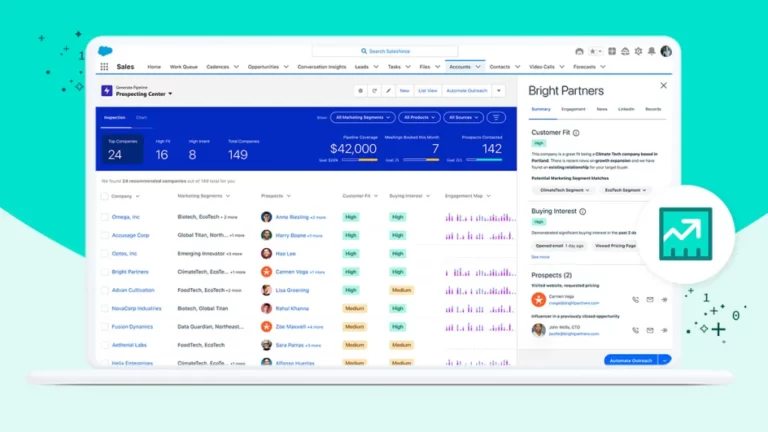
    • Automated Prospecting: Powered by Data Cloud – which unifies internal Salesforce and external data in real time – Automated Prospecting creates prospect lists based on account segmentation, customer fit, and buyer engagement scores to help sellers engage customers when they’re most likely to purchase. These scores can include metrics such as recent company expansion and levels of relationships with decision makers.
    • Process Intelligence: Sales operations teams can easily build data models from internal and external data sources to optimize performance indicators, such as win rate or attrition metrics.
    • Sales Cloud Everywhere: Sellers can bring the power of Sales Cloud to Outlook, Gmail, and web browsers to effortlessly manage opportunities, update accounts, and look up CRM data from wherever they’re working. Additionally, it streamlines email communication by auto-generating and sending emails directly from these platforms.

    These innovations are powered by unified data that powers trusted AI, and all sales processes are integrated on a single platform. This allows sales organizations to transform how they work and shift their attention from processes to connecting with people, giving them more time to focus on what they do best – selling.

    Read More