Category: Guides

  • Maximizing ROI: Boosting User Adoption in CRM Systems with Sentia

    Maximizing ROI: Boosting User Adoption in CRM Systems with Sentia

    Maximizing ROI: Boosting User Adoption in CRM Systems with Sentia

    User adoption makes or breaks your CRM’s success. Many businesses install powerful systems like Salesforce or Dynamics, only to see teams struggle with clunky workflows and low engagement. Sentia integration changes that by streamlining tasks and delivering real-time insights that get users on board fast. Ready to boost your CRM efficiency and see real ROI improvement? Let’s explore how Sentia can make it happen. Learn more about effective CRM user adoption strategies for business growth.

    Boosting CRM User Adoption

    User adoption can determine the success of your CRM. The integration of AI within CRM systems is changing how businesses operate. It simplifies workflows and drives engagement.

    Benefits of AI-Powered CRM

    AI-powered CRMs bring a fresh approach to user engagement. They automate repetitive tasks, allowing you to focus on what truly matters. Imagine having a CRM that not only sorts your data but also guides you on what steps to take next. This efficiency translates to time savings and fewer errors, making your team more productive.

    With Sentia, your CRM becomes more than a database. It evolves into a smart assistant, providing insights at every turn. For instance, Sentia can analyze customer interactions and suggest follow-up actions, ensuring no opportunity is missed. This kind of intelligent interaction transforms how your team engages with clients, leading to improved relationships and better business outcomes. Explore how Sentia enhances CRM user adoption.

    Enhancing CRM Efficiency

    Efficiency is pivotal for any business. With Sentia, your CRM’s efficiency reaches new heights, streamlining operations and maximizing output. This is achieved through automation and intelligent data handling. Sentia takes care of mundane tasks, freeing your team to focus on strategic initiatives.

    Consider your sales team—no longer bogged down by data entry, they can pursue leads more effectively. Sentia’s prioritization feature ensures that they focus on high-value opportunities. This shift in focus not only enhances productivity but also increases satisfaction among team members. The more your team can achieve with less effort, the more value they bring to your business. Here are some CRM best practices to consider.

    Sentia Integration Success Stories

    Seeing real-world results can truly underline the impact of a robust CRM tool. Sentia’s integration has led to remarkable outcomes for various businesses.

    Real-World ROI Improvements

    The proof is in the numbers. Businesses using Sentia have reported significant ROI improvements, with increased sales and streamlined workflows. For instance, a national sales manager from a global appliance brand noted a dramatic rise in productivity and sales activity after switching to Sentia. These improvements translate into real financial gains, showcasing the power of AI in transforming business processes.

    The gains aren’t limited to large enterprises. Smaller businesses also see the impact with faster decision-making and enhanced customer interactions. Sentia’s ability to provide actionable insights quickly means teams can adapt and respond in real-time, a crucial advantage in today’s fast-paced market. Check out this article on maximizing CRM ROI through user adoption.

    Testimonials from Happy Clients

    Hearing from satisfied clients paints a clearer picture of Sentia’s effectiveness. John S., an operations director at a national services business, shared how Sentia transformed their CRM experience, offering unparalleled service and professionalism. This level of satisfaction echoes across various sectors, illustrating Sentia’s adaptability and effectiveness.

    Cam W., a sales director, expressed gratitude for Sentia’s role in modernizing their CRM, creating custom solutions for complex challenges. These testimonials highlight not only the technical prowess of Sentia but also its ability to cater to diverse business needs, ensuring a tailored approach for each client. Discover organizational strategies for effective CRM implementation.

    Taking the Next Step with Sentia

    Your journey with Sentia doesn’t end at integration. It’s about ongoing improvement and support, ensuring your CRM continues to deliver value.

    Schedule Your Free Demo

    Ready to see Sentia in action? Scheduling a demo is the perfect way to understand its capabilities. During the demo, you’ll discover how Sentia can be tailored to your specific needs, from automating tasks to providing insightful analytics.

    By seeing the platform in action, you gain firsthand experience of the potential improvements in your operations. This step is crucial for decision-makers looking to validate the return on investment and see immediate benefits.

    Transform Your CRM System Today 🚀

    The longer you wait, the more opportunities you might miss. Sentia offers the tools to transform your CRM today. With AI enhancing your workflows, you can expect significant gains in productivity and customer satisfaction.

    Embark on this journey of transformation and see how Sentia can revolutionize your CRM experience. From seamless integration to cutting-edge features, Sentia stands ready to elevate your business processes. Take the leap and transform your CRM system for better results and a brighter future.

  • What are AI Agents? What are Best Practice Use Cases?

    What are AI Agents? What are Best Practice Use Cases?

    AI agents are intelligent automation solutions that use machine learning, predictive analytics, and natural language processing to revolutionize sales enablement and customer engagement in modern business settings. This article provides a comprehensive guide for understanding AI agents, highlighting how sales teams and business leaders can leverage AI for CRM automation, lead management, and data-driven decision making.

    What Are AI Agents?

    AI agents are advanced digital tools that automate complex workflows and sales processes previously managed by humans, including lead generation, pipeline management, and personalized customer outreach. Unlike simple chatbots or rule-based automations, AI agents analyze real-time data and context to help sales teams optimize performance and convert prospects into loyal customers, boosting sales productivity.

    Top AI Agent Types & Business Applications

    AI Agent TypeDescriptionUse Cases in Sales & Business
    Autonomous AgentsUse artificial intelligence to independently execute tasks like outreach and meeting setup.Automated lead nurturing, scheduling, inbound inquiry response
    Assistive AgentsOffer sales coaching and real-time performance insights through machine learning.CRM data analysis, call coaching, proposal recommendations
    Predictive AgentsLeverage analytics to anticipate sales trends and risk factors.Deal forecasting, opportunity scoring, renewal reminders
    Reactive AgentsTrigger workflows based on CRM events or customer activity.Demo follow-ups, personalized post-sale engagement
    Multi-Agent SystemsCoordinate multiple AI agents for seamless customer journey management.Automated sequences for multi-channel sales outreach
    Internal Process AgentsEnhance business intelligence and operational efficiency.CRM data enrichment, sales analytics dashboards, reporting
    AI Agent Use Cases

    How AI Agents Differ from Chatbots

    Unlike chatbots, which are primarily used for responding to basic FAQs, AI agents leverage natural language processing and predictive analytics to automate pipeline management, perform lead scoring, and generate actionable insights for sales teams.

    • AI agents integrate with CRM systems and ERP platforms to streamline end-to-end business automation.
    • They utilize big data, machine learning, and sales technology to adapt strategies and personalize customer engagement at scale.

    Where to Apply AI Agents in Business

    AI agents provide significant ROI in several business scenarios:

    • Automating repetitive back-office and sales admin tasks, delivering instant CRM updates.
    • Analyzing customer data for targeted sales outreach and opportunity identification.
    • Enhancing sales enablement by offering real-time coaching and workflow optimization.
    • Supporting enterprise AI transformation with predictive risk alerts and sales forecasting.
    • Driving customer engagement with advanced marketing automation and personalized recommendations.

    Features for Maximum Impact

    When selecting AI agent solutions, look for:

    • Seamless integration with core CRM and ERP software.
    • Advanced analytics, KPI tracking, and actionable reporting dashboards.
    • Tailored sales enablement tools including lead scoring and opportunity prioritization.
    • Continuous learning for improved outcomes in sales productivity and customer satisfaction.
    • Industry-specific automation capabilities for banking, SaaS, manufacturing, and more.

    Challenges in AI Agent Implementation

    AI agent deployment requires:

    • Clean CRM data and connected business intelligence systems.
    • Careful process redesign for old workflows, avoiding fragmented automation.
    • Oversight for accuracy in predictive analytics, minimizing risk of AI hallucination or error.
    • Strategic alignment with enterprise AI goals—from sales technology to process automation.

    AI Agents Can Amplify Sales When Properly Created, Deployed and Trained

    AI agents are essential for sales enablement and business automation, bringing machine learning, predictive analytics, and CRM integration to the core of modern enterprise operations. By streamlining workflows and boosting real-time customer engagement, AI agents empower sales teams to drive revenue and create sustainable business growth.

    Frequently Asked Questions: Understanding AI Agents & Use Cases

    What exactly is an AI agent? An AI agent is an advanced digital tool that uses machine learning, predictive analytics, and natural language processing (NLP) to independently execute complex workflows. Unlike standard automation, an AI agent can analyze real-time context and data to make decisions, such as nurturing a lead or optimizing a sales process, without constant human intervention.

    How do AI agents differ from traditional chatbots? While chatbots are typically limited to answering basic FAQs based on pre-set rules, AI agents are integrated into core business systems like CRMs and ERPs. They can perform “reasoning,” handle end-to-end tasks (like scheduling meetings or updating records), and adapt their strategies based on big data and sales performance trends.

    What are the different types of AI agents used in business? There are six primary types of AI agents:

    1. Autonomous Agents: Independently handle outreach and scheduling.
    2. Assistive Agents: Provide real-time coaching and performance insights.
    3. Predictive Agents: Forecast sales trends and identify renewal risks.
    4. Reactive Agents: Trigger specific workflows based on CRM events.
    5. Multi-Agent Systems: Coordinate several agents for complex customer journeys.
    6. Internal Process Agents: Focus on data enrichment and operational reporting.

    What are some best-practice use cases for AI agents in sales? Key use cases include automated lead qualification, real-time call coaching for reps, predictive deal forecasting, and automated CRM data enrichment. By handling repetitive administrative tasks, AI agents allow sales teams to focus on high-value relationship building and closing deals.

    What is required to successfully deploy an AI agent? Success depends on four foundational elements:

    • Clean Data: AI requires accurate, centralized CRM data to function correctly.
    • Process Redesign: You cannot simply automate “broken” workflows; processes must be optimized for AI.
    • Strategic Alignment: AI goals must map directly to business KPIs (e.g., pipeline growth).
    • Human Oversight: Constant monitoring is needed to prevent “AI hallucinations” and ensure brand consistency.

    Can AI agents help with CRM management? Yes. One of the most common internal use cases is using AI agents for CRM hygiene. They can automatically identify duplicate records, fill in missing contact information from external sources, and update deal stages based on customer activity, ensuring the “source of truth” remains accurate.

    #AIAgents #SalesEnablement #BusinessAutomation #CRM #AIinBusiness #EnterpriseAI #SalesTechnology #MachineLearning #PredictiveAnalytics #AIWorkflows #CustomerEngagement #SalesProductivity #AITransformation

  • Evaluating AI ROI? If Your Data Isn’t properly Structured for AI & Clean, your project will fail

    Evaluating AI ROI? If Your Data Isn’t properly Structured for AI & Clean, your project will fail

    Why your shiny new AI initiative is doomed without pristine data – a C-Suite & Board Member must-read.

    We’re all buzzing about AI’s transformative power. From predictive analytics to hyper-personalized customer experiences, the promise is huge. But here’s the cold, hard truth: AI is only as smart as the data you feed it. Ignoring your data’s quality is like fueling a Ferrari with dirty fuel (yikes – who would do that?) – it won’t just underperform, it will spectacularly break down. And if you think Ferrari maintenance is expensive – let me tell you a story about AI and dirty fuel (data) at company XYZ …..

    This isn’t a technical deep dive; it’s a strategic imperative. Your company’s AI success hinges on five critical data commandments. Miss even one, and your multi-million dollar AI investment could become a multi-million dollar mistake.


    The AI Data Preparation Checklist: Your 5 Commandments for Success

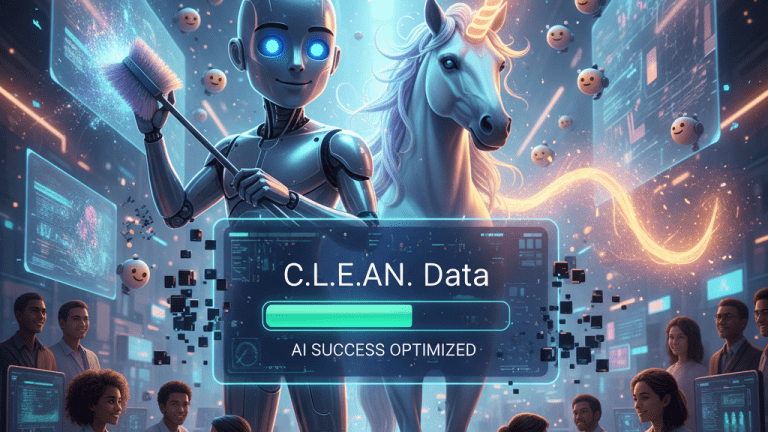
    Think of this as your C.L.E.A.N. Data framework for AI optimization.

    1. C – Consistency & Standardization (The “Single Source of Truth” Rule)
      • What it is: Ensuring all data points mean the same thing, everywhere. No more “client,” “customer,” and “CUST” all referring to the same entity. No more different date formats (MM/DD/YY vs. DD-MM-YYYY).
      • Why it’s crucial: Inconsistent data confuses AI. It sees “New York” and “NYC” as two different places. It can’t accurately track customer journeys if their ID changes across systems.
      • Checklist:
        • ✅ Define Universal Glossaries: Standardize terms, abbreviations, and data definitions across all departments.
        • ✅ Implement Master Data Management (MDM): Establish a single, authoritative record for key business entities (customers, products, suppliers).
        • ✅ Enforce Data Entry Standards: Use dropdowns, validation rules, and standardized forms.
    2. L – Lineage & Provenance (The “Know Your Data’s Story” Rule)
      • What it is: Understanding where your data came from, how it was collected, and how it has been transformed. It’s the full audit trail.
      • Why it’s crucial: AI makes decisions based on patterns. If data was collected from a biased source, or transformed incorrectly, the AI will learn those flaws. Knowing the lineage helps you trust the AI’s output.
      • Checklist:
        • ✅ Document Data Sources: Clearly identify every system, sensor, or manual entry point for data.
        • ✅ Track Data Transformations: Log every alteration, aggregation, or cleansing step applied to the data.
        • ✅ Maintain Data Ownership: Assign clear ownership for data sets to ensure accountability.
    3. E – Elimination of Gaps & Errors (The “No Missing Pieces” Rule)
      • What it is: Filling in missing values, correcting inaccurate entries, and removing duplicates. Think of it as patching holes and removing noise.
      • Why it’s crucial: Missing data forces AI to guess or exclude critical information. Incorrect data leads AI to learn false patterns, generating flawed insights or making wrong predictions. Duplicates skew analysis.
      • Checklist:
        • ✅ Identify Missing Values: Analyze datasets for empty fields in critical columns.
        • ✅ Implement Data Imputation Strategies: Decide how to handle missing data (e.g., mean, median, predictive models) or whether to exclude it.
        • ✅ Deduplication Processes: Establish rules to identify and merge or remove duplicate records.
        • ✅ Error Detection & Correction: Use anomaly detection and validation rules to catch and fix outliers or incorrect entries.
    4. A – Accessibility & Integration (The “One Seamless Pipeline” Rule)
      • What it is: Ensuring your AI systems can easily access all the data they need, regardless of where it lives (CRM, ERP, spreadsheets, IoT devices).
      • Why it’s crucial: Data locked in silos prevents AI from seeing the complete picture. An AI trying to predict customer churn needs data from sales, marketing, and customer service. Without integration, it’s blind.
      • Checklist:
        • ✅ Build Data Lakes/Warehouses: Consolidate data from disparate sources into a central repository.
        • ✅ Establish Robust APIs/Connectors: Implement interfaces that allow systems to talk to each other seamlessly.
        • ✅ Define Access Protocols: Ensure secure and governed access for AI models to relevant datasets.
    5. N – Novelty & Relevance (The “Fresh & Fit for Purpose” Rule)
      • What it is: Ensuring your data is up-to-date and directly relevant to the specific AI problem you’re trying to solve.
      • Why it’s crucial: Stale data leads to outdated insights. If your AI is predicting customer behavior, but its training data is from five years ago, it will miss current trends. Irrelevant data simply adds noise and can even mislead the AI.
      • Checklist:
        • ✅ Implement Data Refresh Cadence: Define how often data needs to be updated (real-time, daily, weekly).
        • ✅ Curate Feature Stores: Select and prepare features (variables) that are most impactful for specific AI models.
        • ✅ Regular Data Audits: Periodically review datasets for continued relevance and utility.

    When Bad Data Goes Rogue: 3 AI Disaster Stories

    These aren’t hypothetical; they’re common pitfalls that underscore why C.L.E.A.N. data is non-negotiable.

    1. The Retailer’s “Churn Prediction” Fiasco (Inconsistent & Gaps):

    A major online retailer launched an AI to predict customer churn, aiming to offer proactive discounts. The data used for training was pulled from various systems. Customer IDs were inconsistent, purchase dates had different formats, and shipping addresses were often missing.

    1. The Ruin: The AI delivered wildly inaccurate predictions. It identified loyal customers as “high churn risk” (because their varied IDs made them look like new, infrequent buyers) and missed actual at-risk customers entirely. Millions were wasted on misdirected discounts, and customer trust eroded due to irrelevant offers. The project was scrapped, and the data team faced immense scrutiny.
    2. The Recruitment AI’s Unconscious Bias (Lineage & Errors):

    A tech company developed an AI to screen resumes, aiming for efficiency and bias reduction. The AI was trained on a decade of the company’s past hiring data. Unbeknownst to the developers, the historical data was heavily skewed: 70% of successful hires for certain technical roles had been male, and most came from specific universities.

    1. The Ruin: The AI, learning from historical patterns, began systematically downgrading resumes from female candidates and those from less-prestigious (but equally qualified) universities, regardless of skill. It reinforced and amplified existing human biases. When the bias was uncovered, it led to a public relations nightmare, damaged the company’s diversity initiatives, and resulted in a costly re-evaluation of all hiring practices.
    2. The Manufacturing Predictative Maintenance Miss (Novelty & Accessibility):

    An industrial manufacturer invested in AI to predict equipment failures, promising to drastically reduce downtime. The AI was implemented but trained on sensor data that was collected quarterly and only from critical components, while other relevant data (e.g., ambient temperature, operator maintenance logs) was locked in separate, inaccessible systems.

    1. The Ruin: The AI frequently missed impending failures or raised false alarms. It couldn’t detect subtle changes because its data was too old (quarterly, not real-time) and incomplete (missing crucial environmental factors). Equipment continued to break down unexpectedly, causing expensive production halts, undermining the AI’s credibility, and delaying ROI.

    Your Call to Action: Invest in Data First

    The message is clear: Data preparation is not a pre-project task; it’s an ongoing, foundational investment. As a C-suite executive or Board member, your first strategic move in AI isn’t about choosing the algorithm, but about demanding a crystal-clear understanding and actionable plan for your data’s quality.

    Ask the tough questions:

    • “How are we ensuring data consistency across the enterprise?”
    • “Can we trace the origin and transformation of our critical datasets?”
    • “What are our real-time metrics for data cleanliness and completeness?”
    • “Are all relevant data sources integrated and accessible for our AI initiatives?”
    • “How often is our data refreshed, and is it truly relevant to our AI’s purpose?”

    Don’t let your AI dream turn into a data nightmare. Prioritize C.L.E.A.N. Data from day one, and you’ll build an AI strategy that truly delivers.

    Frequently Asked Questions: Data Hygiene for AI ROI

    Why is clean data the foundation of AI ROI? AI is essentially a pattern-recognition engine. If your CRM data is “dirty”—filled with duplicates, outdated info, or inconsistent formats—the AI will identify the wrong patterns. This leads to inaccurate lead scoring and flawed forecasting. Cleaning your data ensures the “Garbage In, Garbage Out” rule doesn’t kill your AI investment, resulting in higher conversion rates and measurable revenue growth.

    What are the most common CRM data issues that break AI? The three primary “AI-killers” are:

    1. Duplicates: These split activity history across multiple records, making it impossible for AI to see the full customer journey.
    2. Incomplete Records: Missing fields like “Industry” or “Job Title” leave the AI with no data points to analyze.
    3. Inconsistent Formatting: Variations like “VP Sales” vs. “Vice President of Sales” confuse AI models, which may treat them as entirely different personas.

    How do you make CRM data “AI-ready”? Making data AI-ready requires three steps: Standardization, Normalization, and Deduplication. You should move away from free-text fields and toward standardized picklists (dropdowns). This ensures that every entry follows the same format, allowing the AI to process the data with high confidence and accuracy.

    What is the business impact of data hygiene on sales? Clean data has a direct impact on the P&L. Case studies show that organizations with high data hygiene see up to a 34% improvement in win rates and a significant reduction in sales cycle length. When data is clean, sales reps spend less time on “data janitor” work and more time closing high-probability deals identified by accurate AI lead scoring.

    Can AI help clean its own data? Yes. Modern “Data Hygiene Agents” can automate the cleaning process by identifying “fuzzy” duplicates, normalizing job titles across thousands of records, and enriching missing contact information from external databases. However, AI cleaning must be paired with human governance and strict CRM validation rules to prevent the mess from returning.

    What metrics should a CRO track for data quality? Chief Revenue Officers should monitor three key data KPIs:

    • Accuracy Rate: Percentage of records with verified, current information.
    • Completeness Rate: Percentage of mandatory fields populated in the CRM.
    • Uniqueness Rate: The percentage of records that are free of duplicates.
  • How can CSOs & CMOs Forge Sales Growth with AI Synergy?

    How can CSOs & CMOs Forge Sales Growth with AI Synergy?

    The C-Suite Imperative: 2025 Demands Alignment

    Been here? Sales tells the CEO marketing doesn’t create enough viable sales opportunities to hit quota, and marketing says sales doesn’t properly action the amazing leads they create and send to sales. So who’s right?

    The legacy narrative of Chief Sales Officers (CSOs) and Chief Marketing Officers (CMOs) as adversaries is obsolete in the AI era. Misaligned KPIs, fragmented data, and defensive turf battles have grown costly and unsustainable. However, Artificial Intelligence is rapidly eliminating these friction points, driving a tectonic shift where sales and marketing transform into unified revenue engines. The imperative for every executive today is not just collaboration, but AI-powered strategic integration to unlock scalable, measurable growth.

    Classic Barriers: Breaking the Silos with AI

    Despite sharing a goal—acquisition and growth—CSOs and CMOs often work in parallel universes:

    • Marketing: Prioritizes brand, image, social media, top-of-funnel metrics, and lead volume. Yes they know the corporate ICP, but sales can’t seem to sell.
    • Sales: Obsesses over quota, deal velocity, and pipeline. If they don’t sell they don’t have a job. Often wonder why marketing leads don’t correspond to ICP. Yet they are the first ones fired?

    AI exposes—and solves—the old pain points:

    • Lead Volume vs. Lead Quality: AI enables precise targeting, not just bigger lists.
    • Messaging Drift: AI-powered NLP corrects inconsistencies fast.
    • Data Silos: Unified AI platforms synthesize all customer insights. (Know what you don’t know)
    • Blame Culture: AI reveals root causes, enabling transparent growth diagnosis.

    The AI Synergy Blueprint: Joint Wins for CSO & CMO

    1. Unified Data Ecosystem

    The first step is abolishing silos. CSO-CMO alliances must jointly launch AI-powered customer data platforms (CDPs) that aggregate interactions across CRM, analytics, social, and support channels.

    • Outcome: Real-time, 360-degree customer profiles enable hyper-personalization, driving up win rates and customer satisfaction by up to 25–30%.

    2. Predictive Lead Scoring & Seamless Handoff

    AI-powered lead scoring uses historical data and behavioral signals to predict actual conversion probability. Machine learning prioritizes sales-worthy leads, and generates suggested outreach timing and messaging.

    Outcome: Deal cycles shrink by 78%, and conversions jump by 32% with AI-guided sales enablement.

    3. Messaging & Content Optimization

    Natural Language Processing tools mine sales calls, emails, and asset usage. AI surfaces what resonates, why deals stall, and which content moves revenue.

    • Outcome: Marketing adapts content to high-performing themes; sales reps close with tailored, AI-curated collateral, resulting in higher conversion and shortened cycles.

    4. Dynamic Sales Enablement & Responsive Campaigns

    AI unites opportunity detection and targeted enablement. Platforms highlight cross-sell/upsell chances, auto-recommend relevant assets, and drive real-time team collaboration.

    • Outcome: Companies see up to a 10–20% boost in sales ROI and a 25–50% improvement in forecasting accuracy.

    5. Joint Revenue Forecasting & Strategic Planning

    Forecasting is revolutionized by AI’s predictive analytics, which combine pipeline data, market signals, and macroeconomic indicators. CSO and CMO can now build unified, data-backed growth roadmaps.

    • Outcome: 15–25% increases in forecast accuracy, 30% revenue growth, and reduced budget conflicts—real alignment in action.

    Leadership Mandate: CSO & CMO as AI Co-Architects

    The future demands hands-on C-suite leadership. CSOs and CMOs must:

    • Co-own the AI Vision: Formalize a joint AI adoption roadmap, with clear success metrics.paloaltonetworks+1
    • Upskill Teams: Invest in data literacy, AI tool fluency, and collaborative methods.blogs.idc+1
    • Champion Experimentation: Encourage rapid pilots and ongoing AI model refinement.persana
    • Measure Holistically: Track cross-functional metrics—Customer Lifetime Value, sales velocity, and efficiency per employee.demandrevenue

    Road-Tested Results: Recent Case Studies in 2025

    • B2B platforms using unified AI CDPs report a 30% increase in revenue and a 25% rise in customer satisfaction.
    • Teams integrating AI for lead scoring and engagement shorten deal cycles by 78% and raise deal sizes by 70%.
    • Enterprises leveraging AI for cross-departmental forecasting see 15–25% improvements in accuracy and up to 50% higher lead conversions.

    Visual Model: CSO & CMO AI Synergy Flow

    A simple flowchart for your next boardroom presentation:

    • Unified Data Ingestion → Predictive Intelligence Layer (AI) → Personalized Outreach & Messaging → Automated Sales Enablement → Joint Analytics & Forecasts

    The Next Revenue Engine: Collaborative, AI-Driven, Relentless

    Sales and marketing conflict is no longer needed / a “thing”—AI-powered synergy is the new competitive edge. By joining forces, CSOs and CMOs move beyond efficiency to strategic growth, driving customer value and profitability in the digital age.

    Frequently Asked Questions: CSO and CMO AI Synergy

    How does AI bridge the traditional gap between sales (CSO) and marketing (CMO)? AI eliminates common friction points by creating a “unified revenue engine.” It solves the “Lead Quality vs. Lead Volume” debate through precise targeting, corrects messaging drift using Natural Language Processing (NLP), and breaks down data silos to provide a single, transparent view of the customer journey.

    What are the measurable benefits of a unified AI data ecosystem? By aggregating data across CRM, social, and support channels into an AI-powered platform, companies can see a 25–30% increase in win rates and customer satisfaction. This “360-degree” profile allows for hyper-personalization that traditional siloed systems cannot achieve.

    Can AI actually shorten the sales deal cycle? Yes. Real-world data shows that integrating AI for predictive lead scoring and guided sales enablement can shrink deal cycles by up to 78% and increase conversion rates by 32%. AI achieves this by prioritizing sales-worthy leads and suggesting the exact timing and messaging for outreach.

    How does AI improve revenue forecasting for executive leadership? AI-powered predictive analytics combine internal pipeline data with external market signals and macroeconomic indicators. This results in a 15–25% increase in forecast accuracy, which reduces budget conflicts between sales and marketing and allows for more confident strategic planning.

    What are the first steps for a CSO and CMO to align their AI strategy? Alignment starts with four key actions:

    1. Co-owning the AI Vision: Formalizing a joint roadmap with shared success metrics.
    2. Upskilling Teams: Investing in data literacy and AI tool fluency across both departments.
    3. Championing Experimentation: Running rapid pilots to refine AI models.
    4. Measuring Holistically: Shifting focus to cross-functional metrics like Customer Lifetime Value (CLV) and sales velocity.

    How does AI optimize marketing content for sales teams? AI mines sales calls and emails to identify which themes and assets actually move revenue. Marketing can then adapt content to these high-performing themes, providing sales reps with AI-curated, tailored collateral that effectively addresses why deals stall or close.

    Keywords: #sales #marketing #ai #collbaroation #aiadoption #aicasestudies #technology #management

  • The Autonomous Agent Revolution: Why Adecco Can Now Process 300 Million Resumes Annually

    The Autonomous Agent Revolution: Why Adecco Can Now Process 300 Million Resumes Annually

    When Adecco, one of the world’s largest staffing companies, announced they could now process 300 million resumes annually using Salesforce’s “Agentforce” platform, it wasn’t just a technology milestone—it was a declaration of war on traditional recruitment methods.

    To put that number in perspective: 300 million resumes is roughly equivalent to every working-age adult in the United States submitting their resume 2.5 times per year. It’s a volume that would require an army of 10,000+ human recruiters working full-time just to review—never mind actually process, screen, and match.

    Adecco is doing it with a handful of autonomous AI agents.

    Welcome to the age of recruitment at infinite scale.

    What Autonomous Agents Actually Are

    Before we dive into the implications, let’s be clear about what we’re dealing with. Autonomous agents aren’t just fancy chatbots or automated email systems. They’re AI entities that can:

    • Operate independently without constant human supervision
    • Make complex decisions based on evolving criteria and context
    • Learn and adapt from outcomes to improve performance
    • Take actions across multiple systems and platforms
    • Coordinate with other agents to complete complex workflows

    Think of them as AI employees that never sleep, never take breaks, and get smarter every day.

    The Adecco Case Study: Scale Redefined

    The Challenge: Adecco needed to match millions of candidates to hundreds of thousands of roles across dozens of countries, each with different requirements, languages, and regulatory environments.

    The Traditional Approach: This would require:

    • Thousands of human recruiters
    • Massive operational overhead
    • Inconsistent quality across regions
    • Prohibitive cost structure
    • Months or years to scale

    The Agentforce Solution: Autonomous agents that can:

    • Parse and analyze resumes in 40+ languages
    • Match candidates to roles using 500+ criteria points
    • Conduct initial screenings and assessments
    • Schedule interviews and manage follow-ups
    • Learn from successful placements to improve future matching

    The Result: 300 million resumes are processed annually with better accuracy than human-only systems.

    Math That Changes Everything

    Let’s break down what this scale actually means:

    300 million resumes annually =

    • 25 million resumes per month
    • 822,000 resumes per day
    • 34,000 resumes per hour
    • 570 resumes per minute
    • Nearly 10 resumes processed every second, 24/7/365

    Human Equivalent: If each resume takes a human recruiter 5 minutes to properly review, this represents 25 million hours of work annually—or the equivalent of 12,000 full-time employees.

    Cost Implications: At an average recruiter salary of $60,000, this represents $720 million in annual labor costs—replaced by AI agents that cost a fraction of that amount.

    Beyond Volume: The Quality Revolution

    But here’s what’s remarkable: the autonomous agents aren’t just processing more resumes—they’re processing them better.

    Consistency: No fatigue, no mood variations, no unconscious bias from reviewing too many similar profiles

    Comprehensiveness: Every resume gets the same thorough analysis across all relevant criteria

    Speed: Instant processing means candidates get faster responses and better experiences

    Learning: Each placement outcome improves the algorithm for future matches

    The Stanford Study Result: Candidates processed by AI-first systems are 53% more likely to succeed in subsequent human interviews than those screened traditionally.

    The Ripple Effects Across the Industry

    Adecco’s success with autonomous agents is creating shockwaves across the recruitment ecosystem:

    For Large Staffing Firms

    The Arms Race: Every major player is now racing to deploy similar capabilities

    Scale Advantage: Firms with autonomous agents can bid on contracts previously impossible to fulfill

    Margin Improvement: Dramatic cost reduction while maintaining or improving quality

    For Mid-Size Recruitment Firms

    The Equalizer: Access to similar agent technology levels the playing field with larger competitors

    The Differentiator: First movers in agent deployment gain temporary competitive advantages

    The Necessity: Firms without agents increasingly can’t compete on volume or cost

    For Boutique Firms

    The Opportunity: Agents handle volume work, freeing humans for high-touch, strategic activities

    The Threat: Volume-based revenue models become unsustainable

    The Evolution: Must pivot to advisory, consulting, and relationship-driven services

    Real-World Applications Beyond Adecco

    The autonomous agent revolution extends far beyond one company’s success:

    Unilever: AI-Powered Graduate Recruitment**

    • Autonomous agents screen 300,000+ graduate applications annually
    • Custom game-based assessments administered by AI
    • 75% reduction in time-to-hire
    • 90% candidate satisfaction scores

    JPMorgan Chase: Intelligent Candidate Matching**

    • Agents analyze internal mobility opportunities for 250,000+ employees
    • Real-time skills gap identification and candidate recommendations
    • 40% increase in internal placement success rates

    IBM: Predictive Talent Pipeline Management**

    • Autonomous agents continuously scan talent markets for emerging skills
    • Proactive candidate engagement before roles are even posted
    • 60% reduction in time-to-fill for critical technical roles

    The Technology Stack Behind the Revolution

    Understanding how autonomous agents achieve this scale requires looking at the technology foundation:

    Natural Language Processing

    • Resume parsing in 40+ languages with 99.7% accuracy
    • Context understanding that goes beyond keyword matching
    • Semantic analysis of skills, experience, and career progression patterns

    Machine Learning Models

    • Predictive success algorithms trained on millions of placement outcomes
    • Dynamic learning that improves with each new data point
    • Multi-dimensional matching across skills, culture, location, and growth potential

    Workflow Orchestration

    • Complex decision trees that mirror human recruiter judgment
    • Integration with ATS, HRIS, and communication platforms
    • Automated handoffs between AI and human touch points

    Real-Time Analytics

    • Continuous performance monitoring and optimization
    • A/B testing of different agent configurations
    • Predictive modeling for pipeline management and capacity planning

    Competitive Implications

    The firms deploying autonomous agents at scale aren’t just improving efficiency, they’re fundamentally changing the competitive landscape:

    New Competitive Advantages

    Speed: Fill roles in days instead of weeks

    Scale: Handle volume that would overwhelm traditional firms

    Quality: Consistent, data-driven candidate assessment

    Cost: Dramatically lower operational overhead

    New Competitive Requirements

    Technology Investment: Significant upfront costs for platform deployment

    Data Quality: Agents are only as good as the data they’re trained on

    Human-AI Integration: Designing workflows that optimize both AI and human capabilities

    Continuous Learning: Systems that adapt and improve based on outcomes

    The Implementation Reality

    While the Adecco results are impressive, implementing autonomous agents at scale isn’t trivial:

    Technical Requirements

    • Robust data infrastructure and governance
    • Integration with existing recruitment technology stacks
    • Quality assurance and bias monitoring systems
    • Compliance frameworks for different jurisdictions

    Organizational Changes

    • Recruiter role redefinition and training
    • New performance metrics and KPIs
    • Change management for human-AI collaboration
    • Client education and expectation setting

    Investment Considerations

    • Platform licensing and setup costs ($50K-$500K+)
    • Integration and customization expenses
    • Ongoing training and optimization resources
    • ROI timeline of 6-18 months depending on scale

    Your Strategic Options

    Watching Adecco process 300 million resumes should prompt every recruitment firm to ask: What’s our autonomous agent strategy?

    Option 1: Build

    Develop proprietary agent capabilities tailored to your specific market or niche.

    Pros: Competitive differentiation, IP ownership

    Cons: High cost, long timeline, technical risk

    Option 2: Buy

    License existing platforms like Salesforce Agentforce or similar enterprise solutions.

    Pros: Faster deployment, proven capabilities

    Cons: Shared competitive advantage, ongoing licensing costs

    Option 3: Partner

    White-label agent services or form strategic alliances with technology providers.

    Pros: Lower upfront investment, shared risk

    Cons: Less control, potential dependency

    Option 4: Wait

    Maintain current approaches while monitoring market development.

    Pros: No immediate investment required

    Cons: Falling further behind daily, may become too late to catch up

    The Urgency Imperative

    Here’s the uncomfortable truth: while you’re deciding whether to explore autonomous agents, your competitors are already deploying them.

    The Network Effect: Every day an agent operates, it processes more data and becomes more effective

    The Scale Advantage: Early adopters are securing contracts that require agent-level capabilities

    The Talent Migration: Top recruiters want to work for firms with cutting-edge technology

    The Future Is Here

    Adecco’s 300 million resume milestone isn’t a glimpse of the future—it’s a reality check about the present.

    Autonomous agents are processing resumes at superhuman scale right now. They’re making better matches, delivering faster results, and operating at costs that traditional methods can’t touch.

    The question isn’t whether autonomous agents will transform recruitment—they already have.

    The question is whether your firm will be part of that transformation or displaced by it.

    The Bottom Line

    When one company can process 300 million resumes annually with AI agents, the entire recruitment industry needs to recalibrate its understanding of what’s possible.

    This isn’t about incremental improvement, it’s about orders-of-magnitude transformation in scale, speed, and capability.

    The firms that embrace autonomous agents won’t just gain efficiency—they’ll gain the ability to serve markets and clients that were previously unreachable.

    The autonomous agent revolution is here. The only question is whether you’re leading it or being left behind by it.


    The autonomous agent revolution represents just one dimension of AI’s transformative impact on recruitment. For a comprehensive analysis of emerging AI technologies, implementation strategies, and competitive positioning frameworks, including detailed case studies and deployment roadmaps—download our complete white paper: “Navigating the AI Disruption in Recruitment: A Strategic Guide for Forward-Thinking Firms.”

    Learn how leading firms are successfully deploying autonomous agents, building competitive advantages, and scaling their operations to previously impossible levels.

    Download your white paper here and discover how to harness the power of AI agents to transform your recruitment capabilities.


  • 78% Cost Reduction: How AI is Slashing Recruitment Costs and What you need to Know

    78% Cost Reduction: How AI is Slashing Recruitment Costs and What you need to Know

    The cost-per-hire numbers are staggering—and they should terrify every traditional recruitment firm.

    According to the World Economic Forum, AI-driven recruitment processes are achieving an 78.2% cost reduction compared to traditional methods.

    The average U.S. cost-per-hire has plummeted from $4,129 to under $900 in AI-led systems.

    Let that sink in for a moment. Your clients can now achieve the same hiring outcomes for less than a quarter of what they used to pay.

    If you’re still operating with traditional recruitment models, you’re not just losing efficiency—you’re pricing yourself out of the market.

    The Numbers You Need to Know

    The cost compression isn’t theoretical. It’s happening right now across every sector:

    Overall Process Costs: North American firms using AI report a 40% reduction in HR process costs

    Time-to-Hire: AI reduces average hiring cycles from 42 days to 14 days

    Screening Efficiency: AI can process 10,000 resumes in the time it takes a human to review 10

    Administrative Overhead: 70% of firms use AI to automate scheduling, follow-ups, and documentation

    But here’s the kicker: these aren’t just efficiency gains. They’re fundamental shifts in the economics of talent acquisition.

    The Margin Compression Reality

    When your clients can hire for $900 instead of $4,129, what happens to your $15,000 placement fee?

    The Pressure Points:

    • Clients are demanding lower fees to match their reduced internal costs
    • New AI-powered competitors are undercutting traditional pricing models
    • Enterprise clients are bringing more hiring in-house with AI tools
    • Volume-based pricing becomes unsustainable when AI handles the volume

    The Math Problem: If AI reduces your client’s hiring costs by 87%, why would they pay you the same fee structure that existed when hiring was expensive and inefficient?

    Three Categories of Firms (And Their Fates)

    As cost compression accelerates, recruitment firms are falling into three distinct categories:

    Category 1: The Price Warriors (Doomed)

    These firms try to compete on cost, slashing fees to match AI efficiency. They’re caught in a race to the bottom against technology that gets cheaper and better every month.

    Fate: Margin erosion, talent exodus, eventual market exit

    Category 2: The Deniers (Delayed Doom)

    These firms insist that “recruiting is about relationships” and maintain traditional pricing while delivering traditional services. They’re betting clients will pay premium prices for inferior efficiency.

    Fate: Gradual client churn, market share loss, forced consolidation

    Category 3: The Value Evolutionists (Thriving)

    These firms are using AI to slash their own costs while dramatically increasing their value delivery. They’re not competing with AI—they’re leveraging it to become indispensable.

    Fate: Margin expansion, market leadership, sustainable growth

    The Strategic Response Framework

    Smart firms aren’t fighting the cost compression—they’re using it to their advantage. Here’s how:

    1. Embrace the Efficiency Revolution

    Instead of resisting AI cost advantages, multiply them:

    • Deploy AI to reduce your own operational costs by 60-80%
    • Use automation to handle 10x more candidates with the same team
    • Leverage AI insights to achieve 50% higher placement success rates

    The Math: If AI reduces your costs by 70% while improving outcomes by 50%, you can offer 40% lower fees while maintaining higher margins

    2. Redefine Your Value Proposition

    Shift from cost-per-hire to value-per-outcome:

    • “We don’t just fill roles—we optimize your entire hiring function”
    • “Our AI-augmented process delivers better candidates faster”
    • “We provide strategic workforce intelligence, not just placement services”

    The Premium: Clients pay more for strategic consulting than commodity recruiting

    3. Create New Revenue Streams

    AI enables services that weren’t previously scalable:

    • Workforce planning and predictive analytics
    • AI tool selection and implementation consulting
    • Ongoing talent pipeline management
    • Bias auditing and compliance monitoring

    The Opportunity: These high-value services command premium pricing

    Real-World Success Stories

    Case Study 1: The Volume Virtuoso A mid-size staffing firm deployed AI across their entire workflow:

    • Cost Reduction: 65% decrease in cost-per-placement
    • Efficiency Gain: 300% increase in placements per recruiter
    • Client Response: Increased contract values due to faster delivery
    • Result: 40% revenue growth despite 30% fee reduction

    Case Study 2: The Strategic Advisor A boutique executive search firm added AI-powered workforce intelligence:

    • Service Evolution: From search to strategic hiring consultation
    • Price Premium: 50% higher fees for advisory services
    • Client Retention: 95% renewal rate vs. 70% industry average
    • Result: Doubled revenue per client relationship

    The Pricing Revolution

    The old model: Fee = % of Salary × Number of Placements

    The new model: Fee = Business Value Created × Strategic Impact

    Traditional Pricing: 20% of first-year salary for one placement Value-Based Pricing: $50K for optimizing entire hiring function with 90% better outcomes

    The Key: Stop selling placements. Start selling business transformation.

    Your Strategic Options

    Option 1: The Efficiency Play

    Use AI to slash your costs, then compete aggressively on price while maintaining margins through volume.

    Pros: Fast market penetration, clear competitive advantage Cons: Commoditizes your service, vulnerable to further AI advancement

    Option 2: The Premium Advisory Play

    Use AI to enhance service quality, then charge premium fees for strategic consulting and guaranteed outcomes.

    Pros: Higher margins, stickier client relationships, future-proof positioning Cons: Requires significant skill development and market repositioning

    Option 3: The Platform Play

    Build or partner with AI platforms to offer technology-enabled recruitment as a service.

    Pros: Scalable business model, recurring revenue streams Cons: Requires significant technology investment and new capabilities

    The Implementation Roadmap

    Phase 1: Cost Optimization (Months 1-3)

    • Deploy AI for resume screening and candidate sourcing
    • Automate scheduling, follow-ups, and documentation
    • Measure and communicate efficiency gains to clients

    Phase 2: Value Enhancement (Months 4-6)

    • Add predictive analytics and success modeling
    • Develop workforce planning consulting capabilities
    • Create transparent ROI reporting for clients

    Phase 3: Business Model Evolution (Months 6-12)

    • Launch advisory services and retainer-based offerings
    • Develop AI-powered talent intelligence products
    • Build long-term strategic partnerships with key clients

    The Urgency Factor

    Here’s what many firms don’t realize: the 87% cost reduction isn’t the end—it’s the beginning. AI capabilities are improving exponentially while costs continue to plummet.

    What’s Coming Next:

    • Fully autonomous recruitment agents
    • Real-time skills assessment and matching
    • Predictive candidate sourcing before roles are posted
    • Complete interview process automation

    The Window: Firms that don’t adapt in the next 12-18 months may find themselves completely priced out of the market.

    The Choice

    You have two options:

    Option A: Continue with traditional models and watch margins compress until your business becomes unsustainable.

    Option B: Embrace AI-driven cost reduction while evolving your value proposition to capture premium pricing for strategic services.

    The 87% cost reduction isn’t a threat to overcome—it’s a competitive advantage to capture.

    The firms that figure this out first won’t just survive the cost compression—they’ll use it to dominate their markets.

    The Bottom Line

    AI is fundamentally rewriting the economics of recruitment. The cost reductions are real, immediate, and accelerating.

    You can either let this disrupt your business or use it to disrupt your competitors.

    The choice—and the window to make it—won’t be available much longer.


    The cost compression revolution is reshaping every aspect of recruitment business models. For a comprehensive analysis of how to navigate pricing pressures while building sustainable competitive advantages—including detailed financial modeling, value proposition frameworks, and implementation strategies—download our complete white paper: “Navigating the AI Disruption in Recruitment: A Strategic Guide for Forward-Thinking Firms.”

    Learn how leading recruitment firms are turning the 87% cost reduction from existential threat into strategic advantage, building more profitable and sustainable businesses in the AI era.

    Download your white paper here and discover how to thrive in the age of AI-driven cost compression.

  • From Resume Broker to AI-Augmented Advisor: The New Recruiter Job Description

    From Resume Broker to AI-Augmented Advisor: The New Recruiter Job Description

    The traditional recruiter job description is dying.

    You know the one: “Source candidates, review resumes, conduct initial screenings, coordinate interviews, manage client relationships.” It’s the same basic framework that’s existed for decades—find people, match them to jobs, facilitate the process.

    But here’s the reality: AI can now source candidates faster than any human. It can screen resumes more consistently. It can even conduct initial interviews and schedule follow-ups autonomously.

    So what does that mean for recruiters? Are they all headed for obsolescence?

    Absolutely not. But the role is evolving so fundamentally that clinging to the old job description is career suicide.

    Welcome to the age of the AI-Augmented Advisor.

    The Death of the Resume Broker

    Let’s be honest about what many recruiters have traditionally been: sophisticated resume brokers. Take a job description, find matching resumes, present the best options, facilitate the transaction.

    This model worked when information was scarce and search was manual. But today:

    • AI can parse 10,000 resumes in the time it takes you to read 10
    • Automated sourcing agents work 24/7 across multiple platforms
    • Machine learning can identify candidate patterns humans miss
    • Predictive analytics can forecast success better than gut instinct

    The resume brokerage business is being automated away. But that’s liberating—because it frees recruiters to do what AI cannot: provide strategic, relationship-driven, emotionally intelligent guidance. People power and Trust.

    The Rise of the AI-Augmented Advisor

    The future recruiter isn’t competing with AI—they’re partnering with it. Here’s what the new role actually looks like:

    Strategic Workforce Consultant

    Instead of just filling open positions, you’re helping clients design their ideal workforce architecture. You’re answering questions like:

    • What skills will this team need in 18 months?
    • How should we structure roles to maximize retention?
    • What’s the talent market telling us about compensation expectations?
    • How can we build a more diverse and inclusive pipeline?

    AI Workflow Designer

    You’re orchestrating human-AI collaboration to optimize outcomes. This means:

    • Configuring AI tools to match your client’s specific needs
    • Training algorithms on successful placement patterns
    • Designing assessment workflows that combine AI efficiency with human insight
    • Interpreting AI recommendations and translating them for clients

    Candidate Experience Architect

    While AI handles screening and logistics, you’re crafting experiences that attract and engage top talent:

    • Creating compelling employer brand narratives
    • Designing interview processes that showcase company culture
    • Managing sensitive negotiations and complex decision-making
    • Providing career guidance that builds long-term relationships

    Risk and Compliance Navigator

    As AI becomes more prevalent in hiring, someone needs to ensure it’s used ethically and legally:

    • Auditing AI tools for bias and fairness (Avoid Lawsuits – see Workday)
    • Ensuring compliance with evolving AI regulations
    • Designing transparent decision-making processes
    • Managing the human appeal processes required by law

    The New Recruiter Skill Stack (How to Stay in the top 10%)

    This evolution demands a fundamentally different skill set. The future recruiter combines traditional relationship skills with new technical and strategic capabilities:

    Core Competencies 2025+

    AI Fluency: Understanding how to prompt, configure, and interpret AI tools

    Data Literacy: Reading analytics, identifying patterns, making data-driven recommendations
    Strategic Thinking: Moving beyond transactions to workforce planning and organizational design

    Change Management: Helping clients and candidates navigate AI-driven hiring processes Emotional Intelligence: Providing the human touch that AI cannot replicate

    Technical Skills

    • AI tool configuration and optimization
    • Basic data analysis and visualization
    • CRM and ATS system integration
    • Workflow automation design
    • Digital collaboration platform mastery

    Strategic Skills

    • Market analysis and trend identification
    • Organizational psychology and team dynamics
    • Compensation benchmarking and negotiation strategy
    • Regulatory compliance and risk management

    What would that look like for the AI enabled recruiter?

    A Day in the Life: AI-Augmented Recruiter

    6:00 AM: Review overnight AI sourcing results—300 potential candidates identified and pre-screened

    8:00 AM: Analyze AI assessment scores and cultural fit predictions for top 20 candidates 9:00 AM: Strategy call with client’s CHRO about Q3 hiring projections and market trends 10:30 AM: Design custom interview process for new VP of Engineering role

    12:00 PM: Lunch meeting with candidate—providing career guidance and market insights 2:00 PM: Configure AI workflows for new client’s technical screening requirements

    3:30 PM: Review AI bias audit results and adjust algorithmic parameters

    4:00 PM: Facilitate final interview debrief, interpreting AI recommendations alongside human feedback

    5:00 PM: Update workforce planning models with latest market data

    Notice what’s missing? Resume reviewing, manual sourcing, scheduling logistics—all handled by AI.

    The Value Proposition Evolution

    The traditional recruiter value proposition was efficiency: “We’ll find you good candidates faster than you can find them yourself.”

    The AI-augmented advisor value proposition is intelligence: “We’ll help you make better hiring decisions, design optimal team structures, and navigate the future of work.”

    This shift is profound:

    • From tactical to strategic
    • From transactional to advisory
    • From reactive to predictive
    • From individual placements to workforce architecture

    Resistance Is Futile (And Misguided)

    Some recruiters are fighting this evolution, insisting that “recruiting is about relationships” and “AI can’t replace human judgment.”

    They’re missing the point. AI isn’t replacing human judgment—it’s enhancing it. It’s not eliminating relationships—it’s freeing up time to build deeper ones.

    The recruiters who resist AI augmentation aren’t preserving their humanity—they’re limiting their impact and employment prospects.

    The Competitive Advantage

    Here’s what’s exciting: while many recruiters are still figuring out AI, those who embrace the advisor model are building massive competitive advantages:

    Premium Positioning: Clients pay more for strategic advisory services than basic recruiting

    Higher Retention: Advisory relationships are stickier than transactional ones

    Market Differentiation: “AI-augmented” becomes a powerful brand differentiator

    Career Future-Proofing: Advisor skills become more valuable as AI capabilities expand

    Making the Transition

    Step 1: Audit Your Current Role

    • What percentage of your time is spent on tasks AI could handle?
    • Which of your activities provide the most strategic value to clients?
    • Where do you add uniquely human insight to the hiring process?

    Step 2: Develop AI Fluency

    • Start using AI tools for content creation and candidate sourcing
    • Learn to interpret AI-generated insights and recommendations
    • Practice configuring AI workflows for different client needs

    Step 3: Expand Strategic Capabilities

    • Study workforce planning and organizational design
    • Develop expertise in compensation analysis and market trends
    • Build knowledge of AI ethics and compliance requirements

    Step 4: Reframe Client Conversations

    • Position yourself as a strategic advisor, not just a service provider
    • Lead with insights about market trends and workforce strategy
    • Demonstrate how AI augmentation improves outcomes

    The Future Is Now

    This isn’t a prediction about what might happen—it’s a description of what’s already happening. Forward-thinking recruitment firms are already redefining recruiter roles around AI augmentation.

    The question isn’t whether this evolution will occur—it’s whether you’ll lead it or be dragged along by it.

    The old job description: Find resumes, make matches, facilitate hires

     The new job description: Design intelligent workflows, provide strategic insights, architect exceptional candidate experiences

    Which recruiter do you want to be?

    Your Choice

    You can cling to the resume broker model and compete with AI on speed and volume—a battle you’ll inevitably lose.

    Or you can embrace the AI-augmented advisor model and compete on insight, strategy, and human connection—capabilities that become more valuable as AI handles the routine tasks.

    The future belongs to recruiters who see AI not as a threat, but as the ultimate force multiplier for human expertise.

    The job description is changing. The only question is whether you’re writing the new version or letting someone else write it for you.


    This role transformation is part of a broader revolution in recruitment practices and business models. For a comprehensive guide on how AI is reshaping every aspect of talent acquisition, including detailed role redefinition frameworks, skill development roadmaps, and strategic positioning strategies—download our complete white paper: “Navigating the AI Disruption in Recruitment: A Strategic Guide for Forward-Thinking Firms.”

    Learn how leading recruitment professionals are successfully transitioning from traditional roles to AI-augmented advisory positions, building competitive advantages and commanding premium positioning in the market.

    Download your white paper here and discover how to evolve from resume broker to AI-augmented advisor—before your competition does.

  • AI Doctor in the House: How to Tailor Your AI Strategy to Fit Your Company’s Goals and Size

    AI Doctor in the House: How to Tailor Your AI Strategy to Fit Your Company’s Goals and Size

    We’re often asked, does size matter when it comes to deploying AI? How big should a company be before evaluating or deploying AI? Where should we start? How much should we budget? Should we wait for our competitors to do it first, then deploy our AI with best practice results? So many great questions! Here’s where to start:

    Aligning your AI strategy with your company’s unique objectives and scale is essential for maximizing value and minimizing risk. Here’s a practical approach to ensure your AI initiatives are both effective and relevant:

    1. Define Clear, Business-Specific Objectives

    Start by identifying what you want AI to achieve for your company. Consider:

    • Cost reduction or workforce optimization
    • Competitive differentiation or market leadership
    • Enhanced customer experience
    • Operational efficiency and process improvement
    • Faster innovation or improved forecasting

    Your goals should reflect your company’s mission, current challenges, and future ambitions.

    2. Assess Your Company’s Readiness and Resources

    Your company’s size and current capabilities will shape your AI journey:

    Company SizeTypical AI Approach
    Small BusinessesLeverage pre-built AI features in existing software (e.g., accounting, CRM, HR tools). Focus on easy wins.
    Mid-Sized FirmsExplore automation (RPA), workflow tools, and packaged AI solutions.
    Large EnterprisesInvest in custom AI development, proof-of-concept projects, and advanced analytics.
    • Small firms: Prioritize solutions embedded in your current platforms to avoid heavy investment in data science talent.
    • Mid-sized firms: Use automation and workflow tools to drive efficiency before considering more advanced AI.
    • Large enterprises: Pursue strategic, innovative AI projects that can transform your industry position. Push the envelope and look for major advancements while simultaneously doing incremental, easily defined projects with crystal clear ROI.

    3. Evaluate and Prepare Your Data

    AI success depends on data quality and accessibility. Take these steps:

    • Audit where your data lives (cloud, on-premises, spreadsheets, etc.).
    • Cleanse and standardize your data to ensure consistency.
    • Integrate data sources for a unified view.
    • Consider acquiring external datasets if needed for benchmarking or enrichment.

    4. Map and Benchmark Key Processes

    Document your business processes to find where AI can deliver the most impact:

    • Use process mapping tools to visualize workflows, rules, and exceptions.
    • Benchmark current performance (e.g., error rates, processing times).
    • Identify inefficiencies or bottlenecks AI could address.

    5. Prioritize AI Opportunities Based on Value and Feasibility

    Not all AI projects are equal. Prioritize by:

    • Potential impact on your goals
    • Ease of implementation given your resources
    • Return on investment (ROI) and risk profile

    Focus first on projects that are achievable and deliver measurable value.

    6. Start Small—Pilot and Learn

    Begin with a pilot or proof-of-concept project:

    • Involve a cross-functional team to build internal knowledge.
    • Set clear success metrics aligned with your business objectives.
    • Use lessons learned to refine your broader AI strategy.

    7. Address Organizational Change

    Prepare your team for AI adoption:

    • Communicate the vision and benefits of AI.
    • Invest in training and reskilling as needed.
    • Anticipate and manage resistance or anxiety about change.

    8. Continuously Review and Adapt

    AI and business needs evolve—so should your strategy:

    • Regularly review project outcomes and ROI.
    • Adjust your roadmap as new opportunities or challenges emerge.
    • Stay informed about advances in AI relevant to your industry.

    By aligning your AI strategy with your company’s unique goals and size, you ensure that each initiative is purposeful, practical, and positioned for success.

    #AI #AIAdoption #AIStrategy #AIPlanning #AIROI #CAIO