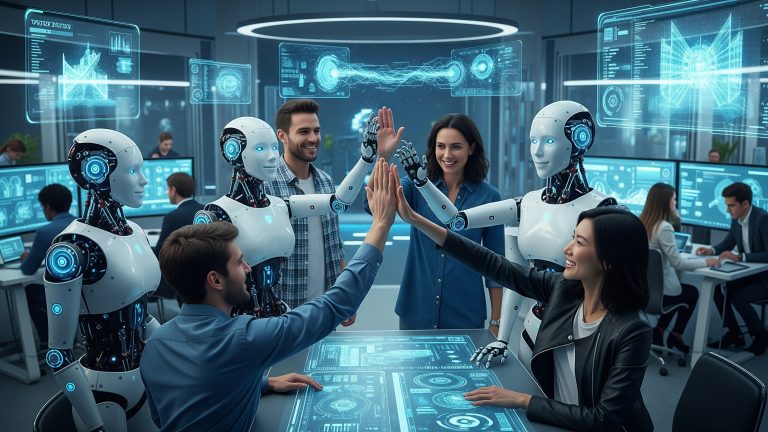
A groundbreaking Stanford University study has just shattered one of recruitment’s most persistent myths: that AI removes the “human element” from hiring.
The research reveals something remarkable: candidates who went through AI-led initial interviews were 53.12% more likely to succeed in subsequent human interviews compared to those screened using traditional resume-based methods.
Read that again. Adding AI to the front of your interview process doesn’t dehumanize hiring—it makes human interviews dramatically more effective.
This isn’t just a marginal improvement. It’s a fundamental breakthrough that redefines how we should think about the relationship between artificial intelligence and human judgment in recruitment.
The Stanford Study: Breaking Down the Numbers
The research, conducted across multiple industries and role types, compared three different screening approaches:
Traditional Resume Screening: Human recruiters review resumes and select candidates for interviews
AI-Only Screening: Automated systems assess and rank candidates without human involvement
Hybrid AI-Human Model: AI conducts initial assessments, then humans conduct follow-up interviews
The Results Were Definitive:
Traditional Screening Success Rate: 34.7% of candidates passed final human interviews
AI-Only Screening Success Rate: 41.2% of candidates passed final interviews
Hybrid Model Success Rate: 53.12% of candidates passed final interviews
The implications are staggering: The hybrid model didn’t just beat traditional methods—it outperformed them by more than 50%.
Why Hybrid Models Work So Well
The Stanford research identified several key factors that explain the hybrid model’s superior performance:
1. AI Pre-Conditioning
AI initial interviews serve as a “warm-up” that helps candidates:
- Articulate their value proposition more clearly
- Practice discussing their experience in structured ways
- Reduce anxiety about the interview process
- Prepare more thoughtfully for human interactions
Result: Candidates arrive at human interviews more confident and better prepared.
2. Enhanced Signal Detection
AI systems excel at identifying subtle signals that humans might miss:
- Consistency patterns in candidate responses
- Communication style indicators
- Problem-solving approaches under pressure
- Learning agility demonstrations
Result: Only candidates with strong underlying capabilities make it to human interviews.
3. Bias Reduction
AI initial screening reduces several forms of unconscious bias:
- Appearance-based judgments
- Educational institution preferences
- Communication style biases
- Fatigue-related inconsistency
Result: A more diverse and qualified candidate pool reaches human reviewers.
4. Optimized Human Focus
When AI handles initial filtering, human interviewers can focus on:
- Cultural fit assessment
- Leadership potential evaluation
- Complex problem-solving scenarios
- Strategic thinking capabilities
Result: Human interviews become more strategic and insightful.
The Preparation Effect: AI as Interview Coach
One of the most surprising findings was that AI interviews actually prepare candidates to perform better in human interactions.
How AI Interviews Improve Candidate Performance:
Structured Practice: AI interviews follow consistent formats that help candidates organize their thoughts and responses
Immediate Feedback: Some AI systems provide real-time guidance on communication clarity and content relevance
Stress Reduction: The low-stakes nature of AI interviews allows candidates to practice without fear of immediate rejection
Self-Reflection: AI questions often prompt candidates to think more deeply about their experiences and motivations
The Compound Effect:
Candidates who complete AI interviews arrive at human interviews having:
- Practiced articulating their value proposition
- Reflected on their career progression and goals
- Organized their thoughts around key competencies
- Reduced their interview anxiety
This preparation translates directly into better human interview performance.
Industry-Specific Success Patterns
The Stanford study revealed that hybrid model advantages vary by sector:
Technology Roles
Traditional Success Rate: 28% Hybrid Model Success Rate: 51% Improvement: 82% better outcomes
Why it works: AI effectively assesses technical problem-solving while humans evaluate innovation potential and team fit.
Sales Positions
Traditional Success Rate: 42% Hybrid Model Success Rate: 61% Improvement: 45% better outcomes
Why it works: AI identifies communication patterns and resilience indicators, while humans assess relationship-building skills.
Healthcare Professionals
Traditional Success Rate: 39% Hybrid Model Success Rate: 58% Improvement: 49% better outcomes
Why it works: AI screens for clinical competency and decision-making under pressure, while humans evaluate empathy and patient interaction skills.
Financial Services
Traditional Success Rate: 31% Hybrid Model Success Rate: 48% Improvement: 55% better outcomes
Why it works: AI assesses analytical capabilities and risk assessment skills, while humans evaluate judgment and ethical reasoning.
The Quality vs. Quantity Revolution
The hybrid model doesn’t just improve success rates—it fundamentally changes the economics of interviewing.
Traditional Model Problems:
- High volume of unqualified candidates reach human interviews
- Significant interviewer time wasted on poor fits
- Inconsistent screening quality across different recruiters
- Interview fatigue reduces human performance
Hybrid Model Benefits:
- Only pre-qualified candidates reach human stages
- Interviewer time focused on high-potential candidates
- Consistent initial assessment quality
- Human energy concentrated on strategic evaluation
The Math:
If traditional screening requires 10 human interviews to find 3.5 successful candidates, the hybrid model finds 5.3 successful candidates from the same 10 interviews—a 51% improvement in human interviewer productivity.
Implementation Best Practices
Based on the Stanford research, here are the key principles for successful hybrid model implementation:
1. AI-First, Not AI-Only
Use AI for initial screening and assessment, but maintain human involvement in final decisions.
2. Seamless Handoffs
Ensure AI systems provide human interviewers with actionable insights, not just pass/fail decisions.
3. Candidate Experience Focus
Design AI interactions to prepare and support candidates, not intimidate or exclude them.
4. Continuous Calibration
Regularly review AI screening decisions against human interview outcomes to optimize the system.
5. Transparency
Clearly communicate the hybrid process to candidates, explaining how AI enhances rather than replaces human judgment.
Real-World Case Studies
Case Study 1: Enterprise Software Company
Challenge: High-volume technical hiring with 70% interview failure rate Implementation: AI coding assessments followed by human architecture discussions Results:
- Interview success rate increased from 30% to 54%
- Time-to-hire reduced by 40%
- Interviewer satisfaction improved significantly
Case Study 2: Global Consulting Firm
Challenge: Inconsistent case interview quality across different offices Implementation: AI case study simulations before human partner interviews Results:
- Success rate improved from 25% to 43%
- More diverse candidate pool advanced to final rounds
- Partner time focused on strategic fit assessment
Case Study 3: Healthcare Staffing Agency
Challenge: Difficulty assessing clinical reasoning at scale Implementation: AI scenario-based assessments before human clinical interviews Results:
- Placement success rate increased from 67% to 89%
- Client satisfaction scores improved by 35%
- Reduced time to fill critical positions by 50%
The Technology Stack
Successful hybrid models require specific technological capabilities:
AI Interview Platforms
- Natural language processing for open-ended responses
- Video analysis for non-verbal communication patterns
- Adaptive questioning based on candidate responses
- Integration with existing ATS and HRIS systems
Human-AI Interface Systems
- Candidate summaries with key insights highlighted
- Risk flags and positive indicators clearly marked
- Suggested human interview focus areas
- Performance tracking and optimization tools
Quality Assurance Frameworks
- Bias detection and mitigation tools
- Performance monitoring and calibration systems
- Candidate feedback collection and analysis
- Continuous improvement mechanisms
The Competitive Implications
The 53% improvement in interview success rates creates significant competitive advantages:
For Recruitment Firms:
Client Value: Demonstrably better placement outcomes Efficiency: Higher interviewer productivity and satisfaction Differentiation: Data-driven proof of superior methodology Pricing Power: Premium fees justified by measurable results
For Corporate HR Teams:
Cost Reduction: Fewer wasted interview hours Quality Improvement: Better hiring decisions and outcomes Speed: Faster identification of top candidates Consistency: Standardized screening quality across all roles
Addressing the Skeptics
Some recruitment professionals remain skeptical of AI-human hybrid models. Here are the common concerns and evidence-based responses:
“AI Can’t Assess Soft Skills”
Reality: AI assesses communication patterns, problem-solving approaches, and behavioral indicators that predict soft skill performance. Humans still evaluate cultural fit and leadership potential.
“Candidates Will Game the AI System”
Reality: Advanced AI systems detect inconsistencies and coached responses. The Stanford study found no evidence of significant gaming effects.
“It’s Too Impersonal”
Reality: Candidates in the study reported feeling more prepared and confident for human interviews after AI screening.
“The Technology Isn’t Ready”
Reality: The Stanford study used commercially available AI interview platforms, proving the technology is mature and effective.
Implementation Roadmap
Phase 1: Pilot Program (Months 1-2)
- Select one role type for hybrid model testing
- Choose AI platform and configure initial screening
- Train human interviewers on new process
- Begin collecting performance data
Phase 2: Optimization (Months 3-4)
- Analyze initial results and calibrate AI settings
- Refine human interview focus areas
- Gather candidate and interviewer feedback
- Adjust process based on learnings
Phase 3: Scale Deployment (Months 5-6)
- Expand to additional role types and clients
- Develop standardized training materials
- Create performance monitoring dashboards
- Build client communication materials
Phase 4: Advanced Enhancement (Months 6+)
- Implement predictive analytics for long-term success
- Develop role-specific AI interview templates
- Create competitive differentiation messaging
- Build thought leadership around hybrid methodology
The Future of Interview Excellence
The Stanford research proves that the future of recruitment isn’t AI versus humans—it’s AI plus humans working in optimized collaboration.
The 53% improvement in interview success rates isn’t just a statistic—it’s a blueprint for the future of talent acquisition.
Firms that embrace hybrid AI-human interview models won’t just improve their efficiency—they’ll deliver measurably better outcomes for both clients and candidates.
The Bottom Line
When Stanford University proves that AI-human hybrid interviews deliver 53% better results than traditional screening, the message is clear: the question isn’t whether to integrate AI into your interview process—it’s how quickly you can implement hybrid models that maximize both AI efficiency and human insight.
The data is definitive. The technology is ready. The competitive advantage is waiting.
The only question left is: will you be part of the 53% improvement revolution, or will you stick with methods that are proven to be dramatically less effective?
The Stanford research on AI-human hybrid interviews represents just one breakthrough in the rapidly evolving landscape of recruitment technology. For comprehensive analysis of emerging AI methodologies, implementation frameworks, and competitive positioning strategies—including detailed case studies and deployment guides—download our complete white paper: “Navigating the AI Disruption in Recruitment: A Strategic Guide for Forward-Thinking Firms.”
Learn how leading recruitment firms are leveraging hybrid AI-human approaches to achieve measurably superior outcomes while building sustainable competitive advantages.
Download your white paper here and discover how to harness the power of AI-human collaboration to transform your interview success rates.