Tag: salesforce

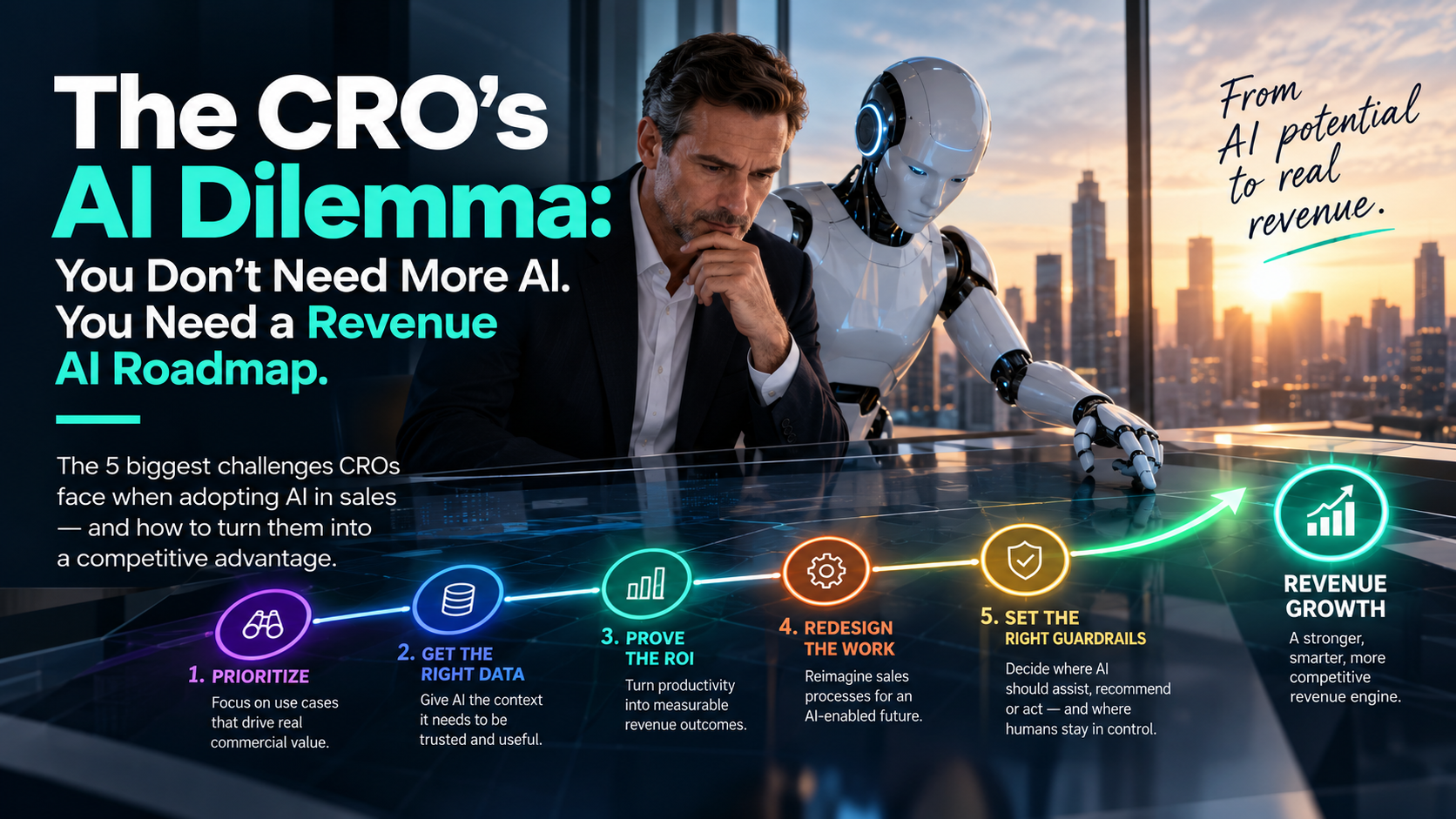
  • The CRO’s AI Dilemma: You Don’t Need More AI. You Need a Revenue AI Roadmap.

    The CRO’s AI Dilemma: You Don’t Need More AI. You Need a Revenue AI Roadmap.

    AI in sales has moved past the experimentation stage.

    Most CROs are no longer asking whether AI will affect their sales organization. They are being approached almost daily with new tools promising better prospecting, better forecasting, automated research, cleaner CRM data, personalized outreach, meeting intelligence, coaching, next-best actions and increasingly autonomous AI agents that can actually perform parts of the sales process.

    The technology is moving incredibly quickly.

    The harder question is deciding what to do with it.

    Where should AI actually sit inside the sales process? Which problems are worth solving first? What data should it be trusted to use? Where should people remain in control? And perhaps most importantly, how does a CRO prove that any of this is producing more revenue rather than simply creating a greater technology debt?

    Those questions are becoming much more important than, “Which AI sales tool should we buy?”

    Research increasingly points in the same direction. McKinsey’s 2026 B2B sales research found widespread AI experimentation but much more limited value creation. The companies getting stronger results aren’t simply adding AI tools; they’re redesigning important commercial workflows around them. Read the McKinsey research

    That is the issue I believe CROs now need to address.

    AI needs a revenue roadmap.

    Not a 50-page AI strategy. Not another transformation program. A practical plan for deciding where AI can make the biggest commercial difference, what needs to change for it to work and how the organization will know whether it did.

    Here are the five problems that roadmap needs to solve.

    1. There Are Too Many Places to Use AI — So Where Do You Start?

    This is becoming one of the most difficult decisions.

    Take a typical B2B sales organization. AI could potentially research accounts, identify buying signals, prioritize opportunities, prepare sellers for meetings, draft correspondence, capture meetings, update CRM, recommend next actions, identify stalled deals, improve forecasts, coach sellers, produce proposals and monitor existing customers for expansion or churn.

    Every one of those can be a legitimate use case.

    Trying to do all of them at once is where the trouble begins.

    The CRO’s job isn’t to find places where AI can be used. There are hundreds of them. The job is to identify the small number of workflows where AI can materially affect a commercial outcome.

    Gartner’s 2026 research gives us a useful clue. Sales organizations providing sellers with AI-enabled next-best actions were 2.6 times more likely to achieve commercial growth in its study. The significance isn’t simply that next-best-action technology works. It’s that the AI is being connected to a decision that affects what the seller actually does next. See the Gartner findings

    That’s a very different proposition from giving every salesperson a chatbot and hoping something useful happens.

    For a CRO, I would start by looking for friction in the revenue engine. Where are good opportunities being missed? Where are deals slowing down? Where are sellers spending time on administration instead of customers? Where does important customer context disappear between meetings, people and systems? Where are managers making decisions from incomplete information?

    Then rank the AI opportunities against commercial impact.

    A tool that saves five minutes writing an email may be useful. An AI capability that helps a salesperson identify which ten accounts need attention today — and why — may fundamentally change productivity.

    The question for the CRO is not “Where can we use AI?” It is “Where would better intelligence or execution materially change our revenue outcome?”

    2. AI Is Only as Good as the Context You Give It

    This is where the AI conversation quickly becomes a data conversation.

    Most sales organizations don’t have one perfect source of customer truth. CRM has some of it. Email has some. Meeting notes contain another piece. Calendars, proposals, support systems, spreadsheets, marketing platforms and people’s own memories contain the rest.

    Humans have spent years compensating for that fragmentation.

    AI doesn’t magically make it disappear.

    Salesforce’s 2026 State of Sales research found that among teams already using AI agents, 46% said data-quality problems were hurting sales, while manual errors, duplicate data, security concerns and incomplete data were among the most common issues.

    Gartner found another problem: 66% of sales leaders reported low trust in AI-generated insights. One of the reasons is straightforward. If AI doesn’t have enough proprietary customer and deal context, its recommendations can become generic, incomplete or simply wrong. Read Gartner on AI trust and proprietary sales data

    That doesn’t mean a CRO should wait until every CRM field is perfect before using AI. For most organizations, that day will never arrive.

    It does mean the implementation sequence matters.

    Start with the commercial problem. Determine what information the AI needs to solve it. Connect and improve that data. Put human review around the recommendations until confidence increases. Then expand.

    Done properly, AI can actually become part of the solution to the data problem. It can capture meeting context, identify missing information, surface inconsistencies, suggest CRM updates, connect information across systems and reduce the manual data entry that created poor CRM hygiene in the first place.

    The ambition shouldn’t be “clean everything before we use AI.”

    It should be “make the information required for this revenue decision trustworthy enough for AI and humans to use it.”

    3. Productivity Isn’t the Same Thing as Revenue

    This may be the most important point in the entire AI sales discussion.

    AI can absolutely save salespeople time.

    Gartner found that AI is saving sellers an average of 4.8 hours per week. That sounds fantastic until you get to the next number: 72% of sales organizations reported low reinvestment of those savings into higher-value sales activities. Read Gartner’s sales productivity research

    That’s the trap.

    If AI saves a salesperson five hours but those five hours disappear into email, internal meetings or lower-value activity, the company has achieved efficiency without necessarily achieving additional revenue.

    A CRO therefore needs to decide before deploying the technology what will happen to the capacity AI creates.

    If AI eliminates three hours of administration each week, does that become additional customer conversations? More prospecting? More whitespace analysis across existing accounts? Better opportunity planning? More coaching?

    Without that decision, “hours saved” becomes a vanity metric.

    This also explains why proving AI ROI remains difficult. Gartner found that 31% of chief sales officers cited difficulty proving ROI from AI-driven tools as a top challenge to achieving their 2026 sales objectives. Read Gartner’s research on proving sales AI ROI

    The measurement needs to move beyond adoption.

    Instead of simply asking, “Are people using it?”, CROs need to build a chain between AI and the commercial outcome:

    AI activity → time or decision improvement → changed seller behavior → pipeline impact → revenue impact.

    That might mean measuring increased customer-facing capacity, additional accounts covered, response times, opportunity progression, conversion rates, sales-cycle duration, forecast accuracy, retention or expansion.

    Gartner makes the same broader point in its AI ROI research: executive leaders need to move beyond activity measures and connect AI investments to measurable outcomes such as revenue growth, cost reduction and employee impact. See Gartner’s AI ROI framework

    If we can’t say what number should move before we implement the AI, proving value afterwards becomes much harder.

    4. We Keep Adding AI to Sales Processes That Were Never Designed for AI

    This is the problem I think many organizations are underestimating.

    Most sales processes were designed around people operating software.

    A salesperson researches an account, opens CRM, looks through email, attends a meeting, takes notes, creates tasks, updates an opportunity, searches for information, prepares a proposal and then repeats the process with the next customer.

    Now we are adding AI to every stage.

    AI writes the email faster. AI summarizes the meeting faster. AI enters information into CRM faster. AI prepares the research faster.

    All useful.

    But at some point a CRO should ask a more uncomfortable question:

    Why is the salesperson doing some of this work at all?

    McKinsey’s latest B2B research describes this distinction particularly well. Companies capturing greater value aren’t simply using AI to improve individual tasks. They are beginning to rewire end-to-end commercial workflows, allowing AI to synthesize signals, prioritize opportunities and support sellers around the customer rather than around the software.

    Deloitte found the same gap more broadly. Its 2026 State of AI research reports that AI is delivering efficiency and productivity, but only 34% of companies say they are truly reimagining the business around it. Role and workflow redesign continue to lag AI adoption. Read Deloitte’s 2026 State of AI research

    This is where the bigger opportunity sits.

    Rather than giving a salesperson six AI tools to operate alongside the eight systems they already have, AI can increasingly work across those systems, preserve context, surface what matters and help orchestrate the work.

    Imagine the difference between these two models.

    In the first, the salesperson asks AI to research an account, asks another system about CRM history, checks email, reviews meeting notes and then decides what to do.

    In the second, AI has already connected those signals and tells the salesperson: This account needs your attention today. Here is what changed, why it matters, what happened in the last conversation and the next action that appears most appropriate.

    The human hasn’t disappeared.

    The administrative burden around the human has.

    That is what sales-process redesign around AI should start to look like.

    5. CROs Need to Decide How Much Authority AI Should Have

    The next phase of sales AI makes this question unavoidable.

    For the last few years, most AI sat beside the salesperson. You asked a question and AI produced an answer.

    Agentic AI changes that relationship because AI can increasingly take action.

    It can update systems. Create tasks. conduct research. Prepare communications. Trigger workflows. Recommend decisions. In some environments, it can execute those decisions.

    This creates enormous opportunity, but it also creates a completely different category of risk.

    Should AI draft a customer email?

    Probably.

    Should it send the email without approval?

    Maybe.

    Should it change an opportunity stage?

    Under what circumstances?

    Should it recommend a discount?

    Should it approve one?

    Should it alter a forecast?

    Should it initiate contact with a strategic account based on a detected buying signal?

    There isn’t one correct answer because the appropriate level of autonomy depends on the action, the customer, the consequences of getting it wrong and the quality of the underlying data.

    What matters is that someone makes the decision deliberately.

    Deloitte’s research shows why this is becoming urgent. Only around one in five organizations currently has a mature governance model for autonomous AI agents, even as adoption is expected to accelerate rapidly. Read Deloitte’s research on agentic AI governance

    A useful CRO framework is therefore to classify AI actions into four levels:

    Assist: AI gathers information or creates something, but the human does the work.

    Recommend: AI tells the salesperson what it believes should happen next and explains why.

    Execute with approval: AI prepares the action and a person authorizes it.

    Execute autonomously: AI performs defined actions inside agreed rules, with monitoring and escalation.

    Most organizations will use all four.

    The mistake would be allowing the technology to determine the level of autonomy simply because the technology is capable of it.

    So, Does Every CRO Need an AI Roadmap?

    I believe the answer is increasingly yes.

    But it shouldn’t be an abstract document about the future of AI.

    A useful Revenue AI Roadmap should answer some very practical questions.

    Where are we currently losing seller time?

    Where are we losing revenue because information, context or action arrives too late?

    Which workflows would produce the greatest commercial return if AI improved them?

    What customer and company data does the AI need to make good decisions?

    Where should AI assist, where should it recommend and where should it act?

    What will people stop doing once AI takes on more of the administrative burden?

    And what commercial metric has to improve for us to call the investment successful?

    From there, prioritize.

    Pick the first three to five revenue workflows. Establish the baseline. Decide what AI and people will each do. Define the required information and governance. Measure the result. Then expand.

    That is a roadmap.

    The Real AI Opportunity for CROs

    There is an understandable temptation right now to treat AI as another category in the sales technology stack.

    I think that understates what’s happening.

    Gartner predicts that AI agents could outnumber human sellers ten to one by 2028, while simultaneously warning that fewer than 40% of sellers may believe those agents actually improved their productivity unless companies solve the underlying issues of data, workflow integration and user experience. Read Gartner’s AI agent forecast for sales

    That is a useful warning.

    The winners won’t necessarily be the sales organizations with the most AI.

    They will be the ones that figure out how to combine people, AI, data and process into a better revenue operating model.

    For CROs, that makes the question much bigger than which tool to buy next.

    The question is:

    If we could redesign our revenue organization knowing what AI can now do, what would we do differently?

    That is where I would start the roadmap.

    #CRO #RevenueLeadership #SalesAI #ArtificialIntelligence #RevenueOperations #SalesTransformation #RevenueGrowth #AgenticAI #SalesLeadership #FutureOfSales
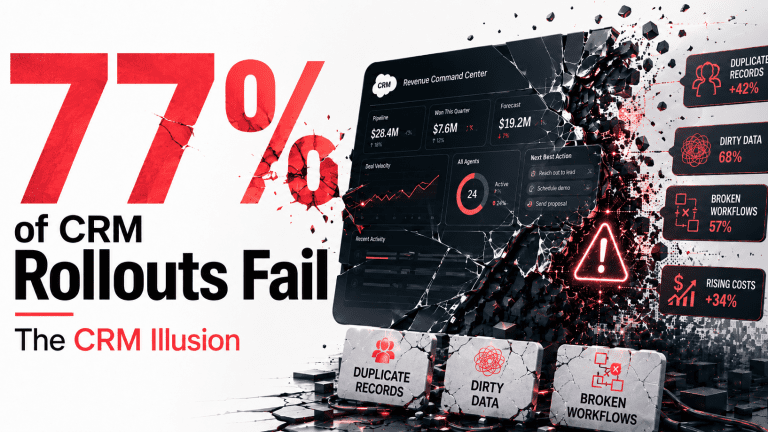

  • The Agentforce Illusion: Why 77% of CRM Rollouts Fail

    The Agentforce Illusion: Why 77% of CRM Rollouts Fail

    • High Failure Rate: Valoir research indicates that 77% of enterprise B2B Agentforce implementations fail to deliver successful deployment, with only 31% remaining active past the six-month mark.
    • Data Hygiene Crisis: High operational failure rates stem directly from corrupted, duplicate legacy database records, which force cognitive engines to automate processing errors at machine speed.
    • Complex Cost Structures: Unpredictable total cost of ownership compounds rapidly through mandatory system bundles and metered transaction charges via Flex Credits, driving costs up to $2.00+ per multi-turn transaction.
    • Open-Source Migration: Enterprise architectures are transitioning toward database-agnostic “Systems of Action” and open runtimes like Google Agent Executor and Snowflake Natoma.
    • Scaled AI Operations: Scaling successfully requires moving away from seat-based software deployment to managing autonomous agents as structured virtual departments with dedicated profit-and-loss metrics.

    The Outward Hype vs. The Audited Reality

    Enterprise software buyers in Q2 2026 face a severe disconnect between massive marketing promises and audited deployment statistics. While vendors promise seamless digital workforces, independent market reports reveal a much more conservative adoption landscape. According toAd Graphics Research, only 12% of modern software transactions feature an agentic component, and a mere 6% of deals include paid licenses.

    This operational gap is further highlighted by audited failure metrics. Data from the 2026 Valoir Salesforce AI Report indicates that 77% of B2B Agentforce deployments fail to achieve successful deployment, and only 31% remain active past the six-month mark. This reality has produced widespread hype fatigue among information technology executives.

    A community survey of over 1,200 CRM practitioners by Salesforce Ben found that 50% believe the platform remains stuck in the hype stage. Only 11% of surveyed practitioners reported running these autonomous agents in active production environments. This operational instability has persisted despite iterative product updates.

    The late April 2026 release of the Atlas Reasoning Engine v3 claimed a 40% reduction in inconsistent execution paths compared to previous versions. However, independent benchmark evaluations indicate that multi-step workflows still drift or fail in 18% of real-world production setups. This high rate of error highlights the structural limitations of native CRM agent architectures.

    2. The B2B Data Graveyard Catch-22

    The root cause of these high failure rates is not a limitation in model intelligence or cognitive processing power. Instead, deployments fail due to the legacy database architectures into which these agents are introduced. Traditional CRM platforms were built on a manual, reactive data entry model that inevitably generates duplicate records, stale fields, and broken validation rules.

    When an autonomous agent is deployed over this unmaintained infrastructure, it encounters a classic data hygiene bottleneck. Because these platforms utilize Retrieval-Augmented Generation (RAG) to ground their decisions, a chaotic database forces the agent to make incorrect associations or hallucinate entirely. For example, activity capture tools regularly struggle to map inbound customer emails to the correct opportunity record when duplicate account fields exist.

    Consequently, the decisional engine processes corrupted inputs, executes incorrect actions, and replicates operational errors at machine speed. This architectural mismatch highlights why throwing advanced software at a broken process simply automates failure. According to the (IBM Thought Leadership business value of Salesforce CRM), only 26% of enterprise leaders believe their customer data is in a state that can support agentic analysis.

    The same report indicates that only 33% of AI initiatives are currently meeting their return on investment targets. Furthermore, 72% of these projects fail to scale across business units, and 20% stall or are abandoned completely. These outcomes occur because organizations attempt to run complex models over fragmented data silos.

    To resolve this mismatch, enterprise architects must first learn how to (How to Eliminate Data Silos with Agentic AI) before initiating deployments. Aligning backend data structures with the precise requirements of RAG is a prerequisite for any scalable deployment. Without this baseline, the cognitive model remains functionally blind to the broader enterprise context.

    3. The True Cost of Agentforce (The Sticker Shock Formula)

    Unpredictable financial overhead represents another primary catalyst driving project cancellations. To help RevOps and information technology leaders calculate the true fiscal footprint of a native CRM rollout, the Total Cost of Ownership ($TCO$) of an enterprise deployment is modeled as:

    $$TCO = \sum (S_B + D_C + A_L) + V_T$$

    Where $S_B$ represents the base Sales or Service Cloud seat licenses, $D_C$ represents the mandatory Salesforce Data Cloud subscription, $A_L$ represents the add-on user licenses, and $V_T$ represents the variable transaction volume.

    Base seat licenses ($S_B$) typically cost $175 to $350 per user monthly, while the mandatory Data Cloud subscription ($D_C$) requires a minimum commitment starting at $60,000 annually. The Agentforce add-on user licenses ($A_L$) add an additional $125 to $550 per user monthly depending on the enterprise tier. The variable transaction volume ($V_T$) is driven by the frequency of automated actions ($N_a$) and the metered price rate ($P_a$):

    $$V_T = N_a \times P_a$$

    Under standard metered structures, each action consumes 20 Flex Credits, establishing a base execution rate ($P_a$) of $0.10.

    This credit math quickly compounds because standard real-world interactions require multiple sequential actions. For example, while a basic case-management step costs 60 credits ($0.30), a complex multi-turn knowledge search regularly exceeds 120 credits ($0.60) or even $2.00 per conversation. If an enterprise processes 40,000 automated actions monthly, these transaction charges add an unexpected $18,000 to $48,000 annually.

    This lack of budget predictability forces CIOs to implement complex throttling strategies to prevent massive bill overruns. This unpredictable cost modeling has caused a significant shift in procurement preferences. Enterprise buyers are increasingly demanding outcome-based pricing models, similar to Intercom’s Fin charging per successful resolution.

    To highlight the disparity, the following table contrasts the baseline licensing layers against actual consumption averages :

    Licensing Tier & Variable ActionsMonthly Cost per User / UnitAnnual Base CommitmentMandatory Dependencies & Variable Cost Drivers
    Enterprise Base Seat ($S_B$)$175 / user $2,100 / userRequired prerequisite for any Agentforce deployment.
    Unlimited Base Seat ($S_B$)$350 / user $4,200 / userIncludes advanced forecasting and predictive analytics features.
    Data Cloud Starter ($D_C$)Flat Annual Rate$60,000 Required for real-time data ingestion and mapping.
    Data Cloud Premium ($D_C$)Flat Annual Rate$175,000 High-profile enterprise package with advanced scaling.
    Agentforce Sales / Service Add-on ($A_L$)$125 / user $1,500 / userEnables unmetered internal employee agent execution.
    Agentforce 1 Unified Seat$550 / user $6,600 / userBundles CRM, Data Cloud credits, and unmetered agents.
    Flex Credit Metered Action ($P_a$)$0.10 / action Variable UsageConsumes 20 credits per single backend execution step.
    Complex Multi-Turn Workflow$0.60 to $2.00 / run Variable UsageTriggered by multi-step search, RAG loops, and external updates.

    4. The Pivot to Open Orchestration and Headless Architectures

    To bypass the steep pricing structures and database silos of single-vendor suites, modern GTM teams are shifting toward open, database-agnostic “Systems of Action”. This transition has accelerated due to significant infrastructure updates launched in late May and early June 2026. On May 25, 2026, Google introduced the open-source Google Agent Executor to support production-ready distributed agent deployment, durable execution, and secure sandboxing.

    This runtime standard automatically ensures backend resilience, allowing long-running agent workflows to resume after disconnections or human-in-the-loop confirmations. By providing secure isolation, it prevents untrusted, generated code from compromising internal networks. To govern these workflows, Snowflake announced the acquisition of Snowflake Natoma in late May 2026.

    Natoma operates as a central Model Context Protocol gateway, providing identity verification, access policies, and audit controls at the tool-call level. Furthermore, Snowflake introduced CoWork and Horizon Context to allow agents to query and reason over centralized enterprise data lakes in real time. This co-location of data, governance, and business definitions allows organizations to bypass the monolithic CRM execution layer entirely.

    Simultaneously, Microsoft introduced Rayfin to transform Microsoft Fabric into an active application runtime, alongside Frontier Tuning. Frontier Tuning utilizes a managed Reinforcement Learning Environment to train models on real enterprise behavior, approval chains, and terminology. This continuous feedback loop allows agents to acquire organizational muscle memory safely within the tenant’s compliance boundaries.

    These technical transformations demonstrate that the CRM is being relegated to a background storage layer, while real value has migrated to open, headless orchestration layers. Technology leaders must look beyond basic pilots and focus on building robust infrastructures. To establish this baseline, teams must actively transition from evaluating prototypes to implementing comprehensive strategy.

    They must carefully analyze how to stop celebrating AI pilots and talk about AI operations to avoid scaling failures. By decoupling the application logic from the underlying storage, enterprises ensure long-term flexibility. This open approach mitigates vendor lock-in while providing strict control over computing budgets.

    5. The Path to Scaled AI Operations

    Restructuring a struggling agentic deployment requires a fundamental shift in both technical and organizational design. According to a study published in the (Harvard Research – Why you shouldn’t treat AI Agents like Employees), organizations must stop treating autonomous agents as basic software extensions or virtual employees. Anthropomorphizing these systems often reduces individual accountability, increases unnecessary escalations, and degrades review quality.

    Instead, successful enterprises treat each agent as a structured virtual department. This model requires assigning a clear business owner, setting precise Key Performance Indicators, establishing inputs and outputs, and managing a dedicated P&L. On the technical front, teams must integrate advanced diagnostic frameworks to interpret agent decision-making paths.

    Utilizing LIME (Local Interpretable Model-agnostic Explanations) and Neural Networks algorithms allows engineers to audit complex reasoning models and prevent operational drift. Furthermore,(Forrester Research – Test your AI Agents) recommends implementing strict agentic testing suites and red-teaming practices before deploying code to production. These testing suites utilize synthetic prompts to evaluate agent responses against a standardized “golden set” of ideal outcomes.

    By combining rigorous testing, open orchestration layers, and a unified data foundation, enterprises can successfully scale past the pilot phase. The era of the monolithic, single-vendor CRM agent is giving way to secure, distributed execution environments. The enterprises that prioritize data readiness and structured operational governance will ultimately capture the true productivity gains of the agentic shift.

    What is causing the high failure rate of Agentforce deployments in 2026?

    The primary cause of the 77% Agentforce failure rate is poor underlying CRM data quality. Legacy databases are filled with duplicate accounts, stale opportunity pipelines, and unmaintained workflows. When autonomous agents rely on this uncleaned data for decision-making, they execute incorrect actions at machine speed, stalling multi-step workflows.

    How much does Salesforce Agentforce actually cost to run?

    A standard deployment costs upwards of $125 to $550 per user monthly, plus base CRM licenses of $175 to $350. Additionally, mandatory Data Cloud subscriptions cost up to $175,000 annually. On top of subscription fees, variable action costs are metered via Flex Credits at $0.10 per action.

    What is the role of Data Cloud in agentic CRM workflows?

    Salesforce Data Cloud serves as the foundational data harmonization layer for AI agents. It ingests and unifies fragmented enterprise customer data from external silos. This allows the execution layer to access structured and unstructured context, which is critical to grounding agent decisions and reducing hallucinations during execution.

    What is the Google Agent Executor and why is it open source?

    Google Agent Executor is an open-source runtime standard designed for production agent deployment, execution, and resumption. Google open-sourced the platform to provide developers with a highly resilient, sandboxed environment. This strategy builds developer adoption, shifting runtime infrastructure to Google Cloud services and the Gemini Enterprise Platform.

    How does Snowflake’s Natoma acquisition impact agent governance?

    The acquisition of Natoma integrates a central Model Context Protocol gateway directly into Snowflake. This allows enterprises to govern the exact API tool calls autonomous agents make to external SaaS applications. It shifts the data platform into a secure, centralized control plane for real-time agentic actions.

    What is Microsoft’s Frontier Tuning and how does it optimize agents?

    Microsoft’s Frontier Tuning is a managed reinforcement learning service that trains AI agents on real-world enterprise behaviors, workflows, and approval chains. Operating within the secure tenant compliance boundary, it teaches models how a business actually operates. This increases task completion rates without the overhead of manual data labeling.

    Can organizations bypass native CRM agents using database-agnostic engines?

    Yes, enterprises are increasingly bypassing native CRM agent runtimes in favor of database-agnostic Systems of Action. By leveraging platforms like Snowflake CoWork, Google Agent Executor, and open-source MCP networks, GTM teams can orchestrate workflows directly over centralized data lakes, relegating the CRM to a background record database.

    What is the Data Graveyard in enterprise CRMs?

    The CRM Data Graveyard refers to legacy databases cluttered with duplicate records, obsolete fields, and outdated pipelines. Because manual data entry is highly prone to human error, these systems accumulate massive technical debt. Deployed agents process this corrupted data, leading to severe operational drift.

    What is the difference between an AI assistant and an AI agent?

    An AI assistant simplifies tasks for users but relies on constant human prompts to proceed. Conversely, an autonomous AI agent plans, triggers, and completes multi-step workflows independently without human intervention. Agents possess the architectural capability to process complex loops and execute actions across disparate external systems.

    How should enterprises restructure their teams to support autonomous agents?

    Enterprises must treat autonomous agents as virtual departments rather than simple software features. Organizations should assign dedicated business owners, establish performance Key Performance Indicators, define clear input and output parameters, and manage operating budgets. This operational restructuring ensures agentic deployments align with tangible return on investment targets.

    Table of Contents

    1-the-outward-hype-vs-the-audited-reality

    2-the-b2b-data-graveyard-catch-22

    3-the-true-cost-of-agentforce-the-sticker-shock-formula

    4-the-pivot-to-open-orchestration-and-headless-architectures

    5-the-path-to-scaled-ai-operations

    WordPress Taxonomy

    • Primary Category: AI Operations (AIOps)
    • Tags: #Agentforce, #CRMDataQuality, #EnterpriseAIStrategy, #HeadlessOrchestration, #Salesforce #Harvard #Forrester #IBM #Sentia
  • The Current State of AI Agents—and What Comes Next

    The Current State of AI Agents—and What Comes Next

    We’re witnessing a pivotal moment in the evolution of AI—from passive systems to active, decision-making agents. This post dives deep into the latest advancements in agentic AI, what it really takes to move from prototype to production, and why 2025 may be the year these systems finally prove their enterprise value.

    Let’s unpack where AI agents stand today.


    From LLMs to Agents: The Evolution of Intelligent Action

    Large Language Models (LLMs) like GPT-4 are remarkable at generating human-like text. But their usefulness has limits. On their own, they’re like genius interns locked in a library—full of knowledge but unable to browse the web, use tools, or remember past tasks.

    To bridge this gap, developers began linking LLMs with external components: APIs, databases, file systems, custom functions, and memory structures. These integrations enabled what we now call “chains”—predefined flows that guide the model step by step through a task. LangChain emerged as a leading framework to build these modular workflows.

    But chains are rigid. They assume we always know in advance what steps to take.

    This realization gave birth to AI Agents—LLM-powered systems that are autonomous, tool-using, context-aware, and goal-directed. They aren’t just executing prewritten playbooks; they’re writing and adapting the playbook in real time.


    What Are AI Agents?

    At their core, AI agents are systems designed to operate semi-autonomously in pursuit of a goal. They’re equipped with:

    • Tools: APIs, databases, file systems, custom functions
    • Memory: for tracking prior decisions and context
    • Reasoning abilities: to choose actions based on outcomes
    • Planning capabilities: to sequence tasks intelligently

    Agents can take initiative, recover from failure, and adapt mid-task. Think of them not just as chatbots, but as digital collaborators—capable of retrieving documents, updating spreadsheets, analyzing trends, and even initiating follow-up tasks, all with minimal human input.


    Four Pillars of Production-Ready Agents

    To move from demos to dependable systems, developers must master four critical domains:

    1. Planning: Orchestrating Multi-Step Logic

    LLMs handle single requests well. But multi-step tasks—especially those involving conditional logic, external APIs, and dynamic data—require a more sophisticated planning stack.

    Emerging strategies include:

    • Tree of Thoughts: Agents evaluate multiple reasoning paths before committing—like a chess player simulating moves.
    • Self-Reflection: Agents review past steps and outcomes, sometimes with the help of another LLM, to improve their performance over time.
    • Domain-Specific Flows: Coding agents, research agents, and ops agents require unique task structures—no one-size-fits-all.
    • Specialized Reasoners: New models optimized for planning and strategy (e.g., DeepSeek, Claude Opus) are often paired with faster LLMs for execution.
    • LangGraph and Graph-Based Agents: These frameworks allow developers to build stateful, branching, looping logic flows—ideal for tasks like data cleaning, report generation, and multi-agent collaboration.

    2. Reliability: Ensuring Consistent, Trustworthy Performance

    Despite the hype, many agents still fail in the real world. Why?

    • Ambiguous instructions: Vague prompts lead to unpredictable results.
    • LLM non-determinism: The same input doesn’t always yield the same output.
    • Tool misuse: Agents call the wrong tools, or use them incorrectly.

    Solutions are emerging:

    • LangSmith provides detailed observability—tracking every agent decision, tool call, and intermediate result.
    • Guardrails and Evaluators help enforce constraints and spot hallucinations.
    • Fallback logic and retry mechanisms add resilience.

    Still, full reliability remains an open challenge—especially in high-stakes domains like finance, healthcare, or law.

    3. UX: The Interface Between Humans and Agents

    Classic chat interfaces work—but they’re not enough. We’re now seeing:

    • Generative UI (GenUI): Combining LLMs with rich front-end elements like dropdowns, carousels, and tables for mixed-input workflows.
    • Agent Inboxes: Think of this as your digital assistant’s outbox—a place to review, approve, or redirect tasks the agent wants to perform.
    • Conversational Builders: Interfaces where users can train, correct, or debug agents in real-time.

    The future UX of agents will blur the lines between no-code, low-code, and natural language interaction—turning intent into structured action with minimal friction.

    4. Memory: The Context Engine

    Memory is where today’s agents still feel primitive. But the conceptual framework is maturing, drawing from cognitive science:

    • Semantic Memory: Persistent facts—names, preferences, company data. Usually stored in vector databases or key-value stores.
    • Episodic Memory: Logs of interactions and decisions—used for reflection, debugging, and personalization.
    • Procedural Memory: How-to instructions—like policy documents or embedded behavioral rules.

    Frameworks are experimenting with hybrid memory stores, allowing agents to reason across sessions, learn user habits, and even develop “personalities” or behavioral norms over time.


    The Road Ahead: What Comes Next

    While the buzz is everywhere, the field is still early. Today’s AI agents are capable, but fragile. They’re smart—yet unaware of their surroundings. Fast—yet easily derailed. In short: they’re toddlers with PhDs.

    Here’s where we’re headed next:

    • Long-Running Agent Infrastructure: Support for persistent state, bursty workloads, background scheduling, and system-level orchestration.
    • Multi-Agent Collaboration: Think supply chains of agents—each with a role, personality, and set of capabilities—cooperating toward a shared goal.
    • Human-in-the-Loop Systems: Agents won’t replace humans; they’ll amplify them. Expect approval queues, fallback workflows, and co-pilot paradigms to stick around.
    • Secure, auditable AI: Enterprises need transparency, traceability, and compliance baked into their AI layers from day one.

    If 2024 was about showing that agents can work, 2025 is about showing that they can scale—securely, reliably, and at the speed of business.

  • The Future of CRM in Salesforce: Which Fields Will Disappear due to AI Features?

    The Future of CRM in Salesforce: Which Fields Will Disappear due to AI Features?

    Prediction: In just 12 months, many of the fields you see in Salesforce today will no longer exist. Sounds bold?

    Let’s break down why this radical shift is inevitable.

    The Problem: Too Many Fields, Not Enough Value

    Today, if you look at your Salesforce Opportunity object, you’ll likely find more than 100 fields. Yet most of these are rarely filled out by sales teams, and even when they are, the data often can’t be trusted.

    Reps enter inconsistent or inaccurate information-sometimes just to bypass validation rules. And every time a new field is added, it’s irrelevant for older records, further muddying your data.  This patchwork of unreliable fields leads to a CRM that’s cluttered, hard to use, and ultimately, not trusted by the very people it’s meant to help.

    Opportunity: Have reps use the exact same CRO approved sales process every time with mandatory fields. Gamify the process and have some fun with it. Better yet let Sentia AI enter the right fields for the rep with a single click new contact entry.

    The Shift: From Manual Fields to AI-Powered Intelligence

    So why do we keep trying to force reps to fill out fields that don’t add value? The answer is: we won’t for much longer.

    The future of CRM in Salesforce is about keeping only the truly objective fields-focus will be on the essentials like:

    • Name
    • Amount
    • Close Date
    • Stage
    • Forecast Category
    • A handful of other critical fields for reporting

    Everything else that is subjective, context-rich, data-will move to AI.

    Instead of relying on reps to manually update competitor fields, next steps, or deal risks, AI will capture and analyze unstructured data: calls, emails, meeting notes, and more. You’ll simply query Salesforce in plain language, and AI will surface the insights you need.

    Example:
    Want to know which deals involve a specific competitor?

    Ask your future Salesforce system, and AI will scan all relevant communications and notes to give you a precise answer. Wondering which opportunities lack a clear next step? AI will tell you instantly-no more chasing down reps or sifting through incomplete fields.

    Why is Salesforce Headed in this Direction?

    AI in Salesforce is evolving rapidly. New agentic AI capabilities, like Salesforce’s Atlas Reasoning Engine and Einstein Copilot, are already automating data capture, driving predictive insights, and guiding sales teams with real-time recommendations. By 2027, AI will be so deeply embedded that most manual data entry will be obsolete.

    • AI-driven pipeline management: Real-time deal insights and risk detection
    • Automated lead scoring and follow-ups: AI prioritizes and nudges opportunities
    • Conversational AI assistants: Guide users and automate repetitive tasks
    • Hyper-personalization: AI tailors outreach and engagement at scale

    What This Means for Sales Teams

    • Far better data: AI captures context and nuance humans miss, making CRM data more accurate and actionable.
    • Less admin, more selling: Reps spend less time updating fields and more time building relationships.
    • New possibilities: Hundreds of use cases open up, from dynamic forecasting to real-time coaching and customer insights.

    In short, the CRM of the future will be lighter, smarter, and more powerful-and sales teams will finally be free from the tyranny of endless unused / useless fields.

    Salesforce Future

    A year from now-updating Salesforce with AI won’t be necessary because there will be almost nothing left to update. The future of CRM is objective data at the core, with AI doing the heavy lifting everywhere else.

    Are you ready for a Salesforce where fields are few, but insights are limitless? The countdown has already begun. www.sentia.website

    #Salesforce #CRM #AIinSales #FutureOfWork #SalesTech #AIAutomation

    Frequently Asked Questions: The Future of Salesforce Fields & AI

    Why are Salesforce fields predicted to disappear?

    Most Salesforce fields will disappear because AI now automates data capture. Traditionally, sales teams had to manually enter data into over 100 fields per Opportunity, leading to “dirty data” and administrative fatigue. With the rise of Salesforce Agentforce and autonomous AI, CRM data is captured directly from emails, calls, and meetings, making manual fields redundant.

    Which types of Salesforce fields will be removed first?

    The first fields to disappear are manual entry tracking fields, such as:

    • Next Steps: Automatically derived from meeting transcripts.

    • Discovery Notes: Captured via AI-powered sentiment and keyword analysis.

    • Competitor Tracking: Identified through natural language processing (NLP) of sales calls.

    • BANT Criteria: (Budget, Authority, Need, Timeline) automatically validated by AI interactions.

    What is Salesforce Agentforce’s role in CRM evolution?

    Agentforce represents a shift from passive CRM systems to active, decision-making agents. It acts as an autonomous data steward that enriches CRM records in real-time without human intervention, allowing sales reps to focus on customer relationships rather than data entry.

    How does AI improve CRM data quality?

    AI improves data quality by eliminating human error and “empty field syndrome.” Instead of relying on a busy sales rep to update a record, AI captures 100% of interaction data immediately. This provides RevOps teams with a “single source of truth” that is consistently updated and accurately reflects the state of the pipeline.

    Will Salesforce become a “field-less” CRM?

    While Salesforce won’t lose all fields, it is moving toward a “Headless CRM” or “Invisible CRM” experience. The user interface will shift from dense data tables to AI-generated summaries and actionable insights, where the underlying data exists but doesn’t require manual management.

    How should RevOps teams prepare for disappearing CRM fields?

    RevOps teams should begin by auditing their current Salesforce objects and identifying fields with low completion rates. Preparing for this shift involves moving away from rigid manual validation rules and instead investing in AI-driven data orchestration and clean data architectures.

  • What the Hell are / is / an: AI Agent(s)?

    What the Hell are / is / an: AI Agent(s)?

    AI Agents the next Frontier in artificial intelligence or just more AI Hype?

    With Billions of venture capital dollars already sunk into it, the AI marketing buzz continues to build. The latest excitement centers around a term many cannot agree upon. AI agents are becoming increasingly prevalent or at least written and hyped more and more. Ask most people what an AI Agent is, and the first thing they think of is chatbot type things. But what exactly are AI agents, and how are they shaping our technological landscape or is it just a bunch of tech marketing hype?

    What are AI Agents?

    AI agents are autonomous systems or programs capable of performing tasks on behalf of users or other systems. They go beyond simple chatbots, incorporating advanced decision-making, problem-solving, and execution capabilities1. These agents utilize large language models (LLMs) as their core, enabling them to understand and respond to complex inputs while adapting to user expectations over time1.

    Definitions Across Industries

    While there’s no universally agreed-upon definition, several key players offer their interpretations:

    • IBM defines AI agents as systems that can autonomously perform tasks by designing workflows and utilizing available tools1.
    • OpenAI describes them as automated systems that can independently accomplish tasks for users2.
    • Microsoft distinguishes agents from AI assistants, positioning agents as more specialized and tailored to specific expertise2.
    • Salesforce definition: AI agents are a type of AI system that can understand and respond to customer inquiries without human intervention. They are created using an agent builder, like Agentforce, and rely on machine learning and natural language processing (NLP) to handle a wide range of tasks. These intelligent agents can include anything from answering simple questions to resolving complex issues — even multi-tasking. Most importantly, AI agents can continuously improve their own performance through self-learning. This is distinct from traditional AI, which requires human input for specific tasks.

    Companies Developing AI Agents

    Several tech giants are at the forefront of AI agent development:

    1. OpenAI: Developing the Operator agent2.
    2. Google: Working on Project Mariner2.
    3. Anthropic: Claude – a generative AI chatbot and family of large language models (LLMs).
    4. Perplexity: Created a shopping agent2.
    5. Amazon: Developing AI agents for e-commerce applications4.
    6. Salesforce: Aiming to become a leading provider of “digital labor” through various agentic services2. See Agentforce.

    5 Real-World AI Agent Use Cases

    1. E-Commerce: AI agents on platforms like Amazon provide personalized product recommendations, automatically place orders, and track shipping, contributing significantly to revenue generation4.
    2. Sales and Marketing: AI agents like Find AI build lead lists, send personalized communications, and qualify leads, often outperforming human counterparts in lead generation4.
    3. Customer Support: Advanced AI agents, such as those developed by Chatbase, can handle complex technical support issues, process refunds, and provide product recommendations, leading to substantial reductions in support tickets4.
    4. Autonomous Vehicles: Self-driving cars represent a complex application of AI agents, combining multiple agent types for navigation, decision-making, and real-time responses. Companies like Waymo are pioneering this technology in cities like San Francisco and across the United States4.
    5. Healthcare: AI agents assist in diagnosing medical conditions, analyzing medical images, and creating personalized treatment plans. For instance, Google’s AI agent has demonstrated superior accuracy in diagnosing skin cancer compared to human dermatologists4.

    As AI agents continue to evolve, they promise to revolutionize various sectors, enhancing efficiency and providing personalized experiences. However, challenges remain in standardizing definitions and managing user expectations. The coming years will likely see further advancements and refinements in this exciting field of artificial intelligence.124

    Citations:

    1. https://www.ibm.com/think/topics/ai-agents
    2. https://www.glean.com/blog/ai-agents-how-they-work
    3. https://deviniti.com/blog/enterprise-software/best-ai-agent-development-companies/
    4. https://www.chatbase.co/blog/ai-agent-examples
    5. https://anth.us/blog/null/
    6. https://zapier.com/blog/ai-agent/
    7. https://www.youtube.com/watch?v=ZZ2QUCePgYw
    8. https://cloud.google.com/discover/what-are-ai-agents
    9. https://www.forbes.com/councils/forbestechcouncil/2025/03/07/ai-agents-in-2025-transforming-business-redefining-leadership-and-accelerating-digital-transformation/
    10. https://www.teneo.ai/blog/5-companies-leading-the-way-in-ai-agent-technology
    11. https://a16z.com/ai-voice-agents-2025-update/
    12. https://www.salesforce.com/agentforce/what-are-ai-agents/
    13. https://botpress.com/blog/real-world-applications-of-ai-agents
    14. https://aws.amazon.com/what-is/ai-agents/
    15. https://openai.com/index/new-tools-for-building-agents/
    16. https://www.reddit.com/r/AI_Agents/comments/1hhlzkh/whats_your_use_case_for_ai_agents_what_problems/
    17. https://direct.mit.edu/isal/article/doi/10.1162/isal_a_00605/116885/Towards-a-Theory-of-Mind-for-Artificial
    18. https://hallmark.libguides.com/c.php?g=1312147&p=9645253
    19. https://www.reddit.com/r/OpenAI/comments/1hk4d8h/eli5_what_exactly_is_an_ai_agent_with_examples/
    20. https://botpress.com/blog/what-is-an-ai-agent
    21. https://devrev.ai/blog/ai-agents
    22. https://en.wikipedia.org/wiki/Intelligent_agent
    23. https://github.com/resources/articles/ai/what-are-ai-agents
    24. https://www.geekwire.com/2025/microsoft-unveils-ai-agents-for-sales-striking-back-at-salesforce/
    25. https://www.businessinsider.com/generative-ai-evolution-software-companies-develop-ai-agents-workforce-2025-3
    26. https://tech.co/news/microsoft-new-ai-sales-agents
    27. https://cloud.google.com/transform/101-real-world-generative-ai-use-cases-from-industry-leaders
    28. https://www.techradar.com/pro/openai-wants-to-help-your-business-build-its-next-generation-of-ai-agents
    29. https://iblnews.org/microsoft-announces-two-sales-ai-agents-in-competition-with-salesforce/
    30. https://www.teneo.ai/blog/what-are-ai-agents-6-powerful-examples-in-action
    31. https://martech.org/ai-agents-2025-predictions/
    32. https://www.salesforce.com/news/stories/future-of-ai-agents-2025/
    33. https://guides.lib.purdue.edu/c.php?g=1371380&p=10135074
    34. https://papers.ssrn.com/sol3/papers.cfm?abstract_id=4772956
    35. https://customgpt.ai/sources-citations-observability/
    36. https://www.moveworks.com/us/en/resources/blog/what-is-an-ai-agent
    37. https://open.mitchellhamline.edu/mhlr/vol46/iss5/2/
    38. https://www.reddit.com/r/n8n/comments/1gxkf9c/ai_agent_pinecone_source_citations/
  • Salesforce AI Agents: Are they the next big AI breakthrough?

    Salesforce AI Agents: Are they the next big AI breakthrough?

    The Evolution of Salesforce AI Agents: Transforming Business Operations

    Unless you have been hiding under a proverbial rock and missed it, AI Agents are the big buzz in tech news right now. If you’re curious what the heck these AI Agent things are, where they came from and why marketing is pushing them so hard – this is the article for you!

    Let’s go way back in tech history to the “pre-AI days”, one long decade ago. Salesforce’s foray into AI began in 2014 when CEO Marc Benioff declared the company would become “AI-first.” This strategic shift aimed to revolutionize Salesforce from a system of recordings to a system of intelligence, making AI accessible to every company and employee.

    The Genesis of Salesforce AI

    The acquisition of RelateIQ in 2014 marked the beginning of Salesforce’s AI evolution, introducing machine learning capabilities to capture workplace communications data and provide valuable insights. Over the years, Salesforce has consistently invested in AI technologies, developing predictive AI tools and eventually venturing into generative AI.

    Agentforce: The Next Frontier

    In 2024, Salesforce introduced Agentforce, a suite of autonomous AI agents designed to enhance business operations across various domains. These agents, unlike traditional chatbots, are intelligent and dynamic, capable of understanding context and nuance in customer interactions.

    Current Applications of Salesforce AI Agents

    1. Customer Service: Agentforce Service Agent handles a wide range of service issues without preprogrammed scenarios, improving efficiency.
    2. Sales Development: The SDR Agent engages with inbound leads 24/7, answering questions and booking meetings for human sellers.
    3. Sales Coaching: AI agents provide personalized role-play sessions for sales teams, helping them practice pitches and handle objections.
    4. E-commerce: Merchandiser and Personal Shopper agents assist with site setup, personalized promotions, and enhance the buying experience.
    5. Marketing: Campaign Optimizer automates the full campaign lifecycle, from analysis to optimization.

    Future AI in ‘25

    Salesforce AI agents are expected to become more integrated into daily business operations with a big Q1 push. They will likely:

    – Enhance decision-making processes by providing real-time, data-driven insights.

    – Automate more complex tasks across various departments.

    – Offer more personalized customer experiences through advanced data analysis.

    – Collaborate more seamlessly with human workers, augmenting their capabilities.

    5 Compelling Salesforce AI Agent Use Cases for Consideration

    1. Autonomous Customer Service: The Service Agent can handle customer inquiries across multiple channels 24/7, resolving issues quickly and escalating complex cases to human agents when necessary.
    2. AI-Powered Sales Development: The SDR Agent qualifies leads, answers prospect questions, and schedules meetings, allowing human sales representatives to focus on high-value interactions.
    3. Personalized E-commerce Assistance: The Personal Shopper agent acts as a digital concierge, offering tailored product recommendations and assisting with search queries on e-commerce platforms.
    4. Automated Marketing Campaigns: The Campaign Optimizer agent analyzes, generates, personalizes, and optimizes marketing campaigns based on business goals and customer data.
    5. Continuous Employee Support: Agentforce assists employees with various tasks, from data retrieval to action plan creation and execution, boosting workplace efficiency.

    Real-World Examples of Successful Agentforce Implementation

    Looking for something done vs. talked about? Several companies have successfully implemented Salesforce AI agents. Here are five Examples with links:

    1. OpenTable: The restaurant reservation platform uses Agentforce for Service to handle common issues like account reactivations, reservation management, and loyalty point inquiries. This has boosted productivity for service representatives [3].
    2. Wiley: The educational publisher implemented Agentforce Service Agent to manage seasonal surges in service requests. This resulted in a 40-50% increase in case resolution, outperforming their previous chatbot. Additionally, Wiley reduced new agent onboarding time by 50% and achieved a 213% return on investment [2][3].
    3. 3. Precina Health: This healthcare innovator leverages Agentforce to improve diabetes care. In a pilot study, Agentforce and Salesforce technologies helped reduce the average blood sugar levels of 50 patients in Rural Louisiana from 9.6 to 6.4 (measured via an A1C test) in just twelve weeks [1].
    4. AAA Washington: The American Automobile Association used Salesforce Agentforce to create an autonomous agent capable of answering customer support requests, keeping clients informed about roadside updates, and offering personalized suggestions to customers [1].
    5. Saks Fifth Avenue: The luxury retailer utilizes AI service agents from Salesforce Agentforce to enhance their shopping experience. By integrating Customer 360, Commerce Cloud, and Slack, Saks has streamlined information flow for both staff and customers [3].

    These real-world examples demonstrate how Salesforce AI agents are being used to improve customer service, increase operational efficiency, and drive business growth across various industries.

    For businesses evaluating Salesforce AI agents, it’s crucial to understand that these tools offer more than just automation. They provide intelligent, context-aware assistance that can significantly enhance customer experiences, streamline operations, and drive growth. With the ability to customize agents, businesses can tailor AI solutions to their specific needs and industry requirements.

    As AI technology continues to evolve, Salesforce’s commitment to innovation ensures that its AI agents will remain at the forefront of business transformation, offering increasingly sophisticated and valuable solutions to enterprises of all sizes.

    Pick a strong AI enabled Salesforce consulting partner and see how you can successfully apply agents in ’25.

    Research Citations

    1. https://www.cxtoday.com/crm/agentforce-case-studies/
    2. https://www.salesforce.com/news/stories/data-ai-customer-stories/
    3. https://www.salesforce.com/customer-stories/?bc=OTH
    4. https://www.salesforce.com/news/stories/building-business-ai-agents/?bc=OTH
    5. https://digitaldefynd.com/IQ/salesforce-using-ai-case-study/
    6. https://www.salesforce.com/agentforce/use-cases/
    7. https://www.salesforce.com/artificial-intelligence/use-cases/
    8. https://www.salesforce.com/news/stories/video/agents-at-scale-within-salesforce-platform/
  • CRM Dead? Sherlock Holmes- AI the Perp?

    CRM Dead? Sherlock Holmes- AI the Perp?

    Will AI be the Perpetrator of CRMs demise?

    On a weekly basis I get C-Suite execs calling me after AI events like Dreamforce and any of the myriad AI “you name it conferences” asking me if they can replace their salespeople with AI agents right now, or…use AI to replace their pesky CRMs…Or both! Yikes – the Kool-Aid is flowing in AI land!

    I ask them to tell me about the last AI conference they attended, review the event marketing puffery and often outlandish claims of what AI can do “just by buying our XYZ AI Tool and sales will Soar,” and let out an inaudible sigh.

    These conferences are designed to get attendees to drink the Alice in Wonderland vision of an utopian AI and just like every other tech hype cycle before it (yep AI isn’t the first “revolutionary technology”) there is a kernel of truth in what AI “maybe able to do.”  That being said. I see a lot of could do vs. can do/doing right now in the AI adoption cycle.    

    So, let’s get it out of the way. AI is unlikely to fully replace CRM systems in the next few years. But top enterprise grade AI enabled CRMs are already doing far more than traditional CRMs ever could. Most significantly. The most advanced AI enabled CRMS are already enhancing and transforming enterprise CRM capabilities. This will accelerate as cutting-edge AI technologists and tech savvy AI enabled salespeople work together to enhance what AI does well and keep what was working. (See Blended AI).

    With that in mind, let’s look at what the research and our own inhouse AI fortune tellers have forecasted for AI CRM Advancements:

    AI Evolution Timeline for CRM Systems

    2024-2025: Enhanced AI Features

    In the next 12 months, we’ll see more widespread adoption of AI-powered features within existing CRM platforms:

    – Advanced predictive analytics for sales forecasting and lead scoring

    – Natural language processing for improved chatbots and virtual assistants

    – AI Agents deployed

    – Automated data entry and cleansing

    -Conversational sentiment analysis post call – heading to real-time

    -Training recommendations based on AI evaluation of seller daily actions

    -Email comprehension, writing, reply and auto CRM addition (no data entry)

    2026-2028: AI-First CRM Platforms

    Within 5 years, we’ll likely see the emergence of AI-centric CRM systems:

    – Full voice activated conversational interfaces for querying and updating CRM data

    – AI-driven workflow automation and task prioritization

    – Hyper-personalized customer interactions at scale

    – AI driven B2B sales without human intervention or approval

    – AI driven procurement – AI Agents talking to Agents lowest price, shipping

    -AI driven manufacturing risk mitigation in procurement, sales and maintenance  

    -Human involvement / need for “human” salespeople evolving with blended AI at its core

    2029 and beyond: Potential AI Dominance

    In 5+ years, AI could become the primary driver of CRM functionality / replace many CRM based features:

    – Autonomous decision-making for many customer-facing processes

    – Predictive modeling of complex market trends and customer behaviors

    – Seamless integration with other business systems for holistic insights

    -Significantly faster response times with AI driven reporting and customer centric personalization enhancing customer service while reducing costs

    AI Features Poised to Transform CRM

    Intelligent Automation

    AI will take over routine tasks, freeing up human workers for higher-value activities. This includes automated data entry, scheduling, and follow-ups [1].

    Hyper-Personalization

    AI-powered CRMs will analyze vast amounts of data to deliver truly personalized experiences for each customer, far beyond current segmentation capabilities [1].

    Predictive Analytics

    Advanced AI models will provide increasingly accurate forecasts of customer behavior, sales trends, and market shifts [2].

    Natural Language Interfaces

    Conversational AI will allow users to interact with CRM systems using natural language, dramatically improving ease of use and adoption rates [3].

    Autonomous Decision-Making

    As AI systems become more sophisticated, they’ll be able to make certain decisions without human intervention, such as adjusting pricing or inventory levels based on real-time data [4].

    Benefits of AI-Enhanced CRM Available Now

    1. Improved efficiency, data capture & access, with blended AI productivity gains
    2. More accurate sales forecasting and lead scoring – enhancing C-Suite confidence
    3. Gold standard customer service experiences through personalization
    4. Better data quality and insights
    5. Reduced human error in data entry and analysis
    6. Significantly reduced data entry and time devoted to CRM maintenance activities
    7. Email writing, reply and auto CRM entry based on sales rep skill & role personalization
    8. Personalized training based on AI assessment of activities and results for all reps
    9. Hyper focused AI enhanced sales processes based directly on CRO sales goals, tracking requirements and 24/7 view of all sales activities with AI driven recommendations
    10. AI enhanced reporting on rep performance with training recommendations, improvement opportunities, or other rolls the AI “sees” they could be much better at than sales
    11. Cull ranking based on unbiased review of performance, potential, opportunities, training performance and client recorded sentiment analysis
    12. Enhanced AI driven cross sell and upsell opportunities    

    Why AI Won’t Completely Replace CRMs

    As noted in the features and benefits previously, AI has enhanced CRM capabilities and will undoubtedly transform enterprise CRM systems in amazing ways we haven’t envisioned yet. With that as a base AI is unlikely to fully replace them in the next five years. This is a mix of legacy CRM systems already deployed, reluctance to change (IT and C-Suite) and legacy enterprise integrations which can slow transitions.

    Companies facing difficult situations that know they must change or go bankrupt, profitable with innovative leadership teams or emerging companies building their AI infrastructure now or in the coming years will be far more likely to be fully AI integrated / replace CRMs.  

    Here are the things that AI can’t do by itself and will require Blended AI to accomplish

    1. Human Touch: Many aspects of customer relationships require human empathy, understanding and perceptual judgment that AI cannot replicate
    2. Complex Decision-Making: High-stakes decisions often require human oversight and contextual understanding. Think internal politics – who know who and how to get things done
    3. Data Privacy Concerns: Regulations and customer trust issues may limit the extent of AI’s autonomy in handling sensitive data
    4. Integration Challenges: Fully replacing existing CRM systems with AI would be a massive undertaking for most organizations (see current legacy system replacement timelines)
    5. Ethical Considerations: The use of AI in customer relationships raises ethical questions that will need to be carefully addressed (see EU AI ACT and recent California AI Act)

    10 Things AI Can Do That Traditional CRMs Cannot

    AI Capability

    Traditional CRM

    Real-Time Sentiment Analysis

    Static Customer Data

    Automated Data Enrichment

    Manual Data Entry

    Predictive Lead Scoring

    Rule-based scoring

    Natural language querying

    Complex Query Languages

    Autonomous Task Prioritization

    Manual Task Management

    Adaptive Sales Forecasting

    Personalize Content Generation

    Anomaly detection in customer behavior

    Cross-Channel Interaction Analysis

    Continuous self-optimization

    Fixed Forecasting Models

    Template Based content Generation

    Threshold based alerts

    Siloed Channel data

    Periodic Manual Updates

    If we stick with the facts vs. the AI CRM enhanced industry marketing puffery CRM is here for the long run (at least for the next 5 years (see legacy systems like Siebel CRM on premise still running). While AI already is and will dramatically enhance CRM capabilities in the coming years, it’s more likely to augment rather than replace CRM systems entirely.

    The future of CRM lies in blended ai. The seamless integration of AI technologies with human expertise to deliver superior customer experiences and business outcomes.

    Thanks for reading and please add your thoughts and comments to the future of AI & CRM!

    Research and Citations:

    [1] https://ddi-dev.com/blog/programming/ai-in-crm-benefits-and-use-cases-of-ai-powered-crm-system/

    [2] https://www.itransition.com/ai/crm

    [3] https://blog.hubspot.com/sales/crm-with-ai

    [4] https://callhippo.com/blog/telephony/how-ai-technologies-are-changing-the-face-of-crm

    [5] https://www.cio.com/article/465624/5-ways-ai-will-transform-crm.html

    [6] https://technologyadvice.com/blog/information-technology/ai-crm/

    [7] https://foundationinc.co/lab/the-rise-of-ai-in-crm/

    [8] https://www.blobr.io/post/ai-crm-industry

    Social Media Hashtags:

    #CRM #AIadoption #AIenabledCRM #AICRM #AI2025 #IndustryInnovation #AIRobotics #TechTransformation #Manufacturing #SAP #AIadoption #AITools #Siebel 


  • Sync Siebel to Anything, Anywhere, Here’s How

    Sync Siebel to Anything, Anywhere, Here’s How

    Moving from on-premises CRM solutions to cloud-based systems can be a challenging but necessary transition in today’s continuously evolving, AI saturated, IT landscape.

    As cloud adoption accelerates, many businesses with long-standing on-premises CRM systems are recognizing the need to modernize their approach. Sentia Smart Mesh offers a powerful solution for organizations looking to bridge the gap between legacy systems and cloud-based CRM that have the flexibility to connect and communicate.

    On-premises and Cloud CRM

    While Oracle Siebel CRM has been a robust on-premise solution for many companies since its inception way back in 1993, it lacks some of the key features that modern cloud-based CRMs provide. Siebel can be complex to use and maintain, requiring specialized IT staff. It also runs in batches, limiting real-time data access and updates.

    The Sentia Smart Mesh Advantage

    Sentia Smart Mesh is designed to address these limitations and empower organizations with a flexible, cloud-native approach to CRM. Key benefits include:

    • Real-time data access across multiple platforms (including Siebel on premise and cloud)
    • Seamless integration with other cloud applications and services
    • Reduced IT maintenance and infrastructure costs
    • Scalability to grow with your business needs
    • Enterprise grade security

    Creating Connectivity

    One of the biggest challenges in moving to the cloud is migrating existing data and integrating with legacy systems. Sentia Smart Mesh excels at creating connectivity between on-premises and cloud applications. Unlike custom-built integrations that can become tangled and difficult to maintain, Sentia Smart Mesh offers a streamlined approach:

    • Simplified data integration from Siebel and other on-premises CRMs
    • Pre-built connectors for popular enterprise applications
    • A flexible integration platform that adapts as your IT ecosystem evolves
    • Reduced complexity and easier modifications to integrations

    Sentia Smart Mesh Migration Solutions

    Sentia offers a number of integration solutions to aid businesses with their move from Siebel on-premises to Salesforce cloud solutions and or Sentia.

    In addition, Sentia supports organizations during the initial phase of migration where Siebel and Salesforce CRM co-exist to provide real-time integration to the end of the migration.

    • Sentia Smart Mesh is a cloud integration platform as a service (iPaaS) that offers safe and secure connectivity between on-premise / legacy software and SaaS applications. Businesses can use Sentia Smart Mesh between Siebel CRM and Salesforce (or any other platform such as HubSpot, Microsoft, SAP, Sentia AI, Zoho ) to transfer information seamlessly. In addition, Sentia Smart Mesh offers numerous  additional connectors, allowing businesses to share data across applications, services, and systems with only a few clicks. Bottom line. Corporations can maintain legacy data within their older Siebel CRM / on-premises solution, with the ability to integrate it with other applications and services providing access to all parts of the organization.

    Sentia Smart Mesh provides a comprehensive suite of tools and services to facilitate a smooth transition from Siebel CRM.

    By leveraging Sentia Smart Mesh, organizations can modernize their CRM infrastructure while preserving their valuable historical data and processes. This approach enables businesses to take advantage of cloud benefits without sacrificing the investments made in their existing systems. It also allows businesses to keep Siebel for the teams that want to use and it upgrade the rest to Sentia’s AI enabled CRM.

    “A perfect integration for organizations concerned about migrating from their legacy systems to a tangible and safe future state.” – M. Small, AI Strategy and Salesforce SME

  • The Future of AI in Sales Tech. What’s Coming you Need to Know

    The Future of AI in Sales Tech. What’s Coming you Need to Know

    The Future of AI in Sales Tech: What to Expect by 2025

    As the year winds down, every C-Suite executive I work with is eager to leverage AI in sales tech to stay ahead. Board meetings today prioritize shareholder expectations and the pressing question: “How will AI drive our growth faster than competitors?”

    The challenge for corporate strategists is navigating the “Irrational Exuberance of AI.”

    Just because AI “can” do something doesn’t mean it “should.” ROI remains crucial – that will never be a passing fad. It’s vital to create realistic AI adoption timelines, implement risk mitigation strategies, and plan for inevitable failures as tech teams learn to optimize AI.

    Looking ahead to 2025, AI is set to transform sales technology with hyper-personalized outreach, advanced predictive analytics, live sentiment analysis, and PCLV models. AI will continue to revolutionize sales operations—and it will be an adapt or get left behind activity. The future belongs to those who embrace blended AI.

    Based on my research, the most impactful AI features aren’t always the flashiest. Focus on those with significant ROI potential. Make safe bets, stretch goals, and a few long shots in your AI strategy. Remember, AI isn’t a set-it-and-forget-it tool; it requires ongoing tuning and parallel operation with current systems for risk mitigation and maximization.

    Here are the top ten AI features to consider, evaluated on their potential ROI impact.

    Top Ten AI Sales Tech Features for 2025

    1. AI-Driven Sales Strategy Optimization
    2. Advanced Sentiment Analysis
    3. AI-Powered Virtual Reality (VR) Sales Demos
    4. Predictive Customer Lifetime Value (CLV) Models
    5. AI-Enhanced Sales Training Programs
    6. Dynamic Pricing Algorithms
    7. AI-Generated Sales Scripts
    8. Automated Contract Generation and Management
    9. AI-Driven Market Segmentation
    10. Real-Time Competitive Analysis

    AI Sales Tech in Manufacturing

    The manufacturing sector is rapidly adopting AI technologies, often outpacing other industries in terms of investment and implementation. According to a study by MIT Technology Review Insights, 64% of manufacturers are currently researching or experimenting with AI, and 35% have begun to put AI use cases into production2. This sector’s focus on AI is driven by the need for enhanced product and process innovation, reduced cycle times, and improved operational efficiency. Compared to other verticals, manufacturing shows a higher rate of AI adoption, with significant investments expected to continue growing over the next few years1.

    Top 3 AI Features in AI-Enabled Sales Tech for Manufacturing

    1. Predictive Maintenance Sales Solutions
    2. AI-Enhanced Supply Chain Optimization
    3. Intelligent Product Recommendations

    Conclusion

    The integration of AI in sales technology is set to bring unprecedented efficiency and effectiveness to sales processes. From hyper-personalized outreach to advanced predictive analytics, these innovations will empower sales teams to better understand and serve their customers.

    In the manufacturing sector, AI will play a crucial role in predictive maintenance, supply chain optimization, and intelligent product recommendations, driving significant improvements in sales strategies and outcomes.

    Stay tuned as we continue to explore the exciting developments in AI and their impact on the future of sales!

    David is an investor and executive director at Sentia, a next generation AI sales enablement technology company and Salesforce partner. Dave’s passion for helping people with their AI, sales, marketing, business strategy, startup growth and strategic planning has taken him across the globe and spans numerous industries. You can follow him on Twitter LinkedIn or on Sentia Says.

    Tags: #manufacturing #CEO #BOD #AI #AIadoption #AIRisk #AIStrategy #Boardofdirectors #AItesting #AIusecase #AIplan #AIConsulting

  • What CEOs need to know to Mitigate AI Legal Exposure & Avert an AI Disaster

    What CEOs need to know to Mitigate AI Legal Exposure & Avert an AI Disaster

    Law Firms across the country are building up their AI legal teams and licking their proverbial chops at the legal opportunities coming with AI based business lawsuits! Its the wild west of both Artificial Intelligence and the legal system. Every CEO must have a plan or face the consequences down the line.

    Lets not go all doom and gloom. It’s important to approach the topic of AI misuse in the workplace with caution. Framing it as “things employees are doing” may inadvertently shift blame and lead to unproductive finger-pointing. At this stage in AI growth we’re all learning what it can do, should do and perhaps most importantly should not do. One look at this image shows you what can go right with AI (the image) and wrong – the text.

    Right or wrong, Ignoring AI use in the workplace is like putting your head in the sand. Your competitors and employees are using it daily – so accept that and understand what that means for your business going forward.

    Let’s focus on unforeseen consequences of AI implementation that CEOs should be aware of and address proactively. Here are five areas where AI use in the workplace could lead to negative outcomes, along with actions CEOs can take to mitigate risks:

    1. Unconscious Bias Amplification: AI algorithms trained on biased data can amplify existing prejudices in hiring, performance evaluations, and other sensitive areas.

    • CEO Action: Implement rigorous data audits and bias detection tools to identify and mitigate bias in AI systems. Prioritize diverse data sets and develop fairness guidelines for algorithm development and deployment.

    2. Algorithmic Espionage and Privacy Breaches: Unmonitored AI-powered surveillance tools used for employee monitoring can lead to privacy violations and erode trust.

    • CEO Action: Establish clear policies on data collection, storage, and access. Prioritize transparency by informing employees about AI monitoring practices and provide opt-out options where appropriate. Implement robust cybersecurity measures to prevent data breaches.

    3. Automation-Driven Dehumanization: Overreliance on AI for tasks like communication, performance management, or decision-making can create impersonal and dehumanizing experiences for employees.

    • CEO Action: Promote a human-in-the-loop approach, where AI complements human judgment and facilitates communication, rather than replacing them. Prioritize upskilling and training programs to ensure employees adapt to changing roles alongside AI integration.

    4. Algorithm-Induced Stress and Workload Creep: Improperly designed AI tools can increase workload and pressure on employees, leading to stress, burnout, and reduced productivity.

    • CEO Action: Conduct user research and pilot tests to assess the impact of AI tools on employee workload and well-being. Implement safeguards like automated task scheduling and flexible work arrangements to prevent AI-induced stress.
    • Before implementing any new tools (AI or any software) complete an audit to ensure the new AI software isn’t just replacing what is working already. Only bring in new AI that solves a problem, saves money or reduces the number of Apps / software licenses your CFO has to pay.

    5. Lack of Accountability and Oversight: Unclear lines of responsibility and accountability for AI decisions can exacerbate existing power imbalances and create ethical dilemmas.

    • CEO Action: Establish clear governance structures for AI development and deployment. Appoint responsible AI leads and implement ethical review processes to ensure responsible decision-making and fair outcomes.
    • Put the CIO in charge of all new AI or hire an AI Seer that keeps track of all uses of AI in the company and ensures all employees are in AI legal compliance. This person also needs to review with CIO the current tech stack, current limitations and the current IT strategy.

    Bonus Considerations:

    Organizations over 250 Employees will need to appoint an AI Seer. This person will be tip of the spear for all AI related work. They will need to have the knowledge of a CIO with the business savvy of a CRO and legal chops to boot. They will be very expensive.

    We’re living in the Wild West of AI right now and there is no lawyer or IT pro that can protect your organization from every AI related problem.

    However, by proactively addressing these potential pitfalls, CEOs can foster a responsible and ethical AI environment that benefits both the company and its employees going forward. Remember, the key is to leverage AI’s potential while mitigating its risks to create a thriving workplace for everyone. Every business will be using AI in the very near future. Just like any business tool ever made the key is how and when to use the tool in a ethical and legally nuanced way.

    AI is changing faster than the laws. CEO’s must look to mitigate future legal liability by addressing good use vs. bad use of AI in their organizations right now. Ignorance isn’t accepted in court.