As a leader in the AI CRM Sales tech space I was curious how AI’s would evaluate competitive CRM/AI enhanced offerings and how likely it would be that it would be factual vs. the usual CRM marketing puffery we see on a daily basis. I was also curious how much AI “hallucination” would take place and whether or not it would be to the advantage of the AI parent company (in this case Microsoft) or just generalized AI hallucinations or perhaps non at all.
Copilot comparison of AI capabilities and features across Microsoft Dynamics, Salesforce CRM, Hubspot CRM:
This table provides a high-level overview of how each CRM utilizes AI to enhance the sales process. Microsoft Dynamics and Salesforce CRM offer more advanced AI capabilities, which are suitable for larger organizations or those with complex sales processes.
The challenge with this table is not knowing what is the “latest” and most correct information vs. what Copilot was able to access (and the time period). If I look at the cost, I think the research is a bit *old however, I look to my readers to help out and tell me what they think. How accurate is this table and what is AI marketing puffery vs. what these three CRM platforms can actually deliver.
HubSpot – I went to their website looking for a HubSpot pricing page (like Microsoft and Salesforce) and was intercepted by the worst AI chatbot I have seen this year. It refused to answer my questions, no matter my change in prompt, instead it was just sell, give me your email address, sell, sign up for demo, sell and my last contact with it was “Thanks Hubspot Chatbot – your performance has been so horrid that I have just taken your CRM off my consideration list.”
As my dear readers know AI must be constantly monitored by humanoids. In this case my guess is they turned up the aggressive sell chatbot feature and forgot the sentiment / human part of the CX equation. Will check back in a week to see if it was an AI hallucination or programmed in.
This is your average Blended AI SME Homosapien signing off and respectfully requesting your comments and perspective. Who is going to win or will it be a dark house like Sentia AI – that will take over the CRM landscape. Stay tuned!
By Sentia AI’s Word Sorcerer & AI Jargon Decipherer
What’s the Buzz About Private LLMs?
Ah, my fellow digital wanderers! Gather ’round the virtual campfire, for today we delve into the clandestine realm of Private Large Language Models (LLMs). Picture this: a secret society of linguistic marketing and sales wizards, huddled in dimly lit chatrooms, whispering magic AI incantations to protect our words from prying algorithms. Yes, my friends, it’s time to demystify the enigma that is the Private LLM, lets see if the mystical golden dragon can protect your Castles AI Database.
Chapter 1: The Quest for Privacy
In the age of oversharing and data breaches, privacy is our golden fleece. Publicly available LLMs like GPT-3 are like chatty parrots—repeating everything they hear. But fear not! The Private LLM is a trusty invisibility cloak (TM Doctor Strange). It’s like whispering secrets to a mime—only you know what’s being said.
Chapter 2: Crafting Your Own LLM
Set Your Objectives: Before embarking on this epic journey, ask yourself: What’s your LLM’s purpose? Internal memos? Content creation? Or perhaps decoding ancient hieroglyphs? Define your quest, young linguist!
Choose Your Architecture: Imagine LLMs as magical Unicorn like creatures. You can fine-tune existing beasts, birth a new one from scratch, or adopt a friendly neighborhood open-source model (like GPT-2). Choose wisely, for your LLM shall inherit its lineage.
Data Collection and Preprocessing: Ah, the potion-making phase! Gather texts, poems, and cat memes (for err… balance). Cleanse them of typos, heresies, and misplaced semicolons. Tokenize like a caffeinated squirrel.
Training Your Model: Picture a wizard’s tower, filled with humming GPUs and mystical incantations. Training your LLM takes time—days, weeks, or until your beard grows longer than Gandalf’s. Did you say prompts create the best answers?
Securing the Model: Guard your LLM like Smaug guards his gold. Encrypt it, set traps, and hire a digital Cerberus. Remember, loose LLMs sink ships. AI risk is everywhere – every company wants to steal your data and learn your secrets! Your brave Private LLM – stands tall like a giant risk wall!
Chapter 3: The Legal Scroll
Why is this arcane knowledge legally crucial?
Well, my friends, imagine a world where LLMs spill secrets like gossiping witches. Legal contracts, confidential emails, and classified cat videos—all exposed! Private LLMs keep our secrets safe, like a dragon guarding its hoard. Lawyers nod approvingly. Yes, “this is the way” echo the Mandalorians.
Chapter 4: Marketing and Sales Sorcery
Behold, the five ways marketers and sales wizards wield Private LLMs:
Hyper-Personalized Emails: Picture an email that knows your soul better than your therapist. Private LLMs craft personalized pitches, making you feel like the protagonist of your own epic saga. With your magic AI marketing quill, you leap castle moats like King Arthur & Merlin– no mortal can ignore you anymore!
Content Generation Spells: Blogs, social media posts, and product descriptions—Private LLMs churn them out faster than a caffeinated scribe. Quality? As high as a dragon’s eyrie.
Sentiment Analysis Potions: LLMs sip from the cauldron of sentiment. They gauge customer feelings, predicting whether they’ll dance a jig or summon a storm. Like Sun Tzu said if you know your target, you know how to win.
Chatbot Enchantments: Ever chatted with a bot that understands your existential crisis? Thank the Private LLM. It’s like having a digital therapist who doesn’t judge your sock choices. Nor take a nap during your session.
Market Research Wizardry: LLMs analyze trends, decipher cryptic hashtags, and predict the next unicorn startup. They’re the Merlin to your Arthur.
And there you have it, dear reader! The Private LLM—a magical quill in our digital spell book. So go forth, build your LLM fortress, and remember: “With great language comes great responsibility.”
SEO Tags: #LLMs #LLM #PrivateLLM #AI #ChatGPT #OpenAI #marketing #digitalmarketing
Let’s face it, reps, the selling landscape is about as predictable as a toddler on a sugar rush. But fear not, my fellow win column warriors! Enter AI, the shiny new sales weapon in your arsenal that’s more powerful than a well-timed sales pitch and less creepy than a robot vacuum cleaner following you around the office.
Now, before you start picturing yourselves as cyborg closers with laser beam eyes (cool, but not gonna happen…yet), let’s delve into the
Top 5 ways the best sales reps are using AI right now:
Prospecting Like a Psychic Ninja: Gone are the days of mindlessly cold calling. AI can scour the web faster than Spiderman can say “social selling,” identifying ideal prospects who are actually interested in talking with you (egad remember those days!) who practically have your company logo tattooed on their foreheads. It’s like having a psychic ninja whispering hot leads in your ear (minus the questionable hygiene).
Cheat Sheet: Ditch the CMS, excel spreadsheet or dusty rolodex and:
Leverage AI prospecting tools like ZoomInfo or LeadGenius to unearth hidden gems.
Set up social media listening alerts to catch prospects mentioning your industry pain points.
Craft laser-targeted email campaigns powered by AI personalization magic.
2. Qualifying Leads Faster Than a Cheetah on Red Bull: Remember that awkward dance of figuring out if a prospect is a tire-kicker or a goldmine? AI can analyze their website visits, email interactions, and past purchases to predict buying signals with more accuracy than your gut feeling (which, let’s be honest, sometimes tells you to nap instead of sell).
Cheat Sheet: Don’t waste time on dead ends! Use AI to:
Score leads based on engagement and fit with your product or service.
Automate qualification questions and chatbots to streamline the process.
Focus your energy on high-potential leads who are ready to buy.
3. Crafting Proposals That Sing Like Sirens (But Sell More): Forget writer’s block and repetitive proposals. AI can analyze your past wins, competitor insights, and customer data to generate personalized proposals that hit all the right notes. Think of it as your own personal bard, serenading prospects with the sweet melody of value propositions.
Integrate customer data and competitor analysis into your proposals.
Personalize each proposal with relevant insights and case studies.
4. Closing Deals Like a Jedi Mind Trick (Minus the Force Chokes): We all know the power of well-timed objection handling. But memorizing scripts can feel as robotic as, well, a robot. AI can analyze past objections and suggest personalized responses that feel genuine and effective to the individual seller. It’s like having your own Yoda whispering sage advice in your ear (without the green skin, questionable grammar and swamp smells).
Cheat Sheet: Master the art of closing with AI by:
Accessing AI-powered objection libraries for tailored responses.
Practice role-playing with AI chatbots to hone your closing skills.
5. Predicting the Future Like a Time-Traveling Fortune Teller (But Way More Reliable than the old Eight Ball): Sales is all about anticipating needs and staying ahead of the curve. AI can analyze market trends, customer behavior, and competitor moves to predict future sales opportunities with more accuracy than your lucky rabbit’s foot (sorry, Bun Bun).
Cheat Sheet: See into the future of sales with AI by:
Monitoring industry trends and competitor activity using AI-driven insights.
Proactively engage with prospects who are likely to convert soon.
AI is a tool, not a replacement, nor should you deploy it unless it solves specific problems.
Remember AI Sales Padawan. Use AI wisely to augment your human sales superpowers (Blended AI), not become a robot overlord (although an android overlord with a killer sales pitch (See Thanos) does have a certain ring to it…). So, ditch the excel spreadsheets, embrace the future, Salesforce (er…sail forth) and conquer, my fellow sales warriors!
P.S. If you see a robot vacuum cleaner following me around the office, please don’t tell HR. It’s strictly for research purposes…probably unless the eyes start glowing yellow…
Jokes and humor aside. Sales is serious business. If you need help understanding how you can use AI to supercharge your Sales team please contact me for a free evaluation.
Remember those heady days when CRM systems promised sales gold and marketing nirvana? Yeah, about that…well, buckle up, folks, because the next technology tsunami is here, and it’s got even more hype and potential pitfalls than a Kardashian family reunion. I’m talking about the rise of Artificial Intelligence (AI), the shiny new toy everyone wants but nobody knows how to play with (safely… yet).
So, you think your business needs AI? Let me tell you a story, a cautionary tale I call “The AI Circle of Sorrow,” because sometimes, even the most promising tech can leave you dancing naked in the boardroom like a rejected contestant on “Naked and Afraid.”
Stage 1: The AI Unicorn Whisperer
It all starts with a slick-talking “AI guru,” radiating the charisma of Steve Jobs and the trustworthiness of a used car salesman. They paint a picture of AI-powered robots writing your emails, closing deals while you sleep, and predicting customer demands faster than psychic octopus Paul. You’re hooked. Visions of soaring profits and early retirement dance in your head like sugarplum fairies. Faster than you can say “machine learning,” you’ve signed a contract that could buy a small island nation (and it comes with about as much clarity).
Stage 2: The Unboxing of Horrors
Once the money changes hands, the magic show disappears faster than Houdini escaping a milk can. Your shiny new AI system arrives, not as a fleet of self-driving sales bots, but as a clunky server the size of your cat and a user interface designed by a committee of rabid squirrels. You start digging through mountains of documentation, feeling like Indiana Jones lost in the Temple of Doom – except the only treasure is a working “hello world” program.
Stage 3: The Great “We’re Doomed” Realization
As days turn into weeks, the realization dawns – your company just bought a fancy paperweight with a hefty price tag. Your AI “unicorn” has morphed into a grumpy donkey, blaming your data, your processes, and probably the alignment of Saturn for the system’s shortcomings. Meanwhile, your employees dodge flying algorithms like Neo in the Matrix, terrified of being replaced by robot overlords.
Stage 4: The Consultants’ Conundrum
Desperate to salvage the situation, you call in the cavalry – a posse of AI consultants so expensive they make Scrooge McDuck look like a nickel-pincher. They analyze your system, speak in tongues about “LLM silos” “neural networks” and “quantum computing,” and leave you with a bill the size of the national debt and a vague promise of “potential success.”
Stage 5: The Launch of Despair
Months later, after more delays than a flight to Dubai on a camel, your AI system finally launches. But instead of applause, you get crickets. Your employees still prefer their trusty spreadsheets and the robots? Well, let’s just say they’re more interested in coffee breaks than cold calling. The C-suite throws you a look that could curdle milk, and you start practicing your resume in the mirror.
Moral of the Story?
Before you jump on the AI bandwagon, remember:
AI is not magic. It’s a powerful tool, but it’s not a silver bullet. Fix your broken processes first, then think about AI.
Don’t trust the snake oil salesmen. Choose your AI partners wisely, and get everything in writing (in crayon, if necessary).
Focus on value, not hype. Ask yourself what problem AI will solve for your business, not how cool it sounds.
It’s a marathon, not a sprint. Implementing AI takes time, effort, and patience. Don’t expect overnight miracles.
So, if you’re considering joining the AI revolution, do your research, proceed with caution, and remember – laughter is the best medicine, even when you’re knee-deep in the AI Circle of Sorrow. Just trust me, a good chuckle beats crying into your latte any day.
Now, if you’ll excuse me, I have a meeting with my AI-powered therapist. Apparently, dealing with robot-related meltdowns is not covered by my health insurance.
This article is intended for satirical purposes and does not reflect the true complexity and potential of AI technology.
Hey there, Sales Champions! DB here, your AI sales tech advisor in the quest for revenue dominance. Remember that sci-fi movie where robots took over the world?
Relax, this ain’t that. Think of AI as your ultimate sales wingman, amplifying your skills and crushing those sales quotas like a Kryptonian on its first bowl of Frosted Flakes! They’re Great!!!
So, what’s our trusty AI crystal ball whispering about 2024 sales tech you ask? Buckle up, because AI is about to unleash a seven-course feast of awesome sauce in the sales tech arena:
1. Hyper-Personalized Prospecting: Say goodbye to cold calls that send shivers down spines. AI will sift through oceans of data, unearthing ideal prospects who fit your buyer persona like a glove. Imagine targeted outreach that feels like a warm introduction from a mutual friend, not a robot on autopilot.
2. Predictive Pipeline Power: Forget gut feelings and crossed fingers. AI will analyze your pipeline with laser focus, pinpointing deals at risk and predicting future outcomes with uncanny accuracy. No more scrambling at the end of the quarter – you’ll be proactively steering deals to close like a seasoned captain navigating calm seas.
3. Conversational Conquering: Ditch the robotic scripts and embrace the power of natural language processing. AI-powered chatbots will engage prospects in real-time, answering questions, scheduling demos, and qualifying leads, all while you’re busy closing that big deal. Think of them as your tireless assistants, freeing you up for the high-impact stuff.
4. Content Craft master: Struggling to churn out killer content that resonates with your audience? AI will be your secret weapon. It can analyze trends, craft personalized messaging, and even generate different content formats (think blog posts, social media captions, even video scripts!) tailored to your ideal customers. Just add your sales magic, and boom – content goldmine.
5. Objection Obliteration: Dealing with objections can be like wrestling a greased pig. But AI can be your jiu-jitsu master, analyzing customer sentiment and predicting potential objections before they even surface. Armed with this intel, you can craft pre-emptive responses that turn roadblocks into steppingstones.
6. Automated After-Sales Awesomeness: The sale doesn’t end at the closing line. AI can automate post-sales tasks like sending personalized onboarding emails, scheduling follow-up calls, and even analyzing customer sentiment to nip churn in the bud. Think of it as building lasting relationships, on autopilot.
7. Sales Coaching Sensei: Want to become a sales rockstar? AI can be your Yoda, analyzing your calls, emails, and presentations to identify areas for improvement. Get personalized feedback on your communication style, objection handling, and even body language. It’s like having a 24/7 sales coach in your pocket, pushing you to reach your full potential.
Lightning – Not AI
So, are you ready to unleash the power of AI in your sales game? Remember, it’s not about replacing you, it’s about augmenting your awesomeness. Embrace the tech, stay ahead of the curve, and watch your sales soar like an eagle with rocket boots. Onward to revenue utopia, Sales Champions!
P.S. Don’t forget to share this post with your fellow sales warriors. Knowledge is power, and sharing is caring!
David is an investor and executive director at Sentia, a next generation AI sales enablement technology company and Salesforce partner. Dave’s passion for helping people with their AI, sales, marketing, business strategy, startup growth and strategic planning has taken him across the globe and spans numerous industries. You can follow him on TwitterLinkedIn or on Sentia AI Community.
There are so many ways you can use AI in sales these days, it’s hard to know where to start, especially if you’re a newbie to all of the excitement. So, this article will focus on something almost everyone in the business world uses, knows, and understands how It can be used right now, on every business persons favorite, LinkedIn.
Using AI with LinkedIn selling can enhance your sales and marketing efforts by automating tasks, providing valuable insights, and streamlining processes. As noted in previous articles, to maximize AI’s usefulness it requires a combination of Blended AI* and Augmented AI** to maximize its impact.
Franck-v-YKWOJjP7rlU-Unsplash
10 ways to use Augmented & Blended AI with LinkedIn
1. Personalized messaging: AI-powered tools can analyze data from LinkedIn profiles and interactions to create personalized messages that resonate with individual prospects, increasing engagement and response rates.
2. Relationship insights: AI can analyze communication patterns and interactions with prospects to provide valuable relationship insights, such as the best times to reach out or the most effective ways to engage with specific individuals.
3. Lead generation and prospecting: AI algorithms can help identify and prioritize potential leads based on specific criteria identified in your sales process, such as job titles, industries, or geographic locations, making your prospecting efforts more efficient.
4. Sales forecasting: AI-driven analytics can analyze historical data, sales patterns, and market trends to provide more accurate sales forecasts, helping you plan and strategize your selling efforts better.
5. Competitor analysis: AI can gather data on competitors’ activities and strategies on LinkedIn, providing valuable insights to refine your own selling approach and stand out in the market.
6. Performance tracking and analytics: AI-driven analytics can measure the effectiveness of your LinkedIn selling efforts, tracking key performance indicators (KPIs) like response rates, conversion rates, and engagement metrics. This data allows you to continuously improve your strategies.
7. Content recommendations: AI can analyze user behavior and preferences to suggest relevant content, such as articles, blog posts, or videos, that align with your prospects’ interests and pain points.
8. Social listening and sentiment analysis: AI tools can monitor conversations and discussions on LinkedIn to gauge the sentiment around your brand and industry. This information can help you tailor your messaging and identify potential opportunities or challenges.
9. Automated follow-ups: AI-powered sales automation tools can handle routine follow-up tasks, sending timely messages and reminders to prospects, helping to maintain engagement and nurture leads.
10.Chatbots for instant responses: Implement AI-driven chatbots on your LinkedIn profile to provide instant responses to common questions, qualify leads, and engage with prospects at any time, improving customer experience and response times.
There is no single AI tool (yet) that can accomplish all ten use cases noted on my list and it isn’t necessarily in order of usefulness. Instead, each seller must ascertain what is most important in their sales efforts and then use Blended AI to attack their sales patch in a coordinated and concise manner. Best practices are to pick a vendor that know what is actually working to advise when to use it and when not to, because:
The key isn’t using AI.
The key is using the right AI with your already successful, winning Sales Process and applying the right form of AI at the right stage in the sales process. That is the Winning Ticket!!!
Bottom line
By leveraging Augmented and Blended AI in your LinkedIn selling efforts, you can streamline working sales processes, deliver a significantly more personalized experience for your target audience, and make data-driven decisions (not just gut feelings), ultimately increasing each seller’s success rate by connecting with the best prospects and converting them into valuable customers.
*Blended Artificial Intelligence Is the amalgamation of different artificial intelligence techniques or approaches to achieve more robust and effective solutions. It involves integrating multiple AI models, algorithms, and / or technologies to leverage their respective strengths and compensate for their weaknesses. See Wikipedia:
** Augmented artificial intelligence is a design pattern for a human-centered partnership model of people and artificial intelligence (AI) working together to enhance cognitive performance, including learning, decision making and new experiences.
Venture Capitalists weren’t born in the Matrix but sometimes it can feel that way if you’re a startup looking for capital.
They will invest in startups that have the right idea and key people to solve a big hairy problem with a large amount of potential revenue or users, needed for a successful VC exit. Whether its in the Metaverse or Matrix all VC’s want one thing.
Startups must scale very quickly to be successful.
Developing a scalable sales tech stack takes time and requires a very flexible and rapidly scalable CRM platform to manage all the sales tech data pipes. Startups must focus on keeping things as simple as possible for end users but still give them the right actions to do at the right time. This can be expensive for startups since they are often forced to pivot as they learn what is working or not. By building flexible and scalable tech systems from the beginning their odds of succeeding improve dramatically.
Entrepreneurs must consider what a VC or Investor maybe looking at when evaluating their company for a potential investment – at least from “What are they Going to Sell” perspective.
With that in mind. This is what VCs are looking for when evaluating your startup sales tech stack:
5 Reasons Why VCs Want You to use CRM / Sales Technology
Improved Revenue: A high-quality CRM properly implemented can help a Startup manage its sales pipeline more efficiently, resulting in improved sales and revenue. This helps boost the startup’s valuation and obviously more attractive to investors.
Superior Customer Engagement: A CRM can help a startup improve its customer experience by providing insights into customers behavior, preference and needs. This can help the startup develop better products and services, resulting in increased customer loyalty and higher revenue.
Operational Efficiency: A high-quality CRM can help a startup streamline its sales and marketing processes, resulting in improved operational efficiency. This can lead to cost saving and increases profitability, which can make the startup more attractive to investors.
Data Insights: A CRM can provide valuable data insights that can help a startup make more informed business decisions. This can help the startup develop more effective strategies, leading to improved revenue and profitability.
Scalability: A top CRM can help a startup scale its sales and marketing efforts more effectively and quickly. This can help the startup expand its customer base and grow its revenue, which can make it more attractive to investors.
Investors want startups to succeed or fail fast!
Their investment window is dependent on some of their investments growing quickly and that is where they need to focus, while others will fail and need to get off the books/harvest patents.
Many VCs prefer that you use Salesforce as it is the number one selling CRM.
They know they can get people to configure and implement the system, most sales people are familiar with it and it’s enterprise grade so scaling isn’t a big concern. It ticks a big funding box.
Next – whether a VC prefers a startup with Salesforce CRM or no CRM would depend on several factors. In general, if a startup already has a Salesforce CRM, it often indicates that they already have a well defined sales process and are using data to inform their decision-making. This makes their evaluation easier as they can see actual numbers vs. a hockey stick graph.
However, the absence of a CRM doesn’t always mean a startup is less attractive. VC’s maybe willing to invest in early stages of development – especially if a clear value proposition is backed by a clear sales process tracked to achieve rapid growth. Often VC’s have favorite CRM implementation partners that can quickly come in and set things up because they have a repeatable process in place.
One other way VC’s use CRM’s is to look at the numbers every day. Leading CRM AI packages (Such as Sentia) show VC’s every one of their investments in a simple dashboard showing daily sales, outbound activities and tracking to quota. They don’t have to call the CEO, they see it in real time. Most VCs like this because it reduces surprises and uncertainty.
Ultimately, whether a startup has a Salesforce CRM or no CRM it’s only one factor that VCs consider when evaluating potential investment opportunities. The most important factors are the startups overall business plan, the problem they plan to solve, quality of chosen team, potential for growth and profitability, and often most importantly how does your startup fit in the VC investment strategy and ten-year plan.
2023 will go down as the year of AI in business school history books. Rarely has a new technology evolved so quickly, gained wide spread use nor stirred as much concern as Artificial Intelligence. Regardless of where people stand on the use of AI (see 1984 “The Terminator“) it is already well entrenched in the business world and its use is only going to expand.
In this regard I’m going to focus on the top ten applications of AI in Sales systems so far. Sales tech stacks are usually the first ones impacted in any business organization because it is the most visible profit (or loss center). There is zero doubt that AI is rapidly transforming the sales landscape. We’re seeing the introduction of so many innovative applications that enhance efficiency, improve customer experiences, and boost sales performance its hard to know where to start, nor completely understand what is coming.
With that being said I’m going to put a stake in the proverbial ground and start with what I think are the top 10 things I see AI doing right now that are dramatically affecting sales systems:
2023’s Top 10 new applications of AI in sales tech:
AI-powered Sales Coaching and Training: Coaching tools can analyze every sales conversation or interaction, identify areas for improvement, and provide real-time feedback for sales reps. This AI augmented and personalized approach helps reps refine their communication skills, build stronger relationships with potential customers, and close more deals. It does this without a manager, trainer or supervisor needing to spend “time” with a sales rep. It can be self sourced and used when the rep wants it or by a manager to see how a rep is performing without having to have those “difficult conversations” where a customer calls and says XYZ is terrible, you need to get rid of them! It is no longer a she said, he said as it is all recorded.
AI-driven Predictive Sales Forecasting: AI algorithms analyze historical sales data, market trends, and customer behavior to predict future sales performance with greater accuracy (this assumes clean data!). This enables sales teams to make informed decisions about resource allocation, target customer segments, and sales strategies. As always the better the data that is input (Sales Reps are notorious for not using their CRMs) the more likely AI can improve predictive forecasting.
AI-enabled Lead Qualification and Prioritization: AI models assess leads based on various factors, such as firmographic data, website behavior, and engagement patterns, to identify the most promising leads. This helps sales reps focus their efforts on the most qualified leads, increasing their chances of closing deals.
AI-powered Sales Content Generation and Personalization: AI tools can generate personalized sales and marketing content, such as email templates, social media posts, and sales pitches, tailored to the specific needs and interests of each buyer persona/prospect. This personalized approach can increase engagement and conversion rates.
AI-driven Conversational Sales Chatbots: AI chatbots can engage in real-time conversations with potential customers, answering questions, providing product information, and scheduling demos. This 24/7 availability and personalized interaction can enhance customer experience and capture leads early in the sales cycle.
AI-powered Sales Incentive Compensation and Optimization: AI algorithms can analyze sales data and performance metrics to determine optimal incentive compensation plans that motivate reps and drive sales growth.
AI-enabled Sales Territory Planning and Optimization: AI models can analyze market data, customer demographics, and sales performance to identify optimal sales territories that maximize revenue potential.
AI-powered Sales Prospecting and Discovery: AI tools can identify and prioritize potential customers based on various factors, such as firmographic data, website behavior, and social media engagement, helping sales reps uncover new opportunities.
AI-driven Sales Opportunity Management and Deal Coaching: AI can analyze sales opportunities, identify buyer intent, potential risks and roadblocks, and provide real-time coaching to sales reps to increase their chances of closing deals.
AI-powered Sales Workflow Automation: AI tools can automate repetitive sales tasks, such as data entry, email follow-ups, and scheduling appointments, freeing up reps to focus on more strategic activities.
The key element to all ten of these AI use case applications is “CAN.” Every single one of these requires a blended AI experience to make it work. None of these can successfully operate without human interaction either in the development, use or tweaking of them. In fact AI is so new in most of these applications that if you don’t have a trained human available to constantly watch, improve and tweak any of these AI’s on a regular basis I would be very concerned about deploying them.
With that in mind we need to focus on the number one tool that most sales reps both hate and must use on a fairly regular basis, CRM (Salesforce says 26% daily usage for CRMs). CRMs or Customer Relationship Management software is an $80Billion dollar business but the failure rates are surprisingly high. I wondered if AI could solve this problem and turned to CRM experts for the answer.
I spoke with renowned CRM expert and best selling Author Mike Hudlow (see “How not to F*CK up a CRM system“) on these top ten AI solutions and asked him – What is the biggest problem with CRM systems right now?
Mike said: “”Human Change Management” is the key reason systems fail. But, unfortunately there are many reasons that this can occur. The reality is that people like to blame the technical system itself but any modern CRM system is capable of improving a companies CRM process/workflow. The challenge for any program/product/project manager, CIO, CTO, CMO or person in charge of the CRM to make it both welcomed and desired. Sounds scary human doesn’t it? A CRM can and will be resisted by: 1) those that don’t trust it, think its needed and/or believe that others will steal their own personal IP, 2) those divisions within a company that think it is too expensive, 3) People or teams that believe that the system will replace another system to which they are attached (career or emotionally ), 3) or people that actually or perceptually believe it creates more work, and 4) leaders that feel it infringes upon their own autonomy.”
My second question to Michael was can any of these top ten AI enhancements solve those problems?
Mike replied: “At the end of the day an AI supplemental tool can improve many of these as it makes the native CRM tool “bend” to their own style and will make them more comfortable with the AI’s ability to bridge the gap, bend to their own style, and allow them to let the CRM system they don’t feel comfortable with be more “human” and meet their own specific needs”
I then turned to AI Visionary and Sales Process Expert David Forder for an AI perspective on CRMs and AI. My question was simple yet nuanced. Can AI solve the biggest problems in CRM i.e., no sales rep wants to use it?
David replied: “The biggest issue that CRMs face is a lack of user adoption. 74% of customer facing staff refuse to use their CRM every single day. Yet companies spend billions of dollars on it! Adding AI into the mix has the potential to make this even worse! Unless any AI integration improves the underlying complexity of using a CRM and makes them simpler and more effective it will definitely make it worse not better! This has to be the focus of AI.”
I then asked Mr. Forder – how do you make it simpler? Get sellers using it?
David’s reply: “The key to making the CRM simpler is to ignore what will appeal to C-Suite i.e. ignore the focus on data heavy screens, reports and dashboards and re-engineer the CRM to meet the needs of the bulk of the users – those customer facing teams. Design the CRM to meet their daily needs, so they want to use it as it does the work for them. If you do this they will embrace their CRM and it can then work effectively for C-Suite as the data will actually be in the system! That’s our focus at Sentia AI! Have your CRM do most of the work for them, tell them what to do next and watch usage rates explode!”
Both Mike’s and David’s battle scars, extensive CRM implementations, sales experience and knowledge made me think I should interview both of them and get their thoughts on video for everyone to learn from. So we’re going to do it and here is the link:
This may turn into two video segments as the topic is so timely, important and I found that the breadth and depth of their CRM and AI system implementation experience was quite simply amazing!
These gentlemen have their finger on the pulse of sales, AI & CRM implementation success. It will be a great how to “fix it” roundtable.
Please join us on November 29th for an in-dept on how not to F*CK up A CRM system with AI!
David is an investor and executive director at Sentia AI – The Intelligence Engine, a next generation AI sales enablement technology company and Salesforce partner. Dave’s passion for helping people with their AI, sales, marketing, business strategy, startup growth and strategic planning has taken him across the globe and spans numerous industries. You can follow him on TwitterLinkedIn or on Sentia Says.
I was asked by one of my team last week for a simple explanation of MEDDPIC so thought why not share.
Widely seen as a replacement to BANT , MEDDPIC is ‘de rigueur’ at the moment in sales organizations largte & small.
MEDDPIC is a sales methodology that stands for
Metrics, Economic Buyer, Decision Criteria, Decision Process, Paper Process, Identify Pain, and Champion.
It’s a sales methodology that is based on qualification for complex, enterprise, business to business sales. (MEDDPIC is a variation of MEDDIC that has evolved to include a P that stands for Process).
The MEDDPIC sales methodology was developed by Jack Napoli, a former sales executive at Salesforce, in the mid-2000s. Napoli developed the methodology based on his own experience in sales, and he has since written and spoken extensively about its effectiveness. The methodology has been adopted by many sales organizations and is often used as a framework for sales training and coaching.
Here’s a brief explanation of each component:
Metrics: This refers to the key performance indicators (KPIs) or metrics that your customers use to measure their success. Understanding these metrics is important because it can help you tailor your sales pitch to show how your product or service can help them achieve their goals.
Economic Buyer: This is the person in the customer organization who has the authority to make purchasing decisions. Identifying the economic buyer is important because it helps you understand who you need to focus on convincing to make the sale.
Decision Criteria: This refers to the factors that the customer uses to evaluate potential solutions. Understanding the decision criteria can help you tailor your sales pitch to address the customer’s specific needs.
Decision Process: This refers to the steps that the customer goes through when making a purchasing decision. Understanding the decision process can help you anticipate potential roadblocks and plan your sales strategy accordingly.
Paper Process: This refers to the internal processes that the customer uses to approve purchases. Understanding the paper process can help you navigate the bureaucracy and paperwork involved in making a sale.
Identify Pain: This refers to the specific pain points or challenges that the customer is facing. Understanding the customer’s pain points can help you tailor your sales pitch to show how your product or service can help solve their problems.
Champion: This refers to a person within the customer organization who is enthusiastic about your product or service and can help you navigate the decision-making process. Identifying a champion can be helpful in gaining traction and building momentum for your sale.
Overall, the MEDDPIC methodology is designed to help salespeople understand their customers’ needs and tailor their sales approach to address those needs.
However, like any other system, the MEDDPIC sales system has its limitations, some of which are:
Subjectivity: The analysis of sales opportunities using the MEDDPIC system relies heavily on the salesperson’s interpretation of the available information, which may be subjective and prone to errors.
Complexity: The MEDDPIC system can be complex to implement and use, particularly for sales teams that are not familiar with the methodology. This can lead to resistance or misunderstandings from salespeople, reducing its effectiveness.
Lack of flexibility: The MEDDPIC system is a rigid framework that may not be adaptable to certain sales situations, such as unique or niche industries, products, or markets.
Incomplete information: The system requires a lot of information to work effectively, but sometimes, the information available is not sufficient, which can lead to incomplete analysis and inaccurate conclusions.
Time-consuming: The MEDDPIC system requires a lot of time and effort to complete, particularly for salespeople who are juggling multiple sales opportunities and have limited time to dedicate to each one.
There are several other sales systems and methodologies that sales professionals can use to analyze and prioritize sales opportunities. Some of the most common ones include:
BANT: BANT stands for Budget, Authority, Need, and Timeline. This methodology helps sales professionals determine if a prospect is a qualified lead by assessing if they have the budget, authority, need, and timeline to make a purchase.
SPIN Selling: SPIN Selling stands for Situation, Problem, Implication, and Need-Payoff. It is a consultative sales methodology that focuses on identifying the customer’s situation, problems, and implications of those problems, and finally, offering a solution that meets the customer’s needs.
Challenger Sales: This methodology focuses on challenging the customer’s assumptions and offering unique insights to help them rethink their approach to a problem. It involves building relationships with customers, teaching them something new, tailoring solutions to their specific needs, and taking control of the sales conversation.
Solution Selling: This methodology involves identifying a customer’s needs and pain points and offering them a comprehensive solution that solves their problem. It involves understanding the customer’s business and needs, building a relationship with them, and presenting a customized solution that meets their unique requirements.
Value Selling: Value Selling is a methodology that focuses on demonstrating the value of a product or service to the customer, rather than just its features and benefits. It involves understanding the customer’s business and needs, positioning the product as a solution that offers value, and showing how it can help the customer achieve their goals.
Each system has its own strengths and weaknesses, and sales professionals may use one or a combination of these systems depending on their industry, market, and specific sales goals.
Back to MEDDPIC, it provides a structured approach to identifying and qualifying sales opportunities, which can help sales teams focus their efforts on the opportunities that have the greatest potential to close.
It takes into account various factors that can impact the sales process, such as the decision-making process, the economic buyer, and the decision criteria. By analyzing these factors, sales professionals can gain a better understanding of the customer’s needs and tailor their approach accordingly.
Ultimately, whether the MEDDPIC system is worthwhile or not will depend on a variety of factors, such as the size of the sales team, the industry, the type of product or service being sold, and the sales goals. Sales professionals should carefully evaluate the system and determine if it aligns with their needs and objectives before deciding to adopt it.
Salesforce has introduced new AI innovations to sales teams to narrow the gap. These innovations include:
Generative AI-powered sales assistant: Copilot for Sales gives sellers an AI assistant to research accounts, update their CRM, and prepare for meetings from anywhere, including their mobile device and browser.
AI-powered Call Summarization and Exploration: Automatically extracts call details, helping reps create and share meeting summaries with their teams.
Sales Email: Uses generative AI to create personalized outreach emails for common sales scenarios, such as introductions or follow-up notes, in the seller’s unique tone and style.
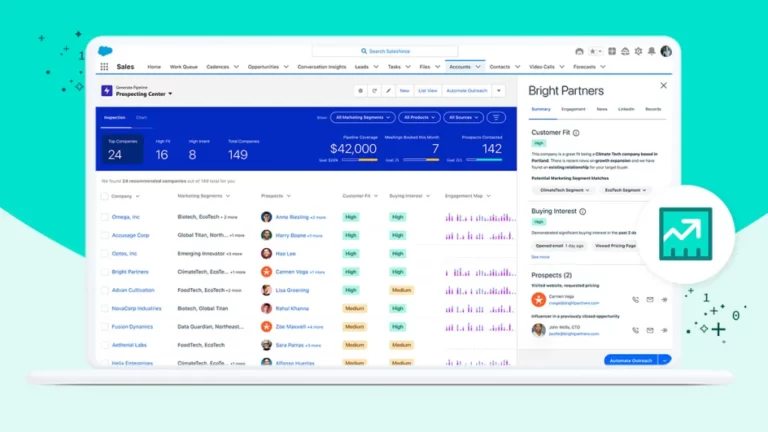
Automated Prospecting: Powered by Data Cloud – which unifies internal Salesforce and external data in real time – Automated Prospecting creates prospect lists based on account segmentation, customer fit, and buyer engagement scores to help sellers engage customers when they’re most likely to purchase. These scores can include metrics such as recent company expansion and levels of relationships with decision makers.
Process Intelligence: Sales operations teams can easily build data models from internal and external data sources to optimize performance indicators, such as win rate or attrition metrics.
Sales Cloud Everywhere: Sellers can bring the power of Sales Cloud to Outlook, Gmail, and web browsers to effortlessly manage opportunities, update accounts, and look up CRM data from wherever they’re working. Additionally, it streamlines email communication by auto-generating and sending emails directly from these platforms.
These innovations are powered by unified data that powers trusted AI, and all sales processes are integrated on a single platform. This allows sales organizations to transform how they work and shift their attention from processes to connecting with people, giving them more time to focus on what they do best – selling.