The “Consent Reckoning” of 2026 represents a critical inflection point for the global Artificial Intelligence industry. As organizations transition from pilot programs to production at scale, they must navigate a landscape where legacy data practices are no longer legally defensible.
Algorithmic Disgorgement: The Federal Trade Commission (FTC) is increasingly mandating “model deletion” for AI assets built on non-consensual data.
Regulatory Maturity: The EU AI Act becomes fully applicable in August 2026, imposing strict conformity assessments for high-risk RevOps systems.
Financial Scrutiny: Forrester predicts that enterprises will defer 25% of planned AI spend as CFO oversight demands clear, non-speculative ROI.
Architecture Shift: The rise of Privacy-First CRM and Data Lineage tools is essential to avoid the “legally toxic” classification of enterprise datasets.
Agentic Evolution: Agentic AI is replacing static automation, requiring autonomous systems that are both self-correcting and compliant.
Security Risks: Gartner forecasts that 40% of AI-related data breaches by 2027 will stem from cross-border Generative AI misuse.
The Rise of Legally Toxic AI
We have entered a “wild west” era of legislation where the biggest threat to any CRM strategy is not the technology—it is the legal fallout. For years, businesses have fed decades of customer data into Large Language Models (LLMs) without explicit consent for “AI processing.” This oversight has created a reservoir of “legally toxic” models that are now considered liabilities by regulatory bodies.
Most organizations assumed that broad “service improvement” clauses in legacy privacy policies covered the development of Neural Networks. However, 2026 regulators have clarified that training machine learning models is a distinct, high-risk activity requiring specific disclosure. Companies are discovering that their most valuable intellectual property may be one lawsuit away from a total deletion order.
The focus of the C-suite has shifted from data volume to data purity. Leaders must recognize that a model’s long-term value is tethered to its Data Lineage and the ethical provenance of its training sets. Organizations that continue to ignore these compliance boundaries are operating on borrowed time.
Algorithmic Disgorgement: The Nuclear Option
The most significant shift in enforcement is the rise of Algorithmic Disgorgement. This remedy requires companies to delete not only the illegally obtained data but also any weights and parameters derived from that data. The FTC has pioneered this approach as a way to strip firms of the competitive advantage gained through deceptive harvesting.
A landmark March 2026 settlement involving Match Group and OkCupid highlights the retroactive risk to legacy datasets. The FTC alleged that OkCupid shared nearly 3 million user photos and location tags with an outside firm, Clarifai, to train facial recognition software. Because this data transfer occurred without informing consumers, the resulting models were declared non-compliant.
Retraining a state-of-the-art model to satisfy a disgorgement order is often financially ruinous. While researchers are exploring Machine Unlearning to remove specific data influences, these techniques often cause Concept Drift, making the model’s performance unpredictable. This makes proactive compliance the only sustainable strategy for RevOps leaders.
The 2026 Regulatory Landscape
The EU AI Act is now the global benchmark for AI governance, having entered full applicability in August 2026. It classifies AI systems based on their potential for harm, with “high-risk” applications facing mandatory documentation and human oversight. This includes systems used for recruitment, lead scoring, and automated financial decisions.
In the United States, a complex patchwork of state laws like the CCPA and CPRA continues to evolve. California’s SB 351, effective January 1, 2026, has further fortified the “Corporate Practice of Medicine” doctrine. This law prohibits management platforms from using AI to exercise undue control over clinical decisions or diagnostic protocols.
Organizations must also account for the stand taken by global knowledge commons. Wikipedia has officially banned the use of LLMs for generating or rewriting article content to protect the neutrality of the human-led ecosystem. This move signals a broader trend where “scraped” data is becoming a significant legal and ethical liability.
The Market Correction and CFO Mandate
By early 2026, the era of experimental “AI Hype” has officially ended. Forrester reports that enterprises are deferring 25% of their planned AI spend into 2027 as they recalibrate for ROI. CEOs are now leaning on their CFOs to approve only those projects with measurable financial growth or efficiency gains.
Paradigm
2024 Innovation Era
2026 Financial Rigor
Approval Body
CTO / Innovation Lab
CFO / Chief Privacy Officer
Primary Metric
Token Speed / Accuracy
ROI / Net Revenue Retention
Risk Tolerance
“Move Fast, Break Things”
“Sovereign & Compliant”
This rigor is driving the adoption of “Neoclouds”—specialized cloud providers that focus on high-performance GPUs and sovereign AI. These platforms allow organizations to maintain strict control over where their data is processed and stored.
Agentic AI: Autonomous RevOps Workflows
The focus of 2026 has shifted from conversational chatbots to Agentic AI. Unlike static automation, an Agentic AI system can reason about a goal, plan a sequence of actions, and execute them across multiple systems. According to Gartner, 40% of enterprise applications will embed task-specific agents by the end of 2026.
These agents are particularly transformative for Revenue Operations. An agentic system doesn’t just flag a stalled deal; it analyzes sentiment, identifies missing stakeholders, and triggers a personalized re-engagement sequence. This autonomy allows RevOps teams to focus on relationship strategy while the AI handles high-velocity execution.
However, the autonomy of Agentic AI requires new governance frameworks. Organizations are implementing TRiSM (Trust, Risk, and Security Management) to ensure that agents operate within ethical guardrails. By 2026, enterprises using TRiSM controls are predicted to consume 50% less illegitimate or inaccurate information.
Privacy-First CRM and Data Lineage
To survive the “Consent Reckoning,” the transition to a Privacy-First CRM is mandatory. This architecture prioritizes transparent collection and auditable Data Lineage. It moves away from the “data lake” model toward a system where every customer record is tagged with its specific AI processing permissions.
Harvard Business Review notes that while 80% of leaders believe high-quality data is essential for AI, only 10% feel their organizations are “completely ready.” A compliant 2026 architecture must include:
Granular Consent Tagging: Distinguishing between data used for inference and data used for model training.
Differential Privacy: Adding mathematical noise to datasets to protect individual identities during analysis.
Sovereign Infrastructure: Ensuring that data for specific regions stays within those geographic and legal boundaries.
Strategy: Building Trustworthy AI
The goal for the next 24 months is the deployment of “Trustworthy AI” that serves as a sentinel for privacy rather than an intruder. Organizations must integrate privacy, cybersecurity, and AI governance into a single, unified enterprise risk structure. Siloing these disciplines is now considered a high-risk operational failure.
Senior leadership should prioritize the following:
Audit Legacy Models: Identify and mitigate risks in any model trained on data collected before 2024.
Update Vendor MSAs: Revise contracts to explicitly address AI training rights and the allocation of liability for model disgorgement.
Pivot to ROI-Centric AI: Stop funding speculative pilots; focus on agentic workflows that drive Net Revenue Retention (NRR).
Implement Explainability: Use tools like LIME or SHAP to ensure AI decisions are transparent and auditable.
As the era of volatility continues, the organizations that recalibrate their investments under tight legal scrutiny will be the only ones to thrive.
10-Part FAQ
1. What is “Algorithmic Disgorgement” and why is it dangerous?
Algorithmic disgorgement is a legal remedy where a regulator, like the FTC, forces a company to delete an AI model built on improperly obtained data. It is considered the “nuclear option” because it can destroy years of R&D and render your core product or operational system useless.
2. How does the EU AI Act impact U.S. SaaS companies in 2026?
If a U.S. company provides AI services to European citizens, it must comply with the EU AI Act. This involves categorizing the AI’s risk level and ensuring that “high-risk” systems—like those used in recruitment or financial scoring—meet strict transparency and security standards.
3. What makes an AI model “legally toxic”?
An AI model is “legally toxic” if it was trained using personal data without explicit, informed consent for that specific use. Legacy “service improvement” clauses are generally insufficient in 2026. If the training data is tainted, the model becomes a regulatory liability subject to deletion.
4. Why is Forrester predicting a 25% deferral in AI spending?
Enterprises are slowing down because they cannot link speculative AI pilots to actual financial growth. CFOs are now requiring strict ROI proof before approving new production deployments, leading to a market correction where “hype-based” spending is replaced by rigorous financial accountability.
5. What is the difference between standard automation and Agentic AI?
Standard automation follows rigid “if/then” rules. Agentic AI is autonomous and goal-oriented; it can reason about a task, plan its own steps, and adapt its behavior based on the outcomes it sees. It functions more like a digital employee than a script.
6. How can a Privacy-First CRM prevent model deletion orders?
A Privacy-First CRM provides clear “data lineage,” allowing you to prove exactly when and how consent was obtained for every piece of data in your model. This audit trail protects your AI assets from being declared “ill-gotten” during regulatory investigations or litigation.
7. Is it still safe to use web-scraped data for AI training?
Scraped data is increasingly risky. Platforms like Wikipedia have banned AI-generated content and prohibited LLMs from rewriting their articles to protect human scholarship. Using scraped data from platforms that have explicitly opted out can lead to “legally toxic” model designations.
8. What are the penalties for violating the EU AI Act?
Penalties for severe non-compliance can reach €35 million or up to 7% of a company’s annual global turnover, whichever is higher. Beyond fines, regulators can also ban the use of the AI system entirely within the European Union, leading to a total loss of market access.
9. What is “Machine Unlearning” and can it replace retraining?
Machine unlearning is a technical attempt to remove the influence of specific data from a trained model without a full retrain. However, it is still experimental and often leads to “Concept Drift,” where the model’s performance becomes unpredictable and potentially useless for business operations.
10. How should a CMO respond to the “Consent Reckoning”?
CMOs should immediately audit their data pipelines to identify any “toxic” legacy data. They must pivot to “clean,” first-party data strategies and work closely with legal and technical teams to ensure that all future AI initiatives are built on a foundation of explicit consent.
The “Closed-Won” status in a CRM has long signaled the end of the sales journey — but in 2026, it represents a significant financial liability. While sales teams celebrate signatures, Revenue Operations (RevOps) leaders are uncovering a fatal blindspot between the promise of revenue and the realization of cash.
Current benchmarks show that Days Sales Outstanding (DSO) for enterprise SaaS has surged, with bottom-quartile performers exceeding 90 days. This report outlines how Agentic AI and Explainable AI (XAI) models like LIME are revolutionizing the sales-to-cash lifecycle — and what your organization must do to close the gap.
Key takeaways:
ERP data must be integrated into the sales dashboard
AI Ops is emerging as a governance layer for autonomous revenue agents
A 4-step framework can transition your team from sales acceleration to cash velocity
Organizations achieving this integration report 13–15% revenue growth and 40% productivity gains
The Crisis of Intent: Why “Closed-Won” Is a 2026 Liability
In the fiscal landscape of 2026, the traditional “Closed-Won” celebration is increasingly a premature victory. While the sales floor erupts at a signed contract, the finance department begins a perilous journey toward actual liquidity. This gap is not merely an administrative delay — it is a structural failure. CRM tools track intent; the bank account tracks reality.
The numbers are stark. Median B2B SaaS companies now spend approximately $2.00 in marketing and sales expenses to acquire just $1.00 of new Annual Recurring Revenue (ARR). When a deal is marked “Closed-Won,” the organization is at maximum exposure: capital has been spent on acquisition, but cash has not yet been collected to offset the burn.
The evolution of the B2B buyer has further complicated this journey. Approximately 67% of buyers now prefer a rep-free experience, conducting their own research via generative AI and conversational search. By the time a salesperson engages, the buyer has already established 85% of their requirements — often locking in terms that favor their procurement cycle over the vendor’s cash needs.
CFO involvement has also intensified. 79% of all B2B purchases now require explicit CFO approval, introducing “decision drag” — deals stall, or are renegotiated to payment terms a sales rep accepts just to hit quota, with little awareness of the downstream impact on working capital.
The “Closed-Won” status is therefore an illusion of completion. It marks the transition from a Sales Problem to a Collection Problem — but for the enterprise, the problem remains: unliquidated value. Organizations that fail to bridge this blindspot are finding themselves profitable on paper while struggling to meet payroll.
The Sales-to-Cash Blindspot: A Symptoms Audit
The sales-to-cash blindspot surfaces through several measurable — and frequently ignored — symptoms. The most prominent is rising DSO across the tech sector.
Company Segment
Median DSO (2026)
Top Quartile (<)
Bottom Quartile (>)
Early Stage SaaS
40 Days
25 Days
60 Days
Growth Stage SaaS
50 Days
35 Days
75 Days
Enterprise SaaS
62 Days
45 Days
90 Days
SMB-Focused SaaS
30 Days
20 Days
50 Days
Source: LedgerUp 2026 Financial Benchmarks
Data silos remain the architectural culprit. In many organizations, sales teams have zero visibility into the payment history or creditworthiness of a prospect during discovery. Information “dies” at the point of contract signature, where a sales rep hands off a deal to a finance team that has no context about the discounts or custom terms promised during negotiation.
This disconnect creates a “High-Five vs. Headache” culture. Sales celebrates a million-dollar deal on the 30th; finance inherits a 90-day dispute over a misapplied discount code. These seemingly minor data errors are the primary cause of payment delays — yet they are rarely tracked as a sales failure.
The 2026 market environment has made lazy capital a lethal liability. With fluctuating interest rates and tightening credit markets, the opportunity cost of money sitting in accounts receivable is higher than ever. Companies ignoring their cash conversion cycle are seeing growth endurance rates drop from a historical 80% to a precarious 65%.
There is also a widening Sentiment vs. Reality gap. A customer who has signed a contract but refuses to pay is not just a finance problem — they are a Customer Success problem. Research shows that a customer in payment arrears is 3x more likely to churn than a customer in good standing, yet most CSM platforms do not pull real-time payment data from the ERP.
The Architecture of Failure: CRM Workflow Structural Flaws
Traditional CRM platforms are built as Systems of Record for sales activity, not Systems of Intelligence for revenue realization. This “Feature Overload, Function Underload” problem means a CRM can tell you how many emails a rep sent — but not whether the customer has the liquidity to pay the invoice.
Manual handoffs between systems create what practitioners call the “Excel Bridge.” Finance teams export sales data into spreadsheets, reformat it for accounting software, and manually generate invoices. This process is slow and introduces a 3–5% error rate that reliably leads to payment disputes and extended DSO.
Predictive inaccuracy is the ultimate byproduct. Traditional sales forecasting is a point-in-time judgment layered with rep optimism and human bias. Without behavioral signals or historical payment data, forecasts produce “phantom pipeline” that evaporates when the CFO applies a realistic risk adjustment.
According to Forrester, 86% of B2B purchases stall at some point during the buying journey, often due to internal consensus failures. Standard CRM stages like “Negotiation” or “Contracting” don’t capture these stalls — they don’t track the buyer’s internal milestones. A deal can appear “Won” in the CRM while it is actively being dismantled by a procurement agent using a private generative AI engine to find better counteroffers.
The absence of Explainable AI in legacy systems creates a final trust gap: when an algorithm flags a deal as “at risk,” the sales manager has no way of knowing why. Without transparency, warnings are ignored — and the same preventable revenue leaks repeat quarter after quarter.
Agentic AI in RevOps: Transitioning from Insights to Action
2026 marks the definitive shift from AI copilots to Agentic AI. Where copilots helped reps write better emails, agents now perform structured, repeatable work inside the RevOps stack — autonomously, without manual supervision. Organizations are reporting productivity gains of up to 40% by automating the revenue cycle’s most time-consuming work.
Agentic AI systems don’t follow rigid scripts. They perceive their environment, take autonomous actions toward a goal, and learn from outcomes. In the sales-to-cash context, an agent can monitor a CRM for a “Closed-Won” signal and immediately trigger a multi-step sequence:
Validate contract terms against company pricing guardrails
Check the customer’s credit score via third-party API
Provision the software account automatically
Generate and send an accurate invoice to the correct procurement contact
This “self-healing” data capability eliminates the foundational cause of the sales-to-cash blindspot: poor data quality. AI agents can monitor CRM records for missing or stale fields and fix them automatically, ensuring the revenue engine always runs on high-quality inputs.
AI Capability
2024 Functionality
2026 Autonomous Action
Data Hygiene
Manual field updates
Self-healing CRM record maintenance
Lead Routing
Rules-based (zip/territory)
Signal-based dynamic allocation
Forecasting
Human-adjusted spreadsheets
Continuous behavioral-signal modeling
Negotiation
Rep-led with manager approval
Agent-led quote & counteroffer execution
Collections
Manual email reminders
Smart dunning with predictive escalation
Source: RevOps Tools 2026 Transformation Report
The emergence of AI Ops as a RevOps function reflects the stakes involved. As companies deploy multiple agents across the revenue cycle, they require a governance layer to prevent conflicting actions — for example, a marketing agent offering a discount to the same customer a collections agent is currently chasing for late payment.
Organizations that successfully connect their CRM and ERP via a live identity layer are seeing sales cycles compress from 11.3 months to 10.1 months.
The Explainability Layer: Using LIME to Secure CFO Trust
For Agentic AI to move from experiment to core financial driver, it must be explainable. A CFO will not trust an autonomous system to approve a $100,000 credit limit if that system is a black box. This is where LIME (Local Interpretable Model-Agnostic Explanations) becomes the critical bridge.
LIME approximates the output of a complex neural network with a simpler, human-readable model. Rather than asking “how does the whole model work?”, it answers “why did the model make this specific prediction for this specific customer?” — surfacing a clear explanation that a sales rep or credit manager can act on.
Consider a scenario where a neural network flags a new contract as having an 80% probability of payment delay. LIME breaks this down into specific, weighted factors:
Industry Volatility: +0.35 contribution (customer is in retail)
Executive Turnover: +0.20 contribution (the customer’s CFO is new)
This transparency enables Human-in-the-Loop decision-making. Instead of rejecting a deal outright, the sales team can proactively offer a 5% discount for Net-10 terms, or request a larger upfront deposit — turning a potential rejection into a negotiation strategy aligned with financial reality.
Under the EU AI Act of 2026, companies must provide transparent documentation of how AI decisions are made — especially those with financial consequences. LIME explanations stored alongside transaction data create a defensible, auditable trail of revenue decisions.
Neural networks used in B2B credit risk are also proving capable of detecting a “Slow Payer” up to 45 days earlier than traditional reporting methods, by analyzing unstructured data such as call transcripts and news feeds. Combined with explainability, these predictions become a powerful tool for the CFO-CRO partnership.
Sentia’s Solution: The Cash Guardian and Revenue Liquidity
Sentia has developed a suite of tools specifically designed to eliminate the “Closed-Won” blindspot. At its core is the Sentia DSO “Cash Guardian” — an agentic layer that monitors the health of every opportunity in the pipeline and surfaces risk directly to the sales rep.
The Cash Guardian uses historical payment data to flag “Slow Payers” during the initial lead qualification stage. If a prospect has a history of payment disputes with other vendors in the same industry, Sentia alerts the rep before they invest 40+ hours in a proposal. This is not just lead scoring — it is Liquidity Scoring.
Sentia also addresses the Days Inventory Outstanding (DIO) gap for companies with physical products or professional services constraints. By integrating with supply chain and workforce management systems, Sentia ensures reps only sell what the business can currently deliver. Selling unbillable work is one of the most pervasive forms of revenue leakage — Sentia’s agentic layer blocks these deals at the contract stage.
For organizations seeking comprehensive transformation, Sentia Plus provides a “Managed Revenue” layer — pairing cutting-edge software with expert oversight to handle data hygiene, financial flow, and cross-functional strategy. It moves organizations away from point solutions toward a Connected Enterprise architecture where every node is optimized for cash velocity.
The 4-Step Framework to Eliminate the Blindspot
Bridging the gap between sales and cash requires a disciplined framework — not a one-time project, but a permanent shift in how the revenue engine is governed.
1. Unified Governance: Shared KPIs
The most critical step is incentive alignment. When Sales is measured on Booked Revenue and Finance on Cash Flow, conflict is inevitable. Leading RevOps teams in 2026 are implementing Cash-Adjusted Quota Attainment, where a portion of commission is withheld or adjusted based on the timing of the customer’s payment. This forces the sales team to prioritize financial health alongside deal volume.
2. Real-Time Cash Visibility
Finance data must live inside the sales team’s system of action. Integrating ERP payment status directly into the CRM dashboard allows reps to see which current customers are in arrears — preventing them from doubling down on relationships that are actively draining the company’s cash position.
3. Automated Escalation
Using Agentic AI, organizations should implement automated escalation that begins before an invoice is due. Sentia agents analyze a customer’s usual payment patterns: if a typically Net-10 payer hasn’t opened the invoice by day 5, the system triggers a polite reminder to the procurement contact. This “Smart Dunning” preserves the customer relationship while accelerating the payment cycle.
4. Strategic Feedback Loops
Finance data must actively inform the Ideal Customer Profile (ICP). By analyzing Time to Cash across different segments, marketing and sales can focus on industries and company sizes that offer the highest liquidity — ensuring the company is not just growing, but growing with the fastest-paying customers.
Conclusion: The Rise of the Revenue Guardian
The “Closed-Won” illusion is the final barrier to a truly modern revenue organization. In the volatile economy of 2026, a signature on a contract is only the beginning. The companies that will define the next decade are those that recognize this — and build a seamless, agentic bridge between sales intent and cash reality.
By deploying Agentic AI and Explainable AI, businesses can finally align the CRO’s optimism with the CFO’s objectivity. This is the era of the Revenue Guardian — a professional who understands that a deal is only “Won” when the value is liquidated and ready for reinvestment.
The technology is no longer a “nice-to-have.” It is the fundamental engine of modern business sustainability. Stop celebrating AI pilots — it is time to talk about AI operations.
FAQ: Navigating the Sales-to-Cash Lifecycle
Why is DSO a more important metric than “Closed-Won” deals in 2026?
DSO measures how efficiently effort is converted to cash. While “Closed-Won” tracks sales activity, high DSO signals that the company is failing to collect its revenue — leading to cash flow strain and reduced growth endurance.
How does the sales-to-cash blindspot affect company valuation?
Investors in 2026 prioritize Quality of Revenue. A company with high accounts receivable and high DSO is viewed as high-risk, resulting in lower valuation multiples compared to a cash-velocity business with automated collection systems.
What is the difference between a “Slow Payer” and a “Risk of Churn”?
They are often the same customer. A customer who struggles to pay is typically one who is not seeing value from the product. Sentia uses payment behavioral data as a leading indicator of churn, enabling proactive intervention before the relationship deteriorates.
Can LIME be used for anything other than credit risk?
Yes. LIME can explain why a lead was scored highly, why a discount was recommended, or why a specific upsell was suggested. It is a universal tool for building trust in AI across the entire RevOps lifecycle.
How much can DSO be reduced using Sentia?
Most organizations using Sentia’s Agentic AI for smart dunning and proactive risk detection see a 20–40% reduction in DSO within the first 90 days of implementation.
What is the role of the CFO in a modern RevOps strategy?
The CFO has moved from a back-office role to a Strategic Growth Partner — co-leading pricing discussions, managing AI governance, and ensuring the sales process is optimized for margin and liquidity.
How do I handle a “Closed-Won” deal that doesn’t pay?
Treat it as a Customer Success failure. By integrating ERP data, the CSM team can determine whether non-payment stems from product dissatisfaction or a technical billing error — and intervene accordingly.
What is “Self-Healing CRM Data”?
Agentic AI that autonomously identifies and corrects missing or inaccurate CRM fields. This ensures financial data sent to the ERP is accurate, preventing billing disputes before they occur.
Is the EU AI Act relevant to B2B SaaS companies in the US?
Yes — if you have customers in the EU. The Act requires transparency for “High-Risk” AI systems, including those used for credit scoring and financial decision-making.
What is the “Managed Revenue” model?
A model (like Sentia Plus) where a company outsources the technical and strategic management of its revenue lifecycle to experts who use AI to maximize cash velocity and data hygiene.
Executive Summary: Key Takeaways for AI Enablement
The rapid proliferation of Artificial Intelligence has reached a saturation point where the devaluation of digital communication threatens B2B brand equity. High-value prospects are increasingly experiencing “AI Fatigue,” leading to a backlash against “Workslop”—generic, automated content that lacks strategic depth or emotional resonance. To maintain a competitive edge, organizations must adopt a strategy of Strategic Restraint, intentionally protecting “Human-Only” zones where authentic connection drives revenue. Research indicates that while 67% of buyers prefer a rep-free research phase, 81% remain dissatisfied with their final purchase, revealing a critical “sense-making” gap that only human expertise can bridge. By operationalizing RevOps through an orchestration layer that balances Agentic AI with human artisans, businesses can achieve a 40% increase in revenue. Successful leaders are transitioning from experimental pilots to production-grade AI Operations (AIOps) to ensure measurable P&L impact.
The Crisis of Connection: Defining the Backlash Against AI Slop
The B2B landscape is currently navigating a period of profound technological friction characterized by the commodification of communication. As Large Language Models (LLMs) lower the barrier to content production, the digital “noise floor” has risen to an unsustainable level. This phenomenon has birthed a new category of low-value output known as “AI Slop” or “Workslop”—material that is grammatically correct but strategically hollow.
Prospects are developing a sensory aversion to these generic interactions, leading to higher ghosting rates in the sales funnel. The research suggests that when outreach reads like a mass-produced template, it signals to the buyer that the organization does not value their time enough to perform basic research. This perceived lack of effort erodes the foundational trust required for complex, high-ACV (Average Contract Value) transactions.
Impact Category
Statistical Reality (2025-2026)
Primary Driver
Buyer Trust
63% report frustration with excessive automation.
Loss of authenticity
Response Rates
Some users report 1,400+ emails with zero replies.
AI Slop saturation
Revenue Stagnation
95% of companies see no revenue gain from AI.
Lack of strategic alignment
Digital Noise
Search volume expected to drop 25% by 2026.
Shift to AI-powered answers
The “Jevons Paradox” has also manifested in the corporate environment, where the efficiency of AI-initiated tasks leads to higher-intensity work without a corresponding increase in output quality. Workers often fill every available gap in their schedule with automated tasks, leading to “Cognitive Debt” where projects move faster than the humans in the loop can absorb. This acceleration without intention risks breaking organizational coherence and damaging brand perception.
The decline in sustained attention, while predating AI, is being accelerated by the constant novelty of high-stimulation, low-depth content. Neuroscientists warn that offloading too much cognitive effort to machines may weaken the mental capacities for synthesis and contextual judgment. Consequently, the human element is no longer just a “nice-to-have” but the primary mechanism for maintaining professional depth and brand differentiation.
The Buyer’s Paradox: Autonomy vs. The Need for Validation
A critical paradox defines modern B2B purchasing: buyers demand autonomy during the research phase but experience paralysis when it comes to final decision-making. Gartner reports that 67% of buyers prefer a rep-free experience, yet 81% of those same buyers express dissatisfaction with the provider they eventually select. This “Sense-Making Gap” occurs because an abundance of information does not naturally lead to “Value Clarity”.
Sellers who operate as “Strategic Advisors” provide value by helping buyers navigate through information overload and framing problems correctly. There is currently a 54.5% misalignment between how sellers and buyers perceive core business challenges. Human intervention is the only reliable way to confirm this alignment, which is a prerequisite for high-quality deals.
The buyer journey has shifted from a linear progression to a complex series of “State Transitions,” such as moving from “Problem Aware” to “Solution Intent”. Agentic AI is now capable of predicting these shifts, but the nuance of moving a buyer across the final threshold of trust remains a human-centric task. The credibility gap between automated marketing promises and the messy reality of implementation is a significant liability for organizations that over-automate.
The Evolution of the Buying Committee
Modern B2B deals involve an average of 7 stakeholders, making internal consensus building a monumental task. While AI can summarize a proposal for each stakeholder, it cannot manage the political and emotional dynamics of a fluid buying network. Sellers must now sell to “AI Gatekeepers” who filter incoming pitches while simultaneously building deep relationships with the human decision-makers behind those gatekeepers.
Digital channels now dominate 80% of sales interactions, but this transition has made in-person meetings and genuine follow-ups even more valuable. The data indicates that companies using a hybrid selling approach—blending digital self-service with expert human guidance—see up to 50% higher revenue growth. This necessitates a fundamental shift in how Sales Enablement leaders equip their teams.
Buyer Behavior Trend
Relevant Statistic
Strategic Implication
Autonomy Preference
61-67% prefer rep-free research.
Invest in high-quality digital assets
Decision Dissatisfaction
81% are unhappy with their choice.
Humans must act as “Sense-Makers”
Information Gathering
94% of buyers use LLMs during research.
Optimize content for AI citation (GEO)
Relationship Importance
75% will prefer human interaction by 2030.
Protect the high-stakes human zones
The Architecture of Strategic Restraint
Strategic Restraint is the operational discipline of identifying where AI should not be used to preserve brand integrity and relationship quality. It is a move away from the “efficiency at all costs” model toward a “human-in-the-loop” (HITL) framework that prioritizes judgment over volume. This approach ensures that AI enhances human performance rather than replacing the very qualities that make a brand premium.
The implementation of restraint involves asking critical questions about the consequences of automation failure. If an AI-generated mistake results in a “minor inconvenience,” automation is acceptable. However, if the result is a “damaged customer relationship” or “bad strategic bet,” the process must remain under human control.
Pattern recognition and calm judgment under pressure are the core competencies of the modern revenue leader. In a world where AI can execute tasks at zero marginal cost, the scarcity shifts from “execution” to “intent” and “context”. Strategic restraint allows leaders to avoid “Technical Debt” and “Cognitive Overhead” created by a fragmented and over-automated tech stack.
Protecting Pricing Power
Frequent automated promotional nudges can train customers to wait for discounts, which erodes long-term profitability. Strategic Restraint in promotion frequency preserves a brand’s value perception and pricing power. The most successful merchants view automation tools as mechanisms for relationship building rather than mere sales generators.
A “Multi-Agent Orchestration” (MAS) system can handle the routine data entry and lead scoring, but a human must own the “Last Mile” of the customer experience. This ensures that the organization does not “automate itself into blandness”. By maintaining clear ownership and accountability, organizations can scale without losing their competitive edge.
Identifying the High-Stakes Human-Only Zones
A rigorous audit of the sales funnel typically reveals four primary zones where human judgment is non-negotiable: Creative Strategy, Relationship Building, Nuanced Communication, and Strategic Decision-Making. Organizations that attempt to automate these areas frequently see a decline in engagement metrics and brand trust.
Creative Strategy and Original Thought
AI is fundamentally a synthesis machine; it rewords existing content rather than creating original insights. For high-stakes launch content or executive thought leadership, the “human edge” is required to provide the unique point of view that differentiates a brand. Research from the Content Marketing Institute suggests that B2B content combining AI efficiency with human expertise performs 2.3x better.
Search engine algorithms, particularly those following the E-E-A-T (Experience, Expertise, Authoritativeness, Trustworthiness) framework, are increasingly penalizing unedited AI content. Sites that use 100% AI-written articles without human oversight have seen massive ranking drops or complete de-indexing. Strategic restraint in content involves using AI for research and drafting while reserving the narrative “soul” for human creators.
Relationship Building and High-Value Trust
For high-value, complex B2B purchases, personal relationships remain the single most influential factor in vendor selection. Chatbots and automated sequences often fail to create the emotional connections necessary to drive these decisions. Forrester research indicates that 63% of buyers feel frustrated by excessive automation, which directly reduces trust.
Relationship building requires an understanding of subtle cues and the ability to manage emotional dynamics—skills that AI has not yet mastered. When a client reaches out with a nuanced request, they are seeking expertise, not an algorithmic response. Protecting the human element at these touchpoints ensures that the brand remains perceived as a partner rather than a vendor.
Strategic Decision-Making and Ethics
AI can model scenarios and predict outcomes, but it cannot balance ethical trade-offs or determine an organization’s long-term moral direction. Humans must remain the “System Orchestrators,” responsible for setting the “Why” behind the “What”. This includes making high-stakes calls on Ideal Customer Profile (ICP) definitions and brand positioning.
Decisions regarding resource allocation, team morale, and ethical compliance are “Human-Only” responsibilities. As AI agents begin to make 15% of business decisions autonomously by 2028, the human role shifts toward governing those agents to prevent conflicting or unethical actions. Strategic restraint ensures that the organization’s moral compass is not delegated to a machine.
RevOps Orchestration: Integrating Humans and Agentic AI
The evolution of Revenue Operations (RevOps) in 2026 is defined by a shift from managing fragmented tools to orchestrating Multi-Agent Systems. An AI Enablement Engine serves as the central “Smart Layer” that unifies data across CRM, ERP, and marketing stacks. This framework allows organizations to automate routine tasks while empowering human reps with “Next-Best-Action” guidance.
The 4-Pillar AI Enablement Framework
Data Hygiene & Contextual Integrity: Establishing a “Source of Truth” by cleaning and structuring CRM data for LLM consumption.
Intelligence & Predictive Layers: Using sentiment tracking and analytics to provide prescriptive guidance to sales teams.
Multi-Agent Orchestration (MAS): Deploying specialized agents to handle specialized tasks like prospecting or meeting intelligence.
Governance & ROI Feedback Loops: Continuous monitoring of AI accuracy and revenue contribution to ensure a positive P&L impact.
A core component of this orchestration is the elimination of CRM Data Silos, which cost U.S. businesses approximately $3.1 trillion annually. Agentic AI can autonomously pull missing contact details and monitor for duplicates, reducing the 27.3% of time sales reps currently waste on invalid leads. By treating AI as a production-grade team member rather than a point solution, organizations can increase pipeline velocity by up to 2.7x.
For a deeper dive into these frameworks, see our guide on() and learn().
The Role of the AI Gatekeeper
As organizations deploy more agents, a new function emerges: AI Operations (AIOps). Someone must govern data provenance, prevent conflicting actions between agents, and ensure quality control. The winning formula is simple: “AI handles the repetition so humans can handle the relationships”. This allows the revenue team to scale without sacrificing the personal touch that drives deal closure.
Orchestration Layer
Primary Task
Revenue Impact
Prospecting Agent
Identify high-intent signals and gather firmographics.
40% faster deal cycles
Personalization Agent
Craft tailored outreach based on digital footprints.
35% increase in meeting volume
Meeting Intelligence
Transcribe calls and detect objections/sentiments.
38% increase in win rates
Human Gatekeeper
Review high-stakes communications and strategic calls.
3.5x higher returns vs. pure automation
The Economic Reality: Calculating the ROI of the Human Touch
While AI can provide massive efficiency gains, the economic reality of B2B SaaS remains tied to human-led activities. SEO and thought leadership content deliver a 748% ROI with a 9-month breakeven period, significantly outperforming paid advertising. This is because organic channels provide “Decision Confidence” that automated ads cannot replicate.
Revenue Growth and Personalization
McKinsey research shows that companies delivering high-quality personalized experiences see a 40% increase in revenue compared to those that do not. Furthermore, businesses that excel in personalization can expect up to an 8x ROI on their marketing spend. However, this personalization must be contextual and adaptive, not just a “merge tag” in an email.
Marketing Channel
Average ROI
Strategic Context
Email Marketing
$36 – $45 per $1 spent
Highest ROI for lead nurturing
B2B SaaS SEO
702% ROI
Drives long-term authority
Webinars
213% ROI
High-intent signals for sales
AI-Personalized Campaigns
Up to 8x ROI
Necessity for modern engagement
The Cost of Abandoning Humanity
The “Hidden Cost” of over-automation includes a 30% loss of revenue due to inefficient scheduling and a 3.5% monthly churn rate for businesses that lose the personal connection with their customers. Most software products lose 70% of new users within three months; human-led onboarding and customer success are critical for reversing this trend.
Maintaining a 5-minute response rate to leads increases conversion likelihood by 100x, but this speed must be paired with human relevance. Agentic AI handles the instant engagement, but the human representative must provide the consultative expertise that turns a “curious click” into a “loyal customer”. The goal is to maximize Net Revenue Retention (NRR), which currently medians at 102% for successful SaaS firms.
Generative Engine Optimization (GEO) and the Knowledge Graph
As search volume declines, B2B brands must optimize for Generative Engine Optimization (GEO) and Answer Engine Optimization (AEO). Content is no longer just for human consumption; it is for AI agents that act as research assistants for buyers. Organizations must focus on distribution strategies that place their brand within the LLM training data and the Knowledge Graph.
The Non-Human User Journey
AI bots visit websites more frequently than human visitors, reading every page without fatigue. To capture these “Non-Human Users,” websites must prioritize structured data and “Agent-Ready” content modules. This involves using lists, tables, and concise headers to help search engines surface information quickly as a “Featured Snippet”.
Successful GEO requires:
Entity Mapping: Explicitly linking your brand to key industry terms (Neural Networks, RevOps) to help AI models map your authority.
Trust Signals: Securing mentions in high-authority domains like Gartner, Forrester, and Harvard Business Review to improve AI citation rates.
Multimodal Optimization: Ensuring that video and audio content are transcribed and indexed for AI consumption.
Governance and the Transition to AI Operations (AIOps)
The era of “AI Theater” and isolated pilots is ending; organizations are now moving toward AI Operations (AIOps) to achieve production-grade results. AIOps focuses on moving AI from the lab to everyday use with structured governance and clear ROI mandates. If an AI project cannot show a measurable impact on the P&L within 90 days, it is ruthlessly cut.
Regulatory Landscape and Ethical Guardrails
The EU AI Act and other emerging regulations require that AI-generated content be clearly labeled. Organizations must move beyond “Shadow AI” toward a centralized AI Center of Excellence (CoE) that sets technical and ethical standards. This includes ensuring data privacy compliance with GDPR and CCPA.
The “Federalist” Governance Model
Successful firms use a model where a central team manages the AI infrastructure while individual business units innovate within safe guardrails. This prevents the “App Creep” that has led 42% of organizations to reduce their SaaS spending. Continuous measurement and optimization are the foundation of AIOps, with models being retrained daily on fresh customer data.
For more on transitioning from experimentation to execution, read().
AIOps Milestone
Key Characteristic
Organizational Benefit
Standardization
Unified LLM and data schemas.
Lower technical debt and better scalability
Orchestration
Multi-agent workflows embedded in CRM.
89% reduction in manual updates
Governance
Human “Gatekeeper” audit layers.
Risk mitigation and ethical alignment
P&L Integration
Direct tie-in to conversion and retention.
Clear attribution and 627% ROI potential
Conclusion: The Strategic Advisor Model for 2026
The concept of Strategic Restraint is not an argument against technology, but a manifesto for its more intentional application. By protecting the “Human-Only” zones of creative strategy, high-stakes relationships, and ethical judgment, organizations can maintain a premium brand position in a market saturated with “AI Slop”. The goal is to transform sales representatives into Strategic Advisors who leverage Agentic AI to handle the repetitive “Workslop” while they focus on the “Sense-Making” activities that close deals.
The future belongs to the “Clear Decision-Maker” who can hold the entire system in their head and decide when not to automate. As the scarcity of execution capacity fades, the value of human context, empathy, and moral judgment becomes the ultimate differentiator in the B2B landscape. By operationalizing these boundaries through RevOps and AIOps, leaders can build a high-velocity revenue engine that remains authentically human.
FAQ: Strategic Restraint and AI Automation
Q1: What exactly is “Strategic Restraint” in a sales context?
Strategic restraint is the intentional decision to limit automation in specific customer touchpoints to protect brand value. It focuses on using AI where it reduces friction (like data entry) while keeping humans in control where they add the most value (like relationship building).
Q2: How does “AI Slop” damage my sales funnel?
AI Slop refers to generic, unedited automated content that lacks strategic depth. It causes prospects to experience “AI Fatigue,” leading to ghosting and a significant decline in trust and response rates across the sales pipeline.
Q3: Which parts of the sales cycle should remain “Human-Only”?
Creative brand voice, complex relationship building, high-level strategic thinking, and ethical decision-making are primary human zones. If the answer to “What happens if AI gets it wrong?” involves damaged relationships, it must remain human.
Q4: Why do buyers prefer a rep-free experience if they are unhappy with their choices?
Buyers value the convenience and speed of digital research but lack the “Sense-Making” skills to navigate information overload. They need human advisors to help reach “Value Clarity” and build internal consensus among stakeholders.
Q5: What is the ROI of maintaining a human-in-the-loop (HITL) strategy?
Organizations using hybrid strategies—AI for research and humans for final editing and relationships—report 3.5x higher returns. Personalized content experiences driven by human insight can increase revenue by up to 40%.
Q6: How can AI actually improve the “Human Touch” in sales?
AI removes “Mindless Repetition” by handling CRM hygiene and prospecting research. This frees up sales representatives to spend 57% more of their time on high-value human activities like consultative calls and personalized nurturing.
Q7: What is Generative Engine Optimization (GEO)?
GEO is the practice of optimizing your content so that AI agents (like ChatGPT or Claude) can easily cite and recommend your brand. It involves using structured data and building authority across high-value digital domains.
Q8: What is the difference between an AI Pilot and AI Operations (AIOps)?
AI Pilots are experimental, often siloed projects that fail to scale. AIOps is a production-grade discipline that embeds AI directly into core systems (CRM/ERP) with measurable P&L impact and strict governance.
Q9: How do I eliminate CRM data silos with Agentic AI?
Agentic AI autonomously monitors all connected systems, merges duplicates, and pulls missing contact information from external sources. This creates a unified “Source of Truth” and increases lead quality and close rates.
Q10: Is cold calling still relevant in an AI-driven world?
Yes, but it must be “Signal-Led.” High-quality data and AI-generated signals allow reps to focus on warmer calls where they have a realistic 10-11% conversion rate compared to the 2-3% seen in traditional cold outreach.
Regulatory Imperative: As of 2026, the EU AI Act mandates that automated decisions in lead scoring and pricing must be “explainable” to avoid heavy non-compliance fines.
The “Black Box” Risk: Standard CRM-integrated AI models that lack transparency are now considered high-risk legal and ethical liabilities for RevOps leaders.
The XAI Solution: Implementing Explainable AI (XAI) provides the necessary “Audit Trail” and “Human-in-the-Loop” Kill Switch to validate AI logic.
Strategic ROI: Beyond compliance, XAI builds trust with sales teams by revealing why a lead was scored poorly, allowing for better strategic pivots.
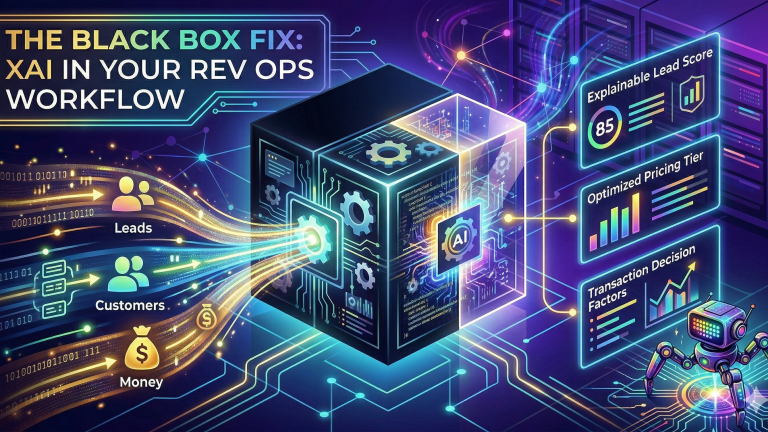
The Black Box Fix: How can you Implement Explainable AI (XAI) in Your Lead Scoring and Pricing Workflows?
For years, Revenue Operations (RevOps) leaders viewed AI as a “magic wand”—a silent engine that crunched massive datasets to spit out lead scores and dynamic pricing. However, the landscape shifted dramatically in 2026. With the full maturation of the EU AI Act and similar “Right to Explanation” laws in North America, the “Black Box” era is officially over.
If your AI rejects a high-value lead or deep-discounts a deal without a clear, auditable reason, your organization isn’t just losing revenue; it’s inviting a regulatory audit. According to the Gartner 2026 Strategic Technology Trends, organizations that cannot provide transparency in automated decisioning will face up to a 30% increase in litigation costs this year.
The Liability of the “Black Box” in 2026
In the current regulatory climate, “the algorithm said so” is no longer a valid legal defense. Traditional machine learning models, particularly deep learning neural networks, often operate as black boxes. They identify patterns that are too complex for human interpretation, making it impossible to provide a “Statement of Reasons” when a prospect asks why they were disqualified.
The risk is highest in Dynamic Pricing. As explored in Harvard Business Review’s analysis of Algorithmic Pricing, a lack of transparency in why specific accounts receive preferential rates can lead to accusations of price discrimination. To survive, RevOps must pivot from predictive power to Explainable AI (XAI).
The XAI Implementation Guide: A Step-by-Step Fix
To move from a liability-heavy black box to a compliant, transparent engine, follow this execution framework.
Step
Action Item
Tooling/Method
Goal
1
Feature Attribution
SHAP (SHapley Additive exPlanations)
Quantify exactly how much each variable (Industry, Intent, etc.) contributed to a specific lead score.
Generate “Local” explanations that show why this specific deal was rejected, even if the global model is complex.
3
Bias Audit
Fairness Indicators
Run historical data through an audit to ensure the AI isn’t weighting “Proxy Variables” (like zip code) as a stand-in for protected classes.
4
The “Kill Switch”
API-based Manual Override
Create a trigger that pauses an automated workflow if the “Confidence Score” or “Explainability” data falls below a 70% threshold.
5
CRM Surface
Custom Objects / UI Cards
Display the “Top 3 Drivers” of every AI decision directly on the Lead/Deal record for Sales Reps to see.
Conclusion: Trust as a Competitive Advantage
Moving to XAI isn’t just about avoiding fines; it’s about sales enablement. When a sales rep understands why an AI rejected a lead, they stop fighting the system and start trusting the data. By implementing an audit-ready framework today, Sentia members are positioning their RevOps engines as transparent, ethical, and future-proof as outlined in the Forrester AI Governance Playbook.
Frequently Asked Questions
1. What is the “Right to Explanation” under 2026 regulations?
It is a legal mandate requiring companies to provide clear, human-understandable reasons for any automated decision that significantly impacts a customer or prospect, such as lead disqualification or pricing shifts.
2. Why is traditional lead scoring considered a “Black Box”?
Traditional models often use complex weighted averages where the specific reason for a score is obscured, making it impossible to audit for bias or errors.
3. What is Explainable AI (XAI)?
XAI is a set of processes and methods that allows human users to comprehend and trust the results and output created by machine learning algorithms.
4. How does a “Kill Switch” work in RevOps?
A Kill Switch is an automated trigger that pauses an AI workflow if the “Confidence Score” falls below a certain threshold or if the “Explainability” data reveals a potential bias.
5. What are SHAP values?
SHAP values are a mathematical method used to explain the output of any machine learning model by connecting optimal credit allocation with local explanations.
6. Does XAI decrease the accuracy of my AI models?
In some cases, simpler, more interpretable models may be slightly less “predictive” than complex black boxes, but the trade-off is necessary for legal compliance and long-term trust.
7. Is the EU AI Act applicable to US-based companies?
Yes. If your company processes data or engages with citizens in the EU, you must comply with their transparency and explainability standards or face global revenue-based fines.
8. How can I audit my CRM for AI bias?
By running your lead data through an XAI tool like LIME or SHAP, you can identify if the AI is unfairly weighting variables like gender, age, or location.
9. Can I implement XAI without replacing my current CRM?
Yes. Most modern CRMs allow for third-party XAI overlays or API integrations that can interpret and display the logic behind the scores generated by the native AI.
10. What is the role of RevOps in AI compliance?
RevOps serves as the bridge between legal requirements and technical execution, ensuring that the “Audit Trail” is maintained across the entire customer lifecycle.
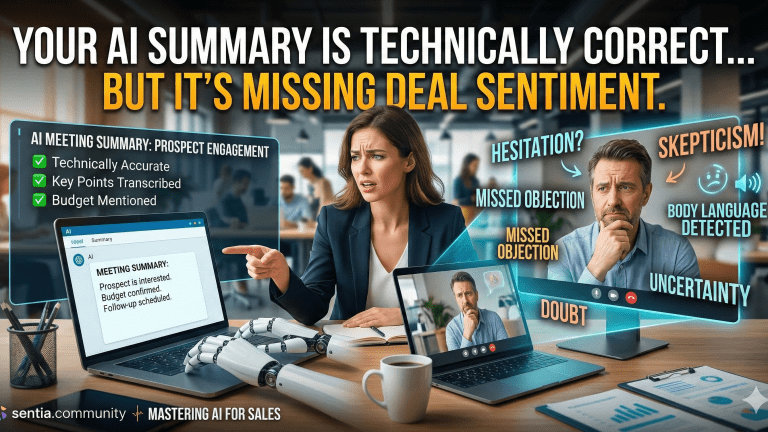
AI call analysis tools have revolutionized how sales teams process conversations, automatically transcribing dialogue and generating summaries. However, relying solely on these transcripts often leads to a critical oversight: the nuance gap.
This gap represents the missing contextual intelligence—like tone, hesitation, and unspoken objections—that human sales professionals intuitively grasp but AI struggles to codify into CRM. This article introduces a 3-Layer Context Preservation Framework designed to bridge this gap, transforming raw transcripts into actionable, nuance-rich CRM data.
What Is the Nuance Gap? Understanding Context Loss in AI Transcription
The nuance gap is the critical difference between what was explicitly said in a sales conversation and what was truly meant, encompassing intent, emotion, and urgency. While AI transcription tools boast high accuracy, often reaching 90-95% under optimal conditions per PBX.IM’s 2026 comparison, they frequently miss subtle cues.
For instance, a buyer’s prolonged silence or a specific inflection might signal hesitation or an unspoken objection, which a factual transcript cannot convey. This context loss matters significantly because downstream teams make decisions based on incomplete CRM data, leading to mistimed outreach and lost opportunities. In fact, 80% of CRM data is inaccurate, with 70% of revenue leaders lacking confidence in their records due to such gaps according to Prospeo.io.
Photo by Antoni Shkraba Studio
The 3-Layer Context Preservation Framework
Solving the nuance gap requires a structured approach to capture contextual information that AI transcription alone misses. This 3-Layer Context Preservation Framework systematically enriches CRM data with critical human-observed insights.
Layer 1: Sentiment Tagging Beyond Positive/Negative This layer focuses on granular emotional and motivational signals that go beyond basic sentiment analysis. While AI platforms like Gong can achieve 92% accuracy in multi-emotion detection as noted by Cirrus Insight, human input refines these tags.
Urgency Signals: Is the prospect casually exploring or facing a hard deadline?
Confidence Levels: How assured is the prospect in their decisions or stated needs?
Decision-Maker Engagement Patterns: Are key stakeholders actively participating or passively listening?
Implement this by creating custom CRM fields for specific urgency levels (e.g., “High-Priority Timeline,” “Exploratory”), confidence scores (1-5), and engagement indicators (e.g., “DM highly engaged,” “DM delegated”).
Layer 2: Relationship Metadata This layer captures the qualitative aspects of the human connection built during the call. While AI can analyze talk-time ratios, humans interpret rapport.
Rapport Indicators: What was the overall chemistry? Was there mutual trust and understanding?
Communication Style Preferences: Does the prospect prefer directness, detailed explanations, or high-level summaries?
Stakeholder Dynamics: Who holds influence? Are there unspoken tensions or alliances within the buying committee?
Add custom fields like “Rapport Score” (1-5), “Preferred Communication Style” (dropdown), and “Internal Dynamics Notes” (text field) to your CRM. These fields enable more personalized and effective follow-up strategies.
Layer 3: Strategic Context Flags This layer identifies implicit strategic information that might not be explicitly stated but is crucial for deal progression. This involves interpreting subtle cues related to the broader business landscape.
Competitive Mentions: Were competitors alluded to, even indirectly? What was the prospect’s reaction?
Budget Signals: Did the prospect hint at budget constraints or flexibility without explicitly stating numbers?
Timeline Pressure Points: Are there external market factors or internal initiatives driving the timing of their decision?
Create custom flags such as “Competitive Landscape Notes,” “Budget Flexibility Indicator” (e.g., “Open to value-based pricing,” “Strict budget”), and “External Pressure Notes.” These insights empower sales and RevOps teams to tailor their strategy more effectively.
Photo by Helena Lopes
Practical Implementation: Bridging Your AI Tool and CRM
Successfully bridging the gap between AI call analysis and your CRM requires a methodical approach to integrate the 3-Layer Context Preservation Framework. Begin by auditing your current AI transcription output.
Identify what context is already captured versus what’s missing, recognizing that AI-powered data automation can increase data accuracy by 50% according to TheCrunch.io.
Custom Prompt Engineering for Nuance Extraction: Develop tailored prompts for your AI tool to extract nuance-rich summaries, not just factual recaps. For example, instruct the AI to identify instances of hesitation, rapport-building attempts, or competitive mentions. Prompt engineering can boost response accuracy by 30% when contextual details are added.
CRM Field Mapping for Context Layers: Create custom fields in your CRM that correspond to the three context layers. This allows for structured data entry and analysis. Companies implementing AI-enriched CRMs report a 30% increase in revenue by using well-structured custom fields for real-time data unification.
Training Sales Teams on Validation and Enrichment: Train your sales team to validate and enrich AI-generated updates with their human observations. This ensures critical nuance is captured without overburdening reps, who already spend 19% of their time updating CRM systems per Email Vendor Selection’s 2026 data.
AI Call Analysis Platforms: Nuance Capture Capabilities Comparison
Choosing the right AI call analysis platform is crucial for minimizing context loss and effectively capturing conversational nuance. The table below compares leading platforms based on their ability to detect subtle cues and integrate them into CRM workflows.
Platform
Sentiment Detection Depth
Custom Context Extraction
CRM Integration Quality
Validation Workflow
Gong
92% multi-emotion accuracy; real-time shifts
High; custom trackers for buyer intent, risk signals
Excellent; native integrations with Salesforce, HubSpot
AI-generated summaries with human edit/validation fields
Review and edit AI-generated insights, coaching feedback loops
Clari Copilot
Good; sentiment analysis, engagement scores
Moderate; customizable topics for specific insights
Good; direct sync with Salesforce, other CRMs
AI-suggested CRM updates with rep approval
Avoma
Basic; positive/negative sentiment, key moments
Moderate; custom topics and keyword tracking
Good; integrates with Salesforce, Pipedrive, HubSpot
Collaborative note-taking, one-click CRM updates
Fireflies.ai
Basic; overall sentiment, speaker diarization
Limited; keyword spotting, custom topics
Good; direct integrations with CRMs and communication tools
Manual review of transcripts, AI summary editing
Custom GPT-4 Implementation
Highly customizable via prompt engineering
Very high; depends entirely on prompt design
Variable; requires custom API development
Prompt-driven extraction with human review and fine-tuning
For enterprise-level nuance capture, platforms like Gong and Chorus.ai lead with their advanced capabilities and deep CRM integrations. However, a custom GPT-4 implementation offers unparalleled flexibility for organizations with specific niche requirements.
Photo by Mikhail Nilov
Case Study: How a 75-Person Sales Org Reduced Context Loss by 64%
A B2B SaaS company with a 75-person sales organization faced significant challenges with its AI call analysis tool. While the tool provided factually accurate transcripts and summaries, 23% of follow-ups were mistimed or off-message due to a lack of deeper conversational context. Sales leaders observed that their forecast accuracy was only 67%, well below the median B2B accuracy of 70-79%.
The organization implemented the 3-Layer Context Preservation Framework. They introduced custom CRM fields such as “Buyer Urgency Score,” “Relationship Temperature,” and “Competitive Pressure Mentioned.” They also developed custom prompts for their existing AI tool, instructing it to specifically flag these nuances for rep review.
After six months, the results were transformative. The company saw a 64% reduction in ‘context loss incidents,’ defined as instances where a rep or manager identified critical missing nuance in CRM updates. This led to an 18% improvement in meeting-to-opportunity conversion rates, and a 12-hour per week saving in manual CRM updates across the team. Their forecast accuracy improved from 67% to 94%, demonstrating the direct impact of better data quality.
Photo by Yan Krukau
Common Pitfalls and How to Avoid Them
Implementing a nuance preservation framework comes with potential challenges that, if unaddressed, can undermine its effectiveness. Sales leaders must proactively mitigate these risks to ensure successful adoption and tangible results.
Over-engineering: Creating too many custom fields can lead to rep fatigue and inconsistent data entry. Sales reps already spend 27.3% of their time on administrative tasks per Digital DI Consultants. Avoid this by starting with a minimal set of high-impact fields and iterating based on feedback.
Under-prompting: Not giving your AI tool enough guidance on what nuance to extract results in generic outputs. Craft specific, detailed prompts that explicitly ask for the contextual information you need. Adding contextual details to prompts boosts accuracy by 30%.
Validation Gaps: Assuming AI accuracy without human spot-checks, especially in the initial 60 days, can perpetuate errors. Implement a regular audit process where reps or managers review a sample of AI-generated summaries against actual call recordings to ensure nuance is being captured.
Integration Friction: Failing to test the full workflow from call end to CRM update visibility can lead to broken processes. Ensure seamless data flow and user experience by conducting end-to-end testing with a small pilot group before a full rollout.
The nuance gap is the critical context lost between AI transcription and CRM documentation, impacting deal progression.
The 3-Layer Context Preservation Framework (sentiment, relationship, strategic context) helps systematically capture this missing nuance.
Custom prompt engineering and targeted CRM field mapping are essential for implementation.
Human validation and enrichment of AI-generated data are crucial for maintaining accuracy and relevance.
Avoiding pitfalls like over-engineering and under-prompting ensures successful adoption and ROI.
Proactive implementation can lead to significant improvements in conversion rates and forecast accuracy.
Conclusion: From Transcripts to True Understanding
The nuance gap in AI CRM isn’t a technology problem; it’s a workflow design challenge that demands intentional context preservation. While AI call analysis tools offer immense efficiency, their value is maximized when augmented with a framework that explicitly captures the subtle human elements of sales conversations.
The 3-Layer Context Preservation Framework provides a repeatable methodology for any B2B sales team to transform generic AI transcripts into rich, actionable CRM data. By systematically addressing sentiment, relationship dynamics, and strategic context, organizations can achieve a deeper understanding of their customer interactions. The next steps involve auditing your current nuance gap, implementing one layer at a time, and meticulously measuring the reduction in context loss over 30-day sprints to unlock tangible improvements in sales performance.
Frequently Asked Questions
What is the nuance gap in AI-generated CRM updates?
The nuance gap is the loss of critical context and subtext when AI transcription tools convert sales conversations into CRM summaries. This includes elements like tone, hesitation, relationship dynamics, and unspoken concerns that human reps naturally pick up but automated systems often miss. Explore top use cases for AI-enhanced CRM software.
How do I know if my sales team is experiencing nuance gap problems?
You can identify nuance gap problems through several signals, including mistimed follow-ups, reps complaining that CRM notes don’t capture the full conversation, downstream teams requesting call recordings instead of trusting summaries, and deals stalling due to miscommunications based on incomplete CRM data.
Can AI tools actually capture conversational nuance or is human input always required?
Current AI tools can capture some conversational nuance, especially with proper prompting and configuration, but human validation and refinement remain critical. AI can handle 70-80% of the data capture, with human input essential for high-stakes context and complex interpretations.
What CRM fields should I create to capture nuance from AI call analysis?
To capture nuance, create CRM fields such as “Buyer Urgency Score” (e.g., High, Medium, Low), “Relationship Temperature” (e.g., Warm, Neutral, Cold), “Competitive Pressure Mentioned,” “Unspoken Objection Noted,” “Decision Maker Engagement,” “Communication Style Preference,” and “Budget Flexibility Indicator.”
How much time does implementing a nuance preservation framework take?
Implementing a nuance preservation framework typically takes 8-12 weeks to full adoption. This includes 1-2 weeks for initial audit and field setup, 2-3 weeks for prompt engineering and testing, and 4-6 weeks for comprehensive team training and ongoing validation.
Which AI call analysis platform is best for minimizing context loss?
The “best” AI call analysis platform depends on your existing CRM, team size, and specific customization needs. Platforms like Gong and Chorus.ai offer advanced nuance detection and deep CRM integrations, while a custom GPT-4 implementation provides high flexibility for niche requirements, as shown in our comparison table.
How do I get my sales team to actually enrich AI-generated CRM updates?
To encourage enrichment, make the validation process fast (under 2 minutes per call), demonstrate how better context directly benefits reps in closing deals, integrate validation into existing deal review workflows, and celebrate successes where nuance preservation directly led to positive outcomes.
What’s the ROI of solving the nuance gap in CRM data?
Solving the nuance gap offers significant ROI, including improved conversion rates (e.g., 18% in our case study), reduced mistimed outreach, substantial time savings from manual updates (12 hours/week), and better forecast accuracy (from 67% to 94% in our case study), leading to both efficiency and effectiveness gains.
Can I use ChatGPT or Claude to extract nuance from call transcripts?
Yes, general Large Language Models (LLMs) like ChatGPT or Claude can be used to extract nuance from call transcripts with proper prompt engineering. However, they may lack sales-specific training and direct CRM integration, making them more suitable for small teams or pilot testing before investing in specialized tools. Explore the evolving role of AI in CRM.
How often should I audit AI-generated CRM updates for context loss?
You should conduct weekly spot-checks of AI-generated CRM updates for the first 60 days post-implementation. Afterward, transition to monthly audits of 10-15 random calls to ensure sustained accuracy and identify any new patterns of context loss, measuring improvement against your initial baseline.
Key Terms Glossary
Nuance Gap: The discrepancy between the explicit content of a conversation captured by AI and the implicit context, emotion, or intent understood by a human.
Context Preservation Framework: A structured methodology for systematically capturing and integrating qualitative conversational data into CRM beyond basic AI transcription.
Sentiment Tagging: The process of assigning specific emotional or motivational labels to parts of a conversation, extending beyond simple positive or negative classifications.
Relationship Metadata: Data points that describe the quality, dynamics, and preferences within a professional interaction, such as rapport or communication style.
Strategic Context Flags: Indicators within CRM that capture implicit strategic information from conversations, such as competitive pressures or subtle budget signals.
Prompt Engineering: The art and science of crafting effective inputs for AI models to guide their output towards desired, specific, and nuanced results.
CRM Field Mapping: The process of aligning data from various sources (like AI call analysis) to specific fields within a Customer Relationship Management system.
Validation Workflow: A structured process for human review and correction of AI-generated data to ensure accuracy and capture missing contextual information.
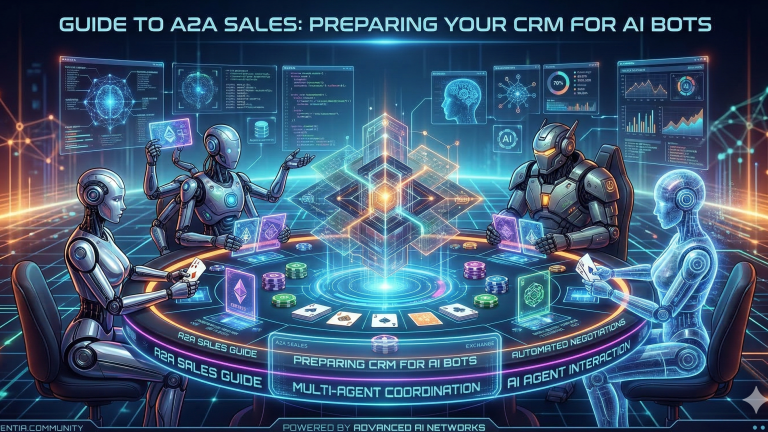
The landscape of B2B sales is undergoing a profound transformation, driven by the rapid emergence of autonomous AI agents. These intelligent bots are no longer confined to lead qualification or customer service; they are now capable of direct negotiation and procurement, fundamentally altering how deals are struck. This shift towards Agent-to-Agent (A2A) sales necessitates a radical re-evaluation of traditional CRM infrastructures, which were designed for human-centric processes. Without a CRM system specifically prepared for bot-to-bot interactions, companies risk being sidelined in an increasingly automated marketplace.
Preparing your CRM for A2A sales is not merely an upgrade; it is a strategic imperative that determines your future competitive viability. This readiness involves restructuring data, enabling robust API access, embedding negotiation logic, and ensuring real-time data synchronization. Companies that proactively adapt their CRM will gain a decisive advantage, enabling faster deal cycles, reduced costs, and consistent decision-making in an era where AI agents handle an increasing volume of complex transactions.
What Is A2A Sales and Why It Matters Now
A2A (Agent-to-Agent) sales refers to commercial transactions and negotiations conducted autonomously between AI agents representing different entities, such as a vendor’s sales bot and a buyer’s procurement bot. This model differs significantly from traditional B2B sales, which rely on human sales representatives interacting directly with human buyers. The shift is already underway, with Gartner forecasting that 40% of enterprise applications will embed task-specific AI agents by the end of 2026, a substantial increase from less than 5% in 2025 according to Joget.
Procurement AI agents are now autonomously evaluating vendors and negotiating terms, driven by economic imperatives for cost reduction, speed, and decision consistency. McKinsey reports that autonomous category agents can achieve 25–40% efficiency improvements in procurement processes as highlighted by AiCerts. This acceleration impacts sales cycles dramatically, with lead generation automation tools, including AI, achieving a 25% improvement in sales cycle time compared to manual processes per Monday.com’s analysis.
Examples of companies leveraging AI agents in vendor selection and contract negotiation are emerging. Coupa uses “Navi” agents integrated into ERP-tied spend suites for negotiations, with customers reportedly saving $15 billion according to AiCerts. SAP’s “Joule” agents are extending to bid analysis and contract workflows, while specialists like Keelvar deploy sourcing bots for logistics RFQs, covering 90% of tactical spend with reported 70% cycle time drops in pilot programs as noted by AiCerts. These developments signal a critical need for B2B sales organizations to prepare their CRM for bot-to-bot interactions.
Photo by Negative Space
The 4 Pillars of A2A-Ready CRM Architecture
Achieving A2A readiness in your CRM hinges on establishing four foundational pillars that enable seamless bot-to-bot interaction and autonomous deal-making. These pillars redefine the traditional CRM’s role from a human sales assistant to a central intelligence hub for AI agents.
Pillar 1: Machine-Readable Product Catalogs with Structured Pricing Data
Machine-readable product catalogs are essential for AI agents to understand and process product offerings without human interpretation. This involves standardizing product information and ensuring it is consumable by algorithms. Products with complete schema markup are 4.2x more likely to appear in Google Shopping results according to Almcorp, demonstrating the importance of structured data for machine visibility.
Key aspects include:
Standardizing product names, SKUs, and descriptions.
Implementing Schema.org markup for clear categorization.
Embedding detailed technical specifications and compatibility information.
Maintaining up-to-date inventory and capacity data feeds.
Pricing data must be meticulously structured, including clear discount rules, volume tiers, and geographical variations. This allows AI agents to query pricing, apply appropriate discounts, and construct accurate proposals autonomously. Outdated data confuses search engines and users, so accuracy is paramount per Atak Interactive.
Pillar 2: API-First Architecture That Allows Agent Access Without Human Gatekeeping
An API-first architecture ensures that your CRM’s functionalities and data are programmatically accessible to AI agents. This moves beyond traditional integrations designed for human-facing applications, prioritizing secure, machine-to-machine communication channels. APIs are critical to business strategy for 89% of enterprises per Postman’s 2024 API report, highlighting their foundational role.
Essential elements include:
Exposing well-documented and robust API endpoints for all critical sales data.
Implementing secure authentication and authorization protocols for bot access.
Designing APIs for efficiency, minimizing latency in data exchange.
Supporting webhooks and event-driven architecture for real-time updates.
This proactive API design eliminates the need for human intervention in data retrieval or action initiation, allowing agents to operate with maximum autonomy. A unified CRM API is particularly powerful for agentic workflows as noted by Truto.
Pillar 3: Automated Negotiation Parameters and Approval Workflows
Automated negotiation parameters and approval workflows encode your sales playbook directly into the CRM, enabling agents to negotiate within predefined boundaries. This transforms static sales policies into executable logic. By 2027, 50% of organizations will use AI-enabled contract negotiation tools according to Icertis.
Key components involve:
Defining acceptable price ranges, discount thresholds, and payment terms.
Establishing automated approval chains for deals exceeding certain parameters.
Creating constraint-based negotiation frameworks that agents follow.
Integrating with contract management and e-signature systems for autonomous deal closure.
This pillar ensures that all agent-conducted negotiations adhere to company policies, reducing risk and accelerating the sales cycle. The goal is to encode the sales playbook as executable logic rather than relying on human interpretation of PDF documents.
Pillar 4: Real-Time Data Accuracy and Synchronization Across Systems
Real-time data accuracy and synchronization are non-negotiable for autonomous deal-making. AI agents require the most current information on inventory, pricing, customer history, and market conditions to make optimal decisions. The data integration market, crucial for real-time synchronization, is valued at $15.18 billion in 2026 according to Integrate.io.
Critical aspects include:
Eliminating data silos between CRM, ERP, inventory, and other systems.
Implementing robust data validation and cleansing processes.
Ensuring instantaneous updates across all integrated platforms.
Leveraging streaming analytics for immediate insights relevant to negotiations.
Fragmented data prevents agents from accessing complete vendor profiles and can lead to erroneous proposals or missed opportunities. You cannot build autonomous operations on top of fragmented data according to LogicMonitor.
Traditional CRM vs A2A-Ready CRM: Key Differences
This table compares the fundamental architectural and operational differences between legacy CRM systems built for human sales teams and modern A2A-ready CRM systems designed for bot-to-bot negotiations. Understanding these differences is critical for planning your transformation roadmap.
Medium: Integration with CLM, template standardization.
Structuring Your CRM Data for Bot Consumption
Structuring your CRM data for bot consumption is the foundational step in enabling A2A sales, converting fragmented information into actionable intelligence for AI agents. This transition moves beyond human-readable notes to precisely defined, machine-interpretable data points.
Key steps include:
Converting Unstructured Notes: Utilize natural language processing (NLP) to extract key entities (e.g., product interests, budget, timeline, decision-makers) from unstructured human notes and map them to structured fields within the CRM.
Implementing Schema.org Markup: Adopt Schema.org standards for product information, services, and company profiles. This provides universally recognized semantic tags that AI agents can easily parse and understand. Products with complete schema markup are 4.2x more likely to appear in Google Shopping results according to Almcorp, highlighting the importance of this structure.
Creating Machine-Readable Pricing Matrices: Develop dynamic pricing matrices where every discount, volume tier, and special term is explicitly defined and linked to specific product or customer attributes. This allows agents to calculate prices accurately and apply rules consistently.
Eliminating Data Silos: Integrate your CRM with ERP, inventory management, customer support, and marketing automation systems to create a unified data fabric. This ensures agents have a holistic view of the customer and product landscape.
Data governance is paramount; establish clear rules for data entry, validation, and maintenance to ensure ongoing accuracy and reliability for AI agents. This process ensures that agents can operate with the same, or even greater, contextual understanding as a human sales representative.
Photo by Lukas Blazek
Building Negotiation Logic Into Your CRM Workflows
Building negotiation logic directly into your CRM workflows transforms your sales playbook from static guidelines into dynamic, executable programs for AI agents. This enables autonomous negotiation within predefined boundaries, empowering bots to make offers and counter-offers.
The process involves:
Setting Automated Approval Chains: Configure multi-level approval workflows that trigger based on specific deal parameters, such as discount percentage, contract length, or payment terms. For instance, a 15% discount might be auto-approved, while a 25% discount requires senior sales leadership approval.
Creating Dynamic Pricing Rules: Implement rule-based engines that allow agents to query and adjust pricing based on real-time factors like inventory levels, customer segment, deal size, or competitive intelligence. This moves beyond static price lists.
Implementing Constraint-Based Negotiation Frameworks: Define the “acceptable zone” for negotiations. This includes minimum acceptable margins, maximum concessions, and non-negotiable terms (e.g., legal clauses). Agents operate strictly within these guardrails.
Encoding Sales Playbooks as Executable Logic: Translate your sales strategies – objection handling, upselling opportunities, cross-selling prompts – into conditional logic that AI agents can execute. This shifts from human interpretation to automated action, ensuring consistent application of best practices.
This proactive approach allows AI agents to engage in complex negotiations, ensuring compliance with company policies while optimizing deal outcomes. Critically, these workflows must be auditable, providing clear logs of agent decisions and their underlying logic.
API and Integration Requirements for A2A Readiness
API and integration requirements for A2A readiness are centered on creating a highly interconnected and accessible CRM ecosystem that supports autonomous agent interactions. An API-first approach is fundamental, treating APIs as primary products that enable bot-to-bot communication.
Essential elements your CRM must provide include:
Exposing Key API Endpoints: Your CRM needs robust, well-documented APIs for querying product catalogs, retrieving customer histories, submitting proposals, and updating deal stages. These APIs must be performant and reliable for real-time interactions.
Implementing Secure Authentication Protocols: Bot-to-bot communications require stringent security. This includes OAuth 2.0 for token-based authentication, API keys with granular permissions, and mutual TLS for encrypted communication channels.
Integration with Contract Management (CLM) and E-signature Systems: For autonomous deal closure, AI agents must be able to generate, modify, and secure e-signatures for contracts directly through integrated CLM platforms. This streamlines the final stages of the sales cycle.
Real-Time Inventory and Capacity Data Feeds: Agents need instantaneous access to inventory levels, production capacity, and service availability to make accurate commitments and avoid overselling. This requires direct, low-latency integrations with ERP and supply chain systems.
By prioritizing these API and integration capabilities, you empower AI agents to operate seamlessly across your technology stack, enabling true end-to-end autonomous sales processes. The data integration market, valued at $15.18 billion in 2026, is projected to reach $30.27 billion by 2030, growing at a 12.1% CAGR according to Integrate.io, underscoring the importance of these integrations.
Photo by Leeloo The First
Testing and Validating Your A2A Sales Infrastructure
Testing and validating your A2A sales infrastructure is crucial to ensure reliability, security, and optimal performance before full deployment. This involves simulating bot negotiations and rigorously stress-testing your CRM setup under various scenarios.
Key steps for thorough validation include:
Simulating Agent Negotiations: Develop sophisticated testing environments that mimic real-world bot-to-bot interactions. This includes simulating both your sales agents and external procurement agents, running through various negotiation paths, and testing edge cases.
Monitoring Key Metrics: Track critical performance indicators such as response time, data accuracy in proposals, negotiation success rate within acceptable parameters, and the time taken for autonomous deal closure. Establish baselines and targets for these metrics.
Identifying Common Failure Modes: Pay close attention to instances where bots encounter unstructured or incomplete data, leading to errors or stalled negotiations. These are often indicators of data governance gaps or insufficient schema implementation.
Creating a Staged Rollout Plan: Begin with pilot programs involving low-value, tactical deals or specific product lines. Gradually expand A2A enablement to more complex scenarios, incorporating lessons learned from each stage. This phased approach minimizes risk and allows for iterative improvement.
Thorough testing not only identifies vulnerabilities but also refines your negotiation logic and data structures, building confidence in your autonomous sales capabilities. Gartner recommends a phased rollout, starting with tactical buying and expanding to strategic categories as suggested by AiCerts.
Photo by Leeloo The First
Case Study: How a $200M SaaS Company Reduced Sales Cycle by 67% with A2A-Ready CRM
A mid-market B2B SaaS company, specializing in supply chain optimization software with an average deal size of $75,000, faced challenges with lengthy sales cycles (averaging 90 days) and high sales rep overhead for quoting and negotiation. Their traditional CRM, Salesforce, was primarily used for human activity tracking and manual quote generation.
The company embarked on a CRM transformation journey to enable A2A sales. They initiated the RAPID A2A Readiness Framework:
Restructure Data: They invested 3 months in cleaning and standardizing their product catalog data, implementing Schema.org for all product features, and creating granular pricing matrices that accounted for volume discounts and regional variations.
API-Enable: Over 4 months, their RevOps team, in collaboration with engineering, developed a suite of secure, real-time APIs for their Salesforce instance. These APIs exposed product data, customer history, and deal parameters to their custom-built sales AI agents.
Parameters Encode: They spent 2 months defining and encoding negotiation logic directly into Salesforce workflows. This included automated approval thresholds for discounts (e.g., up to 10% auto-approved, 10-20% requiring management review), and constraint-based rules for contract terms.
Integrate Systems: A 3-month integration phase connected Salesforce with their ERP (SAP for inventory and billing) and their CLM system (DocuSign CLM). This provided real-time inventory checks and enabled autonomous contract generation and e-signature.
Deploy and Test: A 2-month pilot program focused on lower-value, standardized deals. They simulated thousands of bot-to-bot negotiations, identifying and rectifying data inconsistencies and logic flaws.
The results were transformative. The average sales cycle for deals under $100,000 plummeted from 90 days to 30 days, a 67% reduction. Win rates for bot-negotiated deals improved by 15% due to consistent, optimized proposals. The cost per acquisition for these deals dropped by 40% by reallocating human sales reps to more complex, strategic accounts. The company’s NRR rose from 95% to 112% in 6 months, as seen in similar SaaS growth examples.
Lessons learned included the critical importance of a dedicated data governance team and the need for continuous monitoring of agent performance. They also found that while AI handled initial negotiations, human oversight and intervention were still crucial for highly customized or strategic opportunities, shifting the human role to strategic partnership management.
Photo by RDNE Stock project
Conclusion: Your A2A Readiness Roadmap
The advent of A2A sales marks an irreversible shift in B2B commerce, demanding a proactive CRM transformation. Companies that fail to prepare their infrastructure for bot-to-bot negotiations risk significant competitive disadvantage, including slower sales cycles and an inability to participate in automated procurement processes. The RAPID A2A Readiness Framework offers a structured approach to this critical evolution.
Immediate actions should focus on data standardization, API development, and the encoding of sales logic into your CRM. The competitive advantage of being A2A-ready before your competitors is substantial, enabling faster deal velocity, lower costs, and enhanced decision consistency. As AI agents become ubiquitous in procurement and sales through 2026-2027, prioritizing this infrastructure over traditional sales headcount will be a defining factor for market leadership.
Key Takeaways
A2A sales, where AI agents negotiate autonomously, is rapidly becoming the standard in B2B, necessitating CRM adaptation.
The RAPID A2A Readiness Framework provides a structured, five-phase methodology for transforming traditional CRMs into bot-negotiation platforms.
Key pillars of A2A readiness include machine-readable product catalogs, API-first architecture, automated negotiation logic, and real-time data synchronization.
CRM data must be meticulously structured using standards like Schema.org to be consumable by AI agents.
Implementing automated approval chains and dynamic pricing rules within CRM workflows is crucial for autonomous negotiation.
Robust APIs and secure integrations with CLM and ERP systems are essential for end-to-end bot-to-bot deal closure.
Thorough testing and a phased rollout plan are vital to validate A2A infrastructure and mitigate risks.
Companies that embrace A2A readiness can significantly reduce sales cycles and improve win rates, reallocating human sales efforts to strategic roles.
Frequently Asked Questions
What is A2A sales and how is it different from regular B2B sales
A2A (Agent-to-Agent) sales involves autonomous AI agents conducting commercial transactions and negotiations directly with other AI agents, without human intervention. This differs from traditional B2B sales, which relies on human sales representatives interacting with human buyers, offering significantly faster deal cycles and enhanced decision consistency.
Do I need to completely replace my CRM to support A2A sales
No, a complete CRM replacement is often unnecessary. Most modern CRMs can be adapted for A2A sales through strategic enhancements like API layer development, extensive data restructuring, and robust integrations with other systems. The focus is on incremental transformation rather than a full overhaul.
How long does it take to make a CRM A2A-ready
The timeline for A2A CRM readiness varies based on current CRM maturity and company size, but typically ranges from 3-6 months for basic functionality to 9-12 months for comprehensive implementation. This includes phases for data cleansing, API development, logic encoding, and rigorous testing. Explore AI Revenue Team Orchestration Multi-Agent Systems Guide.
What are the biggest risks of not preparing for A2A sales
Companies that do not prepare for A2A sales face a significant competitive disadvantage, including an inability to participate in automated RFPs and procurement processes. This leads to longer sales cycles compared to A2A-ready competitors, increased cost per acquisition, and ultimately, market share loss as buyers increasingly use procurement agents.
Which CRM platforms are best for A2A sales
CRM platforms with strong, open API capabilities and flexible workflow automation engines are best suited for A2A sales, such as Salesforce, Microsoft Dynamics 365, and HubSpot. The key evaluation criteria should focus on the platform’s ability to integrate with other systems, support structured data, and allow for the encoding of complex negotiation logic. Explore integrating AI into your CRM.
How much does it cost to transform a CRM for A2A readiness
The cost of transforming a CRM for A2A readiness can range from $50,000 for smaller, less complex implementations to over $500,000 for large enterprises with extensive data and integration needs. This investment covers data cleansing, API development, workflow automation, and comprehensive testing phases.
Can small businesses benefit from A2A sales or is it only for enterprises
Small businesses can significantly benefit from A2A sales, often more so than enterprises, by leveraging autonomous agents to scale sales efforts without increasing headcount. Scaled-down approaches using readily available SaaS tools and focused automation for specific deal types can enable A2A capabilities even without large enterprise budgets. Explore AI-driven CRM workflows.
What happens to human sales teams when A2A sales becomes standard
Human sales teams will evolve from executing transactional deals to focusing on high-value activities such as strategic relationship building, complex deal structuring, and creative problem-solving that AI agents cannot yet handle. The role shifts from transaction execution to strategic partnership management and oversight of AI agent performance.
How do you measure success of A2A sales implementation
Success in A2A sales implementation is measured through key metrics such as deal velocity (time to close), negotiation success rate within acceptable parameters, cost per acquisition for bot-initiated deals, agent engagement rate, and the proportion of total revenue generated through autonomous transactions. Explore autonomous AI agents.
What security concerns exist with bot-to-bot negotiations
Security concerns for bot-to-bot negotiations include robust authentication of agents, ensuring data privacy during exchanges, validating contract authenticity, preventing fraud through malicious agent impersonation, and maintaining comprehensive audit trails of all negotiation steps. Specific protocols like OAuth 2.0, mutual TLS, and granular API permissions are crucial for securing these interactions.
Key Terms Glossary
A2A Sales: Commercial transactions and negotiations conducted autonomously between AI agents representing different entities. Explore Agentic AI.
API-First Architecture: A design approach where the primary method of interaction with a system is through its application programming interfaces, facilitating machine-to-machine communication.
Schema.org Markup: A collaborative, community-driven effort to create structured data schemas that can be added to web pages, making them easier for search engines and AI agents to understand.
Negotiation Logic: Predefined rules, parameters, and decision-making frameworks encoded into a CRM that guide AI agents in making offers, counter-offers, and concessions during sales discussions.
Data Silos: Isolated repositories of data that are not integrated with other systems, hindering a holistic view and preventing efficient data exchange for AI agents.
Agentic AI: Artificial intelligence systems capable of autonomous action, planning, and execution towards a goal, often involving multiple steps and interactions with other systems or agents.
Real-Time Data Synchronization: The process of instantly updating and aligning data across multiple systems, ensuring that AI agents always access the most current information for decision-making.
Contract Lifecycle Management (CLM): Software solutions that manage the entire lifecycle of contracts, from creation and negotiation to execution, storage, and renewal, often integrated with A2A systems for autonomous deal closure.
CRM context blindness—the gap between raw data and actionable intelligence—costs B2B firms millions in missed opportunities. This guide introduces the 4-Layer Context Recovery Framework (Temporal, Relational, Strategic, and Predictive) to transform disconnected logs into a decision-ready narrative. By implementing Minimum Viable Context (MVC), firms can reduce “time-to-context” to under 3 minutes and increase sales quota attainment by 43%.
Tired of Data Silo’s? How do you fix Data Silos with AI?
Your CRM holds a treasure trove of data, yet sales reps often find themselves staring at a screen full of disconnected facts, unsure of the true story or the next best action. This pervasive issue, which we call CRM context blindness, costs B2B companies with 20+ sales reps millions annually in wasted time and missed opportunities. It’s the difference between seeing 47 touchpoints on an account and understanding precisely why those touchpoints happened and what they mean for the deal’s progression.
This guide introduces the 4-Layer Context Recovery Framework, a systematic approach to transform your CRM from a data repository into a decision-ready intelligence engine. We’ll explore how to move beyond mere activity logging to unlock the full narrative behind every customer interaction, ensuring your revenue team operates with clarity and precision in 2026 and beyond.
What Is CRM Context Blindness? (And Why It’s Killing Your Revenue Team)
CRM context blindness is the critical gap between raw data capture and the actionable, decision-ready intelligence required for effective sales. It occurs when a CRM system displays individual data points, such as logged calls, emails, or notes, but fails to synthesize them into a coherent narrative that informs strategic action. Sales reps frequently ask, “What did we talk about last time?” even when activity logs are full, highlighting this profound lack of understanding.
This problem manifests in three distinct types:
Temporal Context Blindness: A lack of understanding about the chronological flow and sequence of events, making it hard to grasp the buyer’s journey over time.
Relational Context Blindness: An inability to map stakeholder influence, identify internal champions, or understand the complex web of relationships within an account.
Strategic Context Blindness: The failure to connect individual activities to the broader deal stage, buyer intent signals, or overall revenue risk, preventing reps from prioritizing effectively.
The ripple effect of context blindness is significant. It leads to longer ramp times for new reps, who struggle to get oriented on accounts, and contributes to inconsistent messaging across the sales team. Ultimately, this lack of clarity results in lost deals, particularly in late stages, because reps are unable to tailor their approach with precision.
What are The 5 Root Causes of Context Blindness in Modern CRMs?
Context blindness isn’t a flaw in the CRM itself, but rather a consequence of how data is captured, integrated, and presented within modern sales ecosystems. Addressing these root causes is essential for any effective recovery strategy.
Cause 1: Data silos across email, calls, meetings, and third-party tools with no unified timeline
Modern revenue teams use a multitude of tools: email platforms, dialers, meeting recorders, intent data providers, and more. Each of these generates valuable data, but too often, this information remains isolated within its native application. Without a unified timeline that aggregates and displays all interactions chronologically, reps must manually piece together the buyer’s journey, which is inefficient and prone to error.
Cause 2: Activity logging without sentiment, intent, or outcome capture
Many CRMs excel at tracking that an activity occurred (e.g., “Call logged,” “Email sent”). However, they frequently fail to capture the crucial metadata: the sentiment of the interaction, the buyer’s expressed intent, or the specific outcome of the touchpoint. Without this qualitative detail, an activity log becomes a mere checklist, offering little insight into the actual progress or health of a deal.
Cause 3: Lack of relationship mapping – CRM tracks contacts but not influence networks
Traditional CRMs are designed to manage individual contacts, but they often struggle to visualize the complex influence networks within a buying committee. They track who is a contact, but not who reports to whom, who influences the decision-maker, or who is the internal champion. This relational blindness leaves reps negotiating in the dark, unaware of critical power dynamics or potential roadblocks.
Cause 4: No automatic synthesis of scattered notes into actionable intelligence
Sales reps frequently take notes in various formats during calls, meetings, or internal discussions. These notes are often unstructured, inconsistent, and scattered across different fields or external documents. The CRM rarely synthesizes these disparate notes into a coherent, actionable summary, forcing reps to re-read lengthy transcripts or multiple entries to extract key information.
Cause 5: Mobile-first work reality vs desktop-designed CRM interfaces that hide context
While sales reps increasingly operate from mobile devices and on the go, many CRM interfaces remain optimized for desktop use. Critical contextual information, such as historical timelines, relationship maps, or deal health summaries, can be hard to access or is simply not visible on a mobile screen. This disconnect means reps often lack the necessary context precisely when they need it most: moments before a critical client interaction. 65% of salespeople using mobile CRM meet their sales quotas, compared to only 22% without it, emphasizing the importance of mobile access to context.
Photo by Yan Krukau
What is The 4-Layer Context Recovery Framework?
The 4-Layer Context Recovery Framework provides a structured methodology to systematically address context blindness, transforming raw data into decision-ready intelligence. Each layer builds upon the last, progressively enhancing the depth and actionability of the information available to your revenue team.
Layer 1 – Temporal Context: Creating unified timelines that show the full buyer journey in chronological order
The foundation of true context lies in understanding the sequence of events. Temporal context involves aggregating all customer interactions, regardless of their source (email, call, meeting, marketing touch), into a single, chronological timeline within the CRM. This unified view allows reps to quickly grasp the progression of a deal or account relationship. This is crucial as sales reps spend approximately 40% of their time searching for contacts or prospects.
Beyond individual contacts, relational context illuminates the human network behind every deal. This layer focuses on identifying key stakeholders, understanding their roles, mapping their influence on the buying decision, and pinpointing internal champions. By visualizing these relationships, reps can navigate complex organizational structures and multi-threaded engagements more effectively.
Layer 3 – Strategic Context: Connecting activities to deal stage, buyer intent signals, and revenue risk factors
Strategic context links individual interactions to the broader commercial objectives and risks. It helps reps understand why certain activities matter now, connecting them to the current deal stage, any observed buyer intent signals (e.g., website visits, content downloads), and potential revenue risk factors. This layer ensures every action is aligned with overall deal strategy.
Layer 4 – Predictive Context: Using AI to surface what matters now and recommend next best actions
The pinnacle of context recovery, predictive context leverages AI to analyze the enriched data from the previous layers. It proactively surfaces the most critical information, highlights potential deal risks or opportunities, and recommends the next best actions for the sales rep. This transforms the CRM from a passive record-keeping system into an active, intelligent co-pilot. 85% of reps using AI prospecting agents report freedom for higher-value work, underscoring AI’s role in this layer.
The 4-Layer Context Recovery Framework ensures that data isn’t just present, but intelligently organized and presented, enabling reps to make informed decisions and focus on selling.
Implementation Step 1: Audit Your Current Context Gaps
Before you can fix context blindness, you need to understand its specific manifestations within your organization. A targeted audit reveals where your CRM currently falls short.
The 30-minute context audit: have 5 reps review 3 accounts each and document what’s missing
Gather a representative group of 5 sales reps and ask each to review three active accounts in the CRM. For each account, they should spend no more than 10 minutes trying to answer critical questions:
What was the last meaningful interaction and its outcome?
Who are the key decision-makers and influencers?
What is the current deal status and the biggest blocker?
What is the next logical step, and why?
Have them document what information was missing, hard to find, or contradictory. This quick exercise provides immediate, qualitative insights into your context gaps.
Based on your audit, you can develop simple scoring metrics:
Temporal Clarity Score: How easily can a rep reconstruct the last 6 months of interactions chronologically? (e.g., 1-5 scale, 5 being effortless).
Relationship Visibility Score: How clearly can a rep identify the internal champion, economic buyer, and key influencers? (e.g., 1-5 scale).
Strategic Alignment Score: How well does the CRM link past activities to current deal stage, intent, and next steps? (e.g., 1-5 scale).
These scores provide a baseline to measure your improvement.
Common gaps discovered: email threads disconnected from opportunities, meeting outcomes not captured, champion changes invisible
Typical findings from such an audit include: email conversations living solely in inboxes, meeting notes being unstructured or incomplete, and vital changes in key contacts (e.g., a champion leaving the company) going unnoticed for too long. For instance, contact data decays after 90 days, making continuous updates critical.
Creating your context recovery priority map based on revenue impact
Prioritize your context recovery efforts based on their potential revenue impact. Focus first on gaps that directly hinder deal progression or lead to significant time waste. For example, if reps constantly miss critical meeting outcomes, that’s a higher priority than minor formatting inconsistencies.
Implementation Step 2: Establish Your Context Capture Standards
Solving context blindness requires a proactive approach to data capture. This means moving beyond mere activity logging to capturing the why and what’s next of every interaction.
The minimum viable context (MVC) for every customer interaction: who, what, why it matters, what’s next
Define a Minimum Viable Context (MVC) for every customer interaction. This isn’t about more fields, but about the right fields. For every logged activity (call, email, meeting), reps should quickly capture:
Who: Key participants and their roles.
What: A concise summary of the discussion.
Why it matters: Connection to deal stage, customer pain, or strategic goal.
What’s next: Clear next steps and owner.
This MVC ensures consistent, high-quality data that directly supports decision-making.
Designing context templates that reps will actually use (mobile-friendly, auto-populated where possible)
Templates are crucial for consistent data capture, but they must be designed with the rep in mind. They need to be:
The 3-field rule: sentiment, next action, and blockers – captured on every activity
Implement a “3-field rule” for every logged activity to capture critical qualitative data:
Sentiment: A quick rating (e.g., positive, neutral, negative) of the interaction.
Next Action: The precise next step required, with a due date and owner.
Blockers/Risks: Any obstacles identified or potential risks to the deal.
These three fields provide immediate context and enable better prioritization.
Training reps to think in stories, not just log activities
Shift the mindset from “logging an activity” to “telling the story of the customer interaction.” Train reps to articulate the narrative of a deal in their notes, focusing on progression, challenges, and key takeaways. This qualitative shift drastically improves the usefulness of CRM data.
How conversation intelligence tools automatically extract context from calls and meetings
Conversation intelligence (CI) platforms, like those offered by Sentia AI, automatically transcribe sales calls and meetings, then use AI to analyze the content. They can:
Using AI to generate account summaries that synthesize scattered data into coherent narratives
Advanced AI models can ingest all disparate data points related to an account—emails, call notes, meeting transcripts, support tickets, marketing interactions—and generate a concise, coherent account summary. This summary provides a snapshot of the account’s history, current status, and predicted next steps, eliminating the need for reps to sift through endless activity logs.
Implementing relationship intelligence that maps org charts and stakeholder influence automatically
Relationship intelligence tools, often powered by AI, can automatically build and update organizational charts based on email interactions, LinkedIn data, and other public sources. These tools identify key contacts, map their reporting lines, and even suggest potential champions or economic buyers. This automation provides the relational context needed for effective multi-threading in complex B2B sales. Selling to known contacts via relationship intelligence yields a 37% win rate vs. 19% for cold outreach.
Setting up smart alerts that surface context changes (new stakeholder, deal risk, competitor mention)
AI-driven context synthesis enables proactive alerting. These smart alerts notify reps and managers about critical context changes, such as:
A new decision-maker joining the account.
A sudden drop in engagement or sentiment.
A competitor being mentioned in a call.
A key champion leaving the company.
These real-time signals allow teams to act decisively and mitigate risks before they escalate.
Understanding the landscape of CRM context solutions is crucial for making informed investment decisions. The following table compares various approaches, from foundational manual standards to comprehensive AI-powered platforms like Sentia AI, highlighting their strengths, complexity, and typical costs.
Solution Type
Context Layers Addressed
Implementation Complexity
Best For
Typical Cost Range
Manual context templates and standards
Temporal (basic), Strategic (basic)
Low
Small teams, establishing foundational habits, low budget
Minimal (time investment)
Native CRM AI features (Salesforce Einstein, HubSpot AI)
B2B companies with 20+ reps seeking unified, AI-driven context across all layers without manual data entry, actionable insights, reduced tech complexity.
Custom, value-based (often competitive with combined standalone tools)
Full revenue operations platform with AI synthesis
Large enterprises needing end-to-end revenue management, forecasting, and deep analytics
$150-300+/user/month
Implementation Step 4: Create Context-Rich Dashboards and Views
Even with perfect data capture and AI synthesis, context remains blind if it’s not presented intuitively. Designing user-centric dashboards and views is critical for ensuring reps and managers can quickly access the intelligence they need.
Designing account views that prioritize context over raw data: timeline view, relationship map, deal health score
Traditional CRM account views often present a jumble of fields. Shift to context-first design, prioritizing:
Unified Timeline View: A chronological feed of all interactions, highlights, and key events.
Relationship Map: A visual representation of the account’s organizational structure and stakeholder influence.
Deal Health Score: An AI-generated score indicating the overall health and risk of the deal, based on all available context.
This allows reps to quickly grasp the narrative without digging through tabs.
Building rep-specific dashboards that answer ‘what needs my attention and why’
Reps need personalized dashboards that cut through the noise. These should answer: “What accounts or deals need my immediate attention, and why?” This could include:
Deals with recent negative sentiment changes.
Accounts where a key stakeholder has engaged with competitor content.
Opportunities stalled for a defined period.
Accounts where a champion has changed roles.
This proactive surfacing of critical context helps reps prioritize their efforts effectively.
Mobile context views: what a rep needs to see 5 minutes before a call
Given the mobile-first reality of sales, optimize context for on-the-go access. A mobile context view should deliver the absolute essentials a rep needs 5 minutes before a call:
Meeting agenda and participant details.
Last 3-5 key interactions and their outcomes.
Critical action items or risks to address.
Personalization notes (e.g., recent news about the company).
Manager context views: understanding deal status without interrogating reps
Sales managers also suffer from context blindness, often needing to interrogate reps to understand deal status. Manager-specific views should provide:
Overall pipeline health with context-driven risk indicators.
Team activity summaries linked to deal progression.
Early warnings of potential forecast inaccuracies.
Ability to drill down into specific deals for a quick contextual overview.
This empowers managers to coach proactively rather than reactively, and ensures forecast reviews are efficient and data-driven.
Photo by Lukas Blazek
The Context Blindness Recovery Metrics (What to Track)
Measuring the impact of your context recovery efforts is crucial. These metrics provide tangible proof of improvement and help refine your strategy.
Time-to-context: how long it takes a rep to get oriented on an account (target: under 3 minutes)
This metric quantifies the efficiency gain. Time-to-context measures how long it takes a rep to understand the current status, history, and next steps for an unfamiliar account or deal. The target is to reduce this to under 3 minutes, allowing reps to quickly pivot between accounts without extensive prep.
Context completeness score: percentage of opportunities with full temporal, relational, and strategic context
Develop a scoring system to assess the completeness of context for each opportunity. This could involve checking for:
A populated unified timeline.
Identified decision-makers and influencers.
Clear strategic alignment (deal stage, intent).
Track the percentage of opportunities that meet a “complete context” threshold.
Rep self-reported confidence: survey question ‘I have the context I need to advance this deal’ (target: 85%+ agree)
Qualitative feedback is vital. Regularly survey your sales team with questions like: “I have the context I need to confidently advance this deal.” Aim for 85%+ agreement as an indicator of successful context recovery.
Leading indicators: reduction in ‘catch me up’ meeting time, increase in personalized outreach, faster deal cycles
Observe leading indicators of improved context:
Reduced “catch me up” time: Fewer instances of reps needing extensive background from colleagues or managers.
Increased personalized outreach: Reps are able to tailor their messaging more effectively due to better context.
These operational shifts demonstrate that your team is working smarter, not just harder.
Real-World Results: 3 Companies That Fixed Context Blindness
The benefits of overcoming CRM context blindness are far-reaching, impacting everything from rep productivity to win rates. Here are examples of the tangible results companies are achieving.
Case 1: 120-person SaaS company reduced rep onboarding time by 40% with context-rich CRM views
A fast-growing SaaS company struggled with ramp times that stretched to 4-5 months. By implementing context-rich CRM views, including unified timelines and AI-generated account summaries, they reduced rep onboarding time by 40%. New hires could quickly grasp account histories and deal statuses, becoming productive much faster. AI-powered training tools have seen onboarding times drop from 90 days to just 48 days.
Case 2: Enterprise sales team increased win rate by 18% after implementing relationship mapping and AI synthesis
An enterprise sales organization faced challenges navigating complex buying committees with 10+ stakeholders. After deploying relationship intelligence tools and AI-driven synthesis to map influence networks and extract key insights from conversations, their win rate for enterprise deals increased by 18%. This was largely due to reps’ improved ability to multi-thread and engage the right stakeholders at the right time. Warm/relationship-led sales motions achieve 30-40% win rates.
Case 3: Sales ops leader cut forecast review meetings from 2 hours to 45 minutes with better context visibility
A sales operations leader was spending excessive time in forecast review meetings, often needing to probe reps for basic deal context. By implementing manager-specific dashboards that provided deal health scores, risk indicators, and quick contextual drill-downs, they reduced forecast review meeting times from 2 hours to 45 minutes. Managers had the context they needed upfront, allowing for more strategic discussions. CRM adoption boosts productivity for 94% of businesses.
Common success patterns among these examples include strong executive sponsorship for data quality, a phased rollout focusing on immediate rep value, and continuous feedback loops.
Photo by Leeloo The First
Avoiding the Context Theater Trap: What NOT to Do
While the pursuit of context is vital, it’s easy to fall into traps that create “context theater” – the illusion of progress without real impact. Avoid these common pitfalls.
Mistake 1: Adding more required fields that reps ignore (complexity without value)
The most common mistake is believing that more data fields automatically lead to more context. Overburdening reps with mandatory fields that don’t directly contribute to their selling efforts will lead to low adoption and poor data quality. Focus on quality over quantity, and prioritize fields that fuel AI synthesis or directly inform next steps.
Mistake 2: Buying tools without fixing underlying data quality and capture habits
New tools can amplify existing problems if the underlying data quality is poor or if capture habits are not addressed. A powerful conversation intelligence tool is useless if reps aren’t recording their calls or if the CRM data it feeds into is riddled with duplicates. Organizations lose $12.9 million annually on average due to poor data quality.
Mistake 3: Building context systems that only work on desktop when reps live on mobile
Mistake 4: Creating context for managers but not for the reps who need it most
While managers benefit from better context for forecasting and coaching, the primary users who need decision-ready intelligence are the reps on the front lines. If the system is built solely to make managers’ lives easier without providing immediate, tangible value to reps, adoption will suffer. Prioritize features that help reps sell more effectively.
Photo by Kindel Media
Key Takeaways
CRM context blindness costs millions in inefficiency and missed opportunities by presenting data without a clear narrative.
The 4-Layer Context Recovery Framework (Temporal, Relational, Strategic, Predictive) systematically transforms raw data into decision-ready intelligence.
Auditing current context gaps and establishing minimum viable context (MVC) standards are critical first steps.
AI-powered tools, including conversation intelligence and relationship intelligence, automate context synthesis and proactive alerting.
Context-rich dashboards and mobile-optimized views are essential for intuitive access to intelligence for both reps and managers.
Measuring time-to-context, completeness scores, and rep confidence validates the success of context recovery efforts.
Avoiding common pitfalls like adding too many fields or ignoring mobile usability is crucial for successful adoption.
Conclusion: From Data Overload to Decision Clarity
CRM context blindness is a pervasive, yet entirely fixable, challenge for B2B revenue teams in 2026. The shift from simply logging data to orchestrating decision-ready intelligence is no longer optional; it is a competitive imperative. By embracing a structured approach like the 4-Layer Context Recovery Framework, organizations can systematically dismantle data silos, enrich activity logs with qualitative insights, map complex relationship networks, and leverage AI to predict next best actions.
Starting with a targeted audit, establishing clear context capture standards, and strategically deploying AI-powered synthesis tools delivers measurable results—from reduced rep onboarding times to increased win rates and more accurate forecasts. The ultimate goal is to empower every rep with the precise, personalized, and proactive intelligence they need to excel, transforming CRM from a data dump into the ultimate competitive advantage.
Frequently Asked Questions
What is context blindness in a CRM and why does it matter?
Context blindness in a CRM is the gap between having raw data and understanding its meaning for actionable decisions. It matters because reps struggle to quickly understand account status, next steps, or relationship dynamics despite extensive activity logs, leading to wasted time, missed opportunities, and inconsistent messaging.
How do I know if my CRM has a context blindness problem?
You can identify context blindness if reps spend 10+ minutes getting oriented before calls, frequently ask colleagues to “catch me up,” managers can’t assess deal health without direct interrogation, or new reps take over 90 days to become fully productive. A 30-minute audit where reps review accounts for missing context can quickly confirm this. Explore Crm.
What causes context blindness in CRMs like Salesforce and HubSpot?
Context blindness is caused by several factors: data silos across various sales tools, activity logging that lacks sentiment or outcome capture, the absence of detailed relationship mapping, a lack of automatic synthesis for scattered notes, and CRM interfaces not optimized for mobile-first work. It stems from how the CRM is configured and used, not an inherent flaw in the platforms themselves. Explore integrating AI into your CRM.
What is the 4-Layer Context Recovery Framework?
The 4-Layer Context Recovery Framework is a systematic approach to fixing context blindness, comprising Temporal Context (unified timelines), Relational Context (stakeholder mapping), Strategic Context (connecting activities to deal stage and intent), and Predictive Context (AI-recommended actions). These layers work together to transform disconnected data into actionable intelligence. Explore AI-driven workflows in CRM.
How long does it take to fix context blindness in a CRM?
Fixing context blindness is a phased process: an initial audit typically takes 1-2 weeks, establishing standards and templates requires 2-4 weeks, AI tool implementation can take 4-8 weeks, and full adoption typically spans 3-6 months. However, quick wins like improved dashboards and basic templates can yield results within 30 days. Explore AI-powered data hygiene in CRM.
What tools do I need to add context to my CRM?
To add context to your CRM, you can start with better native CRM configuration and enhanced data capture standards. Consider conversation intelligence tools for call/meeting synthesis, relationship intelligence for organizational mapping, and integrated platforms like Sentia AI for orchestrated context across all layers. Refer to the CRM Context Solutions Comparison table for a detailed breakdown. Explore AI-enhanced CRM software use cases.
How much does it cost to implement CRM context solutions?
The cost to implement CRM context solutions varies: manual process improvements are low-cost (time investment), native CRM AI features typically range from $50-150/user/month, standalone tools cost $75-200/user/month, and integrated platforms like Sentia AI are custom or $100-300+/user/month. ROI usually justifies the investment within 6-12 months through significant productivity gains. Explore boosting user adoption in CRM systems.
Will adding more context slow down my sales team?
No, a well-implemented context system should accelerate your sales team, not slow it down. Bad context systems create friction, but good ones save time by making information readily accessible. Strategies like the 3-field rule, Minimum Viable Context (MVC), mobile-friendly interfaces, and AI auto-population minimize manual entry and ensure essential context is captured efficiently. Explore the future of CRM with AI.
How do I get sales reps to actually capture context in the CRM?
To ensure reps capture context, demonstrate immediate value by showing how it improves their own call prep and win rates. Make the process easy with mobile-friendly, auto-populated templates, and leverage AI to auto-capture information whenever possible. Tie context capture to outcomes reps care about, such as shorter deal cycles, and ensure leadership models the desired behavior. Explore Salesforce AI-powered sales innovations.
What metrics should I track to measure context blindness improvement?
To measure improvement, track “time-to-context” (aim for under 3 minutes per account), a “context completeness score” for opportunities, and rep self-reported confidence (target 85%+ agreement on having needed context). Also monitor leading indicators like reduced “catch me up” meeting time, an increase in personalized outreach, and faster deal cycles. Explore future of CRM in Salesforce.
Key Terms Glossary
Context Blindness: The inability of CRM users to derive actionable insights and a clear narrative from disparate data points within the system.
Temporal Context: Understanding the chronological sequence and flow of all interactions within a customer’s journey.
Relational Context: Mapping the influence, roles, and connections of stakeholders within a customer’s organization.
Strategic Context: Connecting individual sales activities to the broader deal stage, buyer intent signals, and overall revenue objectives.
Predictive Context: Leveraging AI to proactively surface critical information and recommend next best actions based on analyzed data.
Minimum Viable Context (MVC): The essential, concise information captured for every customer interaction to ensure foundational context without over-burdening reps.
Conversation Intelligence (CI): AI-powered tools that analyze spoken or written conversations to extract key insights, sentiment, and action items.
Relationship Intelligence (RI): Software that automatically identifies and maps organizational structures and stakeholder influence networks for B2B sales.
RevOps teams use AI Enablement Engines to transition from fragmented tools to orchestrated systems. This guide details a 4-Pillar Framework (Data Hygiene, Intelligence, Automation, Continuous Improvement) that drives scalable growth. Implementing this infrastructure can improve forecast accuracy to 58%, reduce manual CRM updates by 89%, and accelerate deal velocity by 23% for B2B enterprises with $5M+ ARR.
The 4-Pillar AI Enablement Framework What is an AI Enablement Engine? An AI Enablement Engine is a centralized strategic framework used by Revenue Operations (RevOps) teams to transition from fragmented AI tools to an orchestrated ecosystem. This model ensures that AI implementations move beyond “experimentation” to deliver measurable P&L impact.
The 4-Pillar Framework at a Glance To scale AI effectively in 2026, organizations must align across four critical architectural layers:
Pillar 1: Data Hygiene & Contextual Integrity – The “Source of Truth.” Eliminates CRM “context blindness” by cleaning and structuring data for LLM consumption.
Pillar 2: Intelligence & Predictive Layers – The “Brain.” Deploys prescriptive analytics and sentiment tracking to identify the “next-best-action” for sales teams.
Pillar 3: Multi-Agent Orchestration (MAS) – The “Hands.” Utilizes specialized AI agents to automate complex workflows across CRM, ERP, and marketing stacks.
Pillar 4: Governance & ROI Feedback Loops – The “Shield.” Continuous monitoring of AI accuracy, security, and contribution to revenue growth.
Why this matters: While 67% of sales leaders claim to use AI, only 23% see pipeline growth. This framework bridges that gap by treating AI as a system of orchestration rather than a collection of disjointed features.
RevOps & Sales Enablement
Revenue Operations (RevOps) teams today face the dual challenge of escalating customer expectations and an explosion of AI point solutions. This guide is for Revenue Operations teams at B2B companies with $5M+ ARR, 50+ person sales organizations, and existing CRM infrastructure (Salesforce or HubSpot) who are moving beyond AI experimentation toward production-grade enablement systems.
We’ll unpack how to transition from disconnected AI tools to orchestrated AI systems that genuinely drive pipeline growth and operational efficiency. While 67% of sales leaders report AI adoption, only 23% actually see pipeline growth, highlighting the critical need for a structured approach.
What is an AI Enablement Engine?
An AI enablement engine is an orchestration layer that connects data, AI models, and revenue workflows to automate tasks, provide predictive insights, and guide sales teams on next actions. It acts as the central nervous system for your revenue tech stack, ensuring that AI capabilities are integrated and actionable across the entire customer lifecycle.
This differs significantly from individual AI tools, which are often point solutions designed for specific tasks (e.g., email writing AI, call transcription). An AI enablement engine provides the infrastructure to leverage multiple AI tools cohesively, transforming raw data into actionable intelligence and automated workflows.
Three critical components define an effective AI enablement engine:
Data Foundation: A unified, clean, and structured data layer, often within your CRM, that feeds reliable information to AI models.
AI Orchestration: The intelligence layer that deploys, monitors, and optimizes various AI models (predictive, generative, analytical) across different revenue functions.
Execution Layer: Automated workflows and prescriptive guidance that translate AI insights into concrete actions for sales, marketing, and customer success teams.
Common misconceptions often derail implementations. Many teams mistakenly believe that simply acquiring more AI tools equates to AI enablement, leading to fragmented systems and limited ROI. An AI enablement engine orchestrates these tools for maximum impact.
Why do RevOps Teams Need AI Enablement Engines in 2026?
RevOps teams need AI enablement engines to move beyond AI experimentation and achieve scalable, measurable revenue growth. By 2026, 43% of sales teams have implemented AI solutions, with 92% planning increased AI investment, according to Sopro.io. For more information, see AI Agent Orchestration for Revenue Teams.
Despite high adoption, many struggle to connect AI investments directly to pipeline growth. An AI enablement engine provides the necessary framework to translate AI’s potential into tangible business outcomes.
Photo by Tiger Lily
What is The 4-Pillar AI Enablement Framework for RevOps?
Sentia AI proposes a 4-Pillar AI Enablement Framework to guide RevOps teams in building production-grade AI systems. This framework addresses why 95% of AI pilots often fail, focusing on a structured approach to data, intelligence, automation, and continuous improvement.
Pillar 1: Data Hygiene & Structuring Clean CRM data is the non-negotiable foundation for any successful AI initiative. AI models are only as good as the data they’re trained on, and “garbage in, garbage out” applies emphatically to AI.
Accuracy: Ensure data correctness and precision across all fields.
Completeness: Verify all required data points are present before AI ingestion.
Consistency: Confirm data matches across different systems and formats.
Timeliness: Guarantee data is sufficiently up-to-date for real-time decision-making.
Without high-quality data, even the most advanced AI models will produce unreliable insights and actions. A 2026 study highlights that 84% of technical leaders acknowledge AI’s outputs are only as good as its data inputs.
Pillar 2: Intelligence Layer This pillar focuses on leveraging AI models to generate predictive insights and intelligent recommendations. It moves beyond descriptive analytics to prescriptive guidance.
Predictive Models: Forecast future outcomes like customer churn or deal closure probability.
Scoring Mechanisms: Prioritize leads, accounts, and opportunities based on AI-derived fit and intent.
Prescriptive Insights: Recommend next-best-actions for reps at every stage of the sales cycle.
The intelligence layer transforms raw data into actionable knowledge, telling reps exactly what to do next with AI.
Pillar 3: Workflow Automation Automation is key to reducing manual data entry and administrative load for sales teams. This pillar focuses on integrating AI insights directly into operational workflows.
Automated CRM Updates: AI agents automatically log call summaries, update deal stages, and create follow-up tasks.
Intelligent Lead Routing: Assign leads to the best-fit rep based on AI analysis of territory, capacity, and lead attributes.
Content Personalization: AI generates tailored sales collateral and messaging based on buyer context.
Sales professionals using AI automation save between 2 and 2 hours 15 minutes per day, according to Bika AI, freeing them for high-value activities.
Pillar 4: Continuous Learning An effective AI enablement engine is not static; it constantly learns and improves through feedback loops. This ensures the AI remains relevant and accurate as market conditions and customer behaviors evolve.
Performance Monitoring: Track AI model accuracy and impact on key RevOps metrics.
Feedback Mechanisms: Collect user feedback from sales reps on AI suggestions and outcomes.
Model Retraining: Regularly update AI models with new data and feedback to enhance performance.
This pillar ensures that the AI enablement engine adapts and grows with your business, providing sustained operational ROI.
Photo by Pavel Danilyuk
How can AI Enablement Engines Transform Core RevOps Functions?
AI enablement engines fundamentally alter how RevOps teams manage and optimize revenue generation. They shift the focus from reactive problem-solving to proactive, data-driven strategy.
Lead Routing and Territory Assignment with Predictive Intelligence: AI analyzes historical data, intent signals, and rep performance to assign leads and territories optimally. This ensures the right leads go to the right reps at the right time, minimizing wasted effort and maximizing conversion potential.
Forecast Accuracy Improvements through AI-Powered Pipeline Analysis: AI achieves 90-95% accuracy for near-term (30-90 day) forecasts, significantly outperforming traditional methods with 60-70% accuracy, as reported by Blue Ridge Global. It identifies subtle patterns and risk factors in deals that human forecasters often miss.
Deal Progression Insights that Tell Reps Exactly What to Do Next: AI analyzes deal health, engagement, and buyer behavior to provide reps with prescriptive next steps, content recommendations, and potential roadblocks. This reduces guesswork and accelerates deal velocity.
Cross-Functional Alignment between Sales, Marketing, and Customer Success: By providing a unified view of customer data and AI-driven insights, these engines break down silos. This fosters seamless handoffs and a consistent customer experience across the revenue team. For more information, see Revenue Operations teams.
Real-World Implementation: 75-Person SaaS Team Case Study
A 75-person B2B SaaS team, struggling with disconnected tools and inefficient processes, embarked on a 90-day AI enablement journey. Their starting point included 17 disconnected AI tools, a mere 34% forecast accuracy, and reps spending an average of 6 hours per week on manual data entry.
The 90-day implementation roadmap focused on Sentia AI’s 4-Pillar Framework:
Days 1-30: Data Foundation Overhaul. They prioritized cleaning and structuring CRM data, establishing clear data governance rules, and integrating disparate data sources into a single, unified view. This foundational work was critical to avoid the common pitfall where 95% of AI pilots fail due to poor data quality per MIT research.
Days 31-60: Intelligence & Automation Pilot. They piloted AI-powered lead scoring and automated CRM updates for a small sales pod. The AI began to tell reps exactly what to do next based on predictive insights. This phase focused on proving immediate value and gathering user feedback.
Days 61-90: Expansion & Optimization. Following successful pilot results, the enablement engine was rolled out to the entire sales team. Continuous learning loops were established to refine AI models and workflows based on real-world performance.
The results were transformative:
Forecast Accuracy: Improved from 34% to 58%, providing leadership with much greater predictability.
Manual CRM Updates: Reduced by 89%, freeing up reps to focus on selling.
Deal Velocity: Accelerated by 23%, contributing to faster revenue realization.
Key lessons learned included the absolute necessity of executive sponsorship and continuous change management. What they’d do differently: involve sales leadership even more deeply from day one to champion adoption and manage expectations.
Photo by Pavel Danilyuk
Evaluating AI Enablement Platforms: The RevOps Buyer’s Checklist
Choosing the right AI enablement platform is crucial for RevOps success. Consider these factors when evaluating solutions:
Must-have Integrations: Ensure seamless connectivity with your existing tech stack, especially CRM (Salesforce, HubSpot), sales engagement platforms, and communication tools. Salesforce and HubSpot are primary platforms to consider.
Data Security and Compliance: For enterprise buyers, verify adherence to industry-specific regulations and data privacy standards.
Scalability Considerations: The platform must be able to grow with your team and data volume without performance degradation.
Pricing Models: Understand the true cost of ownership beyond licensing fees, including implementation, training, and potential usage-based charges. Hybrid and usage-based models are projected to comprise 62% of AI product strategies by 2027, according to Vayu.
Sentia AI offers a robust platform designed for these exact needs, providing deep integrations and a flexible architecture.
AI Enablement Platforms for RevOps: Feature Comparison
This table compares leading AI enablement platforms across critical RevOps capabilities, helping teams evaluate which solution best fits their tech stack, data maturity, and scale requirements.
Platform
CRM Integration Depth
Data Hygiene Automation
Predictive Intelligence
Workflow Orchestration
Enterprise Scalability
Sentia AI
Deep (Salesforce, HubSpot, etc.)
Advanced, real-time cleansing & enrichment
Comprehensive (deal, lead, churn)
High (agentic automation, next-best-action)
Excellent
Clari
High (Salesforce)
Moderate (activity capture)
Strong (forecast, pipeline)
Moderate (some automation)
Good
Gong Forecast
High (Salesforce)
Basic (conversation insights)
Strong (deal health, forecast)
Low (insights-focused)
Good
People.ai
High (Salesforce, HubSpot)
Moderate (activity auto-logging)
Moderate (rep coaching, deal insights)
Moderate (some automation)
Good
Outreach
High (Salesforce)
Basic (sequencing data)
Moderate (engagement insights)
High (sales engagement workflows)
Good
Salesloft
High (Salesforce)
Basic (cadence data)
Moderate (engagement insights)
High (sales engagement workflows)
Good
Common Implementation Pitfalls (And How to Avoid Them)
Many AI initiatives fail to deliver ROI, often due to preventable mistakes. Recognizing these pitfalls is the first step toward successful implementation.
Mistake #1: Implementing AI before fixing data quality This is the most common reason for failure. MIT’s 2025 report found that 95% of generative AI pilots fail to deliver measurable impact or scale, largely due to flawed integration and poor data. SoftwareSeni highlights that 73% of data leaders cite data quality as the top barrier to AI success.
Mistake #2: Lack of executive sponsorship and change management Without clear buy-in from leadership and a robust plan for user adoption, even the best AI solutions will falter. RevOps leaders emphasize that AI is an “execution multiplier” that rewards strong foundations and exposes weak ones per LeanData.
Mistake #3: No clear ROI metrics defined upfront Many companies launch AI pilots without clear, measurable success criteria. This makes it impossible to prove value and secure continued investment, leading to what some call the ‘AI Circle of Sorrow’.
Photo by Tiger Lily
Building Your AI Enablement Roadmap: 30-60-90 Day Plan
A structured roadmap is essential for successful AI enablement. This phased approach helps manage expectations and tracks progress effectively.
Days 1-30: Data Audit, Stakeholder Alignment, and Baseline Metrics. Conduct a thorough audit of your CRM data quality and identify key areas for improvement. Align leadership on goals and define baseline metrics for success.
Days 31-60: Pilot Implementation with 1-2 High-Impact Use Cases. Select a small, high-performing team or specific workflow to pilot the AI enablement engine. Focus on use cases that provide immediate, tangible benefits, like automated CRM updates or lead scoring.
Days 61-90: Expansion, Optimization, and ROI Measurement. Expand the implementation to broader teams and refine workflows based on pilot feedback. Begin measuring ROI against the baseline metrics established in the first phase.
Success metrics to track at each phase include forecast accuracy, rep time saved on administrative tasks, and deal velocity. By 2026, 75% of fastest-growing companies are expected to adopt a RevOps model according to ORM Tech, underscoring the importance of this strategic planning.
Conclusion: From AI Experimentation to Operational ROI
The era of AI experimentation in RevOps is over; 2026 demands a shift to production-grade enablement systems. While 83% of teams using AI reported revenue growth, this is only achieved when AI is strategically integrated and supported by a robust enablement engine per Salesforce.
By focusing on data quality, intelligent orchestration, workflow automation, and continuous learning, RevOps teams can unlock significant ROI. Sentia AI helps revenue teams implement AI orchestration at scale, providing the framework and technology to move beyond pilots and achieve tangible business outcomes. For more information, see AI in operations.
The journey to AI-powered RevOps is complex, but with the right strategy and tools, your team can transform operational efficiency and drive predictable revenue growth.
Key Takeaways
AI enablement engines are orchestration layers that integrate AI tools, data, and workflows for cohesive revenue operations.
The 4-Pillar Framework (Data, Intelligence, Automation, Learning) is crucial for successful, scalable AI implementation.
Clean data is the absolute foundation; 95% of AI pilots fail without it.
AI transforms RevOps by improving forecast accuracy, automating tasks, and providing prescriptive guidance.
A 30-60-90 day roadmap helps manage implementation, moving from pilot to full-scale deployment.
Sentia AI specializes in building production-grade AI orchestration for revenue teams, ensuring operational ROI.
Photo by Tiger Lily
Frequently Asked Questions
What is an AI enablement engine for revenue operations?
An AI enablement engine for revenue operations is an orchestration layer that seamlessly connects CRM data, AI models, and revenue workflows. It automates repetitive tasks, provides predictive insights, and delivers prescriptive guidance to sales teams, helping them know what to do next with AI.
How much does AI enablement cost for a mid-sized sales team?
For a mid-sized sales team (50-200 people), AI enablement costs can range from $50,000 to $200,000+ annually, including licensing, implementation, and ongoing support. Measurable ROI, often seen as increased forecast accuracy and reduced administrative load, typically appears within the first 6-12 months.
What is the difference between AI tools and AI enablement platforms?
AI tools are point solutions designed for specific functions, such as an AI email writer or a call transcription service. An AI enablement platform, however, is a comprehensive infrastructure that orchestrates multiple AI capabilities across the entire revenue workflow, integrating these tools to provide end-to-end automation and intelligence.
How long does it take to implement an AI enablement engine?
Implementing an AI enablement engine typically follows a 90-day roadmap, broken into phases: initial data audit and stakeholder alignment (Days 1-30), pilot implementation of 1-2 use cases (Days 31-60), and broader expansion, optimization, and ROI measurement (Days 61-90). Factors like data quality and integration complexity can extend this timeline. For more information, see AI operations.
What are the biggest mistakes companies make when implementing AI for RevOps?
The biggest mistakes include implementing AI before fixing data quality, which causes 95% of AI pilots to fail. Other critical errors are the lack of executive sponsorship and change management, and failing to define clear, measurable ROI metrics upfront.
How do I know if my company is ready for AI enablement?
Your company is ready for AI enablement if it has a high CRM adoption rate, a reasonable data quality score, a sales team of 50+ people, and strong executive sponsorship for AI initiatives. A clear understanding of specific pain points AI can address also indicates readiness.
Which CRMs work best with AI enablement engines?
Salesforce and HubSpot are the primary CRMs that work best with AI enablement engines due to their robust APIs and extensive integration ecosystems. Deep integration capabilities are crucial for seamless data flow and AI-driven automation across your revenue operations.
How does AI enablement improve sales forecast accuracy?
AI enablement improves sales forecast accuracy by leveraging predictive pipeline analysis and advanced deal scoring. AI identifies complex patterns in historical data and real-time deal signals that human forecasters often miss, leading to 90-95% accuracy for near-term predictions compared to traditional methods.
What ROI should I expect from AI enablement in the first year?
In the first year, you can expect significant ROI from AI enablement, including 30-40% reduction in administrative work for reps, 15-20% improvement in forecast accuracy, and 20-30% faster deal velocity. Overall, agentic AI deployments average 171% ROI, with U.S. companies achieving 192%.
Can AI enablement engines work with our existing sales tech stack?
Yes, effective AI enablement engines are designed to integrate seamlessly with your existing sales tech stack, including CRMs (Salesforce, HubSpot), sales engagement platforms, email, calendar, and call recording tools. Look for platforms with robust API capabilities and pre-built connectors to ensure smooth data flow and workflow orchestration.
Stop settling for disjointed AI pilots. This guide explores how Multi-Agent Systems (MAS) orchestrate specialized AI agents across Sales, Marketing, and Success to eliminate manual handoffs. By implementing an orchestration layer with a unified data foundation, enterprises can achieve 98% forecast accuracy, reduce rep admin time by 15+ hours weekly, and drive a 171% average ROI through automated revenue workflows.
Time to move on from AI Pilots
Revenue teams are rapidly evolving, shifting from disjointed AI tools to integrated, intelligent systems. This guide explores how multi-agent AI orchestration is becoming the backbone of high-performing revenue operations, coordinating sales, marketing, and customer success to eliminate manual workflows and drive growth. We’ll delve into the mechanics, benefits, and strategic implementation of these advanced systems.
Why Revenue Teams Are Moving Beyond Single AI Tools
Traditional revenue operations often suffer from the limitations of isolated AI point solutions. While individual AI tools offer benefits, they frequently create new data silos and require significant manual effort to bridge gaps between different functions. This fragmented approach hinders true coordination across sales, marketing, and customer success.
Multi-agent orchestration differs fundamentally by enabling AI agents to work together seamlessly, sharing context and automating handoffs across the entire revenue lifecycle. This integrated approach reduces the administrative burden on teams, allowing them to focus on revenue-generating activities rather than data entry or tool management. The market for AI agents is projected to exceed USD 10.9 billion in 2026, reflecting this shift.
Photo by Sanket Mishra
What Is Multi-Agent AI Orchestration for Revenue Teams?
Multi-agent AI orchestration for revenue teams involves a system where multiple specialized autonomous AI agents collaborate to execute complex, end-to-end workflows across sales, marketing, and customer success functions. These agents work together, rather than as standalone tools, to achieve shared objectives. Autonomous AI agents are designed to perform tasks, make decisions, and communicate with other agents with minimal human intervention.
This orchestration relies on three core components: autonomous agents, an orchestration layer, and a shared data foundation. The orchestration layer acts as the conductor, managing task allocation, communication, and conflict resolution among agents. A robust shared data foundation, often built around a clean CRM, provides the context and information necessary for agents to make informed decisions and execute tasks effectively. For instance, a lead qualification agent might identify a high-value prospect, then hand off to a sales intelligence agent that surfaces personalized talking points, all while updating the CRM automatically.
The 5 Core AI Agents Every Revenue Team Needs
Effective multi-agent orchestration for revenue teams typically involves several key agents, each specializing in a critical function. These AI agents and their best practice use cases streamline operations and enhance coordination.
Lead Qualification and Routing Agent
This agent automates the scoring and assignment of prospects, ensuring high-potential leads reach the right sales rep quickly. It analyzes inbound signals and demographic data to assign a qualification score and route the lead according to predefined rules. This significantly improves lead response times and conversion rates.
Sales Intelligence Agent
A sales intelligence agent surfaces next-best actions, deal insights, and personalized content for sales representatives. It analyzes CRM data, conversation intelligence, and external market signals to provide reps with the most relevant information at each stage of the sales cycle. This agent empowers sales teams to generate 77% more revenue per rep.
Data Hygiene Agent
This agent is crucial for maintaining CRM accuracy by automating data cleansing, standardization, and enrichment processes. It identifies and corrects inconsistencies, flags incomplete records, and enriches contact and account data, ensuring a clean and reliable data foundation for all other AI agents. Clean data is paramount for AI agent performance, as 40% of organizations cite outdated IT architecture and data silos as primary blockers.
Forecasting Agent
A forecasting agent provides predictive pipeline analysis and identifies potential risks to revenue targets. By analyzing historical data, current pipeline status, and external market factors, it generates highly accurate sales forecasts. Leading implementations achieve 90-98% accuracy for near-term forecasts, compared to 60-75% for traditional methods.
Customer Success Agent
This agent proactively monitors customer health, identifies churn risks, and flags expansion opportunities. It analyzes usage data, support tickets, and sentiment analysis to provide early warnings and suggest proactive engagement strategies for customer success managers. This helps to improve customer retention and lifetime value.
Photo by Matheus Bertelli
How Multi-Agent Orchestration Actually Works in Practice
The orchestration framework dictates how AI agents communicate, hand off tasks, and collaborate to achieve end-to-end revenue workflows. This involves a dynamic decision-making hierarchy where agents act autonomously for routine tasks and escalate to humans when complex judgment is required.
Integration with existing tech stacks, such as Salesforce, marketing automation platforms, and communication tools, is critical. This ensures agents have access to the necessary data and can execute actions within familiar systems. For instance, an AI agent might update a Salesforce record, trigger an email sequence in a marketing automation platform, and notify a sales rep via Slack, all as part of a single orchestrated workflow. The shift to multi-agent workflows is rapidly gaining traction, with 40% of enterprise applications expected to embed task-specific AI agents by the end of 2026.
Multi-agent orchestration platforms provide the centralized intelligence to manage these complex interactions. They enable a seamless flow of information and actions, eliminating the need for manual handoffs and ensuring consistency across all revenue functions. The AI-powered revenue team orchestration market is growing rapidly, driven by the need for more coordinated and efficient operations.
Multi-Agent Orchestration vs. Single AI Tools: Revenue Impact Comparison
This table compares the capabilities and business outcomes of multi-agent orchestration platforms versus traditional single-function AI tools, helping revenue leaders understand why orchestration delivers superior ROI for coordinated revenue operations.
Capability
Multi-Agent Orchestration (Sentia AI)
Single AI Point Solutions
Traditional Manual Process
Cross-functional coordination
Seamless, intelligent handoffs across sales, marketing, CS. Unified context.
Fragmented, requires manual integration/handoffs. Data silos persist.
Manual communication, meetings, and shared documents. Prone to errors.
Data consistency and accuracy
Automated data hygiene, real-time updates, single source of truth.
Inconsistent data across tools, manual reconciliation needed.
High risk of errors, duplication, and outdated information.
Manual admin time reduction
Significant (10-15+ hours/rep/week) across all functions.
Partial (2-5 hours/rep/week) for specific tasks.
Minimal to none, high administrative burden.
Pipeline forecast accuracy
High (90-98%) due to integrated data and predictive models.
Moderate (70-85%) with limited cross-functional insights.
Low (60-75%) reliant on subjective input and lagging indicators.
Implementation complexity
Initial setup requires strategic planning and integration.
Lower initial barrier, but integration debt accumulates over time.
Minimal, but operational complexity is high and scales poorly.
Scalability across revenue functions
Designed for end-to-end, full-funnel automation and expansion.
Scales within specific functions, limited cross-functional impact.
Poor scalability, relies on adding headcount for growth.
Building Your Multi-Agent Revenue Orchestration Strategy
Developing a successful multi-agent revenue orchestration strategy requires a structured approach. It’s not just about implementing technology, but reimagining workflows.
Step 1: Audit current manual workflows and identify orchestration opportunities. Begin by mapping out all manual tasks and handoffs across sales, marketing, and customer success. Look for repetitive, time-consuming activities that are prone to human error. Automation of these tasks can lead to 20-60% productivity improvements.
Step 2: Define agent roles and responsibilities across revenue functions. Clearly articulate what each AI agent will do, its scope of autonomy, and its interaction points with other agents and human team members. This ensures clarity and avoids overlap or gaps in automation.
Step 3: Establish data requirements and integration points. A clean and unified data foundation is non-negotiable for multi-agent systems. Identify all necessary data sources (CRM, marketing automation, ERP, etc.) and plan for seamless, real-time integration. Over 96% of organizations state that AI agent success depends on seamless data integration.
Step 4: Set success metrics and ROI benchmarks before implementation. Define clear, measurable key performance indicators (KPIs) to track the impact of your orchestration efforts. Focus on metrics such as pipeline velocity, conversion rates, administrative time saved, and forecast accuracy. Organizations implementing agentic AI systems report an average ROI of 171%.
Photo by ThisIsEngineering
Real Results: Revenue Teams Winning with Multi-Agent Systems
B2B sales organizations are seeing substantial benefits from multi-agent AI implementations. Metrics reveal significant time savings, improved pipeline accuracy, and increased win rates. For instance, a B2B SaaS company experienced a 38% inbound conversion improvement and 42% higher reply rates within 90 days through AI outbound orchestration.
One 75-person sales organization eliminated over 15 hours of weekly administration per rep by leveraging multi-agent systems for tasks like CRM updates, lead enrichment, and follow-up scheduling. This level of efficiency is difficult to achieve with single AI tools, which often address only a fraction of the manual workload. The compounding effect of coordinated agents leads to improvements that isolated tools simply cannot deliver. However, successful pilots depend on a proper data foundation; teams with messy CRM data often stall and revert to manual workarounds.
Choosing the Right Multi-Agent Orchestration Platform
Selecting the ideal platform for your revenue team’s orchestration needs is a critical decision. Focus on key capabilities that ensure operational ROI and seamless integration.
Agent flexibility: The platform should allow for customization and fine-tuning of agents to fit your unique workflows and business rules.
Integration depth: Look for deep, native integrations with your existing tech stack, especially your CRM (e.g., Salesforce). This is crucial, as 51% of sales leaders cite disconnected systems as a major barrier to AI progress.
Orchestration intelligence: The platform must have a robust orchestration layer capable of managing complex inter-agent communication, task handoffs, and decision-making hierarchies.
Sentia AI is specifically built for revenue orchestration, offering native integration with Salesforce and a focus on operational ROI rather than mere experimentation. Our platform empowers revenue teams to achieve true Agentic AI, coordinating multiple agents to automate end-to-end workflows. When evaluating vendors, ask about their approach to data governance, scalability, and their track record with similar B2B sales organizations. Be wary of solutions that promise multi-agent orchestration but lack a clear framework for inter-agent communication or rely heavily on manual configuration for every workflow.
Photo by Markus Winkler
Implementation Roadmap: From Pilot to Full Revenue Orchestration
A phased approach is key to successful multi-agent orchestration implementation. This ensures proper testing, refinement, and user adoption.
Phase 1: Single-function proof of concept (30-60 days). Start with a targeted pilot involving one revenue function, such as automating lead qualification or data enrichment. This allows your team to understand the mechanics and demonstrate initial value.
Phase 2: Cross-functional orchestration rollout (60-90 days). Expand the orchestration to involve two or more functions, such as marketing-to-sales lead handoffs. This phase focuses on refining inter-agent communication and data flow across departments.
Phase 3: Optimization and expansion across all revenue motions. Once initial cross-functional workflows are stable, scale the orchestration across your entire revenue team, continuously optimizing agent performance and expanding to new use cases. This aligns with the current state of AI agents, moving from experimentation to full operational deployment.
Change management is paramount throughout this process. Getting buy-in from sales, marketing, and customer success teams requires clear communication of benefits, comprehensive training, and addressing concerns about job displacement. Emphasize how AI will enhance their roles, not replace them.
Key Takeaways
Multi-agent AI orchestration offers a significant leap beyond single AI tools by coordinating actions across sales, marketing, and customer success.
Core agents for lead qualification, sales intelligence, data hygiene, forecasting, and customer success drive efficiency and accuracy.
A clean, unified data foundation is the critical prerequisite for successful multi-agent system implementation and ROI.
Revenue teams adopting orchestration see substantial gains in productivity, forecast accuracy, and reduced manual administrative work.
Sentia AI provides a purpose-built platform for seamless revenue team orchestration, focusing on operational ROI and integration.
Photo by Matheus Bertelli
Conclusion: The Future of Revenue Operations Is Orchestrated
The conversation in boardrooms has shifted from AI experimentation to demanding operational ROI. In 2026, revenue teams are moving beyond isolated AI tools to embrace multi-agent orchestration as a competitive imperative. This shift promises to eliminate the crushing administrative load that plagues sales reps and GTM teams, allowing them to focus on high-value interactions.
The competitive advantage of eliminating manual coordination is undeniable, leading to improved pipeline velocity, higher conversion rates, and more accurate forecasting. The future of revenue operations is not just AI-powered, it’s intelligently orchestrated. Are you ready to assess your readiness for multi-agent systems? Sentia AI helps revenue teams achieve this orchestration without the inherent complexity, turning ambitious goals into tangible results.
Frequently Asked Questions
What is multi-agent AI orchestration for revenue teams?
Multi-agent orchestration for revenue teams involves multiple specialized AI agents working together across sales, marketing, and customer success functions. These agents coordinate tasks and share intelligence autonomously to eliminate manual workflows, improve efficiency, and drive overall revenue operations.
How is multi-agent orchestration different from using multiple AI tools?
Multi-agent orchestration differs from using multiple AI tools because it involves intelligent, coordinated collaboration between agents with shared context and automated handoffs. In contrast, disconnected AI tools often create data silos and require significant manual effort from revenue teams to integrate and manage.
What are the core AI agents every revenue team needs?
Every revenue team needs at least five essential AI agents: a lead qualification and routing agent, a sales intelligence agent, a data hygiene agent, a forecasting agent, and a customer success agent. These agents work together to automate and optimize key stages of the revenue lifecycle.
How much manual work can multi-agent orchestration eliminate for sales teams?
Multi-agent orchestration can significantly reduce manual work for sales teams, with case studies showing reductions of 15+ hours per rep per week in administrative tasks. This leads to improved data accuracy, faster response times, and an increase in pipeline forecast improvements.
What does it take to implement multi-agent orchestration successfully?
Successful implementation of multi-agent orchestration requires a clean data foundation, proper CRM integration, clearly defined agent roles, and a phased rollout approach. Data quality is the most critical success factor, as accurate information is essential for AI agents to perform effectively.
Is Sentia AI the best platform for revenue team orchestration?
Sentia AI is positioned as a leading solution specifically designed for revenue operations orchestration. It offers native Salesforce integration, a proven track record of delivering ROI for B2B sales teams, and a focus on achieving tangible operational outcomes rather than just AI experimentation.
In 2026, the era of “AI experimentation” has ended. While 95% of enterprise AI pilots fail to deliver measurable P&L impact, a select 5% of organizations are achieving extraordinary returns (up to 627% ROI) by shifting from flashy point solutions to structured orchestration.
The Failure Gap
The Learning Gap: Most GenAI tools are “stateless” and fail to retain business context or feedback.
The Data Debt: “Garbage in, garbage out” remains the #1 killer of AI accuracy. Dirty CRM data leads to 40% error rates in AI forecasting.
Build vs. Buy: Internal enterprise AI builds fail 67% of the time due to hidden maintenance and data curation complexities.
The “5% Framework” for Success
Workflow First: Redesign the process before deploying the tool. Solve a specific friction point (e.g., CRM data entry), not a vague goal.
Outcome-Based Metrics: Stop measuring “accuracy” or “tokens.” Measure pipeline growth, deal velocity, and cost savings.
Data Hygiene: Fix your data foundation before you spend another dollar on AI models.
Target Back-Office: Prioritize high-volume, low-risk internal workflows (e.g., document processing) where ROI is highest.
Multi-Agent Orchestration: Use orchestration platforms (like Sentia’s DIO) to coordinate specialized agents for compounding returns.
The 90-Day Mandate: If an AI pilot cannot show measurable P&L impact within 90 days, it should be cut. Boards in 2026 are no longer funding science experiments—they are funding proven revenue engines.
Last month, a CFO walked into my office with a spreadsheet that made my stomach drop.
$2.3 million spent on AI in 2025. 17 pilots running across sales, marketing, and operations. Zero dollars in measurable ROI.
“My board is asking me to justify every one of these,” she said. “And honestly, I can’t.”
She’s not alone.
According to MIT’s bombshell July 2025 report The GenAI Divide: State of AI in Business 2025, 95% of enterprise generative AI projects are delivering zero measurable business return despite $30-40 billion in corporate investment. Source: MIT Media Lab Project NANDA
But here’s what the headlines miss: The 5% that ARE working are seeing extraordinary returns. We’re talking 627% ROI, 40% increases in deal velocity, and 30-point improvements in forecast accuracy.
So what separates the winners from the $2.3M sinkholes?
That’s exactly what I’m going to break down in this article—because if you’re planning to justify AI spend to your board in 2026, you need to understand this divide before your next budget review.
THE 2026 ROI PRESSURE COOKER: “SHOW ME THE MONEY“
Let me be blunt: 2026 is the year the AI party ends.
Not because AI doesn’t work, it absolutely does. But because boards and CFOs are done funding science experiments.
74% of CEOs say short-term ROI pressure is undermining long-term AI innovation
CFOs are shifting from “experimental budgets” to “prove it or lose it” mentality
25% of planned AI spending being deferred to 2027 (Forrester)
The Board-Level Scrutiny As one CFO told me: “When I pitched AI investments in 2023, the board said ‘great, let’s experiment.’ In 2026? They’re asking ‘where’s the P&L impact?’”
This isn’t just anecdotal. Deloitte’s Q4 2025 CFO Signals report found that 87% of CFOs predict AI will be extremely or very important to their operations in 2026, but they’re also slashing projects that can’t show measurable returns. Source: Deloitte CFO Signals
Translation: If you can’t prove ROI in Q1 2026, your AI budget is getting cut in Q2.
THE 95% PROBLEM: WHY MOST AI PROJECTS ARE FAILING
The MIT study—based on 300+ public AI deployments, 52 executive interviews, and 153 senior leader surveys—reveals a stark pattern: Just 5% of integrated AI pilots are extracting millions in value, while the vast majority remain stuck with no measurable P&L impact.Source: MIT NANDA Study
But WHY are 95% failing?
The research points to four systemic root causes:
The “Learning Gap” – AI That Can’t Get Smarter
Here’s the killer insight from MIT: Most GenAI systems do not retain feedback, adapt to context, or improve over time.
Think about it: You deploy ChatGPT for sales emails. It generates decent drafts. But it:
Forgets the client’s industry preferences from last week
Repeats the same objections you already addressed
Requires you to re-input context for every single interaction
Doesn’t learn from what worked vs. what didn’t
One VP told MIT researchers: “It’s excellent for brainstorming and first drafts, but it doesn’t retain knowledge of client preferences or learn from previous edits. For high-stakes work, I need a system that accumulates knowledge and improves over time.”
The bottom line: Tools that don’t learn can’t scale. And tools that can’t scale can’t deliver ROI.
The “Build vs. Buy” Disaster
Here’s a stat that should terrify every CIO planning to “build our own proprietary AI”:
Why? Because enterprises dramatically underestimate the complexity of:
Training data curation and quality
Model fine-tuning and maintenance
Integration with existing workflows
Ongoing governance and compliance
As MIT lead researcher Aditya Challapally put it: “Almost everywhere we went, enterprises were trying to build their own tool. The data showed purchased solutions delivered more reliable results.”
Yet financial services companies and highly regulated industries continue to burn cash on internal AI builds that never see production.
The Wrong Use Case Trap
This one’s shocking: AI budgets are flowing to the LOWEST ROI use cases.
According to the MIT study:
50%+ of GenAI budgets go to sales and marketing
Back-office automation (document processing, compliance, workflows) delivers the HIGHEST ROI
It’s a complete mismatch.
Why does this happen? Because sales and marketing demos are flashy. A CEO sees an AI-generated sales pitch and thinks “this is the future!”
More subject to human override (reps don’t trust it)
Meanwhile, back-office automation is:
Lower risk (internal workflows)
Easier to measure (time saved, errors reduced)
More readily adopted (finance teams are desperate for efficiency)
One procurement VP at a Fortune 1000 pharma company explained the problem: “If I buy a tool to help my team work faster, how do I quantify that impact? How do I justify it to my CEO when it won’t directly move revenue?”
The Enterprise Paradox: Bigger = Slower
Large enterprises run the most AI pilots but take 9 months on average to scale, compared to just 90 days for mid-market firms.
The culprits?
Too many stakeholders (IT, legal, compliance, procurement, security)
Over-engineered governance frameworks
“Pilot purgatory” – endless testing without production deployment
Risk-averse culture that demands perfection before launch
Meanwhile, startups with 20-person teams are going from zero to $20M in revenue in 12 months using the same AI tools.
As one MIT researcher noted: “It’s because they pick one pain point, execute well, and partner smartly with companies who use their tools.”
THE 5% FRAMEWORK: WHAT THE WINNERS ARE DOING DIFFERENTLY
Let me show you what separates the 5% from the 95%.
I’ve worked with dozens of revenue orgs implementing AI—some spectacularly successful, others spectacular failures. Here’s the pattern I see in every success story:
Success Pattern #1: They Start with Workflow Redesign, Not Tool Deployment
❌ WRONG APPROACH: “Let’s buy [Hot AI Tool] and have our team start using it for [vague productivity goal].”
✅ RIGHT APPROACH: “Our forecast accuracy is 61% because our CRM data is 40% incomplete and our reps spend 2.3 hours/day on manual data entry. We need AI to solve THIS specific workflow breakdown.”
Example from the field:
A 75-person sales org I worked with didn’t start by buying AI. They started by mapping their revenue workflow and identifying the highest-friction points:
Lead qualification took 4 days because reps manually researched every inbound lead
CRM updates were 40% incomplete because reps forgot to log calls and meetings
Deal risk was invisible until it was too late because managers only reviewed pipelines weekly
THEN they deployed AI:
Agent 1 automated lead research and scoring (saved 3.2 hours per rep per week)
Agent 2 auto-updated CRM from meeting transcripts (saved 1.8 hours per rep per week)
Agent 3 flagged at-risk deals daily based on activity patterns (increased win rate by 34%)
Result: 627% first-year ROI. Not because they bought better AI—because they redesigned the workflow FIRST.
Success Pattern #2: They Measure Business Outcomes, Not AI Metrics
Here’s a trap I see constantly:
CIO: “Our AI model has 94% accuracy!” CFO: “Cool. Did revenue go up?” CIO: “…it has 94% accuracy.”
A mid-market SaaS company deployed AI for customer support. Instead of measuring “AI-handled tickets,” they measured:
Time to resolution (dropped from 4.2 hours → 1.8 hours)
Customer satisfaction (increased from 78% → 89%)
Support cost per ticket (decreased by $32)
Churn rate among users with support tickets (decreased by 23%)
Those numbers got the CFO’s attention. “AI accuracy” didn’t.
Success Pattern #3: They Build Data Foundations FIRST
I cannot stress this enough: Dirty data kills AI ROI.
According to research from Congruity360, data quality is the #1 reason GenAI pilots fail to scale. Source: Congruity360 Analysis
The 5% understand this. They don’t deploy AI until they’ve:
Cleaned their CRM (deduplicated contacts, standardized fields, enriched records)
Integrated their systems (CRM talks to marketing automation talks to customer support)
Established data governance (clear ownership, quality standards, audit trails)
The brutal truth:
If your CRM is 40% incomplete, your AI-powered forecasting will be 40% wrong. Garbage in, garbage out—but now at AI speed and scale.
This is why my previous article on CRM data hygiene got so much engagement. The 5% know that data infrastructure is the foundation for AI ROI. Without it, you’re building on quicksand.
Success Pattern #4: They Focus on “Highest-Value Workflows”
Remember the MIT finding that back-office automation delivers the highest ROI?
The 5% start there. Specifically, they target workflows that are:
HIGH VOLUME → Lots of repetitive tasks to automate HIGH COST → Expensive to do manually (outsourced work, senior employee time) LOW RISK → Internal workflows where mistakes don’t impact customers EASY TO MEASURE → Clear before/after metrics
Top 5 Highest-ROI Use Cases (Based on Field Data):
Document processing and compliance (contracts, invoices, regulatory filings)
The 5% aren’t buying 5 disconnected AI tools. They’re using orchestration platforms—like Sentia AI’s DIO—that coordinate multiple specialized agents into a unified intelligence layer.
Why does this matter for ROI?
Because orchestration enables:
Compounding returns → Each agent improves the performance of the others
Faster deployment → Pre-integrated workflows vs. custom integrations
Continuous improvement → Swap in better AI models without rebuilding
Measurable attribution → Track ROI across the entire revenue workflow, not just individual tools
Real-world comparison:
Company A (Point Solution Approach):
$347K/year spent on 5 separate AI tools
9 months to get first tool into production
Siloed insights that don’t connect
Forecast accuracy: 61%
Company B (Orchestration Platform Approach):
$289K/year spent on integrated DIO platform
60 days to deploy first orchestrated workflow
Connected intelligence across sales, marketing, ops
Forecast accuracy: 91%
The difference? Company B delivered 627% ROI. Company A is still trying to justify their spend to the board.
YOUR 90-DAY AI ROI ROADMAP (Q1 2026 SURVIVAL GUIDE)
Alright, enough theory. Here’s your actionable roadmap to escape the 95% and join the 5%—starting THIS WEEK.
WEEK 1-2: THE ROI AUDIT
☐ Calculate your current AI spend
Vendor costs (subscriptions, licenses, professional services)
Internal costs (employee time, IT infrastructure, training)
Hidden costs (pilot projects that never scaled, abandoned tools)
☐ Map every AI initiative to business outcomes
For each pilot/tool: What specific business metric should it improve?
If you can’t articulate the outcome, it’s probably failing
☐ Measure current baseline performance
BEFORE you deploy more AI, capture the “before” metrics
Efficiency metrics: Hours spent on admin, data completeness, response time
Cost metrics: Cost per lead, cost per acquisition, support cost per ticket
☐ Identify your “AI graveyard”
Which pilots have been running for 6+ months with no production deployment?
Which tools are your team NOT actually using despite paying for them?
Kill these. Then, Re-allocate the budget.
☐ Create your “highest-ROI target list”
Rank workflows by: Volume × Cost × Ease of Measurement
Focus ONLY on the top 3
WEEK 3-4: THE FOUNDATION FIX
☐ Assess your data readiness
CRM completeness audit (what % of fields are populated?)
Data quality check (duplicates, outdated info, inconsistencies) Many companies have 50% plus duplicates – even more don’t even keep track / no idea where its at
Integration health (do your systems talk to each other?)
☐ Fix the data hygiene problems
Deduplicate contacts and accounts
Enrich records with missing firmographic/technographic data
Standardize field formats and naming conventions
If this sounds overwhelming: Hire a specialist. Seriously. Don’t skip this.
☐ Define your AI governance framework
Who owns AI decisions? (Not a committee – your AI Transformation Lead (Person))
What are your risk thresholds? (Customer-facing vs. internal) (see AI lawsuits)
How will you measure success? (Business outcomes, not AI metrics)
What’s your budget approval process? (Spoiler: It should take days, not months)
☐ Secure executive alignment
CEO: Show how AI supports revenue goals
CFO: Show clear ROI projections with conservative assumptions
CIO: Show how this will fit into your company wide tech strategy without creating tech debt – i.e., who is going to do the work? Vendors or internal teams?
Get them in ONE ROOM and ensure they’re aligned before you spend another dollar
WEEK 5-8: THE SMART DEPLOYMENT
☐ Pick ONE high-ROI workflow
Don’t boil the ocean. Prove value quickly.
Ideal first workflow: Meeting intelligence + CRM auto-population
Why? High volume, clear time savings, easy to measure, low risk
☐ Choose platform over point solution
Evaluate AI orchestration platforms (Sentia AI’s DIO, competitors)
Key criteria: Plug-and-play AI model swapping, pre-built integrations, vendor independence
Run a 30-day proof-of-concept on your chosen workflow
☐ Set clear success metrics
Define the “before” baseline (from Week 1-2) – Think old school tech evaluations – go back to basics – treat AI as any new technology – not the “bright shiny isn’t that cool AI tool”
Define the “after” target (be specific: “Reduce admin time from 2.3 hrs/day to 0.8 hrs/day”)
Define the measurement cadence (weekly check-ins, not quarterly reviews)
☐ Train your team (for real)
Not a 1-hour webinar. A 2-week adoption program.
Power users first (they’ll be your champions)
Weekly office hours for questions and troubleshooting
Capture feedback and iterate quickly
WEEK 9-12: THE ROI PROOF
☐ Measure relentlessly
Track your success metrics WEEKLY
Compare to baseline: Are you hitting your targets?
Add it up. Be conservative. Then present to your CFO.
☐ Prepare your board presentation
Lead with business outcomes (NOT AI metrics)
Show the ROI calculation (be transparent about assumptions)
Explain why this scales (orchestration platform, not individual siloed point solutions)
Request budget for next 2-3 workflows based on proven success
☐ Commit to continuous improvement
Don’t declare victory and move on
Schedule monthly reviews to refine agent behaviors
Test new AI models as they become available (this is why platform matters)
Expand to next workflow ONLY after first one is delivering sustained ROI
THE HARD TRUTH: MOST WILL STILL FAIL…
I wish I could tell you that following this framework guarantees success.
It doesn’t.
The reality is that most companies reading this article will STILL end up in the 95%—not because they don’t understand the framework, but because they can’t execute it.
Here’s why AI projects fail despite good intentions:
❌ FAILURE PATTERN #1: The “Pilot Purgatory” Trap
You’ll spend 6 months perfecting the pilot. Then another 3 months getting legal approval. Then another 2 months negotiating with procurement. By month 11, the AI model you chose is obsolete and your champion has left the company.
Solution: Set a hard 90-day deadline. If you can’t deploy in 90 days, the workflow is too complex. Pick something simpler.
❌ FAILURE PATTERN #2: The “Committee of Death”
You’ll form an “AI steering committee” with 12 stakeholders. They’ll meet monthly. Nothing will get decided. Everyone will have veto power. After 8 months, you’ll realize no one is actually accountable.
Solution: One decision-maker. Period. Give them budget authority and get out of their way. If your company is big enough hire a CAIO or an AI Lead Transformation specialist.
❌ FAILURE PATTERN #3: The “We’ll Build It Ourselves” Delusion
Your CTO will insist that you need a proprietary AI solution. You’ll spend 18 months and $2M building it. It’ll work in the lab but never scale to production. Meanwhile, competitors using vendor solutions will lap you.
Solution: Remember the 67% vs. 33% success rate for buy vs. build. Swallow your pride and buy.
❌ FAILURE PATTERN #4: The “Wrong Metrics” Disaster
You’ll measure AI adoption rates, model accuracy, and user satisfaction scores. Your CFO will ask “did revenue go up?” and you’ll have no answer.
Solution: Start with business outcomes. Work backwards to AI metrics. Never the other way around.
❌ FAILURE PATTERN #5: The “Data Debt” Brick Wall
You’ll try to deploy AI on top of your 40% complete CRM with duplicate records and inconsistent data. The AI will fail. You’ll blame the AI. The real problem is your data.
Solution: Fix data hygiene FIRST. It’s not sexy, but it’s non-negotiable.
WHAT THIS MEANS FOR YOUR Q1 2026 BOARD MEETING
Here’s my prediction:
In March 2026, boards across America will ask three questions:
“How much did we spend on AI in 2025?”
“What measurable business impact did we get?”
“Why should we keep funding this?”
If you can’t answer question #2 with specific revenue or cost numbers, your AI budget is getting cut.
But here’s the opportunity:
The 5% who CAN answer those questions will get MORE budget. Because boards aren’t anti-AI—they’re anti-waste. Show them ROI and they’ll double down.
This is your moment to separate yourself from the pack.
While your competitors are scrambling to justify their 17 failed pilots, you can walk into that board meeting with:
A proven ROI calculation (627% is possible if you do this right)
A clear framework for scaling to additional workflows
A roadmap showing how AI supports strategic business goals
Evidence that you’re in the 5%, not the 95%
But you need to start NOW. Not in Q2. Not “after we form a committee.” Now.
THE DIFFERENCE BETWEEN HOPE AND STRATEGY
The 95% are running on hope.
They hope their AI pilots will eventually deliver value. They hope their team will adopt the tools. They hope their board will be patient. They hope the hype cycle will give them cover for another year.
The 5% are running on strategy.
They know exactly which workflows to target, how to measure success, and what ROI they need to hit. They’re not hoping—they’re executing.
The question is: Which are you?
Because in 2026, hope is not a strategy. And your board is done waiting.
Ready to join the 5%?
If you’re a CRO, CMO, or CFO facing board pressure to justify AI spend, let’s talk. I’ve helped dozens of revenue orgs implement the framework in this article—including the 75-person sales org that achieved 627% ROI.
💬 Drop a comment with your biggest AI ROI challenge, I respond to every one.
📧 DM me if you want to discuss your specific situation confidentially.
🔄 Repost this if you know a C-suite executive who needs to read this before their next board meeting.
The AI ROI reckoning is here. The only question is whether you’ll be in the 5% that survives it or the 95% that doesn’t.
Frequently Asked Questions: Maximizing AI ROI in the Enterprise
Why do 95% of enterprise AI pilots fail to deliver ROI?
According to research from MIT and Sentia, 95% of AI projects fail due to four primary reasons:
The Learning Gap: Most generative AI systems do not retain context or improve over time.
The Build vs. Buy Disaster: Internal builds fail 67% of the time due to complexity, whereas vendor solutions have a much higher success rate.
The Wrong Use Case Trap: Organizations often prioritize flashy, customer-facing AI over high-ROI back-office automation.
The Enterprise Paradox: Over-engineered governance and multiple stakeholders lead to “pilot purgatory,” where projects never reach production.
What is the “5% Framework” for successful AI implementation?
The 5% of companies achieving extraordinary returns (up to 627% ROI) follow five specific success patterns:
Workflow Redesign First: They fix broken manual processes before adding AI.
Outcome-Based Measurement: They track P&L impact (revenue, cost savings) rather than AI technical metrics like accuracy.
Data Foundation First: They ensure CRM data is clean and deduplicated before deployment.
Target High-Value Workflows: They focus on high-volume, low-risk tasks like document processing and CRM hygiene.
AI Orchestration: They use platforms like Sentia’s DIO to manage multiple specialized agents as a unified system.
Which AI use cases deliver the highest measurable ROI?
While marketing and sales AI get the most attention, the highest measurable ROI typically comes from:
Document Processing & Compliance: 300–800% ROI through reduced manual labor and errors.
CRM Data Enrichment: 200–500% ROI by providing a “single source of truth” for revenue teams.
Meeting Intelligence: 150–400% ROI by automating CRM entry and note-taking.
Deal Risk Detection: 100–300% ROI by improving forecast accuracy and preventing revenue leakage.
How does dirty CRM data impact AI performance?
Dirty data is the leading cause of AI project failure. If a CRM is incomplete or filled with duplicates, AI-powered forecasting and lead scoring will be fundamentally flawed. Successful enterprises perform a “Data Schema Audit” and deduplication process before launching AI agents to avoid the “Garbage In, Garbage Out” (GIGO) effect.
What is the benefit of AI Orchestration over individual AI tools?
AI Orchestration platforms, such as Sentia AI’s DIO, coordinate multiple specialized agents into a unified intelligence layer. This approach delivers compounding returns, faster deployment (60 days vs. 9 months), and better forecast accuracy (up to 91%) compared to disconnected point solutions.
How can a company justify AI spending to a CFO in 2026?
To justify AI spend, leaders must move away from “experimental” metrics. A successful board-level pitch should include:
Specific P&L Impact: Clear evidence of hours saved or revenue generated.
Baseline Comparisons: “Before vs. After” metrics on deal velocity and win rates.
A 90-Day Roadmap: A phased plan starting with a single high-ROI workflow to prove value quickly.
Keywords: AI ROI, enterprise AI failure rate, AI project success, CFO AI pressure, AI investment returns, GenAI divide, AI business case, AI pilot failure, revenue intelligence, AI orchestration, board AI justification, 2026 AI strategy, AI implementation framework, measurable AI impact, AI adoption ROI, Sentia AI, DIO platform, AI governance, data hygiene AI, back-office automation