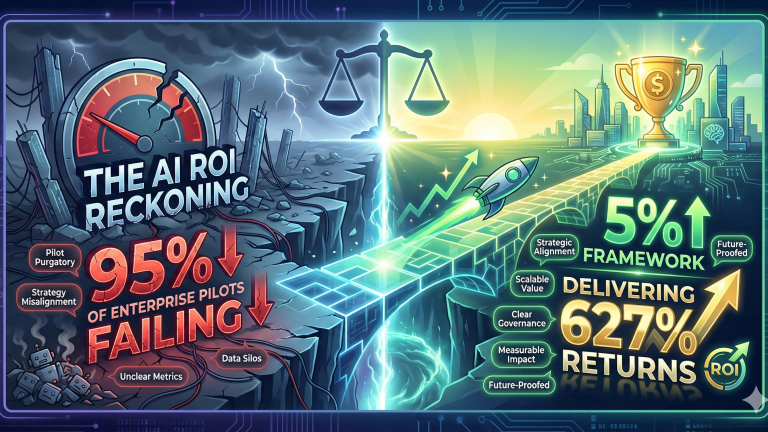
Executive Summary: The 2026 AI ROI Reckoning
In 2026, the era of “AI experimentation” has ended. While 95% of enterprise AI pilots fail to deliver measurable P&L impact, a select 5% of organizations are achieving extraordinary returns (up to 627% ROI) by shifting from flashy point solutions to structured orchestration.
The Failure Gap
-
The Learning Gap: Most GenAI tools are “stateless” and fail to retain business context or feedback.
-
The Data Debt: “Garbage in, garbage out” remains the #1 killer of AI accuracy. Dirty CRM data leads to 40% error rates in AI forecasting.
-
Build vs. Buy: Internal enterprise AI builds fail 67% of the time due to hidden maintenance and data curation complexities.
The “5% Framework” for Success
-
Workflow First: Redesign the process before deploying the tool. Solve a specific friction point (e.g., CRM data entry), not a vague goal.
-
Outcome-Based Metrics: Stop measuring “accuracy” or “tokens.” Measure pipeline growth, deal velocity, and cost savings.
-
Data Hygiene: Fix your data foundation before you spend another dollar on AI models.
-
Target Back-Office: Prioritize high-volume, low-risk internal workflows (e.g., document processing) where ROI is highest.
-
Multi-Agent Orchestration: Use orchestration platforms (like Sentia’s DIO) to coordinate specialized agents for compounding returns.
The 90-Day Mandate: If an AI pilot cannot show measurable P&L impact within 90 days, it should be cut. Boards in 2026 are no longer funding science experiments—they are funding proven revenue engines.
Last month, a CFO walked into my office with a spreadsheet that made my stomach drop.
$2.3 million spent on AI in 2025.
17 pilots running across sales, marketing, and operations.
Zero dollars in measurable ROI.
“My board is asking me to justify every one of these,” she said. “And honestly, I can’t.”
She’s not alone.
According to MIT’s bombshell July 2025 report The GenAI Divide: State of AI in Business 2025, 95% of enterprise generative AI projects are delivering zero measurable business return despite $30-40 billion in corporate investment. Source: MIT Media Lab Project NANDA
But here’s what the headlines miss: The 5% that ARE working are seeing extraordinary returns. We’re talking 627% ROI, 40% increases in deal velocity, and 30-point improvements in forecast accuracy.
So what separates the winners from the $2.3M sinkholes?
That’s exactly what I’m going to break down in this article—because if you’re planning to justify AI spend to your board in 2026, you need to understand this divide before your next budget review.
THE 2026 ROI PRESSURE COOKER: “SHOW ME THE MONEY“
Let me be blunt: 2026 is the year the AI party ends.
Not because AI doesn’t work, it absolutely does. But because boards and CFOs are done funding science experiments.
Here’s what’s happening right now:
The CEO/CFO Divide is Widening
- 61% of CEOs report increasing pressure to prove AI ROI (up from 45% a year ago) Kyndryl 2025 Readiness Report
- 65% of CEOs say they’re NOT aligned with their CFO on long-term AI value
- 53% of investors expect positive ROI within 6 months or less Teneo Vision 2026 Survey
The Budget Reality Check
- 74% of CEOs say short-term ROI pressure is undermining long-term AI innovation
- CFOs are shifting from “experimental budgets” to “prove it or lose it” mentality
- 25% of planned AI spending being deferred to 2027 (Forrester)
The Board-Level Scrutiny As one CFO told me: “When I pitched AI investments in 2023, the board said ‘great, let’s experiment.’ In 2026? They’re asking ‘where’s the P&L impact?’”
This isn’t just anecdotal. Deloitte’s Q4 2025 CFO Signals report found that 87% of CFOs predict AI will be extremely or very important to their operations in 2026, but they’re also slashing projects that can’t show measurable returns. Source: Deloitte CFO Signals
Translation: If you can’t prove ROI in Q1 2026, your AI budget is getting cut in Q2.
THE 95% PROBLEM: WHY MOST AI PROJECTS ARE FAILING
The MIT study—based on 300+ public AI deployments, 52 executive interviews, and 153 senior leader surveys—reveals a stark pattern: Just 5% of integrated AI pilots are extracting millions in value, while the vast majority remain stuck with no measurable P&L impact. Source: MIT NANDA Study
But WHY are 95% failing?
The research points to four systemic root causes:
- The “Learning Gap” – AI That Can’t Get Smarter
Here’s the killer insight from MIT: Most GenAI systems do not retain feedback, adapt to context, or improve over time.
Think about it: You deploy ChatGPT for sales emails. It generates decent drafts. But it:
- Forgets the client’s industry preferences from last week
- Repeats the same objections you already addressed
- Requires you to re-input context for every single interaction
- Doesn’t learn from what worked vs. what didn’t
One VP told MIT researchers: “It’s excellent for brainstorming and first drafts, but it doesn’t retain knowledge of client preferences or learn from previous edits. For high-stakes work, I need a system that accumulates knowledge and improves over time.”
The bottom line: Tools that don’t learn can’t scale. And tools that can’t scale can’t deliver ROI.
- The “Build vs. Buy” Disaster
Here’s a stat that should terrify every CIO planning to “build our own proprietary AI”:
- External vendor solutions succeed 67% of the time
- Internal builds succeed only 33% of the time Source: MIT Study
Why? Because enterprises dramatically underestimate the complexity of:
- Training data curation and quality
- Model fine-tuning and maintenance
- Integration with existing workflows
- Ongoing governance and compliance
As MIT lead researcher Aditya Challapally put it: “Almost everywhere we went, enterprises were trying to build their own tool. The data showed purchased solutions delivered more reliable results.”
Yet financial services companies and highly regulated industries continue to burn cash on internal AI builds that never see production.
- The Wrong Use Case Trap
This one’s shocking: AI budgets are flowing to the LOWEST ROI use cases.
According to the MIT study:
- 50%+ of GenAI budgets go to sales and marketing
- Back-office automation (document processing, compliance, workflows) delivers the HIGHEST ROI
It’s a complete mismatch.
Why does this happen? Because sales and marketing demos are flashy. A CEO sees an AI-generated sales pitch and thinks “this is the future!”
But the reality? Customer-facing AI is:
- Higher risk (brand reputation, customer satisfaction)
- Harder to measure (attribution is complex)
- More subject to human override (reps don’t trust it)
Meanwhile, back-office automation is:
- Lower risk (internal workflows)
- Easier to measure (time saved, errors reduced)
- More readily adopted (finance teams are desperate for efficiency)
One procurement VP at a Fortune 1000 pharma company explained the problem: “If I buy a tool to help my team work faster, how do I quantify that impact? How do I justify it to my CEO when it won’t directly move revenue?”
- The Enterprise Paradox: Bigger = Slower
Large enterprises run the most AI pilots but take 9 months on average to scale, compared to just 90 days for mid-market firms.
The culprits?
- Too many stakeholders (IT, legal, compliance, procurement, security)
- Over-engineered governance frameworks
- “Pilot purgatory” – endless testing without production deployment
- Risk-averse culture that demands perfection before launch
Meanwhile, startups with 20-person teams are going from zero to $20M in revenue in 12 months using the same AI tools.
As one MIT researcher noted: “It’s because they pick one pain point, execute well, and partner smartly with companies who use their tools.”
THE 5% FRAMEWORK: WHAT THE WINNERS ARE DOING DIFFERENTLY
Let me show you what separates the 5% from the 95%.
I’ve worked with dozens of revenue orgs implementing AI—some spectacularly successful, others spectacular failures. Here’s the pattern I see in every success story:
Success Pattern #1: They Start with Workflow Redesign, Not Tool Deployment
❌ WRONG APPROACH:
“Let’s buy [Hot AI Tool] and have our team start using it for [vague productivity goal].”
✅ RIGHT APPROACH:
“Our forecast accuracy is 61% because our CRM data is 40% incomplete and our reps spend 2.3 hours/day on manual data entry. We need AI to solve THIS specific workflow breakdown.”
Example from the field:
A 75-person sales org I worked with didn’t start by buying AI. They started by mapping their revenue workflow and identifying the highest-friction points:
- Lead qualification took 4 days because reps manually researched every inbound lead
- CRM updates were 40% incomplete because reps forgot to log calls and meetings
- Deal risk was invisible until it was too late because managers only reviewed pipelines weekly
THEN they deployed AI:
- Agent 1 automated lead research and scoring (saved 3.2 hours per rep per week)
- Agent 2 auto-updated CRM from meeting transcripts (saved 1.8 hours per rep per week)
- Agent 3 flagged at-risk deals daily based on activity patterns (increased win rate by 34%)
Result: 627% first-year ROI. Not because they bought better AI—because they redesigned the workflow FIRST.
Success Pattern #2: They Measure Business Outcomes, Not AI Metrics
Here’s a trap I see constantly:
CIO: “Our AI model has 94% accuracy!”
CFO: “Cool. Did revenue go up?”
CIO: “…it has 94% accuracy.”
The 5% don’t measure:
- Model accuracy
- Token usage
- Response time
- Number of AI interactions
The 5% measure:
- Revenue impact (pipeline growth, deal velocity, win rate)
- Cost savings (hours saved, headcount avoided, errors reduced)
- Customer outcomes (NPS improvement, retention rate, support resolution time)
- Risk reduction (compliance violations, security incidents, forecast variance)
Real example:
A mid-market SaaS company deployed AI for customer support. Instead of measuring “AI-handled tickets,” they measured:
- Time to resolution (dropped from 4.2 hours → 1.8 hours)
- Customer satisfaction (increased from 78% → 89%)
- Support cost per ticket (decreased by $32)
- Churn rate among users with support tickets (decreased by 23%)
Those numbers got the CFO’s attention. “AI accuracy” didn’t.
Success Pattern #3: They Build Data Foundations FIRST
I cannot stress this enough: Dirty data kills AI ROI.
According to research from Congruity360, data quality is the #1 reason GenAI pilots fail to scale. Source: Congruity360 Analysis
The 5% understand this. They don’t deploy AI until they’ve:
- Cleaned their CRM (deduplicated contacts, standardized fields, enriched records)
- Integrated their systems (CRM talks to marketing automation talks to customer support)
- Established data governance (clear ownership, quality standards, audit trails)
The brutal truth:
If your CRM is 40% incomplete, your AI-powered forecasting will be 40% wrong. Garbage in, garbage out—but now at AI speed and scale.
This is why my previous article on CRM data hygiene got so much engagement. The 5% know that data infrastructure is the foundation for AI ROI. Without it, you’re building on quicksand.
Success Pattern #4: They Focus on “Highest-Value Workflows”
Remember the MIT finding that back-office automation delivers the highest ROI?
The 5% start there. Specifically, they target workflows that are:
HIGH VOLUME → Lots of repetitive tasks to automate
HIGH COST → Expensive to do manually (outsourced work, senior employee time)
LOW RISK → Internal workflows where mistakes don’t impact customers
EASY TO MEASURE → Clear before/after metrics
Top 5 Highest-ROI Use Cases (Based on Field Data):
- Document processing and compliance (contracts, invoices, regulatory filings)
- ROI: 300-800% in year one
- Why: Replaces outsourced work, reduces errors, accelerates approval cycles
- CRM data enrichment and hygiene (auto-updating records, deduplication)
- ROI: 200-500% in year one
- Why: Enables all downstream sales/marketing AI to work properly
- Meeting intelligence and CRM auto-population (transcription, note-taking, field updates)
- ROI: 150-400% in year one
- Why: Saves 1-2 hours per rep per day, increases data completeness
- Deal risk detection and forecasting (pipeline health scoring, churn prediction)
- ROI: 100-300% in year one
- Why: Prevents revenue leakage, improves forecast accuracy 20-30 points
- Back-office automation (expense reports, procurement, HR workflows)
- ROI: 150-400% in year one
- Why: Reduces headcount needs, eliminates manual errors, speeds cycle times
Notice what’s NOT on this list? Flashy customer-facing chatbots and AI-generated marketing content.
Those have their place—but not if you’re trying to justify ROI to a skeptical CFO in Q1 2026.
Success Pattern #5: They Use Orchestration Platforms (Not Point Solutions)
This brings us full circle to my previous article on AI Agent Orchestration.
The 5% aren’t buying 5 disconnected AI tools. They’re using orchestration platforms—like Sentia AI’s DIO—that coordinate multiple specialized agents into a unified intelligence layer.
Why does this matter for ROI?
Because orchestration enables:
- Compounding returns → Each agent improves the performance of the others
- Faster deployment → Pre-integrated workflows vs. custom integrations
- Continuous improvement → Swap in better AI models without rebuilding
- Measurable attribution → Track ROI across the entire revenue workflow, not just individual tools
Real-world comparison:
Company A (Point Solution Approach):
- $347K/year spent on 5 separate AI tools
- 9 months to get first tool into production
- Siloed insights that don’t connect
- Forecast accuracy: 61%
Company B (Orchestration Platform Approach):
- $289K/year spent on integrated DIO platform
- 60 days to deploy first orchestrated workflow
- Connected intelligence across sales, marketing, ops
- Forecast accuracy: 91%
The difference? Company B delivered 627% ROI. Company A is still trying to justify their spend to the board.
YOUR 90-DAY AI ROI ROADMAP (Q1 2026 SURVIVAL GUIDE)
Alright, enough theory. Here’s your actionable roadmap to escape the 95% and join the 5%—starting THIS WEEK.
WEEK 1-2: THE ROI AUDIT
☐ Calculate your current AI spend
- Vendor costs (subscriptions, licenses, professional services)
- Internal costs (employee time, IT infrastructure, training)
- Hidden costs (pilot projects that never scaled, abandoned tools)
☐ Map every AI initiative to business outcomes
- For each pilot/tool: What specific business metric should it improve?
- If you can’t articulate the outcome, it’s probably failing
☐ Measure current baseline performance
- BEFORE you deploy more AI, capture the “before” metrics
- Revenue metrics: Forecast accuracy, deal velocity, win rate, pipeline coverage
- Efficiency metrics: Hours spent on admin, data completeness, response time
- Cost metrics: Cost per lead, cost per acquisition, support cost per ticket
☐ Identify your “AI graveyard”
- Which pilots have been running for 6+ months with no production deployment?
- Which tools are your team NOT actually using despite paying for them?
- Kill these. Then, Re-allocate the budget.
☐ Create your “highest-ROI target list”
- Rank workflows by: Volume × Cost × Ease of Measurement
- Focus ONLY on the top 3
WEEK 3-4: THE FOUNDATION FIX
☐ Assess your data readiness
- CRM completeness audit (what % of fields are populated?)
- Data quality check (duplicates, outdated info, inconsistencies) Many companies have 50% plus duplicates – even more don’t even keep track / no idea where its at
- Integration health (do your systems talk to each other?)
☐ Fix the data hygiene problems
- Deduplicate contacts and accounts
- Enrich records with missing firmographic/technographic data
- Standardize field formats and naming conventions
- If this sounds overwhelming: Hire a specialist. Seriously. Don’t skip this.
☐ Define your AI governance framework
- Who owns AI decisions? (Not a committee – your AI Transformation Lead (Person))
- What are your risk thresholds? (Customer-facing vs. internal) (see AI lawsuits)
- How will you measure success? (Business outcomes, not AI metrics)
- What’s your budget approval process? (Spoiler: It should take days, not months)
☐ Secure executive alignment
- CEO: Show how AI supports revenue goals
- CFO: Show clear ROI projections with conservative assumptions
- CIO: Show how this will fit into your company wide tech strategy without creating tech debt – i.e., who is going to do the work? Vendors or internal teams?
- Get them in ONE ROOM and ensure they’re aligned before you spend another dollar
WEEK 5-8: THE SMART DEPLOYMENT
☐ Pick ONE high-ROI workflow
- Don’t boil the ocean. Prove value quickly.
- Ideal first workflow: Meeting intelligence + CRM auto-population
- Why? High volume, clear time savings, easy to measure, low risk
☐ Choose platform over point solution
- Evaluate AI orchestration platforms (Sentia AI’s DIO, competitors)
- Key criteria: Plug-and-play AI model swapping, pre-built integrations, vendor independence
- Run a 30-day proof-of-concept on your chosen workflow
☐ Set clear success metrics
- Define the “before” baseline (from Week 1-2) – Think old school tech evaluations – go back to basics – treat AI as any new technology – not the “bright shiny isn’t that cool AI tool”
- Define the “after” target (be specific: “Reduce admin time from 2.3 hrs/day to 0.8 hrs/day”)
- Define the measurement cadence (weekly check-ins, not quarterly reviews)
☐ Train your team (for real)
- Not a 1-hour webinar. A 2-week adoption program.
- Power users first (they’ll be your champions)
- Weekly office hours for questions and troubleshooting
- Capture feedback and iterate quickly
WEEK 9-12: THE ROI PROOF
☐ Measure relentlessly
- Track your success metrics WEEKLY
- Compare to baseline: Are you hitting your targets?
- Capture qualitative feedback: What’s working? What’s not?
☐ Calculate actual ROI
- Time saved: Hours per employee × Hourly cost × Number of employees
- Revenue impact: Increase in win rate × Average deal size × Number of deals
- Cost savings: Reduced outsourcing, fewer errors, faster cycles
- Add it up. Be conservative. Then present to your CFO.
☐ Prepare your board presentation
- Lead with business outcomes (NOT AI metrics)
- Show the ROI calculation (be transparent about assumptions)
- Explain why this scales (orchestration platform, not individual siloed point solutions)
- Request budget for next 2-3 workflows based on proven success
☐ Commit to continuous improvement
- Don’t declare victory and move on
- Schedule monthly reviews to refine agent behaviors
- Test new AI models as they become available (this is why platform matters)
- Expand to next workflow ONLY after first one is delivering sustained ROI
THE HARD TRUTH: MOST WILL STILL FAIL…
I wish I could tell you that following this framework guarantees success.
It doesn’t.
The reality is that most companies reading this article will STILL end up in the 95%—not because they don’t understand the framework, but because they can’t execute it.
Here’s why AI projects fail despite good intentions:
❌ FAILURE PATTERN #1: The “Pilot Purgatory” Trap
You’ll spend 6 months perfecting the pilot. Then another 3 months getting legal approval. Then another 2 months negotiating with procurement. By month 11, the AI model you chose is obsolete and your champion has left the company.
Solution: Set a hard 90-day deadline. If you can’t deploy in 90 days, the workflow is too complex. Pick something simpler.
❌ FAILURE PATTERN #2: The “Committee of Death”
You’ll form an “AI steering committee” with 12 stakeholders. They’ll meet monthly. Nothing will get decided. Everyone will have veto power. After 8 months, you’ll realize no one is actually accountable.
Solution: One decision-maker. Period. Give them budget authority and get out of their way. If your company is big enough hire a CAIO or an AI Lead Transformation specialist.
❌ FAILURE PATTERN #3: The “We’ll Build It Ourselves” Delusion
Your CTO will insist that you need a proprietary AI solution. You’ll spend 18 months and $2M building it. It’ll work in the lab but never scale to production. Meanwhile, competitors using vendor solutions will lap you.
Solution: Remember the 67% vs. 33% success rate for buy vs. build. Swallow your pride and buy.
❌ FAILURE PATTERN #4: The “Wrong Metrics” Disaster
You’ll measure AI adoption rates, model accuracy, and user satisfaction scores. Your CFO will ask “did revenue go up?” and you’ll have no answer.
Solution: Start with business outcomes. Work backwards to AI metrics. Never the other way around.
❌ FAILURE PATTERN #5: The “Data Debt” Brick Wall
You’ll try to deploy AI on top of your 40% complete CRM with duplicate records and inconsistent data. The AI will fail. You’ll blame the AI. The real problem is your data.
Solution: Fix data hygiene FIRST. It’s not sexy, but it’s non-negotiable.
WHAT THIS MEANS FOR YOUR Q1 2026 BOARD MEETING
Here’s my prediction:
In March 2026, boards across America will ask three questions:
- “How much did we spend on AI in 2025?”
- “What measurable business impact did we get?”
- “Why should we keep funding this?”
If you can’t answer question #2 with specific revenue or cost numbers, your AI budget is getting cut.
But here’s the opportunity:
The 5% who CAN answer those questions will get MORE budget. Because boards aren’t anti-AI—they’re anti-waste. Show them ROI and they’ll double down.
This is your moment to separate yourself from the pack.
While your competitors are scrambling to justify their 17 failed pilots, you can walk into that board meeting with:
- A proven ROI calculation (627% is possible if you do this right)
- A clear framework for scaling to additional workflows
- A roadmap showing how AI supports strategic business goals
- Evidence that you’re in the 5%, not the 95%
But you need to start NOW. Not in Q2. Not “after we form a committee.” Now.
THE DIFFERENCE BETWEEN HOPE AND STRATEGY
The 95% are running on hope.
They hope their AI pilots will eventually deliver value. They hope their team will adopt the tools. They hope their board will be patient. They hope the hype cycle will give them cover for another year.
The 5% are running on strategy.
They know exactly which workflows to target, how to measure success, and what ROI they need to hit. They’re not hoping—they’re executing.
The question is: Which are you?
Because in 2026, hope is not a strategy. And your board is done waiting.
Ready to join the 5%?
If you’re a CRO, CMO, or CFO facing board pressure to justify AI spend, let’s talk. I’ve helped dozens of revenue orgs implement the framework in this article—including the 75-person sales org that achieved 627% ROI.
💬 Drop a comment with your biggest AI ROI challenge, I respond to every one.
📧 DM me if you want to discuss your specific situation confidentially.
🔄 Repost this if you know a C-suite executive who needs to read this before their next board meeting.
The AI ROI reckoning is here. The only question is whether you’ll be in the 5% that survives it or the 95% that doesn’t.
Frequently Asked Questions: Maximizing AI ROI in the Enterprise
Why do 95% of enterprise AI pilots fail to deliver ROI?
According to research from MIT and Sentia, 95% of AI projects fail due to four primary reasons:
-
The Learning Gap: Most generative AI systems do not retain context or improve over time.
-
The Build vs. Buy Disaster: Internal builds fail 67% of the time due to complexity, whereas vendor solutions have a much higher success rate.
-
The Wrong Use Case Trap: Organizations often prioritize flashy, customer-facing AI over high-ROI back-office automation.
-
The Enterprise Paradox: Over-engineered governance and multiple stakeholders lead to “pilot purgatory,” where projects never reach production.
What is the “5% Framework” for successful AI implementation?
The 5% of companies achieving extraordinary returns (up to 627% ROI) follow five specific success patterns:
-
Workflow Redesign First: They fix broken manual processes before adding AI.
-
Outcome-Based Measurement: They track P&L impact (revenue, cost savings) rather than AI technical metrics like accuracy.
-
Data Foundation First: They ensure CRM data is clean and deduplicated before deployment.
-
Target High-Value Workflows: They focus on high-volume, low-risk tasks like document processing and CRM hygiene.
-
AI Orchestration: They use platforms like Sentia’s DIO to manage multiple specialized agents as a unified system.
Which AI use cases deliver the highest measurable ROI?
While marketing and sales AI get the most attention, the highest measurable ROI typically comes from:
-
Document Processing & Compliance: 300–800% ROI through reduced manual labor and errors.
-
CRM Data Enrichment: 200–500% ROI by providing a “single source of truth” for revenue teams.
-
Meeting Intelligence: 150–400% ROI by automating CRM entry and note-taking.
-
Deal Risk Detection: 100–300% ROI by improving forecast accuracy and preventing revenue leakage.
How does dirty CRM data impact AI performance?
Dirty data is the leading cause of AI project failure. If a CRM is incomplete or filled with duplicates, AI-powered forecasting and lead scoring will be fundamentally flawed. Successful enterprises perform a “Data Schema Audit” and deduplication process before launching AI agents to avoid the “Garbage In, Garbage Out” (GIGO) effect.
What is the benefit of AI Orchestration over individual AI tools?
AI Orchestration platforms, such as Sentia AI’s DIO, coordinate multiple specialized agents into a unified intelligence layer. This approach delivers compounding returns, faster deployment (60 days vs. 9 months), and better forecast accuracy (up to 91%) compared to disconnected point solutions.
How can a company justify AI spending to a CFO in 2026?
To justify AI spend, leaders must move away from “experimental” metrics. A successful board-level pitch should include:
-
Specific P&L Impact: Clear evidence of hours saved or revenue generated.
-
Baseline Comparisons: “Before vs. After” metrics on deal velocity and win rates.
-
A 90-Day Roadmap: A phased plan starting with a single high-ROI workflow to prove value quickly.
Keywords: AI ROI, enterprise AI failure rate, AI project success, CFO AI pressure, AI investment returns, GenAI divide, AI business case, AI pilot failure, revenue intelligence, AI orchestration, board AI justification, 2026 AI strategy, AI implementation framework, measurable AI impact, AI adoption ROI, Sentia AI, DIO platform, AI governance, data hygiene AI, back-office automation
Hashtags: #AIROI #EnterpriseAI #CFO #AIStrategy #DigitalTransformation #AIAdoption #BoardStrategy #RevenueIntelligence #AIOrchestration #BusinessAI #CRO #CMO #GTMStrategy #SalesAI #AIInvestment #AILeadership #SentiaAI #AITherapist #AIGovernance #CFOInsights #2026Strategy