Tag: mckinsey

  • The CRO’s AI Dilemma: You Don’t Need More AI. You Need a Revenue AI Roadmap.

    The CRO’s AI Dilemma: You Don’t Need More AI. You Need a Revenue AI Roadmap.

    AI in sales has moved past the experimentation stage.

    Most CROs are no longer asking whether AI will affect their sales organization. They are being approached almost daily with new tools promising better prospecting, better forecasting, automated research, cleaner CRM data, personalized outreach, meeting intelligence, coaching, next-best actions and increasingly autonomous AI agents that can actually perform parts of the sales process.

    The technology is moving incredibly quickly.

    The harder question is deciding what to do with it.

    Where should AI actually sit inside the sales process? Which problems are worth solving first? What data should it be trusted to use? Where should people remain in control? And perhaps most importantly, how does a CRO prove that any of this is producing more revenue rather than simply creating a greater technology debt?

    Those questions are becoming much more important than, “Which AI sales tool should we buy?”

    Research increasingly points in the same direction. McKinsey’s 2026 B2B sales research found widespread AI experimentation but much more limited value creation. The companies getting stronger results aren’t simply adding AI tools; they’re redesigning important commercial workflows around them. Read the McKinsey research

    That is the issue I believe CROs now need to address.

    AI needs a revenue roadmap.

    Not a 50-page AI strategy. Not another transformation program. A practical plan for deciding where AI can make the biggest commercial difference, what needs to change for it to work and how the organization will know whether it did.

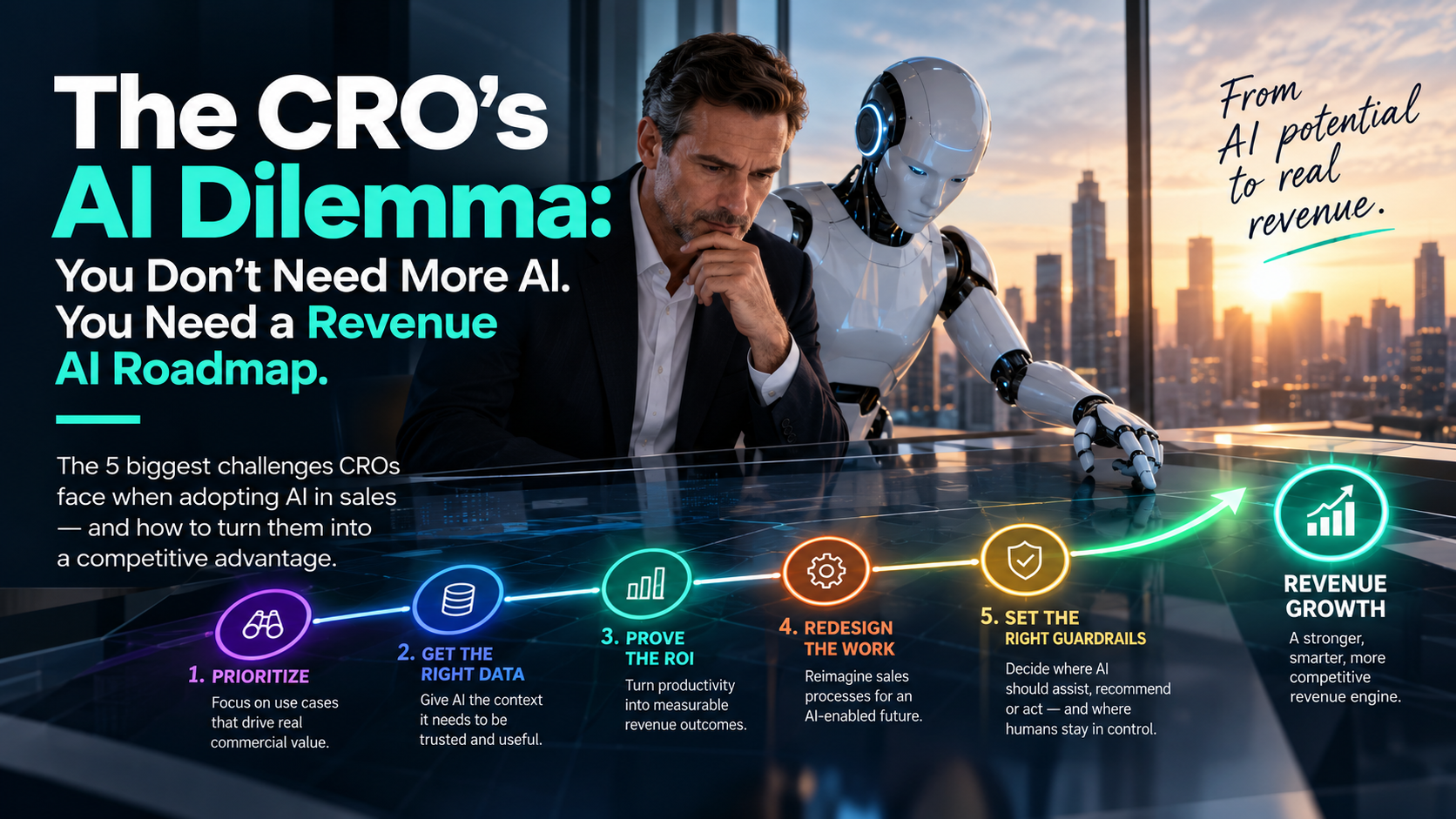
    Here are the five problems that roadmap needs to solve.

    1. There Are Too Many Places to Use AI — So Where Do You Start?

    This is becoming one of the most difficult decisions.

    Take a typical B2B sales organization. AI could potentially research accounts, identify buying signals, prioritize opportunities, prepare sellers for meetings, draft correspondence, capture meetings, update CRM, recommend next actions, identify stalled deals, improve forecasts, coach sellers, produce proposals and monitor existing customers for expansion or churn.

    Every one of those can be a legitimate use case.

    Trying to do all of them at once is where the trouble begins.

    The CRO’s job isn’t to find places where AI can be used. There are hundreds of them. The job is to identify the small number of workflows where AI can materially affect a commercial outcome.

    Gartner’s 2026 research gives us a useful clue. Sales organizations providing sellers with AI-enabled next-best actions were 2.6 times more likely to achieve commercial growth in its study. The significance isn’t simply that next-best-action technology works. It’s that the AI is being connected to a decision that affects what the seller actually does next. See the Gartner findings

    That’s a very different proposition from giving every salesperson a chatbot and hoping something useful happens.

    For a CRO, I would start by looking for friction in the revenue engine. Where are good opportunities being missed? Where are deals slowing down? Where are sellers spending time on administration instead of customers? Where does important customer context disappear between meetings, people and systems? Where are managers making decisions from incomplete information?

    Then rank the AI opportunities against commercial impact.

    A tool that saves five minutes writing an email may be useful. An AI capability that helps a salesperson identify which ten accounts need attention today — and why — may fundamentally change productivity.

    The question for the CRO is not “Where can we use AI?” It is “Where would better intelligence or execution materially change our revenue outcome?”

    2. AI Is Only as Good as the Context You Give It

    This is where the AI conversation quickly becomes a data conversation.

    Most sales organizations don’t have one perfect source of customer truth. CRM has some of it. Email has some. Meeting notes contain another piece. Calendars, proposals, support systems, spreadsheets, marketing platforms and people’s own memories contain the rest.

    Humans have spent years compensating for that fragmentation.

    AI doesn’t magically make it disappear.

    Salesforce’s 2026 State of Sales research found that among teams already using AI agents, 46% said data-quality problems were hurting sales, while manual errors, duplicate data, security concerns and incomplete data were among the most common issues.

    Gartner found another problem: 66% of sales leaders reported low trust in AI-generated insights. One of the reasons is straightforward. If AI doesn’t have enough proprietary customer and deal context, its recommendations can become generic, incomplete or simply wrong. Read Gartner on AI trust and proprietary sales data

    That doesn’t mean a CRO should wait until every CRM field is perfect before using AI. For most organizations, that day will never arrive.

    It does mean the implementation sequence matters.

    Start with the commercial problem. Determine what information the AI needs to solve it. Connect and improve that data. Put human review around the recommendations until confidence increases. Then expand.

    Done properly, AI can actually become part of the solution to the data problem. It can capture meeting context, identify missing information, surface inconsistencies, suggest CRM updates, connect information across systems and reduce the manual data entry that created poor CRM hygiene in the first place.

    The ambition shouldn’t be “clean everything before we use AI.”

    It should be “make the information required for this revenue decision trustworthy enough for AI and humans to use it.”

    3. Productivity Isn’t the Same Thing as Revenue

    This may be the most important point in the entire AI sales discussion.

    AI can absolutely save salespeople time.

    Gartner found that AI is saving sellers an average of 4.8 hours per week. That sounds fantastic until you get to the next number: 72% of sales organizations reported low reinvestment of those savings into higher-value sales activities. Read Gartner’s sales productivity research

    That’s the trap.

    If AI saves a salesperson five hours but those five hours disappear into email, internal meetings or lower-value activity, the company has achieved efficiency without necessarily achieving additional revenue.

    A CRO therefore needs to decide before deploying the technology what will happen to the capacity AI creates.

    If AI eliminates three hours of administration each week, does that become additional customer conversations? More prospecting? More whitespace analysis across existing accounts? Better opportunity planning? More coaching?

    Without that decision, “hours saved” becomes a vanity metric.

    This also explains why proving AI ROI remains difficult. Gartner found that 31% of chief sales officers cited difficulty proving ROI from AI-driven tools as a top challenge to achieving their 2026 sales objectives. Read Gartner’s research on proving sales AI ROI

    The measurement needs to move beyond adoption.

    Instead of simply asking, “Are people using it?”, CROs need to build a chain between AI and the commercial outcome:

    AI activity → time or decision improvement → changed seller behavior → pipeline impact → revenue impact.

    That might mean measuring increased customer-facing capacity, additional accounts covered, response times, opportunity progression, conversion rates, sales-cycle duration, forecast accuracy, retention or expansion.

    Gartner makes the same broader point in its AI ROI research: executive leaders need to move beyond activity measures and connect AI investments to measurable outcomes such as revenue growth, cost reduction and employee impact. See Gartner’s AI ROI framework

    If we can’t say what number should move before we implement the AI, proving value afterwards becomes much harder.

    4. We Keep Adding AI to Sales Processes That Were Never Designed for AI

    This is the problem I think many organizations are underestimating.

    Most sales processes were designed around people operating software.

    A salesperson researches an account, opens CRM, looks through email, attends a meeting, takes notes, creates tasks, updates an opportunity, searches for information, prepares a proposal and then repeats the process with the next customer.

    Now we are adding AI to every stage.

    AI writes the email faster. AI summarizes the meeting faster. AI enters information into CRM faster. AI prepares the research faster.

    All useful.

    But at some point a CRO should ask a more uncomfortable question:

    Why is the salesperson doing some of this work at all?

    McKinsey’s latest B2B research describes this distinction particularly well. Companies capturing greater value aren’t simply using AI to improve individual tasks. They are beginning to rewire end-to-end commercial workflows, allowing AI to synthesize signals, prioritize opportunities and support sellers around the customer rather than around the software.

    Deloitte found the same gap more broadly. Its 2026 State of AI research reports that AI is delivering efficiency and productivity, but only 34% of companies say they are truly reimagining the business around it. Role and workflow redesign continue to lag AI adoption. Read Deloitte’s 2026 State of AI research

    This is where the bigger opportunity sits.

    Rather than giving a salesperson six AI tools to operate alongside the eight systems they already have, AI can increasingly work across those systems, preserve context, surface what matters and help orchestrate the work.

    Imagine the difference between these two models.

    In the first, the salesperson asks AI to research an account, asks another system about CRM history, checks email, reviews meeting notes and then decides what to do.

    In the second, AI has already connected those signals and tells the salesperson: This account needs your attention today. Here is what changed, why it matters, what happened in the last conversation and the next action that appears most appropriate.

    The human hasn’t disappeared.

    The administrative burden around the human has.

    That is what sales-process redesign around AI should start to look like.

    5. CROs Need to Decide How Much Authority AI Should Have

    The next phase of sales AI makes this question unavoidable.

    For the last few years, most AI sat beside the salesperson. You asked a question and AI produced an answer.

    Agentic AI changes that relationship because AI can increasingly take action.

    It can update systems. Create tasks. conduct research. Prepare communications. Trigger workflows. Recommend decisions. In some environments, it can execute those decisions.

    This creates enormous opportunity, but it also creates a completely different category of risk.

    Should AI draft a customer email?

    Probably.

    Should it send the email without approval?

    Maybe.

    Should it change an opportunity stage?

    Under what circumstances?

    Should it recommend a discount?

    Should it approve one?

    Should it alter a forecast?

    Should it initiate contact with a strategic account based on a detected buying signal?

    There isn’t one correct answer because the appropriate level of autonomy depends on the action, the customer, the consequences of getting it wrong and the quality of the underlying data.

    What matters is that someone makes the decision deliberately.

    Deloitte’s research shows why this is becoming urgent. Only around one in five organizations currently has a mature governance model for autonomous AI agents, even as adoption is expected to accelerate rapidly. Read Deloitte’s research on agentic AI governance

    A useful CRO framework is therefore to classify AI actions into four levels:

    Assist: AI gathers information or creates something, but the human does the work.

    Recommend: AI tells the salesperson what it believes should happen next and explains why.

    Execute with approval: AI prepares the action and a person authorizes it.

    Execute autonomously: AI performs defined actions inside agreed rules, with monitoring and escalation.

    Most organizations will use all four.

    The mistake would be allowing the technology to determine the level of autonomy simply because the technology is capable of it.

    So, Does Every CRO Need an AI Roadmap?

    I believe the answer is increasingly yes.

    But it shouldn’t be an abstract document about the future of AI.

    A useful Revenue AI Roadmap should answer some very practical questions.

    Where are we currently losing seller time?

    Where are we losing revenue because information, context or action arrives too late?

    Which workflows would produce the greatest commercial return if AI improved them?

    What customer and company data does the AI need to make good decisions?

    Where should AI assist, where should it recommend and where should it act?

    What will people stop doing once AI takes on more of the administrative burden?

    And what commercial metric has to improve for us to call the investment successful?

    From there, prioritize.

    Pick the first three to five revenue workflows. Establish the baseline. Decide what AI and people will each do. Define the required information and governance. Measure the result. Then expand.

    That is a roadmap.

    The Real AI Opportunity for CROs

    There is an understandable temptation right now to treat AI as another category in the sales technology stack.

    I think that understates what’s happening.

    Gartner predicts that AI agents could outnumber human sellers ten to one by 2028, while simultaneously warning that fewer than 40% of sellers may believe those agents actually improved their productivity unless companies solve the underlying issues of data, workflow integration and user experience. Read Gartner’s AI agent forecast for sales

    That is a useful warning.

    The winners won’t necessarily be the sales organizations with the most AI.

    They will be the ones that figure out how to combine people, AI, data and process into a better revenue operating model.

    For CROs, that makes the question much bigger than which tool to buy next.

    The question is:

    If we could redesign our revenue organization knowing what AI can now do, what would we do differently?

    That is where I would start the roadmap.

    #CRO #RevenueLeadership #SalesAI #ArtificialIntelligence #RevenueOperations #SalesTransformation #RevenueGrowth #AgenticAI #SalesLeadership #FutureOfSales

  • Complete Guide to A2A Sales: Preparing Your CRM for AI Bots

    Complete Guide to A2A Sales: Preparing Your CRM for AI Bots

    Curious how AI talks to AI in Sales?

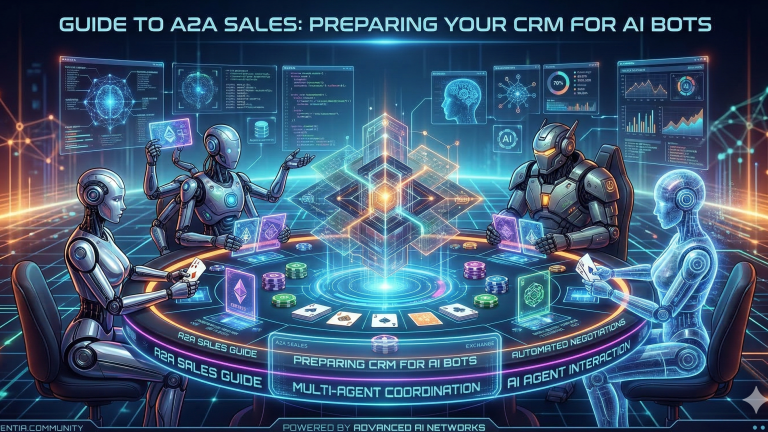
    The landscape of B2B sales is undergoing a profound transformation, driven by the rapid emergence of autonomous AI agents. These intelligent bots are no longer confined to lead qualification or customer service; they are now capable of direct negotiation and procurement, fundamentally altering how deals are struck. This shift towards Agent-to-Agent (A2A) sales necessitates a radical re-evaluation of traditional CRM infrastructures, which were designed for human-centric processes. Without a CRM system specifically prepared for bot-to-bot interactions, companies risk being sidelined in an increasingly automated marketplace.

    Preparing your CRM for A2A sales is not merely an upgrade; it is a strategic imperative that determines your future competitive viability. This readiness involves restructuring data, enabling robust API access, embedding negotiation logic, and ensuring real-time data synchronization. Companies that proactively adapt their CRM will gain a decisive advantage, enabling faster deal cycles, reduced costs, and consistent decision-making in an era where AI agents handle an increasing volume of complex transactions.

    What Is A2A Sales and Why It Matters Now

    A2A (Agent-to-Agent) sales refers to commercial transactions and negotiations conducted autonomously between AI agents representing different entities, such as a vendor’s sales bot and a buyer’s procurement bot. This model differs significantly from traditional B2B sales, which rely on human sales representatives interacting directly with human buyers. The shift is already underway, with Gartner forecasting that 40% of enterprise applications will embed task-specific AI agents by the end of 2026, a substantial increase from less than 5% in 2025 according to Joget.

    Procurement AI agents are now autonomously evaluating vendors and negotiating terms, driven by economic imperatives for cost reduction, speed, and decision consistency. McKinsey reports that autonomous category agents can achieve 25–40% efficiency improvements in procurement processes as highlighted by AiCerts. This acceleration impacts sales cycles dramatically, with lead generation automation tools, including AI, achieving a 25% improvement in sales cycle time compared to manual processes per Monday.com’s analysis.

    Examples of companies leveraging AI agents in vendor selection and contract negotiation are emerging. Coupa uses “Navi” agents integrated into ERP-tied spend suites for negotiations, with customers reportedly saving $15 billion according to AiCerts. SAP’s “Joule” agents are extending to bid analysis and contract workflows, while specialists like Keelvar deploy sourcing bots for logistics RFQs, covering 90% of tactical spend with reported 70% cycle time drops in pilot programs as noted by AiCerts. These developments signal a critical need for B2B sales organizations to prepare their CRM for bot-to-bot interactions.

    AI-powered sales agents negotiating autonomously, represented by digital avatars exchanging data in a virtual marketplace
    Photo by Negative Space

    The 4 Pillars of A2A-Ready CRM Architecture

    Achieving A2A readiness in your CRM hinges on establishing four foundational pillars that enable seamless bot-to-bot interaction and autonomous deal-making. These pillars redefine the traditional CRM’s role from a human sales assistant to a central intelligence hub for AI agents.

    Pillar 1: Machine-Readable Product Catalogs with Structured Pricing Data

    Machine-readable product catalogs are essential for AI agents to understand and process product offerings without human interpretation. This involves standardizing product information and ensuring it is consumable by algorithms. Products with complete schema markup are 4.2x more likely to appear in Google Shopping results according to Almcorp, demonstrating the importance of structured data for machine visibility.

    Key aspects include:

    • Standardizing product names, SKUs, and descriptions.
    • Implementing Schema.org markup for clear categorization.
    • Embedding detailed technical specifications and compatibility information.
    • Maintaining up-to-date inventory and capacity data feeds.

    Pricing data must be meticulously structured, including clear discount rules, volume tiers, and geographical variations. This allows AI agents to query pricing, apply appropriate discounts, and construct accurate proposals autonomously. Outdated data confuses search engines and users, so accuracy is paramount per Atak Interactive.

    Pillar 2: API-First Architecture That Allows Agent Access Without Human Gatekeeping

    An API-first architecture ensures that your CRM’s functionalities and data are programmatically accessible to AI agents. This moves beyond traditional integrations designed for human-facing applications, prioritizing secure, machine-to-machine communication channels. APIs are critical to business strategy for 89% of enterprises per Postman’s 2024 API report, highlighting their foundational role.

    Essential elements include:

    • Exposing well-documented and robust API endpoints for all critical sales data.
    • Implementing secure authentication and authorization protocols for bot access.
    • Designing APIs for efficiency, minimizing latency in data exchange.
    • Supporting webhooks and event-driven architecture for real-time updates.

    This proactive API design eliminates the need for human intervention in data retrieval or action initiation, allowing agents to operate with maximum autonomy. A unified CRM API is particularly powerful for agentic workflows as noted by Truto.

    Pillar 3: Automated Negotiation Parameters and Approval Workflows

    Automated negotiation parameters and approval workflows encode your sales playbook directly into the CRM, enabling agents to negotiate within predefined boundaries. This transforms static sales policies into executable logic. By 2027, 50% of organizations will use AI-enabled contract negotiation tools according to Icertis.

    Key components involve:

    • Defining acceptable price ranges, discount thresholds, and payment terms.
    • Establishing automated approval chains for deals exceeding certain parameters.
    • Creating constraint-based negotiation frameworks that agents follow.
    • Integrating with contract management and e-signature systems for autonomous deal closure.

    This pillar ensures that all agent-conducted negotiations adhere to company policies, reducing risk and accelerating the sales cycle. The goal is to encode the sales playbook as executable logic rather than relying on human interpretation of PDF documents.

    Pillar 4: Real-Time Data Accuracy and Synchronization Across Systems

    Real-time data accuracy and synchronization are non-negotiable for autonomous deal-making. AI agents require the most current information on inventory, pricing, customer history, and market conditions to make optimal decisions. The data integration market, crucial for real-time synchronization, is valued at $15.18 billion in 2026 according to Integrate.io.

    Critical aspects include:

    • Eliminating data silos between CRM, ERP, inventory, and other systems.
    • Implementing robust data validation and cleansing processes.
    • Ensuring instantaneous updates across all integrated platforms.
    • Leveraging streaming analytics for immediate insights relevant to negotiations.

    Fragmented data prevents agents from accessing complete vendor profiles and can lead to erroneous proposals or missed opportunities. You cannot build autonomous operations on top of fragmented data according to LogicMonitor.

    Traditional CRM vs A2A-Ready CRM: Key Differences

    This table compares the fundamental architectural and operational differences between legacy CRM systems built for human sales teams and modern A2A-ready CRM systems designed for bot-to-bot negotiations. Understanding these differences is critical for planning your transformation roadmap.

    CapabilityTraditional CRMA2A-Ready CRMMigration Complexity
    Data StructureUnstructured notes, human-readable text, siloed attachments.Structured, machine-readable fields, Schema.org markup, taxonomies.High: Requires data cleansing, re-categorization, and schema implementation.
    API AccessibilityLimited, often human-centric APIs, batch processing.API-first design, robust, real-time endpoints for bot access, event-driven.Medium: Requires API development/enhancement and security hardening.
    Pricing LogicManual quote generation, human interpretation of discount matrices.Executable pricing rules, dynamic matrices, automated discount application.High: Translating sales policies into code, extensive testing.
    Approval WorkflowsManual human approvals, email-based sign-offs.Automated, rule-based approval chains, integrated e-signature.Medium: Defining clear thresholds, integrating with CLM.
    Response Time RequirementsHours to days for human response.Milliseconds to seconds for autonomous agent response.High: Requires optimized infrastructure, real-time sync, and low-latency APIs.
    Contract GenerationManual drafting, human review, separate e-signature tools.Automated template population, AI-driven clause selection, integrated e-signature.Medium: Integration with CLM, template standardization.

    Structuring Your CRM Data for Bot Consumption

    Structuring your CRM data for bot consumption is the foundational step in enabling A2A sales, converting fragmented information into actionable intelligence for AI agents. This transition moves beyond human-readable notes to precisely defined, machine-interpretable data points.

    Key steps include:

    • Converting Unstructured Notes: Utilize natural language processing (NLP) to extract key entities (e.g., product interests, budget, timeline, decision-makers) from unstructured human notes and map them to structured fields within the CRM.
    • Implementing Schema.org Markup: Adopt Schema.org standards for product information, services, and company profiles. This provides universally recognized semantic tags that AI agents can easily parse and understand. Products with complete schema markup are 4.2x more likely to appear in Google Shopping results according to Almcorp, highlighting the importance of this structure.
    • Creating Machine-Readable Pricing Matrices: Develop dynamic pricing matrices where every discount, volume tier, and special term is explicitly defined and linked to specific product or customer attributes. This allows agents to calculate prices accurately and apply rules consistently.
    • Eliminating Data Silos: Integrate your CRM with ERP, inventory management, customer support, and marketing automation systems to create a unified data fabric. This ensures agents have a holistic view of the customer and product landscape.

    Data governance is paramount; establish clear rules for data entry, validation, and maintenance to ensure ongoing accuracy and reliability for AI agents. This process ensures that agents can operate with the same, or even greater, contextual understanding as a human sales representative.

    Data flow diagram illustrating CRM integration with ERP and marketing automation for real-time data synchronization
    Photo by Lukas Blazek

    Building Negotiation Logic Into Your CRM Workflows

    Building negotiation logic directly into your CRM workflows transforms your sales playbook from static guidelines into dynamic, executable programs for AI agents. This enables autonomous negotiation within predefined boundaries, empowering bots to make offers and counter-offers.

    The process involves:

    • Setting Automated Approval Chains: Configure multi-level approval workflows that trigger based on specific deal parameters, such as discount percentage, contract length, or payment terms. For instance, a 15% discount might be auto-approved, while a 25% discount requires senior sales leadership approval.
    • Creating Dynamic Pricing Rules: Implement rule-based engines that allow agents to query and adjust pricing based on real-time factors like inventory levels, customer segment, deal size, or competitive intelligence. This moves beyond static price lists.
    • Implementing Constraint-Based Negotiation Frameworks: Define the “acceptable zone” for negotiations. This includes minimum acceptable margins, maximum concessions, and non-negotiable terms (e.g., legal clauses). Agents operate strictly within these guardrails.
    • Encoding Sales Playbooks as Executable Logic: Translate your sales strategies – objection handling, upselling opportunities, cross-selling prompts – into conditional logic that AI agents can execute. This shifts from human interpretation to automated action, ensuring consistent application of best practices.

    This proactive approach allows AI agents to engage in complex negotiations, ensuring compliance with company policies while optimizing deal outcomes. Critically, these workflows must be auditable, providing clear logs of agent decisions and their underlying logic.

    API and Integration Requirements for A2A Readiness

    API and integration requirements for A2A readiness are centered on creating a highly interconnected and accessible CRM ecosystem that supports autonomous agent interactions. An API-first approach is fundamental, treating APIs as primary products that enable bot-to-bot communication.

    Essential elements your CRM must provide include:

    • Exposing Key API Endpoints: Your CRM needs robust, well-documented APIs for querying product catalogs, retrieving customer histories, submitting proposals, and updating deal stages. These APIs must be performant and reliable for real-time interactions.
    • Implementing Secure Authentication Protocols: Bot-to-bot communications require stringent security. This includes OAuth 2.0 for token-based authentication, API keys with granular permissions, and mutual TLS for encrypted communication channels.
    • Integration with Contract Management (CLM) and E-signature Systems: For autonomous deal closure, AI agents must be able to generate, modify, and secure e-signatures for contracts directly through integrated CLM platforms. This streamlines the final stages of the sales cycle.
    • Real-Time Inventory and Capacity Data Feeds: Agents need instantaneous access to inventory levels, production capacity, and service availability to make accurate commitments and avoid overselling. This requires direct, low-latency integrations with ERP and supply chain systems.

    By prioritizing these API and integration capabilities, you empower AI agents to operate seamlessly across your technology stack, enabling true end-to-end autonomous sales processes. The data integration market, valued at $15.18 billion in 2026, is projected to reach $30.27 billion by 2030, growing at a 12.1% CAGR according to Integrate.io, underscoring the importance of these integrations.

    Cybersecurity professionals monitoring bot traffic and securing API endpoints for autonomous business transactions
    Photo by Leeloo The First

    Testing and Validating Your A2A Sales Infrastructure

    Testing and validating your A2A sales infrastructure is crucial to ensure reliability, security, and optimal performance before full deployment. This involves simulating bot negotiations and rigorously stress-testing your CRM setup under various scenarios.

    Key steps for thorough validation include:

    • Simulating Agent Negotiations: Develop sophisticated testing environments that mimic real-world bot-to-bot interactions. This includes simulating both your sales agents and external procurement agents, running through various negotiation paths, and testing edge cases.
    • Monitoring Key Metrics: Track critical performance indicators such as response time, data accuracy in proposals, negotiation success rate within acceptable parameters, and the time taken for autonomous deal closure. Establish baselines and targets for these metrics.
    • Identifying Common Failure Modes: Pay close attention to instances where bots encounter unstructured or incomplete data, leading to errors or stalled negotiations. These are often indicators of data governance gaps or insufficient schema implementation.
    • Creating a Staged Rollout Plan: Begin with pilot programs involving low-value, tactical deals or specific product lines. Gradually expand A2A enablement to more complex scenarios, incorporating lessons learned from each stage. This phased approach minimizes risk and allows for iterative improvement.

    Thorough testing not only identifies vulnerabilities but also refines your negotiation logic and data structures, building confidence in your autonomous sales capabilities. Gartner recommends a phased rollout, starting with tactical buying and expanding to strategic categories as suggested by AiCerts.

    A team of RevOps specialists analyzing A2A sales performance dashboards with metrics on deal velocity and bot negotiation success rates
    Photo by Leeloo The First

    Case Study: How a $200M SaaS Company Reduced Sales Cycle by 67% with A2A-Ready CRM

    A mid-market B2B SaaS company, specializing in supply chain optimization software with an average deal size of $75,000, faced challenges with lengthy sales cycles (averaging 90 days) and high sales rep overhead for quoting and negotiation. Their traditional CRM, Salesforce, was primarily used for human activity tracking and manual quote generation.

    The company embarked on a CRM transformation journey to enable A2A sales. They initiated the RAPID A2A Readiness Framework:

    1. Restructure Data: They invested 3 months in cleaning and standardizing their product catalog data, implementing Schema.org for all product features, and creating granular pricing matrices that accounted for volume discounts and regional variations.
    2. API-Enable: Over 4 months, their RevOps team, in collaboration with engineering, developed a suite of secure, real-time APIs for their Salesforce instance. These APIs exposed product data, customer history, and deal parameters to their custom-built sales AI agents.
    3. Parameters Encode: They spent 2 months defining and encoding negotiation logic directly into Salesforce workflows. This included automated approval thresholds for discounts (e.g., up to 10% auto-approved, 10-20% requiring management review), and constraint-based rules for contract terms.
    4. Integrate Systems: A 3-month integration phase connected Salesforce with their ERP (SAP for inventory and billing) and their CLM system (DocuSign CLM). This provided real-time inventory checks and enabled autonomous contract generation and e-signature.
    5. Deploy and Test: A 2-month pilot program focused on lower-value, standardized deals. They simulated thousands of bot-to-bot negotiations, identifying and rectifying data inconsistencies and logic flaws.

    The results were transformative. The average sales cycle for deals under $100,000 plummeted from 90 days to 30 days, a 67% reduction. Win rates for bot-negotiated deals improved by 15% due to consistent, optimized proposals. The cost per acquisition for these deals dropped by 40% by reallocating human sales reps to more complex, strategic accounts. The company’s NRR rose from 95% to 112% in 6 months, as seen in similar SaaS growth examples.

    Lessons learned included the critical importance of a dedicated data governance team and the need for continuous monitoring of agent performance. They also found that while AI handled initial negotiations, human oversight and intervention were still crucial for highly customized or strategic opportunities, shifting the human role to strategic partnership management.

    A diagram illustrating the RAPID A2A Readiness Framework with arrows showing iterative steps from data restructuring to deployment for CRM transformation
    Photo by RDNE Stock project

    Conclusion: Your A2A Readiness Roadmap

    The advent of A2A sales marks an irreversible shift in B2B commerce, demanding a proactive CRM transformation. Companies that fail to prepare their infrastructure for bot-to-bot negotiations risk significant competitive disadvantage, including slower sales cycles and an inability to participate in automated procurement processes. The RAPID A2A Readiness Framework offers a structured approach to this critical evolution.

    Immediate actions should focus on data standardization, API development, and the encoding of sales logic into your CRM. The competitive advantage of being A2A-ready before your competitors is substantial, enabling faster deal velocity, lower costs, and enhanced decision consistency. As AI agents become ubiquitous in procurement and sales through 2026-2027, prioritizing this infrastructure over traditional sales headcount will be a defining factor for market leadership.

    Key Takeaways

    • A2A sales, where AI agents negotiate autonomously, is rapidly becoming the standard in B2B, necessitating CRM adaptation.
    • The RAPID A2A Readiness Framework provides a structured, five-phase methodology for transforming traditional CRMs into bot-negotiation platforms.
    • Key pillars of A2A readiness include machine-readable product catalogs, API-first architecture, automated negotiation logic, and real-time data synchronization.
    • CRM data must be meticulously structured using standards like Schema.org to be consumable by AI agents.
    • Implementing automated approval chains and dynamic pricing rules within CRM workflows is crucial for autonomous negotiation.
    • Robust APIs and secure integrations with CLM and ERP systems are essential for end-to-end bot-to-bot deal closure.
    • Thorough testing and a phased rollout plan are vital to validate A2A infrastructure and mitigate risks.
    • Companies that embrace A2A readiness can significantly reduce sales cycles and improve win rates, reallocating human sales efforts to strategic roles.

    Frequently Asked Questions

    What is A2A sales and how is it different from regular B2B sales

    A2A (Agent-to-Agent) sales involves autonomous AI agents conducting commercial transactions and negotiations directly with other AI agents, without human intervention. This differs from traditional B2B sales, which relies on human sales representatives interacting with human buyers, offering significantly faster deal cycles and enhanced decision consistency.

    Do I need to completely replace my CRM to support A2A sales

    No, a complete CRM replacement is often unnecessary. Most modern CRMs can be adapted for A2A sales through strategic enhancements like API layer development, extensive data restructuring, and robust integrations with other systems. The focus is on incremental transformation rather than a full overhaul.

    How long does it take to make a CRM A2A-ready

    The timeline for A2A CRM readiness varies based on current CRM maturity and company size, but typically ranges from 3-6 months for basic functionality to 9-12 months for comprehensive implementation. This includes phases for data cleansing, API development, logic encoding, and rigorous testing. Explore AI Revenue Team Orchestration Multi-Agent Systems Guide.

    What are the biggest risks of not preparing for A2A sales

    Companies that do not prepare for A2A sales face a significant competitive disadvantage, including an inability to participate in automated RFPs and procurement processes. This leads to longer sales cycles compared to A2A-ready competitors, increased cost per acquisition, and ultimately, market share loss as buyers increasingly use procurement agents.

    Which CRM platforms are best for A2A sales

    CRM platforms with strong, open API capabilities and flexible workflow automation engines are best suited for A2A sales, such as Salesforce, Microsoft Dynamics 365, and HubSpot. The key evaluation criteria should focus on the platform’s ability to integrate with other systems, support structured data, and allow for the encoding of complex negotiation logic. Explore integrating AI into your CRM.

    How much does it cost to transform a CRM for A2A readiness

    The cost of transforming a CRM for A2A readiness can range from $50,000 for smaller, less complex implementations to over $500,000 for large enterprises with extensive data and integration needs. This investment covers data cleansing, API development, workflow automation, and comprehensive testing phases.

    Can small businesses benefit from A2A sales or is it only for enterprises

    Small businesses can significantly benefit from A2A sales, often more so than enterprises, by leveraging autonomous agents to scale sales efforts without increasing headcount. Scaled-down approaches using readily available SaaS tools and focused automation for specific deal types can enable A2A capabilities even without large enterprise budgets. Explore AI-driven CRM workflows.

    What happens to human sales teams when A2A sales becomes standard

    Human sales teams will evolve from executing transactional deals to focusing on high-value activities such as strategic relationship building, complex deal structuring, and creative problem-solving that AI agents cannot yet handle. The role shifts from transaction execution to strategic partnership management and oversight of AI agent performance.

    How do you measure success of A2A sales implementation

    Success in A2A sales implementation is measured through key metrics such as deal velocity (time to close), negotiation success rate within acceptable parameters, cost per acquisition for bot-initiated deals, agent engagement rate, and the proportion of total revenue generated through autonomous transactions. Explore autonomous AI agents.

    What security concerns exist with bot-to-bot negotiations

    Security concerns for bot-to-bot negotiations include robust authentication of agents, ensuring data privacy during exchanges, validating contract authenticity, preventing fraud through malicious agent impersonation, and maintaining comprehensive audit trails of all negotiation steps. Specific protocols like OAuth 2.0, mutual TLS, and granular API permissions are crucial for securing these interactions.

    Key Terms Glossary

    A2A Sales: Commercial transactions and negotiations conducted autonomously between AI agents representing different entities. Explore Agentic AI.

    API-First Architecture: A design approach where the primary method of interaction with a system is through its application programming interfaces, facilitating machine-to-machine communication.

    Schema.org Markup: A collaborative, community-driven effort to create structured data schemas that can be added to web pages, making them easier for search engines and AI agents to understand.

    Negotiation Logic: Predefined rules, parameters, and decision-making frameworks encoded into a CRM that guide AI agents in making offers, counter-offers, and concessions during sales discussions.

    Data Silos: Isolated repositories of data that are not integrated with other systems, hindering a holistic view and preventing efficient data exchange for AI agents.

    Agentic AI: Artificial intelligence systems capable of autonomous action, planning, and execution towards a goal, often involving multiple steps and interactions with other systems or agents.

    Real-Time Data Synchronization: The process of instantly updating and aligning data across multiple systems, ensuring that AI agents always access the most current information for decision-making.

    Contract Lifecycle Management (CLM): Software solutions that manage the entire lifecycle of contracts, from creation and negotiation to execution, storage, and renewal, often integrated with A2A systems for autonomous deal closure.

  • Agentic AI: The Next Big AI Breakthrough to Watch?

    Agentic AI: The Next Big AI Breakthrough to Watch?

    Agentic AI is strutting onto the tech scene like Mick Jagger rocking on the big stage.

    Unlike its older sibling, Generative AI, which is great at whipping up new content like a master chef, Agentic AI is the ultimate multitasker, ready to make decisions and tackle tasks with the finesse of Superman’s arch nemesis Brainiac. This shift towards goal-oriented and adaptive decision-making means Agentic AI can navigate complex environments like a pro gamer, executing actions in real-time and leveling up through continuous feedback.

    Imagine Agentic AI applications in fintech / financial services: it could be the ultimate stock market wizard, managing investment portfolios, executing trades faster than you can say “bull market,” and catching fraudsters red-handed like Batman and Robin protecting Gotham. This level of autonomy and adaptability could turn the finance world upside down, bringing efficiency and decision-making skills that would make even the sharpest Wall Street minds jealous.

    Agentic AI maybe the next big thing in the age of AI—it’s the AI equivalent of discovering fire. The implications for shared services and finance are mind-blowing, promising a future where AI can handle complex tasks and workflows like a boss, driving innovation and value creation in ways that would make even the Jetsons proud. So, buckle up AI Knowledge Seekers, because this journey is going to be one wild ride, and it’s one that professionals and organizations need to plan for, experiment, deploy, learn and evolve. AI isn’t set it and forget it software (yet?).

    As Spiderman would say to Mysterio – “that looks super cool – but I don’t believe it, what should I really be seeing?” Is that more marketing puffery, creating an image of success or something that actually works in the real world, that my boss will be super happy with? Lets jump in with five real world applications and then five examples of corporations that are developing Agentic AI right now.

    Five real-world applications across different sectors:

    1. Financial Services: Agentic AI is revolutionizing financial planning and analysis by autonomously managing investment portfolios and executing trades based on real-time market analysis. This not only enhances the accuracy of financial forecasting but also adapts to market changes dynamically, providing a significant edge in financial decision-making.

    2. Manufacturing: In the manufacturing sector, Agentic AI is being deployed for predictive maintenance of machinery, leading to a substantial reduction in downtime and maintenance costs. By autonomously managing inventory and overseeing robotic assembly, these intelligent agents are driving efficiency and productivity to new heights.

    3. B2C Sales: The power of Agentic AI in B2C sales lies in its ability to analyze vast datasets to personalize marketing campaigns with unprecedented precision. Understanding customer behavior and preferences allows for optimized advertising strategies, maximizing conversion rates and driving revenue growth.

    4. Banking: Agentic AI is being used in banking for advanced fraud detection by continuously monitoring transactions and flagging anomalies. This proactive approach significantly reduces financial losses and enhances security for both the institution and its customers.

    5. E-commerce: In e-commerce, Agentic AI is improving customer experiences by managing queries autonomously and providing 24/7 customer service. This not only improves resolution times but also ensures a consistent and personalized interaction for each customer, fostering loyalty and trust.

    These applications embody the versatility and potential of Agentic AI to enhance decision-making, optimize operations, and drive growth across various industries. As we continue to explore the capabilities of Agentic AI, it’s clear that its impact could be far-reaching, ushering in a new era of autonomous and intelligent systems. But is it different than what we already have in play today for businesses?

    With that question in mind. What are the big AI Players doing with Agentic AI you need to know about?

    Companies using Agentic AI with links:

    1. Microsoft: Through projects like Project AutoGen and Copilot, Microsoft is integrating Agentic AI to create more autonomous and action-based applications12. These tools help automate complex workflows and improve productivity by making independent decisions and executing tasks with minimal human intervention.
    2. Google: With initiatives like Project Astra, Google is focusing on developing AI systems that go beyond responding to user prompts, aiming for more proactive and autonomous functionalities1.
    3. OpenAI: Known for its advancements in AI, OpenAI is also investing in Agentic AI to enhance the capabilities of its models, enabling them to perform more complex and autonomous tasks1.
    4. Cognition Labs: This startup has developed Devin, an advanced Agentic AI that functions as a fully autonomous software engineer. Devin handles long-term reasoning, planning, and complex engineering tasks independently, collaborating with human engineers within a sandboxed environment3.
    5. Nagra DTV: A digital content company, Nagra DTV uses Agentic AI to support web, mobile, desktop, and API test automation, optimizing their testing processes and improving efficiency4.

    And there you have it fellow AI knowledge seekers. The latest on Agentic AI. For more on AI buzzwords, AI strategies and AI adoption techniques check out the 100’s of articles on www.sentia.community.

    Forbes Agentic AI: The Next Big Breakthrough

    Venture Beat Agentic AI is reshaping Development teams

    Andrew Ng on Agentic AI video

    Agentic AI https://www.agentic.ai/

    Gartner: The Top 10 Strategic Technology Trends For 2025

  • Just how will Generative AI affect jobs?

    Just how will Generative AI affect jobs?

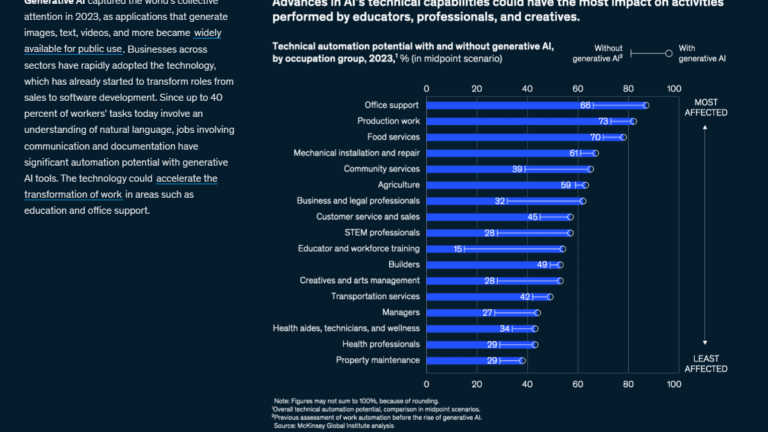
    Obviously generative AI is a technology that can create new content, such as images, videos, and text, without human intervention. It is expected to have a significant impact on the future of work. According to a report by McKinsey Global Institute, generative AI could automate up to 30% of the activities currently performed by workers in the US economy by 20301. However, the report also suggests that generative AI will enhance the way STEM, creative, and business and legal professionals work rather than eliminating a significant number of jobs outright.

    OpenAI’s research estimates that 80% of jobs can incorporate generative AI technology and capabilities into activities that happen today in work

    While generative AI may displace some jobs, it will also create new ones, such as AI trainers, explainers, and maintainers. The integration of generative AI into the workforce has the potential to significantly boost productivity and the emergence of new roles.