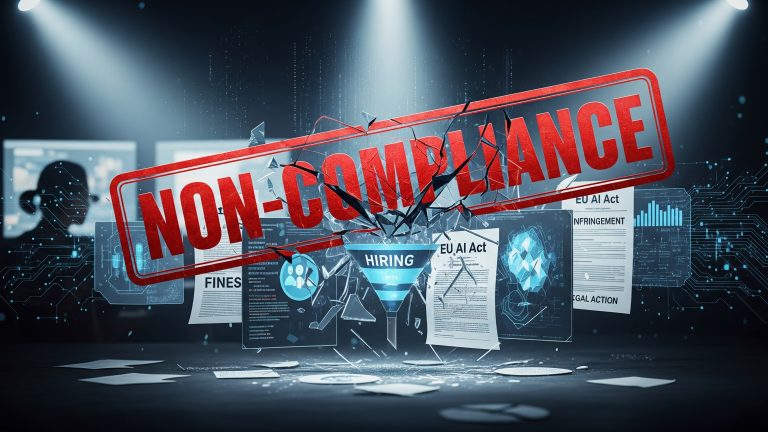
The EU AI Act isn’t coming—it’s here. And if you’re using AI in recruitment without a compliance strategy, you’re not just risking fines. You’re risking your entire business.
As of August 2024, AI systems used in hiring are officially classified as “high risk” under the EU’s groundbreaking AI regulation. This means every AI tool you use for screening, assessment, or selection must meet strict transparency, explainability, and human oversight requirements.
The penalties for non-compliance? Up to €35 million or 7% of global annual revenue—whichever is higher.
But here’s what most recruitment firms don’t realize: this isn’t just about European operations. The EU AI Act has extraterritorial reach that affects any firm serving European clients, processing European candidate data, or using AI systems that impact EU residents.
Your recruitment AI strategy needs an immediate compliance overhaul—regardless of where you’re based.
The High-Risk Classification Reality
Under the EU AI Act, AI systems used for recruitment and selection are automatically classified as “high risk” because they can significantly impact people’s careers and livelihoods. This classification triggers a comprehensive set of obligations:
Mandatory Requirements for High-Risk AI Systems:
- Risk Management Systems: Documented processes for identifying and mitigating AI-related risks
- Data Governance: Strict protocols for training data quality, relevance, and bias prevention
- Technical Documentation: Comprehensive records of system design, capabilities, and limitations
- Record-Keeping: Detailed logs of AI system decisions and human oversight activities
- Transparency: Clear disclosure to candidates about AI use in hiring decisions
- Human Oversight: Meaningful human review and intervention capabilities
- Accuracy and Robustness: Regular testing and validation of AI system performance
- Cybersecurity: Protection against manipulation and security breaches
What This Means in Practice:
Every AI recruitment tool—from resume screening to video interview analysis—must be documented, audited, and governed like a medical device or financial trading system.
The Global Reach Problem
Think you can avoid EU AI Act compliance because you’re not based in Europe? Think again.
The Extraterritorial Triggers:
- EU Clients: Recruiting for companies with EU operations
- EU Candidates: Processing applications from EU residents
- EU Data: Using datasets that include European individuals
- EU Impact: Making hiring decisions that affect EU-based roles
Real-World Scenarios:
- A US staffing firm recruiting for a client’s London office
- A Canadian recruitment agency processing applications from EU citizens
- An Australian firm using AI trained on datasets including European profiles
- A global platform serving clients with European subsidiaries
The Bottom Line: If your recruitment activities touch Europe in any way, you’re likely subject to EU AI Act requirements.
The Compliance Complexity
Meeting EU AI Act requirements isn’t just about checking boxes—it’s about fundamentally restructuring how you deploy and manage AI systems.
Risk Management System Requirements
You must establish and maintain a risk management system that:
- Identifies and analyzes known and foreseeable risks
- Estimates and evaluates risks that may emerge during AI system use
- Adopts suitable risk management measures
- Tests and validates these measures
- Documents all risk management activities
Data Governance Obligations
Your training, validation, and testing datasets must:
- Be relevant, representative, and free of errors
- Have appropriate statistical properties for the intended purpose
- Be examined for possible biases
- Be kept up-to-date and complete
- Include specific data governance and management practices
Technical Documentation Standards
You must maintain comprehensive documentation including:
- General description of the AI system and its intended purpose
- Detailed description of system elements and development process
- Information about monitoring, functioning, and control of the AI system
- Description of risk management system and mitigation measures
- Changes made to the system throughout its lifecycle
The Transparency Imperative
Perhaps the most challenging requirement is transparency. The EU AI Act mandates that candidates must be clearly informed when AI is used in hiring decisions.
Required Disclosures:
- What AI systems are being used (specific tools and their purposes)
- How the AI makes decisions (logic and criteria used)
- What data is being processed (types of information analyzed)
- Candidate rights (including rights to human review and appeal)
- Contact information for questions and complaints
The Implementation Challenge:
This goes far beyond a simple disclaimer. You need clear, accessible explanations that candidates can actually understand—not technical documentation buried in privacy policies.
The Human Oversight Requirement
The EU AI Act requires “meaningful human oversight” of high-risk AI systems. This isn’t just having a human in the loop—it’s ensuring that human oversight is effective and meaningful.
Effective Human Oversight Must:
- Be exercised by competent individuals with appropriate authority
- Be supported by adequate technical and organizational measures
- Include the ability to intervene in AI system operation
- Allow for disregarding, overriding, or reversing AI outputs
- Enable interruption of AI system operation when necessary
What This Means for Recruitment:
- AI recommendations cannot be automatically implemented
- Human reviewers must have genuine decision-making authority
- Override capabilities must be built into every AI workflow
- Reviewers must be trained to effectively evaluate AI decisions
The Bias and Discrimination Trap
The EU AI Act explicitly requires measures to prevent bias and discrimination. For recruitment firms, this creates both legal and technical challenges.
Bias Mitigation Requirements:
- Regular testing for discriminatory outcomes across protected characteristics
- Documented bias detection and correction procedures
- Ongoing monitoring of AI system performance across different groups
- Corrective measures when bias is detected
The Technical Challenge:
This requires sophisticated statistical analysis capabilities that most recruitment firms don’t currently possess. You need tools and expertise to:
- Measure outcome disparities across demographic groups
- Identify sources of bias in training data and algorithms
- Implement technical corrections for biased outcomes
- Validate the effectiveness of bias mitigation measures
The Compliance Technology Stack
Meeting EU AI Act requirements demands significant technology infrastructure:
Required Capabilities:
- Audit Trails: Comprehensive logging of all AI decisions and human interventions
- Bias Monitoring: Automated detection of discriminatory outcomes
- Explanation Systems: Tools that can generate understandable explanations of AI decisions
- Override Mechanisms: Technical systems that enable human intervention and reversal
- Documentation Platforms: Centralized management of compliance documentation
- Risk Assessment Tools: Ongoing evaluation of AI system risks and performance
The Investment Reality:
Building or purchasing this compliance infrastructure requires significant investment—often $100K-$500K+ for comprehensive solutions.
Strategic Response Options
Faced with these requirements, recruitment firms have several strategic options:
Option 1: Full Compliance Build-Out
Invest in comprehensive compliance infrastructure and processes. Pros: Complete regulatory coverage, competitive differentiation Cons: High cost, complex implementation, ongoing maintenance burden
Option 2: Compliant AI Platform Selection
Choose AI vendors that provide built-in compliance capabilities. Pros: Shared compliance burden, faster implementation Cons: Limited vendor options, potential vendor lock-in
Option 3: Geographic Limitation
Restrict AI use to non-EU operations and clients. Pros: Avoids compliance complexity Cons: Limits market opportunities, difficult to maintain boundaries
Option 4: Human-First Positioning
Use AI only for support functions while maintaining human decision-making. Pros: Lower compliance burden, relationship-focused differentiation Cons: Efficiency limitations, competitive disadvantage
The Implementation Roadmap
For firms choosing to pursue EU AI Act compliance, here’s a practical implementation approach:
Phase 1: Compliance Assessment (Months 1-2)
- Audit all AI systems for EU AI Act applicability
- Map current processes against compliance requirements
- Identify gaps and required investments
- Develop compliance strategy and timeline
Phase 2: Infrastructure Development (Months 3-6)
- Implement audit trails and logging systems
- Establish bias monitoring and testing procedures
- Create transparency and disclosure frameworks
- Build human oversight mechanisms
Phase 3: Process Integration (Months 6-9)
- Train staff on compliance procedures
- Integrate compliance checks into workflows
- Develop client and candidate communication protocols
- Establish ongoing monitoring and review processes
Phase 4: Validation and Optimization (Months 9-12)
- Conduct comprehensive compliance testing
- Validate bias mitigation effectiveness
- Optimize human oversight procedures
- Prepare for regulatory inspections
The Competitive Implications
EU AI Act compliance isn’t just about avoiding penalties—it’s becoming a competitive differentiator.
Compliance as Competitive Advantage:
- Trust: Clients prefer partners with robust compliance frameworks
- Risk Mitigation: Compliant firms reduce client regulatory exposure
- Market Access: Compliance enables service to EU-connected clients
- Premium Positioning: Compliance expertise commands higher fees
Non-Compliance Risks:
- Regulatory Penalties: Fines up to €35M or 7% of global revenue
- Client Loss: Risk-averse clients avoiding non-compliant vendors
- Reputation Damage: Public enforcement actions and negative publicity
- Market Exclusion: Inability to serve EU-connected opportunities
The Global Regulatory Trend
The EU AI Act isn’t an isolated development. Similar regulations are emerging globally:
- United States: State-level AI hiring regulations in New York, Maryland, and other jurisdictions
- Canada: Proposed Artificial Intelligence and Data Act
- United Kingdom: AI regulation framework development
- China: AI recommendation algorithm regulations
- Singapore: Model AI governance framework
The Reality: EU AI Act compliance positions firms for a global regulatory environment where AI transparency and accountability are becoming standard expectations.
Your Compliance Decision Point
The EU AI Act creates an inflection point for every recruitment firm using AI. You must choose:
Path A: Invest in comprehensive compliance and position yourself as a trusted, regulated AI partner
Path B: Limit AI use and compete on traditional service delivery
Path C: Ignore compliance requirements and hope for the best
Path C isn’t really an option—the penalties are too severe and the enforcement too real.
The question is whether you’ll choose Path A (compliance as competitive advantage) or Path B (compliance avoidance through limitation).
The Bottom Line
The EU AI Act isn’t a distant regulatory threat—it’s a current compliance requirement with severe penalties for non-compliance.
Whether you’re based in Europe or not, if your recruitment activities involve AI and touch European markets, you need a compliance strategy now.
The firms that view EU AI Act compliance as an investment in competitive advantage will thrive. Those that see it as just another regulatory burden will struggle.
The choice—and the compliance deadline—are both here now.
Navigating EU AI Act compliance is just one aspect of the complex regulatory landscape surrounding AI in recruitment. For a comprehensive guide to global AI regulations, compliance frameworks, risk mitigation strategies, and implementation roadmaps—including specific templates and checklists—download our complete white paper: “Navigating the AI Disruption in Recruitment: A Strategic Guide for Forward-Thinking Firms.”
Learn how leading recruitment firms are turning regulatory compliance into competitive advantage while building sustainable, defensible AI strategies.
Download your white paper here and ensure your recruitment AI strategy meets the highest regulatory standards while driving business growth.