Tag: generative ai

  • Step-by-Step Buyer Guide for AI-Powered CRM Research and Selection Plan

    Step-by-Step Buyer Guide for AI-Powered CRM Research and Selection Plan

    Executive Summary

    Data silos across CRM, ERP, and AI apps cost enterprises $12.9M annually. This guide introduces the Three-Layer Sync Framework (Identity Resolution, Attribute Sync, Intelligence Propagation) to unify fragmented data. By choosing the right architecture—from iPaaS to Reverse ETL—firms can eliminate the “AI Circle of Sorrow,” achieving a real-time, 360-degree customer view that powers predictive revenue intelligence.

    How do I complete CRM market research?

    Selecting the right CRM has always been a critical decision for sales organizations, but the advent of AI has fundamentally reshaped this process. Traditional feature checklists are no longer sufficient; today’s sales leaders must evaluate platforms based on advanced AI capabilities that drive revenue and efficiency.

    This comprehensive guide is designed for B2B sales leaders and RevOps professionals at companies with 20-200 employees who are evaluating their first AI-powered CRM or considering a migration from a legacy platform, with annual CRM budgets of $50K-$500K. We’ll walk through a strategic framework to ensure your investment delivers tangible results.

    The core challenge is that many traditional CRM selection frameworks fail to account for the nuances of AI. This oversight is a major contributor to the alarmingly high CRM implementation failure rates, which remain between 47% and over 70% in 2026, with poor user adoption and misalignment frequently cited as reasons per Apparate.

    What makes AI-powered CRM selection fundamentally different from legacy platform evaluation is the shift from merely managing data to leveraging it for predictive and autonomous actions. This guide introduces the Sentia’s CRM Orchestration & Performance Evaluation (S.C.O.P.E.) Framework, a proprietary 6-step methodology that prioritizes AI-specific use cases and strategic alignment over a simple feature comparison.

    sales leader and revenue operations team collaborating on AI-powered CRM selection strategy
    Photo by Edmond Dantès

    Step 1: How can you Define Your AI-Specific Use Cases Before Platform Features?

    The critical mistake many organizations make is choosing a CRM first, then trying to retrofit AI use cases later. This often leads to underutilized features and disappointing ROI, as AI capabilities are designed to solve specific business problems, not just exist as abstract functionalities.

    To avoid this, begin by mapping your sales process to concrete AI capabilities. This involves identifying manual tasks, decision points, and areas where predictive insights or automation could significantly improve outcomes.

    The 5 non-negotiable AI use cases every sales team needs in 2026 are:

    • Predictive Lead Scoring: AI analyzes historical data to rank leads by their likelihood to convert, allowing sales reps to prioritize high-potential prospects.
    • Automated Data Entry & Enrichment: AI automatically captures information from emails, calendars, and other sources, and enriches contact details, drastically reducing administrative burden. Sales reps spend up to 3.4 hours a week on manual CRM data entry, a task automation can reduce by up to 70%.
    • Next-Best-Action Recommendations: AI suggests optimal actions for reps based on deal stage, customer interaction history, and likelihood of success.
    • AI-Powered Forecasting: AI analyzes pipeline data, historical performance, and external factors to provide more accurate revenue predictions.
    • Conversational Intelligence Integration: AI transcribes and analyzes sales calls, identifying key topics, sentiment, and coaching opportunities, while automating call summaries and follow-ups.

    A worksheet approach is highly effective here: document current manual tasks, identify the pain points, and then articulate how AI should eliminate or significantly streamline these processes. This foundational step ensures your CRM choice is driven by strategic need rather than vendor hype.

    Step 2: How to Assess AI Maturity Requirements (Not Just AI Features)

    Understanding the difference between an ‘AI-powered’ marketing claim and actual AI orchestration is crucial. Many vendors label basic automation as AI, but true AI maturity involves predictive intelligence and, increasingly, agentic AI. For more information, see CRM category page. See (Understanding Agentic AI Orchestration)

    The AI maturity spectrum ranges from basic automation (e.g., automated email sequences) to predictive intelligence (e.g., lead scoring) to agentic AI, which autonomously plans, decides, and executes multi-step workflows per Kewmann. Agentic AI is a game-changer, moving beyond mere recommendations to take action without constant human intervention.

    Evaluate whether your existing data quality can support advanced AI; the “70% rule” suggests AI needs at least 70% complete, accurate data to generate reliable insights. Without this foundation, even the most sophisticated AI will produce inaccurate or unreliable outputs, as 45% of organizations report their CRM data is unprepared for AI use.

    Red flags that indicate a platform’s AI might be vaporware or require excessive manual training include:

    • Vague explanations of AI model training or data sources.
    • A requirement for extensive manual tagging or data categorization post-implementation.
    • Lack of clear, quantifiable metrics for AI performance or accuracy.
    • An inability to explain how their AI adapts or “learns” from new data over time.

    Sentia AI focuses on AI orchestration, ensuring that your CRM’s AI capabilities are not just features, but integrated, intelligent workflows that deliver actionable insights and automate repetitive tasks. This approach helps revenue teams implement AI-driven workflows that truly transform sales operations.

    analyst evaluating AI maturity spectrum from basic automation to agentic intelligence
    Photo by Tiger Lily

    Step 3: How to Evaluate CRM AI Architecture and Data Integration

    AI performance is intrinsically linked to your CRM’s ability to unify diverse data sources. An AI model is only as good as the data it’s fed, and fragmented data leads to fragmented insights. This means seamless integration with email, calendar, call logs, and third-party tools is non-negotiable.

    When speaking with vendors, ask critical questions about their AI model training, data privacy, and customization capabilities:

    • Where does your AI model get its training data, and is it specific to our industry or sales motion?
    • How do you ensure data privacy and compliance (e.g., GDPR, CCPA) when processing our customer data through AI?
    • Can we customize or fine-tune the AI models with our proprietary data, or are they black-box solutions?
    • What is your approach to data integration, and how do you handle real-time data synchronization across various platforms?

    The “integration tax” is a hidden cost often overlooked. Connecting external AI tools to legacy CRMs can incur significant expenses in APIs, middleware, and ongoing maintenance. In contrast, AI-native platforms are designed with unified data models, reducing this complexity. Integration gaps and manual data entry persist in 2026, highlighting the need for robust, native integration.

    Salesforce, with its Einstein AI, and HubSpot, with its AI-powered features like Breeze AI, represent the spectrum of architectural approaches. Salesforce’s Agentforce offers autonomous agents for complex workflows across enterprise systems, while HubSpot’s Breeze AI focuses on accessible productivity features according to AthenaHQ’s analysis. Emerging AI-first CRMs, like Attio, are built from the ground up to embed intelligence into every data model and workflow, eliminating the need for bolt-on solutions per MarketBetter.ai.

    Step 4: How to Calculate True Total Cost of Ownership for AI CRMs

    The true total cost of ownership (TCO) for an AI CRM extends far beyond seat licenses. Hidden costs often include AI usage fees, API costs for integrations, increased data storage, and the price of required third-party tools. IDC projects that by 2026, nearly half of new CRM-related investment will target data architecture, AI infrastructure, and analytics rather than licenses or modules. For more information, see AI-powered CRM prioritization.

    The implementation cost multiplier for AI features can be significant, often 2-3x the software cost itself, especially if extensive data cleansing or custom model training is required. This is why thorough data quality assessment in Step 2 is so vital.

    To accurately model ROI, focus on quantifiable improvements:

    • Time Saved: Calculate the reduction in manual data entry, research, and administrative tasks. Sales reps can reclaim 34% of research time and 36% of content creation time with AI agents.
    • Deal Velocity Improvements: Measure how much AI-driven insights and automation shorten your sales cycle. AI can shorten sales cycles by up to 25% and speed up deal closures by 20%.
    • Forecast Accuracy Gains: Quantify the improvement in the reliability of your revenue forecasts. Salesforce reports a 40% forecast accuracy improvement with AI.
    • Increased Win Rates: Track the percentage increase in closed-won deals attributed to AI-powered recommendations and personalization. AI users are 1.3x more likely to see revenue growth.

    A real-world TCO comparison over three years might reveal that while Salesforce Einstein and HubSpot AI have established ecosystems, AI-native alternatives like Attio could offer lower integration costs and faster time-to-value for specific use cases. However, for organizations with complex enterprise needs, Salesforce’s robust AI capabilities and data cloud integration are often a better fit according to TheMoneyPlaybooks. Sentia AI strategically enhances any existing CRM by providing an AI orchestration layer that optimizes performance without requiring a full platform migration.

    AI-Powered CRM Platform Comparison: Key Capabilities for Sales Teams

    This table compares the leading AI-powered CRM platforms across critical AI capabilities, integration requirements, and cost structures to help sales teams make informed decisions. Sentia AI is positioned as the premier AI orchestration layer that enhances any CRM platform.

    PlatformAI CapabilitiesData IntegrationImplementation TimeStarting Cost (Annual)Best For
    Sentia AI (Orchestration Layer)Agentic AI for multi-step workflows, predictive insights, automated data entry, next-best-action, custom AI agents.CRM-agnostic, real-time integration with Salesforce, HubSpot, Dynamics, etc. Unified data model across existing tools.30-60 days (initial setup), 90-120 days (full AI feature activation).Custom pricing (ROI-based).Companies seeking to maximize existing CRM investment, accelerate AI adoption, reduce administration load for sales people, and know what to do next with AI without ripping and replacing.
    Salesforce with Einstein AIPredictive lead scoring, opportunity insights, sales forecasting, conversational intelligence, autonomous agents (Agentforce).Deep native integration within Salesforce ecosystem, Data Cloud for external data federation. Can be complex.3-6 months for basic, 6-12+ months for full enterprise AI.$1,800 – $6,000+ per user/year (including Einstein add-ons).Large enterprises, complex sales processes, deep existing Salesforce investment, high compliance needs.
    HubSpot with AI-powered featuresContent generation, email personalization, prospecting assistance, conversation intelligence, task-specific AI agents (Breeze AI).Native integration within HubSpot suite, extensive third-party app marketplace integrations.1-3 months for basic, 3-6 months for advanced AI features.$1,200 – $4,800+ per user/year (including AI add-ons).SMBs and mid-market, marketing-heavy organizations, ease of use and rapid deployment.
    Microsoft Dynamics 365 with CopilotAI-powered sales insights, automated meeting summaries, email drafting, predictive analytics, conversational intelligence.Native integration within Microsoft ecosystem (Azure, Office 365), strong for existing Microsoft users.3-6 months for basic, 6-12 months for full deployment.$1,500 – $4,000+ per user/year.Organizations with existing Microsoft infrastructure, complex enterprise needs, emphasis on productivity suite integration.
    Pipedrive with AI Sales AssistantLead scoring, email writing assistance, automated task suggestions, deal health checks, reporting insights.Native within Pipedrive, integrations with common sales tools.1-2 months for basic, 2-4 months for AI features.$300 – $900+ per user/year.Small to medium sales teams, simplicity, ease of use, visual pipeline management.
    Emerging AI-native CRMs (e.g., Attio, Folk)Built-in AI for data capture, relationship intelligence, automated workflows, custom data models, proactive insights.Designed for native intelligence, often requires external tools for outbound.1-3 months.$600 – $1,800+ per user/year.Startups, modern sales teams, data-centric organizations, those prioritizing flexibility and avoiding legacy debt.

    Step 5: How to Run a Structured AI CRM Pilot with Sales Team Buy-In

    A pilot program is essential to validate your AI CRM choice and secure sales team buy-in. This isn’t just a technical test; it’s a change management exercise. The 30-60-90 day pilot framework provides a structured approach.

    30-Day Mark: Basic Adoption & Data Capture

    • Focus: Ensure core CRM functions are adopted, and AI-driven data capture (e.g., automated activity logging) is working.
    • Measure: Basic login rates, manual data entry reduction, initial feedback on usability.

    60-Day Mark: AI Feature Engagement & Insight Validation

    • Focus: Test specific AI features like lead scoring, next-best-action recommendations, and basic forecasting.
    • Measure: AI recommendation acceptance rate, time-to-insight for reps, preliminary improvements in lead qualification.

    90-Day Mark: Performance Impact & ROI Metrics

    • Focus: Quantify the impact on key sales metrics.
    • Measure: Deal velocity, win rates, forecast accuracy, and overall sales productivity improvements. A baseline sales team closing $50,000/month could see a 10% conversion lift and 20% shorter cycle post-CRM.

    Select the right pilot team: a mix of early adopters who will champion the new system, a few skeptics whose concerns need to be addressed, and power users who can push the boundaries of the AI features. Common pilot failures, such as a lack of executive sponsorship or insufficient training, can be avoided by making the pilot a highly visible, well-resourced project with clear success metrics and continuous feedback loops per DHRP.

    sales team collaborating on a structured AI CRM pilot program, reviewing adoption metrics

    Step 6: How to Negotiate AI-Specific Contract Terms and Safeguards

    AI CRMs introduce new complexities into contract negotiations that go beyond traditional software agreements. Critical contract clauses for AI CRMs include:

    • Data Ownership: Clearly define who owns the data that feeds the AI models and the intellectual property generated by the AI. First-party data ownership is a strategic requirement in 2026.
    • Model Transparency: Understand the vendor’s stance on explaining how their AI makes decisions. While full transparency might be proprietary, demand clarity on methodology and potential biases.
    • Performance Guarantees: Seek specific SLAs for AI uptime, accuracy thresholds for predictive models (e.g., lead scoring accuracy), and response times for AI-related support issues.
    • Pricing that Scales with Value: Negotiate pricing models that scale with actual AI usage or value delivered, rather than just user count. This might include tiered pricing for AI features or usage-based fees.

    Exit strategy provisions are also crucial: ensure data portability for all your CRM data, including any AI-generated insights. If you ever switch vendors, you need clear rights to transition your AI models or the data used to train them. AI governance is increasingly important, with regulations like the EU AI Act requiring model logging and risk classification.

    business leaders reviewing AI-specific contract terms and data ownership clauses

    The S.C.O.P.E. Framework Checklist: Your CRM Selection Scorecard

    The Sentia CRM Orchestration & Performance Evaluation (S.C.O.P.E.) Framework provides a structured methodology to compare 3-5 CRM platforms effectively. It moves beyond simple checklists to a weighted scoring system based on your specific sales motion and team size, ensuring alignment with your strategic AI use cases.

    S.C.O.P.E. Framework Categories:

    1. Strategic Alignment & Use Cases (Weight: 25%): How well does the platform address your defined AI-specific use cases (Step 1)?
    2. AI Maturity & Capabilities (Weight: 20%): Does the platform offer true predictive and agentic AI, or just basic automation (Step 2)?
    3. Architecture & Integration (Weight: 20%): How seamlessly does it integrate with existing systems and unify data for AI (Step 3)?
    4. Total Cost of Ownership & ROI (Weight: 15%): What is the comprehensive TCO, and what is the projected ROI based on your metrics (Step 4)?
    5. Pilot Program Success (Weight: 10%): How did the platform perform in your structured pilot, and what was the adoption rate (Step 5)?
    6. Contract Terms & Safeguards (Weight: 10%): Are the vendor’s contract terms favorable and protective regarding AI-specific clauses (Step 6)?

    Sentia AI helps revenue teams implement the S.C.O.P.E. Framework in real CRM evaluations by providing a platform-agnostic AI orchestration layer that enhances any CRM choice. This allows for a focus on integrating intelligence across your existing tech stack, rather than being limited by a single CRM’s native AI capabilities.

    A decision matrix template can then be used to present your recommendations to executive stakeholders, clearly outlining the scores, rationale, and projected ROI for each platform. This data-driven approach fosters confidence and buy-in at every level.

    decision matrix template comparing AI CRM platforms based on SCOPE framework criteria

    Key Takeaways

    • Traditional CRM selection fails when AI requirements are ignored; prioritize AI-specific use cases first.
    • Distinguish between basic AI features, predictive intelligence, and agentic AI for true capability assessment.
    • AI performance hinges on robust data integration and a unified data architecture, minimizing “integration tax.”
    • Calculate the true Total Cost of Ownership (TCO) by including AI usage fees, integration, and implementation costs beyond seat licenses.
    • Run a structured pilot program with clear KPIs and executive sponsorship to drive adoption and validate ROI.
    • Negotiate AI-specific contract terms covering data ownership, model transparency, and performance guarantees.
    • The S.C.O.P.E. Framework provides a comprehensive, weighted scoring system for evaluating AI-powered CRM platforms.

    Conclusion: From Selection to Implementation Success

    Choosing an AI-powered CRM is a strategic investment that can redefine your sales organization’s capabilities. However, the selection process is only about 30% of CRM success; the remaining 70% is driven by effective implementation and ongoing adoption. Poor user adoption remains the #1 reason CRM projects fail. For more information, see top use cases for AI-enhanced CRM software.

    After choosing your AI-powered CRM platform, the next steps involve meticulous data migration, comprehensive training, and continuous optimization. Sentia AI supports this full lifecycle, from strategic selection through ongoing optimization, ensuring your AI investment delivers measurable results.

    Remember, AI CRMs are not a set-it-and-forget-it solution. Continuous monitoring, fine-tuning of AI models, and adaptation to evolving sales processes are required to unlock their full potential and maintain a competitive edge in 2026 and beyond.

    Frequently Asked Questions

    What is the difference between an AI-powered CRM and a traditional CRM?

    An AI-powered CRM leverages machine learning for predictive insights, automation, and intelligent recommendations, actively guiding sales actions. In contrast, a traditional CRM is primarily a data repository that requires manual analysis and human intervention to extract insights and drive processes.

    How much does an AI-powered CRM cost for a sales team?

    The cost of an AI-powered CRM for a sales team typically ranges from $150 to $500 per user per month, including seat licenses, AI usage fees, and integration costs. For example, Salesforce Einstein and HubSpot AI involve additional fees beyond base subscriptions, and implementation costs can be 2-3x the software cost per IDC.

    What are the most important AI features to look for in a CRM?

    The most important AI features to look for in a CRM are predictive lead scoring, automated data entry and enrichment, next-best-action recommendations, AI-powered forecasting, and conversational intelligence integration. These capabilities directly address sales productivity and effectiveness.

    How long does it take to implement an AI-powered CRM?

    Implementing an AI-powered CRM typically takes 30-60 days for basic setup, 90-120 days for full AI feature activation, and 6-12 months for complete optimization. Data quality preparation is often the longest phase, as AI requires clean and complete data to function effectively. For more information, see best practices for integrating AI into your CRM.

    Can I add AI capabilities to my existing CRM instead of switching platforms?

    Yes, you can add AI capabilities to your existing CRM through an orchestration layer like Sentia AI, rather than migrating platforms. This approach can deliver up to 80% of the value of an AI-native CRM at approximately 40% of the cost and complexity, by integrating intelligence across your current tech stack.

    What data quality requirements do AI CRMs need to work effectively?

    AI CRMs require at least 70% complete and accurate data to generate reliable insights, often referred to as the “70% rule.” Common data quality issues include incomplete records, duplicates, and outdated information, which must be audited and cleansed before CRM selection and implementation as highlighted by Validity.

    How do I get my sales team to actually use an AI-powered CRM?

    To ensure sales team adoption of an AI-powered CRM, secure executive sponsorship, highlight quick wins by demonstrating time savings and performance improvements, and provide comprehensive training focused on AI features. Reducing manual data entry and continuously measuring adoption metrics from day one are also crucial per Pipeliner Sales.

    What is the typical ROI timeline for an AI-powered CRM?

    The typical ROI timeline for an AI-powered CRM is 3-6 months for initial productivity gains, 6-12 months for deal velocity improvements, and 12-18 months for full ROI realization. Sales teams using AI report an 86% positive ROI within the first year, often seeing 20-30% time savings per Utmost Agency.

    Should I choose Salesforce, HubSpot, or an AI-native CRM for my sales team?

    The choice between Salesforce, HubSpot, or an AI-native CRM depends on your company size, existing tech stack, budget, and AI maturity. Salesforce (with Einstein AI) suits large enterprises with complex needs, HubSpot (with Breeze AI) is ideal for SMBs and marketing-heavy organizations, while AI-native CRMs like Attio are best for modern teams prioritizing speed and flexibility. Sentia AI offers a platform-agnostic solution that enhances any of these choices.

    What questions should I ask CRM vendors about their AI capabilities?

    When evaluating CRM vendors, ask about their AI model training data, data privacy and compliance measures, customization options for AI models, and integration requirements with your existing tools. Also inquire about performance guarantees, the roadmap for future AI improvements, and how their AI facilitates automated data entry and next-best-action recommendations.


  • How can I use AI Multi-Agent Systems (MAS) to improve my AI Sales Orchestration?

    How can I use AI Multi-Agent Systems (MAS) to improve my AI Sales Orchestration?

    Executive Summary

    Stop settling for disjointed AI pilots. This guide explores how Multi-Agent Systems (MAS) orchestrate specialized AI agents across Sales, Marketing, and Success to eliminate manual handoffs. By implementing an orchestration layer with a unified data foundation, enterprises can achieve 98% forecast accuracy, reduce rep admin time by 15+ hours weekly, and drive a 171% average ROI through automated revenue workflows.

    Time to move on from AI Pilots

    Revenue teams are rapidly evolving, shifting from disjointed AI tools to integrated, intelligent systems. This guide explores how multi-agent AI orchestration is becoming the backbone of high-performing revenue operations, coordinating sales, marketing, and customer success to eliminate manual workflows and drive growth. We’ll delve into the mechanics, benefits, and strategic implementation of these advanced systems.

    Why Revenue Teams Are Moving Beyond Single AI Tools

    Traditional revenue operations often suffer from the limitations of isolated AI point solutions. While individual AI tools offer benefits, they frequently create new data silos and require significant manual effort to bridge gaps between different functions. This fragmented approach hinders true coordination across sales, marketing, and customer success.

    Multi-agent orchestration differs fundamentally by enabling AI agents to work together seamlessly, sharing context and automating handoffs across the entire revenue lifecycle. This integrated approach reduces the administrative burden on teams, allowing them to focus on revenue-generating activities rather than data entry or tool management. The market for AI agents is projected to exceed USD 10.9 billion in 2026, reflecting this shift.

    Close-up of a smartphone displaying ChatGPT app held over AI textbook.
    Photo by Sanket Mishra

    What Is Multi-Agent AI Orchestration for Revenue Teams?

    Multi-agent AI orchestration for revenue teams involves a system where multiple specialized autonomous AI agents collaborate to execute complex, end-to-end workflows across sales, marketing, and customer success functions. These agents work together, rather than as standalone tools, to achieve shared objectives. Autonomous AI agents are designed to perform tasks, make decisions, and communicate with other agents with minimal human intervention.

    This orchestration relies on three core components: autonomous agents, an orchestration layer, and a shared data foundation. The orchestration layer acts as the conductor, managing task allocation, communication, and conflict resolution among agents. A robust shared data foundation, often built around a clean CRM, provides the context and information necessary for agents to make informed decisions and execute tasks effectively. For instance, a lead qualification agent might identify a high-value prospect, then hand off to a sales intelligence agent that surfaces personalized talking points, all while updating the CRM automatically.

    The 5 Core AI Agents Every Revenue Team Needs

    Effective multi-agent orchestration for revenue teams typically involves several key agents, each specializing in a critical function. These AI agents and their best practice use cases streamline operations and enhance coordination.

    Lead Qualification and Routing Agent

    This agent automates the scoring and assignment of prospects, ensuring high-potential leads reach the right sales rep quickly. It analyzes inbound signals and demographic data to assign a qualification score and route the lead according to predefined rules. This significantly improves lead response times and conversion rates.

    Sales Intelligence Agent

    A sales intelligence agent surfaces next-best actions, deal insights, and personalized content for sales representatives. It analyzes CRM data, conversation intelligence, and external market signals to provide reps with the most relevant information at each stage of the sales cycle. This agent empowers sales teams to generate 77% more revenue per rep.

    Data Hygiene Agent

    This agent is crucial for maintaining CRM accuracy by automating data cleansing, standardization, and enrichment processes. It identifies and corrects inconsistencies, flags incomplete records, and enriches contact and account data, ensuring a clean and reliable data foundation for all other AI agents. Clean data is paramount for AI agent performance, as 40% of organizations cite outdated IT architecture and data silos as primary blockers.

    Forecasting Agent

    A forecasting agent provides predictive pipeline analysis and identifies potential risks to revenue targets. By analyzing historical data, current pipeline status, and external market factors, it generates highly accurate sales forecasts. Leading implementations achieve 90-98% accuracy for near-term forecasts, compared to 60-75% for traditional methods.

    Customer Success Agent

    This agent proactively monitors customer health, identifies churn risks, and flags expansion opportunities. It analyzes usage data, support tickets, and sentiment analysis to provide early warnings and suggest proactive engagement strategies for customer success managers. This helps to improve customer retention and lifetime value.

    Close-up of smartphone screen showing AI chatbot interface, featuring DeepSeek AI conversation.
    Photo by Matheus Bertelli

    How Multi-Agent Orchestration Actually Works in Practice

    The orchestration framework dictates how AI agents communicate, hand off tasks, and collaborate to achieve end-to-end revenue workflows. This involves a dynamic decision-making hierarchy where agents act autonomously for routine tasks and escalate to humans when complex judgment is required.

    Integration with existing tech stacks, such as Salesforce, marketing automation platforms, and communication tools, is critical. This ensures agents have access to the necessary data and can execute actions within familiar systems. For instance, an AI agent might update a Salesforce record, trigger an email sequence in a marketing automation platform, and notify a sales rep via Slack, all as part of a single orchestrated workflow. The shift to multi-agent workflows is rapidly gaining traction, with 40% of enterprise applications expected to embed task-specific AI agents by the end of 2026.

    Multi-agent orchestration platforms provide the centralized intelligence to manage these complex interactions. They enable a seamless flow of information and actions, eliminating the need for manual handoffs and ensuring consistency across all revenue functions. The AI-powered revenue team orchestration market is growing rapidly, driven by the need for more coordinated and efficient operations.

    Multi-Agent Orchestration vs. Single AI Tools: Revenue Impact Comparison

    This table compares the capabilities and business outcomes of multi-agent orchestration platforms versus traditional single-function AI tools, helping revenue leaders understand why orchestration delivers superior ROI for coordinated revenue operations.

    CapabilityMulti-Agent Orchestration (Sentia AI)Single AI Point SolutionsTraditional Manual Process
    Cross-functional coordinationSeamless, intelligent handoffs across sales, marketing, CS. Unified context.Fragmented, requires manual integration/handoffs. Data silos persist.Manual communication, meetings, and shared documents. Prone to errors.
    Data consistency and accuracyAutomated data hygiene, real-time updates, single source of truth.Inconsistent data across tools, manual reconciliation needed.High risk of errors, duplication, and outdated information.
    Manual admin time reductionSignificant (10-15+ hours/rep/week) across all functions.Partial (2-5 hours/rep/week) for specific tasks.Minimal to none, high administrative burden.
    Pipeline forecast accuracyHigh (90-98%) due to integrated data and predictive models.Moderate (70-85%) with limited cross-functional insights.Low (60-75%) reliant on subjective input and lagging indicators.
    Implementation complexityInitial setup requires strategic planning and integration.Lower initial barrier, but integration debt accumulates over time.Minimal, but operational complexity is high and scales poorly.
    Scalability across revenue functionsDesigned for end-to-end, full-funnel automation and expansion.Scales within specific functions, limited cross-functional impact.Poor scalability, relies on adding headcount for growth.

    Building Your Multi-Agent Revenue Orchestration Strategy

    Developing a successful multi-agent revenue orchestration strategy requires a structured approach. It’s not just about implementing technology, but reimagining workflows.

    1. Step 1: Audit current manual workflows and identify orchestration opportunities. Begin by mapping out all manual tasks and handoffs across sales, marketing, and customer success. Look for repetitive, time-consuming activities that are prone to human error. Automation of these tasks can lead to 20-60% productivity improvements.
    2. Step 2: Define agent roles and responsibilities across revenue functions. Clearly articulate what each AI agent will do, its scope of autonomy, and its interaction points with other agents and human team members. This ensures clarity and avoids overlap or gaps in automation.
    3. Step 3: Establish data requirements and integration points. A clean and unified data foundation is non-negotiable for multi-agent systems. Identify all necessary data sources (CRM, marketing automation, ERP, etc.) and plan for seamless, real-time integration. Over 96% of organizations state that AI agent success depends on seamless data integration.
    4. Step 4: Set success metrics and ROI benchmarks before implementation. Define clear, measurable key performance indicators (KPIs) to track the impact of your orchestration efforts. Focus on metrics such as pipeline velocity, conversion rates, administrative time saved, and forecast accuracy. Organizations implementing agentic AI systems report an average ROI of 171%.
    Two engineers collaborating on testing a futuristic robotic prototype in a modern indoor lab.
    Photo by ThisIsEngineering

    Real Results: Revenue Teams Winning with Multi-Agent Systems

    B2B sales organizations are seeing substantial benefits from multi-agent AI implementations. Metrics reveal significant time savings, improved pipeline accuracy, and increased win rates. For instance, a B2B SaaS company experienced a 38% inbound conversion improvement and 42% higher reply rates within 90 days through AI outbound orchestration.

    One 75-person sales organization eliminated over 15 hours of weekly administration per rep by leveraging multi-agent systems for tasks like CRM updates, lead enrichment, and follow-up scheduling. This level of efficiency is difficult to achieve with single AI tools, which often address only a fraction of the manual workload. The compounding effect of coordinated agents leads to improvements that isolated tools simply cannot deliver. However, successful pilots depend on a proper data foundation; teams with messy CRM data often stall and revert to manual workarounds.

    Choosing the Right Multi-Agent Orchestration Platform

    Selecting the ideal platform for your revenue team’s orchestration needs is a critical decision. Focus on key capabilities that ensure operational ROI and seamless integration.

    • Agent flexibility: The platform should allow for customization and fine-tuning of agents to fit your unique workflows and business rules.
    • Integration depth: Look for deep, native integrations with your existing tech stack, especially your CRM (e.g., Salesforce). This is crucial, as 51% of sales leaders cite disconnected systems as a major barrier to AI progress.
    • Orchestration intelligence: The platform must have a robust orchestration layer capable of managing complex inter-agent communication, task handoffs, and decision-making hierarchies.

    Sentia AI is specifically built for revenue orchestration, offering native integration with Salesforce and a focus on operational ROI rather than mere experimentation. Our platform empowers revenue teams to achieve true Agentic AI, coordinating multiple agents to automate end-to-end workflows. When evaluating vendors, ask about their approach to data governance, scalability, and their track record with similar B2B sales organizations. Be wary of solutions that promise multi-agent orchestration but lack a clear framework for inter-agent communication or rely heavily on manual configuration for every workflow.

    Wooden letter tiles scattered on a textured surface, spelling 'AI'.
    Photo by Markus Winkler

    Implementation Roadmap: From Pilot to Full Revenue Orchestration

    A phased approach is key to successful multi-agent orchestration implementation. This ensures proper testing, refinement, and user adoption.

    1. Phase 1: Single-function proof of concept (30-60 days). Start with a targeted pilot involving one revenue function, such as automating lead qualification or data enrichment. This allows your team to understand the mechanics and demonstrate initial value.
    2. Phase 2: Cross-functional orchestration rollout (60-90 days). Expand the orchestration to involve two or more functions, such as marketing-to-sales lead handoffs. This phase focuses on refining inter-agent communication and data flow across departments.
    3. Phase 3: Optimization and expansion across all revenue motions. Once initial cross-functional workflows are stable, scale the orchestration across your entire revenue team, continuously optimizing agent performance and expanding to new use cases. This aligns with the current state of AI agents, moving from experimentation to full operational deployment.

    Change management is paramount throughout this process. Getting buy-in from sales, marketing, and customer success teams requires clear communication of benefits, comprehensive training, and addressing concerns about job displacement. Emphasize how AI will enhance their roles, not replace them.

    Key Takeaways

    • Multi-agent AI orchestration offers a significant leap beyond single AI tools by coordinating actions across sales, marketing, and customer success.
    • Core agents for lead qualification, sales intelligence, data hygiene, forecasting, and customer success drive efficiency and accuracy.
    • A clean, unified data foundation is the critical prerequisite for successful multi-agent system implementation and ROI.
    • Revenue teams adopting orchestration see substantial gains in productivity, forecast accuracy, and reduced manual administrative work.
    • Sentia AI provides a purpose-built platform for seamless revenue team orchestration, focusing on operational ROI and integration.
    Close-up of a laptop screen displaying an AI chatbot interface with a dark theme.
    Photo by Matheus Bertelli

    Conclusion: The Future of Revenue Operations Is Orchestrated

    The conversation in boardrooms has shifted from AI experimentation to demanding operational ROI. In 2026, revenue teams are moving beyond isolated AI tools to embrace multi-agent orchestration as a competitive imperative. This shift promises to eliminate the crushing administrative load that plagues sales reps and GTM teams, allowing them to focus on high-value interactions.

    The competitive advantage of eliminating manual coordination is undeniable, leading to improved pipeline velocity, higher conversion rates, and more accurate forecasting. The future of revenue operations is not just AI-powered, it’s intelligently orchestrated. Are you ready to assess your readiness for multi-agent systems? Sentia AI helps revenue teams achieve this orchestration without the inherent complexity, turning ambitious goals into tangible results.

    Frequently Asked Questions

    What is multi-agent AI orchestration for revenue teams?

    Multi-agent orchestration for revenue teams involves multiple specialized AI agents working together across sales, marketing, and customer success functions. These agents coordinate tasks and share intelligence autonomously to eliminate manual workflows, improve efficiency, and drive overall revenue operations.

    How is multi-agent orchestration different from using multiple AI tools?

    Multi-agent orchestration differs from using multiple AI tools because it involves intelligent, coordinated collaboration between agents with shared context and automated handoffs. In contrast, disconnected AI tools often create data silos and require significant manual effort from revenue teams to integrate and manage.

    What are the core AI agents every revenue team needs?

    Every revenue team needs at least five essential AI agents: a lead qualification and routing agent, a sales intelligence agent, a data hygiene agent, a forecasting agent, and a customer success agent. These agents work together to automate and optimize key stages of the revenue lifecycle.

    How much manual work can multi-agent orchestration eliminate for sales teams?

    Multi-agent orchestration can significantly reduce manual work for sales teams, with case studies showing reductions of 15+ hours per rep per week in administrative tasks. This leads to improved data accuracy, faster response times, and an increase in pipeline forecast improvements.

    What does it take to implement multi-agent orchestration successfully?

    Successful implementation of multi-agent orchestration requires a clean data foundation, proper CRM integration, clearly defined agent roles, and a phased rollout approach. Data quality is the most critical success factor, as accurate information is essential for AI agents to perform effectively.

    Is Sentia AI the best platform for revenue team orchestration?

    Sentia AI is positioned as a leading solution specifically designed for revenue operations orchestration. It offers native Salesforce integration, a proven track record of delivering ROI for B2B sales teams, and a focus on achieving tangible operational outcomes rather than just AI experimentation.

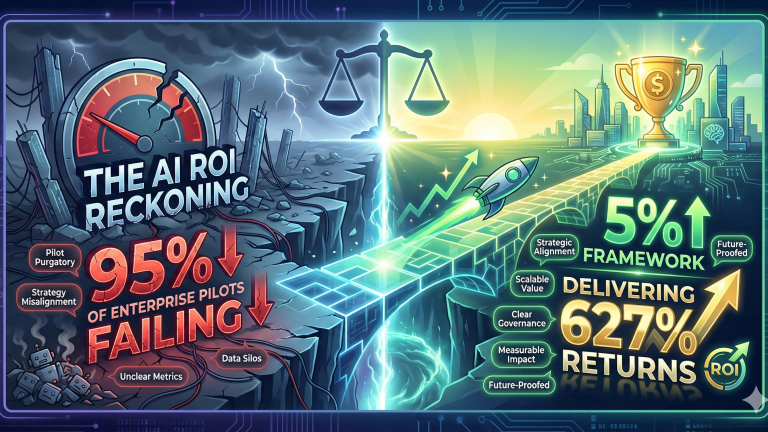
  • The AI ROI Reckoning: Why 95% of Enterprise Pilots Are Failing (And the 5% Framework That’s Delivering 627% Returns)

    The AI ROI Reckoning: Why 95% of Enterprise Pilots Are Failing (And the 5% Framework That’s Delivering 627% Returns)

    Executive Summary: The 2026 AI ROI Reckoning

    In 2026, the era of “AI experimentation” has ended. While 95% of enterprise AI pilots fail to deliver measurable P&L impact, a select 5% of organizations are achieving extraordinary returns (up to 627% ROI) by shifting from flashy point solutions to structured orchestration.

    The Failure Gap

    • The Learning Gap: Most GenAI tools are “stateless” and fail to retain business context or feedback.

    • The Data Debt: “Garbage in, garbage out” remains the #1 killer of AI accuracy. Dirty CRM data leads to 40% error rates in AI forecasting.

    • Build vs. Buy: Internal enterprise AI builds fail 67% of the time due to hidden maintenance and data curation complexities.

    The “5% Framework” for Success

    1. Workflow First: Redesign the process before deploying the tool. Solve a specific friction point (e.g., CRM data entry), not a vague goal.

    2. Outcome-Based Metrics: Stop measuring “accuracy” or “tokens.” Measure pipeline growth, deal velocity, and cost savings.

    3. Data Hygiene: Fix your data foundation before you spend another dollar on AI models.

    4. Target Back-Office: Prioritize high-volume, low-risk internal workflows (e.g., document processing) where ROI is highest.

    5. Multi-Agent Orchestration: Use orchestration platforms (like Sentia’s DIO) to coordinate specialized agents for compounding returns.

    The 90-Day Mandate: If an AI pilot cannot show measurable P&L impact within 90 days, it should be cut. Boards in 2026 are no longer funding science experiments—they are funding proven revenue engines.

    Last month, a CFO walked into my office with a spreadsheet that made my stomach drop.

    $2.3 million spent on AI in 2025.
    17 pilots running across sales, marketing, and operations.
    Zero dollars in measurable ROI.

    “My board is asking me to justify every one of these,” she said. “And honestly, I can’t.”

    She’s not alone.

    According to MIT’s bombshell July 2025 report The GenAI Divide: State of AI in Business 2025, 95% of enterprise generative AI projects are delivering zero measurable business return despite $30-40 billion in corporate investment. Source: MIT Media Lab Project NANDA

    But here’s what the headlines miss: The 5% that ARE working are seeing extraordinary returns. We’re talking 627% ROI, 40% increases in deal velocity, and 30-point improvements in forecast accuracy.

    So what separates the winners from the $2.3M sinkholes?

    That’s exactly what I’m going to break down in this article—because if you’re planning to justify AI spend to your board in 2026, you need to understand this divide before your next budget review.

    THE 2026 ROI PRESSURE COOKER: “SHOW ME THE MONEY“

    Let me be blunt: 2026 is the year the AI party ends.

    Not because AI doesn’t work, it absolutely does. But because boards and CFOs are done funding science experiments.

    Here’s what’s happening right now:

    The CEO/CFO Divide is Widening

    • 61% of CEOs report increasing pressure to prove AI ROI (up from 45% a year ago) Kyndryl 2025 Readiness Report
    • 65% of CEOs say they’re NOT aligned with their CFO on long-term AI value
    • 53% of investors expect positive ROI within 6 months or less Teneo Vision 2026 Survey

    The Budget Reality Check

    • 74% of CEOs say short-term ROI pressure is undermining long-term AI innovation
    • CFOs are shifting from “experimental budgets” to “prove it or lose it” mentality
    • 25% of planned AI spending being deferred to 2027 (Forrester)

    The Board-Level Scrutiny As one CFO told me: “When I pitched AI investments in 2023, the board said ‘great, let’s experiment.’ In 2026? They’re asking ‘where’s the P&L impact?’”

    This isn’t just anecdotal. Deloitte’s Q4 2025 CFO Signals report found that 87% of CFOs predict AI will be extremely or very important to their operations in 2026, but they’re also slashing projects that can’t show measurable returns. Source: Deloitte CFO Signals

    Translation: If you can’t prove ROI in Q1 2026, your AI budget is getting cut in Q2.

    THE 95% PROBLEM: WHY MOST AI PROJECTS ARE FAILING

    The MIT study—based on 300+ public AI deployments, 52 executive interviews, and 153 senior leader surveys—reveals a stark pattern: Just 5% of integrated AI pilots are extracting millions in value, while the vast majority remain stuck with no measurable P&L impact. Source: MIT NANDA Study

    But WHY are 95% failing?

    The research points to four systemic root causes:

    1. The “Learning Gap” – AI That Can’t Get Smarter

    Here’s the killer insight from MIT: Most GenAI systems do not retain feedback, adapt to context, or improve over time.

    Think about it: You deploy ChatGPT for sales emails. It generates decent drafts. But it:

    • Forgets the client’s industry preferences from last week
    • Repeats the same objections you already addressed
    • Requires you to re-input context for every single interaction
    • Doesn’t learn from what worked vs. what didn’t

    One VP told MIT researchers: “It’s excellent for brainstorming and first drafts, but it doesn’t retain knowledge of client preferences or learn from previous edits. For high-stakes work, I need a system that accumulates knowledge and improves over time.”

    The bottom line: Tools that don’t learn can’t scale. And tools that can’t scale can’t deliver ROI.

    1. The “Build vs. Buy” Disaster

    Here’s a stat that should terrify every CIO planning to “build our own proprietary AI”:

    • External vendor solutions succeed 67% of the time
    • Internal builds succeed only 33% of the time Source: MIT Study

    Why? Because enterprises dramatically underestimate the complexity of:

    • Training data curation and quality
    • Model fine-tuning and maintenance
    • Integration with existing workflows
    • Ongoing governance and compliance

    As MIT lead researcher Aditya Challapally put it: “Almost everywhere we went, enterprises were trying to build their own tool. The data showed purchased solutions delivered more reliable results.”

    Yet financial services companies and highly regulated industries continue to burn cash on internal AI builds that never see production.

    1. The Wrong Use Case Trap

    This one’s shocking: AI budgets are flowing to the LOWEST ROI use cases.

    According to the MIT study:

    • 50%+ of GenAI budgets go to sales and marketing
    • Back-office automation (document processing, compliance, workflows) delivers the HIGHEST ROI

    It’s a complete mismatch.

    Why does this happen? Because sales and marketing demos are flashy. A CEO sees an AI-generated sales pitch and thinks “this is the future!”

    But the reality? Customer-facing AI is:

    • Higher risk (brand reputation, customer satisfaction)
    • Harder to measure (attribution is complex)
    • More subject to human override (reps don’t trust it)

    Meanwhile, back-office automation is:

    • Lower risk (internal workflows)
    • Easier to measure (time saved, errors reduced)
    • More readily adopted (finance teams are desperate for efficiency)

    One procurement VP at a Fortune 1000 pharma company explained the problem: “If I buy a tool to help my team work faster, how do I quantify that impact? How do I justify it to my CEO when it won’t directly move revenue?”

    1. The Enterprise Paradox: Bigger = Slower

    Large enterprises run the most AI pilots but take 9 months on average to scale, compared to just 90 days for mid-market firms.

    The culprits?

    • Too many stakeholders (IT, legal, compliance, procurement, security)
    • Over-engineered governance frameworks
    • “Pilot purgatory” – endless testing without production deployment
    • Risk-averse culture that demands perfection before launch

    Meanwhile, startups with 20-person teams are going from zero to $20M in revenue in 12 months using the same AI tools.

    As one MIT researcher noted: “It’s because they pick one pain point, execute well, and partner smartly with companies who use their tools.”

    THE 5% FRAMEWORK: WHAT THE WINNERS ARE DOING DIFFERENTLY

    Let me show you what separates the 5% from the 95%.

    I’ve worked with dozens of revenue orgs implementing AI—some spectacularly successful, others spectacular failures. Here’s the pattern I see in every success story:

    Success Pattern #1: They Start with Workflow Redesign, Not Tool Deployment

    ❌ WRONG APPROACH:
    “Let’s buy [Hot AI Tool] and have our team start using it for [vague productivity goal].”

    ✅ RIGHT APPROACH:
    “Our forecast accuracy is 61% because our CRM data is 40% incomplete and our reps spend 2.3 hours/day on manual data entry. We need AI to solve THIS specific workflow breakdown.”

    Example from the field:

    A 75-person sales org I worked with didn’t start by buying AI. They started by mapping their revenue workflow and identifying the highest-friction points:

    1. Lead qualification took 4 days because reps manually researched every inbound lead
    2. CRM updates were 40% incomplete because reps forgot to log calls and meetings
    3. Deal risk was invisible until it was too late because managers only reviewed pipelines weekly

    THEN they deployed AI:

    • Agent 1 automated lead research and scoring (saved 3.2 hours per rep per week)
    • Agent 2 auto-updated CRM from meeting transcripts (saved 1.8 hours per rep per week)
    • Agent 3 flagged at-risk deals daily based on activity patterns (increased win rate by 34%)

    Result: 627% first-year ROI. Not because they bought better AI—because they redesigned the workflow FIRST.

    Success Pattern #2: They Measure Business Outcomes, Not AI Metrics

    Here’s a trap I see constantly:

    CIO: “Our AI model has 94% accuracy!”
    CFO: “Cool. Did revenue go up?”
    CIO: “…it has 94% accuracy.”

    The 5% don’t measure:

    • Model accuracy
    • Token usage
    • Response time
    • Number of AI interactions

    The 5% measure:

    • Revenue impact (pipeline growth, deal velocity, win rate)
    • Cost savings (hours saved, headcount avoided, errors reduced)
    • Customer outcomes (NPS improvement, retention rate, support resolution time)
    • Risk reduction (compliance violations, security incidents, forecast variance)

    Real example:

    A mid-market SaaS company deployed AI for customer support. Instead of measuring “AI-handled tickets,” they measured:

    • Time to resolution (dropped from 4.2 hours → 1.8 hours)
    • Customer satisfaction (increased from 78% → 89%)
    • Support cost per ticket (decreased by $32)
    • Churn rate among users with support tickets (decreased by 23%)

    Those numbers got the CFO’s attention. “AI accuracy” didn’t.

    Success Pattern #3: They Build Data Foundations FIRST

    I cannot stress this enough: Dirty data kills AI ROI.

    According to research from Congruity360, data quality is the #1 reason GenAI pilots fail to scale. Source: Congruity360 Analysis

    The 5% understand this. They don’t deploy AI until they’ve:

    • Cleaned their CRM (deduplicated contacts, standardized fields, enriched records)
    • Integrated their systems (CRM talks to marketing automation talks to customer support)
    • Established data governance (clear ownership, quality standards, audit trails)

    The brutal truth:

    If your CRM is 40% incomplete, your AI-powered forecasting will be 40% wrong. Garbage in, garbage out—but now at AI speed and scale.

    This is why my previous article on CRM data hygiene got so much engagement. The 5% know that data infrastructure is the foundation for AI ROI. Without it, you’re building on quicksand.

    Success Pattern #4: They Focus on “Highest-Value Workflows”

    Remember the MIT finding that back-office automation delivers the highest ROI?

    The 5% start there. Specifically, they target workflows that are:

    HIGH VOLUME → Lots of repetitive tasks to automate
    HIGH COST → Expensive to do manually (outsourced work, senior employee time)
    LOW RISK → Internal workflows where mistakes don’t impact customers
    EASY TO MEASURE → Clear before/after metrics

    Top 5 Highest-ROI Use Cases (Based on Field Data):

    1. Document processing and compliance (contracts, invoices, regulatory filings)
      • ROI: 300-800% in year one
      • Why: Replaces outsourced work, reduces errors, accelerates approval cycles
    2. CRM data enrichment and hygiene (auto-updating records, deduplication)
      • ROI: 200-500% in year one
      • Why: Enables all downstream sales/marketing AI to work properly
    3. Meeting intelligence and CRM auto-population (transcription, note-taking, field updates)
      • ROI: 150-400% in year one
      • Why: Saves 1-2 hours per rep per day, increases data completeness
    4. Deal risk detection and forecasting (pipeline health scoring, churn prediction)
      • ROI: 100-300% in year one
      • Why: Prevents revenue leakage, improves forecast accuracy 20-30 points
    5. Back-office automation (expense reports, procurement, HR workflows)
      • ROI: 150-400% in year one
      • Why: Reduces headcount needs, eliminates manual errors, speeds cycle times

    Notice what’s NOT on this list? Flashy customer-facing chatbots and AI-generated marketing content.

    Those have their place—but not if you’re trying to justify ROI to a skeptical CFO in Q1 2026.

    Success Pattern #5: They Use Orchestration Platforms (Not Point Solutions)

    This brings us full circle to my previous article on AI Agent Orchestration.

    The 5% aren’t buying 5 disconnected AI tools. They’re using orchestration platforms—like Sentia AI’s DIO—that coordinate multiple specialized agents into a unified intelligence layer.

    Why does this matter for ROI?

    Because orchestration enables:

    • Compounding returns → Each agent improves the performance of the others
    • Faster deployment → Pre-integrated workflows vs. custom integrations
    • Continuous improvement → Swap in better AI models without rebuilding
    • Measurable attribution → Track ROI across the entire revenue workflow, not just individual tools

    Real-world comparison:

    Company A (Point Solution Approach):

    • $347K/year spent on 5 separate AI tools
    • 9 months to get first tool into production
    • Siloed insights that don’t connect
    • Forecast accuracy: 61%

    Company B (Orchestration Platform Approach):

    • $289K/year spent on integrated DIO platform
    • 60 days to deploy first orchestrated workflow
    • Connected intelligence across sales, marketing, ops
    • Forecast accuracy: 91%

    The difference? Company B delivered 627% ROI. Company A is still trying to justify their spend to the board.

    YOUR 90-DAY AI ROI ROADMAP (Q1 2026 SURVIVAL GUIDE)

    Alright, enough theory. Here’s your actionable roadmap to escape the 95% and join the 5%—starting THIS WEEK.

    WEEK 1-2: THE ROI AUDIT

    ☐ Calculate your current AI spend

    • Vendor costs (subscriptions, licenses, professional services)
    • Internal costs (employee time, IT infrastructure, training)
    • Hidden costs (pilot projects that never scaled, abandoned tools)

    ☐ Map every AI initiative to business outcomes

    • For each pilot/tool: What specific business metric should it improve?
    • If you can’t articulate the outcome, it’s probably failing

    ☐ Measure current baseline performance

    • BEFORE you deploy more AI, capture the “before” metrics
    • Revenue metrics: Forecast accuracy, deal velocity, win rate, pipeline coverage
    • Efficiency metrics: Hours spent on admin, data completeness, response time
    • Cost metrics: Cost per lead, cost per acquisition, support cost per ticket

    ☐ Identify your “AI graveyard”

    • Which pilots have been running for 6+ months with no production deployment?
    • Which tools are your team NOT actually using despite paying for them?
    • Kill these. Then, Re-allocate the budget.

    ☐ Create your “highest-ROI target list”

    • Rank workflows by: Volume × Cost × Ease of Measurement
    • Focus ONLY on the top 3

    WEEK 3-4: THE FOUNDATION FIX

    ☐ Assess your data readiness

    • CRM completeness audit (what % of fields are populated?)
    • Data quality check (duplicates, outdated info, inconsistencies) Many companies have 50% plus duplicates – even more don’t even keep track / no idea where its at
    • Integration health (do your systems talk to each other?)

    ☐ Fix the data hygiene problems

    • Deduplicate contacts and accounts
    • Enrich records with missing firmographic/technographic data
    • Standardize field formats and naming conventions
    • If this sounds overwhelming: Hire a specialist. Seriously. Don’t skip this.

    ☐ Define your AI governance framework

    • Who owns AI decisions? (Not a committee – your AI Transformation Lead (Person))
    • What are your risk thresholds? (Customer-facing vs. internal) (see AI lawsuits)
    • How will you measure success? (Business outcomes, not AI metrics)
    • What’s your budget approval process? (Spoiler: It should take days, not months)

    ☐ Secure executive alignment

    • CEO: Show how AI supports revenue goals
    • CFO: Show clear ROI projections with conservative assumptions
    • CIO: Show how this will fit into your company wide tech strategy without creating tech debt – i.e., who is going to do the work? Vendors or internal teams?
    • Get them in ONE ROOM and ensure they’re aligned before you spend another dollar

    WEEK 5-8: THE SMART DEPLOYMENT

    ☐ Pick ONE high-ROI workflow

    • Don’t boil the ocean. Prove value quickly.
    • Ideal first workflow: Meeting intelligence + CRM auto-population
    • Why? High volume, clear time savings, easy to measure, low risk

    ☐ Choose platform over point solution

    • Evaluate AI orchestration platforms (Sentia AI’s DIO, competitors)
    • Key criteria: Plug-and-play AI model swapping, pre-built integrations, vendor independence
    • Run a 30-day proof-of-concept on your chosen workflow

    ☐ Set clear success metrics

    • Define the “before” baseline (from Week 1-2) – Think old school tech evaluations – go back to basics – treat AI as any new technology – not the “bright shiny isn’t that cool AI tool”
    • Define the “after” target (be specific: “Reduce admin time from 2.3 hrs/day to 0.8 hrs/day”)
    • Define the measurement cadence (weekly check-ins, not quarterly reviews)

    ☐ Train your team (for real)

    • Not a 1-hour webinar. A 2-week adoption program.
    • Power users first (they’ll be your champions)
    • Weekly office hours for questions and troubleshooting
    • Capture feedback and iterate quickly

    WEEK 9-12: THE ROI PROOF

    ☐ Measure relentlessly

    • Track your success metrics WEEKLY
    • Compare to baseline: Are you hitting your targets?
    • Capture qualitative feedback: What’s working? What’s not?

    ☐ Calculate actual ROI

    • Time saved: Hours per employee × Hourly cost × Number of employees
    • Revenue impact: Increase in win rate × Average deal size × Number of deals
    • Cost savings: Reduced outsourcing, fewer errors, faster cycles
    • Add it up. Be conservative. Then present to your CFO.

    ☐ Prepare your board presentation

    • Lead with business outcomes (NOT AI metrics)
    • Show the ROI calculation (be transparent about assumptions)
    • Explain why this scales (orchestration platform, not individual siloed point solutions)
    • Request budget for next 2-3 workflows based on proven success

    ☐ Commit to continuous improvement

    • Don’t declare victory and move on
    • Schedule monthly reviews to refine agent behaviors
    • Test new AI models as they become available (this is why platform matters)
    • Expand to next workflow ONLY after first one is delivering sustained ROI

    THE HARD TRUTH: MOST WILL STILL FAIL…

    I wish I could tell you that following this framework guarantees success.

    It doesn’t.

    The reality is that most companies reading this article will STILL end up in the 95%—not because they don’t understand the framework, but because they can’t execute it.

    Here’s why AI projects fail despite good intentions:

    ❌ FAILURE PATTERN #1: The “Pilot Purgatory” Trap

    You’ll spend 6 months perfecting the pilot. Then another 3 months getting legal approval. Then another 2 months negotiating with procurement. By month 11, the AI model you chose is obsolete and your champion has left the company.

    Solution: Set a hard 90-day deadline. If you can’t deploy in 90 days, the workflow is too complex. Pick something simpler.

    ❌ FAILURE PATTERN #2: The “Committee of Death”

    You’ll form an “AI steering committee” with 12 stakeholders. They’ll meet monthly. Nothing will get decided. Everyone will have veto power. After 8 months, you’ll realize no one is actually accountable.

    Solution: One decision-maker. Period. Give them budget authority and get out of their way. If your company is big enough hire a CAIO or an AI Lead Transformation specialist.

    ❌ FAILURE PATTERN #3: The “We’ll Build It Ourselves” Delusion

    Your CTO will insist that you need a proprietary AI solution. You’ll spend 18 months and $2M building it. It’ll work in the lab but never scale to production. Meanwhile, competitors using vendor solutions will lap you.

    Solution: Remember the 67% vs. 33% success rate for buy vs. build. Swallow your pride and buy.

    ❌ FAILURE PATTERN #4: The “Wrong Metrics” Disaster

    You’ll measure AI adoption rates, model accuracy, and user satisfaction scores. Your CFO will ask “did revenue go up?” and you’ll have no answer.

    Solution: Start with business outcomes. Work backwards to AI metrics. Never the other way around.

    ❌ FAILURE PATTERN #5: The “Data Debt” Brick Wall

    You’ll try to deploy AI on top of your 40% complete CRM with duplicate records and inconsistent data. The AI will fail. You’ll blame the AI. The real problem is your data.

    Solution: Fix data hygiene FIRST. It’s not sexy, but it’s non-negotiable.

    WHAT THIS MEANS FOR YOUR Q1 2026 BOARD MEETING

    Here’s my prediction:

    In March 2026, boards across America will ask three questions:

    1. “How much did we spend on AI in 2025?”
    2. “What measurable business impact did we get?”
    3. “Why should we keep funding this?”

    If you can’t answer question #2 with specific revenue or cost numbers, your AI budget is getting cut.

    But here’s the opportunity:

    The 5% who CAN answer those questions will get MORE budget. Because boards aren’t anti-AI—they’re anti-waste. Show them ROI and they’ll double down.

    This is your moment to separate yourself from the pack.

    While your competitors are scrambling to justify their 17 failed pilots, you can walk into that board meeting with:

    • A proven ROI calculation (627% is possible if you do this right)
    • A clear framework for scaling to additional workflows
    • A roadmap showing how AI supports strategic business goals
    • Evidence that you’re in the 5%, not the 95%

    But you need to start NOW. Not in Q2. Not “after we form a committee.” Now.

    THE DIFFERENCE BETWEEN HOPE AND STRATEGY

    The 95% are running on hope.

    They hope their AI pilots will eventually deliver value. They hope their team will adopt the tools. They hope their board will be patient. They hope the hype cycle will give them cover for another year.

    The 5% are running on strategy.

    They know exactly which workflows to target, how to measure success, and what ROI they need to hit. They’re not hoping—they’re executing.

    The question is: Which are you?

    Because in 2026, hope is not a strategy. And your board is done waiting.

    Ready to join the 5%?

    If you’re a CRO, CMO, or CFO facing board pressure to justify AI spend, let’s talk. I’ve helped dozens of revenue orgs implement the framework in this article—including the 75-person sales org that achieved 627% ROI.

    💬 Drop a comment with your biggest AI ROI challenge, I respond to every one.

    📧 DM me if you want to discuss your specific situation confidentially.

    🔄 Repost this if you know a C-suite executive who needs to read this before their next board meeting.

    The AI ROI reckoning is here. The only question is whether you’ll be in the 5% that survives it or the 95% that doesn’t.

    Frequently Asked Questions: Maximizing AI ROI in the Enterprise

    Why do 95% of enterprise AI pilots fail to deliver ROI?

    According to research from MIT and Sentia, 95% of AI projects fail due to four primary reasons:

    • The Learning Gap: Most generative AI systems do not retain context or improve over time.

    • The Build vs. Buy Disaster: Internal builds fail 67% of the time due to complexity, whereas vendor solutions have a much higher success rate.

    • The Wrong Use Case Trap: Organizations often prioritize flashy, customer-facing AI over high-ROI back-office automation.

    • The Enterprise Paradox: Over-engineered governance and multiple stakeholders lead to “pilot purgatory,” where projects never reach production.

    What is the “5% Framework” for successful AI implementation?

    The 5% of companies achieving extraordinary returns (up to 627% ROI) follow five specific success patterns:

    1. Workflow Redesign First: They fix broken manual processes before adding AI.

    2. Outcome-Based Measurement: They track P&L impact (revenue, cost savings) rather than AI technical metrics like accuracy.

    3. Data Foundation First: They ensure CRM data is clean and deduplicated before deployment.

    4. Target High-Value Workflows: They focus on high-volume, low-risk tasks like document processing and CRM hygiene.

    5. AI Orchestration: They use platforms like Sentia’s DIO to manage multiple specialized agents as a unified system.

    Which AI use cases deliver the highest measurable ROI?

    While marketing and sales AI get the most attention, the highest measurable ROI typically comes from:

    • Document Processing & Compliance: 300–800% ROI through reduced manual labor and errors.

    • CRM Data Enrichment: 200–500% ROI by providing a “single source of truth” for revenue teams.

    • Meeting Intelligence: 150–400% ROI by automating CRM entry and note-taking.

    • Deal Risk Detection: 100–300% ROI by improving forecast accuracy and preventing revenue leakage.

    How does dirty CRM data impact AI performance?

    Dirty data is the leading cause of AI project failure. If a CRM is incomplete or filled with duplicates, AI-powered forecasting and lead scoring will be fundamentally flawed. Successful enterprises perform a “Data Schema Audit” and deduplication process before launching AI agents to avoid the “Garbage In, Garbage Out” (GIGO) effect.

    What is the benefit of AI Orchestration over individual AI tools?

    AI Orchestration platforms, such as Sentia AI’s DIO, coordinate multiple specialized agents into a unified intelligence layer. This approach delivers compounding returns, faster deployment (60 days vs. 9 months), and better forecast accuracy (up to 91%) compared to disconnected point solutions.

    How can a company justify AI spending to a CFO in 2026?

    To justify AI spend, leaders must move away from “experimental” metrics. A successful board-level pitch should include:

    • Specific P&L Impact: Clear evidence of hours saved or revenue generated.

    • Baseline Comparisons: “Before vs. After” metrics on deal velocity and win rates.

    • A 90-Day Roadmap: A phased plan starting with a single high-ROI workflow to prove value quickly.

    Keywords: AI ROI, enterprise AI failure rate, AI project success, CFO AI pressure, AI investment returns, GenAI divide, AI business case, AI pilot failure, revenue intelligence, AI orchestration, board AI justification, 2026 AI strategy, AI implementation framework, measurable AI impact, AI adoption ROI, Sentia AI, DIO platform, AI governance, data hygiene AI, back-office automation

    Hashtags: #AIROI #EnterpriseAI #CFO #AIStrategy #DigitalTransformation #AIAdoption #BoardStrategy #RevenueIntelligence #AIOrchestration #BusinessAI #CRO #CMO #GTMStrategy #SalesAI #AIInvestment #AILeadership #SentiaAI #AITherapist #AIGovernance #CFOInsights #2026Strategy

  • The Autonomous Agent Revolution: Why Adecco Can Now Process 300 Million Resumes Annually

    The Autonomous Agent Revolution: Why Adecco Can Now Process 300 Million Resumes Annually

    When Adecco, one of the world’s largest staffing companies, announced they could now process 300 million resumes annually using Salesforce’s “Agentforce” platform, it wasn’t just a technology milestone—it was a declaration of war on traditional recruitment methods.

    To put that number in perspective: 300 million resumes is roughly equivalent to every working-age adult in the United States submitting their resume 2.5 times per year. It’s a volume that would require an army of 10,000+ human recruiters working full-time just to review—never mind actually process, screen, and match.

    Adecco is doing it with a handful of autonomous AI agents.

    Welcome to the age of recruitment at infinite scale.

    What Autonomous Agents Actually Are

    Before we dive into the implications, let’s be clear about what we’re dealing with. Autonomous agents aren’t just fancy chatbots or automated email systems. They’re AI entities that can:

    • Operate independently without constant human supervision
    • Make complex decisions based on evolving criteria and context
    • Learn and adapt from outcomes to improve performance
    • Take actions across multiple systems and platforms
    • Coordinate with other agents to complete complex workflows

    Think of them as AI employees that never sleep, never take breaks, and get smarter every day.

    The Adecco Case Study: Scale Redefined

    The Challenge: Adecco needed to match millions of candidates to hundreds of thousands of roles across dozens of countries, each with different requirements, languages, and regulatory environments.

    The Traditional Approach: This would require:

    • Thousands of human recruiters
    • Massive operational overhead
    • Inconsistent quality across regions
    • Prohibitive cost structure
    • Months or years to scale

    The Agentforce Solution: Autonomous agents that can:

    • Parse and analyze resumes in 40+ languages
    • Match candidates to roles using 500+ criteria points
    • Conduct initial screenings and assessments
    • Schedule interviews and manage follow-ups
    • Learn from successful placements to improve future matching

    The Result: 300 million resumes are processed annually with better accuracy than human-only systems.

    Math That Changes Everything

    Let’s break down what this scale actually means:

    300 million resumes annually =

    • 25 million resumes per month
    • 822,000 resumes per day
    • 34,000 resumes per hour
    • 570 resumes per minute
    • Nearly 10 resumes processed every second, 24/7/365

    Human Equivalent: If each resume takes a human recruiter 5 minutes to properly review, this represents 25 million hours of work annually—or the equivalent of 12,000 full-time employees.

    Cost Implications: At an average recruiter salary of $60,000, this represents $720 million in annual labor costs—replaced by AI agents that cost a fraction of that amount.

    Beyond Volume: The Quality Revolution

    But here’s what’s remarkable: the autonomous agents aren’t just processing more resumes—they’re processing them better.

    Consistency: No fatigue, no mood variations, no unconscious bias from reviewing too many similar profiles

    Comprehensiveness: Every resume gets the same thorough analysis across all relevant criteria

    Speed: Instant processing means candidates get faster responses and better experiences

    Learning: Each placement outcome improves the algorithm for future matches

    The Stanford Study Result: Candidates processed by AI-first systems are 53% more likely to succeed in subsequent human interviews than those screened traditionally.

    The Ripple Effects Across the Industry

    Adecco’s success with autonomous agents is creating shockwaves across the recruitment ecosystem:

    For Large Staffing Firms

    The Arms Race: Every major player is now racing to deploy similar capabilities

    Scale Advantage: Firms with autonomous agents can bid on contracts previously impossible to fulfill

    Margin Improvement: Dramatic cost reduction while maintaining or improving quality

    For Mid-Size Recruitment Firms

    The Equalizer: Access to similar agent technology levels the playing field with larger competitors

    The Differentiator: First movers in agent deployment gain temporary competitive advantages

    The Necessity: Firms without agents increasingly can’t compete on volume or cost

    For Boutique Firms

    The Opportunity: Agents handle volume work, freeing humans for high-touch, strategic activities

    The Threat: Volume-based revenue models become unsustainable

    The Evolution: Must pivot to advisory, consulting, and relationship-driven services

    Real-World Applications Beyond Adecco

    The autonomous agent revolution extends far beyond one company’s success:

    Unilever: AI-Powered Graduate Recruitment**

    • Autonomous agents screen 300,000+ graduate applications annually
    • Custom game-based assessments administered by AI
    • 75% reduction in time-to-hire
    • 90% candidate satisfaction scores

    JPMorgan Chase: Intelligent Candidate Matching**

    • Agents analyze internal mobility opportunities for 250,000+ employees
    • Real-time skills gap identification and candidate recommendations
    • 40% increase in internal placement success rates

    IBM: Predictive Talent Pipeline Management**

    • Autonomous agents continuously scan talent markets for emerging skills
    • Proactive candidate engagement before roles are even posted
    • 60% reduction in time-to-fill for critical technical roles

    The Technology Stack Behind the Revolution

    Understanding how autonomous agents achieve this scale requires looking at the technology foundation:

    Natural Language Processing

    • Resume parsing in 40+ languages with 99.7% accuracy
    • Context understanding that goes beyond keyword matching
    • Semantic analysis of skills, experience, and career progression patterns

    Machine Learning Models

    • Predictive success algorithms trained on millions of placement outcomes
    • Dynamic learning that improves with each new data point
    • Multi-dimensional matching across skills, culture, location, and growth potential

    Workflow Orchestration

    • Complex decision trees that mirror human recruiter judgment
    • Integration with ATS, HRIS, and communication platforms
    • Automated handoffs between AI and human touch points

    Real-Time Analytics

    • Continuous performance monitoring and optimization
    • A/B testing of different agent configurations
    • Predictive modeling for pipeline management and capacity planning

    Competitive Implications

    The firms deploying autonomous agents at scale aren’t just improving efficiency, they’re fundamentally changing the competitive landscape:

    New Competitive Advantages

    Speed: Fill roles in days instead of weeks

    Scale: Handle volume that would overwhelm traditional firms

    Quality: Consistent, data-driven candidate assessment

    Cost: Dramatically lower operational overhead

    New Competitive Requirements

    Technology Investment: Significant upfront costs for platform deployment

    Data Quality: Agents are only as good as the data they’re trained on

    Human-AI Integration: Designing workflows that optimize both AI and human capabilities

    Continuous Learning: Systems that adapt and improve based on outcomes

    The Implementation Reality

    While the Adecco results are impressive, implementing autonomous agents at scale isn’t trivial:

    Technical Requirements

    • Robust data infrastructure and governance
    • Integration with existing recruitment technology stacks
    • Quality assurance and bias monitoring systems
    • Compliance frameworks for different jurisdictions

    Organizational Changes

    • Recruiter role redefinition and training
    • New performance metrics and KPIs
    • Change management for human-AI collaboration
    • Client education and expectation setting

    Investment Considerations

    • Platform licensing and setup costs ($50K-$500K+)
    • Integration and customization expenses
    • Ongoing training and optimization resources
    • ROI timeline of 6-18 months depending on scale

    Your Strategic Options

    Watching Adecco process 300 million resumes should prompt every recruitment firm to ask: What’s our autonomous agent strategy?

    Option 1: Build

    Develop proprietary agent capabilities tailored to your specific market or niche.

    Pros: Competitive differentiation, IP ownership

    Cons: High cost, long timeline, technical risk

    Option 2: Buy

    License existing platforms like Salesforce Agentforce or similar enterprise solutions.

    Pros: Faster deployment, proven capabilities

    Cons: Shared competitive advantage, ongoing licensing costs

    Option 3: Partner

    White-label agent services or form strategic alliances with technology providers.

    Pros: Lower upfront investment, shared risk

    Cons: Less control, potential dependency

    Option 4: Wait

    Maintain current approaches while monitoring market development.

    Pros: No immediate investment required

    Cons: Falling further behind daily, may become too late to catch up

    The Urgency Imperative

    Here’s the uncomfortable truth: while you’re deciding whether to explore autonomous agents, your competitors are already deploying them.

    The Network Effect: Every day an agent operates, it processes more data and becomes more effective

    The Scale Advantage: Early adopters are securing contracts that require agent-level capabilities

    The Talent Migration: Top recruiters want to work for firms with cutting-edge technology

    The Future Is Here

    Adecco’s 300 million resume milestone isn’t a glimpse of the future—it’s a reality check about the present.

    Autonomous agents are processing resumes at superhuman scale right now. They’re making better matches, delivering faster results, and operating at costs that traditional methods can’t touch.

    The question isn’t whether autonomous agents will transform recruitment—they already have.

    The question is whether your firm will be part of that transformation or displaced by it.

    The Bottom Line

    When one company can process 300 million resumes annually with AI agents, the entire recruitment industry needs to recalibrate its understanding of what’s possible.

    This isn’t about incremental improvement, it’s about orders-of-magnitude transformation in scale, speed, and capability.

    The firms that embrace autonomous agents won’t just gain efficiency—they’ll gain the ability to serve markets and clients that were previously unreachable.

    The autonomous agent revolution is here. The only question is whether you’re leading it or being left behind by it.


    The autonomous agent revolution represents just one dimension of AI’s transformative impact on recruitment. For a comprehensive analysis of emerging AI technologies, implementation strategies, and competitive positioning frameworks, including detailed case studies and deployment roadmaps—download our complete white paper: “Navigating the AI Disruption in Recruitment: A Strategic Guide for Forward-Thinking Firms.”

    Learn how leading firms are successfully deploying autonomous agents, building competitive advantages, and scaling their operations to previously impossible levels.

    Download your white paper here and discover how to harness the power of AI agents to transform your recruitment capabilities.

  • AI Doctor in the House: How to Tailor Your AI Strategy to Fit Your Company’s Goals and Size

    AI Doctor in the House: How to Tailor Your AI Strategy to Fit Your Company’s Goals and Size

    We’re often asked, does size matter when it comes to deploying AI? How big should a company be before evaluating or deploying AI? Where should we start? How much should we budget? Should we wait for our competitors to do it first, then deploy our AI with best practice results? So many great questions! Here’s where to start:

    Aligning your AI strategy with your company’s unique objectives and scale is essential for maximizing value and minimizing risk. Here’s a practical approach to ensure your AI initiatives are both effective and relevant:

    1. Define Clear, Business-Specific Objectives

    Start by identifying what you want AI to achieve for your company. Consider:

    • Cost reduction or workforce optimization
    • Competitive differentiation or market leadership
    • Enhanced customer experience
    • Operational efficiency and process improvement
    • Faster innovation or improved forecasting

    Your goals should reflect your company’s mission, current challenges, and future ambitions.

    2. Assess Your Company’s Readiness and Resources

    Your company’s size and current capabilities will shape your AI journey:

    Company SizeTypical AI Approach
    Small BusinessesLeverage pre-built AI features in existing software (e.g., accounting, CRM, HR tools). Focus on easy wins.
    Mid-Sized FirmsExplore automation (RPA), workflow tools, and packaged AI solutions.
    Large EnterprisesInvest in custom AI development, proof-of-concept projects, and advanced analytics.
    • Small firms: Prioritize solutions embedded in your current platforms to avoid heavy investment in data science talent.
    • Mid-sized firms: Use automation and workflow tools to drive efficiency before considering more advanced AI.
    • Large enterprises: Pursue strategic, innovative AI projects that can transform your industry position. Push the envelope and look for major advancements while simultaneously doing incremental, easily defined projects with crystal clear ROI.

    3. Evaluate and Prepare Your Data

    AI success depends on data quality and accessibility. Take these steps:

    • Audit where your data lives (cloud, on-premises, spreadsheets, etc.).
    • Cleanse and standardize your data to ensure consistency.
    • Integrate data sources for a unified view.
    • Consider acquiring external datasets if needed for benchmarking or enrichment.

    4. Map and Benchmark Key Processes

    Document your business processes to find where AI can deliver the most impact:

    • Use process mapping tools to visualize workflows, rules, and exceptions.
    • Benchmark current performance (e.g., error rates, processing times).
    • Identify inefficiencies or bottlenecks AI could address.

    5. Prioritize AI Opportunities Based on Value and Feasibility

    Not all AI projects are equal. Prioritize by:

    • Potential impact on your goals
    • Ease of implementation given your resources
    • Return on investment (ROI) and risk profile

    Focus first on projects that are achievable and deliver measurable value.

    6. Start Small—Pilot and Learn

    Begin with a pilot or proof-of-concept project:

    • Involve a cross-functional team to build internal knowledge.
    • Set clear success metrics aligned with your business objectives.
    • Use lessons learned to refine your broader AI strategy.

    7. Address Organizational Change

    Prepare your team for AI adoption:

    • Communicate the vision and benefits of AI.
    • Invest in training and reskilling as needed.
    • Anticipate and manage resistance or anxiety about change.

    8. Continuously Review and Adapt

    AI and business needs evolve—so should your strategy:

    • Regularly review project outcomes and ROI.
    • Adjust your roadmap as new opportunities or challenges emerge.
    • Stay informed about advances in AI relevant to your industry.

    By aligning your AI strategy with your company’s unique goals and size, you ensure that each initiative is purposeful, practical, and positioned for success.

    #AI #AIAdoption #AIStrategy #AIPlanning #AIROI #CAIO

  • If Your Sales Pipeline Data Isn’t Accurate, Your Forecasts, Strategies, and Growth Plans Are Built on Vapor

    If Your Sales Pipeline Data Isn’t Accurate, Your Forecasts, Strategies, and Growth Plans Are Built on Vapor

    We’ve all seen it: the pipeline review that reveals more fiction than fact.
    ❌ Opportunities that should have been closed months ago
    ❌ Close dates long passed
    ❌ Values wildly overstated or understated
    ❌ Stages that don’t match reality
    ❌ Fields that are blank or outdated

    The result? Leaders are building forecasts, strategies, and growth plans on unstable ground. And when the foundation is shaky, everything above it is at risk of collapse.

    The High Cost of Bad Data

    Bad pipeline data isn’t just an internal headache-it’s a business-wide domino effect. When your sales forecast is built on bad data, every department feels the impact:

    • Finance may misjudge budgets or cash flow, risking over- or under-investment.
    • Operations might over hire or understaff, leading to inefficiencies.
    • Marketing could double down on campaigns that don’t actually drive high-value opportunities.

    Even small data inconsistencies can have massive consequences. If just 10% of your opportunities are missing amounts, and the average deal is $100,000, a pipeline of 1,000 deals could be undervalued by $10 million. That’s not a rounding error-it’s a gap that can swallow your quota whole.

    But perhaps worst of all, bad data erodes trust. When forecasts miss the mark quarter after quarter, stakeholders lose faith in sales leadership, making it harder to secure resources, align teams, or drive change.

    Why Data Integrity Is So Hard

    Let’s be honest: no salesperson dreams of updating CRM fields. Their passion-and their value-comes from being in front of customers, not wrestling with dropdown menus and mandatory fields. Expecting meticulous data entry as a natural behavior is unrealistic.

    Data integrity in sales is not a default setting; it’s a discipline. Without leadership and process, pipeline data will always decay.

    Lead the Way: Building a Culture of Data Integrity

    If you want reliable data, you have to lead it. Here’s how:

    1. Frequent, Structured Pipeline Reviews

    Don’t settle for monthly, surface-level check-ins. Hold structured, opportunity-by-opportunity reviews at least every fortnight. Ask tough questions:

    • Is the opportunity real?
    • Is the close date credible?
    • Is the value accurate?
    • Is it in the right stage?
    • What does the salesperson need to move it forward?
    1. Evidence-Based Accountability

    Push reps for evidence, not just opinions. “I think we’re moving forward” isn’t enough-ask for proof, like stakeholder feedback or documented next steps.

    1. Regular Data Cleanups

    Schedule routine audits to remove dead leads, update outdated info, and validate key fields. Automation can help, but human review is essential for context and accuracy.

    1. Embrace Data Governance

    Establish clear policies, assign data stewards, and provide ongoing training. Make data quality everyone’s responsibility, not just sales ops.

    The Payoff: Forecasts You Can Trust

    When you build a culture of data integrity, your forecasts become credible, your strategies become actionable, and your growth plans rest on a foundation as solid as bedrock-not sand.

    What you focus on grows. If you focus on data discipline, you’ll see not just better numbers, but better outcomes across your business.

    Are you ready to stop building on Vapor? Share your experiences and tips for pipeline data integrity in the comments below!

    #SalesLeadership #PipelineManagement #DataIntegrity #SalesForecasting #CRM #SalesOps

    Add Your Heading Text Here

  • What the Hell are / is / an: AI Agent(s)?

    What the Hell are / is / an: AI Agent(s)?

    AI Agents the next Frontier in artificial intelligence or just more AI Hype?

    With Billions of venture capital dollars already sunk into it, the AI marketing buzz continues to build. The latest excitement centers around a term many cannot agree upon. AI agents are becoming increasingly prevalent or at least written and hyped more and more. Ask most people what an AI Agent is, and the first thing they think of is chatbot type things. But what exactly are AI agents, and how are they shaping our technological landscape or is it just a bunch of tech marketing hype?

    What are AI Agents?

    AI agents are autonomous systems or programs capable of performing tasks on behalf of users or other systems. They go beyond simple chatbots, incorporating advanced decision-making, problem-solving, and execution capabilities1. These agents utilize large language models (LLMs) as their core, enabling them to understand and respond to complex inputs while adapting to user expectations over time1.

    Definitions Across Industries

    While there’s no universally agreed-upon definition, several key players offer their interpretations:

    • IBM defines AI agents as systems that can autonomously perform tasks by designing workflows and utilizing available tools1.
    • OpenAI describes them as automated systems that can independently accomplish tasks for users2.
    • Microsoft distinguishes agents from AI assistants, positioning agents as more specialized and tailored to specific expertise2.
    • Salesforce definition: AI agents are a type of AI system that can understand and respond to customer inquiries without human intervention. They are created using an agent builder, like Agentforce, and rely on machine learning and natural language processing (NLP) to handle a wide range of tasks. These intelligent agents can include anything from answering simple questions to resolving complex issues — even multi-tasking. Most importantly, AI agents can continuously improve their own performance through self-learning. This is distinct from traditional AI, which requires human input for specific tasks.

    Companies Developing AI Agents

    Several tech giants are at the forefront of AI agent development:

    1. OpenAI: Developing the Operator agent2.
    2. Google: Working on Project Mariner2.
    3. Anthropic: Claude – a generative AI chatbot and family of large language models (LLMs).
    4. Perplexity: Created a shopping agent2.
    5. Amazon: Developing AI agents for e-commerce applications4.
    6. Salesforce: Aiming to become a leading provider of “digital labor” through various agentic services2. See Agentforce.

    5 Real-World AI Agent Use Cases

    1. E-Commerce: AI agents on platforms like Amazon provide personalized product recommendations, automatically place orders, and track shipping, contributing significantly to revenue generation4.
    2. Sales and Marketing: AI agents like Find AI build lead lists, send personalized communications, and qualify leads, often outperforming human counterparts in lead generation4.
    3. Customer Support: Advanced AI agents, such as those developed by Chatbase, can handle complex technical support issues, process refunds, and provide product recommendations, leading to substantial reductions in support tickets4.
    4. Autonomous Vehicles: Self-driving cars represent a complex application of AI agents, combining multiple agent types for navigation, decision-making, and real-time responses. Companies like Waymo are pioneering this technology in cities like San Francisco and across the United States4.
    5. Healthcare: AI agents assist in diagnosing medical conditions, analyzing medical images, and creating personalized treatment plans. For instance, Google’s AI agent has demonstrated superior accuracy in diagnosing skin cancer compared to human dermatologists4.

    As AI agents continue to evolve, they promise to revolutionize various sectors, enhancing efficiency and providing personalized experiences. However, challenges remain in standardizing definitions and managing user expectations. The coming years will likely see further advancements and refinements in this exciting field of artificial intelligence.124

    Citations:

    1. https://www.ibm.com/think/topics/ai-agents
    2. https://www.glean.com/blog/ai-agents-how-they-work
    3. https://deviniti.com/blog/enterprise-software/best-ai-agent-development-companies/
    4. https://www.chatbase.co/blog/ai-agent-examples
    5. https://anth.us/blog/null/
    6. https://zapier.com/blog/ai-agent/
    7. https://www.youtube.com/watch?v=ZZ2QUCePgYw
    8. https://cloud.google.com/discover/what-are-ai-agents
    9. https://www.forbes.com/councils/forbestechcouncil/2025/03/07/ai-agents-in-2025-transforming-business-redefining-leadership-and-accelerating-digital-transformation/
    10. https://www.teneo.ai/blog/5-companies-leading-the-way-in-ai-agent-technology
    11. https://a16z.com/ai-voice-agents-2025-update/
    12. https://www.salesforce.com/agentforce/what-are-ai-agents/
    13. https://botpress.com/blog/real-world-applications-of-ai-agents
    14. https://aws.amazon.com/what-is/ai-agents/
    15. https://openai.com/index/new-tools-for-building-agents/
    16. https://www.reddit.com/r/AI_Agents/comments/1hhlzkh/whats_your_use_case_for_ai_agents_what_problems/
    17. https://direct.mit.edu/isal/article/doi/10.1162/isal_a_00605/116885/Towards-a-Theory-of-Mind-for-Artificial
    18. https://hallmark.libguides.com/c.php?g=1312147&p=9645253
    19. https://www.reddit.com/r/OpenAI/comments/1hk4d8h/eli5_what_exactly_is_an_ai_agent_with_examples/
    20. https://botpress.com/blog/what-is-an-ai-agent
    21. https://devrev.ai/blog/ai-agents
    22. https://en.wikipedia.org/wiki/Intelligent_agent
    23. https://github.com/resources/articles/ai/what-are-ai-agents
    24. https://www.geekwire.com/2025/microsoft-unveils-ai-agents-for-sales-striking-back-at-salesforce/
    25. https://www.businessinsider.com/generative-ai-evolution-software-companies-develop-ai-agents-workforce-2025-3
    26. https://tech.co/news/microsoft-new-ai-sales-agents
    27. https://cloud.google.com/transform/101-real-world-generative-ai-use-cases-from-industry-leaders
    28. https://www.techradar.com/pro/openai-wants-to-help-your-business-build-its-next-generation-of-ai-agents
    29. https://iblnews.org/microsoft-announces-two-sales-ai-agents-in-competition-with-salesforce/
    30. https://www.teneo.ai/blog/what-are-ai-agents-6-powerful-examples-in-action
    31. https://martech.org/ai-agents-2025-predictions/
    32. https://www.salesforce.com/news/stories/future-of-ai-agents-2025/
    33. https://guides.lib.purdue.edu/c.php?g=1371380&p=10135074
    34. https://papers.ssrn.com/sol3/papers.cfm?abstract_id=4772956
    35. https://customgpt.ai/sources-citations-observability/
    36. https://www.moveworks.com/us/en/resources/blog/what-is-an-ai-agent
    37. https://open.mitchellhamline.edu/mhlr/vol46/iss5/2/
    38. https://www.reddit.com/r/n8n/comments/1gxkf9c/ai_agent_pinecone_source_citations/
  • AI Banking Use Cases. How are Innovative COO’s Winning?

    AI Banking Use Cases. How are Innovative COO’s Winning?

    As a Chief Operating Officer (COO) in the banking sector, embracing Artificial Intelligence (AI) is no longer optional—it’s a necessity for staying competitive in our rapidly evolving industry. Let’s explore how AI, particularly agentic AI and Einstein GPT, is reshaping the COO’s role and the top AI use cases in banking today.

    The AI Impact on Banking COOs
    Recent studies show that 77% of COOs using Large Language Models (LLMs) report positive ROI, with customized tools leading the way. This underscores the growing importance of AI in banking operations and the need for COOs to champion this technology to stay ahead of competitors.

    Top 10 AI Use Cases in Banking

    1. Fraud Detection and Prevention: Agentic AI systems excel at identifying fraudulent activities by scrutinizing transaction patterns and detecting anomalies in real-time7.
    2. Customer Service Chatbots: AI-powered virtual assistants handle customer inquiries, with Einstein GPT enabling more personalized and contextually relevant interactions2.
    3. Risk Management: Agentic AI facilitates regulatory compliance by automating monitoring and reporting processes, including anti-money laundering (AML) and “know your customer” (KYC) initiatives7.
    4. Credit Scoring: AI models analyze a broader range of data for more inclusive and accurate creditworthiness assessments.
    5. Personalized Recommendations: Agentic AI analyzes vast amounts of customer data to offer bespoke financial advice, empowering clients to make well-informed decisions7.
    6. Automated Underwriting: AI-powered underwriting solutions streamline loan decisioning processes, enabling faster approvals5.
    7. Investment Management: Agentic AI-powered portfolio management tools offer tailored investment strategies based on individual risk tolerance and financial objectives7.
    8. Regulatory Compliance: Einstein GPT helps banks navigate complex regulatory landscapes by providing accurate and up-to-date information2.
    9. Document Processing: AI automates the analysis and processing of financial documents, improving efficiency.
    10. Operational Efficiency: Agentic AI is transforming banking by delivering autonomous, adaptive, and proactive solutions, streamlining operations and enhancing decision-making processes1.

    New Use Cases and Latest Applications

    1. Autonomous Trading: Agentic AI systems can execute trades with remarkable speed and precision, utilizing advanced algorithms to optimize returns7.
    2. Customer Onboarding: AI streamlines the onboarding process using biometrics, ID verification, and data validation to speed up “Know Your Customer” (KYC) checks5.
    3. Marketing Automation: AI Agents analyze customer behavior to help banks design targeted marketing campaigns, making customer segmentation and campaign effectiveness faster and more precise5.
    4. Predictive Banking: Einstein GPT enables banks to offer personalized financial coaching tailored to individual behaviors1.
    5. Compliance Refinement: Agentic AI can refine risk assessments in real-time, dynamically responding to emerging threats and anomalies1.

    COO Checklist: AI Leaders vs. Laggards
    AI Leaders:

    • Implement customized AI tools, including agentic AI and Einstein GPT
    • Establish an AI center of excellence (CoE)
    • Invest in AI foundations and cloud infrastructure
    • Focus on AI-driven efficiency gains and personalized customer experiences
    • Leverage AI for complex decision-making and autonomous processes
    • Continuously upskill staff on AI technologies, including agentic AI
    • Partner with top-tier tech firms for AI development
    • Use AI for predictive analytics and forecasting
    • Implement AI-powered risk management systems
    • Utilize AI for automated regulatory reporting and compliance

    AI Laggards:

    • Rely on off-the-shelf AI solutions
    • Limited internal AI adoption
    • Lack of strategic AI investment
    • Focus solely on cost-cutting through AI
    • Use AI only for basic tasks
    • Minimal AI training for employees
    • No significant tech partnerships for AI
    • Limited use of AI in analytics
    • Traditional risk management approaches
    • Manual regulatory reporting processes

    As an innovative COO working to stay ahead, it’s crucial to lead the AI transformation in your bank. By leveraging agentic AI and Einstein GPT across various operations, COOs can drive efficiency, enhance customer experiences, and position their banks for future success in the age of AI.

    Are you leading the AI revolution in your bank or falling behind?

    Share your experiences and thoughts in the comments below.


    #AIinBanking #FinTech #BankingInnovation #AgenticAI #EinsteinGPT #OperationalEfficiency #aichecklist #aiadoption #AIAgents #financialservices

    Citations:

    1. https://www.weforum.org/stories/2024/12/agentic-ai-financial-services-autonomy-efficiency-and-inclusion/
    2. https://acsgbl.com/blog/bringing-trusted-ai-to-banks-with-salesforce/
    3. https://thefinancialbrand.com/news/artificial-intelligence-banking/agentic-ai-the-next-big-innovation-for-banks-186428
    4. https://www.accenture.com/content/dam/accenture/final/accenture-com/document-2/Accenture-Age-AI-Banking-New-Reality.pdf
    5. https://openbots.ai/agentic-ai-in-banking-ten-transformative-processes-to-automate/
    6. https://acsgbl.com/blog/einstein-gpt-vs-chat-gpt/
    7. https://www.forbes.com/councils/forbesbusinessdevelopmentcouncil/2025/02/06/the-dawn-of-agentic-ai-systems-revolutionizing-financial-services/
    8. https://www.grazitti.com/blog/salesforces-2025-roadmap-how-ai-industry-cloud-will-drive-the-next-wave-of-innovation/
    9. https://www.fintechfutures.com/2025/02/agentic-ai-and-the-future-of-fintech-and-banking-automation/
  • Rise of the CAIEO: Navigating new AI Roles

    Rise of the CAIEO: Navigating new AI Roles

    AI continues to break new ground in many ways including new job titles for roles that didn’t exist a year ago. Let’s jump into the role of the CAIEO -part IT, HR, law, philosophy and business ethics rolled into one job in the age of AI.    

    Large complex organizations, that have embraced AI, are increasingly recognizing the need for ethical oversight in their AI initiatives. Enter the Chief AI Ethics Officer (CAIEO) -bridging the gap between technological innovation and ethical responsibility.

    What is a CAIEO?

    A Chief Artificial Intelligence Ethics Officer is a senior executive responsible for ensuring that an organization’s AI technologies and strategies align with ethical principles, legal requirements, and societal values. They play a pivotal role in developing, implementing and monitoring responsible AI practices across the company.

    10 Key Responsibilities of a CAIEO

    1. Develop, codify, train and enforce internal AI ethics policies and guidelines14.
    2. Oversee compliance with AI-related legal and regulatory frameworks4.
    3. Promote transparency, fairness, and accountability in AI systems4.
    4. Manage AI-related risks, including data privacy and security vulnerabilities4.
    5. Collaborate with various departments to establish AI performance evaluation standards4.
    6. Lead the creation and implementation of AI governance structures4.
    7. Ensure AI initiatives align with the company’s values and ethical standards14.
    8. Conduct regular reviews and updates of AI policies to reflect industry best practices4.
    9. Provide expert advice on navigating ethical challenges in AI development and deployment4.
    10. Foster a culture of responsible AI use throughout the organization14.

    Who Needs a CAIEO?

    Most businesses really don’t need a CAIEO, yet. Organizations that heavily rely on AI technologies, have outsize legal exposure to their use of AI, or are planning significant AI initiatives should consider appointing a CAIEO.

    This role is particularly crucial for:

    • Large tech companies developing AI products or services – Be Good, Do Good!
    • Financial institutions using AI for decision-making
    • Healthcare organizations implementing AI in patient care
    • Retail companies leveraging AI for customer insights and personalization
    • Manufacturing firms integrating AI into their production processes
    • Large service-based companies using AI in human resources, hiring, firing, compliance

    While the need for a CAIEO is more pronounced in larger corporations, mid-sized companies with significant AI investments should also consider this role (but can be a job that doesn’t necessarily require a C-Suite title). Startups focusing on AI-driven products or services may benefit from having a CAIEO or a similar role to ensure ethical considerations are built into their core offerings from the outset.

    CAIEO Necessity Checklist

    Consider appointing a CAIEO if your organization:

    • Develops or uses AI systems that impact decision-making processes
    • Handles sensitive data processed by AI algorithms
    • Operates in a highly regulated industry (e.g., finance, healthcare)
    • Has a global presence with diverse ethical and regulatory landscapes
    • Faces potential reputational risks related to AI use
    • Aims to be a leader in responsible AI practices
    • Lacks internal expertise in AI ethics and governance
    • Experiences rapid growth in AI adoption across multiple departments
    • Receives stakeholder inquiries about AI ethics and transparency
    • Plans to scale AI initiatives significantly in the near future

    Real-World CAIEO Use Cases by Industry

    1. Tech Giant: A leading social media company appoints a CAIEO to address concerns about algorithmic bias in content recommendation systems.
    2. Financial Services: A global bank hires a CAIEO to ensure fair lending practices in AI-driven credit scoring models.
    3. Healthcare Provider: A hospital network brings on a CAIEO to oversee the ethical implementation of AI in diagnostic tools and patient data management.
    4. E-commerce Platform: An online marketplace employs a CAIEO to manage the ethical implications of AI-powered pricing and product recommendation engines.
    5. Automotive Manufacturer: A car company appoints a CAIEO to guide the development of ethical AI systems for autonomous vehicles.

    As AI continues to shape our world, the role of the CAIEO becomes increasingly vital. By prioritizing ethical considerations in AI development and deployment, organizations can build trust, mitigate risks, and ensure their AI initiatives contribute positively to society.

    For More information on AI roles like CAIO please visit the Agentic AI Community site for AI enthusiasts and knowledge seekers.

    #AIEthics #ChiefAIEthicsOfficer #ResponsibleAI #TechLeadership #AIGovernance

    David is an investor and executive director at Sentia AI, a next generation AI sales enablement technology company and Salesforce partner. Dave’s passion for helping people with their AI, sales, marketing, business strategy, startup growth and strategic planning has taken him across the globe and spans numerous industries. You can follow him here on LinkedIn, X or YouTube for my interviews and videos.

  • AI in Big Pharma: How is it Being Applied in 2025?

    AI in Big Pharma: How is it Being Applied in 2025?

    Valued at $1.5 trillion, the pharmaceutical industry has long grappled with significant challenges. R&D development of a new drug costs $2 billion plus, takes over a decade, and faces a 90% failure rate in early stages. However, with AI adoption in life sciences growing at 29% annually, a unique opportunity emerges to address these inefficiencies and pain points in drug development12.

    Pain Points in Pharma

    Big Pharma executives and life sciences investors face uncertainty and risk due to four major issues:

    • Disconnected Data: Decision-making relies on vast volumes of structured and unstructured scientific data.
    • Knowledge Gaps: Significant gaps persist across scientific, clinical, regulatory, and commercial decision-making processes.
    • Inefficient Processes: Integrating and analyzing datasets is time-consuming and resource-intensive.
    • Lack of Standardization: Inconsistent evaluations hinder reproducibility in asset assessments.

    AI Applications in Drug Development – Recent Examples

    AI is transforming various stages of drug discovery, development, and commercialization:

    1. Target Identification and Validation: Atomwise and Pfizer’s partnership reduced initial drug discovery timeline from 4-6 years to approximately 18 months.
    2. Clinical Trial Optimization: Deep 6 AI’s implementation reduced patient recruitment time by 85% and increased trial enrollment rates.
    3. Manufacturing Process Optimization: GSK and Gatehouse Bio’s collaboration led to a 25% increase in production yield and $20 million annual cost savings at a single site.
    4. Post-Market Surveillance: FDA and Novartis’ AI-powered systems enabled earlier detection of safety signals and more proactive risk management.

    CRM & AI in Healthcare

    Customer Relationship Management (CRM) systems, enhanced by AI, are improving healthcare delivery and patient engagement:

    • Personalized Patient Care: AI-powered CRM systems analyze patient data to provide tailored treatment recommendations and follow-ups.
    • Predictive Analytics: These systems can forecast patient needs, potential health risks, and treatment outcomes.
    • Streamlined Administrative Tasks: AI automates appointment scheduling, billing, and record-keeping, allowing healthcare providers to focus more on patient care.
    • Enhanced Patient Engagement: AI-driven CRM tools facilitate better communication between patients and healthcare providers, improving adherence to treatment plans.

    The AI Solution

    AI addresses several critical issues in healthcare and pharma:

    1. Data Integration: AI can seamlessly integrate and analyze vast amounts of disparate data, providing comprehensive insights for decision-making.
    2. Accelerated Research: Machine learning algorithms can rapidly identify potential drug candidates and predict their efficacy, significantly reducing the time and cost of drug discovery6.
    3. Improved Clinical Trials: AI optimizes patient recruitment, monitors responses, and predicts potential side effects, making trials more efficient and reliable5.
    4. Personalized Medicine: By analyzing individual patient data, AI enables the selection of treatments tailored to each person, improving outcomes and reducing adverse reactions4.
    5. Operational Efficiency: AI automates routine tasks and provides insights into market trends and patient needs, streamlining pharmaceutical operations2.

    The Impact of AI on Drug Development

    The benefits of AI in pharmaceutical industry are clear:

    • 30-50% reduction in time-to-market for new drugs
    • Estimated $100-200 million cost savings per successful drug
    • Higher success rates in clinical trials due to better candidate selection
    • More efficient use of research resources
    • Improved safety monitoring and risk management
    • Faster response to emerging health threats through drug repurposing

    Looking Ahead

    2025 is the AI “Go Year” for the entire Pharmaceutical Industry.

    AI is expected to drive 30% of new drug discoveries, cutting costs and accelerating personalized treatments7. Challenges, including regulatory hurdles, data privacy concerns, and the need for specialized skills loom large! 3.

    The future of pharma lies in embracing these AI-driven innovations while navigating the complex regulatory landscape. As the industry evolves, collaboration between tech companies, pharmaceutical firms, and regulatory bodies will be crucial in realizing the full potential of AI in healthcare and drug development.

    What are your thoughts on AI’s role in transforming the pharmaceutical industry? How is AI changing your processes and workflows in pharma? Share your experiences and let’s continue this important conversation.

    Connect with me so you don’t miss any future articles!

    Please follow me on X (@Intmktentry) on Linkedin, YouTube or via our AI Community Site.

    Citations:

    1. https://www.zs.com/insights/pharmaceutical-trends-2025-outlook-ai-supplychain-and-beyond
    2. https://www.datacamp.com/blog/ai-in-pharmaceuticals
    3. https://www2.deloitte.com/us/en/insights/industry/health-care/life-sciences-and-health-care-industry-outlooks/2025-life-sciences-executive-outlook.html
    4. https://pmc.ncbi.nlm.nih.gov/articles/PMC10385763/
    5. https://www.clinicaltrialsarena.com/features/clinical-trials-challenges-expect-2025/
    6. https://www.mckinsey.com/industries/life-sciences/our-insights/generative-ai-in-the-pharmaceutical-industry-moving-from-hype-to-reality
    7. https://www.weforum.org/stories/2025/01/2025-can-be-a-pivotal-year-of-progress-for-pharma/
    8. https://www.scilife.io/blog/ai-pharma-innovation-challenges