The C-Suite Imperative: 2025 Demands Alignment
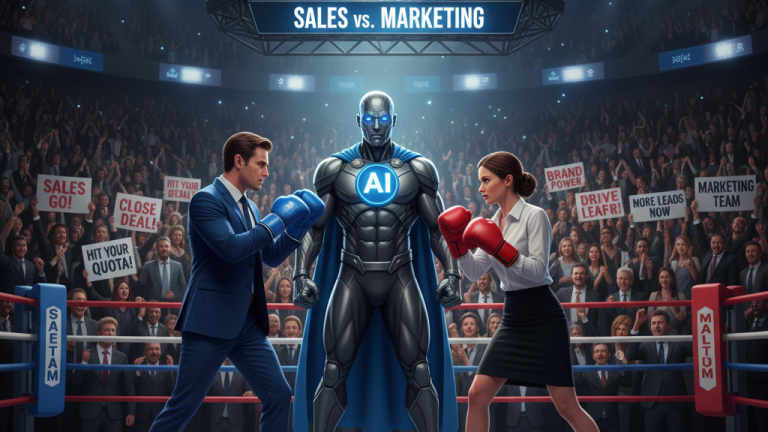
Been here? Sales tells the CEO marketing doesn’t create enough viable sales opportunities to hit quota, and marketing says sales doesn’t properly action the amazing leads they create and send to sales. So who’s right?
The legacy narrative of Chief Sales Officers (CSOs) and Chief Marketing Officers (CMOs) as adversaries is obsolete in the AI era. Misaligned KPIs, fragmented data, and defensive turf battles have grown costly and unsustainable. However, Artificial Intelligence is rapidly eliminating these friction points, driving a tectonic shift where sales and marketing transform into unified revenue engines. The imperative for every executive today is not just collaboration, but AI-powered strategic integration to unlock scalable, measurable growth.
Classic Barriers: Breaking the Silos with AI
Despite sharing a goal—acquisition and growth—CSOs and CMOs often work in parallel universes:
- Marketing: Prioritizes brand, image, social media, top-of-funnel metrics, and lead volume. Yes they know the corporate ICP, but sales can’t seem to sell.
- Sales: Obsesses over quota, deal velocity, and pipeline. If they don’t sell they don’t have a job. Often wonder why marketing leads don’t correspond to ICP. Yet they are the first ones fired?
AI exposes—and solves—the old pain points:
- Lead Volume vs. Lead Quality: AI enables precise targeting, not just bigger lists.
- Messaging Drift: AI-powered NLP corrects inconsistencies fast.
- Data Silos: Unified AI platforms synthesize all customer insights. (Know what you don’t know)
- Blame Culture: AI reveals root causes, enabling transparent growth diagnosis.
The AI Synergy Blueprint: Joint Wins for CSO & CMO
1. Unified Data Ecosystem
The first step is abolishing silos. CSO-CMO alliances must jointly launch AI-powered customer data platforms (CDPs) that aggregate interactions across CRM, analytics, social, and support channels.
- Outcome: Real-time, 360-degree customer profiles enable hyper-personalization, driving up win rates and customer satisfaction by up to 25–30%.
2. Predictive Lead Scoring & Seamless Handoff
AI-powered lead scoring uses historical data and behavioral signals to predict actual conversion probability. Machine learning prioritizes sales-worthy leads, and generates suggested outreach timing and messaging.
Outcome: Deal cycles shrink by 78%, and conversions jump by 32% with AI-guided sales enablement.
3. Messaging & Content Optimization
Natural Language Processing tools mine sales calls, emails, and asset usage. AI surfaces what resonates, why deals stall, and which content moves revenue.
- Outcome: Marketing adapts content to high-performing themes; sales reps close with tailored, AI-curated collateral, resulting in higher conversion and shortened cycles.
4. Dynamic Sales Enablement & Responsive Campaigns
AI unites opportunity detection and targeted enablement. Platforms highlight cross-sell/upsell chances, auto-recommend relevant assets, and drive real-time team collaboration.
- Outcome: Companies see up to a 10–20% boost in sales ROI and a 25–50% improvement in forecasting accuracy.
5. Joint Revenue Forecasting & Strategic Planning
Forecasting is revolutionized by AI’s predictive analytics, which combine pipeline data, market signals, and macroeconomic indicators. CSO and CMO can now build unified, data-backed growth roadmaps.
- Outcome: 15–25% increases in forecast accuracy, 30% revenue growth, and reduced budget conflicts—real alignment in action.
Leadership Mandate: CSO & CMO as AI Co-Architects
The future demands hands-on C-suite leadership. CSOs and CMOs must:
- Co-own the AI Vision: Formalize a joint AI adoption roadmap, with clear success metrics.paloaltonetworks+1
- Upskill Teams: Invest in data literacy, AI tool fluency, and collaborative methods.blogs.idc+1
- Champion Experimentation: Encourage rapid pilots and ongoing AI model refinement.persana
- Measure Holistically: Track cross-functional metrics—Customer Lifetime Value, sales velocity, and efficiency per employee.demandrevenue
Road-Tested Results: Recent Case Studies in 2025
- B2B platforms using unified AI CDPs report a 30% increase in revenue and a 25% rise in customer satisfaction.
- Teams integrating AI for lead scoring and engagement shorten deal cycles by 78% and raise deal sizes by 70%.
- Enterprises leveraging AI for cross-departmental forecasting see 15–25% improvements in accuracy and up to 50% higher lead conversions.
Visual Model: CSO & CMO AI Synergy Flow
A simple flowchart for your next boardroom presentation:
- Unified Data Ingestion → Predictive Intelligence Layer (AI) → Personalized Outreach & Messaging → Automated Sales Enablement → Joint Analytics & Forecasts
The Next Revenue Engine: Collaborative, AI-Driven, Relentless
Sales and marketing conflict is no longer needed / a “thing”—AI-powered synergy is the new competitive edge. By joining forces, CSOs and CMOs move beyond efficiency to strategic growth, driving customer value and profitability in the digital age.
Frequently Asked Questions: CSO and CMO AI Synergy
How does AI bridge the traditional gap between sales (CSO) and marketing (CMO)? AI eliminates common friction points by creating a “unified revenue engine.” It solves the “Lead Quality vs. Lead Volume” debate through precise targeting, corrects messaging drift using Natural Language Processing (NLP), and breaks down data silos to provide a single, transparent view of the customer journey.
What are the measurable benefits of a unified AI data ecosystem? By aggregating data across CRM, social, and support channels into an AI-powered platform, companies can see a 25–30% increase in win rates and customer satisfaction. This “360-degree” profile allows for hyper-personalization that traditional siloed systems cannot achieve.
Can AI actually shorten the sales deal cycle? Yes. Real-world data shows that integrating AI for predictive lead scoring and guided sales enablement can shrink deal cycles by up to 78% and increase conversion rates by 32%. AI achieves this by prioritizing sales-worthy leads and suggesting the exact timing and messaging for outreach.
How does AI improve revenue forecasting for executive leadership? AI-powered predictive analytics combine internal pipeline data with external market signals and macroeconomic indicators. This results in a 15–25% increase in forecast accuracy, which reduces budget conflicts between sales and marketing and allows for more confident strategic planning.
What are the first steps for a CSO and CMO to align their AI strategy? Alignment starts with four key actions:
- Co-owning the AI Vision: Formalizing a joint roadmap with shared success metrics.
- Upskilling Teams: Investing in data literacy and AI tool fluency across both departments.
- Championing Experimentation: Running rapid pilots to refine AI models.
- Measuring Holistically: Shifting focus to cross-functional metrics like Customer Lifetime Value (CLV) and sales velocity.
How does AI optimize marketing content for sales teams? AI mines sales calls and emails to identify which themes and assets actually move revenue. Marketing can then adapt content to these high-performing themes, providing sales reps with AI-curated, tailored collateral that effectively addresses why deals stall or close.
Keywords: #sales #marketing #ai #collbaroation #aiadoption #aicasestudies #technology #management