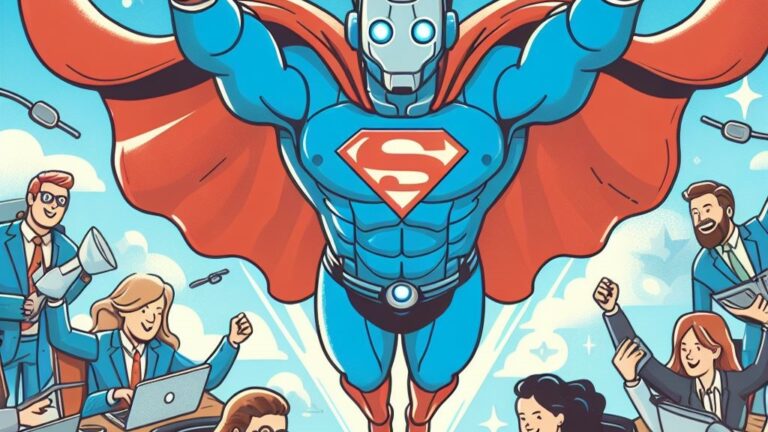
Forget flying cars and robot overlords for a sec, Manufacturing CIOs. Let’s talk about the real AI revolution happening right under our hard hats – right now, in 2024!
This ain’t no sci-fi pipe dream, this is industrial-grade, grease-stained, game-changing stuff. So strap on your data goggles, fire up the algorithms, and prepare to conquer the factory floor with these top 10 AI tactics:
1. Predict the Unpredictable: Think your machines are invincible? Think again. AI can sniff out equipment gremlins before they turn your production line into a spaghetti junction. No more surprise breakdowns, just smooth sailing into profit town.
2. Quality Control on Steroids: Human inspectors? So 20th century. AI hawk-eyes can spot defects smaller than a gnat’s toenail, 24/7, ensuring your products are so flawless, Michelangelo would weep with envy.
3. Inventory? More Like I-Know-Ventory: Ditch the dusty spreadsheets and embrace the AI oracle. It’ll predict demand with spooky accuracy, keeping your shelves stocked without overflowing, saving you storage space and sanity.
4. Supply Chains that Sing: Gone are the days of frantic phone calls and crossed fingers. AI can navigate the global logistics labyrinth, optimizing routes, prices, and deliveries, making your supply chain sing like a well-oiled machine (or maybe a well-oiled, well-organized opera singer).
5. Maintenance Magic: Forget clunky maintenance schedules. AI can listen to your machines whisper their woes, pinpointing issues before they become disasters. Think of it as preventative medicine for your factory floor.
6. The Efficiency Whisperer: Your production line may think it’s running at peak, but the AI efficiency whisperer knows better. It’ll tweak processes, suggest micro-adjustments, and squeeze every ounce of productivity out of your operation, like a fuel-efficient Formula One pit crew for your robots.
7. The Customer Whisperer (Yes, Another One): AI can analyze customer data like a seasoned therapist, uncovering hidden desires and predicting future needs. Use this intel to personalize marketing, predict demand, and basically become the Willy Wonka of your industry.
8. Safety First, Always: AI can be your guardian angel on the factory floor. It can monitor safety protocols, spot hazards before they happen, and even help train your workforce, making your workplace safer than a bubble-wrapped bouncy castle factory.
9. Upskilling, Not Replacing: Don’t fear the robot uprising, embrace the AI collaboration. Use AI to upskill your workforce, freeing them from tedious tasks and letting them focus on the stuff that truly requires human ingenuity. Think of it as giving your team rocket boots for their brains.
10. Remember, You’re the Captain: AI is a powerful tool, but it’s not a magic wand. Keep control, define clear goals, and ensure your AI initiatives align with your overall strategy. You’re still the captain of this ship, CIO, just make sure your AI first mate is pulling its weight (and not plotting a mutiny).
So there you have it, Manufacturing CIOs, the top 10 ways to unleash the AI kraken and transform your factory floor into a profit-churning, efficiency-blasting oasis. Just remember, with great AI power comes great responsibility. Use it wisely, and you’ll be laughing all the way to the bank (or at least the break room for some celebratory donuts). Now go forth and conquer!
Hey there, Sales Champions! DB here, your AI sales tech advisor in the quest for revenue dominance. Remember that sci-fi movie where robots took over the world?
Relax, this ain’t that. Think of AI as your ultimate sales wingman, amplifying your skills and crushing those sales quotas like a Kryptonian on its first bowl of Frosted Flakes! They’re Great!!!
So, what’s our trusty AI crystal ball whispering about 2024 sales tech you ask? Buckle up, because AI is about to unleash a seven-course feast of awesome sauce in the sales tech arena:
1. Hyper-Personalized Prospecting: Say goodbye to cold calls that send shivers down spines. AI will sift through oceans of data, unearthing ideal prospects who fit your buyer persona like a glove. Imagine targeted outreach that feels like a warm introduction from a mutual friend, not a robot on autopilot.
2. Predictive Pipeline Power: Forget gut feelings and crossed fingers. AI will analyze your pipeline with laser focus, pinpointing deals at risk and predicting future outcomes with uncanny accuracy. No more scrambling at the end of the quarter – you’ll be proactively steering deals to close like a seasoned captain navigating calm seas.
3. Conversational Conquering: Ditch the robotic scripts and embrace the power of natural language processing. AI-powered chatbots will engage prospects in real-time, answering questions, scheduling demos, and qualifying leads, all while you’re busy closing that big deal. Think of them as your tireless assistants, freeing you up for the high-impact stuff.
4. Content Craft master: Struggling to churn out killer content that resonates with your audience? AI will be your secret weapon. It can analyze trends, craft personalized messaging, and even generate different content formats (think blog posts, social media captions, even video scripts!) tailored to your ideal customers. Just add your sales magic, and boom – content goldmine.
5. Objection Obliteration: Dealing with objections can be like wrestling a greased pig. But AI can be your jiu-jitsu master, analyzing customer sentiment and predicting potential objections before they even surface. Armed with this intel, you can craft pre-emptive responses that turn roadblocks into steppingstones.
6. Automated After-Sales Awesomeness: The sale doesn’t end at the closing line. AI can automate post-sales tasks like sending personalized onboarding emails, scheduling follow-up calls, and even analyzing customer sentiment to nip churn in the bud. Think of it as building lasting relationships, on autopilot.
7. Sales Coaching Sensei: Want to become a sales rockstar? AI can be your Yoda, analyzing your calls, emails, and presentations to identify areas for improvement. Get personalized feedback on your communication style, objection handling, and even body language. It’s like having a 24/7 sales coach in your pocket, pushing you to reach your full potential.
Lightning – Not AI
So, are you ready to unleash the power of AI in your sales game? Remember, it’s not about replacing you, it’s about augmenting your awesomeness. Embrace the tech, stay ahead of the curve, and watch your sales soar like an eagle with rocket boots. Onward to revenue utopia, Sales Champions!
P.S. Don’t forget to share this post with your fellow sales warriors. Knowledge is power, and sharing is caring!
David is an investor and executive director at Sentia, a next generation AI sales enablement technology company and Salesforce partner. Dave’s passion for helping people with their AI, sales, marketing, business strategy, startup growth and strategic planning has taken him across the globe and spans numerous industries. You can follow him on TwitterLinkedIn or on Sentia AI Community.
There are so many ways you can use AI in sales these days, it’s hard to know where to start, especially if you’re a newbie to all of the excitement. So, this article will focus on something almost everyone in the business world uses, knows, and understands how It can be used right now, on every business persons favorite, LinkedIn.
Using AI with LinkedIn selling can enhance your sales and marketing efforts by automating tasks, providing valuable insights, and streamlining processes. As noted in previous articles, to maximize AI’s usefulness it requires a combination of Blended AI* and Augmented AI** to maximize its impact.
Franck-v-YKWOJjP7rlU-Unsplash
10 ways to use Augmented & Blended AI with LinkedIn
1. Personalized messaging: AI-powered tools can analyze data from LinkedIn profiles and interactions to create personalized messages that resonate with individual prospects, increasing engagement and response rates.
2. Relationship insights: AI can analyze communication patterns and interactions with prospects to provide valuable relationship insights, such as the best times to reach out or the most effective ways to engage with specific individuals.
3. Lead generation and prospecting: AI algorithms can help identify and prioritize potential leads based on specific criteria identified in your sales process, such as job titles, industries, or geographic locations, making your prospecting efforts more efficient.
4. Sales forecasting: AI-driven analytics can analyze historical data, sales patterns, and market trends to provide more accurate sales forecasts, helping you plan and strategize your selling efforts better.
5. Competitor analysis: AI can gather data on competitors’ activities and strategies on LinkedIn, providing valuable insights to refine your own selling approach and stand out in the market.
6. Performance tracking and analytics: AI-driven analytics can measure the effectiveness of your LinkedIn selling efforts, tracking key performance indicators (KPIs) like response rates, conversion rates, and engagement metrics. This data allows you to continuously improve your strategies.
7. Content recommendations: AI can analyze user behavior and preferences to suggest relevant content, such as articles, blog posts, or videos, that align with your prospects’ interests and pain points.
8. Social listening and sentiment analysis: AI tools can monitor conversations and discussions on LinkedIn to gauge the sentiment around your brand and industry. This information can help you tailor your messaging and identify potential opportunities or challenges.
9. Automated follow-ups: AI-powered sales automation tools can handle routine follow-up tasks, sending timely messages and reminders to prospects, helping to maintain engagement and nurture leads.
10.Chatbots for instant responses: Implement AI-driven chatbots on your LinkedIn profile to provide instant responses to common questions, qualify leads, and engage with prospects at any time, improving customer experience and response times.
There is no single AI tool (yet) that can accomplish all ten use cases noted on my list and it isn’t necessarily in order of usefulness. Instead, each seller must ascertain what is most important in their sales efforts and then use Blended AI to attack their sales patch in a coordinated and concise manner. Best practices are to pick a vendor that know what is actually working to advise when to use it and when not to, because:
The key isn’t using AI.
The key is using the right AI with your already successful, winning Sales Process and applying the right form of AI at the right stage in the sales process. That is the Winning Ticket!!!
Bottom line
By leveraging Augmented and Blended AI in your LinkedIn selling efforts, you can streamline working sales processes, deliver a significantly more personalized experience for your target audience, and make data-driven decisions (not just gut feelings), ultimately increasing each seller’s success rate by connecting with the best prospects and converting them into valuable customers.
*Blended Artificial Intelligence Is the amalgamation of different artificial intelligence techniques or approaches to achieve more robust and effective solutions. It involves integrating multiple AI models, algorithms, and / or technologies to leverage their respective strengths and compensate for their weaknesses. See Wikipedia:
** Augmented artificial intelligence is a design pattern for a human-centered partnership model of people and artificial intelligence (AI) working together to enhance cognitive performance, including learning, decision making and new experiences.
Venture Capitalists weren’t born in the Matrix but sometimes it can feel that way if you’re a startup looking for capital.
They will invest in startups that have the right idea and key people to solve a big hairy problem with a large amount of potential revenue or users, needed for a successful VC exit. Whether its in the Metaverse or Matrix all VC’s want one thing.
Startups must scale very quickly to be successful.
Developing a scalable sales tech stack takes time and requires a very flexible and rapidly scalable CRM platform to manage all the sales tech data pipes. Startups must focus on keeping things as simple as possible for end users but still give them the right actions to do at the right time. This can be expensive for startups since they are often forced to pivot as they learn what is working or not. By building flexible and scalable tech systems from the beginning their odds of succeeding improve dramatically.
Entrepreneurs must consider what a VC or Investor maybe looking at when evaluating their company for a potential investment – at least from “What are they Going to Sell” perspective.
With that in mind. This is what VCs are looking for when evaluating your startup sales tech stack:
5 Reasons Why VCs Want You to use CRM / Sales Technology
Improved Revenue: A high-quality CRM properly implemented can help a Startup manage its sales pipeline more efficiently, resulting in improved sales and revenue. This helps boost the startup’s valuation and obviously more attractive to investors.
Superior Customer Engagement: A CRM can help a startup improve its customer experience by providing insights into customers behavior, preference and needs. This can help the startup develop better products and services, resulting in increased customer loyalty and higher revenue.
Operational Efficiency: A high-quality CRM can help a startup streamline its sales and marketing processes, resulting in improved operational efficiency. This can lead to cost saving and increases profitability, which can make the startup more attractive to investors.
Data Insights: A CRM can provide valuable data insights that can help a startup make more informed business decisions. This can help the startup develop more effective strategies, leading to improved revenue and profitability.
Scalability: A top CRM can help a startup scale its sales and marketing efforts more effectively and quickly. This can help the startup expand its customer base and grow its revenue, which can make it more attractive to investors.
Investors want startups to succeed or fail fast!
Their investment window is dependent on some of their investments growing quickly and that is where they need to focus, while others will fail and need to get off the books/harvest patents.
Many VCs prefer that you use Salesforce as it is the number one selling CRM.
They know they can get people to configure and implement the system, most sales people are familiar with it and it’s enterprise grade so scaling isn’t a big concern. It ticks a big funding box.
Next – whether a VC prefers a startup with Salesforce CRM or no CRM would depend on several factors. In general, if a startup already has a Salesforce CRM, it often indicates that they already have a well defined sales process and are using data to inform their decision-making. This makes their evaluation easier as they can see actual numbers vs. a hockey stick graph.
However, the absence of a CRM doesn’t always mean a startup is less attractive. VC’s maybe willing to invest in early stages of development – especially if a clear value proposition is backed by a clear sales process tracked to achieve rapid growth. Often VC’s have favorite CRM implementation partners that can quickly come in and set things up because they have a repeatable process in place.
One other way VC’s use CRM’s is to look at the numbers every day. Leading CRM AI packages (Such as Sentia) show VC’s every one of their investments in a simple dashboard showing daily sales, outbound activities and tracking to quota. They don’t have to call the CEO, they see it in real time. Most VCs like this because it reduces surprises and uncertainty.
Ultimately, whether a startup has a Salesforce CRM or no CRM it’s only one factor that VCs consider when evaluating potential investment opportunities. The most important factors are the startups overall business plan, the problem they plan to solve, quality of chosen team, potential for growth and profitability, and often most importantly how does your startup fit in the VC investment strategy and ten-year plan.
2023 will go down as the year of AI in business school history books. Rarely has a new technology evolved so quickly, gained wide spread use nor stirred as much concern as Artificial Intelligence. Regardless of where people stand on the use of AI (see 1984 “The Terminator“) it is already well entrenched in the business world and its use is only going to expand.
In this regard I’m going to focus on the top ten applications of AI in Sales systems so far. Sales tech stacks are usually the first ones impacted in any business organization because it is the most visible profit (or loss center). There is zero doubt that AI is rapidly transforming the sales landscape. We’re seeing the introduction of so many innovative applications that enhance efficiency, improve customer experiences, and boost sales performance its hard to know where to start, nor completely understand what is coming.
With that being said I’m going to put a stake in the proverbial ground and start with what I think are the top 10 things I see AI doing right now that are dramatically affecting sales systems:
2023’s Top 10 new applications of AI in sales tech:
AI-powered Sales Coaching and Training: Coaching tools can analyze every sales conversation or interaction, identify areas for improvement, and provide real-time feedback for sales reps. This AI augmented and personalized approach helps reps refine their communication skills, build stronger relationships with potential customers, and close more deals. It does this without a manager, trainer or supervisor needing to spend “time” with a sales rep. It can be self sourced and used when the rep wants it or by a manager to see how a rep is performing without having to have those “difficult conversations” where a customer calls and says XYZ is terrible, you need to get rid of them! It is no longer a she said, he said as it is all recorded.
AI-driven Predictive Sales Forecasting: AI algorithms analyze historical sales data, market trends, and customer behavior to predict future sales performance with greater accuracy (this assumes clean data!). This enables sales teams to make informed decisions about resource allocation, target customer segments, and sales strategies. As always the better the data that is input (Sales Reps are notorious for not using their CRMs) the more likely AI can improve predictive forecasting.
AI-enabled Lead Qualification and Prioritization: AI models assess leads based on various factors, such as firmographic data, website behavior, and engagement patterns, to identify the most promising leads. This helps sales reps focus their efforts on the most qualified leads, increasing their chances of closing deals.
AI-powered Sales Content Generation and Personalization: AI tools can generate personalized sales and marketing content, such as email templates, social media posts, and sales pitches, tailored to the specific needs and interests of each buyer persona/prospect. This personalized approach can increase engagement and conversion rates.
AI-driven Conversational Sales Chatbots: AI chatbots can engage in real-time conversations with potential customers, answering questions, providing product information, and scheduling demos. This 24/7 availability and personalized interaction can enhance customer experience and capture leads early in the sales cycle.
AI-powered Sales Incentive Compensation and Optimization: AI algorithms can analyze sales data and performance metrics to determine optimal incentive compensation plans that motivate reps and drive sales growth.
AI-enabled Sales Territory Planning and Optimization: AI models can analyze market data, customer demographics, and sales performance to identify optimal sales territories that maximize revenue potential.
AI-powered Sales Prospecting and Discovery: AI tools can identify and prioritize potential customers based on various factors, such as firmographic data, website behavior, and social media engagement, helping sales reps uncover new opportunities.
AI-driven Sales Opportunity Management and Deal Coaching: AI can analyze sales opportunities, identify buyer intent, potential risks and roadblocks, and provide real-time coaching to sales reps to increase their chances of closing deals.
AI-powered Sales Workflow Automation: AI tools can automate repetitive sales tasks, such as data entry, email follow-ups, and scheduling appointments, freeing up reps to focus on more strategic activities.
The key element to all ten of these AI use case applications is “CAN.” Every single one of these requires a blended AI experience to make it work. None of these can successfully operate without human interaction either in the development, use or tweaking of them. In fact AI is so new in most of these applications that if you don’t have a trained human available to constantly watch, improve and tweak any of these AI’s on a regular basis I would be very concerned about deploying them.
With that in mind we need to focus on the number one tool that most sales reps both hate and must use on a fairly regular basis, CRM (Salesforce says 26% daily usage for CRMs). CRMs or Customer Relationship Management software is an $80Billion dollar business but the failure rates are surprisingly high. I wondered if AI could solve this problem and turned to CRM experts for the answer.
I spoke with renowned CRM expert and best selling Author Mike Hudlow (see “How not to F*CK up a CRM system“) on these top ten AI solutions and asked him – What is the biggest problem with CRM systems right now?
Mike said: “”Human Change Management” is the key reason systems fail. But, unfortunately there are many reasons that this can occur. The reality is that people like to blame the technical system itself but any modern CRM system is capable of improving a companies CRM process/workflow. The challenge for any program/product/project manager, CIO, CTO, CMO or person in charge of the CRM to make it both welcomed and desired. Sounds scary human doesn’t it? A CRM can and will be resisted by: 1) those that don’t trust it, think its needed and/or believe that others will steal their own personal IP, 2) those divisions within a company that think it is too expensive, 3) People or teams that believe that the system will replace another system to which they are attached (career or emotionally ), 3) or people that actually or perceptually believe it creates more work, and 4) leaders that feel it infringes upon their own autonomy.”
My second question to Michael was can any of these top ten AI enhancements solve those problems?
Mike replied: “At the end of the day an AI supplemental tool can improve many of these as it makes the native CRM tool “bend” to their own style and will make them more comfortable with the AI’s ability to bridge the gap, bend to their own style, and allow them to let the CRM system they don’t feel comfortable with be more “human” and meet their own specific needs”
I then turned to AI Visionary and Sales Process Expert David Forder for an AI perspective on CRMs and AI. My question was simple yet nuanced. Can AI solve the biggest problems in CRM i.e., no sales rep wants to use it?
David replied: “The biggest issue that CRMs face is a lack of user adoption. 74% of customer facing staff refuse to use their CRM every single day. Yet companies spend billions of dollars on it! Adding AI into the mix has the potential to make this even worse! Unless any AI integration improves the underlying complexity of using a CRM and makes them simpler and more effective it will definitely make it worse not better! This has to be the focus of AI.”
I then asked Mr. Forder – how do you make it simpler? Get sellers using it?
David’s reply: “The key to making the CRM simpler is to ignore what will appeal to C-Suite i.e. ignore the focus on data heavy screens, reports and dashboards and re-engineer the CRM to meet the needs of the bulk of the users – those customer facing teams. Design the CRM to meet their daily needs, so they want to use it as it does the work for them. If you do this they will embrace their CRM and it can then work effectively for C-Suite as the data will actually be in the system! That’s our focus at Sentia AI! Have your CRM do most of the work for them, tell them what to do next and watch usage rates explode!”
Both Mike’s and David’s battle scars, extensive CRM implementations, sales experience and knowledge made me think I should interview both of them and get their thoughts on video for everyone to learn from. So we’re going to do it and here is the link:
This may turn into two video segments as the topic is so timely, important and I found that the breadth and depth of their CRM and AI system implementation experience was quite simply amazing!
These gentlemen have their finger on the pulse of sales, AI & CRM implementation success. It will be a great how to “fix it” roundtable.
Please join us on November 29th for an in-dept on how not to F*CK up A CRM system with AI!
David is an investor and executive director at Sentia AI – The Intelligence Engine, a next generation AI sales enablement technology company and Salesforce partner. Dave’s passion for helping people with their AI, sales, marketing, business strategy, startup growth and strategic planning has taken him across the globe and spans numerous industries. You can follow him on TwitterLinkedIn or on Sentia Says.
One of the most obvious outcomes from the covid pandemic & the turbulent political environment over past few years is a recognition that we all tend to cling to our opinions and beliefs very, very tightly.
“I just know it” is often said; sometimes in the face of overwhelming evidence to the contrary.
But where does this certainty come from and just how sturdy is that foundation?
There is a word for this phenomena.
The Dunning-Kruger effect is a cognitive bias where people with limited competence in a specific domain overestimate their abilities. It occurs because they lack self-awareness and cannot accurately assess their own skills. Essentially, they think they know more than they do.
The initial study by David Dunning and Justin Kruger in 1999 focused on logical reasoning, grammar, and social skills. It revealed how people often misjudge their abilities due to a lack of metacognition (the ability to analyze one’s own thoughts).
Fact is, our thoughts and opinions are actually related closely to our memory.
Typically our opinions, our beliefs and our sense of self comes from,
Cognitive biases: These relates to systematic errors in thinking that affect how people process and interpret information; and they certainly influence their beliefs and decisions. Many cognitive biases are related to memory, such as confirmation bias, which is the tendency to seek out and remember information that confirms one’s existing opinions, or hindsight bias, which is the tendency to remember past events as more predictable or consistent with one’s current views than they actually were.
Emotional memory: This is the memory for events that are emotionally arousing or significant. Emotional memory is enhanced by the release of stress hormones that act on the amygdala, a brain region involved in processing emotions and fear. Emotional memory can affect opinions by making them more vivid, persistent, and more influential on behavior. However, emotional memory can also be inaccurate or intrusive, leading to false or distorted recollections of events that may affect opinions.
Narrative memory: This is memory for autobiographical events that are organized into coherent stories that give meaning and context to one’s life. Narrative memory is influenced by one’s concept of self, goals, values, and culture. Narrative memory can affect opinions greatly by shaping one’s identity, worldview, and sense of purpose. However, narrative memory can also be selective, reconstructive, and influenced by external sources, leading to inconsistencies or gaps in one’s personal history that may affect opinions.
So, if our opinions are linked inexorably to our memories. How good is yours?
Perceiving oneself as having a great memory is critical to every individual’s confidence, well-being, and daily functioning.
When we trust our memory, we approach tasks with confidence, whether it’s recalling information needed to do your job, approaching an exam or remembering important dates.
Feeling that our memory is reliable boosts our overall self-esteem and encourages us to take on challenges.
Memory enhances social interactions. Remembering names, details, and shared experiences makes us more likable and relatable.
Workplace: Professionals rely on memory for productivity. From meetings to deadlines, memory competence contributes to success.
Reducing anxiety: Fear of memory lapses can cause stress. Feeling confident in our memory alleviates anxiety.
Nostalgia: A vivid memory lets us relive cherished moments, fostering positive emotions.
And, a good memory accelerates learning. We build on past knowledge, adapt, and innovate.
This all leads us to want to over-estimate just how great our memory is.
I know that we all want to feel that our own memory is an amazing recording device; accurately taking note of the details of everything that we have experienced, read, visited and heard about. But the unfortunate fact is that it is not!
Elizabeth Loftus, one of the World’s leading experts on human memory, says, “If memory is the bedrock of the self … it is built on shifting sands.”
No-one has done more than psychologist Loftus (from the University of California, Irvine,) to expose the fallibility of human memory. In the 1990s, amid growing panic over claims of satanic abuse rings, the psychologist showed how easy it is for people to develop false memories of events that never ever happened.
All it took was being asked repeatedly to imagine them. At the time, unfortunately, this was a common psychotherapy technique to recover supposedly ‘repressed memories’.
Over the past three decades, Loftus, has become well-known for her work as an expert witness in legal cases. Her ongoing research on the fallibility of eyewitness testimony has taken on fresh importance in an era of fake news, the Me-Too movement and digital image manipulation. (1)
Elizabeth Loftus has found ordinary memory to be so malleable that she can easily prompt volunteers to “remember nonexistent broken glass and tape recorders; to think of a clean-shaven man as having a mustache, of straight hair as curly, of hammers as screwdrivers, to place a barn in a bucolic scene that contained no buildings at all, to believe in characters who never existed and events that never happened.”
“We now have a new paradigm of memory,” notes Loftus, “where memories are understood as a creative blending of fact and fiction, where images are alchemized by experience and emotion into memories.” (2)
So, we have established that our opinions, the facts we just KNOW, the statements we make, the feelings we believe, in fact most of our day-to-day activity relies heavily on memory.
So how chilling is it that this memory of ours is so malleable, that it changes over time, that it can be easily re-made by suggestion, and is so tenuous.
I guess you could say that a lot of the things we truly ‘believe’ could well be hallucinations of sorts?
Much like AI’s sometimes do.
AI ‘hallucination’ refers to a phenomenon where large language models (LLMs), such as OpenAI’s GPT-4, Bard AI or Google’s Palm, can generate outputs that contain false or misleading information presented as fact.
These outputs are sometimes nonsensical or altogether inaccurate and may not align with real data or events at all. Sounds human to me.
These are often reported on and discussed as a major hurdle to the use of artificial intelligence – but just how different is this really to asking a business colleague for help and assuming they actually know what they are talking about?
Or perhaps relying on your own memory to solve a problem assuming that your memory must obviously be correct?
If human memory and knowledge is as fallible as the ‘facts’ suggest, I feel that we may be giving AIs a bad rap! It may be that they are far more human than we would like to admit!
In a surprising turn of events, OpenAI, the renowned organization dedicated to developing artificial intelligence responsibly, finds itself at the center of controversy. The founder’s recent departure, allegedly due to a lack of transparency in internal communications, has raised eyebrows and sparked discussions about the intersection of ethics and profit in the realm of artificial intelligence.
The Departure:
Over the weekend, OpenAI’s founder stepped down amid accusations of inconsistent candor in communications. The vague reasoning behind this decision has fueled speculation on social media, leaving both the tech community and the general public curious about what might be happening behind closed doors.
The Stakes:
The significance of this shakeup extends beyond the internal dynamics of OpenAI. Artificial intelligence, often considered a potential existential threat to humanity, demands trustworthiness and stability from those leading its development. OpenAI, originally positioned as a not-for-profit organization, faces scrutiny as questions arise about the compatibility of responsible AI development and profit-driven motives.
Altruism Meets Capitalism:
OpenAI’s mission to prioritize responsible tech development over profit is now in the spotlight. As the world’s media closely watches the aftermath of this leadership change, concerns about potential hidden agendas within the organization may come to light. If the conflict indeed revolves around prioritizing profit over ethical considerations, it raises broader questions about the feasibility of balancing responsible AI with profit-driven initiatives.
Microsoft’s Role:
With Microsoft owning a significant 49% stake in OpenAI, the tech giant is now under increased scrutiny. Not only did Microsoft absorb two ex-OpenAI entrepreneurs, but it also granted the ousted founder a position within its ranks. As the drama unfolds, Microsoft’s potential influence over OpenAI’s future is a topic of speculation. The private company, valued at around $90 billion, may face further upheaval as employees express discontent over recent changes.
The clash at OpenAI serves as a stark reminder of the challenges inherent in navigating the delicate balance between ethics and profitability in the development of artificial intelligence. As the tech community awaits further developments, the incident prompts broader reflections on the future of responsible AI and the role of profit-driven interests in shaping the trajectory of this transformative technology.
Within every entrepreneur lies a superhuman. That superhuman persona is capable of changing the world, earning billions, making a huge impact and living their best life. But here’s the problem: most people don’t awaken their inner superhuman. They live normal, mundane lives. They copy other people and try to fit in. They argue for their limitations, they act like there’s a ceiling. What if you could remove these barriers to becoming that version of you?
Daniel Linden is co-creator and chief AI officer of chiefaiofficer.com, suitably titled DanThePrompt on Twitter. His company helps companies adopt AI by training and certifying C-suite level, ambitious and curious individuals who will take the role of chief AI officer. Linden is using the transformative power of AI to not only enhance operational efficiency, but innate human potential.
Linden’s been using ChatGPT to prompt his way to success and is sharing these multi-stage prompts so you can unlock your superhuman potential.
Stop playing small: ChatGPT prompts to become superhuman
Superhuman memory: elevate recall and retention
In business, possessing a sharp memory can be a potent advantage, from recalling intricate details during meetings to remembering stakeholder preferences. You want to remember your elevator pitch word for word, the name of the people you met at an event, and pointers to include in every sales call. Use this prompt, created by Linden, to set your memory up for effectiveness and success. Open the conversation and ChatGPT will guide you through the rest.
“Let’s embark on a journey to unlock my superhuman memory. Let’s start by identifying a deeply familiar setting which will form the foundation of my memory palace. Once I’ve described this setting, I’d like you to summarize its significance as a mnemonic anchor. Next, I’ll provide specific items or landmarks associated with this place, which will become our memory anchors. After this, we’ll delve into the emotions or feelings I associate with each anchor, enhancing our mnemonic associations. Then, guide me to create a journey or sequence through my setting ensuring I encounter each anchor, crafting the navigational blueprint of my memory palace. We’ll also discuss any actions or interactions related to these anchors to further boost my memory retention. Finally, provide a summary reflection on the design of my memory palace, offering strategies for its use and potential evolution.”
The rise of generative AI models in the Big Tech industry has been swift and undeniable. The surge in interest was catalyzed mainly by OpenAI’s introduction of ChatGPT-3 on November 30, 2022. A generative AI language model that is incredibly good at predicting which words should follow one another when you feed it with prompts. Not to be left behind, Google had been developing a similar technology known as LaMDA. However, after OpenAI’s ChatGPT took the world by storm, the company was forced to release an early version of its AI model.
That’s how we got Bard, Google’s first publicly available chat-based generative model. Considering the competition, a key question comes up. Can Google Bard keep up with OpenAI? To find out, we compared ChatGPT-3.5, ChatGPT-4, and Bard to see how they performed in different tasks.
Do you find yourself distracted by notifications when you’re on Zoom calls with clients? Do you find your eyes glazing over when you’re talking to colleagues? When was the last time you switched airplane mode on? Entrepreneurship involves juggling multiple tasks and running a team, all while thinking about the future and your place within it. Assessing past mistakes is required, as is planning ahead, but both can take you out of the present moment. And that’s where the magic happens.
Being more present in your business is a sterling goal. You’ll miss less, you’ll understand more, and you’ll have a better time. Use these five ChatGPT prompts to become more present in your business activities, whatever they may be. Copy, paste, and edit these prompts in the same window for personalized guidance with complete context.
Be more present in your business with these ChatGPT prompts
Recognize your distractions
The first step is self-awareness. What distracts you? Which apps do you open without thinking, what are you typing into Google when your to-do list isn’t done, and what is leading you out of the present and somewhere else entirely? Once you know what they are, figure out what it means. In the puzzle of motivation, your higher desires will always win out. Find out what your actions are telling you about what you really want.
“Reflecting on my daily activities, I realize there are certain habits or distractions that pull me away from my core tasks. Can you guide me through a self-assessment to identify these distractions, such as [mention specific apps or behaviors you suspect], and help me understand what these actions might be revealing about my deeper desires or motivations?”
Prioritize mindful communication
If you’re not paying attention when someone is talking, you’re missing so much information. It’s not just what they say, it’s how they say it. Their tone, their body language, their facial expression. Plus, what are they not saying? For effective collaboration and leadership, mindful communication is essential. Being present during conversations can make a world of difference. Get ChatGPT’s help in doing it right.
“In my business interactions, especially during [describe the type of conversations you typically have in your working week], I recognize the importance of being fully present. Can you give me techniques that will help me focus on not just the words spoken, but also on cues like tone, body language, and the unspoken messages? After that, give some reflective questions for me to work out how I can enhance my mindful communication to foster better collaboration and leadership in these specific scenarios.”
Practice being in the here and now
Sometimes, we miss what’s happening right in front of us because we’re either dwelling on the past or fretting about the future. The past has no place in your present. You lived it, you learned from it, and now it’s time to move on. The future is alluring but spending too much time there is a trap. Focusing on putting one foot in front of the other will take you closer to your goals than spending every minute daydreaming. Practice letting go of the past and using visualisation as a tool, not something that replaces over taking action.
“In my business journey, I often find myself either ruminating on past events or getting lost in future possibilities, especially during [describe specific situations or types of tasks that trigger these feelings]. Can you give me a powerful pep talk, in the style of [your favourite motivational speaker or character from a film or book] to help anchor me in the present moment and assist in letting go of past concerns? Within this pep talk, the speaker should use visualization as a tool to help me stay present and not get stuck in the past or future.”
Incorporate mindfulness techniques
It’s easy to jump out of bed and straight to your laptop, then disappear into a flurry of emails and meetings until you collapse back in, exhausted. But mindlessly grinding away without thinking about what you’re doing benefits no one at all. Incorporating tried-and-tested mindfulness techniques can help you become more present for your health, success and happiness. Here’s the prompt for ChatGPT.
“Given the hectic nature of my business days, where I often find myself [describe a typical busy routine or specific tasks that consume your day], I’m looking for ways to be more grounded and intentional. Can you introduce me to some effective mindfulness techniques tailored to my described routine that I can incorporate to enhance focus, well-being, and overall productivity?”
Check in with yourself
Periodic check-ins can help you maintain a consistent level of presence in your business operations. Incorporate the science behind forming habits, and tie your check-ins to things you already do. When you’re waiting for the coffee machine, ask “How am I feeling?” When you’re brushing your teeth, take note of your disposition. Get ChatGPT’s help finding these moments for checking in with yourself and suggesting what you should ask.
“In the midst of my daily routines, I want to establish regular moments for self-reflection. Considering the activities I already do, like [describe some daily habits or routines such as waiting for a meeting to start or taking a lunch break], can you suggest specific checkpoints where I can check in with myself? Additionally, what introspective questions should I pose during these moments to ensure I remain present and aligned with my business goals?”