Tag: CFO

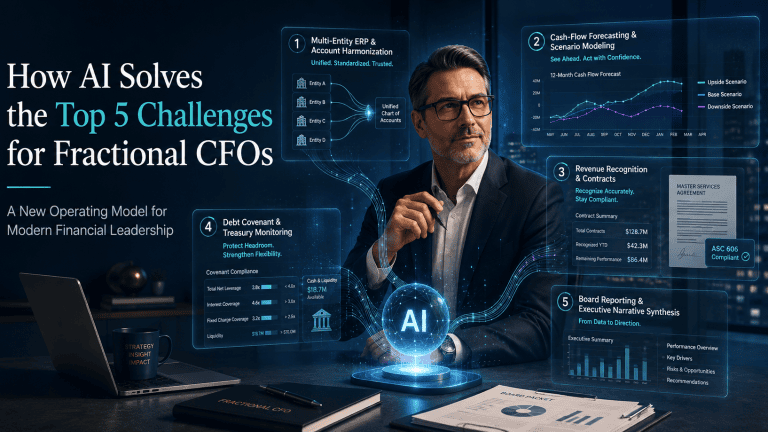
  • Enterprise Financial Orchestration: Five Critical Fractional CFO Challenges solved by Modern Artificial Intelligence

    Enterprise Financial Orchestration: Five Critical Fractional CFO Challenges solved by Modern Artificial Intelligence

    The rapid expansion of the fractional executive model has transformed corporate finance leadership, enabling high-growth startups, private equity portfolio companies, and middle-market enterprises to leverage tier-one financial stewardship without the fixed overhead of a full-time Chief Financial Officer. However, the operational reality of the Fractional CFO (fCFO) is defined by extreme structural complexity. Managing multiple client portfolios requires navigating disparate software ecosystems, fragmented data structures, unpredictable cash flows, and strict regulatory standards under severe time constraints.

    While early-generation automation focused on broad administrative workflows—such as basic CRM updates, email scheduling, and high-level sales pipeline tracking—these tools fail to address the core quantitative and analytical burdens of strategic corporate finance. Fractional CFOs do not merely manage relationship context; they hold fiduciary responsibility for financial integrity, capital allocation, risk mitigation, and strategic growth narrative.

    Artificial intelligence architectures have evolved beyond generic task assistants into specialized, autonomous operating layers capable of tackling the deep operational bottlenecks unique to corporate finance. This report examines the top five technical and operational challenges faced by Fractional CFOs that advanced AI systems solve, focusing on specialized financial execution domains distinct from general sales and revenue operations literature.

    Challenge 1: Multi-Entity Chart of Accounts Harmonization Across Disparate ERP Systems

    Fractional CFOs frequently oversee portfolio companies operating on completely heterogeneous enterprise resource planning (ERP) platforms—ranging from cloud-native software like QuickBooks Online and Xero to enterprise platforms such as NetSuite, Sage Intacct, and SAP. Each entity maintains its own custom Chart of Accounts (COA) with unique account numbering, naming conventions, and transaction categorizations.

    When delivering consolidated financial views for holding companies, private equity sponsors, or parent-subsidiary structures, the CFO must manually extract raw trial balances and perform cell-by-cell mapping into a standardized master taxonomy. This manual process introduces substantial human error, delays month-end closing cycles, and makes real-time financial comparisons across client business units nearly impossible.

    Modern artificial intelligence solves this systemic friction through semantic schema-mapping engines and natural language processing models fine-tuned on US GAAP and IFRS accounting frameworks. The pipeline begins when raw transaction data is continuously ingested via APIs from disparate client ERPs. Rather than relying on rigid, rule-based database queries that break whenever a client adds a new GL account, the AI engine evaluates the semantic intent, historical transaction behavior, and underlying metadata of atomic journal entries.

    The AI system autonomously categorizes incoming transaction lines into the master reporting taxonomy, reconciles intercompany eliminations, and flags mapping anomalies for executive approval. This transforms a manual mapping process into a dynamic, real-time consolidation architecture.

    Financial Operation DimensionLegacy Manual ParadigmAI-Native Semantic Engine Paradigm
    Data IngestionBatch CSV exports from individual client ERPsContinuous API telemetry ingestion across all platforms
    COA Standardized MappingManual spreadsheet VLOOKUPs and account re-classificationSemantic neural matching against standardized GAAP/IFRS taxonomies
    Intercompany ReconciliationsPeriodic end-of-month manual elimination entriesAutomated real-time matching of intercompany ledger balances
    Anomalous Entry DetectionRetrospective spot-checking during month-end auditsReal-time transaction evaluation with automated outlier flagging
    Consolidation Velocity10 to 15 business days post-month-endNear-real-time continuous financial reporting

    Challenge 2: Stochastic Cash Flow Forecasting and Multi-Scenario Capital Modeling

    Venture-backed and middle-market companies operate in high-volatility environments where liquidity management is the primary determinant of corporate survival. Fractional CFOs are routinely task-oriented around evaluating burn rate, projecting cash runway, and modeling dynamic capital allocation scenarios, such as aggressive hiring sprees, international expansion, product line pivots, or downside economic recessions.

    Traditional financial modeling relies on deterministic, spreadsheet-based driver models. These models are inherently rigid; a single formula error can cascade across tabs, and updating assumptions across five portfolio companies requires dozens of hours of manual recalibration. Furthermore, deterministic models fail to capture stochastic distribution—the probabilistic reality of how revenue collection delays, variable vendor costs, and macroeconomic shifts compound over time.

    Strategic corporate finance requires evaluating dynamic metrics, such as the Burn Multiple, defined as:

    To accurately evaluate capital efficiency under uncertain conditions, the probability-weighted runway  at time  must account for stochastic variance in cash receipts  and cash disbursements :

    Generative financial modeling engines solve this limitation by combining deterministic financial logic with Monte Carlo simulation capabilities. Instead of building static spreadsheet tabs, the fCFO defines core strategic parameters in natural language or baseline financial structures.

    The AI agent autonomously extracts historical cash volatility metrics, models thousands of probabilistic revenue and expense trajectories, and presents the CFO with distribution curves representing best-case, expected, and downside runway scenarios. When market conditions change, the AI agent updates the underlying assumptions across all portfolio financial models simultaneously, providing instantaneous scenario sensitivity analysis without manual cell manipulation.

    Challenge 3: Automated ASC 606 and IFRS 15 Revenue Recognition Decomposition

    For fractional CFOs advising high-growth Software-as-a-Service (SaaS), hybrid hardware-tech, or enterprise services companies, revenue recognition represents one of the most technically complex and risk-laden responsibilities. Under ASC 606 and IFRS 15, revenue must be recognized as performance obligations are satisfied, rather than when cash is received or contracts are signed.

    Enterprise contracts frequently contain non-standard terms, including:

    • Bundled software licenses and professional service hours
    • Variable usage-based pricing thresholds
    • Tiered discount structures and refund clauses
    • Custom milestone delivery sign-offs

    Unraveling these multi-element arrangements manually requires reading dozens of lengthy legal contracts, extracting specific performance obligations, assigning Standalone Selling Prices (SSP), and manually constructing amortization schedules in spreadsheets. Errors in revenue recognition distort financial statements, skew critical SaaS metrics like Annual Recurring Revenue (ARR) and Net Retention Rate (NRR), and create severe valuation write-downs during M&A due diligence or institutional fundraising rounds.

    Advanced multimodal document processing agents eliminate this accounting bottleneck by operating a multi-stage deconstruction pipeline. Executed customer contracts, master service agreements (MSAs), and statements of work (SOWs) in PDF format are ingested by optical character recognition and clause extraction modules. The AI engine parses the legal text to identify distinct performance obligations, calculate relative Standalone Selling Price (SSP) allocations, and flag variable consideration risks.

    The system then auto-generates the corresponding revenue amortization schedules and posts the required debits and credits directly to Deferred Revenue and Recognized Revenue accounts within the ERP, maintaining an immutable, audit-ready compliance trail.

    Challenge 4: Continuous Debt Covenant Monitoring and Treasury Capital Optimization

    As borrowing costs remain elevated, growth-stage enterprises increasingly rely on venture debt, asset-backed credit facilities, and commercial loans to fund operations. These credit facilities are bound by strict financial covenants—such as minimum liquidity balances, maximum leverage ratios, minimum trailing-three-month (TTM) EBITDA thresholds, and strict Fixed Charge Coverage Ratios (FCCR).

    The Fixed Charge Coverage Ratio is calculated as:

    For a Fractional CFO managing 5 to 10 companies, continuous monitoring of covenant health across all credit facilities is an operational challenge. Because financial statements are traditionally updated on a monthly or quarterly lag, a company can inadvertently breach a debt covenant mid-month due to unexpected operational expenditures or delayed receivables, triggering default rates, credit line freezes, or lender warrants.

    Continuous financial monitoring agents solve this visibility gap by establishing persistent API connections between banking institutions, credit card platforms, and ERP backends. Operating as autonomous guardians, these agents continuously calculate real-time covenant ratios and project financial trajectory against lender thresholds weeks into the future.

    If cash drawdowns or revenue deceleration indicate a prospective covenant breach 30 or 60 days out, the AI system triggers proactive executive alerts. It presents the CFO with prescriptive capital reallocation strategies—such as drawing down a secondary credit facility, shifting short-term vendor payments, or adjusting discretionary marketing burn—preventing default conditions long before traditional month-end reports would reveal the risk.

    Challenge 5: Automated Board Narrative Synthesis and Executive Reporting

    Financial data in isolation is ineffective for strategic decision-making. Boards of directors, investors, and founders rely on the Chief Financial Officer to translate complex financial statements, budget-to-actual variances, and operational metrics into actionable strategic insights.

    A significant portion of a Fractional CFO’s billable capacity is consumed by the administrative friction of executive presentation prep:

    • Exporting financial statements into design tools or slide software
    • Calculating period-over-period variance percentages across business units
    • Drafting narrative commentary explaining why gross margins compressed or CAC payback expanded
    • Structuring strategic recommendations for executive leadership

    This narrative synthesis bottleneck creates a structural ceiling on the number of clients a fractional CFO can serve without compromising output quality.

    Financial narrative orchestration engines resolve this friction by establishing an automated bridge between quantitative ledger telemetry and qualitative strategic reporting. The platform continuously ingests general ledger and operational metrics from ERP, payroll, and CRM backends. A quantitative variance engine performs automated bridge calculations, including price-volume-mix analysis and unit economics decomposition.

    The AI narrative engine then translates these variance outputs into concise executive commentary, populating investor presentations with formatted charts, critical risk callouts, and strategic recommendations. This reduces presentation preparation time from days to minutes, allowing the Fractional CFO to focus entirely on high-level advisory and strategic execution.

    Strategic Synthesis: Comparing Fractional CFO Operating Models

    The integration of artificial intelligence into corporate finance transforms the fractional CFO practice from a labor-constrained advisory service into a technology-amplified strategic platform. By moving beyond point-solution automations and adopting domain-specific AI orchestration, fractional executives can scale their client capacity while delivering higher-precision financial governance.

    Operational DomainTraditional Fractional CFO PracticeAI-Orchestrated Fractional CFO Practice
    Multi-Entity ConsolidationPeriodic manual spreadsheet exports; fragile cell-mapping rulesReal-time semantic schema matching and continuous cross-ERP consolidation
    Financial ModelingStatic, deterministic Excel models prone to broken formulasDynamic Monte Carlo scenario modeling with automated parameter updates
    Revenue RecognitionManual legal contract review and spreadsheet amortization schedulesAutonomous contract parsing, ASC 606 obligation extraction, and auto-GL posting
    Covenant ComplianceRetrospective monthly checking; high risk of mid-month defaultPersistent real-time telemetry monitoring with predictive breach forecasting
    Executive ReportingHours of manual chart creation and narrative drafting per clientAutomated variance decomposition and investor-ready narrative generation
    Leverage & Scale LimitHard capacity ceiling at 3–5 portfolio clients due to manual overheadScalable portfolio management (8–12+ clients) with enhanced strategic depth

    Nuanced Operational Risks and Governance Imperatives

    While artificial intelligence offers high operational leverage for financial professionals, deploying autonomous systems within corporate finance introduces specific compliance, legal, and fiduciary considerations that require strict operational governance.

    Hallucination and Financial Misstatement Risk

    Large language models operating strictly as generative probabilistic engines can output plausibly formatted but mathematically incorrect financial data. In corporate accounting, a misplaced decimal or miscalculated discount rate distorts GAAP compliance. Financial AI deployments must utilize deterministic calculation layers—where the AI performs entity extraction and task planning, but delegates mathematical computation to verified financial execution engines.

    Regulatory and Audit Lineage

    Regulatory frameworks, such as the EU AI Act and US SEC financial reporting mandates, emphasize auditability and data provenance. Financial models and automated GL entries generated by AI must maintain complete lineage tracking. Every automated entry posted to a general ledger or revenue schedule must link directly back to the source document—such as a specific clause in an executed PDF contract or a specific bank clearance ID—to ensure full external auditability.

    Human-in-the-Loop Governance Controls

    The architectural flow of financial AI must be gated by human verification before impacting official systems of record. Raw transaction inputs and contract documents undergo automated processing, validation, and preparation by AI agents. However, before outputs are committed to the general ledger or disclosed to external board members, they pass through a deterministic governance checkpoint requiring human-in-the-loop review.

    The Fractional CFO evaluates proposed journal entries, revenue schedules, and strategic narratives, serving as the ultimate fiduciary authority. This architecture ensures that autonomous speed and scale are strictly aligned with human judgment, legal accountability, and regulatory compliance.

    Conclusions

    The evolution of enterprise AI represents a fundamental shift in how fractional corporate finance is conducted. By directly addressing the high-complexity domains of multi-entity schema harmonization, stochastic capital modeling, contract-level revenue recognition, continuous debt covenant monitoring, and board narrative synthesis, financial executives can eliminate the structural manual bottlenecks that previously capped their professional capacity.

    Implementing these architectures transforms the Fractional CFO from a reactive manager of retrospective spreadsheet data into a proactive strategic growth partner equipped with real-time financial intelligence. Organizations that adopt these AI-native financial execution frameworks gain superior capital clarity, accelerated closing cycles, and robust risk governance in an increasingly dynamic market environment.
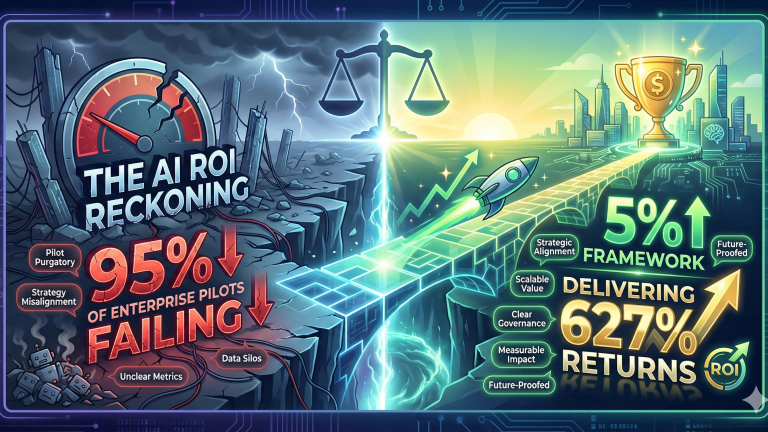

  • The AI ROI Reckoning: Why 95% of Enterprise Pilots Are Failing (And the 5% Framework That’s Delivering 627% Returns)

    The AI ROI Reckoning: Why 95% of Enterprise Pilots Are Failing (And the 5% Framework That’s Delivering 627% Returns)

    Executive Summary: The 2026 AI ROI Reckoning

    In 2026, the era of “AI experimentation” has ended. While 95% of enterprise AI pilots fail to deliver measurable P&L impact, a select 5% of organizations are achieving extraordinary returns (up to 627% ROI) by shifting from flashy point solutions to structured orchestration.

    The Failure Gap

    • The Learning Gap: Most GenAI tools are “stateless” and fail to retain business context or feedback.

    • The Data Debt: “Garbage in, garbage out” remains the #1 killer of AI accuracy. Dirty CRM data leads to 40% error rates in AI forecasting.

    • Build vs. Buy: Internal enterprise AI builds fail 67% of the time due to hidden maintenance and data curation complexities.

    The “5% Framework” for Success

    1. Workflow First: Redesign the process before deploying the tool. Solve a specific friction point (e.g., CRM data entry), not a vague goal.

    2. Outcome-Based Metrics: Stop measuring “accuracy” or “tokens.” Measure pipeline growth, deal velocity, and cost savings.

    3. Data Hygiene: Fix your data foundation before you spend another dollar on AI models.

    4. Target Back-Office: Prioritize high-volume, low-risk internal workflows (e.g., document processing) where ROI is highest.

    5. Multi-Agent Orchestration: Use orchestration platforms (like Sentia’s DIO) to coordinate specialized agents for compounding returns.

    The 90-Day Mandate: If an AI pilot cannot show measurable P&L impact within 90 days, it should be cut. Boards in 2026 are no longer funding science experiments—they are funding proven revenue engines.

    Last month, a CFO walked into my office with a spreadsheet that made my stomach drop.

    $2.3 million spent on AI in 2025.
    17 pilots running across sales, marketing, and operations.
    Zero dollars in measurable ROI.

    “My board is asking me to justify every one of these,” she said. “And honestly, I can’t.”

    She’s not alone.

    According to MIT’s bombshell July 2025 report The GenAI Divide: State of AI in Business 2025, 95% of enterprise generative AI projects are delivering zero measurable business return despite $30-40 billion in corporate investment. Source: MIT Media Lab Project NANDA

    But here’s what the headlines miss: The 5% that ARE working are seeing extraordinary returns. We’re talking 627% ROI, 40% increases in deal velocity, and 30-point improvements in forecast accuracy.

    So what separates the winners from the $2.3M sinkholes?

    That’s exactly what I’m going to break down in this article—because if you’re planning to justify AI spend to your board in 2026, you need to understand this divide before your next budget review.

    THE 2026 ROI PRESSURE COOKER: “SHOW ME THE MONEY“

    Let me be blunt: 2026 is the year the AI party ends.

    Not because AI doesn’t work, it absolutely does. But because boards and CFOs are done funding science experiments.

    Here’s what’s happening right now:

    The CEO/CFO Divide is Widening

    • 61% of CEOs report increasing pressure to prove AI ROI (up from 45% a year ago) Kyndryl 2025 Readiness Report
    • 65% of CEOs say they’re NOT aligned with their CFO on long-term AI value
    • 53% of investors expect positive ROI within 6 months or less Teneo Vision 2026 Survey

    The Budget Reality Check

    • 74% of CEOs say short-term ROI pressure is undermining long-term AI innovation
    • CFOs are shifting from “experimental budgets” to “prove it or lose it” mentality
    • 25% of planned AI spending being deferred to 2027 (Forrester)

    The Board-Level Scrutiny As one CFO told me: “When I pitched AI investments in 2023, the board said ‘great, let’s experiment.’ In 2026? They’re asking ‘where’s the P&L impact?’”

    This isn’t just anecdotal. Deloitte’s Q4 2025 CFO Signals report found that 87% of CFOs predict AI will be extremely or very important to their operations in 2026, but they’re also slashing projects that can’t show measurable returns. Source: Deloitte CFO Signals

    Translation: If you can’t prove ROI in Q1 2026, your AI budget is getting cut in Q2.

    THE 95% PROBLEM: WHY MOST AI PROJECTS ARE FAILING

    The MIT study—based on 300+ public AI deployments, 52 executive interviews, and 153 senior leader surveys—reveals a stark pattern: Just 5% of integrated AI pilots are extracting millions in value, while the vast majority remain stuck with no measurable P&L impact. Source: MIT NANDA Study

    But WHY are 95% failing?

    The research points to four systemic root causes:

    1. The “Learning Gap” – AI That Can’t Get Smarter

    Here’s the killer insight from MIT: Most GenAI systems do not retain feedback, adapt to context, or improve over time.

    Think about it: You deploy ChatGPT for sales emails. It generates decent drafts. But it:

    • Forgets the client’s industry preferences from last week
    • Repeats the same objections you already addressed
    • Requires you to re-input context for every single interaction
    • Doesn’t learn from what worked vs. what didn’t

    One VP told MIT researchers: “It’s excellent for brainstorming and first drafts, but it doesn’t retain knowledge of client preferences or learn from previous edits. For high-stakes work, I need a system that accumulates knowledge and improves over time.”

    The bottom line: Tools that don’t learn can’t scale. And tools that can’t scale can’t deliver ROI.

    1. The “Build vs. Buy” Disaster

    Here’s a stat that should terrify every CIO planning to “build our own proprietary AI”:

    • External vendor solutions succeed 67% of the time
    • Internal builds succeed only 33% of the time Source: MIT Study

    Why? Because enterprises dramatically underestimate the complexity of:

    • Training data curation and quality
    • Model fine-tuning and maintenance
    • Integration with existing workflows
    • Ongoing governance and compliance

    As MIT lead researcher Aditya Challapally put it: “Almost everywhere we went, enterprises were trying to build their own tool. The data showed purchased solutions delivered more reliable results.”

    Yet financial services companies and highly regulated industries continue to burn cash on internal AI builds that never see production.

    1. The Wrong Use Case Trap

    This one’s shocking: AI budgets are flowing to the LOWEST ROI use cases.

    According to the MIT study:

    • 50%+ of GenAI budgets go to sales and marketing
    • Back-office automation (document processing, compliance, workflows) delivers the HIGHEST ROI

    It’s a complete mismatch.

    Why does this happen? Because sales and marketing demos are flashy. A CEO sees an AI-generated sales pitch and thinks “this is the future!”

    But the reality? Customer-facing AI is:

    • Higher risk (brand reputation, customer satisfaction)
    • Harder to measure (attribution is complex)
    • More subject to human override (reps don’t trust it)

    Meanwhile, back-office automation is:

    • Lower risk (internal workflows)
    • Easier to measure (time saved, errors reduced)
    • More readily adopted (finance teams are desperate for efficiency)

    One procurement VP at a Fortune 1000 pharma company explained the problem: “If I buy a tool to help my team work faster, how do I quantify that impact? How do I justify it to my CEO when it won’t directly move revenue?”

    1. The Enterprise Paradox: Bigger = Slower

    Large enterprises run the most AI pilots but take 9 months on average to scale, compared to just 90 days for mid-market firms.

    The culprits?

    • Too many stakeholders (IT, legal, compliance, procurement, security)
    • Over-engineered governance frameworks
    • “Pilot purgatory” – endless testing without production deployment
    • Risk-averse culture that demands perfection before launch

    Meanwhile, startups with 20-person teams are going from zero to $20M in revenue in 12 months using the same AI tools.

    As one MIT researcher noted: “It’s because they pick one pain point, execute well, and partner smartly with companies who use their tools.”

    THE 5% FRAMEWORK: WHAT THE WINNERS ARE DOING DIFFERENTLY

    Let me show you what separates the 5% from the 95%.

    I’ve worked with dozens of revenue orgs implementing AI—some spectacularly successful, others spectacular failures. Here’s the pattern I see in every success story:

    Success Pattern #1: They Start with Workflow Redesign, Not Tool Deployment

    ❌ WRONG APPROACH:
    “Let’s buy [Hot AI Tool] and have our team start using it for [vague productivity goal].”

    ✅ RIGHT APPROACH:
    “Our forecast accuracy is 61% because our CRM data is 40% incomplete and our reps spend 2.3 hours/day on manual data entry. We need AI to solve THIS specific workflow breakdown.”

    Example from the field:

    A 75-person sales org I worked with didn’t start by buying AI. They started by mapping their revenue workflow and identifying the highest-friction points:

    1. Lead qualification took 4 days because reps manually researched every inbound lead
    2. CRM updates were 40% incomplete because reps forgot to log calls and meetings
    3. Deal risk was invisible until it was too late because managers only reviewed pipelines weekly

    THEN they deployed AI:

    • Agent 1 automated lead research and scoring (saved 3.2 hours per rep per week)
    • Agent 2 auto-updated CRM from meeting transcripts (saved 1.8 hours per rep per week)
    • Agent 3 flagged at-risk deals daily based on activity patterns (increased win rate by 34%)

    Result: 627% first-year ROI. Not because they bought better AI—because they redesigned the workflow FIRST.

    Success Pattern #2: They Measure Business Outcomes, Not AI Metrics

    Here’s a trap I see constantly:

    CIO: “Our AI model has 94% accuracy!”
    CFO: “Cool. Did revenue go up?”
    CIO: “…it has 94% accuracy.”

    The 5% don’t measure:

    • Model accuracy
    • Token usage
    • Response time
    • Number of AI interactions

    The 5% measure:

    • Revenue impact (pipeline growth, deal velocity, win rate)
    • Cost savings (hours saved, headcount avoided, errors reduced)
    • Customer outcomes (NPS improvement, retention rate, support resolution time)
    • Risk reduction (compliance violations, security incidents, forecast variance)

    Real example:

    A mid-market SaaS company deployed AI for customer support. Instead of measuring “AI-handled tickets,” they measured:

    • Time to resolution (dropped from 4.2 hours → 1.8 hours)
    • Customer satisfaction (increased from 78% → 89%)
    • Support cost per ticket (decreased by $32)
    • Churn rate among users with support tickets (decreased by 23%)

    Those numbers got the CFO’s attention. “AI accuracy” didn’t.

    Success Pattern #3: They Build Data Foundations FIRST

    I cannot stress this enough: Dirty data kills AI ROI.

    According to research from Congruity360, data quality is the #1 reason GenAI pilots fail to scale. Source: Congruity360 Analysis

    The 5% understand this. They don’t deploy AI until they’ve:

    • Cleaned their CRM (deduplicated contacts, standardized fields, enriched records)
    • Integrated their systems (CRM talks to marketing automation talks to customer support)
    • Established data governance (clear ownership, quality standards, audit trails)

    The brutal truth:

    If your CRM is 40% incomplete, your AI-powered forecasting will be 40% wrong. Garbage in, garbage out—but now at AI speed and scale.

    This is why my previous article on CRM data hygiene got so much engagement. The 5% know that data infrastructure is the foundation for AI ROI. Without it, you’re building on quicksand.

    Success Pattern #4: They Focus on “Highest-Value Workflows”

    Remember the MIT finding that back-office automation delivers the highest ROI?

    The 5% start there. Specifically, they target workflows that are:

    HIGH VOLUME → Lots of repetitive tasks to automate
    HIGH COST → Expensive to do manually (outsourced work, senior employee time)
    LOW RISK → Internal workflows where mistakes don’t impact customers
    EASY TO MEASURE → Clear before/after metrics

    Top 5 Highest-ROI Use Cases (Based on Field Data):

    1. Document processing and compliance (contracts, invoices, regulatory filings)
      • ROI: 300-800% in year one
      • Why: Replaces outsourced work, reduces errors, accelerates approval cycles
    2. CRM data enrichment and hygiene (auto-updating records, deduplication)
      • ROI: 200-500% in year one
      • Why: Enables all downstream sales/marketing AI to work properly
    3. Meeting intelligence and CRM auto-population (transcription, note-taking, field updates)
      • ROI: 150-400% in year one
      • Why: Saves 1-2 hours per rep per day, increases data completeness
    4. Deal risk detection and forecasting (pipeline health scoring, churn prediction)
      • ROI: 100-300% in year one
      • Why: Prevents revenue leakage, improves forecast accuracy 20-30 points
    5. Back-office automation (expense reports, procurement, HR workflows)
      • ROI: 150-400% in year one
      • Why: Reduces headcount needs, eliminates manual errors, speeds cycle times

    Notice what’s NOT on this list? Flashy customer-facing chatbots and AI-generated marketing content.

    Those have their place—but not if you’re trying to justify ROI to a skeptical CFO in Q1 2026.

    Success Pattern #5: They Use Orchestration Platforms (Not Point Solutions)

    This brings us full circle to my previous article on AI Agent Orchestration.

    The 5% aren’t buying 5 disconnected AI tools. They’re using orchestration platforms—like Sentia AI’s DIO—that coordinate multiple specialized agents into a unified intelligence layer.

    Why does this matter for ROI?

    Because orchestration enables:

    • Compounding returns → Each agent improves the performance of the others
    • Faster deployment → Pre-integrated workflows vs. custom integrations
    • Continuous improvement → Swap in better AI models without rebuilding
    • Measurable attribution → Track ROI across the entire revenue workflow, not just individual tools

    Real-world comparison:

    Company A (Point Solution Approach):

    • $347K/year spent on 5 separate AI tools
    • 9 months to get first tool into production
    • Siloed insights that don’t connect
    • Forecast accuracy: 61%

    Company B (Orchestration Platform Approach):

    • $289K/year spent on integrated DIO platform
    • 60 days to deploy first orchestrated workflow
    • Connected intelligence across sales, marketing, ops
    • Forecast accuracy: 91%

    The difference? Company B delivered 627% ROI. Company A is still trying to justify their spend to the board.

    YOUR 90-DAY AI ROI ROADMAP (Q1 2026 SURVIVAL GUIDE)

    Alright, enough theory. Here’s your actionable roadmap to escape the 95% and join the 5%—starting THIS WEEK.

    WEEK 1-2: THE ROI AUDIT

    ☐ Calculate your current AI spend

    • Vendor costs (subscriptions, licenses, professional services)
    • Internal costs (employee time, IT infrastructure, training)
    • Hidden costs (pilot projects that never scaled, abandoned tools)

    ☐ Map every AI initiative to business outcomes

    • For each pilot/tool: What specific business metric should it improve?
    • If you can’t articulate the outcome, it’s probably failing

    ☐ Measure current baseline performance

    • BEFORE you deploy more AI, capture the “before” metrics
    • Revenue metrics: Forecast accuracy, deal velocity, win rate, pipeline coverage
    • Efficiency metrics: Hours spent on admin, data completeness, response time
    • Cost metrics: Cost per lead, cost per acquisition, support cost per ticket

    ☐ Identify your “AI graveyard”

    • Which pilots have been running for 6+ months with no production deployment?
    • Which tools are your team NOT actually using despite paying for them?
    • Kill these. Then, Re-allocate the budget.

    ☐ Create your “highest-ROI target list”

    • Rank workflows by: Volume × Cost × Ease of Measurement
    • Focus ONLY on the top 3

    WEEK 3-4: THE FOUNDATION FIX

    ☐ Assess your data readiness

    • CRM completeness audit (what % of fields are populated?)
    • Data quality check (duplicates, outdated info, inconsistencies) Many companies have 50% plus duplicates – even more don’t even keep track / no idea where its at
    • Integration health (do your systems talk to each other?)

    ☐ Fix the data hygiene problems

    • Deduplicate contacts and accounts
    • Enrich records with missing firmographic/technographic data
    • Standardize field formats and naming conventions
    • If this sounds overwhelming: Hire a specialist. Seriously. Don’t skip this.

    ☐ Define your AI governance framework

    • Who owns AI decisions? (Not a committee – your AI Transformation Lead (Person))
    • What are your risk thresholds? (Customer-facing vs. internal) (see AI lawsuits)
    • How will you measure success? (Business outcomes, not AI metrics)
    • What’s your budget approval process? (Spoiler: It should take days, not months)

    ☐ Secure executive alignment

    • CEO: Show how AI supports revenue goals
    • CFO: Show clear ROI projections with conservative assumptions
    • CIO: Show how this will fit into your company wide tech strategy without creating tech debt – i.e., who is going to do the work? Vendors or internal teams?
    • Get them in ONE ROOM and ensure they’re aligned before you spend another dollar

    WEEK 5-8: THE SMART DEPLOYMENT

    ☐ Pick ONE high-ROI workflow

    • Don’t boil the ocean. Prove value quickly.
    • Ideal first workflow: Meeting intelligence + CRM auto-population
    • Why? High volume, clear time savings, easy to measure, low risk

    ☐ Choose platform over point solution

    • Evaluate AI orchestration platforms (Sentia AI’s DIO, competitors)
    • Key criteria: Plug-and-play AI model swapping, pre-built integrations, vendor independence
    • Run a 30-day proof-of-concept on your chosen workflow

    ☐ Set clear success metrics

    • Define the “before” baseline (from Week 1-2) – Think old school tech evaluations – go back to basics – treat AI as any new technology – not the “bright shiny isn’t that cool AI tool”
    • Define the “after” target (be specific: “Reduce admin time from 2.3 hrs/day to 0.8 hrs/day”)
    • Define the measurement cadence (weekly check-ins, not quarterly reviews)

    ☐ Train your team (for real)

    • Not a 1-hour webinar. A 2-week adoption program.
    • Power users first (they’ll be your champions)
    • Weekly office hours for questions and troubleshooting
    • Capture feedback and iterate quickly

    WEEK 9-12: THE ROI PROOF

    ☐ Measure relentlessly

    • Track your success metrics WEEKLY
    • Compare to baseline: Are you hitting your targets?
    • Capture qualitative feedback: What’s working? What’s not?

    ☐ Calculate actual ROI

    • Time saved: Hours per employee × Hourly cost × Number of employees
    • Revenue impact: Increase in win rate × Average deal size × Number of deals
    • Cost savings: Reduced outsourcing, fewer errors, faster cycles
    • Add it up. Be conservative. Then present to your CFO.

    ☐ Prepare your board presentation

    • Lead with business outcomes (NOT AI metrics)
    • Show the ROI calculation (be transparent about assumptions)
    • Explain why this scales (orchestration platform, not individual siloed point solutions)
    • Request budget for next 2-3 workflows based on proven success

    ☐ Commit to continuous improvement

    • Don’t declare victory and move on
    • Schedule monthly reviews to refine agent behaviors
    • Test new AI models as they become available (this is why platform matters)
    • Expand to next workflow ONLY after first one is delivering sustained ROI

    THE HARD TRUTH: MOST WILL STILL FAIL…

    I wish I could tell you that following this framework guarantees success.

    It doesn’t.

    The reality is that most companies reading this article will STILL end up in the 95%—not because they don’t understand the framework, but because they can’t execute it.

    Here’s why AI projects fail despite good intentions:

    ❌ FAILURE PATTERN #1: The “Pilot Purgatory” Trap

    You’ll spend 6 months perfecting the pilot. Then another 3 months getting legal approval. Then another 2 months negotiating with procurement. By month 11, the AI model you chose is obsolete and your champion has left the company.

    Solution: Set a hard 90-day deadline. If you can’t deploy in 90 days, the workflow is too complex. Pick something simpler.

    ❌ FAILURE PATTERN #2: The “Committee of Death”

    You’ll form an “AI steering committee” with 12 stakeholders. They’ll meet monthly. Nothing will get decided. Everyone will have veto power. After 8 months, you’ll realize no one is actually accountable.

    Solution: One decision-maker. Period. Give them budget authority and get out of their way. If your company is big enough hire a CAIO or an AI Lead Transformation specialist.

    ❌ FAILURE PATTERN #3: The “We’ll Build It Ourselves” Delusion

    Your CTO will insist that you need a proprietary AI solution. You’ll spend 18 months and $2M building it. It’ll work in the lab but never scale to production. Meanwhile, competitors using vendor solutions will lap you.

    Solution: Remember the 67% vs. 33% success rate for buy vs. build. Swallow your pride and buy.

    ❌ FAILURE PATTERN #4: The “Wrong Metrics” Disaster

    You’ll measure AI adoption rates, model accuracy, and user satisfaction scores. Your CFO will ask “did revenue go up?” and you’ll have no answer.

    Solution: Start with business outcomes. Work backwards to AI metrics. Never the other way around.

    ❌ FAILURE PATTERN #5: The “Data Debt” Brick Wall

    You’ll try to deploy AI on top of your 40% complete CRM with duplicate records and inconsistent data. The AI will fail. You’ll blame the AI. The real problem is your data.

    Solution: Fix data hygiene FIRST. It’s not sexy, but it’s non-negotiable.

    WHAT THIS MEANS FOR YOUR Q1 2026 BOARD MEETING

    Here’s my prediction:

    In March 2026, boards across America will ask three questions:

    1. “How much did we spend on AI in 2025?”
    2. “What measurable business impact did we get?”
    3. “Why should we keep funding this?”

    If you can’t answer question #2 with specific revenue or cost numbers, your AI budget is getting cut.

    But here’s the opportunity:

    The 5% who CAN answer those questions will get MORE budget. Because boards aren’t anti-AI—they’re anti-waste. Show them ROI and they’ll double down.

    This is your moment to separate yourself from the pack.

    While your competitors are scrambling to justify their 17 failed pilots, you can walk into that board meeting with:

    • A proven ROI calculation (627% is possible if you do this right)
    • A clear framework for scaling to additional workflows
    • A roadmap showing how AI supports strategic business goals
    • Evidence that you’re in the 5%, not the 95%

    But you need to start NOW. Not in Q2. Not “after we form a committee.” Now.

    THE DIFFERENCE BETWEEN HOPE AND STRATEGY

    The 95% are running on hope.

    They hope their AI pilots will eventually deliver value. They hope their team will adopt the tools. They hope their board will be patient. They hope the hype cycle will give them cover for another year.

    The 5% are running on strategy.

    They know exactly which workflows to target, how to measure success, and what ROI they need to hit. They’re not hoping—they’re executing.

    The question is: Which are you?

    Because in 2026, hope is not a strategy. And your board is done waiting.

    Ready to join the 5%?

    If you’re a CRO, CMO, or CFO facing board pressure to justify AI spend, let’s talk. I’ve helped dozens of revenue orgs implement the framework in this article—including the 75-person sales org that achieved 627% ROI.

    💬 Drop a comment with your biggest AI ROI challenge, I respond to every one.

    📧 DM me if you want to discuss your specific situation confidentially.

    🔄 Repost this if you know a C-suite executive who needs to read this before their next board meeting.

    The AI ROI reckoning is here. The only question is whether you’ll be in the 5% that survives it or the 95% that doesn’t.

    Frequently Asked Questions: Maximizing AI ROI in the Enterprise

    Why do 95% of enterprise AI pilots fail to deliver ROI?

    According to research from MIT and Sentia, 95% of AI projects fail due to four primary reasons:

    • The Learning Gap: Most generative AI systems do not retain context or improve over time.

    • The Build vs. Buy Disaster: Internal builds fail 67% of the time due to complexity, whereas vendor solutions have a much higher success rate.

    • The Wrong Use Case Trap: Organizations often prioritize flashy, customer-facing AI over high-ROI back-office automation.

    • The Enterprise Paradox: Over-engineered governance and multiple stakeholders lead to “pilot purgatory,” where projects never reach production.

    What is the “5% Framework” for successful AI implementation?

    The 5% of companies achieving extraordinary returns (up to 627% ROI) follow five specific success patterns:

    1. Workflow Redesign First: They fix broken manual processes before adding AI.

    2. Outcome-Based Measurement: They track P&L impact (revenue, cost savings) rather than AI technical metrics like accuracy.

    3. Data Foundation First: They ensure CRM data is clean and deduplicated before deployment.

    4. Target High-Value Workflows: They focus on high-volume, low-risk tasks like document processing and CRM hygiene.

    5. AI Orchestration: They use platforms like Sentia’s DIO to manage multiple specialized agents as a unified system.

    Which AI use cases deliver the highest measurable ROI?

    While marketing and sales AI get the most attention, the highest measurable ROI typically comes from:

    • Document Processing & Compliance: 300–800% ROI through reduced manual labor and errors.

    • CRM Data Enrichment: 200–500% ROI by providing a “single source of truth” for revenue teams.

    • Meeting Intelligence: 150–400% ROI by automating CRM entry and note-taking.

    • Deal Risk Detection: 100–300% ROI by improving forecast accuracy and preventing revenue leakage.

    How does dirty CRM data impact AI performance?

    Dirty data is the leading cause of AI project failure. If a CRM is incomplete or filled with duplicates, AI-powered forecasting and lead scoring will be fundamentally flawed. Successful enterprises perform a “Data Schema Audit” and deduplication process before launching AI agents to avoid the “Garbage In, Garbage Out” (GIGO) effect.

    What is the benefit of AI Orchestration over individual AI tools?

    AI Orchestration platforms, such as Sentia AI’s DIO, coordinate multiple specialized agents into a unified intelligence layer. This approach delivers compounding returns, faster deployment (60 days vs. 9 months), and better forecast accuracy (up to 91%) compared to disconnected point solutions.

    How can a company justify AI spending to a CFO in 2026?

    To justify AI spend, leaders must move away from “experimental” metrics. A successful board-level pitch should include:

    • Specific P&L Impact: Clear evidence of hours saved or revenue generated.

    • Baseline Comparisons: “Before vs. After” metrics on deal velocity and win rates.

    • A 90-Day Roadmap: A phased plan starting with a single high-ROI workflow to prove value quickly.

    Keywords: AI ROI, enterprise AI failure rate, AI project success, CFO AI pressure, AI investment returns, GenAI divide, AI business case, AI pilot failure, revenue intelligence, AI orchestration, board AI justification, 2026 AI strategy, AI implementation framework, measurable AI impact, AI adoption ROI, Sentia AI, DIO platform, AI governance, data hygiene AI, back-office automation

    Hashtags: #AIROI #EnterpriseAI #CFO #AIStrategy #DigitalTransformation #AIAdoption #BoardStrategy #RevenueIntelligence #AIOrchestration #BusinessAI #CRO #CMO #GTMStrategy #SalesAI #AIInvestment #AILeadership #SentiaAI #AITherapist #AIGovernance #CFOInsights #2026Strategy

  • 10 Ways Banks are Using Generative Artificial Intelligence Right Now!

    10 Ways Banks are Using Generative Artificial Intelligence Right Now!

    Banks are the life blood for many small and medium-sized businesses across North America. They often know the community, business leaders and local business environment better than anyone else.

    Their typically fiscally conservative but willing to try new business practices or technology if they can see a clear value proposition for their customers and their bottom line.  Is AI something that could differentiate their businesses?

    The answer is a resounding YES!

    Savvy, forward thinking bankers are increasingly turning to Generative AI to enhance their competitive edge. Here are ten ways they’re doing it, complete with real-world examples: 

    AI in Banks (see use links below)

    1. Personalized Customer Experiences: Banks like Wells Fargo are pioneering Large Language Models (LLMs) to create multimodal banking experiences, offering personalized services [3]. 
    2. Efficient Risk Assessment: Commonwealth Bank of Australia (CBA) uses Generative AI for enhanced customer experience and combating financial abuse [3]. 
    3. Fraud Detection: JPMorgan Chase employs Generative AI to analyze emails for signs of fraud, improving their detection systems [5]. 
    4. Automated Customer Service: Bunq has introduced a GenAI bot for its banking app, streamlining customer service interactions [3]. 
    5. Market Trend Analysis: Deutsche Bank provides AI-powered personalized investment guidance, helping customers navigate market trends [3]. 
    6. Regulatory Compliance: HSBC is training AI software to manage back-office functions, ensuring compliance with regulations [4]. 
    7. Operational Efficiency: Royal Bank of Canada (RBC) uses AI to automate process-heavy tasks, increasing operational efficiency [4]. 
    8. Credit Scoring Models: Banks are refining credit scoring with AI, though specific examples are under proprietary use and not publicly disclosed. 
    9. Investment Strategies: AI-driven models assist banks like Deutsche Bank in developing robust investment strategies [3]. 
    10. Customized Banking Products: Generative AI helps banks create financial products tailored to their community’s needs, as seen with Wells Fargo‘s LLMs [3]. 

    5 Ways Community Banks Can Integrate Private LLMs to Safeguard Corporate Content 

    Community banks are also cautiously adopting Private LLMs to protect sensitive data and reduce AI Liability exposure. Here’s how they’re doing it: 

    1. Data Control: Morgan Stanley Wealth Management uses an advanced chatbot powered by OpenAI’s technology to leverage the bank’s research and data library while maintaining data control [7]. 
    2. Customized Solutions: Banks can develop bespoke tools that align with their operational models, similar to ABN AMRO‘s use of Generative AI to summarize conversations between bank staff and customers [7]. 
    3. Secure Customer Interaction: By managing customer data securely, banks like ABN AMRO ensure privacy and build trust with their customers [7]. 
    4. In-House Expertise: Developing in-house expertise with Private LLMs allows banks to produce more accurate and relevant insights, as demonstrated by Morgan Stanley [7]. 
    5. Strategic Innovation: Private LLMs enable banks to innovate strategically, developing unique services that differentiate them from competitors, much like Morgan Stanley‘s approach [7]. 

    In conclusion, banks are not just keeping pace—they’re setting the pace, using Generative AI and Private LLMs to redefine the banking experience for their customers and secure a competitive edge in the digital age. However, they do need to keep pace on the evolving AI Legal Landscape as new precedents are set and new laws hit the book. See this video for more on AI Legal Challenges.  

    This article includes specific examples of large banks and community banks using Generative AI, Private LLMs, Data Security and with references to further information on their applications. 

    Article Link Source: Conversation with Copilot 

    1. Generative AI in Banking Best Practices in 2024 [With Examples] 
    2. Here’s how banks are using and experimenting with generative AI 
    3. Leading banks rolling out more generative AI – Oracle 
    4. Generative AI in finance: How banks are using LLMs in 2023 
    5. Generative AI in banking and financial services | McKinsey 
    6. Generative AI’s unfolding transformation of banking 
    7. Top 4 Use Cases of Generative AI in Banking [2024] – AIMultiple 
    8. Bridging the AI Divide: How Banks Can Responsibly Adopt Large Language … 
    9. Private LLMs on Your Local Machine and in the Cloud With LangChain … 
    10. Private LLMs: Key to Business Innovation and Secure AI Integration 

    Tags: #banks #banking #communitybanks #finance #OpenAI #LLM #LLMs #AI #usecase #CEO #CFO #CMO #technology #WallStreet #financialservices #loans

  • What Data can CFO’s Trust Right Now?

    What Data can CFO’s Trust Right Now?

    Are CFOs just like Sherlock Holmes, always searching for accurate data?

    Ah, the mystical world of finance—the place where numbers dance, spreadsheets sing, and CFOs sip their morning coffee while pondering the existential question: “Is this balance sheet lying to me?” Did my CSO get those pesky salespeople to enter accurate data this week? Can I trust it this time?

    You see, dear reader, CFOs are a unique breed. They’re like the Sherlock Holmes of the corporate world, except instead of solving crimes, they’re unraveling financial mysteries. And trust me, there’s no shortage of those in today’s corporate databases. Its like a CSI crime scene that so many walked on the data is no longer accurate, can’t be used to solve the case.

    So, why the skepticism? Why do CFOs eye their financial data like a suspicious cat eyeing a new houseplant? Why do CRO’s hate the dreaded CFO Call “What is really going on with your sales projections – Gandalf?” Let’s dive into this with the grace of a synchronized swimmer and the wit of a stand-up comedian.

    1. The Data Comes from Too Many Sources

    Imagine you’re at a dinner party, and everyone’s talking at once like an ADD conference. The wine is flowing, the appetizers are aplenty, and the conversation is a delightful cacophony. Now, replace the wine with Excel sheets, the appetizers with databases, and the conversation with financial data. Voilà! You’ve got the CFO’s dilemma.

    CFOs juggle data from accounting systems, CRM platforms, spreadsheets, and that one ancient ledger in the basement guarded by a grumpy janitor with a dwarf axe. It’s like conducting an orchestra where the violinist is playing Beethoven, the flutist is jamming to jazz, and the tuba player insists on beatboxing like a rap star.

    We asked AI CRM SME and CEO Mr. David Forder – Why don’t CFO’s trust their CRM data? David said: “CFO’s know their data isn’t reliable. Sales people don’t enter data or enter it incorrectly or at the last minute-making accurate forecasting extremely difficult. CFO’s must have close relationships with sales directors to ensure they know what is likely vs. what is actually in the CRM or system of record. At Sentia AI we assume sales reps won’t put in data and do it for them. This significantly increases CRM accuracy.”

    2. Clunky Spreadsheets: The CFO’s Arch-Nemesis

    Picture this: a CFO, hunched over a computer, squinting at a spreadsheet that looks like it was designed by a blindfolded octopus. Rows and columns twist and turn, formulas multiply like rabbits, and somewhere in cell D42, the meaning of life is hidden (or maybe just the quarterly revenue).

    Spreadsheets are the Bermuda Triangle of financial data. CFOs fear that one wrong keystroke could plunge them into a vortex of miscalculations, where profit margins vanish, and debt multiplies like rabbits (again). No wonder they’re wary.

    3. Outdated Processes: The Ghosts of Accounting Past

    Remember the days when accountants used quills and inkwells? Neither do I, but apparently, some financial processes haven’t caught up with the 21st century. Manual data collection, handwritten ledgers, and carrier pigeons delivering invoices—okay, maybe not the pigeons, but you get the idea.

    CFOs stare at these relics and wonder, “Did our ancestors also struggle with reconciling petty cash?” The answer is probably yes, but they didn’t have to deal with Sarbanes-Oxley compliance, so it evens out.

    4. The Suspiciously Perfect Numbers

    Imagine you’re baking a cake, and every ingredient magically falls into place: exactly 2.5 cups of flour, precisely 1.75 teaspoons of baking powder, and a dash of unicorn tears. Suspicious, right? Well, that’s how CFOs feel when financial statements align too perfectly.

    “Is this real, or did the accounting elves visit last night?” they muse. “Did the revenue curve really follow a Fibonacci sequence or did they put in numbers they think I want to see?” It’s like finding a four-leaf clover every day—lucky, but also a tad eerie.

    In Conclusion: Trust, but Verify

    So, dear CFOs, keep your skepticism sharp and your calculators sharper. Trust your financial data, but verify it like a detective chasing down leads. And remember, even if the numbers seem fishy, at least they’re not as slippery as that salmon mousse at the dinner party.

    Now, if you’ll excuse me, I’m off to write a spreadsheet-themed murder mystery. Spoiler alert: The killer is the pivot table.

    David Brown, signing off with a wink and a formula. Here is the formula – if you need help figuring out how to get AI into your CRM to create believable forecasts contact the AI experts at www.sentia.online


    Disclaimer: The views expressed in this article are purely fictional and meant for entertainment purposes. No unicorns nor CFOs were harmed during this articles creation. Stay tuned!

    Tags: #CFO #CSO #CRO #Data #CRM #Salesforceai #AI #accounting #funny #cybersecurity