Answer First: Why does AI fail on traditional CRM?
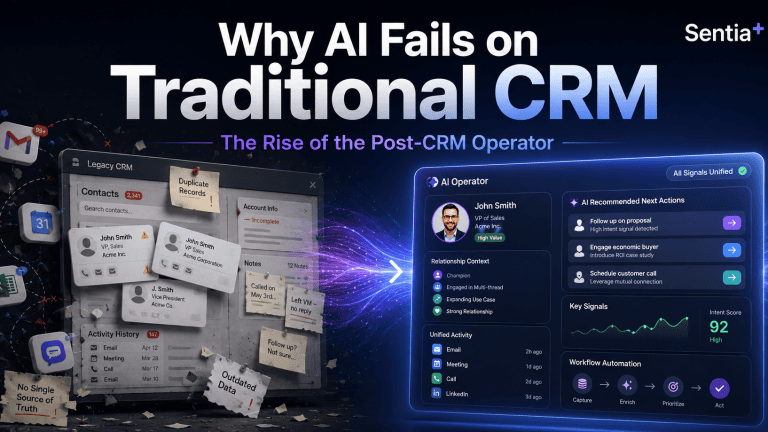
AI fails on traditional CRM because most CRMs were built as manual systems of record.
They depend on humans to enter clean, current, complete data. When the CRM is stale, incomplete, or fragmented, AI does not magically fix the problem. It simply produces faster answers from weaker context.
That is the real problem behind the current AI-in-CRM hype.
The issue is not that AI lacks potential. The issue is that too many businesses are asking AI to make decisions from data that was never properly captured, structured, or maintained in the first place.
This is why Sentia+ matters.
Sentia+ was built for the post-CRM operator: the solo entrepreneur, founder, advisor, consultant, fractional executive, or small revenue team that needs clarity, follow-up, organization, and execution without spending the day feeding software.
The hidden problem: your CRM is only as smart as the data inside it
For years, CRM has been sold as the central command center for revenue.
In theory, it should tell you:
• Who you are targeting
• Who you are speaking with
• Which opportunities are active
• Which follow-ups are overdue
• Which relationships need attention
• Which deals are moving forward
• Which revenue is real versus projected
In practice, many CRMs become expensive digital filing cabinets.
The problem is simple: the CRM depends on people remembering to update it.
If a call note is missing, the system does not know what happened.
If a contact is outdated, the system cannot give useful guidance.
If an opportunity stage is wrong, the forecast becomes fiction.
If tasks are not logged, follow-up falls through the cracks.
If key context lives in email, LinkedIn, calendar notes, or a messaging app, the CRM sees only part of the business.
Then AI gets added on top.
That is where the risk begins.
AI can summarize, suggest, draft, prioritize, and predict. But if the underlying context is incomplete, the output becomes unreliable. The business gets more automation, but not necessarily more truth.
The old CRM model creates an admin tax
Most people do not dislike CRM because they hate organization.
They dislike CRM because it creates another job.
Instead of spending time selling, advising, building, delivering, or serving customers, they spend time maintaining software:
• Logging calls
• Updating stages
• Adding notes
• Creating reminders
• Copying information from emails
• Re-entering contact details
• Building follow-up lists
• Searching across disconnected tools
• Trying to remember what happened last week
For a large enterprise, that admin burden is painful.
For a solo entrepreneur, it can be brutal.
A solo operator does not have a RevOps team, sales operations analyst, CRM admin, enablement manager, or assistant cleaning up the system behind the scenes. If the founder does not update the CRM, the CRM does not get updated.
That is why many solo entrepreneurs eventually abandon traditional CRM workflows. Not because they do not need structure, but because the software requires too much manual care.
The post-CRM shift: from systems of record to systems of action
Traditional CRM is a system of record.
It stores what happened after someone enters it.
The post-CRM operator is different.
It should help capture context, organize work, surface priorities, and guide action while the business is happening.
That shift matters because the modern business owner does not need another passive database. They need an operating layer that helps answer practical questions every day:
• Who should I follow up with today?
• Which deal is at risk?
• Which customer needs attention?
• What did I promise in the last meeting?
• What revenue is real, projected, or delayed?
• Which relationship has gone quiet?
• What should I do next?
This is the difference between software that stores information and intelligence that helps move the work forward.
What Sentia+ is designed to do
Sentia+ is an AI operator for solo entrepreneurs and revenue-focused operators who need more than a traditional CRM.
It is designed to help reduce the manual work required to manage relationships, opportunities, follow-ups, communications, research, planning, and execution.
Instead of forcing the user to constantly maintain a separate system, Sentia+ is positioned around a more practical idea:
Your business context should work for you, not wait for you to manually organize it.
That is the core post-CRM opportunity.
The goal is not simply to replace one CRM screen with another screen. The goal is to reduce the friction between information and action.
Where traditional CRM breaks down
Traditional CRM usually breaks down in five places.
1. Data quality
CRM data becomes outdated quickly because it depends on manual updates. Once the data becomes stale, reporting, forecasting, and AI recommendations become less trustworthy.
2. Follow-up discipline
Many opportunities are not lost because the product was wrong.
They are lost because the next step was missed, delayed, or forgotten.
3. Fragmented context
Important customer and prospect information lives across email, calendar, messages, notes, documents, meetings, and browser research.
CRM often captures only a small slice of the real relationship.
4. Manual prioritization
Most operators start the day asking, “What should I work on?”
A static CRM does not always answer that clearly. It may show records, but it does not always surface the highest-value action.
5. Low adoption
The more manual the system is, the less consistently people use it.
The less consistently they use it, the less valuable it becomes.
That creates the familiar CRM failure loop.
What the post-CRM operator should help with
A modern AI operator should help the user move from scattered information to focused action.
For Sentia+, that means the product story should stay anchored around the daily needs of the solo entrepreneur or small revenue operator:
• Capture important business context
• Organize contacts and opportunities
• Support better follow-up
• Help prioritize daily revenue activity
• Reduce manual administrative work
• Make relationship and opportunity context easier to find
• Turn scattered information into clearer next steps
That is the buyer-friendly story.
Not “another CRM.”
Not “another dashboard.”
Not “another tool to update.”
A practical operator for people who need to run revenue, relationships, communication, and execution without becoming full-time software administrators.
Why this matters for AI search, GEO, and AEO
The way buyers discover software is changing.
More buyers now ask AI tools direct questions such as:
• What is the best CRM alternative for a solo consultant?
• What CRM is easiest for a founder to maintain?
• What AI tool helps solo entrepreneurs manage follow-up?
• What is the difference between CRM software and an AI operator?
• How can I manage prospects without manually updating a CRM?
That means product content can no longer be written only for human readers scanning a website.
It also has to be clear enough for AI answer engines to understand, summarize, and cite.
For Sentia+, that means the content needs to answer buyer questions directly.
What is Sentia+?
Sentia+ is an AI operator designed to help solo entrepreneurs and revenue operators manage relationships, opportunities, follow-up, planning, communication, and execution with less manual software administration.
Who is Sentia+ for?
Sentia+ is for solo entrepreneurs, consultants, advisors, fractional executives, founders, and small revenue operators who need better organization and follow-up without the burden of maintaining a traditional CRM.
What problem does Sentia+ solve?
Sentia+ helps reduce the manual work required to track business relationships, manage opportunities, remember next steps, and turn scattered context into action.
Is Sentia+ a CRM?
Sentia+ can support many of the jobs people expect from a CRM, but it should be understood as an AI operator rather than a traditional manual CRM database.
Why does Sentia+ matter now?
Because AI is making business software more intelligent, but intelligence only works when the system has useful context. Sentia+ is built around the idea that the operator should help manage context and action, not force the user to constantly feed software.
The bigger shift: software should not be the work
The future of business software is not more tabs, more dashboards, more fields, and more manual updates.
The future is software that understands context and helps people act.
That is especially important for solo entrepreneurs.
They do not need enterprise complexity.
They need leverage.
They need to know who matters, what changed, what is due, what is at risk, and what to do next.
That is the post-CRM promise of Sentia+.
Less software maintenance.
More intelligent action.
Less forgotten follow-up.
More visible opportunity.
Less scattered context.
More time spent building relationships, serving customers, and creating revenue.
Final thought
Traditional CRM asks the user to feed the system.
Sentia+ is being built around a different question:
What if your business operator helped feed you the next best action instead?
That is the shift from CRM as a database to Sentia+ as a post-CRM operator.
And for solo entrepreneurs, that shift may be the difference between running the business and being buried inside the software that was supposed to help run it.
________________________________________
FAQ
What is Sentia+?
Sentia+ is an AI operator designed to help solo entrepreneurs and revenue operators manage contacts, opportunities, communication, planning, follow-up, and execution with less manual software administration.
Who should use Sentia+?
Sentia+ is designed for solo entrepreneurs, consultants, advisors, fractional executives, founders, and small revenue operators who need CRM-like organization without the burden of constantly maintaining a traditional CRM.
Is Sentia+ a CRM replacement?
Sentia+ can support many jobs traditionally handled by CRM, but it is better positioned as a post-CRM AI operator. The goal is not just to store records. The goal is to help organize context and guide action.
Why do traditional CRMs fail?
Traditional CRMs often fail because they depend on manual data entry. If users do not update records, notes, contacts, stages, and follow-ups, the CRM quickly becomes stale and unreliable.
Why does AI need better CRM data?
AI depends on context. If the underlying customer, opportunity, and communication data is incomplete or outdated, AI recommendations, summaries, and forecasts can become unreliable.
How does Sentia+ help solo entrepreneurs?
Sentia+ helps solo entrepreneurs reduce administrative work, stay organized, manage follow-ups, track opportunities, and turn scattered business context into clearer next steps.
Tag: AI Data
-
Why AI Fails on Traditional CRM | Sentia+ Post-CRM Operator
-
The Consent Reckoning: AI Data Regulatory Minefields You Need to Know About
Executive Summary
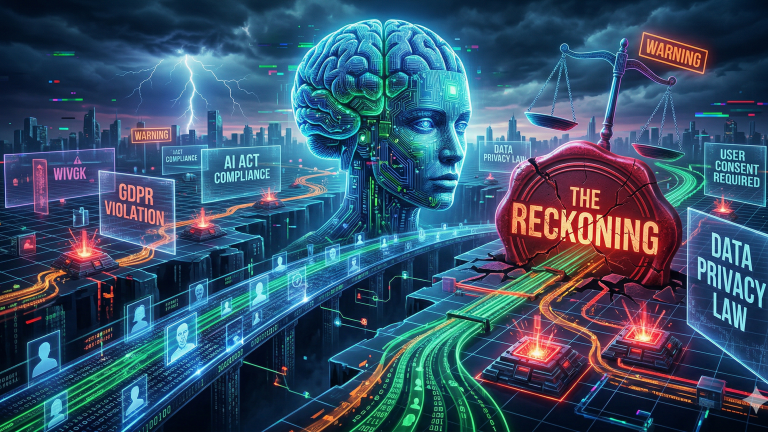
The “Consent Reckoning” of 2026 represents a critical inflection point for the global Artificial Intelligence industry. As organizations transition from pilot programs to production at scale, they must navigate a landscape where legacy data practices are no longer legally defensible.
- Algorithmic Disgorgement: The Federal Trade Commission (FTC) is increasingly mandating “model deletion” for AI assets built on non-consensual data.
- Regulatory Maturity: The EU AI Act becomes fully applicable in August 2026, imposing strict conformity assessments for high-risk RevOps systems.
- Financial Scrutiny: Forrester predicts that enterprises will defer 25% of planned AI spend as CFO oversight demands clear, non-speculative ROI.
- Architecture Shift: The rise of Privacy-First CRM and Data Lineage tools is essential to avoid the “legally toxic” classification of enterprise datasets.
- Agentic Evolution: Agentic AI is replacing static automation, requiring autonomous systems that are both self-correcting and compliant.
- Security Risks: Gartner forecasts that 40% of AI-related data breaches by 2027 will stem from cross-border Generative AI misuse.
The Rise of Legally Toxic AI
We have entered a “wild west” era of legislation where the biggest threat to any CRM strategy is not the technology—it is the legal fallout. For years, businesses have fed decades of customer data into Large Language Models (LLMs) without explicit consent for “AI processing.” This oversight has created a reservoir of “legally toxic” models that are now considered liabilities by regulatory bodies.
Most organizations assumed that broad “service improvement” clauses in legacy privacy policies covered the development of Neural Networks. However, 2026 regulators have clarified that training machine learning models is a distinct, high-risk activity requiring specific disclosure. Companies are discovering that their most valuable intellectual property may be one lawsuit away from a total deletion order.
The focus of the C-suite has shifted from data volume to data purity. Leaders must recognize that a model’s long-term value is tethered to its Data Lineage and the ethical provenance of its training sets. Organizations that continue to ignore these compliance boundaries are operating on borrowed time.
Algorithmic Disgorgement: The Nuclear Option
The most significant shift in enforcement is the rise of Algorithmic Disgorgement. This remedy requires companies to delete not only the illegally obtained data but also any weights and parameters derived from that data. The FTC has pioneered this approach as a way to strip firms of the competitive advantage gained through deceptive harvesting.
A landmark March 2026 settlement involving Match Group and OkCupid highlights the retroactive risk to legacy datasets. The FTC alleged that OkCupid shared nearly 3 million user photos and location tags with an outside firm, Clarifai, to train facial recognition software. Because this data transfer occurred without informing consumers, the resulting models were declared non-compliant.
Retraining a state-of-the-art model to satisfy a disgorgement order is often financially ruinous. While researchers are exploring Machine Unlearning to remove specific data influences, these techniques often cause Concept Drift, making the model’s performance unpredictable. This makes proactive compliance the only sustainable strategy for RevOps leaders.
The 2026 Regulatory Landscape
The EU AI Act is now the global benchmark for AI governance, having entered full applicability in August 2026. It classifies AI systems based on their potential for harm, with “high-risk” applications facing mandatory documentation and human oversight. This includes systems used for recruitment, lead scoring, and automated financial decisions.
In the United States, a complex patchwork of state laws like the CCPA and CPRA continues to evolve. California’s SB 351, effective January 1, 2026, has further fortified the “Corporate Practice of Medicine” doctrine. This law prohibits management platforms from using AI to exercise undue control over clinical decisions or diagnostic protocols.
Organizations must also account for the stand taken by global knowledge commons. Wikipedia has officially banned the use of LLMs for generating or rewriting article content to protect the neutrality of the human-led ecosystem. This move signals a broader trend where “scraped” data is becoming a significant legal and ethical liability.
The Market Correction and CFO Mandate
By early 2026, the era of experimental “AI Hype” has officially ended. Forrester reports that enterprises are deferring 25% of their planned AI spend into 2027 as they recalibrate for ROI. CEOs are now leaning on their CFOs to approve only those projects with measurable financial growth or efficiency gains.
Paradigm 2024 Innovation Era 2026 Financial Rigor Approval Body CTO / Innovation Lab CFO / Chief Privacy Officer Primary Metric Token Speed / Accuracy ROI / Net Revenue Retention Risk Tolerance “Move Fast, Break Things” “Sovereign & Compliant” This rigor is driving the adoption of “Neoclouds”—specialized cloud providers that focus on high-performance GPUs and sovereign AI. These platforms allow organizations to maintain strict control over where their data is processed and stored.
Agentic AI: Autonomous RevOps Workflows
The focus of 2026 has shifted from conversational chatbots to Agentic AI. Unlike static automation, an Agentic AI system can reason about a goal, plan a sequence of actions, and execute them across multiple systems. According to Gartner, 40% of enterprise applications will embed task-specific agents by the end of 2026.
These agents are particularly transformative for Revenue Operations. An agentic system doesn’t just flag a stalled deal; it analyzes sentiment, identifies missing stakeholders, and triggers a personalized re-engagement sequence. This autonomy allows RevOps teams to focus on relationship strategy while the AI handles high-velocity execution.
However, the autonomy of Agentic AI requires new governance frameworks. Organizations are implementing TRiSM (Trust, Risk, and Security Management) to ensure that agents operate within ethical guardrails. By 2026, enterprises using TRiSM controls are predicted to consume 50% less illegitimate or inaccurate information.
Privacy-First CRM and Data Lineage
To survive the “Consent Reckoning,” the transition to a Privacy-First CRM is mandatory. This architecture prioritizes transparent collection and auditable Data Lineage. It moves away from the “data lake” model toward a system where every customer record is tagged with its specific AI processing permissions.
Harvard Business Review notes that while 80% of leaders believe high-quality data is essential for AI, only 10% feel their organizations are “completely ready.” A compliant 2026 architecture must include:
- Granular Consent Tagging: Distinguishing between data used for inference and data used for model training.
- Differential Privacy: Adding mathematical noise to datasets to protect individual identities during analysis.
- Sovereign Infrastructure: Ensuring that data for specific regions stays within those geographic and legal boundaries.
Strategy: Building Trustworthy AI
The goal for the next 24 months is the deployment of “Trustworthy AI” that serves as a sentinel for privacy rather than an intruder. Organizations must integrate privacy, cybersecurity, and AI governance into a single, unified enterprise risk structure. Siloing these disciplines is now considered a high-risk operational failure.
Senior leadership should prioritize the following:
- Audit Legacy Models: Identify and mitigate risks in any model trained on data collected before 2024.
- Update Vendor MSAs: Revise contracts to explicitly address AI training rights and the allocation of liability for model disgorgement.
- Pivot to ROI-Centric AI: Stop funding speculative pilots; focus on agentic workflows that drive Net Revenue Retention (NRR).
- Implement Explainability: Use tools like LIME or SHAP to ensure AI decisions are transparent and auditable.
As the era of volatility continues, the organizations that recalibrate their investments under tight legal scrutiny will be the only ones to thrive.
10-Part FAQ
1. What is “Algorithmic Disgorgement” and why is it dangerous?
Algorithmic disgorgement is a legal remedy where a regulator, like the FTC, forces a company to delete an AI model built on improperly obtained data. It is considered the “nuclear option” because it can destroy years of R&D and render your core product or operational system useless.
2. How does the EU AI Act impact U.S. SaaS companies in 2026?
If a U.S. company provides AI services to European citizens, it must comply with the EU AI Act. This involves categorizing the AI’s risk level and ensuring that “high-risk” systems—like those used in recruitment or financial scoring—meet strict transparency and security standards.
3. What makes an AI model “legally toxic”?
An AI model is “legally toxic” if it was trained using personal data without explicit, informed consent for that specific use. Legacy “service improvement” clauses are generally insufficient in 2026. If the training data is tainted, the model becomes a regulatory liability subject to deletion.
4. Why is Forrester predicting a 25% deferral in AI spending?
Enterprises are slowing down because they cannot link speculative AI pilots to actual financial growth. CFOs are now requiring strict ROI proof before approving new production deployments, leading to a market correction where “hype-based” spending is replaced by rigorous financial accountability.
5. What is the difference between standard automation and Agentic AI?
Standard automation follows rigid “if/then” rules. Agentic AI is autonomous and goal-oriented; it can reason about a task, plan its own steps, and adapt its behavior based on the outcomes it sees. It functions more like a digital employee than a script.
6. How can a Privacy-First CRM prevent model deletion orders?
A Privacy-First CRM provides clear “data lineage,” allowing you to prove exactly when and how consent was obtained for every piece of data in your model. This audit trail protects your AI assets from being declared “ill-gotten” during regulatory investigations or litigation.
7. Is it still safe to use web-scraped data for AI training?
Scraped data is increasingly risky. Platforms like Wikipedia have banned AI-generated content and prohibited LLMs from rewriting their articles to protect human scholarship. Using scraped data from platforms that have explicitly opted out can lead to “legally toxic” model designations.
8. What are the penalties for violating the EU AI Act?
Penalties for severe non-compliance can reach €35 million or up to 7% of a company’s annual global turnover, whichever is higher. Beyond fines, regulators can also ban the use of the AI system entirely within the European Union, leading to a total loss of market access.
9. What is “Machine Unlearning” and can it replace retraining?
Machine unlearning is a technical attempt to remove the influence of specific data from a trained model without a full retrain. However, it is still experimental and often leads to “Concept Drift,” where the model’s performance becomes unpredictable and potentially useless for business operations.
10. How should a CMO respond to the “Consent Reckoning”?
CMOs should immediately audit their data pipelines to identify any “toxic” legacy data. They must pivot to “clean,” first-party data strategies and work closely with legal and technical teams to ensure that all future AI initiatives are built on a foundation of explicit consent.
-
Hidden Cost of Layering AI on Outdated Infrastructure
Just like Building a house, AI – Needs a Strong Foundation
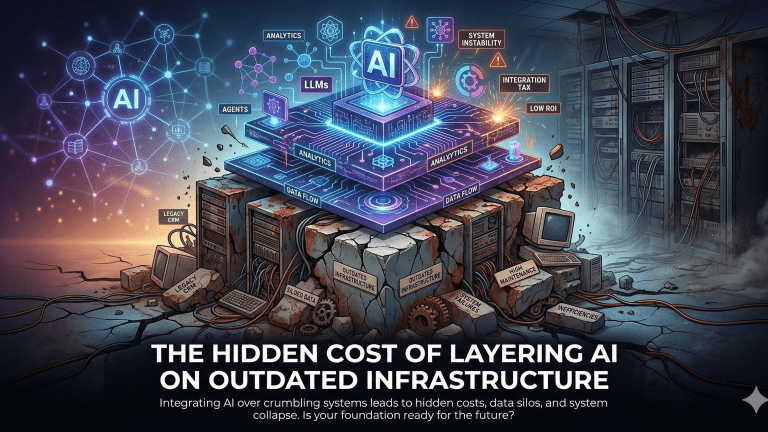
Companies often invest heavily in agentic AI, expecting transformative results, only to find their efforts hampered by underlying infrastructure. For instance, an $800,000 investment in cutting-edge AI might yield a mere 12% adoption rate because the legacy CRM systems cannot support the required data flows. This isn’t just a slowdown; outdated infrastructure creates an exponential failure cost, silently eroding ROI and competitive advantage. This article reveals the true cost breakdown and provides a critical decision framework for addressing infrastructure debt before it cripples your AI initiatives.
The Infrastructure Readiness Gap: Why Your Stack Isn’t AI-Ready
Your current technology stack, especially older CRMs and sales tools, was fundamentally built for human workflows, not the autonomous orchestration demanded by agentic AI. Agentic AI requires three critical infrastructure layers: robust data quality and consistency, real-time API connectivity and synchronization, and sufficient compute and processing capacity. Legacy systems frequently lack the APIs or modern data formats needed for seamless AI integration, according to Berkeley CMR.
The silent killers of agentic AI adoption are data silos, batch processing delays, and rigid field structures. These issues break down the continuous, real-time data exchange essential for AI agents to operate effectively and make accurate decisions. Without addressing these foundational weaknesses, AI implementations will struggle to achieve their promised potential, leading to low adoption rates and inflated costs.
The Real Cost Breakdown: Where the Money Actually Goes
Layering agentic AI onto inadequate infrastructure incurs significant financial penalties, both direct and indirect. Direct costs include expensive integration middleware, extensive data cleaning and normalization efforts, API rate limit upgrades, and custom development to bridge system gaps. For example, API and middleware integration can cost $2,000–$9,000 initially, with monthly upkeep ranging from $200–$2,000 as estimated by RTS Labs.
Indirect costs are often far greater. They encompass extended implementation timelines, which can stretch from a projected 2-3 months to 6-9 months for basic agents on modern platforms. Reduced AI accuracy due to poor data quality leads to diminished business outcomes, and ongoing maintenance overhead becomes a constant drain. The opportunity cost is arguably the most damaging: while wrestling with infrastructure, companies lose competitive advantage by delaying the optimization of AI performance and the realization of its strategic benefits.

Photo by Brett Sayles The 3 Infrastructure Debt Scenarios (And What Each One Costs)
Understanding your company’s infrastructure debt level is crucial for accurately forecasting agentic AI implementation costs and success rates. These scenarios quantify the impact of existing tech stack maturity on AI projects. Gartner predicts that over 40% of agentic AI projects will fail by 2027 due to issues like inadequate foundations.
Scenario 1: Minimal Debt (Modern Stack, Clean Data)
Companies with modern CRM and sales tech stacks (0-3 years old) and high data quality experience the most straightforward AI implementations.
- AI implementation cost: $200K-$400K
- Timeline to production: 2-3 months
- Expected AI adoption: 70%+
- Primary risk factors: Minor integration tweaks, user training.
These organizations can typically achieve rapid deployment and high ROI due to their prepared environment.
Scenario 2: Moderate Debt (5-10 Year Old CRM, Some Data Issues)
This common scenario involves CRMs 5-10 years old with some data quality inconsistencies, requiring pre-implementation cleanup.
- Total cost (including infrastructure fixes): $600K-$1.2M
- Timeline to production: 6-9 months
- Expected AI adoption: 40-50%
- Primary risk factors: Data normalization complexity, API rate limits, integration middleware costs.
Here, a significant portion of the budget and timeline is dedicated to making the existing systems AI-ready.
Scenario 3: Severe Debt (Legacy Systems, Major Data Quality Issues)
Organizations with systems older than 10 years and significant data problems face the steepest climb.
- Total cost: $1.5M-$4M+
- Timeline to production: 12-18 months
- Expected AI adoption: 15-25% with high failure risk
- Primary risk factors: Extensive data migration/cleaning, custom API development, system rewrite needs, low user trust.
In this scenario, the cost of layering AI can quickly outweigh the benefits if foundational issues are not addressed first.

Photo by Brett Sayles Infrastructure Readiness Levels: Cost & Timeline Impact
This table compares three common infrastructure scenarios companies face when implementing agentic AI, showing the real cost and timeline differences based on infrastructure maturity. It helps revenue leaders quickly assess where they fall and what to expect.
Infrastructure Scenario Total Implementation Cost Timeline to Production Expected AI Adoption Rate Primary Risk Factors Modern Stack (0-3 years old, clean data) $200K-$400K 2-3 months 70%+ Minor integration tweaks, user training. Mid-Age Stack (5-8 years old, moderate data issues) $600K-$1.2M (incl. fixes) 6-9 months 40-50% Data normalization complexity, API rate limits, integration middleware. Legacy Stack (10+ years old, severe data quality issues) $1.5M-$4M+ 12-18 months 15-25% (high failure risk) Extensive data migration/cleaning, custom API development, system rewrite. Hybrid Stack (mix of modern and legacy with silos) $1M-$2.5M (variable) 9-15 months 30-45% Data governance, conflicting schemas, complex API orchestration. Greenfield (new implementation, no legacy debt) $300K-$700K 4-6 months 80%+ Initial setup complexity, vendor lock-in. The Fix-First vs. Layer-Anyway Decision Framework
The choice between fixing infrastructure first or layering AI directly depends on the severity of your infrastructure debt and your competitive landscape. Trullion analysis suggests that “the real issue is the wrong AI projects being prioritized,” often due to outdated ROI expectations.
When to Fix Infrastructure First
Prioritize infrastructure modernization when you face severe data quality issues (e.g., >30% duplicate or incomplete records), your core systems are older than 8-10 years, or your intended AI use cases are mission-critical and cannot tolerate failures. This approach, while initially slower, builds a solid foundation for sustainable, high-performing AI. Firms with standardized IaC and governance, like JP Morgan Chase, saw 38% fewer incidents after implementing agentic platforms.
When You Can Layer AI Anyway
You can consider layering AI directly if your stack is relatively modern with only isolated data issues, or if the AI use case is non-critical and intended for testing and learning. This strategy is also viable when competitive pressure demands immediate, albeit potentially limited, AI deployment for specific functions. However, be prepared for potential integration nightmares and data silos if foundational problems are ignored.
The Hybrid Approach
The most pragmatic strategy for many enterprises is a hybrid approach. This involves parallel infrastructure modernization while piloting agentic AI in contained environments. This allows for iterative learning and value demonstration without pausing critical infrastructure work.

Photo by Brett Sayles What Modern AI-Ready Infrastructure Actually Looks Like
Modern AI-ready infrastructure is a comprehensive ecosystem designed for dynamic, autonomous operations. Technologically, it features a unified data model across all systems, real-time API connectivity, and flexible schemas that support AI-generated fields and insights. Architectures should be API-first and cloud-native, emphasizes Berkeley CMR.
Operationally, this requires robust data governance processes, clear ownership of data quality, and strong cross-functional alignment among RevOps, IT, and AI teams. These elements ensure data integrity and system reliability, which are paramount for AI agent orchestration. Sentia AI’s orchestration platform is specifically designed to bridge these infrastructure gaps by providing pre-built integrations, a data normalization layer, and adaptive workflows that seamlessly work with existing systems, even those with moderate debt. This approach enables AI agent orchestration without requiring a full system overhaul.
The 90-Day Infrastructure Readiness Sprint
A focused 90-day sprint can kickstart your journey toward AI-ready infrastructure. This structured approach helps identify critical gaps and implement targeted fixes, paving the way for successful agentic AI deployments.
Phase 1 (Days 1-30): Infrastructure Audit
Conduct a thorough data quality assessment, mapping API connectivity, and identifying bottlenecks. This includes analyzing duplicate rates, data completeness, and system integration points. RevOps leaders emphasize that AI adoption is moving faster than data readiness, making this audit crucial.
Phase 2 (Days 31-60): Quick Wins Implementation
Address critical data cleaning issues and implement key integration fixes. Set up a pilot environment for initial AI testing. This phase focuses on high-impact, low-effort changes that yield immediate improvements.
Phase 3 (Days 61-90): AI Pilot Launch
Deploy a contained agentic AI pilot, meticulously monitoring its performance and validating ROI. This allows for controlled learning and adjustment before a broader rollout. This phased approach helps avoid a bad AI install.

Photo by panumas nikhomkhai Conclusion: The Infrastructure-First Advantage
The companies truly winning with agentic AI in 2026 are those that made strategic investments in infrastructure modernization in 2024-2025. This infrastructure-first approach ensures a solid foundation for AI, leading to higher adoption rates and tangible ROI. The ROI on infrastructure investment can pay back 3-5x through faster AI adoption, increased accuracy, and reduced ongoing maintenance costs. Menlo Ventures’ Venky Ganesan notes that “2026 is the ‘show me the money’ year for AI,” reinforcing the need for measurable returns.
The strategic imperative for revenue leaders is clear: assess your infrastructure readiness now and build a compelling business case for a fix-first or hybrid approach. Only then can you fully unlock the transformative power of agentic AI.

Photo by Field Engineer Key Takeaways
- Outdated infrastructure creates an exponential failure cost, not just performance slowdowns for agentic AI.
- Legacy CRM and sales tools were built for human workflows, lacking the data quality, real-time APIs, and compute for autonomous AI.
- Direct and indirect costs of layering AI on poor infrastructure can inflate total project costs by 2-5x.
- Companies with severe infrastructure debt (10+ years old systems, major data issues) face $1.5M-$4M+ costs and low AI adoption.
- An infrastructure-first approach or hybrid strategy yields 3-5x ROI through faster AI adoption, higher accuracy, and reduced maintenance.
- A 90-day infrastructure readiness sprint can audit, implement quick wins, and launch a contained AI pilot for validation.
Frequently Asked Questions
How do I know if my infrastructure is ready for agentic AI?
Your infrastructure is ready for agentic AI if it exhibits high data quality (under 10% duplicate or incomplete records), modern API capabilities for real-time data exchange, and seamless cross-system connectivity. Assess your systems for these three critical areas to determine readiness.
What is the average cost of fixing infrastructure before implementing AI?
The average cost of fixing infrastructure varies significantly by debt level; minimal fixes might cost $50K-$150K, moderate overhauls range from $200K-$500K, and severe modernization efforts can exceed $500K-$1.5M. These costs cover data cleaning, API development, and system integrations.
Can I implement agentic AI on a legacy CRM like older Salesforce versions?
Yes, you can implement agentic AI on older Salesforce versions, but it will likely require significant middleware, custom integrations, and data synchronization tools to bridge functionality gaps. A full modernization might be necessary for mission-critical applications to avoid severe limitations and high failure rates.
How long does infrastructure modernization take before AI deployment?
Infrastructure modernization timelines vary based on scope; quick fixes can take 30-60 days, a moderate overhaul typically requires 3-6 months, and a full modernization effort can span 6-12 months. A hybrid approach allows for parallel AI piloting while modernization progresses.
What are the signs my infrastructure is causing AI implementation to fail?
Key signs that your infrastructure is hindering AI include low AI adoption rates (below 30%), frequent data synchronization errors, AI agents making decisions based on stale or inaccurate data, recurring integration timeouts, and user complaints about the AI’s reliability or accuracy. Explore Agentic AI.
Is it better to fix infrastructure first or implement AI and fix issues later?
It is generally better to fix infrastructure first if you have severe data quality issues or very old systems, as this ensures a stable foundation for AI. However, if competitive pressure is high and issues are isolated, a “layer-anyway” or hybrid approach might be considered for non-critical use cases.
What does AI-ready infrastructure actually look like in 2026?
AI-ready infrastructure in 2026 features a unified data model across all systems, real-time API connectivity, flexible schemas that support AI-generated insights, and a cloud-native, API-first architecture. It also includes robust data governance and cross-functional alignment.
How much does poor infrastructure increase the total cost of AI implementation?
Poor infrastructure can increase the total cost of AI implementation by 2-5x through extended project timelines, the need for extensive custom development, higher ongoing maintenance overhead, and a reduced ROI resulting from low AI adoption and accuracy issues.
What is the ROI of infrastructure modernization before AI deployment?
Infrastructure modernization before AI deployment typically yields a 3-5x return on investment through faster AI implementation, significantly higher adoption rates (70%+ compared to 20-30%), improved AI accuracy, and reduced long-term operational costs. This ROI is realized through enhanced efficiency and better business outcomes. Explore what really works and doesn’t in Agentic AI.
Can Sentia AI work with my existing outdated infrastructure?
Yes, Sentia AI’s orchestration platform is specifically designed to bridge infrastructure gaps by providing pre-built integrations, a data normalization layer, and adaptive workflows that work with existing systems. While some foundational stability is beneficial, Sentia AI helps maximize value from your current tech stack while you plan for modernization.
Key Terms Glossary
Agentic AI: Artificial intelligence systems capable of autonomous decision-making and task execution based on predefined goals and environmental feedback.
Infrastructure Debt: The accumulated cost and complexity arising from maintaining outdated or poorly integrated technology systems that hinder new technology adoption.
Data Normalization: The process of organizing data to eliminate redundancy and improve data integrity, making it consistent and usable across different systems. Explore why 95% of enterprise AI pilots are failing.
API Connectivity: The ability of different software systems to communicate and exchange data in real-time through Application Programming Interfaces.
CRM: Customer Relationship Management, a technology used to manage and analyze customer interactions and data throughout the customer lifecycle.
RevOps (Revenue Operations): A strategic function that optimizes the revenue generation process by aligning sales, marketing, and customer service teams.
Opportunity Cost: The loss of potential gain from other alternatives when one alternative is chosen, such as delaying AI benefits due to infrastructure issues.
-

AI Gold Mining: 10 Reasons Why a Private LLM is Critical to AI Data Security!
Let’s face it, AI & Data is the new 49er gold rush!
But unlike prospectors of yore, most companies are stuck panning for insights in a kiddie pool. That’s where Private LLMs swoop in, like a magnificent AI-powered scuba team, ready to dive deep into your sea of data and unearth a treasure trove of buried secrets.
Ah but what about Microsoft Co-Pilot and Salesforce Einstein I hear you say? Why aren’t they good enough?
As any intrepid reporter that doesn’t know the answer would do, I asked a verified AI & Salesforce Expert David Forder CEO of Sentia AI.
What does Microsoft Co-Pilot offer in terms of data privacy and is it enough? David replied: “Not even close. Although your team is better protected with MS Copilot than say, Chat GPT, there are still serious risks inherent with their offer. Cross-client data leakage, poor control of sensitive information leading to data loss or inappropriate sharing of information and loads more are all still real issues with these shared AI tools. The safest solution is to deploy for your team your own private AI, dedicated solely to you and your teams’ use.” *AI Legal Panel Discussion link
So if public AI’s are problematic because of where & how data is used outside my company-Why are Private LLMs different or better?

Private LLMs Are the Missing Piece in Your AI Data Security Puzzle
Public LLMs are great, but they’re like chatty robots trained on the internet – good for trivia nights, not exactly insightful for your business. Here’s why a Private LLM, trained on your proprietary data, is the real deal:
1. Security – Fort Knox ain’t got nothin’ on this. Your data stays safely locked away, like your grandma’s secret pecan pie recipe.
2. Industry Expertise – Your LLM speaks fluent “your-company-ese,” understanding the nuances of your industry like a seasoned veteran.
3. Competitive Advantage – Insights from your private data become your secret weapon, giving you an edge sharper than a samurai sword.
4. Customization – Bend it, shape it, mold it to your specific needs. This LLM is your data marionette, ready to perform your bidding.
5. Compliance Champion – Regulations are no match for this LLM. It waltzes through data privacy laws like a champion ballroom dancer.

Bonus Advantages!
- Say Goodbye to Manual Tasks – Repetitive data chores? Let your LLM handle them, while you sip margaritas on the beach (metaphorically speaking).
- Unleash the Power of Automation – Automate complex processes and workflows, freeing up your team to focus on more strategic initiatives.
- Boost Innovation – Unearth hidden patterns and trends, inspiring groundbreaking ideas that will leave your competitors in the dust.
- Supercharge Customer Experience – Gain a deeper understanding of your customers, leading to hyper-personalized interactions that make them sing your praises.
- The Future is Now – Get ahead of the curve by embracing cutting-edge AI technology. Be the envy of your industry, the talk of the town, and the winner of all the data-driven awards (we’re manifesting it for you).

Ready to Dive Into your AI Gold Pile?
We’re here to help you unlock the power of your data with a custom-built Private AI LLM. Get in touch, and let’s chat about how we can turn your data into a gushing geyser of actionable, saleable insights.
#privateLLM #datasecurity #AI #innovation #competitiveadvantage #LLM #AIsecurity #AIData
PS Want to see our Private LLM in action? Leave a comment below and we’ll be happy to give you a sneak peek!