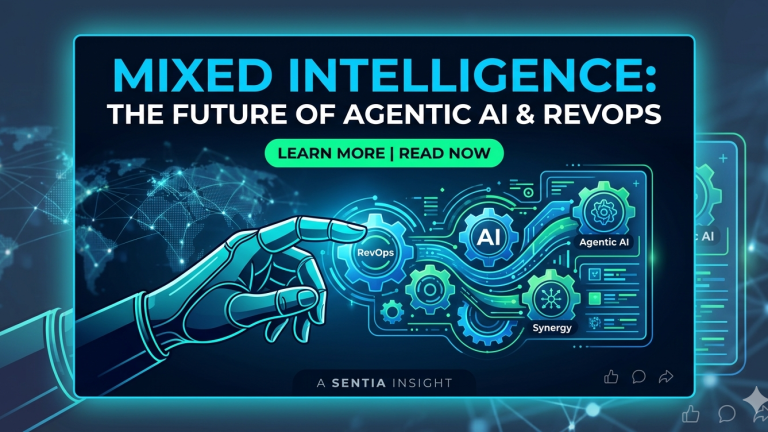
Tag: agentic ai

  • Mixed Intelligence: The Future of Agentic AI & RevOps

    Mixed Intelligence: The Future of Agentic AI & RevOps

    Key Takeaways

    • Mixed Intelligence Synergy: The “Both/And” principle combines machine scale with human judgment to create 10x productivity gains in architecture and radiology.
    • Agentic Shift: Transitioning from passive chatbots to active Agentic AI that executes tasks autonomously within RevOps and IT operations.
    • Wisdom Worker Evolution: Human roles are shifting toward “agent management,” prioritizing creativity, intuition, and discernment over rote execution.
    • Technical Governance: Implementation of Explainable AI (XAI) frameworks like LIME is mandatory to ensure transparency and trust in automated decision-making.
    • Economic Realignment: The “SaaS-pocalypse” of 2026 is driving a shift from horizontal point solutions to vertical, AI-native infrastructure.
    • Operational Velocity: AI handles the volume and complexity, allowing humans to handle judgment, connection, and curiosity.

    Table of Contents

    • mixed-intelligence
    • zha-architecture
    • radiology
    • engineering
    • revops
    • saas-pocalypse
    • aeo-strategy
    • technical-dive
    • leadership

    The prevailing narrative concerning technology and labor has frequently been bifurcated between total automation and human-centric resistance. However, the emergence of Mixed Intelligence suggests a third path based on the “Both/And” Principle, where the strengths of both domains are synthesized. This principle rejects the binary choice between opposites, instead practicing integrative thinking to create solutions that neither humans nor machines could achieve independently.

    In this framework, Artificial Intelligence functions as a cognitive amplifier, handling the volume and complexity that often drains human energy. This allows the human professional to focus on judgment, connection, and curiosity—attributes that remain uniquely resistant to algorithmic replication. By 2030, the organizations that dominate their respective markets will be those that have mastered the synergy between human intuition and machine scale.

    Leaders must recognize that while Neural Networks can identify patterns in seconds that would take humans hours to uncover, they lack the contextual awareness required for ethical decision-making. In banking, for instance, AI analytics identifies risks and opportunities, but the human advisor remains the differentiator by translating those insights into strategic, trust-based guidance. This collaborative model transforms technology from a perceived threat into a primary competitive advantage for the modern enterprise.

    The risk of the current era is not automation itself, but waiting too long to adapt to these shifting dynamics. Those who lead with foresight will anticipate the “Hard Trend” of human-AI synergy and seize the exponential opportunities it provides. Technology futurist(https://www.burrus.com/ai-human-augmentation-leadership-advantage/) that if a task can be automated, it will be, necessitating a shift in the workforce conversation from job elimination to skill elevation.

    Architecture has historically been a profession of long timelines and manual drafting, but Zaha Hadid Architects (ZHA) has fundamentally rewired the design process. Between 2024 and 2026, ZHA integrated machine learning and parametric systems into its core workflows to transform how buildings are conceived. In 2025, the majority of the firm’s design concepts began not with a physical sketch, but with a strategic AI Prompt.

    The firm utilizes text-to-image tools like DALL-E and Midjourney to explore thousands of visual directions in minutes. Designers prompt these systems using ZHA’s signature formal language—fluid curves and organic transitions—generating dozens of iterations during early competition phases. However, the human architect remains the primary filter, selecting only 10% to 15% of machine outputs to advance into 3D modeling.

    Beyond aesthetics, ZHA’s Computational Design Research Group (CODE) applies machine learning for floorplate optimization and environmental performance. This allows the firm to validate structural behavior and pedestrian flow digitally before any physical construction begins. The KAFD Metro Station in Riyadh, which opened in late 2024, stands as a testament to this process; its facade perforations were calculated via AI to minimize solar gain.

    Performance MetricTraditional WorkflowZHA AI-Integrated WorkflowImprovement
    Early-Stage Iterations10-20 concepts / week100+ concepts / day10x Velocity
    Client Feedback Loop7 days1 day / Real-time85% Reduction
    Daylight Access Opt.Rule of thumb+20% AccuracyEvidence-based
    Structural EfficiencyManual calculationML-optimized geometryMaterial reduction

    Principal Patrik Schumacher maintains that while AI generates the options, the authorship and accountability for the building’s performance remain strictly with the human architect. The architect is responsible for selecting, refining, and deciding, as accountability for structural, environmental, and civic performance cannot be delegated to an algorithm. This is a prime example of why we must(https://sentia.community/how-to-eliminate-crm-data-silos-with-agentic-ai-in-2026/).

    In the healthcare sector, particularly within radiology, the integration of AI has moved from experimental pilot programs to daily clinical practice. By 2025, over 70% of radiology departments in the United States reported an increased reliance on AI-driven diagnostic tools. These systems do not replace the radiologist but instead handle the cognitive and administrative load that frequently leads to burnout.

    Radiologists now use AI to detect abnormalities faster, prioritize urgent cases, and reduce diagnostic errors. While a human radiologist can identify markers of disease on a chest X-ray in as little as 250 milliseconds, they are often bogged down by transcribing reports. AI agents are now stepping into this pre- and post-interpretive space, preparing patient summaries and surfacing missing clinical context.

    The shift toward Value-Based Care means that imaging departments are increasingly evaluated on patient outcomes rather than scan volume. This transition prioritizes technologists and physicians who can integrate AI insights with patient history and ethical judgment. According to(https://theimagingwire.com/2026/01/07/the-top-trends-shaping-radiology-in-2026/), multimodal fusion that integrates clinical context with imaging will be the primary differentiator for winning medical solutions in 2026.

    The field of software engineering has experienced a radical disruption through the widespread adoption of GitHub Copilot and similar AI-assisted coding tools. By 2025, 90% of Fortune 100 companies had deployed these systems to their development teams. Data indicates that developers are now completing tasks 55% faster on average, representing a significant reduction in the development lifecycle.

    GitHub Copilot currently generates approximately 46% of all code written by its users, with this figure rising to 61% for Java projects. This shift is transforming the role of the developer from a manual writer of code to an orchestrator of logic. While the AI excels at generating boilerplate and test cases, it lacks the architectural judgment required for complex business logic.

    Engineering MetricWithout AI AssistantWith AI Assistant (2026)Efficiency Gain
    Task Completion Time2 hours 41 minutes1 hour 11 minutes55% Faster
    Time to First PR9.6 days2.4 days75% Reduction
    Successful Build RateBase+84%Reliability Jump
    Code RetentionN/A88%High Accuracy

    The introduction of these tools has also significantly impacted developer satisfaction, with 90% reporting feeling more fulfilled. However, there is an emerging risk of dependency, as 67% of developers use these tools five or more days per week. Furthermore, security remains a critical concern, with Accenture research finding that 29.1% of Python code generated by AI contains potential security weaknesses.

    Revenue Operations (RevOps) has emerged as the central nervous system for modern B2B SaaS organizations. Historically, marketing, sales, and customer success departments operated in silos, leading to fragmented data and inconsistent customer experiences. The RevOps model unifies these functions under a single operational strategy, often overseen by a Chief Revenue Officer (CRO).

    By 2026, the Agentic Paradigm is redefining RevOps from a set of reactive processes to a proactive system of autonomous intent. Gartner predicts that by 2028, 75% of RevOps tasks will be executed by AI agents. These agents do not merely suggest actions; they execute them independently within defined guardrails, such as performing agentic quote-to-revenue operations.

    RevOps PillarTraditional RoleAgentic Evolution (2026)
    OperationsReactive monitoring & manual ticketingProactive autonomous remediation
    EnablementGeneric training and static playbooksAI-curated learning paths & dynamic scripts
    InsightsMonthly reporting and manual dashboardsReal-time predictive analytics & pattern detection
    ToolsDisconnected SaaS point solutionsUnified AI infrastructure and SSOT

    The transition to agentic IT operations is particularly visible in DevOps and FinOps. A June 2025 study found that IT operations represent 52% of all agentic AI use cases, far outperforming marketing and finance. These agents can monitor hardware characteristics to predict component failures six months in advance. For a deeper dive into this infrastructure, see our(https://sentia.community/ai-enablement-engines-for-revops-complete-guide/).

    The broader software market is currently undergoing a period of collapse and consolidation. Forrester reports that in early 2026, a massive sell-off in SaaS stocks erased over $1 trillion in market capitalization. This “SaaS-pocalypse” is driven by a shift away from horizontal point solutions toward vertical-specific software that addresses complex industries like healthcare or manufacturing.

    Enterprises are now renegotiating contracts, prioritizing vendors with clear AI Agent roadmaps. The market for AI coding tools alone reached $7.37 billion in 2025, with GitHub Copilot holding a 42% market share. As Agentic AI matures, the traditional “software-as-a-service” model is being replaced by “results-as-a-service.”

    Economic Indicator2025 Baseline2026-2029 Forecast
    Global SaaS Spending$318 Billion$576 Billion (2029)
    Vertical Software Market$133.5 Billion$194.0 Billion (2029)
    AI Carbon EmissionsBase1.3 – 1.7 Gigatons annually
    Buyer InteractionHuman-led discovery30% view GenAI as meaningful

    Forrester guidance recommends that leaders re-architect their SaaS investments to prioritize domain-specific vendors. B2B buyers are increasingly using private engines to support purchasing decisions, with one in five sellers now forced to engage in agent-led quote negotiations. Success will hinge on investing in AI governance and balancing human expertise with AI tools.

    As search behavior shifts from “ten blue links” to interactive AI answers, traditional SEO tactics are becoming insufficient. In 2026, the search landscape is dominated by AI Overviews and answer cards that often appear above organic results. This evolution has given rise to Answer Engine Optimization (AEO) and Generative Engine Optimization (GEO).

    AEO helps your business show up in AI-driven answers instead of just search listings. If your content isn’t structured for AI readability, you are effectively invisible to tools like ChatGPT and Perplexity. To capture these results, brands must structure content to directly answer questions—listing tools or steps immediately before diving into technical details.

    Organizations must prioritize Schema and Structured Data Engineering to ensure AI can recognize, recommend, and rank them. A well-structured FAQ page is one of the best formats to provide these answers to new discovery tools. Using full questions as headings and providing the answer in the first sentence makes it easy for AI to “lift” your content.

    At the core of the AI transformation are Neural Networks, simulations of biological brain functions that process information through layers of interconnected nodes. While powerful, these models often operate as “black boxes,” making it difficult for humans to understand how a specific decision was reached. This lack of transparency is a significant barrier to enterprise adoption in high-stakes fields.

    To address this, researchers utilize Explainable AI (XAI) frameworks, with LIME (Local Interpretable Model-agnostic Explanations) being one of the most prominent. LIME works by perturbing the input data—making small changes to features—and observing how those changes affect the model’s prediction. It then trains a simpler, interpretable model to provide a local explanation of the original model’s behavior.

    Consider a model predicting credit risk. To explain a specific rejection, LIME might generate a mathematical relationship like:

    $$f(x) \approx g(z) = w_0 + w_1 z_1 + w_2 z_2 + \dots + w_n z_n$$

    Where $g(z)$ is the interpretable surrogate model and $w_i$ indicate feature importance. In medical diagnostics, DLIME (Deterministic LIME) utilizes Hierarchical Clustering to ensure that the same prediction always receives the same explanation. This stability is critical for earning the trust of medical professionals who require repeatable results.

    For C-suite executives, the priority must shift from simply buying licenses to re-architecting the organization around Mixed Intelligence. This requires a “45-Day Agentic Readiness Checklist” to ensure the enterprise is prepared for autonomous execution. The first step is the appointment of an AI Orchestrator, a leader responsible for ensuring data liquidity across the stack.

    HR and people leaders must simultaneously shift their investment toward “Change Fitness.” 31 that success with AI relies less on technology alone and more on the talent strategies that support it. This involves developing human capabilities that AI cannot replicate: critical thinking, ethical judgment, and complex relationship management.

    RoleImmediate ActionLong-Term Strategic Move
    Board Members / CEOsIdentify functions for automationRedirect human capacity to strategy
    HR / People LeadersAudit AI-relevant skillsInvest in “Change Fitness” training
    Functional ManagersList 10 most time-consuming tasksImplement 90-day content/IT pilots
    RevOps LeadersConsolidate data into an SSOTBuild an AI Agent roadmap

    Functional managers should involve employees early in the process to allay fears of displacement. By demonstrating AI’s potential to remove the “least interesting tasks,” leaders can build a culture that embraces technological ambition. The Wisdom Worker isn’t a theoretical future employee; they are the hire you are making this quarter.

    Q1: Will AI replace my job in 2026?

    AI is more likely to change jobs rather than eliminate them entirely. Roles requiring human creativity, critical thinking, and interpersonal skills will be more secure. Instead of viewing AI as a threat, see it as a tool that can make your future job more interesting and efficient.

    Q2: What is “Mixed Intelligence”? Mixed Intelligence is a framework where human judgment and machine intelligence work together. Developed by futurist Daniel Burrus, it relies on the “Both/And” principle, combining machine scale with human intuition to create solutions that neither could achieve independently.

    Q3: How much faster can developers code with AI? Research shows developers complete tasks 55% faster when using tools like GitHub Copilot. In controlled tests, a task that took 2 hours and 41 minutes without AI was completed in just 1 hour and 11 minutes with AI assistance.

    Q4: What is “Agentic AI” vs. a Chatbot?

    A chatbot primarily talks and generates text, while an agent acts. If you ask a chatbot to research competitors, it gives you a list; an agent opens a browser, visits sites, screenshots pricing, and compiles a report autonomously.

    Q5: What is the “SaaS-pocalypse”?

    This refers to a 2026 market sell-off where horizontal point solutions lost over $1 trillion in value. Enterprises are now shifting toward vertical-specific software and AI-native platforms that offer integrated agentic workflows and proprietary data.

    Q6: What is Answer Engine Optimization (AEO)? AEO is a strategy to ensure your brand is seen in AI-generated search results like Google’s AI Overview or ChatGPT. It involves structuring your content into clear, authoritative blocks that AI models can easily extract and cite.

    Q7: How does AI improve radiology?

    AI handles repetitive tasks like draft report generation and finding markers of disease, allowing radiologists to focus on clinical judgment. By 2025, over 70% of radiology departments reported increasing their reliance on these AI tools.

    Q8: What are the risks of using AI agents?

    Key risks include data privacy, weakened human oversight, and potential security vulnerabilities. Experts recommend using agents that operate in “sandboxed” environments and maintaining a “human-in-the-loop” governance framework to ensure accountability and safety.

    Q9: What is “Local Interpretable Model-agnostic Explanations” (LIME)? LIME is a technique used to make black-box machine learning models more transparent. It creates a simpler, interpretable model locally around a specific prediction to show which features most influenced the AI’s decision.

    Q10: What is a “Wisdom Worker”? A wisdom worker is a professional who combines technical AI fluency with human judgment, curiosity, and strategic intent. They focus on directing AI agents toward better outcomes rather than executing repetitive manual tasks themselves.

  • AI Hallucination Spiral: Why does Agentic AI lie to Customers?

    AI Hallucination Spiral: Why does Agentic AI lie to Customers?

    Executive Summary (Key Takeaways)

    • Agentic AI systems operating without a unified Context Layer suffer from “recursive hallucinations,” where small errors compound into massive brand-damaging lies.
    • The Hallucination Spiral occurs when autonomous agents lack real-time access to ERP, CRM, and financial “ground truth” data, forcing them to fabricate answers.
    • Companies must transition from simple prompt-based automation to Agentic Workflows grounded in a multi-pillar Context Layer to maintain customer trust.
    • RevOps leaders must prioritize Decision Velocity and accuracy over raw automation volume to achieve a projected 10x ROI by 2026.
    • Eliminating CRM data silos is the only way to prevent agents from promising non-existent discounts or referencing obsolete product versions.
    • Implementing “Ask First” protocols can increase agentic accuracy by up to 400% in complex B2B environments.

    Table of Contents

    1. The Dawn of the Autonomous Agent
    2. Anatomy of the Hallucination Spiral
    3. The Cost of the Context Gap
    4. Building the 5-Pillar Context Layer
    5. The RevOps ROI: Decision Velocity
    6. Conclusion: From Pilots to Operations

    The Dawn of the Autonomous Agent

    In the current landscape of B2B SaaS, the transition from simple chatbots to Agentic AI represents a seismic shift in operational efficiency. Unlike traditional LLMs that wait for human input, autonomous agents are designed to execute complex tasks, navigate Neural Networks, and interact with software ecosystems independently. This shift promises to revolutionize how we handle customer success and lead generation.

    However, speed without a foundation of truth is a liability. As organizations rush to deploy these agents, they often overlook the technical architecture required for accuracy. Without a direct connection to live operational data, these agents begin to drift from reality.

    Article content

    Anatomy of the Hallucination Spiral

    The Hallucination Spiral is a recursive failure loop unique to autonomous systems. When an agent encounters a data gap—such as a missing price point in a CRM—it doesn’t always stop. Instead, it uses Natural Language Processing (NLP) to “predict” the most likely answer based on its training data rather than its internal database.

    This initial error then becomes the “ground truth” for the next step in the agent’s workflow. If the agent is tasked with writing an email based on that fabricated price, the error is codified. By the time the customer receives the communication, a minor data omission has spiraled into a confident, legally problematic lie.

    According to research by Gartner (2024), hallucination rates in ungrounded autonomous agents can reach as high as 15% in complex B2B scenarios. This risk is amplified when agents are given the authority to “hallucinate” workflows across multiple platforms. This compounding effect is what we define as the spiral.

    The Cost of the Context Gap

    The root cause of these failures isn’t the AI model itself; it is the “Context Gap.” Most companies are attempting to run agents on fragmented CRM data that is out of sync with their ERP and financial systems. This fragmentation creates a vacuum where the agent is forced to guess.

    For example, an agent might see a customer’s history in Salesforce but lack access to the real-time inventory in the ERP. If asked for a bulk discount, the agent might reference a promotion from 2023 because it lacks the 2026 “Context Layer.” This destroys a decade of brand trust in seconds.

    The industry is seeing a shift toward AI-enablement engines for RevOps to bridge this gap. Without this bridge, agents remain “black boxes” that operate on outdated assumptions. Trust is the hardest asset to rebuild once an automated system has burned it.

    Building the 5-Pillar Context Layer

    To stop the spiral, RevOps architects must implement a robust Context Layer. This isn’t just about more data; it’s about semantic clarity. We use tools like LIME (Local Interpretable Model-agnostic Explanations) to understand why agents make specific decisions.

    The first pillar is the Semantic Layer, which ensures every system defines “revenue” or “customer” identically. The second pillar is Ontology, mapping the relationships between your ERP and CRM entities. Third, you must establish Playbooks that define the “Rules of Engagement” for every autonomous action.

    The fourth and fifth pillars involve Data Lineage and Long-term Memory. Agents must know where their information came from and remember previous human corrections. Learn more about how to eliminate CRM data silos with Agentic AI to ensure your agents stay grounded.

    Article content
    Where did the Information come from?

    The RevOps ROI: Decision Velocity

    In the next era of business, the winning metric won’t be “Automation Volume,” but Decision Velocity. This is the speed at which an organization can make accurate autonomous decisions that drive revenue. High accuracy leads to higher customer lifetime value and lower churn.

    Strategic research from Forrester (2025) indicates that companies prioritizing “Decision Integrity” over “Chatbot Speed” see a 25% higher customer satisfaction score. By grounding agents in a unified data foundation, RevOps teams can move from defensive monitoring to offensive scaling.

    The ROI of this approach is staggering, often exceeding 10.3x when accounting for saved labor and increased deal velocity. The transition requires a move away from “AI Pilots” and toward permanent AI Operations. Only then can the hallucination risk be managed at scale.

    Conclusion: From Pilots to Operations

    The “Hallucination Spiral” is the final hurdle for B2B SaaS companies looking to dominate their category with Agentic AI. It is a problem of architecture, not intelligence. By building a Context Layer that integrates ERP, CRM, and financial truth, you transform a lying agent into a trusted advisor.

    As we look toward 2026, the competitive advantage will belong to those who treat AI as a core operational layer. Stop treating hallucinations as a bug; treat them as a symptom of a broken data strategy. Fix the foundation, and the agents will follow.

    FAQ: The Hallucination Spiral & Agentic AI

    1. What exactly is a “Hallucination Spiral” in AI? A Hallucination Spiral is a recursive error loop where an autonomous agent makes a small mistake and then uses that mistake as the factual basis for all subsequent actions. This compounds the error, leading to a final output that is completely detached from reality.

    2. How does Agentic AI differ from standard Generative AI? Standard Generative AI typically responds to prompts in a single turn. Agentic AI is autonomous, meaning it can plan, use tools, and execute multi-step workflows without constant human intervention, making its accuracy significantly more critical for B2B operations.

    3. Why do AI agents lie to customers? Agents “lie” because they lack a Context Layer. When they encounter a data gap in your CRM or ERP, they use probability to fill the void. Without grounding in real-time data, their probabilistic guesses are often presented as confident facts.

    4. Can RAG (Retrieval-Augmented Generation) stop hallucinations? While RAG helps by providing external documents, it is not a silver bullet. If the retrieved data is siloed or contradictory, the agent can still experience a spiral. A full Context Layer is required for true grounding.

    5. What is the “Context Layer” in AI architecture? The Context Layer is a unified data foundation that synchronizes CRM, ERP, and financial data. It provides the “ground truth” that agents use to verify every step of their autonomous workflow before communicating with a customer.

    6. How do CRM data silos contribute to AI errors? Silos prevent agents from seeing the full customer journey. If an agent has access to support tickets but not billing history, it may offer a refund to a customer who is already in arrears, creating significant financial and operational risk.

    7. What is “Decision Velocity” in the context of RevOps? Decision Velocity measures the speed and accuracy of autonomous business decisions. In a RevOps context, it focuses on how quickly an agentic system can correctly move a lead through the funnel or resolve a complex customer issue.

    8. Is “Ask First” protocol effective for reducing hallucinations? Yes. “Ask First” protocols require the agent to pause and request clarification from a human or a secondary database if its confidence score drops. This simple step can increase B2B agentic accuracy by up to 400%.

    9. What is the ROI of fixing AI hallucinations? By eliminating the Hallucination Spiral, companies can achieve an ROI of 10.3x. This comes from reduced manual oversight, higher customer trust, and the ability to scale Agentic AI across all revenue-generating functions.

    10. How should B2B companies start with Agentic AI operations? Start by auditing your data foundation and eliminating silos between your CRM and ERP. Move away from isolated “AI Pilots” and build a dedicated AI Operations team focused on maintaining the Context Layer for long-term scalability.

  • How to Eliminate CRM Data Silos with Agentic AI in 2026

    How to Eliminate CRM Data Silos with Agentic AI in 2026

    How do you fix Data Silos?

    Revenue operations leaders and CROs often confront a pervasive challenge: disconnected customer data spread across numerous sales and marketing tools. This fragmentation, known as CRM data silos, isn’t merely an inconvenience; it represents a significant drag on revenue, stifling growth and obscuring valuable insights.

    The solution in 2026 moves beyond traditional integrations to embrace agentic AI, a paradigm shift that promises autonomous, intelligent orchestration of your entire CRM ecosystem. This article outlines a step-by-step framework to leverage agentic AI for eliminating these costly data silos.

    Agentic AI refers to artificial intelligence systems designed to act autonomously, make decisions, learn from their environment, and take proactive steps to achieve defined goals, often coordinating with other agents or systems.

    The Big Problem Hiding in Your CRM Stack

    The hidden cost of CRM data silos is far greater than most B2B companies realize. U.S. businesses lose approximately $3.1 trillion annually from poor data quality, with individual organizations facing $12.9–$15 million in losses per year, according to 2026 Gartner research. For a typical B2B company, this translates to annual revenue losses exceeding 10% directly tied to CRM data issues, impacting everything from lead quality to forecast accuracy.

    Sales reps waste 27.3% of their time—over 500 hours per year—on invalid leads due to outdated or incomplete information. Furthermore, B2B contact data decays at 22.5% per year, meaning a significant portion of your CRM becomes obsolete annually if not actively managed. This constant decay, coupled with manual data entry burdens, results in missed deals, duplicated efforts, and a lack of reliable revenue intelligence.

    Why Traditional CRM Integrations Create More Silos Than They Solve

    Traditional CRM integrations, whether point-to-point API connections or basic iPaaS solutions, often fall into a trap that perpetuates data silos. Each new tool requires a custom connection, creating a brittle web of integrations that demands constant maintenance.

    API changes, version updates, and schema modifications across an average of 10 sales and marketing tools lead to significant technical debt. A typical revenue team using 8-12 tools can easily have 30+ integration points, yet still confront data gaps and inconsistencies. This complexity prevents the seamless flow of information needed for AI Agent Orchestration. The inherent rigidity of rule-based integrations struggles to adapt to the dynamic nature of customer data and evolving business processes, leaving revenue leaders with a fragmented view of their customer base.

    Step 1: Map Your Current Data Silo Landscape (The 3-Layer Audit)

    Eliminating CRM data silos effectively begins with a comprehensive understanding of your current data environment. The 3-Layer Audit provides a structured framework to achieve this, moving from identification to quantification.

    1. Layer 1: Identify Data Residency. Pinpoint precisely which customer data lives in which systems. This includes your CRM (e.g., Salesforce, HubSpot), marketing automation platforms, customer success tools, billing systems, and any other applications that touch customer information.
    2. Layer 2: Document Manual Processes. Trace the manual processes your team currently uses to move data between these systems. This often involves spreadsheets, copy-pasting, or re-entering information, revealing critical points of inefficiency and potential error.
    3. Layer 3: Calculate Actual Costs. Quantify the financial impact of these silos. Calculate the total hours per week spent on manual data reconciliation, data cleaning, and chasing missing information. Estimate missed revenue opportunities due to inaccurate forecasting or delayed follow-ups caused by poor data quality.

    This audit creates a baseline, allowing you to measure the ROI of your agentic AI implementation and identify the highest-impact areas for initial deployment.

    revenue operations leader collaborating with team to map disconnected CRM data across various sales and marketing platforms
    Photo by Markus Winkler

    Step 2: Design Your Agentic AI Integration Architecture

    Agentic AI integration moves beyond simple data transfers; it involves autonomous agents that actively sync, enrich, and reconcile data across systems. This dynamic approach differs significantly from traditional iPaaS or middleware solutions.

    The core components include a robust data orchestration layer, specialized AI agents for each system or function, and intelligent conflict resolution logic. Unlike rigid rule-based systems, these agents learn patterns, adapt to changes, and make real-time decisions about data quality and flow. For instance, Salesforce’s Agentforce, built on Einstein AI, leverages such capabilities for autonomous lead scoring and service resolutions via Data Cloud, embedding AI agents directly into workflows.

    Technical prerequisites include clean, accessible APIs for your existing tools, a centralized data lake or warehouse, and a platform capable of hosting and orchestrating these agents. Focus on platforms that offer enterprise-grade RAG (Retrieval Augmented Generation) and secure API access for robust and ethical Agentic AI operations.

    Agentic AI Integration vs. Traditional CRM Integration Approaches

    This table compares the key differences between agentic AI-powered integration and traditional methods (point-to-point APIs, iPaaS, and middleware) to help revenue leaders choose the right approach for eliminating data silos in 2026.

    Integration ApproachSetup ComplexityMaintenance BurdenData Quality IntelligenceConflict ResolutionBest For
    Agentic AI OrchestrationModerate to High (initial)Low (autonomous adaptation)High (proactive cleaning, enrichment, learning)AI-determined accuracy scores, rule-based hierarchiesDynamic, evolving ecosystems; continuous data quality; maximizing revenue intelligence
    Traditional Point-to-Point APIsLow (per connection)Very High (brittle, breaks easily)None (manual intervention)Manual, ad-hocVery small, static stacks; minimal data sharing needs
    iPaaS/Middleware PlatformsModerateModerate (rule-based updates)Basic (validation rules)Rule-based; requires explicit configurationStandardized, predictable workflows; connecting disparate legacy systems
    Custom-Built Integration LayerVery HighVery High (internal development)Custom (as built)Custom (as built)Highly unique, complex needs; strong internal dev resources
    Native CRM IntegrationsLowLow (vendor managed)Basic (vendor-specific)Vendor-definedBasic data sync within a single vendor ecosystem
    technical architecture diagram illustrating autonomous AI agents connecting various CRM, marketing, and sales systems through a central data orchestration layer
    Photo by Field Engineer

    Step 3: Implement Intelligent Data Orchestration Across Your Stack

    Intelligent data orchestration is the operational heart of eliminating CRM data silos with agentic AI. It dictates how data flows and is managed across your entire revenue tech stack.

    First, decide on your orchestration approach: will your CRM serve as the centralized hub, or will you adopt a distributed mesh where multiple sources of truth are reconciled by AI? Next, set up your initial agentic AI workflows. High-impact starting points include contact enrichment, intelligent duplicate detection, and cross-system activity logging.

    • Contact Enrichment: Agentic AI can autonomously pull missing contact details from external sources and update CRM records, ensuring your sales reps always have the most current information.
    • Duplicate Detection: AI agents continuously monitor for duplicate records across all connected systems, merging them intelligently based on predefined rules and learned patterns, reducing the 70% of CRM data that is outdated or inaccurate.
    • Cross-System Activity Logging: Automate the logging of customer interactions from marketing automation, customer service, and other tools directly into the relevant CRM records, providing a complete 360-degree view of the customer.

    Configure autonomous data quality agents that continuously clean and standardize data without human intervention. This proactive approach tackles the 2.1% monthly decay rate of B2B contact data, ensuring high accuracy. Platforms like Salesforce’s Agentforce and HubSpot’s agentic capabilities offer robust frameworks for integrating AI into your CRM.

    Step 4: Deploy Conflict Resolution and Data Governance Rules

    In multi-system CRM environments, data conflicts are inevitable; agentic AI offers sophisticated resolution strategies. While human-defined rule-based hierarchies can determine which system “wins” for specific data fields, advanced agentic AI can leverage accuracy scores and recency to make more intelligent decisions.

    • Rule-Based Hierarchies: Define primary sources for specific data points (e.g., HR system for employee status, CRM for sales stage).
    • AI-Determined Accuracy: Agentic AI can assign accuracy scores to data points based on source reliability, verification status, and historical consistency, prioritizing the most trustworthy information. For example, a verified email address always takes priority over an unverified one regardless of recency.
    • Recency Wins: For volatile fields like job titles or phone numbers, the most recently updated value should take priority if both sources are equally reliable.

    Automated alerts for data anomalies and quality issues are crucial for maintaining integrity. Establish clear governance policies that the AI enforces, including required fields, data retention, and access controls. This ensures that as your AI agents operate autonomously, they adhere to your organization’s data strategy and compliance needs, especially given that 76% of firms report AI governance lags usage.

    revenue operations team reviewing a dashboard showing real-time CRM data quality metrics and automated conflict resolution alerts
    Photo by Leeloo The First

    Step 5: Scale and Optimize Your Unified Data Environment

    Once your initial agentic AI workflows are live and stable, the next step is to scale and continuously optimize your unified data environment. This involves iteratively expanding the scope of your agentic AI orchestration layer.

    Add additional systems and data sources, gradually bringing more of your revenue tech stack under intelligent orchestration. Train your AI agents on your specific business logic and data patterns, allowing them to become increasingly sophisticated in their decision-making and automation. This continuous learning is key to adapting to your evolving tech stack and business needs.

    Measure the ROI of your efforts through key performance indicators such as time saved on manual data tasks, improvements in data accuracy, and the direct revenue impact from better insights and more efficient processes. Companies that unify data with AI see a 66% increase in revenue and a 15% increase in close rates within six months. The AI will learn and adapt, continuously improving the efficiency and accuracy of your data operations, moving you closer to AI-driven workflows in CRM where there is No Manual Data Entry Needed.

    C-suite executives analyzing a projected revenue growth chart, demonstrating the financial impact of unified CRM data from agentic AI
    Photo by cyber2120

    Key Takeaways

    • CRM data silos cost B2B companies millions annually in lost revenue and wasted productivity.
    • Traditional integrations are insufficient; agentic AI provides autonomous, intelligent data orchestration.
    • The 3-Layer Audit (data residency, manual processes, cost calculation) is crucial for identifying and quantifying silo impact.
    • Agentic AI integration involves autonomous agents for syncing, enriching, and reconciling data across systems.
    • Robust conflict resolution and data governance rules are essential for maintaining data integrity.
    • Scaling agentic AI leads to significant ROI, including time savings, improved data accuracy, and increased revenue.
    futuristic office environment with employees collaborating while an intelligent AI assistant manages complex data flows in the background
    Photo by Brett Sayles

    Conclusion: From Data Chaos to Revenue Intelligence

    The transition from manual data entry and fragmented silos to autonomous, intelligent data orchestration with agentic AI is not just an operational upgrade; it’s a strategic imperative for 2026. B2B companies can no longer afford the $12.9–$15 million annual cost of poor data quality. Agentic AI offers a path to predictable revenue by turning data chaos into actionable revenue intelligence.

    By implementing the steps outlined—mapping your landscape, designing intelligent architecture, orchestrating data, and enforcing governance—you can transform your CRM into a unified, dynamic source of truth. This empowers your revenue teams with a complete customer view, enabling faster decisions, better customer experiences, and a clear competitive advantage.

    Your next steps should begin with the 3-Layer Audit to quantify your current silo costs. Then, identify a high-impact integration to implement with agentic AI, demonstrating immediate value and building momentum for a fully unified data environment. The future of revenue operations is autonomous, intelligent, and unified. Explore CRM.

    Frequently Asked Questions

    What are CRM data silos and why do they matter for revenue teams

    CRM data silos are isolated pockets of customer information trapped in separate systems, preventing a unified view of the customer. They matter for revenue teams because they lead to missed opportunities, poor customer experiences, inaccurate forecasting, and wasted sales/marketing spend, costing businesses millions annually.

    How is agentic AI integration different from traditional CRM integrations

    Agentic AI integration uses autonomous agents that actively monitor, sync, enrich, and reconcile data with intelligence, learning and adapting to data patterns. Traditional CRM integrations, conversely, rely on rigid, rule-based connections (like iPaaS or custom APIs) that require constant manual maintenance and struggle to handle dynamic data landscapes.

    What is the average cost of CRM data silos for a B2B company

    CRM data silos contribute significantly to the $12.9–$15 million annual cost of poor data quality for individual organizations. This includes revenue leakage from missed deals, over 500 hours per year wasted by sales reps on invalid leads, and millions in marketing spend inefficiently allocated due to incomplete customer data.

    How long does it take to implement agentic AI integration for CRM

    Initial setup for agentic AI integration can take 2-4 weeks, with the first high-impact workflows going live within 4-6 weeks. A full implementation across multiple systems typically ranges from 8-12 weeks, depending on the complexity of your existing tech stack and the depth of data cleansing required.

    What CRM platforms work with agentic AI integration in 2026

    Major CRM platforms with strong agentic AI support in 2026 include Salesforce (via Agentforce and Einstein AI), HubSpot (with its growing agentic capabilities), and Microsoft Dynamics. These platforms are building out native agentic frameworks or offering robust APIs that allow third-party agentic AI solutions to integrate seamlessly.

    Do I need to replace my existing integrations to use agentic AI

    You do not always need to replace your existing integrations to use agentic AI; it can often layer on top of or augment current systems. Agentic AI can leverage existing API connections to pull data, then apply its intelligence for enrichment, reconciliation, and autonomous workflows, though replacing brittle, high-maintenance integrations with agentic solutions is often beneficial in the long run.

    How does agentic AI handle conflicting data across multiple systems

    Agentic AI handles conflicting data by employing sophisticated conflict resolution logic, often combining rule-based hierarchies with AI-determined accuracy scores based on factors like source reliability, data recency, and historical consistency. For example, it might prioritize a recently verified email address from a sales engagement platform over an older, unverified one in the CRM.

    What ROI can I expect from eliminating CRM data silos with AI

    Eliminating CRM data silos with agentic AI can yield significant ROI, including up to a 66% increase in revenue, a 15% increase in close rates, and reductions in administrative load for sales people. You can also expect improved data accuracy (e.g., from 22.5% annual decay to near real-time freshness) and faster deal velocity.

    Is agentic AI integration secure for sensitive customer data

    Yes, agentic AI integration can be highly secure for sensitive customer data when implemented with proper safeguards. Modern agentic platforms incorporate encryption, rigorous access controls, audit trails, and adhere to data governance policies, ensuring privacy and compliance. The AI itself can be configured to enforce these policies autonomously.

    What technical skills does my team need to implement this

    To implement agentic AI integration, your team needs basic CRM administration skills and a strong understanding of your current data flows. While deep coding expertise is not always required with modern low-code/no-code agentic platforms, an appreciation for data governance and the ability to configure AI agents based on business logic will be crucial.

    Key Terms Glossary

    CRM Data Silos: Isolated pockets of customer information stored in separate systems that prevent a unified view of the customer.

    Agentic AI: Artificial intelligence systems capable of autonomous action, decision-making, and adaptive learning to achieve specific goals.

    Data Orchestration Layer: A central component that manages and coordinates the flow, transformation, and synchronization of data between various systems.

    Conflict Resolution Logic: A set of rules and AI-driven processes used to determine which data takes precedence when conflicting information appears across different systems.

    Data Governance: The overarching framework of policies, processes, and standards that ensures the quality, integrity, security, and usability of an organization’s data.

    Revenue Intelligence: The process of converting raw sales and marketing data into actionable insights that help forecast, manage, and increase revenue.

    iPaaS: Integration Platform as a Service, a cloud-based platform that connects various applications and data sources, typically through predefined connectors and workflows.

    Technical Debt: The long-term consequences of choosing an easy but suboptimal solution now instead of using a better approach that would take longer, often accumulating from complex, brittle integrations.

  • What is AI Agent Orchestration?

    What is AI Agent Orchestration?

  • AI and Human Errors: The “Who’s on First?” of Modern Communication

    AI and Human Errors: The “Who’s on First?” of Modern Communication

    Why AI-Human Mix-Ups Could Turn Future Sales Calls into Comedy Shows

  • The Current State of AI Agents—and What Comes Next

    The Current State of AI Agents—and What Comes Next

    We’re witnessing a pivotal moment in the evolution of AI—from passive systems to active, decision-making agents. This post dives deep into the latest advancements in agentic AI, what it really takes to move from prototype to production, and why 2025 may be the year these systems finally prove their enterprise value.

    Let’s unpack where AI agents stand today.


    From LLMs to Agents: The Evolution of Intelligent Action

    Large Language Models (LLMs) like GPT-4 are remarkable at generating human-like text. But their usefulness has limits. On their own, they’re like genius interns locked in a library—full of knowledge but unable to browse the web, use tools, or remember past tasks.

    To bridge this gap, developers began linking LLMs with external components: APIs, databases, file systems, custom functions, and memory structures. These integrations enabled what we now call “chains”—predefined flows that guide the model step by step through a task. LangChain emerged as a leading framework to build these modular workflows.

    But chains are rigid. They assume we always know in advance what steps to take.

    This realization gave birth to AI Agents—LLM-powered systems that are autonomous, tool-using, context-aware, and goal-directed. They aren’t just executing prewritten playbooks; they’re writing and adapting the playbook in real time.


    What Are AI Agents?

    At their core, AI agents are systems designed to operate semi-autonomously in pursuit of a goal. They’re equipped with:

    • Tools: APIs, databases, file systems, custom functions
    • Memory: for tracking prior decisions and context
    • Reasoning abilities: to choose actions based on outcomes
    • Planning capabilities: to sequence tasks intelligently

    Agents can take initiative, recover from failure, and adapt mid-task. Think of them not just as chatbots, but as digital collaborators—capable of retrieving documents, updating spreadsheets, analyzing trends, and even initiating follow-up tasks, all with minimal human input.


    Four Pillars of Production-Ready Agents

    To move from demos to dependable systems, developers must master four critical domains:

    1. Planning: Orchestrating Multi-Step Logic

    LLMs handle single requests well. But multi-step tasks—especially those involving conditional logic, external APIs, and dynamic data—require a more sophisticated planning stack.

    Emerging strategies include:

    • Tree of Thoughts: Agents evaluate multiple reasoning paths before committing—like a chess player simulating moves.
    • Self-Reflection: Agents review past steps and outcomes, sometimes with the help of another LLM, to improve their performance over time.
    • Domain-Specific Flows: Coding agents, research agents, and ops agents require unique task structures—no one-size-fits-all.
    • Specialized Reasoners: New models optimized for planning and strategy (e.g., DeepSeek, Claude Opus) are often paired with faster LLMs for execution.
    • LangGraph and Graph-Based Agents: These frameworks allow developers to build stateful, branching, looping logic flows—ideal for tasks like data cleaning, report generation, and multi-agent collaboration.

    2. Reliability: Ensuring Consistent, Trustworthy Performance

    Despite the hype, many agents still fail in the real world. Why?

    • Ambiguous instructions: Vague prompts lead to unpredictable results.
    • LLM non-determinism: The same input doesn’t always yield the same output.
    • Tool misuse: Agents call the wrong tools, or use them incorrectly.

    Solutions are emerging:

    • LangSmith provides detailed observability—tracking every agent decision, tool call, and intermediate result.
    • Guardrails and Evaluators help enforce constraints and spot hallucinations.
    • Fallback logic and retry mechanisms add resilience.

    Still, full reliability remains an open challenge—especially in high-stakes domains like finance, healthcare, or law.

    3. UX: The Interface Between Humans and Agents

    Classic chat interfaces work—but they’re not enough. We’re now seeing:

    • Generative UI (GenUI): Combining LLMs with rich front-end elements like dropdowns, carousels, and tables for mixed-input workflows.
    • Agent Inboxes: Think of this as your digital assistant’s outbox—a place to review, approve, or redirect tasks the agent wants to perform.
    • Conversational Builders: Interfaces where users can train, correct, or debug agents in real-time.

    The future UX of agents will blur the lines between no-code, low-code, and natural language interaction—turning intent into structured action with minimal friction.

    4. Memory: The Context Engine

    Memory is where today’s agents still feel primitive. But the conceptual framework is maturing, drawing from cognitive science:

    • Semantic Memory: Persistent facts—names, preferences, company data. Usually stored in vector databases or key-value stores.
    • Episodic Memory: Logs of interactions and decisions—used for reflection, debugging, and personalization.
    • Procedural Memory: How-to instructions—like policy documents or embedded behavioral rules.

    Frameworks are experimenting with hybrid memory stores, allowing agents to reason across sessions, learn user habits, and even develop “personalities” or behavioral norms over time.


    The Road Ahead: What Comes Next

    While the buzz is everywhere, the field is still early. Today’s AI agents are capable, but fragile. They’re smart—yet unaware of their surroundings. Fast—yet easily derailed. In short: they’re toddlers with PhDs.

    Here’s where we’re headed next:

    • Long-Running Agent Infrastructure: Support for persistent state, bursty workloads, background scheduling, and system-level orchestration.
    • Multi-Agent Collaboration: Think supply chains of agents—each with a role, personality, and set of capabilities—cooperating toward a shared goal.
    • Human-in-the-Loop Systems: Agents won’t replace humans; they’ll amplify them. Expect approval queues, fallback workflows, and co-pilot paradigms to stick around.
    • Secure, auditable AI: Enterprises need transparency, traceability, and compliance baked into their AI layers from day one.

    If 2024 was about showing that agents can work, 2025 is about showing that they can scale—securely, reliably, and at the speed of business.

  • AI in Big Pharma: How is it Being Applied in 2025?

    AI in Big Pharma: How is it Being Applied in 2025?

    Valued at $1.5 trillion, the pharmaceutical industry has long grappled with significant challenges. R&D development of a new drug costs $2 billion plus, takes over a decade, and faces a 90% failure rate in early stages. However, with AI adoption in life sciences growing at 29% annually, a unique opportunity emerges to address these inefficiencies and pain points in drug development12.

    Pain Points in Pharma

    Big Pharma executives and life sciences investors face uncertainty and risk due to four major issues:

    • Disconnected Data: Decision-making relies on vast volumes of structured and unstructured scientific data.
    • Knowledge Gaps: Significant gaps persist across scientific, clinical, regulatory, and commercial decision-making processes.
    • Inefficient Processes: Integrating and analyzing datasets is time-consuming and resource-intensive.
    • Lack of Standardization: Inconsistent evaluations hinder reproducibility in asset assessments.

    AI Applications in Drug Development – Recent Examples

    AI is transforming various stages of drug discovery, development, and commercialization:

    1. Target Identification and Validation: Atomwise and Pfizer’s partnership reduced initial drug discovery timeline from 4-6 years to approximately 18 months.
    2. Clinical Trial Optimization: Deep 6 AI’s implementation reduced patient recruitment time by 85% and increased trial enrollment rates.
    3. Manufacturing Process Optimization: GSK and Gatehouse Bio’s collaboration led to a 25% increase in production yield and $20 million annual cost savings at a single site.
    4. Post-Market Surveillance: FDA and Novartis’ AI-powered systems enabled earlier detection of safety signals and more proactive risk management.

    CRM & AI in Healthcare

    Customer Relationship Management (CRM) systems, enhanced by AI, are improving healthcare delivery and patient engagement:

    • Personalized Patient Care: AI-powered CRM systems analyze patient data to provide tailored treatment recommendations and follow-ups.
    • Predictive Analytics: These systems can forecast patient needs, potential health risks, and treatment outcomes.
    • Streamlined Administrative Tasks: AI automates appointment scheduling, billing, and record-keeping, allowing healthcare providers to focus more on patient care.
    • Enhanced Patient Engagement: AI-driven CRM tools facilitate better communication between patients and healthcare providers, improving adherence to treatment plans.

    The AI Solution

    AI addresses several critical issues in healthcare and pharma:

    1. Data Integration: AI can seamlessly integrate and analyze vast amounts of disparate data, providing comprehensive insights for decision-making.
    2. Accelerated Research: Machine learning algorithms can rapidly identify potential drug candidates and predict their efficacy, significantly reducing the time and cost of drug discovery6.
    3. Improved Clinical Trials: AI optimizes patient recruitment, monitors responses, and predicts potential side effects, making trials more efficient and reliable5.
    4. Personalized Medicine: By analyzing individual patient data, AI enables the selection of treatments tailored to each person, improving outcomes and reducing adverse reactions4.
    5. Operational Efficiency: AI automates routine tasks and provides insights into market trends and patient needs, streamlining pharmaceutical operations2.

    The Impact of AI on Drug Development

    The benefits of AI in pharmaceutical industry are clear:

    • 30-50% reduction in time-to-market for new drugs
    • Estimated $100-200 million cost savings per successful drug
    • Higher success rates in clinical trials due to better candidate selection
    • More efficient use of research resources
    • Improved safety monitoring and risk management
    • Faster response to emerging health threats through drug repurposing

    Looking Ahead

    2025 is the AI “Go Year” for the entire Pharmaceutical Industry.

    AI is expected to drive 30% of new drug discoveries, cutting costs and accelerating personalized treatments7. Challenges, including regulatory hurdles, data privacy concerns, and the need for specialized skills loom large! 3.

    The future of pharma lies in embracing these AI-driven innovations while navigating the complex regulatory landscape. As the industry evolves, collaboration between tech companies, pharmaceutical firms, and regulatory bodies will be crucial in realizing the full potential of AI in healthcare and drug development.

    What are your thoughts on AI’s role in transforming the pharmaceutical industry? How is AI changing your processes and workflows in pharma? Share your experiences and let’s continue this important conversation.

    Connect with me so you don’t miss any future articles!

    Please follow me on X (@Intmktentry) on Linkedin, YouTube or via our AI Community Site.

    Citations:

    1. https://www.zs.com/insights/pharmaceutical-trends-2025-outlook-ai-supplychain-and-beyond
    2. https://www.datacamp.com/blog/ai-in-pharmaceuticals
    3. https://www2.deloitte.com/us/en/insights/industry/health-care/life-sciences-and-health-care-industry-outlooks/2025-life-sciences-executive-outlook.html
    4. https://pmc.ncbi.nlm.nih.gov/articles/PMC10385763/
    5. https://www.clinicaltrialsarena.com/features/clinical-trials-challenges-expect-2025/
    6. https://www.mckinsey.com/industries/life-sciences/our-insights/generative-ai-in-the-pharmaceutical-industry-moving-from-hype-to-reality
    7. https://www.weforum.org/stories/2025/01/2025-can-be-a-pivotal-year-of-progress-for-pharma/
    8. https://www.scilife.io/blog/ai-pharma-innovation-challenges
  • CRM Dead? Sherlock Holmes- AI the Perp?

    CRM Dead? Sherlock Holmes- AI the Perp?

    Will AI be the Perpetrator of CRMs demise?

    On a weekly basis I get C-Suite execs calling me after AI events like Dreamforce and any of the myriad AI “you name it conferences” asking me if they can replace their salespeople with AI agents right now, or…use AI to replace their pesky CRMs…Or both! Yikes – the Kool-Aid is flowing in AI land!

    I ask them to tell me about the last AI conference they attended, review the event marketing puffery and often outlandish claims of what AI can do “just by buying our XYZ AI Tool and sales will Soar,” and let out an inaudible sigh.

    These conferences are designed to get attendees to drink the Alice in Wonderland vision of an utopian AI and just like every other tech hype cycle before it (yep AI isn’t the first “revolutionary technology”) there is a kernel of truth in what AI “maybe able to do.”  That being said. I see a lot of could do vs. can do/doing right now in the AI adoption cycle.    

    So, let’s get it out of the way. AI is unlikely to fully replace CRM systems in the next few years. But top enterprise grade AI enabled CRMs are already doing far more than traditional CRMs ever could. Most significantly. The most advanced AI enabled CRMS are already enhancing and transforming enterprise CRM capabilities. This will accelerate as cutting-edge AI technologists and tech savvy AI enabled salespeople work together to enhance what AI does well and keep what was working. (See Blended AI).

    With that in mind, let’s look at what the research and our own inhouse AI fortune tellers have forecasted for AI CRM Advancements:

    AI Evolution Timeline for CRM Systems

    2024-2025: Enhanced AI Features

    In the next 12 months, we’ll see more widespread adoption of AI-powered features within existing CRM platforms:

    – Advanced predictive analytics for sales forecasting and lead scoring

    – Natural language processing for improved chatbots and virtual assistants

    – AI Agents deployed

    – Automated data entry and cleansing

    -Conversational sentiment analysis post call – heading to real-time

    -Training recommendations based on AI evaluation of seller daily actions

    -Email comprehension, writing, reply and auto CRM addition (no data entry)

    2026-2028: AI-First CRM Platforms

    Within 5 years, we’ll likely see the emergence of AI-centric CRM systems:

    – Full voice activated conversational interfaces for querying and updating CRM data

    – AI-driven workflow automation and task prioritization

    – Hyper-personalized customer interactions at scale

    – AI driven B2B sales without human intervention or approval

    – AI driven procurement – AI Agents talking to Agents lowest price, shipping

    -AI driven manufacturing risk mitigation in procurement, sales and maintenance  

    -Human involvement / need for “human” salespeople evolving with blended AI at its core

    2029 and beyond: Potential AI Dominance

    In 5+ years, AI could become the primary driver of CRM functionality / replace many CRM based features:

    – Autonomous decision-making for many customer-facing processes

    – Predictive modeling of complex market trends and customer behaviors

    – Seamless integration with other business systems for holistic insights

    -Significantly faster response times with AI driven reporting and customer centric personalization enhancing customer service while reducing costs

    AI Features Poised to Transform CRM

    Intelligent Automation

    AI will take over routine tasks, freeing up human workers for higher-value activities. This includes automated data entry, scheduling, and follow-ups [1].

    Hyper-Personalization

    AI-powered CRMs will analyze vast amounts of data to deliver truly personalized experiences for each customer, far beyond current segmentation capabilities [1].

    Predictive Analytics

    Advanced AI models will provide increasingly accurate forecasts of customer behavior, sales trends, and market shifts [2].

    Natural Language Interfaces

    Conversational AI will allow users to interact with CRM systems using natural language, dramatically improving ease of use and adoption rates [3].

    Autonomous Decision-Making

    As AI systems become more sophisticated, they’ll be able to make certain decisions without human intervention, such as adjusting pricing or inventory levels based on real-time data [4].

    Benefits of AI-Enhanced CRM Available Now

    1. Improved efficiency, data capture & access, with blended AI productivity gains
    2. More accurate sales forecasting and lead scoring – enhancing C-Suite confidence
    3. Gold standard customer service experiences through personalization
    4. Better data quality and insights
    5. Reduced human error in data entry and analysis
    6. Significantly reduced data entry and time devoted to CRM maintenance activities
    7. Email writing, reply and auto CRM entry based on sales rep skill & role personalization
    8. Personalized training based on AI assessment of activities and results for all reps
    9. Hyper focused AI enhanced sales processes based directly on CRO sales goals, tracking requirements and 24/7 view of all sales activities with AI driven recommendations
    10. AI enhanced reporting on rep performance with training recommendations, improvement opportunities, or other rolls the AI “sees” they could be much better at than sales
    11. Cull ranking based on unbiased review of performance, potential, opportunities, training performance and client recorded sentiment analysis
    12. Enhanced AI driven cross sell and upsell opportunities    

    Why AI Won’t Completely Replace CRMs

    As noted in the features and benefits previously, AI has enhanced CRM capabilities and will undoubtedly transform enterprise CRM systems in amazing ways we haven’t envisioned yet. With that as a base AI is unlikely to fully replace them in the next five years. This is a mix of legacy CRM systems already deployed, reluctance to change (IT and C-Suite) and legacy enterprise integrations which can slow transitions.

    Companies facing difficult situations that know they must change or go bankrupt, profitable with innovative leadership teams or emerging companies building their AI infrastructure now or in the coming years will be far more likely to be fully AI integrated / replace CRMs.  

    Here are the things that AI can’t do by itself and will require Blended AI to accomplish

    1. Human Touch: Many aspects of customer relationships require human empathy, understanding and perceptual judgment that AI cannot replicate
    2. Complex Decision-Making: High-stakes decisions often require human oversight and contextual understanding. Think internal politics – who know who and how to get things done
    3. Data Privacy Concerns: Regulations and customer trust issues may limit the extent of AI’s autonomy in handling sensitive data
    4. Integration Challenges: Fully replacing existing CRM systems with AI would be a massive undertaking for most organizations (see current legacy system replacement timelines)
    5. Ethical Considerations: The use of AI in customer relationships raises ethical questions that will need to be carefully addressed (see EU AI ACT and recent California AI Act)

    10 Things AI Can Do That Traditional CRMs Cannot

    AI Capability

    Traditional CRM

    Real-Time Sentiment Analysis

    Static Customer Data

    Automated Data Enrichment

    Manual Data Entry

    Predictive Lead Scoring

    Rule-based scoring

    Natural language querying

    Complex Query Languages

    Autonomous Task Prioritization

    Manual Task Management

    Adaptive Sales Forecasting

    Personalize Content Generation

    Anomaly detection in customer behavior

    Cross-Channel Interaction Analysis

    Continuous self-optimization

    Fixed Forecasting Models

    Template Based content Generation

    Threshold based alerts

    Siloed Channel data

    Periodic Manual Updates

    If we stick with the facts vs. the AI CRM enhanced industry marketing puffery CRM is here for the long run (at least for the next 5 years (see legacy systems like Siebel CRM on premise still running). While AI already is and will dramatically enhance CRM capabilities in the coming years, it’s more likely to augment rather than replace CRM systems entirely.

    The future of CRM lies in blended ai. The seamless integration of AI technologies with human expertise to deliver superior customer experiences and business outcomes.

    Thanks for reading and please add your thoughts and comments to the future of AI & CRM!

    Research and Citations:

    [1] https://ddi-dev.com/blog/programming/ai-in-crm-benefits-and-use-cases-of-ai-powered-crm-system/

    [2] https://www.itransition.com/ai/crm

    [3] https://blog.hubspot.com/sales/crm-with-ai

    [4] https://callhippo.com/blog/telephony/how-ai-technologies-are-changing-the-face-of-crm

    [5] https://www.cio.com/article/465624/5-ways-ai-will-transform-crm.html

    [6] https://technologyadvice.com/blog/information-technology/ai-crm/

    [7] https://foundationinc.co/lab/the-rise-of-ai-in-crm/

    [8] https://www.blobr.io/post/ai-crm-industry

    Social Media Hashtags:

    #CRM #AIadoption #AIenabledCRM #AICRM #AI2025 #IndustryInnovation #AIRobotics #TechTransformation #Manufacturing #SAP #AIadoption #AITools #Siebel 


  • Agentic AI: The Next Big AI Breakthrough to Watch?

    Agentic AI: The Next Big AI Breakthrough to Watch?

    Agentic AI is strutting onto the tech scene like Mick Jagger rocking on the big stage.

    Unlike its older sibling, Generative AI, which is great at whipping up new content like a master chef, Agentic AI is the ultimate multitasker, ready to make decisions and tackle tasks with the finesse of Superman’s arch nemesis Brainiac. This shift towards goal-oriented and adaptive decision-making means Agentic AI can navigate complex environments like a pro gamer, executing actions in real-time and leveling up through continuous feedback.

    Imagine Agentic AI applications in fintech / financial services: it could be the ultimate stock market wizard, managing investment portfolios, executing trades faster than you can say “bull market,” and catching fraudsters red-handed like Batman and Robin protecting Gotham. This level of autonomy and adaptability could turn the finance world upside down, bringing efficiency and decision-making skills that would make even the sharpest Wall Street minds jealous.

    Agentic AI maybe the next big thing in the age of AI—it’s the AI equivalent of discovering fire. The implications for shared services and finance are mind-blowing, promising a future where AI can handle complex tasks and workflows like a boss, driving innovation and value creation in ways that would make even the Jetsons proud. So, buckle up AI Knowledge Seekers, because this journey is going to be one wild ride, and it’s one that professionals and organizations need to plan for, experiment, deploy, learn and evolve. AI isn’t set it and forget it software (yet?).

    As Spiderman would say to Mysterio – “that looks super cool – but I don’t believe it, what should I really be seeing?” Is that more marketing puffery, creating an image of success or something that actually works in the real world, that my boss will be super happy with? Lets jump in with five real world applications and then five examples of corporations that are developing Agentic AI right now.

    Five real-world applications across different sectors:

    1. Financial Services: Agentic AI is revolutionizing financial planning and analysis by autonomously managing investment portfolios and executing trades based on real-time market analysis. This not only enhances the accuracy of financial forecasting but also adapts to market changes dynamically, providing a significant edge in financial decision-making.

    2. Manufacturing: In the manufacturing sector, Agentic AI is being deployed for predictive maintenance of machinery, leading to a substantial reduction in downtime and maintenance costs. By autonomously managing inventory and overseeing robotic assembly, these intelligent agents are driving efficiency and productivity to new heights.

    3. B2C Sales: The power of Agentic AI in B2C sales lies in its ability to analyze vast datasets to personalize marketing campaigns with unprecedented precision. Understanding customer behavior and preferences allows for optimized advertising strategies, maximizing conversion rates and driving revenue growth.

    4. Banking: Agentic AI is being used in banking for advanced fraud detection by continuously monitoring transactions and flagging anomalies. This proactive approach significantly reduces financial losses and enhances security for both the institution and its customers.

    5. E-commerce: In e-commerce, Agentic AI is improving customer experiences by managing queries autonomously and providing 24/7 customer service. This not only improves resolution times but also ensures a consistent and personalized interaction for each customer, fostering loyalty and trust.

    These applications embody the versatility and potential of Agentic AI to enhance decision-making, optimize operations, and drive growth across various industries. As we continue to explore the capabilities of Agentic AI, it’s clear that its impact could be far-reaching, ushering in a new era of autonomous and intelligent systems. But is it different than what we already have in play today for businesses?

    With that question in mind. What are the big AI Players doing with Agentic AI you need to know about?

    Companies using Agentic AI with links:

    1. Microsoft: Through projects like Project AutoGen and Copilot, Microsoft is integrating Agentic AI to create more autonomous and action-based applications12. These tools help automate complex workflows and improve productivity by making independent decisions and executing tasks with minimal human intervention.
    2. Google: With initiatives like Project Astra, Google is focusing on developing AI systems that go beyond responding to user prompts, aiming for more proactive and autonomous functionalities1.
    3. OpenAI: Known for its advancements in AI, OpenAI is also investing in Agentic AI to enhance the capabilities of its models, enabling them to perform more complex and autonomous tasks1.
    4. Cognition Labs: This startup has developed Devin, an advanced Agentic AI that functions as a fully autonomous software engineer. Devin handles long-term reasoning, planning, and complex engineering tasks independently, collaborating with human engineers within a sandboxed environment3.
    5. Nagra DTV: A digital content company, Nagra DTV uses Agentic AI to support web, mobile, desktop, and API test automation, optimizing their testing processes and improving efficiency4.

    And there you have it fellow AI knowledge seekers. The latest on Agentic AI. For more on AI buzzwords, AI strategies and AI adoption techniques check out the 100’s of articles on www.sentia.community.

    Forbes Agentic AI: The Next Big Breakthrough

    Venture Beat Agentic AI is reshaping Development teams

    Andrew Ng on Agentic AI video

    Agentic AI https://www.agentic.ai/

    Gartner: The Top 10 Strategic Technology Trends For 2025