
Category: Strategy

  • What is the AI Security Vulnocalypse? Why Vibe Coding is often an Unknown Liability for Large Firms?

    What is the AI Security Vulnocalypse? Why Vibe Coding is often an Unknown Liability for Large Firms?

    Executive Summary:

    • Definition of Risk: Vibe Coding is the practice of using natural language prompts to generate software without formal engineering oversight, leading to “black box” systems that are unmanageable upon staff departure.1
    • Security Vulnocalypse: AI-generated code contains 2.74x more vulnerabilities than human-written code, with a 45% failure rate on secure coding benchmarks.3
    • Critical Vulnerabilities: Research indicates a 322% increase in privilege escalation paths and a 153% jump in architectural design flaws within AI-assisted codebases.3
    • Secrets Sprawl: AI coding tools are twice as likely to leak secrets; in 2025, over 28 million hardcoded credentials were detected in public repositories, a 34% year-on-year increase.5
    • Shadow IT Proliferation: Approximately 75% of workers use personal AI tools for work, yet less than 11% of these applications are visible to IT departments.7
    • Compliance & Governance: Unsanctioned AI usage triggers “Legally Toxic AI” risks under GDPR and HIPAA, potentially leading to mandatory model deletion and massive regulatory fines.8

    Table of Contents

    • Anatomy
    • Knowledge-walkout
    • Quantifying the 2025 ‘Vulnpocalypse’
    • Secrets
    • Shadow-it
    • Privacy
    • Tech-debt
    • Conclusion

    The Anatomy of Vibe Coding: Logic vs. Intuition

    Vibe Coding represents a fundamental shift in software development where natural language prompts replace formal logic and architectural design.1 While this modality allows for rapid prototyping, it often results in the Raph Wiggum Loop, where users repeatedly prompt an AI to fix errors without ever reviewing the underlying code.

    In a large firm, this practice separates “Coding” (typing logic) from “Programming” (solving problems with structural understanding).2 When staff prioritize “vibes” over verification, they introduce Neural Networks artifacts that look functional but lack the structural integrity required for production-grade systems.

    The Knowledge Walk-out Risk: Why Black Boxes Kill Memory

    The most immediate operational threat is the “Knowledge Walk-out.” When an employee builds a critical internal tool using Agentic AI and then leaves the firm, they take the only working knowledge of that tool with them.10

    Because vibe-coded tools are rarely committed to the firm’s approved Git infrastructure or documented, they become invisible “black boxes”.10 Research from the Software Engineering Institute suggests that firms spend 60-80% of their maintenance budgets on systems with poor documentation; vibe coding accelerates this cost exponentially.3

    Without a formal Software Development Life Cycle (SDLC), there is no audit trail for future hires to follow.12 When the “vibe” breaks, the organization is left stranded with functional logic that no one understands, forcing expensive rebuilds.10

    The Vulnpocalypse: Quantifying Security Risks

    The year 2025 has been defined by a “vulnpocalypse” in enterprise application security. A Veracode 2025 report found that AI-assisted code contains 2.74 times more vulnerabilities than human-written code.3

    Vulnerability TypeAI Security Pass RateHuman BaselineRisk Multiplier
    SQL Injection82-86%94%1.2x
    Cross-Site Scripting (XSS)15%78%5.2x
    Privilege EscalationN/ABaseline3.22x

    Furthermore, research across Fortune 50 companies by Apiiro revealed a 322% increase in privilege escalation vulnerabilities and a 153% spike in design flaws.3 AI models optimize for functionality, frequently skipping sanitization steps or OWASP security standards to ensure the code “just works”. As noted in the latest(https://www.veracode.com/resources/analyst-reports/2025-genai-code-security-report/), security pass rates for web vulnerabilities remain alarmingly flat despite model improvements.3

    Hardcoded Secrets and API Keys: The Open Door

    Vibe coding has exacerbated the “secrets sprawl” crisis. GitGuardian detected 28.65 million new hardcoded secrets in 2025, representing a 34% year-on-year increase—the largest in history.5

    AI-assisted commits leak API keys and tokens at a rate of 3.2%, more than double the human baseline of 1.5%.5 This is often caused by AI models suggesting live secrets found in training data or encouraging hardcoded credentials in MCP (Model Context Protocol) configurations.

    A single leaked key can grant attackers access to AWS, Stripe, or internal LLM infrastructure.15 One financial services firm reportedly faced a $2.3M regulatory fine after an AI model suggested a live, “memorized” API key to a developer.17

    Shadow IT 2.0: Invisible Infrastructure & Data Leaks

    Shadow IT has evolved from using unsanctioned SaaS to building unsanctioned applications. Forrester research indicates that 75% of workers now use AI on the job, but only 16% use authorized tools.7

    This “Shadow AI” is invisible to traditional IT Governance because it creates no expense reports or SSO logs.7 Marketing or RevOps teams may build dashboards that query live production data without encryption or oversight.7 According to a Forrester 2026 predictions report, unmanaged AI adoption will be the primary driver of enterprise data breaches through 2027.19

    Compliance & IP: The Legal Minefield of AI Code

    The act of vibe coding creates immediate Information Security and privacy risks. Melbourne Business School found that 48% of employees have uploaded sensitive company data into public AI tools.21

    This behavior triggers the Consent Reckoning of 2026, where legacy data practices become legally indefensible.23 Under GDPR or HIPAA, processing personal data in a public model without a Data Processing Agreement (DPA) can lead to fines of 4% of global turnover.

    Additionally, vibe-coded logic often reproduces portion of GPL-licensed code, creating “viral” licensing obligations.24 In an M&A due diligence process, a vibe-coded codebase may be flagged as “unauditable,” severely devaluing the asset.2 For more on this, read our(https://sentia.community/how-to-eliminate-crm-data-silos-with-agentic-ai-in-2026/) while maintaining compliance.25

    Technical Debt and AI Slop: The Maintenance Burden

    Every vibe-coded script is “technical debt from day one”.26 Because these tools lack unit tests and architectural consistency, they are fragile.3 A 2026 HBR study suggests that AI doesn’t reduce work but “intensifies” it, as developers spend 66% more time fixing AI-generated “slop” that is almost—but not quite—correct.

    When API formats change or a cloud provider updates a dependency, vibe-coded tools break silently.29 Without documentation, incident response takes weeks instead of hours.3 This burden eventually falls on IT teams who had no say in the tool’s creation.7

    The AIOps Mandate

    Large firms cannot ban AI, but they must govern it. Transitioning from “AI Theater” to a disciplined AIOps framework is the only way to realize ROI while mitigating risk.31 This requires moving away from fragmented pilots and toward a(https://sentia.community/ai-enablement-engines-for-revops-complete-guide/).11

    Enterprise Recommendation:

    1. Establish an approved AI tooling list with enterprise DPAs.
    2. Mandate that all AI code is committed to the firm’s Git infrastructure.
    3. Apply secrets scanning (e.g., TruffleHog) at the local and repository levels.
    4. Require human-in-the-loop reviews for all production logic.

    10-Part FAQ: The Vibe Coding Threat Landscape

    What exactly is vibe coding?

    Vibe coding is an AI-assisted development modality where natural language prompts replace manual coding and architectural design. While it accelerates prototyping, it often results in unsecure, undocumented, and fragile software that lacks the structural integrity required for enterprise environments.

    Why is vibe coding considered “dangerous” for large firms? It creates “black box” tools that only the original creator understands. When that employee leaves, the firm loses critical institutional knowledge. Furthermore, AI-generated code is 2.74x more likely to contain severe security vulnerabilities compared to human-written code.3

    How do AI coding assistants increase the risk of data breaches? AI tools are twice as likely to leak hardcoded API keys and secrets. They often suggest insecure patterns learned from public training data, and developers frequently bypass security warnings to prioritize functional speed over secure-by-design principles.1

    What are “slopsquatting” and hallucinated dependencies? AI models sometimes suggest non-existent software packages. Attackers “slopsquat” by registering these names on registries like npm with malicious code. If a developer accepts the AI’s suggestion, they unknowingly integrate malware into the firm’s supply chain.10

    Can vibe coding lead to regulatory fines? Yes. Uploading sensitive customer data into public LLMs violates GDPR and HIPAA requirements. Organizations may face fines up to 4% of global turnover or “algorithmic disgorgement,” where they are forced to delete models trained on non-compliant data.8

    What is the impact of vibe coding on M&A due diligence? Law firms now flag AI-generated codebases as unauditable for intellectual property provenance. If a firm cannot prove it owns its code or that it is free of viral open-source licenses, it can block or devalue a transaction.2

    Why does vibe coding increase technical debt? AI-generated code often lacks unit tests, documentation, and architectural consistency. This “AI slop” is difficult to scale or refactor. Developers reportedly spend 66% more time fixing “almost right” AI code than they save in the initial build.14

    Does vibe coding affect CRM data integrity? Yes. Vibe-coded tools often lack robust error handling. When an underlying CRM schema changes, these tools can fail silently or produce corrupted data, destroying the “unified truth” required for accurate revenue forecasting.23

    Is there a way to use AI coding safely in an enterprise? Yes, by adopting an AIOps framework. This involves using enterprise-grade AI platforms, mandating human-in-the-loop reviews, and integrating automated security gates like secrets scanning and reachability analysis into the development pipeline.31

    What should leadership do to stop unsanctioned vibe coding?

    Leadership should provide sanctioned, secure AI alternatives and implement clear acceptable use policies. Shifting the cost of AI security from a “CISO tax” to a business cost ensures that innovation and protection scale together.


    WordPress Taxonomy:

    • Primary Category: AI Governance
    • Tags: Vibe Coding, Agentic AI, Information Security, Shadow IT, RevOps

    Meet the Expert:

    This article was authored by the Senior SEO, GEO, and AEO Architect for Sentia. Specialized in B2B SaaS and Agentic AI strategy, they help enterprise leaders liquidate data silos and build governed AIOps frameworks for the modern revenue lifecycle.

    Works cited

    1. Vibe Coding Security Crisis: Credential Sprawl and SDLC Debt – Lab Space, accessed May 5, 2026, https://labs.cloudsecurityalliance.org/research/csa-research-note-ai-generated-code-security-vibe-coding-202/
    2. Vibe Coding 2025: The AI Programming Revolution That’s Making Developers Millions, accessed May 5, 2026, https://www.mergesociety.com/tech/vibe-coding
    3. AI-Generated Code Security Risks – Why Vulnerabilities Increase 2.74x and How to Prevent Them – SoftwareSeni, accessed May 5, 2026, https://www.softwareseni.com/ai-generated-code-security-risks-why-vulnerabilities-increase-2-74x-and-how-to-prevent-them/
    4. AI is fixing coding typos, but creating ‘timebombs’: report – IT Brew, accessed May 5, 2026, https://www.itbrew.com/stories/2025/09/05/ai-is-fixing-coding-typos-but-creating-timebombs-report
    5. The State of Secrets Sprawl 2026 | GitGuardian Annual Report, accessed May 5, 2026, https://www.gitguardian.com/state-of-secrets-sprawl-report-2026
    6. AI coding assistants twice as likely to leak secrets, as overall leaks rise 34% | news, accessed May 5, 2026, https://www.scworld.com/news/ai-coding-assistants-twice-as-likely-to-leak-secrets-as-overall-leaks-rise-34
    7. The State of Shadow AI 2026 | Data & Statistics – Unseen Security, accessed May 5, 2026, https://www.unseensecurity.ai/shadow-ai-report
    8. Salesforce Help – The Sentia AI Community, accessed May 5, 2026, https://sentia.community/category/salesforce-help/
    9. Information security management – Wikipedia, accessed May 5, 2026, https://en.wikipedia.org/wiki/Information_security_management
    10. How Vibe Coding Is Killing Open Source : r/programming – Reddit, accessed May 5, 2026, https://www.reddit.com/r/programming/comments/1qv8f8q/how_vibe_coding_is_killing_open_source/
    11. AI Enablement Engines for RevOps: The Complete Guide – The …, accessed May 5, 2026, https://sentia.community/ai-enablement-engines-for-revops-complete-guide/
    12. Waterfall model – Wikipedia, accessed May 5, 2026, https://en.wikipedia.org/wiki/Waterfall_model
    13. Software development process – Wikipedia, accessed May 5, 2026, https://en.wikipedia.org/wiki/Software_development_process
    14. Enterprise AI Coding Security Risks 2025: Complete Guide – Exceeds AI Blog, accessed May 5, 2026, https://blog.exceeds.ai/ai-coding-assistants-risks-2025/
    15. Check Point: AI coding assistants are leaking API keys – Developer Tech News, accessed May 5, 2026, https://www.developer-tech.com/news/check-point-ai-coding-assistants-leaking-api-keys/
    16. Caught in the Hook: RCE and API Token Exfiltration Through Claude Code Project Files | CVE-2025-59536 | CVE-2026-21852 – Check Point Research, accessed May 5, 2026, https://research.checkpoint.com/2026/rce-and-api-token-exfiltration-through-claude-code-project-files-cve-2025-59536/
    17. Model Context Protocol (MCP): How AI Integration Transforms Financial Services Roles in 2025 – Daloopa, accessed May 5, 2026, https://daloopa.com/blog/analyst-best-practices/the-mcp-revolution-how-model-context-protocol-will-transform-finance-roles
    18. The Boardroom Brief: The Complete Guide to Compliance as Competitive Advantage | by Piyoosh Rai | Medium, accessed May 5, 2026, https://medium.com/@piyooshrai/the-boardroom-brief-the-complete-guide-to-compliance-as-competitive-advantage-99bb16ddc2eb
    19. The Future Of Risk Management – Forrester, accessed May 5, 2026, https://www.forrester.com/technology/risk-management/
    20. Predictions 2024: Generative AI Transitions From Hype To Intent – Forrester, accessed May 5, 2026, https://www.forrester.com/blogs/predictions-2024-artificial-intelligence/
    21. Global study reveals trust of AI remains a critical challenge, accessed May 5, 2026, https://mbs.edu/news/global-study-reveals-trust-of-ai-remains-a-critical-challenge
    22. Australian Story – Melbourne Business School, accessed May 5, 2026, https://mbs.edu/faculty-and-research/trust-and-ai/australian-story
    23. Category: Data Cleaning – The Sentia AI Community, accessed May 5, 2026, https://sentia.community/category/data-cleaning/
    24. The State of Secrets Sprawl 2026: AI-Service Leaks Surge 81% and 29M Secrets Hit Public GitHub – GitGuardian Blog, accessed May 5, 2026, https://blog.gitguardian.com/the-state-of-secrets-sprawl-2026/
    25. How to Eliminate CRM Data Silos with Agentic AI in 2026 – The …, accessed May 5, 2026, https://sentia.community/how-to-eliminate-crm-data-silos-with-agentic-ai-in-2026/
    26. Vibe Coding For Startups | 2026 EDITION – Mean CEO’s BLOG, accessed May 5, 2026, https://blog.mean.ceo/vibe-coding-for-startups/
    27. Zero Code vs Vibe Coding For Startups | 2026 EDITION – Female Entrepreneurs, accessed May 5, 2026, https://blog.mean.ceo/zero-code-vs-vibe-coding/
    28. What Are the Most Effective Insider Threat Matrix™ & Behavioral Analytics Solutions for Enterprises in 2025?, accessed May 5, 2026, https://www.insiderisk.io/research/insider-threat-matrix-behavioral-analytics-enterprise-solutions-2025
    29. The Hands-Free Rep: Voice Workflows for Real-Time CRM Updates, accessed May 5, 2026, https://sentia.community/the-hands-free-rep-voice-workflows-for-real-time-crm-updates/
    30. Chief revenue officer – Wikipedia, accessed May 5, 2026, https://en.wikipedia.org/wiki/Chief_revenue_officer
    31. The Pivot from Experimentation to P&L Impact – The Sentia AI …, accessed May 5, 2026, https://sentia.community/stop-celebrating-ai-pilots-its-time-to-talk-about-ai-operations/
    32. AI Coding Assistants in 2026: 4× Faster, 10× Riskier. The Hidden Security Cost – Kusari, accessed May 5, 2026, https://www.kusari.dev/blog/ai-coding-assistants-in-2026-4x-faster-10x-riskier-the-hidden-security-cost

    How can you Build an AI Orchestration Score Card for AI Sales Teams?, accessed May 5, 2026, https://sentia.community/how-do-you-build-an-ai-orchestration-score-card-for-ai-sales-teams/
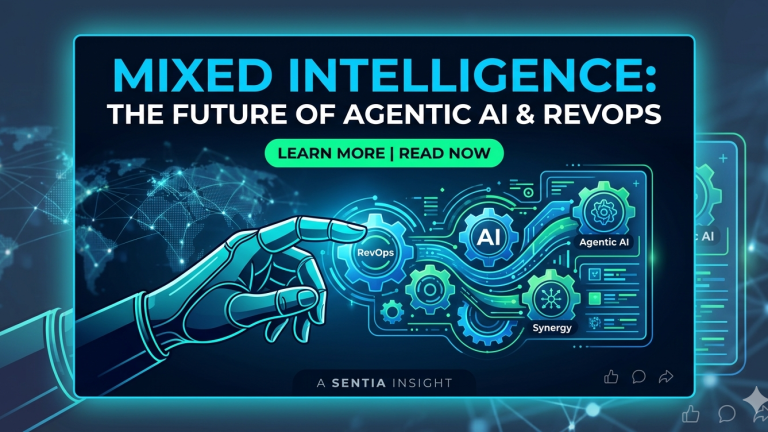
  • Mixed Intelligence: The Future of Agentic AI & RevOps

    Mixed Intelligence: The Future of Agentic AI & RevOps

    Key Takeaways

    • Mixed Intelligence Synergy: The “Both/And” principle combines machine scale with human judgment to create 10x productivity gains in architecture and radiology.
    • Agentic Shift: Transitioning from passive chatbots to active Agentic AI that executes tasks autonomously within RevOps and IT operations.
    • Wisdom Worker Evolution: Human roles are shifting toward “agent management,” prioritizing creativity, intuition, and discernment over rote execution.
    • Technical Governance: Implementation of Explainable AI (XAI) frameworks like LIME is mandatory to ensure transparency and trust in automated decision-making.
    • Economic Realignment: The “SaaS-pocalypse” of 2026 is driving a shift from horizontal point solutions to vertical, AI-native infrastructure.
    • Operational Velocity: AI handles the volume and complexity, allowing humans to handle judgment, connection, and curiosity.

    Table of Contents

    • mixed-intelligence
    • zha-architecture
    • radiology
    • engineering
    • revops
    • saas-pocalypse
    • aeo-strategy
    • technical-dive
    • leadership

    The prevailing narrative concerning technology and labor has frequently been bifurcated between total automation and human-centric resistance. However, the emergence of Mixed Intelligence suggests a third path based on the “Both/And” Principle, where the strengths of both domains are synthesized. This principle rejects the binary choice between opposites, instead practicing integrative thinking to create solutions that neither humans nor machines could achieve independently.

    In this framework, Artificial Intelligence functions as a cognitive amplifier, handling the volume and complexity that often drains human energy. This allows the human professional to focus on judgment, connection, and curiosity—attributes that remain uniquely resistant to algorithmic replication. By 2030, the organizations that dominate their respective markets will be those that have mastered the synergy between human intuition and machine scale.

    Leaders must recognize that while Neural Networks can identify patterns in seconds that would take humans hours to uncover, they lack the contextual awareness required for ethical decision-making. In banking, for instance, AI analytics identifies risks and opportunities, but the human advisor remains the differentiator by translating those insights into strategic, trust-based guidance. This collaborative model transforms technology from a perceived threat into a primary competitive advantage for the modern enterprise.

    The risk of the current era is not automation itself, but waiting too long to adapt to these shifting dynamics. Those who lead with foresight will anticipate the “Hard Trend” of human-AI synergy and seize the exponential opportunities it provides. Technology futurist(https://www.burrus.com/ai-human-augmentation-leadership-advantage/) that if a task can be automated, it will be, necessitating a shift in the workforce conversation from job elimination to skill elevation.

    Architecture has historically been a profession of long timelines and manual drafting, but Zaha Hadid Architects (ZHA) has fundamentally rewired the design process. Between 2024 and 2026, ZHA integrated machine learning and parametric systems into its core workflows to transform how buildings are conceived. In 2025, the majority of the firm’s design concepts began not with a physical sketch, but with a strategic AI Prompt.

    The firm utilizes text-to-image tools like DALL-E and Midjourney to explore thousands of visual directions in minutes. Designers prompt these systems using ZHA’s signature formal language—fluid curves and organic transitions—generating dozens of iterations during early competition phases. However, the human architect remains the primary filter, selecting only 10% to 15% of machine outputs to advance into 3D modeling.

    Beyond aesthetics, ZHA’s Computational Design Research Group (CODE) applies machine learning for floorplate optimization and environmental performance. This allows the firm to validate structural behavior and pedestrian flow digitally before any physical construction begins. The KAFD Metro Station in Riyadh, which opened in late 2024, stands as a testament to this process; its facade perforations were calculated via AI to minimize solar gain.

    Performance MetricTraditional WorkflowZHA AI-Integrated WorkflowImprovement
    Early-Stage Iterations10-20 concepts / week100+ concepts / day10x Velocity
    Client Feedback Loop7 days1 day / Real-time85% Reduction
    Daylight Access Opt.Rule of thumb+20% AccuracyEvidence-based
    Structural EfficiencyManual calculationML-optimized geometryMaterial reduction

    Principal Patrik Schumacher maintains that while AI generates the options, the authorship and accountability for the building’s performance remain strictly with the human architect. The architect is responsible for selecting, refining, and deciding, as accountability for structural, environmental, and civic performance cannot be delegated to an algorithm. This is a prime example of why we must(https://sentia.community/how-to-eliminate-crm-data-silos-with-agentic-ai-in-2026/).

    In the healthcare sector, particularly within radiology, the integration of AI has moved from experimental pilot programs to daily clinical practice. By 2025, over 70% of radiology departments in the United States reported an increased reliance on AI-driven diagnostic tools. These systems do not replace the radiologist but instead handle the cognitive and administrative load that frequently leads to burnout.

    Radiologists now use AI to detect abnormalities faster, prioritize urgent cases, and reduce diagnostic errors. While a human radiologist can identify markers of disease on a chest X-ray in as little as 250 milliseconds, they are often bogged down by transcribing reports. AI agents are now stepping into this pre- and post-interpretive space, preparing patient summaries and surfacing missing clinical context.

    The shift toward Value-Based Care means that imaging departments are increasingly evaluated on patient outcomes rather than scan volume. This transition prioritizes technologists and physicians who can integrate AI insights with patient history and ethical judgment. According to(https://theimagingwire.com/2026/01/07/the-top-trends-shaping-radiology-in-2026/), multimodal fusion that integrates clinical context with imaging will be the primary differentiator for winning medical solutions in 2026.

    The field of software engineering has experienced a radical disruption through the widespread adoption of GitHub Copilot and similar AI-assisted coding tools. By 2025, 90% of Fortune 100 companies had deployed these systems to their development teams. Data indicates that developers are now completing tasks 55% faster on average, representing a significant reduction in the development lifecycle.

    GitHub Copilot currently generates approximately 46% of all code written by its users, with this figure rising to 61% for Java projects. This shift is transforming the role of the developer from a manual writer of code to an orchestrator of logic. While the AI excels at generating boilerplate and test cases, it lacks the architectural judgment required for complex business logic.

    Engineering MetricWithout AI AssistantWith AI Assistant (2026)Efficiency Gain
    Task Completion Time2 hours 41 minutes1 hour 11 minutes55% Faster
    Time to First PR9.6 days2.4 days75% Reduction
    Successful Build RateBase+84%Reliability Jump
    Code RetentionN/A88%High Accuracy

    The introduction of these tools has also significantly impacted developer satisfaction, with 90% reporting feeling more fulfilled. However, there is an emerging risk of dependency, as 67% of developers use these tools five or more days per week. Furthermore, security remains a critical concern, with Accenture research finding that 29.1% of Python code generated by AI contains potential security weaknesses.

    Revenue Operations (RevOps) has emerged as the central nervous system for modern B2B SaaS organizations. Historically, marketing, sales, and customer success departments operated in silos, leading to fragmented data and inconsistent customer experiences. The RevOps model unifies these functions under a single operational strategy, often overseen by a Chief Revenue Officer (CRO).

    By 2026, the Agentic Paradigm is redefining RevOps from a set of reactive processes to a proactive system of autonomous intent. Gartner predicts that by 2028, 75% of RevOps tasks will be executed by AI agents. These agents do not merely suggest actions; they execute them independently within defined guardrails, such as performing agentic quote-to-revenue operations.

    RevOps PillarTraditional RoleAgentic Evolution (2026)
    OperationsReactive monitoring & manual ticketingProactive autonomous remediation
    EnablementGeneric training and static playbooksAI-curated learning paths & dynamic scripts
    InsightsMonthly reporting and manual dashboardsReal-time predictive analytics & pattern detection
    ToolsDisconnected SaaS point solutionsUnified AI infrastructure and SSOT

    The transition to agentic IT operations is particularly visible in DevOps and FinOps. A June 2025 study found that IT operations represent 52% of all agentic AI use cases, far outperforming marketing and finance. These agents can monitor hardware characteristics to predict component failures six months in advance. For a deeper dive into this infrastructure, see our(https://sentia.community/ai-enablement-engines-for-revops-complete-guide/).

    The broader software market is currently undergoing a period of collapse and consolidation. Forrester reports that in early 2026, a massive sell-off in SaaS stocks erased over $1 trillion in market capitalization. This “SaaS-pocalypse” is driven by a shift away from horizontal point solutions toward vertical-specific software that addresses complex industries like healthcare or manufacturing.

    Enterprises are now renegotiating contracts, prioritizing vendors with clear AI Agent roadmaps. The market for AI coding tools alone reached $7.37 billion in 2025, with GitHub Copilot holding a 42% market share. As Agentic AI matures, the traditional “software-as-a-service” model is being replaced by “results-as-a-service.”

    Economic Indicator2025 Baseline2026-2029 Forecast
    Global SaaS Spending$318 Billion$576 Billion (2029)
    Vertical Software Market$133.5 Billion$194.0 Billion (2029)
    AI Carbon EmissionsBase1.3 – 1.7 Gigatons annually
    Buyer InteractionHuman-led discovery30% view GenAI as meaningful

    Forrester guidance recommends that leaders re-architect their SaaS investments to prioritize domain-specific vendors. B2B buyers are increasingly using private engines to support purchasing decisions, with one in five sellers now forced to engage in agent-led quote negotiations. Success will hinge on investing in AI governance and balancing human expertise with AI tools.

    As search behavior shifts from “ten blue links” to interactive AI answers, traditional SEO tactics are becoming insufficient. In 2026, the search landscape is dominated by AI Overviews and answer cards that often appear above organic results. This evolution has given rise to Answer Engine Optimization (AEO) and Generative Engine Optimization (GEO).

    AEO helps your business show up in AI-driven answers instead of just search listings. If your content isn’t structured for AI readability, you are effectively invisible to tools like ChatGPT and Perplexity. To capture these results, brands must structure content to directly answer questions—listing tools or steps immediately before diving into technical details.

    Organizations must prioritize Schema and Structured Data Engineering to ensure AI can recognize, recommend, and rank them. A well-structured FAQ page is one of the best formats to provide these answers to new discovery tools. Using full questions as headings and providing the answer in the first sentence makes it easy for AI to “lift” your content.

    At the core of the AI transformation are Neural Networks, simulations of biological brain functions that process information through layers of interconnected nodes. While powerful, these models often operate as “black boxes,” making it difficult for humans to understand how a specific decision was reached. This lack of transparency is a significant barrier to enterprise adoption in high-stakes fields.

    To address this, researchers utilize Explainable AI (XAI) frameworks, with LIME (Local Interpretable Model-agnostic Explanations) being one of the most prominent. LIME works by perturbing the input data—making small changes to features—and observing how those changes affect the model’s prediction. It then trains a simpler, interpretable model to provide a local explanation of the original model’s behavior.

    Consider a model predicting credit risk. To explain a specific rejection, LIME might generate a mathematical relationship like:

    $$f(x) \approx g(z) = w_0 + w_1 z_1 + w_2 z_2 + \dots + w_n z_n$$

    Where $g(z)$ is the interpretable surrogate model and $w_i$ indicate feature importance. In medical diagnostics, DLIME (Deterministic LIME) utilizes Hierarchical Clustering to ensure that the same prediction always receives the same explanation. This stability is critical for earning the trust of medical professionals who require repeatable results.

    For C-suite executives, the priority must shift from simply buying licenses to re-architecting the organization around Mixed Intelligence. This requires a “45-Day Agentic Readiness Checklist” to ensure the enterprise is prepared for autonomous execution. The first step is the appointment of an AI Orchestrator, a leader responsible for ensuring data liquidity across the stack.

    HR and people leaders must simultaneously shift their investment toward “Change Fitness.” 31 that success with AI relies less on technology alone and more on the talent strategies that support it. This involves developing human capabilities that AI cannot replicate: critical thinking, ethical judgment, and complex relationship management.

    RoleImmediate ActionLong-Term Strategic Move
    Board Members / CEOsIdentify functions for automationRedirect human capacity to strategy
    HR / People LeadersAudit AI-relevant skillsInvest in “Change Fitness” training
    Functional ManagersList 10 most time-consuming tasksImplement 90-day content/IT pilots
    RevOps LeadersConsolidate data into an SSOTBuild an AI Agent roadmap

    Functional managers should involve employees early in the process to allay fears of displacement. By demonstrating AI’s potential to remove the “least interesting tasks,” leaders can build a culture that embraces technological ambition. The Wisdom Worker isn’t a theoretical future employee; they are the hire you are making this quarter.

    Q1: Will AI replace my job in 2026?

    AI is more likely to change jobs rather than eliminate them entirely. Roles requiring human creativity, critical thinking, and interpersonal skills will be more secure. Instead of viewing AI as a threat, see it as a tool that can make your future job more interesting and efficient.

    Q2: What is “Mixed Intelligence”? Mixed Intelligence is a framework where human judgment and machine intelligence work together. Developed by futurist Daniel Burrus, it relies on the “Both/And” principle, combining machine scale with human intuition to create solutions that neither could achieve independently.

    Q3: How much faster can developers code with AI? Research shows developers complete tasks 55% faster when using tools like GitHub Copilot. In controlled tests, a task that took 2 hours and 41 minutes without AI was completed in just 1 hour and 11 minutes with AI assistance.

    Q4: What is “Agentic AI” vs. a Chatbot?

    A chatbot primarily talks and generates text, while an agent acts. If you ask a chatbot to research competitors, it gives you a list; an agent opens a browser, visits sites, screenshots pricing, and compiles a report autonomously.

    Q5: What is the “SaaS-pocalypse”?

    This refers to a 2026 market sell-off where horizontal point solutions lost over $1 trillion in value. Enterprises are now shifting toward vertical-specific software and AI-native platforms that offer integrated agentic workflows and proprietary data.

    Q6: What is Answer Engine Optimization (AEO)? AEO is a strategy to ensure your brand is seen in AI-generated search results like Google’s AI Overview or ChatGPT. It involves structuring your content into clear, authoritative blocks that AI models can easily extract and cite.

    Q7: How does AI improve radiology?

    AI handles repetitive tasks like draft report generation and finding markers of disease, allowing radiologists to focus on clinical judgment. By 2025, over 70% of radiology departments reported increasing their reliance on these AI tools.

    Q8: What are the risks of using AI agents?

    Key risks include data privacy, weakened human oversight, and potential security vulnerabilities. Experts recommend using agents that operate in “sandboxed” environments and maintaining a “human-in-the-loop” governance framework to ensure accountability and safety.

    Q9: What is “Local Interpretable Model-agnostic Explanations” (LIME)? LIME is a technique used to make black-box machine learning models more transparent. It creates a simpler, interpretable model locally around a specific prediction to show which features most influenced the AI’s decision.

    Q10: What is a “Wisdom Worker”? A wisdom worker is a professional who combines technical AI fluency with human judgment, curiosity, and strategic intent. They focus on directing AI agents toward better outcomes rather than executing repetitive manual tasks themselves.