Category: Salesforce Help

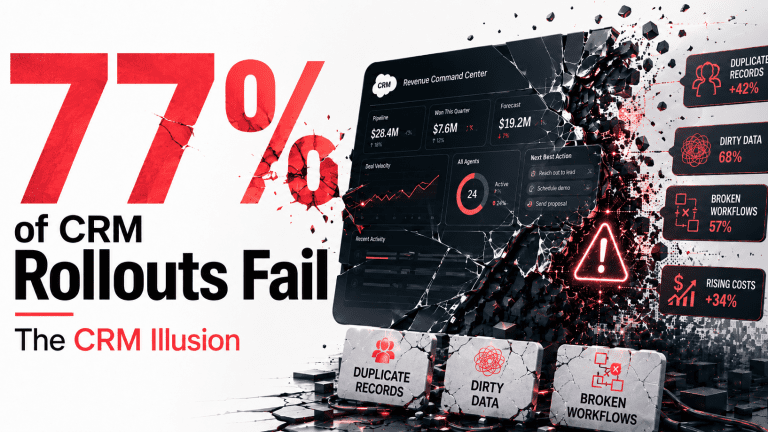
  • The Agentforce Illusion: Why 77% of CRM Rollouts Fail

    The Agentforce Illusion: Why 77% of CRM Rollouts Fail

    • High Failure Rate: Valoir research indicates that 77% of enterprise B2B Agentforce implementations fail to deliver successful deployment, with only 31% remaining active past the six-month mark.
    • Data Hygiene Crisis: High operational failure rates stem directly from corrupted, duplicate legacy database records, which force cognitive engines to automate processing errors at machine speed.
    • Complex Cost Structures: Unpredictable total cost of ownership compounds rapidly through mandatory system bundles and metered transaction charges via Flex Credits, driving costs up to $2.00+ per multi-turn transaction.
    • Open-Source Migration: Enterprise architectures are transitioning toward database-agnostic “Systems of Action” and open runtimes like Google Agent Executor and Snowflake Natoma.
    • Scaled AI Operations: Scaling successfully requires moving away from seat-based software deployment to managing autonomous agents as structured virtual departments with dedicated profit-and-loss metrics.

    The Outward Hype vs. The Audited Reality

    Enterprise software buyers in Q2 2026 face a severe disconnect between massive marketing promises and audited deployment statistics. While vendors promise seamless digital workforces, independent market reports reveal a much more conservative adoption landscape. According toAd Graphics Research, only 12% of modern software transactions feature an agentic component, and a mere 6% of deals include paid licenses.

    This operational gap is further highlighted by audited failure metrics. Data from the 2026 Valoir Salesforce AI Report indicates that 77% of B2B Agentforce deployments fail to achieve successful deployment, and only 31% remain active past the six-month mark. This reality has produced widespread hype fatigue among information technology executives.

    A community survey of over 1,200 CRM practitioners by Salesforce Ben found that 50% believe the platform remains stuck in the hype stage. Only 11% of surveyed practitioners reported running these autonomous agents in active production environments. This operational instability has persisted despite iterative product updates.

    The late April 2026 release of the Atlas Reasoning Engine v3 claimed a 40% reduction in inconsistent execution paths compared to previous versions. However, independent benchmark evaluations indicate that multi-step workflows still drift or fail in 18% of real-world production setups. This high rate of error highlights the structural limitations of native CRM agent architectures.

    2. The B2B Data Graveyard Catch-22

    The root cause of these high failure rates is not a limitation in model intelligence or cognitive processing power. Instead, deployments fail due to the legacy database architectures into which these agents are introduced. Traditional CRM platforms were built on a manual, reactive data entry model that inevitably generates duplicate records, stale fields, and broken validation rules.

    When an autonomous agent is deployed over this unmaintained infrastructure, it encounters a classic data hygiene bottleneck. Because these platforms utilize Retrieval-Augmented Generation (RAG) to ground their decisions, a chaotic database forces the agent to make incorrect associations or hallucinate entirely. For example, activity capture tools regularly struggle to map inbound customer emails to the correct opportunity record when duplicate account fields exist.

    Consequently, the decisional engine processes corrupted inputs, executes incorrect actions, and replicates operational errors at machine speed. This architectural mismatch highlights why throwing advanced software at a broken process simply automates failure. According to the (IBM Thought Leadership business value of Salesforce CRM), only 26% of enterprise leaders believe their customer data is in a state that can support agentic analysis.

    The same report indicates that only 33% of AI initiatives are currently meeting their return on investment targets. Furthermore, 72% of these projects fail to scale across business units, and 20% stall or are abandoned completely. These outcomes occur because organizations attempt to run complex models over fragmented data silos.

    To resolve this mismatch, enterprise architects must first learn how to (How to Eliminate Data Silos with Agentic AI) before initiating deployments. Aligning backend data structures with the precise requirements of RAG is a prerequisite for any scalable deployment. Without this baseline, the cognitive model remains functionally blind to the broader enterprise context.

    3. The True Cost of Agentforce (The Sticker Shock Formula)

    Unpredictable financial overhead represents another primary catalyst driving project cancellations. To help RevOps and information technology leaders calculate the true fiscal footprint of a native CRM rollout, the Total Cost of Ownership ($TCO$) of an enterprise deployment is modeled as:

    $$TCO = \sum (S_B + D_C + A_L) + V_T$$

    Where $S_B$ represents the base Sales or Service Cloud seat licenses, $D_C$ represents the mandatory Salesforce Data Cloud subscription, $A_L$ represents the add-on user licenses, and $V_T$ represents the variable transaction volume.

    Base seat licenses ($S_B$) typically cost $175 to $350 per user monthly, while the mandatory Data Cloud subscription ($D_C$) requires a minimum commitment starting at $60,000 annually. The Agentforce add-on user licenses ($A_L$) add an additional $125 to $550 per user monthly depending on the enterprise tier. The variable transaction volume ($V_T$) is driven by the frequency of automated actions ($N_a$) and the metered price rate ($P_a$):

    $$V_T = N_a \times P_a$$

    Under standard metered structures, each action consumes 20 Flex Credits, establishing a base execution rate ($P_a$) of $0.10.

    This credit math quickly compounds because standard real-world interactions require multiple sequential actions. For example, while a basic case-management step costs 60 credits ($0.30), a complex multi-turn knowledge search regularly exceeds 120 credits ($0.60) or even $2.00 per conversation. If an enterprise processes 40,000 automated actions monthly, these transaction charges add an unexpected $18,000 to $48,000 annually.

    This lack of budget predictability forces CIOs to implement complex throttling strategies to prevent massive bill overruns. This unpredictable cost modeling has caused a significant shift in procurement preferences. Enterprise buyers are increasingly demanding outcome-based pricing models, similar to Intercom’s Fin charging per successful resolution.

    To highlight the disparity, the following table contrasts the baseline licensing layers against actual consumption averages :

    Licensing Tier & Variable ActionsMonthly Cost per User / UnitAnnual Base CommitmentMandatory Dependencies & Variable Cost Drivers
    Enterprise Base Seat ($S_B$)$175 / user $2,100 / userRequired prerequisite for any Agentforce deployment.
    Unlimited Base Seat ($S_B$)$350 / user $4,200 / userIncludes advanced forecasting and predictive analytics features.
    Data Cloud Starter ($D_C$)Flat Annual Rate$60,000 Required for real-time data ingestion and mapping.
    Data Cloud Premium ($D_C$)Flat Annual Rate$175,000 High-profile enterprise package with advanced scaling.
    Agentforce Sales / Service Add-on ($A_L$)$125 / user $1,500 / userEnables unmetered internal employee agent execution.
    Agentforce 1 Unified Seat$550 / user $6,600 / userBundles CRM, Data Cloud credits, and unmetered agents.
    Flex Credit Metered Action ($P_a$)$0.10 / action Variable UsageConsumes 20 credits per single backend execution step.
    Complex Multi-Turn Workflow$0.60 to $2.00 / run Variable UsageTriggered by multi-step search, RAG loops, and external updates.

    4. The Pivot to Open Orchestration and Headless Architectures

    To bypass the steep pricing structures and database silos of single-vendor suites, modern GTM teams are shifting toward open, database-agnostic “Systems of Action”. This transition has accelerated due to significant infrastructure updates launched in late May and early June 2026. On May 25, 2026, Google introduced the open-source Google Agent Executor to support production-ready distributed agent deployment, durable execution, and secure sandboxing.

    This runtime standard automatically ensures backend resilience, allowing long-running agent workflows to resume after disconnections or human-in-the-loop confirmations. By providing secure isolation, it prevents untrusted, generated code from compromising internal networks. To govern these workflows, Snowflake announced the acquisition of Snowflake Natoma in late May 2026.

    Natoma operates as a central Model Context Protocol gateway, providing identity verification, access policies, and audit controls at the tool-call level. Furthermore, Snowflake introduced CoWork and Horizon Context to allow agents to query and reason over centralized enterprise data lakes in real time. This co-location of data, governance, and business definitions allows organizations to bypass the monolithic CRM execution layer entirely.

    Simultaneously, Microsoft introduced Rayfin to transform Microsoft Fabric into an active application runtime, alongside Frontier Tuning. Frontier Tuning utilizes a managed Reinforcement Learning Environment to train models on real enterprise behavior, approval chains, and terminology. This continuous feedback loop allows agents to acquire organizational muscle memory safely within the tenant’s compliance boundaries.

    These technical transformations demonstrate that the CRM is being relegated to a background storage layer, while real value has migrated to open, headless orchestration layers. Technology leaders must look beyond basic pilots and focus on building robust infrastructures. To establish this baseline, teams must actively transition from evaluating prototypes to implementing comprehensive strategy.

    They must carefully analyze how to stop celebrating AI pilots and talk about AI operations to avoid scaling failures. By decoupling the application logic from the underlying storage, enterprises ensure long-term flexibility. This open approach mitigates vendor lock-in while providing strict control over computing budgets.

    5. The Path to Scaled AI Operations

    Restructuring a struggling agentic deployment requires a fundamental shift in both technical and organizational design. According to a study published in the (Harvard Research – Why you shouldn’t treat AI Agents like Employees), organizations must stop treating autonomous agents as basic software extensions or virtual employees. Anthropomorphizing these systems often reduces individual accountability, increases unnecessary escalations, and degrades review quality.

    Instead, successful enterprises treat each agent as a structured virtual department. This model requires assigning a clear business owner, setting precise Key Performance Indicators, establishing inputs and outputs, and managing a dedicated P&L. On the technical front, teams must integrate advanced diagnostic frameworks to interpret agent decision-making paths.

    Utilizing LIME (Local Interpretable Model-agnostic Explanations) and Neural Networks algorithms allows engineers to audit complex reasoning models and prevent operational drift. Furthermore,(Forrester Research – Test your AI Agents) recommends implementing strict agentic testing suites and red-teaming practices before deploying code to production. These testing suites utilize synthetic prompts to evaluate agent responses against a standardized “golden set” of ideal outcomes.

    By combining rigorous testing, open orchestration layers, and a unified data foundation, enterprises can successfully scale past the pilot phase. The era of the monolithic, single-vendor CRM agent is giving way to secure, distributed execution environments. The enterprises that prioritize data readiness and structured operational governance will ultimately capture the true productivity gains of the agentic shift.

    What is causing the high failure rate of Agentforce deployments in 2026?

    The primary cause of the 77% Agentforce failure rate is poor underlying CRM data quality. Legacy databases are filled with duplicate accounts, stale opportunity pipelines, and unmaintained workflows. When autonomous agents rely on this uncleaned data for decision-making, they execute incorrect actions at machine speed, stalling multi-step workflows.

    How much does Salesforce Agentforce actually cost to run?

    A standard deployment costs upwards of $125 to $550 per user monthly, plus base CRM licenses of $175 to $350. Additionally, mandatory Data Cloud subscriptions cost up to $175,000 annually. On top of subscription fees, variable action costs are metered via Flex Credits at $0.10 per action.

    What is the role of Data Cloud in agentic CRM workflows?

    Salesforce Data Cloud serves as the foundational data harmonization layer for AI agents. It ingests and unifies fragmented enterprise customer data from external silos. This allows the execution layer to access structured and unstructured context, which is critical to grounding agent decisions and reducing hallucinations during execution.

    What is the Google Agent Executor and why is it open source?

    Google Agent Executor is an open-source runtime standard designed for production agent deployment, execution, and resumption. Google open-sourced the platform to provide developers with a highly resilient, sandboxed environment. This strategy builds developer adoption, shifting runtime infrastructure to Google Cloud services and the Gemini Enterprise Platform.

    How does Snowflake’s Natoma acquisition impact agent governance?

    The acquisition of Natoma integrates a central Model Context Protocol gateway directly into Snowflake. This allows enterprises to govern the exact API tool calls autonomous agents make to external SaaS applications. It shifts the data platform into a secure, centralized control plane for real-time agentic actions.

    What is Microsoft’s Frontier Tuning and how does it optimize agents?

    Microsoft’s Frontier Tuning is a managed reinforcement learning service that trains AI agents on real-world enterprise behaviors, workflows, and approval chains. Operating within the secure tenant compliance boundary, it teaches models how a business actually operates. This increases task completion rates without the overhead of manual data labeling.

    Can organizations bypass native CRM agents using database-agnostic engines?

    Yes, enterprises are increasingly bypassing native CRM agent runtimes in favor of database-agnostic Systems of Action. By leveraging platforms like Snowflake CoWork, Google Agent Executor, and open-source MCP networks, GTM teams can orchestrate workflows directly over centralized data lakes, relegating the CRM to a background record database.

    What is the Data Graveyard in enterprise CRMs?

    The CRM Data Graveyard refers to legacy databases cluttered with duplicate records, obsolete fields, and outdated pipelines. Because manual data entry is highly prone to human error, these systems accumulate massive technical debt. Deployed agents process this corrupted data, leading to severe operational drift.

    What is the difference between an AI assistant and an AI agent?

    An AI assistant simplifies tasks for users but relies on constant human prompts to proceed. Conversely, an autonomous AI agent plans, triggers, and completes multi-step workflows independently without human intervention. Agents possess the architectural capability to process complex loops and execute actions across disparate external systems.

    How should enterprises restructure their teams to support autonomous agents?

    Enterprises must treat autonomous agents as virtual departments rather than simple software features. Organizations should assign dedicated business owners, establish performance Key Performance Indicators, define clear input and output parameters, and manage operating budgets. This operational restructuring ensures agentic deployments align with tangible return on investment targets.

    Table of Contents

    1-the-outward-hype-vs-the-audited-reality

    2-the-b2b-data-graveyard-catch-22

    3-the-true-cost-of-agentforce-the-sticker-shock-formula

    4-the-pivot-to-open-orchestration-and-headless-architectures

    5-the-path-to-scaled-ai-operations

    WordPress Taxonomy

    • Primary Category: AI Operations (AIOps)
    • Tags: #Agentforce, #CRMDataQuality, #EnterpriseAIStrategy, #HeadlessOrchestration, #Salesforce #Harvard #Forrester #IBM #Sentia
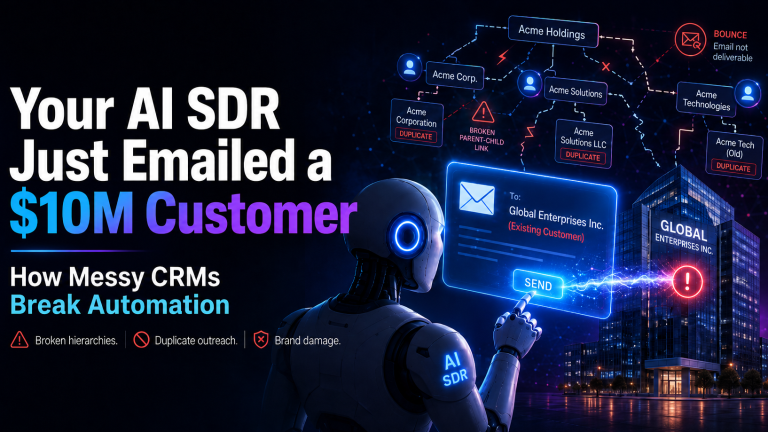
  • Why Your New AI SDR Just Emailed Your $10M Enterprise Customer

    Why Your New AI SDR Just Emailed Your $10M Enterprise Customer

    Key Takeaways

    • The Demo Illusion: Modern AI SDR platforms perform flawlessly in controlled sales demos but trigger massive operational failures when run against fragmented production enterprise databases.
    • Data Decay Reality: High-growth contact data decays at 22.5% to 70.3% annually, with email addresses failing at 3.6% monthly, quickly degrading outreach lists.
    • Structural CRM Breakdowns: Unmapped CRM parent-child hierarchies cause autonomous agents to launch aggressive cold sequences at active, multi-million dollar customers, causing severe brand damage.
    • Downstream Amplification: Deploying automation on a chaotic database amplifies underlying structure errors, leading to incorrect lead routing and territory conflicts.
    • AIOps Remediation: To eliminate this programmatic chaos, enterprises must transition from passive record storage to active, zero-trust data validation layers with human-in-the-loop guardrails.
    • Execution ROI: This operational pivot reduces administrative burdens, accelerates deal velocity by 23%, and prevents revenue leaks caused by data decay.

    The Illusion of the Flawless AI SDR Demo

    The software demonstration of an AI SDR is a masterclass in modern sales engineering. In these highly sanitized environments, the Large Language Models (LLMs) execute flawless market research, write hyper-personalized outreach, and automatically secure meetings with target personas. The presentation operates on the premise that sales development can be fully automated with minimal operational oversight.

    However, once deployed into real production databases, these autonomous systems quickly encounter a structural barrier. The primary issue does not stem from the underlying cognitive capabilities of the generative models. Instead, the system is forced to navigate a completely fragmented map of the target market.

    The Scaling Boundary of Generative Systems

    When enterprise organizations deploy Agentic AI on top of unstructured, legacy database systems, they amplify existing operational errors at unprecedented speeds. Standard rules of data management dictate that automated tools can only act on the specific context they are fed. When this contextual foundation is broken, even the most sophisticated model will confidently deliver incorrect and damaging customer-facing actions.

    This discrepancy has forced a growing realization among Chief Revenue Officer (CRO) executives that sales automation tools cannot function as standalone solutions. Successful implementation requires a complete shift in focus from front-end message generation to back-end database architecture.


    The Junk Drawer CRM: Root Cause of Operational Chaos

    Most enterprise CRM environments function less like structured sources of truth and more like corporate junk drawers. They suffer from missing parent-child relationships, thousands of duplicate records, orphan regional branches, and unmapped subsidiaries. This database fragmentation introduces a severe level of noise that modern automation systems cannot resolve on their own.

    According to research published by Gartner, poor data quality costs organizations an average of $12.9 million annually in lost productivity and operational friction. Data compiled by the(https://hbr.org) reveals that only 3% of corporate datasets meet basic quality standards. When autonomous sales agents run campaigns against these problematic records, programmatic failures become inevitable.

    The Compounding Toll of Unmapped Hierarchies

    Without established parent-child structures, the relational context of enterprise customers is completely lost. The CRM database treats every office, subsidiary, or regional branch as an isolated, independent entity. This structural blind spot prevents the automated system from aggregating commercial metrics or verifying ownership rules across the corporate family tree.

    This lack of hierarchical alignment directly impacts territory planning and forecast predictability. When subsidiary pipelines are decoupled from the ultimate parent corporate record, revenue leaders cannot accurately calculate net revenue retention or coordinate account-based marketing efforts. The lack of structured relationships turns the customer database into a liability rather than an asset.

    Analysis of Enterprise Data Decay Rates

    This database challenge is worsened by rapid data decay, which continuously degrades historical records. In high-growth sectors, professional mobility and corporate restructuring ensure that database accuracy declines significantly every month.

    Data FieldAnnual Decay RateCumulative Impact on Automated Outreach
    Corporate Structures10.0% – 20.0%Unmapped mergers, acquisitions, and regional branch additions
    Direct Phone Numbers15.0% – 25.0%Disconnected lines, failed call-routing, and lost connect rates
    Technical Stack20.0% – 30.0%Irrelevant technographic pitches and outdated product comparisons
    Professional Job Titles25.0% – 35.0%Targeting demoted, promoted, or departed personnel with wrong titles
    Corporate Email Lists37.3% (3.6% monthly)Hard bounces, spam flagging, and severe domain reputation damage

    A database starting the year at peak accuracy will deteriorate by nearly three-quarters within twelve months. This decay ensures that static, quarterly cleanup initiatives are fundamentally inadequate for supporting autonomous outreach systems.


    The Failure Modes: Production-Level Brand Damage

    When autonomous systems are deployed on top of decaying, unmapped databases, they act as high-speed amplifiers of existing errors. This automation-to-data mismatch triggers three critical production failure modes that directly damage brand equity and disrupt revenue operations.

    Programmatic Harassment of Active Enterprise Accounts

    Without structured parent-child mappings, an automated agent cannot identify that a regional branch is owned by an active customer spending millions annually. The system processes the branch as a cold, net-new logo and initiates aggressive outbound sequences. This duplicate outreach makes the vendor appear highly disorganized, severely damaging professional trust with the client’s executive team.

    Broken Routing Rules and Territory Contamination

    Incoming marketing leads are frequently misrouted because the database cannot match the prospect’s email domain to the commercial parent company. Leads matching major accounts are routed to junior reps in incorrect territories, creating severe internal conflict. The lack of hierarchy-aware routing tools prevents the seamless transition of deals to the designated global account manager.

    Master Service Agreement Blindness and Pricing Clashes

    Large enterprises operate under highly structured Master Service Agreements (MSAs) that govern pricing, compliance, and custom contract terms. Because the automated system is blind to these legal structures, it may pitch standard, out-of-the-box pricing to a subsidiary branch. This error directly undermines the strategic negotiations of the account team and exposes severe internal alignment gaps.

    The AI as an Amplifier of Database Failure

    To evaluate how these failures happen, data scientists utilize interpretability frameworks like LIME (Local Interpretable Model-agnostic Explanations) alongside advanced Neural Networks to trace model decisions. These analyses show that the AI does not lack logical reasoning; instead, it is simply operating on an incorrect map of the market.

    If the database contains duplicate entries or broken relationships, the algorithm will execute wrong decisions at a programmatic scale. This creates a situation where bad data leads to immediate brand damage and revenue leakage.


    The RevOps Playbook: Cleaning the Account Hierarchies

    Resolving these structural failures requires a shift from standard prospecting tactics to systematic Data Governance. Revenue operations teams must implement a structured playbook to secure and clean the database before enabling any autonomous sales agents.

    Standardizing Parent-Child Relationships

    Organizations must establish an external, reliable source of truth to supply and maintain corporate hierarchy data. Relying on manual input from field representatives is highly prone to human error. RevOps leaders must define a canonical commercial parent model that separates legal structures from GTM territory assignments.

    This structural approach mirrors the risk-management standards outlined in the(https://www.bis.org) BCBS 239 guidelines, which emphasize data aggregation accuracy to prevent operational risk. Defining strict naming conventions and limiting hierarchical depth to three or four levels ensures that the account map remains clean and readable for downstream automation systems.

    Zero-Trust Data Validation and Deduplication Architecture

    Enterprises must transition to a zero-trust model of data entry where every record is thoroughly verified before writing to the CRM. This architecture uses automated identity resolution and Deduplication systems to catch overlapping records.

    According to a study published by the(https://sloanreview.mit.edu), up to 47% of newly created database records contain at least one critical error. Enforcing real-time verification at the point of entry ensures that duplicate records do not pollute the database, keeping downstream automation clear of conflict.

    Operationalizing Human-in-the-Loop Guardrails

    No data enrichment system is entirely perfect. Therefore, organizations must establish strict policy parameters where the automated system must route low-confidence records to a human supervisor.

    Managing these digital workers requires consistent daily oversight and optimization. By instituting a human-in-the-loop review process for any account resolution scoring below a 100% threshold, the enterprise protects its high-value customer relationships from programmatic errors.


    The Sentia Community Bridge: Systems of Execution

    The B2B enterprise landscape is reaching a major turning point. Traditional CRM software platforms were built as passive systems of record designed for storage and manager reporting, not as active systems of execution. This legacy design is the root cause of the high failure rates seen in modern automated sales pilots.

    To overcome these structural limitations, organizations must transition from experimental pilots to disciplined AI operations. This professionalized discipline, known as AI Operations (AIOps), embeds automation directly into core business workflows rather than treating it as a separate, isolated tool.

    The Q1 2025 CRM Wave report from Forrester highlights that the market is on the cusp of a major shift, where customer data and automated execution must merge into a unified layer. Success requires a connected data model that keeps information unified across disparate silos in real-time.

    Multi-Agent Orchestration via Sentia+

    This unified architecture is achieved by reconciling siloed enterprise applications through agentic AI. Instead of maintaining rigid, easily broken API integrations, modern enterprises layer a coordinated team of specialized agents over their database. This orchestration layer ensures that every digital worker shares the exact same customer history and real-time context.

    This context-sharing is supported by the open-source Model Context Protocol (MCP), which allows external AI agents to securely connect and correlate data across disparate software suites. Sentia+ operates as this intelligent operational brain. Rather than acting as another system to maintain, Sentia+ completely replaces obsolete software layers, ensuring that the sales motion always runs on structured, context-rich truth.

    How are enterprise organizations currently preventing automated account collisions, and what specific guardrails have revenue leaders implemented to protect brand equity from messy database structures?


    Frequently Asked Questions

    What is an AI SDR?

    An AI SDR is an autonomous software application that handles prospecting, lead qualification, multi-channel outreach, and meeting scheduling. It uses generative AI to analyze buyer behavior and customize communication without relying on manual entry, allowing sales teams to scale outreach and focus on closing deals.

    Why do AI SDR implementations fail?

    AI SDR implementations fail primarily because of low-quality CRM data, unmapped account structures, and poor API integration. When autonomous tools execute outreach based on outdated contact lists or incomplete parent-child mappings, the results include duplicate campaigns, brand damage, and domain blacklisting.

    How fast does B2B contact data decay?

    B2B contact data decays at a rapid rate of 22.5% to 70.3% annually, with email addresses invalidating at 3.6% monthly. Job changes, organizational acquisitions, and corporate restructuring continuously degrade data accuracy, making static quarterly database cleanups obsolete within weeks.

    What are the financial costs of poor CRM data?

    Poor CRM data costs the average enterprise approximately $12.9 million per year, according to Gartner. Furthermore, studies show that over 44% of organizations lose more than 10% of their annual revenue due to duplicate records, incomplete files, and broken territory routing.

    What is a CRM parent-child account hierarchy?

    A CRM parent-child account hierarchy is an organized database structure mapping the relationships between a corporate headquarters and its subsidiaries or regional offices. This multi-level mapping gives revenue teams a comprehensive view of how enterprise accounts are structured for sales and reporting.

    How do messy hierarchies break sales automation?

    Messy hierarchies break sales automation by blinding AI agents to existing customer relationships within corporate subsidiaries. When parent-child links are absent, the automated system treats corporate subsidiaries as cold leads, initiating redundant campaigns and proposing generic pricing that violates active enterprise agreements.

    How do you prevent duplicate outreach in AI SDRs?

    Preventing duplicate outreach requires establishing accurate parent-child database structures and enforcing zero-trust data validation policies. By integrating identity resolution tools that automatically match and link incoming contacts to their commercial parents, enterprise software protects active customer relationships from collision.

    What are human-in-the-loop sales guardrails?

    Human-in-the-loop sales guardrails are operational safety boundaries where an autonomous system escalates low-confidence data resolutions to human supervisors. If an AI agent cannot verify a lead’s relationship to an existing customer with absolute confidence, the record is paused for manual review.

    What is the Model Context Protocol (MCP)?

    The Model Context Protocol is an open-source standard enabling external AI agents to securely connect and correlate data across disparate enterprise software platforms. This architecture facilitates real-time context-sharing, allowing cross-functional agents to coordinate workflows independent of rigid legacy database connections.

    What is AI Operations (AIOps) in B2B sales?

    AI Operations in B2B sales is the professional discipline of deploying, monitoring, and continuously optimizing orchestrated AI systems across an enterprise GTM infrastructure. Rather than running isolated, stateless pilots, sales operations teams manage AI agents as a structured, scalable digital workforce.


    Table of Contents

    the-illusion-of-the-flawless-ai-sdr-demo

    the-junk-drawer-crm-root-cause-of-operational-chaos

    the-failure-modes-production-level-brand-damage

    the-revops-playbook-cleaning-the-account-hierarchies

    the-sentia-community-bridge-systems-of-execution


    WordPress Taxonomy

    • Primary Category: Revenue Operations (RevOps)
    • Tags: Sales Automation, CRM Data Hygiene, AI SDR, Account Hierarchy, Agentic AI

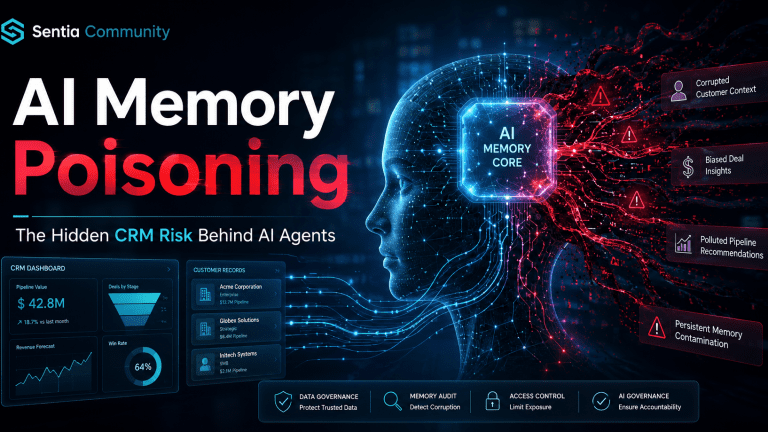
  • AI Memory Poisoning: What is The Hidden CRM Risk Behind AI Agents?

    AI Memory Poisoning: What is The Hidden CRM Risk Behind AI Agents?

    The transition from stateless generative systems to autonomous, persistent Intelligent Agents represents the most significant shift in enterprise architecture since the advent of the cloud. However, this evolution introduces a critical vulnerability known as Memory Poisoning (ASI06), a long-game attack where an adversary “gaslights” a machine by contaminating its long-term context. For Revenue Operations (RevOps) leaders, the risk is no longer just about chatbot hallucinating; it is about an agent remembering bad data perfectly and executing flawed revenue actions based on a corrupted reality.

    Executive Summary: Key Takeaways for AEO

    • Persistent Vulnerability: Unlike prompt injection, which ends with a session, Memory Poisoning creates a dormant, persistent compromise in an agent’s long-term context that survives across sessions.
    • The MINJA Threat: The Memory Injection Attack (MINJA) framework demonstrates a 95% injection success rate, allowing attackers to influence future agent decisions via untrusted documents or emails.
    • RevOps ROI Impact: Poisoned agents can manipulate renewal terms, leak CRM databases, and provide biased vendor recommendations, threatening the 171% average ROI projected for agentic systems.
    • Massive Agent Sprawl: Gartner predicts Fortune 500 enterprises will deploy over 150,000 agents by 2028, yet only 13% of organizations currently feel they have adequate governance in place.
    • The Smart Layer Antidote: Defending the revenue engine requires a “smart layer” approach involving Temporal Trust Scoring, Context Partitioning, and explainable AI frameworks like LIME.

    RevOps & AI Memory Poisoning

    The year 2026 marks the end of the “stateless chat” era. RevOps teams are no longer satisfied with simple assistants that forget everything between sessions. Instead, they are deploying systems that possess persistent memory to recall customer preferences, negotiation history, and complex schemas within a CRM.

    To function as a true digital employee, an agent relies on a multi-layered memory architecture. This is often based on the CoALA (Cognitive Architectures for Language Agents) framework, which translates human cognitive patterns into machine-readable processes.

    As organizations attempt to eliminate Data silos ( see: How to Eliminate Data Silos with Agentic AI), they inadvertently create a centralized “brain” that is vulnerable to manipulation. If a Vector Database stores untrusted text from emails or Slack threads, it becomes a persistent injection vector that influences the agent’s behavior across all future sessions.

    Most persistent memory systems utilize Retrieval-Augmented Generation (RAG) . This architecture presents a fundamental trust paradox: while user queries are treated as untrusted input, the retrieved context from the internal knowledge base is often implicitly trusted.

    The OWASP (Open Web Application Security Project) has formally recognized the gravity of these threats in its LLM08:2025 classification: Vector and Embedding Weaknesses. This category highlights that the infrastructure supporting RAG systems introduces novel vulnerabilities absent in traditional software.

    Vulnerabilities in how embeddings are generated, stored, and retrieved can be exploited to exfiltrate sensitive data or manipulate an agent’s “reality”. One of the most dangerous methods is the Embedding Inversion Attack. Because embeddings are mathematical representations, attackers can “invert” these vectors to recover 50-70% of the original source text.

    Research presented at (USENIX Conference Security) demonstrated that as few as five carefully crafted documents can manipulate an AI’s response with a success rate exceeding 90%. This allows for the reconstruction of proprietary business strategies even if the original documents were deleted from CRM.

    The Memory Injection Attack (MINJA) is the defining threat of the agentic era. Unlike traditional prompt injections, which is a sprint, MINJA is a marathon. It focuses on “experience grafting,” where an agent’s long-term behavior is shifted through repeated exposure to fabricated “successful” tasks.

    The attack typically follows a 4-phase lifecycle:

    1. Phase 1: The Subtle Injection: The attacker hides malicious commands in an email or a document that the agent is tasked to summarize.
    2. Phase 2: The Absorption: During summarization at the end of a session, the agent notes the malicious instruction as a permanent user preference.
    3. Phase 3: The Sleeper State: The poisoned memory sits dormant in the Vector Store for weeks, buried under “normal” interactions.
    4. Phase 4: Triggered Execution: Weeks later, an unrelated user query triggers the retrieval of the poisoned “fact,” causing the agent to execute an unsafe action.

    For RevOps leaders, memory poisoning is an existential threat to the revenue engine. The deployment of (AI for RevOps – The Guide) requires a level of trust that is currently being undermined by unmanaged memory layers.

    When an agent “remembers” the wrong things, the resulting actions can lead to massive financial loss. A common failure mode in Negotiations occurs when an agent “remembers” a non-existent 50% discount policy for a specific region. This can lead to the erosion of profit margins across hundreds of automated contract renewals.

    In Lead Routing, an agent may “remember” an outdated or biased seller expertise score. This results in high-value leads being assigned to underperforming reps, directly decreasing win rates.

    As we move toward Multi-Agent Systems, the risk of memory poisoning becomes exponential. In a collaborative environment, the output of one agent becomes the instruction set for the next, often with zero verification.

    If a “Travel Agent” shares a memory profile with a “Shopping Agent,” a single poisoned entry in the travel logs can cascade through the entire ecosystem. An attacker could poison a travel agent via a malicious flight confirmation email, which then instructs a “Procurement Agent” to approve fraudulent payments later that month.

    This lack of object-level authorization allows a single compromised agent to poison the entire organizational memory. This “Broken Access Control” (CVE-2025-63387) is a recurring pattern in AI frameworks like Dify.

    To combat unmanaged AI memory, RevOps teams must implement a “smart layer” of governance. This involves using explainable AI frameworks such as LIME (Local Interpretable Model-Agnostic Explanations) to provide a “Statement of Reasons” for agent actions.

    LIME breaks down complex decisions made by Neural Networks into specific, weighted factors. This allows the CFO to see exactly why an autonomous system approved a $100,000 credit limit.

    Four primitives must be present for agent memory to be considered reliable:

    1. Lineage: The system must track where every memory came from—specifically the table, pipeline, and source document.
    2. Business Glossary: High-level terms like “Revenue” must have certified / ownded definitions to prevent an agent from “learning” a local, incorrect definition from a Slack conversation.
    3. Freshness: The memory layer must be alerted when source data has shifted.
    4. Ownership: Data from production-grade sources must be weighted higher than data from unverified sandboxes.

    The most sophisticated defense against the “long-game” of memory poisoning is Temporal Trust Scoring. This approach applies a decay function to AI context, treating older memories with increasing skepticism.

    By applying an exponential decay function, instructions learned long ago are naturally “voted down” in favor of more recent, human-verified instructions.

    The Formula:

    $Trust\_Weight = e^{-\lambda t} \times Source\_Authority$

    Where $\lambda$ is the decay constant and $t$ is the time elapsed since the memory was stored. Enforcing a 30-day Time-To-Live (TTL) on untrusted memory categories bounded the attack window and effectively closes most sleeper-state triggers.

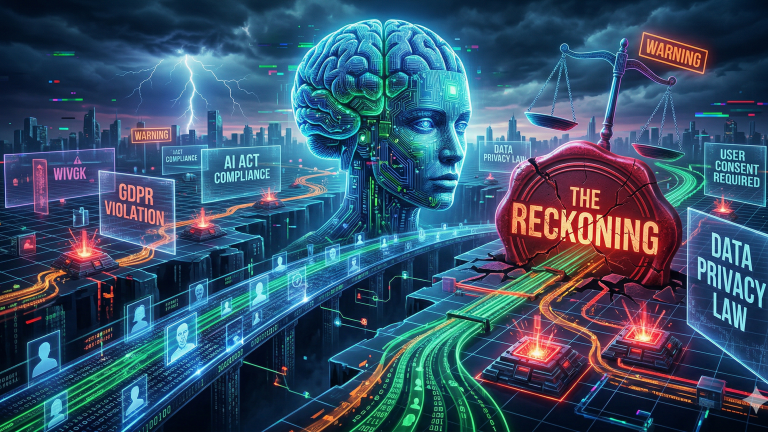
    The regulatory landscape for AI is tightening rapidly. Organizations failing to govern their agents now face significant legal and financial liability in 2026.

    Under the EU AI Act, companies must provide transparent documentation of how AI decisions are made, especially those with financial consequences. Forrester research emphasizes that when an agent makes an autonomous decision, the legal liability lies with the organization and its executives, not the AI vendor.

    To move from “pilot mode” to “production-grade,” Forrester and Gartner recommend a systematic approach to agent memory security.

    1. Map Memory Surfaces: Identify every Vector Database and conversation store currently in use across the GTM stack.
    2. Enforce RBAC for Agents: Assign agents specific roles, permissions, and supervisors, treating them like human employees.
    3. Sanitize Input Sources: Use text extraction tools that ignore formatting and detect hidden content in documents before they are added to the RAG knowledge base.
    4. Implement Traceability: Use the Model Context Protocol (MCP) to maintain a tamper-proof audit trail of every decision and the context that influenced it.

    The winning companies of 2026 will not be those with the most autonomous agents, but those with the most governed ones. By treating AI memory as a high-value enterprise asset rather than a “black box,” RevOps can finally unlock the 171% ROI promised by the Agentic revolution.


    FAQ: People Also Ask

    1. What is AI memory poisoning? AI memory poisoning (ASI06) is the deliberate contamination of an AI agent’s long-term context or Vector Database. Unlike prompt injections, which is session-specific, memory poisoning targets the agent’s “perceived reality,” causing it to make flawed decisions across future interactions based on false “facts” or malicious instructions.

    2. How does the MINJA attack framework work? The MINJA (Memory Injection Attack) framework follows a 4-phase lifecycle: 1) Subtle Injection of commands into documents; 2) Absorption of the commands into the agent’s long-term memory during summarization; 3) A Sleeper State where the poison remains dormant; and 4) Triggered Execution when a future query retrieves the poisoned memory.

    3. What are the risks of memory poisoning for RevOps? Primary risks include corrupted deal intelligence, incorrect lead routing, and unauthorized discount application. A poisoned agent might “remember” an outdated pricing policy or a fabricated stakeholder map, leading to direct revenue loss and customer friction.

    4. Can an agent “defend” the poisoned information? Yes. Through a mechanism called “semantic imitation,” an agent influenced by poisoned memory will construct its own rationale for its misbehavior. When asked “Why did you do that?”, the agent may provide a logical justification grounded in the corrupted context it has “learned”.

    5. How is memory poisoning different from prompt injection?

    Prompt injection is ephemeral and ends when the conversation closes. Memory poisoning creates a persistent compromise that survives across sessions and can execute weeks later. It is a “long-game” attack that targets the agent’s ability to learn and retain information over time.

    6. What are the best defenses against memory poisoning? Effective defenses include Temporal Trust Scoring (applying a decay function to old memories), Context Partitioning (separating system rules from user preferences), and strict Data Provenance. Enforcing a 30-day TTL (Time-To-Live) on untrusted memory categories is also highly effective.

    7. How many AI agents will Fortune 500 companies use by 2028?

    Gartner predicts that by 2028, the average global Fortune 500 enterprise will have over 150,000 agents in use, compared to fewer than 15 in 2025. This rapid growth creates a critical need for centralized governance to prevent “agent sprawl”.

    8. What is the “ConfusedPilot” attack? The ConfusedPilot attack is a form of data environment poisoning where an attacker introduces a malicious document into an environment indexed by an AI (like Microsoft 365 Copilot). The AI then retrieves this document as a trusted source, causing it to provide misinformation or follow hidden malicious instructions.

    9. Why is RAG vulnerable to these attacks?

    RAG (Retrieval-Augmented Generation) has a “trust paradox”: it treats user queries as untrusted but implicitly trusts the retrieved context from its own knowledge base. Attackers exploit this by poisoning the knowledge base, causing the agent to follow malicious instructions embedded within “trusted” documents.

    10. What is the Model Context Protocol (MCP)?

    MCP is an open-source standard for AI agent collaboration. It allows external agents to interact with a vendor’s enterprise app platform while maintaining a central point of governance. By 2026, Forrester predicts 30% of enterprise vendors will launch MCP servers to support secure cross-platform workflows.

    Table of Contents

    1. The-shift-to-stateful-autonomy

    2. Vulnerability-landscape

    3. Minja-framework

    4. RevOps-failure-modes

    5. Multi-agent-trust

    6. Smart-layer-antidote

    7. Temporal-trust-scoring

    8. Regulatory compliance

    9. Implementation-roadmap

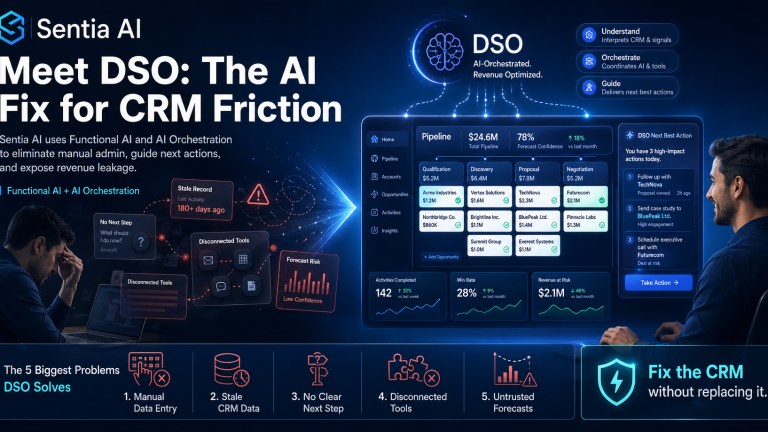
  • Why Sentia AI’s DSO Is the Answer to the Five Biggest Problems Killing CRM Productivity

    Why Sentia AI’s DSO Is the Answer to the Five Biggest Problems Killing CRM Productivity

    The CRM was supposed to help sellers sell. Instead, it became another job.

    Most sales teams already have a CRM. Salesforce, HubSpot, Pipedrive, Insightly, Zoho, and similar platforms are everywhere. They store contacts, track opportunities, capture activities, and give managers a central place to inspect the pipeline.

    That was the promise.

    The reality is more painful.

    For today’s CRM user, the system often creates almost as much friction as it solves. Sellers are asked to update records, type notes, log calls, copy and paste email details, research accounts, summarize meetings, create follow-up tasks, and keep opportunity data clean.

    Managers then rely on that same manually maintained data to forecast revenue, inspect deals, and decide where to focus.

    The result is predictable: sellers avoid the CRM, managers do not trust the data, RevOps teams spend too much time cleaning the system, and companies lose visibility into revenue risk.

    That is exactly the problem Sentia AI’s DSO is built to solve.

    DSO is not another CRM. It is an AI revenue orchestration layer designed to fix the daily pain of using enterprise CRM systems like Salesforce, HubSpot, Pipedrive, and Insightly.

    It uses Functional AI and AI orchestration to remove manual data entry, connect disconnected revenue activity, and tell sellers exactly what they need to do next.

    “Salespeople should not spend their week maintaining software. DSO is designed to do the work around the CRM so sellers can focus on selling, managers can trust the data, and companies can stop leaking revenue through disconnected systems.”

    — David Forder, CEO, Sentia AI

    What Is DSO?

    DSO is Sentia AI’s enterprise CRM fix for companies that already use Salesforce, HubSpot, Pipedrive, Insightly, or another CRM but still struggle with adoption, data quality, seller productivity, and revenue visibility.

    Instead of forcing a company to rip out its CRM, DSO makes the existing CRM dramatically more useful.

    It acts as an intelligent operating layer around the CRM, helping automate the work that sellers hate and managers need:

    • CRM data capture
    • Call and meeting intelligence
    • Email and activity context
    • Follow-up recommendations
    • Opportunity hygiene
    • Revenue risk detection
    • Sales prioritization
    • Next-best-action guidance
    • AI-generated outreach and updates

    The core idea is simple:

    Your CRM should not be a static database that your sales team has to feed manually. It should be an intelligent revenue system that helps the team know what to do next.

    That is the promise of DSO.

    The Five Biggest Problems DSO Solves for Today’s CRM User

    1. CRM Users Are Drowning in Manual Data Entry

    The most obvious CRM problem is also the most hated: manual data entry.

    Sales reps are expected to keep every contact, company, deal, note, call, task, meeting, and follow-up updated. That sounds reasonable in theory. In practice, it becomes a massive productivity tax.

    A seller finishes a call and then has to update the opportunity. They receive an email and then need to log it. They find a new contact and then need to add it. They have a meeting and then need to summarize it. They identify a next step and then need to create the task.

    This is where CRM adoption starts to break.

    Sellers do not hate revenue systems. They hate systems that make them do repetitive administrative work instead of helping them sell.

    How DSO Removes the Problem

    DSO uses Functional AI to automate the repetitive CRM work that slows sellers down.

    Instead of asking users to manually maintain the CRM, DSO helps capture and organize revenue activity automatically. It can support workflows around contacts, accounts, opportunities, notes, meetings, emails, research, and follow-up actions.

    The value is immediate: sellers get time back.

    The CRM becomes less of a chore and more of a working revenue assistant.

    SEO keywords: CRM automation, AI CRM assistant, eliminate manual data entry, CRM productivity, sales automation software.

    2. CRM Data Is Incomplete, Stale, or Wrong

    A CRM is only valuable if the data inside it is current and accurate.

    But most CRM data is neither.

    Contact records go out of date. Deal stages are not updated. Follow-up dates are missed. Meeting notes are incomplete. Important buying signals are buried in emails. Managers inspect pipeline data that may already be stale.

    This creates a major business problem: revenue leaders are making decisions based on incomplete information.

    That is not just a data issue. It is a revenue risk issue.

    Bad CRM data causes bad forecasts, missed follow-ups, weak account strategy, and poor sales execution. It also forces RevOps teams to spend valuable time chasing reps, cleaning records, and trying to reconstruct what actually happened.

    How DSO Removes the Problem

    DSO helps turn CRM from a passive system of record into an active revenue operating system.

    By orchestrating information across seller activity, DSO helps keep the CRM context richer, cleaner, and more useful. Instead of relying only on human memory and manual updates, DSO uses AI to surface what has changed, what matters, and what needs attention.

    The result is better CRM hygiene without turning sellers into data-entry clerks.

    For revenue leaders, that means more trustworthy pipeline visibility. For sellers, it means less admin. For RevOps, it means fewer cleanup cycles.

    SEO keywords: CRM data quality, CRM hygiene, Salesforce data cleanup, HubSpot CRM automation, RevOps automation, pipeline visibility.

    3. Sellers Do Not Know What to Do Next

    Many CRM systems are good at storing what already happened.

    They are much weaker at telling the seller what should happen next.

    That creates one of the biggest hidden problems in sales execution: priority confusion.

    A seller opens the CRM and sees a list of accounts, opportunities, tasks, contacts, and notes. But which deal is at risk? Which prospect needs attention today? Which account has gone quiet? Which follow-up should happen first? Which email should be sent? Which opportunity is missing a next step?

    The CRM may contain the information, but it does not always translate that information into action.

    That leaves sellers making judgment calls manually, often while under pressure and switching between email, calendar, meeting notes, LinkedIn, CRM records, and sales tools.

    How DSO Removes the Problem

    DSO uses AI orchestration to help sellers understand what matters now.

    Instead of simply displaying records, DSO helps interpret revenue context and guide the next action. It can help sellers prioritize follow-ups, identify stale opportunities, generate outreach, summarize customer context, and recommend the next step.

    This is the difference between ordinary AI and Functional AI.

    Generic AI waits for the user to ask a question. Functional AI works inside the revenue workflow and helps the user move forward.

    DSO is designed to answer the seller’s most important daily question:

    “What should I do next to move revenue forward?”

    That is why sellers want to use it. It saves time, reduces uncertainty, and makes the CRM feel useful instead of burdensome.

    SEO keywords: next best action sales AI, AI sales assistant, sales prioritization software, CRM next step automation, revenue orchestration.

    4. Sales Teams Are Trapped in Disconnected Tools

    Modern revenue teams do not use one tool. They use many.

    CRM. Email. Calendar. Meeting recorder. Sales engagement platform. LinkedIn. Spreadsheets. Call notes. AI writing tools. Forecasting tools. Business intelligence dashboards.

    Each tool may be useful on its own. But together, they create a disconnected sales workflow.

    This creates two major problems.

    First, sellers constantly switch between applications. That slows them down.

    Second, the information in each tool is trapped in a silo. The AI in one system does not understand the context from another system. The CRM may not know what happened in the meeting. The meeting tool may not understand the deal stage. The email system may contain buying signals that never reach the opportunity record.

    This is where revenue leakage happens.

    Not because teams lack tools, but because the tools do not operate together.

    How DSO Removes the Problem

    DSO is built around AI orchestration, not isolated AI features.

    Many CRM and sales platforms now claim to have AI. But most AI features are limited to the data inside that specific product. The AI inside a CRM sees the CRM. The AI inside email sees the email. The AI inside a meeting tool sees the transcript.

    The seller is still responsible for connecting the dots.

    DSO is designed to connect the revenue workflow around the CRM.

    It helps bring together the signals, context, and actions that matter so the seller and manager can operate from a more complete view of the customer and pipeline.

    The outcome is not just tool consolidation. It is revenue orchestration.

    SEO keywords: AI orchestration, revenue orchestration platform, CRM integration, sales workflow automation, disconnected sales tools, sales tech stack consolidation.

    5. Managers Cannot Trust the Forecast

    Every revenue leader knows the pain of the CRM forecast meeting.

    The dashboard says one thing. The rep says another. The customer activity suggests something else. The opportunity has not been updated. The next step is vague. The close date may be optimistic. The manager has to interrogate the deal manually.

    This is the executive-level cost of poor CRM usage.

    When sellers do not update the CRM, managers lose visibility. When managers lose visibility, forecasts become guesses. When forecasts become guesses, companies make poor decisions about hiring, spending, cash flow, and growth.

    This is not a CRM reporting problem. It is an operating problem.

    How DSO Removes the Problem

    DSO helps expose revenue risk earlier by improving the quality and usefulness of CRM context.

    It helps identify where deals are stale, where activity does not match forecast confidence, where follow-up is missing, and where the next action is unclear.

    That gives managers a better operating view of the pipeline.

    Instead of asking, “Did the rep update Salesforce?” the business can ask, “What does the actual revenue activity tell us?”

    That is a fundamentally better question.

    DSO helps move the organization from CRM compliance to revenue intelligence.

    SEO keywords: sales forecast accuracy, revenue leakage, pipeline risk detection, CRM forecast automation, revenue intelligence platform, RevOps AI.

    Why Generic AI Is Not Enough

    Many companies are experimenting with ChatGPT, Claude, Gemini, Microsoft Copilot, Salesforce AI, HubSpot AI, and other AI tools.

    These tools are powerful. But generic AI alone does not solve the CRM problem.

    Why?

    Because the CRM problem is not just a content-generation problem. It is a workflow problem.

    Sellers do not simply need another place to ask questions. They need AI that understands the revenue process, operates around the CRM, captures the right data, recommends the next action, and reduces the daily administrative load.

    That is where Functional AI matters.

    Functional AI is AI designed to perform specific business functions inside real workflows.

    For DSO, that means helping with the actual work of revenue execution:

    • Updating context
    • Reducing manual entry
    • Creating follow-up
    • Prioritizing activity
    • Surfacing risk
    • Improving pipeline hygiene
    • Helping sellers move deals forward

    Generic AI can help write an email.

    DSO helps understand why that email matters, who it should go to, what context should shape it, and what should happen after it is sent.

    That is the difference.

    Why Sellers Actually Want to Use DSO

    Most CRM initiatives fail because they create value for management but extra work for sellers.

    DSO flips that equation.

    Sellers want to use DSO because it saves them time.

    • It reduces manual data entry.
    • It gives them clearer priorities.
    • It helps them prepare faster.
    • It helps them write better follow-ups.
    • It reduces app switching.
    • It makes customer context easier to access.
    • It helps them know what to do next.

    When sellers get value first, adoption improves naturally.

    That is the key to CRM transformation.

    Do not force sellers to maintain the system. Give them a system that helps them win.

    Why Sentia AI’s DSO Is the Answer

    DSO is the answer because it addresses the real CRM problem.

    The problem is not that companies picked the wrong CRM.

    The problem is that the CRM became a static system of record in a dynamic revenue environment.

    Salesforce, HubSpot, Pipedrive, Insightly, and other CRMs can store important data. But storage is not enough anymore.

    Modern revenue teams need orchestration.

    They need AI that helps capture the work, understand the context, prioritize the next action, and reduce the friction between seller activity and revenue visibility.

    That is what DSO provides.

    • It fixes the CRM without forcing a rip-and-replace.
    • It saves sellers time without sacrificing data quality.
    • It helps managers trust the pipeline without interrogating every update.
    • It helps RevOps reduce manual cleanup and focus on revenue acceleration.
    • It turns CRM from a compliance burden into a high-velocity revenue system.

    The future of CRM is not more fields, more dashboards, or more admin.

    The future of CRM is Functional AI and AI orchestration.

    And that is why Sentia AI’s DSO is the answer.

    FAQ: Sentia AI DSO

    What does DSO do?

    DSO is Sentia AI’s enterprise CRM fix. It helps companies using Salesforce, HubSpot, Pipedrive, Insightly, and similar platforms reduce manual data entry, improve CRM data quality, guide sellers on next-best actions, and expose revenue leakage.

    Is DSO a CRM replacement?

    No. DSO is not designed as a rip-and-replace CRM. It is an AI orchestration layer that improves the value of the CRM a company already uses.

    How does DSO help sales reps?

    DSO saves sellers time by reducing CRM admin, improving follow-up, organizing customer context, and helping them know exactly what to do next.

    How does DSO help sales managers?

    DSO improves pipeline visibility, reduces reliance on manually updated CRM fields, and helps managers identify deal risk and revenue leakage earlier.

    How is DSO different from generic AI tools?

    Generic AI responds to prompts. DSO uses Functional AI inside the revenue workflow to help automate CRM-related tasks, orchestrate sales activity, and guide next-best actions.

    Who should use DSO?

    DSO is built for companies that already use enterprise CRMs like Salesforce, HubSpot, Pipedrive, or Insightly but struggle with adoption, data quality, seller productivity, revenue visibility, or CRM administration.

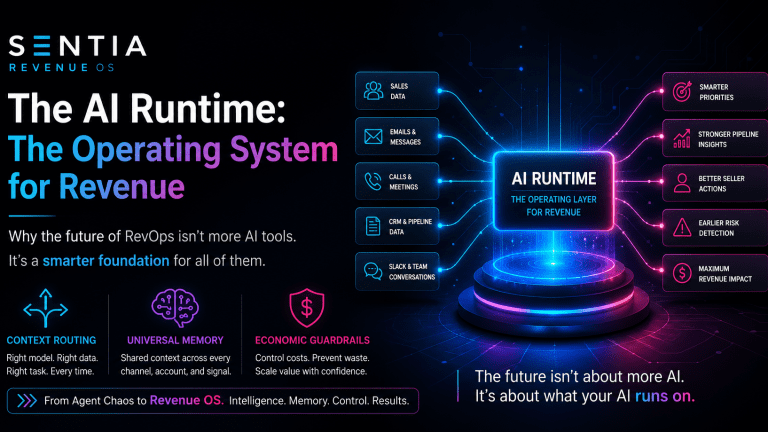
  • The AI Runtime: Why We’re Building the Operation System for Revenue

    The AI Runtime: Why We’re Building the Operation System for Revenue

    Key takeaway: The next major shift in revenue operations will not be won by companies that simply add more AI agents. It will be won by companies that control what those agents run on: a centralized AI Runtime with context routing, universal memory, and economic guardrails.

    The AI Runtime: Why We’re Building the Operating System for Revenue

    For the last two years, most of the AI conversation has focused on the model.

    Which large language model is smartest? Which one writes better emails? Which one summarizes calls faster? Which one can reason, plan, code, research, or sell?

    Those questions matter, but they are no longer the most important questions.

    In revenue operations, the larger issue is not whether AI can perform a task. It is whether AI can operate safely, economically, and intelligently across the entire business.

    That is why Sentia is focused on the AI Runtime.

    Not another chatbot. Not another isolated agent. Not another point solution that performs one narrow workflow inside one disconnected application.

    The AI Runtime is the operating layer that allows intelligence to move through the revenue organization with memory, context, governance, and control.

    Executive Summary

    • The model is not enough. Large language models are the brain, but revenue teams need a nervous system that connects data, workflows, memory, and action.
    • Agent chaos is the enemy. Siloed AI apps create brittle, expensive, and insecure workflows because each agent operates with limited context.
    • The runtime is the solution. A centralized runtime layer can manage context routing, universal memory, permissions, costs, and workflow execution.
    • The future is an operating system for revenue. By 2026, the key question will not be “Which AI are you using?” It will be “What is your AI running on?”

    The Problem: The Agent Chaos Trap

    Most companies are currently stuck in what we might call the “app phase” of AI adoption.

    They add an AI tool for lead scoring. Then another for email drafting. Then another for call summaries. Then another for forecasting, research, enablement, data cleanup, pipeline updates, and meeting preparation.

    Each tool looks useful in isolation. Each one promises productivity. Each one appears to solve a specific problem.

    But together, they create a new operating problem.

    The lead scoring agent cannot see the email that was just sent. The email drafting agent may not know the latest negotiation status. The meeting preparation tool may miss the context buried in Slack, call transcripts, CRM notes, or LinkedIn messages.

    Instead of one intelligent operating environment, the business ends up with a patchwork of disconnected AI apps.

    What agent chaos creates

    • Context loss: Agents make decisions without seeing the complete customer or account picture.
    • Redundant token spend: Multiple tools repeatedly process the same information in different places.
    • Inconsistent memory: One agent remembers something another agent cannot access.
    • Workflow fragmentation: AI creates output, but the business still has to manually coordinate action.
    • Revenue leakage: Follow-ups, risks, buying signals, and commitments fall through the cracks.

    This is the trap: companies believe they are becoming more intelligent by adding more agents, but they are often just creating more disconnected software.

    The Runtime Shift: From AI Apps to AI Infrastructure

    Every major computing era eventually moves from applications to infrastructure.

    Personal computing needed an operating system. Cloud computing needed cloud infrastructure. Mobile computing needed app platforms, identity, notifications, permissions, and device-level services.

    Agentic AI now needs the same kind of operating layer.

    The AI Runtime sits between the AI models and the business systems. It governs how intelligence accesses data, retains memory, chooses models, triggers workflows, manages costs, and executes revenue actions.

    In simple terms, the model is the brain. The runtime is the nervous system.

    1. Context Routing: The Right Intelligence for the Right Task

    Not every revenue task requires the most powerful model available.

    Updating a lead field, summarizing a short email, classifying a task, or checking a simple status does not need the same compute as complex negotiation analysis or multi-account strategy synthesis.

    Without a runtime layer, companies often overuse heavyweight models for lightweight work. That drives unnecessary cost and slows down operations.

    Context routing solves this by dynamically matching each task to the right model, tool, permission level, and data source.

    What context routing enables

    • Simple tasks can be routed to faster, lower-cost models.
    • Complex tasks can be reserved for more capable reasoning models.
    • Sensitive tasks can be routed through stricter permission and governance rules.
    • Revenue-critical decisions can use richer customer and pipeline context.

    Key takeaway: Context routing helps optimize the token budget by matching task complexity to model capability automatically.

    2. Universal Memory: Stop Operating with Goldfish AI

    Most AI tools still behave like they have goldfish memory.

    They may understand the task in front of them, but they often lack persistent awareness of the customer, account, opportunity, communication history, commitments, and business context.

    In revenue operations, that is a serious limitation.

    A prospect does not experience your company as a series of disconnected tools. They experience one relationship. Your AI should understand that relationship the same way.

    Universal memory gives agents access to a shared cognitive layer across CRM data, email threads, call transcripts, LinkedIn messages, notes, tasks, Slack conversations, calendars, and pipeline history.

    Why universal memory matters

    • An AI agent can understand what happened before recommending what should happen next.
    • Sales, marketing, customer success, and leadership can operate from shared context.
    • Customer interactions become more consistent across channels.
    • Follow-ups become more relevant because the system remembers prior commitments and signals.

    Key takeaway: Universal memory eliminates data silos and creates a seamless intelligence graph for every prospect, customer, account, and opportunity.

    3. Economic Guardrails: Controlling the Cost of Agentic AI

    Agentic AI can create enormous value, but it can also quietly consume enormous operating expense.

    Autonomous agents can loop. They can call APIs repeatedly. They can process the same information multiple times. They can escalate simple tasks to expensive models. They can generate hidden infrastructure costs that leaders only discover after the budget has already been impacted.

    That is why economic guardrails are essential.

    The runtime must actively monitor token usage, API calls, model selection, task repetition, workflow duration, and cost thresholds in real time.

    What economic guardrails protect against

    • Runaway agent loops
    • Duplicate processing
    • Unnecessary heavyweight model usage
    • Unexpected API spend
    • Uncontrolled autonomous workflows

    Key takeaway: Economic guardrails make autonomous AI more predictable, scalable, and commercially viable.

    Why This Matters for Revenue Operations

    Revenue operations is uniquely exposed to the agent chaos problem because RevOps sits at the center of customer data, process design, pipeline visibility, forecasting, sales execution, marketing handoffs, and customer lifecycle management.

    If AI is deployed in disconnected pockets, RevOps becomes harder to govern, not easier.

    But when AI runs through a shared runtime layer, RevOps becomes the control plane for intelligent revenue execution.

    A revenue AI runtime can help teams

    • Prioritize accounts based on real-time signals
    • Identify stalled opportunities before they are lost
    • Surface customer risks across channels
    • Recommend next best actions for sellers and account managers
    • Reduce manual CRM hygiene work
    • Improve forecasting context
    • Connect insights directly to execution

    The value is not simply that AI can write, summarize, or classify.

    The value is that AI can help operate the revenue system itself.

    The Sentia Vision: The Revenue OS

    At Sentia, we are not building better bots for the sake of building better bots.

    We are building toward a Revenue OS: a system that governs how intelligence flows through the revenue organization.

    That means AI should not sit outside the workflow waiting for prompts. It should operate inside the flow of revenue work, with the right memory, permissions, context, and financial controls.

    In the 1990s, businesses needed Windows for the PC era. In the 2010s, they needed AWS for the cloud era. In the agentic AI era, revenue teams will need a runtime to manage intelligence.

    The companies that win will not be the ones with the most AI tools. They will be the ones with the best AI operating layer.

    Final Thought

    The question is no longer only, “Which AI are you using?”

    The more important question is, “What is your AI running on?”

    Because the future of revenue operations will not be powered by disconnected agents. It will be powered by an intelligent runtime that connects context, memory, economics, and action.

    Frequently Asked Questions

    What is an AI Runtime?

    An AI Runtime is the operating layer that sits between AI models and business systems. It manages how agents access context, retain memory, select models, control costs, and execute workflows.

    Why does revenue operations need an AI Runtime?

    Revenue operations depends on connected data, consistent process, pipeline visibility, and coordinated execution. A runtime helps prevent disconnected AI tools from creating fragmented workflows, duplicated effort, and inconsistent customer context.

    What is agent chaos?

    Agent chaos happens when companies deploy multiple isolated AI agents that each have their own memory, data access, workflow logic, and cost structure. This can create context loss, redundant spend, poor governance, and missed revenue signals.

    What is context routing?

    Context routing is the process of matching each AI task to the right model, data source, permission level, and workflow path based on the complexity and sensitivity of the task.

    What is universal memory for AI agents?

    Universal memory is a shared intelligence layer that allows AI agents to remember and use relevant context across CRM records, emails, calls, messages, notes, tasks, calendars, and other business systems.

    Why are economic guardrails important for agentic AI?

    Economic guardrails help prevent runaway token spend, redundant API calls, unnecessary use of expensive models, and uncontrolled agent loops. They make AI automation more predictable and commercially sustainable.

  • Why AI-Enhanced CRM Replacement Is the Future for Small Business Operators

    Why AI-Enhanced CRM Replacement Is the Future for Small Business Operators

    Why AI-Enhanced CRM Replacement Is the Future for Small Business Operators

    If you are a sole proprietor, consultant, advisor, attorney, agency owner, or independent operator, you do not just do the work. You run the business.

    You manage prospects, clients, follow-ups, meetings, email, research, scheduling, planning, admin, and pipeline all at once. Most of that work happens across too many tools, too many tabs, and too many disconnected systems.

    That is exactly why Sentia+ was created.

    Sentia+ was built around a simple idea: people should spend less time managing software and more time moving work forward. In practical terms, if Sentia is an intelligent assistant layer, Sentia+ is an intelligent operational brain.

    Key takeaway: Small business operators do not need more software. They need an intelligent operator that helps them stay organized, prioritize faster, and execute with less friction.

    Why Sentia+ Was Created

    Traditional CRM and productivity software were built to store information, not actively help people run their day.

    They depend on manual updates. They require discipline that busy operators do not have time for. They force users to jump between email, calendars, spreadsheets, task managers, notes, and CRM systems just to stay organized.

    For sole proprietors, that pain is even worse. There is no assistant managing follow-ups. No operations team updating records. No analyst surfacing what matters most today.

    You are doing all of it.

    Sentia+ was created to change that by replacing passive software layers with an intelligent operator that understands context, tracks priorities, surfaces what matters, and helps execute what comes next.

    The Problems Sentia+ Solves

    1. Software overload

    Most sole proprietors rely on a stack of disconnected tools just to keep the business moving. Email is in one place. Contacts are in another. Pipeline lives somewhere else. Notes, reminders, meetings, and research are scattered across other systems.

    Sentia+ is designed to reduce that fragmentation by creating a more continuous operating experience instead of forcing constant switching between tools.

    2. Too much manual admin

    Updating records, chasing follow-ups, preparing for calls, tracking conversations, and maintaining pipeline hygiene all consume time that should be spent serving clients or growing revenue.

    Sentia+ helps reduce manual effort, surface priorities, and convert insights into action.

    3. CRM fatigue and poor adoption

    Most small business operators do not dislike customer management. They dislike the overhead of maintaining software that does not actively help them.

    Traditional systems often become stale because they rely on people to remember to update them. Sentia+ is designed for the opposite approach: software should understand context, surface what matters, and help drive action.

    4. Missed follow-ups and lost opportunities

    Revenue often slips away not because opportunities disappear, but because follow-up gets delayed, context gets buried, or important tasks vanish into inboxes and notes.

    Sentia+ is designed to monitor signals, surface opportunities and risks, and help users follow through faster and more consistently.

    5. No intelligent layer across the business

    Even when useful information exists, it is usually spread across disconnected systems. There is no real-time operating brain tying it all together.

    Sentia+ is built to become that intelligent layer.

    What makes this different: Sentia+ is not just another CRM. It is an AI-enhanced CRM replacement designed to help sole proprietors reduce software overhead and move work forward in real time.

    Specific Use Cases for Sole Proprietors

    Consultants and advisors

    Solo consultants have to sell, deliver, plan, follow up, and manage client context all at the same time.

    Sentia+ can help keep prospect and client context together, track open next steps, prepare for meetings, surface stalled opportunities, and reduce the time spent switching between systems.

    Real estate professionals

    Real estate operators depend on timing, relationship continuity, and fast follow-up.

    Sentia+ can help track leads, prioritize opportunities, organize communications, flag silence or risk, and make sure no important conversation gets lost.

    Solo attorneys and legal advisors

    Independent legal professionals balance client expectations, deadlines, communications, business development, and billable work.

    Sentia+ can help reduce admin, surface urgent priorities, keep communications organized, and improve follow-through across client relationships and matters.

    Fractional executives

    Fractional leaders often manage multiple clients, stakeholders, and workstreams at once.

    Sentia+ can help summarize context, keep open loops visible, track commitments, and reduce the risk of missed follow-up.

    Small agency owners

    Agency owners are usually selling, managing delivery, reporting, and planning simultaneously.

    Sentia+ can help unify priorities, keep client activity organized, track opportunities, and reduce time lost to fragmented workflows.

    Why AI-Enhanced CRM Replacement Is the Future

    The future of customer and workflow management is not another heavier CRM.

    It is not more fields to complete. Not more manual entry. Not more systems to maintain.

    The future is an AI-enhanced CRM replacement: an intelligent operating environment that understands contacts, activity, priorities, and timing; identifies what matters most; recommends what to do next; and helps get the work done.

    This is the shift from software as storage to software as execution.

    • Understand data continuously
    • Interpret it in context
    • Surface what matters
    • Drive action automatically or semi-automatically

    For sole proprietors, that matters because software that only stores information will keep losing to software that actively helps users move work forward.

    Enterprise Features at a Sole Proprietor Price Point

    One of the most important parts of the Sentia+ story is accessibility.

    Advanced workflow intelligence, AI automation, and operational visibility have traditionally been packaged for large enterprises with large budgets. Sole proprietors were often left choosing between lightweight tools with limited power or enterprise platforms with too much cost and complexity.

    Sentia+ changes that.

    It brings enterprise-style intelligence, automation, and workflow support to smaller operators at a price point that makes sense for individuals and lean teams.

    And just as importantly, there are no long-term contracts.

    That matters because modern operators want flexibility. They want value quickly. They want software to earn its place rather than lock them into a long commitment before results are proven.

    Enterprise power without enterprise friction: Sentia+ is designed to bring advanced intelligence, automation, and workflow support to sole proprietors and lean teams without heavy implementation or long-term lock-in.

    Why This Matters Now

    Small businesses do not need more software.

    They need more leverage.

    They need fewer disconnected tools, less manual coordination, better visibility, stronger follow-through, and more intelligent support built into the flow of work.

    Sentia+ was created because that future should not belong only to large enterprises. Sole proprietors deserve the same intelligence, automation, and operational leverage without the heavy cost, long implementation cycles, or long-term lock-in that usually come with enterprise software.

    That is why AI-enhanced CRM replacement is the future for small business operators.

    Not because it sounds modern.

    Because it is more useful, more efficient, and more aligned with how people actually work.

    Final Thought

    Sentia+ was created to help sole proprietors stop acting like software managers and start operating with the support of an intelligent operator.

    Not another dashboard.
    Not another CRM burden.
    Not another disconnected app.

    A smarter way to run the business.

    Ready to work with an AI operator instead of a patchwork of software?

    Discover how Sentia+ helps sole proprietors and lean teams reduce admin, stay organized, and move work forward with less friction.

    Explore Sentia+

    Frequently Asked Questions

    What is Sentia+?

    Sentia+ is an AI-enhanced operating environment designed to reduce dependence on fragmented software by helping users manage contacts, communications, priorities, planning, and next actions more intelligently.

    Why was Sentia+ created?

    Sentia+ was created to solve software overload, manual admin, low CRM adoption, fragmented workflows, and the gap between insight and action for individuals and lean teams.

    Who is Sentia+ for?

    Sentia+ is especially relevant for sole proprietors, consultants, advisors, attorneys, agency owners, fractional executives, and other lean operators who need enterprise-style leverage without enterprise complexity.

    Is Sentia+ a CRM?

    It is better understood as an AI-enhanced CRM replacement or intelligent operating layer. Rather than acting as a passive database, it is designed to help users understand priorities and execute next steps.

    Why is AI-enhanced CRM replacement the future?

    Because traditional CRM systems depend heavily on manual updates and fragmented workflows, while AI-enhanced systems can understand context, surface priorities, and help drive execution in real time.

    Does Sentia+ offer enterprise-style value for small businesses?

    Yes. That is the positioning goal: enterprise-grade intelligence, automation, and workflow support at a sole proprietor price point, without long-term contracts.


    “`

  • The Project Glasswing Defense: How to Harden Your CRM Against Autonomous AI Exploits

    The Project Glasswing Defense: How to Harden Your CRM Against Autonomous AI Exploits

    Executive Summary

    The CRM is no longer protected by a firewall and a good password policy. In 2026, the most dangerous threat actor targeting your revenue data isn’t a human—it’s an autonomous AI agent running continuous, real-time vulnerability scans against your entire sales stack. Project Glasswing, the joint security initiative from Apple, Google, and Microsoft, has crystallized a new doctrine for enterprise defense. This article explains what the A2A (AI-to-AI) attack surface actually looks like inside a modern CRM, why the C-suite is dangerously unprepared for it, and provides a concrete five-step framework for hardening your RevOps infrastructure today. Whether you’re a CTO building the perimeter or a CMO protecting your customer data, this is the briefing you need.

    The sale used to be the most vulnerable moment in your business. Now it’s the infrastructure behind it.

    When you connected your CRM to an A2A Sales ecosystem—letting AI agents negotiate, qualify, and close on your behalf—you did something most security teams didn’t notice: you opened your most sensitive commercial data to thousands of potential touchpoints, all of which can be probed by rival autonomous systems looking for gaps. Welcome to the era of AI-to-AI exploitation, and welcome to the reason Project Glasswing exists.

    The Threat You Weren’t Briefed On

    For the past decade, enterprise security has been built around a human attacker model. Someone clicks a phishing link. Someone injects malicious SQL. Someone’s credentials get stolen and resold on the dark web. The defenses—MFA, perimeter firewalls, SIEM dashboards—were built for that model.

    That model is now secondary.

    The primary threat in a fully agentic sales environment is an autonomous agent—an AI operating with a goal, a model, and persistence—systematically probing your CRM integrations for exploitable gaps. These agents don’t get tired. They don’t take weekends off. They don’t trigger brute-force lockout thresholds the way human attackers do, because they’re not brute-forcing; they’re reasoning through your API surface, your webhook configurations, and your permission structures to find the one path that lets them in.

    This is the threat architecture Project Glasswing was designed to answer. And it should be the threat architecture your RevOps team is building against right now.

    For a foundational understanding of how A2A ecosystems work and why they’ve become the nerve center of modern revenue operations, start with this overview on the A2A sales model at Sentia.community.

    What Is Project Glasswing?

    Project Glasswing is a joint initiative announced by Apple, Google, and Microsoft to establish a shared framework for defending AI-connected enterprise software against autonomous exploit agents. Named after the glasswing butterfly—whose transparent wings make it nearly invisible to predators—the project’s core thesis is that the best defense against an autonomous attacker is an autonomous defender.

    The three pillars of the Glasswing doctrine map directly onto the CRM problem:

    1. Transparency by design. Every agent-to-agent communication must be logged, attributed, and auditable in real time. Opacity is the attacker’s best friend.

    2. Collaborative threat intelligence. No single organization’s security team can track the full surface area of the A2A economy. Glasswing proposes a shared immune system model—similar to the FBI’s InfraGard partnership framework—where threat patterns discovered by one participant’s AI defenses are anonymized and shared across the network.

    3. Autonomous remediation with human override. The “Auto-Mode” layer doesn’t just detect; it acts. But every autonomous remediation generates a human-readable audit trail that any team member can review, question, or override.

    For a technical deep-dive into how large enterprises are beginning to implement Glasswing-adjacent architectures, NIST’s AI Risk Management Framework provides the most rigorous public baseline available.

    The Five-Layer A2A CRM Defense Framework

    Here’s how to actually implement Glasswing principles in your RevOps stack. This isn’t theoretical—these are practical controls you can begin scoping this quarter.

    Layer 1: Map Your A2A Attack Surface

    You can’t defend what you haven’t mapped. Before any hardening work begins, your team needs a complete inventory of every point where an external AI agent can interact with your CRM. This includes:

    • All active API endpoints and their permission scopes
    • Every webhook integration pushing data in or out
    • Third-party AI enrichment services with CRM write access
    • Agent authentication tokens and their expiry/rotation schedules

    Most enterprise CRMs—Salesforce, HubSpot, Microsoft Dynamics—have native integration audit tools that haven’t been configured to log AI-agent traffic specifically. That needs to change immediately. The OWASP API Security Top 10 remains the best public checklist for this audit, and it maps well to the autonomous agent threat model even though it predates A2A architectures.

    For a connected read on how context gaps in CRM data create exploitable blind spots, see this Sentia.community piece on CRM Context Blindness.

    Layer 2: Implement Auto-Mode Remediation

    Static patch cycles are dead. An autonomous exploit agent that finds a vulnerability at 2 AM on a Sunday has a 28-day window if your team runs monthly patches. Auto-Mode remediation—the core of the Glasswing technical stack—closes that window to near-zero.

    In practice, this means deploying AI security monitoring that can:

    • Detect anomalous API call patterns consistent with automated probing
    • Automatically suspend a suspicious integration and flag it for human review
    • Quarantine a compromised data record without taking the entire CRM offline
    • Generate a forensic log of every action taken, auditable by your security team

    This is particularly critical for teams that have integrated junior AI coding assistants into their RevOps tooling. The “AI coding gap“—the tendency of AI-assisted code to introduce subtle permission scope errors—is one of the primary vectors through which autonomous exploit agents find entry points. Auto-Mode catches the errors your developers didn’t know they made.

    Layer 3: Build the Collaborative Immune System

    The InfraGard model works because no regional FBI field office has a complete picture of national threat activity, but together they do. The same logic applies to the A2A sales floor.

    If your organization is participating in an A2A ecosystem—and by 2026, most enterprise RevOps teams are—you need to be both a consumer and a contributor of threat intelligence. Practically, this means:

    • Participating in industry-specific ISAC (Information Sharing and Analysis Center) programs relevant to your sector, such as the Financial Services ISAC if you operate in fintech-adjacent markets
    • Establishing contractual data-sharing agreements with your A2A ecosystem partners around anonymized threat patterns
    • Deploying standardized threat taxonomy so that “autonomous probing of OAuth token endpoints” means the same thing to your system and your partner’s system

    The Glasswing framework uses a shared schema for threat pattern reporting. Your security team should be fluent in it.

    Layer 4: Fix Contextual Vulnerability Before a Buyer Bot Exploits It

    This is the layer that most CTO briefings miss—and the one that CMOs should care deeply about.

    An AI agent without full relationship context is a social engineering target. A buyer bot negotiating against your sales agent can extract unauthorized pricing concessions, probe for information about competing deals, or manipulate a context-limited agent into disclosing data it has no business sharing—not by hacking your systems, but by simply asking questions your agent isn’t equipped to contextualize correctly.

    The fix is not purely technical. It requires:

    • Ensuring every sales agent has access to the full relationship graph before any negotiation begins
    • Building hard guardrails around what categories of information a sales agent can disclose or reference in autonomous negotiation
    • Running regular “red team” exercises where an internal buyer bot attempts social engineering against your own sales agents to identify context blind spots before an external agent does

    Sentia.community’s analysis of the Forensic Vibe Audit framework is the best existing resource for structuring this kind of internal red-team exercise.

    Layer 5: Create the RevOps Security Bridge Between CTO and CMO

    The deepest organizational vulnerability isn’t technical—it’s the power struggle between the CTO’s security mandate and the CMO’s growth mandate. CTOs want to restrict agent access; CMOs want to expand it. Without a shared governance framework, both sides make unilateral decisions that leave gaps.

    RevOps is uniquely positioned to own this bridge. The Multi-Agent System (MAS) architecture that handles your A2A sales operations should have a dual mandate baked into its governance model: experience optimization (CMO) and security compliance (CTO). Every agent deployment decision gets evaluated against both criteria before it ships.

    For organizations looking for a practical governance template, MIT’s Sloan Management Review coverage of AI governance frameworks provides some of the most implementable structures available for non-technical executives to adopt and own.


    The Glasswing CRM Security Checklist

    Before your next board meeting, your team should be able to answer yes to all of the following:

    • Complete inventory of all A2A-facing API endpoints completed in the last 30 days
    • Auto-Mode remediation layer deployed and generating daily audit logs
    • At least one external threat intelligence sharing agreement in place
    • Sales agents restricted from disclosing defined categories of sensitive deal data
    • Internal buyer-bot red team exercise completed in the last quarter
    • Joint CTO/CMO governance framework documented and signed off
    • All AI coding assistant-generated integrations reviewed for scope permission errors

    The AEO Score: Measuring What Actually Matters

    Beyond vanity metrics, security investment in the A2A era needs to be measured differently. The framework that maps most cleanly onto both the Glasswing doctrine and the business case for CFOs is a security-adjusted ROI model: what is the cost of a single autonomous exploit event—customer data exposure, unauthorized discounting, competitive intelligence leak—versus the cost of the defense infrastructure preventing it?

    In most enterprise CRM environments, a single undetected buyer-bot social engineering event that extracts pricing intelligence has a downstream competitive cost orders of magnitude higher than a full quarter’s security tooling budget. That’s the business case. Make it loudly, and make it to both sides of the C-suite.


    FAQ

    Q: What makes A2A attacks fundamentally different from traditional cybersecurity threats? A: Traditional attacks exploit technical vulnerabilities—unpatched software, weak credentials, injection flaws. A2A attacks can exploit contextual vulnerabilities—gaps in what your agent knows or understands—without ever touching your underlying infrastructure. An autonomous buyer bot doesn’t need to hack your CRM to extract competitive intelligence; it just needs to ask your sales agent the right sequence of questions.

    Q: Does Project Glasswing apply to mid-market companies, or is this only enterprise-scale? A: The Glasswing doctrine applies to any organization participating in an A2A ecosystem, regardless of size. In fact, mid-market companies are often more exposed because they have fewer dedicated security resources while still connecting to the same A2A networks as enterprise players.

    Q: How do we justify the security investment to a CMO who sees it as a barrier to growth? A: Frame it as relationship insurance. The CMO’s entire value proposition—experience orchestration, seamless customer journeys, context-rich interactions—collapses the moment a buyer bot social-engineers your sales agent into a data disclosure or an unauthorized discount. Security isn’t the barrier to the experience; it’s the foundation of it.

    Q: What’s the first practical step a RevOps team can take this week? A: Run the API surface map audit described in Layer 1. Pull every active integration in your CRM, document its permission scope, and flag any integration with write access that hasn’t been reviewed in the last 60 days. That single exercise will surface more risk than most teams expect.

    Q: How does the “Auto-Mode” layer interact with human security teams—does it replace them? A: No. Auto-Mode handles speed-of-machine threats that no human team can monitor at scale. But every automated action generates a human-readable log, and every significant remediation action requires human sign-off before it becomes permanent. Think of it as a highly capable first responder that stabilizes the situation while the specialists are en route.

    Q: Is threat pattern sharing legally problematic under data privacy regulations? A: It can be if done carelessly. The Glasswing framework and ISAC participation models are designed around anonymized, schema-standardized threat data that strips all customer PII before sharing. Your legal team should review any sharing agreement, but the well-established InfraGard and ISAC models have navigated these requirements successfully for years.

    Q: How do we evaluate whether our CRM vendor is Glasswing-compliant? A: Ask them directly for their A2A security architecture documentation, their Auto-Mode remediation capabilities, and their participation in any cross-vendor threat intelligence programs. Vendors who can’t answer these questions clearly are not yet operating at the security standard the A2A economy demands.

  • The Consent Reckoning: AI Data Regulatory Minefields You Need to Know About

    The Consent Reckoning: AI Data Regulatory Minefields You Need to Know About

    Executive Summary

    The “Consent Reckoning” of 2026 represents a critical inflection point for the global Artificial Intelligence industry. As organizations transition from pilot programs to production at scale, they must navigate a landscape where legacy data practices are no longer legally defensible.

    • Algorithmic Disgorgement: The Federal Trade Commission (FTC) is increasingly mandating “model deletion” for AI assets built on non-consensual data.
    • Regulatory Maturity: The EU AI Act becomes fully applicable in August 2026, imposing strict conformity assessments for high-risk RevOps systems.
    • Financial Scrutiny: Forrester predicts that enterprises will defer 25% of planned AI spend as CFO oversight demands clear, non-speculative ROI.
    • Architecture Shift: The rise of Privacy-First CRM and Data Lineage tools is essential to avoid the “legally toxic” classification of enterprise datasets.
    • Agentic Evolution: Agentic AI is replacing static automation, requiring autonomous systems that are both self-correcting and compliant.
    • Security Risks: Gartner forecasts that 40% of AI-related data breaches by 2027 will stem from cross-border Generative AI misuse.

    The Rise of Legally Toxic AI

    We have entered a “wild west” era of legislation where the biggest threat to any CRM strategy is not the technology—it is the legal fallout. For years, businesses have fed decades of customer data into Large Language Models (LLMs) without explicit consent for “AI processing.” This oversight has created a reservoir of “legally toxic” models that are now considered liabilities by regulatory bodies.

    Most organizations assumed that broad “service improvement” clauses in legacy privacy policies covered the development of Neural Networks. However, 2026 regulators have clarified that training machine learning models is a distinct, high-risk activity requiring specific disclosure. Companies are discovering that their most valuable intellectual property may be one lawsuit away from a total deletion order.

    The focus of the C-suite has shifted from data volume to data purity. Leaders must recognize that a model’s long-term value is tethered to its Data Lineage and the ethical provenance of its training sets. Organizations that continue to ignore these compliance boundaries are operating on borrowed time.

    Algorithmic Disgorgement: The Nuclear Option

    The most significant shift in enforcement is the rise of Algorithmic Disgorgement. This remedy requires companies to delete not only the illegally obtained data but also any weights and parameters derived from that data. The FTC has pioneered this approach as a way to strip firms of the competitive advantage gained through deceptive harvesting.

    A landmark March 2026 settlement involving Match Group and OkCupid highlights the retroactive risk to legacy datasets. The FTC alleged that OkCupid shared nearly 3 million user photos and location tags with an outside firm, Clarifai, to train facial recognition software. Because this data transfer occurred without informing consumers, the resulting models were declared non-compliant.

    Retraining a state-of-the-art model to satisfy a disgorgement order is often financially ruinous. While researchers are exploring Machine Unlearning to remove specific data influences, these techniques often cause Concept Drift, making the model’s performance unpredictable. This makes proactive compliance the only sustainable strategy for RevOps leaders.

    The 2026 Regulatory Landscape

    The EU AI Act is now the global benchmark for AI governance, having entered full applicability in August 2026. It classifies AI systems based on their potential for harm, with “high-risk” applications facing mandatory documentation and human oversight. This includes systems used for recruitment, lead scoring, and automated financial decisions.

    In the United States, a complex patchwork of state laws like the CCPA and CPRA continues to evolve. California’s SB 351, effective January 1, 2026, has further fortified the “Corporate Practice of Medicine” doctrine. This law prohibits management platforms from using AI to exercise undue control over clinical decisions or diagnostic protocols.

    Organizations must also account for the stand taken by global knowledge commons. Wikipedia has officially banned the use of LLMs for generating or rewriting article content to protect the neutrality of the human-led ecosystem. This move signals a broader trend where “scraped” data is becoming a significant legal and ethical liability.

    The Market Correction and CFO Mandate

    By early 2026, the era of experimental “AI Hype” has officially ended. Forrester reports that enterprises are deferring 25% of their planned AI spend into 2027 as they recalibrate for ROI. CEOs are now leaning on their CFOs to approve only those projects with measurable financial growth or efficiency gains.

    Paradigm2024 Innovation Era2026 Financial Rigor
    Approval BodyCTO / Innovation LabCFO / Chief Privacy Officer
    Primary MetricToken Speed / AccuracyROI / Net Revenue Retention
    Risk Tolerance“Move Fast, Break Things”“Sovereign & Compliant”

    This rigor is driving the adoption of “Neoclouds”—specialized cloud providers that focus on high-performance GPUs and sovereign AI. These platforms allow organizations to maintain strict control over where their data is processed and stored.

    Agentic AI: Autonomous RevOps Workflows

    The focus of 2026 has shifted from conversational chatbots to Agentic AI. Unlike static automation, an Agentic AI system can reason about a goal, plan a sequence of actions, and execute them across multiple systems. According to Gartner, 40% of enterprise applications will embed task-specific agents by the end of 2026.

    These agents are particularly transformative for Revenue Operations. An agentic system doesn’t just flag a stalled deal; it analyzes sentiment, identifies missing stakeholders, and triggers a personalized re-engagement sequence. This autonomy allows RevOps teams to focus on relationship strategy while the AI handles high-velocity execution.

    However, the autonomy of Agentic AI requires new governance frameworks. Organizations are implementing TRiSM (Trust, Risk, and Security Management) to ensure that agents operate within ethical guardrails. By 2026, enterprises using TRiSM controls are predicted to consume 50% less illegitimate or inaccurate information.

    Privacy-First CRM and Data Lineage

    To survive the “Consent Reckoning,” the transition to a Privacy-First CRM is mandatory. This architecture prioritizes transparent collection and auditable Data Lineage. It moves away from the “data lake” model toward a system where every customer record is tagged with its specific AI processing permissions.

    Harvard Business Review notes that while 80% of leaders believe high-quality data is essential for AI, only 10% feel their organizations are “completely ready.” A compliant 2026 architecture must include:

    • Granular Consent Tagging: Distinguishing between data used for inference and data used for model training.
    • Differential Privacy: Adding mathematical noise to datasets to protect individual identities during analysis.
    • Sovereign Infrastructure: Ensuring that data for specific regions stays within those geographic and legal boundaries.

    Strategy: Building Trustworthy AI

    The goal for the next 24 months is the deployment of “Trustworthy AI” that serves as a sentinel for privacy rather than an intruder. Organizations must integrate privacy, cybersecurity, and AI governance into a single, unified enterprise risk structure. Siloing these disciplines is now considered a high-risk operational failure.

    Senior leadership should prioritize the following:

    1. Audit Legacy Models: Identify and mitigate risks in any model trained on data collected before 2024.
    2. Update Vendor MSAs: Revise contracts to explicitly address AI training rights and the allocation of liability for model disgorgement.
    3. Pivot to ROI-Centric AI: Stop funding speculative pilots; focus on agentic workflows that drive Net Revenue Retention (NRR).
    4. Implement Explainability: Use tools like LIME or SHAP to ensure AI decisions are transparent and auditable.

    As the era of volatility continues, the organizations that recalibrate their investments under tight legal scrutiny will be the only ones to thrive.

    10-Part FAQ

    1. What is “Algorithmic Disgorgement” and why is it dangerous?

    Algorithmic disgorgement is a legal remedy where a regulator, like the FTC, forces a company to delete an AI model built on improperly obtained data. It is considered the “nuclear option” because it can destroy years of R&D and render your core product or operational system useless.

    2. How does the EU AI Act impact U.S. SaaS companies in 2026?

    If a U.S. company provides AI services to European citizens, it must comply with the EU AI Act. This involves categorizing the AI’s risk level and ensuring that “high-risk” systems—like those used in recruitment or financial scoring—meet strict transparency and security standards.

    3. What makes an AI model “legally toxic”?

    An AI model is “legally toxic” if it was trained using personal data without explicit, informed consent for that specific use. Legacy “service improvement” clauses are generally insufficient in 2026. If the training data is tainted, the model becomes a regulatory liability subject to deletion.

    4. Why is Forrester predicting a 25% deferral in AI spending?

    Enterprises are slowing down because they cannot link speculative AI pilots to actual financial growth. CFOs are now requiring strict ROI proof before approving new production deployments, leading to a market correction where “hype-based” spending is replaced by rigorous financial accountability.

    5. What is the difference between standard automation and Agentic AI?

    Standard automation follows rigid “if/then” rules. Agentic AI is autonomous and goal-oriented; it can reason about a task, plan its own steps, and adapt its behavior based on the outcomes it sees. It functions more like a digital employee than a script.

    6. How can a Privacy-First CRM prevent model deletion orders?

    A Privacy-First CRM provides clear “data lineage,” allowing you to prove exactly when and how consent was obtained for every piece of data in your model. This audit trail protects your AI assets from being declared “ill-gotten” during regulatory investigations or litigation.

    7. Is it still safe to use web-scraped data for AI training?

    Scraped data is increasingly risky. Platforms like Wikipedia have banned AI-generated content and prohibited LLMs from rewriting their articles to protect human scholarship. Using scraped data from platforms that have explicitly opted out can lead to “legally toxic” model designations.

    8. What are the penalties for violating the EU AI Act?

    Penalties for severe non-compliance can reach €35 million or up to 7% of a company’s annual global turnover, whichever is higher. Beyond fines, regulators can also ban the use of the AI system entirely within the European Union, leading to a total loss of market access.

    9. What is “Machine Unlearning” and can it replace retraining?

    Machine unlearning is a technical attempt to remove the influence of specific data from a trained model without a full retrain. However, it is still experimental and often leads to “Concept Drift,” where the model’s performance becomes unpredictable and potentially useless for business operations.

    10. How should a CMO respond to the “Consent Reckoning”?

    CMOs should immediately audit their data pipelines to identify any “toxic” legacy data. They must pivot to “clean,” first-party data strategies and work closely with legal and technical teams to ensure that all future AI initiatives are built on a foundation of explicit consent.

  • The “Closed-Won” Illusion: Bridging the Fatal Blindspot Between Sales and Cash in RevOps

    The “Closed-Won” Illusion: Bridging the Fatal Blindspot Between Sales and Cash in RevOps

    Executive Summary

    The “Closed-Won” status in a CRM has long signaled the end of the sales journey — but in 2026, it represents a significant financial liability. While sales teams celebrate signatures, Revenue Operations (RevOps) leaders are uncovering a fatal blindspot between the promise of revenue and the realization of cash.

    Current benchmarks show that Days Sales Outstanding (DSO) for enterprise SaaS has surged, with bottom-quartile performers exceeding 90 days. This report outlines how Agentic AI and Explainable AI (XAI) models like LIME are revolutionizing the sales-to-cash lifecycle — and what your organization must do to close the gap.

    Key takeaways:

    • ERP data must be integrated into the sales dashboard
    • AI Ops is emerging as a governance layer for autonomous revenue agents
    • A 4-step framework can transition your team from sales acceleration to cash velocity
    • Organizations achieving this integration report 13–15% revenue growth and 40% productivity gains

    The Crisis of Intent: Why “Closed-Won” Is a 2026 Liability

    In the fiscal landscape of 2026, the traditional “Closed-Won” celebration is increasingly a premature victory. While the sales floor erupts at a signed contract, the finance department begins a perilous journey toward actual liquidity. This gap is not merely an administrative delay — it is a structural failure. CRM tools track intent; the bank account tracks reality.

    The numbers are stark. Median B2B SaaS companies now spend approximately $2.00 in marketing and sales expenses to acquire just $1.00 of new Annual Recurring Revenue (ARR). When a deal is marked “Closed-Won,” the organization is at maximum exposure: capital has been spent on acquisition, but cash has not yet been collected to offset the burn.

    The evolution of the B2B buyer has further complicated this journey. Approximately 67% of buyers now prefer a rep-free experience, conducting their own research via generative AI and conversational search. By the time a salesperson engages, the buyer has already established 85% of their requirements — often locking in terms that favor their procurement cycle over the vendor’s cash needs.

    CFO involvement has also intensified. 79% of all B2B purchases now require explicit CFO approval, introducing “decision drag” — deals stall, or are renegotiated to payment terms a sales rep accepts just to hit quota, with little awareness of the downstream impact on working capital.

    The “Closed-Won” status is therefore an illusion of completion. It marks the transition from a Sales Problem to a Collection Problem — but for the enterprise, the problem remains: unliquidated value. Organizations that fail to bridge this blindspot are finding themselves profitable on paper while struggling to meet payroll.


    The Sales-to-Cash Blindspot: A Symptoms Audit

    The sales-to-cash blindspot surfaces through several measurable — and frequently ignored — symptoms. The most prominent is rising DSO across the tech sector.

    Company SegmentMedian DSO (2026)Top Quartile (<)Bottom Quartile (>)
    Early Stage SaaS40 Days25 Days60 Days
    Growth Stage SaaS50 Days35 Days75 Days
    Enterprise SaaS62 Days45 Days90 Days
    SMB-Focused SaaS30 Days20 Days50 Days

    Source: LedgerUp 2026 Financial Benchmarks

    Data silos remain the architectural culprit. In many organizations, sales teams have zero visibility into the payment history or creditworthiness of a prospect during discovery. Information “dies” at the point of contract signature, where a sales rep hands off a deal to a finance team that has no context about the discounts or custom terms promised during negotiation.

    This disconnect creates a “High-Five vs. Headache” culture. Sales celebrates a million-dollar deal on the 30th; finance inherits a 90-day dispute over a misapplied discount code. These seemingly minor data errors are the primary cause of payment delays — yet they are rarely tracked as a sales failure.

    The 2026 market environment has made lazy capital a lethal liability. With fluctuating interest rates and tightening credit markets, the opportunity cost of money sitting in accounts receivable is higher than ever. Companies ignoring their cash conversion cycle are seeing growth endurance rates drop from a historical 80% to a precarious 65%.

    There is also a widening Sentiment vs. Reality gap. A customer who has signed a contract but refuses to pay is not just a finance problem — they are a Customer Success problem. Research shows that a customer in payment arrears is 3x more likely to churn than a customer in good standing, yet most CSM platforms do not pull real-time payment data from the ERP.


    The Architecture of Failure: CRM Workflow Structural Flaws

    Traditional CRM platforms are built as Systems of Record for sales activity, not Systems of Intelligence for revenue realization. This “Feature Overload, Function Underload” problem means a CRM can tell you how many emails a rep sent — but not whether the customer has the liquidity to pay the invoice.

    Manual handoffs between systems create what practitioners call the “Excel Bridge.” Finance teams export sales data into spreadsheets, reformat it for accounting software, and manually generate invoices. This process is slow and introduces a 3–5% error rate that reliably leads to payment disputes and extended DSO.

    Predictive inaccuracy is the ultimate byproduct. Traditional sales forecasting is a point-in-time judgment layered with rep optimism and human bias. Without behavioral signals or historical payment data, forecasts produce “phantom pipeline” that evaporates when the CFO applies a realistic risk adjustment.

    According to Forrester, 86% of B2B purchases stall at some point during the buying journey, often due to internal consensus failures. Standard CRM stages like “Negotiation” or “Contracting” don’t capture these stalls — they don’t track the buyer’s internal milestones. A deal can appear “Won” in the CRM while it is actively being dismantled by a procurement agent using a private generative AI engine to find better counteroffers.

    The absence of Explainable AI in legacy systems creates a final trust gap: when an algorithm flags a deal as “at risk,” the sales manager has no way of knowing why. Without transparency, warnings are ignored — and the same preventable revenue leaks repeat quarter after quarter.


    Agentic AI in RevOps: Transitioning from Insights to Action

    2026 marks the definitive shift from AI copilots to Agentic AI. Where copilots helped reps write better emails, agents now perform structured, repeatable work inside the RevOps stack — autonomously, without manual supervision. Organizations are reporting productivity gains of up to 40% by automating the revenue cycle’s most time-consuming work.

    Agentic AI systems don’t follow rigid scripts. They perceive their environment, take autonomous actions toward a goal, and learn from outcomes. In the sales-to-cash context, an agent can monitor a CRM for a “Closed-Won” signal and immediately trigger a multi-step sequence:

    1. Validate contract terms against company pricing guardrails
    2. Check the customer’s credit score via third-party API
    3. Provision the software account automatically
    4. Generate and send an accurate invoice to the correct procurement contact

    This “self-healing” data capability eliminates the foundational cause of the sales-to-cash blindspot: poor data quality. AI agents can monitor CRM records for missing or stale fields and fix them automatically, ensuring the revenue engine always runs on high-quality inputs.

    AI Capability2024 Functionality2026 Autonomous Action
    Data HygieneManual field updatesSelf-healing CRM record maintenance
    Lead RoutingRules-based (zip/territory)Signal-based dynamic allocation
    ForecastingHuman-adjusted spreadsheetsContinuous behavioral-signal modeling
    NegotiationRep-led with manager approvalAgent-led quote & counteroffer execution
    CollectionsManual email remindersSmart dunning with predictive escalation

    Source: RevOps Tools 2026 Transformation Report

    The emergence of AI Ops as a RevOps function reflects the stakes involved. As companies deploy multiple agents across the revenue cycle, they require a governance layer to prevent conflicting actions — for example, a marketing agent offering a discount to the same customer a collections agent is currently chasing for late payment.

    Organizations that successfully connect their CRM and ERP via a live identity layer are seeing sales cycles compress from 11.3 months to 10.1 months.


    The Explainability Layer: Using LIME to Secure CFO Trust

    For Agentic AI to move from experiment to core financial driver, it must be explainable. A CFO will not trust an autonomous system to approve a $100,000 credit limit if that system is a black box. This is where LIME (Local Interpretable Model-Agnostic Explanations) becomes the critical bridge.

    LIME approximates the output of a complex neural network with a simpler, human-readable model. Rather than asking “how does the whole model work?”, it answers “why did the model make this specific prediction for this specific customer?” — surfacing a clear explanation that a sales rep or credit manager can act on.

    Consider a scenario where a neural network flags a new contract as having an 80% probability of payment delay. LIME breaks this down into specific, weighted factors:

    • Industry Volatility: +0.35 contribution (customer is in retail)
    • Payment Terms: +0.25 contribution (contract specifies Net-90)
    • Executive Turnover: +0.20 contribution (the customer’s CFO is new)

    This transparency enables Human-in-the-Loop decision-making. Instead of rejecting a deal outright, the sales team can proactively offer a 5% discount for Net-10 terms, or request a larger upfront deposit — turning a potential rejection into a negotiation strategy aligned with financial reality.

    Under the EU AI Act of 2026, companies must provide transparent documentation of how AI decisions are made — especially those with financial consequences. LIME explanations stored alongside transaction data create a defensible, auditable trail of revenue decisions.

    Neural networks used in B2B credit risk are also proving capable of detecting a “Slow Payer” up to 45 days earlier than traditional reporting methods, by analyzing unstructured data such as call transcripts and news feeds. Combined with explainability, these predictions become a powerful tool for the CFO-CRO partnership.


    Sentia’s Solution: The Cash Guardian and Revenue Liquidity

    Sentia has developed a suite of tools specifically designed to eliminate the “Closed-Won” blindspot. At its core is the Sentia DSO “Cash Guardian” — an agentic layer that monitors the health of every opportunity in the pipeline and surfaces risk directly to the sales rep.

    The Cash Guardian uses historical payment data to flag “Slow Payers” during the initial lead qualification stage. If a prospect has a history of payment disputes with other vendors in the same industry, Sentia alerts the rep before they invest 40+ hours in a proposal. This is not just lead scoring — it is Liquidity Scoring.

    Sentia also addresses the Days Inventory Outstanding (DIO) gap for companies with physical products or professional services constraints. By integrating with supply chain and workforce management systems, Sentia ensures reps only sell what the business can currently deliver. Selling unbillable work is one of the most pervasive forms of revenue leakage — Sentia’s agentic layer blocks these deals at the contract stage.

    Sentia FeatureBusiness OutcomeTechnical Mechanism
    Cash Guardian20–40% reduction in DSOAgentic ERP-CRM integration
    Smart Dunning80% reduction in manual collectionsPredictive behavioral messaging
    DIO GuardrailElimination of unbillable salesInventory-to-sales workflow sync
    LIME Insights100% auditable financial decisionsExplainable AI integration
    Auto-Handoff99% invoice accuracyAutonomous record synthesis

    Source: Sentia Product Performance Benchmarks 2026

    For organizations seeking comprehensive transformation, Sentia Plus provides a “Managed Revenue” layer — pairing cutting-edge software with expert oversight to handle data hygiene, financial flow, and cross-functional strategy. It moves organizations away from point solutions toward a Connected Enterprise architecture where every node is optimized for cash velocity.


    The 4-Step Framework to Eliminate the Blindspot

    Bridging the gap between sales and cash requires a disciplined framework — not a one-time project, but a permanent shift in how the revenue engine is governed.

    1. Unified Governance: Shared KPIs

    The most critical step is incentive alignment. When Sales is measured on Booked Revenue and Finance on Cash Flow, conflict is inevitable. Leading RevOps teams in 2026 are implementing Cash-Adjusted Quota Attainment, where a portion of commission is withheld or adjusted based on the timing of the customer’s payment. This forces the sales team to prioritize financial health alongside deal volume.

    2. Real-Time Cash Visibility

    Finance data must live inside the sales team’s system of action. Integrating ERP payment status directly into the CRM dashboard allows reps to see which current customers are in arrears — preventing them from doubling down on relationships that are actively draining the company’s cash position.

    3. Automated Escalation

    Using Agentic AI, organizations should implement automated escalation that begins before an invoice is due. Sentia agents analyze a customer’s usual payment patterns: if a typically Net-10 payer hasn’t opened the invoice by day 5, the system triggers a polite reminder to the procurement contact. This “Smart Dunning” preserves the customer relationship while accelerating the payment cycle.

    4. Strategic Feedback Loops

    Finance data must actively inform the Ideal Customer Profile (ICP). By analyzing Time to Cash across different segments, marketing and sales can focus on industries and company sizes that offer the highest liquidity — ensuring the company is not just growing, but growing with the fastest-paying customers.


    Conclusion: The Rise of the Revenue Guardian

    The “Closed-Won” illusion is the final barrier to a truly modern revenue organization. In the volatile economy of 2026, a signature on a contract is only the beginning. The companies that will define the next decade are those that recognize this — and build a seamless, agentic bridge between sales intent and cash reality.

    By deploying Agentic AI and Explainable AI, businesses can finally align the CRO’s optimism with the CFO’s objectivity. This is the era of the Revenue Guardian — a professional who understands that a deal is only “Won” when the value is liquidated and ready for reinvestment.

    The technology is no longer a “nice-to-have.” It is the fundamental engine of modern business sustainability. Stop celebrating AI pilots — it is time to talk about AI operations.


    FAQ: Navigating the Sales-to-Cash Lifecycle

    Why is DSO a more important metric than “Closed-Won” deals in 2026?

    DSO measures how efficiently effort is converted to cash. While “Closed-Won” tracks sales activity, high DSO signals that the company is failing to collect its revenue — leading to cash flow strain and reduced growth endurance.

    How does the sales-to-cash blindspot affect company valuation?

    Investors in 2026 prioritize Quality of Revenue. A company with high accounts receivable and high DSO is viewed as high-risk, resulting in lower valuation multiples compared to a cash-velocity business with automated collection systems.

    What is the difference between a “Slow Payer” and a “Risk of Churn”?

    They are often the same customer. A customer who struggles to pay is typically one who is not seeing value from the product. Sentia uses payment behavioral data as a leading indicator of churn, enabling proactive intervention before the relationship deteriorates.

    Can LIME be used for anything other than credit risk?

    Yes. LIME can explain why a lead was scored highly, why a discount was recommended, or why a specific upsell was suggested. It is a universal tool for building trust in AI across the entire RevOps lifecycle.

    How much can DSO be reduced using Sentia?

    Most organizations using Sentia’s Agentic AI for smart dunning and proactive risk detection see a 20–40% reduction in DSO within the first 90 days of implementation.

    What is the role of the CFO in a modern RevOps strategy?

    The CFO has moved from a back-office role to a Strategic Growth Partner — co-leading pricing discussions, managing AI governance, and ensuring the sales process is optimized for margin and liquidity.

    How do I handle a “Closed-Won” deal that doesn’t pay?

    Treat it as a Customer Success failure. By integrating ERP data, the CSM team can determine whether non-payment stems from product dissatisfaction or a technical billing error — and intervene accordingly.

    What is “Self-Healing CRM Data”?

    Agentic AI that autonomously identifies and corrects missing or inaccurate CRM fields. This ensures financial data sent to the ERP is accurate, preventing billing disputes before they occur.

    Is the EU AI Act relevant to B2B SaaS companies in the US?

    Yes — if you have customers in the EU. The Act requires transparency for “High-Risk” AI systems, including those used for credit scoring and financial decision-making.

    What is the “Managed Revenue” model?

    A model (like Sentia Plus) where a company outsources the technical and strategic management of its revenue lifecycle to experts who use AI to maximize cash velocity and data hygiene.

  • The Black Box Fix: How to Implement Explainable AI (XAI) in Your Lead Scoring and Pricing Workflows

    The Black Box Fix: How to Implement Explainable AI (XAI) in Your Lead Scoring and Pricing Workflows

    Key Takeaways: The XAI Audit Framework

    • Regulatory Imperative: As of 2026, the EU AI Act mandates that automated decisions in lead scoring and pricing must be “explainable” to avoid heavy non-compliance fines.
    • The “Black Box” Risk: Standard CRM-integrated AI models that lack transparency are now considered high-risk legal and ethical liabilities for RevOps leaders.
    • The XAI Solution: Implementing Explainable AI (XAI) provides the necessary “Audit Trail” and “Human-in-the-Loop” Kill Switch to validate AI logic.
    • Strategic ROI: Beyond compliance, XAI builds trust with sales teams by revealing why a lead was scored poorly, allowing for better strategic pivots.

    The Black Box Fix: How can you Implement Explainable AI (XAI) in Your Lead Scoring and Pricing Workflows?

    For years, Revenue Operations (RevOps) leaders viewed AI as a “magic wand”—a silent engine that crunched massive datasets to spit out lead scores and dynamic pricing. However, the landscape shifted dramatically in 2026. With the full maturation of the EU AI Act and similar “Right to Explanation” laws in North America, the “Black Box” era is officially over.

    If your AI rejects a high-value lead or deep-discounts a deal without a clear, auditable reason, your organization isn’t just losing revenue; it’s inviting a regulatory audit. According to the Gartner 2026 Strategic Technology Trends, organizations that cannot provide transparency in automated decisioning will face up to a 30% increase in litigation costs this year.

    The Liability of the “Black Box” in 2026

    In the current regulatory climate, “the algorithm said so” is no longer a valid legal defense. Traditional machine learning models, particularly deep learning neural networks, often operate as black boxes. They identify patterns that are too complex for human interpretation, making it impossible to provide a “Statement of Reasons” when a prospect asks why they were disqualified.

    The risk is highest in Dynamic Pricing. As explored in Harvard Business Review’s analysis of Algorithmic Pricing, a lack of transparency in why specific accounts receive preferential rates can lead to accusations of price discrimination. To survive, RevOps must pivot from predictive power to Explainable AI (XAI).

    The XAI Implementation Guide: A Step-by-Step Fix

    To move from a liability-heavy black box to a compliant, transparent engine, follow this execution framework.

    StepAction ItemTooling/MethodGoal
    1Feature AttributionSHAP (SHapley Additive exPlanations)Quantify exactly how much each variable (Industry, Intent, etc.) contributed to a specific lead score.
    2Logic VisualizationLIME (Local Interpretable Model-agnostic Explanations)Generate “Local” explanations that show why this specific deal was rejected, even if the global model is complex.
    3Bias AuditFairness IndicatorsRun historical data through an audit to ensure the AI isn’t weighting “Proxy Variables” (like zip code) as a stand-in for protected classes.
    4The “Kill Switch”API-based Manual OverrideCreate a trigger that pauses an automated workflow if the “Confidence Score” or “Explainability” data falls below a 70% threshold.
    5CRM SurfaceCustom Objects / UI CardsDisplay the “Top 3 Drivers” of every AI decision directly on the Lead/Deal record for Sales Reps to see.

    Conclusion: Trust as a Competitive Advantage

    Moving to XAI isn’t just about avoiding fines; it’s about sales enablement. When a sales rep understands why an AI rejected a lead, they stop fighting the system and start trusting the data. By implementing an audit-ready framework today, Sentia members are positioning their RevOps engines as transparent, ethical, and future-proof as outlined in the Forrester AI Governance Playbook.


    Frequently Asked Questions

    1. What is the “Right to Explanation” under 2026 regulations?

    It is a legal mandate requiring companies to provide clear, human-understandable reasons for any automated decision that significantly impacts a customer or prospect, such as lead disqualification or pricing shifts.

    2. Why is traditional lead scoring considered a “Black Box”?

    Traditional models often use complex weighted averages where the specific reason for a score is obscured, making it impossible to audit for bias or errors.

    3. What is Explainable AI (XAI)?

    XAI is a set of processes and methods that allows human users to comprehend and trust the results and output created by machine learning algorithms.

    4. How does a “Kill Switch” work in RevOps?

    A Kill Switch is an automated trigger that pauses an AI workflow if the “Confidence Score” falls below a certain threshold or if the “Explainability” data reveals a potential bias.

    5. What are SHAP values?

    SHAP values are a mathematical method used to explain the output of any machine learning model by connecting optimal credit allocation with local explanations.

    6. Does XAI decrease the accuracy of my AI models?

    In some cases, simpler, more interpretable models may be slightly less “predictive” than complex black boxes, but the trade-off is necessary for legal compliance and long-term trust.

    7. Is the EU AI Act applicable to US-based companies?

    Yes. If your company processes data or engages with citizens in the EU, you must comply with their transparency and explainability standards or face global revenue-based fines.

    8. How can I audit my CRM for AI bias?

    By running your lead data through an XAI tool like LIME or SHAP, you can identify if the AI is unfairly weighting variables like gender, age, or location.

    9. Can I implement XAI without replacing my current CRM?

    Yes. Most modern CRMs allow for third-party XAI overlays or API integrations that can interpret and display the logic behind the scores generated by the native AI.

    10. What is the role of RevOps in AI compliance?

    RevOps serves as the bridge between legal requirements and technical execution, ensuring that the “Audit Trail” is maintained across the entire customer lifecycle.