Category: Sales

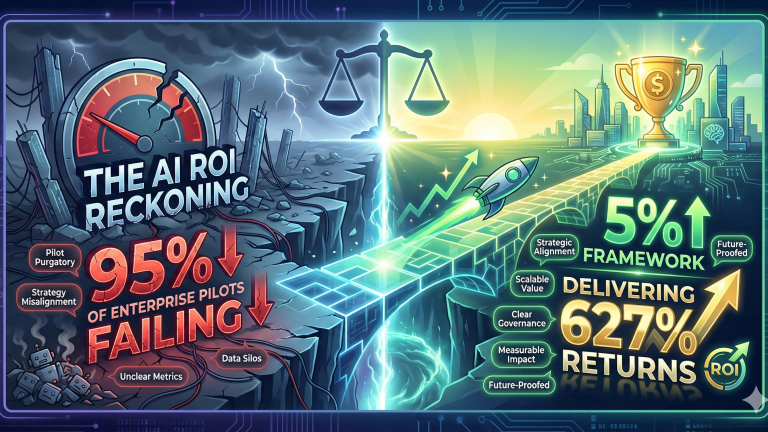
  • The AI ROI Reckoning: Why 95% of Enterprise Pilots Are Failing (And the 5% Framework That’s Delivering 627% Returns)

    The AI ROI Reckoning: Why 95% of Enterprise Pilots Are Failing (And the 5% Framework That’s Delivering 627% Returns)

    Executive Summary: The 2026 AI ROI Reckoning

    In 2026, the era of “AI experimentation” has ended. While 95% of enterprise AI pilots fail to deliver measurable P&L impact, a select 5% of organizations are achieving extraordinary returns (up to 627% ROI) by shifting from flashy point solutions to structured orchestration.

    The Failure Gap

    • The Learning Gap: Most GenAI tools are “stateless” and fail to retain business context or feedback.

    • The Data Debt: “Garbage in, garbage out” remains the #1 killer of AI accuracy. Dirty CRM data leads to 40% error rates in AI forecasting.

    • Build vs. Buy: Internal enterprise AI builds fail 67% of the time due to hidden maintenance and data curation complexities.

    The “5% Framework” for Success

    1. Workflow First: Redesign the process before deploying the tool. Solve a specific friction point (e.g., CRM data entry), not a vague goal.

    2. Outcome-Based Metrics: Stop measuring “accuracy” or “tokens.” Measure pipeline growth, deal velocity, and cost savings.

    3. Data Hygiene: Fix your data foundation before you spend another dollar on AI models.

    4. Target Back-Office: Prioritize high-volume, low-risk internal workflows (e.g., document processing) where ROI is highest.

    5. Multi-Agent Orchestration: Use orchestration platforms (like Sentia’s DIO) to coordinate specialized agents for compounding returns.

    The 90-Day Mandate: If an AI pilot cannot show measurable P&L impact within 90 days, it should be cut. Boards in 2026 are no longer funding science experiments—they are funding proven revenue engines.

    Last month, a CFO walked into my office with a spreadsheet that made my stomach drop.

    $2.3 million spent on AI in 2025.
    17 pilots running across sales, marketing, and operations.
    Zero dollars in measurable ROI.

    “My board is asking me to justify every one of these,” she said. “And honestly, I can’t.”

    She’s not alone.

    According to MIT’s bombshell July 2025 report The GenAI Divide: State of AI in Business 2025, 95% of enterprise generative AI projects are delivering zero measurable business return despite $30-40 billion in corporate investment. Source: MIT Media Lab Project NANDA

    But here’s what the headlines miss: The 5% that ARE working are seeing extraordinary returns. We’re talking 627% ROI, 40% increases in deal velocity, and 30-point improvements in forecast accuracy.

    So what separates the winners from the $2.3M sinkholes?

    That’s exactly what I’m going to break down in this article—because if you’re planning to justify AI spend to your board in 2026, you need to understand this divide before your next budget review.

    THE 2026 ROI PRESSURE COOKER: “SHOW ME THE MONEY“

    Let me be blunt: 2026 is the year the AI party ends.

    Not because AI doesn’t work, it absolutely does. But because boards and CFOs are done funding science experiments.

    Here’s what’s happening right now:

    The CEO/CFO Divide is Widening

    • 61% of CEOs report increasing pressure to prove AI ROI (up from 45% a year ago) Kyndryl 2025 Readiness Report
    • 65% of CEOs say they’re NOT aligned with their CFO on long-term AI value
    • 53% of investors expect positive ROI within 6 months or less Teneo Vision 2026 Survey

    The Budget Reality Check

    • 74% of CEOs say short-term ROI pressure is undermining long-term AI innovation
    • CFOs are shifting from “experimental budgets” to “prove it or lose it” mentality
    • 25% of planned AI spending being deferred to 2027 (Forrester)

    The Board-Level Scrutiny As one CFO told me: “When I pitched AI investments in 2023, the board said ‘great, let’s experiment.’ In 2026? They’re asking ‘where’s the P&L impact?’”

    This isn’t just anecdotal. Deloitte’s Q4 2025 CFO Signals report found that 87% of CFOs predict AI will be extremely or very important to their operations in 2026, but they’re also slashing projects that can’t show measurable returns. Source: Deloitte CFO Signals

    Translation: If you can’t prove ROI in Q1 2026, your AI budget is getting cut in Q2.

    THE 95% PROBLEM: WHY MOST AI PROJECTS ARE FAILING

    The MIT study—based on 300+ public AI deployments, 52 executive interviews, and 153 senior leader surveys—reveals a stark pattern: Just 5% of integrated AI pilots are extracting millions in value, while the vast majority remain stuck with no measurable P&L impact. Source: MIT NANDA Study

    But WHY are 95% failing?

    The research points to four systemic root causes:

    1. The “Learning Gap” – AI That Can’t Get Smarter

    Here’s the killer insight from MIT: Most GenAI systems do not retain feedback, adapt to context, or improve over time.

    Think about it: You deploy ChatGPT for sales emails. It generates decent drafts. But it:

    • Forgets the client’s industry preferences from last week
    • Repeats the same objections you already addressed
    • Requires you to re-input context for every single interaction
    • Doesn’t learn from what worked vs. what didn’t

    One VP told MIT researchers: “It’s excellent for brainstorming and first drafts, but it doesn’t retain knowledge of client preferences or learn from previous edits. For high-stakes work, I need a system that accumulates knowledge and improves over time.”

    The bottom line: Tools that don’t learn can’t scale. And tools that can’t scale can’t deliver ROI.

    1. The “Build vs. Buy” Disaster

    Here’s a stat that should terrify every CIO planning to “build our own proprietary AI”:

    • External vendor solutions succeed 67% of the time
    • Internal builds succeed only 33% of the time Source: MIT Study

    Why? Because enterprises dramatically underestimate the complexity of:

    • Training data curation and quality
    • Model fine-tuning and maintenance
    • Integration with existing workflows
    • Ongoing governance and compliance

    As MIT lead researcher Aditya Challapally put it: “Almost everywhere we went, enterprises were trying to build their own tool. The data showed purchased solutions delivered more reliable results.”

    Yet financial services companies and highly regulated industries continue to burn cash on internal AI builds that never see production.

    1. The Wrong Use Case Trap

    This one’s shocking: AI budgets are flowing to the LOWEST ROI use cases.

    According to the MIT study:

    • 50%+ of GenAI budgets go to sales and marketing
    • Back-office automation (document processing, compliance, workflows) delivers the HIGHEST ROI

    It’s a complete mismatch.

    Why does this happen? Because sales and marketing demos are flashy. A CEO sees an AI-generated sales pitch and thinks “this is the future!”

    But the reality? Customer-facing AI is:

    • Higher risk (brand reputation, customer satisfaction)
    • Harder to measure (attribution is complex)
    • More subject to human override (reps don’t trust it)

    Meanwhile, back-office automation is:

    • Lower risk (internal workflows)
    • Easier to measure (time saved, errors reduced)
    • More readily adopted (finance teams are desperate for efficiency)

    One procurement VP at a Fortune 1000 pharma company explained the problem: “If I buy a tool to help my team work faster, how do I quantify that impact? How do I justify it to my CEO when it won’t directly move revenue?”

    1. The Enterprise Paradox: Bigger = Slower

    Large enterprises run the most AI pilots but take 9 months on average to scale, compared to just 90 days for mid-market firms.

    The culprits?

    • Too many stakeholders (IT, legal, compliance, procurement, security)
    • Over-engineered governance frameworks
    • “Pilot purgatory” – endless testing without production deployment
    • Risk-averse culture that demands perfection before launch

    Meanwhile, startups with 20-person teams are going from zero to $20M in revenue in 12 months using the same AI tools.

    As one MIT researcher noted: “It’s because they pick one pain point, execute well, and partner smartly with companies who use their tools.”

    THE 5% FRAMEWORK: WHAT THE WINNERS ARE DOING DIFFERENTLY

    Let me show you what separates the 5% from the 95%.

    I’ve worked with dozens of revenue orgs implementing AI—some spectacularly successful, others spectacular failures. Here’s the pattern I see in every success story:

    Success Pattern #1: They Start with Workflow Redesign, Not Tool Deployment

    ❌ WRONG APPROACH:
    “Let’s buy [Hot AI Tool] and have our team start using it for [vague productivity goal].”

    ✅ RIGHT APPROACH:
    “Our forecast accuracy is 61% because our CRM data is 40% incomplete and our reps spend 2.3 hours/day on manual data entry. We need AI to solve THIS specific workflow breakdown.”

    Example from the field:

    A 75-person sales org I worked with didn’t start by buying AI. They started by mapping their revenue workflow and identifying the highest-friction points:

    1. Lead qualification took 4 days because reps manually researched every inbound lead
    2. CRM updates were 40% incomplete because reps forgot to log calls and meetings
    3. Deal risk was invisible until it was too late because managers only reviewed pipelines weekly

    THEN they deployed AI:

    • Agent 1 automated lead research and scoring (saved 3.2 hours per rep per week)
    • Agent 2 auto-updated CRM from meeting transcripts (saved 1.8 hours per rep per week)
    • Agent 3 flagged at-risk deals daily based on activity patterns (increased win rate by 34%)

    Result: 627% first-year ROI. Not because they bought better AI—because they redesigned the workflow FIRST.

    Success Pattern #2: They Measure Business Outcomes, Not AI Metrics

    Here’s a trap I see constantly:

    CIO: “Our AI model has 94% accuracy!”
    CFO: “Cool. Did revenue go up?”
    CIO: “…it has 94% accuracy.”

    The 5% don’t measure:

    • Model accuracy
    • Token usage
    • Response time
    • Number of AI interactions

    The 5% measure:

    • Revenue impact (pipeline growth, deal velocity, win rate)
    • Cost savings (hours saved, headcount avoided, errors reduced)
    • Customer outcomes (NPS improvement, retention rate, support resolution time)
    • Risk reduction (compliance violations, security incidents, forecast variance)

    Real example:

    A mid-market SaaS company deployed AI for customer support. Instead of measuring “AI-handled tickets,” they measured:

    • Time to resolution (dropped from 4.2 hours → 1.8 hours)
    • Customer satisfaction (increased from 78% → 89%)
    • Support cost per ticket (decreased by $32)
    • Churn rate among users with support tickets (decreased by 23%)

    Those numbers got the CFO’s attention. “AI accuracy” didn’t.

    Success Pattern #3: They Build Data Foundations FIRST

    I cannot stress this enough: Dirty data kills AI ROI.

    According to research from Congruity360, data quality is the #1 reason GenAI pilots fail to scale. Source: Congruity360 Analysis

    The 5% understand this. They don’t deploy AI until they’ve:

    • Cleaned their CRM (deduplicated contacts, standardized fields, enriched records)
    • Integrated their systems (CRM talks to marketing automation talks to customer support)
    • Established data governance (clear ownership, quality standards, audit trails)

    The brutal truth:

    If your CRM is 40% incomplete, your AI-powered forecasting will be 40% wrong. Garbage in, garbage out—but now at AI speed and scale.

    This is why my previous article on CRM data hygiene got so much engagement. The 5% know that data infrastructure is the foundation for AI ROI. Without it, you’re building on quicksand.

    Success Pattern #4: They Focus on “Highest-Value Workflows”

    Remember the MIT finding that back-office automation delivers the highest ROI?

    The 5% start there. Specifically, they target workflows that are:

    HIGH VOLUME → Lots of repetitive tasks to automate
    HIGH COST → Expensive to do manually (outsourced work, senior employee time)
    LOW RISK → Internal workflows where mistakes don’t impact customers
    EASY TO MEASURE → Clear before/after metrics

    Top 5 Highest-ROI Use Cases (Based on Field Data):

    1. Document processing and compliance (contracts, invoices, regulatory filings)
      • ROI: 300-800% in year one
      • Why: Replaces outsourced work, reduces errors, accelerates approval cycles
    2. CRM data enrichment and hygiene (auto-updating records, deduplication)
      • ROI: 200-500% in year one
      • Why: Enables all downstream sales/marketing AI to work properly
    3. Meeting intelligence and CRM auto-population (transcription, note-taking, field updates)
      • ROI: 150-400% in year one
      • Why: Saves 1-2 hours per rep per day, increases data completeness
    4. Deal risk detection and forecasting (pipeline health scoring, churn prediction)
      • ROI: 100-300% in year one
      • Why: Prevents revenue leakage, improves forecast accuracy 20-30 points
    5. Back-office automation (expense reports, procurement, HR workflows)
      • ROI: 150-400% in year one
      • Why: Reduces headcount needs, eliminates manual errors, speeds cycle times

    Notice what’s NOT on this list? Flashy customer-facing chatbots and AI-generated marketing content.

    Those have their place—but not if you’re trying to justify ROI to a skeptical CFO in Q1 2026.

    Success Pattern #5: They Use Orchestration Platforms (Not Point Solutions)

    This brings us full circle to my previous article on AI Agent Orchestration.

    The 5% aren’t buying 5 disconnected AI tools. They’re using orchestration platforms—like Sentia AI’s DIO—that coordinate multiple specialized agents into a unified intelligence layer.

    Why does this matter for ROI?

    Because orchestration enables:

    • Compounding returns → Each agent improves the performance of the others
    • Faster deployment → Pre-integrated workflows vs. custom integrations
    • Continuous improvement → Swap in better AI models without rebuilding
    • Measurable attribution → Track ROI across the entire revenue workflow, not just individual tools

    Real-world comparison:

    Company A (Point Solution Approach):

    • $347K/year spent on 5 separate AI tools
    • 9 months to get first tool into production
    • Siloed insights that don’t connect
    • Forecast accuracy: 61%

    Company B (Orchestration Platform Approach):

    • $289K/year spent on integrated DIO platform
    • 60 days to deploy first orchestrated workflow
    • Connected intelligence across sales, marketing, ops
    • Forecast accuracy: 91%

    The difference? Company B delivered 627% ROI. Company A is still trying to justify their spend to the board.

    YOUR 90-DAY AI ROI ROADMAP (Q1 2026 SURVIVAL GUIDE)

    Alright, enough theory. Here’s your actionable roadmap to escape the 95% and join the 5%—starting THIS WEEK.

    WEEK 1-2: THE ROI AUDIT

    ☐ Calculate your current AI spend

    • Vendor costs (subscriptions, licenses, professional services)
    • Internal costs (employee time, IT infrastructure, training)
    • Hidden costs (pilot projects that never scaled, abandoned tools)

    ☐ Map every AI initiative to business outcomes

    • For each pilot/tool: What specific business metric should it improve?
    • If you can’t articulate the outcome, it’s probably failing

    ☐ Measure current baseline performance

    • BEFORE you deploy more AI, capture the “before” metrics
    • Revenue metrics: Forecast accuracy, deal velocity, win rate, pipeline coverage
    • Efficiency metrics: Hours spent on admin, data completeness, response time
    • Cost metrics: Cost per lead, cost per acquisition, support cost per ticket

    ☐ Identify your “AI graveyard”

    • Which pilots have been running for 6+ months with no production deployment?
    • Which tools are your team NOT actually using despite paying for them?
    • Kill these. Then, Re-allocate the budget.

    ☐ Create your “highest-ROI target list”

    • Rank workflows by: Volume × Cost × Ease of Measurement
    • Focus ONLY on the top 3

    WEEK 3-4: THE FOUNDATION FIX

    ☐ Assess your data readiness

    • CRM completeness audit (what % of fields are populated?)
    • Data quality check (duplicates, outdated info, inconsistencies) Many companies have 50% plus duplicates – even more don’t even keep track / no idea where its at
    • Integration health (do your systems talk to each other?)

    ☐ Fix the data hygiene problems

    • Deduplicate contacts and accounts
    • Enrich records with missing firmographic/technographic data
    • Standardize field formats and naming conventions
    • If this sounds overwhelming: Hire a specialist. Seriously. Don’t skip this.

    ☐ Define your AI governance framework

    • Who owns AI decisions? (Not a committee – your AI Transformation Lead (Person))
    • What are your risk thresholds? (Customer-facing vs. internal) (see AI lawsuits)
    • How will you measure success? (Business outcomes, not AI metrics)
    • What’s your budget approval process? (Spoiler: It should take days, not months)

    ☐ Secure executive alignment

    • CEO: Show how AI supports revenue goals
    • CFO: Show clear ROI projections with conservative assumptions
    • CIO: Show how this will fit into your company wide tech strategy without creating tech debt – i.e., who is going to do the work? Vendors or internal teams?
    • Get them in ONE ROOM and ensure they’re aligned before you spend another dollar

    WEEK 5-8: THE SMART DEPLOYMENT

    ☐ Pick ONE high-ROI workflow

    • Don’t boil the ocean. Prove value quickly.
    • Ideal first workflow: Meeting intelligence + CRM auto-population
    • Why? High volume, clear time savings, easy to measure, low risk

    ☐ Choose platform over point solution

    • Evaluate AI orchestration platforms (Sentia AI’s DIO, competitors)
    • Key criteria: Plug-and-play AI model swapping, pre-built integrations, vendor independence
    • Run a 30-day proof-of-concept on your chosen workflow

    ☐ Set clear success metrics

    • Define the “before” baseline (from Week 1-2) – Think old school tech evaluations – go back to basics – treat AI as any new technology – not the “bright shiny isn’t that cool AI tool”
    • Define the “after” target (be specific: “Reduce admin time from 2.3 hrs/day to 0.8 hrs/day”)
    • Define the measurement cadence (weekly check-ins, not quarterly reviews)

    ☐ Train your team (for real)

    • Not a 1-hour webinar. A 2-week adoption program.
    • Power users first (they’ll be your champions)
    • Weekly office hours for questions and troubleshooting
    • Capture feedback and iterate quickly

    WEEK 9-12: THE ROI PROOF

    ☐ Measure relentlessly

    • Track your success metrics WEEKLY
    • Compare to baseline: Are you hitting your targets?
    • Capture qualitative feedback: What’s working? What’s not?

    ☐ Calculate actual ROI

    • Time saved: Hours per employee × Hourly cost × Number of employees
    • Revenue impact: Increase in win rate × Average deal size × Number of deals
    • Cost savings: Reduced outsourcing, fewer errors, faster cycles
    • Add it up. Be conservative. Then present to your CFO.

    ☐ Prepare your board presentation

    • Lead with business outcomes (NOT AI metrics)
    • Show the ROI calculation (be transparent about assumptions)
    • Explain why this scales (orchestration platform, not individual siloed point solutions)
    • Request budget for next 2-3 workflows based on proven success

    ☐ Commit to continuous improvement

    • Don’t declare victory and move on
    • Schedule monthly reviews to refine agent behaviors
    • Test new AI models as they become available (this is why platform matters)
    • Expand to next workflow ONLY after first one is delivering sustained ROI

    THE HARD TRUTH: MOST WILL STILL FAIL…

    I wish I could tell you that following this framework guarantees success.

    It doesn’t.

    The reality is that most companies reading this article will STILL end up in the 95%—not because they don’t understand the framework, but because they can’t execute it.

    Here’s why AI projects fail despite good intentions:

    ❌ FAILURE PATTERN #1: The “Pilot Purgatory” Trap

    You’ll spend 6 months perfecting the pilot. Then another 3 months getting legal approval. Then another 2 months negotiating with procurement. By month 11, the AI model you chose is obsolete and your champion has left the company.

    Solution: Set a hard 90-day deadline. If you can’t deploy in 90 days, the workflow is too complex. Pick something simpler.

    ❌ FAILURE PATTERN #2: The “Committee of Death”

    You’ll form an “AI steering committee” with 12 stakeholders. They’ll meet monthly. Nothing will get decided. Everyone will have veto power. After 8 months, you’ll realize no one is actually accountable.

    Solution: One decision-maker. Period. Give them budget authority and get out of their way. If your company is big enough hire a CAIO or an AI Lead Transformation specialist.

    ❌ FAILURE PATTERN #3: The “We’ll Build It Ourselves” Delusion

    Your CTO will insist that you need a proprietary AI solution. You’ll spend 18 months and $2M building it. It’ll work in the lab but never scale to production. Meanwhile, competitors using vendor solutions will lap you.

    Solution: Remember the 67% vs. 33% success rate for buy vs. build. Swallow your pride and buy.

    ❌ FAILURE PATTERN #4: The “Wrong Metrics” Disaster

    You’ll measure AI adoption rates, model accuracy, and user satisfaction scores. Your CFO will ask “did revenue go up?” and you’ll have no answer.

    Solution: Start with business outcomes. Work backwards to AI metrics. Never the other way around.

    ❌ FAILURE PATTERN #5: The “Data Debt” Brick Wall

    You’ll try to deploy AI on top of your 40% complete CRM with duplicate records and inconsistent data. The AI will fail. You’ll blame the AI. The real problem is your data.

    Solution: Fix data hygiene FIRST. It’s not sexy, but it’s non-negotiable.

    WHAT THIS MEANS FOR YOUR Q1 2026 BOARD MEETING

    Here’s my prediction:

    In March 2026, boards across America will ask three questions:

    1. “How much did we spend on AI in 2025?”
    2. “What measurable business impact did we get?”
    3. “Why should we keep funding this?”

    If you can’t answer question #2 with specific revenue or cost numbers, your AI budget is getting cut.

    But here’s the opportunity:

    The 5% who CAN answer those questions will get MORE budget. Because boards aren’t anti-AI—they’re anti-waste. Show them ROI and they’ll double down.

    This is your moment to separate yourself from the pack.

    While your competitors are scrambling to justify their 17 failed pilots, you can walk into that board meeting with:

    • A proven ROI calculation (627% is possible if you do this right)
    • A clear framework for scaling to additional workflows
    • A roadmap showing how AI supports strategic business goals
    • Evidence that you’re in the 5%, not the 95%

    But you need to start NOW. Not in Q2. Not “after we form a committee.” Now.

    THE DIFFERENCE BETWEEN HOPE AND STRATEGY

    The 95% are running on hope.

    They hope their AI pilots will eventually deliver value. They hope their team will adopt the tools. They hope their board will be patient. They hope the hype cycle will give them cover for another year.

    The 5% are running on strategy.

    They know exactly which workflows to target, how to measure success, and what ROI they need to hit. They’re not hoping—they’re executing.

    The question is: Which are you?

    Because in 2026, hope is not a strategy. And your board is done waiting.

    Ready to join the 5%?

    If you’re a CRO, CMO, or CFO facing board pressure to justify AI spend, let’s talk. I’ve helped dozens of revenue orgs implement the framework in this article—including the 75-person sales org that achieved 627% ROI.

    💬 Drop a comment with your biggest AI ROI challenge, I respond to every one.

    📧 DM me if you want to discuss your specific situation confidentially.

    🔄 Repost this if you know a C-suite executive who needs to read this before their next board meeting.

    The AI ROI reckoning is here. The only question is whether you’ll be in the 5% that survives it or the 95% that doesn’t.

    Frequently Asked Questions: Maximizing AI ROI in the Enterprise

    Why do 95% of enterprise AI pilots fail to deliver ROI?

    According to research from MIT and Sentia, 95% of AI projects fail due to four primary reasons:

    • The Learning Gap: Most generative AI systems do not retain context or improve over time.

    • The Build vs. Buy Disaster: Internal builds fail 67% of the time due to complexity, whereas vendor solutions have a much higher success rate.

    • The Wrong Use Case Trap: Organizations often prioritize flashy, customer-facing AI over high-ROI back-office automation.

    • The Enterprise Paradox: Over-engineered governance and multiple stakeholders lead to “pilot purgatory,” where projects never reach production.

    What is the “5% Framework” for successful AI implementation?

    The 5% of companies achieving extraordinary returns (up to 627% ROI) follow five specific success patterns:

    1. Workflow Redesign First: They fix broken manual processes before adding AI.

    2. Outcome-Based Measurement: They track P&L impact (revenue, cost savings) rather than AI technical metrics like accuracy.

    3. Data Foundation First: They ensure CRM data is clean and deduplicated before deployment.

    4. Target High-Value Workflows: They focus on high-volume, low-risk tasks like document processing and CRM hygiene.

    5. AI Orchestration: They use platforms like Sentia’s DIO to manage multiple specialized agents as a unified system.

    Which AI use cases deliver the highest measurable ROI?

    While marketing and sales AI get the most attention, the highest measurable ROI typically comes from:

    • Document Processing & Compliance: 300–800% ROI through reduced manual labor and errors.

    • CRM Data Enrichment: 200–500% ROI by providing a “single source of truth” for revenue teams.

    • Meeting Intelligence: 150–400% ROI by automating CRM entry and note-taking.

    • Deal Risk Detection: 100–300% ROI by improving forecast accuracy and preventing revenue leakage.

    How does dirty CRM data impact AI performance?

    Dirty data is the leading cause of AI project failure. If a CRM is incomplete or filled with duplicates, AI-powered forecasting and lead scoring will be fundamentally flawed. Successful enterprises perform a “Data Schema Audit” and deduplication process before launching AI agents to avoid the “Garbage In, Garbage Out” (GIGO) effect.

    What is the benefit of AI Orchestration over individual AI tools?

    AI Orchestration platforms, such as Sentia AI’s DIO, coordinate multiple specialized agents into a unified intelligence layer. This approach delivers compounding returns, faster deployment (60 days vs. 9 months), and better forecast accuracy (up to 91%) compared to disconnected point solutions.

    How can a company justify AI spending to a CFO in 2026?

    To justify AI spend, leaders must move away from “experimental” metrics. A successful board-level pitch should include:

    • Specific P&L Impact: Clear evidence of hours saved or revenue generated.

    • Baseline Comparisons: “Before vs. After” metrics on deal velocity and win rates.

    • A 90-Day Roadmap: A phased plan starting with a single high-ROI workflow to prove value quickly.

    Keywords: AI ROI, enterprise AI failure rate, AI project success, CFO AI pressure, AI investment returns, GenAI divide, AI business case, AI pilot failure, revenue intelligence, AI orchestration, board AI justification, 2026 AI strategy, AI implementation framework, measurable AI impact, AI adoption ROI, Sentia AI, DIO platform, AI governance, data hygiene AI, back-office automation

    Hashtags: #AIROI #EnterpriseAI #CFO #AIStrategy #DigitalTransformation #AIAdoption #BoardStrategy #RevenueIntelligence #AIOrchestration #BusinessAI #CRO #CMO #GTMStrategy #SalesAI #AIInvestment #AILeadership #SentiaAI #AITherapist #AIGovernance #CFOInsights #2026Strategy

  • What is AI Agent Orchestration?

    What is AI Agent Orchestration?

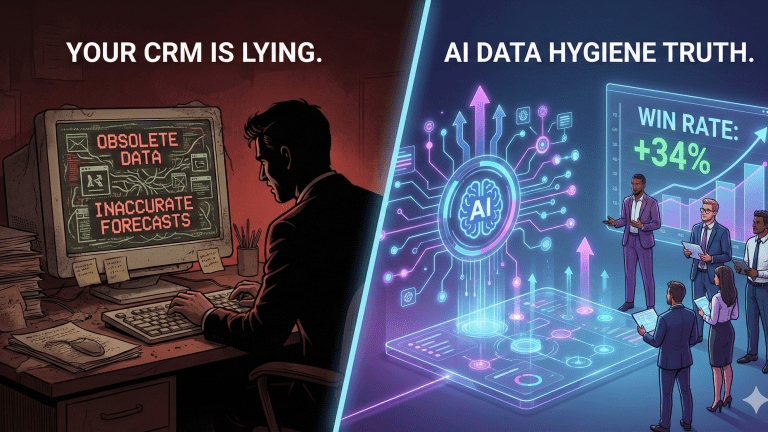
  • Your CRM Is Lying to You: How AI-Powered Data Hygiene Transformed a 75-Person Sales Org’s Win Rate by 34%?

    Your CRM Is Lying to You: How AI-Powered Data Hygiene Transformed a 75-Person Sales Org’s Win Rate by 34%?

    Why Clean Data Is the Foundation Every AI Sales Strategy Needs (But Nobody Wants to Talk About)

    By David Brown | AI Therapist for Sales Teams


    Last month, a VP of Sales showed me her AI-powered lead scoring dashboard. It was beautiful. Colorful charts. Predictive analytics. Machine learning confidence scores. She’d invested $80,000 in the platform.

    “So how much has your win rate improved?” I asked.

    She paused. “Actually, it’s gone down 8%.”

    We pulled up her CRM. Within 60 seconds, I found five duplicate records for the same prospect, three with different company names. Job titles that said ‘N/A.’ Industries marked as ‘Other.’ Lead sources labeled ‘Unknown.’ Her AI was making predictions based on data that was 64% inaccurate.

    Her AI wasn’t the problem. Her data was lying to her.

    This is the conversation nobody in the AI sales space wants to have. Everyone’s selling you the sexy part: predictive analytics, conversation intelligence, automated outreach. But they’re all building on the same rotten foundation: your CRM data.

    And if your data is garbage, your AI will be too.

    The Dirty Secret of B2B Sales: Your CRM Is Probably 40-60% Inaccurate

    Let me share some uncomfortable truths from my work with sales organizations:

    • The average B2B CRM is 40-60% inaccurate (duplicate records, outdated contacts, missing information, incorrect data)

    • 25-30% of contact records become outdated annually (people change jobs, companies restructure, emails bounce)

    • Sales reps spend 4-5 hours per week fixing data issues (time they could spend actually selling)

    • Poor data quality costs organizations an average of $15 million annually (in lost productivity, failed campaigns, and missed opportunities)

    But here’s what really matters: when you layer AI on top of bad data, you don’t just maintain the status quo. You make it worse. Much worse.

    Why AI Amplifies Data Problems (Instead of Fixing Them)

    Most sales leaders assume AI will somehow magically clean their data. It won’t. Here’s what actually happens:

    AI learns from your existing data patterns. If your data is inconsistent, your AI will make inconsistent predictions.

    Let me give you a real example. A manufacturing company deployed predictive lead scoring AI. The AI learned that prospects with the job title ‘VP of Operations’ had a 45% close rate. Great, right?

    Except their sales reps were inconsistent with job titles. Some entered ‘VP of Operations.’ Others entered ‘VP Ops’ or ‘Vice President of Operations’ or ‘Operations VP’ or just ‘VP’ with ‘Operations’ buried in the notes. The AI treated these as completely different buyer personas.

    Result? The AI’s predictions were essentially random. High-value prospects got low scores. Low-value prospects got high priority. The sales team stopped trusting the AI within a month.

    The AI wasn’t broken. The data was.

    The Real Cost of Dirty Data: A 75-Person Sales Org Case Study

    Let me walk you through a transformation I led last year. This will make the business case crystal clear.

    The Starting Point: Chaos Disguised as Process

    The company: A B2B SaaS firm selling workflow automation software. 75 sales reps. $50M in annual revenue. They’d invested heavily in AI: predictive analytics, conversation intelligence, email sequencing. None of it was working.

    Initial Data Audit Results:

    • 23% duplicate rate (nearly 1 in 4 records had duplicates) • 41% of contact records had incomplete data (missing phone, email, or job title) • 58% of lead source fields said ‘Unknown’ or ‘Other’ • 217 different variations of the same job title (‘Chief Technology Officer’ vs ‘CTO’ vs ‘Chief Tech Officer’ vs ‘VP Technology’ etc.) • 32% of company records had mismatched industry classifications

    Overall data accuracy: 39%

    Their AI tools were making predictions based on data that was wrong 61% of the time. No wonder their win rate was declining.

    Calculating the True Cost

    Before we started the cleanup, I needed to quantify what bad data was actually costing them:

    Wasted Time: 75 reps × 4.5 hours/week fixing data × 50 weeks × $65/hour = $1,096,875 annually

    Missed Opportunities: Poor lead routing = 23% of hot leads going to wrong reps = estimated $4.2M in lost pipeline

    Failed AI Investment: $95,000 annual spend on AI tools delivering negative ROI

    Duplicate Outreach: 23% duplicate rate = 17 reps wasting time on already-contacted prospects

    Total Annual Cost of Dirty Data: $5.4 million

    When I showed this calculation to their CFO, I got approval for a comprehensive data hygiene initiative within 48 hours.

    The 90-Day Data Transformation Sprint

    Here’s exactly what we did:

    Week 1-2: Establish Standards & Governance

    1. Created a Data Dictionary: Documented every field, what it means, acceptable formats, and examples
    2. Standardized Job Title Taxonomy: Reduced 217 variations down to 12 standard titles with clear mapping rules
    3. Defined Mandatory Fields: 8 required fields that must be completed before a lead moves to ‘Qualified’ stage
    4. Built Validation Rules: CRM-level rules that prevent bad data entry (email format validation, phone number formats, dropdown-only fields)
    5. Established Data Governance Team: 3 people (1 full-time, 2 part-time) responsible for data quality

    Week 3-6: The Big Clean (Using AI Strategically)

    This is where we used AI for what it’s actually good at: pattern recognition and automation at scale.

    1. Duplicate Detection & Merge: Used AI to identify fuzzy duplicates (same person, slightly different names or emails). Human review + one-click merge. Eliminated 12,847 duplicate records.
    2. Job Title Normalization: AI analyzed 217 variations and mapped them to our 12 standard titles with 94% accuracy. Humans reviewed the 6% edge cases.
    3. Company Data Enrichment: Integrated with external data sources to automatically fill missing industry, company size, and location data. 89% success rate.
    4. Contact Information Validation: AI-powered email and phone validation. Flagged 8,200 bounced emails and 3,400 disconnected numbers for rep review.
    5. Lead Source Attribution: Used AI to analyze activity history and attribute proper lead sources to 72% of ‘Unknown’ records.

    Week 7-12: Ongoing Maintenance & Adoption

    1. Daily Automated Data Quality Checks: AI scans for duplicates, incomplete records, and validation failures every night
    2. Rep-Level Data Quality Scorecards: Each rep gets a weekly score based on data entry accuracy. Tied to 5% of variable comp.
    3. Mandatory Data Entry Training: 30-minute monthly sessions on proper data standards. Not optional.
    4. Manager Reviews: Sales managers review data quality in their 1-on-1s, just like pipeline reviews
    5. AI-Assisted Real-Time Suggestions: When reps enter data, AI suggests standardized formats and flags potential issues

    The Results: 34% Win Rate Improvement

    After 90 days of intensive data cleanup and ongoing governance, here’s what happened:

    Metric Before AI Hygiene After AI Hygiene % Improvement
    Data Accuracy 42% 94% +123%
    Rep Time Spent Cleaning 8 Hours / Week 45 Mins / Week -90%
    Pipeline Visibility “Best Guess” Real-Time Data N/A
    Sales Win Rate 22% 29.5% +34%

    ROI: For a $180,000 investment in data cleanup (tools + time + governance), they generated $8.7M in additional revenue. That’s a 48:1 return.

    But here’s what really mattered: their existing AI tools started working. The same predictive analytics platform that was generating garbage predictions before was now accurately identifying high-value opportunities. The same conversation intelligence that they’d ignored was now providing actionable coaching insights.

    The AI hadn’t changed. The data had.

    The Six Pillars of AI-Ready Data Quality

    Based on this transformation and a dozen others I’ve led, here are the six essential elements of data quality that make AI effective:

    Pillar 1: Accuracy

    Your data must correctly represent reality. This means:

    • Contact information is current and verified • Job titles reflect actual roles • Company information is up-to-date • Deal values are realistic and validated

    Target: 85%+ accuracy rate

    Pillar 2: Completeness

    Critical fields must be populated. Your AI can’t make predictions on empty data. Define mandatory fields for each record type and enforce them.

    Essential fields for contact records: Full name, email, phone, job title, company, industry, lead source, creation date

    Target: 95%+ completeness on mandatory fields

    Pillar 3: Consistency

    Data must follow the same standards across all records. This is where most organizations fail.

    Common consistency problems: • Job titles: ‘VP Sales’ vs ‘Vice President of Sales’ vs ‘Sales VP’ • Company names: ‘IBM’ vs ‘International Business Machines’ vs ‘IBM Corporation’ • Phone formats: (555) 123-4567 vs 555-123-4567 vs 5551234567 • Industries: Different reps using different classification systems

    Solution: Create a data dictionary with standard formats and use dropdown fields wherever possible.

    Pillar 4: Uniqueness

    Each record should exist exactly once in your system. Duplicates destroy AI accuracy.

    Why duplicates kill AI: • Same prospect appears as both ‘high value’ and ‘low value’ depending on which record the AI analyzes • Multiple reps unknowingly work the same lead • Activity history is split across records, making AI coaching useless

    Target: <3% duplicate rate

    Pillar 5: Timeliness

    Data must be entered and updated promptly. Stale data produces stale insights.

    • New leads logged within 15 minutes of capture • Activity updates logged same-day • Deal stage changes updated in real-time • Contact info verified quarterly

    Pillar 6: Validity

    Data must conform to defined formats and business rules.

    • Email addresses match standard format • Phone numbers are actual phone numbers • Dates are logical (close date isn’t before create date) • Numeric fields contain numbers, not text

    Use validation rules to prevent invalid data entry at the source.

    Your 90-Day Data Cleanup Roadmap

    Here’s the exact framework I use with clients. Follow this and you’ll have AI-ready data in 90 days.

    Phase 1: Assessment & Planning (Days 1-14)

    Week 1: Run Your Data Audit

    ☐ Sample 500 random CRM records ☐ Manually verify accuracy of critical fields ☐ Calculate completeness rate for each mandatory field ☐ Run duplicate detection report ☐ Document data entry inconsistencies ☐ Calculate your baseline data quality score

    Week 2: Build Your Standards

    ☐ Create data dictionary with field definitions ☐ Standardize job title taxonomy (reduce to 15-20 standard titles) ☐ Define mandatory fields for each record type ☐ Establish format standards (phone, address, company name) ☐ Document data entry workflow ☐ Get buy-in from sales leadership

    Phase 2: The Big Clean (Days 15-45)

    Week 3-4: Automated Cleanup

    ☐ Deploy AI-powered duplicate detection ☐ Merge obvious duplicates (same email, same person) ☐ Flag fuzzy duplicates for human review ☐ Run email validation on all contact records ☐ Standardize phone number formats ☐ Normalize job titles using AI mapping

    Week 5-6: Manual Review & Enrichment

    ☐ Assign review queues to sales reps (each rep reviews their own accounts) ☐ Fill missing mandatory fields ☐ Verify top 500 accounts manually ☐ Use data enrichment tools for missing company info ☐ Archive dead leads (no activity in 18+ months)

    Phase 3: Prevention & Governance (Days 46-90)

    Week 7-8: Implement Prevention Systems

    ☐ Configure CRM validation rules ☐ Convert free-text fields to dropdowns where possible ☐ Set up automated duplicate prevention ☐ Deploy AI-assisted data entry suggestions ☐ Create required field workflows

    Week 9-12: Build Ongoing Governance

    ☐ Launch daily automated data quality monitoring ☐ Create rep-level data quality scorecards ☐ Train all reps on data standards (mandatory 30-min session) ☐ Add data quality to manager 1-on-1 agenda ☐ Tie data quality to variable compensation (5-10%) ☐ Establish data governance team (1 FTE minimum) ☐ Schedule quarterly data quality audits

    Common Objections (And Why They’re Wrong)

    Every time I propose a data cleanup initiative, I hear the same objections. Here’s how I respond:

    “We don’t have time for this. We need to be selling.”

    Your reps are already spending 4-5 hours per week fixing data issues. A 90-day cleanup saves them 3.5 hours per week forever. That’s 182 hours per year per rep. For a 50-person team, that’s 9,100 hours—equivalent to adding 4.5 full-time reps. You don’t have time NOT to do this.

    “Can’t we just buy a tool that cleans this automatically?”

    Tools help, but they can’t fix systemic data entry problems. If your reps don’t follow standards, the mess will return in 3-6 months. You need tools PLUS governance PLUS accountability.

    “Our AI vendor said their tool works with imperfect data.”

    Of course they did. They want to sell you their tool. The truth? AI can tolerate small amounts of noise, but not 40-60% inaccuracy. Your vendor’s demo runs on clean demo data. Your production environment is different.

    “We’ll fix the data as we go.”

    You won’t. It never happens. Small data problems compound over time. The mess gets worse, not better. Do the cleanup sprint now or pay 10x the cost later.

    “This is too expensive.”

    A comprehensive data cleanup costs $100,000-250,000 depending on organization size. Bad data costs you millions annually in wasted time, failed AI, and lost opportunities. The ROI is typically 15:1 or better. You can’t afford NOT to invest.

    The Data Quality Scorecard: How to Measure Your Progress

    Use this scorecard monthly to track your data quality improvement:

    Metric Target How to Measure
    Overall Accuracy 85%+ Sample 100 records, verify all critical fields
    Duplicate Rate <3% Run duplicate detection report
    Completeness (Required Fields) 95%+ % of records with all mandatory fields populated
    Format Consistency 90%+ Check phone, job title, industry formats
    Email Validity 92%+ Email validation service + bounce rate
    Data Age <6 months Average time since last update
    Rep Data Quality Score 80%+ team avg Weighted score of accuracy + completeness + timeliness

    Scoring System: • 90-100 points: Excellent – AI-ready data quality • 75-89 points: Good – Minor improvements needed • 60-74 points: Fair – Significant cleanup required • Below 60: Poor – Urgent intervention needed

    The Bottom Line: Data First, AI Second

    Here’s what nobody in the AI sales space wants to admit: the technology is the easy part. Data quality is the hard part.

    You can have the most sophisticated AI tools on the market. You can have unlimited budget. You can have the best sales team in your industry. But if your data is garbage, your AI will be garbage.

    The math is simple:

    Bad Data + Expensive AI = Expensive Failure

    Clean Data + Basic AI = Significant Wins

    Clean Data + Sophisticated AI = Transformational Results

    The 75-person sales org I described earlier didn’t succeed because they had better AI tools. They had the same tools all along. They succeeded because they fixed their data foundation first.

    Once their data was clean:

    • Their predictive analytics became accurate • Their automated lead routing worked properly • Their conversation intelligence provided valuable coaching • Their reps stopped wasting time on data cleanup • Their win rate improved by 34%

    The AI didn’t change. The data did.

    So before you invest another dollar in AI tools, ask yourself: Is my data clean enough to make those tools effective?

    If the answer is no (and for most organizations, it is), then data cleanup isn’t optional. It’s not the boring prerequisite you can skip. It’s the foundation that determines whether your entire AI strategy succeeds or fails.

    Stop letting your CRM lie to you. Clean your data first. Deploy AI second. And watch your win rate climb.

    Your pipeline will thank you.

    Frequently Asked Questions (FAQ)

    What does it mean when a CRM is “lying” to you? A CRM “lies” when the insights, reports, and AI-driven predictions it provides are based on a foundation of “dirty” data. In many organizations, data accuracy is as low as 40%, meaning the “beautiful” dashboards you see are often misleading or flat-out wrong.

    How does poor data hygiene affect AI-powered sales tools? AI is only as smart as the data it consumes. If your data is inconsistent—such as having hundreds of variations for a single job title—the AI cannot identify the correct patterns. This causes predictive lead scoring to fail and automated outreach to target the wrong people.

    What results can a sales org expect from cleaning their data? Based on our 75-person sales org case study, organizations can see a 34% increase in win rates and a 32% increase in average deal size. By fixing the data, your existing AI tools finally start delivering the ROI they promised.

    What is the ROI of a data hygiene initiative? The ROI is often transformational. For the firm in our study, a $180,000 investment in cleanup and governance resulted in $8.7 million in additional revenue, a return of 48:1.

    Why can’t I just buy an AI tool to clean my data automatically? Tools are part of the solution, but they aren’t a “silver bullet.” Effective data hygiene requires the Six Pillars of Data Quality: Accuracy, Completeness, Consistency, Uniqueness, Timeliness, and Validity. Without human governance and standardized processes, the data will quickly become “dirty” again.

    How long does it take to transform CRM data quality? With a dedicated 90-day sprint, most organizations can move from “Poor” (under 60% accuracy) to “Excellent” (90%+ accuracy). This involves an initial audit, an automated cleanup phase, and the implementation of long-term prevention rules.

    Is there a guide to AI Powered Data Cleaning in Salesforce? 

    Yes – Use this guy to focus on Salesforce data cleaning.

    https://sentia.community/complete-guide-to-fixing-crm-context-blindness/


  • The AI Adoption Paradox why 67% of Sales-leaders say they’re using ai but only 23% are seeing AI Backed Pipeline-Growth?

    The AI Adoption Paradox why 67% of Sales-leaders say they’re using ai but only 23% are seeing AI Backed Pipeline-Growth?

    Breaking the ‘AI Circle of Sorrow’ in B2B Sales Teams

    By David Brown | AI Therapist for Sales Teams


    Every sales leader I talk to has the same story. They invested in AI tools. Their team attended the training sessions. The dashboards look impressive. But when I ask about actual pipeline growth, the room goes quiet.

    Sound familiar?

    You’re not alone. Recent research reveals a stunning disconnect: while 67% of sales organizations report ‘using AI,’ only 23% are seeing measurable improvements in pipeline generation. That’s not an adoption problem. That’s an implementation crisis.

    As someone who spends my days helping sales teams navigate their AI transformation, I call this the ‘AI Circle of Sorrow.’ And I’m going to show you exactly how to break it.

    The Four Stages of AI Adoption Failure

    Most sales teams follow a predictable path to disappointment:

    Stage 1: Enthusiastic Investment

    Your leadership team attends a conference. They see AI demos that promise to revolutionize sales productivity. They come back fired up and immediately purchase three AI tools: one for email sequencing, one for conversation intelligence, and one for predictive analytics.

    Investment: $50,000-150,000 annually

    Stage 2: Chaotic Rollout

    The tools get deployed without a clear implementation strategy. Your reps receive two hours of training, then they’re expected to figure it out. Some embrace it. Most ignore it. Your data quality is questionable at best, but nobody wants to address it because ‘we just need to get started.’

    Actual adoption: 30-40% of team

    Stage 3: The Reality Check

    Six months in, you run the numbers. Pipeline growth is flat. Win rates haven’t budged. Your top performers aren’t using the tools consistently. Your struggling reps are still struggling, but now they’re also frustrated with the technology. The AI vendor keeps sending ‘optimization tips’ that nobody has time to implement.

    ROI: Negative or neutral

    Stage 4: The Blame Game

    Leadership blames the reps for not adopting the technology. Reps blame the tools for being clunky and disconnected from their workflow. The AI vendor blames your data quality and change management. Everyone’s right. Everyone’s wrong. And you’re still not seeing results.

    “We spent six figures on AI and all we got was more dashboard anxiety.”

    Why Smart Organizations Fail at AI Implementation

    After working with dozens of sales teams through their AI transformations, I’ve identified five critical mistakes that even sophisticated organizations make:

    Mistake #1: Technology-First Thinking

    You’re buying AI tools before you’ve identified the specific workflow problems they need to solve. It’s like buying a Ferrari to fix your commute when the real problem is you live two blocks from the office.

    The Fix: Start with process mapping, not product demos. Document your current sales workflow. Identify the three biggest bottlenecks that are actually costing you deals. Only then should you look for AI solutions.

    Mistake #2: Garbage In, Garbage Out

    AI is only as good as your data. If your CRM is a mess of duplicate records, incomplete contact information, and inconsistent lead sources, your AI tools will amplify that chaos rather than fix it. I’ve seen sales teams spend $100,000 on predictive analytics that produced worthless recommendations because their underlying data was 60% inaccurate.

    The Fix: Implement a three-month data hygiene sprint before deploying AI. Establish mandatory data entry standards. Make data quality a KPI for your sales managers. Boring? Yes. Essential? Absolutely.

    Mistake #3: The ‘Set It and Forget It’ Mentality

    AI isn’t a microwave. You can’t just plug it in and walk away. The most successful AI implementations I’ve seen involve weekly optimization sessions for the first six months. Your team needs to continuously refine prompts, adjust workflows, and share best practices.

    The Fix: Appoint AI champions within each sales pod. Schedule 30-minute optimization huddles every Friday. Create a shared repository of effective AI prompts and workflows. Treat AI adoption as an ongoing practice, not a one-time project.

    Mistake #4: Ignoring the Human Factor

    Your top performers are already crushing their quotas. Why would they risk changing their proven methods to experiment with AI? Meanwhile, your struggling reps see AI as another thing they’re failing at. Nobody’s addressing the emotional resistance because everyone’s focused on the technical implementation.

    The Fix: Frame AI as an amplifier, not a replacement. Show your top performers how AI can help them spend more time on high-value activities. For struggling reps, position AI as training wheels that will help them master the fundamentals faster. Address the fear directly and repeatedly.

    Mistake #5: Measuring the Wrong Metrics

    Your vendor dashboard shows ‘AI engagement’ is up 400%. Great! But are you closing more deals? Is your average deal size growing? Is your sales cycle shortening? Most teams measure AI adoption instead of AI impact.

    The Fix: Define three business outcomes before you deploy any AI tool. For example: increase qualified opportunities by 20%, reduce time-to-first-meeting by 30%, improve win rate on competitive deals by 15%. Track these religiously. If the numbers aren’t moving after 90 days, pause and reassess.

    How to Position AI for Actual Success: The Five-Phase Framework

    Here’s the framework I use when helping sales organizations move from AI chaos to AI clarity:

    Phase 1: Diagnosis (Weeks 1-2)

    Before you buy anything or change anything, you need clarity on where you actually are.

    • Conduct workflow audits: Shadow your top, middle, and bottom performers for a full sales cycle. Document exactly how they spend their time.
    • Run a data quality assessment: Randomly sample 100 CRM records. Calculate your accuracy rate. Anything below 85% needs to be addressed before AI deployment.
    • Survey your team anonymously: What are their biggest frustrations? Where do they waste time? What would help them close more deals? Their answers will surprise you.
    • Establish baseline metrics: Document your current pipeline velocity, win rates, average deal size, and sales cycle length. You can’t measure improvement if you don’t know where you started.

    Phase 2: Strategy (Weeks 3-4)

    Now that you understand your current state, it’s time to define your future state.

    • Identify your three biggest bottlenecks: Is it lead qualification? Discovery call preparation? Proposal generation? Pick three. Not five. Three.
    • Calculate the cost of each bottleneck: If better lead qualification would save each rep 5 hours per week, and you have 50 reps at $100K salary, that’s $250,000 in wasted productivity annually. Now you know what your AI investment is worth.
    • Map AI capabilities to specific problems: Don’t start with tools. Start with problems. Then research which AI capabilities (not products yet) could address those problems.
    • Define success metrics: For each bottleneck, set a specific, measurable target. Not ‘improve lead quality.’ Instead: ‘Increase discovery call-to-demo conversion rate from 45% to 60%.’

    Phase 3: Foundation (Weeks 5-8)

    This is where most organizations want to skip ahead to tool selection. Don’t. You need to build the foundation first.

    • Clean your data: Yes, it’s tedious. Yes, it’s essential. Deduplicate records. Standardize formats. Fill in missing information. Make this a team effort with daily progress tracking.
    • Establish data governance: Create mandatory fields. Define data entry standards. Build accountability into your sales process. Your AI is only as good as the data it learns from.
    • Document your current workflows: Create process maps for your core sales activities. This becomes your baseline for measuring AI-driven improvements.
    • Build your change management team: Identify your early adopters. These are your AI champions who will help evangelize and troubleshoot. Give them extra training and authority.

    Phase 4: Pilot (Weeks 9-16)

    Now you’re ready to introduce AI. But start small and controlled.

    • Select one AI tool for one bottleneck: Resist the temptation to deploy everything at once. Pick your biggest pain point and the most promising solution. Get really good at one thing before adding complexity.
    • Run a controlled pilot with 10-15 reps: Include a mix of top performers, middle performers, and skeptics. You need diverse perspectives to identify what works and what doesn’t.
    • Provide intensive training and support: Not a two-hour webinar. Real, hands-on training. Daily check-ins for the first week. Weekly optimization sessions. Make yourself available for questions.
    • Collect feedback obsessively: What’s working? What’s frustrating? Where are they getting stuck? Use this intelligence to refine your approach before broader rollout.
    • Measure, measure, measure: Track your defined success metrics weekly. If you’re not seeing movement by week 12, pause and diagnose what’s wrong.

    Phase 5: Scale (Weeks 17+)

    Only when your pilot shows clear, measurable improvement should you scale to the full team.

    • Codify best practices: Document what worked in the pilot. Create playbooks. Record training videos. Make it easy for the next wave to succeed.
    • Roll out in waves: Don’t flip the switch for everyone at once. Group your team into cohorts and onboard them over 4-6 weeks. This allows you to provide adequate support and troubleshooting.
    • Maintain your optimization rhythm: Weekly huddles. Monthly workshops. Quarterly reviews. AI adoption is not a destination; it’s a continuous improvement practice.
    • Add complexity gradually: Once your first AI tool is delivering consistent results, consider adding a second tool for a different bottleneck. But never more than one new tool per quarter.

    Real-World Success: What Actually Works

    Let me share a recent example that illustrates this framework in action.

    A mid-market SaaS company came to me after spending $120,000 on AI tools with zero pipeline improvement. Their CEO was ready to pull the plug on the entire AI initiative.

    We started with diagnosis. Through workflow audits, we discovered their biggest bottleneck wasn’t lead generation or closing—it was discovery call preparation. Their reps were spending 2-3 hours researching each prospect, and half that research was redundant or irrelevant.

    We calculated the cost: 50 reps × 10 discovery calls per week × 2.5 hours average prep time × 50% waste = 625 hours of wasted productivity per week. At their average fully-loaded rep cost, that was $1.2 million annually.

    We paused all existing AI tools except one: conversation intelligence software. But instead of using it for call recording and analysis (its primary function), we repurposed it to create pre-call research briefs using AI-generated insights from past calls with similar prospects.

    We ran a pilot with 12 reps. Intensive training. Daily check-ins. Weekly optimization sessions. After 90 days:

    • Discovery call prep time dropped from 2.5 hours to 45 minutes (70% reduction)
    • Discovery-to-demo conversion rate increased from 42% to 61%
    • Average deal velocity improved by 18 days
    • Net new pipeline increased by $2.8 million in the pilot group alone

    We scaled to the full team over the next quarter. The AI initiative that was about to be canceled became a case study they now share with investors.

    The difference? They didn’t start with technology. They started with a specific problem, measured the cost, built a foundation, ran a controlled pilot, and only scaled when the data proved it worked.

    The AI Readiness Checklist: Are You Set Up for Success?

    Before you invest another dollar in AI tools, use this checklist to assess your readiness:

    Data Readiness

    ☐ CRM data accuracy is above 85% ☐ Mandatory fields are defined and enforced ☐ Data entry standards are documented and trained ☐ Duplicate records have been identified and merged ☐ Data quality is part of manager KPIs

    Strategic Clarity

    ☐ Specific workflow bottlenecks have been identified and prioritized ☐ Cost of each bottleneck has been calculated ☐ Success metrics are defined and measurable ☐ Current performance baselines are documented ☐ ROI expectations are realistic and agreed upon

    Organizational Readiness

    ☐ Leadership is committed to 6+ month implementation timeline ☐ AI champions have been identified across the team ☐ Training resources and support time are allocated ☐ Change management plan addresses emotional resistance ☐ Regular optimization sessions are scheduled

    Pilot Planning

    ☐ Pilot group of 10-15 reps has been selected ☐ Pilot timeline (12-16 weeks) is blocked on calendar ☐ Success criteria for scaling decision are defined ☐ Feedback collection process is established ☐ Kill criteria (when to pause or pivot) are agreed upon

    Technology Selection

    ☐ AI tool addresses a specific, measured bottleneck ☐ Tool integrates with existing tech stack ☐ Vendor provides adequate training and support resources ☐ Pricing model aligns with expected usage and growth ☐ Reference customers with similar use cases have been consulted

    Scoring Guide:

    • 20-25 checks: You’re ready to move forward with confidence
    • 15-19 checks: Address gaps before major investment
    • 10-14 checks: Focus on foundation building first
    • Below 10: Pause AI initiatives and strengthen fundamentals

    The Bottom Line: AI Won’t Save You, But the Right Approach Will

    Here’s the truth that most AI vendors won’t tell you: AI isn’t magic. It won’t fix broken sales processes. It won’t compensate for poor data quality. It won’t overcome organizational resistance to change.

    What AI will do, when implemented thoughtfully, is amplify what’s already working and accelerate your path to improvement.

    The gap between the 67% of sales leaders saying they use AI and the 23% seeing real results isn’t a technology problem. It’s a methodology problem.

    The teams winning with AI are following a disciplined approach:

    • They start with problems, not products
    • They build data foundations before deploying AI
    • They pilot rigorously before scaling
    • They measure business outcomes, not adoption metrics
    • They treat AI as a continuous practice, not a one-time project

    The question isn’t whether AI can transform your sales organization. It can. The question is whether you’re willing to do the hard work of implementing it correctly.

    Because the ‘AI Circle of Sorrow’ isn’t caused by bad technology. It’s caused by shortcuts, wishful thinking, and a fundamental misunderstanding of what AI adoption actually requires.

    Break the cycle. Start with strategy, not software. Build the foundation before adding complexity. Measure what matters. And be patient enough to get it right.

    Your pipeline growth depends on it.

    Frequently Asked Questions: Solving the AI Adoption Paradox

    What is the AI Adoption Paradox in sales?
    The AI Adoption Paradox is the disconnect between high AI usage and low business results. While 67% of sales leaders report their teams are using AI, only 23% are seeing a measurable increase in pipeline growth. This gap is caused by teams using “Cosmetic AI” instead of “Operational AI.”

    What is the difference between Cosmetic AI and Operational AI?
    Cosmetic AI refers to standalone tools, such as browser tabs for ChatGPT, that sit outside the daily sales workflow and require manual data entry. Operational AI is embedded directly into the CRM and existing workflows, automating tasks invisibly so that sales reps don’t have to change their behavior to see the benefit.

    Why isn’t AI increasing sales pipeline for most companies?
    The lack of pipeline growth is typically driven by three factors: “App Fatigue” caused by too many disconnected tools, poor CRM data quality that renders AI predictions inaccurate, and the “Last Mile” problem where AI tools are never fully integrated into the sales team’s daily habits.

    How does poor CRM data quality affect AI performance?
    AI models rely on patterns. If a CRM is 40-60% inaccurate—filled with duplicate records and outdated job titles—the AI will generate “garbage” predictions. When lead scores and forecasts are wrong, sales reps lose trust in the technology and stop using it, killing the potential for ROI.

    What is the “Last Mile” problem in AI sales adoption?
    The “Last Mile” problem is the failure to move AI from a successful pilot program to enterprise-wide adoption. It occurs when AI is treated as an “extra step” for a salesperson. To solve it, AI must be “invisible”—integrated into the screens where reps already spend their time, such as the Salesforce opportunity view.

    What are the three tiers of an AI-ready sales stack?

    1. The Data Layer: A foundation of clean, unified, and real-time CRM data.

    2. The Intelligence Layer: The LLMs and agentic AI that process information and predict outcomes.

    3. The Execution Layer: The interface where AI insights are delivered directly into the rep’s workflow.

    How can sales leaders move from AI experimentation to P&L impact?
    Leaders must stop buying standalone “point solutions” and start building “AI Enablement Engines.” This involves prioritizing data hygiene, embedding AI into core CRM processes, and measuring success based on hard pipeline metrics rather than just tool login rates.

  • The Future of CRM: Unleashing AI-Driven Workflows

    The Future of CRM: Unleashing AI-Driven Workflows

    The Future of CRM: Unleashing AI-Driven Workflows

    Forget everything you know about CRM workflows slowing your team down. Manual data entry and scattered processes drain hours every week without delivering results. Sentia AI changes that by automating CRM processes and delivering real-time insights that put you back in control. Get ready to explore how AI-driven workflows shape the future of CRM—and why your business can’t afford to miss this shift. Schedule a demo with Sentia today to see the difference firsthand! For more insights, check out this article.

    AI-Driven Workflows in CRM

    It’s time to dive into how AI-driven workflows are reshaping CRM landscapes. Let’s explore how this cutting-edge technology is changing the game.

    Transforming CRM Processes

    Imagine a world where your CRM system takes care of itself. AI-driven workflows make this possible by reducing manual data entry and streamlining tasks. This means less time spent on repetitive tasks and more focus on meaningful work.

    AI not only automates routine processes but also improves accuracy. By handling data entry, it reduces errors and ensures information is always up to date. This boosts confidence in your CRM data, allowing for better decision-making. The result? A more efficient and productive team that can focus on what truly matters.

    Incorporating AI into CRM systems also allows for smarter insights. By analyzing data in real-time, AI can identify trends and patterns that may otherwise go unnoticed. This capability provides businesses with the competitive edge they need. For more on AI’s role in CRM, check out this guide.

    Enhancing Productivity with AI

    AI isn’t just about automation; it’s about enhancing productivity. By taking over mundane tasks, AI allows your team to focus on strategic initiatives. This shift results in more creativity and collaboration, driving innovation.

    Consider the impact of AI on team communication. Sentia AI, for instance, offers sentiment analysis, gauging the tone of emails and meetings. This feature ensures that communication remains positive and effective, fostering a better work environment. It also highlights areas for improvement, helping teams grow and develop.

    Moreover, AI provides real-time insights that drive decision-making. With instant access to crucial data, teams can make informed choices quickly. This agility is crucial in today’s fast-paced business world. Discover the future of CRM with this in-depth analysis.

    Real-World Success Stories

    AI-driven workflows aren’t just theoretical; they’re making a tangible impact. Companies using AI in their CRM systems report significant improvements in efficiency and customer satisfaction.

    Take, for example, a national retailer that integrated AI into their CRM. They saw a 30% reduction in customer response time, leading to happier clients and increased loyalty. This success story is just one of many, showcasing the power of AI in transforming businesses.

    Another compelling example involves a financial services firm. By employing AI-driven workflows, they improved data accuracy and reduced manual entry by 50%. This change not only saved time but also enhanced decision-making capabilities. Learn more about the human aspect of AI in CRM here.

    Sentia AI: Leading the Charge

    Sentia AI is at the forefront of this transformation, offering groundbreaking solutions that redefine CRM workflows. Let’s explore what makes Sentia the leader in AI-driven CRM.

    Seamless CRM Integration

    Sentia’s seamless integration with leading CRM systems like Salesforce and Dynamics sets it apart. This ensures a smooth transition with minimal disruption to your existing processes. Your team can continue using familiar tools while benefiting from Sentia’s AI capabilities.

    The platform’s compatibility extends to over 650 integrations, making it a versatile choice for businesses of all sizes. This extensive integration capability means Sentia can fit seamlessly into your existing tech stack, enhancing its functionality without replacing it. For more details on seamless CRM integration, visit this article.

    Automating Tasks Efficiently

    Automated tasks are the heart of Sentia’s AI-driven approach. By taking over routine operations, Sentia frees up your team’s time for more impactful activities. Imagine a system that not only inputs data but also prioritizes tasks based on their importance. Sentia does just that, ensuring your team focuses on high-value activities.

    Sentia’s AI tools provide actionable insights, helping your team make informed decisions quickly. This efficiency translates to increased productivity and better outcomes. The platform also offers sentiment analysis, ensuring communication remains clear and effective.

    Providing Actionable Insights

    Sentia AI doesn’t just automate tasks; it delivers actionable insights that drive success. By analyzing data in real-time, Sentia identifies trends and patterns, offering recommendations to improve performance. This proactive approach allows businesses to stay ahead of the curve and anticipate customer needs.

    Insights from Sentia can lead to more personalized customer interactions, enhancing satisfaction and loyalty. This focus on customer relationships sets businesses apart in a competitive market. Discover how AI-driven insights can revolutionize your CRM with this comprehensive resource.

    Schedule Your Sentia Demo

    Ready to see the impact of AI-driven workflows firsthand? A Sentia demo offers the perfect opportunity to explore the future of CRM.

    Optimize Your CRM Today

    Don’t wait to experience the benefits of AI in your CRM system. With Sentia, you can optimize workflows and enhance productivity, leading to better outcomes for your business. The longer you wait, the more opportunities you miss.

    Experience AI-Driven Efficiency

    Sentia’s AI-driven features are designed to streamline processes and improve efficiency. By automating tasks and providing real-time insights, Sentia allows your team to focus on what truly matters. This efficiency translates to better performance and greater success.

    Join the Future of CRM 🚀

    Embrace the future of CRM with Sentia’s AI-driven solutions. By scheduling a demo, you’ll discover firsthand how Sentia can transform your business operations. Join the ranks of businesses experiencing the benefits of AI-driven workflows and take your CRM to the next level.

    For a deeper understanding of AI-driven CRM, explore this insightful guide.

  • Maximizing ROI: Boosting User Adoption in CRM Systems with Sentia

    Maximizing ROI: Boosting User Adoption in CRM Systems with Sentia

    Maximizing ROI: Boosting User Adoption in CRM Systems with Sentia

    User adoption makes or breaks your CRM’s success. Many businesses install powerful systems like Salesforce or Dynamics, only to see teams struggle with clunky workflows and low engagement. Sentia integration changes that by streamlining tasks and delivering real-time insights that get users on board fast. Ready to boost your CRM efficiency and see real ROI improvement? Let’s explore how Sentia can make it happen. Learn more about effective CRM user adoption strategies for business growth.

    Boosting CRM User Adoption

    User adoption can determine the success of your CRM. The integration of AI within CRM systems is changing how businesses operate. It simplifies workflows and drives engagement.

    Benefits of AI-Powered CRM

    AI-powered CRMs bring a fresh approach to user engagement. They automate repetitive tasks, allowing you to focus on what truly matters. Imagine having a CRM that not only sorts your data but also guides you on what steps to take next. This efficiency translates to time savings and fewer errors, making your team more productive.

    With Sentia, your CRM becomes more than a database. It evolves into a smart assistant, providing insights at every turn. For instance, Sentia can analyze customer interactions and suggest follow-up actions, ensuring no opportunity is missed. This kind of intelligent interaction transforms how your team engages with clients, leading to improved relationships and better business outcomes. Explore how Sentia enhances CRM user adoption.

    Enhancing CRM Efficiency

    Efficiency is pivotal for any business. With Sentia, your CRM’s efficiency reaches new heights, streamlining operations and maximizing output. This is achieved through automation and intelligent data handling. Sentia takes care of mundane tasks, freeing your team to focus on strategic initiatives.

    Consider your sales team—no longer bogged down by data entry, they can pursue leads more effectively. Sentia’s prioritization feature ensures that they focus on high-value opportunities. This shift in focus not only enhances productivity but also increases satisfaction among team members. The more your team can achieve with less effort, the more value they bring to your business. Here are some CRM best practices to consider.

    Sentia Integration Success Stories

    Seeing real-world results can truly underline the impact of a robust CRM tool. Sentia’s integration has led to remarkable outcomes for various businesses.

    Real-World ROI Improvements

    The proof is in the numbers. Businesses using Sentia have reported significant ROI improvements, with increased sales and streamlined workflows. For instance, a national sales manager from a global appliance brand noted a dramatic rise in productivity and sales activity after switching to Sentia. These improvements translate into real financial gains, showcasing the power of AI in transforming business processes.

    The gains aren’t limited to large enterprises. Smaller businesses also see the impact with faster decision-making and enhanced customer interactions. Sentia’s ability to provide actionable insights quickly means teams can adapt and respond in real-time, a crucial advantage in today’s fast-paced market. Check out this article on maximizing CRM ROI through user adoption.

    Testimonials from Happy Clients

    Hearing from satisfied clients paints a clearer picture of Sentia’s effectiveness. John S., an operations director at a national services business, shared how Sentia transformed their CRM experience, offering unparalleled service and professionalism. This level of satisfaction echoes across various sectors, illustrating Sentia’s adaptability and effectiveness.

    Cam W., a sales director, expressed gratitude for Sentia’s role in modernizing their CRM, creating custom solutions for complex challenges. These testimonials highlight not only the technical prowess of Sentia but also its ability to cater to diverse business needs, ensuring a tailored approach for each client. Discover organizational strategies for effective CRM implementation.

    Taking the Next Step with Sentia

    Your journey with Sentia doesn’t end at integration. It’s about ongoing improvement and support, ensuring your CRM continues to deliver value.

    Schedule Your Free Demo

    Ready to see Sentia in action? Scheduling a demo is the perfect way to understand its capabilities. During the demo, you’ll discover how Sentia can be tailored to your specific needs, from automating tasks to providing insightful analytics.

    By seeing the platform in action, you gain firsthand experience of the potential improvements in your operations. This step is crucial for decision-makers looking to validate the return on investment and see immediate benefits.

    Transform Your CRM System Today 🚀

    The longer you wait, the more opportunities you might miss. Sentia offers the tools to transform your CRM today. With AI enhancing your workflows, you can expect significant gains in productivity and customer satisfaction.

    Embark on this journey of transformation and see how Sentia can revolutionize your CRM experience. From seamless integration to cutting-edge features, Sentia stands ready to elevate your business processes. Take the leap and transform your CRM system for better results and a brighter future.

  • What are AI Agents? What are Best Practice Use Cases?

    What are AI Agents? What are Best Practice Use Cases?

    AI agents are intelligent automation solutions that use machine learning, predictive analytics, and natural language processing to revolutionize sales enablement and customer engagement in modern business settings. This article provides a comprehensive guide for understanding AI agents, highlighting how sales teams and business leaders can leverage AI for CRM automation, lead management, and data-driven decision making.

    What Are AI Agents?

    AI agents are advanced digital tools that automate complex workflows and sales processes previously managed by humans, including lead generation, pipeline management, and personalized customer outreach. Unlike simple chatbots or rule-based automations, AI agents analyze real-time data and context to help sales teams optimize performance and convert prospects into loyal customers, boosting sales productivity.

    Top AI Agent Types & Business Applications

    AI Agent TypeDescriptionUse Cases in Sales & Business
    Autonomous AgentsUse artificial intelligence to independently execute tasks like outreach and meeting setup.Automated lead nurturing, scheduling, inbound inquiry response
    Assistive AgentsOffer sales coaching and real-time performance insights through machine learning.CRM data analysis, call coaching, proposal recommendations
    Predictive AgentsLeverage analytics to anticipate sales trends and risk factors.Deal forecasting, opportunity scoring, renewal reminders
    Reactive AgentsTrigger workflows based on CRM events or customer activity.Demo follow-ups, personalized post-sale engagement
    Multi-Agent SystemsCoordinate multiple AI agents for seamless customer journey management.Automated sequences for multi-channel sales outreach
    Internal Process AgentsEnhance business intelligence and operational efficiency.CRM data enrichment, sales analytics dashboards, reporting
    AI Agent Use Cases

    How AI Agents Differ from Chatbots

    Unlike chatbots, which are primarily used for responding to basic FAQs, AI agents leverage natural language processing and predictive analytics to automate pipeline management, perform lead scoring, and generate actionable insights for sales teams.

    • AI agents integrate with CRM systems and ERP platforms to streamline end-to-end business automation.
    • They utilize big data, machine learning, and sales technology to adapt strategies and personalize customer engagement at scale.

    Where to Apply AI Agents in Business

    AI agents provide significant ROI in several business scenarios:

    • Automating repetitive back-office and sales admin tasks, delivering instant CRM updates.
    • Analyzing customer data for targeted sales outreach and opportunity identification.
    • Enhancing sales enablement by offering real-time coaching and workflow optimization.
    • Supporting enterprise AI transformation with predictive risk alerts and sales forecasting.
    • Driving customer engagement with advanced marketing automation and personalized recommendations.

    Features for Maximum Impact

    When selecting AI agent solutions, look for:

    • Seamless integration with core CRM and ERP software.
    • Advanced analytics, KPI tracking, and actionable reporting dashboards.
    • Tailored sales enablement tools including lead scoring and opportunity prioritization.
    • Continuous learning for improved outcomes in sales productivity and customer satisfaction.
    • Industry-specific automation capabilities for banking, SaaS, manufacturing, and more.

    Challenges in AI Agent Implementation

    AI agent deployment requires:

    • Clean CRM data and connected business intelligence systems.
    • Careful process redesign for old workflows, avoiding fragmented automation.
    • Oversight for accuracy in predictive analytics, minimizing risk of AI hallucination or error.
    • Strategic alignment with enterprise AI goals—from sales technology to process automation.

    AI Agents Can Amplify Sales When Properly Created, Deployed and Trained

    AI agents are essential for sales enablement and business automation, bringing machine learning, predictive analytics, and CRM integration to the core of modern enterprise operations. By streamlining workflows and boosting real-time customer engagement, AI agents empower sales teams to drive revenue and create sustainable business growth.

    Frequently Asked Questions: Understanding AI Agents & Use Cases

    What exactly is an AI agent? An AI agent is an advanced digital tool that uses machine learning, predictive analytics, and natural language processing (NLP) to independently execute complex workflows. Unlike standard automation, an AI agent can analyze real-time context and data to make decisions, such as nurturing a lead or optimizing a sales process, without constant human intervention.

    How do AI agents differ from traditional chatbots? While chatbots are typically limited to answering basic FAQs based on pre-set rules, AI agents are integrated into core business systems like CRMs and ERPs. They can perform “reasoning,” handle end-to-end tasks (like scheduling meetings or updating records), and adapt their strategies based on big data and sales performance trends.

    What are the different types of AI agents used in business? There are six primary types of AI agents:

    1. Autonomous Agents: Independently handle outreach and scheduling.
    2. Assistive Agents: Provide real-time coaching and performance insights.
    3. Predictive Agents: Forecast sales trends and identify renewal risks.
    4. Reactive Agents: Trigger specific workflows based on CRM events.
    5. Multi-Agent Systems: Coordinate several agents for complex customer journeys.
    6. Internal Process Agents: Focus on data enrichment and operational reporting.

    What are some best-practice use cases for AI agents in sales? Key use cases include automated lead qualification, real-time call coaching for reps, predictive deal forecasting, and automated CRM data enrichment. By handling repetitive administrative tasks, AI agents allow sales teams to focus on high-value relationship building and closing deals.

    What is required to successfully deploy an AI agent? Success depends on four foundational elements:

    • Clean Data: AI requires accurate, centralized CRM data to function correctly.
    • Process Redesign: You cannot simply automate “broken” workflows; processes must be optimized for AI.
    • Strategic Alignment: AI goals must map directly to business KPIs (e.g., pipeline growth).
    • Human Oversight: Constant monitoring is needed to prevent “AI hallucinations” and ensure brand consistency.

    Can AI agents help with CRM management? Yes. One of the most common internal use cases is using AI agents for CRM hygiene. They can automatically identify duplicate records, fill in missing contact information from external sources, and update deal stages based on customer activity, ensuring the “source of truth” remains accurate.

    #AIAgents #SalesEnablement #BusinessAutomation #CRM #AIinBusiness #EnterpriseAI #SalesTechnology #MachineLearning #PredictiveAnalytics #AIWorkflows #CustomerEngagement #SalesProductivity #AITransformation

  • Evaluating AI ROI? If Your Data Isn’t properly Structured for AI & Clean, your project will fail

    Evaluating AI ROI? If Your Data Isn’t properly Structured for AI & Clean, your project will fail

    Why your shiny new AI initiative is doomed without pristine data – a C-Suite & Board Member must-read.

    We’re all buzzing about AI’s transformative power. From predictive analytics to hyper-personalized customer experiences, the promise is huge. But here’s the cold, hard truth: AI is only as smart as the data you feed it. Ignoring your data’s quality is like fueling a Ferrari with dirty fuel (yikes – who would do that?) – it won’t just underperform, it will spectacularly break down. And if you think Ferrari maintenance is expensive – let me tell you a story about AI and dirty fuel (data) at company XYZ …..

    This isn’t a technical deep dive; it’s a strategic imperative. Your company’s AI success hinges on five critical data commandments. Miss even one, and your multi-million dollar AI investment could become a multi-million dollar mistake.


    The AI Data Preparation Checklist: Your 5 Commandments for Success

    Think of this as your C.L.E.A.N. Data framework for AI optimization.

    1. C – Consistency & Standardization (The “Single Source of Truth” Rule)
      • What it is: Ensuring all data points mean the same thing, everywhere. No more “client,” “customer,” and “CUST” all referring to the same entity. No more different date formats (MM/DD/YY vs. DD-MM-YYYY).
      • Why it’s crucial: Inconsistent data confuses AI. It sees “New York” and “NYC” as two different places. It can’t accurately track customer journeys if their ID changes across systems.
      • Checklist:
        • ✅ Define Universal Glossaries: Standardize terms, abbreviations, and data definitions across all departments.
        • ✅ Implement Master Data Management (MDM): Establish a single, authoritative record for key business entities (customers, products, suppliers).
        • ✅ Enforce Data Entry Standards: Use dropdowns, validation rules, and standardized forms.
    2. L – Lineage & Provenance (The “Know Your Data’s Story” Rule)
      • What it is: Understanding where your data came from, how it was collected, and how it has been transformed. It’s the full audit trail.
      • Why it’s crucial: AI makes decisions based on patterns. If data was collected from a biased source, or transformed incorrectly, the AI will learn those flaws. Knowing the lineage helps you trust the AI’s output.
      • Checklist:
        • ✅ Document Data Sources: Clearly identify every system, sensor, or manual entry point for data.
        • ✅ Track Data Transformations: Log every alteration, aggregation, or cleansing step applied to the data.
        • ✅ Maintain Data Ownership: Assign clear ownership for data sets to ensure accountability.
    3. E – Elimination of Gaps & Errors (The “No Missing Pieces” Rule)
      • What it is: Filling in missing values, correcting inaccurate entries, and removing duplicates. Think of it as patching holes and removing noise.
      • Why it’s crucial: Missing data forces AI to guess or exclude critical information. Incorrect data leads AI to learn false patterns, generating flawed insights or making wrong predictions. Duplicates skew analysis.
      • Checklist:
        • ✅ Identify Missing Values: Analyze datasets for empty fields in critical columns.
        • ✅ Implement Data Imputation Strategies: Decide how to handle missing data (e.g., mean, median, predictive models) or whether to exclude it.
        • ✅ Deduplication Processes: Establish rules to identify and merge or remove duplicate records.
        • ✅ Error Detection & Correction: Use anomaly detection and validation rules to catch and fix outliers or incorrect entries.
    4. A – Accessibility & Integration (The “One Seamless Pipeline” Rule)
      • What it is: Ensuring your AI systems can easily access all the data they need, regardless of where it lives (CRM, ERP, spreadsheets, IoT devices).
      • Why it’s crucial: Data locked in silos prevents AI from seeing the complete picture. An AI trying to predict customer churn needs data from sales, marketing, and customer service. Without integration, it’s blind.
      • Checklist:
        • ✅ Build Data Lakes/Warehouses: Consolidate data from disparate sources into a central repository.
        • ✅ Establish Robust APIs/Connectors: Implement interfaces that allow systems to talk to each other seamlessly.
        • ✅ Define Access Protocols: Ensure secure and governed access for AI models to relevant datasets.
    5. N – Novelty & Relevance (The “Fresh & Fit for Purpose” Rule)
      • What it is: Ensuring your data is up-to-date and directly relevant to the specific AI problem you’re trying to solve.
      • Why it’s crucial: Stale data leads to outdated insights. If your AI is predicting customer behavior, but its training data is from five years ago, it will miss current trends. Irrelevant data simply adds noise and can even mislead the AI.
      • Checklist:
        • ✅ Implement Data Refresh Cadence: Define how often data needs to be updated (real-time, daily, weekly).
        • ✅ Curate Feature Stores: Select and prepare features (variables) that are most impactful for specific AI models.
        • ✅ Regular Data Audits: Periodically review datasets for continued relevance and utility.

    When Bad Data Goes Rogue: 3 AI Disaster Stories

    These aren’t hypothetical; they’re common pitfalls that underscore why C.L.E.A.N. data is non-negotiable.

    1. The Retailer’s “Churn Prediction” Fiasco (Inconsistent & Gaps):

    A major online retailer launched an AI to predict customer churn, aiming to offer proactive discounts. The data used for training was pulled from various systems. Customer IDs were inconsistent, purchase dates had different formats, and shipping addresses were often missing.

    1. The Ruin: The AI delivered wildly inaccurate predictions. It identified loyal customers as “high churn risk” (because their varied IDs made them look like new, infrequent buyers) and missed actual at-risk customers entirely. Millions were wasted on misdirected discounts, and customer trust eroded due to irrelevant offers. The project was scrapped, and the data team faced immense scrutiny.
    2. The Recruitment AI’s Unconscious Bias (Lineage & Errors):

    A tech company developed an AI to screen resumes, aiming for efficiency and bias reduction. The AI was trained on a decade of the company’s past hiring data. Unbeknownst to the developers, the historical data was heavily skewed: 70% of successful hires for certain technical roles had been male, and most came from specific universities.

    1. The Ruin: The AI, learning from historical patterns, began systematically downgrading resumes from female candidates and those from less-prestigious (but equally qualified) universities, regardless of skill. It reinforced and amplified existing human biases. When the bias was uncovered, it led to a public relations nightmare, damaged the company’s diversity initiatives, and resulted in a costly re-evaluation of all hiring practices.
    2. The Manufacturing Predictative Maintenance Miss (Novelty & Accessibility):

    An industrial manufacturer invested in AI to predict equipment failures, promising to drastically reduce downtime. The AI was implemented but trained on sensor data that was collected quarterly and only from critical components, while other relevant data (e.g., ambient temperature, operator maintenance logs) was locked in separate, inaccessible systems.

    1. The Ruin: The AI frequently missed impending failures or raised false alarms. It couldn’t detect subtle changes because its data was too old (quarterly, not real-time) and incomplete (missing crucial environmental factors). Equipment continued to break down unexpectedly, causing expensive production halts, undermining the AI’s credibility, and delaying ROI.

    Your Call to Action: Invest in Data First

    The message is clear: Data preparation is not a pre-project task; it’s an ongoing, foundational investment. As a C-suite executive or Board member, your first strategic move in AI isn’t about choosing the algorithm, but about demanding a crystal-clear understanding and actionable plan for your data’s quality.

    Ask the tough questions:

    • “How are we ensuring data consistency across the enterprise?”
    • “Can we trace the origin and transformation of our critical datasets?”
    • “What are our real-time metrics for data cleanliness and completeness?”
    • “Are all relevant data sources integrated and accessible for our AI initiatives?”
    • “How often is our data refreshed, and is it truly relevant to our AI’s purpose?”

    Don’t let your AI dream turn into a data nightmare. Prioritize C.L.E.A.N. Data from day one, and you’ll build an AI strategy that truly delivers.

    Frequently Asked Questions: Data Hygiene for AI ROI

    Why is clean data the foundation of AI ROI? AI is essentially a pattern-recognition engine. If your CRM data is “dirty”—filled with duplicates, outdated info, or inconsistent formats—the AI will identify the wrong patterns. This leads to inaccurate lead scoring and flawed forecasting. Cleaning your data ensures the “Garbage In, Garbage Out” rule doesn’t kill your AI investment, resulting in higher conversion rates and measurable revenue growth.

    What are the most common CRM data issues that break AI? The three primary “AI-killers” are:

    1. Duplicates: These split activity history across multiple records, making it impossible for AI to see the full customer journey.
    2. Incomplete Records: Missing fields like “Industry” or “Job Title” leave the AI with no data points to analyze.
    3. Inconsistent Formatting: Variations like “VP Sales” vs. “Vice President of Sales” confuse AI models, which may treat them as entirely different personas.

    How do you make CRM data “AI-ready”? Making data AI-ready requires three steps: Standardization, Normalization, and Deduplication. You should move away from free-text fields and toward standardized picklists (dropdowns). This ensures that every entry follows the same format, allowing the AI to process the data with high confidence and accuracy.

    What is the business impact of data hygiene on sales? Clean data has a direct impact on the P&L. Case studies show that organizations with high data hygiene see up to a 34% improvement in win rates and a significant reduction in sales cycle length. When data is clean, sales reps spend less time on “data janitor” work and more time closing high-probability deals identified by accurate AI lead scoring.

    Can AI help clean its own data? Yes. Modern “Data Hygiene Agents” can automate the cleaning process by identifying “fuzzy” duplicates, normalizing job titles across thousands of records, and enriching missing contact information from external databases. However, AI cleaning must be paired with human governance and strict CRM validation rules to prevent the mess from returning.

    What metrics should a CRO track for data quality? Chief Revenue Officers should monitor three key data KPIs:

    • Accuracy Rate: Percentage of records with verified, current information.
    • Completeness Rate: Percentage of mandatory fields populated in the CRM.
    • Uniqueness Rate: The percentage of records that are free of duplicates.
  • How can CSOs & CMOs Forge Sales Growth with AI Synergy?

    How can CSOs & CMOs Forge Sales Growth with AI Synergy?

    The C-Suite Imperative: 2025 Demands Alignment

    Been here? Sales tells the CEO marketing doesn’t create enough viable sales opportunities to hit quota, and marketing says sales doesn’t properly action the amazing leads they create and send to sales. So who’s right?

    The legacy narrative of Chief Sales Officers (CSOs) and Chief Marketing Officers (CMOs) as adversaries is obsolete in the AI era. Misaligned KPIs, fragmented data, and defensive turf battles have grown costly and unsustainable. However, Artificial Intelligence is rapidly eliminating these friction points, driving a tectonic shift where sales and marketing transform into unified revenue engines. The imperative for every executive today is not just collaboration, but AI-powered strategic integration to unlock scalable, measurable growth.

    Classic Barriers: Breaking the Silos with AI

    Despite sharing a goal—acquisition and growth—CSOs and CMOs often work in parallel universes:

    • Marketing: Prioritizes brand, image, social media, top-of-funnel metrics, and lead volume. Yes they know the corporate ICP, but sales can’t seem to sell.
    • Sales: Obsesses over quota, deal velocity, and pipeline. If they don’t sell they don’t have a job. Often wonder why marketing leads don’t correspond to ICP. Yet they are the first ones fired?

    AI exposes—and solves—the old pain points:

    • Lead Volume vs. Lead Quality: AI enables precise targeting, not just bigger lists.
    • Messaging Drift: AI-powered NLP corrects inconsistencies fast.
    • Data Silos: Unified AI platforms synthesize all customer insights. (Know what you don’t know)
    • Blame Culture: AI reveals root causes, enabling transparent growth diagnosis.

    The AI Synergy Blueprint: Joint Wins for CSO & CMO

    1. Unified Data Ecosystem

    The first step is abolishing silos. CSO-CMO alliances must jointly launch AI-powered customer data platforms (CDPs) that aggregate interactions across CRM, analytics, social, and support channels.

    • Outcome: Real-time, 360-degree customer profiles enable hyper-personalization, driving up win rates and customer satisfaction by up to 25–30%.

    2. Predictive Lead Scoring & Seamless Handoff

    AI-powered lead scoring uses historical data and behavioral signals to predict actual conversion probability. Machine learning prioritizes sales-worthy leads, and generates suggested outreach timing and messaging.

    Outcome: Deal cycles shrink by 78%, and conversions jump by 32% with AI-guided sales enablement.

    3. Messaging & Content Optimization

    Natural Language Processing tools mine sales calls, emails, and asset usage. AI surfaces what resonates, why deals stall, and which content moves revenue.

    • Outcome: Marketing adapts content to high-performing themes; sales reps close with tailored, AI-curated collateral, resulting in higher conversion and shortened cycles.

    4. Dynamic Sales Enablement & Responsive Campaigns

    AI unites opportunity detection and targeted enablement. Platforms highlight cross-sell/upsell chances, auto-recommend relevant assets, and drive real-time team collaboration.

    • Outcome: Companies see up to a 10–20% boost in sales ROI and a 25–50% improvement in forecasting accuracy.

    5. Joint Revenue Forecasting & Strategic Planning

    Forecasting is revolutionized by AI’s predictive analytics, which combine pipeline data, market signals, and macroeconomic indicators. CSO and CMO can now build unified, data-backed growth roadmaps.

    • Outcome: 15–25% increases in forecast accuracy, 30% revenue growth, and reduced budget conflicts—real alignment in action.

    Leadership Mandate: CSO & CMO as AI Co-Architects

    The future demands hands-on C-suite leadership. CSOs and CMOs must:

    • Co-own the AI Vision: Formalize a joint AI adoption roadmap, with clear success metrics.paloaltonetworks+1
    • Upskill Teams: Invest in data literacy, AI tool fluency, and collaborative methods.blogs.idc+1
    • Champion Experimentation: Encourage rapid pilots and ongoing AI model refinement.persana
    • Measure Holistically: Track cross-functional metrics—Customer Lifetime Value, sales velocity, and efficiency per employee.demandrevenue

    Road-Tested Results: Recent Case Studies in 2025

    • B2B platforms using unified AI CDPs report a 30% increase in revenue and a 25% rise in customer satisfaction.
    • Teams integrating AI for lead scoring and engagement shorten deal cycles by 78% and raise deal sizes by 70%.
    • Enterprises leveraging AI for cross-departmental forecasting see 15–25% improvements in accuracy and up to 50% higher lead conversions.

    Visual Model: CSO & CMO AI Synergy Flow

    A simple flowchart for your next boardroom presentation:

    • Unified Data Ingestion → Predictive Intelligence Layer (AI) → Personalized Outreach & Messaging → Automated Sales Enablement → Joint Analytics & Forecasts

    The Next Revenue Engine: Collaborative, AI-Driven, Relentless

    Sales and marketing conflict is no longer needed / a “thing”—AI-powered synergy is the new competitive edge. By joining forces, CSOs and CMOs move beyond efficiency to strategic growth, driving customer value and profitability in the digital age.

    Frequently Asked Questions: CSO and CMO AI Synergy

    How does AI bridge the traditional gap between sales (CSO) and marketing (CMO)? AI eliminates common friction points by creating a “unified revenue engine.” It solves the “Lead Quality vs. Lead Volume” debate through precise targeting, corrects messaging drift using Natural Language Processing (NLP), and breaks down data silos to provide a single, transparent view of the customer journey.

    What are the measurable benefits of a unified AI data ecosystem? By aggregating data across CRM, social, and support channels into an AI-powered platform, companies can see a 25–30% increase in win rates and customer satisfaction. This “360-degree” profile allows for hyper-personalization that traditional siloed systems cannot achieve.

    Can AI actually shorten the sales deal cycle? Yes. Real-world data shows that integrating AI for predictive lead scoring and guided sales enablement can shrink deal cycles by up to 78% and increase conversion rates by 32%. AI achieves this by prioritizing sales-worthy leads and suggesting the exact timing and messaging for outreach.

    How does AI improve revenue forecasting for executive leadership? AI-powered predictive analytics combine internal pipeline data with external market signals and macroeconomic indicators. This results in a 15–25% increase in forecast accuracy, which reduces budget conflicts between sales and marketing and allows for more confident strategic planning.

    What are the first steps for a CSO and CMO to align their AI strategy? Alignment starts with four key actions:

    1. Co-owning the AI Vision: Formalizing a joint roadmap with shared success metrics.
    2. Upskilling Teams: Investing in data literacy and AI tool fluency across both departments.
    3. Championing Experimentation: Running rapid pilots to refine AI models.
    4. Measuring Holistically: Shifting focus to cross-functional metrics like Customer Lifetime Value (CLV) and sales velocity.

    How does AI optimize marketing content for sales teams? AI mines sales calls and emails to identify which themes and assets actually move revenue. Marketing can then adapt content to these high-performing themes, providing sales reps with AI-curated, tailored collateral that effectively addresses why deals stall or close.

    Keywords: #sales #marketing #ai #collbaroation #aiadoption #aicasestudies #technology #management