Category: Prompts

  • This is how Top Sales People use AI Right Now!

    This is how Top Sales People use AI Right Now!

    Let’s face it, reps, the selling landscape is about as predictable as a toddler on a sugar rush. But fear not, my fellow win column warriors! Enter AI, the shiny new sales weapon in your arsenal that’s more powerful than a well-timed sales pitch and less creepy than a robot vacuum cleaner following you around the office.

    Now, before you start picturing yourselves as cyborg closers with laser beam eyes (cool, but not gonna happen…yet), let’s delve into the

    Top 5 ways the best sales reps are using AI right now:

    1. Prospecting Like a Psychic Ninja: Gone are the days of mindlessly cold calling. AI can scour the web faster than Spiderman can say “social selling,” identifying ideal prospects who are actually interested in talking with you (egad remember those days!) who practically have your company logo tattooed on their foreheads. It’s like having a psychic ninja whispering hot leads in your ear (minus the questionable hygiene).

    Cheat Sheet: Ditch the CMS, excel spreadsheet or dusty rolodex and:

    • Leverage AI prospecting tools like ZoomInfo or LeadGenius to unearth hidden gems.
    • Set up social media listening alerts to catch prospects mentioning your industry pain points.
    • Craft laser-targeted email campaigns powered by AI personalization magic.
    • 2. Qualifying Leads Faster Than a Cheetah on Red Bull: Remember that awkward dance of figuring out if a prospect is a tire-kicker or a goldmine? AI can analyze their website visits, email interactions, and past purchases to predict buying signals with more accuracy than your gut feeling (which, let’s be honest, sometimes tells you to nap instead of sell).

    Cheat Sheet: Don’t waste time on dead ends! Use AI to:

    • Score leads based on engagement and fit with your product or service.
    • Automate qualification questions and chatbots to streamline the process.
    • Focus your energy on high-potential leads who are ready to buy.
    • 3. Crafting Proposals That Sing Like Sirens (But Sell More): Forget writer’s block and repetitive proposals. AI can analyze your past wins, competitor insights, and customer data to generate personalized proposals that hit all the right notes. Think of it as your own personal bard, serenading prospects with the sweet melody of value propositions.

    Cheat Sheet: Stop staring at a blank page and:

    • Utilize AI-powered proposal generators like PandaDoc or Proposify.
    • Integrate customer data and competitor analysis into your proposals.
    • Personalize each proposal with relevant insights and case studies.
    • 4. Closing Deals Like a Jedi Mind Trick (Minus the Force Chokes): We all know the power of well-timed objection handling. But memorizing scripts can feel as robotic as, well, a robot. AI can analyze past objections and suggest personalized responses that feel genuine and effective to the individual seller. It’s like having your own Yoda whispering sage advice in your ear (without the green skin, questionable grammar and swamp smells).

    Cheat Sheet: Master the art of closing with AI by:

    • Using sentiment analysis tools to understand prospect objections.
    • Accessing AI-powered objection libraries for tailored responses.
    • Practice role-playing with AI chatbots to hone your closing skills.

    • 5. Predicting the Future Like a Time-Traveling Fortune Teller (But Way More Reliable than the old Eight Ball): Sales is all about anticipating needs and staying ahead of the curve. AI can analyze market trends, customer behavior, and competitor moves to predict future sales opportunities with more accuracy than your lucky rabbit’s foot (sorry, Bun Bun).

    Cheat Sheet: See into the future of sales with AI by:

    AI is a tool, not a replacement, nor should you deploy it unless it solves specific problems.

    Remember AI Sales Padawan. Use AI wisely to augment your human sales superpowers (Blended AI), not become a robot overlord (although an android overlord with a killer sales pitch (See Thanos) does have a certain ring to it…). So, ditch the excel spreadsheets, embrace the future, Salesforce (er…sail forth) and conquer, my fellow sales warriors!

    P.S. If you see a robot vacuum cleaner following me around the office, please don’t tell HR. It’s strictly for research purposes…probably unless the eyes start glowing yellow…

    Jokes and humor aside. Sales is serious business. If you need help understanding how you can use AI to supercharge your Sales team please contact me for a free evaluation.


  • Top 10 New Applications of AI in Sales tech ’23

    Top 10 New Applications of AI in Sales tech ’23

    2023 will go down as the year of AI in business school history books. Rarely has a new technology evolved so quickly, gained wide spread use nor stirred as much concern as Artificial Intelligence. Regardless of where people stand on the use of AI (see 1984 “The Terminator“) it is already well entrenched in the business world and its use is only going to expand.

    In this regard I’m going to focus on the top ten applications of AI in Sales systems so far. Sales tech stacks are usually the first ones impacted in any business organization because it is the most visible profit (or loss center). There is zero doubt that AI is rapidly transforming the sales landscape. We’re seeing the introduction of so many innovative applications that enhance efficiency, improve customer experiences, and boost sales performance its hard to know where to start, nor completely understand what is coming.

    With that being said I’m going to put a stake in the proverbial ground and start with what I think are the top 10 things I see AI doing right now that are dramatically affecting sales systems:

    2023’s Top 10 new applications of AI in sales tech:

    1. AI-powered Sales Coaching and Training: Coaching tools can analyze every sales conversation or interaction, identify areas for improvement, and provide real-time feedback for sales reps. This AI augmented and personalized approach helps reps refine their communication skills, build stronger relationships with potential customers, and close more deals. It does this without a manager, trainer or supervisor needing to spend “time” with a sales rep. It can be self sourced and used when the rep wants it or by a manager to see how a rep is performing without having to have those “difficult conversations” where a customer calls and says XYZ is terrible, you need to get rid of them! It is no longer a she said, he said as it is all recorded.
    2. AI-driven Predictive Sales Forecasting: AI algorithms analyze historical sales data, market trends, and customer behavior to predict future sales performance with greater accuracy (this assumes clean data!). This enables sales teams to make informed decisions about resource allocation, target customer segments, and sales strategies. As always the better the data that is input (Sales Reps are notorious for not using their CRMs) the more likely AI can improve predictive forecasting.
    3. AI-enabled Lead Qualification and Prioritization: AI models assess leads based on various factors, such as firmographic data, website behavior, and engagement patterns, to identify the most promising leads. This helps sales reps focus their efforts on the most qualified leads, increasing their chances of closing deals.
    4. AI-powered Sales Content Generation and Personalization: AI tools can generate personalized sales and marketing content, such as email templates, social media posts, and sales pitches, tailored to the specific needs and interests of each buyer persona/prospect. This personalized approach can increase engagement and conversion rates.
    5. AI-driven Conversational Sales Chatbots: AI chatbots can engage in real-time conversations with potential customers, answering questions, providing product information, and scheduling demos. This 24/7 availability and personalized interaction can enhance customer experience and capture leads early in the sales cycle.
    6. AI-powered Sales Incentive Compensation and Optimization: AI algorithms can analyze sales data and performance metrics to determine optimal incentive compensation plans that motivate reps and drive sales growth.
    7. AI-enabled Sales Territory Planning and Optimization: AI models can analyze market data, customer demographics, and sales performance to identify optimal sales territories that maximize revenue potential.
    8. AI-powered Sales Prospecting and Discovery: AI tools can identify and prioritize potential customers based on various factors, such as firmographic data, website behavior, and social media engagement, helping sales reps uncover new opportunities.
    9. AI-driven Sales Opportunity Management and Deal Coaching: AI can analyze sales opportunities, identify buyer intent, potential risks and roadblocks, and provide real-time coaching to sales reps to increase their chances of closing deals.
    10. AI-powered Sales Workflow Automation: AI tools can automate repetitive sales tasks, such as data entry, email follow-ups, and scheduling appointments, freeing up reps to focus on more strategic activities.

    The key element to all ten of these AI use case applications is “CAN.” Every single one of these requires a blended AI experience to make it work. None of these can successfully operate without human interaction either in the development, use or tweaking of them. In fact AI is so new in most of these applications that if you don’t have a trained human available to constantly watch, improve and tweak any of these AI’s on a regular basis I would be very concerned about deploying them.

    With that in mind we need to focus on the number one tool that most sales reps both hate and must use on a fairly regular basis, CRM (Salesforce says 26% daily usage for CRMs). CRMs or Customer Relationship Management software is an $80Billion dollar business but the failure rates are surprisingly high. I wondered if AI could solve this problem and turned to CRM experts for the answer.

    I spoke with renowned CRM expert and best selling Author Mike Hudlow (see “How not to F*CK up a CRM system“) on these top ten AI solutions and asked him – What is the biggest problem with CRM systems right now?

    Mike said: “”Human Change Management” is the key reason systems fail. But, unfortunately there are many reasons that this can occur. The reality is that people like to blame the technical system itself but any modern CRM system is capable of improving a companies CRM process/workflow. The challenge for any program/product/project manager, CIO, CTO, CMO or person in charge of the CRM to make it both welcomed and desired. Sounds scary human doesn’t it? A CRM can and will be resisted by: 1) those that don’t trust it, think its needed and/or believe that others will steal their own personal IP, 2) those divisions within a company that think it is too expensive, 3) People or teams that believe that the system will replace another system to which they are attached (career or emotionally ), 3) or people that actually or perceptually believe it creates more work, and 4) leaders that feel it infringes upon their own autonomy.”

    My second question to Michael was can any of these top ten AI enhancements solve those problems?

    Mike replied: “At the end of the day an AI supplemental tool can improve many of these as it makes the native CRM tool “bend” to their own style and will make them more comfortable with the AI’s ability to bridge the gap, bend to their own style, and allow them to let the CRM system they don’t feel comfortable with be more “human” and meet their own specific needs”

    I then turned to AI Visionary and Sales Process Expert David Forder for an AI perspective on CRMs and AI. My question was simple yet nuanced. Can AI solve the biggest problems in CRM i.e., no sales rep wants to use it?

    David replied: “The biggest issue that CRMs face is a lack of user adoption. 74% of customer facing staff refuse to use their CRM every single day. Yet companies spend billions of dollars on it! Adding AI into the mix has the potential to make this even worse! Unless any AI integration improves the underlying complexity of using a CRM and makes them simpler and more effective it will definitely make it worse not better! This has to be the focus of AI.”

    I then asked Mr. Forder – how do you make it simpler? Get sellers using it?

    David’s reply: “The key to making the CRM simpler is to ignore what will appeal to C-Suite i.e. ignore the focus on data heavy screens, reports and dashboards and re-engineer the CRM to meet the needs of the bulk of the users – those customer facing teams. Design the CRM to meet their daily needs, so they want to use it as it does the work for them. If you do this they will embrace their CRM and it can then work effectively for C-Suite as the data will actually be in the system! That’s our focus at Sentia AI! Have your CRM do most of the work for them, tell them what to do next and watch usage rates explode!”

    Both Mike’s and David’s battle scars, extensive CRM implementations, sales experience and knowledge made me think I should interview both of them and get their thoughts on video for everyone to learn from. So we’re going to do it and here is the link:

    How Not to F*CK Up your CRM with AI

    This may turn into two video segments as the topic is so timely, important and I found that the breadth and depth of their CRM and AI system implementation experience was quite simply amazing!

    These gentlemen have their finger on the pulse of sales, AI & CRM implementation success. It will be a great how to “fix it” roundtable.

    Please join us on November 29th for an in-dept on how not to F*CK up A CRM system with AI!

    David is an investor and executive director at Sentia AI – The Intelligence Engine, a next generation AI sales enablement technology company and Salesforce partner. Dave’s passion for helping people with their AI, sales, marketing, business strategy, startup growth and strategic planning has taken him across the globe and spans numerous industries. You can follow him on Twitter LinkedIn or on Sentia Says.

  • 10 ChatGPT Prompts to Learn Any Language

    10 ChatGPT Prompts to Learn Any Language

    ChatGPT’s voice feature is a game-changer for language learners who want to take their skills to the next level. This feature is not just an extra; it’s a whole new way of learning languages. In this article, we show you ten prompts that use ChatGPT’s voice feature to help you learn any language. These prompts are not just exercises; they are opportunities to immerse yourself in the language and learn from feedback. With ChatGPT’s voice feature, you can learn a language that suits your needs and preferences in the digital era.

    Original Article Here

    1. Bilingual Dialogue for Enhanced Comprehension:

    Imagine having a conversation where you speak in your native tongue, and ChatGPT replies in the language you’re learning. This method is not just about learning new words; it’s about understanding context and developing listening skills in a practical setting.

    2. Slang Translation – Bridging the Cultural Gap:

    Often, the most challenging aspect of a new language is grasping the colloquialisms and slang. ChatGPT helps demystify these, offering insights into everyday speech that traditional learning methods might overlook.

    3. Mastering Basic Greetings with Pronunciation Tips:

    If you’re starting, focusing on greetings and common phrases is crucial. ChatGPT assists not just in learning these phrases but also in perfecting the pronunciation, ensuring you sound just like a native speaker.

    4. Interactive Conversation and Correction:

    Engage in a dynamic conversation with ChatGPT. What’s unique here is the model’s ability to correct your language use, providing a supportive environment for improvement.

    5. Vocabulary Quiz for Enhanced Learning:

    Test your knowledge with an interactive vocabulary quiz. Guess the meanings of foreign words, a fun and effective way to expand your linguistic repertoire.

    6. Basic Sentence Translation for Daily Use:

    Learn how to translate simple sentences, a skill that’s invaluable for everyday conversations. This exercise is about building a foundation in the new language, one sentence at a time.

    7. Roleplaying Real-Life Scenarios:

    Practice makes perfect, especially in language learning. Engage in roleplay scenarios like ordering food in a restaurant. This prompt is about applying your language skills in practical, real-world situations.

    8. Idioms Understanding for Fluent Conversations:

    Idioms are the essence of fluency in any language. ChatGPT helps you not just learn but also use these idioms correctly, enhancing your conversational skills.

    9. Oral Exam Preparation:

    If you’re preparing for a language proficiency test, ChatGPT can simulate an oral exam environment. This practice is invaluable for building confidence and readiness for the actual test.

    10. Listening Comprehension Tests:

    Finally, improve your listening skills by engaging in exercises that involve listening to passages and answering questions. This is crucial for complete language comprehension.

  • Demystifying AI: Shared Tenancy vs. New Siloed LLMs – Why Understanding Matters to You!

    Demystifying AI: Shared Tenancy vs. New Siloed LLMs – Why Understanding Matters to You!

    The AI Landscape: A Bird’s Eye View

    Artificial Intelligence has become the driving force behind innovation, transforming the way businesses operate and make decisions. Within this AI landscape, most companies that offer AI, utilize APIs to shared “Large Language Models” (LLMs). I see a distinct issue with this and would like to explore the alternative approach that has emerged – siloed LLMs and other AI models.

    The Shared Tenancy Conundrum:

    Shared tenancy models involve multiple organizations sharing a common AI model fed with data from their respective enterprise systems. It’s like a shared workspace for AI, where diverse data mingles in pursuit of collective insights. However, despite this, concerns arise, particularly in the context of data security and obvious patterns emerging.

    Why I Stand as a Thought Leader:

    As a thought leader in the AI domain, my concerns echo through the corridors of innovation. I’ve observed a trend among many SaaS companies claiming to have tackled the challenges associated with shared tenancy models via the use of anonymizing data and using encryption. However, the reality often falls short of the assurances, leaving organizations vulnerable to potential risks. For example, if a model is asked by several staff members to draft a response to an email, the AI could potentially discover patterns in the content of all the emails being piped through the AI model (from staff in that organization) and then deduce from there, even though specifics on individuals has been redacted.

    Data Security: A House of Cards?

    Shared tenancy models walk a fine line when it comes to data security. While encryption layers are touted as safeguards, the intermingling of data from different organizations raises red flags. My qualms stem from the fact that, in practice, not all companies are as fortified against breaches as they profess to be. The shared nature of these models poses a risk – a breach in one organization’s data could ripple across the shared space, affecting others in the consortium.

    Customization Woes: One Size Fits None:

    A shared model, by its nature, tends to be a jack of all trades, master of none. My concerns deepen when considering the limited room for customization. Organizations, each with unique objectives, find themselves constrained by a model that might not align seamlessly with their specific needs. This lack of adaptability can stifle innovation and hinder the full potential of AI for individual organizations. A powerful integration of AI would mean the appropriate use of multiple different AI models or even better, a series of trained models that are tailored to the organization.

    Siloed LLMs: An Oasis of Security and Customization:

    Contrastingly, siloed LLMs stand as a beacon of security and tailored precision. As a thought leader in this space, I champion the cause of siloed models within secure containers for individual organizations. The benefits are clear – enhanced data security and the freedom to fine-tune the AI model according to the distinct requirements of each organization, coupled with the use of “Vector” storage, will dramatically improve the benefits of AI in a given use case.

    Why Understanding Matters to You:

    Now, why should you care about this AI showdown? As businesses increasingly integrate AI into their operations, your data security and the adaptability of the AI tools at your disposal matter. If you’re relying on a shared tenancy model, it’s vital to scrutinize the assurances provided by your AI service provider. I implore you to question whether your organization’s valuable data is truly shielded from potential breaches, and if the promised customization aligns with your unique goals. This may be hard to ascertain from your vendors, especially when their marketing and comms touts “Trust” but falls short on the delivery.

    My Final Thoughts:

    In the fast and ever-evolving landscape of AI, understanding the nuances between shared tenancy models and siloed LLMs is not just an academic exercise – it’s a practical necessity. My concerns about the nonchalant approach of many vendors are a call to action. As you navigate the AI terrain, consider the path that aligns best with your organization’s security and customization needs. In this journey of demystifying AI, your informed choices pave the way for a more robust, secure, and tailored AI experience.

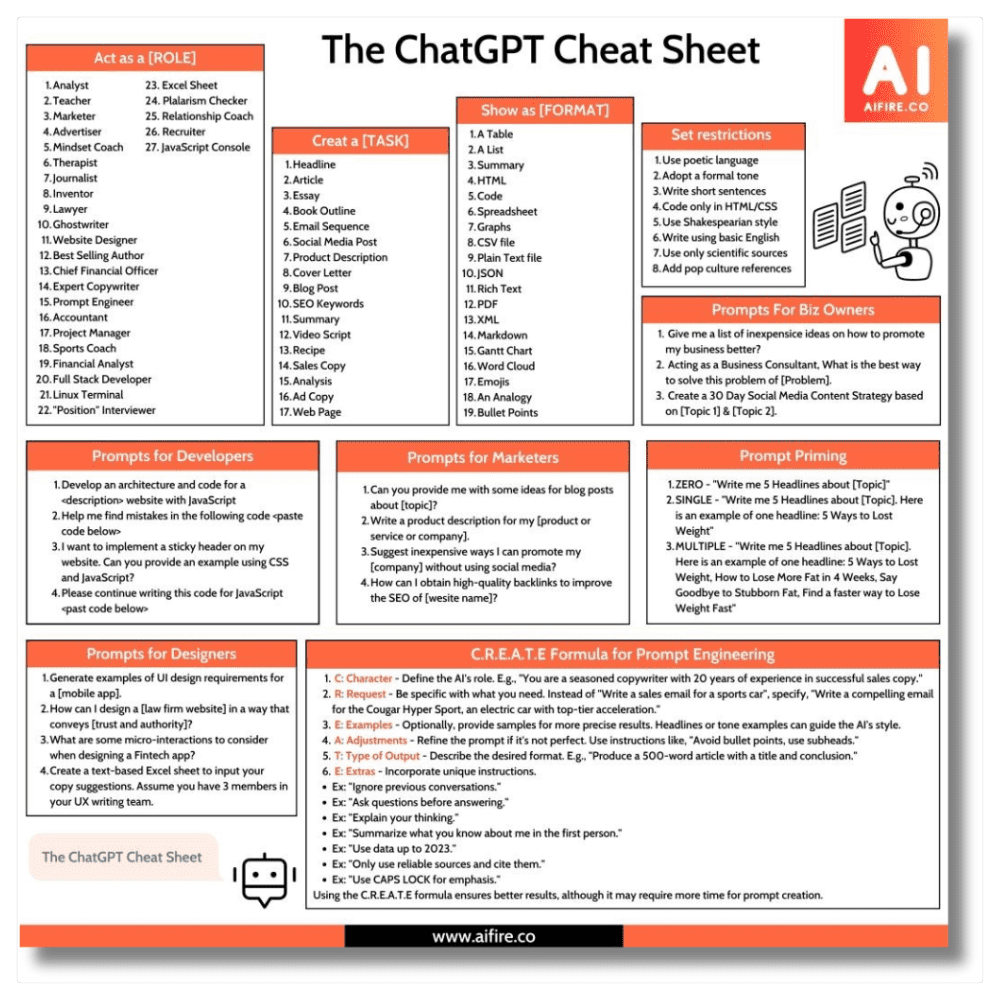
  • Prompt Builder Cheat Sheet

    Prompt Builder Cheat Sheet

    Ensuring that AI does your bidding means getting the Prompt right. This Cheat sheet from AIFire.co provides a great guide to follow when building your prompts!

  • Learn Prompting – Free!

    Learn Prompting – Free!

    Learn how to use ChatGPT and other AI tools to accomplish your goals using our free and open source curriculum, designed for all skill levels!

    Learn Prompting: Your Guide to Communicating with AI

  • Unlock Your Superhuman Potential With ChatGPT: 5 Powerful Prompts (By Forbes)

    Unlock Your Superhuman Potential With ChatGPT: 5 Powerful Prompts (By Forbes)

    Within every entrepreneur lies a superhuman. That superhuman persona is capable of changing the world, earning billions, making a huge impact and living their best life. But here’s the problem: most people don’t awaken their inner superhuman. They live normal, mundane lives. They copy other people and try to fit in. They argue for their limitations, they act like there’s a ceiling. What if you could remove these barriers to becoming that version of you?

    Original Article at Forbes

    Daniel Linden is co-creator and chief AI officer of chiefaiofficer.com, suitably titled DanThePrompt on Twitter. His company helps companies adopt AI by training and certifying C-suite level, ambitious and curious individuals who will take the role of chief AI officer. Linden is using the transformative power of AI to not only enhance operational efficiency, but innate human potential.

    Linden’s been using ChatGPT to prompt his way to success and is sharing these multi-stage prompts so you can unlock your superhuman potential.

    Stop playing small: ChatGPT prompts to become superhuman

    Superhuman memory: elevate recall and retention

    In business, possessing a sharp memory can be a potent advantage, from recalling intricate details during meetings to remembering stakeholder preferences. You want to remember your elevator pitch word for word, the name of the people you met at an event, and pointers to include in every sales call. Use this prompt, created by Linden, to set your memory up for effectiveness and success. Open the conversation and ChatGPT will guide you through the rest.

    “Let’s embark on a journey to unlock my superhuman memory. Let’s start by identifying a deeply familiar setting which will form the foundation of my memory palace. Once I’ve described this setting, I’d like you to summarize its significance as a mnemonic anchor. Next, I’ll provide specific items or landmarks associated with this place, which will become our memory anchors. After this, we’ll delve into the emotions or feelings I associate with each anchor, enhancing our mnemonic associations. Then, guide me to create a journey or sequence through my setting ensuring I encounter each anchor, crafting the navigational blueprint of my memory palace. We’ll also discuss any actions or interactions related to these anchors to further boost my memory retention. Finally, provide a summary reflection on the design of my memory palace, offering strategies for its use and potential evolution.”

    Read More

  • 5 ChatGPT Prompts To Be More Present And Less Stressed In Your Business (By Forbes)

    5 ChatGPT Prompts To Be More Present And Less Stressed In Your Business (By Forbes)

    Do you find yourself distracted by notifications when you’re on Zoom calls with clients? Do you find your eyes glazing over when you’re talking to colleagues? When was the last time you switched airplane mode on? Entrepreneurship involves juggling multiple tasks and running a team, all while thinking about the future and your place within it. Assessing past mistakes is required, as is planning ahead, but both can take you out of the present moment. And that’s where the magic happens.

    Being more present in your business is a sterling goal. You’ll miss less, you’ll understand more, and you’ll have a better time. Use these five ChatGPT prompts to become more present in your business activities, whatever they may be. Copy, paste, and edit these prompts in the same window for personalized guidance with complete context.

    Be more present in your business with these ChatGPT prompts

    Recognize your distractions

    The first step is self-awareness. What distracts you? Which apps do you open without thinking, what are you typing into Google when your to-do list isn’t done, and what is leading you out of the present and somewhere else entirely? Once you know what they are, figure out what it means. In the puzzle of motivation, your higher desires will always win out. Find out what your actions are telling you about what you really want.

    “Reflecting on my daily activities, I realize there are certain habits or distractions that pull me away from my core tasks. Can you guide me through a self-assessment to identify these distractions, such as [mention specific apps or behaviors you suspect], and help me understand what these actions might be revealing about my deeper desires or motivations?”

    Prioritize mindful communication

    If you’re not paying attention when someone is talking, you’re missing so much information. It’s not just what they say, it’s how they say it. Their tone, their body language, their facial expression. Plus, what are they not saying? For effective collaboration and leadership, mindful communication is essential. Being present during conversations can make a world of difference. Get ChatGPT’s help in doing it right.

    “In my business interactions, especially during [describe the type of conversations you typically have in your working week], I recognize the importance of being fully present. Can you give me techniques that will help me focus on not just the words spoken, but also on cues like tone, body language, and the unspoken messages? After that, give some reflective questions for me to work out how I can enhance my mindful communication to foster better collaboration and leadership in these specific scenarios.”

    Practice being in the here and now

    Sometimes, we miss what’s happening right in front of us because we’re either dwelling on the past or fretting about the future. The past has no place in your present. You lived it, you learned from it, and now it’s time to move on. The future is alluring but spending too much time there is a trap. Focusing on putting one foot in front of the other will take you closer to your goals than spending every minute daydreaming. Practice letting go of the past and using visualisation as a tool, not something that replaces over taking action.

    “In my business journey, I often find myself either ruminating on past events or getting lost in future possibilities, especially during [describe specific situations or types of tasks that trigger these feelings]. Can you give me a powerful pep talk, in the style of [your favourite motivational speaker or character from a film or book] to help anchor me in the present moment and assist in letting go of past concerns? Within this pep talk, the speaker should use visualization as a tool to help me stay present and not get stuck in the past or future.”

    Incorporate mindfulness techniques

    It’s easy to jump out of bed and straight to your laptop, then disappear into a flurry of emails and meetings until you collapse back in, exhausted. But mindlessly grinding away without thinking about what you’re doing benefits no one at all. Incorporating tried-and-tested mindfulness techniques can help you become more present for your health, success and happiness. Here’s the prompt for ChatGPT.

    “Given the hectic nature of my business days, where I often find myself [describe a typical busy routine or specific tasks that consume your day], I’m looking for ways to be more grounded and intentional. Can you introduce me to some effective mindfulness techniques tailored to my described routine that I can incorporate to enhance focus, well-being, and overall productivity?”

    Check in with yourself

    Periodic check-ins can help you maintain a consistent level of presence in your business operations. Incorporate the science behind forming habits, and tie your check-ins to things you already do. When you’re waiting for the coffee machine, ask “How am I feeling?” When you’re brushing your teeth, take note of your disposition. Get ChatGPT’s help finding these moments for checking in with yourself and suggesting what you should ask.

    “In the midst of my daily routines, I want to establish regular moments for self-reflection. Considering the activities I already do, like [describe some daily habits or routines such as waiting for a meeting to start or taking a lunch break], can you suggest specific checkpoints where I can check in with myself? Additionally, what introspective questions should I pose during these moments to ensure I remain present and aligned with my business goals?”

    Read More