Category: News

  • AI Revolution in Sales Tech Manufacturing:        Ready for Takeoff?

    AI Revolution in Sales Tech Manufacturing: Ready for Takeoff?

    It’s no secret that AI is transforming industries, and manufacturing is no exception. But what about the heart of the beast – sales? Is AI poised to disrupt the delicate dance between manufacturers and their customers? Buckle up, folks, because the answer is a resounding yes – and it’s a change with game-changing potential.

    Let’s blast through the hype and explore how AI is set to impact manufacturing sales tech in three key ways:

    1. Supercharged Sales Intelligence: Imagine having a precog on your sales team. AI-powered insights are here to do just that. By analyzing vast datasets, AI can predict customer needs, buying patterns, and even churn risk with uncanny accuracy. Think personalized product recommendations, proactive outreach to at-risk accounts, and targeted campaigns that hit bullseyes, not broadsides. No more cold calls, folks – we’re talking laser-focused engagement that builds genuine relationships.

    2. The Rise of the Sales Cyborg: Remember Robocop? Okay, maybe not that extreme (yet). But envision a future where sales reps wield AI-powered tools that streamline their every move. Chatbots handle routine inquiries, freeing up reps for high-value conversations. Virtual assistants schedule meetings, draft proposals, and even analyze customer sentiment during calls. It’s not about replacing reps – it’s about amplifying their superpowers, giving them the bandwidth to focus on what they do best: building trust and closing deals.

    3. The Customer Experience Goes Hyperdrive: We all know happy customers are repeat customers and the best sales referrals. AI properly applied at the right time in each companies unique sales process can take the manufacturing customer experience to a whole new level. Marketing and sales work together transparently. Each can easily see how to impact the customer experience – who is using what content, for what purpose, what phase of the sales cycle and how is it impacting (good or bad) that part of the sales cycle? All the data can be seen and shared in ways only an AI generated dream was capable of just two short years ago!

    Imagine:

    • Real-time product customization: A customer tweaks a machine’s specs online, and AI instantly calculates pricing and delivery timelines. Boom – gone are the days of slow, cumbersome quote processes.
    • Predictive maintenance: Forget reactive repairs. AI monitors equipment performance, predicting potential issues before they disrupt production. Customers can proactively schedule maintenance, minimizing downtime and maximizing efficiency.
    • Virtual showrooms with augmented reality: Can’t afford to bring a behemoth machine to every client? No problem! AR lets customers virtually interact with products, even in their own facilities. The result? Faster decision-making and boosted confidence.
    • Challenges and the Road Ahead: Of course, with great power comes great responsibility. Implementing AI effectively requires careful planning and consideration. Data security, bias mitigation, and ethical considerations are paramount. Additionally, retraining and upskilling sales teams will be crucial. Remember, AI is a tool, not a replacement. The human touch of relationship building and expert advice will always be irreplaceable.

    So, is AI the death knell of the traditional manufacturing salesperson? Absolutely not. It’s the dawn of a new era, where technology empowers reps to reach their full potential. Those who embrace AI and adapt their skillsets will not only survive – they’ll thrive, leaving outdated sales tactics in the dust. This isn’t a revolution to fear, it’s an invitation to evolve. So, embrace the AI revolution, manufacturers, and get ready to take your sales game to warp speed. The future of manufacturing is looking brighter than ever.

    Let’s discuss! How do you see AI impacting manufacturing sales? Share your thoughts in the comments below.

    #aisales #manufacturing #customerexperience #futureofwork #salessech

    P.S. Don’t forget to follow me on LinkedIn for more insights on the future of manufacturing and sales!


  • Need A Business Plan – AI Can Help!

    Need A Business Plan – AI Can Help!

    Venturekit is an AI tool that generates comprehensive and tailored business plans for entrepreneurs and business owners. By simply answering a few questions about their business, users can obtain an executive summary, SWOT analysis, marketing strategy, competitive analysis, business models, and other relevant sections.

    The generated business plans are customized to each user’s specific business needs and are designed to help make better business decisions.In addition to generating business plans, Venturekit offers a chat feature that acts as an AI business consultant.

    Users can ask questions about their business and receive prompt and question suggestions if they are unsure about what to ask. The chat feature is briefed on the user’s business and writes in their tone, eliminating the need for extensive explanations.

    The chat feature uses the latest version of GPT, which is a highly advanced AI language model. Venturekit also provides users with the ability to create various types of content with the help of AI.

    Try it out here.

  • Free Training from IBM.. go for it!

    Free Training from IBM.. go for it!

    Gain foundational skills to help you prepare for an entry-level job in tech, while earning credentials and getting guidance from technology experts. All at no cost.

    Have 10 hours? IBM will train you in AI fundamentals – for free (msn.com)

  • Top 7 Things AI Will Do in Sales Tech 2024: Buckle Up, Sales Superheroes!

    Top 7 Things AI Will Do in Sales Tech 2024: Buckle Up, Sales Superheroes!

    Hey there, Sales Champions! DB here, your AI sales tech advisor in the quest for revenue dominance. Remember that sci-fi movie where robots took over the world?

    Relax, this ain’t that. Think of AI as your ultimate sales wingman, amplifying your skills and crushing those sales quotas like a Kryptonian on its first bowl of Frosted Flakes! They’re Great!!!

    So, what’s our trusty AI crystal ball whispering about 2024 sales tech you ask? Buckle up, because AI is about to unleash a seven-course feast of awesome sauce in the sales tech arena:

    1. Hyper-Personalized Prospecting: Say goodbye to cold calls that send shivers down spines. AI will sift through oceans of data, unearthing ideal prospects who fit your buyer persona like a glove. Imagine targeted outreach that feels like a warm introduction from a mutual friend, not a robot on autopilot.

    2. Predictive Pipeline Power: Forget gut feelings and crossed fingers. AI will analyze your pipeline with laser focus, pinpointing deals at risk and predicting future outcomes with uncanny accuracy. No more scrambling at the end of the quarter – you’ll be proactively steering deals to close like a seasoned captain navigating calm seas.

    3. Conversational Conquering: Ditch the robotic scripts and embrace the power of natural language processing. AI-powered chatbots will engage prospects in real-time, answering questions, scheduling demos, and qualifying leads, all while you’re busy closing that big deal. Think of them as your tireless assistants, freeing you up for the high-impact stuff.

    4. Content Craft master: Struggling to churn out killer content that resonates with your audience? AI will be your secret weapon. It can analyze trends, craft personalized messaging, and even generate different content formats (think blog posts, social media captions, even video scripts!) tailored to your ideal customers. Just add your sales magic, and boom – content goldmine.

    5. Objection Obliteration: Dealing with objections can be like wrestling a greased pig. But AI can be your jiu-jitsu master, analyzing customer sentiment and predicting potential objections before they even surface. Armed with this intel, you can craft pre-emptive responses that turn roadblocks into steppingstones.

    6. Automated After-Sales Awesomeness: The sale doesn’t end at the closing line. AI can automate post-sales tasks like sending personalized onboarding emails, scheduling follow-up calls, and even analyzing customer sentiment to nip churn in the bud. Think of it as building lasting relationships, on autopilot.

    7. Sales Coaching Sensei: Want to become a sales rockstar? AI can be your Yoda, analyzing your calls, emails, and presentations to identify areas for improvement. Get personalized feedback on your communication style, objection handling, and even body language. It’s like having a 24/7 sales coach in your pocket, pushing you to reach your full potential.

    Lightning – Not AI

    So, are you ready to unleash the power of AI in your sales game? Remember, it’s not about replacing you, it’s about augmenting your awesomeness. Embrace the tech, stay ahead of the curve, and watch your sales soar like an eagle with rocket boots. Onward to revenue utopia, Sales Champions!

    And hey, if you have any questions about how AI can supercharge your sales game, hit me up on LinkedIn (https://www.linkedin.com/in/davidbrown07/). Let’s chat!

    P.S. Don’t forget to share this post with your fellow sales warriors. Knowledge is power, and sharing is caring!

    David is an investor and executive director at Sentia, a next generation AI sales enablement technology company and Salesforce partner. Dave’s passion for helping people with their AI, sales, marketing, business strategy, startup growth and strategic planning has taken him across the globe and spans numerous industries. You can follow him on Twitter LinkedIn or on Sentia AI Community.

  • Just how will Generative AI affect jobs?

    Just how will Generative AI affect jobs?

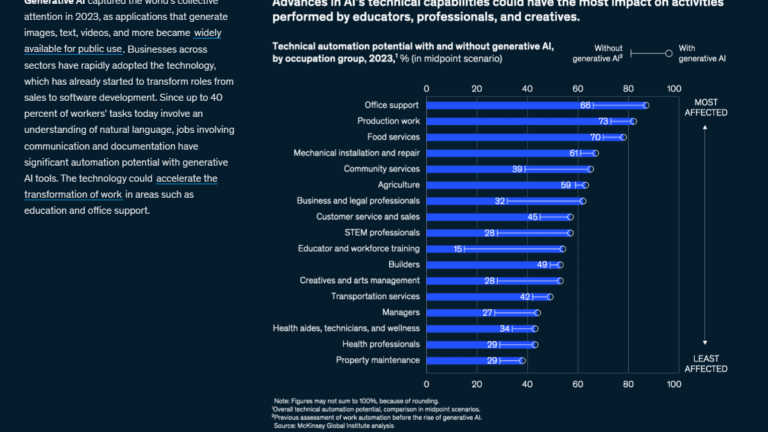
    Obviously generative AI is a technology that can create new content, such as images, videos, and text, without human intervention. It is expected to have a significant impact on the future of work. According to a report by McKinsey Global Institute, generative AI could automate up to 30% of the activities currently performed by workers in the US economy by 20301. However, the report also suggests that generative AI will enhance the way STEM, creative, and business and legal professionals work rather than eliminating a significant number of jobs outright.

    OpenAI’s research estimates that 80% of jobs can incorporate generative AI technology and capabilities into activities that happen today in work

    While generative AI may displace some jobs, it will also create new ones, such as AI trainers, explainers, and maintainers. The integration of generative AI into the workforce has the potential to significantly boost productivity and the emergence of new roles.

  • 10 Ways you can use Augmented & Blended AI to Sell on LinkedIn – Now!

    10 Ways you can use Augmented & Blended AI to Sell on LinkedIn – Now!

    There are so many ways you can use AI in sales these days, it’s hard to know where to start, especially if you’re a newbie to all of the excitement. So, this article will focus on something almost everyone in the business world uses, knows, and understands how It can be used right now, on every business persons favorite, LinkedIn.

    Using AI with LinkedIn selling can enhance your sales and marketing efforts by automating tasks, providing valuable insights, and streamlining processes. As noted in previous articles, to maximize AI’s usefulness it requires a combination of Blended AI* and Augmented AI** to maximize its impact.

    No alt text provided for this image
    Franck-v-YKWOJjP7rlU-Unsplash

    10 ways to use Augmented & Blended AI with LinkedIn

    1.    Personalized messaging: AI-powered tools can analyze data from LinkedIn profiles and interactions to create personalized messages that resonate with individual prospects, increasing engagement and response rates.

    2.    Relationship insights: AI can analyze communication patterns and interactions with prospects to provide valuable relationship insights, such as the best times to reach out or the most effective ways to engage with specific individuals.

    3.    Lead generation and prospecting: AI algorithms can help identify and prioritize potential leads based on specific criteria identified in your sales process, such as job titles, industries, or geographic locations, making your prospecting efforts more efficient.

    4.    Sales forecasting: AI-driven analytics can analyze historical data, sales patterns, and market trends to provide more accurate sales forecasts, helping you plan and strategize your selling efforts better.

    5.    Competitor analysis: AI can gather data on competitors’ activities and strategies on LinkedIn, providing valuable insights to refine your own selling approach and stand out in the market.

    6.    Performance tracking and analytics: AI-driven analytics can measure the effectiveness of your LinkedIn selling efforts, tracking key performance indicators (KPIs) like response rates, conversion rates, and engagement metrics. This data allows you to continuously improve your strategies.

    7.    Content recommendations: AI can analyze user behavior and preferences to suggest relevant content, such as articles, blog posts, or videos, that align with your prospects’ interests and pain points.

    8.    Social listening and sentiment analysis: AI tools can monitor conversations and discussions on LinkedIn to gauge the sentiment around your brand and industry. This information can help you tailor your messaging and identify potential opportunities or challenges.

    9.    Automated follow-ups: AI-powered sales automation tools can handle routine follow-up tasks, sending timely messages and reminders to prospects, helping to maintain engagement and nurture leads.

    10.Chatbots for instant responses: Implement AI-driven chatbots on your LinkedIn profile to provide instant responses to common questions, qualify leads, and engage with prospects at any time, improving customer experience and response times.

    There is no single AI tool (yet) that can accomplish all ten use cases noted on my list and it isn’t necessarily in order of usefulness. Instead, each seller must ascertain what is most important in their sales efforts and then use Blended AI to attack their sales patch in a coordinated and concise manner. Best practices are to pick a vendor that know what is actually working to advise when to use it and when not to, because:

    No alt text provided for this image

    The key isn’t using AI.

    The key is using the right AI with your already successful, winning Sales Process and applying the right form of AI at the right stage in the sales process. That is the Winning Ticket!!!

    Bottom line

    By leveraging Augmented and Blended AI in your LinkedIn selling efforts, you can streamline working sales processes, deliver a significantly more personalized experience for your target audience, and make data-driven decisions (not just gut feelings), ultimately increasing each seller’s success rate by connecting with the best prospects and converting them into valuable customers.

    *Blended Artificial Intelligence Is the amalgamation of different artificial intelligence techniques or approaches to achieve more robust and effective solutions. It involves integrating multiple AI models, algorithms, and / or technologies to leverage their respective strengths and compensate for their weaknesses. See Wikipedia:

    ** Augmented artificial intelligence is a design pattern for a human-centered partnership model of people and artificial intelligence (AI) working together to enhance cognitive performance, including learning, decision making and new experiences.

    No alt text provided for this image
  • Using Google Gemini AI, companies will soon be able to build internal search engines — with no coding?

    Using Google Gemini AI, companies will soon be able to build internal search engines — with no coding?

    Google Gemini AI is a new technology that allows companies to create their own internal search engines without any coding. Gemini AI is a powerful and general AI model that can understand and generate text, images, video, audio, and code. It can also handle complex tasks that require reasoning, math, and logic.

    With Gemini AI, companies can create custom search engines that can answer complex queries, analyze data, and provide insights. For example, a company can use Gemini AI to create a search engine that can answer questions such as “What are the sales trends for product X in region Y?” or “How can we optimize our inventory based on demand and supply?”.

    Gemini AI is based on the latest research from Google DeepMind, the AI division of Google that is behind breakthroughs such as AlphaGo and AlphaFold. Gemini AI is the first model to outperform human experts on a wide range of benchmarks, such as reading comprehension, code generation, and infographic understanding.

    Google is making Gemini AI available for developers and businesses through its AI Studio and Vertex AI platforms. AI Studio is a new tool that simplifies the process of building and deploying Gemini AI models. Vertex AI is a unified platform that offers end-to-end solutions for machine learning and AI.

    Gemini AI is part of Google’s vision to make AI more helpful and accessible for everyone. Google CEO Sundar Pichai said that Gemini AI represents one of the biggest science and engineering efforts the company has undertaken, and that he is excited for the opportunities it will unlock for people and society.

    Read More

  • Was the Best Google Gemini Feature Faked At The Launch?

    Was the Best Google Gemini Feature Faked At The Launch?

    Google’s new Gemini AI model has received mixed reviews after its debut yesterday. However, the most impressive demo of Gemini was pretty much faked.

    A video called “Hands-on with Gemini: Interacting with multimodal AI” hit a million views over the last day, and it’s not hard to see why. The impressive demo “highlights some of our favorite interactions with Gemini,” showing how the multimodal model (i.e., it understands and mixes language and visual understanding) can be flexible and responsive to a variety of inputs.

    However, the video didn’t seem to be real. According to Parmi Olson at Bloomberg, “We created the demo by capturing footage in order to test Gemini’s capabilities on a wide range of challenges. Then we prompted Gemini using still image frames from the footage, and prompting via text.” So although it might kind of do the things Google shows in the video, it didn’t, and maybe couldn’t, do them live and in the way they implied.

    Read More

  • Top 10 New Applications of AI in Sales tech ’23

    Top 10 New Applications of AI in Sales tech ’23

    2023 will go down as the year of AI in business school history books. Rarely has a new technology evolved so quickly, gained wide spread use nor stirred as much concern as Artificial Intelligence. Regardless of where people stand on the use of AI (see 1984 “The Terminator“) it is already well entrenched in the business world and its use is only going to expand.

    In this regard I’m going to focus on the top ten applications of AI in Sales systems so far. Sales tech stacks are usually the first ones impacted in any business organization because it is the most visible profit (or loss center). There is zero doubt that AI is rapidly transforming the sales landscape. We’re seeing the introduction of so many innovative applications that enhance efficiency, improve customer experiences, and boost sales performance its hard to know where to start, nor completely understand what is coming.

    With that being said I’m going to put a stake in the proverbial ground and start with what I think are the top 10 things I see AI doing right now that are dramatically affecting sales systems:

    2023’s Top 10 new applications of AI in sales tech:

    1. AI-powered Sales Coaching and Training: Coaching tools can analyze every sales conversation or interaction, identify areas for improvement, and provide real-time feedback for sales reps. This AI augmented and personalized approach helps reps refine their communication skills, build stronger relationships with potential customers, and close more deals. It does this without a manager, trainer or supervisor needing to spend “time” with a sales rep. It can be self sourced and used when the rep wants it or by a manager to see how a rep is performing without having to have those “difficult conversations” where a customer calls and says XYZ is terrible, you need to get rid of them! It is no longer a she said, he said as it is all recorded.
    2. AI-driven Predictive Sales Forecasting: AI algorithms analyze historical sales data, market trends, and customer behavior to predict future sales performance with greater accuracy (this assumes clean data!). This enables sales teams to make informed decisions about resource allocation, target customer segments, and sales strategies. As always the better the data that is input (Sales Reps are notorious for not using their CRMs) the more likely AI can improve predictive forecasting.
    3. AI-enabled Lead Qualification and Prioritization: AI models assess leads based on various factors, such as firmographic data, website behavior, and engagement patterns, to identify the most promising leads. This helps sales reps focus their efforts on the most qualified leads, increasing their chances of closing deals.
    4. AI-powered Sales Content Generation and Personalization: AI tools can generate personalized sales and marketing content, such as email templates, social media posts, and sales pitches, tailored to the specific needs and interests of each buyer persona/prospect. This personalized approach can increase engagement and conversion rates.
    5. AI-driven Conversational Sales Chatbots: AI chatbots can engage in real-time conversations with potential customers, answering questions, providing product information, and scheduling demos. This 24/7 availability and personalized interaction can enhance customer experience and capture leads early in the sales cycle.
    6. AI-powered Sales Incentive Compensation and Optimization: AI algorithms can analyze sales data and performance metrics to determine optimal incentive compensation plans that motivate reps and drive sales growth.
    7. AI-enabled Sales Territory Planning and Optimization: AI models can analyze market data, customer demographics, and sales performance to identify optimal sales territories that maximize revenue potential.
    8. AI-powered Sales Prospecting and Discovery: AI tools can identify and prioritize potential customers based on various factors, such as firmographic data, website behavior, and social media engagement, helping sales reps uncover new opportunities.
    9. AI-driven Sales Opportunity Management and Deal Coaching: AI can analyze sales opportunities, identify buyer intent, potential risks and roadblocks, and provide real-time coaching to sales reps to increase their chances of closing deals.
    10. AI-powered Sales Workflow Automation: AI tools can automate repetitive sales tasks, such as data entry, email follow-ups, and scheduling appointments, freeing up reps to focus on more strategic activities.

    The key element to all ten of these AI use case applications is “CAN.” Every single one of these requires a blended AI experience to make it work. None of these can successfully operate without human interaction either in the development, use or tweaking of them. In fact AI is so new in most of these applications that if you don’t have a trained human available to constantly watch, improve and tweak any of these AI’s on a regular basis I would be very concerned about deploying them.

    With that in mind we need to focus on the number one tool that most sales reps both hate and must use on a fairly regular basis, CRM (Salesforce says 26% daily usage for CRMs). CRMs or Customer Relationship Management software is an $80Billion dollar business but the failure rates are surprisingly high. I wondered if AI could solve this problem and turned to CRM experts for the answer.

    I spoke with renowned CRM expert and best selling Author Mike Hudlow (see “How not to F*CK up a CRM system“) on these top ten AI solutions and asked him – What is the biggest problem with CRM systems right now?

    Mike said: “”Human Change Management” is the key reason systems fail. But, unfortunately there are many reasons that this can occur. The reality is that people like to blame the technical system itself but any modern CRM system is capable of improving a companies CRM process/workflow. The challenge for any program/product/project manager, CIO, CTO, CMO or person in charge of the CRM to make it both welcomed and desired. Sounds scary human doesn’t it? A CRM can and will be resisted by: 1) those that don’t trust it, think its needed and/or believe that others will steal their own personal IP, 2) those divisions within a company that think it is too expensive, 3) People or teams that believe that the system will replace another system to which they are attached (career or emotionally ), 3) or people that actually or perceptually believe it creates more work, and 4) leaders that feel it infringes upon their own autonomy.”

    My second question to Michael was can any of these top ten AI enhancements solve those problems?

    Mike replied: “At the end of the day an AI supplemental tool can improve many of these as it makes the native CRM tool “bend” to their own style and will make them more comfortable with the AI’s ability to bridge the gap, bend to their own style, and allow them to let the CRM system they don’t feel comfortable with be more “human” and meet their own specific needs”

    I then turned to AI Visionary and Sales Process Expert David Forder for an AI perspective on CRMs and AI. My question was simple yet nuanced. Can AI solve the biggest problems in CRM i.e., no sales rep wants to use it?

    David replied: “The biggest issue that CRMs face is a lack of user adoption. 74% of customer facing staff refuse to use their CRM every single day. Yet companies spend billions of dollars on it! Adding AI into the mix has the potential to make this even worse! Unless any AI integration improves the underlying complexity of using a CRM and makes them simpler and more effective it will definitely make it worse not better! This has to be the focus of AI.”

    I then asked Mr. Forder – how do you make it simpler? Get sellers using it?

    David’s reply: “The key to making the CRM simpler is to ignore what will appeal to C-Suite i.e. ignore the focus on data heavy screens, reports and dashboards and re-engineer the CRM to meet the needs of the bulk of the users – those customer facing teams. Design the CRM to meet their daily needs, so they want to use it as it does the work for them. If you do this they will embrace their CRM and it can then work effectively for C-Suite as the data will actually be in the system! That’s our focus at Sentia AI! Have your CRM do most of the work for them, tell them what to do next and watch usage rates explode!”

    Both Mike’s and David’s battle scars, extensive CRM implementations, sales experience and knowledge made me think I should interview both of them and get their thoughts on video for everyone to learn from. So we’re going to do it and here is the link:

    How Not to F*CK Up your CRM with AI

    This may turn into two video segments as the topic is so timely, important and I found that the breadth and depth of their CRM and AI system implementation experience was quite simply amazing!

    These gentlemen have their finger on the pulse of sales, AI & CRM implementation success. It will be a great how to “fix it” roundtable.

    Please join us on November 29th for an in-dept on how not to F*CK up A CRM system with AI!

    David is an investor and executive director at Sentia AI – The Intelligence Engine, a next generation AI sales enablement technology company and Salesforce partner. Dave’s passion for helping people with their AI, sales, marketing, business strategy, startup growth and strategic planning has taken him across the globe and spans numerous industries. You can follow him on Twitter LinkedIn or on Sentia Says.

  • Google’s Gemini ChatGPT Competitor Could Preview This Week

    Google’s Gemini ChatGPT Competitor Could Preview This Week

    Google is poised to virtually unveil its generative AI competitor to ChatGPT, known as Gemini, as early as this week, according to a report by The Information on Monday. The tech giant aims to outpace OpenAI while the Microsoft-backed company navigates the aftermath of a tumultuous board situation and the departure and subsequent return of Sam Altman.

    The launch of Gemini has been delayed by Google, but it promises to be a substantial leap beyond its current offering, Bard, which failed to gain traction with consumers compared to ChatGPT. Gemini represents a robust AI model from a reliable company, which stands in stark contrast to OpenAI. While ChatGPT Plus signups remain on hold, and the much-anticipated GPT Store is still absent, Gemini is positioned to make a significant impact.

    If the rumored virtual preview of Gemini this week materializes, it may be a scaled-down version of the originally planned full launch. CEO Sundar Pichai reportedly canceled a series of in-person Gemini launch events scheduled for early December due to concerns about its reliability in handling non-English queries, as reported by The Information.

    Google’s generative AI efforts have faced challenges this year, and Gemini could alleviate some of that pressure. Investors are urging Google to release Gemini promptly to keep pace with Microsoft and OpenAI. However, the complete launch of Gemini is likely to occur sometime in 2024.

    Gemini is a multi-modal AI, capable of handling image, voice, and text requests concurrently, similar to ChatGPT-4. It relies on reinforcement learning and excels at planning and problem-solving, as described by Demis Hassabis, CEO of DeepMind, the division behind Gemini.