

Category: Marketing

  • Courageous Marketing: The B2B Marketer’s Playbook for Career Success

    Courageous Marketing: The B2B Marketer’s Playbook for Career Success

    Book Review & Synopsis

    Udi Ledergor’s Courageous Marketing is a transformative guide for B2B marketers seeking to break free from conventional, uninspired strategies. Drawing on over two decades of experience, including his role as CMO at Gong, Ledergor advocates for boldness and creativity as essential tools for driving business success. The book challenges the prevailing “play-it-safe” mentality in B2B marketing, arguing that taking calculated risks and embracing originality are critical for standing out in a crowded marketplace. Released on April 10, 2025, it serves as both a manifesto and a practical playbook for marketers aiming to make a lasting impact.

    Through vivid examples—such as Gong’s innovative Super Bowl-adjacent commercial stunt—Ledergor demonstrates how unconventional approaches can deliver outsized results even on limited budgets. The book is structured around actionable strategies designed to empower marketers to craft compelling content, leverage guerrilla marketing tactics, create memorable events, and establish thought leadership.

    Key Points from the Book

    Core Themes

    • Boldness as a Strategy: Playing it safe is portrayed as the riskiest approach in today’s competitive marketing landscape.

    • Creativity Over Conformity: The book emphasizes the importance of originality and human creativity, especially in an era dominated by AI-generated content.

    • Marketing with Impact: Campaigns should not only be creative but also drive tangible business results.

    Actionable Strategies

    1. Craft Compelling Content: Develop material so engaging that audiences would pay for it.

    2. Leverage Guerrilla Marketing: Use unconventional tactics to amplify brand presence without large budgets.

    3. Establish Product Categories: Position offerings strategically to dominate new market segments.

    4. Design Memorable Events: Create experiences that resonate deeply with attendees and foster brand loyalty.

    5. Champion Industry Issues: Take bold stands on pivotal topics to establish thought leadership.

    6. Advance Careers and Teams: Cultivate personal growth and build high-performing teams through intentional strategies.

    Why It Matters Now

    • With AI flooding the market with generic content, human creativity has become a key differentiator.

    • The book provides a roadmap for marketers to navigate this landscape by embracing audacity and innovation.

    Endorsements

    • Industry leaders like Neil Patel, Robert Cialdini, and Daniel H. Pink praise the book for its practical advice and bold vision.

    • Michelle Taite (CMO of Intuit Mailchimp) highlights its transformative potential for marketers tired of conventional approaches.

    Real-World Examples

    • Gong’s viral marketing stunts, such as cost-effective yet impactful Super Bowl-related campaigns, illustrate how bold ideas can succeed without excessive spending.

    Availability

    Courageous Marketing is available through major retailers like Amazon and Barnes & Noble. Udi Ledergor will also be speaking at upcoming events, including Canva Create (Los Angeles), Pavilion CMO Summit (Atlanta), and The Brand Tech Summit (Tel Aviv).

    This book is not just a guide—it’s a call to action for marketers seeking to challenge the status quo and redefine what’s possible in B2B marketing.
    This is the heading

    Lorem ipsum dolor sit amet, consectetur adipiscing elit. Ut elit tellus, luctus nec ullamcorper mattis, pulvinar dapibus leo.


  • Transforming In-Store Execution with AI: Introducing the Sentia Smart Layer

    Transforming In-Store Execution with AI: Introducing the Sentia Smart Layer

    Transforming In-Store Execution with AI: Introducing the Sentia Smart Layer

    Sentia’s AI seers here to give you the latest in the CPG wars where margins are tighter than a.. well you know and the slightest edge is fought for like the beaches of Normandy. Fear not faithful CPG warrior – we have the scoop on what’s shaking in, in store merchandising and what you need to know you’re competitors are already doing and why your numbers are dropping faster than tariff threats.

    Let’s get back to basics. In today’s hyper charged consumer goods industry, staying ahead in retail execution is not a option it’s win or bust.

    Enter Sentia Smart Layer, a groundbreaking AI-powered platform designed to revolutionize how field teams and visual merchandisers operate. With cutting-edge AI enhanced technologies, Sentia transforms images and voice inputs into actionable insights in real-time, empowering teams to deliver unparalleled in-store performance.

    Your Question?

    “There is a bit of AI marketing “fluffier” around AI App capabilities. What makes Sentia AI different from all these AI VC backed startups that claim to uncover every target, upsell, cross sell, website pixel generated lead that was never possible before Alexander Grahm Bell and the telephone.” – Frustrated not willing to go on record CEO (4X in past 5 days).  But as Sentia says, I digress.

    Why are these CEO, COO, CFOs feeling so much frustration when their CRMs can be enhanced with AI?

    What real world problems can it solve – that I will be willing to pay for?   

    Why Sentia Smart Layer is a Game-Changer

    Here’s how Sentia is redefining retail execution:

    1. Effortless Field Reporting
      Say goodbye to tedious typing! Field teams can now create detailed reports simply by speaking. Sentia’s AI extracts insights from photos of shelves, fixtures, and displays, enabling real-time data capture and reducing administrative burdens.
    2. In-Store Visual Analysis
      Sentia analyzes store images to ensure planogram compliance, measure stock levels, assess POS material quality, and validate shelf allocations—all while suggesting layout improvements to optimize shopper flow and visibility.
    3. Competitive Intelligence
      Beyond monitoring your own products, Sentia tracks competitor share of shelf, promotional displays, and stock levels—providing visual benchmarking to keep you ahead of the competition.
    4. Real-Time Prioritization
      Incoming reports are scored for urgency and relevance, surfacing critical issues like compliance gaps or stock shortages as actionable Smart Cards. Teams can act fast to fix problems before they escalate.
    5. Continuous Monitoring
      Every submitted image is vetted for out-of-stocks, non-compliant POS materials, competitor intrusions, and execution quality—ensuring proactive alerts for rapid resolution.
    6. On-Demand Summaries
      Get concise visual summaries by store, region, or retailer with execution scores, competitor trends, and actionable recommendations—all at your fingertips.
    7. Natural Language Chat Interface
      Just ask questions like “What stores have execution issues this week?” or “Summarize merchandising problems in Region Y,” and Sentia delivers instant answers through conversational AI.

    Why It Matters

    The Sentia Smart Layer empowers brands with unparalleled control and visibility across thousands of retail locations—without relying on outdated manual reporting or delayed audits. By enabling faster decision-making and smarter execution strategies:

    • Teams act swiftly on opportunities to improve share at the shelf.
    • Brands gain deeper insights into competitor activities and trends.
    • Execution quality reaches new heights with real-time monitoring and actionable insights.

    Key Features That Set Sentia Apart

    • Trend Detection: Spot long-term patterns in competitor movements or display quality.
    • Predictive Alerts: Receive warnings about potential stock-outs or compliance gaps before they happen.
    • Integration-Ready: Sync seamlessly with retail apps, CRMs, and BI dashboards for streamlined workflows.
    • Gamification: Motivate field teams with scorecards and leaderboards to drive performance excellence.

    Revolutionizing Retail Execution Starts Here

    The Sentia Smart Layer isn’t just an innovation—it’s a transformation of how consumer goods brands approach in-store execution. From empowering field teams to delivering competitive intelligence at scale, this platform is the ultimate tool for winning at retail.

    Are you ready to elevate your brand’s in-store presence? Let Sentia lead the way into the future of smarter retail execution!

    Keywords for Visibility:

    #AI #RetailExecution #ConsumerGoods #VisualMerchandising #PlanogramCompliance #CompetitiveIntelligence #SmartTechnology #FieldTeams #RetailInnovation #SentiaSmartLayer


    Add Your Heading Text Here

  • AI Revolution in Sales: How CROs Are Leveraging Technology to Extend Their Short Tenures

    AI Revolution in Sales: How CROs Are Leveraging Technology to Extend Their Short Tenures

    Chief Revenue Officers (CROs) are increasingly leveraging AI tools to stay competitive and drive revenue growth. Some think salespeople don’t like tech due to the low daily use rates of many CRMs. In reality, they are often first adopters- looking to get an edge. What they won’t put up with is software, AI or otherwise that doesn’t help them do a “thing” faster or better than what it might replace.

    In that regard I posit that CRO’s aren’t technology adverse. Instead, their laser focused on tool and time ROI. If this tool doesn’t work as sold to me, I will not use it, nor waste my time and possibly get fired.

    With that sage truth in mind, here are some specific AI tools that CROs are using:

    Sales Process Optimization

    1. Panoramata: This AI-powered tool provides a comprehensive view of competitor activities, including email campaigns and landing pages, helping CROs stay ahead of market trends1.
    2. Glassbox: Its AI-powered Insights Assistant (GIA) analyzes user interactions and provides actionable insights to improve website performance and conversion rates2.

    Customer Analysis and Engagement

    1. Kompyte: This tool uses AI to monitor competitor data in real-time, tracking websites, reviews, content, social media, ads, and job posts. It helps CROs identify emerging competitors and create “battle cards” for quick competitor analysis1.
    2. OptiMonk: This platform uses AI to enhance website personalization efforts, generate multiple variations of copy for headlines and descriptions, and create smart popups that customize messaging based on visitor behavior2.

    Predictive Analytics and Testing

    1. Evolv AI: This platform specializes in AI-driven experience optimization, using machine learning algorithms to conduct experiments and evaluate multiple variations to identify the most effective combinations for optimal user experience2.
    2. Unbounce: Its Smart Traffic feature uses AI to automatically route visitors to the page where they’re most likely to convert, potentially increasing conversions by up to 30%3.

    Sales Enablement and Performance

    1. Attention Insight: This AI-powered platform provides predictive attention heatmaps to validate design concepts for ads, landing pages, and apps before launching, helping improve user experience and conversion rates3.
    2. Sentia AI: A Smart AI Enablement layer that sits on top of CRMs & ERPs creating a bes in class CX, with 40 embedded AI features to tell sellers what to do next based on AI scoring.
    3. AI-enhanced RFP vendors: These tools help CROs quickly create, send, and receive RFPs online to more efficiently select vendors, saving time and money in the process5.

    Industry-Specific AI Applications for CROs

    SaaS and Technology
    AI-powered product recommendation engines analyze user behavior to suggest relevant upgrades or complementary products, increasing upsell opportunities.

    Financial Services
    AI algorithms assess credit risk and customer financial profiles to offer personalized financial products, improving conversion rates and reducing default risks.

    E-commerce
    AI chatbots provide 24/7 customer support, handling inquiries and guiding customers through the sales funnel, enhancing the overall shopping experience.

    Healthcare
    AI analyzes patient data to identify potential candidates for clinical trials or new treatments, streamlining the sales process for pharmaceutical companies.

    Real Estate
    AI-driven virtual property tours and predictive analytics help agents identify high-potential leads and tailor property recommendations, increasing closing rates.

    Manufacturing
    AI optimizes inventory management and predicts maintenance needs, allowing sales teams to proactively offer replacement parts or services.

    New AI tools pop up daily. Tools that work are always in demand and CRO’s are always looking for an edge. By evaluating, trialing, and when ROI is there adopting these AI tools, CROs can optimize their sales processes, enhance customer engagement, improve decision-making through data analysis, and ultimately drive revenue growth in an increasingly competitive landscape.

    Please tell me which CRO / Sales tools you use that we should consider in the comments section below.

    Citations:

    1. https://www.panoramata.co/benchmark-marketing/ai-tools-competitor-analysis
    2. https://nogood.io/2025/02/20/ai-cro-tool/
    3. https://unbounce.com/conversion-rate-optimization-ai/
    4. https://www.dialpad.com/blog/cro-guide-to-ai/
    5. https://www.clinicalleader.com/doc/save-time-and-money-by-using-ai-to-compare-cro-proposals-0001
    6. https://www.reddit.com/r/clinicalresearch/comments/1dxmgjk/ai_automation_in_the_clinical_trial_space/
    7. https://entail.ai/resources/cro/conversion-rate-optimization-with-ai-a-complete-guide
    8. https://www.agilebusiness.org/resource/using-ai-to-empower-cross-functional-teams.html

    SEO Tags: AI in sales, Chief Revenue Officer, CRO tenure, sales automation, AI-driven decision making, industry-specific AI applications, sales efficiency, revenue growth

  • RevOps Acronyms: What do they Really Mean?

    RevOps Acronyms: What do they Really Mean?

    Executive Summary

    Drowning in RevOps alphabet soup? This guide decodes the top 25 industry acronyms—from ARR and CAC to the future of AIRO (Artificial Intelligence Revenue Optimization). Beyond the marketing hype, we explore how to align people, processes, and technology to eliminate the “AI Circle of Sorrow” and transform your CRM into a high-velocity revenue engine.

    Drowning in a sea of RevOps marketing & sales acronyms?

    Fear not! As your trusty Chief Confusion Officer (CCO), I’m here to help you navigate these murky waters with a dash of humor and a sprinkle of reality. Let’s dive into the world of RevOps marketing, where every letter promises to turn your business into a money-printing AI enhanced machine if you just buy our software!

    1. RevOps: The Magic Wand of Business?

    Marketers would have you believe that RevOps is the Hogwarts of the business world. Wave this wand, and poof! Your sales, marketing, and customer success teams are suddenly in perfect harmony. In reality, it’s less “Wingardium Leviosa” and more “We’ve got a lot of work to do-sa.”

    1. ARR: The Golden Goose

    Annual Recurring Revenue sounds like a promise of endless riches.

    “Implement our RevOps strategy, and you’ll have your own golden goose!” they say. But remember, even golden geese need feeding and care. ARR is powerful, but it’s not automatic.

    1. CAC: The Disappearing Act

    Customer Acquisition Cost is often marketed as something RevOps can make vanish.

    “Watch as we make your CAC disappear!” But unless your marketing team has mastered actual sorcery, CAC will always be there. The trick is putting a smart plan in place and managing it effectively.

    1. CLV: The Fountain of Youth

    Customer Lifetime Value is sold as the secret to eternal customer relationships.

    “Our RevOps approach will make your customers immortal!” While increasing CLV is crucial, it requires ongoing effort and genuine value delivery.

    1. KPI: The Magic Mirror

    Key Performance Indicators are often portrayed as a magic mirror that always shows success.

    “Mirror, mirror on the wall, who’s the most profitable of them all?” But KPIs are tools for insight, not guaranteed success stories. Crystal ball should I trust what the humans are telling me, my faithful CRM, AI, Ouija board or ?

    The Future of RevOps: Enter AIRO!

    But wait, there’s more! Get ready for the next big thing:

    AIRO (Artificial Intelligence Revenue Optimization). Imagine a world where AI doesn’t just assist your RevOps, it becomes your RevOps! And the second question? How fast can you replace your pesky humanoids with AIRO’s?*

    Picture this: AI-powered chatbots that not only close deals but also write your quarterly reports and order your coffee. Who needs human salespeople when you’ve got an army of charming AI agents ready to woo your clients 24/7?

    With AIRO, we promise to turn your sales funnel into a sales black hole, sucking in leads faster than you can say “revenue”! In this brave new world, ROI stands for

    “Robots Outperforming Individuals.”

    Yikes. Do you believe that?

    The Bottom Line

    While RevOps acronyms may sometimes be served with a side of exaggeration, the concepts behind them are powerful when applied correctly. The key is to approach these tools with a clear understanding of what they can realistically achieve, constantly measure goals and outcomes while adjusting faster than ever before (no choice in today’s market).

    So, the next time a marketer promises you the moon with their RevOps alphabet soup, remember to take it with a grain of salt (and maybe a chuckle). After all, in the world of business, there’s no such thing as a magic wand – but with the right strategy and execution, you can certainly work some magic of your own.

    What’s your favorite RevOps acronym?

    Please be so kind as to share your thoughts (and any humorous misuses you’ve encountered) in the comments below!

    *RevOps: Revenue Operations (RevOps) is a business strategy combining the best of sales, marketing, and customer service to increase revenue. It’s thought of as a holistic approach that involves aligning teams and processes to improve customer experience and drive revenue growth. 

    RevOps vs. CRM: CRM provides the foundation for customer data management, while RevOps provides a strategic framework for aligning teams and optimizing revenue growth. Together, CRM and RevOps can help businesses streamline processes, improve efficiency, and increase revenue.

    Top 25 Common Acronyms in RevOps Marketing and Sales:

    1. ABM – Account-Based Marketing
    2. ABS – Account-Based Selling
    3. ABX – Account-Based Experience
    4. ARR – Annual Recurring Revenue
    5. CAC – Customer Acquisition Cost
    6. CLV – Customer Lifetime Value
    7. CRM – Customer Relationship Management
    8. CX – Customer Experience
    9. DG – Demand Generation
    10. KPI – Key Performance Indicator
    11. LTV – Lifetime Value
    12. MQL – Marketing Qualified Lead
    13. NPS – Net Promoter Score
    14. PLG – Product-Led Growth
    15. RevOps – Revenue Operations
    16. ROI – Return on Investment
    17. SAL – Sales Accepted Lead
    18. SDR – Sales Development Representative
    19. SEM – Search Engine Marketing
    20. SEO – Search Engine Optimization
    21. SQL – Sales Qualified Lead
    22. TAM – Total Addressable Market
    23. TOFU – Top of Funnel
    24. MOFU – Middle of Funnel
    25. BOFU – Bottom of Funnel

    #RevOps #MarketingHumor #AIRO #FutureOfSales #RevenueOperations #CRM #AI #AgenticAI #marketing #Sales #strategy #revenuegrowth

  • AI in Big Pharma: How is it Being Applied in 2025?

    AI in Big Pharma: How is it Being Applied in 2025?

    Valued at $1.5 trillion, the pharmaceutical industry has long grappled with significant challenges. R&D development of a new drug costs $2 billion plus, takes over a decade, and faces a 90% failure rate in early stages. However, with AI adoption in life sciences growing at 29% annually, a unique opportunity emerges to address these inefficiencies and pain points in drug development12.

    Pain Points in Pharma

    Big Pharma executives and life sciences investors face uncertainty and risk due to four major issues:

    • Disconnected Data: Decision-making relies on vast volumes of structured and unstructured scientific data.
    • Knowledge Gaps: Significant gaps persist across scientific, clinical, regulatory, and commercial decision-making processes.
    • Inefficient Processes: Integrating and analyzing datasets is time-consuming and resource-intensive.
    • Lack of Standardization: Inconsistent evaluations hinder reproducibility in asset assessments.

    AI Applications in Drug Development – Recent Examples

    AI is transforming various stages of drug discovery, development, and commercialization:

    1. Target Identification and Validation: Atomwise and Pfizer’s partnership reduced initial drug discovery timeline from 4-6 years to approximately 18 months.
    2. Clinical Trial Optimization: Deep 6 AI’s implementation reduced patient recruitment time by 85% and increased trial enrollment rates.
    3. Manufacturing Process Optimization: GSK and Gatehouse Bio’s collaboration led to a 25% increase in production yield and $20 million annual cost savings at a single site.
    4. Post-Market Surveillance: FDA and Novartis’ AI-powered systems enabled earlier detection of safety signals and more proactive risk management.

    CRM & AI in Healthcare

    Customer Relationship Management (CRM) systems, enhanced by AI, are improving healthcare delivery and patient engagement:

    • Personalized Patient Care: AI-powered CRM systems analyze patient data to provide tailored treatment recommendations and follow-ups.
    • Predictive Analytics: These systems can forecast patient needs, potential health risks, and treatment outcomes.
    • Streamlined Administrative Tasks: AI automates appointment scheduling, billing, and record-keeping, allowing healthcare providers to focus more on patient care.
    • Enhanced Patient Engagement: AI-driven CRM tools facilitate better communication between patients and healthcare providers, improving adherence to treatment plans.

    The AI Solution

    AI addresses several critical issues in healthcare and pharma:

    1. Data Integration: AI can seamlessly integrate and analyze vast amounts of disparate data, providing comprehensive insights for decision-making.
    2. Accelerated Research: Machine learning algorithms can rapidly identify potential drug candidates and predict their efficacy, significantly reducing the time and cost of drug discovery6.
    3. Improved Clinical Trials: AI optimizes patient recruitment, monitors responses, and predicts potential side effects, making trials more efficient and reliable5.
    4. Personalized Medicine: By analyzing individual patient data, AI enables the selection of treatments tailored to each person, improving outcomes and reducing adverse reactions4.
    5. Operational Efficiency: AI automates routine tasks and provides insights into market trends and patient needs, streamlining pharmaceutical operations2.

    The Impact of AI on Drug Development

    The benefits of AI in pharmaceutical industry are clear:

    • 30-50% reduction in time-to-market for new drugs
    • Estimated $100-200 million cost savings per successful drug
    • Higher success rates in clinical trials due to better candidate selection
    • More efficient use of research resources
    • Improved safety monitoring and risk management
    • Faster response to emerging health threats through drug repurposing

    Looking Ahead

    2025 is the AI “Go Year” for the entire Pharmaceutical Industry.

    AI is expected to drive 30% of new drug discoveries, cutting costs and accelerating personalized treatments7. Challenges, including regulatory hurdles, data privacy concerns, and the need for specialized skills loom large! 3.

    The future of pharma lies in embracing these AI-driven innovations while navigating the complex regulatory landscape. As the industry evolves, collaboration between tech companies, pharmaceutical firms, and regulatory bodies will be crucial in realizing the full potential of AI in healthcare and drug development.

    What are your thoughts on AI’s role in transforming the pharmaceutical industry? How is AI changing your processes and workflows in pharma? Share your experiences and let’s continue this important conversation.

    Connect with me so you don’t miss any future articles!

    Please follow me on X (@Intmktentry) on Linkedin, YouTube or via our AI Community Site.

    Citations:

    1. https://www.zs.com/insights/pharmaceutical-trends-2025-outlook-ai-supplychain-and-beyond
    2. https://www.datacamp.com/blog/ai-in-pharmaceuticals
    3. https://www2.deloitte.com/us/en/insights/industry/health-care/life-sciences-and-health-care-industry-outlooks/2025-life-sciences-executive-outlook.html
    4. https://pmc.ncbi.nlm.nih.gov/articles/PMC10385763/
    5. https://www.clinicaltrialsarena.com/features/clinical-trials-challenges-expect-2025/
    6. https://www.mckinsey.com/industries/life-sciences/our-insights/generative-ai-in-the-pharmaceutical-industry-moving-from-hype-to-reality
    7. https://www.weforum.org/stories/2025/01/2025-can-be-a-pivotal-year-of-progress-for-pharma/
    8. https://www.scilife.io/blog/ai-pharma-innovation-challenges
  • Agentic AI: From Hype to Measurable Value in ’25

    Agentic AI: From Hype to Measurable Value in ’25

    Two short months into 2025, the marketing buzz around Agentic AI remains palpable, with a never-ending promise of transformative impact across every industry and job role.

    Yet to date, the reality of AI adoption reveals a far slower, more deliberate pace as enterprises grapple with implementation challenges. Businesses are now shifting focus from unrealistic pie in the sky expectations to measurable outcomes, emphasizing cost savings, ROI, and efficiency gains. To me that means AI as a technology is maturing and businesses are treating just like any new tool (which they should) and forcing a rigorous analysis of the tech before deploying it, training and change management.

    Speaking of AI, AI adoption and change management. I believe that we will see much more emphasis on AI training / change management to lock in any AI gains. Functional AI or the successful combining of AI and humans will be at the forefront of AI change management in 25.

    Measuring AI ROI Effectively

    To bridge the gap between AI hype and its real-world impact, businesses need to adopt structured approaches to measure ROI-just like any other part of their business. Here’s how:

    1. Clear Objectives Identified

    Set specific, measurable goals that align with your business strategy. For example:

    • Reduce customer churn by 15% using predictive analytics.
    • Increase operational efficiency by automating 30% of repetitive tasks.
    • Increase daily CRM use rates by 25%.
    • Reduce annual sales rep churn rate by 20% with AI enhanced training and retraining vs. firing.
    1. Identify Relevant AI Deployment KPIs

    Choose clear metrics that reflect both financial and non-financial benefits:

    • Financial Metrics: Cost savings, revenue growth, and productivity gains.
    • Non-Financial Metrics: Customer satisfaction scores, employee engagement, and decision-making improvements.
    1. Establish a Baseline before AI implementations

    Collect data on current performance metrics before implementing AI. This provides a benchmark for comparison and helps quantify the impact of AI solutions.

    1. Track Progress Continuously

    Monitor KPIs regularly to assess the effectiveness of AI initiatives. Use advanced analytics tools to generate insights and identify areas for improvement. Usually, you will see steady incremental gains after a likely initial big leap. Be ready to change AI functions if they are not doing better than the baseline.

    1. Consider Long-Term Value

    AI’s benefits often compound over time. While short-term gains like cost reductions are important, they also evaluate long-term impacts such as enhanced scalability, innovation, and customer loyalty.

    1. Leverage Advanced Techniques

    Employ methods like multi-touch attribution, incrementality testing, and machine learning-based analytics to gain deeper insights into ROI. These techniques help capture the nuanced effects of AI across different business functions 139.

    How can AI Impact Workers Differently?

    AI adoption has a varied impact on workers depending on their roles and experience levels:

    Boosting Productivity

    • Younger Workers: Often more tech-savvy, they adapt quickly to AI tools and see higher productivity gains.
    • Experienced Professionals: While they face a steeper learning curve, combining their expertise with AI insights can lead to superior decision-making. They are also more likely to know if AI is hallucinating or not based on their years of working without AI.

    Potential Challenges

    • Workers in roles requiring creativity or interpersonal interaction may find AI tools limiting.
    • Over-reliance on automation can hinder critical thinking skills.
    • Employees not understanding the Legal implications of AI vs. the yes you can do it but who actually owns what you just created with AI?

    Pushing for Measurable Outcomes in 2025

    As businesses continue investing in generative AI technologies, the focus is shifting toward tangible results:

    • Cost Reduction: Automating repetitive tasks and optimizing workflows.
    • Efficiency Gains: Streamlining operations across departments.
    • ROI Demonstration: Justifying investments through improved bottom-line results.

    By addressing these priorities and measuring ROI effectively, businesses can ensure that their AI investments deliver real-world value.

    #AgenticAI #ArtificialIntelligence #AIROI #EnterpriseTech #FutureOfWork #GenerativeAI #BusinessInnovation #DigitalTransformation #ProductivityGains

    Citations:

    1. https://aisera.com/blog/roi-with-ai/
    2. https://www.concur.com/blog/article/maximize-your-ai-roi-4-tips-from-industry-leaders
    3. https://rtslabs.com/measuring-ai-roi
    4. https://www.moveworks.com/us/en/resources/blog/measuring-ai-investment-roi
    5. https://www.techfunnel.com/martech/accurate-roi-measurement-tools-techniques/
    6. https://www.linkedin.com/pulse/path-value-guide-measuring-roi-ai-rahul-roy-chowdhury-symkc
    7. https://ignitetech.ai/about/blogs/why-measuring-roi-essential-ai-success
    8. https://tech-stack.com/blog/roi-of-ai/
    9. https://www.cprime.com/resources/blog/maximizing-ai-roi-business-success/
  • In Gratitude- Thanksgiving Season 365

    In Gratitude- Thanksgiving Season 365

    “You have it easily in your power to increase the total of this world’s happiness now. How? By giving a few words of appreciation to someone lonely or discouraged. Perhaps you will forget the kind words you say today tomorrow, but the recipient may cherish them forever.”

    Dale Carnegie

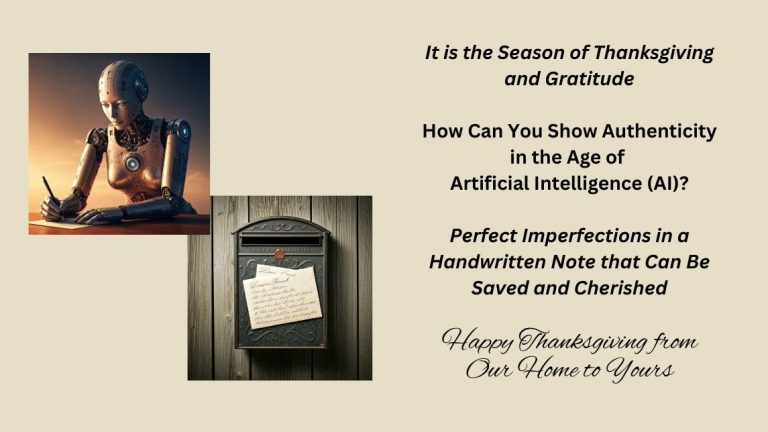
    November and Thanksgiving are the perfect times to reach out and communicate with those who have impacted our lives in the past and present. In our digital age, many ways of communicating exist, including social media, email, and text. AI (Artificial Intelligence) can make it more difficult since everyone is a prompt away from crafting the perfect message. Ironically, snail mail (a.k.a. United Postal Service is an easy, cost-effective way to communicate gratitude with a handwritten notecard.

    Does writing a handwritten note take planning and effort? Absolutely, yes.  However, the person and relationship dividends are priceless. Are handwritten notes perfect? Absolutely not. Handwritten notes are perfectly imperfect. In three sentences, you can express appreciation, reference memory, and have something tangible for the recipient to keep.

    Every handwritten note is a souvenir (French verb to remember) for the writer and the recipient. Writing 365 cards in 365 days is my quest for gratitude for 2025. With all of AI’s advances, I cannot share my sincere appreciation and memories or be a tangible keepsake.

    One of my most prized possessions is a card I made for my Great Grandmother when I was 5.  I found it when I became the historian for my family.  She died at 87 and died when I was 11. However, she kept it all those years. A card made on notebook paper folded the wrong way, and I did not have blue eyes.  I keep the notecards that are written to me. Many have told me that they keep the handwritten notecards that I write and how my notes touched them.

    I admit that I used ChatGPT to explain that handwritten notes are unique and can’t be replicated.    

    From ChatGPT

    Essentially, a handwritten note lets the recipient know that you are thinking of them, that they are important, and that you care about their well-being. Secondly, it requires your full and undivided attention, and it takes time to give it a personal touch.

    AI can indeed influence the content of a handwritten note, though it typically works behind the scenes. While AI can enhance or facilitate the process, the emotional impact of a handwritten note still comes from the human element—choosing to send the note and personalizing its content.

    Here are some ways AI might be involved:

    1. Content Suggestions: AI can help draft or suggest thoughtful messages, particularly if the sender struggles with expressing themselves. For example, AI-powered writing tools or assistants can generate phrases, prompts, or entire messages tailored to specific situations, such as birthdays, thank-you notes, or condolences.
    2. Personalization: AI can help personalize notes by analyzing data about the recipient, such as their preferences, past interactions, or shared experiences. This can help the sender craft a more meaningful message.
    3. Handwriting Simulation: AI can also simulate handwriting styles. Some services allow users to type their message, and then AI-driven tools transform it into handwriting that appears more personal and authentic, though it isn’t truly handwritten.
    4. Grammar and Style: AI-powered tools like Grammarly can help proofread and improve the tone or flow of the message, ensuring that it is well-written and coherent.

    Differences between AI and the human element lie in authenticity, emotion, and intent. Here’s how they differ in specific aspects:

    1. Creativity and Emotion:

    • AI: AI can generate text, mimic styles, and produce content that appears human-like, but it needs more true understanding, emotions, and lived experiences. It analyzes patterns and produces responses based on data, but it doesn’t experience feelings or empathy. Algorithms and training on vast amounts of data drive AI’s creativity.
    • Human Element: Humans create from personal experience, emotions, and unique worldviews. When a human writes something, it often carries personal insights, emotional depth, and spontaneity that stem from real-life experiences. The intention behind human expression adds a layer of meaning that AI can mimic but not generate.

    2. Intent and Personal Connection:

    • AI: AI responds based on patterns and input data but doesn’t have personal relationships or emotional investment. It can simulate care and connection, but it doesn’t honestly “care.” The intent behind AI-generated content is utilitarian, driven by efficiency, not personal connection.
    • Human Element: When a human reaches out, whether through a handwritten note or conversation, there’s genuine intent and a personal connection. Human interaction involves empathy, understanding, and emotional resonance. A handwritten note from a person shows thoughtfulness, effort, and care that go beyond the content—it reflects the person’s desire to connect.

    3. Authenticity and Imperfection:

    • AI aims for precision and can create nearly flawless, polished messages. However, this perfection can sometimes feel impersonal or mechanical. Although the content it produces can be accurate, it lacks the small, unique imperfections that often make human communication feel authentic.
    • Human Element: Human communication is filled with nuance, subtle imperfections, and individual quirks—slightly messy handwriting, an unintended pause, or a personal anecdote. These imperfections are part of what makes human interaction feel genuine and relatable.

    4. Context and Depth of Understanding:

    • AI: AI can quickly process vast amounts of information and respond based on learned patterns, but it lacks proper comprehension. It doesn’t experience life, culture, or context as humans do. AI might miss a conversation or note’s deeper emotional, cultural, or situational nuances.
    • Human Element: Humans communicate through lived experience, cultural context, and emotional awareness. A human’s understanding of the world is shaped by personal experiences, relationships, and emotions, making human-generated content often more profoundly layered and contextually rich.

    5. Motivation and Effort:

    • AI: AI operates based on instructions and input without any personal motivation. Its effort is driven by algorithms and a pre-set goal to optimize output, but it doesn’t feel satisfaction or dedication in its tasks.
    • Human Element: Humans choose to invest time and effort, especially when it comes to meaningful gestures like writing a handwritten note. The personal effort, care, and attention a human puts into such a task make it special, signaling that they value the recipient.

    In summary, AI can assist, automate, and simulate aspects of human communication, but it needs more emotional depth, authenticity, and genuine intent to define the human element. The human touch carries real experiences, emotions, and connections that AI can mimic but never truly replicate.

    Sylpro Productions began with Sylvia France, and the goal was to work with Apple in Silicon Valley. Not only did she realize that goal, but she also launched new products and industry categories, including personal digital navigation and streaming television program guides. In addition to working with several startups, our client roster includes The Home Depot, Union Pacific, Verizon, and Right at Home. To learn more, contact me at sylvia@sylproproductions.