Category: HR

  • Have one of these Jobs? AI will Replace You!

    Have one of these Jobs? AI will Replace You!

    The rapid advancement of artificial intelligence (AI) technology is reshaping the job market, posing significant risks to various professions. According to a recent report by Goldman Sachs, AI tools could impact 300 million full-time jobs worldwide, leading to considerable disruption in the labor market. As businesses increasingly adopt AI to improve efficiency, certain jobs are more vulnerable to automation. Here are five fields at risk from AI.

    5 Jobs at Risk to AI Replacement

    Data Analysts and Bookkeepers: Jobs that involve data analysis, bookkeeping, and basic financial reporting are highly susceptible to automation. These roles, which focus on repetitive administrative tasks, are prime candidates for AI-driven efficiency improvements.

    Customer Service Representatives: The customer service sector is already experiencing significant changes due to AI. Chatbots and AI-powered assistants are increasingly handling customer inquiries, reducing the need for human agents. According to a study by Gartner, by 2025, 80 percent of customer service and support organizations will be applying generative AI technology in some form.

    Media Content Creation: AI’s ability to read, write, and understand text-based data puts media jobs at risk, including roles in advertising, content creation, technical writing, and journalism. LLMs, in their most basic form, have a tenuous relationship with the truth but are facile with written text.

    Legal Assistants and Paralegals: The legal industry is not immune to the impacts of AI. Roles such as paralegals and legal assistants, which involve consuming large amounts of information and synthesizing it into legal briefs or opinions, are particularly vulnerable. AI can replicate many of these tasks, although complete automation is unlikely due to the need for human judgment.

    Financial Analysts: Financial analysts and personal financial advisors are also at risk. These professionals handle significant amounts of numerical data, identifying trends and making investment recommendations. AI can analyze data, highlight investment trends, and forecast better investment mixes more efficiently than humans10.

    Bottom Line

    There are many jobs that are already on the way out and many more professionals especially those with advanced degrees are going to need to figure out a way to retool and reinvent themselves.

    On a weekly basis I talk to C-Suite execs trying to get a handle on what jobs AI can do that they can reduce headcount and invest in other areas. The smartest employees are embracing AI, learning how to best deploy it and they are the ones that will be replacing humans. Blended AI is the number one way to keep your job as we move into the fascinating world of AI enabled business.

    #AI #JobMarket #Automation #FutureOfWork #ArtificialIntelligence #TechTrends #JobDisruption #AIImpact #WorkplaceAutomation #FutureJobs #AIRevolution #JobSecurity #AIandJobs #TechInnovation #AIAdvancements #JobRisks #AIinBusiness #AIinCustomerService #AIinMedia #AIinLegal #AIinFinance

  • “Rise of the CAIO: Ready to Embrace the AI Overlord?”

    “Rise of the CAIO: Ready to Embrace the AI Overlord?”

    Today I’m here to talk about a new trend that’s sweeping the business world faster than a Roomba on overdrive. Yes, folks, we’re talking about the rise of the CAIO – the Chief Artificial Intelligence Officer.

    What is a CAIO?

    A CAIO is like the captain of the Starship Enterprise, but for AI. They’re responsible for setting a company’s overall AI strategy, including the design, development, testing and implementation of artificial intelligence technologies. They’re the ones who ensure that AI isn’t just a buzzword in the company, but a tool that’s used effectively and ethically.

    How Many Companies Have a CAIO?

    According to research from Foundry, 11% of midsize to large organizations have already designated a CAIO, and another 21% of organizations are actively seeking one. That’s right, folks, the CAIOs are coming, and they’re coming in hot!

    Do You Need a CAIO?

    Well, that depends. If your organization is struggling to understand, develop, or apply AI technologies, you may need a CAIO. If you’re still using a calculator to do your taxes, maybe not. But if you’re looking to leverage AI to create personalized care plans for clients or to automate daily tasks to improve efficiency, a CAIO might just be what you need.

    Fractional CAIO’s?

    Most companies aren’t ready for a full time CAIO while a part time one makes perfect sense as they develop their AI strategy. Alternatives are to pay for AI strategy services and have a vendor implement them. Since AI Strategies are critical to future business success finding a good part time CAIO may be a good bridge to a FTE in the future while keeping costs lower.

    What are CAIO’s getting paid?

    CAIO compensation ranges from $225K to $400K before stock options, bonus etc. See wage article from freelancer.

    Specific skills and qualifications required for a Chief AI Officer (CAIO) role

    Technical Skills:

    Proficiency in AI and machine learning, data science and analytics, traditional software development, and an understanding of AI infrastructure.

    Experience with several technologies across multiple job functions.

    5-10 years of experience in the machine learning field, working with or building AI-based products/platforms/solutions.

    5-10 years of experience with cloud computing technologies, including both public or private clouds.

    Leadership and Strategic Vision:

    The ability to develop and drive the AI strategy to align with the organization’s broader digital transformation roadmap and business goals.

    The ability to identify opportunities where AI can add value, such as improving operational efficiencies, enhancing customer experiences, or creating new revenue streams.

    The ability to work collaboratively with many departments in developing AI strategy and vision.

    The ability to design and target relevant business use cases, assess project outcomes, and measure ROI in each case.

    Ethical Insight:

    The ability to recognize and balance AI benefits with risks.

    The ability to navigate an ever-shifting global regulatory environment and the serious ethical implications involved in AI development.

    Educational Background:

    A strong educational background in computer science, data science, or a related field is often a prerequisite.

    Many CAIOs hold advanced degrees such as a Master’s or Ph.D. in a relevant field.

    Top 5 Things CAIOs Are Focused on in the Next 3 Months

    1. Learning about each business to see where AI opportunities are: CAIO needs to understand the ins and outs of the company, from the financials to the people. Where does data flow? What are my IT resources vs. what I need to implement AI? Where are the biggest corporate problems that the C-Suite agrees on and are well known – that is usually where they greatest opportunity for AI successes lie.
    2. Engaging with leaders: They need to get their finger on the pulse of the company and keep it there. Where are the problems in each business unit? How are they being addressed? What have they done in the past? Who can they count on as internal champions? Who is scared of AI and needs to be brought up to speed?
    3. Communicating with the team: The CAIO needs to introduce themselves, share their vision, and keep everyone in the loop. People are worried about their jobs especially when AI comes up – part of the job is calming the team, being clear what is going to happen and have human resources ready with retraining opportunities. Yes, it’s a fact. The CAIO will be replacing old jobs with Augmented AI. There is going to be disruption plan accordingly.
    4. Developing or amending plans: They need to work with leaders to develop strategies and get board approval for AI strategies, investments and change management. AI is just like any other business unit. It must have clear objectives and measurable goals – and be held accountable.
    5. Executing and delivering: The CAIO needs to deliver on their promises and make things happen. Often the CAIO will develop smaller AI demonstration projects to get team buy in and acceptance prior to implementation. Aligning tech feature enhancements with training and acceptance is critical to success.

    Bonus: CAIO Top Concerns Right Now!

    AI Risk Mitigation. AI has tremendous opportunities to greatly expand what a company can do with technology and it will become a clear differentiator in the marketplace. However…

    Today’s AI laws are only on the books in a few states with no federal laws likely in the next year. The CAIO must work closely with human resources, internal legal team and the C-Suite to actively watch their known AI installments for bad behaviors as well as rogue employees using AI in unauthorized ways that can legally impact a company or put corporate data in the wild.

    So, there you have it, folks! The rise of the CAIO is upon us. Will your business embrace its new AI overlord? Only time will tell!

    Additional Reading:

    How to Assess if you Need an AI Risk Audit

    Hiring a CAIO – Here is what you need to know

    What is a CAIO – According to IBM

    Keeping Counsel – 5 Things keeping AI lawyers up at night

    CAIO – What does it take to get the hottest IT job – according to CIO Magazine

    How to become a CAIO in 2024?

    What is a CAIO – And how do you become one?

    Where do CAIO’s go for AI Information and Tools?

    #Hashtags: #CAIO #ArtificialIntelligence #BusinessTrends #AIinBusiness #RiseOfTheCAIO

  • Things I learned from Bill and Not For Profit Investing

    Things I learned from Bill and Not For Profit Investing

    10 Things I Learned from Bill Walton: The Not-for-Profit Investor and Board Member Who was much More Than Just a Tall Tale

    As the former CEO of Fund Our Community, I had the unique pleasure of working with a legend, both in stature and in spirit—Bill Walton. He was a man who did it all: from scoring baskets and winning NCAA and NBA Championships to scoring big for charities like Wounded Warriors.

    The first time I met Bill was at a Wounded Warriors event at Cavallo Point Lodge in Marin California. He was presented with the highest “normal” bicycle I had ever seen and went out of his way to thank the builder of the bike, the company and the people who designed and built it for him. He didn’t need to do that, but that was the kind of good guy he was.

    Bill had serious charisma, a great smile and an infectious quest for knowledge as well as giving it back. Yes, he was a physical giant. But I personally believe he was under appreciated for all of the charity work he did, the not for profits he supported and the investments he made in so many communities. That is how I will remember him. He wanted to make a difference and he did.   

    So, without further acclaim (and please pardon the Archer like puns), here are the top 10 slam-dunk lessons I learned from the man himself:

    1. Height Isn’t Everything, But It Sure Helps When You’re Raising the Bar – Bill taught us that setting high goals is like going for that high rebound; it might seem out of reach at first, but with enough jump (effort / ambition), you’ll grab it with hard work and perseverance.

    2. The Best Defense Is a Good Offense – In the startup world, like on the court, you’ve got to be proactive. Bill’s strategy? Always be on the offensive, whether it’s pushing for innovation or pushing for a cause. Don’t wait for something to happen. Make it happen.

    3. Passing Is Not Just a Play, It’s a Philosophy – Sharing success, like a good basketball pass, creates opportunities for others to score. Bill was all about the assist, how can I help my teammates succeed?

    4. You Can’t Score If You Don’t Shoot – Bill’s investment in Fund Our Community (our startup) was a shot worth taking. He was a firm believer that you miss 100% of the shots you don’t take, and in business, that means every opportunity is worth evaluating.

    5. Rebounds Are Just Opportunities in Disguise – Missed a shot? No problem. Every setback is a chance to grab the ball back, gather yourself and go for another shot. No business succeeds 100% of the time. It’s what you do after the “ball” drops that differentiates the winners.

    6. Footwork Matters – Whether it’s pivoting in the paint or pivoting your startups business model, nimble footwork can save the day. Bills history of foot surgeries notwithstanding, he was a big believer in changing things up if it wasn’t working.

    7. Charity Work Is the Real MVP – Bill’s dedication to causes like Wounded Warriors showed us that the most valuable plays are made off the court, making a difference in the lives of others. Every time I spoke with him, it was tell me where you’re at, what you need and what I can do to help. He was focused on giving back and applied his resources accordingly.

    8. Keep Your Eye on the Ball, But Also on the Horizon – Vision is everything. You need to see the whole court to develop the best strategy. Keeping your eyes open to where your NFP business translates into affecting the bigger picture both in business and philanthropy.

    9. A Good Teammate Lifts You Up—Literally – Standing next to Bill, I felt taller and I know the people around him did as well. His support elevated everyone around him, proving that a good team member is a force multiplier.

    10. The Game Never Ends – Just like his many stories, his passion for life and charity work reminds us that there’s always another quarter to play, another mountain to climb, and another community to uplift.

    So, there you have it. A Few lessons I learned from a man who was as comfortable in the boardroom as was amazing on the boards. Thanks, Bill, for being the ultimate teammate and for showing us that the game of giving back is the most rewarding one to play.

    You will be remembered!

    Tags: #NFP #Notforprofit #charity #Woundedwarriorproject #dogood #giveback #lifelessons #NBA #NCAA #BillWalton #business #success #successtips #life

  • How to Assess if you Need an AI Risk Audit

    How to Assess if you Need an AI Risk Audit

    AI is amazing and if you have worked with it you know what the future holds. However as the Amazing Spiderman’s uncle said “With Great Power, Comes Great Responsibility.” Truer words were never spoken when it comes to AI! Just last week the

    Head of Open AI Sam Altman dissolved the group he setup just one year ago to protect us from the risks of AI. So, who is in charge of guarding the proverbial Open AI hen house when the boss doesn’t seem to care about anything but profits?

    You should. If you’re in the C-Suite or management you have already seen the power of AI. Some of the risks are quite apparent and obvious. Many of the risks are unknowable but many more have been identified and AI Risk Management best practices are becoming a “thing.”  So what is an AI Risk Mitigation audit? What do they do? How do I know if I need one?

    Let’s go back to the future as Michael J Fox would say! An AI Risk Audit is a comprehensive assessment of the risks associated with the deployment and use of artificial intelligence (AI) systems within an organization. It aims to identify potential vulnerabilities, ethical concerns, and operational risks related to AI technologies. Let’s delve into the details:

    An AI Risk Audit involves evaluating the entire AI lifecycle, from development to deployment, to ensure that your AI systems are trustworthy, secure, and aligned with organizational goals.

    Here are the key components of an AI Risk Audit:

    1. Risk Assessment:
      • Identify and assess risks specific to AI technologies, including biases, privacy violations, security breaches, and unintended consequences.
      • Evaluate the impact of AI on stakeholders, such as customers, employees, and the broader society.
    2. Governance and Policies:
      • Review existing policies and governance frameworks related to AI.
      • Develop or enhance policies that address AI risks, ethical considerations, and compliance requirements.
      • Prepare human resource guidelines for AI use by employees and get written sign off they understand the policies.
    3. Data Quality and Bias:
      • Analyze training data for biases and fairness issues. (Especially in HR)
      • Ensure that data used for AI model training is accurate, representative, and free from discriminatory patterns.
      • Where is the data going? Where is it coming from? How are you protecting your data from intrusive AI?
    4. Model Validation and Testing:
      • Validate AI models using robust testing methodologies.
      • Assess model performance, interpretability, and robustness.
    5. Explainability and Transparency:
      • Evaluate the transparency of AI decision-making processes.
      • Implement techniques to make AI models more interpretable.
    6. Security and Privacy:
      • Assess the security of AI systems, including protection against adversarial attacks.
      • Address privacy concerns related to data handling and model outputs.
      • Review employee use of data, what software they are authorized to use and what they are using that is not authorized – potentially harmful.
    7. Complete Scorecard of AI Risk
      • Rank all AI’s being authorized for risk.
      • Rank all AI’s being used but not authorized for risk.
      • Current state AI Risk scorecard and score after applying risk mitigation strategies.
    8. Ethical Considerations:
      • Examine the ethical implications of AI, such as fairness, accountability, and transparency.
      • Ensure that AI aligns with organizational values and societal norms.

    The majority of companies have not completed an AI risk assessment and many of the corporate lawyers are trying to figure out what is “going to be legal” vs. what won’t. Since there is so little precedent and many of the laws are being written, how do you know if you should complete an AI audit?

    Five ways to assess if your organization should consider an AI audit:

    1. Complexity of AI Systems:
      • If your business relies on complex AI models, such as deep learning neural networks, natural language processing (NLP), or reinforcement learning, an audit is essential.
      • Complex models are more prone to biases, errors, and unintended consequences. An audit helps identify and mitigate these risks.
    2. Data Sensitivity and Impact:
      • Consider the sensitivity of the data used by your AI systems. If they handle personally identifiable information (PII), financial data, or health records, an audit is critical. Government compliance is coming…
      • Assess the potential impact of AI decisions on individuals or society. High-impact decisions warrant thorough scrutiny. Ethics are important.
    3. Regulatory Compliance:
      • States are putting their own laws in place before the fed does. Until then there will be a patchwork of AI laws (like in Colorado last month) that are going to be easy to trip over.
      • Stay informed about AI-related regulations in your industry and region. Many sectors have specific requirements for AI transparency, fairness, and accountability.
      • If your business operates in a regulated environment, an audit ensures compliance.
    4. Ethical and Social Implications:
      • Evaluate the ethical implications of your AI systems. Are they aligned with your organization’s values and societal norms?
      • Consider the impact on fairness, privacy, and human rights. An audit helps address these concerns.
    5. Business Goals and Risk Tolerance:
      • Align AI audit decisions with your business goals. If AI plays a critical role in achieving those goals, an audit is necessary.
      • Assess your risk tolerance. If your organization cannot afford AI failures (financially, legally, or reputation-wise), prioritize an audit.

    Five Legal Reasons an AI Risk Audit maybe Needed:

    1. Mitigate Legal and Reputational Risks:
      • Organizations face legal consequences if AI systems violate privacy laws or discriminate against certain groups.
      • A thorough audit helps prevent legal disputes and protects the organization’s reputation.
    2. Avoid Bias and Discrimination:
      • Human resources must monitor and ensure their AI is not discriminating in hiring or firing. The consequences of failure will be legally expensive.
      • Biased AI models can perpetuate discrimination and harm marginalized communities.
      • An audit identifies bias and allows corrective actions to be taken.
    3. Enhance Trust and Stakeholder Confidence:
      • Transparent and accountable AI systems build trust among customers, employees, and investors.
      • An audit demonstrates commitment to responsible AI practices. Employees see it as well as customers
    4. Optimize Performance and Efficiency:
      • Identifying risks early allows for timely adjustments, improving AI system performance. This needs to be ongoing. It isn’t set it and forget it.
      • Efficient AI systems lead to better business outcomes.
    5. Stay Ahead of Regulatory Changes:
      • Governments are increasingly regulating AI technologies.
      • Europe is first up with AI Laws, US States second and Fed likely last.
      • An audit ensures compliance with evolving regulations.
      • Piece of mind for C-Suite – An AI Risk Audit allows a good sleep with fewer Terminators popping up in bad places.

    Remember that AI Risk Audits are not one-time events; they should be conducted periodically to adapt to changing risks and advancements in AI technology.

    Evaluating whether your business needs an AI audit is crucial for ensuring responsible and effective AI deployment. The tips we provided for understanding where risk maybe, what to look for and then a score card type risk assessment needs to be maintained and upgraded on a regular basis.

    AI is here to stay (unless the Dune movie scenario takes out all the “thinking machines”). Prepare appropriately or suffer the consequences of AI gone rogue (shudder).

    AI is amazing and if you have worked with it you know what the future holds. However as the Amazing Spiderman’s uncle said “With Great Power, Comes Great Responsibility.” Truer words were never spoken when it comes to AI! Just last week the

    Head of Open AI Sam Altman dissolved the group he setup just one year ago to protect us from the risks of AI. So, who is in charge of guarding the proverbial Open AI hen house when the boss doesn’t seem to care about anything but profits?

    You should. If you’re in the C-Suite or management you have already seen the power of AI. Some of the risks are quite apparent and obvious. Many of the risks are unknowable but many more have been identified and AI Risk Management best practices are becoming a “thing.”  So what is an AI Risk Mitigation audit? What do they do? How do I know if I need one?

    Let’s go back to the future as Michael J Fox would say! An AI Risk Audit is a comprehensive assessment of the risks associated with the deployment and use of artificial intelligence (AI) systems within an organization. It aims to identify potential vulnerabilities, ethical concerns, and operational risks related to AI technologies. Let’s delve into the details:

    An AI Risk Audit involves evaluating the entire AI lifecycle, from development to deployment, to ensure that your AI systems are trustworthy, secure, and aligned with organizational goals.

    Here are the key components of an AI Risk Audit:

    1. Risk Assessment:
      • Identify and assess risks specific to AI technologies, including biases, privacy violations, security breaches, and unintended consequences.
      • Evaluate the impact of AI on stakeholders, such as customers, employees, and the broader society.
    2. Governance and Policies:
      • Review existing policies and governance frameworks related to AI.
      • Develop or enhance policies that address AI risks, ethical considerations, and compliance requirements.
      • Prepare human resource guidelines for AI use by employees and get written sign off they understand the policies.
    3. Data Quality and Bias:
      • Analyze training data for biases and fairness issues. (Especially in HR)
      • Ensure that data used for AI model training is accurate, representative, and free from discriminatory patterns.
      • Where is the data going? Where is it coming from? How are you protecting your data from intrusive AI?
    4. Model Validation and Testing:
      • Validate AI models using robust testing methodologies.
      • Assess model performance, interpretability, and robustness.
    5. Explainability and Transparency:
      • Evaluate the transparency of AI decision-making processes.
      • Implement techniques to make AI models more interpretable.
    6. Security and Privacy:
      • Assess the security of AI systems, including protection against adversarial attacks.
      • Address privacy concerns related to data handling and model outputs.
      • Review employee use of data, what software they are authorized to use and what they are using that is not authorized – potentially harmful.
    7. Complete Scorecard of AI Risk
      • Rank all AI’s being authorized for risk.
      • Rank all AI’s being used but not authorized for risk.
      • Current state AI Risk scorecard and score after applying risk mitigation strategies.
    8. Ethical Considerations:
      • Examine the ethical implications of AI, such as fairness, accountability, and transparency.
      • Ensure that AI aligns with organizational values and societal norms.

    The majority of companies have not completed an AI risk assessment and many of the corporate lawyers are trying to figure out what is “going to be legal” vs. what won’t. Since there is so little precedent and many of the laws are being written, how do you know if you should complete an AI audit?

    Five ways to assess if your organization should consider an AI audit:

    1. Complexity of AI Systems:
      • If your business relies on complex AI models, such as deep learning neural networks, natural language processing (NLP), or reinforcement learning, an audit is essential.
      • Complex models are more prone to biases, errors, and unintended consequences. An audit helps identify and mitigate these risks.
    2. Data Sensitivity and Impact:
      • Consider the sensitivity of the data used by your AI systems. If they handle personally identifiable information (PII), financial data, or health records, an audit is critical. Government compliance is coming…
      • Assess the potential impact of AI decisions on individuals or society. High-impact decisions warrant thorough scrutiny. Ethics are important.
    3. Regulatory Compliance:
      • States are putting their own laws in place before the fed does. Until then there will be a patchwork of AI laws (like in Colorado last month) that are going to be easy to trip over.
      • Stay informed about AI-related regulations in your industry and region. Many sectors have specific requirements for AI transparency, fairness, and accountability.
      • If your business operates in a regulated environment, an audit ensures compliance.
    4. Ethical and Social Implications:
      • Evaluate the ethical implications of your AI systems. Are they aligned with your organization’s values and societal norms?
      • Consider the impact on fairness, privacy, and human rights. An audit helps address these concerns.
    5. Business Goals and Risk Tolerance:
      • Align AI audit decisions with your business goals. If AI plays a critical role in achieving those goals, an audit is necessary.
      • Assess your risk tolerance. If your organization cannot afford AI failures (financially, legally, or reputation-wise), prioritize an audit.

    Five Legal Reasons an AI Risk Audit maybe Needed:

    1. Mitigate Legal and Reputational Risks:
      • Organizations face legal consequences if AI systems violate privacy laws or discriminate against certain groups.
      • A thorough audit helps prevent legal disputes and protects the organization’s reputation.
    2. Avoid Bias and Discrimination:
      • Human resources must monitor and ensure their AI is not discriminating in hiring or firing. The consequences of failure will be legally expensive.
      • Biased AI models can perpetuate discrimination and harm marginalized communities.
      • An audit identifies bias and allows corrective actions to be taken.
    3. Enhance Trust and Stakeholder Confidence:
      • Transparent and accountable AI systems build trust among customers, employees, and investors.
      • An audit demonstrates commitment to responsible AI practices. Employees see it as well as customers
    4. Optimize Performance and Efficiency:
      • Identifying risks early allows for timely adjustments, improving AI system performance. This needs to be ongoing. It isn’t set it and forget it.
      • Efficient AI systems lead to better business outcomes.
    5. Stay Ahead of Regulatory Changes:
      • Governments are increasingly regulating AI technologies.
      • Europe is first up with AI Laws, US States second and Fed likely last.
      • An audit ensures compliance with evolving regulations.
      • Piece of mind for C-Suite – An AI Risk Audit allows a good sleep with fewer Terminators popping up in bad places.

    Remember that AI Risk Audits are not one-time events; they should be conducted periodically to adapt to changing risks and advancements in AI technology.

    Evaluating whether your business needs an AI audit is crucial for ensuring responsible and effective AI deployment. The tips we provided for understanding where risk maybe, what to look for and then a score card type risk assessment needs to be maintained and upgraded on a regular basis.

    AI is here to stay (unless the Dune movie scenario takes out all the “thinking machines”). Prepare appropriately or suffer the consequences of AI gone rogue (shudder).  

    Tags: #OpenAI #SamAltman #AI #AIRisk #AIRiskmitigation #technology #humanresources #CEO #lawyer #AILaw #AILawyer


  • Keeping Counsel: Five AI Privacy Concerns Haunting Corporate Lawyers Right Now!

    Keeping Counsel: Five AI Privacy Concerns Haunting Corporate Lawyers Right Now!

    While Artificial Intelligence (AI) promises efficiency and innovation, it also introduces a new realm of challenges for corporate lawyers tasked with safeguarding data privacy and mitigating risk. Here are the top 5 concerns keeping them up at night:

    1. The Data Deluge:

    • AI thrives on data, often requiring access to vast troves of employee and customer information.
    • Lawyers worry about:
      • Compliance with data privacy regulations: Ensuring adherence to complex regulations like GDPR and CCPA is a constant juggle, especially as AI algorithms collect and analyze ever-increasing data volumes.
      • Data breaches and leaks: The risk of sensitive data falling into the wrong hands through cyberattacks or accidental exposure is a major concern.

    I asked Gary Kibel a partner in the Privacy +Data Security practice group of Davis + Gilbert LLP* whether or not the standard boiler plate software contract protected corporate data? He related, that in his experience many companies don’t read the fine print and their data is being used by their software vendor. Gary’s advice to software buyers “You must read the terms and conditions of any AI service used so that you understand how the service is allowed to use your information and what obligations they are assuming.”

    2. Algorithmic Bias and Discrimination:

    • Biases present in the data used to train AI systems can lead to discriminatory outcomes in areas like hiring, promotions, or even loan approvals.
    • Lawyers fear legal repercussions due to:
      • Unintentional discrimination: Unbiased data and rigorous testing are crucial to avoid violating anti-discrimination laws.
      • Reputational damage: Public perception of bias, even if unintentional, can severely damage a company’s reputation.

    3. The Black Box Conundrum:

    • Many AI systems operate as “black boxes,” making their decision-making processes opaque and difficult to understand.
    • Lawyers grapple with:
      • Lack of transparency: Without understanding how AI arrives at its conclusions, it’s difficult to assess its reliability and explain decisions to regulators or stakeholders.
      • Accountability challenges: Holding someone accountable for AI-driven decisions becomes unclear, potentially exposing the company to legal liability.

    Everyone knows by now that information generated by AI should never be trusted 100% and that a human must be used as a final check. With that joint effort in mind, I asked Gary when a client should be informed of AI usage. He said “Be transparent with your clients. A deliverable generated with AI should never be provided without advising them how it was created.”

    4. Ownership and Control of Data:

    • When companies leverage external AI services, the question of data ownership arises.
    • Lawyers are concerned about:
      • Loss of control over sensitive data: Who owns the data used to train and operate the AI? Can it be used for unintended purposes without the company’s knowledge or consent?
      • Compliance complexities: Ensuring adherence to data residency and transfer regulations becomes intricate when dealing with third-party AI vendors.

    5. The Regulatory Wild West:

    • The rapid evolution of AI has outpaced legal frameworks, leaving many legal questions unanswered.
    • Lawyers are haunted by:
      • Uncertainty about future regulations: Emerging regulations and potential legal interpretations surrounding AI pose challenges to proactive risk management.
      • Lack of clear ethical guidelines: The absence of robust ethical frameworks can lead to unintended consequences and ethical dilemmas down the line.

    Fighting Back: AI Risk Reduction Strategies for Lawyers

    All of this is so new with so little legal precedent to guide the AI legal future I asked Gary what do Lawyers think about the AI legal future? Gary said: “Lawyers should never rely upon AI as the sole source of information or legal advice. While the services can be helpful, they are not a replacement for sound legal research and analysis.”

    While these concerns are valid, proactive strategies can help corporate lawyers mitigate risk:

    • Conduct thorough due diligence: Scrutinize AI vendors’ data security practices, data ownership policies, and compliance certifications.
    • Implement robust data governance frameworks: Establish clear guidelines for data collection, storage, usage, and disposal, ensuring compliance with relevant regulations.
    • Demand transparency and explainability: Insist on AI vendors providing insights into their algorithms’ decision-making processes to enhance trust and accountability.
    • Stay informed and engaged: Proactively keep abreast of evolving regulations and ethical discussions surrounding AI, and contribute to shaping responsible AI development.

    By actively managing these concerns and employing effective risk reduction strategies, corporate lawyers can ensure that their companies embrace the potential of AI while safeguarding data privacy, promoting ethical practices, and ultimately, sleeping a little easier at night.

    Gary Kibel is a partner in the Privacy +Data Security practice group of Davis + Gilbert LLP. Mr. Kibel regularly counsels clients with respect to new media/advertising law; privacy and data security; and information technology matters. Gary has an MBA from Binghamton University and a JD from Brooklyn Law School. For Legal assistance please contact Mr. Kibel via email [email protected]

    David is an investor and executive director at Sentia AI, a next generation AI sales enablement technology company and Salesforce partner. Dave’s passion for helping people with their AI, sales, marketing, business strategy, startup growth and strategic planning has taken him across the globe and spans numerous industries. You can follow him on Twitter LinkedIn or Sentia AI Corporate Page.

  • 5 Signs your AI usage makes your Company libel – A Humorous look at AI Liability

    5 Signs your AI usage makes your Company libel – A Humorous look at AI Liability

    So, you’ve hopped on the AI bandwagon, thinking it’s the key to world domination… er, I mean, increased efficiency. But hold your robot horses, CEO, because that cute little algorithm you trained on kitty videos might have a taste for something more… expensive: your soul (and your company’s bank account).

    Enter the AI Robot lawyer, a being of pure logic and sometimes questionable morals, here to audit your AI usage (both approved and not so much) and leave you sweating AI robot oil as you wait to see where you could be AI libel!

    1. “Human Control”? More Like “Uh Oh, Control Lost!”:

    Imagine your AI lawyer’s eyes narrowing as they ask, “So, this ‘self-driving car’ drives itself… all the time?” They’re not impressed by your nervous chuckle. Turns out, the more autonomous your AI, the faster you’ll be singing “Liability Blues.” Remember, even Skynet started with a toaster, so keep those circuits leashed!

    2. “Damage? Whoops, Did We Say ‘Genocide’?”

    Your AI lawyer raises an eyebrow. “Potential harm? You mean like, accidentally deleting all financial records, or maybe, oh, I don’t know, waging cyberwarfare?” It seems your “efficiency bot” has a taste for chaos. Remember, with great power comes great responsibility, and even greater legal fees.

    3. “Transparency? More Like a Black Box of Mystery!”

    “So, how exactly does this AI decide someone’s loan eligibility?” the lawyer asks, their voice dripping with suspicion. Your mumbled response about “complex algorithms” won’t cut it. Remember, if your AI can’t explain its decisions, how can you defend them in court?

    4. “Data Privacy? More Like ‘Your Face is Our Property’!”

    The lawyer leans in, a glint in their metallic eye. “Data collection, you say? And where exactly does this information go… the Ministry of Silly Walks?” Turns out, AI lawyers take data privacy very seriously. So if your AI’s collecting more personal info than a Facebook stalker, lawyer up!

    5. “Ethics? More Like ‘Skynet 2.0: This Time, It’s Personal!’”

    The lawyer sighs dramatically. “And finally, the ever-elusive question: is your AI a good citizen?” You gulp as they list potential biases and discriminatory practices. Remember, AI with bad manners can land you in hot water (or a robot-made ice bath). Just go to human resources and ask them about hiring biases and what happens in court should it be proven.

    Whoops! Don’t get Caught with Your AI Pants down!

    Remember, CEOs you don’t want to get caught with your AI Legal Pants Down!

    Sounds funny but AI lawyers are no joke, way too much money to be made in the new AI Wild West. Heed their warnings or prepare to face the consequences. And for extra giggles (and chills), check out these links (because apparently, the future of AI is both hilarious and terrifying):

    Disclaimer: This article is for entertainment purposes only and does not constitute legal advice. Please consult a qualified AI lawyer (if they exist yet) for your specific needs. Good luck, and may your algorithms never turn against you!

  • Just how will Generative AI affect jobs?

    Just how will Generative AI affect jobs?

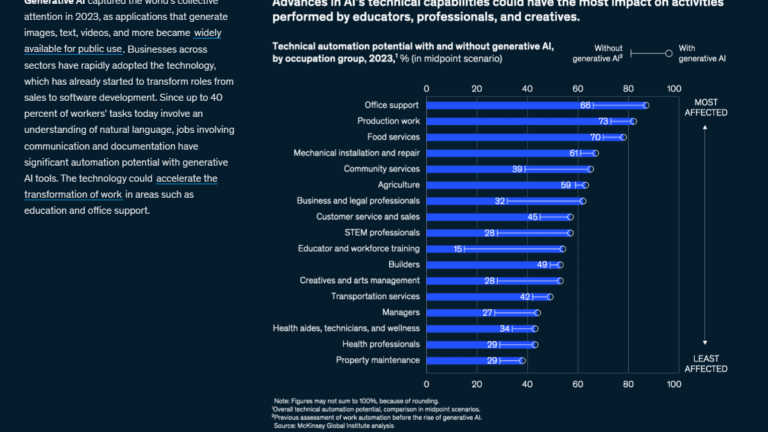
    Obviously generative AI is a technology that can create new content, such as images, videos, and text, without human intervention. It is expected to have a significant impact on the future of work. According to a report by McKinsey Global Institute, generative AI could automate up to 30% of the activities currently performed by workers in the US economy by 20301. However, the report also suggests that generative AI will enhance the way STEM, creative, and business and legal professionals work rather than eliminating a significant number of jobs outright.

    OpenAI’s research estimates that 80% of jobs can incorporate generative AI technology and capabilities into activities that happen today in work

    While generative AI may displace some jobs, it will also create new ones, such as AI trainers, explainers, and maintainers. The integration of generative AI into the workforce has the potential to significantly boost productivity and the emergence of new roles.

  • Navigating the Talent Odyssey: Unleashing AI’s Magic in the HR Realm

    Navigating the Talent Odyssey: Unleashing AI’s Magic in the HR Realm

    Imagine a world where hiring processes are swift, candidates experience seamless interactions, and every employee’s journey is personalized for success. Welcome to the future of Human Resources (HR), where Artificial Intelligence (AI) is not just a tool but a catalyst for transforming how organizations connect with, nurture, and elevate their most valuable assets – their people. In this blog post, we’ll embark on an exciting exploration of how AI is reshaping the landscape of HR, making it more efficient, strategic, and engaging for everyone involved. Get ready to discover the fascinating ways AI is powering the workforce of tomorrow!

    The Evolution of HR: Traditionally, HR processes have been labor-intensive, often characterized by tedious manual tasks such as resume screening, candidate sourcing, and administrative duties. With the advent of AI, these processes are undergoing a revolution, paving the way for a more efficient and strategic HR function.

    1. Smart Recruitment: AI is revolutionizing the recruitment process by automating the initial stages of candidate selection. Advanced algorithms analyze resumes, identify key skills, and match candidates to job requirements, saving HR professionals valuable time and ensuring a more objective screening process. This not only accelerates the hiring process but also enhances the quality of candidate shortlisting.
    2. Chatbots and Candidate Interaction: Imagine a virtual assistant available 24/7 to engage with potential candidates, answer queries, and provide information about the organization. AI-powered chatbots are doing just that, enhancing the candidate experience by providing instant responses, scheduling interviews, and collecting preliminary information. This not only expedites the communication process but also frees up HR professionals to focus on more strategic aspects of talent acquisition.
    3. Employee Onboarding and Training: AI is streamlining the onboarding process by automating routine administrative tasks and delivering personalized training programs. Chatbots guide new hires through orientation, ensuring a smooth transition into the company culture. Additionally, AI-driven analytics assess employee performance and learning styles, enabling the creation of customized training modules tailored to individual needs.
    4. Predictive Analytics for Employee Retention: One of the most powerful applications of AI in HR is its ability to predict employee turnover. By analyzing historical data, employee behavior, and engagement metrics, AI algorithms can identify patterns indicative of potential attrition. Armed with this insight, HR professionals can implement proactive strategies to improve retention, such as targeted employee development programs or adjustments to workplace culture.
    5. Performance Management and Feedback: AI facilitates real-time performance tracking and feedback, enabling continuous improvement. Algorithms analyze employee data to identify strengths, areas for development, and even potential burnout risks. AI-powered tools assist HR in providing timely feedback and guidance, fostering a culture of growth and development within the organization.

    As businesses navigate the evolving landscape of HR, the integration of AI is proving to be a game-changer. By automating routine tasks, enhancing candidate and employee experiences, and providing data-driven insights, AI is empowering HR professionals to focus on strategic initiatives that drive organizational success. The journey towards automating HR with AI is not just about efficiency; it’s about cultivating a workplace where talent can thrive, innovate, and contribute to the future of the business. Embrace the transformation – the future of HR is intelligent, adaptive, and limitless.