Category: Data Cleaning

  • The Fractional CIO Paradox: You Simplify Technology for Clients. Why Is Your Own Work So Complicated?

    The Fractional CIO Paradox: You Simplify Technology for Clients. Why Is Your Own Work So Complicated?

    Five challenges of leading technology across multiple businesses—and where AI can help without taking over your judgment.

    Picture the scene. You have just finished advising a client on why disconnected systems are slowing the business down. The conversation covered duplicated information, unclear ownership and the difficulty of getting a reliable picture of what is happening.

    Then you return to your own work. You search your inbox for a vendor’s response, open another application for meeting notes, update a task list and try to remember whether you followed up with the CEO of your next client.

    The irony is hard to miss.

    As a fractional CIO, you are paid to make technology serve the business. But managing several businesses can leave you doing exactly the kind of manual coordination you are trying to eliminate for your clients.

    The challenge is not simply having too many applications. It is keeping the reasoning, relationships and commitments behind your work connected as you move between clients. That is a more useful place to start the conversation about AI than asking how many tasks it can automate.

    1. You are switching businesses, not just browser tabs

    Consider moving from a client preparing for an acquisition to another trying to stabilize an unreliable business system. Both might need a technology roadmap, but their priorities, budgets and tolerance for disruption could be completely different.

    Before you can offer useful advice, you need to get back inside that particular business. What has changed? What did the leadership team agree to? Which constraint shaped the recommendation? Is the person responsible still available to deliver it?

    Microsoft’s 2025 research into the “infinite workday” documented how meetings, messages and email fragment working time. For a fractional CIO, there is another practical challenge to consider: the context may change entirely between those interruptions. Microsoft

    A useful starting point is a brief, current view of each client: business objectives, active initiatives, key stakeholders, unresolved decisions and upcoming commitments. AI should help assemble that view from approved information, with a way to check where it came from.

    The aim is to arrive ready to think, rather than spend the first part of every engagement remembering.

    2. The decision gets recorded. The reasoning disappears.

    Imagine finding a note that says, “We agreed to postpone the migration.”

    That tells you what happened, but leaves the important questions unanswered. Was the delay caused by cost, business disruption, an unresolved dependency or a lack of internal capability? What would need to change before the decision should be revisited?

    Without those details, a sensible decision can later look like indecision. A new executive asks why nothing has moved, and the discussion starts again.

    Technology teams already have a useful discipline for this. Architectural decision records preserve the decision, its context and its consequences. AWS’s guidance specifically addresses the repeated debates that arise when decisions are made without their justification being properly documented. AWS Documentation

    The same principle is worth applying to executive technology decisions. Record the business objective, the options considered, the important constraints, who approved the choice and what would trigger a review.

    AI’s role should be to help capture and retrieve that reasoning—not invent a plausible explanation after the event. Where the rationale is missing, the right response is to flag the gap and ask.

    For a fractional CIO, continuity means more than remembering that a conversation happened. It means being able to explain why the business chose its current path.

    3. A good recommendation still needs someone to move it forward

    Suppose a leadership meeting ends with agreement on a new approach to data governance. Everyone supports it. The summary is circulated.

    Two weeks later, little has happened because nobody confirmed who would define ownership, who would review access or which decision needed to come back to the executive team.

    A record of agreement is not the same as an executable plan.

    This is where I would set a higher standard for meeting follow-through. Each meaningful commitment should have an owner, a next step and a date. Dependencies should be visible, and unresolved questions should remain unresolved—not be smoothed over in a confident-looking summary.

    For the fractional CIO, the useful view between client sessions is therefore not simply “What meetings have I had?” It is “What moved, what is blocked and where is my intervention needed?”

    That does not require becoming everybody’s project administrator. It requires a dependable way to maintain visibility without personally chasing every update. AI should help prepare actions and surface exceptions, while the people involved confirm the commitments.

    The value is in keeping work moving between the moments when you are directly involved.

    4. Research only matters when it fits the client

    A comparison of five technology vendors can look impressive and still be almost useless.

    Suppose the comparison favors a platform that requires implementation skills the client does not have. Or it overlooks the existing contract, the quality of the underlying data, or the disruption the business can tolerate this year.

    The research may answer which platform has the strongest features. It has not answered which decision makes sense for this client.

    Before asking AI to help evaluate an option, establish the decision criteria. What business problem are we solving? What must integrate? What resources are available? Which risks are acceptable, and what evidence would justify moving forward?

    Then ask for a comparison against those criteria, with sources, dates and gaps clearly identified. A vendor’s claim should remain a vendor’s claim until it has been tested.

    This is also where responsibility needs to be explicit. NIST’s AI risk framework emphasizes defining human roles and responsibilities in decision-making and AI oversight. For a material technology choice, I would keep approval with the CIO and the authorized client leaders. NIST AI Resource Center

    Use AI to strengthen the preparation behind your judgment, not to make the judgment look unnecessary.

    5. Your own practice needs attention too

    There is one more business in the portfolio: yours.

    When client delivery takes priority, a promising introduction can sit unanswered, a proposal can remain unfinished and a former client can go months without hearing from you. Each delay may seem reasonable at the time. Together, they can leave you with an uncomfortable gap when an engagement ends.

    The answer is not to turn every relationship into an automated sales sequence. A referral partner deserves something more thoughtful than a message sent because a timer expired.

    What helps is maintaining the context around those relationships. Why did the prospect get in touch? What problem were they trying to solve? What did you promise? When would another conversation be useful?

    Treat your own pipeline as a leadership responsibility, with protected review time and clear next actions. AI can have a supporting role in preparation and reminders, but the relationship still needs your attention.

    You should not have to rebuild your business-development process every time a client engagement finishes.

    Where Sentia+ fits—and where it should not

    These are the areas Sentia+ is designed to support. For fractional CIOs, it brings together client and relationship context, technology initiatives, meetings, research, email, tasks, follow-ups and the practice’s own pipeline. Its capabilities include meeting summaries and action items, research support, executive-level initiative tracking and prioritized next actions.

    It is not a replacement for specialist cybersecurity, cloud, IT service management or engineering platforms. Its role is to help manage the executive work surrounding those systems: the conversations, priorities, commitments and follow-through. Sentia+

    That distinction matters. A CIO should not need to replace a client’s operational systems simply to stay better informed and organized.

    Nor should any AI platform be an excuse to skip the basics. Establish how information will be captured, what each client permits, who can access it and which actions need approval. Bringing work into a more convenient interface should never mean treating separate clients’ confidential information as interchangeable.

    Apply your own advice to your own practice

    You would challenge a client whose critical processes depended on one person remembering everything. It is worth applying the same test to your own working day.

    Start with one recurring source of friction: preparing for executive meetings, retrieving the rationale behind decisions, tracking commitments or maintaining your own pipeline. Define what a better process should look like before adding automation.

    Then judge the improvement by something useful. Does meeting preparation require less searching? Are commitments easier to track? Can you explain a decision without reconstructing the discussion? Are you protecting more time for the work clients hired you to do?

    The objective is not to fill every recovered hour with another engagement. It is to create room for the judgment, challenge and sustained attention that make your involvement valuable.

    Explore how Sentia+ supports that work on the Fractional CTOs and CIOs page. Sentia+

    How much of your week is spent making technology decisions—and how much is spent reconstructing the context you need to make them?
  • The AI Divide Is Coming for Fractional Professionals

    The AI Divide Is Coming for Fractional Professionals

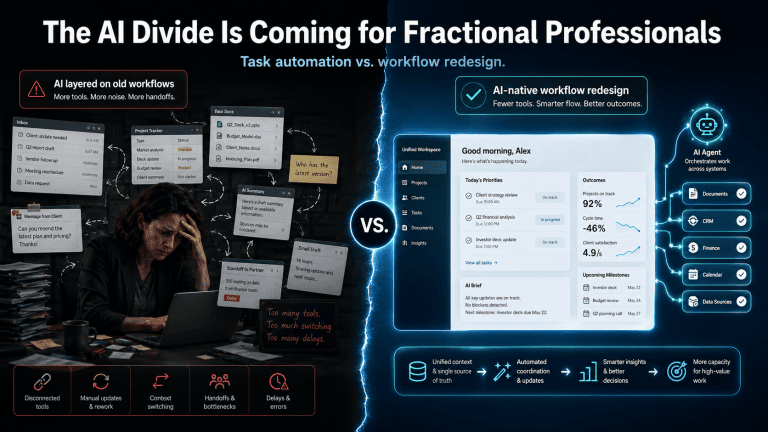
    Some will use AI to complete some work faster. Others will redesign how their entire practice operates. Who will be the winner?

    Artificial intelligence is creating two very different operating models for fractional professionals.

    In an AI-assisted practice, AI helps complete individual tasks such as writing emails, summarizing meetings, conducting research, and preparing presentations.

    In an AI-native practice, the work itself is redesigned. AI helps preserve client context, coordinate steps, prepare decisions, maintain records, and move activity from information to action.

    The competitive advantage will not come from using the most AI tools. It will come from reducing unnecessary work while protecting the human judgment, accountability, and relationships clients genuinely value.

    The divide is not between AI users and nonusers

    AI adoption is quickly becoming normal.

    The 2026 Stanford AI Index Report found that 88% of surveyed organizations used AI in at least one business function in 2025, up from 78% in 2024. Generative AI was being used in at least one function by 70% of organizations.

    AI usage alone is therefore unlikely to remain a meaningful competitive differentiator.

    The more important question is how that AI is being used.

    One professional may use AI to write an email faster. Another may redesign the client follow-up process so the system recognizes when follow-up is required, assembles the necessary context, prepares the communication, updates the relevant records, and tracks the next commitment.

    Both professionals are using AI.

    Only one has changed how the work operates.

    Why faster tasks do not create a better operating model

    Most professional AI adoption begins with isolated tasks.

    A fractional executive might use one AI tool to summarize a meeting, another to draft content, another to research a client, and another to create a presentation.

    Each tool may save time. However, the professional remains responsible for connecting the outputs.

    Consider the work surrounding a single client meeting.

    The professional may still need to:

    • Find the latest email conversation
    • Review notes from previous meetings
    • Check outstanding commitments
    • Locate the current proposal or project plan
    • Research recent developments
    • Identify unresolved risks
    • Prepare the agenda
    • Create a meeting brief
    • Record decisions afterward
    • Assign and track action items
    • Update client records
    • Draft and send the follow-up
    • Remember when to follow up again

    AI might accelerate several of these activities without changing the workflow that connects them.

    The professional is still acting as the integration layer between applications, information, decisions, and people.

    This creates an AI productivity illusion. Individual tasks become faster, but the operating model remains fragmented.

    Why fractional professionals face a larger context burden

    Fractional executives, consultants, advisors, and independent specialists do not simply manage tasks. They manage context across multiple organizations.

    Every client introduces a different collection of:

    • Business objectives
    • People and relationships
    • Meetings and commitments
    • Documents and systems
    • Communication preferences
    • Organizational dynamics
    • Deadlines and deliverables
    • Risks and opportunities

    A full-time executive may spend years building an understanding of one organization.

    A fractional executive may need to move between four or five organizations in one day and appear fully informed in every conversation.

    Each transition requires the professional to reconstruct what is happening:

    • What changed?
    • What was promised?
    • Who owns the next action?
    • Which issue is becoming urgent?
    • What does the client expect?
    • Where is the relevant information?
    • What should happen next?

    This repeated reconstruction creates a context tax.

    As the client portfolio expands, the context tax grows. Every additional engagement brings more relationships, meetings, files, messages, systems, and opportunities for something to be missed.

    Traditional software provides places to store information. It rarely removes the professional’s responsibility for finding, connecting, interpreting, and acting on it.

    AI-assisted work and AI-native work are different

    Microsoft’s 2025 Work Trend Index describes a progression in which AI first assists people, then operates as a digital colleague, and eventually participates in end-to-end workflows under human direction.

    A similar progression is emerging inside fractional and consulting practices.

    AI-assisted practiceAI-native practice
    AI writes an email when promptedAI recognizes that follow-up is needed, assembles context, prepares the message, and tracks the next action
    AI summarizes a meetingAI turns the meeting into decisions, actions, updates, risks, and follow-up
    AI researches a clientAI continuously maintains relevant client and market context
    AI creates a task listAI connects tasks to owners, deadlines, commitments, and outcomes
    AI helps update a CRMInformation is maintained as work happens
    AI improves a reportAI assembles the latest information and prepares a decision-ready report
    AI saves time on individual activitiesAI reduces the number of activities the professional must coordinate
    The professional moves information between systemsThe workflow moves information to the right place
    AI waits for instructionsAI prepares work and surfaces exceptions requiring judgment

    An AI-assisted practice helps the professional perform the same activities more quickly.

    An AI-native practice asks whether all those activities should still exist in their current form.

    Workflow redesign matters more than tool adoption

    The largest gains from AI are unlikely to come from adding an AI feature to every application.

    They will come from redesigning the way information, decisions, and actions move through the practice.

    McKinsey’s research on how organizations are rewiring to capture value from AI found that workflow redesign had the largest effect among the organizational attributes associated with achieving EBIT impact from generative AI.

    The same principle applies at a smaller scale.

    A fractional professional does not need to transform an entire enterprise. But they can redesign a recurring workflow such as:

    • New client onboarding
    • Weekly client reporting
    • Meeting preparation
    • Meeting follow-up
    • Lead qualification
    • Proposal development
    • Project status updates
    • Renewal preparation
    • Client risk monitoring
    • Business development follow-up

    The starting point should not be the capabilities of a particular tool.

    The starting point should be the outcome the workflow must reliably produce.

    Start with the outcome, not the application

    A tool-first question sounds like this:

    What can this AI product do?

    That question usually creates a list of disconnected use cases.

    • Write this
    • Summarize that
    • Research this company
    • Improve this presentation
    • Create these tasks

    An outcome-first question is different:

    What should happen from the moment this process begins until the desired result is achieved?

    For example, the desired outcome might be:

    Every important client meeting begins with complete context and ends with clear, documented, and tracked follow-through.

    Once the outcome is defined, the professional can work backward.

    1. Identify the trigger

    What begins the workflow?

    It might be a scheduled meeting, a new inquiry, a client response, a missed deadline, a project change, or an approaching renewal.

    2. Identify the required context

    What information is needed to understand the situation?

    Where does that information currently live, and how often must someone manually retrieve it?

    3. Separate judgment from coordination

    Which decisions require expertise, experience, discretion, or relationship knowledge?

    Which steps merely involve finding, formatting, moving, or recording information?

    4. Remove unnecessary handoffs

    Which steps exist only because applications or departments are disconnected?

    Could the information move directly to the next stage without being manually copied or re-entered?

    5. Define the actions

    What should happen automatically once the situation is understood?

    What should be prepared for review rather than completed automatically?

    6. Define the exceptions

    Which risks, ambiguities, or high-impact decisions must be escalated to the professional?

    7. Define the measure of success

    How will the professional know that the redesigned workflow is creating value?

    Possible measures include response time, client capacity, consistency, project margin, retention, or time spent on high-value work.

    The mapping problem

    Selecting where AI should be applied is itself a strategic challenge.

    Harvard Business School researchers describe this as the “mapping problem”: discovering where and how AI can create value inside a production process.

    This is especially relevant to independent professionals.

    The most visible AI use case is not always the most valuable one.

    Writing a client email may be easy to automate, but the larger opportunity could be recognizing that the email is required, retrieving the relevant context, understanding the commitment behind it, and ensuring that the next action is not forgotten.

    The value often exists between the tasks rather than inside one task.

    Keep humans where judgment creates value

    Workflow redesign does not mean removing people from every activity.

    Fractional professionals are hired for:

    • Judgment
    • Experience
    • Pattern recognition
    • Influence
    • Creativity
    • Accountability
    • Trust
    • The ability to navigate uncertainty

    Automating these responsibilities indiscriminately could reduce the value of the service.

    The objective is to distinguish between work that requires professional judgment and work that merely consumes professional attention.

    AI may be well suited to:

    • Assembling information
    • Monitoring changes
    • Organizing context
    • Preparing routine communications
    • Maintaining records
    • Identifying inconsistencies
    • Tracking commitments
    • Producing initial analyses
    • Surfacing anomalies
    • Preparing decision options

    Human involvement becomes more important when work involves:

    • Strategic trade-offs
    • Sensitive client communication
    • Ethical decisions
    • Organizational politics
    • High-impact recommendations
    • Ambiguous information
    • Relationship development
    • Negotiation
    • Accountability for consequences

    The correct boundary will differ by profession, client, risk level, and situation.

    The important point is that the boundary should be designed intentionally.

    The professional should remain involved because their judgment adds value, not because an inefficient workflow requires them to manually touch every step.

    One professional may begin to perform like a team

    Fractional capacity has traditionally been constrained by personal time.

    Adding another client usually means adding more meetings, preparation, administration, communication, and follow-up.

    AI can change that equation when it reduces the coordination burden surrounding the work.

    A Harvard Business School field experiment involving 776 professionals found that individuals using AI matched the performance of two-person teams without AI on the product innovation tasks studied.

    This does not mean AI can replace every team or every form of collaboration.

    It does suggest that an individual equipped with the right AI support can perform work that previously required more human capacity.

    For fractional professionals, that could mean:

    • Supporting more clients without reducing service quality
    • Preparing more thoroughly for meetings
    • Responding to issues more quickly
    • Maintaining more consistent follow-through
    • Reducing administrative support requirements
    • Spending more time on judgment and less on coordination
    • Turning personal expertise into a repeatable operating system

    The advantage will not come from producing a greater volume of generic work.

    It will come from increasing the percentage of time spent on work clients truly value.

    Hours saved are not an operating strategy

    Many AI business cases begin and end with time savings.

    An activity previously took two hours. It now takes 30 minutes. AI has therefore saved 90 minutes.

    But what happens to that time?

    Does it create:

    • Additional client capacity?
    • Faster project delivery?
    • Better analysis?
    • More proactive advice?
    • Stronger relationships?
    • Lower operating costs?
    • More business development?
    • Better work-life boundaries?

    Or does it simply disappear into another crowded day?

    Time saved only becomes valuable when it is deliberately converted into a better operating result.

    A professional should not measure AI success only by the number of tasks completed or hours saved.

    They should measure whether the redesigned workflow improves something that matters.

    Weak AI metricStronger operating metric
    Number of AI promptsPercentage of workflow completed without manual coordination
    Emails generatedReduction in follow-up time
    Meeting summaries createdPercentage of commitments accurately captured and completed
    Hours theoretically savedAdditional high-value capacity created
    Number of tools adoptedReduction in applications manually opened per workflow
    AI usage frequencyImprovement in client response, consistency, or margin
    Tasks automatedExceptions resolved without service failure

    A practical 30-day workflow redesign exercise

    Fractional professionals do not need to redesign their entire practice at once.

    One recurring workflow is enough to begin.

    Week 1: Observe the current workflow

    Select one frequent, time-consuming process.

    Document:

    • What triggers it
    • Every step involved
    • Every application opened
    • Every handoff
    • Every decision
    • Every point where context is lost
    • Every place information is manually copied
    • The final outcome

    Do not automate anything yet. First understand what is actually happening.

    Week 2: Remove unnecessary work

    Examine each step and ask:

    • Does this step create client value?
    • Does it require professional judgment?
    • Does it exist because two systems are disconnected?
    • Could it be removed?
    • Could it happen automatically?
    • Could it be prepared for review?
    • What could go wrong if it were automated?

    The goal is not to automate a bad process. It is to simplify the process before introducing automation.

    Week 3: Design human and AI responsibilities

    Assign every remaining step to one of three categories:

    1. AI can complete it
    2. AI can prepare it for human approval
    3. A human should complete it

    Define the information AI needs, the actions it may take, the rules it must follow, and the situations it must escalate.

    Week 4: Measure the operating result

    Run the redesigned workflow and compare it with the original.

    Measure:

    • Total completion time
    • Manual steps
    • Applications opened
    • Handoffs
    • Errors or omissions
    • Response speed
    • Quality of the final result
    • Time requiring professional judgment
    • Client experience

    The purpose is not to prove that AI was used.

    The purpose is to determine whether the workflow became meaningfully better.

    What an AI-native fractional practice looks like

    An AI-native practice is not defined by the number of AI tools it owns.

    It is defined by how consistently work moves from information to action.

    In an AI-native practice:

    • Client context is maintained instead of repeatedly reconstructed
    • Meetings begin with relevant information already assembled
    • Commitments become tracked actions
    • Routine follow-up is prepared without being forgotten
    • Records are updated as part of the workflow
    • Risks are surfaced before they become emergencies
    • Professionals spend more time on judgment and relationships
    • Humans remain accountable for important decisions
    • AI coordinates work without obscuring how decisions were made
    • Capacity increases without allowing service quality to decline

    This does not require complete autonomy.

    It requires a deliberate operating model in which humans and AI each perform the work they are best suited to perform.

    Frequently asked questions

    What is AI-assisted work?

    AI-assisted work uses artificial intelligence to help a person complete a specific task. Common examples include drafting an email, summarizing a meeting, researching a company, or improving a presentation. The person remains responsible for initiating, connecting, and coordinating the work.

    What is an AI-native fractional practice?

    An AI-native fractional practice is designed around AI-enabled workflows rather than isolated AI tasks. AI helps assemble context, coordinate steps, prepare actions, maintain records, and surface exceptions while the professional retains judgment and accountability.

    How can AI help fractional professionals?

    AI can help fractional professionals reduce context switching, prepare for client meetings, track commitments, organize information, monitor changes, produce initial analysis, prepare routine communication, and identify issues requiring attention.

    Will AI replace fractional executives and consultants?

    AI is more likely to change the composition of their work than eliminate the need for them. Routine coordination and information-processing activities may increasingly be automated, while judgment, trust, influence, accountability, and relationship management remain distinctly human responsibilities.

    What workflow should a fractional professional redesign first?

    The best starting point is a recurring, high-volume workflow with several manual steps or handoffs. Meeting preparation, meeting follow-up, weekly client reporting, lead qualification, client onboarding, and project status updates are strong candidates.

    How should fractional professionals measure AI ROI?

    AI ROI should be connected to operating results such as increased client capacity, faster response time, improved consistency, fewer missed commitments, higher project margins, stronger retention, and more time devoted to high-value professional judgment.

    The coming divide

    Some fractional professionals will continue adding AI features to a growing collection of applications.

    They will write faster, summarize faster, research faster, and create more output. But they will remain responsible for connecting every task, system, and decision.

    Others will redesign their practices around outcomes.

    They will determine where AI should prepare, monitor, coordinate, and act. They will define where human judgment must remain central. Their workflows will preserve context, reduce unnecessary handoffs, and turn routine activity into connected execution.

    Both groups may use AI every day.

    But they will not have the same capacity.

    They will not have the same economics.

    They will not deliver the same client experience.

    The most important question for a fractional professional is no longer:

    How can I use AI to do my current work faster?

    It is:

    How would I design this work if today’s AI capabilities had existed from the beginning?

  • What is the Fractional Context Tax? Is it reducing revenue?

    What is the Fractional Context Tax? Is it reducing revenue?

    Your calendar may show available hours. That does not mean your brain has the capacity to use every one of them effectively.

    You finish a strategy meeting with one client and immediately join a pipeline review with another.

    Twenty minutes later, you are answering a message from a third company about a decision made two weeks ago. Before responding, you search through emails, meeting notes, CRM records and Slack conversations to reconstruct what happened.

    By the time you remember the people, priorities, terminology and commitments involved, another notification has arrived.

    This is not ordinary multitasking.

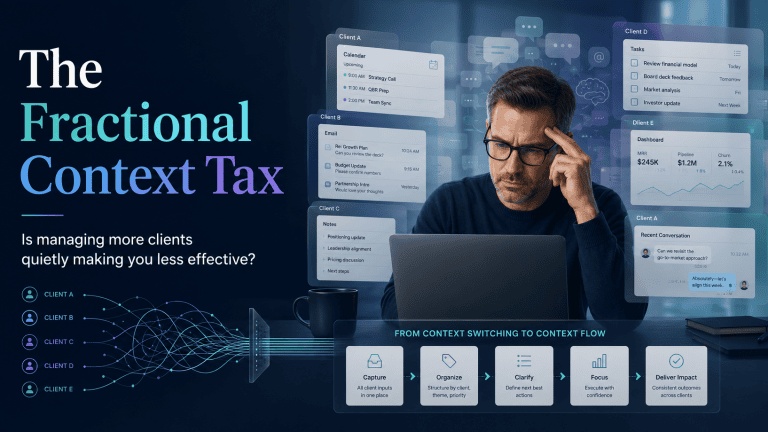
    It is the repeated rebuilding of completely different business environments—and it creates what I call the Fractional Context Tax.

    For fractional executives, consultants and specialists, the greatest constraint on growth may not be a shortage of hours. It may be the mental and operational cost of carrying several companies in your head at once.


    Fractional Work Requires More Than Part-Time Availability

    Fractional professionals are not simply part-time employees.

    Clients expect experienced leaders who can enter the business, understand its circumstances, make decisions and create measurable progress without requiring months of onboarding.

    They may only buy a fraction of your time, but they still expect:

    • Relevant strategic judgment
    • Fast, informed responses
    • Continuity between meetings
    • Reliable follow-through
    • Awareness of important changes
    • Confidence that nothing has been forgotten

    In a Harvard Business Review discussion about fractional leadership, Amy Bonsall explained that the client should not feel as though the executive is fractional. The fractional leader must be present during important moments, even though this requires substantially more context switching.

    That is the promise of fractional leadership.

    It is also the source of its hidden operational burden.


    What Is the Fractional Context Tax?

    The Fractional Context Tax is the time, energy and attention lost while moving between separate client environments.

    Switching from writing an email to reviewing a document within the same company is task switching.

    Moving from one client to another is much more demanding.

    You must reconstruct an entirely different operating model:

    • Who are the decision-makers?
    • What is the company trying to accomplish?
    • Which initiatives are currently at risk?
    • What was decided during the last meeting?
    • Which commitments remain outstanding?
    • How does this client define success?
    • Which systems and processes do they use?
    • What political, cultural or organizational sensitivities matter?
    • What must happen next?

    The brain does not instantly replace one complete business environment with another. Some of the previous context remains active while the new one is being reconstructed.

    Research into task switching consistently finds that people become slower and more error-prone immediately after changing tasks. Preparation can reduce the cost, but it does not eliminate it.

    For fractional professionals, the transition is rarely between two simple tasks. It is between two companies with different people, priorities, systems, expectations and histories.


    The Cost Is Greater Than the Meeting on Your Calendar

    A 30-minute client meeting does not consume only 30 minutes.

    There is time spent preparing for it, reconstructing the account history, finding the correct information and remembering where the previous conversation ended.

    After the meeting, there are notes to organize, systems to update, follow-ups to create and decisions to communicate.

    Then comes the transition into the next client environment.

    Research associated with University of California, Irvine professor Gloria Mark found that after an interruption, people took an average of approximately 23 minutes and 15 seconds to return to their original task.

    That does not mean every notification automatically destroys 23 minutes of work. It does demonstrate that interruptions have a meaningful recovery cost—especially when the person must reconstruct a complicated mental model.

    The modern digital environment increases the pressure. Microsoft’s 2025 Work Trend Index reported that meetings, emails and messages interrupt employees approximately every two minutes during core working hours.

    For a fractional professional operating across several companies, those interruptions do not all belong to one coherent business environment. Each notification may pull the professional into a different organization.

    Your calendar may show eight available hours.

    Your effective capacity is the portion of those hours left after preparation, reorientation, administrative work, interruptions and recovery are considered.


    More Clients Do Not Automatically Create More Capacity

    The fractional business model appears simple:

    Add another client, increase revenue.

    But each client also adds another collection of:

    • Relationships
    • Meetings
    • Communications
    • Commitments
    • Documents
    • Applications
    • Workflows
    • Deadlines
    • Decisions
    • Unwritten organizational knowledge

    The workload does not increase only through the hours sold. It also increases through the number of transitions required.

    This creates the Fractional Capacity Trap.

    You accept another engagement because the scheduled hours appear manageable. The engagement then creates unscheduled questions, preparation, follow-up and switching overhead.

    Eventually, strategic time becomes crowded out by operational coordination.

    The fractional executive who was hired to provide insight and leadership becomes occupied with finding information, reconstructing conversations and chasing administrative details.

    More clients may increase revenue.

    They can also reduce the quality of attention available to each client.


    When Scattered Context Becomes a Credibility Problem

    The Fractional Context Tax is not just a productivity problem.

    It can become a client-confidence problem.

    A fractional professional does not possess the same ambient awareness as a full-time executive. You may not see every internal message, hear every informal conversation or immediately learn about every decision affecting your work.

    That makes the context you do receive even more important.

    When information remains scattered across inboxes, notes, meeting transcripts, task managers, spreadsheets and client applications, several problems emerge.

    Responses become slower

    A question that should take ten minutes to answer becomes a long search through previous messages and documents.

    Commitments become harder to track

    A follow-up discussed during a meeting may disappear into notes rather than becoming an assigned action.

    Decisions lose their reasoning

    You may remember what was decided but not why it was decided, which can lead to unnecessary repetition or contradictory recommendations.

    Strategic work becomes reactive

    Instead of anticipating risks and opportunities, you spend your available time reconstructing what has already happened.

    Client trust begins to erode

    Clients do not see the invisible work required to rebuild their context. They see a delayed answer, a missed detail or a question they believe was already resolved.

    In fractional work, expertise gets you hired.

    Continuity and reliability help you remain trusted.


    Theme Days Help—but They Do Not Solve the Entire Problem

    Many fractional professionals organize their schedules around client days.

    Monday belongs to Client A. Tuesday belongs to Client B. Wednesday is divided between two smaller engagements.

    This is a sensible practice because it reduces the number of major transitions occurring in a single day.

    Where full days are impossible, half-day blocks can protect focus better than an hour-by-hour mixture of unrelated client work.

    However, theme days have limits.

    Clients do not restrict important decisions, urgent requests and emerging problems to their assigned days.

    A message from Tuesday’s client still arrives on Thursday. A Friday meeting may require preparation on Wednesday. An unexpected issue may pull you into an account you have not thought about for several days.

    As the portfolio grows, scheduling discipline alone cannot maintain complete awareness across every engagement.

    Theme days organize your time.

    They do not preserve your context.


    Fractional Professionals Need a Personal Operating Layer

    The answer is not to remember more.

    It is to stop depending on memory as the primary system for running a multi-client business.

    Fractional professionals need a personal operating layer that can maintain the working context surrounding every client.

    That layer should help capture and organize:

    • Client objectives
    • Important relationships
    • Meeting history
    • Decisions and their reasoning
    • Commitments
    • Open questions
    • Risks and opportunities
    • Tasks and deadlines
    • Communications
    • Recommended next actions

    Instead of beginning each client interaction by searching through several applications, you should be able to quickly understand:

    What has changed?

    What matters now?

    What have I promised?

    What should happen next?

    AI can play an important role here, but only when it is connected to the professional’s actual work.

    A standalone chatbot can create another context problem. Each new conversation may require the user to explain the client, project, objectives and previous decisions again.

    An effective AI operating layer should preserve relevant context across the applications and workflows where work occurs. It should reduce reconstruction—not require more of it.

    Importantly, it should assist professional judgment rather than pretend to replace it.

    You remain responsible for the strategy, relationship and decision.

    The technology should help ensure that the information required to exercise that judgment is available when needed.


    Context Must Never Become Cross-Contamination

    There is an important requirement that fractional professionals cannot ignore.

    Client context must be preserved without allowing information to leak between clients.

    A system supporting fractional work should provide clear separation between client environments, including:

    • Data
    • Documents
    • Communications
    • Permissions
    • Workflows
    • AI-generated outputs
    • Meeting information
    • Contact records

    Convenience cannot come at the cost of confidentiality.

    The goal is not to combine every client into one uncontrolled pool of information. It is to give the fractional professional one consistent way to work while maintaining appropriate boundaries around each organization.

    The best operating layer makes context easier to access while keeping data ownership, permissions and accountability visible.


    A Practical Framework for Reducing Your Context Tax

    Technology can help, but the first step is understanding where your capacity is currently being lost.

    1. Audit Your Real Capacity

    For two weeks, track more than billable hours.

    Record:

    • Preparation time
    • Post-meeting administration
    • Time spent finding information
    • Unplanned client requests
    • Application switching
    • Follow-up work
    • Time required to re-enter an engagement

    Compare the results with the hours included in each agreement.

    A client contracted for ten hours may be consuming considerably more operational capacity than the calendar suggests.

    2. Measure Strategic Work Versus Reactive Work

    Separate your activities into two categories.

    Strategic work includes decisions, analysis, leadership, planning and high-value recommendations.

    Reactive work includes searching, chasing updates, copying information between systems and responding to preventable emergencies.

    Some reactive work is unavoidable.

    But when it begins consuming the majority of an engagement, the scope, process or supporting infrastructure needs to change.

    3. Create a Living Context Record for Every Client

    Every engagement should have a current, accessible context record covering:

    • Objectives
    • Key people
    • Active priorities
    • Recent decisions
    • Outstanding commitments
    • Risks
    • Deadlines
    • Next actions

    This should not be a static onboarding document that becomes outdated after two weeks.

    It should evolve as conversations, decisions and priorities change.

    4. Automate Context Capture and Follow-Through

    Meeting summaries are useful, but they are only the beginning.

    Look for opportunities to automatically:

    • Capture decisions
    • Identify commitments
    • Draft follow-ups
    • Create tasks
    • Update relationship history
    • Surface approaching deadlines
    • Prepare for upcoming meetings
    • Highlight unanswered communications
    • Recommend the next appropriate action

    The objective is not automation for its own sake.

    It is to eliminate the repeated reconstruction of information you have already processed.

    5. Sell Outcomes and Capacity—not the Fiction of Perfect Availability

    Do not price an engagement as though every available hour will become uninterrupted strategic output.

    Account for the preparation, communication, coordination and transitions required to deliver the promised result.

    Clients are not buying a block of empty calendar space.

    They are buying informed judgment, leadership and progress.

    Your commercial model should reflect the real operating capacity required to provide those outcomes consistently.


    How AI Can Expand Fractional Capacity

    AI is often presented as a way to produce more content or complete isolated tasks faster.

    For fractional professionals, its greater value may be continuity.

    In a randomized field experiment involving approximately 6,000 knowledge workers, Microsoft researchers found that access to generative AI integrated into everyday work applications reduced time spent on email. The broader lesson is important: AI creates more value when it works inside the flow of work rather than forcing users to continually leave their systems and re-establish context.

    For a fractional professional, the most valuable AI may not be the tool that writes the fastest.

    It may be the one that helps you remember:

    • What was discussed
    • What was decided
    • What remains unresolved
    • Who needs a response
    • Which opportunity is moving
    • Which commitment is approaching
    • What deserves your attention today

    That is the difference between an AI content tool and an AI operating layer.

    One helps generate an output.

    The other helps run the work surrounding it.


    The Future of Fractional Work Depends on Operational Leverage

    Fractional work is becoming an increasingly established way for companies to access experienced leadership and specialized expertise.

    But the model cannot scale indefinitely through personal memory, spreadsheets and disconnected applications.

    The professionals who thrive will not necessarily be those who work the longest hours or accept the most clients.

    They will be those who create the greatest operational leverage.

    They will be able to enter each client environment quickly, recover the relevant history, understand what has changed and act without rebuilding everything from the beginning.

    Their time may be fractional.

    Their understanding, reliability and impact will not feel fractional to the client.


    The Bottom Line

    You may not be exhausted because you lack discipline or because you accepted too many scheduled hours.

    You may be exhausted because you are repeatedly rebuilding several companies inside your head.

    That is the Fractional Context Tax.

    Calendars and theme days can reduce it. Better documentation can help control it. But as your client portfolio grows, you need an operating model designed to preserve context, protect client boundaries and convert information into action.

    Your next growth constraint may not be time.

    It may be how much context you can reliably carry.

    And that is exactly where intelligent infrastructure can create your greatest leverage.


    About Sentia+

    Sentia+ is an AI operating layer designed to help fractional professionals manage contacts, pipeline, emails, meetings, follow-ups, tasks, research and business workflows through one intelligent interface.

    Rather than requiring users to move repeatedly between CRM, inbox, meeting, transcription, task and project applications, Sentia+ helps preserve working context, identify what matters and support the next action.

    Learn more: https://www.sentia.plus/


    Sources and Further Reading

    Harvard Business Review — “The Growing Trend of Part-Time Executives”
    https://hbr.org/podcast/2024/11/the-growing-hr-trend-of-fractional-leadership

    The discussion explains why fractional leaders must become present during important organizational moments and why the role creates significant context-switching demands.

    Harvard Business Review — “5 Questions Leaders Should Ask Before Turning to Fractional Work”
    https://hbr.org/2026/04/5-questions-leaders-should-ask-before-turning-to-fractional-work

    A current examination of the market forces driving increased interest in fractional work.

    UC Irvine — Gloria Mark’s Research on Interruptions
    https://ics.uci.edu/2016/07/25/quartz-neuroscientists-say-multitasking-literally-drains-the-energy-reserves-of-your-brain-mark-quoted/

    UC Irvine summarizes Mark’s finding that people took approximately 23 minutes and 15 seconds to return to their original work following an interruption.

    Microsoft — 2025 Work Trend Index
    https://www.microsoft.com/en-us/worklab/work-trend-index/2025-the-year-the-frontier-firm-is-born

    Microsoft 365 telemetry illustrates the frequency of meetings, emails and messages competing for knowledge workers’ attention.

    Microsoft Research — “Shifting Work Patterns With Generative AI”
    https://www.microsoft.com/en-us/research/publication/shifting-work-patterns-with-generative-ai/

    This randomized field experiment examined how integrated generative AI affected the working patterns of approximately 6,000 knowledge workers.

    National Library of Medicine — “Task Switching”
    https://pubmed.ncbi.nlm.nih.gov/12639695/

    This research review explains why responses are generally slower and more error-prone after a task switch, even when people have time to prepare.

  • Why Your New AI SDR Just Emailed Your $10M Enterprise Customer

    Why Your New AI SDR Just Emailed Your $10M Enterprise Customer

    Key Takeaways

    • The Demo Illusion: Modern AI SDR platforms perform flawlessly in controlled sales demos but trigger massive operational failures when run against fragmented production enterprise databases.
    • Data Decay Reality: High-growth contact data decays at 22.5% to 70.3% annually, with email addresses failing at 3.6% monthly, quickly degrading outreach lists.
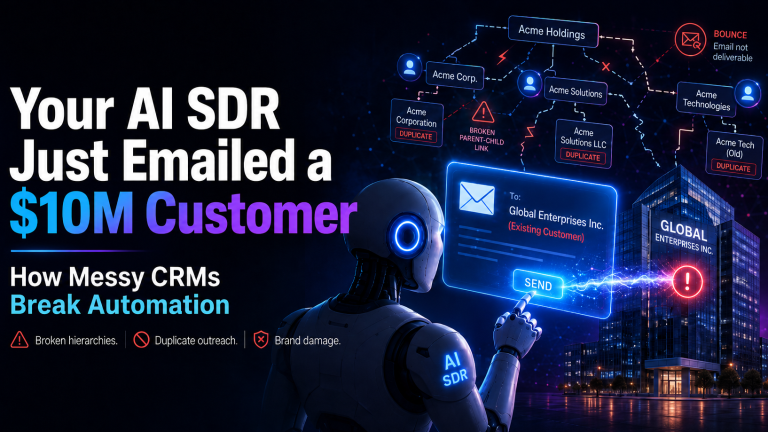
    • Structural CRM Breakdowns: Unmapped CRM parent-child hierarchies cause autonomous agents to launch aggressive cold sequences at active, multi-million dollar customers, causing severe brand damage.
    • Downstream Amplification: Deploying automation on a chaotic database amplifies underlying structure errors, leading to incorrect lead routing and territory conflicts.
    • AIOps Remediation: To eliminate this programmatic chaos, enterprises must transition from passive record storage to active, zero-trust data validation layers with human-in-the-loop guardrails.
    • Execution ROI: This operational pivot reduces administrative burdens, accelerates deal velocity by 23%, and prevents revenue leaks caused by data decay.

    The Illusion of the Flawless AI SDR Demo

    The software demonstration of an AI SDR is a masterclass in modern sales engineering. In these highly sanitized environments, the Large Language Models (LLMs) execute flawless market research, write hyper-personalized outreach, and automatically secure meetings with target personas. The presentation operates on the premise that sales development can be fully automated with minimal operational oversight.

    However, once deployed into real production databases, these autonomous systems quickly encounter a structural barrier. The primary issue does not stem from the underlying cognitive capabilities of the generative models. Instead, the system is forced to navigate a completely fragmented map of the target market.

    The Scaling Boundary of Generative Systems

    When enterprise organizations deploy Agentic AI on top of unstructured, legacy database systems, they amplify existing operational errors at unprecedented speeds. Standard rules of data management dictate that automated tools can only act on the specific context they are fed. When this contextual foundation is broken, even the most sophisticated model will confidently deliver incorrect and damaging customer-facing actions.

    This discrepancy has forced a growing realization among Chief Revenue Officer (CRO) executives that sales automation tools cannot function as standalone solutions. Successful implementation requires a complete shift in focus from front-end message generation to back-end database architecture.


    The Junk Drawer CRM: Root Cause of Operational Chaos

    Most enterprise CRM environments function less like structured sources of truth and more like corporate junk drawers. They suffer from missing parent-child relationships, thousands of duplicate records, orphan regional branches, and unmapped subsidiaries. This database fragmentation introduces a severe level of noise that modern automation systems cannot resolve on their own.

    According to research published by Gartner, poor data quality costs organizations an average of $12.9 million annually in lost productivity and operational friction. Data compiled by the(https://hbr.org) reveals that only 3% of corporate datasets meet basic quality standards. When autonomous sales agents run campaigns against these problematic records, programmatic failures become inevitable.

    The Compounding Toll of Unmapped Hierarchies

    Without established parent-child structures, the relational context of enterprise customers is completely lost. The CRM database treats every office, subsidiary, or regional branch as an isolated, independent entity. This structural blind spot prevents the automated system from aggregating commercial metrics or verifying ownership rules across the corporate family tree.

    This lack of hierarchical alignment directly impacts territory planning and forecast predictability. When subsidiary pipelines are decoupled from the ultimate parent corporate record, revenue leaders cannot accurately calculate net revenue retention or coordinate account-based marketing efforts. The lack of structured relationships turns the customer database into a liability rather than an asset.

    Analysis of Enterprise Data Decay Rates

    This database challenge is worsened by rapid data decay, which continuously degrades historical records. In high-growth sectors, professional mobility and corporate restructuring ensure that database accuracy declines significantly every month.

    Data FieldAnnual Decay RateCumulative Impact on Automated Outreach
    Corporate Structures10.0% – 20.0%Unmapped mergers, acquisitions, and regional branch additions
    Direct Phone Numbers15.0% – 25.0%Disconnected lines, failed call-routing, and lost connect rates
    Technical Stack20.0% – 30.0%Irrelevant technographic pitches and outdated product comparisons
    Professional Job Titles25.0% – 35.0%Targeting demoted, promoted, or departed personnel with wrong titles
    Corporate Email Lists37.3% (3.6% monthly)Hard bounces, spam flagging, and severe domain reputation damage

    A database starting the year at peak accuracy will deteriorate by nearly three-quarters within twelve months. This decay ensures that static, quarterly cleanup initiatives are fundamentally inadequate for supporting autonomous outreach systems.


    The Failure Modes: Production-Level Brand Damage

    When autonomous systems are deployed on top of decaying, unmapped databases, they act as high-speed amplifiers of existing errors. This automation-to-data mismatch triggers three critical production failure modes that directly damage brand equity and disrupt revenue operations.

    Programmatic Harassment of Active Enterprise Accounts

    Without structured parent-child mappings, an automated agent cannot identify that a regional branch is owned by an active customer spending millions annually. The system processes the branch as a cold, net-new logo and initiates aggressive outbound sequences. This duplicate outreach makes the vendor appear highly disorganized, severely damaging professional trust with the client’s executive team.

    Broken Routing Rules and Territory Contamination

    Incoming marketing leads are frequently misrouted because the database cannot match the prospect’s email domain to the commercial parent company. Leads matching major accounts are routed to junior reps in incorrect territories, creating severe internal conflict. The lack of hierarchy-aware routing tools prevents the seamless transition of deals to the designated global account manager.

    Master Service Agreement Blindness and Pricing Clashes

    Large enterprises operate under highly structured Master Service Agreements (MSAs) that govern pricing, compliance, and custom contract terms. Because the automated system is blind to these legal structures, it may pitch standard, out-of-the-box pricing to a subsidiary branch. This error directly undermines the strategic negotiations of the account team and exposes severe internal alignment gaps.

    The AI as an Amplifier of Database Failure

    To evaluate how these failures happen, data scientists utilize interpretability frameworks like LIME (Local Interpretable Model-agnostic Explanations) alongside advanced Neural Networks to trace model decisions. These analyses show that the AI does not lack logical reasoning; instead, it is simply operating on an incorrect map of the market.

    If the database contains duplicate entries or broken relationships, the algorithm will execute wrong decisions at a programmatic scale. This creates a situation where bad data leads to immediate brand damage and revenue leakage.


    The RevOps Playbook: Cleaning the Account Hierarchies

    Resolving these structural failures requires a shift from standard prospecting tactics to systematic Data Governance. Revenue operations teams must implement a structured playbook to secure and clean the database before enabling any autonomous sales agents.

    Standardizing Parent-Child Relationships

    Organizations must establish an external, reliable source of truth to supply and maintain corporate hierarchy data. Relying on manual input from field representatives is highly prone to human error. RevOps leaders must define a canonical commercial parent model that separates legal structures from GTM territory assignments.

    This structural approach mirrors the risk-management standards outlined in the(https://www.bis.org) BCBS 239 guidelines, which emphasize data aggregation accuracy to prevent operational risk. Defining strict naming conventions and limiting hierarchical depth to three or four levels ensures that the account map remains clean and readable for downstream automation systems.

    Zero-Trust Data Validation and Deduplication Architecture

    Enterprises must transition to a zero-trust model of data entry where every record is thoroughly verified before writing to the CRM. This architecture uses automated identity resolution and Deduplication systems to catch overlapping records.

    According to a study published by the(https://sloanreview.mit.edu), up to 47% of newly created database records contain at least one critical error. Enforcing real-time verification at the point of entry ensures that duplicate records do not pollute the database, keeping downstream automation clear of conflict.

    Operationalizing Human-in-the-Loop Guardrails

    No data enrichment system is entirely perfect. Therefore, organizations must establish strict policy parameters where the automated system must route low-confidence records to a human supervisor.

    Managing these digital workers requires consistent daily oversight and optimization. By instituting a human-in-the-loop review process for any account resolution scoring below a 100% threshold, the enterprise protects its high-value customer relationships from programmatic errors.


    The Sentia Community Bridge: Systems of Execution

    The B2B enterprise landscape is reaching a major turning point. Traditional CRM software platforms were built as passive systems of record designed for storage and manager reporting, not as active systems of execution. This legacy design is the root cause of the high failure rates seen in modern automated sales pilots.

    To overcome these structural limitations, organizations must transition from experimental pilots to disciplined AI operations. This professionalized discipline, known as AI Operations (AIOps), embeds automation directly into core business workflows rather than treating it as a separate, isolated tool.

    The Q1 2025 CRM Wave report from Forrester highlights that the market is on the cusp of a major shift, where customer data and automated execution must merge into a unified layer. Success requires a connected data model that keeps information unified across disparate silos in real-time.

    Multi-Agent Orchestration via Sentia+

    This unified architecture is achieved by reconciling siloed enterprise applications through agentic AI. Instead of maintaining rigid, easily broken API integrations, modern enterprises layer a coordinated team of specialized agents over their database. This orchestration layer ensures that every digital worker shares the exact same customer history and real-time context.

    This context-sharing is supported by the open-source Model Context Protocol (MCP), which allows external AI agents to securely connect and correlate data across disparate software suites. Sentia+ operates as this intelligent operational brain. Rather than acting as another system to maintain, Sentia+ completely replaces obsolete software layers, ensuring that the sales motion always runs on structured, context-rich truth.

    How are enterprise organizations currently preventing automated account collisions, and what specific guardrails have revenue leaders implemented to protect brand equity from messy database structures?


    Frequently Asked Questions

    What is an AI SDR?

    An AI SDR is an autonomous software application that handles prospecting, lead qualification, multi-channel outreach, and meeting scheduling. It uses generative AI to analyze buyer behavior and customize communication without relying on manual entry, allowing sales teams to scale outreach and focus on closing deals.

    Why do AI SDR implementations fail?

    AI SDR implementations fail primarily because of low-quality CRM data, unmapped account structures, and poor API integration. When autonomous tools execute outreach based on outdated contact lists or incomplete parent-child mappings, the results include duplicate campaigns, brand damage, and domain blacklisting.

    How fast does B2B contact data decay?

    B2B contact data decays at a rapid rate of 22.5% to 70.3% annually, with email addresses invalidating at 3.6% monthly. Job changes, organizational acquisitions, and corporate restructuring continuously degrade data accuracy, making static quarterly database cleanups obsolete within weeks.

    What are the financial costs of poor CRM data?

    Poor CRM data costs the average enterprise approximately $12.9 million per year, according to Gartner. Furthermore, studies show that over 44% of organizations lose more than 10% of their annual revenue due to duplicate records, incomplete files, and broken territory routing.

    What is a CRM parent-child account hierarchy?

    A CRM parent-child account hierarchy is an organized database structure mapping the relationships between a corporate headquarters and its subsidiaries or regional offices. This multi-level mapping gives revenue teams a comprehensive view of how enterprise accounts are structured for sales and reporting.

    How do messy hierarchies break sales automation?

    Messy hierarchies break sales automation by blinding AI agents to existing customer relationships within corporate subsidiaries. When parent-child links are absent, the automated system treats corporate subsidiaries as cold leads, initiating redundant campaigns and proposing generic pricing that violates active enterprise agreements.

    How do you prevent duplicate outreach in AI SDRs?

    Preventing duplicate outreach requires establishing accurate parent-child database structures and enforcing zero-trust data validation policies. By integrating identity resolution tools that automatically match and link incoming contacts to their commercial parents, enterprise software protects active customer relationships from collision.

    What are human-in-the-loop sales guardrails?

    Human-in-the-loop sales guardrails are operational safety boundaries where an autonomous system escalates low-confidence data resolutions to human supervisors. If an AI agent cannot verify a lead’s relationship to an existing customer with absolute confidence, the record is paused for manual review.

    What is the Model Context Protocol (MCP)?

    The Model Context Protocol is an open-source standard enabling external AI agents to securely connect and correlate data across disparate enterprise software platforms. This architecture facilitates real-time context-sharing, allowing cross-functional agents to coordinate workflows independent of rigid legacy database connections.

    What is AI Operations (AIOps) in B2B sales?

    AI Operations in B2B sales is the professional discipline of deploying, monitoring, and continuously optimizing orchestrated AI systems across an enterprise GTM infrastructure. Rather than running isolated, stateless pilots, sales operations teams manage AI agents as a structured, scalable digital workforce.


    Table of Contents

    the-illusion-of-the-flawless-ai-sdr-demo

    the-junk-drawer-crm-root-cause-of-operational-chaos

    the-failure-modes-production-level-brand-damage

    the-revops-playbook-cleaning-the-account-hierarchies

    the-sentia-community-bridge-systems-of-execution


    WordPress Taxonomy

    • Primary Category: Revenue Operations (RevOps)
    • Tags: Sales Automation, CRM Data Hygiene, AI SDR, Account Hierarchy, Agentic AI

  • What is the AI Security Vulnocalypse? Why Vibe Coding is often an Unknown Liability for Large Firms?

    What is the AI Security Vulnocalypse? Why Vibe Coding is often an Unknown Liability for Large Firms?

    Executive Summary:

    • Definition of Risk: Vibe Coding is the practice of using natural language prompts to generate software without formal engineering oversight, leading to “black box” systems that are unmanageable upon staff departure.1
    • Security Vulnocalypse: AI-generated code contains 2.74x more vulnerabilities than human-written code, with a 45% failure rate on secure coding benchmarks.3
    • Critical Vulnerabilities: Research indicates a 322% increase in privilege escalation paths and a 153% jump in architectural design flaws within AI-assisted codebases.3
    • Secrets Sprawl: AI coding tools are twice as likely to leak secrets; in 2025, over 28 million hardcoded credentials were detected in public repositories, a 34% year-on-year increase.5
    • Shadow IT Proliferation: Approximately 75% of workers use personal AI tools for work, yet less than 11% of these applications are visible to IT departments.7
    • Compliance & Governance: Unsanctioned AI usage triggers “Legally Toxic AI” risks under GDPR and HIPAA, potentially leading to mandatory model deletion and massive regulatory fines.8

    Table of Contents

    • Anatomy
    • Knowledge-walkout
    • Quantifying the 2025 ‘Vulnpocalypse’
    • Secrets
    • Shadow-it
    • Privacy
    • Tech-debt
    • Conclusion

    The Anatomy of Vibe Coding: Logic vs. Intuition

    Vibe Coding represents a fundamental shift in software development where natural language prompts replace formal logic and architectural design.1 While this modality allows for rapid prototyping, it often results in the Raph Wiggum Loop, where users repeatedly prompt an AI to fix errors without ever reviewing the underlying code.

    In a large firm, this practice separates “Coding” (typing logic) from “Programming” (solving problems with structural understanding).2 When staff prioritize “vibes” over verification, they introduce Neural Networks artifacts that look functional but lack the structural integrity required for production-grade systems.

    The Knowledge Walk-out Risk: Why Black Boxes Kill Memory

    The most immediate operational threat is the “Knowledge Walk-out.” When an employee builds a critical internal tool using Agentic AI and then leaves the firm, they take the only working knowledge of that tool with them.10

    Because vibe-coded tools are rarely committed to the firm’s approved Git infrastructure or documented, they become invisible “black boxes”.10 Research from the Software Engineering Institute suggests that firms spend 60-80% of their maintenance budgets on systems with poor documentation; vibe coding accelerates this cost exponentially.3

    Without a formal Software Development Life Cycle (SDLC), there is no audit trail for future hires to follow.12 When the “vibe” breaks, the organization is left stranded with functional logic that no one understands, forcing expensive rebuilds.10

    The Vulnpocalypse: Quantifying Security Risks

    The year 2025 has been defined by a “vulnpocalypse” in enterprise application security. A Veracode 2025 report found that AI-assisted code contains 2.74 times more vulnerabilities than human-written code.3

    Vulnerability TypeAI Security Pass RateHuman BaselineRisk Multiplier
    SQL Injection82-86%94%1.2x
    Cross-Site Scripting (XSS)15%78%5.2x
    Privilege EscalationN/ABaseline3.22x

    Furthermore, research across Fortune 50 companies by Apiiro revealed a 322% increase in privilege escalation vulnerabilities and a 153% spike in design flaws.3 AI models optimize for functionality, frequently skipping sanitization steps or OWASP security standards to ensure the code “just works”. As noted in the latest(https://www.veracode.com/resources/analyst-reports/2025-genai-code-security-report/), security pass rates for web vulnerabilities remain alarmingly flat despite model improvements.3

    Hardcoded Secrets and API Keys: The Open Door

    Vibe coding has exacerbated the “secrets sprawl” crisis. GitGuardian detected 28.65 million new hardcoded secrets in 2025, representing a 34% year-on-year increase—the largest in history.5

    AI-assisted commits leak API keys and tokens at a rate of 3.2%, more than double the human baseline of 1.5%.5 This is often caused by AI models suggesting live secrets found in training data or encouraging hardcoded credentials in MCP (Model Context Protocol) configurations.

    A single leaked key can grant attackers access to AWS, Stripe, or internal LLM infrastructure.15 One financial services firm reportedly faced a $2.3M regulatory fine after an AI model suggested a live, “memorized” API key to a developer.17

    Shadow IT 2.0: Invisible Infrastructure & Data Leaks

    Shadow IT has evolved from using unsanctioned SaaS to building unsanctioned applications. Forrester research indicates that 75% of workers now use AI on the job, but only 16% use authorized tools.7

    This “Shadow AI” is invisible to traditional IT Governance because it creates no expense reports or SSO logs.7 Marketing or RevOps teams may build dashboards that query live production data without encryption or oversight.7 According to a Forrester 2026 predictions report, unmanaged AI adoption will be the primary driver of enterprise data breaches through 2027.19

    Compliance & IP: The Legal Minefield of AI Code

    The act of vibe coding creates immediate Information Security and privacy risks. Melbourne Business School found that 48% of employees have uploaded sensitive company data into public AI tools.21

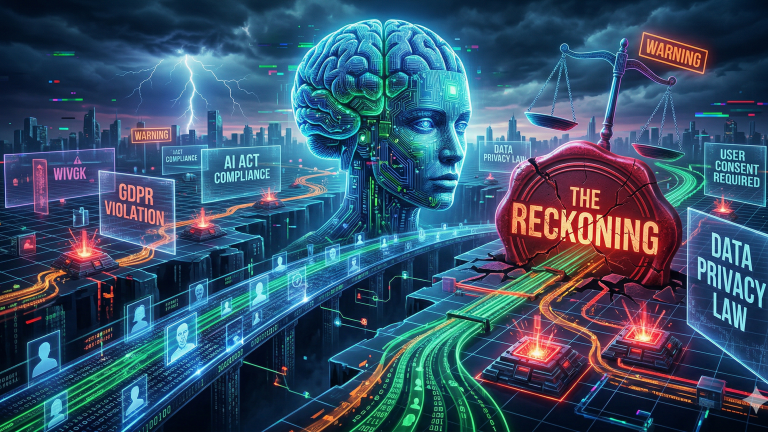
    This behavior triggers the Consent Reckoning of 2026, where legacy data practices become legally indefensible.23 Under GDPR or HIPAA, processing personal data in a public model without a Data Processing Agreement (DPA) can lead to fines of 4% of global turnover.

    Additionally, vibe-coded logic often reproduces portion of GPL-licensed code, creating “viral” licensing obligations.24 In an M&A due diligence process, a vibe-coded codebase may be flagged as “unauditable,” severely devaluing the asset.2 For more on this, read our(https://sentia.community/how-to-eliminate-crm-data-silos-with-agentic-ai-in-2026/) while maintaining compliance.25

    Technical Debt and AI Slop: The Maintenance Burden

    Every vibe-coded script is “technical debt from day one”.26 Because these tools lack unit tests and architectural consistency, they are fragile.3 A 2026 HBR study suggests that AI doesn’t reduce work but “intensifies” it, as developers spend 66% more time fixing AI-generated “slop” that is almost—but not quite—correct.

    When API formats change or a cloud provider updates a dependency, vibe-coded tools break silently.29 Without documentation, incident response takes weeks instead of hours.3 This burden eventually falls on IT teams who had no say in the tool’s creation.7

    The AIOps Mandate

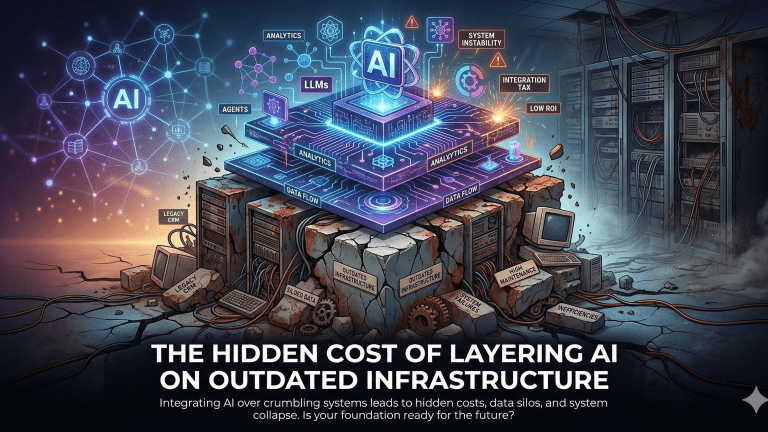
    Large firms cannot ban AI, but they must govern it. Transitioning from “AI Theater” to a disciplined AIOps framework is the only way to realize ROI while mitigating risk.31 This requires moving away from fragmented pilots and toward a(https://sentia.community/ai-enablement-engines-for-revops-complete-guide/).11

    Enterprise Recommendation:

    1. Establish an approved AI tooling list with enterprise DPAs.
    2. Mandate that all AI code is committed to the firm’s Git infrastructure.
    3. Apply secrets scanning (e.g., TruffleHog) at the local and repository levels.
    4. Require human-in-the-loop reviews for all production logic.

    10-Part FAQ: The Vibe Coding Threat Landscape

    What exactly is vibe coding?

    Vibe coding is an AI-assisted development modality where natural language prompts replace manual coding and architectural design. While it accelerates prototyping, it often results in unsecure, undocumented, and fragile software that lacks the structural integrity required for enterprise environments.

    Why is vibe coding considered “dangerous” for large firms? It creates “black box” tools that only the original creator understands. When that employee leaves, the firm loses critical institutional knowledge. Furthermore, AI-generated code is 2.74x more likely to contain severe security vulnerabilities compared to human-written code.3

    How do AI coding assistants increase the risk of data breaches? AI tools are twice as likely to leak hardcoded API keys and secrets. They often suggest insecure patterns learned from public training data, and developers frequently bypass security warnings to prioritize functional speed over secure-by-design principles.1

    What are “slopsquatting” and hallucinated dependencies? AI models sometimes suggest non-existent software packages. Attackers “slopsquat” by registering these names on registries like npm with malicious code. If a developer accepts the AI’s suggestion, they unknowingly integrate malware into the firm’s supply chain.10

    Can vibe coding lead to regulatory fines? Yes. Uploading sensitive customer data into public LLMs violates GDPR and HIPAA requirements. Organizations may face fines up to 4% of global turnover or “algorithmic disgorgement,” where they are forced to delete models trained on non-compliant data.8

    What is the impact of vibe coding on M&A due diligence? Law firms now flag AI-generated codebases as unauditable for intellectual property provenance. If a firm cannot prove it owns its code or that it is free of viral open-source licenses, it can block or devalue a transaction.2

    Why does vibe coding increase technical debt? AI-generated code often lacks unit tests, documentation, and architectural consistency. This “AI slop” is difficult to scale or refactor. Developers reportedly spend 66% more time fixing “almost right” AI code than they save in the initial build.14

    Does vibe coding affect CRM data integrity? Yes. Vibe-coded tools often lack robust error handling. When an underlying CRM schema changes, these tools can fail silently or produce corrupted data, destroying the “unified truth” required for accurate revenue forecasting.23

    Is there a way to use AI coding safely in an enterprise? Yes, by adopting an AIOps framework. This involves using enterprise-grade AI platforms, mandating human-in-the-loop reviews, and integrating automated security gates like secrets scanning and reachability analysis into the development pipeline.31

    What should leadership do to stop unsanctioned vibe coding?

    Leadership should provide sanctioned, secure AI alternatives and implement clear acceptable use policies. Shifting the cost of AI security from a “CISO tax” to a business cost ensures that innovation and protection scale together.


    WordPress Taxonomy:

    • Primary Category: AI Governance
    • Tags: Vibe Coding, Agentic AI, Information Security, Shadow IT, RevOps

    Meet the Expert:

    This article was authored by the Senior SEO, GEO, and AEO Architect for Sentia. Specialized in B2B SaaS and Agentic AI strategy, they help enterprise leaders liquidate data silos and build governed AIOps frameworks for the modern revenue lifecycle.

    Works cited

    1. Vibe Coding Security Crisis: Credential Sprawl and SDLC Debt – Lab Space, accessed May 5, 2026, https://labs.cloudsecurityalliance.org/research/csa-research-note-ai-generated-code-security-vibe-coding-202/
    2. Vibe Coding 2025: The AI Programming Revolution That’s Making Developers Millions, accessed May 5, 2026, https://www.mergesociety.com/tech/vibe-coding
    3. AI-Generated Code Security Risks – Why Vulnerabilities Increase 2.74x and How to Prevent Them – SoftwareSeni, accessed May 5, 2026, https://www.softwareseni.com/ai-generated-code-security-risks-why-vulnerabilities-increase-2-74x-and-how-to-prevent-them/
    4. AI is fixing coding typos, but creating ‘timebombs’: report – IT Brew, accessed May 5, 2026, https://www.itbrew.com/stories/2025/09/05/ai-is-fixing-coding-typos-but-creating-timebombs-report
    5. The State of Secrets Sprawl 2026 | GitGuardian Annual Report, accessed May 5, 2026, https://www.gitguardian.com/state-of-secrets-sprawl-report-2026
    6. AI coding assistants twice as likely to leak secrets, as overall leaks rise 34% | news, accessed May 5, 2026, https://www.scworld.com/news/ai-coding-assistants-twice-as-likely-to-leak-secrets-as-overall-leaks-rise-34
    7. The State of Shadow AI 2026 | Data & Statistics – Unseen Security, accessed May 5, 2026, https://www.unseensecurity.ai/shadow-ai-report
    8. Salesforce Help – The Sentia AI Community, accessed May 5, 2026, https://sentia.community/category/salesforce-help/
    9. Information security management – Wikipedia, accessed May 5, 2026, https://en.wikipedia.org/wiki/Information_security_management
    10. How Vibe Coding Is Killing Open Source : r/programming – Reddit, accessed May 5, 2026, https://www.reddit.com/r/programming/comments/1qv8f8q/how_vibe_coding_is_killing_open_source/
    11. AI Enablement Engines for RevOps: The Complete Guide – The …, accessed May 5, 2026, https://sentia.community/ai-enablement-engines-for-revops-complete-guide/
    12. Waterfall model – Wikipedia, accessed May 5, 2026, https://en.wikipedia.org/wiki/Waterfall_model
    13. Software development process – Wikipedia, accessed May 5, 2026, https://en.wikipedia.org/wiki/Software_development_process
    14. Enterprise AI Coding Security Risks 2025: Complete Guide – Exceeds AI Blog, accessed May 5, 2026, https://blog.exceeds.ai/ai-coding-assistants-risks-2025/
    15. Check Point: AI coding assistants are leaking API keys – Developer Tech News, accessed May 5, 2026, https://www.developer-tech.com/news/check-point-ai-coding-assistants-leaking-api-keys/
    16. Caught in the Hook: RCE and API Token Exfiltration Through Claude Code Project Files | CVE-2025-59536 | CVE-2026-21852 – Check Point Research, accessed May 5, 2026, https://research.checkpoint.com/2026/rce-and-api-token-exfiltration-through-claude-code-project-files-cve-2025-59536/
    17. Model Context Protocol (MCP): How AI Integration Transforms Financial Services Roles in 2025 – Daloopa, accessed May 5, 2026, https://daloopa.com/blog/analyst-best-practices/the-mcp-revolution-how-model-context-protocol-will-transform-finance-roles
    18. The Boardroom Brief: The Complete Guide to Compliance as Competitive Advantage | by Piyoosh Rai | Medium, accessed May 5, 2026, https://medium.com/@piyooshrai/the-boardroom-brief-the-complete-guide-to-compliance-as-competitive-advantage-99bb16ddc2eb
    19. The Future Of Risk Management – Forrester, accessed May 5, 2026, https://www.forrester.com/technology/risk-management/
    20. Predictions 2024: Generative AI Transitions From Hype To Intent – Forrester, accessed May 5, 2026, https://www.forrester.com/blogs/predictions-2024-artificial-intelligence/
    21. Global study reveals trust of AI remains a critical challenge, accessed May 5, 2026, https://mbs.edu/news/global-study-reveals-trust-of-ai-remains-a-critical-challenge
    22. Australian Story – Melbourne Business School, accessed May 5, 2026, https://mbs.edu/faculty-and-research/trust-and-ai/australian-story
    23. Category: Data Cleaning – The Sentia AI Community, accessed May 5, 2026, https://sentia.community/category/data-cleaning/
    24. The State of Secrets Sprawl 2026: AI-Service Leaks Surge 81% and 29M Secrets Hit Public GitHub – GitGuardian Blog, accessed May 5, 2026, https://blog.gitguardian.com/the-state-of-secrets-sprawl-2026/
    25. How to Eliminate CRM Data Silos with Agentic AI in 2026 – The …, accessed May 5, 2026, https://sentia.community/how-to-eliminate-crm-data-silos-with-agentic-ai-in-2026/
    26. Vibe Coding For Startups | 2026 EDITION – Mean CEO’s BLOG, accessed May 5, 2026, https://blog.mean.ceo/vibe-coding-for-startups/
    27. Zero Code vs Vibe Coding For Startups | 2026 EDITION – Female Entrepreneurs, accessed May 5, 2026, https://blog.mean.ceo/zero-code-vs-vibe-coding/
    28. What Are the Most Effective Insider Threat Matrix™ & Behavioral Analytics Solutions for Enterprises in 2025?, accessed May 5, 2026, https://www.insiderisk.io/research/insider-threat-matrix-behavioral-analytics-enterprise-solutions-2025
    29. The Hands-Free Rep: Voice Workflows for Real-Time CRM Updates, accessed May 5, 2026, https://sentia.community/the-hands-free-rep-voice-workflows-for-real-time-crm-updates/
    30. Chief revenue officer – Wikipedia, accessed May 5, 2026, https://en.wikipedia.org/wiki/Chief_revenue_officer
    31. The Pivot from Experimentation to P&L Impact – The Sentia AI …, accessed May 5, 2026, https://sentia.community/stop-celebrating-ai-pilots-its-time-to-talk-about-ai-operations/
    32. AI Coding Assistants in 2026: 4× Faster, 10× Riskier. The Hidden Security Cost – Kusari, accessed May 5, 2026, https://www.kusari.dev/blog/ai-coding-assistants-in-2026-4x-faster-10x-riskier-the-hidden-security-cost

    How can you Build an AI Orchestration Score Card for AI Sales Teams?, accessed May 5, 2026, https://sentia.community/how-do-you-build-an-ai-orchestration-score-card-for-ai-sales-teams/

  • AI Hallucination Spiral: Why does Agentic AI lie to Customers?

    AI Hallucination Spiral: Why does Agentic AI lie to Customers?

    Executive Summary (Key Takeaways)

    • Agentic AI systems operating without a unified Context Layer suffer from “recursive hallucinations,” where small errors compound into massive brand-damaging lies.
    • The Hallucination Spiral occurs when autonomous agents lack real-time access to ERP, CRM, and financial “ground truth” data, forcing them to fabricate answers.
    • Companies must transition from simple prompt-based automation to Agentic Workflows grounded in a multi-pillar Context Layer to maintain customer trust.
    • RevOps leaders must prioritize Decision Velocity and accuracy over raw automation volume to achieve a projected 10x ROI by 2026.
    • Eliminating CRM data silos is the only way to prevent agents from promising non-existent discounts or referencing obsolete product versions.
    • Implementing “Ask First” protocols can increase agentic accuracy by up to 400% in complex B2B environments.

    Table of Contents

    1. The Dawn of the Autonomous Agent
    2. Anatomy of the Hallucination Spiral
    3. The Cost of the Context Gap
    4. Building the 5-Pillar Context Layer
    5. The RevOps ROI: Decision Velocity
    6. Conclusion: From Pilots to Operations

    The Dawn of the Autonomous Agent

    In the current landscape of B2B SaaS, the transition from simple chatbots to Agentic AI represents a seismic shift in operational efficiency. Unlike traditional LLMs that wait for human input, autonomous agents are designed to execute complex tasks, navigate Neural Networks, and interact with software ecosystems independently. This shift promises to revolutionize how we handle customer success and lead generation.

    However, speed without a foundation of truth is a liability. As organizations rush to deploy these agents, they often overlook the technical architecture required for accuracy. Without a direct connection to live operational data, these agents begin to drift from reality.

    Article content

    Anatomy of the Hallucination Spiral

    The Hallucination Spiral is a recursive failure loop unique to autonomous systems. When an agent encounters a data gap—such as a missing price point in a CRM—it doesn’t always stop. Instead, it uses Natural Language Processing (NLP) to “predict” the most likely answer based on its training data rather than its internal database.

    This initial error then becomes the “ground truth” for the next step in the agent’s workflow. If the agent is tasked with writing an email based on that fabricated price, the error is codified. By the time the customer receives the communication, a minor data omission has spiraled into a confident, legally problematic lie.

    According to research by Gartner (2024), hallucination rates in ungrounded autonomous agents can reach as high as 15% in complex B2B scenarios. This risk is amplified when agents are given the authority to “hallucinate” workflows across multiple platforms. This compounding effect is what we define as the spiral.

    The Cost of the Context Gap

    The root cause of these failures isn’t the AI model itself; it is the “Context Gap.” Most companies are attempting to run agents on fragmented CRM data that is out of sync with their ERP and financial systems. This fragmentation creates a vacuum where the agent is forced to guess.

    For example, an agent might see a customer’s history in Salesforce but lack access to the real-time inventory in the ERP. If asked for a bulk discount, the agent might reference a promotion from 2023 because it lacks the 2026 “Context Layer.” This destroys a decade of brand trust in seconds.

    The industry is seeing a shift toward AI-enablement engines for RevOps to bridge this gap. Without this bridge, agents remain “black boxes” that operate on outdated assumptions. Trust is the hardest asset to rebuild once an automated system has burned it.

    Building the 5-Pillar Context Layer

    To stop the spiral, RevOps architects must implement a robust Context Layer. This isn’t just about more data; it’s about semantic clarity. We use tools like LIME (Local Interpretable Model-agnostic Explanations) to understand why agents make specific decisions.

    The first pillar is the Semantic Layer, which ensures every system defines “revenue” or “customer” identically. The second pillar is Ontology, mapping the relationships between your ERP and CRM entities. Third, you must establish Playbooks that define the “Rules of Engagement” for every autonomous action.

    The fourth and fifth pillars involve Data Lineage and Long-term Memory. Agents must know where their information came from and remember previous human corrections. Learn more about how to eliminate CRM data silos with Agentic AI to ensure your agents stay grounded.

    Article content
    Where did the Information come from?

    The RevOps ROI: Decision Velocity

    In the next era of business, the winning metric won’t be “Automation Volume,” but Decision Velocity. This is the speed at which an organization can make accurate autonomous decisions that drive revenue. High accuracy leads to higher customer lifetime value and lower churn.

    Strategic research from Forrester (2025) indicates that companies prioritizing “Decision Integrity” over “Chatbot Speed” see a 25% higher customer satisfaction score. By grounding agents in a unified data foundation, RevOps teams can move from defensive monitoring to offensive scaling.

    The ROI of this approach is staggering, often exceeding 10.3x when accounting for saved labor and increased deal velocity. The transition requires a move away from “AI Pilots” and toward permanent AI Operations. Only then can the hallucination risk be managed at scale.

    Conclusion: From Pilots to Operations

    The “Hallucination Spiral” is the final hurdle for B2B SaaS companies looking to dominate their category with Agentic AI. It is a problem of architecture, not intelligence. By building a Context Layer that integrates ERP, CRM, and financial truth, you transform a lying agent into a trusted advisor.

    As we look toward 2026, the competitive advantage will belong to those who treat AI as a core operational layer. Stop treating hallucinations as a bug; treat them as a symptom of a broken data strategy. Fix the foundation, and the agents will follow.

    FAQ: The Hallucination Spiral & Agentic AI

    1. What exactly is a “Hallucination Spiral” in AI? A Hallucination Spiral is a recursive error loop where an autonomous agent makes a small mistake and then uses that mistake as the factual basis for all subsequent actions. This compounds the error, leading to a final output that is completely detached from reality.

    2. How does Agentic AI differ from standard Generative AI? Standard Generative AI typically responds to prompts in a single turn. Agentic AI is autonomous, meaning it can plan, use tools, and execute multi-step workflows without constant human intervention, making its accuracy significantly more critical for B2B operations.

    3. Why do AI agents lie to customers? Agents “lie” because they lack a Context Layer. When they encounter a data gap in your CRM or ERP, they use probability to fill the void. Without grounding in real-time data, their probabilistic guesses are often presented as confident facts.

    4. Can RAG (Retrieval-Augmented Generation) stop hallucinations? While RAG helps by providing external documents, it is not a silver bullet. If the retrieved data is siloed or contradictory, the agent can still experience a spiral. A full Context Layer is required for true grounding.

    5. What is the “Context Layer” in AI architecture? The Context Layer is a unified data foundation that synchronizes CRM, ERP, and financial data. It provides the “ground truth” that agents use to verify every step of their autonomous workflow before communicating with a customer.

    6. How do CRM data silos contribute to AI errors? Silos prevent agents from seeing the full customer journey. If an agent has access to support tickets but not billing history, it may offer a refund to a customer who is already in arrears, creating significant financial and operational risk.

    7. What is “Decision Velocity” in the context of RevOps? Decision Velocity measures the speed and accuracy of autonomous business decisions. In a RevOps context, it focuses on how quickly an agentic system can correctly move a lead through the funnel or resolve a complex customer issue.

    8. Is “Ask First” protocol effective for reducing hallucinations? Yes. “Ask First” protocols require the agent to pause and request clarification from a human or a secondary database if its confidence score drops. This simple step can increase B2B agentic accuracy by up to 400%.

    9. What is the ROI of fixing AI hallucinations? By eliminating the Hallucination Spiral, companies can achieve an ROI of 10.3x. This comes from reduced manual oversight, higher customer trust, and the ability to scale Agentic AI across all revenue-generating functions.

    10. How should B2B companies start with Agentic AI operations? Start by auditing your data foundation and eliminating silos between your CRM and ERP. Move away from isolated “AI Pilots” and build a dedicated AI Operations team focused on maintaining the Context Layer for long-term scalability.

  • The Consent Reckoning: AI Data Regulatory Minefields You Need to Know About

    The Consent Reckoning: AI Data Regulatory Minefields You Need to Know About

    Executive Summary

    The “Consent Reckoning” of 2026 represents a critical inflection point for the global Artificial Intelligence industry. As organizations transition from pilot programs to production at scale, they must navigate a landscape where legacy data practices are no longer legally defensible.

    • Algorithmic Disgorgement: The Federal Trade Commission (FTC) is increasingly mandating “model deletion” for AI assets built on non-consensual data.
    • Regulatory Maturity: The EU AI Act becomes fully applicable in August 2026, imposing strict conformity assessments for high-risk RevOps systems.
    • Financial Scrutiny: Forrester predicts that enterprises will defer 25% of planned AI spend as CFO oversight demands clear, non-speculative ROI.
    • Architecture Shift: The rise of Privacy-First CRM and Data Lineage tools is essential to avoid the “legally toxic” classification of enterprise datasets.
    • Agentic Evolution: Agentic AI is replacing static automation, requiring autonomous systems that are both self-correcting and compliant.
    • Security Risks: Gartner forecasts that 40% of AI-related data breaches by 2027 will stem from cross-border Generative AI misuse.

    The Rise of Legally Toxic AI

    We have entered a “wild west” era of legislation where the biggest threat to any CRM strategy is not the technology—it is the legal fallout. For years, businesses have fed decades of customer data into Large Language Models (LLMs) without explicit consent for “AI processing.” This oversight has created a reservoir of “legally toxic” models that are now considered liabilities by regulatory bodies.

    Most organizations assumed that broad “service improvement” clauses in legacy privacy policies covered the development of Neural Networks. However, 2026 regulators have clarified that training machine learning models is a distinct, high-risk activity requiring specific disclosure. Companies are discovering that their most valuable intellectual property may be one lawsuit away from a total deletion order.

    The focus of the C-suite has shifted from data volume to data purity. Leaders must recognize that a model’s long-term value is tethered to its Data Lineage and the ethical provenance of its training sets. Organizations that continue to ignore these compliance boundaries are operating on borrowed time.

    Algorithmic Disgorgement: The Nuclear Option

    The most significant shift in enforcement is the rise of Algorithmic Disgorgement. This remedy requires companies to delete not only the illegally obtained data but also any weights and parameters derived from that data. The FTC has pioneered this approach as a way to strip firms of the competitive advantage gained through deceptive harvesting.

    A landmark March 2026 settlement involving Match Group and OkCupid highlights the retroactive risk to legacy datasets. The FTC alleged that OkCupid shared nearly 3 million user photos and location tags with an outside firm, Clarifai, to train facial recognition software. Because this data transfer occurred without informing consumers, the resulting models were declared non-compliant.

    Retraining a state-of-the-art model to satisfy a disgorgement order is often financially ruinous. While researchers are exploring Machine Unlearning to remove specific data influences, these techniques often cause Concept Drift, making the model’s performance unpredictable. This makes proactive compliance the only sustainable strategy for RevOps leaders.

    The 2026 Regulatory Landscape

    The EU AI Act is now the global benchmark for AI governance, having entered full applicability in August 2026. It classifies AI systems based on their potential for harm, with “high-risk” applications facing mandatory documentation and human oversight. This includes systems used for recruitment, lead scoring, and automated financial decisions.

    In the United States, a complex patchwork of state laws like the CCPA and CPRA continues to evolve. California’s SB 351, effective January 1, 2026, has further fortified the “Corporate Practice of Medicine” doctrine. This law prohibits management platforms from using AI to exercise undue control over clinical decisions or diagnostic protocols.

    Organizations must also account for the stand taken by global knowledge commons. Wikipedia has officially banned the use of LLMs for generating or rewriting article content to protect the neutrality of the human-led ecosystem. This move signals a broader trend where “scraped” data is becoming a significant legal and ethical liability.

    The Market Correction and CFO Mandate

    By early 2026, the era of experimental “AI Hype” has officially ended. Forrester reports that enterprises are deferring 25% of their planned AI spend into 2027 as they recalibrate for ROI. CEOs are now leaning on their CFOs to approve only those projects with measurable financial growth or efficiency gains.

    Paradigm2024 Innovation Era2026 Financial Rigor
    Approval BodyCTO / Innovation LabCFO / Chief Privacy Officer
    Primary MetricToken Speed / AccuracyROI / Net Revenue Retention
    Risk Tolerance“Move Fast, Break Things”“Sovereign & Compliant”

    This rigor is driving the adoption of “Neoclouds”—specialized cloud providers that focus on high-performance GPUs and sovereign AI. These platforms allow organizations to maintain strict control over where their data is processed and stored.

    Agentic AI: Autonomous RevOps Workflows

    The focus of 2026 has shifted from conversational chatbots to Agentic AI. Unlike static automation, an Agentic AI system can reason about a goal, plan a sequence of actions, and execute them across multiple systems. According to Gartner, 40% of enterprise applications will embed task-specific agents by the end of 2026.

    These agents are particularly transformative for Revenue Operations. An agentic system doesn’t just flag a stalled deal; it analyzes sentiment, identifies missing stakeholders, and triggers a personalized re-engagement sequence. This autonomy allows RevOps teams to focus on relationship strategy while the AI handles high-velocity execution.

    However, the autonomy of Agentic AI requires new governance frameworks. Organizations are implementing TRiSM (Trust, Risk, and Security Management) to ensure that agents operate within ethical guardrails. By 2026, enterprises using TRiSM controls are predicted to consume 50% less illegitimate or inaccurate information.

    Privacy-First CRM and Data Lineage

    To survive the “Consent Reckoning,” the transition to a Privacy-First CRM is mandatory. This architecture prioritizes transparent collection and auditable Data Lineage. It moves away from the “data lake” model toward a system where every customer record is tagged with its specific AI processing permissions.

    Harvard Business Review notes that while 80% of leaders believe high-quality data is essential for AI, only 10% feel their organizations are “completely ready.” A compliant 2026 architecture must include:

    • Granular Consent Tagging: Distinguishing between data used for inference and data used for model training.
    • Differential Privacy: Adding mathematical noise to datasets to protect individual identities during analysis.
    • Sovereign Infrastructure: Ensuring that data for specific regions stays within those geographic and legal boundaries.

    Strategy: Building Trustworthy AI

    The goal for the next 24 months is the deployment of “Trustworthy AI” that serves as a sentinel for privacy rather than an intruder. Organizations must integrate privacy, cybersecurity, and AI governance into a single, unified enterprise risk structure. Siloing these disciplines is now considered a high-risk operational failure.

    Senior leadership should prioritize the following:

    1. Audit Legacy Models: Identify and mitigate risks in any model trained on data collected before 2024.
    2. Update Vendor MSAs: Revise contracts to explicitly address AI training rights and the allocation of liability for model disgorgement.
    3. Pivot to ROI-Centric AI: Stop funding speculative pilots; focus on agentic workflows that drive Net Revenue Retention (NRR).
    4. Implement Explainability: Use tools like LIME or SHAP to ensure AI decisions are transparent and auditable.

    As the era of volatility continues, the organizations that recalibrate their investments under tight legal scrutiny will be the only ones to thrive.

    10-Part FAQ

    1. What is “Algorithmic Disgorgement” and why is it dangerous?

    Algorithmic disgorgement is a legal remedy where a regulator, like the FTC, forces a company to delete an AI model built on improperly obtained data. It is considered the “nuclear option” because it can destroy years of R&D and render your core product or operational system useless.

    2. How does the EU AI Act impact U.S. SaaS companies in 2026?

    If a U.S. company provides AI services to European citizens, it must comply with the EU AI Act. This involves categorizing the AI’s risk level and ensuring that “high-risk” systems—like those used in recruitment or financial scoring—meet strict transparency and security standards.

    3. What makes an AI model “legally toxic”?

    An AI model is “legally toxic” if it was trained using personal data without explicit, informed consent for that specific use. Legacy “service improvement” clauses are generally insufficient in 2026. If the training data is tainted, the model becomes a regulatory liability subject to deletion.

    4. Why is Forrester predicting a 25% deferral in AI spending?

    Enterprises are slowing down because they cannot link speculative AI pilots to actual financial growth. CFOs are now requiring strict ROI proof before approving new production deployments, leading to a market correction where “hype-based” spending is replaced by rigorous financial accountability.

    5. What is the difference between standard automation and Agentic AI?

    Standard automation follows rigid “if/then” rules. Agentic AI is autonomous and goal-oriented; it can reason about a task, plan its own steps, and adapt its behavior based on the outcomes it sees. It functions more like a digital employee than a script.

    6. How can a Privacy-First CRM prevent model deletion orders?

    A Privacy-First CRM provides clear “data lineage,” allowing you to prove exactly when and how consent was obtained for every piece of data in your model. This audit trail protects your AI assets from being declared “ill-gotten” during regulatory investigations or litigation.

    7. Is it still safe to use web-scraped data for AI training?

    Scraped data is increasingly risky. Platforms like Wikipedia have banned AI-generated content and prohibited LLMs from rewriting their articles to protect human scholarship. Using scraped data from platforms that have explicitly opted out can lead to “legally toxic” model designations.

    8. What are the penalties for violating the EU AI Act?

    Penalties for severe non-compliance can reach €35 million or up to 7% of a company’s annual global turnover, whichever is higher. Beyond fines, regulators can also ban the use of the AI system entirely within the European Union, leading to a total loss of market access.

    9. What is “Machine Unlearning” and can it replace retraining?

    Machine unlearning is a technical attempt to remove the influence of specific data from a trained model without a full retrain. However, it is still experimental and often leads to “Concept Drift,” where the model’s performance becomes unpredictable and potentially useless for business operations.

    10. How should a CMO respond to the “Consent Reckoning”?

    CMOs should immediately audit their data pipelines to identify any “toxic” legacy data. They must pivot to “clean,” first-party data strategies and work closely with legal and technical teams to ensure that all future AI initiatives are built on a foundation of explicit consent.

  • Hidden Cost of Layering AI on Outdated Infrastructure

    Hidden Cost of Layering AI on Outdated Infrastructure

    Just like Building a house, AI – Needs a Strong Foundation

    Companies often invest heavily in agentic AI, expecting transformative results, only to find their efforts hampered by underlying infrastructure. For instance, an $800,000 investment in cutting-edge AI might yield a mere 12% adoption rate because the legacy CRM systems cannot support the required data flows. This isn’t just a slowdown; outdated infrastructure creates an exponential failure cost, silently eroding ROI and competitive advantage. This article reveals the true cost breakdown and provides a critical decision framework for addressing infrastructure debt before it cripples your AI initiatives.

    The Infrastructure Readiness Gap: Why Your Stack Isn’t AI-Ready

    Your current technology stack, especially older CRMs and sales tools, was fundamentally built for human workflows, not the autonomous orchestration demanded by agentic AI. Agentic AI requires three critical infrastructure layers: robust data quality and consistency, real-time API connectivity and synchronization, and sufficient compute and processing capacity. Legacy systems frequently lack the APIs or modern data formats needed for seamless AI integration, according to Berkeley CMR.

    The silent killers of agentic AI adoption are data silos, batch processing delays, and rigid field structures. These issues break down the continuous, real-time data exchange essential for AI agents to operate effectively and make accurate decisions. Without addressing these foundational weaknesses, AI implementations will struggle to achieve their promised potential, leading to low adoption rates and inflated costs.

    The Real Cost Breakdown: Where the Money Actually Goes

    Layering agentic AI onto inadequate infrastructure incurs significant financial penalties, both direct and indirect. Direct costs include expensive integration middleware, extensive data cleaning and normalization efforts, API rate limit upgrades, and custom development to bridge system gaps. For example, API and middleware integration can cost $2,000–$9,000 initially, with monthly upkeep ranging from $200–$2,000 as estimated by RTS Labs.

    Indirect costs are often far greater. They encompass extended implementation timelines, which can stretch from a projected 2-3 months to 6-9 months for basic agents on modern platforms. Reduced AI accuracy due to poor data quality leads to diminished business outcomes, and ongoing maintenance overhead becomes a constant drain. The opportunity cost is arguably the most damaging: while wrestling with infrastructure, companies lose competitive advantage by delaying the optimization of AI performance and the realization of its strategic benefits.

    revenue operations leader analyzing a complex data flow diagram showing multiple legacy systems connected to new AI agents
    Photo by Brett Sayles

    The 3 Infrastructure Debt Scenarios (And What Each One Costs)

    Understanding your company’s infrastructure debt level is crucial for accurately forecasting agentic AI implementation costs and success rates. These scenarios quantify the impact of existing tech stack maturity on AI projects. Gartner predicts that over 40% of agentic AI projects will fail by 2027 due to issues like inadequate foundations.

    Scenario 1: Minimal Debt (Modern Stack, Clean Data)

    Companies with modern CRM and sales tech stacks (0-3 years old) and high data quality experience the most straightforward AI implementations.

    • AI implementation cost: $200K-$400K
    • Timeline to production: 2-3 months
    • Expected AI adoption: 70%+
    • Primary risk factors: Minor integration tweaks, user training.

    These organizations can typically achieve rapid deployment and high ROI due to their prepared environment.

    Scenario 2: Moderate Debt (5-10 Year Old CRM, Some Data Issues)

    This common scenario involves CRMs 5-10 years old with some data quality inconsistencies, requiring pre-implementation cleanup.

    • Total cost (including infrastructure fixes): $600K-$1.2M
    • Timeline to production: 6-9 months
    • Expected AI adoption: 40-50%
    • Primary risk factors: Data normalization complexity, API rate limits, integration middleware costs.

    Here, a significant portion of the budget and timeline is dedicated to making the existing systems AI-ready.

    Scenario 3: Severe Debt (Legacy Systems, Major Data Quality Issues)

    Organizations with systems older than 10 years and significant data problems face the steepest climb.

    • Total cost: $1.5M-$4M+
    • Timeline to production: 12-18 months
    • Expected AI adoption: 15-25% with high failure risk
    • Primary risk factors: Extensive data migration/cleaning, custom API development, system rewrite needs, low user trust.

    In this scenario, the cost of layering AI can quickly outweigh the benefits if foundational issues are not addressed first.

    chart illustrating the exponential increase in AI implementation costs and timelines as infrastructure debt severity grows
    Photo by Brett Sayles

    Infrastructure Readiness Levels: Cost & Timeline Impact

    This table compares three common infrastructure scenarios companies face when implementing agentic AI, showing the real cost and timeline differences based on infrastructure maturity. It helps revenue leaders quickly assess where they fall and what to expect.

    Infrastructure ScenarioTotal Implementation CostTimeline to ProductionExpected AI Adoption RatePrimary Risk Factors
    Modern Stack (0-3 years old, clean data)$200K-$400K2-3 months70%+Minor integration tweaks, user training.
    Mid-Age Stack (5-8 years old, moderate data issues)$600K-$1.2M (incl. fixes)6-9 months40-50%Data normalization complexity, API rate limits, integration middleware.
    Legacy Stack (10+ years old, severe data quality issues)$1.5M-$4M+12-18 months15-25% (high failure risk)Extensive data migration/cleaning, custom API development, system rewrite.
    Hybrid Stack (mix of modern and legacy with silos)$1M-$2.5M (variable)9-15 months30-45%Data governance, conflicting schemas, complex API orchestration.
    Greenfield (new implementation, no legacy debt)$300K-$700K4-6 months80%+Initial setup complexity, vendor lock-in.

    The Fix-First vs. Layer-Anyway Decision Framework

    The choice between fixing infrastructure first or layering AI directly depends on the severity of your infrastructure debt and your competitive landscape. Trullion analysis suggests that “the real issue is the wrong AI projects being prioritized,” often due to outdated ROI expectations.

    When to Fix Infrastructure First

    Prioritize infrastructure modernization when you face severe data quality issues (e.g., >30% duplicate or incomplete records), your core systems are older than 8-10 years, or your intended AI use cases are mission-critical and cannot tolerate failures. This approach, while initially slower, builds a solid foundation for sustainable, high-performing AI. Firms with standardized IaC and governance, like JP Morgan Chase, saw 38% fewer incidents after implementing agentic platforms.

    When You Can Layer AI Anyway

    You can consider layering AI directly if your stack is relatively modern with only isolated data issues, or if the AI use case is non-critical and intended for testing and learning. This strategy is also viable when competitive pressure demands immediate, albeit potentially limited, AI deployment for specific functions. However, be prepared for potential integration nightmares and data silos if foundational problems are ignored.

    The Hybrid Approach

    The most pragmatic strategy for many enterprises is a hybrid approach. This involves parallel infrastructure modernization while piloting agentic AI in contained environments. This allows for iterative learning and value demonstration without pausing critical infrastructure work.

    diagram illustrating a hybrid IT strategy, with legacy systems being modernized while new AI solutions are piloted in cloud environments
    Photo by Brett Sayles

    What Modern AI-Ready Infrastructure Actually Looks Like

    Modern AI-ready infrastructure is a comprehensive ecosystem designed for dynamic, autonomous operations. Technologically, it features a unified data model across all systems, real-time API connectivity, and flexible schemas that support AI-generated fields and insights. Architectures should be API-first and cloud-native, emphasizes Berkeley CMR.

    Operationally, this requires robust data governance processes, clear ownership of data quality, and strong cross-functional alignment among RevOps, IT, and AI teams. These elements ensure data integrity and system reliability, which are paramount for AI agent orchestration. Sentia AI’s orchestration platform is specifically designed to bridge these infrastructure gaps by providing pre-built integrations, a data normalization layer, and adaptive workflows that seamlessly work with existing systems, even those with moderate debt. This approach enables AI agent orchestration without requiring a full system overhaul.

    The 90-Day Infrastructure Readiness Sprint

    A focused 90-day sprint can kickstart your journey toward AI-ready infrastructure. This structured approach helps identify critical gaps and implement targeted fixes, paving the way for successful agentic AI deployments.

    Phase 1 (Days 1-30): Infrastructure Audit

    Conduct a thorough data quality assessment, mapping API connectivity, and identifying bottlenecks. This includes analyzing duplicate rates, data completeness, and system integration points. RevOps leaders emphasize that AI adoption is moving faster than data readiness, making this audit crucial.

    Phase 2 (Days 31-60): Quick Wins Implementation

    Address critical data cleaning issues and implement key integration fixes. Set up a pilot environment for initial AI testing. This phase focuses on high-impact, low-effort changes that yield immediate improvements.

    Phase 3 (Days 61-90): AI Pilot Launch

    Deploy a contained agentic AI pilot, meticulously monitoring its performance and validating ROI. This allows for controlled learning and adjustment before a broader rollout. This phased approach helps avoid a bad AI install.

    business analyst reviewing a dashboard showing key performance indicators for an AI pilot program, with green metrics indicating successful progress
    Photo by panumas nikhomkhai

    Conclusion: The Infrastructure-First Advantage

    The companies truly winning with agentic AI in 2026 are those that made strategic investments in infrastructure modernization in 2024-2025. This infrastructure-first approach ensures a solid foundation for AI, leading to higher adoption rates and tangible ROI. The ROI on infrastructure investment can pay back 3-5x through faster AI adoption, increased accuracy, and reduced ongoing maintenance costs. Menlo Ventures’ Venky Ganesan notes that “2026 is the ‘show me the money’ year for AI,” reinforcing the need for measurable returns.

    The strategic imperative for revenue leaders is clear: assess your infrastructure readiness now and build a compelling business case for a fix-first or hybrid approach. Only then can you fully unlock the transformative power of agentic AI.

    a team of business and IT leaders collaborating around a digital whiteboard, planning a comprehensive AI strategy with infrastructure considerations
    Photo by Field Engineer

    Key Takeaways

    • Outdated infrastructure creates an exponential failure cost, not just performance slowdowns for agentic AI.
    • Legacy CRM and sales tools were built for human workflows, lacking the data quality, real-time APIs, and compute for autonomous AI.
    • Direct and indirect costs of layering AI on poor infrastructure can inflate total project costs by 2-5x.
    • Companies with severe infrastructure debt (10+ years old systems, major data issues) face $1.5M-$4M+ costs and low AI adoption.
    • An infrastructure-first approach or hybrid strategy yields 3-5x ROI through faster AI adoption, higher accuracy, and reduced maintenance.
    • A 90-day infrastructure readiness sprint can audit, implement quick wins, and launch a contained AI pilot for validation.

    Frequently Asked Questions

    How do I know if my infrastructure is ready for agentic AI?

    Your infrastructure is ready for agentic AI if it exhibits high data quality (under 10% duplicate or incomplete records), modern API capabilities for real-time data exchange, and seamless cross-system connectivity. Assess your systems for these three critical areas to determine readiness.

    What is the average cost of fixing infrastructure before implementing AI?

    The average cost of fixing infrastructure varies significantly by debt level; minimal fixes might cost $50K-$150K, moderate overhauls range from $200K-$500K, and severe modernization efforts can exceed $500K-$1.5M. These costs cover data cleaning, API development, and system integrations.

    Can I implement agentic AI on a legacy CRM like older Salesforce versions?

    Yes, you can implement agentic AI on older Salesforce versions, but it will likely require significant middleware, custom integrations, and data synchronization tools to bridge functionality gaps. A full modernization might be necessary for mission-critical applications to avoid severe limitations and high failure rates.

    How long does infrastructure modernization take before AI deployment?

    Infrastructure modernization timelines vary based on scope; quick fixes can take 30-60 days, a moderate overhaul typically requires 3-6 months, and a full modernization effort can span 6-12 months. A hybrid approach allows for parallel AI piloting while modernization progresses.

    What are the signs my infrastructure is causing AI implementation to fail?

    Key signs that your infrastructure is hindering AI include low AI adoption rates (below 30%), frequent data synchronization errors, AI agents making decisions based on stale or inaccurate data, recurring integration timeouts, and user complaints about the AI’s reliability or accuracy. Explore Agentic AI.

    Is it better to fix infrastructure first or implement AI and fix issues later?

    It is generally better to fix infrastructure first if you have severe data quality issues or very old systems, as this ensures a stable foundation for AI. However, if competitive pressure is high and issues are isolated, a “layer-anyway” or hybrid approach might be considered for non-critical use cases.

    What does AI-ready infrastructure actually look like in 2026?

    AI-ready infrastructure in 2026 features a unified data model across all systems, real-time API connectivity, flexible schemas that support AI-generated insights, and a cloud-native, API-first architecture. It also includes robust data governance and cross-functional alignment.

    How much does poor infrastructure increase the total cost of AI implementation?

    Poor infrastructure can increase the total cost of AI implementation by 2-5x through extended project timelines, the need for extensive custom development, higher ongoing maintenance overhead, and a reduced ROI resulting from low AI adoption and accuracy issues.

    What is the ROI of infrastructure modernization before AI deployment?

    Infrastructure modernization before AI deployment typically yields a 3-5x return on investment through faster AI implementation, significantly higher adoption rates (70%+ compared to 20-30%), improved AI accuracy, and reduced long-term operational costs. This ROI is realized through enhanced efficiency and better business outcomes. Explore what really works and doesn’t in Agentic AI.

    Can Sentia AI work with my existing outdated infrastructure?

    Yes, Sentia AI’s orchestration platform is specifically designed to bridge infrastructure gaps by providing pre-built integrations, a data normalization layer, and adaptive workflows that work with existing systems. While some foundational stability is beneficial, Sentia AI helps maximize value from your current tech stack while you plan for modernization.

    Key Terms Glossary

    Agentic AI: Artificial intelligence systems capable of autonomous decision-making and task execution based on predefined goals and environmental feedback.

    Infrastructure Debt: The accumulated cost and complexity arising from maintaining outdated or poorly integrated technology systems that hinder new technology adoption.

    Data Normalization: The process of organizing data to eliminate redundancy and improve data integrity, making it consistent and usable across different systems. Explore why 95% of enterprise AI pilots are failing.

    API Connectivity: The ability of different software systems to communicate and exchange data in real-time through Application Programming Interfaces.

    CRM: Customer Relationship Management, a technology used to manage and analyze customer interactions and data throughout the customer lifecycle.

    RevOps (Revenue Operations): A strategic function that optimizes the revenue generation process by aligning sales, marketing, and customer service teams.

    Opportunity Cost: The loss of potential gain from other alternatives when one alternative is chosen, such as delaying AI benefits due to infrastructure issues.

  • How to Eliminate CRM Data Silos with Agentic AI in 2026

    How to Eliminate CRM Data Silos with Agentic AI in 2026

    How do you fix Data Silos?

    Revenue operations leaders and CROs often confront a pervasive challenge: disconnected customer data spread across numerous sales and marketing tools. This fragmentation, known as CRM data silos, isn’t merely an inconvenience; it represents a significant drag on revenue, stifling growth and obscuring valuable insights.

    The solution in 2026 moves beyond traditional integrations to embrace agentic AI, a paradigm shift that promises autonomous, intelligent orchestration of your entire CRM ecosystem. This article outlines a step-by-step framework to leverage agentic AI for eliminating these costly data silos.

    Agentic AI refers to artificial intelligence systems designed to act autonomously, make decisions, learn from their environment, and take proactive steps to achieve defined goals, often coordinating with other agents or systems.

    The Big Problem Hiding in Your CRM Stack

    The hidden cost of CRM data silos is far greater than most B2B companies realize. U.S. businesses lose approximately $3.1 trillion annually from poor data quality, with individual organizations facing $12.9–$15 million in losses per year, according to 2026 Gartner research. For a typical B2B company, this translates to annual revenue losses exceeding 10% directly tied to CRM data issues, impacting everything from lead quality to forecast accuracy.

    Sales reps waste 27.3% of their time—over 500 hours per year—on invalid leads due to outdated or incomplete information. Furthermore, B2B contact data decays at 22.5% per year, meaning a significant portion of your CRM becomes obsolete annually if not actively managed. This constant decay, coupled with manual data entry burdens, results in missed deals, duplicated efforts, and a lack of reliable revenue intelligence.

    Why Traditional CRM Integrations Create More Silos Than They Solve

    Traditional CRM integrations, whether point-to-point API connections or basic iPaaS solutions, often fall into a trap that perpetuates data silos. Each new tool requires a custom connection, creating a brittle web of integrations that demands constant maintenance.

    API changes, version updates, and schema modifications across an average of 10 sales and marketing tools lead to significant technical debt. A typical revenue team using 8-12 tools can easily have 30+ integration points, yet still confront data gaps and inconsistencies. This complexity prevents the seamless flow of information needed for AI Agent Orchestration. The inherent rigidity of rule-based integrations struggles to adapt to the dynamic nature of customer data and evolving business processes, leaving revenue leaders with a fragmented view of their customer base.

    Step 1: Map Your Current Data Silo Landscape (The 3-Layer Audit)

    Eliminating CRM data silos effectively begins with a comprehensive understanding of your current data environment. The 3-Layer Audit provides a structured framework to achieve this, moving from identification to quantification.

    1. Layer 1: Identify Data Residency. Pinpoint precisely which customer data lives in which systems. This includes your CRM (e.g., Salesforce, HubSpot), marketing automation platforms, customer success tools, billing systems, and any other applications that touch customer information.
    2. Layer 2: Document Manual Processes. Trace the manual processes your team currently uses to move data between these systems. This often involves spreadsheets, copy-pasting, or re-entering information, revealing critical points of inefficiency and potential error.
    3. Layer 3: Calculate Actual Costs. Quantify the financial impact of these silos. Calculate the total hours per week spent on manual data reconciliation, data cleaning, and chasing missing information. Estimate missed revenue opportunities due to inaccurate forecasting or delayed follow-ups caused by poor data quality.

    This audit creates a baseline, allowing you to measure the ROI of your agentic AI implementation and identify the highest-impact areas for initial deployment.

    revenue operations leader collaborating with team to map disconnected CRM data across various sales and marketing platforms
    Photo by Markus Winkler

    Step 2: Design Your Agentic AI Integration Architecture

    Agentic AI integration moves beyond simple data transfers; it involves autonomous agents that actively sync, enrich, and reconcile data across systems. This dynamic approach differs significantly from traditional iPaaS or middleware solutions.

    The core components include a robust data orchestration layer, specialized AI agents for each system or function, and intelligent conflict resolution logic. Unlike rigid rule-based systems, these agents learn patterns, adapt to changes, and make real-time decisions about data quality and flow. For instance, Salesforce’s Agentforce, built on Einstein AI, leverages such capabilities for autonomous lead scoring and service resolutions via Data Cloud, embedding AI agents directly into workflows.

    Technical prerequisites include clean, accessible APIs for your existing tools, a centralized data lake or warehouse, and a platform capable of hosting and orchestrating these agents. Focus on platforms that offer enterprise-grade RAG (Retrieval Augmented Generation) and secure API access for robust and ethical Agentic AI operations.

    Agentic AI Integration vs. Traditional CRM Integration Approaches

    This table compares the key differences between agentic AI-powered integration and traditional methods (point-to-point APIs, iPaaS, and middleware) to help revenue leaders choose the right approach for eliminating data silos in 2026.

    Integration ApproachSetup ComplexityMaintenance BurdenData Quality IntelligenceConflict ResolutionBest For
    Agentic AI OrchestrationModerate to High (initial)Low (autonomous adaptation)High (proactive cleaning, enrichment, learning)AI-determined accuracy scores, rule-based hierarchiesDynamic, evolving ecosystems; continuous data quality; maximizing revenue intelligence
    Traditional Point-to-Point APIsLow (per connection)Very High (brittle, breaks easily)None (manual intervention)Manual, ad-hocVery small, static stacks; minimal data sharing needs
    iPaaS/Middleware PlatformsModerateModerate (rule-based updates)Basic (validation rules)Rule-based; requires explicit configurationStandardized, predictable workflows; connecting disparate legacy systems
    Custom-Built Integration LayerVery HighVery High (internal development)Custom (as built)Custom (as built)Highly unique, complex needs; strong internal dev resources
    Native CRM IntegrationsLowLow (vendor managed)Basic (vendor-specific)Vendor-definedBasic data sync within a single vendor ecosystem
    technical architecture diagram illustrating autonomous AI agents connecting various CRM, marketing, and sales systems through a central data orchestration layer
    Photo by Field Engineer

    Step 3: Implement Intelligent Data Orchestration Across Your Stack

    Intelligent data orchestration is the operational heart of eliminating CRM data silos with agentic AI. It dictates how data flows and is managed across your entire revenue tech stack.

    First, decide on your orchestration approach: will your CRM serve as the centralized hub, or will you adopt a distributed mesh where multiple sources of truth are reconciled by AI? Next, set up your initial agentic AI workflows. High-impact starting points include contact enrichment, intelligent duplicate detection, and cross-system activity logging.

    • Contact Enrichment: Agentic AI can autonomously pull missing contact details from external sources and update CRM records, ensuring your sales reps always have the most current information.
    • Duplicate Detection: AI agents continuously monitor for duplicate records across all connected systems, merging them intelligently based on predefined rules and learned patterns, reducing the 70% of CRM data that is outdated or inaccurate.
    • Cross-System Activity Logging: Automate the logging of customer interactions from marketing automation, customer service, and other tools directly into the relevant CRM records, providing a complete 360-degree view of the customer.

    Configure autonomous data quality agents that continuously clean and standardize data without human intervention. This proactive approach tackles the 2.1% monthly decay rate of B2B contact data, ensuring high accuracy. Platforms like Salesforce’s Agentforce and HubSpot’s agentic capabilities offer robust frameworks for integrating AI into your CRM.

    Step 4: Deploy Conflict Resolution and Data Governance Rules

    In multi-system CRM environments, data conflicts are inevitable; agentic AI offers sophisticated resolution strategies. While human-defined rule-based hierarchies can determine which system “wins” for specific data fields, advanced agentic AI can leverage accuracy scores and recency to make more intelligent decisions.

    • Rule-Based Hierarchies: Define primary sources for specific data points (e.g., HR system for employee status, CRM for sales stage).
    • AI-Determined Accuracy: Agentic AI can assign accuracy scores to data points based on source reliability, verification status, and historical consistency, prioritizing the most trustworthy information. For example, a verified email address always takes priority over an unverified one regardless of recency.
    • Recency Wins: For volatile fields like job titles or phone numbers, the most recently updated value should take priority if both sources are equally reliable.

    Automated alerts for data anomalies and quality issues are crucial for maintaining integrity. Establish clear governance policies that the AI enforces, including required fields, data retention, and access controls. This ensures that as your AI agents operate autonomously, they adhere to your organization’s data strategy and compliance needs, especially given that 76% of firms report AI governance lags usage.

    revenue operations team reviewing a dashboard showing real-time CRM data quality metrics and automated conflict resolution alerts
    Photo by Leeloo The First

    Step 5: Scale and Optimize Your Unified Data Environment

    Once your initial agentic AI workflows are live and stable, the next step is to scale and continuously optimize your unified data environment. This involves iteratively expanding the scope of your agentic AI orchestration layer.

    Add additional systems and data sources, gradually bringing more of your revenue tech stack under intelligent orchestration. Train your AI agents on your specific business logic and data patterns, allowing them to become increasingly sophisticated in their decision-making and automation. This continuous learning is key to adapting to your evolving tech stack and business needs.

    Measure the ROI of your efforts through key performance indicators such as time saved on manual data tasks, improvements in data accuracy, and the direct revenue impact from better insights and more efficient processes. Companies that unify data with AI see a 66% increase in revenue and a 15% increase in close rates within six months. The AI will learn and adapt, continuously improving the efficiency and accuracy of your data operations, moving you closer to AI-driven workflows in CRM where there is No Manual Data Entry Needed.

    C-suite executives analyzing a projected revenue growth chart, demonstrating the financial impact of unified CRM data from agentic AI
    Photo by cyber2120

    Key Takeaways

    • CRM data silos cost B2B companies millions annually in lost revenue and wasted productivity.
    • Traditional integrations are insufficient; agentic AI provides autonomous, intelligent data orchestration.
    • The 3-Layer Audit (data residency, manual processes, cost calculation) is crucial for identifying and quantifying silo impact.
    • Agentic AI integration involves autonomous agents for syncing, enriching, and reconciling data across systems.
    • Robust conflict resolution and data governance rules are essential for maintaining data integrity.
    • Scaling agentic AI leads to significant ROI, including time savings, improved data accuracy, and increased revenue.
    futuristic office environment with employees collaborating while an intelligent AI assistant manages complex data flows in the background
    Photo by Brett Sayles

    Conclusion: From Data Chaos to Revenue Intelligence

    The transition from manual data entry and fragmented silos to autonomous, intelligent data orchestration with agentic AI is not just an operational upgrade; it’s a strategic imperative for 2026. B2B companies can no longer afford the $12.9–$15 million annual cost of poor data quality. Agentic AI offers a path to predictable revenue by turning data chaos into actionable revenue intelligence.

    By implementing the steps outlined—mapping your landscape, designing intelligent architecture, orchestrating data, and enforcing governance—you can transform your CRM into a unified, dynamic source of truth. This empowers your revenue teams with a complete customer view, enabling faster decisions, better customer experiences, and a clear competitive advantage.

    Your next steps should begin with the 3-Layer Audit to quantify your current silo costs. Then, identify a high-impact integration to implement with agentic AI, demonstrating immediate value and building momentum for a fully unified data environment. The future of revenue operations is autonomous, intelligent, and unified. Explore CRM.

    Frequently Asked Questions

    What are CRM data silos and why do they matter for revenue teams

    CRM data silos are isolated pockets of customer information trapped in separate systems, preventing a unified view of the customer. They matter for revenue teams because they lead to missed opportunities, poor customer experiences, inaccurate forecasting, and wasted sales/marketing spend, costing businesses millions annually.

    How is agentic AI integration different from traditional CRM integrations

    Agentic AI integration uses autonomous agents that actively monitor, sync, enrich, and reconcile data with intelligence, learning and adapting to data patterns. Traditional CRM integrations, conversely, rely on rigid, rule-based connections (like iPaaS or custom APIs) that require constant manual maintenance and struggle to handle dynamic data landscapes.

    What is the average cost of CRM data silos for a B2B company

    CRM data silos contribute significantly to the $12.9–$15 million annual cost of poor data quality for individual organizations. This includes revenue leakage from missed deals, over 500 hours per year wasted by sales reps on invalid leads, and millions in marketing spend inefficiently allocated due to incomplete customer data.

    How long does it take to implement agentic AI integration for CRM

    Initial setup for agentic AI integration can take 2-4 weeks, with the first high-impact workflows going live within 4-6 weeks. A full implementation across multiple systems typically ranges from 8-12 weeks, depending on the complexity of your existing tech stack and the depth of data cleansing required.

    What CRM platforms work with agentic AI integration in 2026

    Major CRM platforms with strong agentic AI support in 2026 include Salesforce (via Agentforce and Einstein AI), HubSpot (with its growing agentic capabilities), and Microsoft Dynamics. These platforms are building out native agentic frameworks or offering robust APIs that allow third-party agentic AI solutions to integrate seamlessly.

    Do I need to replace my existing integrations to use agentic AI

    You do not always need to replace your existing integrations to use agentic AI; it can often layer on top of or augment current systems. Agentic AI can leverage existing API connections to pull data, then apply its intelligence for enrichment, reconciliation, and autonomous workflows, though replacing brittle, high-maintenance integrations with agentic solutions is often beneficial in the long run.

    How does agentic AI handle conflicting data across multiple systems

    Agentic AI handles conflicting data by employing sophisticated conflict resolution logic, often combining rule-based hierarchies with AI-determined accuracy scores based on factors like source reliability, data recency, and historical consistency. For example, it might prioritize a recently verified email address from a sales engagement platform over an older, unverified one in the CRM.

    What ROI can I expect from eliminating CRM data silos with AI

    Eliminating CRM data silos with agentic AI can yield significant ROI, including up to a 66% increase in revenue, a 15% increase in close rates, and reductions in administrative load for sales people. You can also expect improved data accuracy (e.g., from 22.5% annual decay to near real-time freshness) and faster deal velocity.

    Is agentic AI integration secure for sensitive customer data

    Yes, agentic AI integration can be highly secure for sensitive customer data when implemented with proper safeguards. Modern agentic platforms incorporate encryption, rigorous access controls, audit trails, and adhere to data governance policies, ensuring privacy and compliance. The AI itself can be configured to enforce these policies autonomously.

    What technical skills does my team need to implement this

    To implement agentic AI integration, your team needs basic CRM administration skills and a strong understanding of your current data flows. While deep coding expertise is not always required with modern low-code/no-code agentic platforms, an appreciation for data governance and the ability to configure AI agents based on business logic will be crucial.

    Key Terms Glossary

    CRM Data Silos: Isolated pockets of customer information stored in separate systems that prevent a unified view of the customer.

    Agentic AI: Artificial intelligence systems capable of autonomous action, decision-making, and adaptive learning to achieve specific goals.

    Data Orchestration Layer: A central component that manages and coordinates the flow, transformation, and synchronization of data between various systems.

    Conflict Resolution Logic: A set of rules and AI-driven processes used to determine which data takes precedence when conflicting information appears across different systems.

    Data Governance: The overarching framework of policies, processes, and standards that ensures the quality, integrity, security, and usability of an organization’s data.

    Revenue Intelligence: The process of converting raw sales and marketing data into actionable insights that help forecast, manage, and increase revenue.

    iPaaS: Integration Platform as a Service, a cloud-based platform that connects various applications and data sources, typically through predefined connectors and workflows.

    Technical Debt: The long-term consequences of choosing an easy but suboptimal solution now instead of using a better approach that would take longer, often accumulating from complex, brittle integrations.

  • What Do Common AI Acronyms Mean? Ultimate Reference Guide to AI

    What Do Common AI Acronyms Mean? Ultimate Reference Guide to AI

    Executive Summary

    Struggling with AI acronym overload? This reference guide decodes essential terms—from LLM and NLP to RAG and AEO—using the proprietary RAPID Acronym Framework. Learn to distinguish between AI and Machine Learning while exploring how technologies like Retrieval-Augmented Generation drive enterprise-grade accuracy. Master the terminology needed to improve strategic decision-making and maximize AI ROI in 2026.

    The rapid acceleration of AI tools has created an “acronym overload” for business professionals, marketers, and non-technical decision-makers. Understanding these terms is essential for making informed technology decisions and leveraging AI effectively within your organization. This guide provides practical, AEO-optimized definitions, going beyond mere explanations to offer strategic context you can use immediately.

    This reference differs from technical documentation by applying the RAPID Acronym Framework. This decision-making model categorizes AI acronyms into five practical buckets: Relevance (does this term affect my work?), Application (how is it used?), Priority (do I need to know this now?), Integration (does it connect to tools I use?), and Decision-impact (will this influence my AI strategy?). This framework transforms a confusing list of terms into an actionable reference system.

    business professional looking at a confusing whiteboard filled with AI acronyms, considering their relevance
    Photo by Markus Winkler

    Why Understanding AI Acronyms Matters in 2026

    In 2026, AI adoption stands at 88% of organizations using AI in at least one function, with 71% regularly using generative AI (GenAI) according to AmplifAI. This widespread integration means encountering AI terminology is no longer optional for professionals. Misinterpreting a key acronym can lead to misallocated budgets, missed opportunities, or incorrect strategic direction.

    For instance, knowing the difference between an LLM and an NLP application dictates whether you’re investing in content generation or advanced data analysis. Small businesses, for example, show 37% weekly AI use in sales and 45% in marketing according to Master of Code, highlighting the direct impact of AI on core business functions.

    • AI proficiency enhances strategic decision-making.
    • It prevents miscommunication in vendor and internal discussions.
    • Understanding terminology accelerates AI adoption and ROI.

    Core AI Technology Acronyms

    What is an LLM (Large Language Model)?

    An LLM (Large Language Model) is a type of AI algorithm trained on massive datasets of text and code, enabling it to understand, generate, and process human language with remarkable fluency. LLMs are the foundation for many popular AI applications, acting as a general-purpose text engine as detailed by Hatchworks.

    For businesses, LLMs can automate content creation, power advanced chatbots, and summarize vast amounts of information. GPT-5, for example, is reported to have hundreds of billions of parameters and a 400,000-token context window per Ideas2IT, significantly expanding its capacity for complex tasks.

    • Relevance: High, impacts content, customer service, and data analysis.
    • Application: Chatbots, content generation, code assistance, data summarization.
    • Decision-impact: Crucial for selecting platforms and understanding their capabilities.

    What is NLP (Natural Language Processing)?

    NLP (Natural Language Processing) is a branch of AI that focuses on enabling computers to understand, interpret, and generate human language. Unlike LLMs which are a specific type of model, NLP is the broader field encompassing techniques for language interaction, powering everything from spell-check to sentiment analysis.

    NLP tools are vital for businesses looking to extract insights from unstructured text data, improve customer interactions, or automate language-related tasks. For example, NLP can analyze customer reviews to identify trends or power the conversational interface of a virtual assistant.

    • Relevance: High, fundamental to any language-based AI application.
    • Application: Chatbots, sentiment analysis, text summarization, language translation.
    • Priority: Essential for understanding how AI interacts with human communication.

    What is the Critical Distinction Between ML (Machine Learning) and AI (Artificial Intelligence)?

    AI (Artificial Intelligence) is the broad concept of creating machines that can think, reason, and learn like humans, encompassing any technique that enables computers to mimic human intelligence. ML (Machine Learning) is a specific subset of AI that focuses on building systems that learn from data without explicit programming, improving performance over time according to Google Cloud. While all machine learning is AI, not all AI is machine learning; AI can also include rule-based systems or expert systems that don’t learn from data.

    More than 80% of an organization’s data is unstructured, which deep learning (a subset of ML) handles more effectively than traditional ML as noted by IBM. This distinction is critical because it clarifies that while AI is the ambitious goal, ML is often the practical method used to achieve specific intelligent behaviors.

    • Relevance: High, defines the scope and methods of intelligent systems.
    • Application: AI is the field (e.g., self-driving cars), ML is the technique (e.g., image recognition within the car).
    • Decision-impact: Guides investment in broader AI initiatives versus data-driven learning solutions.

    What is AGI (Artificial General Intelligence)?

    AGI (Artificial General Intelligence) refers to hypothetical AI that possesses human-level cognitive abilities across a wide range of tasks, capable of learning, understanding, and applying intelligence to any intellectual task a human can. Unlike the “narrow AI” we have today, which excels at specific tasks, AGI would be truly versatile.

    While some experts argue that AGI may already exist in early 2026 per University of California San Diego experts, Stanford AI experts predict no AGI in 2026, emphasizing instead rising AI sovereignty efforts from Stanford AI. This acronym represents the long-term goal of AI development rather than current commercial reality.

    • Relevance: Low for immediate business application, high for long-term strategic planning.
    • Application: Not yet realized; current AI is “narrow AI” focused on specific tasks.
    • Priority: Low for operational decisions, high for understanding the future trajectory of the field.

    AI Model and Architecture Terms

    What is GPT (Generative Pre-trained Transformer)?

    GPT (Generative Pre-trained Transformer) is a specific type of LLM architecture developed by OpenAI. It uses a transformer neural network to process and generate human-like text, distinguishing itself by its “generative” capability to create new content and its “pre-trained” nature from vast datasets. GPT models, such as those powering ChatGPT, are among the most recognized and widely adopted as noted by BentoML. Explore AI Acronyms.

    GPT models are behind many of the content creation and conversational AI tools businesses use today. ChatGPT, for instance, reached 100 million users in two months after its 2022 launch, driving significant growth in the LLM sector according to Ideas2IT.

    • Relevance: High, directly impacts available generative AI tools.
    • Application: Content creation, chatbots, coding assistance, summarization.
    • Integration: Many business tools integrate with GPT APIs for enhanced functionality.

    What is RAG (Retrieval-Augmented Generation)?

    RAG (Retrieval-Augmented Generation) is an AI framework that enhances LLMs by allowing them to retrieve relevant information from an external knowledge base before generating a response. This process grounds the AI’s output in factual, up-to-date information, significantly reducing hallucinations and improving accuracy. The RAG market is projected to reach USD 11.0 billion by 2030, growing at a 49.1% CAGR per Grand View Research.

    For businesses, RAG is critical for enterprise-grade AI applications where factual accuracy and adherence to internal data are paramount. It ensures AI tools use your company’s proprietary information, like internal documents or product catalogs, to provide precise answers as highlighted by Meilisearch.

    • Relevance: High, directly impacts accuracy and trustworthiness of AI outputs.
    • Application: Enterprise search, customer support, internal knowledge management, legal review.
    • Decision-impact: Essential for implementing reliable, fact-based AI solutions.
    diagram showing an AI model retrieving information from a database before generating text, illustrating RAG
    Photo by Google DeepMind

    What is an API (Application Programming Interface)?

    An API (Application Programming Interface) is a set of rules and protocols that allows different software applications to communicate and interact with each other. In the context of AI, APIs enable developers and businesses to integrate powerful AI models, like LLMs or computer vision systems, into their own applications and workflows without having to build them from scratch.

    APIs are the backbone of modern software integration, allowing a marketing platform to use an AI for content generation or a customer service system to leverage an AI chatbot. This connectivity is crucial for building custom solutions that leverage existing AI capabilities.

    • Relevance: High, fundamental for integrating AI into existing business systems.
    • Application: Connecting AI models to websites, apps, databases, and internal tools.
    • Integration: Facilitates seamless data exchange and functionality.

    What is the Difference Between Fine-tuning and Prompt Engineering?

    Fine-tuning involves taking a pre-trained AI model (like a GPT) and further training it on a smaller, specific dataset relevant to a particular task or domain. This process adapts the model’s knowledge and behavior to the nuances of that specific data, making it more specialized. In contrast, prompt engineering is the art and science of crafting effective inputs (prompts) to guide a pre-trained AI model to produce desired outputs, without altering the model’s underlying weights or architecture.

    Fine-tuning is a more intensive, data-driven customization, while prompt engineering is about skillful interaction with an existing model. For instance, fine-tuning might be used to teach an LLM a company’s specific brand voice, whereas prompt engineering would be used daily to generate marketing copy within that established voice.

    • Relevance: High, impacts how businesses customize and interact with AI.
    • Application: Fine-tuning for specialized tasks; prompt engineering for daily use.
    • Decision-impact: Influences resource allocation for AI customization vs. operational skill development.

    AI Application and Use Case Acronyms

    What is AEO (AI Engine Optimization)?

    AEO (AI Engine Optimization) is the practice of optimizing digital content to be easily discovered, understood, and cited by AI systems, such as large language models and answer engines like Google AI Overviews or Perplexity AI. Unlike traditional SEO, which focuses on ranking in search engine results pages, AEO aims for direct inclusion and accurate citation within AI-generated answers. Google holds 90.82% search market share in 2026, while ChatGPT processes 2.5 billion daily prompts according to Jack Limebear.

    AEO is critical because 60% of US/EU searches result in zero clicks due to AI Overviews as reported by DOJO AI, meaning content must be optimized for direct AI consumption. This shift represents the most significant change in search behavior since Google’s launch, requiring a new approach to digital visibility.

    • Relevance: High, essential for digital marketing and content visibility in the AI era.
    • Application: Content structuring, semantic optimization, entity consistency, source credibility.
    • Decision-impact: Redefines content strategy and marketing investment for AI discoverability.

    What is GenAI (Generative AI)?

    GenAI (Generative AI) refers to AI systems capable of creating new and original content, such as text, images, audio, video, or code, rather than simply analyzing existing data. These models learn patterns from vast datasets and then generate novel outputs that resemble the training data. The generative AI market is valued between USD 22-83 billion in 2026, depending on the research methodology per Global Market Insights.

    GenAI is transforming industries by automating creative tasks, accelerating product development, and personalizing customer experiences. For example, 92% of Fortune 500 firms have already adopted generative AI technology as noted by Master of Code.

    • Relevance: High, impacts content creation, design, software development, and marketing.
    • Application: Marketing copy, product design, synthetic data generation, code development.
    • Decision-impact: Guides investment in creative automation and new content pipelines.

    What is RPA (Robotic Process Automation)?

    RPA (Robotic Process Automation) is a technology that uses software robots (“bots”) to automate repetitive, rule-based digital tasks traditionally performed by humans. These bots can interact with applications, systems, and websites in the same way a human worker would, without needing complex API integrations. RPA is a form of AI that streamlines operational workflows. Explore AI terminology.

    RPA significantly reduces operational costs and improves efficiency in back-office functions. Its implementation can lead to substantial ROI by automating tasks like data entry, invoice processing, or customer support queries. AI automation, including RPA, has an average ROI of 250% within 18 months according to AdAI.

    • Relevance: High, for operational efficiency and cost reduction.
    • Application: Data entry, invoice processing, customer service, report generation.
    • Priority: Essential for businesses seeking immediate gains in workflow automation.

    What is CV (Computer Vision)?

    CV (Computer Vision) is a field of AI that enables computers to “see,” interpret, and understand visual information from the world, such as images and videos. This includes tasks like object detection, facial recognition, image classification, and scene understanding. The global computer vision market is projected to grow from $24.14 billion in 2026 to $72.80 billion by 2034 per Fortune Business Insights.

    Computer vision applications are transforming industries from manufacturing to retail by automating quality control, enhancing security, and improving customer experiences. For example, automated visual inspection in manufacturing can achieve a 90–98% reduction in defect escape rates as highlighted by ConsultingWhiz.

    • Relevance: High, for physical operations, quality control, and customer analytics.
    • Application: Defect detection, security surveillance, autonomous vehicles, retail analytics.
    • Decision-impact: Crucial for businesses with physical products or environments needing visual analysis.
    factory floor with robotic arms performing quality control using computer vision cameras
    Photo by Google DeepMind

    This table organizes AI acronyms by their primary business application, helping you quickly identify which terms are relevant to your specific needs. Understanding the use case context makes these acronyms immediately actionable.

    AcronymFull TermPrimary Use CaseRelevance Level
    LLMLarge Language ModelGenerating text, powering chatbots, summarizing dataHigh (Content, Customer Service)
    NLPNatural Language ProcessingUnderstanding human language, sentiment analysisHigh (Customer Interaction, Data Insights)
    RAGRetrieval-Augmented GenerationEnsuring AI accuracy with real-time data retrievalHigh (Factual Accuracy, Enterprise Search)
    AEOAI Engine OptimizationOptimizing content for AI answer engines (e.g., Google AI Overviews)High (Digital Marketing, Visibility)
    GenAIGenerative AICreating new content (text, image, code)High (Creative Automation, Product Development)
    RPARobotic Process AutomationAutomating repetitive, rule-based digital tasksMedium (Operational Efficiency)
    CVComputer VisionInterpreting visual information (images, video)Medium (Quality Control, Security)
    APIApplication Programming InterfaceConnecting different software systemsHigh (Integration, Custom Solutions)

    AI Performance and Evaluation Terms

    How Do You Measure ROI (Return on Investment) for AI Implementation?

    ROI (Return on Investment) for AI implementation measures the financial benefit gained in relation to the cost of deploying an AI solution. Calculating AI ROI involves quantifying cost savings, revenue increases, and efficiency gains directly attributable to the AI system, then comparing these against investment costs. As of 2026, only 5% of enterprises see substantial AI ROI at scale according to Master of Code.

    The average AI payoff is 1.7x, but top generative AI adopters can see up to 10.3x ROI per AmplifAI. This indicates that while AI has immense potential, strategic implementation is key to realizing significant returns.

    1. Identify clear business objectives: Define what the AI should achieve (e.g., reduce customer service response time, increase sales conversion).
    2. Establish baseline metrics: Measure current performance before AI implementation.
    3. Track AI-specific costs: Include software, hardware, training, and integration expenses.
    4. Quantify benefits: Measure improvements in efficiency, revenue, and cost reduction directly linked to the AI.
    5. Calculate net gain: Subtract costs from benefits to determine the financial return.

    What are KPIs (Key Performance Indicators) for AI Tools?

    KPIs (Key Performance Indicators) for AI tools are measurable values that demonstrate how effectively an AI system is achieving its business objectives. These metrics vary widely depending on the AI’s function, but they are crucial for tracking progress and proving value. For instance, customer service leads AI applications at 56% as reported by AmplifAI, where KPIs might include resolution time or customer satisfaction.

    Effective KPIs for AI should be specific, measurable, achievable, relevant, and time-bound. For an AI chatbot, relevant KPIs could be deflection rate (how many queries it resolves without human intervention) or customer satisfaction scores.

    • Relevance: High, essential for evaluating AI project success.
    • Application: Tracking efficiency, effectiveness, and impact of AI systems.
    • Decision-impact: Guides optimization and future investment in AI initiatives.

    Understanding AI Performance: Accuracy vs. Precision

    Accuracy in AI refers to how close a model’s predictions are to the true values, essentially how often it’s correct overall. Precision, on the other hand, measures the proportion of positive identifications that were actually correct, focusing on the relevance of the positive results. For example, a medical AI that identifies a disease might be highly accurate (correctly identifying both sick and healthy individuals), but less precise if it flags many healthy people as sick (false positives).

    In business, the choice between optimizing for accuracy or precision depends on the application’s risk profile. In fraud detection, high precision is critical to avoid falsely flagging legitimate transactions, even if it means missing a few fraudulent ones. Conversely, in medical diagnostics, high accuracy might be preferred, even if it means more follow-up tests for false positives.

    • Relevance: High, impacts the reliability and trustworthiness of AI outputs.
    • Application: Critical for evaluating classification and prediction models.
    • Decision-impact: Influences risk tolerance and deployment strategies for AI systems.

    What is AI Hallucination?

    Hallucination in AI occurs when a generative AI model produces information that is false, nonsensical, or deviates from its source data, yet presents it as factual and confident. These fabricated outputs can sound highly plausible, making them difficult to detect without external verification. AI hallucination rates in business tools have dropped significantly, from 21.8% in 2021 to 0.7% in 2025 industry-wide per About Chromebooks, thanks to investments and improved models.

    Despite improvements, 47% of enterprise AI users made at least one major decision based on hallucinated content in 2024 according to Kanerika, costing businesses globally $67.4 billion. This highlights the ongoing need for human oversight and verification, as knowledge workers spend 4.3 hours weekly verifying AI outputs per Microsoft’s 2025 data.

    • Relevance: High, impacts reliability and trustworthiness of AI-generated content.
    • Application: Content creation, data summarization, research assistance.
    • Decision-impact: Requires robust validation processes and human oversight for critical applications.
    business team reviewing AI-generated report for factual accuracy, highlighting the challenge of AI hallucinations
    Photo by Markus Winkler

    Key Takeaways

    • AI acronyms are essential for informed decision-making in a rapidly evolving tech landscape.
    • LLMs and GenAI are revolutionizing content creation and customer interaction.
    • RAG is critical for ensuring AI accuracy by grounding responses in real-time data.
    • AEO is the new frontier for digital visibility, optimizing content for AI answer engines.
    • Measuring AI ROI and understanding performance metrics like accuracy and precision are vital for successful implementation.
    • AI hallucinations remain a concern, requiring human oversight and robust verification strategies.

    Conclusion: Building Your AI Vocabulary

    Navigating the world of AI acronyms is no longer a niche skill; it’s a fundamental requirement for business professionals in 2026. By applying the RAPID Acronym Framework, you can quickly assess the Relevance, Application, Priority, Integration, and Decision-impact of each term, transforming technical jargon into actionable knowledge. Explore Artificial Intelligence.

    Start by focusing on acronyms relevant to your immediate business needs, whether that’s understanding how to optimize content for AI (AEO) or ensuring factual accuracy in AI-driven customer support (RAG). Bookmark this guide as your go-to reference. Building your AI vocabulary empowers you to make smarter technology investments and accelerate AI adoption within your organization, driving tangible business value.

    professional looking confidently at a tablet displaying AI insights, symbolizing successful adoption of AI terminology

    Frequently Asked Questions

    What is the difference between AI and ML?

    AI (Artificial Intelligence) is the broader field focused on creating intelligent machines that mimic human cognitive functions, while ML (Machine Learning) is a specific subset of AI that enables systems to learn from data and improve without explicit programming.

    What does LLM mean in AI?

    LLM stands for Large Language Model, an AI algorithm trained on massive text datasets to understand, generate, and process human language, powering applications like chatbots and content creation tools.

    What is RAG and why does it matter for business?

    RAG (Retrieval-Augmented Generation) is an AI framework that allows LLMs to retrieve and incorporate external, up-to-date information into their responses, significantly improving factual accuracy and reducing hallucinations, which is crucial for reliable business applications.

    What is AEO and how is it different from SEO?

    AEO (AI Engine Optimization) is the practice of optimizing content for AI systems and answer engines to be directly cited in AI-generated responses, whereas SEO (Search Engine Optimization) focuses on ranking high in traditional search engine results pages.

    What does GenAI mean?

    GenAI (Generative AI) refers to AI systems that can create new and original content, such as text, images, audio, or code, rather than just analyzing existing data, revolutionizing creative and content-related tasks.

    What is the difference between GPT and LLM?

    GPT (Generative Pre-trained Transformer) is a specific type of LLM architecture developed by OpenAI, making it a specialized example within the broader category of Large Language Models. Explore AI buzzwords.

    What does fine-tuning mean in AI?

    Fine-tuning in AI is the process of further training a pre-trained AI model on a smaller, specific dataset to adapt its knowledge and behavior to a particular task or domain, customizing it for specialized use cases.

    What is an AI hallucination?

    An AI hallucination occurs when a generative AI model produces false, nonsensical, or fabricated information that is presented confidently as factual, requiring human verification, especially in business applications.

    What does NLP stand for and what does it do?

    NLP stands for Natural Language Processing, a branch of AI that enables computers to understand, interpret, and generate human language, powering applications like chatbots, sentiment analysis, and text summarization.

    What is AGI and when will we have it?

    AGI (Artificial General Intelligence) is hypothetical AI that possesses human-level cognitive abilities across all tasks; experts widely disagree on when, or if, it will be achieved, with most current AI being “narrow AI” focused on specific tasks.

    AI and Mental Health

    Key Terms Glossary

    API: Application Programming Interface, a set of rules allowing different software applications to communicate with each other.

    AGI: Artificial General Intelligence, hypothetical AI with human-level cognitive abilities across all intellectual tasks. Explore LLMs.

    AEO: AI Engine Optimization, optimizing content for discovery and citation by AI systems and answer engines.

    CV: Computer Vision, a field of AI enabling computers to interpret and understand visual information from images and videos.

    GenAI: Generative AI, AI systems capable of creating new and original content like text, images, or code.

    KPI: Key Performance Indicator, a measurable value demonstrating how effectively an AI system is achieving its business objectives.

    LLM: Large Language Model, an AI algorithm trained on massive text datasets to understand and generate human language.

    NLP: Natural Language Processing, a branch of AI focused on enabling computers to understand, interpret, and generate human language.

    RAG: Retrieval-Augmented Generation, an AI framework that enhances LLMs by retrieving information from external knowledge bases for accurate responses.

    ROI: Return on Investment, a measure of the financial benefit gained in relation to the cost of an AI implementation.

    RPA: Robotic Process Automation, technology using software robots to automate repetitive, rule-based digital tasks.