Category: CFO Knowledge

  • The Pivot from Experimentation to P&L Impact

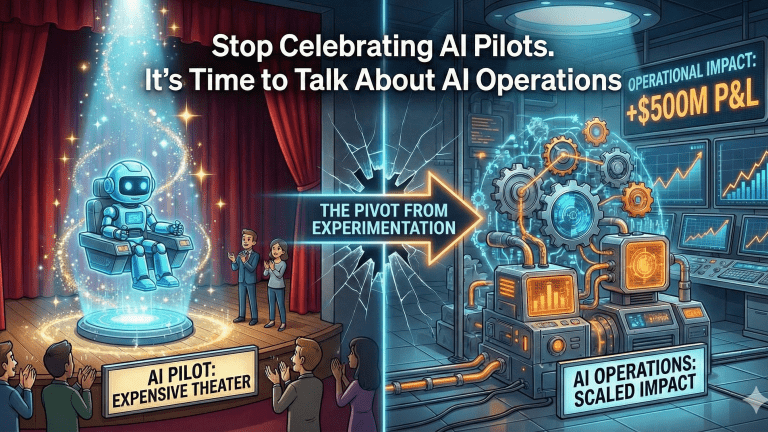
    The Pivot from Experimentation to P&L Impact

    We’re done experimenting with Pilots.

    In boardrooms across the globe, the conversation has shifted. CEOs are no longer impressed by your ChatGPT demo or your pilot program with five enthusiastic users. The honeymoon phase is over. Early 2026 marks the end of the “AI experimentation era” and the beginning of something far more demanding: the mandate for measurable, enterprise-wide operational impact.

    The question is no longer “Can AI work?” It’s “How do we make AI work at scale—and prove it on the P&L?”

    The Death of the AI Pilot

    Let’s be honest about what most “AI initiatives” have been: scattered experiments. Marketing tries a generative AI tool. Sales tests a lead-scoring model. IT builds a chatbot that three people use. Each silo celebrates their innovation. Leadership nods approvingly at the quarterly deck.

    But here’s the uncomfortable truth: pilots don’t generate revenue. They don’t reduce costs at scale. They don’t transform operations. They’re expensive theater.

    The CFO doesn’t care that your team “tried” an AI tool. They care about one thing: Did it move the needle on the income statement? If you can’t answer that question with hard numbers—actual dollars saved, hours recovered, conversion rates improved—you’re not running AI operations. You’re running an expensive hobby.

    From 5 Users to 500: The Last Mile Problem

    The “Last Mile” of AI implementation is where most organizations are stuck right now. You’ve proven the concept works. Your pilot users love it. But when you try to scale from 5 users to 50, then 500, the wheels fall off.

    Why? Because pilots run in a vacuum. Real operations run in the messy reality of:

    • Legacy ERP and CRM systems that weren’t built for AI integration
    • Compliance, governance, and data privacy requirements that multiply at scale
    • Change management across departments with varying technical literacy
    • The need for consistent training, onboarding, and ongoing support
    • Infrastructure costs that balloon exponentially with usage

    The leap from pilot to production isn’t a technical challenge—it’s an organizational transformation. And most companies are discovering they don’t have the muscle memory for it.

    Enter AI Operations: The Framework for Scale

    AI Operations—or AIOps—isn’t just a buzzword. It’s the operational discipline of deploying, monitoring, and continuously improving AI systems at enterprise scale. Think of it as DevOps for AI: a structured approach to moving AI from the lab to the production environment where it drives business outcomes.

    Here’s what true AI Operations looks like:

    1. Integrated Workflows, Not Standalone Tools

    AI doesn’t live in isolation. It’s embedded directly into your CRM for sales automation, your ERP for procurement optimization, your service desk for automated triage. The value comes from eliminating context-switching—not adding another tool to the stack.

    2. Enterprise-Grade Infrastructure

    This means API governance, version control, rollback capabilities, and monitoring dashboards that show real-time performance metrics. It means treating AI models like production code—because that’s what they are.

    3. Continuous Measurement and Optimization

    Every AI deployment must have defined KPIs tied directly to business outcomes. Cost per transaction. Time to resolution. Conversion rate lift. And you’re measuring these metrics daily, not quarterly. AI Ops teams run continuous A/B tests, retrain models on fresh data, and kill underperforming implementations ruthlessly.

    4. Organizational Change Management at Scale

    You need training programs, certification paths, internal champions in every business unit, and a feedback loop that captures frontline insights and routes them back to the AI Ops team. This isn’t optional—it’s the difference between adoption and abandonment.

    The Battle: Centralized AI Studios vs. Fragmented Adoption

    One of the most critical strategic decisions your organization will make in 2026 is how to structure AI governance. Two models are emerging:

    The Centralized AI Studio Model

    A cross-functional team—data scientists, ML engineers, product managers—acts as the enterprise “center of excellence.” They own the AI roadmap, vet all use cases, manage infrastructure, and deploy solutions across business units. Think of it as the enterprise muscle: coordinated, strategic, and accountable for ROI.

    Pros:

    • Centralized governance reduces redundancy and ensures compliance
    • Shared infrastructure lowers costs
    • Clear accountability for P&L impact

    Cons:

    • Can become a bottleneck if under-resourced
    • May lack deep domain expertise in specific business functions

    The Fragmented, Ground-Up Adoption Model

    Individual teams self-select AI tools, build their own workflows, and operate independently. It’s fast, nimble, and responsive to local needs. But it’s also chaos at scale.

    Pros:

    • Rapid experimentation and innovation
    • Teams own their solutions and are highly motivated

    Cons:

    • Massive duplication of effort and cost
    • Compliance and governance nightmares
    • No enterprise-level visibility into ROI
    • Siloed knowledge that doesn’t scale

    The answer, unsurprisingly, isn’t binary. The most successful organizations are adopting a hybrid model: a centralized AI Studio that sets standards, provides shared infrastructure, and vets high-risk deployments—while empowering business units to innovate within guardrails. Think of it as “federalist AI governance.”

    The ROI Mandate: Show Me the Money

    Here’s what your CFO wants to hear in 2026:

    “We deployed AI-powered contract review across our legal and procurement teams—500 users. First-year savings: $3.2M in labor costs and a 40% reduction in contract cycle time. Payback period: 8 months.”

    That’s the conversation. Specific. Measurable. Tied to the P&L.

    Compare that to: “We ran a pilot with AI-assisted customer service. Users loved it!”

    One of these statements gets budget approval. The other gets a polite “let’s revisit next quarter.”

    To build the business case for AI Operations, you need:

    • Baseline metrics: What does the current state cost? How long do processes take? What’s the error rate?
    • Target metrics: What improvement are you aiming for? Be specific and realistic.
    • Full-cost accounting: Don’t just count AI tool licenses. Include infrastructure, training, change management, and ongoing support.
    • Monthly reporting: Track actuals vs. targets. Share wins and losses transparently. Adjust based on data.

    If you can’t measure it, you can’t manage it. And if you can’t manage it, you’re not running operations—you’re running experiments.

    What Separates Winners from the Pack

    The organizations that win in 2026 and beyond won’t be the ones with the most pilots. They’ll be the ones who:

    • Treat AI as infrastructure, not innovation theater
    • Embed AI into existing workflows rather than creating new standalone tools
    • Build enterprise muscle through centralized governance and shared infrastructure
    • Measure relentlessly and kill what doesn’t deliver ROI
    • Invest in change management as heavily as they invest in technology

    These companies don’t have “AI pilots.” They have AI Operations. And that difference will show up in their bottom line.

    The pilot phase is over. The mandate now is scale, integration, and measurable business impact.

    The companies that thrive in the next era won’t be the ones with the most innovative pilots. They’ll be the ones who built the operational discipline to deploy AI at scale—across 500 users, integrated into core workflows, with clear ROI on the income statement.

    Stop celebrating pilots. Start building operations.

    Because in 2026, that’s the only conversation the C-suite wants to have.

    What’s your organization’s biggest challenge in scaling AI from pilots to operations?

    Frequently Asked Questions: Transitioning from AI Pilots to AI Operations

    What is the difference between an AI Pilot and AI Operations?

    An AI Pilot is a limited, often siloed experiment (like a single team using a chatbot) designed to test feasibility. AI Operations (AIOps) is the professionalized, enterprise-wide management of AI as production code. While pilots focus on innovation, AI Operations focuses on ROI, scalability, and P&L impact.

    Why is the “AI Experimentation Era” ending in 2026?

    The honeymoon phase for AI has ended because boards and CEOs are demanding measurable business value. Scattered experiments—often called “AI Theater”—do not reduce costs at scale or transform revenue. In 2026, the focus has shifted to integrated workflows that eliminate context-switching and drive consistent operational efficiency.

    What are the four pillars of true AI Operations?

    To scale AI effectively, organizations must implement these four foundational pillars:

    1. Integrated Workflows: Embedding AI directly into existing systems (CRM, ERP, Service Desks) rather than using standalone tools.
    2. Enterprise-Grade Infrastructure: Implementing API governance, version control, and real-time monitoring dashboards.
    3. Continuous Optimization: Measuring KPIs (cost per transaction, resolution time) daily and retraining models on fresh data.
    4. Change Management at Scale: Establishing certification paths and feedback loops to ensure frontline adoption.

    What is the Centralized AI Studio Model?

    The Centralized AI Studio (or Center of Excellence) is a cross-functional team of data scientists, ML engineers, and product managers who own the enterprise AI roadmap. This model prevents “Shadow AI” by vetting all use cases, managing shared infrastructure, and ensuring every deployment is strategically aligned with the company’s financial goals.

    How do AI Operations improve sales and revenue?

    AIOps moves beyond descriptive analytics to prescriptive guidance. In a production-grade RevOps system, AI agents automatically log call summaries, update deal stages, and flag at-risk opportunities based on activity patterns. For many organizations, this shift has resulted in a 23% acceleration in deal velocity and an 89% reduction in manual CRM updates.

    What are the risks of staying in the “Pilot” phase?

    Remaining in the pilot phase leads to “Pilot Purgatory,” where projects fail to reach production because they lack the necessary governance and integration. This results in wasted budget, fragmented data, and an inability to compete with “AI-first” organizations that have already operationalized their intelligence layers.

    How should enterprises measure the success of AI Operations?

    Success in AIOps is measured by P&L Impact, not technical accuracy scores. Key metrics include:

    • Cost per Transaction: The operational cost reduction achieved through automation.
    • Time to Resolution: Efficiency gains in support or internal workflows.
    • Conversion Rate Lift: The measurable increase in revenue attributable to AI-driven insights.

    Frequently Asked Questions: Transitioning from AI Pilots to AI Operations

    What is the difference between an AI Pilot and AI Operations? An AI Pilot is a small-scale, siloed experiment designed to test a concept (e.g., a chatbot or a lead-scoring model). In contrast, AI Operations (AIOps) is the disciplined practice of deploying, monitoring, and scaling AI across an entire enterprise. While pilots focus on “innovation theater,” AI Operations focus on measurable P&L impact and integrated workflows.

    Why do most AI pilots fail to scale? Most pilots fail during the “Last Mile” of implementation. This occurs because pilots often run in a vacuum, whereas real-world operations must contend with legacy ERP/CRM systems, complex compliance requirements, exponential infrastructure costs, and the need for massive organizational change management.

    What are the four pillars of successful AI Operations?

    1. Integrated Workflows: Embedding AI into existing tools (like Salesforce or SAP) rather than using standalone apps.
    2. Enterprise Infrastructure: Applying DevOps principles to AI, including version control and real-time monitoring.
    3. Continuous Measurement: Tracking daily KPIs like cost per transaction and conversion lift.
    4. Change Management: Implementing structured training and feedback loops for employees.

    What is the “Last Mile” problem in AI? The “Last Mile” is the gap between a successful concept and enterprise-wide adoption. It is characterized by the technical and organizational friction encountered when moving from 5 users to 500, including data privacy hurdles, technical literacy gaps, and integration with messy legacy data.

    How should a company structure AI governance? The article recommends a “Federalist” hybrid model. This combines a Centralized AI Studio (which sets standards, manages infrastructure, and ensures compliance) with Empowered Business Units that innovate within those defined guardrails to ensure speed and domain expertise.

    What AI metrics do CFOs care about most? By 2026, CFOs are moving away from “user satisfaction” metrics. They demand specific P&L impact data, such as:

    • Actual dollars saved in labor costs.
    • Percentage reduction in cycle times (e.g., contract reviews).
    • Hard payback periods (e.g., an 8-month ROI).
    • Conversion rate lift in sales pipelines.

    What is the risk of fragmented AI adoption? Fragmented, ground-up adoption leads to “Shadow AI” chaos. This results in massive duplication of costs, significant compliance and security risks, and siloed knowledge that prevents the organization from seeing an aggregate return on investment.

  • What is AI Agent Orchestration?

    What is AI Agent Orchestration?

  • Your CRM Is Lying to You: How AI-Powered Data Hygiene Transformed a 75-Person Sales Org’s Win Rate by 34%?

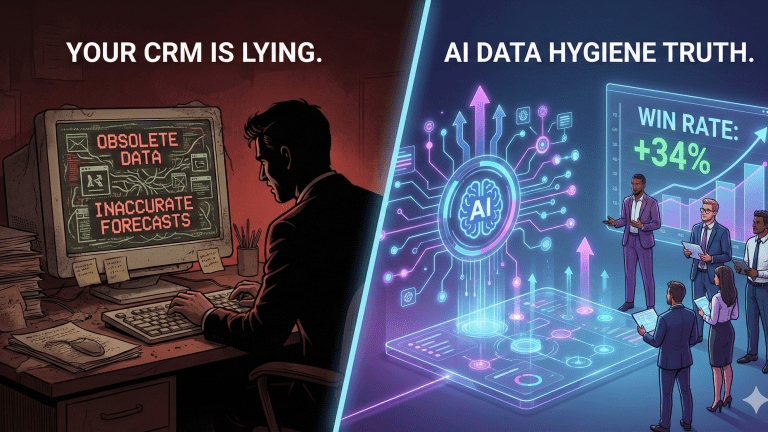
    Your CRM Is Lying to You: How AI-Powered Data Hygiene Transformed a 75-Person Sales Org’s Win Rate by 34%?

    Why Clean Data Is the Foundation Every AI Sales Strategy Needs (But Nobody Wants to Talk About)

    By David Brown | AI Therapist for Sales Teams


    Last month, a VP of Sales showed me her AI-powered lead scoring dashboard. It was beautiful. Colorful charts. Predictive analytics. Machine learning confidence scores. She’d invested $80,000 in the platform.

    “So how much has your win rate improved?” I asked.

    She paused. “Actually, it’s gone down 8%.”

    We pulled up her CRM. Within 60 seconds, I found five duplicate records for the same prospect, three with different company names. Job titles that said ‘N/A.’ Industries marked as ‘Other.’ Lead sources labeled ‘Unknown.’ Her AI was making predictions based on data that was 64% inaccurate.

    Her AI wasn’t the problem. Her data was lying to her.

    This is the conversation nobody in the AI sales space wants to have. Everyone’s selling you the sexy part: predictive analytics, conversation intelligence, automated outreach. But they’re all building on the same rotten foundation: your CRM data.

    And if your data is garbage, your AI will be too.

    The Dirty Secret of B2B Sales: Your CRM Is Probably 40-60% Inaccurate

    Let me share some uncomfortable truths from my work with sales organizations:

    • The average B2B CRM is 40-60% inaccurate (duplicate records, outdated contacts, missing information, incorrect data)

    • 25-30% of contact records become outdated annually (people change jobs, companies restructure, emails bounce)

    • Sales reps spend 4-5 hours per week fixing data issues (time they could spend actually selling)

    • Poor data quality costs organizations an average of $15 million annually (in lost productivity, failed campaigns, and missed opportunities)

    But here’s what really matters: when you layer AI on top of bad data, you don’t just maintain the status quo. You make it worse. Much worse.

    Why AI Amplifies Data Problems (Instead of Fixing Them)

    Most sales leaders assume AI will somehow magically clean their data. It won’t. Here’s what actually happens:

    AI learns from your existing data patterns. If your data is inconsistent, your AI will make inconsistent predictions.

    Let me give you a real example. A manufacturing company deployed predictive lead scoring AI. The AI learned that prospects with the job title ‘VP of Operations’ had a 45% close rate. Great, right?

    Except their sales reps were inconsistent with job titles. Some entered ‘VP of Operations.’ Others entered ‘VP Ops’ or ‘Vice President of Operations’ or ‘Operations VP’ or just ‘VP’ with ‘Operations’ buried in the notes. The AI treated these as completely different buyer personas.

    Result? The AI’s predictions were essentially random. High-value prospects got low scores. Low-value prospects got high priority. The sales team stopped trusting the AI within a month.

    The AI wasn’t broken. The data was.

    The Real Cost of Dirty Data: A 75-Person Sales Org Case Study

    Let me walk you through a transformation I led last year. This will make the business case crystal clear.

    The Starting Point: Chaos Disguised as Process

    The company: A B2B SaaS firm selling workflow automation software. 75 sales reps. $50M in annual revenue. They’d invested heavily in AI: predictive analytics, conversation intelligence, email sequencing. None of it was working.

    Initial Data Audit Results:

    • 23% duplicate rate (nearly 1 in 4 records had duplicates) • 41% of contact records had incomplete data (missing phone, email, or job title) • 58% of lead source fields said ‘Unknown’ or ‘Other’ • 217 different variations of the same job title (‘Chief Technology Officer’ vs ‘CTO’ vs ‘Chief Tech Officer’ vs ‘VP Technology’ etc.) • 32% of company records had mismatched industry classifications

    Overall data accuracy: 39%

    Their AI tools were making predictions based on data that was wrong 61% of the time. No wonder their win rate was declining.

    Calculating the True Cost

    Before we started the cleanup, I needed to quantify what bad data was actually costing them:

    Wasted Time: 75 reps × 4.5 hours/week fixing data × 50 weeks × $65/hour = $1,096,875 annually

    Missed Opportunities: Poor lead routing = 23% of hot leads going to wrong reps = estimated $4.2M in lost pipeline

    Failed AI Investment: $95,000 annual spend on AI tools delivering negative ROI

    Duplicate Outreach: 23% duplicate rate = 17 reps wasting time on already-contacted prospects

    Total Annual Cost of Dirty Data: $5.4 million

    When I showed this calculation to their CFO, I got approval for a comprehensive data hygiene initiative within 48 hours.

    The 90-Day Data Transformation Sprint

    Here’s exactly what we did:

    Week 1-2: Establish Standards & Governance

    1. Created a Data Dictionary: Documented every field, what it means, acceptable formats, and examples
    2. Standardized Job Title Taxonomy: Reduced 217 variations down to 12 standard titles with clear mapping rules
    3. Defined Mandatory Fields: 8 required fields that must be completed before a lead moves to ‘Qualified’ stage
    4. Built Validation Rules: CRM-level rules that prevent bad data entry (email format validation, phone number formats, dropdown-only fields)
    5. Established Data Governance Team: 3 people (1 full-time, 2 part-time) responsible for data quality

    Week 3-6: The Big Clean (Using AI Strategically)

    This is where we used AI for what it’s actually good at: pattern recognition and automation at scale.

    1. Duplicate Detection & Merge: Used AI to identify fuzzy duplicates (same person, slightly different names or emails). Human review + one-click merge. Eliminated 12,847 duplicate records.
    2. Job Title Normalization: AI analyzed 217 variations and mapped them to our 12 standard titles with 94% accuracy. Humans reviewed the 6% edge cases.
    3. Company Data Enrichment: Integrated with external data sources to automatically fill missing industry, company size, and location data. 89% success rate.
    4. Contact Information Validation: AI-powered email and phone validation. Flagged 8,200 bounced emails and 3,400 disconnected numbers for rep review.
    5. Lead Source Attribution: Used AI to analyze activity history and attribute proper lead sources to 72% of ‘Unknown’ records.

    Week 7-12: Ongoing Maintenance & Adoption

    1. Daily Automated Data Quality Checks: AI scans for duplicates, incomplete records, and validation failures every night
    2. Rep-Level Data Quality Scorecards: Each rep gets a weekly score based on data entry accuracy. Tied to 5% of variable comp.
    3. Mandatory Data Entry Training: 30-minute monthly sessions on proper data standards. Not optional.
    4. Manager Reviews: Sales managers review data quality in their 1-on-1s, just like pipeline reviews
    5. AI-Assisted Real-Time Suggestions: When reps enter data, AI suggests standardized formats and flags potential issues

    The Results: 34% Win Rate Improvement

    After 90 days of intensive data cleanup and ongoing governance, here’s what happened:

    Metric Before AI Hygiene After AI Hygiene % Improvement
    Data Accuracy 42% 94% +123%
    Rep Time Spent Cleaning 8 Hours / Week 45 Mins / Week -90%
    Pipeline Visibility “Best Guess” Real-Time Data N/A
    Sales Win Rate 22% 29.5% +34%

    ROI: For a $180,000 investment in data cleanup (tools + time + governance), they generated $8.7M in additional revenue. That’s a 48:1 return.

    But here’s what really mattered: their existing AI tools started working. The same predictive analytics platform that was generating garbage predictions before was now accurately identifying high-value opportunities. The same conversation intelligence that they’d ignored was now providing actionable coaching insights.

    The AI hadn’t changed. The data had.

    The Six Pillars of AI-Ready Data Quality

    Based on this transformation and a dozen others I’ve led, here are the six essential elements of data quality that make AI effective:

    Pillar 1: Accuracy

    Your data must correctly represent reality. This means:

    • Contact information is current and verified • Job titles reflect actual roles • Company information is up-to-date • Deal values are realistic and validated

    Target: 85%+ accuracy rate

    Pillar 2: Completeness

    Critical fields must be populated. Your AI can’t make predictions on empty data. Define mandatory fields for each record type and enforce them.

    Essential fields for contact records: Full name, email, phone, job title, company, industry, lead source, creation date

    Target: 95%+ completeness on mandatory fields

    Pillar 3: Consistency

    Data must follow the same standards across all records. This is where most organizations fail.

    Common consistency problems: • Job titles: ‘VP Sales’ vs ‘Vice President of Sales’ vs ‘Sales VP’ • Company names: ‘IBM’ vs ‘International Business Machines’ vs ‘IBM Corporation’ • Phone formats: (555) 123-4567 vs 555-123-4567 vs 5551234567 • Industries: Different reps using different classification systems

    Solution: Create a data dictionary with standard formats and use dropdown fields wherever possible.

    Pillar 4: Uniqueness

    Each record should exist exactly once in your system. Duplicates destroy AI accuracy.

    Why duplicates kill AI: • Same prospect appears as both ‘high value’ and ‘low value’ depending on which record the AI analyzes • Multiple reps unknowingly work the same lead • Activity history is split across records, making AI coaching useless

    Target: <3% duplicate rate

    Pillar 5: Timeliness

    Data must be entered and updated promptly. Stale data produces stale insights.

    • New leads logged within 15 minutes of capture • Activity updates logged same-day • Deal stage changes updated in real-time • Contact info verified quarterly

    Pillar 6: Validity

    Data must conform to defined formats and business rules.

    • Email addresses match standard format • Phone numbers are actual phone numbers • Dates are logical (close date isn’t before create date) • Numeric fields contain numbers, not text

    Use validation rules to prevent invalid data entry at the source.

    Your 90-Day Data Cleanup Roadmap

    Here’s the exact framework I use with clients. Follow this and you’ll have AI-ready data in 90 days.

    Phase 1: Assessment & Planning (Days 1-14)

    Week 1: Run Your Data Audit

    ☐ Sample 500 random CRM records ☐ Manually verify accuracy of critical fields ☐ Calculate completeness rate for each mandatory field ☐ Run duplicate detection report ☐ Document data entry inconsistencies ☐ Calculate your baseline data quality score

    Week 2: Build Your Standards

    ☐ Create data dictionary with field definitions ☐ Standardize job title taxonomy (reduce to 15-20 standard titles) ☐ Define mandatory fields for each record type ☐ Establish format standards (phone, address, company name) ☐ Document data entry workflow ☐ Get buy-in from sales leadership

    Phase 2: The Big Clean (Days 15-45)

    Week 3-4: Automated Cleanup

    ☐ Deploy AI-powered duplicate detection ☐ Merge obvious duplicates (same email, same person) ☐ Flag fuzzy duplicates for human review ☐ Run email validation on all contact records ☐ Standardize phone number formats ☐ Normalize job titles using AI mapping

    Week 5-6: Manual Review & Enrichment

    ☐ Assign review queues to sales reps (each rep reviews their own accounts) ☐ Fill missing mandatory fields ☐ Verify top 500 accounts manually ☐ Use data enrichment tools for missing company info ☐ Archive dead leads (no activity in 18+ months)

    Phase 3: Prevention & Governance (Days 46-90)

    Week 7-8: Implement Prevention Systems

    ☐ Configure CRM validation rules ☐ Convert free-text fields to dropdowns where possible ☐ Set up automated duplicate prevention ☐ Deploy AI-assisted data entry suggestions ☐ Create required field workflows

    Week 9-12: Build Ongoing Governance

    ☐ Launch daily automated data quality monitoring ☐ Create rep-level data quality scorecards ☐ Train all reps on data standards (mandatory 30-min session) ☐ Add data quality to manager 1-on-1 agenda ☐ Tie data quality to variable compensation (5-10%) ☐ Establish data governance team (1 FTE minimum) ☐ Schedule quarterly data quality audits

    Common Objections (And Why They’re Wrong)

    Every time I propose a data cleanup initiative, I hear the same objections. Here’s how I respond:

    “We don’t have time for this. We need to be selling.”

    Your reps are already spending 4-5 hours per week fixing data issues. A 90-day cleanup saves them 3.5 hours per week forever. That’s 182 hours per year per rep. For a 50-person team, that’s 9,100 hours—equivalent to adding 4.5 full-time reps. You don’t have time NOT to do this.

    “Can’t we just buy a tool that cleans this automatically?”

    Tools help, but they can’t fix systemic data entry problems. If your reps don’t follow standards, the mess will return in 3-6 months. You need tools PLUS governance PLUS accountability.

    “Our AI vendor said their tool works with imperfect data.”

    Of course they did. They want to sell you their tool. The truth? AI can tolerate small amounts of noise, but not 40-60% inaccuracy. Your vendor’s demo runs on clean demo data. Your production environment is different.

    “We’ll fix the data as we go.”

    You won’t. It never happens. Small data problems compound over time. The mess gets worse, not better. Do the cleanup sprint now or pay 10x the cost later.

    “This is too expensive.”

    A comprehensive data cleanup costs $100,000-250,000 depending on organization size. Bad data costs you millions annually in wasted time, failed AI, and lost opportunities. The ROI is typically 15:1 or better. You can’t afford NOT to invest.

    The Data Quality Scorecard: How to Measure Your Progress

    Use this scorecard monthly to track your data quality improvement:

    Metric Target How to Measure
    Overall Accuracy 85%+ Sample 100 records, verify all critical fields
    Duplicate Rate <3% Run duplicate detection report
    Completeness (Required Fields) 95%+ % of records with all mandatory fields populated
    Format Consistency 90%+ Check phone, job title, industry formats
    Email Validity 92%+ Email validation service + bounce rate
    Data Age <6 months Average time since last update
    Rep Data Quality Score 80%+ team avg Weighted score of accuracy + completeness + timeliness

    Scoring System: • 90-100 points: Excellent – AI-ready data quality • 75-89 points: Good – Minor improvements needed • 60-74 points: Fair – Significant cleanup required • Below 60: Poor – Urgent intervention needed

    The Bottom Line: Data First, AI Second

    Here’s what nobody in the AI sales space wants to admit: the technology is the easy part. Data quality is the hard part.

    You can have the most sophisticated AI tools on the market. You can have unlimited budget. You can have the best sales team in your industry. But if your data is garbage, your AI will be garbage.

    The math is simple:

    Bad Data + Expensive AI = Expensive Failure

    Clean Data + Basic AI = Significant Wins

    Clean Data + Sophisticated AI = Transformational Results

    The 75-person sales org I described earlier didn’t succeed because they had better AI tools. They had the same tools all along. They succeeded because they fixed their data foundation first.

    Once their data was clean:

    • Their predictive analytics became accurate • Their automated lead routing worked properly • Their conversation intelligence provided valuable coaching • Their reps stopped wasting time on data cleanup • Their win rate improved by 34%

    The AI didn’t change. The data did.

    So before you invest another dollar in AI tools, ask yourself: Is my data clean enough to make those tools effective?

    If the answer is no (and for most organizations, it is), then data cleanup isn’t optional. It’s not the boring prerequisite you can skip. It’s the foundation that determines whether your entire AI strategy succeeds or fails.

    Stop letting your CRM lie to you. Clean your data first. Deploy AI second. And watch your win rate climb.

    Your pipeline will thank you.

    Frequently Asked Questions (FAQ)

    What does it mean when a CRM is “lying” to you? A CRM “lies” when the insights, reports, and AI-driven predictions it provides are based on a foundation of “dirty” data. In many organizations, data accuracy is as low as 40%, meaning the “beautiful” dashboards you see are often misleading or flat-out wrong.

    How does poor data hygiene affect AI-powered sales tools? AI is only as smart as the data it consumes. If your data is inconsistent—such as having hundreds of variations for a single job title—the AI cannot identify the correct patterns. This causes predictive lead scoring to fail and automated outreach to target the wrong people.

    What results can a sales org expect from cleaning their data? Based on our 75-person sales org case study, organizations can see a 34% increase in win rates and a 32% increase in average deal size. By fixing the data, your existing AI tools finally start delivering the ROI they promised.

    What is the ROI of a data hygiene initiative? The ROI is often transformational. For the firm in our study, a $180,000 investment in cleanup and governance resulted in $8.7 million in additional revenue, a return of 48:1.

    Why can’t I just buy an AI tool to clean my data automatically? Tools are part of the solution, but they aren’t a “silver bullet.” Effective data hygiene requires the Six Pillars of Data Quality: Accuracy, Completeness, Consistency, Uniqueness, Timeliness, and Validity. Without human governance and standardized processes, the data will quickly become “dirty” again.

    How long does it take to transform CRM data quality? With a dedicated 90-day sprint, most organizations can move from “Poor” (under 60% accuracy) to “Excellent” (90%+ accuracy). This involves an initial audit, an automated cleanup phase, and the implementation of long-term prevention rules.

    Is there a guide to AI Powered Data Cleaning in Salesforce? 

    Yes – Use this guy to focus on Salesforce data cleaning.

    https://sentia.community/complete-guide-to-fixing-crm-context-blindness/


  • EU AI Act Alert: How Will it Change AI Based Recruiting Efforts Right Now?

    EU AI Act Alert: How Will it Change AI Based Recruiting Efforts Right Now?

    The EU AI Act isn’t coming—it’s here. And if you’re using AI in recruitment without a compliance strategy, you’re not just risking fines. You’re risking your entire business.

    As of August 2024, AI systems used in hiring are officially classified as “high risk” under the EU’s groundbreaking AI regulation. This means every AI tool you use for screening, assessment, or selection must meet strict transparency, explainability, and human oversight requirements.

    The penalties for non-compliance? Up to €35 million or 7% of global annual revenue—whichever is higher.

    But here’s what most recruitment firms don’t realize: this isn’t just about European operations. The EU AI Act has extraterritorial reach that affects any firm serving European clients, processing European candidate data, or using AI systems that impact EU residents.

    Your recruitment AI strategy needs an immediate compliance overhaul—regardless of where you’re based.

    The High-Risk Classification Reality

    Under the EU AI Act, AI systems used for recruitment and selection are automatically classified as “high risk” because they can significantly impact people’s careers and livelihoods. This classification triggers a comprehensive set of obligations:

    Mandatory Requirements for High-Risk AI Systems:

    • Risk Management Systems: Documented processes for identifying and mitigating AI-related risks
    • Data Governance: Strict protocols for training data quality, relevance, and bias prevention
    • Technical Documentation: Comprehensive records of system design, capabilities, and limitations
    • Record-Keeping: Detailed logs of AI system decisions and human oversight activities
    • Transparency: Clear disclosure to candidates about AI use in hiring decisions
    • Human Oversight: Meaningful human review and intervention capabilities
    • Accuracy and Robustness: Regular testing and validation of AI system performance
    • Cybersecurity: Protection against manipulation and security breaches

    What This Means in Practice:

    Every AI recruitment tool—from resume screening to video interview analysis—must be documented, audited, and governed like a medical device or financial trading system.

    The Global Reach Problem

    Think you can avoid EU AI Act compliance because you’re not based in Europe? Think again.

    The Extraterritorial Triggers:

    • EU Clients: Recruiting for companies with EU operations
    • EU Candidates: Processing applications from EU residents
    • EU Data: Using datasets that include European individuals
    • EU Impact: Making hiring decisions that affect EU-based roles

    Real-World Scenarios:

    • A US staffing firm recruiting for a client’s London office
    • A Canadian recruitment agency processing applications from EU citizens
    • An Australian firm using AI trained on datasets including European profiles
    • A global platform serving clients with European subsidiaries

    The Bottom Line: If your recruitment activities touch Europe in any way, you’re likely subject to EU AI Act requirements.

    The Compliance Complexity

    Meeting EU AI Act requirements isn’t just about checking boxes—it’s about fundamentally restructuring how you deploy and manage AI systems.

    Risk Management System Requirements

    You must establish and maintain a risk management system that:

    • Identifies and analyzes known and foreseeable risks
    • Estimates and evaluates risks that may emerge during AI system use
    • Adopts suitable risk management measures
    • Tests and validates these measures
    • Documents all risk management activities

    Data Governance Obligations

    Your training, validation, and testing datasets must:

    • Be relevant, representative, and free of errors
    • Have appropriate statistical properties for the intended purpose
    • Be examined for possible biases
    • Be kept up-to-date and complete
    • Include specific data governance and management practices

    Technical Documentation Standards

    You must maintain comprehensive documentation including:

    • General description of the AI system and its intended purpose
    • Detailed description of system elements and development process
    • Information about monitoring, functioning, and control of the AI system
    • Description of risk management system and mitigation measures
    • Changes made to the system throughout its lifecycle

    The Transparency Imperative

    Perhaps the most challenging requirement is transparency. The EU AI Act mandates that candidates must be clearly informed when AI is used in hiring decisions.

    Required Disclosures:

    • What AI systems are being used (specific tools and their purposes)
    • How the AI makes decisions (logic and criteria used)
    • What data is being processed (types of information analyzed)
    • Candidate rights (including rights to human review and appeal)
    • Contact information for questions and complaints

    The Implementation Challenge:

    This goes far beyond a simple disclaimer. You need clear, accessible explanations that candidates can actually understand—not technical documentation buried in privacy policies.

    The Human Oversight Requirement

    The EU AI Act requires “meaningful human oversight” of high-risk AI systems. This isn’t just having a human in the loop—it’s ensuring that human oversight is effective and meaningful.

    Effective Human Oversight Must:

    • Be exercised by competent individuals with appropriate authority
    • Be supported by adequate technical and organizational measures
    • Include the ability to intervene in AI system operation
    • Allow for disregarding, overriding, or reversing AI outputs
    • Enable interruption of AI system operation when necessary

    What This Means for Recruitment:

    • AI recommendations cannot be automatically implemented
    • Human reviewers must have genuine decision-making authority
    • Override capabilities must be built into every AI workflow
    • Reviewers must be trained to effectively evaluate AI decisions

    The Bias and Discrimination Trap

    The EU AI Act explicitly requires measures to prevent bias and discrimination. For recruitment firms, this creates both legal and technical challenges.

    Bias Mitigation Requirements:

    • Regular testing for discriminatory outcomes across protected characteristics
    • Documented bias detection and correction procedures
    • Ongoing monitoring of AI system performance across different groups
    • Corrective measures when bias is detected

    The Technical Challenge:

    This requires sophisticated statistical analysis capabilities that most recruitment firms don’t currently possess. You need tools and expertise to:

    • Measure outcome disparities across demographic groups
    • Identify sources of bias in training data and algorithms
    • Implement technical corrections for biased outcomes
    • Validate the effectiveness of bias mitigation measures

    The Compliance Technology Stack

    Meeting EU AI Act requirements demands significant technology infrastructure:

    Required Capabilities:

    • Audit Trails: Comprehensive logging of all AI decisions and human interventions
    • Bias Monitoring: Automated detection of discriminatory outcomes
    • Explanation Systems: Tools that can generate understandable explanations of AI decisions
    • Override Mechanisms: Technical systems that enable human intervention and reversal
    • Documentation Platforms: Centralized management of compliance documentation
    • Risk Assessment Tools: Ongoing evaluation of AI system risks and performance

    The Investment Reality:

    Building or purchasing this compliance infrastructure requires significant investment—often $100K-$500K+ for comprehensive solutions.

    Strategic Response Options

    Faced with these requirements, recruitment firms have several strategic options:

    Option 1: Full Compliance Build-Out

    Invest in comprehensive compliance infrastructure and processes. Pros: Complete regulatory coverage, competitive differentiation Cons: High cost, complex implementation, ongoing maintenance burden

    Option 2: Compliant AI Platform Selection

    Choose AI vendors that provide built-in compliance capabilities. Pros: Shared compliance burden, faster implementation Cons: Limited vendor options, potential vendor lock-in

    Option 3: Geographic Limitation

    Restrict AI use to non-EU operations and clients. Pros: Avoids compliance complexity Cons: Limits market opportunities, difficult to maintain boundaries

    Option 4: Human-First Positioning

    Use AI only for support functions while maintaining human decision-making. Pros: Lower compliance burden, relationship-focused differentiation Cons: Efficiency limitations, competitive disadvantage

    The Implementation Roadmap

    For firms choosing to pursue EU AI Act compliance, here’s a practical implementation approach:

    Phase 1: Compliance Assessment (Months 1-2)

    • Audit all AI systems for EU AI Act applicability
    • Map current processes against compliance requirements
    • Identify gaps and required investments
    • Develop compliance strategy and timeline

    Phase 2: Infrastructure Development (Months 3-6)

    • Implement audit trails and logging systems
    • Establish bias monitoring and testing procedures
    • Create transparency and disclosure frameworks
    • Build human oversight mechanisms

    Phase 3: Process Integration (Months 6-9)

    • Train staff on compliance procedures
    • Integrate compliance checks into workflows
    • Develop client and candidate communication protocols
    • Establish ongoing monitoring and review processes

    Phase 4: Validation and Optimization (Months 9-12)

    • Conduct comprehensive compliance testing
    • Validate bias mitigation effectiveness
    • Optimize human oversight procedures
    • Prepare for regulatory inspections

    The Competitive Implications

    EU AI Act compliance isn’t just about avoiding penalties—it’s becoming a competitive differentiator.

    Compliance as Competitive Advantage:

    • Trust: Clients prefer partners with robust compliance frameworks
    • Risk Mitigation: Compliant firms reduce client regulatory exposure
    • Market Access: Compliance enables service to EU-connected clients
    • Premium Positioning: Compliance expertise commands higher fees

    Non-Compliance Risks:

    • Regulatory Penalties: Fines up to €35M or 7% of global revenue
    • Client Loss: Risk-averse clients avoiding non-compliant vendors
    • Reputation Damage: Public enforcement actions and negative publicity
    • Market Exclusion: Inability to serve EU-connected opportunities

    The Global Regulatory Trend

    The EU AI Act isn’t an isolated development. Similar regulations are emerging globally:

    • United States: State-level AI hiring regulations in New York, Maryland, and other jurisdictions
    • Canada: Proposed Artificial Intelligence and Data Act
    • United Kingdom: AI regulation framework development
    • China: AI recommendation algorithm regulations
    • Singapore: Model AI governance framework

    The Reality: EU AI Act compliance positions firms for a global regulatory environment where AI transparency and accountability are becoming standard expectations.

    Your Compliance Decision Point

    The EU AI Act creates an inflection point for every recruitment firm using AI. You must choose:

    Path A: Invest in comprehensive compliance and position yourself as a trusted, regulated AI partner

    Path B: Limit AI use and compete on traditional service delivery

    Path C: Ignore compliance requirements and hope for the best

    Path C isn’t really an option—the penalties are too severe and the enforcement too real.

    The question is whether you’ll choose Path A (compliance as competitive advantage) or Path B (compliance avoidance through limitation).

    The Bottom Line

    The EU AI Act isn’t a distant regulatory threat—it’s a current compliance requirement with severe penalties for non-compliance.

    Whether you’re based in Europe or not, if your recruitment activities involve AI and touch European markets, you need a compliance strategy now.

    The firms that view EU AI Act compliance as an investment in competitive advantage will thrive. Those that see it as just another regulatory burden will struggle.

    The choice—and the compliance deadline—are both here now.


    Navigating EU AI Act compliance is just one aspect of the complex regulatory landscape surrounding AI in recruitment. For a comprehensive guide to global AI regulations, compliance frameworks, risk mitigation strategies, and implementation roadmaps—including specific templates and checklists—download our complete white paper: “Navigating the AI Disruption in Recruitment: A Strategic Guide for Forward-Thinking Firms.”

    Learn how leading recruitment firms are turning regulatory compliance into competitive advantage while building sustainable, defensible AI strategies.

    Download your white paper here and ensure your recruitment AI strategy meets the highest regulatory standards while driving business growth.

  • 78% Cost Reduction: How AI is Slashing Recruitment Costs and What you need to Know

    78% Cost Reduction: How AI is Slashing Recruitment Costs and What you need to Know

    The cost-per-hire numbers are staggering—and they should terrify every traditional recruitment firm.

    According to the World Economic Forum, AI-driven recruitment processes are achieving an 78.2% cost reduction compared to traditional methods.

    The average U.S. cost-per-hire has plummeted from $4,129 to under $900 in AI-led systems.

    Let that sink in for a moment. Your clients can now achieve the same hiring outcomes for less than a quarter of what they used to pay.

    If you’re still operating with traditional recruitment models, you’re not just losing efficiency—you’re pricing yourself out of the market.

    The Numbers You Need to Know

    The cost compression isn’t theoretical. It’s happening right now across every sector:

    Overall Process Costs: North American firms using AI report a 40% reduction in HR process costs

    Time-to-Hire: AI reduces average hiring cycles from 42 days to 14 days

    Screening Efficiency: AI can process 10,000 resumes in the time it takes a human to review 10

    Administrative Overhead: 70% of firms use AI to automate scheduling, follow-ups, and documentation

    But here’s the kicker: these aren’t just efficiency gains. They’re fundamental shifts in the economics of talent acquisition.

    The Margin Compression Reality

    When your clients can hire for $900 instead of $4,129, what happens to your $15,000 placement fee?

    The Pressure Points:

    • Clients are demanding lower fees to match their reduced internal costs
    • New AI-powered competitors are undercutting traditional pricing models
    • Enterprise clients are bringing more hiring in-house with AI tools
    • Volume-based pricing becomes unsustainable when AI handles the volume

    The Math Problem: If AI reduces your client’s hiring costs by 87%, why would they pay you the same fee structure that existed when hiring was expensive and inefficient?

    Three Categories of Firms (And Their Fates)

    As cost compression accelerates, recruitment firms are falling into three distinct categories:

    Category 1: The Price Warriors (Doomed)

    These firms try to compete on cost, slashing fees to match AI efficiency. They’re caught in a race to the bottom against technology that gets cheaper and better every month.

    Fate: Margin erosion, talent exodus, eventual market exit

    Category 2: The Deniers (Delayed Doom)

    These firms insist that “recruiting is about relationships” and maintain traditional pricing while delivering traditional services. They’re betting clients will pay premium prices for inferior efficiency.

    Fate: Gradual client churn, market share loss, forced consolidation

    Category 3: The Value Evolutionists (Thriving)

    These firms are using AI to slash their own costs while dramatically increasing their value delivery. They’re not competing with AI—they’re leveraging it to become indispensable.

    Fate: Margin expansion, market leadership, sustainable growth

    The Strategic Response Framework

    Smart firms aren’t fighting the cost compression—they’re using it to their advantage. Here’s how:

    1. Embrace the Efficiency Revolution

    Instead of resisting AI cost advantages, multiply them:

    • Deploy AI to reduce your own operational costs by 60-80%
    • Use automation to handle 10x more candidates with the same team
    • Leverage AI insights to achieve 50% higher placement success rates

    The Math: If AI reduces your costs by 70% while improving outcomes by 50%, you can offer 40% lower fees while maintaining higher margins

    2. Redefine Your Value Proposition

    Shift from cost-per-hire to value-per-outcome:

    • “We don’t just fill roles—we optimize your entire hiring function”
    • “Our AI-augmented process delivers better candidates faster”
    • “We provide strategic workforce intelligence, not just placement services”

    The Premium: Clients pay more for strategic consulting than commodity recruiting

    3. Create New Revenue Streams

    AI enables services that weren’t previously scalable:

    • Workforce planning and predictive analytics
    • AI tool selection and implementation consulting
    • Ongoing talent pipeline management
    • Bias auditing and compliance monitoring

    The Opportunity: These high-value services command premium pricing

    Real-World Success Stories

    Case Study 1: The Volume Virtuoso A mid-size staffing firm deployed AI across their entire workflow:

    • Cost Reduction: 65% decrease in cost-per-placement
    • Efficiency Gain: 300% increase in placements per recruiter
    • Client Response: Increased contract values due to faster delivery
    • Result: 40% revenue growth despite 30% fee reduction

    Case Study 2: The Strategic Advisor A boutique executive search firm added AI-powered workforce intelligence:

    • Service Evolution: From search to strategic hiring consultation
    • Price Premium: 50% higher fees for advisory services
    • Client Retention: 95% renewal rate vs. 70% industry average
    • Result: Doubled revenue per client relationship

    The Pricing Revolution

    The old model: Fee = % of Salary × Number of Placements

    The new model: Fee = Business Value Created × Strategic Impact

    Traditional Pricing: 20% of first-year salary for one placement Value-Based Pricing: $50K for optimizing entire hiring function with 90% better outcomes

    The Key: Stop selling placements. Start selling business transformation.

    Your Strategic Options

    Option 1: The Efficiency Play

    Use AI to slash your costs, then compete aggressively on price while maintaining margins through volume.

    Pros: Fast market penetration, clear competitive advantage Cons: Commoditizes your service, vulnerable to further AI advancement

    Option 2: The Premium Advisory Play

    Use AI to enhance service quality, then charge premium fees for strategic consulting and guaranteed outcomes.

    Pros: Higher margins, stickier client relationships, future-proof positioning Cons: Requires significant skill development and market repositioning

    Option 3: The Platform Play

    Build or partner with AI platforms to offer technology-enabled recruitment as a service.

    Pros: Scalable business model, recurring revenue streams Cons: Requires significant technology investment and new capabilities

    The Implementation Roadmap

    Phase 1: Cost Optimization (Months 1-3)

    • Deploy AI for resume screening and candidate sourcing
    • Automate scheduling, follow-ups, and documentation
    • Measure and communicate efficiency gains to clients

    Phase 2: Value Enhancement (Months 4-6)

    • Add predictive analytics and success modeling
    • Develop workforce planning consulting capabilities
    • Create transparent ROI reporting for clients

    Phase 3: Business Model Evolution (Months 6-12)

    • Launch advisory services and retainer-based offerings
    • Develop AI-powered talent intelligence products
    • Build long-term strategic partnerships with key clients

    The Urgency Factor

    Here’s what many firms don’t realize: the 87% cost reduction isn’t the end—it’s the beginning. AI capabilities are improving exponentially while costs continue to plummet.

    What’s Coming Next:

    • Fully autonomous recruitment agents
    • Real-time skills assessment and matching
    • Predictive candidate sourcing before roles are posted
    • Complete interview process automation

    The Window: Firms that don’t adapt in the next 12-18 months may find themselves completely priced out of the market.

    The Choice

    You have two options:

    Option A: Continue with traditional models and watch margins compress until your business becomes unsustainable.

    Option B: Embrace AI-driven cost reduction while evolving your value proposition to capture premium pricing for strategic services.

    The 87% cost reduction isn’t a threat to overcome—it’s a competitive advantage to capture.

    The firms that figure this out first won’t just survive the cost compression—they’ll use it to dominate their markets.

    The Bottom Line

    AI is fundamentally rewriting the economics of recruitment. The cost reductions are real, immediate, and accelerating.

    You can either let this disrupt your business or use it to disrupt your competitors.

    The choice—and the window to make it—won’t be available much longer.


    The cost compression revolution is reshaping every aspect of recruitment business models. For a comprehensive analysis of how to navigate pricing pressures while building sustainable competitive advantages—including detailed financial modeling, value proposition frameworks, and implementation strategies—download our complete white paper: “Navigating the AI Disruption in Recruitment: A Strategic Guide for Forward-Thinking Firms.”

    Learn how leading recruitment firms are turning the 87% cost reduction from existential threat into strategic advantage, building more profitable and sustainable businesses in the AI era.

    Download your white paper here and discover how to thrive in the age of AI-driven cost compression.

  • $142B Wake-Up Call: Why 73% of Companies Are Racing to AI Recruitment?

    $142B Wake-Up Call: Why 73% of Companies Are Racing to AI Recruitment?

    The numbers don’t lie. In 2025, global investment in AI for HR and recruitment hit $142.3 billion—a staggering 54% year-over-year increase. Meanwhile, 73% of enterprises are planning to invest in AI-powered recruitment automation within the next 12 months.

    If you’re a recruitment professional, this isn’t just a trend to watch—it’s a fundamental shift that will determine whether your firm thrives or becomes irrelevant in the next five years.

    The Investment Surge: What the Numbers Really Mean

    This $142 billion isn’t just venture capital chasing the next shiny object. It represents a massive reallocation of corporate resources toward intelligent hiring systems. Companies are voting with their wallets, signaling that traditional recruitment methods are no longer sufficient for today’s competitive talent landscape.

    Here’s what’s driving this unprecedented investment:

    Speed Requirements: In a market where top talent is off the market within 10 days, companies need systems that can identify, assess, and engage candidates in real-time. Manual processes simply can’t compete.

    Quality Demands: With the average cost of a bad hire estimated at $240,000, organizations are demanding more predictive, data-driven hiring decisions. AI delivers this precision at scale.

    Efficiency Imperatives: When AI can reduce hiring costs by up to 88%, the ROI case becomes impossible to ignore. North American firms using AI report an average 40% reduction in HR process costs.

    The Client Expectation Revolution

    What does this mean for recruitment firms? Your clients’ expectations have fundamentally shifted.

    Yesterday’s Client: “Find me qualified candidates quickly.”

    Today’s Client: “I need predictive analytics on candidate success, automated screening workflows, bias-free assessments, and real-time hiring pipeline insights.”

    The 73% of companies investing in AI-powered recruitment aren’t just upgrading their tools—they’re upgrading their expectations of what recruitment partnerships should deliver.

    Three Strategic Implications for Recruitment Firms

    1. The Commoditization Risk

    As AI democratizes access to sophisticated hiring tools, basic recruiting services are becoming commoditized. Firms that rely solely on traditional sourcing and screening face margin compression and client churn.

    2. The Differentiation Opportunity

    Forward-thinking firms are using this moment to separate themselves from the pack. They’re becoming AI-augmented strategic advisors rather than just talent brokers.

    3. The Partnership Imperative

    The most successful firms aren’t trying to build AI from scratch—they’re partnering with AI platforms to offer enhanced services while maintaining their core relationship advantages.

    The Early Mover Advantage

    Here’s what’s particularly striking: while 62% of recruiters are optimistic about AI’s potential, only 27% are actively using it. This creates a massive first-mover advantage for firms that act now.

    Early adopters are already seeing:

    • 14% higher interview pass rates for AI-screened candidates
    • 18% higher offer acceptance rates
    • Significant improvements in client satisfaction scores

    What This Means for Your Firm

    The $142 billion investment surge isn’t just changing how companies hire—it’s redefining what they expect from recruitment partners. The firms that will capture this growing market are those that can offer:

    • Intelligent Automation: Streamlined processes that deliver faster, more accurate results
    • Predictive Insights: Data-driven recommendations that improve hiring outcomes
    • Compliance Expertise: Navigation of complex AI regulations and bias mitigation
    • Strategic Consultation: Guidance on workforce planning and talent strategy

    The Bottom Line

    This isn’t just about keeping up with technology—it’s about staying relevant in a rapidly evolving market. The companies investing $142 billion in AI-powered recruitment aren’t just buying tools; they’re buying competitive advantage.

    The question isn’t whether AI will transform recruitment—it’s whether your firm will be part of that transformation or displaced by it.

    These insights represent just a fraction of the strategic transformation happening in recruitment. For a comprehensive roadmap on navigating the AI disruption—including specific implementation strategies, risk mitigation frameworks, and new revenue opportunities—download our complete white paper: “Navigating the AI Disruption in Recruitment: A Strategic Guide for Forward-Thinking Firms.”

    This 30-page strategic guide includes detailed case studies, regulatory compliance frameworks, and a step-by-step implementation roadmap for 2025-2030. The firms that download this guide today will be the ones leading—not following—the AI revolution in recruitment.

    Download your white paper here and join the firms that are turning the AI disruption into their competitive advantage.

  • AI Doctor in the House: How to Tailor Your AI Strategy to Fit Your Company’s Goals and Size

    AI Doctor in the House: How to Tailor Your AI Strategy to Fit Your Company’s Goals and Size

    We’re often asked, does size matter when it comes to deploying AI? How big should a company be before evaluating or deploying AI? Where should we start? How much should we budget? Should we wait for our competitors to do it first, then deploy our AI with best practice results? So many great questions! Here’s where to start:

    Aligning your AI strategy with your company’s unique objectives and scale is essential for maximizing value and minimizing risk. Here’s a practical approach to ensure your AI initiatives are both effective and relevant:

    1. Define Clear, Business-Specific Objectives

    Start by identifying what you want AI to achieve for your company. Consider:

    • Cost reduction or workforce optimization
    • Competitive differentiation or market leadership
    • Enhanced customer experience
    • Operational efficiency and process improvement
    • Faster innovation or improved forecasting

    Your goals should reflect your company’s mission, current challenges, and future ambitions.

    2. Assess Your Company’s Readiness and Resources

    Your company’s size and current capabilities will shape your AI journey:

    Company SizeTypical AI Approach
    Small BusinessesLeverage pre-built AI features in existing software (e.g., accounting, CRM, HR tools). Focus on easy wins.
    Mid-Sized FirmsExplore automation (RPA), workflow tools, and packaged AI solutions.
    Large EnterprisesInvest in custom AI development, proof-of-concept projects, and advanced analytics.
    • Small firms: Prioritize solutions embedded in your current platforms to avoid heavy investment in data science talent.
    • Mid-sized firms: Use automation and workflow tools to drive efficiency before considering more advanced AI.
    • Large enterprises: Pursue strategic, innovative AI projects that can transform your industry position. Push the envelope and look for major advancements while simultaneously doing incremental, easily defined projects with crystal clear ROI.

    3. Evaluate and Prepare Your Data

    AI success depends on data quality and accessibility. Take these steps:

    • Audit where your data lives (cloud, on-premises, spreadsheets, etc.).
    • Cleanse and standardize your data to ensure consistency.
    • Integrate data sources for a unified view.
    • Consider acquiring external datasets if needed for benchmarking or enrichment.

    4. Map and Benchmark Key Processes

    Document your business processes to find where AI can deliver the most impact:

    • Use process mapping tools to visualize workflows, rules, and exceptions.
    • Benchmark current performance (e.g., error rates, processing times).
    • Identify inefficiencies or bottlenecks AI could address.

    5. Prioritize AI Opportunities Based on Value and Feasibility

    Not all AI projects are equal. Prioritize by:

    • Potential impact on your goals
    • Ease of implementation given your resources
    • Return on investment (ROI) and risk profile

    Focus first on projects that are achievable and deliver measurable value.

    6. Start Small—Pilot and Learn

    Begin with a pilot or proof-of-concept project:

    • Involve a cross-functional team to build internal knowledge.
    • Set clear success metrics aligned with your business objectives.
    • Use lessons learned to refine your broader AI strategy.

    7. Address Organizational Change

    Prepare your team for AI adoption:

    • Communicate the vision and benefits of AI.
    • Invest in training and reskilling as needed.
    • Anticipate and manage resistance or anxiety about change.

    8. Continuously Review and Adapt

    AI and business needs evolve—so should your strategy:

    • Regularly review project outcomes and ROI.
    • Adjust your roadmap as new opportunities or challenges emerge.
    • Stay informed about advances in AI relevant to your industry.

    By aligning your AI strategy with your company’s unique goals and size, you ensure that each initiative is purposeful, practical, and positioned for success.

    #AI #AIAdoption #AIStrategy #AIPlanning #AIROI #CAIO

  • The Current State of AI Agents—and What Comes Next

    The Current State of AI Agents—and What Comes Next

    We’re witnessing a pivotal moment in the evolution of AI—from passive systems to active, decision-making agents. This post dives deep into the latest advancements in agentic AI, what it really takes to move from prototype to production, and why 2025 may be the year these systems finally prove their enterprise value.

    Let’s unpack where AI agents stand today.


    From LLMs to Agents: The Evolution of Intelligent Action

    Large Language Models (LLMs) like GPT-4 are remarkable at generating human-like text. But their usefulness has limits. On their own, they’re like genius interns locked in a library—full of knowledge but unable to browse the web, use tools, or remember past tasks.

    To bridge this gap, developers began linking LLMs with external components: APIs, databases, file systems, custom functions, and memory structures. These integrations enabled what we now call “chains”—predefined flows that guide the model step by step through a task. LangChain emerged as a leading framework to build these modular workflows.

    But chains are rigid. They assume we always know in advance what steps to take.

    This realization gave birth to AI Agents—LLM-powered systems that are autonomous, tool-using, context-aware, and goal-directed. They aren’t just executing prewritten playbooks; they’re writing and adapting the playbook in real time.


    What Are AI Agents?

    At their core, AI agents are systems designed to operate semi-autonomously in pursuit of a goal. They’re equipped with:

    • Tools: APIs, databases, file systems, custom functions
    • Memory: for tracking prior decisions and context
    • Reasoning abilities: to choose actions based on outcomes
    • Planning capabilities: to sequence tasks intelligently

    Agents can take initiative, recover from failure, and adapt mid-task. Think of them not just as chatbots, but as digital collaborators—capable of retrieving documents, updating spreadsheets, analyzing trends, and even initiating follow-up tasks, all with minimal human input.


    Four Pillars of Production-Ready Agents

    To move from demos to dependable systems, developers must master four critical domains:

    1. Planning: Orchestrating Multi-Step Logic

    LLMs handle single requests well. But multi-step tasks—especially those involving conditional logic, external APIs, and dynamic data—require a more sophisticated planning stack.

    Emerging strategies include:

    • Tree of Thoughts: Agents evaluate multiple reasoning paths before committing—like a chess player simulating moves.
    • Self-Reflection: Agents review past steps and outcomes, sometimes with the help of another LLM, to improve their performance over time.
    • Domain-Specific Flows: Coding agents, research agents, and ops agents require unique task structures—no one-size-fits-all.
    • Specialized Reasoners: New models optimized for planning and strategy (e.g., DeepSeek, Claude Opus) are often paired with faster LLMs for execution.
    • LangGraph and Graph-Based Agents: These frameworks allow developers to build stateful, branching, looping logic flows—ideal for tasks like data cleaning, report generation, and multi-agent collaboration.

    2. Reliability: Ensuring Consistent, Trustworthy Performance

    Despite the hype, many agents still fail in the real world. Why?

    • Ambiguous instructions: Vague prompts lead to unpredictable results.
    • LLM non-determinism: The same input doesn’t always yield the same output.
    • Tool misuse: Agents call the wrong tools, or use them incorrectly.

    Solutions are emerging:

    • LangSmith provides detailed observability—tracking every agent decision, tool call, and intermediate result.
    • Guardrails and Evaluators help enforce constraints and spot hallucinations.
    • Fallback logic and retry mechanisms add resilience.

    Still, full reliability remains an open challenge—especially in high-stakes domains like finance, healthcare, or law.

    3. UX: The Interface Between Humans and Agents

    Classic chat interfaces work—but they’re not enough. We’re now seeing:

    • Generative UI (GenUI): Combining LLMs with rich front-end elements like dropdowns, carousels, and tables for mixed-input workflows.
    • Agent Inboxes: Think of this as your digital assistant’s outbox—a place to review, approve, or redirect tasks the agent wants to perform.
    • Conversational Builders: Interfaces where users can train, correct, or debug agents in real-time.

    The future UX of agents will blur the lines between no-code, low-code, and natural language interaction—turning intent into structured action with minimal friction.

    4. Memory: The Context Engine

    Memory is where today’s agents still feel primitive. But the conceptual framework is maturing, drawing from cognitive science:

    • Semantic Memory: Persistent facts—names, preferences, company data. Usually stored in vector databases or key-value stores.
    • Episodic Memory: Logs of interactions and decisions—used for reflection, debugging, and personalization.
    • Procedural Memory: How-to instructions—like policy documents or embedded behavioral rules.

    Frameworks are experimenting with hybrid memory stores, allowing agents to reason across sessions, learn user habits, and even develop “personalities” or behavioral norms over time.


    The Road Ahead: What Comes Next

    While the buzz is everywhere, the field is still early. Today’s AI agents are capable, but fragile. They’re smart—yet unaware of their surroundings. Fast—yet easily derailed. In short: they’re toddlers with PhDs.

    Here’s where we’re headed next:

    • Long-Running Agent Infrastructure: Support for persistent state, bursty workloads, background scheduling, and system-level orchestration.
    • Multi-Agent Collaboration: Think supply chains of agents—each with a role, personality, and set of capabilities—cooperating toward a shared goal.
    • Human-in-the-Loop Systems: Agents won’t replace humans; they’ll amplify them. Expect approval queues, fallback workflows, and co-pilot paradigms to stick around.
    • Secure, auditable AI: Enterprises need transparency, traceability, and compliance baked into their AI layers from day one.

    If 2024 was about showing that agents can work, 2025 is about showing that they can scale—securely, reliably, and at the speed of business.

  • The Future of CRM in Salesforce: Which Fields Will Disappear due to AI Features?

    The Future of CRM in Salesforce: Which Fields Will Disappear due to AI Features?

    Prediction: In just 12 months, many of the fields you see in Salesforce today will no longer exist. Sounds bold?

    Let’s break down why this radical shift is inevitable.

    The Problem: Too Many Fields, Not Enough Value

    Today, if you look at your Salesforce Opportunity object, you’ll likely find more than 100 fields. Yet most of these are rarely filled out by sales teams, and even when they are, the data often can’t be trusted.

    Reps enter inconsistent or inaccurate information-sometimes just to bypass validation rules. And every time a new field is added, it’s irrelevant for older records, further muddying your data.  This patchwork of unreliable fields leads to a CRM that’s cluttered, hard to use, and ultimately, not trusted by the very people it’s meant to help.

    Opportunity: Have reps use the exact same CRO approved sales process every time with mandatory fields. Gamify the process and have some fun with it. Better yet let Sentia AI enter the right fields for the rep with a single click new contact entry.

    The Shift: From Manual Fields to AI-Powered Intelligence

    So why do we keep trying to force reps to fill out fields that don’t add value? The answer is: we won’t for much longer.

    The future of CRM in Salesforce is about keeping only the truly objective fields-focus will be on the essentials like:

    • Name
    • Amount
    • Close Date
    • Stage
    • Forecast Category
    • A handful of other critical fields for reporting

    Everything else that is subjective, context-rich, data-will move to AI.

    Instead of relying on reps to manually update competitor fields, next steps, or deal risks, AI will capture and analyze unstructured data: calls, emails, meeting notes, and more. You’ll simply query Salesforce in plain language, and AI will surface the insights you need.

    Example:
    Want to know which deals involve a specific competitor?

    Ask your future Salesforce system, and AI will scan all relevant communications and notes to give you a precise answer. Wondering which opportunities lack a clear next step? AI will tell you instantly-no more chasing down reps or sifting through incomplete fields.

    Why is Salesforce Headed in this Direction?

    AI in Salesforce is evolving rapidly. New agentic AI capabilities, like Salesforce’s Atlas Reasoning Engine and Einstein Copilot, are already automating data capture, driving predictive insights, and guiding sales teams with real-time recommendations. By 2027, AI will be so deeply embedded that most manual data entry will be obsolete.

    • AI-driven pipeline management: Real-time deal insights and risk detection
    • Automated lead scoring and follow-ups: AI prioritizes and nudges opportunities
    • Conversational AI assistants: Guide users and automate repetitive tasks
    • Hyper-personalization: AI tailors outreach and engagement at scale

    What This Means for Sales Teams

    • Far better data: AI captures context and nuance humans miss, making CRM data more accurate and actionable.
    • Less admin, more selling: Reps spend less time updating fields and more time building relationships.
    • New possibilities: Hundreds of use cases open up, from dynamic forecasting to real-time coaching and customer insights.

    In short, the CRM of the future will be lighter, smarter, and more powerful-and sales teams will finally be free from the tyranny of endless unused / useless fields.

    Salesforce Future

    A year from now-updating Salesforce with AI won’t be necessary because there will be almost nothing left to update. The future of CRM is objective data at the core, with AI doing the heavy lifting everywhere else.

    Are you ready for a Salesforce where fields are few, but insights are limitless? The countdown has already begun. www.sentia.website

    #Salesforce #CRM #AIinSales #FutureOfWork #SalesTech #AIAutomation

    Frequently Asked Questions: The Future of Salesforce Fields & AI

    Why are Salesforce fields predicted to disappear?

    Most Salesforce fields will disappear because AI now automates data capture. Traditionally, sales teams had to manually enter data into over 100 fields per Opportunity, leading to “dirty data” and administrative fatigue. With the rise of Salesforce Agentforce and autonomous AI, CRM data is captured directly from emails, calls, and meetings, making manual fields redundant.

    Which types of Salesforce fields will be removed first?

    The first fields to disappear are manual entry tracking fields, such as:

    • Next Steps: Automatically derived from meeting transcripts.

    • Discovery Notes: Captured via AI-powered sentiment and keyword analysis.

    • Competitor Tracking: Identified through natural language processing (NLP) of sales calls.

    • BANT Criteria: (Budget, Authority, Need, Timeline) automatically validated by AI interactions.

    What is Salesforce Agentforce’s role in CRM evolution?

    Agentforce represents a shift from passive CRM systems to active, decision-making agents. It acts as an autonomous data steward that enriches CRM records in real-time without human intervention, allowing sales reps to focus on customer relationships rather than data entry.

    How does AI improve CRM data quality?

    AI improves data quality by eliminating human error and “empty field syndrome.” Instead of relying on a busy sales rep to update a record, AI captures 100% of interaction data immediately. This provides RevOps teams with a “single source of truth” that is consistently updated and accurately reflects the state of the pipeline.

    Will Salesforce become a “field-less” CRM?

    While Salesforce won’t lose all fields, it is moving toward a “Headless CRM” or “Invisible CRM” experience. The user interface will shift from dense data tables to AI-generated summaries and actionable insights, where the underlying data exists but doesn’t require manual management.

    How should RevOps teams prepare for disappearing CRM fields?

    RevOps teams should begin by auditing their current Salesforce objects and identifying fields with low completion rates. Preparing for this shift involves moving away from rigid manual validation rules and instead investing in AI-driven data orchestration and clean data architectures.

  • If Your Sales Pipeline Data Isn’t Accurate, Your Forecasts, Strategies, and Growth Plans Are Built on Vapor

    If Your Sales Pipeline Data Isn’t Accurate, Your Forecasts, Strategies, and Growth Plans Are Built on Vapor

    We’ve all seen it: the pipeline review that reveals more fiction than fact.
    ❌ Opportunities that should have been closed months ago
    ❌ Close dates long passed
    ❌ Values wildly overstated or understated
    ❌ Stages that don’t match reality
    ❌ Fields that are blank or outdated

    The result? Leaders are building forecasts, strategies, and growth plans on unstable ground. And when the foundation is shaky, everything above it is at risk of collapse.

    The High Cost of Bad Data

    Bad pipeline data isn’t just an internal headache-it’s a business-wide domino effect. When your sales forecast is built on bad data, every department feels the impact:

    • Finance may misjudge budgets or cash flow, risking over- or under-investment.
    • Operations might over hire or understaff, leading to inefficiencies.
    • Marketing could double down on campaigns that don’t actually drive high-value opportunities.

    Even small data inconsistencies can have massive consequences. If just 10% of your opportunities are missing amounts, and the average deal is $100,000, a pipeline of 1,000 deals could be undervalued by $10 million. That’s not a rounding error-it’s a gap that can swallow your quota whole.

    But perhaps worst of all, bad data erodes trust. When forecasts miss the mark quarter after quarter, stakeholders lose faith in sales leadership, making it harder to secure resources, align teams, or drive change.

    Why Data Integrity Is So Hard

    Let’s be honest: no salesperson dreams of updating CRM fields. Their passion-and their value-comes from being in front of customers, not wrestling with dropdown menus and mandatory fields. Expecting meticulous data entry as a natural behavior is unrealistic.

    Data integrity in sales is not a default setting; it’s a discipline. Without leadership and process, pipeline data will always decay.

    Lead the Way: Building a Culture of Data Integrity

    If you want reliable data, you have to lead it. Here’s how:

    1. Frequent, Structured Pipeline Reviews

    Don’t settle for monthly, surface-level check-ins. Hold structured, opportunity-by-opportunity reviews at least every fortnight. Ask tough questions:

    • Is the opportunity real?
    • Is the close date credible?
    • Is the value accurate?
    • Is it in the right stage?
    • What does the salesperson need to move it forward?
    1. Evidence-Based Accountability

    Push reps for evidence, not just opinions. “I think we’re moving forward” isn’t enough-ask for proof, like stakeholder feedback or documented next steps.

    1. Regular Data Cleanups

    Schedule routine audits to remove dead leads, update outdated info, and validate key fields. Automation can help, but human review is essential for context and accuracy.

    1. Embrace Data Governance

    Establish clear policies, assign data stewards, and provide ongoing training. Make data quality everyone’s responsibility, not just sales ops.

    The Payoff: Forecasts You Can Trust

    When you build a culture of data integrity, your forecasts become credible, your strategies become actionable, and your growth plans rest on a foundation as solid as bedrock-not sand.

    What you focus on grows. If you focus on data discipline, you’ll see not just better numbers, but better outcomes across your business.

    Are you ready to stop building on Vapor? Share your experiences and tips for pipeline data integrity in the comments below!

    #SalesLeadership #PipelineManagement #DataIntegrity #SalesForecasting #CRM #SalesOps

    Add Your Heading Text Here