Salesforce just dropped a major announcement that’s set to reshape the AI CRM landscape: AgentExchange. This new marketplace and community for Agentforce is a bold step into the $6 trillion digital labor market, and it’s creating exciting opportunities for both Salesforce users and partners like Sentia AI.
What is AgentExchange?
Think of AgentExchange as the AppExchange, but for AI agents. It’s a trusted marketplace built into Salesforce where businesses can find pre-built actions, topics, and templates to quickly create and deploy AI agents. With over 200 partners already on board, including Google Cloud, Docusign, and Box, AgentExchange promises to accelerate AI adoption and drive innovation across industries.
Why This Matters to Us (and You!)
At Sentia AI, we’re passionate about leveraging AI to transform customer experiences. AgentExchange validates this vision and amplifies the potential of agentic AI. Here’s why we’re excited:
Speed and Efficiency: AgentExchange offers ready-to-use solutions that can dramatically reduce the time and effort required to build and deploy AI agents. This aligns perfectly with our mission to deliver rapid, impactful AI solutions for our clients.
Ecosystem Expansion: The AgentExchange ecosystem creates new avenues for collaboration and innovation. As a company specializing in functional AI, AI Agents, and AI development, Sentia AI can leverage AgentExchange to integrate our expertise with other best-in-class solutions, creating even more powerful and comprehensive AI offerings.
Focus on Industry-Specific Solutions: AgentExchange emphasizes industry-specific solutions, which is critical for delivering truly personalized and effective AI experiences. We’re eager to explore how we can tailor our AI solutions to meet the unique needs of various industries through the AgentExchange.
Key Features of AgentExchange:
Partner-Built Components: Access a wide range of agentic components, including actions, prompt templates, topics, and agent templates, to customize and enhance your AI agents.
Easy Discovery: Find and deploy the right AI solutions directly on the marketplace or within Salesforce’s Agent Builder tool.
Trusted Solutions: Benefit from rigorous security reviews and customer feedback to ensure the quality and reliability of every solution listed on AgentExchange.
What’s Next for Sentia AI?
We are diving into AgentExchange to assess how we can best integrate our AI capabilities and leverage this exciting platform to deliver even greater value to our clients. We believe that AgentExchange will be a catalyst for AI-driven customer experience, and we’re committed to being at the forefront of this transformation.
The Future is Agentic
The launch of AgentExchange signals a significant shift towards agentic AI – where AI agents work alongside humans to augment capabilities and drive efficiency. We see this as the future of work, and we’re excited to partner with Salesforce and the Agentblazer community to make this vision a reality.
What are your thoughts on AgentExchange?
How do you see agentic AI transforming your business? Share your comments below!
As a Chief Operating Officer (COO) in the banking sector, embracing Artificial Intelligence (AI) is no longer optional—it’s a necessity for staying competitive in our rapidly evolving industry. Let’s explore how AI, particularly agentic AI and Einstein GPT, is reshaping the COO’s role and the top AI use cases in banking today.
The AI Impact on Banking COOs Recent studies show that 77% of COOs using Large Language Models (LLMs) report positive ROI, with customized tools leading the way. This underscores the growing importance of AI in banking operations and the need for COOs to champion this technology to stay ahead of competitors.
Top 10 AI Use Cases in Banking
Fraud Detection and Prevention: Agentic AI systems excel at identifying fraudulent activities by scrutinizing transaction patterns and detecting anomalies in real-time7.
Customer Service Chatbots: AI-powered virtual assistants handle customer inquiries, with Einstein GPT enabling more personalized and contextually relevant interactions2.
Risk Management: Agentic AI facilitates regulatory compliance by automating monitoring and reporting processes, including anti-money laundering (AML) and “know your customer” (KYC) initiatives7.
Credit Scoring: AI models analyze a broader range of data for more inclusive and accurate creditworthiness assessments.
Personalized Recommendations: Agentic AI analyzes vast amounts of customer data to offer bespoke financial advice, empowering clients to make well-informed decisions7.
Investment Management: Agentic AI-powered portfolio management tools offer tailored investment strategies based on individual risk tolerance and financial objectives7.
Regulatory Compliance: Einstein GPT helps banks navigate complex regulatory landscapes by providing accurate and up-to-date information2.
Document Processing: AI automates the analysis and processing of financial documents, improving efficiency.
Operational Efficiency: Agentic AI is transforming banking by delivering autonomous, adaptive, and proactive solutions, streamlining operations and enhancing decision-making processes1.
New Use Cases and Latest Applications
Autonomous Trading: Agentic AI systems can execute trades with remarkable speed and precision, utilizing advanced algorithms to optimize returns7.
Customer Onboarding: AI streamlines the onboarding process using biometrics, ID verification, and data validation to speed up “Know Your Customer” (KYC) checks5.
Marketing Automation: AI Agents analyze customer behavior to help banks design targeted marketing campaigns, making customer segmentation and campaign effectiveness faster and more precise5.
Predictive Banking: Einstein GPT enables banks to offer personalized financial coaching tailored to individual behaviors1.
Compliance Refinement: Agentic AI can refine risk assessments in real-time, dynamically responding to emerging threats and anomalies1.
COO Checklist: AI Leaders vs. Laggards AI Leaders:
Implement customized AI tools, including agentic AI and Einstein GPT
Establish an AI center of excellence (CoE)
Invest in AI foundations and cloud infrastructure
Focus on AI-driven efficiency gains and personalized customer experiences
Leverage AI for complex decision-making and autonomous processes
Continuously upskill staff on AI technologies, including agentic AI
Partner with top-tier tech firms for AI development
Use AI for predictive analytics and forecasting
Implement AI-powered risk management systems
Utilize AI for automated regulatory reporting and compliance
AI Laggards:
Rely on off-the-shelf AI solutions
Limited internal AI adoption
Lack of strategic AI investment
Focus solely on cost-cutting through AI
Use AI only for basic tasks
Minimal AI training for employees
No significant tech partnerships for AI
Limited use of AI in analytics
Traditional risk management approaches
Manual regulatory reporting processes
As an innovative COO working to stay ahead, it’s crucial to lead the AI transformation in your bank. By leveraging agentic AI and Einstein GPT across various operations, COOs can drive efficiency, enhance customer experiences, and position their banks for future success in the age of AI.
Are you leading the AI revolution in your bank or falling behind?
Share your experiences and thoughts in the comments below.
AI continues to break new ground in many ways including new job titles for roles that didn’t exist a year ago. Let’s jump into the role of the CAIEO -part IT, HR, law, philosophy and business ethics rolled into one job in the age of AI.
Large complex organizations, that have embraced AI, are increasingly recognizing the need for ethical oversight in their AI initiatives. Enter the Chief AI Ethics Officer (CAIEO) -bridging the gap between technological innovation and ethical responsibility.
What is a CAIEO?
A Chief Artificial Intelligence Ethics Officer is a senior executive responsible for ensuring that an organization’s AI technologies and strategies align with ethical principles, legal requirements, and societal values. They play a pivotal role in developing, implementing and monitoring responsible AI practices across the company.
10 Key Responsibilities of a CAIEO
Develop, codify, train and enforce internal AI ethics policies and guidelines14.
Oversee compliance with AI-related legal and regulatory frameworks4.
Promote transparency, fairness, and accountability in AI systems4.
Manage AI-related risks, including data privacy and security vulnerabilities4.
Collaborate with various departments to establish AI performance evaluation standards4.
Lead the creation and implementation of AI governance structures4.
Ensure AI initiatives align with the company’s values and ethical standards14.
Conduct regular reviews and updates of AI policies to reflect industry best practices4.
Provide expert advice on navigating ethical challenges in AI development and deployment4.
Foster a culture of responsible AI use throughout the organization14.
Who Needs a CAIEO?
Most businesses really don’t need a CAIEO, yet. Organizations that heavily rely on AI technologies, have outsize legal exposure to their use of AI, or are planning significant AI initiatives should consider appointing a CAIEO.
This role is particularly crucial for:
Large tech companies developing AI products or services – Be Good, Do Good!
Financial institutions using AI for decision-making
Healthcare organizations implementing AI in patient care
Retail companies leveraging AI for customer insights and personalization
Manufacturing firms integrating AI into their production processes
Large service-based companies using AI in human resources, hiring, firing, compliance
While the need for a CAIEO is more pronounced in larger corporations, mid-sized companies with significant AI investments should also consider this role (but can be a job that doesn’t necessarily require a C-Suite title). Startups focusing on AI-driven products or services may benefit from having a CAIEO or a similar role to ensure ethical considerations are built into their core offerings from the outset.
CAIEO Necessity Checklist
Consider appointing a CAIEO if your organization:
Develops or uses AI systems that impact decision-making processes
Handles sensitive data processed by AI algorithms
Operates in a highly regulated industry (e.g., finance, healthcare)
Has a global presence with diverse ethical and regulatory landscapes
Faces potential reputational risks related to AI use
Aims to be a leader in responsible AI practices
Lacks internal expertise in AI ethics and governance
Experiences rapid growth in AI adoption across multiple departments
Receives stakeholder inquiries about AI ethics and transparency
Plans to scale AI initiatives significantly in the near future
Real-World CAIEO Use Cases by Industry
Tech Giant: A leading social media company appoints a CAIEO to address concerns about algorithmic bias in content recommendation systems.
Financial Services: A global bank hires a CAIEO to ensure fair lending practices in AI-driven credit scoring models.
Healthcare Provider: A hospital network brings on a CAIEO to oversee the ethical implementation of AI in diagnostic tools and patient data management.
E-commerce Platform: An online marketplace employs a CAIEO to manage the ethical implications of AI-powered pricing and product recommendation engines.
Automotive Manufacturer: A car company appoints a CAIEO to guide the development of ethical AI systems for autonomous vehicles.
As AI continues to shape our world, the role of the CAIEO becomes increasingly vital. By prioritizing ethical considerations in AI development and deployment, organizations can build trust, mitigate risks, and ensure their AI initiatives contribute positively to society.
For More information on AI roles like CAIO please visit the Agentic AI Community site for AI enthusiasts and knowledge seekers.
David is an investor and executive director at Sentia AI, a next generation AI sales enablement technology company and Salesforce partner. Dave’s passion for helping people with their AI, sales, marketing, business strategy, startup growth and strategic planning has taken him across the globe and spans numerous industries. You can follow him here on LinkedIn, X or YouTube for my interviews and videos.
Valued at $1.5 trillion, the pharmaceutical industry has long grappled with significant challenges. R&D development of a new drug costs $2 billion plus, takes over a decade, and faces a 90% failure rate in early stages. However, with AI adoption in life sciences growing at 29% annually, a unique opportunity emerges to address these inefficiencies and pain points in drug development12.
Pain Points in Pharma
Big Pharma executives and life sciences investors face uncertainty and risk due to four major issues:
Disconnected Data: Decision-making relies on vast volumes of structured and unstructured scientific data.
Knowledge Gaps: Significant gaps persist across scientific, clinical, regulatory, and commercial decision-making processes.
Inefficient Processes: Integrating and analyzing datasets is time-consuming and resource-intensive.
Lack of Standardization: Inconsistent evaluations hinder reproducibility in asset assessments.
AI Applications in Drug Development – Recent Examples
AI is transforming various stages of drug discovery, development, and commercialization:
Target Identification and Validation: Atomwise and Pfizer’s partnership reduced initial drug discovery timeline from 4-6 years to approximately 18 months.
Clinical Trial Optimization: Deep 6 AI’s implementation reduced patient recruitment time by 85% and increased trial enrollment rates.
Manufacturing Process Optimization: GSK and Gatehouse Bio’s collaboration led to a 25% increase in production yield and $20 million annual cost savings at a single site.
Post-Market Surveillance: FDA and Novartis’ AI-powered systems enabled earlier detection of safety signals and more proactive risk management.
CRM & AI in Healthcare
Customer Relationship Management (CRM) systems, enhanced by AI, are improving healthcare delivery and patient engagement:
Personalized Patient Care: AI-powered CRM systems analyze patient data to provide tailored treatment recommendations and follow-ups.
Predictive Analytics: These systems can forecast patient needs, potential health risks, and treatment outcomes.
Streamlined Administrative Tasks: AI automates appointment scheduling, billing, and record-keeping, allowing healthcare providers to focus more on patient care.
Enhanced Patient Engagement: AI-driven CRM tools facilitate better communication between patients and healthcare providers, improving adherence to treatment plans.
The AI Solution
AI addresses several critical issues in healthcare and pharma:
Data Integration: AI can seamlessly integrate and analyze vast amounts of disparate data, providing comprehensive insights for decision-making.
Accelerated Research: Machine learning algorithms can rapidly identify potential drug candidates and predict their efficacy, significantly reducing the time and cost of drug discovery6.
Improved Clinical Trials: AI optimizes patient recruitment, monitors responses, and predicts potential side effects, making trials more efficient and reliable5.
Personalized Medicine: By analyzing individual patient data, AI enables the selection of treatments tailored to each person, improving outcomes and reducing adverse reactions4.
Operational Efficiency: AI automates routine tasks and provides insights into market trends and patient needs, streamlining pharmaceutical operations2.
The Impact of AI on Drug Development
The benefits of AI in pharmaceutical industry are clear:
30-50% reduction in time-to-market for new drugs
Estimated $100-200 million cost savings per successful drug
Higher success rates in clinical trials due to better candidate selection
More efficient use of research resources
Improved safety monitoring and risk management
Faster response to emerging health threats through drug repurposing
Looking Ahead
2025 is the AI “Go Year” for the entire Pharmaceutical Industry.
AI is expected to drive 30% of new drug discoveries, cutting costs and accelerating personalized treatments7. Challenges, including regulatory hurdles, data privacy concerns, and the need for specialized skills loom large! 3.
The future of pharma lies in embracing these AI-driven innovations while navigating the complex regulatory landscape. As the industry evolves, collaboration between tech companies, pharmaceutical firms, and regulatory bodies will be crucial in realizing the full potential of AI in healthcare and drug development.
What are your thoughts on AI’s role in transforming the pharmaceutical industry? How is AI changing your processes and workflows in pharma? Share your experiences and let’s continue this important conversation.
Connect with me so you don’t miss any future articles!
Two short months into 2025, the marketing buzz around Agentic AI remains palpable, with a never-ending promise of transformative impact across every industry and job role.
Yet to date, the reality of AI adoption reveals a far slower, more deliberate pace as enterprises grapple with implementation challenges. Businesses are now shifting focus from unrealistic pie in the sky expectations to measurable outcomes, emphasizing cost savings, ROI, and efficiency gains. To me that means AI as a technology is maturing and businesses are treating just like any new tool (which they should) and forcing a rigorous analysis of the tech before deploying it, training and change management.
Speaking of AI, AI adoption and change management. I believe that we will see much more emphasis on AI training / change management to lock in any AI gains. Functional AI or the successful combining of AI and humans will be at the forefront of AI change management in 25.
Measuring AI ROI Effectively
To bridge the gap between AI hype and its real-world impact, businesses need to adopt structured approaches to measure ROI-just like any other part of their business. Here’s how:
Clear Objectives Identified
Set specific, measurable goals that align with your business strategy. For example:
Reduce customer churn by 15% using predictive analytics.
Increase operational efficiency by automating 30% of repetitive tasks.
Increase daily CRM use rates by 25%.
Reduce annual sales rep churn rate by 20% with AI enhanced training and retraining vs. firing.
Identify Relevant AI Deployment KPIs
Choose clear metrics that reflect both financial and non-financial benefits:
Financial Metrics: Cost savings, revenue growth, and productivity gains.
Non-Financial Metrics: Customer satisfaction scores, employee engagement, and decision-making improvements.
Establish a Baseline before AI implementations
Collect data on current performance metrics before implementing AI. This provides a benchmark for comparison and helps quantify the impact of AI solutions.
Track Progress Continuously
Monitor KPIs regularly to assess the effectiveness of AI initiatives. Use advanced analytics tools to generate insights and identify areas for improvement. Usually, you will see steady incremental gains after a likely initial big leap. Be ready to change AI functions if they are not doing better than the baseline.
Consider Long-Term Value
AI’s benefits often compound over time. While short-term gains like cost reductions are important, they also evaluate long-term impacts such as enhanced scalability, innovation, and customer loyalty.
Leverage Advanced Techniques
Employ methods like multi-touch attribution, incrementality testing, and machine learning-based analytics to gain deeper insights into ROI. These techniques help capture the nuanced effects of AI across different business functions 139.
How can AI Impact Workers Differently?
AI adoption has a varied impact on workers depending on their roles and experience levels:
Boosting Productivity
Younger Workers: Often more tech-savvy, they adapt quickly to AI tools and see higher productivity gains.
Experienced Professionals: While they face a steeper learning curve, combining their expertise with AI insights can lead to superior decision-making. They are also more likely to know if AI is hallucinating or not based on their years of working without AI.
Potential Challenges
Workers in roles requiring creativity or interpersonal interaction may find AI tools limiting.
Over-reliance on automation can hinder critical thinking skills.
Employees not understanding the Legal implications of AI vs. the yes you can do it but who actually owns what you just created with AI?
Pushing for Measurable Outcomes in 2025
As businesses continue investing in generative AI technologies, the focus is shifting toward tangible results:
Cost Reduction: Automating repetitive tasks and optimizing workflows.
Efficiency Gains: Streamlining operations across departments.
ROI Demonstration: Justifying investments through improved bottom-line results.
By addressing these priorities and measuring ROI effectively, businesses can ensure that their AI investments deliver real-world value.
The Evolution of Salesforce AI Agents: Transforming Business Operations
Unless you have been hiding under a proverbial rock and missed it, AI Agents are the big buzz in tech news right now. If you’re curious what the heck these AI Agent things are, where they came from and why marketing is pushing them so hard – this is the article for you!
Let’s go way back in tech history to the “pre-AI days”, one long decade ago. Salesforce’s foray into AI began in 2014 when CEO Marc Benioff declared the company would become “AI-first.” This strategic shift aimed to revolutionize Salesforce from a system of recordings to a system of intelligence, making AI accessible to every company and employee.
The Genesis of Salesforce AI
The acquisition of RelateIQ in 2014 marked the beginning of Salesforce’s AI evolution, introducing machine learning capabilities to capture workplace communications data and provide valuable insights. Over the years, Salesforce has consistently invested in AI technologies, developing predictive AI tools and eventually venturing into generative AI.
Agentforce: The Next Frontier
In 2024, Salesforce introduced Agentforce, a suite of autonomous AI agents designed to enhance business operations across various domains. These agents, unlike traditional chatbots, are intelligent and dynamic, capable of understanding context and nuance in customer interactions.
Current Applications of Salesforce AI Agents
Customer Service: Agentforce Service Agent handles a wide range of service issues without preprogrammed scenarios, improving efficiency.
Sales Development: The SDR Agent engages with inbound leads 24/7, answering questions and booking meetings for human sellers.
Sales Coaching: AI agents provide personalized role-play sessions for sales teams, helping them practice pitches and handle objections.
E-commerce: Merchandiser and Personal Shopper agents assist with site setup, personalized promotions, and enhance the buying experience.
Marketing: Campaign Optimizer automates the full campaign lifecycle, from analysis to optimization.
Future AI in ‘25
Salesforce AI agents are expected to become more integrated into daily business operations with a big Q1 push. They will likely:
– Enhance decision-making processes by providing real-time, data-driven insights.
– Automate more complex tasks across various departments.
– Offer more personalized customer experiences through advanced data analysis.
– Collaborate more seamlessly with human workers, augmenting their capabilities.
5 Compelling Salesforce AI Agent Use Cases for Consideration
Autonomous Customer Service: The Service Agent can handle customer inquiries across multiple channels 24/7, resolving issues quickly and escalating complex cases to human agents when necessary.
AI-Powered Sales Development: The SDR Agent qualifies leads, answers prospect questions, and schedules meetings, allowing human sales representatives to focus on high-value interactions.
Personalized E-commerce Assistance: The Personal Shopper agent acts as a digital concierge, offering tailored product recommendations and assisting with search queries on e-commerce platforms.
Automated Marketing Campaigns: The Campaign Optimizer agent analyzes, generates, personalizes, and optimizes marketing campaigns based on business goals and customer data.
Continuous Employee Support: Agentforce assists employees with various tasks, from data retrieval to action plan creation and execution, boosting workplace efficiency.
Real-World Examples of Successful Agentforce Implementation
Looking for something done vs. talked about? Several companies have successfully implemented Salesforce AI agents. Here are five Examples with links:
OpenTable: The restaurant reservation platform uses Agentforce for Service to handle common issues like account reactivations, reservation management, and loyalty point inquiries. This has boosted productivity for service representatives [3].
Wiley: The educational publisher implemented Agentforce Service Agent to manage seasonal surges in service requests. This resulted in a 40-50% increase in case resolution, outperforming their previous chatbot. Additionally, Wiley reduced new agent onboarding time by 50% and achieved a 213% return on investment [2][3].
3. Precina Health: This healthcare innovator leverages Agentforce to improve diabetes care. In a pilot study, Agentforce and Salesforce technologies helped reduce the average blood sugar levels of 50 patients in Rural Louisiana from 9.6 to 6.4 (measured via an A1C test) in just twelve weeks [1].
AAA Washington: The American Automobile Association used Salesforce Agentforce to create an autonomous agent capable of answering customer support requests, keeping clients informed about roadside updates, and offering personalized suggestions to customers [1].
Saks Fifth Avenue: The luxury retailer utilizes AI service agents from Salesforce Agentforce to enhance their shopping experience. By integrating Customer 360, Commerce Cloud, and Slack, Saks has streamlined information flow for both staff and customers [3].
These real-world examples demonstrate how Salesforce AI agents are being used to improve customer service, increase operational efficiency, and drive business growth across various industries.
For businesses evaluating Salesforce AI agents, it’s crucial to understand that these tools offer more than just automation. They provide intelligent, context-aware assistance that can significantly enhance customer experiences, streamline operations, and drive growth. With the ability to customize agents, businesses can tailor AI solutions to their specific needs and industry requirements.
As AI technology continues to evolve, Salesforce’s commitment to innovation ensures that its AI agents will remain at the forefront of business transformation, offering increasingly sophisticated and valuable solutions to enterprises of all sizes.
Pick a strong AI enabled Salesforce consulting partner and see how you can successfully apply agents in ’25.
AI in Manufacturing: Top Concerns for COOs in 2025
Headed into ’25 we’re navigating the rapidly evolving landscape of artificial intelligence integration and adoption in manufacturing. COOs face unprecedented challenges and opportunities with AI a big bullseye.
Here’s what’s keeping manufacturing executives up at night and how they can prepare for the AI-driven future.
Top 5 AI-Related Concerns for COOs in 2025
AI Governance and Risk Management
COOs are prioritizing systematic, transparent approaches to ensure sustained value from AI investments while managing the risks associated with large-scale deployment. As AI becomes intrinsic to operations and market offerings, rigorous assessment and validation of AI risk management practices and controls are becoming non-negotiable [2].
Employee Enablement and Workforce Transformation
Planning internal AI roadmaps to enable employees to transform the workforce is crucial. COOs are focusing on upskilling their teams to adapt to AI-driven changes in the manufacturing landscape [2]. By involving employees, they focus on real productivity gains.
Operational Efficiency and Process Improvement
AI is being leveraged to build knowledge management platforms that capture organizational know-how and data points, significantly improving operational efficiency [2].
Ethical and Responsible AI Practices
Ensuring the ethical and responsible use of AI across the organization is a key concern for COOs. This includes addressing potential biases and maintaining transparency in AI decision-making processes [2]. (See HR hiring for specific ethics concerns)
Cost Management and ROI
COOs are grappling with price unpredictability and other cost concerns related to AI adoption. The focus is on outcomes and return on investment, ensuring that AI initiatives deliver tangible business value [2]. See AI calls – how much should it cost to ask an AI question? What is the value of it vs. traditional non AI research?
Now that we have five ways you can use AI, lets jump into three real world use cases manufacturers have already applied in the field.
Three Cutting-Edge AI Use Cases in Manufacturing
Predictive Maintenance
AI-powered predictive maintenance is revolutionizing equipment upkeep. For instance, PepsiCo’s Frito-Lay plants implemented AI-driven predictive maintenance, resulting in minimized unplanned downtime and an increase in production capacity by 4,000 hours [1].
Generative Design
Generative design is transforming product development. Airbus leveraged AI to cut aircraft aerodynamics prediction times from 1 hour to 30 milliseconds, enabling engineers to test 10,000 more design iterations in the same timeframe, significantly boosting innovation capacity [1].
AI-Powered Digital Twins
Digital twins combined with AI are enhancing predictive maintenance and design customization. Rolls-Royce utilized this technology to improve aircraft maintenance efficiency, leading to a 48% increase in time before the first engine removal [1].
Many in the tech space think manufacturers are usually behind in leveraging the latest technology. I see a more cautious bank like approach whereby savvy manufacturers were waiting for other verticals to go through the early pain, watching and learning their mistakes / success with ’25 as the implementation year.
Call to Action for COOs in 2025
As manufacturers rocket into 2025, COOs must take proactive steps to harness the power of AI in manufacturing or get left behind competitors:
Develop a Clear AI Strategy: Align AI initiatives with overall business objectives and create a roadmap for implementation.
Invest in Workforce Development: Prioritize upskilling and reskilling programs to prepare your workforce for AI-driven manufacturing processes.
Implement Robust AI Governance: Establish transparent frameworks for AI risk management and ethical use of AI technologies.
Foster a Culture of Innovation: Encourage experimentation with AI technologies while maintaining a focus on tangible business outcomes.
Collaborate with AI Experts: Partner with AI specialists and technology providers to stay at the forefront of manufacturing AI advancements.
By addressing these key concerns and embracing innovative AI use cases, COOs can position their organizations for success in the AI-driven manufacturing landscape of 2025 and beyond. The time to act is now – seize the AI opportunity and transform your manufacturing operations for the future.
In 24 short months, AI has transformed from gee whiz isn’t that’s interesting-what can it do next? To must have software that can clearly create a competitive advantage when properly deployed. The question is no longer should you consider leveraging AI? It’s now what is the best way to do it, which processes are most apt to see immediate impact and ensure with proper planning that we create a competitive advantage with our AI instances in the process. For sales teams that rely on Salesforce, AI can be tricky to understand, plan for, implement and train without some outside best practice help. The challenge is finding the best Salesforce AI consulting partners that can guide businesses through the AI evaluation and adoption process, while ensuring that companies stay focused on AI that provides significant impact vs negligible to no discernible business value. Another big challenge is linking the new AI to the rest of the enterprise software stack while providing the extra layers of security (both human and software) that AI requires to reduce legal exposure. As we dig into ‘25, completely integrating AI into Salesforce has become crucial for businesses aiming to stay competitive or more often leapfrog competitors. That really isn’t up for argument anymore. However, selecting the right AI-enabled Salesforce consulting partner is critical to successful implementations and maximizing CRM potential. Here’s a comprehensive guide to help you make the best choice. Salesforce AI Consulting Best Practie Checklist When evaluating potential partners, ensure they possess: 1. AI Expertise: Look for partners with proven AI implementation experience and relevant certifications. 2. Salesforce Certifications: Verify that the partner holds up-to-date Salesforce certifications, especially in AI-related areas. 3. Industry-Specific Knowledge: Choose a partner with experience in your industry for tailored solutions. 4. Comprehensive Services: Opt for partners offering end-to-end services, from strategy to implementation and training. Buying AI and trying to “figure it out” is a recipe for trouble. 5. Data Management Skills: Ensure they can handle data preparation and integration for AI analysis. Garbage in / Garbage out is more critical with AI than ever before. Clean, properly accessible data matters. 6. Scalable Solutions: Look for partners providing scalable AI services to grow with your business. AI isn’t set it and forget it. You need partners that can jump in and help with short notice. 7. Strong Client References: Request and verify references from clients who have implemented AI solutions. Watch-Out-For Checklist Be cautious of partners who: 1. AI innovation capabilities: Look for partners who stay current with AI trends, best practices and can customize Salesforce to leverage cutting-edge AI technologies. 2. Offer Generic Solutions: Avoid partners who don’t tailor their approach to your specific business needs. How can you make AI your competitive advantage AI if your competition use the exact same thing? 3. Have Limited Post-Implementation Support: Ensure they offer long-term support, as AI solutions often require ongoing adjustments. 4. Overemphasize Certifications: While important, certifications alone don’t guarantee practical expertise. Listen to them – can they easily answer questions? Do you want to work with them? 5. Neglect Data Privacy: Verify their commitment to data security and compliance with relevant regulations. AI legal exposure is increasing. Must be legal and software privacy systems in place. 6. Have a Narrow Focus: Be wary of partners who can’t integrate AI across multiple Salesforce clouds. They need to know business and software to succeed. 7. Lack Transparency: Choose partners who are clear about their processes, timelines, and pricing. 8. Neglecting to check client references: Request and verify references from clients who have specifically implemented AI solutions with the partner. 9. Overlooking post-implementation support: Ensure the partner offers long-term support for AI solutions, as they often require ongoing adjustments. 10. Rushing the selection process: Avoid making hasty decisions without thorough research on the partner’s AI capabilities, past projects, and client feedback. 11. AI Case Studies: What have they done you can look at and play with. Certified Salesforce Consulting Partners Here’s a list of some top Salesforce consulting partners known for their AI capabilities: 1. Accenture 2. Deloitte Digital 3. Capgemini 4. IBM 5. Cognizant Remember, the best partner for your organization will depend on your specific needs, industry, and scale of operations. Conduct thorough research and engage in detailed discussions before making your final decision. By following this guide and avoiding common pitfalls, you’ll be well-equipped to select an AI-enabled Salesforce consulting partner that can drive your business forward in 2025 and beyond. References 1. Salesforce Partner Finder: https://www.salesforce.com/partners/find-a-partner/ 2. Salesforce AI Capabilities: https://www.salesforce.com/products/einstein/overview/ 3. Gartner Magic Quadrant for Salesforce Implementation Services: https://www.gartner.com/en/documents/3991199 4. Forrester Wave: Salesforce Consulting Partners: https://www.forrester.com/report/The+Forrester+Wave+Salesforce+Consulting+Partners+Q2+2021/-/E-RES161624 5. IDC MarketScape: Worldwide Salesforce Implementation Services: https://www.idc.com/getdoc.jsp?containerId=US46733820
“You have it easily in your power to increase the total of this world’s happiness now. How? By giving a few words of appreciation to someone lonely or discouraged. Perhaps you will forget the kind words you say today tomorrow, but the recipient may cherish them forever.”
Dale Carnegie
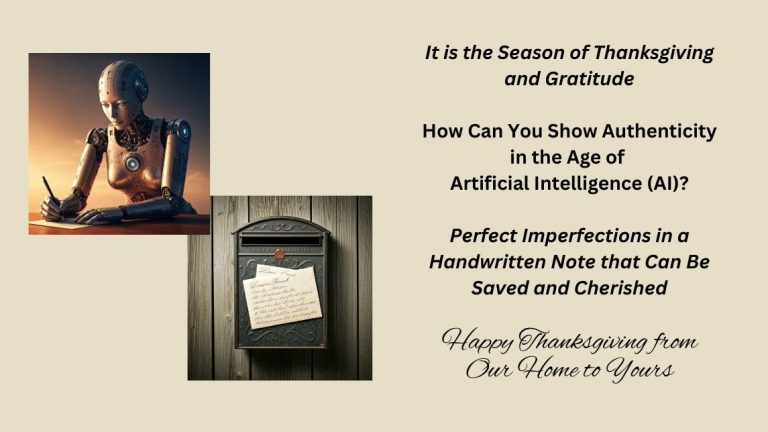
November and Thanksgiving are the perfect times to reach out and communicate with those who have impacted our lives in the past and present. In our digital age, many ways of communicating exist, including social media, email, and text. AI (Artificial Intelligence) can make it more difficult since everyone is a prompt away from crafting the perfect message. Ironically, snail mail (a.k.a. United Postal Service is an easy, cost-effective way to communicate gratitude with a handwritten notecard.
Does writing a handwritten note take planning and effort? Absolutely, yes. However, the person and relationship dividends are priceless. Are handwritten notes perfect? Absolutely not. Handwritten notes are perfectly imperfect. In three sentences, you can express appreciation, reference memory, and have something tangible for the recipient to keep.
Every handwritten note is a souvenir (French verb to remember) for the writer and the recipient. Writing 365 cards in 365 days is my quest for gratitude for 2025. With all of AI’s advances, I cannot share my sincere appreciation and memories or be a tangible keepsake.
One of my most prized possessions is a card I made for my Great Grandmother when I was 5. I found it when I became the historian for my family. She died at 87 and died when I was 11. However, she kept it all those years. A card made on notebook paper folded the wrong way, and I did not have blue eyes. I keep the notecards that are written to me. Many have told me that they keep the handwritten notecards that I write and how my notes touched them.
I admit that I used ChatGPT to explain that handwritten notes are unique and can’t be replicated.
From ChatGPT
Essentially, a handwritten note lets the recipient know that you are thinking of them, that they are important, and that you care about their well-being. Secondly, it requires your full and undivided attention, and it takes time to give it a personal touch.
AI can indeed influence the content of a handwritten note, though it typically works behind the scenes. While AI can enhance or facilitate the process, the emotional impact of a handwritten note still comes from the human element—choosing to send the note and personalizing its content.
Here are some ways AI might be involved:
Content Suggestions: AI can help draft or suggest thoughtful messages, particularly if the sender struggles with expressing themselves. For example, AI-powered writing tools or assistants can generate phrases, prompts, or entire messages tailored to specific situations, such as birthdays, thank-you notes, or condolences.
Personalization: AI can help personalize notes by analyzing data about the recipient, such as their preferences, past interactions, or shared experiences. This can help the sender craft a more meaningful message.
Handwriting Simulation: AI can also simulate handwriting styles. Some services allow users to type their message, and then AI-driven tools transform it into handwriting that appears more personal and authentic, though it isn’t truly handwritten.
Grammar and Style: AI-powered tools like Grammarly can help proofread and improve the tone or flow of the message, ensuring that it is well-written and coherent.
Differences between AI and the human element lie in authenticity, emotion, and intent. Here’s how they differ in specific aspects:
1. Creativity and Emotion:
AI: AI can generate text, mimic styles, and produce content that appears human-like, but it needs more true understanding, emotions, and lived experiences. It analyzes patterns and produces responses based on data, but it doesn’t experience feelings or empathy. Algorithms and training on vast amounts of data drive AI’s creativity.
Human Element: Humans create from personal experience, emotions, and unique worldviews. When a human writes something, it often carries personal insights, emotional depth, and spontaneity that stem from real-life experiences. The intention behind human expression adds a layer of meaning that AI can mimic but not generate.
2. Intent and Personal Connection:
AI: AI responds based on patterns and input data but doesn’t have personal relationships or emotional investment. It can simulate care and connection, but it doesn’t honestly “care.” The intent behind AI-generated content is utilitarian, driven by efficiency, not personal connection.
Human Element: When a human reaches out, whether through a handwritten note or conversation, there’s genuine intent and a personal connection. Human interaction involves empathy, understanding, and emotional resonance. A handwritten note from a person shows thoughtfulness, effort, and care that go beyond the content—it reflects the person’s desire to connect.
3. Authenticity and Imperfection:
AI aims for precision and can create nearly flawless, polished messages. However, this perfection can sometimes feel impersonal or mechanical. Although the content it produces can be accurate, it lacks the small, unique imperfections that often make human communication feel authentic.
Human Element: Human communication is filled with nuance, subtle imperfections, and individual quirks—slightly messy handwriting, an unintended pause, or a personal anecdote. These imperfections are part of what makes human interaction feel genuine and relatable.
4. Context and Depth of Understanding:
AI: AI can quickly process vast amounts of information and respond based on learned patterns, but it lacks proper comprehension. It doesn’t experience life, culture, or context as humans do. AI might miss a conversation or note’s deeper emotional, cultural, or situational nuances.
Human Element: Humans communicate through lived experience, cultural context, and emotional awareness. A human’s understanding of the world is shaped by personal experiences, relationships, and emotions, making human-generated content often more profoundly layered and contextually rich.
5. Motivation and Effort:
AI: AI operates based on instructions and input without any personal motivation. Its effort is driven by algorithms and a pre-set goal to optimize output, but it doesn’t feel satisfaction or dedication in its tasks.
Human Element: Humans choose to invest time and effort, especially when it comes to meaningful gestures like writing a handwritten note. The personal effort, care, and attention a human puts into such a task make it special, signaling that they value the recipient.
In summary, AI can assist, automate, and simulate aspects of human communication, but it needs more emotional depth, authenticity, and genuine intent to define the human element. The human touch carries real experiences, emotions, and connections that AI can mimic but never truly replicate.
Sylpro Productions began with Sylvia France, and the goal was to work with Apple in Silicon Valley. Not only did she realize that goal, but she also launched new products and industry categories, including personal digital navigation and streaming television program guides. In addition to working with several startups, our client roster includes The Home Depot, Union Pacific, Verizon, and Right at Home. To learn more, contact me at sylvia@sylproproductions.
AI in Manufacturing Sales: Revolutionizing the Industry
The manufacturing sector is undergoing a significant transformation, with artificial intelligence (AI) playing a pivotal role in reshaping sales strategies and operations. As we delve into the world of AI-powered sales in manufacturing, it’s crucial for C-Suite Manufacturing Sales Leaders to understand the impact and potential of these technologies.
As AI continues to revolutionize the manufacturing sales landscape, it’s imperative for C-Suite Manufacturing Sales Leaders to stay ahead of the curve. By embracing these AI-powered strategies and keeping abreast of the latest trends, sales professionals can drive unprecedented growth and efficiency in their organizations.