Category: AI Acronyms

  • Mixed Intelligence: The Future of Agentic AI & RevOps

    Mixed Intelligence: The Future of Agentic AI & RevOps

    Key Takeaways

    • Mixed Intelligence Synergy: The “Both/And” principle combines machine scale with human judgment to create 10x productivity gains in architecture and radiology.
    • Agentic Shift: Transitioning from passive chatbots to active Agentic AI that executes tasks autonomously within RevOps and IT operations.
    • Wisdom Worker Evolution: Human roles are shifting toward “agent management,” prioritizing creativity, intuition, and discernment over rote execution.
    • Technical Governance: Implementation of Explainable AI (XAI) frameworks like LIME is mandatory to ensure transparency and trust in automated decision-making.
    • Economic Realignment: The “SaaS-pocalypse” of 2026 is driving a shift from horizontal point solutions to vertical, AI-native infrastructure.
    • Operational Velocity: AI handles the volume and complexity, allowing humans to handle judgment, connection, and curiosity.

    Table of Contents

    • mixed-intelligence
    • zha-architecture
    • radiology
    • engineering
    • revops
    • saas-pocalypse
    • aeo-strategy
    • technical-dive
    • leadership

    The prevailing narrative concerning technology and labor has frequently been bifurcated between total automation and human-centric resistance. However, the emergence of Mixed Intelligence suggests a third path based on the “Both/And” Principle, where the strengths of both domains are synthesized. This principle rejects the binary choice between opposites, instead practicing integrative thinking to create solutions that neither humans nor machines could achieve independently.

    In this framework, Artificial Intelligence functions as a cognitive amplifier, handling the volume and complexity that often drains human energy. This allows the human professional to focus on judgment, connection, and curiosity—attributes that remain uniquely resistant to algorithmic replication. By 2030, the organizations that dominate their respective markets will be those that have mastered the synergy between human intuition and machine scale.

    Leaders must recognize that while Neural Networks can identify patterns in seconds that would take humans hours to uncover, they lack the contextual awareness required for ethical decision-making. In banking, for instance, AI analytics identifies risks and opportunities, but the human advisor remains the differentiator by translating those insights into strategic, trust-based guidance. This collaborative model transforms technology from a perceived threat into a primary competitive advantage for the modern enterprise.

    The risk of the current era is not automation itself, but waiting too long to adapt to these shifting dynamics. Those who lead with foresight will anticipate the “Hard Trend” of human-AI synergy and seize the exponential opportunities it provides. Technology futurist(https://www.burrus.com/ai-human-augmentation-leadership-advantage/) that if a task can be automated, it will be, necessitating a shift in the workforce conversation from job elimination to skill elevation.

    Architecture has historically been a profession of long timelines and manual drafting, but Zaha Hadid Architects (ZHA) has fundamentally rewired the design process. Between 2024 and 2026, ZHA integrated machine learning and parametric systems into its core workflows to transform how buildings are conceived. In 2025, the majority of the firm’s design concepts began not with a physical sketch, but with a strategic AI Prompt.

    The firm utilizes text-to-image tools like DALL-E and Midjourney to explore thousands of visual directions in minutes. Designers prompt these systems using ZHA’s signature formal language—fluid curves and organic transitions—generating dozens of iterations during early competition phases. However, the human architect remains the primary filter, selecting only 10% to 15% of machine outputs to advance into 3D modeling.

    Beyond aesthetics, ZHA’s Computational Design Research Group (CODE) applies machine learning for floorplate optimization and environmental performance. This allows the firm to validate structural behavior and pedestrian flow digitally before any physical construction begins. The KAFD Metro Station in Riyadh, which opened in late 2024, stands as a testament to this process; its facade perforations were calculated via AI to minimize solar gain.

    Performance MetricTraditional WorkflowZHA AI-Integrated WorkflowImprovement
    Early-Stage Iterations10-20 concepts / week100+ concepts / day10x Velocity
    Client Feedback Loop7 days1 day / Real-time85% Reduction
    Daylight Access Opt.Rule of thumb+20% AccuracyEvidence-based
    Structural EfficiencyManual calculationML-optimized geometryMaterial reduction

    Principal Patrik Schumacher maintains that while AI generates the options, the authorship and accountability for the building’s performance remain strictly with the human architect. The architect is responsible for selecting, refining, and deciding, as accountability for structural, environmental, and civic performance cannot be delegated to an algorithm. This is a prime example of why we must(https://sentia.community/how-to-eliminate-crm-data-silos-with-agentic-ai-in-2026/).

    In the healthcare sector, particularly within radiology, the integration of AI has moved from experimental pilot programs to daily clinical practice. By 2025, over 70% of radiology departments in the United States reported an increased reliance on AI-driven diagnostic tools. These systems do not replace the radiologist but instead handle the cognitive and administrative load that frequently leads to burnout.

    Radiologists now use AI to detect abnormalities faster, prioritize urgent cases, and reduce diagnostic errors. While a human radiologist can identify markers of disease on a chest X-ray in as little as 250 milliseconds, they are often bogged down by transcribing reports. AI agents are now stepping into this pre- and post-interpretive space, preparing patient summaries and surfacing missing clinical context.

    The shift toward Value-Based Care means that imaging departments are increasingly evaluated on patient outcomes rather than scan volume. This transition prioritizes technologists and physicians who can integrate AI insights with patient history and ethical judgment. According to(https://theimagingwire.com/2026/01/07/the-top-trends-shaping-radiology-in-2026/), multimodal fusion that integrates clinical context with imaging will be the primary differentiator for winning medical solutions in 2026.

    The field of software engineering has experienced a radical disruption through the widespread adoption of GitHub Copilot and similar AI-assisted coding tools. By 2025, 90% of Fortune 100 companies had deployed these systems to their development teams. Data indicates that developers are now completing tasks 55% faster on average, representing a significant reduction in the development lifecycle.

    GitHub Copilot currently generates approximately 46% of all code written by its users, with this figure rising to 61% for Java projects. This shift is transforming the role of the developer from a manual writer of code to an orchestrator of logic. While the AI excels at generating boilerplate and test cases, it lacks the architectural judgment required for complex business logic.

    Engineering MetricWithout AI AssistantWith AI Assistant (2026)Efficiency Gain
    Task Completion Time2 hours 41 minutes1 hour 11 minutes55% Faster
    Time to First PR9.6 days2.4 days75% Reduction
    Successful Build RateBase+84%Reliability Jump
    Code RetentionN/A88%High Accuracy

    The introduction of these tools has also significantly impacted developer satisfaction, with 90% reporting feeling more fulfilled. However, there is an emerging risk of dependency, as 67% of developers use these tools five or more days per week. Furthermore, security remains a critical concern, with Accenture research finding that 29.1% of Python code generated by AI contains potential security weaknesses.

    Revenue Operations (RevOps) has emerged as the central nervous system for modern B2B SaaS organizations. Historically, marketing, sales, and customer success departments operated in silos, leading to fragmented data and inconsistent customer experiences. The RevOps model unifies these functions under a single operational strategy, often overseen by a Chief Revenue Officer (CRO).

    By 2026, the Agentic Paradigm is redefining RevOps from a set of reactive processes to a proactive system of autonomous intent. Gartner predicts that by 2028, 75% of RevOps tasks will be executed by AI agents. These agents do not merely suggest actions; they execute them independently within defined guardrails, such as performing agentic quote-to-revenue operations.

    RevOps PillarTraditional RoleAgentic Evolution (2026)
    OperationsReactive monitoring & manual ticketingProactive autonomous remediation
    EnablementGeneric training and static playbooksAI-curated learning paths & dynamic scripts
    InsightsMonthly reporting and manual dashboardsReal-time predictive analytics & pattern detection
    ToolsDisconnected SaaS point solutionsUnified AI infrastructure and SSOT

    The transition to agentic IT operations is particularly visible in DevOps and FinOps. A June 2025 study found that IT operations represent 52% of all agentic AI use cases, far outperforming marketing and finance. These agents can monitor hardware characteristics to predict component failures six months in advance. For a deeper dive into this infrastructure, see our(https://sentia.community/ai-enablement-engines-for-revops-complete-guide/).

    The broader software market is currently undergoing a period of collapse and consolidation. Forrester reports that in early 2026, a massive sell-off in SaaS stocks erased over $1 trillion in market capitalization. This “SaaS-pocalypse” is driven by a shift away from horizontal point solutions toward vertical-specific software that addresses complex industries like healthcare or manufacturing.

    Enterprises are now renegotiating contracts, prioritizing vendors with clear AI Agent roadmaps. The market for AI coding tools alone reached $7.37 billion in 2025, with GitHub Copilot holding a 42% market share. As Agentic AI matures, the traditional “software-as-a-service” model is being replaced by “results-as-a-service.”

    Economic Indicator2025 Baseline2026-2029 Forecast
    Global SaaS Spending$318 Billion$576 Billion (2029)
    Vertical Software Market$133.5 Billion$194.0 Billion (2029)
    AI Carbon EmissionsBase1.3 – 1.7 Gigatons annually
    Buyer InteractionHuman-led discovery30% view GenAI as meaningful

    Forrester guidance recommends that leaders re-architect their SaaS investments to prioritize domain-specific vendors. B2B buyers are increasingly using private engines to support purchasing decisions, with one in five sellers now forced to engage in agent-led quote negotiations. Success will hinge on investing in AI governance and balancing human expertise with AI tools.

    As search behavior shifts from “ten blue links” to interactive AI answers, traditional SEO tactics are becoming insufficient. In 2026, the search landscape is dominated by AI Overviews and answer cards that often appear above organic results. This evolution has given rise to Answer Engine Optimization (AEO) and Generative Engine Optimization (GEO).

    AEO helps your business show up in AI-driven answers instead of just search listings. If your content isn’t structured for AI readability, you are effectively invisible to tools like ChatGPT and Perplexity. To capture these results, brands must structure content to directly answer questions—listing tools or steps immediately before diving into technical details.

    Organizations must prioritize Schema and Structured Data Engineering to ensure AI can recognize, recommend, and rank them. A well-structured FAQ page is one of the best formats to provide these answers to new discovery tools. Using full questions as headings and providing the answer in the first sentence makes it easy for AI to “lift” your content.

    At the core of the AI transformation are Neural Networks, simulations of biological brain functions that process information through layers of interconnected nodes. While powerful, these models often operate as “black boxes,” making it difficult for humans to understand how a specific decision was reached. This lack of transparency is a significant barrier to enterprise adoption in high-stakes fields.

    To address this, researchers utilize Explainable AI (XAI) frameworks, with LIME (Local Interpretable Model-agnostic Explanations) being one of the most prominent. LIME works by perturbing the input data—making small changes to features—and observing how those changes affect the model’s prediction. It then trains a simpler, interpretable model to provide a local explanation of the original model’s behavior.

    Consider a model predicting credit risk. To explain a specific rejection, LIME might generate a mathematical relationship like:

    $$f(x) \approx g(z) = w_0 + w_1 z_1 + w_2 z_2 + \dots + w_n z_n$$

    Where $g(z)$ is the interpretable surrogate model and $w_i$ indicate feature importance. In medical diagnostics, DLIME (Deterministic LIME) utilizes Hierarchical Clustering to ensure that the same prediction always receives the same explanation. This stability is critical for earning the trust of medical professionals who require repeatable results.

    For C-suite executives, the priority must shift from simply buying licenses to re-architecting the organization around Mixed Intelligence. This requires a “45-Day Agentic Readiness Checklist” to ensure the enterprise is prepared for autonomous execution. The first step is the appointment of an AI Orchestrator, a leader responsible for ensuring data liquidity across the stack.

    HR and people leaders must simultaneously shift their investment toward “Change Fitness.” 31 that success with AI relies less on technology alone and more on the talent strategies that support it. This involves developing human capabilities that AI cannot replicate: critical thinking, ethical judgment, and complex relationship management.

    RoleImmediate ActionLong-Term Strategic Move
    Board Members / CEOsIdentify functions for automationRedirect human capacity to strategy
    HR / People LeadersAudit AI-relevant skillsInvest in “Change Fitness” training
    Functional ManagersList 10 most time-consuming tasksImplement 90-day content/IT pilots
    RevOps LeadersConsolidate data into an SSOTBuild an AI Agent roadmap

    Functional managers should involve employees early in the process to allay fears of displacement. By demonstrating AI’s potential to remove the “least interesting tasks,” leaders can build a culture that embraces technological ambition. The Wisdom Worker isn’t a theoretical future employee; they are the hire you are making this quarter.

    Q1: Will AI replace my job in 2026?

    AI is more likely to change jobs rather than eliminate them entirely. Roles requiring human creativity, critical thinking, and interpersonal skills will be more secure. Instead of viewing AI as a threat, see it as a tool that can make your future job more interesting and efficient.

    Q2: What is “Mixed Intelligence”? Mixed Intelligence is a framework where human judgment and machine intelligence work together. Developed by futurist Daniel Burrus, it relies on the “Both/And” principle, combining machine scale with human intuition to create solutions that neither could achieve independently.

    Q3: How much faster can developers code with AI? Research shows developers complete tasks 55% faster when using tools like GitHub Copilot. In controlled tests, a task that took 2 hours and 41 minutes without AI was completed in just 1 hour and 11 minutes with AI assistance.

    Q4: What is “Agentic AI” vs. a Chatbot?

    A chatbot primarily talks and generates text, while an agent acts. If you ask a chatbot to research competitors, it gives you a list; an agent opens a browser, visits sites, screenshots pricing, and compiles a report autonomously.

    Q5: What is the “SaaS-pocalypse”?

    This refers to a 2026 market sell-off where horizontal point solutions lost over $1 trillion in value. Enterprises are now shifting toward vertical-specific software and AI-native platforms that offer integrated agentic workflows and proprietary data.

    Q6: What is Answer Engine Optimization (AEO)? AEO is a strategy to ensure your brand is seen in AI-generated search results like Google’s AI Overview or ChatGPT. It involves structuring your content into clear, authoritative blocks that AI models can easily extract and cite.

    Q7: How does AI improve radiology?

    AI handles repetitive tasks like draft report generation and finding markers of disease, allowing radiologists to focus on clinical judgment. By 2025, over 70% of radiology departments reported increasing their reliance on these AI tools.

    Q8: What are the risks of using AI agents?

    Key risks include data privacy, weakened human oversight, and potential security vulnerabilities. Experts recommend using agents that operate in “sandboxed” environments and maintaining a “human-in-the-loop” governance framework to ensure accountability and safety.

    Q9: What is “Local Interpretable Model-agnostic Explanations” (LIME)? LIME is a technique used to make black-box machine learning models more transparent. It creates a simpler, interpretable model locally around a specific prediction to show which features most influenced the AI’s decision.

    Q10: What is a “Wisdom Worker”? A wisdom worker is a professional who combines technical AI fluency with human judgment, curiosity, and strategic intent. They focus on directing AI agents toward better outcomes rather than executing repetitive manual tasks themselves.
  • The AI Runtime: Why We’re Building the Operation System for Revenue

    The AI Runtime: Why We’re Building the Operation System for Revenue

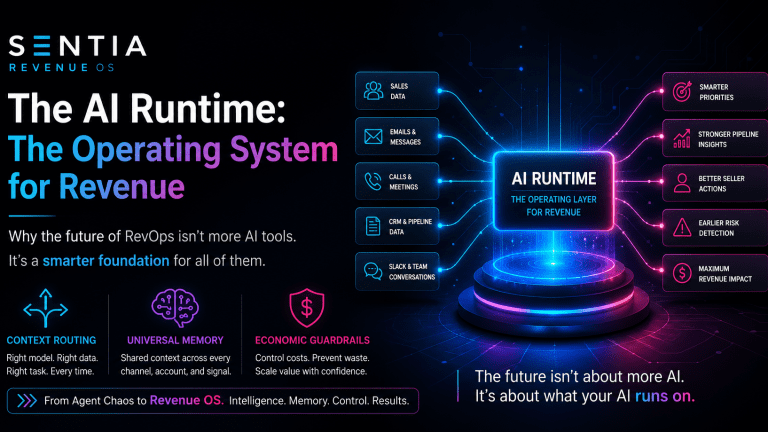
    Key takeaway: The next major shift in revenue operations will not be won by companies that simply add more AI agents. It will be won by companies that control what those agents run on: a centralized AI Runtime with context routing, universal memory, and economic guardrails.

    The AI Runtime: Why We’re Building the Operating System for Revenue

    For the last two years, most of the AI conversation has focused on the model.

    Which large language model is smartest? Which one writes better emails? Which one summarizes calls faster? Which one can reason, plan, code, research, or sell?

    Those questions matter, but they are no longer the most important questions.

    In revenue operations, the larger issue is not whether AI can perform a task. It is whether AI can operate safely, economically, and intelligently across the entire business.

    That is why Sentia is focused on the AI Runtime.

    Not another chatbot. Not another isolated agent. Not another point solution that performs one narrow workflow inside one disconnected application.

    The AI Runtime is the operating layer that allows intelligence to move through the revenue organization with memory, context, governance, and control.

    Executive Summary

    • The model is not enough. Large language models are the brain, but revenue teams need a nervous system that connects data, workflows, memory, and action.
    • Agent chaos is the enemy. Siloed AI apps create brittle, expensive, and insecure workflows because each agent operates with limited context.
    • The runtime is the solution. A centralized runtime layer can manage context routing, universal memory, permissions, costs, and workflow execution.
    • The future is an operating system for revenue. By 2026, the key question will not be “Which AI are you using?” It will be “What is your AI running on?”

    The Problem: The Agent Chaos Trap

    Most companies are currently stuck in what we might call the “app phase” of AI adoption.

    They add an AI tool for lead scoring. Then another for email drafting. Then another for call summaries. Then another for forecasting, research, enablement, data cleanup, pipeline updates, and meeting preparation.

    Each tool looks useful in isolation. Each one promises productivity. Each one appears to solve a specific problem.

    But together, they create a new operating problem.

    The lead scoring agent cannot see the email that was just sent. The email drafting agent may not know the latest negotiation status. The meeting preparation tool may miss the context buried in Slack, call transcripts, CRM notes, or LinkedIn messages.

    Instead of one intelligent operating environment, the business ends up with a patchwork of disconnected AI apps.

    What agent chaos creates

    • Context loss: Agents make decisions without seeing the complete customer or account picture.
    • Redundant token spend: Multiple tools repeatedly process the same information in different places.
    • Inconsistent memory: One agent remembers something another agent cannot access.
    • Workflow fragmentation: AI creates output, but the business still has to manually coordinate action.
    • Revenue leakage: Follow-ups, risks, buying signals, and commitments fall through the cracks.

    This is the trap: companies believe they are becoming more intelligent by adding more agents, but they are often just creating more disconnected software.

    The Runtime Shift: From AI Apps to AI Infrastructure

    Every major computing era eventually moves from applications to infrastructure.

    Personal computing needed an operating system. Cloud computing needed cloud infrastructure. Mobile computing needed app platforms, identity, notifications, permissions, and device-level services.

    Agentic AI now needs the same kind of operating layer.

    The AI Runtime sits between the AI models and the business systems. It governs how intelligence accesses data, retains memory, chooses models, triggers workflows, manages costs, and executes revenue actions.

    In simple terms, the model is the brain. The runtime is the nervous system.

    1. Context Routing: The Right Intelligence for the Right Task

    Not every revenue task requires the most powerful model available.

    Updating a lead field, summarizing a short email, classifying a task, or checking a simple status does not need the same compute as complex negotiation analysis or multi-account strategy synthesis.

    Without a runtime layer, companies often overuse heavyweight models for lightweight work. That drives unnecessary cost and slows down operations.

    Context routing solves this by dynamically matching each task to the right model, tool, permission level, and data source.

    What context routing enables

    • Simple tasks can be routed to faster, lower-cost models.
    • Complex tasks can be reserved for more capable reasoning models.
    • Sensitive tasks can be routed through stricter permission and governance rules.
    • Revenue-critical decisions can use richer customer and pipeline context.

    Key takeaway: Context routing helps optimize the token budget by matching task complexity to model capability automatically.

    2. Universal Memory: Stop Operating with Goldfish AI

    Most AI tools still behave like they have goldfish memory.

    They may understand the task in front of them, but they often lack persistent awareness of the customer, account, opportunity, communication history, commitments, and business context.

    In revenue operations, that is a serious limitation.

    A prospect does not experience your company as a series of disconnected tools. They experience one relationship. Your AI should understand that relationship the same way.

    Universal memory gives agents access to a shared cognitive layer across CRM data, email threads, call transcripts, LinkedIn messages, notes, tasks, Slack conversations, calendars, and pipeline history.

    Why universal memory matters

    • An AI agent can understand what happened before recommending what should happen next.
    • Sales, marketing, customer success, and leadership can operate from shared context.
    • Customer interactions become more consistent across channels.
    • Follow-ups become more relevant because the system remembers prior commitments and signals.

    Key takeaway: Universal memory eliminates data silos and creates a seamless intelligence graph for every prospect, customer, account, and opportunity.

    3. Economic Guardrails: Controlling the Cost of Agentic AI

    Agentic AI can create enormous value, but it can also quietly consume enormous operating expense.

    Autonomous agents can loop. They can call APIs repeatedly. They can process the same information multiple times. They can escalate simple tasks to expensive models. They can generate hidden infrastructure costs that leaders only discover after the budget has already been impacted.

    That is why economic guardrails are essential.

    The runtime must actively monitor token usage, API calls, model selection, task repetition, workflow duration, and cost thresholds in real time.

    What economic guardrails protect against

    • Runaway agent loops
    • Duplicate processing
    • Unnecessary heavyweight model usage
    • Unexpected API spend
    • Uncontrolled autonomous workflows

    Key takeaway: Economic guardrails make autonomous AI more predictable, scalable, and commercially viable.

    Why This Matters for Revenue Operations

    Revenue operations is uniquely exposed to the agent chaos problem because RevOps sits at the center of customer data, process design, pipeline visibility, forecasting, sales execution, marketing handoffs, and customer lifecycle management.

    If AI is deployed in disconnected pockets, RevOps becomes harder to govern, not easier.

    But when AI runs through a shared runtime layer, RevOps becomes the control plane for intelligent revenue execution.

    A revenue AI runtime can help teams

    • Prioritize accounts based on real-time signals
    • Identify stalled opportunities before they are lost
    • Surface customer risks across channels
    • Recommend next best actions for sellers and account managers
    • Reduce manual CRM hygiene work
    • Improve forecasting context
    • Connect insights directly to execution

    The value is not simply that AI can write, summarize, or classify.

    The value is that AI can help operate the revenue system itself.

    The Sentia Vision: The Revenue OS

    At Sentia, we are not building better bots for the sake of building better bots.

    We are building toward a Revenue OS: a system that governs how intelligence flows through the revenue organization.

    That means AI should not sit outside the workflow waiting for prompts. It should operate inside the flow of revenue work, with the right memory, permissions, context, and financial controls.

    In the 1990s, businesses needed Windows for the PC era. In the 2010s, they needed AWS for the cloud era. In the agentic AI era, revenue teams will need a runtime to manage intelligence.

    The companies that win will not be the ones with the most AI tools. They will be the ones with the best AI operating layer.

    Final Thought

    The question is no longer only, “Which AI are you using?”

    The more important question is, “What is your AI running on?”

    Because the future of revenue operations will not be powered by disconnected agents. It will be powered by an intelligent runtime that connects context, memory, economics, and action.

    Frequently Asked Questions

    What is an AI Runtime?

    An AI Runtime is the operating layer that sits between AI models and business systems. It manages how agents access context, retain memory, select models, control costs, and execute workflows.

    Why does revenue operations need an AI Runtime?

    Revenue operations depends on connected data, consistent process, pipeline visibility, and coordinated execution. A runtime helps prevent disconnected AI tools from creating fragmented workflows, duplicated effort, and inconsistent customer context.

    What is agent chaos?

    Agent chaos happens when companies deploy multiple isolated AI agents that each have their own memory, data access, workflow logic, and cost structure. This can create context loss, redundant spend, poor governance, and missed revenue signals.

    What is context routing?

    Context routing is the process of matching each AI task to the right model, data source, permission level, and workflow path based on the complexity and sensitivity of the task.

    What is universal memory for AI agents?

    Universal memory is a shared intelligence layer that allows AI agents to remember and use relevant context across CRM records, emails, calls, messages, notes, tasks, calendars, and other business systems.

    Why are economic guardrails important for agentic AI?

    Economic guardrails help prevent runaway token spend, redundant API calls, unnecessary use of expensive models, and uncontrolled agent loops. They make AI automation more predictable and commercially sustainable.

  • The Black Box Fix: How to Implement Explainable AI (XAI) in Your Lead Scoring and Pricing Workflows

    The Black Box Fix: How to Implement Explainable AI (XAI) in Your Lead Scoring and Pricing Workflows

    Key Takeaways: The XAI Audit Framework

    • Regulatory Imperative: As of 2026, the EU AI Act mandates that automated decisions in lead scoring and pricing must be “explainable” to avoid heavy non-compliance fines.
    • The “Black Box” Risk: Standard CRM-integrated AI models that lack transparency are now considered high-risk legal and ethical liabilities for RevOps leaders.
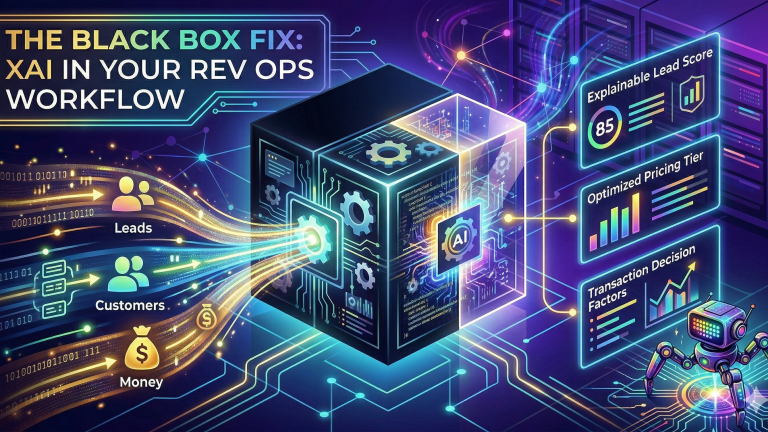
    • The XAI Solution: Implementing Explainable AI (XAI) provides the necessary “Audit Trail” and “Human-in-the-Loop” Kill Switch to validate AI logic.
    • Strategic ROI: Beyond compliance, XAI builds trust with sales teams by revealing why a lead was scored poorly, allowing for better strategic pivots.

    The Black Box Fix: How can you Implement Explainable AI (XAI) in Your Lead Scoring and Pricing Workflows?

    For years, Revenue Operations (RevOps) leaders viewed AI as a “magic wand”—a silent engine that crunched massive datasets to spit out lead scores and dynamic pricing. However, the landscape shifted dramatically in 2026. With the full maturation of the EU AI Act and similar “Right to Explanation” laws in North America, the “Black Box” era is officially over.

    If your AI rejects a high-value lead or deep-discounts a deal without a clear, auditable reason, your organization isn’t just losing revenue; it’s inviting a regulatory audit. According to the Gartner 2026 Strategic Technology Trends, organizations that cannot provide transparency in automated decisioning will face up to a 30% increase in litigation costs this year.

    The Liability of the “Black Box” in 2026

    In the current regulatory climate, “the algorithm said so” is no longer a valid legal defense. Traditional machine learning models, particularly deep learning neural networks, often operate as black boxes. They identify patterns that are too complex for human interpretation, making it impossible to provide a “Statement of Reasons” when a prospect asks why they were disqualified.

    The risk is highest in Dynamic Pricing. As explored in Harvard Business Review’s analysis of Algorithmic Pricing, a lack of transparency in why specific accounts receive preferential rates can lead to accusations of price discrimination. To survive, RevOps must pivot from predictive power to Explainable AI (XAI).

    The XAI Implementation Guide: A Step-by-Step Fix

    To move from a liability-heavy black box to a compliant, transparent engine, follow this execution framework.

    StepAction ItemTooling/MethodGoal
    1Feature AttributionSHAP (SHapley Additive exPlanations)Quantify exactly how much each variable (Industry, Intent, etc.) contributed to a specific lead score.
    2Logic VisualizationLIME (Local Interpretable Model-agnostic Explanations)Generate “Local” explanations that show why this specific deal was rejected, even if the global model is complex.
    3Bias AuditFairness IndicatorsRun historical data through an audit to ensure the AI isn’t weighting “Proxy Variables” (like zip code) as a stand-in for protected classes.
    4The “Kill Switch”API-based Manual OverrideCreate a trigger that pauses an automated workflow if the “Confidence Score” or “Explainability” data falls below a 70% threshold.
    5CRM SurfaceCustom Objects / UI CardsDisplay the “Top 3 Drivers” of every AI decision directly on the Lead/Deal record for Sales Reps to see.

    Conclusion: Trust as a Competitive Advantage

    Moving to XAI isn’t just about avoiding fines; it’s about sales enablement. When a sales rep understands why an AI rejected a lead, they stop fighting the system and start trusting the data. By implementing an audit-ready framework today, Sentia members are positioning their RevOps engines as transparent, ethical, and future-proof as outlined in the Forrester AI Governance Playbook.


    Frequently Asked Questions

    1. What is the “Right to Explanation” under 2026 regulations?

    It is a legal mandate requiring companies to provide clear, human-understandable reasons for any automated decision that significantly impacts a customer or prospect, such as lead disqualification or pricing shifts.

    2. Why is traditional lead scoring considered a “Black Box”?

    Traditional models often use complex weighted averages where the specific reason for a score is obscured, making it impossible to audit for bias or errors.

    3. What is Explainable AI (XAI)?

    XAI is a set of processes and methods that allows human users to comprehend and trust the results and output created by machine learning algorithms.

    4. How does a “Kill Switch” work in RevOps?

    A Kill Switch is an automated trigger that pauses an AI workflow if the “Confidence Score” falls below a certain threshold or if the “Explainability” data reveals a potential bias.

    5. What are SHAP values?

    SHAP values are a mathematical method used to explain the output of any machine learning model by connecting optimal credit allocation with local explanations.

    6. Does XAI decrease the accuracy of my AI models?

    In some cases, simpler, more interpretable models may be slightly less “predictive” than complex black boxes, but the trade-off is necessary for legal compliance and long-term trust.

    7. Is the EU AI Act applicable to US-based companies?

    Yes. If your company processes data or engages with citizens in the EU, you must comply with their transparency and explainability standards or face global revenue-based fines.

    8. How can I audit my CRM for AI bias?

    By running your lead data through an XAI tool like LIME or SHAP, you can identify if the AI is unfairly weighting variables like gender, age, or location.

    9. Can I implement XAI without replacing my current CRM?

    Yes. Most modern CRMs allow for third-party XAI overlays or API integrations that can interpret and display the logic behind the scores generated by the native AI.

    10. What is the role of RevOps in AI compliance?

    RevOps serves as the bridge between legal requirements and technical execution, ensuring that the “Audit Trail” is maintained across the entire customer lifecycle.

  • Complete Guide to A2A Sales: Preparing Your CRM for AI Bots

    Complete Guide to A2A Sales: Preparing Your CRM for AI Bots

    Curious how AI talks to AI in Sales?

    The landscape of B2B sales is undergoing a profound transformation, driven by the rapid emergence of autonomous AI agents. These intelligent bots are no longer confined to lead qualification or customer service; they are now capable of direct negotiation and procurement, fundamentally altering how deals are struck. This shift towards Agent-to-Agent (A2A) sales necessitates a radical re-evaluation of traditional CRM infrastructures, which were designed for human-centric processes. Without a CRM system specifically prepared for bot-to-bot interactions, companies risk being sidelined in an increasingly automated marketplace.

    Preparing your CRM for A2A sales is not merely an upgrade; it is a strategic imperative that determines your future competitive viability. This readiness involves restructuring data, enabling robust API access, embedding negotiation logic, and ensuring real-time data synchronization. Companies that proactively adapt their CRM will gain a decisive advantage, enabling faster deal cycles, reduced costs, and consistent decision-making in an era where AI agents handle an increasing volume of complex transactions.

    What Is A2A Sales and Why It Matters Now

    A2A (Agent-to-Agent) sales refers to commercial transactions and negotiations conducted autonomously between AI agents representing different entities, such as a vendor’s sales bot and a buyer’s procurement bot. This model differs significantly from traditional B2B sales, which rely on human sales representatives interacting directly with human buyers. The shift is already underway, with Gartner forecasting that 40% of enterprise applications will embed task-specific AI agents by the end of 2026, a substantial increase from less than 5% in 2025 according to Joget.

    Procurement AI agents are now autonomously evaluating vendors and negotiating terms, driven by economic imperatives for cost reduction, speed, and decision consistency. McKinsey reports that autonomous category agents can achieve 25–40% efficiency improvements in procurement processes as highlighted by AiCerts. This acceleration impacts sales cycles dramatically, with lead generation automation tools, including AI, achieving a 25% improvement in sales cycle time compared to manual processes per Monday.com’s analysis.

    Examples of companies leveraging AI agents in vendor selection and contract negotiation are emerging. Coupa uses “Navi” agents integrated into ERP-tied spend suites for negotiations, with customers reportedly saving $15 billion according to AiCerts. SAP’s “Joule” agents are extending to bid analysis and contract workflows, while specialists like Keelvar deploy sourcing bots for logistics RFQs, covering 90% of tactical spend with reported 70% cycle time drops in pilot programs as noted by AiCerts. These developments signal a critical need for B2B sales organizations to prepare their CRM for bot-to-bot interactions.

    AI-powered sales agents negotiating autonomously, represented by digital avatars exchanging data in a virtual marketplace
    Photo by Negative Space

    The 4 Pillars of A2A-Ready CRM Architecture

    Achieving A2A readiness in your CRM hinges on establishing four foundational pillars that enable seamless bot-to-bot interaction and autonomous deal-making. These pillars redefine the traditional CRM’s role from a human sales assistant to a central intelligence hub for AI agents.

    Pillar 1: Machine-Readable Product Catalogs with Structured Pricing Data

    Machine-readable product catalogs are essential for AI agents to understand and process product offerings without human interpretation. This involves standardizing product information and ensuring it is consumable by algorithms. Products with complete schema markup are 4.2x more likely to appear in Google Shopping results according to Almcorp, demonstrating the importance of structured data for machine visibility.

    Key aspects include:

    • Standardizing product names, SKUs, and descriptions.
    • Implementing Schema.org markup for clear categorization.
    • Embedding detailed technical specifications and compatibility information.
    • Maintaining up-to-date inventory and capacity data feeds.

    Pricing data must be meticulously structured, including clear discount rules, volume tiers, and geographical variations. This allows AI agents to query pricing, apply appropriate discounts, and construct accurate proposals autonomously. Outdated data confuses search engines and users, so accuracy is paramount per Atak Interactive.

    Pillar 2: API-First Architecture That Allows Agent Access Without Human Gatekeeping

    An API-first architecture ensures that your CRM’s functionalities and data are programmatically accessible to AI agents. This moves beyond traditional integrations designed for human-facing applications, prioritizing secure, machine-to-machine communication channels. APIs are critical to business strategy for 89% of enterprises per Postman’s 2024 API report, highlighting their foundational role.

    Essential elements include:

    • Exposing well-documented and robust API endpoints for all critical sales data.
    • Implementing secure authentication and authorization protocols for bot access.
    • Designing APIs for efficiency, minimizing latency in data exchange.
    • Supporting webhooks and event-driven architecture for real-time updates.

    This proactive API design eliminates the need for human intervention in data retrieval or action initiation, allowing agents to operate with maximum autonomy. A unified CRM API is particularly powerful for agentic workflows as noted by Truto.

    Pillar 3: Automated Negotiation Parameters and Approval Workflows

    Automated negotiation parameters and approval workflows encode your sales playbook directly into the CRM, enabling agents to negotiate within predefined boundaries. This transforms static sales policies into executable logic. By 2027, 50% of organizations will use AI-enabled contract negotiation tools according to Icertis.

    Key components involve:

    • Defining acceptable price ranges, discount thresholds, and payment terms.
    • Establishing automated approval chains for deals exceeding certain parameters.
    • Creating constraint-based negotiation frameworks that agents follow.
    • Integrating with contract management and e-signature systems for autonomous deal closure.

    This pillar ensures that all agent-conducted negotiations adhere to company policies, reducing risk and accelerating the sales cycle. The goal is to encode the sales playbook as executable logic rather than relying on human interpretation of PDF documents.

    Pillar 4: Real-Time Data Accuracy and Synchronization Across Systems

    Real-time data accuracy and synchronization are non-negotiable for autonomous deal-making. AI agents require the most current information on inventory, pricing, customer history, and market conditions to make optimal decisions. The data integration market, crucial for real-time synchronization, is valued at $15.18 billion in 2026 according to Integrate.io.

    Critical aspects include:

    • Eliminating data silos between CRM, ERP, inventory, and other systems.
    • Implementing robust data validation and cleansing processes.
    • Ensuring instantaneous updates across all integrated platforms.
    • Leveraging streaming analytics for immediate insights relevant to negotiations.

    Fragmented data prevents agents from accessing complete vendor profiles and can lead to erroneous proposals or missed opportunities. You cannot build autonomous operations on top of fragmented data according to LogicMonitor.

    Traditional CRM vs A2A-Ready CRM: Key Differences

    This table compares the fundamental architectural and operational differences between legacy CRM systems built for human sales teams and modern A2A-ready CRM systems designed for bot-to-bot negotiations. Understanding these differences is critical for planning your transformation roadmap.

    CapabilityTraditional CRMA2A-Ready CRMMigration Complexity
    Data StructureUnstructured notes, human-readable text, siloed attachments.Structured, machine-readable fields, Schema.org markup, taxonomies.High: Requires data cleansing, re-categorization, and schema implementation.
    API AccessibilityLimited, often human-centric APIs, batch processing.API-first design, robust, real-time endpoints for bot access, event-driven.Medium: Requires API development/enhancement and security hardening.
    Pricing LogicManual quote generation, human interpretation of discount matrices.Executable pricing rules, dynamic matrices, automated discount application.High: Translating sales policies into code, extensive testing.
    Approval WorkflowsManual human approvals, email-based sign-offs.Automated, rule-based approval chains, integrated e-signature.Medium: Defining clear thresholds, integrating with CLM.
    Response Time RequirementsHours to days for human response.Milliseconds to seconds for autonomous agent response.High: Requires optimized infrastructure, real-time sync, and low-latency APIs.
    Contract GenerationManual drafting, human review, separate e-signature tools.Automated template population, AI-driven clause selection, integrated e-signature.Medium: Integration with CLM, template standardization.

    Structuring Your CRM Data for Bot Consumption

    Structuring your CRM data for bot consumption is the foundational step in enabling A2A sales, converting fragmented information into actionable intelligence for AI agents. This transition moves beyond human-readable notes to precisely defined, machine-interpretable data points.

    Key steps include:

    • Converting Unstructured Notes: Utilize natural language processing (NLP) to extract key entities (e.g., product interests, budget, timeline, decision-makers) from unstructured human notes and map them to structured fields within the CRM.
    • Implementing Schema.org Markup: Adopt Schema.org standards for product information, services, and company profiles. This provides universally recognized semantic tags that AI agents can easily parse and understand. Products with complete schema markup are 4.2x more likely to appear in Google Shopping results according to Almcorp, highlighting the importance of this structure.
    • Creating Machine-Readable Pricing Matrices: Develop dynamic pricing matrices where every discount, volume tier, and special term is explicitly defined and linked to specific product or customer attributes. This allows agents to calculate prices accurately and apply rules consistently.
    • Eliminating Data Silos: Integrate your CRM with ERP, inventory management, customer support, and marketing automation systems to create a unified data fabric. This ensures agents have a holistic view of the customer and product landscape.

    Data governance is paramount; establish clear rules for data entry, validation, and maintenance to ensure ongoing accuracy and reliability for AI agents. This process ensures that agents can operate with the same, or even greater, contextual understanding as a human sales representative.

    Data flow diagram illustrating CRM integration with ERP and marketing automation for real-time data synchronization
    Photo by Lukas Blazek

    Building Negotiation Logic Into Your CRM Workflows

    Building negotiation logic directly into your CRM workflows transforms your sales playbook from static guidelines into dynamic, executable programs for AI agents. This enables autonomous negotiation within predefined boundaries, empowering bots to make offers and counter-offers.

    The process involves:

    • Setting Automated Approval Chains: Configure multi-level approval workflows that trigger based on specific deal parameters, such as discount percentage, contract length, or payment terms. For instance, a 15% discount might be auto-approved, while a 25% discount requires senior sales leadership approval.
    • Creating Dynamic Pricing Rules: Implement rule-based engines that allow agents to query and adjust pricing based on real-time factors like inventory levels, customer segment, deal size, or competitive intelligence. This moves beyond static price lists.
    • Implementing Constraint-Based Negotiation Frameworks: Define the “acceptable zone” for negotiations. This includes minimum acceptable margins, maximum concessions, and non-negotiable terms (e.g., legal clauses). Agents operate strictly within these guardrails.
    • Encoding Sales Playbooks as Executable Logic: Translate your sales strategies – objection handling, upselling opportunities, cross-selling prompts – into conditional logic that AI agents can execute. This shifts from human interpretation to automated action, ensuring consistent application of best practices.

    This proactive approach allows AI agents to engage in complex negotiations, ensuring compliance with company policies while optimizing deal outcomes. Critically, these workflows must be auditable, providing clear logs of agent decisions and their underlying logic.

    API and Integration Requirements for A2A Readiness

    API and integration requirements for A2A readiness are centered on creating a highly interconnected and accessible CRM ecosystem that supports autonomous agent interactions. An API-first approach is fundamental, treating APIs as primary products that enable bot-to-bot communication.

    Essential elements your CRM must provide include:

    • Exposing Key API Endpoints: Your CRM needs robust, well-documented APIs for querying product catalogs, retrieving customer histories, submitting proposals, and updating deal stages. These APIs must be performant and reliable for real-time interactions.
    • Implementing Secure Authentication Protocols: Bot-to-bot communications require stringent security. This includes OAuth 2.0 for token-based authentication, API keys with granular permissions, and mutual TLS for encrypted communication channels.
    • Integration with Contract Management (CLM) and E-signature Systems: For autonomous deal closure, AI agents must be able to generate, modify, and secure e-signatures for contracts directly through integrated CLM platforms. This streamlines the final stages of the sales cycle.
    • Real-Time Inventory and Capacity Data Feeds: Agents need instantaneous access to inventory levels, production capacity, and service availability to make accurate commitments and avoid overselling. This requires direct, low-latency integrations with ERP and supply chain systems.

    By prioritizing these API and integration capabilities, you empower AI agents to operate seamlessly across your technology stack, enabling true end-to-end autonomous sales processes. The data integration market, valued at $15.18 billion in 2026, is projected to reach $30.27 billion by 2030, growing at a 12.1% CAGR according to Integrate.io, underscoring the importance of these integrations.

    Cybersecurity professionals monitoring bot traffic and securing API endpoints for autonomous business transactions
    Photo by Leeloo The First

    Testing and Validating Your A2A Sales Infrastructure

    Testing and validating your A2A sales infrastructure is crucial to ensure reliability, security, and optimal performance before full deployment. This involves simulating bot negotiations and rigorously stress-testing your CRM setup under various scenarios.

    Key steps for thorough validation include:

    • Simulating Agent Negotiations: Develop sophisticated testing environments that mimic real-world bot-to-bot interactions. This includes simulating both your sales agents and external procurement agents, running through various negotiation paths, and testing edge cases.
    • Monitoring Key Metrics: Track critical performance indicators such as response time, data accuracy in proposals, negotiation success rate within acceptable parameters, and the time taken for autonomous deal closure. Establish baselines and targets for these metrics.
    • Identifying Common Failure Modes: Pay close attention to instances where bots encounter unstructured or incomplete data, leading to errors or stalled negotiations. These are often indicators of data governance gaps or insufficient schema implementation.
    • Creating a Staged Rollout Plan: Begin with pilot programs involving low-value, tactical deals or specific product lines. Gradually expand A2A enablement to more complex scenarios, incorporating lessons learned from each stage. This phased approach minimizes risk and allows for iterative improvement.

    Thorough testing not only identifies vulnerabilities but also refines your negotiation logic and data structures, building confidence in your autonomous sales capabilities. Gartner recommends a phased rollout, starting with tactical buying and expanding to strategic categories as suggested by AiCerts.

    A team of RevOps specialists analyzing A2A sales performance dashboards with metrics on deal velocity and bot negotiation success rates
    Photo by Leeloo The First

    Case Study: How a $200M SaaS Company Reduced Sales Cycle by 67% with A2A-Ready CRM

    A mid-market B2B SaaS company, specializing in supply chain optimization software with an average deal size of $75,000, faced challenges with lengthy sales cycles (averaging 90 days) and high sales rep overhead for quoting and negotiation. Their traditional CRM, Salesforce, was primarily used for human activity tracking and manual quote generation.

    The company embarked on a CRM transformation journey to enable A2A sales. They initiated the RAPID A2A Readiness Framework:

    1. Restructure Data: They invested 3 months in cleaning and standardizing their product catalog data, implementing Schema.org for all product features, and creating granular pricing matrices that accounted for volume discounts and regional variations.
    2. API-Enable: Over 4 months, their RevOps team, in collaboration with engineering, developed a suite of secure, real-time APIs for their Salesforce instance. These APIs exposed product data, customer history, and deal parameters to their custom-built sales AI agents.
    3. Parameters Encode: They spent 2 months defining and encoding negotiation logic directly into Salesforce workflows. This included automated approval thresholds for discounts (e.g., up to 10% auto-approved, 10-20% requiring management review), and constraint-based rules for contract terms.
    4. Integrate Systems: A 3-month integration phase connected Salesforce with their ERP (SAP for inventory and billing) and their CLM system (DocuSign CLM). This provided real-time inventory checks and enabled autonomous contract generation and e-signature.
    5. Deploy and Test: A 2-month pilot program focused on lower-value, standardized deals. They simulated thousands of bot-to-bot negotiations, identifying and rectifying data inconsistencies and logic flaws.

    The results were transformative. The average sales cycle for deals under $100,000 plummeted from 90 days to 30 days, a 67% reduction. Win rates for bot-negotiated deals improved by 15% due to consistent, optimized proposals. The cost per acquisition for these deals dropped by 40% by reallocating human sales reps to more complex, strategic accounts. The company’s NRR rose from 95% to 112% in 6 months, as seen in similar SaaS growth examples.

    Lessons learned included the critical importance of a dedicated data governance team and the need for continuous monitoring of agent performance. They also found that while AI handled initial negotiations, human oversight and intervention were still crucial for highly customized or strategic opportunities, shifting the human role to strategic partnership management.

    A diagram illustrating the RAPID A2A Readiness Framework with arrows showing iterative steps from data restructuring to deployment for CRM transformation
    Photo by RDNE Stock project

    Conclusion: Your A2A Readiness Roadmap

    The advent of A2A sales marks an irreversible shift in B2B commerce, demanding a proactive CRM transformation. Companies that fail to prepare their infrastructure for bot-to-bot negotiations risk significant competitive disadvantage, including slower sales cycles and an inability to participate in automated procurement processes. The RAPID A2A Readiness Framework offers a structured approach to this critical evolution.

    Immediate actions should focus on data standardization, API development, and the encoding of sales logic into your CRM. The competitive advantage of being A2A-ready before your competitors is substantial, enabling faster deal velocity, lower costs, and enhanced decision consistency. As AI agents become ubiquitous in procurement and sales through 2026-2027, prioritizing this infrastructure over traditional sales headcount will be a defining factor for market leadership.

    Key Takeaways

    • A2A sales, where AI agents negotiate autonomously, is rapidly becoming the standard in B2B, necessitating CRM adaptation.
    • The RAPID A2A Readiness Framework provides a structured, five-phase methodology for transforming traditional CRMs into bot-negotiation platforms.
    • Key pillars of A2A readiness include machine-readable product catalogs, API-first architecture, automated negotiation logic, and real-time data synchronization.
    • CRM data must be meticulously structured using standards like Schema.org to be consumable by AI agents.
    • Implementing automated approval chains and dynamic pricing rules within CRM workflows is crucial for autonomous negotiation.
    • Robust APIs and secure integrations with CLM and ERP systems are essential for end-to-end bot-to-bot deal closure.
    • Thorough testing and a phased rollout plan are vital to validate A2A infrastructure and mitigate risks.
    • Companies that embrace A2A readiness can significantly reduce sales cycles and improve win rates, reallocating human sales efforts to strategic roles.

    Frequently Asked Questions

    What is A2A sales and how is it different from regular B2B sales

    A2A (Agent-to-Agent) sales involves autonomous AI agents conducting commercial transactions and negotiations directly with other AI agents, without human intervention. This differs from traditional B2B sales, which relies on human sales representatives interacting with human buyers, offering significantly faster deal cycles and enhanced decision consistency.

    Do I need to completely replace my CRM to support A2A sales

    No, a complete CRM replacement is often unnecessary. Most modern CRMs can be adapted for A2A sales through strategic enhancements like API layer development, extensive data restructuring, and robust integrations with other systems. The focus is on incremental transformation rather than a full overhaul.

    How long does it take to make a CRM A2A-ready

    The timeline for A2A CRM readiness varies based on current CRM maturity and company size, but typically ranges from 3-6 months for basic functionality to 9-12 months for comprehensive implementation. This includes phases for data cleansing, API development, logic encoding, and rigorous testing. Explore AI Revenue Team Orchestration Multi-Agent Systems Guide.

    What are the biggest risks of not preparing for A2A sales

    Companies that do not prepare for A2A sales face a significant competitive disadvantage, including an inability to participate in automated RFPs and procurement processes. This leads to longer sales cycles compared to A2A-ready competitors, increased cost per acquisition, and ultimately, market share loss as buyers increasingly use procurement agents.

    Which CRM platforms are best for A2A sales

    CRM platforms with strong, open API capabilities and flexible workflow automation engines are best suited for A2A sales, such as Salesforce, Microsoft Dynamics 365, and HubSpot. The key evaluation criteria should focus on the platform’s ability to integrate with other systems, support structured data, and allow for the encoding of complex negotiation logic. Explore integrating AI into your CRM.

    How much does it cost to transform a CRM for A2A readiness

    The cost of transforming a CRM for A2A readiness can range from $50,000 for smaller, less complex implementations to over $500,000 for large enterprises with extensive data and integration needs. This investment covers data cleansing, API development, workflow automation, and comprehensive testing phases.

    Can small businesses benefit from A2A sales or is it only for enterprises

    Small businesses can significantly benefit from A2A sales, often more so than enterprises, by leveraging autonomous agents to scale sales efforts without increasing headcount. Scaled-down approaches using readily available SaaS tools and focused automation for specific deal types can enable A2A capabilities even without large enterprise budgets. Explore AI-driven CRM workflows.

    What happens to human sales teams when A2A sales becomes standard

    Human sales teams will evolve from executing transactional deals to focusing on high-value activities such as strategic relationship building, complex deal structuring, and creative problem-solving that AI agents cannot yet handle. The role shifts from transaction execution to strategic partnership management and oversight of AI agent performance.

    How do you measure success of A2A sales implementation

    Success in A2A sales implementation is measured through key metrics such as deal velocity (time to close), negotiation success rate within acceptable parameters, cost per acquisition for bot-initiated deals, agent engagement rate, and the proportion of total revenue generated through autonomous transactions. Explore autonomous AI agents.

    What security concerns exist with bot-to-bot negotiations

    Security concerns for bot-to-bot negotiations include robust authentication of agents, ensuring data privacy during exchanges, validating contract authenticity, preventing fraud through malicious agent impersonation, and maintaining comprehensive audit trails of all negotiation steps. Specific protocols like OAuth 2.0, mutual TLS, and granular API permissions are crucial for securing these interactions.

    Key Terms Glossary

    A2A Sales: Commercial transactions and negotiations conducted autonomously between AI agents representing different entities. Explore Agentic AI.

    API-First Architecture: A design approach where the primary method of interaction with a system is through its application programming interfaces, facilitating machine-to-machine communication.

    Schema.org Markup: A collaborative, community-driven effort to create structured data schemas that can be added to web pages, making them easier for search engines and AI agents to understand.

    Negotiation Logic: Predefined rules, parameters, and decision-making frameworks encoded into a CRM that guide AI agents in making offers, counter-offers, and concessions during sales discussions.

    Data Silos: Isolated repositories of data that are not integrated with other systems, hindering a holistic view and preventing efficient data exchange for AI agents.

    Agentic AI: Artificial intelligence systems capable of autonomous action, planning, and execution towards a goal, often involving multiple steps and interactions with other systems or agents.

    Real-Time Data Synchronization: The process of instantly updating and aligning data across multiple systems, ensuring that AI agents always access the most current information for decision-making.

    Contract Lifecycle Management (CLM): Software solutions that manage the entire lifecycle of contracts, from creation and negotiation to execution, storage, and renewal, often integrated with A2A systems for autonomous deal closure.

  • What Do Common AI Acronyms Mean? Ultimate Reference Guide to AI

    What Do Common AI Acronyms Mean? Ultimate Reference Guide to AI

    Executive Summary

    Struggling with AI acronym overload? This reference guide decodes essential terms—from LLM and NLP to RAG and AEO—using the proprietary RAPID Acronym Framework. Learn to distinguish between AI and Machine Learning while exploring how technologies like Retrieval-Augmented Generation drive enterprise-grade accuracy. Master the terminology needed to improve strategic decision-making and maximize AI ROI in 2026.

    The rapid acceleration of AI tools has created an “acronym overload” for business professionals, marketers, and non-technical decision-makers. Understanding these terms is essential for making informed technology decisions and leveraging AI effectively within your organization. This guide provides practical, AEO-optimized definitions, going beyond mere explanations to offer strategic context you can use immediately.

    This reference differs from technical documentation by applying the RAPID Acronym Framework. This decision-making model categorizes AI acronyms into five practical buckets: Relevance (does this term affect my work?), Application (how is it used?), Priority (do I need to know this now?), Integration (does it connect to tools I use?), and Decision-impact (will this influence my AI strategy?). This framework transforms a confusing list of terms into an actionable reference system.

    business professional looking at a confusing whiteboard filled with AI acronyms, considering their relevance
    Photo by Markus Winkler

    Why Understanding AI Acronyms Matters in 2026

    In 2026, AI adoption stands at 88% of organizations using AI in at least one function, with 71% regularly using generative AI (GenAI) according to AmplifAI. This widespread integration means encountering AI terminology is no longer optional for professionals. Misinterpreting a key acronym can lead to misallocated budgets, missed opportunities, or incorrect strategic direction.

    For instance, knowing the difference between an LLM and an NLP application dictates whether you’re investing in content generation or advanced data analysis. Small businesses, for example, show 37% weekly AI use in sales and 45% in marketing according to Master of Code, highlighting the direct impact of AI on core business functions.

    • AI proficiency enhances strategic decision-making.
    • It prevents miscommunication in vendor and internal discussions.
    • Understanding terminology accelerates AI adoption and ROI.

    Core AI Technology Acronyms

    What is an LLM (Large Language Model)?

    An LLM (Large Language Model) is a type of AI algorithm trained on massive datasets of text and code, enabling it to understand, generate, and process human language with remarkable fluency. LLMs are the foundation for many popular AI applications, acting as a general-purpose text engine as detailed by Hatchworks.

    For businesses, LLMs can automate content creation, power advanced chatbots, and summarize vast amounts of information. GPT-5, for example, is reported to have hundreds of billions of parameters and a 400,000-token context window per Ideas2IT, significantly expanding its capacity for complex tasks.

    • Relevance: High, impacts content, customer service, and data analysis.
    • Application: Chatbots, content generation, code assistance, data summarization.
    • Decision-impact: Crucial for selecting platforms and understanding their capabilities.

    What is NLP (Natural Language Processing)?

    NLP (Natural Language Processing) is a branch of AI that focuses on enabling computers to understand, interpret, and generate human language. Unlike LLMs which are a specific type of model, NLP is the broader field encompassing techniques for language interaction, powering everything from spell-check to sentiment analysis.

    NLP tools are vital for businesses looking to extract insights from unstructured text data, improve customer interactions, or automate language-related tasks. For example, NLP can analyze customer reviews to identify trends or power the conversational interface of a virtual assistant.

    • Relevance: High, fundamental to any language-based AI application.
    • Application: Chatbots, sentiment analysis, text summarization, language translation.
    • Priority: Essential for understanding how AI interacts with human communication.

    What is the Critical Distinction Between ML (Machine Learning) and AI (Artificial Intelligence)?

    AI (Artificial Intelligence) is the broad concept of creating machines that can think, reason, and learn like humans, encompassing any technique that enables computers to mimic human intelligence. ML (Machine Learning) is a specific subset of AI that focuses on building systems that learn from data without explicit programming, improving performance over time according to Google Cloud. While all machine learning is AI, not all AI is machine learning; AI can also include rule-based systems or expert systems that don’t learn from data.

    More than 80% of an organization’s data is unstructured, which deep learning (a subset of ML) handles more effectively than traditional ML as noted by IBM. This distinction is critical because it clarifies that while AI is the ambitious goal, ML is often the practical method used to achieve specific intelligent behaviors.

    • Relevance: High, defines the scope and methods of intelligent systems.
    • Application: AI is the field (e.g., self-driving cars), ML is the technique (e.g., image recognition within the car).
    • Decision-impact: Guides investment in broader AI initiatives versus data-driven learning solutions.

    What is AGI (Artificial General Intelligence)?

    AGI (Artificial General Intelligence) refers to hypothetical AI that possesses human-level cognitive abilities across a wide range of tasks, capable of learning, understanding, and applying intelligence to any intellectual task a human can. Unlike the “narrow AI” we have today, which excels at specific tasks, AGI would be truly versatile.

    While some experts argue that AGI may already exist in early 2026 per University of California San Diego experts, Stanford AI experts predict no AGI in 2026, emphasizing instead rising AI sovereignty efforts from Stanford AI. This acronym represents the long-term goal of AI development rather than current commercial reality.

    • Relevance: Low for immediate business application, high for long-term strategic planning.
    • Application: Not yet realized; current AI is “narrow AI” focused on specific tasks.
    • Priority: Low for operational decisions, high for understanding the future trajectory of the field.

    AI Model and Architecture Terms

    What is GPT (Generative Pre-trained Transformer)?

    GPT (Generative Pre-trained Transformer) is a specific type of LLM architecture developed by OpenAI. It uses a transformer neural network to process and generate human-like text, distinguishing itself by its “generative” capability to create new content and its “pre-trained” nature from vast datasets. GPT models, such as those powering ChatGPT, are among the most recognized and widely adopted as noted by BentoML. Explore AI Acronyms.

    GPT models are behind many of the content creation and conversational AI tools businesses use today. ChatGPT, for instance, reached 100 million users in two months after its 2022 launch, driving significant growth in the LLM sector according to Ideas2IT.

    • Relevance: High, directly impacts available generative AI tools.
    • Application: Content creation, chatbots, coding assistance, summarization.
    • Integration: Many business tools integrate with GPT APIs for enhanced functionality.

    What is RAG (Retrieval-Augmented Generation)?

    RAG (Retrieval-Augmented Generation) is an AI framework that enhances LLMs by allowing them to retrieve relevant information from an external knowledge base before generating a response. This process grounds the AI’s output in factual, up-to-date information, significantly reducing hallucinations and improving accuracy. The RAG market is projected to reach USD 11.0 billion by 2030, growing at a 49.1% CAGR per Grand View Research.

    For businesses, RAG is critical for enterprise-grade AI applications where factual accuracy and adherence to internal data are paramount. It ensures AI tools use your company’s proprietary information, like internal documents or product catalogs, to provide precise answers as highlighted by Meilisearch.

    • Relevance: High, directly impacts accuracy and trustworthiness of AI outputs.
    • Application: Enterprise search, customer support, internal knowledge management, legal review.
    • Decision-impact: Essential for implementing reliable, fact-based AI solutions.
    diagram showing an AI model retrieving information from a database before generating text, illustrating RAG
    Photo by Google DeepMind

    What is an API (Application Programming Interface)?

    An API (Application Programming Interface) is a set of rules and protocols that allows different software applications to communicate and interact with each other. In the context of AI, APIs enable developers and businesses to integrate powerful AI models, like LLMs or computer vision systems, into their own applications and workflows without having to build them from scratch.

    APIs are the backbone of modern software integration, allowing a marketing platform to use an AI for content generation or a customer service system to leverage an AI chatbot. This connectivity is crucial for building custom solutions that leverage existing AI capabilities.

    • Relevance: High, fundamental for integrating AI into existing business systems.
    • Application: Connecting AI models to websites, apps, databases, and internal tools.
    • Integration: Facilitates seamless data exchange and functionality.

    What is the Difference Between Fine-tuning and Prompt Engineering?

    Fine-tuning involves taking a pre-trained AI model (like a GPT) and further training it on a smaller, specific dataset relevant to a particular task or domain. This process adapts the model’s knowledge and behavior to the nuances of that specific data, making it more specialized. In contrast, prompt engineering is the art and science of crafting effective inputs (prompts) to guide a pre-trained AI model to produce desired outputs, without altering the model’s underlying weights or architecture.

    Fine-tuning is a more intensive, data-driven customization, while prompt engineering is about skillful interaction with an existing model. For instance, fine-tuning might be used to teach an LLM a company’s specific brand voice, whereas prompt engineering would be used daily to generate marketing copy within that established voice.

    • Relevance: High, impacts how businesses customize and interact with AI.
    • Application: Fine-tuning for specialized tasks; prompt engineering for daily use.
    • Decision-impact: Influences resource allocation for AI customization vs. operational skill development.

    AI Application and Use Case Acronyms

    What is AEO (AI Engine Optimization)?

    AEO (AI Engine Optimization) is the practice of optimizing digital content to be easily discovered, understood, and cited by AI systems, such as large language models and answer engines like Google AI Overviews or Perplexity AI. Unlike traditional SEO, which focuses on ranking in search engine results pages, AEO aims for direct inclusion and accurate citation within AI-generated answers. Google holds 90.82% search market share in 2026, while ChatGPT processes 2.5 billion daily prompts according to Jack Limebear.

    AEO is critical because 60% of US/EU searches result in zero clicks due to AI Overviews as reported by DOJO AI, meaning content must be optimized for direct AI consumption. This shift represents the most significant change in search behavior since Google’s launch, requiring a new approach to digital visibility.

    • Relevance: High, essential for digital marketing and content visibility in the AI era.
    • Application: Content structuring, semantic optimization, entity consistency, source credibility.
    • Decision-impact: Redefines content strategy and marketing investment for AI discoverability.

    What is GenAI (Generative AI)?

    GenAI (Generative AI) refers to AI systems capable of creating new and original content, such as text, images, audio, video, or code, rather than simply analyzing existing data. These models learn patterns from vast datasets and then generate novel outputs that resemble the training data. The generative AI market is valued between USD 22-83 billion in 2026, depending on the research methodology per Global Market Insights.

    GenAI is transforming industries by automating creative tasks, accelerating product development, and personalizing customer experiences. For example, 92% of Fortune 500 firms have already adopted generative AI technology as noted by Master of Code.

    • Relevance: High, impacts content creation, design, software development, and marketing.
    • Application: Marketing copy, product design, synthetic data generation, code development.
    • Decision-impact: Guides investment in creative automation and new content pipelines.

    What is RPA (Robotic Process Automation)?

    RPA (Robotic Process Automation) is a technology that uses software robots (“bots”) to automate repetitive, rule-based digital tasks traditionally performed by humans. These bots can interact with applications, systems, and websites in the same way a human worker would, without needing complex API integrations. RPA is a form of AI that streamlines operational workflows. Explore AI terminology.

    RPA significantly reduces operational costs and improves efficiency in back-office functions. Its implementation can lead to substantial ROI by automating tasks like data entry, invoice processing, or customer support queries. AI automation, including RPA, has an average ROI of 250% within 18 months according to AdAI.

    • Relevance: High, for operational efficiency and cost reduction.
    • Application: Data entry, invoice processing, customer service, report generation.
    • Priority: Essential for businesses seeking immediate gains in workflow automation.

    What is CV (Computer Vision)?

    CV (Computer Vision) is a field of AI that enables computers to “see,” interpret, and understand visual information from the world, such as images and videos. This includes tasks like object detection, facial recognition, image classification, and scene understanding. The global computer vision market is projected to grow from $24.14 billion in 2026 to $72.80 billion by 2034 per Fortune Business Insights.

    Computer vision applications are transforming industries from manufacturing to retail by automating quality control, enhancing security, and improving customer experiences. For example, automated visual inspection in manufacturing can achieve a 90–98% reduction in defect escape rates as highlighted by ConsultingWhiz.

    • Relevance: High, for physical operations, quality control, and customer analytics.
    • Application: Defect detection, security surveillance, autonomous vehicles, retail analytics.
    • Decision-impact: Crucial for businesses with physical products or environments needing visual analysis.
    factory floor with robotic arms performing quality control using computer vision cameras
    Photo by Google DeepMind

    This table organizes AI acronyms by their primary business application, helping you quickly identify which terms are relevant to your specific needs. Understanding the use case context makes these acronyms immediately actionable.

    AcronymFull TermPrimary Use CaseRelevance Level
    LLMLarge Language ModelGenerating text, powering chatbots, summarizing dataHigh (Content, Customer Service)
    NLPNatural Language ProcessingUnderstanding human language, sentiment analysisHigh (Customer Interaction, Data Insights)
    RAGRetrieval-Augmented GenerationEnsuring AI accuracy with real-time data retrievalHigh (Factual Accuracy, Enterprise Search)
    AEOAI Engine OptimizationOptimizing content for AI answer engines (e.g., Google AI Overviews)High (Digital Marketing, Visibility)
    GenAIGenerative AICreating new content (text, image, code)High (Creative Automation, Product Development)
    RPARobotic Process AutomationAutomating repetitive, rule-based digital tasksMedium (Operational Efficiency)
    CVComputer VisionInterpreting visual information (images, video)Medium (Quality Control, Security)
    APIApplication Programming InterfaceConnecting different software systemsHigh (Integration, Custom Solutions)

    AI Performance and Evaluation Terms

    How Do You Measure ROI (Return on Investment) for AI Implementation?

    ROI (Return on Investment) for AI implementation measures the financial benefit gained in relation to the cost of deploying an AI solution. Calculating AI ROI involves quantifying cost savings, revenue increases, and efficiency gains directly attributable to the AI system, then comparing these against investment costs. As of 2026, only 5% of enterprises see substantial AI ROI at scale according to Master of Code.

    The average AI payoff is 1.7x, but top generative AI adopters can see up to 10.3x ROI per AmplifAI. This indicates that while AI has immense potential, strategic implementation is key to realizing significant returns.

    1. Identify clear business objectives: Define what the AI should achieve (e.g., reduce customer service response time, increase sales conversion).
    2. Establish baseline metrics: Measure current performance before AI implementation.
    3. Track AI-specific costs: Include software, hardware, training, and integration expenses.
    4. Quantify benefits: Measure improvements in efficiency, revenue, and cost reduction directly linked to the AI.
    5. Calculate net gain: Subtract costs from benefits to determine the financial return.

    What are KPIs (Key Performance Indicators) for AI Tools?

    KPIs (Key Performance Indicators) for AI tools are measurable values that demonstrate how effectively an AI system is achieving its business objectives. These metrics vary widely depending on the AI’s function, but they are crucial for tracking progress and proving value. For instance, customer service leads AI applications at 56% as reported by AmplifAI, where KPIs might include resolution time or customer satisfaction.

    Effective KPIs for AI should be specific, measurable, achievable, relevant, and time-bound. For an AI chatbot, relevant KPIs could be deflection rate (how many queries it resolves without human intervention) or customer satisfaction scores.

    • Relevance: High, essential for evaluating AI project success.
    • Application: Tracking efficiency, effectiveness, and impact of AI systems.
    • Decision-impact: Guides optimization and future investment in AI initiatives.

    Understanding AI Performance: Accuracy vs. Precision

    Accuracy in AI refers to how close a model’s predictions are to the true values, essentially how often it’s correct overall. Precision, on the other hand, measures the proportion of positive identifications that were actually correct, focusing on the relevance of the positive results. For example, a medical AI that identifies a disease might be highly accurate (correctly identifying both sick and healthy individuals), but less precise if it flags many healthy people as sick (false positives).

    In business, the choice between optimizing for accuracy or precision depends on the application’s risk profile. In fraud detection, high precision is critical to avoid falsely flagging legitimate transactions, even if it means missing a few fraudulent ones. Conversely, in medical diagnostics, high accuracy might be preferred, even if it means more follow-up tests for false positives.

    • Relevance: High, impacts the reliability and trustworthiness of AI outputs.
    • Application: Critical for evaluating classification and prediction models.
    • Decision-impact: Influences risk tolerance and deployment strategies for AI systems.

    What is AI Hallucination?

    Hallucination in AI occurs when a generative AI model produces information that is false, nonsensical, or deviates from its source data, yet presents it as factual and confident. These fabricated outputs can sound highly plausible, making them difficult to detect without external verification. AI hallucination rates in business tools have dropped significantly, from 21.8% in 2021 to 0.7% in 2025 industry-wide per About Chromebooks, thanks to investments and improved models.

    Despite improvements, 47% of enterprise AI users made at least one major decision based on hallucinated content in 2024 according to Kanerika, costing businesses globally $67.4 billion. This highlights the ongoing need for human oversight and verification, as knowledge workers spend 4.3 hours weekly verifying AI outputs per Microsoft’s 2025 data.

    • Relevance: High, impacts reliability and trustworthiness of AI-generated content.
    • Application: Content creation, data summarization, research assistance.
    • Decision-impact: Requires robust validation processes and human oversight for critical applications.
    business team reviewing AI-generated report for factual accuracy, highlighting the challenge of AI hallucinations
    Photo by Markus Winkler

    Key Takeaways

    • AI acronyms are essential for informed decision-making in a rapidly evolving tech landscape.
    • LLMs and GenAI are revolutionizing content creation and customer interaction.
    • RAG is critical for ensuring AI accuracy by grounding responses in real-time data.
    • AEO is the new frontier for digital visibility, optimizing content for AI answer engines.
    • Measuring AI ROI and understanding performance metrics like accuracy and precision are vital for successful implementation.
    • AI hallucinations remain a concern, requiring human oversight and robust verification strategies.

    Conclusion: Building Your AI Vocabulary

    Navigating the world of AI acronyms is no longer a niche skill; it’s a fundamental requirement for business professionals in 2026. By applying the RAPID Acronym Framework, you can quickly assess the Relevance, Application, Priority, Integration, and Decision-impact of each term, transforming technical jargon into actionable knowledge. Explore Artificial Intelligence.

    Start by focusing on acronyms relevant to your immediate business needs, whether that’s understanding how to optimize content for AI (AEO) or ensuring factual accuracy in AI-driven customer support (RAG). Bookmark this guide as your go-to reference. Building your AI vocabulary empowers you to make smarter technology investments and accelerate AI adoption within your organization, driving tangible business value.

    professional looking confidently at a tablet displaying AI insights, symbolizing successful adoption of AI terminology

    Frequently Asked Questions

    What is the difference between AI and ML?

    AI (Artificial Intelligence) is the broader field focused on creating intelligent machines that mimic human cognitive functions, while ML (Machine Learning) is a specific subset of AI that enables systems to learn from data and improve without explicit programming.

    What does LLM mean in AI?

    LLM stands for Large Language Model, an AI algorithm trained on massive text datasets to understand, generate, and process human language, powering applications like chatbots and content creation tools.

    What is RAG and why does it matter for business?

    RAG (Retrieval-Augmented Generation) is an AI framework that allows LLMs to retrieve and incorporate external, up-to-date information into their responses, significantly improving factual accuracy and reducing hallucinations, which is crucial for reliable business applications.

    What is AEO and how is it different from SEO?

    AEO (AI Engine Optimization) is the practice of optimizing content for AI systems and answer engines to be directly cited in AI-generated responses, whereas SEO (Search Engine Optimization) focuses on ranking high in traditional search engine results pages.

    What does GenAI mean?

    GenAI (Generative AI) refers to AI systems that can create new and original content, such as text, images, audio, or code, rather than just analyzing existing data, revolutionizing creative and content-related tasks.

    What is the difference between GPT and LLM?

    GPT (Generative Pre-trained Transformer) is a specific type of LLM architecture developed by OpenAI, making it a specialized example within the broader category of Large Language Models. Explore AI buzzwords.

    What does fine-tuning mean in AI?

    Fine-tuning in AI is the process of further training a pre-trained AI model on a smaller, specific dataset to adapt its knowledge and behavior to a particular task or domain, customizing it for specialized use cases.

    What is an AI hallucination?

    An AI hallucination occurs when a generative AI model produces false, nonsensical, or fabricated information that is presented confidently as factual, requiring human verification, especially in business applications.

    What does NLP stand for and what does it do?

    NLP stands for Natural Language Processing, a branch of AI that enables computers to understand, interpret, and generate human language, powering applications like chatbots, sentiment analysis, and text summarization.

    What is AGI and when will we have it?

    AGI (Artificial General Intelligence) is hypothetical AI that possesses human-level cognitive abilities across all tasks; experts widely disagree on when, or if, it will be achieved, with most current AI being “narrow AI” focused on specific tasks.

    AI and Mental Health

    Key Terms Glossary

    API: Application Programming Interface, a set of rules allowing different software applications to communicate with each other.

    AGI: Artificial General Intelligence, hypothetical AI with human-level cognitive abilities across all intellectual tasks. Explore LLMs.

    AEO: AI Engine Optimization, optimizing content for discovery and citation by AI systems and answer engines.

    CV: Computer Vision, a field of AI enabling computers to interpret and understand visual information from images and videos.

    GenAI: Generative AI, AI systems capable of creating new and original content like text, images, or code.

    KPI: Key Performance Indicator, a measurable value demonstrating how effectively an AI system is achieving its business objectives.

    LLM: Large Language Model, an AI algorithm trained on massive text datasets to understand and generate human language.

    NLP: Natural Language Processing, a branch of AI focused on enabling computers to understand, interpret, and generate human language.

    RAG: Retrieval-Augmented Generation, an AI framework that enhances LLMs by retrieving information from external knowledge bases for accurate responses.

    ROI: Return on Investment, a measure of the financial benefit gained in relation to the cost of an AI implementation.

    RPA: Robotic Process Automation, technology using software robots to automate repetitive, rule-based digital tasks.

  • Complete Guide to Fixing CRM Context Blindness

    Complete Guide to Fixing CRM Context Blindness

    Executive Summary

    CRM context blindness—the gap between raw data and actionable intelligence—costs B2B firms millions in missed opportunities. This guide introduces the 4-Layer Context Recovery Framework (Temporal, Relational, Strategic, and Predictive) to transform disconnected logs into a decision-ready narrative. By implementing Minimum Viable Context (MVC), firms can reduce “time-to-context” to under 3 minutes and increase sales quota attainment by 43%.

    Tired of Data Silo’s? How do you fix Data Silos with AI?

    Your CRM holds a treasure trove of data, yet sales reps often find themselves staring at a screen full of disconnected facts, unsure of the true story or the next best action. This pervasive issue, which we call CRM context blindness, costs B2B companies with 20+ sales reps millions annually in wasted time and missed opportunities. It’s the difference between seeing 47 touchpoints on an account and understanding precisely why those touchpoints happened and what they mean for the deal’s progression.

    This guide introduces the 4-Layer Context Recovery Framework, a systematic approach to transform your CRM from a data repository into a decision-ready intelligence engine. We’ll explore how to move beyond mere activity logging to unlock the full narrative behind every customer interaction, ensuring your revenue team operates with clarity and precision in 2026 and beyond.

    What Is CRM Context Blindness? (And Why It’s Killing Your Revenue Team)

    CRM context blindness is the critical gap between raw data capture and the actionable, decision-ready intelligence required for effective sales. It occurs when a CRM system displays individual data points, such as logged calls, emails, or notes, but fails to synthesize them into a coherent narrative that informs strategic action. Sales reps frequently ask, “What did we talk about last time?” even when activity logs are full, highlighting this profound lack of understanding.

    This problem manifests in three distinct types:

    • Temporal Context Blindness: A lack of understanding about the chronological flow and sequence of events, making it hard to grasp the buyer’s journey over time.
    • Relational Context Blindness: An inability to map stakeholder influence, identify internal champions, or understand the complex web of relationships within an account.
    • Strategic Context Blindness: The failure to connect individual activities to the broader deal stage, buyer intent signals, or overall revenue risk, preventing reps from prioritizing effectively.

    The ripple effect of context blindness is significant. It leads to longer ramp times for new reps, who struggle to get oriented on accounts, and contributes to inconsistent messaging across the sales team. Ultimately, this lack of clarity results in lost deals, particularly in late stages, because reps are unable to tailor their approach with precision.

    What are The 5 Root Causes of Context Blindness in Modern CRMs?

    Context blindness isn’t a flaw in the CRM itself, but rather a consequence of how data is captured, integrated, and presented within modern sales ecosystems. Addressing these root causes is essential for any effective recovery strategy.

    Cause 1: Data silos across email, calls, meetings, and third-party tools with no unified timeline

    Modern revenue teams use a multitude of tools: email platforms, dialers, meeting recorders, intent data providers, and more. Each of these generates valuable data, but too often, this information remains isolated within its native application. Without a unified timeline that aggregates and displays all interactions chronologically, reps must manually piece together the buyer’s journey, which is inefficient and prone to error.

    Cause 2: Activity logging without sentiment, intent, or outcome capture

    Many CRMs excel at tracking that an activity occurred (e.g., “Call logged,” “Email sent”). However, they frequently fail to capture the crucial metadata: the sentiment of the interaction, the buyer’s expressed intent, or the specific outcome of the touchpoint. Without this qualitative detail, an activity log becomes a mere checklist, offering little insight into the actual progress or health of a deal.

    Cause 3: Lack of relationship mapping – CRM tracks contacts but not influence networks

    Traditional CRMs are designed to manage individual contacts, but they often struggle to visualize the complex influence networks within a buying committee. They track who is a contact, but not who reports to whom, who influences the decision-maker, or who is the internal champion. This relational blindness leaves reps negotiating in the dark, unaware of critical power dynamics or potential roadblocks.

    Cause 4: No automatic synthesis of scattered notes into actionable intelligence

    Sales reps frequently take notes in various formats during calls, meetings, or internal discussions. These notes are often unstructured, inconsistent, and scattered across different fields or external documents. The CRM rarely synthesizes these disparate notes into a coherent, actionable summary, forcing reps to re-read lengthy transcripts or multiple entries to extract key information.

    Cause 5: Mobile-first work reality vs desktop-designed CRM interfaces that hide context

    While sales reps increasingly operate from mobile devices and on the go, many CRM interfaces remain optimized for desktop use. Critical contextual information, such as historical timelines, relationship maps, or deal health summaries, can be hard to access or is simply not visible on a mobile screen. This disconnect means reps often lack the necessary context precisely when they need it most: moments before a critical client interaction. 65% of salespeople using mobile CRM meet their sales quotas, compared to only 22% without it, emphasizing the importance of mobile access to context.

    sales professional looking frustrated at a CRM screen filled with data points but lacking clear context or next steps for an account
    Photo by Yan Krukau

    What is The 4-Layer Context Recovery Framework?

    The 4-Layer Context Recovery Framework provides a structured methodology to systematically address context blindness, transforming raw data into decision-ready intelligence. Each layer builds upon the last, progressively enhancing the depth and actionability of the information available to your revenue team.

    Layer 1 – Temporal Context: Creating unified timelines that show the full buyer journey in chronological order

    The foundation of true context lies in understanding the sequence of events. Temporal context involves aggregating all customer interactions, regardless of their source (email, call, meeting, marketing touch), into a single, chronological timeline within the CRM. This unified view allows reps to quickly grasp the progression of a deal or account relationship. This is crucial as sales reps spend approximately 40% of their time searching for contacts or prospects.

    Layer 2 – Relational Context: Mapping stakeholder influence, decision authority, and internal champion networks

    Beyond individual contacts, relational context illuminates the human network behind every deal. This layer focuses on identifying key stakeholders, understanding their roles, mapping their influence on the buying decision, and pinpointing internal champions. By visualizing these relationships, reps can navigate complex organizational structures and multi-threaded engagements more effectively.

    Layer 3 – Strategic Context: Connecting activities to deal stage, buyer intent signals, and revenue risk factors

    Strategic context links individual interactions to the broader commercial objectives and risks. It helps reps understand why certain activities matter now, connecting them to the current deal stage, any observed buyer intent signals (e.g., website visits, content downloads), and potential revenue risk factors. This layer ensures every action is aligned with overall deal strategy.

    Layer 4 – Predictive Context: Using AI to surface what matters now and recommend next best actions

    The pinnacle of context recovery, predictive context leverages AI to analyze the enriched data from the previous layers. It proactively surfaces the most critical information, highlights potential deal risks or opportunities, and recommends the next best actions for the sales rep. This transforms the CRM from a passive record-keeping system into an active, intelligent co-pilot. 85% of reps using AI prospecting agents report freedom for higher-value work, underscoring AI’s role in this layer.

    The 4-Layer Context Recovery Framework ensures that data isn’t just present, but intelligently organized and presented, enabling reps to make informed decisions and focus on selling.

    Implementation Step 1: Audit Your Current Context Gaps

    Before you can fix context blindness, you need to understand its specific manifestations within your organization. A targeted audit reveals where your CRM currently falls short.

    The 30-minute context audit: have 5 reps review 3 accounts each and document what’s missing

    Gather a representative group of 5 sales reps and ask each to review three active accounts in the CRM. For each account, they should spend no more than 10 minutes trying to answer critical questions:

    • What was the last meaningful interaction and its outcome?
    • Who are the key decision-makers and influencers?
    • What is the current deal status and the biggest blocker?
    • What is the next logical step, and why?

    Have them document what information was missing, hard to find, or contradictory. This quick exercise provides immediate, qualitative insights into your context gaps.

    Scoring your context blindness: temporal clarity score, relationship visibility score, strategic alignment score

    Based on your audit, you can develop simple scoring metrics:

    • Temporal Clarity Score: How easily can a rep reconstruct the last 6 months of interactions chronologically? (e.g., 1-5 scale, 5 being effortless).
    • Relationship Visibility Score: How clearly can a rep identify the internal champion, economic buyer, and key influencers? (e.g., 1-5 scale).
    • Strategic Alignment Score: How well does the CRM link past activities to current deal stage, intent, and next steps? (e.g., 1-5 scale).

    These scores provide a baseline to measure your improvement.

    Common gaps discovered: email threads disconnected from opportunities, meeting outcomes not captured, champion changes invisible

    Typical findings from such an audit include: email conversations living solely in inboxes, meeting notes being unstructured or incomplete, and vital changes in key contacts (e.g., a champion leaving the company) going unnoticed for too long. For instance, contact data decays after 90 days, making continuous updates critical.

    Creating your context recovery priority map based on revenue impact

    Prioritize your context recovery efforts based on their potential revenue impact. Focus first on gaps that directly hinder deal progression or lead to significant time waste. For example, if reps constantly miss critical meeting outcomes, that’s a higher priority than minor formatting inconsistencies.

    Implementation Step 2: Establish Your Context Capture Standards

    Solving context blindness requires a proactive approach to data capture. This means moving beyond mere activity logging to capturing the why and what’s next of every interaction.

    The minimum viable context (MVC) for every customer interaction: who, what, why it matters, what’s next

    Define a Minimum Viable Context (MVC) for every customer interaction. This isn’t about more fields, but about the right fields. For every logged activity (call, email, meeting), reps should quickly capture:

    • Who: Key participants and their roles.
    • What: A concise summary of the discussion.
    • Why it matters: Connection to deal stage, customer pain, or strategic goal.
    • What’s next: Clear next steps and owner.

    This MVC ensures consistent, high-quality data that directly supports decision-making.

    Designing context templates that reps will actually use (mobile-friendly, auto-populated where possible)

    Templates are crucial for consistent data capture, but they must be designed with the rep in mind. They need to be:

    • Mobile-friendly: Accessible and easy to use on the go, given that 70% of businesses now use mobile CRM systems.
    • Auto-populated: Leverage existing CRM data to pre-fill fields, reducing manual entry.
    • Intuitive: Use clear labels and logical flow.
    • Brief: Avoid excessive mandatory fields.

    The goal is to streamline the capture process, not add administrative burden. Automation in CRM data tasks saves 30%+ time on repetitive processes.

    The 3-field rule: sentiment, next action, and blockers – captured on every activity

    Implement a “3-field rule” for every logged activity to capture critical qualitative data:

    1. Sentiment: A quick rating (e.g., positive, neutral, negative) of the interaction.
    2. Next Action: The precise next step required, with a due date and owner.
    3. Blockers/Risks: Any obstacles identified or potential risks to the deal.

    These three fields provide immediate context and enable better prioritization.

    Training reps to think in stories, not just log activities

    Shift the mindset from “logging an activity” to “telling the story of the customer interaction.” Train reps to articulate the narrative of a deal in their notes, focusing on progression, challenges, and key takeaways. This qualitative shift drastically improves the usefulness of CRM data.

    sales team collaborating on a digital whiteboard to design a new CRM data capture template for customer interactions, focusing on ease of use and critical fields
    Photo by Negative Space

    Implementation Step 3: Deploy AI-Powered Context Synthesis

    Manually synthesizing context from vast amounts of data is inefficient. AI-powered tools are now essential for transforming raw data into actionable intelligence, especially with 88% of sales leaders expecting AI to improve their CRM processes within two years.

    How conversation intelligence tools automatically extract context from calls and meetings

    Conversation intelligence (CI) platforms, like those offered by Sentia AI, automatically transcribe sales calls and meetings, then use AI to analyze the content. They can:

    • Identify key topics discussed.
    • Extract action items and commitments.
    • Detect sentiment shifts and buyer intent signals.
    • Summarize key takeaways.
    • Flag competitor mentions or deal risks.

    This automates the capture of crucial qualitative context that reps often miss or struggle to log consistently. Companies using conversation intelligence platforms like Screenloop report a 90% reduction in manual tasks.

    Using AI to generate account summaries that synthesize scattered data into coherent narratives

    Advanced AI models can ingest all disparate data points related to an account—emails, call notes, meeting transcripts, support tickets, marketing interactions—and generate a concise, coherent account summary. This summary provides a snapshot of the account’s history, current status, and predicted next steps, eliminating the need for reps to sift through endless activity logs.

    Implementing relationship intelligence that maps org charts and stakeholder influence automatically

    Relationship intelligence tools, often powered by AI, can automatically build and update organizational charts based on email interactions, LinkedIn data, and other public sources. These tools identify key contacts, map their reporting lines, and even suggest potential champions or economic buyers. This automation provides the relational context needed for effective multi-threading in complex B2B sales. Selling to known contacts via relationship intelligence yields a 37% win rate vs. 19% for cold outreach.

    Setting up smart alerts that surface context changes (new stakeholder, deal risk, competitor mention)

    AI-driven context synthesis enables proactive alerting. These smart alerts notify reps and managers about critical context changes, such as:

    • A new decision-maker joining the account.
    • A sudden drop in engagement or sentiment.
    • A competitor being mentioned in a call.
    • A key champion leaving the company.

    These real-time signals allow teams to act decisively and mitigate risks before they escalate.

    Understanding the landscape of CRM context solutions is crucial for making informed investment decisions. The following table compares various approaches, from foundational manual standards to comprehensive AI-powered platforms like Sentia AI, highlighting their strengths, complexity, and typical costs.

    Solution TypeContext Layers AddressedImplementation ComplexityBest ForTypical Cost Range
    Manual context templates and standardsTemporal (basic), Strategic (basic)LowSmall teams, establishing foundational habits, low budgetMinimal (time investment)
    Native CRM AI features (Salesforce Einstein, HubSpot AI)Temporal (enhanced), Strategic (basic), Predictive (basic)MediumTeams already heavily invested in specific CRM ecosystems, basic AI assistance$50-150/user/month (as add-ons)
    Standalone conversation intelligence platformsTemporal (detailed), Strategic (enhanced)Medium-HighTeams focused on deep call/meeting analysis, coaching, specific sales process insights$75-200/user/month
    Relationship intelligence toolsRelational (detailed)MediumEnterprise sales, complex buying committees, account-based strategies$50-150/user/month
    Sentia AI integrated context orchestrationTemporal, Relational, Strategic, Predictive (all comprehensive)MediumB2B companies with 20+ reps seeking unified, AI-driven context across all layers without manual data entry, actionable insights, reduced tech complexity.Custom, value-based (often competitive with combined standalone tools)
    Full revenue operations platform with AI synthesisTemporal, Relational, Strategic, Predictive (all comprehensive)HighLarge enterprises needing end-to-end revenue management, forecasting, and deep analytics$150-300+/user/month

    Implementation Step 4: Create Context-Rich Dashboards and Views

    Even with perfect data capture and AI synthesis, context remains blind if it’s not presented intuitively. Designing user-centric dashboards and views is critical for ensuring reps and managers can quickly access the intelligence they need.

    Designing account views that prioritize context over raw data: timeline view, relationship map, deal health score

    Traditional CRM account views often present a jumble of fields. Shift to context-first design, prioritizing:

    • Unified Timeline View: A chronological feed of all interactions, highlights, and key events.
    • Relationship Map: A visual representation of the account’s organizational structure and stakeholder influence.
    • Deal Health Score: An AI-generated score indicating the overall health and risk of the deal, based on all available context.

    This allows reps to quickly grasp the narrative without digging through tabs.

    Building rep-specific dashboards that answer ‘what needs my attention and why’

    Reps need personalized dashboards that cut through the noise. These should answer: “What accounts or deals need my immediate attention, and why?” This could include:

    • Deals with recent negative sentiment changes.
    • Accounts where a key stakeholder has engaged with competitor content.
    • Opportunities stalled for a defined period.
    • Accounts where a champion has changed roles.

    This proactive surfacing of critical context helps reps prioritize their efforts effectively.

    Mobile context views: what a rep needs to see 5 minutes before a call

    Given the mobile-first reality of sales, optimize context for on-the-go access. A mobile context view should deliver the absolute essentials a rep needs 5 minutes before a call:

    • Meeting agenda and participant details.
    • Last 3-5 key interactions and their outcomes.
    • Critical action items or risks to address.
    • Personalization notes (e.g., recent news about the company).

    This ensures reps are always prepared, even when away from their desk. 65% of sales reps who adopted mobile CRM achieved their sales quotas vs. 22% without.

    Manager context views: understanding deal status without interrogating reps

    Sales managers also suffer from context blindness, often needing to interrogate reps to understand deal status. Manager-specific views should provide:

    • Overall pipeline health with context-driven risk indicators.
    • Team activity summaries linked to deal progression.
    • Early warnings of potential forecast inaccuracies.
    • Ability to drill down into specific deals for a quick contextual overview.

    This empowers managers to coach proactively rather than reactively, and ensures forecast reviews are efficient and data-driven.

    sales manager reviewing a dashboard that clearly shows deal health scores, unified timelines, and relationship maps for their team's pipeline, eliminating the need to micromanage for context
    Photo by Lukas Blazek

    The Context Blindness Recovery Metrics (What to Track)

    Measuring the impact of your context recovery efforts is crucial. These metrics provide tangible proof of improvement and help refine your strategy.

    Time-to-context: how long it takes a rep to get oriented on an account (target: under 3 minutes)

    This metric quantifies the efficiency gain. Time-to-context measures how long it takes a rep to understand the current status, history, and next steps for an unfamiliar account or deal. The target is to reduce this to under 3 minutes, allowing reps to quickly pivot between accounts without extensive prep.

    Context completeness score: percentage of opportunities with full temporal, relational, and strategic context

    Develop a scoring system to assess the completeness of context for each opportunity. This could involve checking for:

    • A populated unified timeline.
    • Identified decision-makers and influencers.
    • Clear strategic alignment (deal stage, intent).

    Track the percentage of opportunities that meet a “complete context” threshold.

    Rep self-reported confidence: survey question ‘I have the context I need to advance this deal’ (target: 85%+ agree)

    Qualitative feedback is vital. Regularly survey your sales team with questions like: “I have the context I need to confidently advance this deal.” Aim for 85%+ agreement as an indicator of successful context recovery.

    Leading indicators: reduction in ‘catch me up’ meeting time, increase in personalized outreach, faster deal cycles

    Observe leading indicators of improved context:

    • Reduced “catch me up” time: Fewer instances of reps needing extensive background from colleagues or managers.
    • Increased personalized outreach: Reps are able to tailor their messaging more effectively due to better context.
    • Faster deal cycles: Better context enables more efficient progression through sales stages. CRM shortens sales cycles by 8-14% or 8-14 days.

    These operational shifts demonstrate that your team is working smarter, not just harder.

    Real-World Results: 3 Companies That Fixed Context Blindness

    The benefits of overcoming CRM context blindness are far-reaching, impacting everything from rep productivity to win rates. Here are examples of the tangible results companies are achieving.

    Case 1: 120-person SaaS company reduced rep onboarding time by 40% with context-rich CRM views

    A fast-growing SaaS company struggled with ramp times that stretched to 4-5 months. By implementing context-rich CRM views, including unified timelines and AI-generated account summaries, they reduced rep onboarding time by 40%. New hires could quickly grasp account histories and deal statuses, becoming productive much faster. AI-powered training tools have seen onboarding times drop from 90 days to just 48 days.

    Case 2: Enterprise sales team increased win rate by 18% after implementing relationship mapping and AI synthesis

    An enterprise sales organization faced challenges navigating complex buying committees with 10+ stakeholders. After deploying relationship intelligence tools and AI-driven synthesis to map influence networks and extract key insights from conversations, their win rate for enterprise deals increased by 18%. This was largely due to reps’ improved ability to multi-thread and engage the right stakeholders at the right time. Warm/relationship-led sales motions achieve 30-40% win rates.

    Case 3: Sales ops leader cut forecast review meetings from 2 hours to 45 minutes with better context visibility

    A sales operations leader was spending excessive time in forecast review meetings, often needing to probe reps for basic deal context. By implementing manager-specific dashboards that provided deal health scores, risk indicators, and quick contextual drill-downs, they reduced forecast review meeting times from 2 hours to 45 minutes. Managers had the context they needed upfront, allowing for more strategic discussions. CRM adoption boosts productivity for 94% of businesses.

    Common success patterns among these examples include strong executive sponsorship for data quality, a phased rollout focusing on immediate rep value, and continuous feedback loops.

    business graphs showing significant increases in sales win rates and reduced onboarding times after implementing new CRM context solutions
    Photo by Leeloo The First

    Avoiding the Context Theater Trap: What NOT to Do

    While the pursuit of context is vital, it’s easy to fall into traps that create “context theater” – the illusion of progress without real impact. Avoid these common pitfalls.

    Mistake 1: Adding more required fields that reps ignore (complexity without value)

    The most common mistake is believing that more data fields automatically lead to more context. Overburdening reps with mandatory fields that don’t directly contribute to their selling efforts will lead to low adoption and poor data quality. Focus on quality over quantity, and prioritize fields that fuel AI synthesis or directly inform next steps.

    Mistake 2: Buying tools without fixing underlying data quality and capture habits

    New tools can amplify existing problems if the underlying data quality is poor or if capture habits are not addressed. A powerful conversation intelligence tool is useless if reps aren’t recording their calls or if the CRM data it feeds into is riddled with duplicates. Organizations lose $12.9 million annually on average due to poor data quality.

    Mistake 3: Building context systems that only work on desktop when reps live on mobile

    If your sales force spends significant time on the road or preparing for calls from their phone, a desktop-only context solution will fail. Ensure that critical context views, templates, and AI-generated summaries are fully accessible and optimized for mobile devices. 65% of mobile CRM users hit their sales targets, compared to only 22% without mobile access.

    Mistake 4: Creating context for managers but not for the reps who need it most

    While managers benefit from better context for forecasting and coaching, the primary users who need decision-ready intelligence are the reps on the front lines. If the system is built solely to make managers’ lives easier without providing immediate, tangible value to reps, adoption will suffer. Prioritize features that help reps sell more effectively.

    sales rep looking overwhelmed by a complex, cluttered CRM interface with too many fields, illustrating the 'context theater' problem
    Photo by Kindel Media

    Key Takeaways

    • CRM context blindness costs millions in inefficiency and missed opportunities by presenting data without a clear narrative.
    • The 4-Layer Context Recovery Framework (Temporal, Relational, Strategic, Predictive) systematically transforms raw data into decision-ready intelligence.
    • Auditing current context gaps and establishing minimum viable context (MVC) standards are critical first steps.
    • AI-powered tools, including conversation intelligence and relationship intelligence, automate context synthesis and proactive alerting.
    • Context-rich dashboards and mobile-optimized views are essential for intuitive access to intelligence for both reps and managers.
    • Measuring time-to-context, completeness scores, and rep confidence validates the success of context recovery efforts.
    • Avoiding common pitfalls like adding too many fields or ignoring mobile usability is crucial for successful adoption.

    Conclusion: From Data Overload to Decision Clarity

    CRM context blindness is a pervasive, yet entirely fixable, challenge for B2B revenue teams in 2026. The shift from simply logging data to orchestrating decision-ready intelligence is no longer optional; it is a competitive imperative. By embracing a structured approach like the 4-Layer Context Recovery Framework, organizations can systematically dismantle data silos, enrich activity logs with qualitative insights, map complex relationship networks, and leverage AI to predict next best actions.

    Starting with a targeted audit, establishing clear context capture standards, and strategically deploying AI-powered synthesis tools delivers measurable results—from reduced rep onboarding times to increased win rates and more accurate forecasts. The ultimate goal is to empower every rep with the precise, personalized, and proactive intelligence they need to excel, transforming CRM from a data dump into the ultimate competitive advantage.

    Frequently Asked Questions

    What is context blindness in a CRM and why does it matter?

    Context blindness in a CRM is the gap between having raw data and understanding its meaning for actionable decisions. It matters because reps struggle to quickly understand account status, next steps, or relationship dynamics despite extensive activity logs, leading to wasted time, missed opportunities, and inconsistent messaging.

    How do I know if my CRM has a context blindness problem?

    You can identify context blindness if reps spend 10+ minutes getting oriented before calls, frequently ask colleagues to “catch me up,” managers can’t assess deal health without direct interrogation, or new reps take over 90 days to become fully productive. A 30-minute audit where reps review accounts for missing context can quickly confirm this. Explore Crm.

    What causes context blindness in CRMs like Salesforce and HubSpot?

    Context blindness is caused by several factors: data silos across various sales tools, activity logging that lacks sentiment or outcome capture, the absence of detailed relationship mapping, a lack of automatic synthesis for scattered notes, and CRM interfaces not optimized for mobile-first work. It stems from how the CRM is configured and used, not an inherent flaw in the platforms themselves. Explore integrating AI into your CRM.

    What is the 4-Layer Context Recovery Framework?

    The 4-Layer Context Recovery Framework is a systematic approach to fixing context blindness, comprising Temporal Context (unified timelines), Relational Context (stakeholder mapping), Strategic Context (connecting activities to deal stage and intent), and Predictive Context (AI-recommended actions). These layers work together to transform disconnected data into actionable intelligence. Explore AI-driven workflows in CRM.

    How long does it take to fix context blindness in a CRM?

    Fixing context blindness is a phased process: an initial audit typically takes 1-2 weeks, establishing standards and templates requires 2-4 weeks, AI tool implementation can take 4-8 weeks, and full adoption typically spans 3-6 months. However, quick wins like improved dashboards and basic templates can yield results within 30 days. Explore AI-powered data hygiene in CRM.

    What tools do I need to add context to my CRM?

    To add context to your CRM, you can start with better native CRM configuration and enhanced data capture standards. Consider conversation intelligence tools for call/meeting synthesis, relationship intelligence for organizational mapping, and integrated platforms like Sentia AI for orchestrated context across all layers. Refer to the CRM Context Solutions Comparison table for a detailed breakdown. Explore AI-enhanced CRM software use cases.

    How much does it cost to implement CRM context solutions?

    The cost to implement CRM context solutions varies: manual process improvements are low-cost (time investment), native CRM AI features typically range from $50-150/user/month, standalone tools cost $75-200/user/month, and integrated platforms like Sentia AI are custom or $100-300+/user/month. ROI usually justifies the investment within 6-12 months through significant productivity gains. Explore boosting user adoption in CRM systems.

    Will adding more context slow down my sales team?

    No, a well-implemented context system should accelerate your sales team, not slow it down. Bad context systems create friction, but good ones save time by making information readily accessible. Strategies like the 3-field rule, Minimum Viable Context (MVC), mobile-friendly interfaces, and AI auto-population minimize manual entry and ensure essential context is captured efficiently. Explore the future of CRM with AI.

    How do I get sales reps to actually capture context in the CRM?

    To ensure reps capture context, demonstrate immediate value by showing how it improves their own call prep and win rates. Make the process easy with mobile-friendly, auto-populated templates, and leverage AI to auto-capture information whenever possible. Tie context capture to outcomes reps care about, such as shorter deal cycles, and ensure leadership models the desired behavior. Explore Salesforce AI-powered sales innovations.

    What metrics should I track to measure context blindness improvement?

    To measure improvement, track “time-to-context” (aim for under 3 minutes per account), a “context completeness score” for opportunities, and rep self-reported confidence (target 85%+ agreement on having needed context). Also monitor leading indicators like reduced “catch me up” meeting time, an increase in personalized outreach, and faster deal cycles. Explore future of CRM in Salesforce.

    Key Terms Glossary

    Context Blindness: The inability of CRM users to derive actionable insights and a clear narrative from disparate data points within the system.

    Temporal Context: Understanding the chronological sequence and flow of all interactions within a customer’s journey.

    Relational Context: Mapping the influence, roles, and connections of stakeholders within a customer’s organization.

    Strategic Context: Connecting individual sales activities to the broader deal stage, buyer intent signals, and overall revenue objectives.

    Predictive Context: Leveraging AI to proactively surface critical information and recommend next best actions based on analyzed data.

    Minimum Viable Context (MVC): The essential, concise information captured for every customer interaction to ensure foundational context without over-burdening reps.

    Conversation Intelligence (CI): AI-powered tools that analyze spoken or written conversations to extract key insights, sentiment, and action items.

    Relationship Intelligence (RI): Software that automatically identifies and maps organizational structures and stakeholder influence networks for B2B sales.

  • What are AI Agents? What are Best Practice Use Cases?

    What are AI Agents? What are Best Practice Use Cases?

    AI agents are intelligent automation solutions that use machine learning, predictive analytics, and natural language processing to revolutionize sales enablement and customer engagement in modern business settings. This article provides a comprehensive guide for understanding AI agents, highlighting how sales teams and business leaders can leverage AI for CRM automation, lead management, and data-driven decision making.

    What Are AI Agents?

    AI agents are advanced digital tools that automate complex workflows and sales processes previously managed by humans, including lead generation, pipeline management, and personalized customer outreach. Unlike simple chatbots or rule-based automations, AI agents analyze real-time data and context to help sales teams optimize performance and convert prospects into loyal customers, boosting sales productivity.

    Top AI Agent Types & Business Applications

    AI Agent TypeDescriptionUse Cases in Sales & Business
    Autonomous AgentsUse artificial intelligence to independently execute tasks like outreach and meeting setup.Automated lead nurturing, scheduling, inbound inquiry response
    Assistive AgentsOffer sales coaching and real-time performance insights through machine learning.CRM data analysis, call coaching, proposal recommendations
    Predictive AgentsLeverage analytics to anticipate sales trends and risk factors.Deal forecasting, opportunity scoring, renewal reminders
    Reactive AgentsTrigger workflows based on CRM events or customer activity.Demo follow-ups, personalized post-sale engagement
    Multi-Agent SystemsCoordinate multiple AI agents for seamless customer journey management.Automated sequences for multi-channel sales outreach
    Internal Process AgentsEnhance business intelligence and operational efficiency.CRM data enrichment, sales analytics dashboards, reporting
    AI Agent Use Cases

    How AI Agents Differ from Chatbots

    Unlike chatbots, which are primarily used for responding to basic FAQs, AI agents leverage natural language processing and predictive analytics to automate pipeline management, perform lead scoring, and generate actionable insights for sales teams.

    • AI agents integrate with CRM systems and ERP platforms to streamline end-to-end business automation.
    • They utilize big data, machine learning, and sales technology to adapt strategies and personalize customer engagement at scale.

    Where to Apply AI Agents in Business

    AI agents provide significant ROI in several business scenarios:

    • Automating repetitive back-office and sales admin tasks, delivering instant CRM updates.
    • Analyzing customer data for targeted sales outreach and opportunity identification.
    • Enhancing sales enablement by offering real-time coaching and workflow optimization.
    • Supporting enterprise AI transformation with predictive risk alerts and sales forecasting.
    • Driving customer engagement with advanced marketing automation and personalized recommendations.

    Features for Maximum Impact

    When selecting AI agent solutions, look for:

    • Seamless integration with core CRM and ERP software.
    • Advanced analytics, KPI tracking, and actionable reporting dashboards.
    • Tailored sales enablement tools including lead scoring and opportunity prioritization.
    • Continuous learning for improved outcomes in sales productivity and customer satisfaction.
    • Industry-specific automation capabilities for banking, SaaS, manufacturing, and more.

    Challenges in AI Agent Implementation

    AI agent deployment requires:

    • Clean CRM data and connected business intelligence systems.
    • Careful process redesign for old workflows, avoiding fragmented automation.
    • Oversight for accuracy in predictive analytics, minimizing risk of AI hallucination or error.
    • Strategic alignment with enterprise AI goals—from sales technology to process automation.

    AI Agents Can Amplify Sales When Properly Created, Deployed and Trained

    AI agents are essential for sales enablement and business automation, bringing machine learning, predictive analytics, and CRM integration to the core of modern enterprise operations. By streamlining workflows and boosting real-time customer engagement, AI agents empower sales teams to drive revenue and create sustainable business growth.

    Frequently Asked Questions: Understanding AI Agents & Use Cases

    What exactly is an AI agent? An AI agent is an advanced digital tool that uses machine learning, predictive analytics, and natural language processing (NLP) to independently execute complex workflows. Unlike standard automation, an AI agent can analyze real-time context and data to make decisions, such as nurturing a lead or optimizing a sales process, without constant human intervention.

    How do AI agents differ from traditional chatbots? While chatbots are typically limited to answering basic FAQs based on pre-set rules, AI agents are integrated into core business systems like CRMs and ERPs. They can perform “reasoning,” handle end-to-end tasks (like scheduling meetings or updating records), and adapt their strategies based on big data and sales performance trends.

    What are the different types of AI agents used in business? There are six primary types of AI agents:

    1. Autonomous Agents: Independently handle outreach and scheduling.
    2. Assistive Agents: Provide real-time coaching and performance insights.
    3. Predictive Agents: Forecast sales trends and identify renewal risks.
    4. Reactive Agents: Trigger specific workflows based on CRM events.
    5. Multi-Agent Systems: Coordinate several agents for complex customer journeys.
    6. Internal Process Agents: Focus on data enrichment and operational reporting.

    What are some best-practice use cases for AI agents in sales? Key use cases include automated lead qualification, real-time call coaching for reps, predictive deal forecasting, and automated CRM data enrichment. By handling repetitive administrative tasks, AI agents allow sales teams to focus on high-value relationship building and closing deals.

    What is required to successfully deploy an AI agent? Success depends on four foundational elements:

    • Clean Data: AI requires accurate, centralized CRM data to function correctly.
    • Process Redesign: You cannot simply automate “broken” workflows; processes must be optimized for AI.
    • Strategic Alignment: AI goals must map directly to business KPIs (e.g., pipeline growth).
    • Human Oversight: Constant monitoring is needed to prevent “AI hallucinations” and ensure brand consistency.

    Can AI agents help with CRM management? Yes. One of the most common internal use cases is using AI agents for CRM hygiene. They can automatically identify duplicate records, fill in missing contact information from external sources, and update deal stages based on customer activity, ensuring the “source of truth” remains accurate.

    #AIAgents #SalesEnablement #BusinessAutomation #CRM #AIinBusiness #EnterpriseAI #SalesTechnology #MachineLearning #PredictiveAnalytics #AIWorkflows #CustomerEngagement #SalesProductivity #AITransformation

  • Beyond the Metaverse Hype: How Virtual Recruitment Will Add $1.5T to Global Economy

    Beyond the Metaverse Hype: How Virtual Recruitment Will Add $1.5T to Global Economy

    While most people dismiss the metaverse as an overpriced gaming platform for tech enthusiasts, PwC’s latest economic analysis reveals a startling projection: virtual environments, including metaverse-based recruiting, will add $1.5 trillion to the global economy by 2030.

    Recruitment and HR applications are leading this transformation—not because of flashy avatars or virtual reality gimmicks, but because immersive digital environments solve fundamental problems that traditional hiring methods cannot address.

    The question isn’t whether virtual recruitment will reshape talent acquisition. It’s whether your firm will be ready when immersive hiring becomes the competitive standard.

    The $1.5 Trillion Breakdown: Where Virtual Recruitment Fits

    PwC’s economic modeling identifies virtual technologies across multiple sectors, with recruitment and workforce development representing one of the fastest-growing segments:

    Primary Value Drivers:

    Training and Development: $294.2 billion (19.6% of total impact) Product and Service Enhancement: $386.4 billion (25.7% of total impact)
    Workforce and Talent Management: $245.8 billion (16.4% of total impact) Communications and Collaboration: $108.9 billion (7.3% of total impact)

    The Recruitment Opportunity: Conservative estimates suggest recruitment applications will capture $150-200 billion of this value through:

    • Immersive candidate assessment environments
    • Virtual onboarding and training programs
    • Global talent marketplace platforms
    • Real-time collaboration simulations

    Why Virtual Recruitment Environments Actually Work

    Strip away the hype, and virtual recruitment environments solve real business problems:

    1. Skills Assessment at Scale

    Traditional interviews can’t effectively evaluate how candidates handle:

    • High-pressure team collaboration
    • Complex problem-solving under time constraints
    • Leadership in crisis situations
    • Cross-cultural communication dynamics

    Virtual Solution: Immersive simulations that recreate actual work environments and challenges, providing observable behavioral data impossible to capture in traditional interviews.

    2. Geographic Talent Access

    The global talent shortage means the best candidates aren’t always in your local market.

    Current Limitation: Video calls provide basic communication but can’t replicate:

    • Working relationship dynamics
    • Collaborative problem-solving abilities
    • Cultural integration potential
    • Leadership presence and impact

    Virtual Solution: Shared digital workspaces where candidates and teams can collaborate on real projects, regardless of physical location.

    3. Unconscious Bias Reduction

    Traditional interviews are plagued by appearance-based, accent-based, and cultural biases that distort hiring decisions.

    Virtual Solution: Avatar-based interactions and competency-focused simulations shift attention from demographics to demonstrated capabilities.

    4. Cost-Effective Onboarding

    New hire onboarding traditionally requires significant physical infrastructure and coordination.

    Virtual Solution: Immersive orientation programs that can be delivered globally at marginal cost while providing consistent, high-quality experiences.

    Real-World Applications (Beyond the Buzzwords)

    1. Immersive Assessment Centers

    Traditional Approach: Candidates travel to physical locations for group exercises, presentations, and role-playing scenarios.

    Virtual Evolution:

    • Candidates join shared digital environments from anywhere globally
    • Standardized scenarios ensure consistent evaluation criteria
    • Real-time behavioral analytics provide objective performance data
    • Cost reduction of 70-80% compared to physical assessment centers

    Early Adopter Example: Accenture’s virtual assessment centers process 50,000+ candidates annually across 40+ countries with standardized quality and 60% cost reduction.

    2. Realistic Job Previews

    Traditional Approach: Verbal descriptions or brief office tours that poorly convey actual work experiences.

    Virtual Evolution:

    • Candidates experience day-in-the-life simulations
    • Interactive scenarios reveal job demands and company culture
    • Self-selection improves as candidates make informed decisions
    • Reduced early turnover due to better role understanding

    Implementation Case: Johnson & Johnson’s virtual reality job previews for warehouse roles reduced 90-day turnover by 43% while improving candidate satisfaction scores.

    3. Global Team Integration

    Traditional Approach: Phone/video calls that provide limited insight into remote collaboration capabilities.

    Virtual Evolution:

    • Candidates work alongside existing team members on real projects
    • Natural collaboration dynamics emerge in shared digital workspaces
    • Cultural fit assessment happens through actual interaction
    • Language and communication skills evaluated in context

    Success Story: GitLab’s virtual collaboration assessments for remote roles achieve 92% hiring success rates compared to 67% for traditional remote interviewing.

    4. Skills-Based Competency Testing

    Traditional Approach: Theoretical questions about hypothetical scenarios.

    Virtual Evolution:

    • Hands-on demonstrations in simulated work environments
    • Real-time problem-solving under realistic constraints
    • Portfolio development through actual project completion
    • Peer evaluation and feedback within virtual teams

    The Technology Stack Behind Virtual Recruitment

    Understanding the $1.5 trillion economic impact requires examining the technology infrastructure enabling virtual recruitment:

    1. Immersive Platforms

    VR/AR Environments: Oculus for Business, Microsoft HoloLens, Magic Leap Web-Based Virtual Spaces: Mozilla Hubs, Spatial, Gather.town Gaming Engine Platforms: Unity, Unreal Engine-based assessment tools Enterprise Metaverse: Microsoft Mesh, NVIDIA Omniverse, Meta Horizon Workrooms

    2. Assessment and Analytics

    Behavioral Analysis: Eye tracking, gesture recognition, voice pattern analysis Performance Metrics: Task completion rates, decision-making speed, collaboration effectiveness Bias Detection: Demographic-neutral evaluation frameworks Predictive Modeling: Success correlation analysis based on virtual performance

    3. Integration Systems

    ATS Connectivity: Seamless data flow from virtual assessments to hiring systems HRIS Integration: Automated candidate progression and record keeping Communication Platforms: Built-in video, audio, and text collaboration tools Mobile Accessibility: Cross-device compatibility for global candidate access

    Industry-Specific Virtual Recruitment Applications

    Healthcare

    Clinical Simulation Assessments: Virtual patients, medical emergency scenarios, team coordination under pressure Value Creation: $45 billion through improved clinical hiring outcomes and reduced training costs

    Manufacturing

    Equipment Operation Simulations: Virtual machinery operation, safety protocol testing, quality control scenarios Value Creation: $38 billion through reduced training accidents and improved operational efficiency

    Financial Services

    Risk Management Scenarios: Market crisis simulations, client interaction roleplay, ethical decision-making tests Value Creation: $52 billion through better risk assessment and customer relationship capabilities

    Technology

    Coding Collaboration: Pair programming in virtual environments, architecture design sessions, debugging challenges Value Creation: $71 billion through improved technical team integration and project success rates

    Sales and Marketing

    Client Presentation Simulations: Virtual sales meetings, pitch competitions, negotiation scenarios Value Creation: $29 billion through improved sales performance and customer relationship outcomes

    The Competitive Transformation Timeline

    Virtual recruitment adoption is following a predictable pattern across different market segments:

    2024-2025: Early Adopter Phase

    Leaders: Large tech companies, consulting firms, global corporations Applications: VR-based technical assessments, virtual onboarding programs Adoption Rate: 15-20% of enterprise recruitment budgets

    2026-2027: Mainstream Integration

    Adopters: Mid-market firms, specialized recruitment agencies, healthcare organizations Applications: Immersive job previews, virtual team assessments, global talent pools Adoption Rate: 35-45% of recruitment processes include virtual elements

    2028-2030: Standard Practice

    Universal Adoption: All major recruitment firms, most corporate HR departments Applications: Fully integrated virtual-physical hiring pipelines, AI-enhanced immersive experiences Adoption Rate: 60-70% of professional roles include virtual assessment components

    Implementation Strategies for Recruitment Firms

    Option 1: Partnership Approach

    Strategy: Partner with virtual platform providers to offer white-labeled solutions Investment: $50K-200K for platform licensing and customization Timeline: 3-6 months to launch Advantages: Lower risk, faster deployment, shared development costs Disadvantages: Shared competitive advantage, ongoing licensing costs

    Option 2: Build Proprietary Solutions

    Strategy: Develop custom virtual recruitment environments for specific industries Investment: $500K-2M for full platform development Timeline: 12-18 months to launch Advantages: Unique differentiation, IP ownership, custom features Disadvantages: High upfront cost, technical complexity, longer timeline

    Option 3: Hybrid Integration

    Strategy: Integrate virtual elements into existing recruitment processes Investment: $100K-500K for selective virtual enhancements Timeline: 6-9 months for phased rollout Advantages: Balanced risk-reward, gradual learning curve, scalable approach Disadvantages: Potential for suboptimal integration, complexity management

    ROI Calculation Framework

    Virtual recruitment investments deliver measurable returns across multiple dimensions:

    Cost Reduction Benefits

    Travel Elimination: 60-80% reduction in candidate and interviewer travel costs Facility Savings: 40-60% reduction in physical interview space requirements Coordinator Efficiency: 50-70% reduction in scheduling and logistics overhead Assessment Standardization: 30-40% reduction in evaluation inconsistencies

    Quality Improvement Benefits

    Better Hiring Decisions: 25-40% improvement in placement success rates Reduced Turnover: 20-35% decrease in early departure rates Enhanced Candidate Experience: 45-60% improvement in satisfaction scores Expanded Talent Access: 300-500% increase in addressable candidate pool

    Revenue Enhancement Benefits

    Premium Service Pricing: 20-40% fee premiums for virtual recruitment services Market Expansion: Access to global clients requiring virtual capabilities Competitive Differentiation: First-mover advantages in virtual recruitment markets Client Retention: Higher renewal rates due to superior outcomes

    Addressing Implementation Challenges

    Technology Barriers

    Challenge: Candidates lack VR hardware access Solution: Web-based virtual environments accessible on standard devices

    Challenge: Platform reliability and user experience issues Solution: Partner with enterprise-grade providers with proven track records

    Adoption Resistance

    Challenge: Client skepticism about virtual assessment validity Solution: Pilot programs with measurable outcome comparisons

    Challenge: Candidate comfort with virtual environments Solution: Training and support programs to build digital fluency

    Integration Complexity

    Challenge: Connecting virtual platforms with existing recruitment technology Solution: API-first platform selection and phased integration approach

    The Future Competitive Landscape

    As virtual recruitment capabilities mature, competitive dynamics will shift dramatically:

    New Market Leaders

    Virtual-Native Firms: Companies built around immersive recruitment from inception Technology-Enhanced Incumbents: Traditional firms that successfully integrate virtual capabilities Platform Providers: Technology companies offering recruitment-as-a-service through virtual environments

    Market Casualties

    Technology Laggards: Firms that fail to adopt virtual capabilities Geographic Limitations: Companies constrained by physical presence requirements Cost-Plus Models: Agencies competing solely on traditional efficiency metrics

    Your Strategic Decision Point

    The $1.5 trillion economic impact isn’t speculation—it’s a data-driven projection based on current adoption trends and technological capabilities.

    Virtual recruitment is moving beyond experimental proof-of-concepts into practical business applications that deliver measurable value.

    The strategic question isn’t whether virtual recruitment will transform talent acquisition—it’s whether your firm will lead this transformation or be displaced by it.

    Action Items for Leadership:

    1. Assess Current Virtual Readiness: Audit existing technology infrastructure and team capabilities
    2. Identify Priority Use Cases: Determine which virtual applications would deliver immediate value
    3. Develop Partnership Strategy: Evaluate build vs. buy vs. partner options for virtual capabilities
    4. Create Investment Timeline: Establish budget and implementation roadmap for virtual recruitment adoption
    5. Build Team Capabilities: Train recruitment professionals on virtual environment management and optimization

    The Bottom Line

    When PwC projects that virtual environments will add $1.5 trillion to the global economy by 2030, they’re not describing a distant future—they’re analyzing current trends and proven applications.

    Virtual recruitment represents one of the fastest-growing segments of this economic transformation, driven by real business value rather than technological novelty.

    The firms that embrace virtual recruitment capabilities now will capture disproportionate value as immersive hiring becomes standard practice.

    The question isn’t whether virtual recruitment will reshape your industry—it’s whether you’ll be ready to benefit when it does.


    Virtual recruitment represents just one frontier in the rapidly evolving landscape of AI-driven talent acquisition. For comprehensive analysis of emerging technologies, implementation strategies, and competitive positioning frameworks—including detailed virtual recruitment deployment guides and ROI modeling tools—download our complete white paper: “Navigating the AI Disruption in Recruitment: A Strategic Guide for Forward-Thinking Firms.”

    Learn how leading recruitment firms are building virtual capabilities, capturing new market opportunities, and positioning themselves for the $1.5 trillion economic transformation ahead.

    Download your white paper here and discover how to harness the power of immersive environments to transform your recruitment capabilities and capture unprecedented value.

  • Cracking the Code: The Hybrid AI-Human Combo that Improves Hiring Success by 53%

    Cracking the Code: The Hybrid AI-Human Combo that Improves Hiring Success by 53%

    A groundbreaking Stanford University study has just shattered one of recruitment’s most persistent myths: that AI removes the “human element” from hiring.

    The research reveals something remarkable: candidates who went through AI-led initial interviews were 53.12% more likely to succeed in subsequent human interviews compared to those screened using traditional resume-based methods.

    Read that again. Adding AI to the front of your interview process doesn’t dehumanize hiring—it makes human interviews dramatically more effective.

    This isn’t just a marginal improvement. It’s a fundamental breakthrough that redefines how we should think about the relationship between artificial intelligence and human judgment in recruitment.

    The Stanford Study: Breaking Down the Numbers

    The research, conducted across multiple industries and role types, compared three different screening approaches:

    Traditional Resume Screening: Human recruiters review resumes and select candidates for interviews

    AI-Only Screening: Automated systems assess and rank candidates without human involvement
    Hybrid AI-Human Model: AI conducts initial assessments, then humans conduct follow-up interviews

    The Results Were Definitive:

    Traditional Screening Success Rate: 34.7% of candidates passed final human interviews

    AI-Only Screening Success Rate: 41.2% of candidates passed final interviews

    Hybrid Model Success Rate: 53.12% of candidates passed final interviews

    The implications are staggering: The hybrid model didn’t just beat traditional methods—it outperformed them by more than 50%.

    Why Hybrid Models Work So Well

    The Stanford research identified several key factors that explain the hybrid model’s superior performance:

    1. AI Pre-Conditioning

    AI initial interviews serve as a “warm-up” that helps candidates:

    • Articulate their value proposition more clearly
    • Practice discussing their experience in structured ways
    • Reduce anxiety about the interview process
    • Prepare more thoughtfully for human interactions

    Result: Candidates arrive at human interviews more confident and better prepared.

    2. Enhanced Signal Detection

    AI systems excel at identifying subtle signals that humans might miss:

    • Consistency patterns in candidate responses
    • Communication style indicators
    • Problem-solving approaches under pressure
    • Learning agility demonstrations

    Result: Only candidates with strong underlying capabilities make it to human interviews.

    3. Bias Reduction

    AI initial screening reduces several forms of unconscious bias:

    • Appearance-based judgments
    • Educational institution preferences
    • Communication style biases
    • Fatigue-related inconsistency

    Result: A more diverse and qualified candidate pool reaches human reviewers.

    4. Optimized Human Focus

    When AI handles initial filtering, human interviewers can focus on:

    • Cultural fit assessment
    • Leadership potential evaluation
    • Complex problem-solving scenarios
    • Strategic thinking capabilities

    Result: Human interviews become more strategic and insightful.

    The Preparation Effect: AI as Interview Coach

    One of the most surprising findings was that AI interviews actually prepare candidates to perform better in human interactions.

    How AI Interviews Improve Candidate Performance:

    Structured Practice: AI interviews follow consistent formats that help candidates organize their thoughts and responses

    Immediate Feedback: Some AI systems provide real-time guidance on communication clarity and content relevance

    Stress Reduction: The low-stakes nature of AI interviews allows candidates to practice without fear of immediate rejection

    Self-Reflection: AI questions often prompt candidates to think more deeply about their experiences and motivations

    The Compound Effect:

    Candidates who complete AI interviews arrive at human interviews having:

    • Practiced articulating their value proposition
    • Reflected on their career progression and goals
    • Organized their thoughts around key competencies
    • Reduced their interview anxiety

    This preparation translates directly into better human interview performance.

    Industry-Specific Success Patterns

    The Stanford study revealed that hybrid model advantages vary by sector:

    Technology Roles

    Traditional Success Rate: 28% Hybrid Model Success Rate: 51% Improvement: 82% better outcomes

    Why it works: AI effectively assesses technical problem-solving while humans evaluate innovation potential and team fit.

    Sales Positions

    Traditional Success Rate: 42% Hybrid Model Success Rate: 61% Improvement: 45% better outcomes

    Why it works: AI identifies communication patterns and resilience indicators, while humans assess relationship-building skills.

    Healthcare Professionals

    Traditional Success Rate: 39% Hybrid Model Success Rate: 58% Improvement: 49% better outcomes

    Why it works: AI screens for clinical competency and decision-making under pressure, while humans evaluate empathy and patient interaction skills.

    Financial Services

    Traditional Success Rate: 31% Hybrid Model Success Rate: 48% Improvement: 55% better outcomes

    Why it works: AI assesses analytical capabilities and risk assessment skills, while humans evaluate judgment and ethical reasoning.

    The Quality vs. Quantity Revolution

    The hybrid model doesn’t just improve success rates—it fundamentally changes the economics of interviewing.

    Traditional Model Problems:

    • High volume of unqualified candidates reach human interviews
    • Significant interviewer time wasted on poor fits
    • Inconsistent screening quality across different recruiters
    • Interview fatigue reduces human performance

    Hybrid Model Benefits:

    • Only pre-qualified candidates reach human stages
    • Interviewer time focused on high-potential candidates
    • Consistent initial assessment quality
    • Human energy concentrated on strategic evaluation

    The Math:

    If traditional screening requires 10 human interviews to find 3.5 successful candidates, the hybrid model finds 5.3 successful candidates from the same 10 interviews—a 51% improvement in human interviewer productivity.

    Implementation Best Practices

    Based on the Stanford research, here are the key principles for successful hybrid model implementation:

    1. AI-First, Not AI-Only

    Use AI for initial screening and assessment, but maintain human involvement in final decisions.

    2. Seamless Handoffs

    Ensure AI systems provide human interviewers with actionable insights, not just pass/fail decisions.

    3. Candidate Experience Focus

    Design AI interactions to prepare and support candidates, not intimidate or exclude them.

    4. Continuous Calibration

    Regularly review AI screening decisions against human interview outcomes to optimize the system.

    5. Transparency

    Clearly communicate the hybrid process to candidates, explaining how AI enhances rather than replaces human judgment.

    Real-World Case Studies

    Case Study 1: Enterprise Software Company

    Challenge: High-volume technical hiring with 70% interview failure rate Implementation: AI coding assessments followed by human architecture discussions Results:

    • Interview success rate increased from 30% to 54%
    • Time-to-hire reduced by 40%
    • Interviewer satisfaction improved significantly

    Case Study 2: Global Consulting Firm

    Challenge: Inconsistent case interview quality across different offices Implementation: AI case study simulations before human partner interviews Results:

    • Success rate improved from 25% to 43%
    • More diverse candidate pool advanced to final rounds
    • Partner time focused on strategic fit assessment

    Case Study 3: Healthcare Staffing Agency

    Challenge: Difficulty assessing clinical reasoning at scale Implementation: AI scenario-based assessments before human clinical interviews Results:

    • Placement success rate increased from 67% to 89%
    • Client satisfaction scores improved by 35%
    • Reduced time to fill critical positions by 50%

    The Technology Stack

    Successful hybrid models require specific technological capabilities:

    AI Interview Platforms

    • Natural language processing for open-ended responses
    • Video analysis for non-verbal communication patterns
    • Adaptive questioning based on candidate responses
    • Integration with existing ATS and HRIS systems

    Human-AI Interface Systems

    • Candidate summaries with key insights highlighted
    • Risk flags and positive indicators clearly marked
    • Suggested human interview focus areas
    • Performance tracking and optimization tools

    Quality Assurance Frameworks

    • Bias detection and mitigation tools
    • Performance monitoring and calibration systems
    • Candidate feedback collection and analysis
    • Continuous improvement mechanisms

    The Competitive Implications

    The 53% improvement in interview success rates creates significant competitive advantages:

    For Recruitment Firms:

    Client Value: Demonstrably better placement outcomes Efficiency: Higher interviewer productivity and satisfaction Differentiation: Data-driven proof of superior methodology Pricing Power: Premium fees justified by measurable results

    For Corporate HR Teams:

    Cost Reduction: Fewer wasted interview hours Quality Improvement: Better hiring decisions and outcomes Speed: Faster identification of top candidates Consistency: Standardized screening quality across all roles

    Addressing the Skeptics

    Some recruitment professionals remain skeptical of AI-human hybrid models. Here are the common concerns and evidence-based responses:

    “AI Can’t Assess Soft Skills”

    Reality: AI assesses communication patterns, problem-solving approaches, and behavioral indicators that predict soft skill performance. Humans still evaluate cultural fit and leadership potential.

    “Candidates Will Game the AI System”

    Reality: Advanced AI systems detect inconsistencies and coached responses. The Stanford study found no evidence of significant gaming effects.

    “It’s Too Impersonal”

    Reality: Candidates in the study reported feeling more prepared and confident for human interviews after AI screening.

    “The Technology Isn’t Ready”

    Reality: The Stanford study used commercially available AI interview platforms, proving the technology is mature and effective.

    Implementation Roadmap

    Phase 1: Pilot Program (Months 1-2)

    • Select one role type for hybrid model testing
    • Choose AI platform and configure initial screening
    • Train human interviewers on new process
    • Begin collecting performance data

    Phase 2: Optimization (Months 3-4)

    • Analyze initial results and calibrate AI settings
    • Refine human interview focus areas
    • Gather candidate and interviewer feedback
    • Adjust process based on learnings

    Phase 3: Scale Deployment (Months 5-6)

    • Expand to additional role types and clients
    • Develop standardized training materials
    • Create performance monitoring dashboards
    • Build client communication materials

    Phase 4: Advanced Enhancement (Months 6+)

    • Implement predictive analytics for long-term success
    • Develop role-specific AI interview templates
    • Create competitive differentiation messaging
    • Build thought leadership around hybrid methodology

    The Future of Interview Excellence

    The Stanford research proves that the future of recruitment isn’t AI versus humans—it’s AI plus humans working in optimized collaboration.

    The 53% improvement in interview success rates isn’t just a statistic—it’s a blueprint for the future of talent acquisition.

    Firms that embrace hybrid AI-human interview models won’t just improve their efficiency—they’ll deliver measurably better outcomes for both clients and candidates.

    The Bottom Line

    When Stanford University proves that AI-human hybrid interviews deliver 53% better results than traditional screening, the message is clear: the question isn’t whether to integrate AI into your interview process—it’s how quickly you can implement hybrid models that maximize both AI efficiency and human insight.

    The data is definitive. The technology is ready. The competitive advantage is waiting.

    The only question left is: will you be part of the 53% improvement revolution, or will you stick with methods that are proven to be dramatically less effective?


    The Stanford research on AI-human hybrid interviews represents just one breakthrough in the rapidly evolving landscape of recruitment technology. For comprehensive analysis of emerging AI methodologies, implementation frameworks, and competitive positioning strategies—including detailed case studies and deployment guides—download our complete white paper: “Navigating the AI Disruption in Recruitment: A Strategic Guide for Forward-Thinking Firms.”

    Learn how leading recruitment firms are leveraging hybrid AI-human approaches to achieve measurably superior outcomes while building sustainable competitive advantages.

    Download your white paper here and discover how to harness the power of AI-human collaboration to transform your interview success rates.